


在燃烧领域,对燃烧诊断技术的开发及优化是非常重要的部分。燃烧场的诊断不同于一般的流场诊断,它属于高温流场并具有多相复杂流动的特点[1]。传统的燃烧场实验诊断技术包括传感器测压、皮托管测速、热电偶测温等[2],但这些技术均属于侵入式诊断技术,对于燃烧反应的干扰较大。随着现代科学技术的发展,这些传统诊断技术已不能满足对于燃烧场测试和燃烧过程可视化的要求,特别是涉及湍流燃烧的场合。激光光谱技术的出现极大地促进了燃烧诊断技术的发展,为进一步深入研究燃烧现象及其规律提供了新的、精确可靠的技术支持。激光诊断技术在燃烧场特性分析中起着关键作用,不仅能为燃烧化学反应数值模拟提供验证数据,也能为提高燃烧效率,降低燃烧排放提供技术支持。相对于侵入式诊断技术,激光诊断技术可以有效减少或者避免测量过程中对于燃烧反应的干扰,并且能在恶劣的条件下工作,具有非侵入、灵敏度高、时空分辨高、实时在线测量、多参数同时测量等优点。前国际燃烧学会主席Kohse-Höinghaus认为,“激光诊断技术是获取燃烧中高化学活性的火焰锋面内部信息的唯一方法”[3];前国际燃烧学会副主席Aldén同样指出,“最近几十年,燃烧激光诊断实验技术的发展,是推动燃烧研究前进的最大动因之一”[4];这足以说明激光诊断技术在燃烧研究领域的支撑性地位。
基于纳秒激光的燃烧诊断技术出现于20世纪80年代,目前已在测量火焰结构[5]、燃烧中间产物浓度[6]、温度[7]、速度[8]以及炭黑特性[9]等方面获得了诸多成果[10]。但是,纳秒激光的自身特性也限制了其在燃烧领域的进一步发展,例如,针对燃烧场中某些只能通过多光子共振激发的关键中间产物,纳秒激光技术难以处理多光子测量所要求的高激光功率密度和避免光解干扰所要求的低激光脉冲能量这一矛盾。
飞秒激光的问世,为解决上述问题提供了新的契机[11]。与纳秒激光相比,飞秒激光具有脉宽窄、峰值功率高和线宽宽等特点,这些特点使得飞秒激光在透明介质传播过程中具有非常丰富的物理效应,如频谱展宽[12]、锥状辐射[13]、布局反转[14]等。结合这些效应,飞秒激光在与物质相互作用时会产生一些独特的现象,例如,飞秒激光成丝现象[15]。这些物理效应或者现象能够使飞秒激光在燃烧诊断过程中显示出独特的优势,基于飞秒激光的燃烧激光诊断技术可以为燃烧过程可视化以及燃烧场参数的测量提供新的工具。
飞秒激光在燃烧诊断领域的应用可主要分为以下3个方面:
首先,利用飞秒激光的特殊性质对传统的纳秒激光诊断技术进行优化。这方面主要包括飞秒四波混频技术(Femtosecond Degenerate Four-Wave Mixing,简称fs-DFWM)[16-21]、飞秒相干反斯托克斯拉曼散射技术(Femtosecond Coherent Anti-Stokes Raman spectroscopy,简称fs-CARS)[22-32]以及飞秒多光子激光诱导荧光技术(Femtosecond Multiphoton Laser-Induced Fluorescence,简称fs-MPLIF)。其次,飞秒激光在燃烧领域的另一方面应用是基于飞秒激光成丝现象开发的新型诊断技术,这方面主要以飞秒激光成丝诱导非线性光谱技术(Filament-Induced Nonlinear Spectroscopy,简称FINS)为代表。第三,是基于飞秒激光开发的示踪测速技术,主要以飞秒激光电子激发示踪测速技术(Femtosecond Laser Electronic Excitation Tagging,简称FLEET)为代表。
DFWM技术以及CARS技术是燃烧诊断领域非常常用的非线性光谱技术。以CARS技术为例,它是一种具有灵敏度高、光谱分辨率高等优点的技术,很容易从入射光及强散射背景光中分离出能反映待测流场组分浓度或者温度的信号光。纳秒CARS技术已在燃烧领域取得了广泛的应用[33-35]。相比于传统的纳秒CARS技术,基于飞秒激光的CARS技术可以获得处于飞秒时域的超快过程的有关信息,在测量精度和测量范围等方面较传统纳秒激光有很大的提高[36-37]。此外,fs-CARS可以很好地消除测量过程中的非共振背景噪声,同时,千赫兹的高重频飞秒激光能够大幅度提高测量的采样率[38]。
鉴于作者的研究背景,本文只对CARS等非线性光谱技术做上述简单介绍。对于相关技术更深层次的了解,读者可参考综述类文献[39]。结合作者所在课题组开展的相关工作,本文主要对目前在燃烧领域应用最为广泛的fs-MPLIF、FINS、FLEET技术进行详细介绍,对飞秒激光诊断技术在燃烧领域中的研究进展进行详细综述。对它们目前存在的问题和发展前景进行分析讨论。文章旨在说明此类技术的特点并引发燃烧领域相关研究者对此类技术的重视。
1 飞秒多光子激光诱导荧光技术激光诱导荧光技术(Laser-Induced Fluorescence,简称LIF)是最常用的燃烧激光诊断技术。它采用激光对燃烧场中待测中间产物共振激发进而产生荧光,通过对荧光光谱的分析实现燃烧中间产物的测量;或者使用激光片光源实现燃烧组分的二维成像进而实现燃烧结构的可视化。
在设计诊断策略时,激光诱导荧光技术的核心问题是激发激光频率需要与待测中间产物跃迁能级的能级差共振。然而,对于燃烧场中的一些关键组分,例如H[40]、O[41]和CO[42]等,与其共振的单光子电子能级跃迁的激发频率落在真空紫外区,因此在对其进行LIF测量时,只能采用多光子激发的诊断策略。例如,对于H和CO的测量一般采用波长分别为205和230nm的紫外激光进行双光子共振激发。双光子激发的吸收截面很小,导致诊断效率下降,因此在实际测量中需要高能量的紫外激光进行激发。然而,高能量的紫外激光入射到燃烧场中,同样会带来很多问题,例如光解。
高能量的紫外激光能够使很多燃烧组分发生光解,而光解产物有可能与待测组分相同。例如在火焰中进行H原子的双光子激光诱导荧光(Two-Photon Laser-Induced Fluorescence,简称TPLIF)测量时,205nm激光会光解大部分含H中间产物,例如CH、CH2、CH3[43]等。这使得人们无法区分所测荧光信号来自于火焰中本生的H原子还是来自于光解产物H原子,从而对H原子的测量造成极大干扰[44]。此外,光解产物即使与待测组分不同,也可能对测量造成干扰。例如,在富燃火焰中进行CO激光诱导荧光测量时,230nm的激光会光解出处于电子激发态的C2,C2发射的荧光与CO的荧光有部分重叠,进而对CO的测量造成干扰[45]。
基于上述分析,在优化多光子激光诱导荧光的诊断策略时,我们关注的焦点是降低测量过程中的光解干扰。然而,由于纳秒激光的固有属性,使得从原理上无法在降低光解干扰的同时保证多光子荧光效率。但飞秒激光在解决这一问题时具有天然优势。
飞秒激光的脉宽与纳秒激光相比,要低5个数量级,因此,即使将飞秒激光的脉冲积分能量控制为纳秒激光的百分之一,我们仍然能够获得极高峰值功率密度的飞秒激光输出。这样,通过飞秒激光取代传统的纳秒激光进行多光子激发,可以实现在保证多光子激发效率的同时降低或者避免单光子光解带来的干扰。
对于飞秒多光子激光诱导荧光技术的开发,美国空军实验室及其合作者做出了突出的贡献。他们使用飞秒激光作为激光诱导荧光的光源,先后实现了火焰中自由基OH、原子H、O、分子CO的测量,如表 1所示。在此基础上,他们将激光聚焦成激光片,实现了火焰中H原子的二维成像[49],并且结合荧光猝灭分析实现了火焰中H原子的定量测量[48]。此外,他们以Kr作为示踪分子,通过对混合气中Kr进行飞秒双光子激光诱导荧光成像,实现了混合气中混合分数的测量[57]。这项工作为实现燃烧过程中燃料与助燃剂混合过程的可视化提供了新的方法。
| 所测中间产物 | 激发激光 | 检测荧光 | 燃烧场 | 参考文献 | |||
| 波长/nm | 能级跃迁 | 波长/nm | 能级跃迁 | 燃烧器 | 火焰 | ||
| OH | 620*2 | A-X | ~310 | A-X | Hencken燃烧器 | C2H4/air | [46] |
| H | 205*2 | n=1→n=3 | 656 | n=3→n=2 | Bunsen燃烧器 | CH4/O2/N2 | [47-50] |
| 243*2+486 | n=1→n=4 | 656 | n=3→n=2 | 改进的McKenna燃烧器 | CH4/air | [51] | |
| O | 226*2 | 2p3P→3p3P | 845 | 3p3P→3s3S | Bunsen燃烧器 | CH4/O2/N2 | [52-53] |
| CO | 230.1*2 | B1Σ+←X1Σ+ | 362 ~516 | Hencken燃烧器 | CH4/air | [54-55] | |
| Kr | 212.6*2 | 4s24p6→4s24p55p/4s24p55p′ | 759 | 自然射流喷嘴 | 冷态混合气 | [56] | |
| 204.1*2 | 4p6(1s0)→5p′[3/2]2 | 826 | 5p′[3/2]2→5s′[3/2]2 | 自然射流喷嘴 | 冷态混合气 | [57] | |
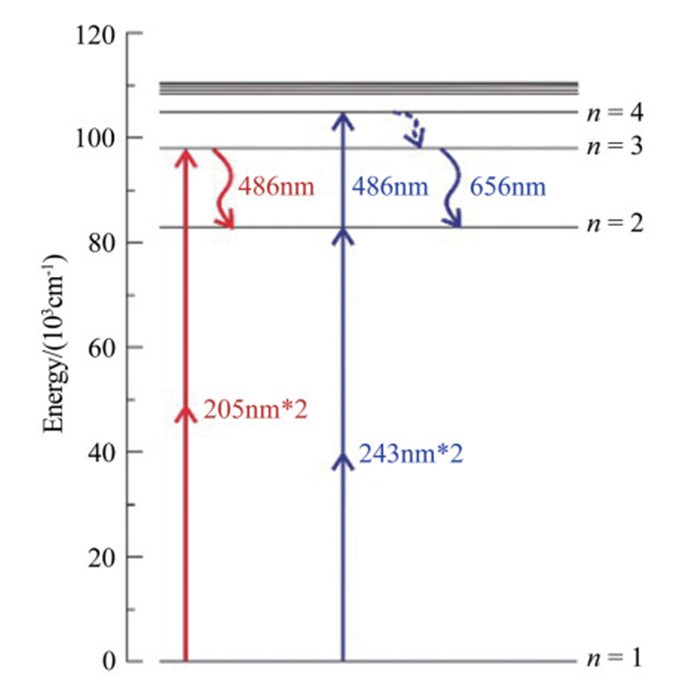
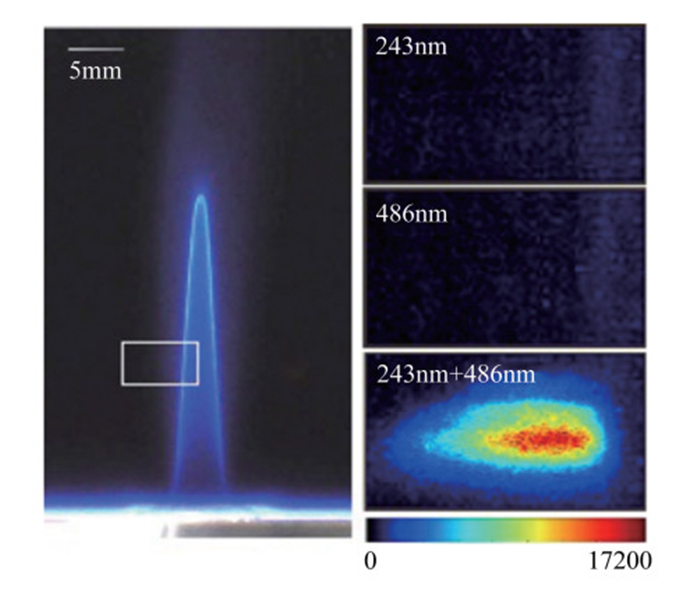
国内对于飞秒多光子激光诱导荧光技术在燃烧领域的研究起步较晚,据作者所知只有本课题组开展了部分相关工作,开发了双色三光子飞秒激光诱导荧光无干扰测量火焰H原子的诊断技术[51]。如图 1所示,不同于美国空军实验室开发的使用205nm激光双光子激发的诊断策略(图 1中的红色能级跃迁),本课题组所开发的诊断策略是使用243nm波长的激光将处于基态的H原子激发到n=2能级,同时使用486nm波长的激光将H原子进一步激发到n=4能级。n=4能级的氢原子会由于弛豫效应跃迁到n=3能级,通过观测由n=3能级向n=2能级跃迁的656nm的荧光信号,实现火焰中H原子的测量,如图 1中的蓝色能级跃迁。此外,本课题组基于此诊断策略实现了甲烷/空气预混燃烧火焰中H原子的二维成像,并且能够给出一个简洁的判定方法来评估测量过程中是否存在光解干扰。如图 2所示,当仅有243nm或者仅有486nm的激光入射到燃烧场中时,成像图片中没有任何信号。只有当243和486nm这2束激光同时入射时才能在成像图片中看到火焰中H原子清晰的二维分布。这说明成像图片中的所有信号均来自于火焰中本生的H原子,测量过程并不存在光解干扰。
|
| 图 1 氢原子能级图 Fig.1 H energy-level diagram |
|
| 图 2 甲烷/空气预混火焰中氢原子二维成像 Fig.2 2D-fluorescence imaging of H atoms in the flame |
虽然飞秒多光子激光诱导荧光技术已在燃烧诊断领域获得了初步发展,但是对于此项技术的研究缺乏系统性,并且,需要开展相关工作对现有技术的适用性进行详细评估,特别是在涉及发动机缸内燃烧等实际工况的场合。此外,在基础研究方面,尚需开展针对飞秒多光子(双光子以上)激光诱导荧光诊断策略可行性问题的研究。
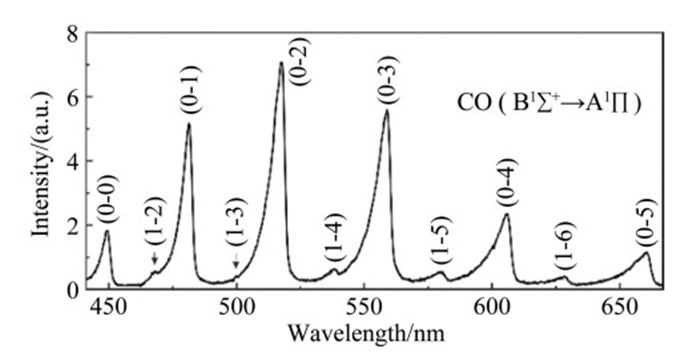
飞秒多光子激光诱导荧光的潜力并不仅限于测量燃烧中间产物。在本课题组进行的飞秒双色三光子激光诱导荧光测量燃烧场CO的实验中[55],发现使用飞秒激光作为激发光源获得的CO荧光谱中,在450~650nm波段,除了一系列已知的CO荧光谱外,我们还首次观察到另一套“伴线”,如图 3所示。这是由于飞秒激光的线宽能够覆盖CO电子能级中的振动能级,从而同时实现了如下CO电子跃迁激发:B1Σ+←X1Σ+(0-0)和(1-1)。这与传统的纳秒多光子激光诱导荧光有显著区别。这一特点使得我们能够通过飞秒激光激发,同时获得CO荧光的2套振转能带。而通过这2套振转能带,有望精确反演出火焰的温度。
|
| 图 3 甲烷/空气预混燃烧火焰中CO光谱图 Fig.3 Spectra of CO fs-TPLIF |
除了利用飞秒激光的性质对纳秒激光技术进行优化之外,飞秒激光在燃烧诊断领域的另一项应用是利用飞秒激光成丝现象开发新型诊断技术。
飞秒激光成丝现象是高功率超短脉冲激光所具备的独特现象。1995年,美国密歇根大学的Braun等人[58]首次观测到超强飞秒激光脉冲在空气中传播形成的稳定等离子体,并对这一现象提出了合理解释:当飞秒激光在空气中传播时,由于非线性克尔效应,激光出现自聚焦现象。当自聚焦的激光功率密度达到临界值时,空气发生多光子电离,形成具有散焦作用的等离子体。当克尔效应引起的自聚焦与等离子体导致的散焦达到动态平衡时,即出现飞秒激光成丝现象[59]。加拿大拉瓦尔大学的陈瑞良教授建议将飞秒激光成丝定义为:“飞秒激光在透明介质传输过程中,形成的存在功率密度钳制且其长度至少超出瑞利长度数倍的区域”[15]。
自飞秒激光成丝现象发现以来,研究人员基于中心波长800nm的钛蓝宝石飞秒激光展开了大量研究,飞秒激光成丝已在诸多领域得到应用[60-64]。但目前飞秒激光成丝应用于燃烧诊断领域的研究比较少,主要以吉林大学的徐淮良教授及其团队提出的飞秒激光成丝诱导非线性光谱技术为主[65]。
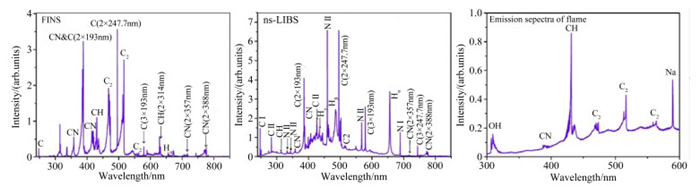
2013年,徐淮良等人[66]将飞秒激光成丝应用于燃烧火焰中,提出了飞秒激光成丝诱导非线性光谱技术(Filament-Induced Nonlinear Spectroscopy,简称FINS)的概念,并阐述了此技术在燃烧中间产物测量的可行性。在此基础上,徐淮良等人[67]将火焰中FINS光谱与纳秒激光诱导击穿光谱(Nanosecond Laser-Induced Breakdown Spectroscopy,简称ns-LIBS)以及火焰自发辐射光谱三者进行比较,如图 4所示,进一步讨论了FINS技术在燃烧中间产物测量的适用性,并对FINS光谱信息进行讨论,发现:光谱中CN信号主要来自于飞秒激光成丝诱导光化学反应C2+N2→2CN;C2信号主要来自飞秒激光多光子激发火焰中本生的C2;CH信号主要来自于多光子激发火焰中本生的CH,少部分来自于飞秒激光光解CH的前驱物。基于上述工作,徐淮良等人[68]利用FINS技术对乙醇/空气火焰以及不同烷醇/空气火焰进行了研究。此外,徐淮良等人[69]进一步测量了飞秒激光成丝在燃烧场中的临界能量和钳制功率。实验发现在乙醇/空气火焰中,飞秒激光成丝的临界能量是空气中临界能量的4~5倍,钳制功率是空气中钳制功率的1/2左右。这些数据为飞秒激光成丝在燃烧领域的进一步应用提供了数据支持。
|
| 图 4 乙醇/空气火焰中飞秒激光成丝诱导非线性光谱、纳秒激光诱导击穿光谱和火焰自发辐射光谱对比 Fig.4 Comparison of emission spectra obtained by femtosecond filament excitation, nanosecond laser-breakdown excitation, as well as without any laser excitation |
通过对上述工作进行总结,并结合本课题组开展的一系列相关工作,可以将FINS技术的特点归纳如下:
(1) FINS技术相比于LIF技术,诊断过程是非共振过程,不需要特定频率的激光光源与待测分子共振,一束激光可以同时实现流场中多组分的同时测量;
(2) FINS技术相比于ns-LIBS技术,FINS光谱中不仅包括原子谱线还包括分子谱线,因此FINS技术能够更真实地反应待测流场的组分;
(3) 通常飞秒激光重频(1 kHz)高于传统纳秒激光重频(10 Hz),因此FINS技术可实现快速检测,采样频率更高,测量速度更快。
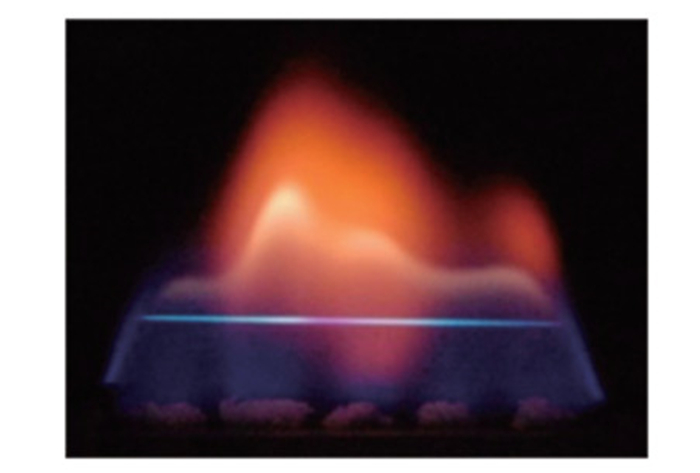
由此可见,基于飞秒激光成丝开发的FINS技术在燃烧领域具有非常诱人的应用前景。然而目前对于此项技术的开发尚不够完善。例如,FINS技术目前只在酒精灯以及酒精灯阵列中进行了相关实验。如图 5所示,酒精灯并非燃烧领域的标准燃烧器,缺乏温度和组分浓度等基础数据支持,不适用于燃烧激光诊断技术的开发。为了更好地研究FINS技术在燃烧诊断中的适用性,需要在标准燃烧器中进一步开展相关基础研究。
|
| 图 5 飞秒激光在酒精灯阵列火焰中成丝照片 Fig.5 Photo of the flame on the burner array together with the laser filament |
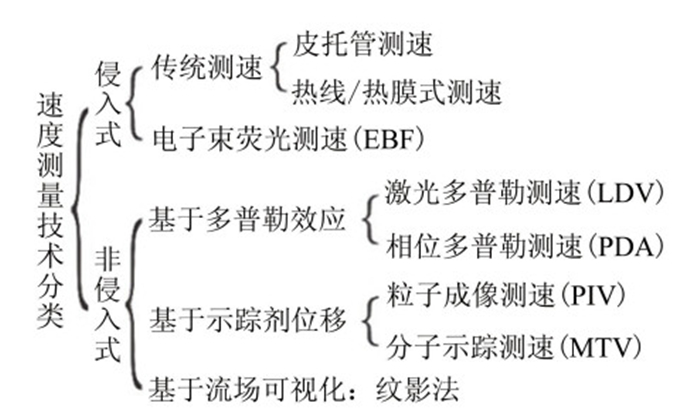
燃烧场中的速度测量是飞秒激光诊断技术在燃烧领域的另一项重要应用。燃烧场的速度信息一直以来都是燃烧领域研究者关注的重要参数之一。燃烧场速度诊断技术包括以皮托管和热线风速仪等为代表的侵入式诊断技术以及以粒子成像测速[70]、激光多普勒测速[71]和分子示踪测速[72]等为代表的非侵入式诊断技术。各种测速技术的分类如图 6所示。其中,分子示踪测速技术(Molecular Tagging Velocimetry,简称MTV)作为当前流场速度测量的最前沿技术在近几十年来发展迅速,并且在燃烧场的速度测量中得到了广泛应用。
|
| 图 6 速度测量技术分类 Fig.6 Classification of velocimetry in flowfield |
MTV技术是利用纳秒激光对标记分子进行“写”和“读”2个过程进而实现速度测量。依据是否需要散布示踪分子,MTV技术可分为2类:散布示踪分子的MTV技术和非散布示踪分子的MTV技术。前者可根据不同流场环境选用不同示踪分子,因此技术利用范围广、准确性高,但是散布示踪分子增加了系统的成本,且需要考虑示踪分子的毒性、腐蚀性以及是否会对燃烧反应造成干扰等问题。后者依据所利用的示踪分子的不同分为:以O2作为示踪分子的RELIEF技术;以NO作为示踪分子的APART技术;以O3作为示踪分子的OTV技术和以OH作为示踪分子的HTV技术。关于MTV技术的详细研究进展,读者可参考西北核技术研究所叶景峰等人的综述文章[73]。本文仅对这些技术的特点进行简要总结,如表 2所示。
| 技术分类 | 示踪粒子/分子 | 特点 | ||
| MTV | 散布示踪分子 | 酯类 | 亚硝酸特丁酯[74] | 可根据不同流场环境选择不同示踪分子,成像图片信噪比高、空间分辨率好;但散布示踪分子增加了系统的成本,且需要考虑散布分子的毒性、腐蚀性、是否会对燃烧场产生干扰等问题。 |
| 酮类 | 丁二酮(磷光)[75-78]、丙酮(荧光)[79-80] | |||
| 金属 | 钠[81]、锶[82] | |||
| 氮氧化物 | NO2[83-87]、NO[88-89] | |||
| 非散布示踪分子 | RELIEF | O2[90-93] | 技术提出于20世纪80年代,并成功应用于纯氧流场中的速度测量,但在空气中的信噪比差,应用具有很大的局限性。 | |
| APART | NO[94-96] | 应用于空气流场中不需要引入任何其他分子,但这种测速技术在应用于燃烧场时,可能会对燃烧反应造成干扰。 | ||
| OTV | O3[97-98] | 可应用于空气流场中的速度测量,但流场的温度严重影响示踪分子O3的浓度,进而影响测速的准确性,因此很难实现燃烧场中的速度测量。 | ||
| HTV | OH[99-104] | 已成功应用于氢气/空气燃烧场中,但示踪分子OH的浓度会受流场中O原子浓度的影响,在燃烧场中应用受限。 | ||
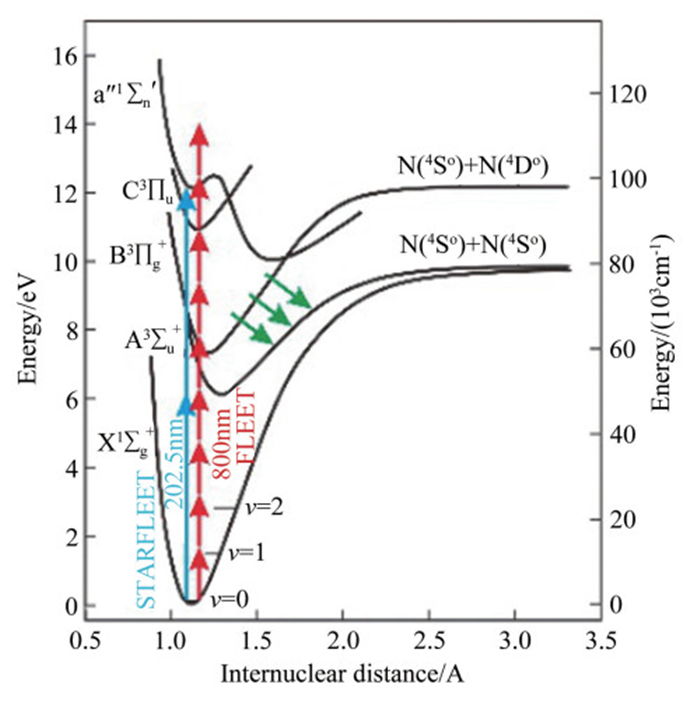
上述这些分子示踪测速技术均以纳秒激光作为光源,美国普林斯顿大学的Miles等人[105]首次将飞秒激光应用于流场速度测量,开发了飞秒激光电子激发示踪测速技术(Femtosecond Laser Electronic Excitation Tagging,简称FLEET),为流场速度测量提供了新的方法。FLEET技术是利用波长为800nm的基频飞秒激光光解N2产生N原子,N原子在重组的过程中生成长寿命激发态的N2,达到标记示踪分子的目的。通过在不同延迟下对N2荧光成像,实现流场速度的测量。但FLEET技术的测速过程为非共振过程,如图 7氮气能级图中的红色跃迁所示,基态N2光解至少需要吸收8个800nm的光子,激发效率较低。基于FLEET技术,Jiang等人[106]开发了通过共振激发-光解过程实现分子标记的STARFLEET技术(Selective Two-Photon Absorptive Resonance Femtosecond-Laser Electronic-Excitation Tagging)。如图 7氮气能级图中的蓝色跃迁所示,STARFLEET技术以波长为202.5nm的飞秒激光作为光源,多光子共振激发基态的N2跃迁到激发态之后进一步光解N2,进而完成分子标记,这在很大程度上提高了技术的激发效率。
|
| 图 7 氮气能级图 Fig.7 N2 energy-level diagram |
FLEET测速技术具有以下优势:仅需要一束飞秒激光就能实现速度测量,实验系统相对简单;以飞秒激光作为光源,提高了多光子光解效率;以氮气分子作为示踪分子,对燃烧反应的影响可降到最小;结合光谱测温技术,此技术可实现流场温度和速度的同时测量[107]。
由此可见,飞秒激光在流场速度测量中具有广阔的应用前景。然而,目前缺乏飞秒测速技术在燃烧场中的深入研究。Miles等人[108]仅在文章中表明FLEET技术能够在燃烧场中应用,如图 8所示,但并没有给出所测燃烧场的详细信息,也未开展相关系统研究。本课题组针对这一问题进行了初步研究,通过前期实验,我们发现:当FLEET技术应用于燃烧场中时,流场中存在大量碳氢化合物,此时示踪分子将不仅仅是N2,还有飞秒激光诱导光化学反应产生的大量CN。由此可见,我们对于基于飞秒激光的测速技术的研究还存在很多不足,相关实验需要进一步开展。

|
| 图 8 甲烷/空气燃烧场中FLEET测速成像图片 Fig.8 FLEET lines written at two locations in a methane/air flame |
本文中,通过列举飞秒多光子激光诱导荧光技术、飞秒激光成丝诱导光谱技术、飞秒激光电子激发示踪测速技术等飞秒激光光谱技术在燃烧领域的应用实例,对飞秒燃烧激光诊断技术的发展现状进行了总结。虽然飞秒激光燃烧诊断技术的发展历史不长,然而进展却很快。目前,飞秒激光已经在燃烧场中速度、温度以及燃烧中间产物测量中得到了广泛应用,但飞秒激光光谱技术的发展依然面临许多挑战。
首先,飞秒激光器成本较高,这在很大程度上限制了飞秒激光光谱技术的普及。但随着对高功率超短脉冲激光研究的不断深入,这方面的问题会得到改善。其次,目前对于飞秒激光与燃烧场相互作用的内在机理研究不够深入,这在一定程度上限制了相关科研人员对于飞秒激光光谱技术的理解。例如在FINS诊断过程中,信号是来自于飞秒激光诱导光化学反应还是来自于飞秒多光子激发火焰中本生的中间产物,这些基础问题尚需解决。
可以预见,随着研究的不断深入以及技术的不断进步,飞秒激光光谱技术将会在燃烧领域发挥越来越大的作用。
| 全称(英文) | 全称(中文) | 简称 |
| Femtosecond Degenerate Four-Wave Mixing | 飞秒四波混频技术 | fs-DFWM |
| Femtosecond Coherent Anti-Stokes Raman Spectroscopy | 飞秒相干反斯托克斯拉曼散射技术 | fs-CARS |
| Femtosecond Multiphoton Laser-Induced Fluorescence | 飞秒多光子激光诱导荧光技术 | fs-MPLIF |
| Filament-Induced Nonlinear Spectroscopy | 飞秒激光成丝诱导非线性光谱技术 | FINS |
| Femtosecond Laser Electronic Excitation Tagging | 飞秒激光电子激发示踪测速技术 | FLEET |
| Laser-Induced Fluorescence | 激光诱导荧光技术 | LIF |
| Two-Photon Laser-Induced Fluorescence | 双光子激光诱导荧光技术 | TPLIF |
| Nanosecond Laser-Induced Breakdown Spectroscopy | 纳秒激光诱导击穿 | ns-LIBS |
| Molecular Tagging Velocimetry | 分子示踪测速技术 | MTV |
| Electron Beam Fluorescence | 电子束荧光技术 | EBF |
| Laser-Doppler Velocimetry | 激光多普勒测速技术 | LDV |
| Phase Doppler Anemometer | 相位多普勒测速技术 | PDA |
| Particle Image Velocimetry | 粒子成像测速技术 | PIV |
| Raman Excitation Plus Laser-Induced Electronic Fluorescence | 拉曼激发激光诱导电子荧光测速技术 | RELIEF |
| Air Photolysis And Recombination Tracking | 空气光解及重组示踪测速技术 | APART |
| Ozone Tagging Velocimetry | 臭氧标记测速技术 | OTV |
| Hydroxyl Tagging Velocimetry | 羟基标记测速技术 | HTV |
| Selective Two-Photon Absorptive Resonance Femtosecond-Laser Electronic-Excitation Tagging | 双光子共振吸收飞秒激光电子激发示踪测速技术 | STARFLEET |
| [1] | 汪亮. 燃烧实验诊断学[M]. 北京: 国防工业出版社, 2011. Wang L. Combustion experimental diagnostics[M]. Beijing: National Defense Industry Press, 2011. |
| [2] | 熊姹, 范玮. 应用燃烧诊断学[M]. 西安: 西北工业大学出版社, 2005. Xiong C, Fan W. Applied combustion diagnostics[M]. Xi'an: Northwestern Polytechnical University Press, 2005. |
| [3] | Kohse-Höinghaus K, Barlow R S, Aldén M, et al. Combustion at the focus:laser diagnostics and control[J]. Proceedings of the Combustion Institute, 2005, 30(1): 89–123. DOI:10.1016/j.proci.2004.08.274 |
| [4] | Aldén M, Bood J, Li Z, et al. Visualization and understanding of combustion processes using spatially and temporally resolved laser diagnostic techniques[J]. Proceedings of the Combustion Institute, 2011, 33(1): 69–97. DOI:10.1016/j.proci.2010.09.004 |
| [5] | Hanson R K, Seitzman J M, Paul P H. Planar laser-fluorescence imaging of combustion gases[J]. Applied Physics B, 1990, 50(1): 441–454. |
| [6] | Crosley D R, Smith G P. Laser-Induced fluorescence spectroscopy for combustion diagnostics[J]. Optical Engineering, 1983, 22(5): 545–553. |
| [7] | Aldén M, Omrane A, Richter M, et al. Thermographic phosphors for thermometry:A survey of combustion applications[J]. Progress in Energy & Combustion Science, 2011, 37(4): 422–461. |
| [8] | Chan V SS, Turner J T. Velocity measurement inside a motored internal combustion engine using three-component laser Doppler anemometry[J]. Optics & Laser Technology, 2000, 32(7-8): 557–566. |
| [9] | Shaddix C R, Smyth K C. Laser-induced incandescence measurements of soot production in steady and flickering methane, propane, and ethylene diffusion flames[J]. Combustion & Flame, 1996, 107(4): 418–452. |
| [10] | 胡志云, 刘晶儒, 张振荣, 等. 激光燃烧诊断技术及应用研究进展[J]. 中国工程科学, 2009, 11(11): 45–50. Hu Z Y, Liu J R, Zhang Z R, et al. The research progress of laser combustion diagnostics techniques and applications[J]. Engineering Sciences, 2009, 11(11): 45–50. DOI:10.3969/j.issn.1009-1742.2009.11.007 |
| [11] | Spence D E, Kean P N, Sibbett W. 60-fsec pulse generation from a self-mode-locked Ti:sapphire laser[J]. Optics Letters, 1991, 16(1): 42–44. DOI:10.1364/OL.16.000042 |
| [12] | Brodeur A, Chin S L. Ultrafast white-light continuum generation and self-focusing in transparent condensed media[J]. Journal of the Optical Society of America B, 1999, 16(4): 637–650. DOI:10.1364/JOSAB.16.000637 |
| [13] | Brodeur A, Chien C Y, Kosareva O G, et al. Conical emission from laser-plasma interactions in the filamentation of powerful ultrashort laser pulses in air[J]. Optics Letters, 1997, 22(17): 1332–1334. DOI:10.1364/OL.22.001332 |
| [14] | Luo Q, Liu W, Chin S L. Lasing action in air induced by ultra-fast laser filamentation[J]. Applied Physics B:Lasers and Optics, 2003, 76(3): 337–340. DOI:10.1007/s00340-003-1115-9 |
| [15] | Chin S L. Femtosecond laser filamentation[Z]. New York, NY: Springer, 2010, 55: 137. |
| [16] | Hornung T, Skenderovi H, Kompa K, et al. Prospect of temperature determination using degenerate four-wave mixing with sub-20 fs pulses[J]. Journal of Raman Spectroscopy, 2004, 35(11): 934–938. DOI:10.1002/(ISSN)1097-4555 |
| [17] | He P, Fan R, Chen D, et al. Ultrafast time-resolved coherent degenerate four-wave-mixing spectroscopy for investigating molecular dynamics in different states[J]. Optics & Laser Technology, 2011, 43(8): 1458–1461. |
| [18] | Sun Z W, Li Z S, Li B, et al. Flame temperature diagnostics with water lines using mid-infrared degenerate four-wave mixing[J]. Journal of Raman Spectroscopy, 2011, 42(10): 1828–1835. DOI:10.1002/jrs.v42.10 |
| [19] | Knopp G, Radi P P, Sych Y, et al. Dissection of dispersed off-resonant femtosecond degenerate four-wave mixing of O2[J]. Journal of Raman Spectroscopy, 2011, 42(10): 1848–1853. DOI:10.1002/jrs.v42.10 |
| [20] | Matylitsky V V, Jarz Ba W, Riehn C, et al. Femtosecond degenerate four-wave mixing study of benzene in the gas phase[J]. Journal of Raman Spectroscopy, 2002, 33(11-12): 877–883. DOI:10.1002/(ISSN)1097-4555 |
| [21] | Riehn C, Matylitsky V V, Gelin M F. Time domain fingerprints of a 'perpendicular' rotational Raman band:formic acid studied by femtosecond degenerate four-wave mixing[J]. Journal of Raman Spectroscopy, 2003, 34(12): 1045–1050. DOI:10.1002/(ISSN)1097-4555 |
| [22] | Bohlin A, Mann M, Patterson B D, et al. Development of two-beam femtosecond/picosecond one-dimensional rotational coherent anti-Stokes Raman spectroscopy:Time-resolved probing of flame wall interactions[J]. Proceedings of the Combustion Institute, 2015, 35(3): 3723–3730. DOI:10.1016/j.proci.2014.05.124 |
| [23] | Richardson D R, Lucht R P, Kulatilaka W D, et al. Chirped-probe-pulse femtosecond coherent anti-Stokes Raman scattering concentration measurements[J]. Journal of the Optical Society of America B, 2013, 30(1): 188–196. DOI:10.1364/JOSAB.30.000188 |
| [24] | Dennis C N, Slabaugh C D, Boxx I G, et al. Chirped probe pulse femtosecond coherent anti-Stokes Raman scattering thermometry at 5kHz in a Gas Turbine Model Combustor[J]. Proceedings of the Combustion Institute, 2015, 35(3): 3731–3738. DOI:10.1016/j.proci.2014.06.063 |
| [25] | Kearney S P, Guildenbecher D R, Hoffmeister K N G, et al. Hybrid fs/ps rotational CARS temperature and oxygen measurements and soot LⅡ measurements in a turbulent C2H4-fueled jet flame[C]. 54th AIAA Aerospace Sciences Meeting, San Diego, California, 2016. |
| [26] | Zhao Y, Zhang S, Zhang Z, et al. Molecular vibrational dynamics in ethanol studied by femtosecond CARS[J]. Optics Communications, 2015, 334: 319–322. DOI:10.1016/j.optcom.2014.08.061 |
| [27] | Xia Y, Zhao Y, Wang Z, et al. Investigation of vibrational characteristics in BBO crystals by femtosecond CARS[J]. Optics & Laser Technology, 2012, 44(7): 2049–2052. |
| [28] | Kozai T, Kayano Y, Aoi T, et al. Coherent molecular vibrational dynamics of CH2 stretching modes in polyethylene studied by femtosecond-CARS[J]. Journal of Raman Spectroscopy, 2015, 46(4): 384–387. DOI:10.1002/jrs.v46.4 |
| [29] | Pestov D, Zhi M, Sariyanni Z, et al. Femtosecond CARS of methanol-water mixtures[J]. Journal of Raman Spectroscopy, 2006, 37(1-3): 392–396. DOI:10.1002/(ISSN)1097-4555 |
| [30] | Kiefer J, Namboodiri M, Kazemi M M, et al. Time-resolved femtosecond CARS of the ionic liquid 1-ethyl-3-methylimidazolium ethylsulfate[J]. Journal of Raman Spectroscopy, 2015, 46(8): 722–726. DOI:10.1002/jrs.4692 |
| [31] | Zhao Y, Zhang S, Zhou B, et al. Molecular vibrational dynamics of rhodamine B dye in solution studied by femtosecond CARS[J]. Vibrational Spectroscopy, 2014, 73: 24–27. DOI:10.1016/j.vibspec.2014.04.001 |
| [32] | Zhao Y, Zhang S, Zhou B, et al. Spectrally dispersed femtosecond CARS investigation of vibrational characteristics in ethanol[J]. Journal of Raman Spectroscopy, 2014, 45(9): 826–829. DOI:10.1002/jrs.v45.9 |
| [33] | 张立荣, 胡志云, 叶景峰, 等. 移动式CARS系统测量超声速燃烧室出口温度[J]. 中国激光, 2013, 40(4): 201–205. Zhang L R, Hu Z Y, Ye J F, et al. Mobile CARS temperature measurements at exhaust of supersonic combustor[J]. Chinese Journal of Lasers, 2013, 40(4): 201–205. |
| [34] | 胡志云, 张振荣, 刘晶儒, 等. 宽带相干反斯托克斯拉曼散射法诊断固体燃剂燃烧场[J]. 强激光与粒子束, 2004, 16(1): 19–22. Hu Z Y, Zhang Z R, Liu J R, et al. Broad-band CARS diagnostics of solid propellant combustion[J]. High Power Laser and Particle Beams, 2004, 16(1): 19–22. |
| [35] | 陶波, 王晟, 胡志云, 等. TDLAS与CARS共线测量发动机温度[J]. 工程热物理学报, 2015, 36(10): 2282–2286. Tao B, Wang S, Hu Z Y, et al. Measurements of engine combustion temperature by using coaxial TDLAS and CARS technique[J]. Journal of Engineering Thermophysics, 2015, 36(10): 2282–2286. |
| [36] | 张天天. 飞秒时间分辨CARS光谱在超快动力学及燃烧测温应用研究[D]. 哈尔滨工业大学, 2010. Zhang T T. Femtosecond time-resolved CARS spectroscopy for the study of ultra-fast dynamics and temperature measurement[D]. Harbin: Harbin Institute of Technology, 2010. |
| [37] | 李金钊. 飞秒CARS在燃烧测温中的应用研究[D]. 哈尔滨工业大学, 2013. Li J Z. Femtosecond CARS for the study of temperature measurement[D]. Harbin: Harbin Institute of Technology, 2013. |
| [38] | 赵阳. 飞秒CARS在分子超快动力学与气体燃烧测温中的应用研究[D]. 哈尔滨工业大学, 2015. Zhao Y. Femtosecond CARS applications in molecular ultrafast dynamics and flame temperature measurements[D]. Harbin Institute of Technology, 2013. |
| [39] | Zheltikov A M. Coherent anti-Stokes Raman scattering:from proof-of-the-principle experiments to femtosecond CARS and higher order wave-mixing generalizations[J]. Journal of Raman Spectroscopy, 2000, 31(8-9): 653–667. DOI:10.1002/(ISSN)1097-4555 |
| [40] | Lucht R P, Salmon J T, King G B, et al. Two-photon-excited fluorescence measurement of hydrogen atoms in flames[J]. Optics Letters, 1983, 8(7): 365–367. DOI:10.1364/OL.8.000365 |
| [41] | Gathen V S V D, Niemi K. Absolute atomic oxygen density measurements by two-photon absorption laser-induced fluorescence spectroscopy in an RF-excited atmospheric pressure plasma jet[J]. Plasma Sources Science & Technology, 2005, 14(2): 375–386. |
| [42] | Rosell J, Sjöholm J, Richter M, et al. Comparison of three schemes of two-photon laser-induced fluorescence for CO detection in flames[J]. Applied Spectroscopy, 2013, 67(3): 314–320. DOI:10.1366/12-06704 |
| [43] | Li B, Zhang D, Yao M, et al. Strategy for single-shot CH3 imaging in premixed methane/air flames using photofragmentation laser-induced fluorescence[J]. Proceedings of the Combustion Institute, 2017, 36(3): 4487–4495. DOI:10.1016/j.proci.2016.07.082 |
| [44] | Kulatilaka W D, Frank J H, Patterson B D, et al. Analysis of 205-nm photolytic production of atomic hydrogen in methane flames[J]. Applied Physics B, 2009, 97(1): 227–242. DOI:10.1007/s00340-009-3474-3 |
| [45] | Brackmann C, Sjöholm J, Rosell J, et al. Picosecond excitation for reduction of photolytic effects in two-photon laser-induced fluorescence of CO[J]. Proceedings of the Combustion Institute, 2013, 34(2): 3541–3548. DOI:10.1016/j.proci.2012.05.011 |
| [46] | Stauffer H U, Kulatilaka W D, Gord J R, et al. Laser-induced fluorescence detection of hydroxyl (OH) radical by femtosecond excitation[J]. Optics Letters, 2011, 36(10): 1776–1778. DOI:10.1364/OL.36.001776 |
| [47] | Kulatilaka W D, Gord J R, Katta V R, et al. Photolytic-interference-free, femtosecond two-photon fluorescence imaging of atomic hydrogen[J]. Optics Letters, 2012, 37(15): 3051–3053. DOI:10.1364/OL.37.003051 |
| [48] | Hall C A, Kulatilaka W D, Gord J R, et al. Quantitative atomic hydrogen measurements in premixed hydrogen tubular flames[J]. Combustion and Flame, 2014, 161(11): 2924–2932. DOI:10.1016/j.combustflame.2014.05.015 |
| [49] | Kulatilaka W D, Gord J R, Roy S. Femtosecond two-photon LIF imaging of atomic species using a frequency-quadrupled Ti:sapphire laser[J]. Applied Physics B, 2014, 116(1): 7–13. DOI:10.1007/s00340-014-5845-7 |
| [50] | Kulatilaka W, Roy S, Gord J. Multi-photon fluorescence imaging of flame species using femtosecond excitation[C]. 28th Aerodynamic Measurement Technology, Ground Testing, and Flight Testing Conference, New Orleans, Louisiana, 2012. |
| [51] | Li B, Zhang D, Li X, et al. Strategy of interference-free atomic hydrogen detection in flames using femtosecond multi-photon laser-induced fluorescence[J]. International Journal of Hydrogen Energy, 2017, 42(6): 3876–3880. DOI:10.1016/j.ijhydene.2016.05.294 |
| [52] | Kulatilaka W D, Roy S, Jiang N, et al. Photolytic-interference-free, femtosecond, two-photon laser-induced fluorescence imaging of atomic oxygen in flames[J]. Applied Physics B, 2016, 122(2): 1–7. |
| [53] | Schmidt J B, Sands B L, Kulatilaka W D, et al. Femtosecond, two-photon laser-induced-fluorescence imaging of atomic oxygen in an atmospheric-pressure plasma jet[J]. Plasma Sources Science & Technology, 2015, 24(3): 1–6. |
| [54] | Richardson D R, Roy S, Gord J R. Femtosecond, two-photon, planar laser-induced fluorescence of carbon monoxide in flames[J]. Optics Letters, 2017, 42(4): 875–878. DOI:10.1364/OL.42.000875 |
| [55] | Li B, Li X, Zhang D, et al. Comprehensive CO detection in flames using femtosecond two-photon laser-induced fluorescence[J]. Optics Express, 2017, 25(21): 25809–25818. DOI:10.1364/OE.25.025809 |
| [56] | Richardson D R, Jiang N, Stauffer H U, et al. Mixture-fraction imaging at 1kHz using femtosecond laser-induced fluorescence of krypton[J]. Optics Letters, 2017, 42(17): 3498–3501. DOI:10.1364/OL.42.003498 |
| [57] | Wang Y, Kulatilaka W D. Mixture fraction imaging using femtosecond TPLIF of Krypton[C]. 55th AIAA Aerospace Sciences Meeting, Grapevine, Texas, 2017. |
| [58] | Braun A, Korn G, Liu X, et al. Self-channeling of high-peak-power femtosecond laser pulses in air[J]. Optics Letters, 1995, 20(1): 73–75. DOI:10.1364/OL.20.000073 |
| [59] | Chin S L, Xu H. Tunnel ionization, population trapping, filamentation and applications[J]. Journal of Physics B:Atomic Molecular & Optical Physics, 2016, 49(22): 222003. |
| [60] | Xu H, Cheng Y, Chin S, et al. Femtosecond laser ionization and fragmentation of molecules for environmental sensing[J]. Laser & Photonics Reviews, 2015, 9(3): 275–293. |
| [61] | Kasparian J, Wolf J P. Physics and applications of atmospheric nonlinear optics and filamentation[J]. Optics Express, 2008, 16(1): 466–493. DOI:10.1364/OE.16.000466 |
| [62] | Couairon A, Mysyrowicz A. Femtosecond filamentation in transparent media[J]. Physics Reports, 2007, 441(2-4): 47–189. DOI:10.1016/j.physrep.2006.12.005 |
| [63] | Bruno A, Ossler F, de Lisio C, et al. Detection of fluorescent nanoparticles in flame with femtosecond laser-induced fluorescence anisotropy[J]. Optics Express, 2008, 16(8): 5623–5632. DOI:10.1364/OE.16.005623 |
| [64] | 李玉同, 张杰, 陈黎明, 等. 对飞秒激光等离子体中成丝现象的研究[J]. 物理学报, 2001, 50(2): 204–208. Li Y T, Zhang J, Chen L M, et al. Study on filamentation in femtosecond laser plasmas[J]. Acta Physica Sinica, 2001, 50(2): 204–208. DOI:10.7498/aps.50.204 |
| [65] | 李贺龙. 超快强场激光在燃烧场中的传输特性和非线性光谱研究[D]. 长春: 吉林大学, 2016. Li H L. Investigations on the propagation properties and nonlinear spectroscopy of ultrafast and ultrastrong laser in combustion fields[D]. Changchun: Jilin University, 2006. |
| [66] | Li H L, Xu H L, Yang B S, et al. Sensing combustion intermediates by femtosecond filament excitation[J]. Optics Letters, 2013, 38(8): 1250–1252. DOI:10.1364/OL.38.001250 |
| [67] | Li H, Wei X, Xu H, et al. Femtosecond laser filamentation for sensing combustion intermediates:A comparative study[J]. Sensors and Actuators B:Chemical, 2014, 203: 887–890. DOI:10.1016/j.snb.2014.06.086 |
| [68] | Li H, Chu W, Xu H, et al. Simultaneous identification of multi-combustion-intermediates of alkanol-air flames by femtosecond filament excitation for combustion sensing[J]. Scientific Reports, 2016, 6(1): 27340. DOI:10.1038/srep27340 |
| [69] | Li H, Chu W, Zang H, et al. Critical power and clamping intensity inside a filament in a flame[J]. Optics Express, 2016, 24(4): 3424–3431. DOI:10.1364/OE.24.003424 |
| [70] | Boden F, Fl N L M. Particle Image Velocimetry[M]. John Wiley & Sons Ltd, 2010: 247-269. |
| [71] | Allen M, Davis S, Kessler W, et al. Velocity field imaging in supersonic reacting flows near atmospheric pressure[J]. AIAA Journal, 1994, 32(8): 1676–1682. DOI:10.2514/3.12159 |
| [72] | Chen F, Li H, Hu H. Molecular tagging techniques and their applications to the study of complex thermal flow phenomena[J]. Review Paper, 2015, 31(4): 425–445. |
| [73] | 叶景峰, 胡志云, 刘晶儒, 等. 分子标记速度测量技术及应用研究进展[J]. 实验流体力学, 2015, 29(3): 11–17. Ye J F, Hu Z Y, Liu J R, et al. Development and application of molecular tagging velocity[J]. Journal of Experiments in Fluid Mechanics, 2015, 29(3): 11–17. |
| [74] | Krüger S, Grünefeld G. Stereoscopic flow-tagging velocimetry[J]. Applied Physics B, 1999, 69(5): 509–512. |
| [75] | Mittal M, Sadr R, Schock H J, et al. In-cylinder engine flow measurement using stereoscopic molecular tagging velocimetry (SMTV)[J]. Experiments in Fluids, 2009, 46(2): 277–284. DOI:10.1007/s00348-008-0557-6 |
| [76] | Ismailov M M, Schock H J, Fedewa A M. Gaseous flow measurements in an internal combustion engine assembly using molecular tagging velocimetry[J]. Experiments in Fluids, 2006, 41(1): 57–65. DOI:10.1007/s00348-006-0150-9 |
| [77] | Stier B, Koochesfahani M M. Molecular tagging velocimetry (MTV) measurements in gas phase flows[J]. Experiments in Fluids, 1999, 26(4): 297–304. DOI:10.1007/s003480050292 |
| [78] | Hiller B, Booman R A, Hassa C, et al. Velocity visualization in gas flows using laser-induced phosphorescence of biacetyl[J]. Review of Scientific Instruments, 1985, 55(12): 1964–1967. |
| [79] | Lempert W R, Jiang N, Sethuram S, et al. Molecular tagging velocimetry measurements in supersonic microjets[J]. AIAA Journal, 2015, 40(40): 1065–1070. |
| [80] | Lempert W R, Boehm M, Jiang N, et al. Comparison of molecular tagging velocimetry data and direct simulation Monte Carlo simulations in supersonic micro jet flows[J]. Experiments in Fluids, 2003, 34(3): 403–411. DOI:10.1007/s00348-002-0576-7 |
| [81] | Barker P, Thomas A, Rubinsztein-Dunlop H, et al. Velocity measurements by flow tagging employing laser enhanced ionisation and laser induced fluorescence[J]. Spectrochimica Acta Part B Atomic Spectroscopy, 1995, 50(11): 1301–1310. DOI:10.1016/0584-8547(95)01353-X |
| [82] | Rubinsztein-Dunlop H, Littleton B, Barker P, et al. Ionic strontium fluorescence as a method for flow tagging velocimetry[J]. Experiments in Fluids, 2001, 30(1): 36–42. DOI:10.1007/s003480000132 |
| [83] | Sanchez-Gonzalez R, Bowersox R D, North S W. Simultaneous velocity and temperature measurements in gaseousflowfields using the vibrationally excited nitric oxide monitoring technique:a comprehensive study[J]. Applied Optics, 2012, 51(9): 1216–1228. DOI:10.1364/AO.51.001216 |
| [84] | Sanchez-Gonzalez R, Srinivasan R, Bowersox R D W, et al. Simultaneous velocity and temperaturemeasurements in gaseous flow fields using the VENOM technique[J]. Optics Letters, 2011, 36(2): 196–198. DOI:10.1364/OL.36.000196 |
| [85] | Orlemann C, Schulz C, Wolfrum J. NO-flow tagging by photodissociation of NO2-A new approach for measuring small-scale flow structures[J]. Chemical Physics Letters, 1999, 307: 15–20. DOI:10.1016/S0009-2614(99)00512-6 |
| [86] | Jiang N, Nishihara M, Lempert W R. Quantitative NO2 molecular tagging velocimetry at 500 kHz frame rate[J]. Applied Physics Letters, 2010, 97(22): 221103. DOI:10.1063/1.3522654 |
| [87] | Hsu A G, Srinivasan R, Bowersox R D W, et al. Molecular tagging using vibrationally excited nitric oxide in anunderexpanded jet flowfield[J]. AIAA Journal, 2009, 47(11): 2597–2604. DOI:10.2514/1.39998 |
| [88] | Pan F, Sanchez-Gonzalez R, Mcilvoy M H, et al. Simultaneous three-dimensional velocimetry and thermometry in gaseous flows using the stereoscopic vibrationally excited nitric oxide monitoring technique[J]. Optics Letters, 2016, 41(7): 1376–1379. DOI:10.1364/OL.41.001376 |
| [89] | Danehy P M. Flow-tagging velocimetry for hypersonic flows using fluorescence of nitric oxide[J]. AIAA Journal, 2003, 41(41): 263–271. |
| [90] | Miles R, Cohen C, Connors J, et al. Velocity measurements by vibrational tagging and fluorescent probing of oxygen[J]. Optics Letters, 1987, 11(12): 861–863. |
| [91] | Miles R B, Zhou D, Zhang B, et al. Fundamental turbulence measurements by relief flow tagging[J]. AIAA Journal, 1991, 29(3): 447–452. |
| [92] | Miles R B, Grinstead J, Kohl R H, et al. The RELIEF flow tagging technique and its application in engine testing facilities and for helium-air mixing studies[J]. Measurement Science & Technology, 2000, 11(11): 1272–1281. |
| [93] | 施翔春, 王杰, 肖绪辉, 等. 拉曼激发激光诱导电子荧光流场测量系统中标记过程的研究[J]. 光学学报, 2001, 21(2): 206–210. Shi X C, Wang J, Xiao X H, et al. Tagging procedures of Raman excitation plus laser induced electronic fluorescence flow velocimetry[J]. Acta Optica Sinica, 2001, 21(2): 206–210. |
| [94] | Laan W P N V, Tolboom R A L, Dam N J, et al. Molecular tagging velocimetry in the wake of an object in supersonic flow[J]. Experiments in Fluids, 2003, 34(4): 531–534. DOI:10.1007/s00348-003-0593-1 |
| [95] | Dam N, Kleindouwel R J, Sijtsema N M, et al. Nitric oxide flow tagging in unseeded air[J]. Optics Letters, 2001, 26(1): 36–38. DOI:10.1364/OL.26.000036 |
| [96] | Sijtsema N M, Dam N J, Kleindouwel R J H, et al. Air photolysis and recombination tracking:a new molecular tagging velocimetry scheme[J]. AIAA Journal, 2002, 40(6): 1061–1064. DOI:10.2514/2.1788 |
| [97] | Pitz R W, Brown T M, Nandula S P, et al. Unseeded velocity measurement by ozone tagging velocimetry[J]. Optics Letters, 1996, 21(10): 755–757. DOI:10.1364/OL.21.000755 |
| [98] | Pitz R W, Ribarov L A, Wehrmeyer J A, et al. Ozone tagging velocimetry using narrowband excimer lasers[J]. AIAA Journal, 1999, 37(37): 708–714. |
| [99] | Lahr M D, Pitz R W, Douglas Z W, et al. Hydroxyl-tagging-velocimetry measurements of a supersonic flow over a cavity[J]. Journal of Propulsion & Power, 2010, 26(4): 790–797. |
| [100] | Ribarov L A, Wehrmeyer J A, Hu S, et al. Multiline hydroxyl tagging velocimetry measurements in reacting and nonreacting experimental flows[J]. Experiments in Fluids, 2004, 37(1): 65–74. DOI:10.1007/s00348-004-0785-3 |
| [101] | Wehrmeyer J A, Ribarov L A, Oguss D A, et al. Flame flow tagging velocimetry with 193-nm H2O photodissociation[J]. Applied Optics, 1999, 38(33): 6912–6917. DOI:10.1364/AO.38.006912 |
| [102] | Ribarov L A, Wehrmeyer J A, Pitz R W, et al. Hydroxyl tagging velocimetry (HTV) in experimental air flows[J]. Applied Physics B:Lasers and Optics, 2002, 74(2): 175–183. DOI:10.1007/s003400100777 |
| [103] | Boedeker L R. Velocity measurement by H2O photolysis and laser-induced fluorescence of OH[J]. Optics Letters, 1989, 14(10): 473–475. DOI:10.1364/OL.14.000473 |
| [104] | 叶景峰, 邵珺, 李国华, 等. 羟基分子标记技术用于超音速流动速度测量[C]. 第十六届全车激波与激波管学术会议, 河南洛阳, 2014. Ye J F, Shao J, Li G H, et al. Supersonic flow velocity measurements by hydroxyl tagging velocimetry[C]. 16th National Shock and Shock Tube Academic Conference, Luoyang Henan, 2014. |
| [105] | Michael J B, Edwards M R, Dogariu A, et al. Femtosecond laser electronic excitation tagging for quantitative velocity imaging in air[J]. Applied Optics, 2011, 50(26): 5158–5162. DOI:10.1364/AO.50.005158 |
| [106] | Jiang N, Halls B R, Stauffer H U, et al. Selective two-photon absorptive resonance femtosecond-laser electronic-excitation tagging (STARFLEET) velocimetry in flow and combustion diagnostics: 32nd AIAA Aerodynamic Measurement Technology and Ground Testing Conference[Z]. Washington D C, 2016. |
| [107] | Edwards M R, Dogariu A, Miles R B. Simultaneous temperature and velocity measurements in air with femtosecond laser tagging[J]. AIAA Journal, 2015, 53(3): 1–9. |
| [108] | Edwards M R, Michael J B, Calvert N D, et al. Femtosecond laser electronic excitation tagging (FLEET) for imaging flow structure in unseeded hot or cold air or nitrogen[C]. 51st AIAA Aerospace Sciences Meeting including the New Horizons Forum and Aerospace Exposition, Grapevine, Texas, 2013. |