 2024, Vol. 35


b Engineering Center of Catalysis and Synthesis for Chiral Molecules, Department of Chemistry, Fudan University, Shanghai 200433, China;
c Shanghai Engineering Center of Industrial Asymmetric Catalysis for Chiral Drugs, Shanghai 200433, China
Allenes extensively exist in numerous natural products, materials, and pharmaceuticals due to their excellent bioactivities and reactivities (Fig. 1a) [1,2]. Among the different classes of allenes, 2,3-allenols are also important building blocks in advanced organic synthesis [3–18] as they provide expeditious routes to a wide range of useful compounds such as 1,3-enynes [19,20], dihydrofurans [21,22], furanone [23,24], dienes [25,26], vinyl epoxides [27,28], and other heterocycles [29–31]. Owing to the versatility of these ubiquitous motifs, substantial efforts have been devoted including the transition metal catalyzed ring opening of propargyl epoxides with organometallic reagents such as Grignard [32,33], organolithium [34], organozinc [35], and organoboron reagent [36]. This methodology has met with considerable success in offering access to a variety of 2,3-allenols via the formation of C—C bonds based on the use of carbon-nucleophiles. Few examples were reported for the preparation of 2,3-allenols via the formation of C-heteroatom (C—Si or C—B, C—P bond) [37–40].

|
Download:
|
| Fig. 1. Some representative examples of biologically active allenes (a) and organothiophosphates (b). | |
On the other hand, phosphorothioates are also essential structural motifs found in a variety of biologically active molecules, natural products, and pharmaceuticals, with remarkable biological and medicinal properties [41–46], involving anticancer, antivirals, cardioprotective-therapeutics, and inhibitor properties (Fig. 1b) [47]. Moreover, phosphorothioates also acted as organic intermediates to prepare complex molecules [48–51]. Numerous efforts have been made in introducing phosphorothioates into alkene, aryl rings, or alkylane compounds. However, reports of the introduction of phosphorothioates into the allenyl skeleton were very rare in recent years. Xiao and Song's group successfully reported a green and high-efficiency method for the synthesis of allenyl organothiophosphates from propargylic alcohols (Scheme 1a) [52]. However, alkyl-substituted tertiary propargylic alcohols failed to give the target products. And this method was limited to the synthesis of tetrasubstituted allenyl thiophosphates, and a trace amount of trisubstituted allenyl thiophosphates were obtained. Consequently, the development of a highly efficient method to access trisubstituted allenyl organothiophosphates from elemental sulfur is an important topic in phosphorus chemistry.

|
Download:
|
| Scheme 1. The three-component reaction of propargylic cyclic carbonate with H-phosphonate and elemental sulfur. | |
Propargylic cyclic carbonates have acted as versatile building blocks [53–63], and they have also been comprehensively applied in organic synthesis over the past decade. Typically, propargylic cyclic carbonates undergo facile decarboxylation in the presence of a copper catalyst to generate a copper allenylidene intermediate I, which might either tautomerize to a cationic intermediate II that induces nucleophilic attacks at position α and γ. Given the relatively prominent electrophilicity of position γ, cationic intermediate II could be used as tertiary carbon electrophiles for the construction of tetrasubstituted stereocenters bearing terminal alkyne and primary alcohol groups. In addition, the zwitterionic intermediate can undergo asymmetric cyclization reactions to produce chiral heterocycles [53–56,64,65]. To the best of our knowledge, few examples of the application of terminal alkynyl cyclic carbonates for the creating allenes bearing hydroxymethyl group from attacking at position α have been reported [66,67]. Yuan and coworkers reported Cu-catalyzed decarboxylative thiolation of propargylic cyclic carbonates with thiols to afford allenyl thioethers (Scheme 1b) [66]. And decarboxylative phosphonylation of propargylic cyclic carbonates was also reported to furnish syn-4-phosphonyl 2,3-allenols [67]. However, the trace amount of product or no product were yielded using alkyl-substituted propargylic cyclic carbonates as candidate. Inspired by these facts and our continuous interest [56], we proposed a Cu-catalyzed C-S-P bond formation from elemental sulfur to access to trisubstituted allenyl phosphorothioates with good yields and regioselectivities under mild reaction conditions.
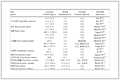
We commenced our investigation by choosing propargylic cyclic carbonate 1a and diethyl phosphorthiolic acid 2a [(EtO)2P(O)SH] as the model substrates in the presence of Cu(CH3CN)4PF6 (5 mol%), DIPEA (2.0 equiv.), and L1 (10 mol%) (Table 1, entry 1). It was found that the desired allenyl phosphorothioate 3aa could be obtained in 18% yield. Then, the effects of different copper catalysts were investigated (Table 1, entries 1–4), and the results indicated that Cu(CH3CN)4BF4 was the best choice. When tridentate ligand L1 was switched to bipyridine ligands L2-L5 (Table 1, entries 5–8), no better results were obtained. It was found that the use of 1,10-phenanthroline with nitro group L6 improved the yield of 3aa to 40% (Table 1, entry 9). Afterward, kinds of bases were evaluated for this reaction, results indicated that the base greatly influenced the reaction activity (Table 1, entries 10–13). To our delight, the desired allenyl phosphorothioate 3aa was furnished in 80% yield in the presence of DABCO as the base. The other nonproton solvents, such as THF or DCM, led to the desired product in diminished yields (Table 1, entries 14 and 15). Further examination of catalyst loading, ligand loading, substrate concentration, and reaction time improved the yield of 3aa to 92% (Table 1, entry 16). The configuration of allenyl phosphorothioate 3aa was testified via 1H-1H NOSEY.
|
Table 1 Optimization of reaction conditions.a |


With the optimized conditions in hand, the scopes of the propargylic cyclic carbonates were investigated using diethyl phosphorthiolic acid 2a as a phosphorothiolation reagent. As summarized in Scheme 2, a broad range of allenyl phosphorothioates were readily prepared with good yield and excellent regioselectivities. The reaction using aromatic propargylic cyclic carbonates bearing electron-donating and electron-withdrawing groups at the para-position proceeded smoothly to provide the corresponding allenyl phosphorothioates 3ba-3ja, these results showed that electron-donating substrates showed a lower reactivity. Halogen substituents on the phenyl ring were well tolerated, furnishing corresponding products in 72% and 75% yield. An investigation of the influence of the substitution pattern of the phenyl ring revealed that substituents at meta- and ortho-position had little effect on reactivity, with the corresponding allenyl phosphorothioates 3ka-3qa being produced in moderate to good yields. Multisubstituted phenyl propargylic cyclic carbonates were also suitable substrates to furnish the corresponding products 3ra and 3sa in 62% and 61% yield, respectively. The reactions of α- or β-naphthyl propargylic cyclic carbonates afforded compounds 3ta-3va in 52%–71% yield. When the phenyl ring was replaced with a fused fluorenyl ring, the reaction proceeded smoothly and produced product 3wa in 71% yield. It was worth noting that alkyl-substituted propargylic cyclic carbonate could transform the desired product 3xa in 38% yield. The reason for the low yield of 3xa could be the instability of alkyl substituted copper allenylidene intermediate.

|
Download:
|
| Scheme 2. The scope of propargylic cyclic carbonates. Reaction conditions: 1b-1x (0.11 mmol), 2a (0.10 mmol), Cu(CH3CN)4BF4 (2.5 mol%), L6 (5 mol%), DABCO (0.1 mmol, 1.0 equiv.), toluene (1 mL), r.t., 4 h, air. a Cu(CH3CN)4BF4 (5 mol%), L6 (10 mol%), DABCO (0.2 mmol, 2.0 equiv.). | |

As an initial attempt, reacting propargylic cyclic carbonate 1a (0.11 mmol) with diethyl H-phosphonate (0.1 mmol) and elemental sulfur (0.1 mmol) was investigated under standard reaction conditions. The reaction provided the desired product 3aa in 60% yield, albeit with the original material. Further screening demonstrated that the molar ratio of the substrate (1a:2b:S = 1.3:1:1) was the best and to furnish the allenyl phosphorothioate 3aa in 86% yield (Table S1 in Supporting information). Various propargylic cyclic carb onates were investigated with diethyl H-phosphonate and elemental sulfur under the above optimal conditions (Scheme 3). A series of allenyl phosphorothioates (3aa-3pa) were achieved in good to excellent yields. To our delight, the three-component reaction for alkyl-substituted propargylic cyclic carbonate could smoothly transform into the corresponding product 3xa in 24% yield. Noteworthily, the three-component reaction showed better reactivities in this transformation than using diethyl phosphorthiolic acid counterparts in most cases.

|
Download:
|
| Scheme 3. The scope of propargylic cyclic carbonates for three-component reaction. Reaction conditions: 1b-1p (0.13 mmol), 2b (0.10 mmol), S8 (0.1 mmol), Cu(CH3CN)4BF4 (2.5 mol%), L6 (5 mol%), DABCO (0.1 mmol, 1.0 equiv.), toluene (1 mL), r.t., 4 h, air. | |

To get insight into the application of the present protocol, gram scale transformation was accomplished (Scheme 4). The allenyl phosphorothioate 3aa can be prepared from 1a and 2a, providing the desired product in 76% yield. Meantime, a three-component gram scale reaction was smoothly transformed into desired products 3aa in 80% yield. In addition, an esterification reaction was also smoothly performed to give the corresponding product 5aaa in 86% yield. The trans-1,3-diene 5aab was obtained in 38% isolated yield via the cross-coupling reaction of allenyl phosphorothioate 3aa with biphenyl boronic acid 4b in the presence of palladium catalyst.

|
Download:
|
| Scheme 4. The gram-scale reaction and application of 3aa. | |

Based on the above experiment results and referring to previous reporters on Cu-catalyzed decarboxylative substitution of propargylic cyclic carbonate [56,66–68], a plausible mechanism for the three component reactions was proposed in Scheme 5. Under the base condition, the deprotonation of the propargyl carbonate 1a under Cu(I) catalysis would generate a copper acetylide species B [69], which undergoes decarboxylation to form a copper-acetylide cation intermediate C, further isomerizes to copper allenylidene intermediate D. Meantime, the treatment of elemental sulfur with H-phosphonates would yield diethyl phosphorthiolic acid 2b, which will be further deprotonated by DABCO gave sulfur anion E [70]. Then, sulfur anion E would trap copper allenylidene intermediate D to form intermediate F. The subsequent protonation of intermediate F furnished the allenyl phosphorothioate 3aa and the copper catalyst A.

|
Download:
|
| Scheme 5. A plausible mechanism. | |

In summary, we have developed an efficient and practical method for the synthesis of allenyl phosphorothioates featuring trisubstituted allenyl scaffolds from propargylic cyclic carbonates and elemental sulfur and H-phosphonates under inexpensive copper as the catalyst. This protocol can be easily scaled up and applied, as a demonstration, in the synthesis of trans-butadiene bearing phosphorothioates.
Declaration of competing interestThe authors declare the following financial interests/personal relationships which may be considered as potential competing interests: There are no conflicts to declare
AcknowledgmentThis work was supported by the Educational Foundation of Zhejiang University of Technology (No. KYY-HX-20220471).
Supplementary materialsSupplementary material associated with this article can be found, in the online version, at doi:10.1016/j.cclet.2024.109617.
| [1] |
V.M. Dembitsky, T. Maoka, Prog. Lipid. Res. 46 (2007) 328-375. DOI:10.1016/j.plipres.2007.07.001 |
| [2] |
A. Hoffmann-Röder, N. Krause, Angew. Chem. Int. Ed. 43 (2004) 1196-1216. DOI:10.1002/anie.200300628 |
| [3] |
C. Aubert, L. Fensterbank, P. Garcia, M. Malacria, A. Simonneau, Chem. Rev. 111 (2011) 1954-1993. DOI:10.1021/cr100376w |
| [4] |
K.M. Brummond, J.E. DeForrest, Synthesis 2007 (2007) 795-818. DOI:10.1055/s-2007-965963 |
| [5] |
Z. Duan, M. Liu, B. Zheng, et al., Org. Lett. 25 (2023) 3298-3302. DOI:10.1021/acs.orglett.3c01066 |
| [6] |
Y. Jiang, A.B. Diagne, R.J. Thomson, S.E. Schaus, J. Am. Chem. Soc. 139 (2017) 1998-2005. DOI:10.1021/jacs.6b11937 |
| [7] |
M.B. Li, D. Posevins, A. Geoffroy, C. Zhu, J.E. Backvall, Angew. Chem. Int. Ed. 59 (2020) 1992-1996. DOI:10.1002/anie.201911462 |
| [8] |
M.B. Li, D. Posevins, K.P.J. Gustafson, et al., Chem. Eur. J. 25 (2019) 210-215. DOI:10.1002/chem.201805118 |
| [9] |
L. Liu, R.M. Ward, J.M. Schomaker, Chem. Rev. 119 (2019) 12422-12490. DOI:10.1021/acs.chemrev.9b00312 |
| [10] |
S. Ma, Chem. Rev. 105 (2005) 2829-2872. DOI:10.1021/cr020024j |
| [11] |
S. Ma, Acc. Chem. Res. 42 (2009) 1679-1688. DOI:10.1021/ar900153r |
| [12] |
J. Naapuri, J.D. Rolfes, J. Keil, C.M. Sapu, J. Deska, Green Chem. 19 (2017) 447-452. DOI:10.1039/C6GC01926A |
| [13] |
H. Tsukamoto, K. Ito, T. Doi, Chem. Commun. 54 (2018) 5102-5105. DOI:10.1039/C8CC02589D |
| [14] |
S. Yu, S. Ma, Angew. Chem. Int. Ed. 51 (2012) 3074-3112. DOI:10.1002/anie.201101460 |
| [15] |
J. Zhang, X. Huo, J. Xiao, et al., J. Am. Chem. Soc. 143 (2021) 12622-12632. DOI:10.1021/jacs.1c05087 |
| [16] |
B. Xiang, Y. Wang, C. Xiao, F. He, Y. Huang, Chin. Chem. Lett. 35 (2024) 108777-108781. DOI:10.1016/j.cclet.2023.108777 |
| [17] |
J. Qian, Z. Chen, Y. Liu, et al., Chin. Chem. Lett. 34 (2023) 107479-107482. DOI:10.1016/j.cclet.2022.04.077 |
| [18] |
Y. Que, W. Lei, Y. Fang, S. He, Y. Chen, Green. Synth. Catal. (2023). DOI:10.1016/j.gresc.2023.11.010 |
| [19] |
Y. Choe, P.H. Lee, Org. Lett. 11 (2009) 1445-1448. DOI:10.1021/ol9001703 |
| [20] |
Y. Deng, X. Jin, C. Fu, S. Ma, Org. Lett. 11 (2009) 2169-2172. DOI:10.1021/ol9004273 |
| [21] |
B. Alcaide, P. Almendros, A. Luna, E. Soriano, J. Org. Chem. 80 (2015) 7050-7057. DOI:10.1021/acs.joc.5b00887 |
| [22] |
D.A. Mundal, K.E. Lutz, R.J. Thomson, J. Am. Chem. Soc. 134 (2012) 5782-5785. DOI:10.1021/ja301489n |
| [23] |
S. Li, B. Miao, W. Yuan, S. Ma, Org. Lett. 15 (2013) 977-979. DOI:10.1021/ol4000197 |
| [24] |
E. Yoneda, T. Kaneko, S. Zhang, K. Onitsuka, S. Takahashi, Org. Lett. 2 (2000) 441-443. DOI:10.1021/ol990377d |
| [25] |
S. Ma, Z. Gu, J. Am. Chem. Soc. 127 (2005) 6182-6183. DOI:10.1021/ja0500815 |
| [26] |
S. Webster, P.C. Young, G. Barker, G.M. Rosair, A.L. Lee, J. Org. Chem. 80 (2015) 1703-1718. DOI:10.1021/jo502648w |
| [27] |
R.W. Friesen, M. Blouin, J. Org. Chem. 58 (1993) 1653-1654. DOI:10.1021/jo00059a006 |
| [28] |
S. Ma, S. Zhao, J. Am. Chem. Soc. 121 (1999) 7943-7944. DOI:10.1021/ja9904888 |
| [29] |
B. Alcaide, P. Almendros, J.M. Alonso, I. Fernandez, S. Khodabakhshi, Adv. Synth. Catal. 356 (2014) 1370-1374. DOI:10.1002/adsc.201301127 |
| [30] |
Y. He, X. Zhang, X. Fan, Chem. Commun. 51 (2015) 16263-16266. DOI:10.1039/C5CC06150D |
| [31] |
Q. Li, X. Jiang, C. Fu, S. Ma, Org. Lett. 13 (2011) 466-469. DOI:10.1021/ol102811x |
| [32] |
G. Chai, Z. Lu, C. Fu, S. Ma, Adv. Synth. Catal. 351 (2009) 1946-1954. DOI:10.1002/adsc.200900091 |
| [33] |
B. Chen, Z. Lu, G. Chai, C. Fu, S. Ma, J. Org. Chem. 73 (2008) 9486-9489. DOI:10.1021/jo801809j |
| [34] |
A. Alexakis, I. Marek, P. Mangeney, J.F. Normant, Tetrahedron Lett. 30 (1989) 2391-2392. DOI:10.1016/S0040-4039(01)80407-X |
| [35] |
F. Bertozzi, P. Crotti, F. Macchia, et al., Tetrahedron Lett. 40 (1999) 4893-4896. DOI:10.1016/S0040-4039(99)00905-3 |
| [36] |
M. Yoshida, H. Ueda, M. Ihara, Tetrahedron Lett. 46 (2005) 6705-6708. DOI:10.1016/j.tetlet.2005.07.134 |
| [37] |
J. Kjellgren, H. Sundén, K.J. Szabó, J. Am. Chem. Soc. 127 (2005) 1787-1796. DOI:10.1021/ja043951b |
| [38] |
J. Zhao, K.J. Szabó, Angew. Chem. Int. Ed. 55 (2016) 1502-1506. DOI:10.1002/anie.201510132 |
| [39] |
T.S.N. Zhao, Y. Yang, T. Lessing, K.J. Szabó, J. Am. Chem. Soc. 136 (2014) 7563-7566. DOI:10.1021/ja502792s |
| [40] |
R. Shen, J. Yang, H. Zhao, et al., Chem. Commun. 52 (2016) 11959-11962. DOI:10.1039/C6CC05428E |
| [41] |
P.J.J. Huang, F. Wang, J. Liu, Anal. Chem. 87 (2015) 6890-6895. DOI:10.1021/acs.analchem.5b01362 |
| [42] |
T.S. Kumar, T. Yang, S. Mishra, et al., J. Med. Chem. 56 (2013) 902-914. DOI:10.1021/jm301372c |
| [43] |
N.S. Li, J.K. Frederiksen, J.A. Piccirilli, Acc. Chem. Res. 44 (2011) 1257-1269. DOI:10.1021/ar200131t |
| [44] |
M.D. McReynolds, J.M. Dougherty, P.R. Hanson, Chem. Rev. 104 (2004) 2239-2258. DOI:10.1021/cr020109k |
| [45] |
T. Ozturk, E. Ertas, O. Mert, Chem. Rev. 110 (2010) 3419-3478. DOI:10.1021/cr900243d |
| [46] |
J.D. Ye, C.D. Barth, P.R. Anjaneyulu, T. Tuschl, J.A. Piccirilli, Org. Biomol. Chem. 5 (2007) 2491-2497. DOI:10.1039/b707205h |
| [47] |
T. Kasagami, T. Miyamoto, I. Yamamoto, Pest Manage. Sci. 58 (2002) 1107-1117. DOI:10.1002/ps.546 |
| [48] |
A.M. Lauer, F. Mahmud, J. Wu, J. Am. Chem. Soc. 133 (2011) 9119-9123. DOI:10.1021/ja202954b |
| [49] |
Y. Qiu, J.C. Worch, W.D.N. Chirdon, Chem. Eur. J. 20 (2014) 7746-7751. DOI:10.1002/chem.201402561 |
| [50] |
M. Sekine, T. Hata, J. Am. Chem. Soc. 105 (1983) 2044-2049. DOI:10.1021/ja00345a062 |
| [51] |
M. Sekine, T. Hata, J. Am. Chem. Soc. 108 (1986) 4581-4586. DOI:10.1021/ja00275a052 |
| [52] |
Y. Zhang, S. Du, T. Yang, et al., Org. Chem. Front. 9 (2022) 3156-3162. DOI:10.1039/D2QO00455K |
| [53] |
T.T. Li, Y. You, T. Sun, et al., Org. Lett. 24 (2022) 5120-5125. DOI:10.1021/acs.orglett.2c01959 |
| [54] |
W.Y. Lu, Y. Wang, Y. You, et al., J. Org. Chem. 86 (2021) 1779-1788. DOI:10.1021/acs.joc.0c02621 |
| [55] |
Y.C. Zhang, B.W. Zhang, R. Geng, J. Song, Org. Lett. 20 (2018) 7907-7911. DOI:10.1021/acs.orglett.8b03454 |
| [56] |
S. Zuo, Y. Tao, Z. Liu, et al., Org. Lett. 25 (2023) 410-415. DOI:10.1021/acs.orglett.2c04113 |
| [57] |
F. Gong, X. Meng, S. Lan, et al., ACS Catal. 12 (2022) 12036-12044. DOI:10.1021/acscatal.2c03623 |
| [58] |
C. Xu, H. Zhang, S. Lan, et al., Angew. Chem. Int. Ed. 62 (2023) e202219064. DOI:10.1002/anie.202219064 |
| [59] |
K. Guo, A.W. Kleij, Angew. Chem. Int. Ed. 60 (2021) 4901-4906. DOI:10.1002/anie.202014310 |
| [60] |
K. Guo, Q. Zeng, A. Yanez, C. Bo, A.W. Kleij, Org. Lett. 24 (2022) 637-641. DOI:10.1021/acs.orglett.1c04086 |
| [61] |
G.S. Sontakke, R.K. Shukla, C.M.R. Volla, Adv. Synth. Catal. 364 (2022) 565-573. DOI:10.1002/adsc.202101064 |
| [62] |
X. Wang, S. Woodward, N. Krause, Eur. J. Org. Chem. 2009 (2009) 2836-2844. DOI:10.1002/ejoc.200900226 |
| [63] |
K. Guo, A. Kleij, Org. Lett. 22 (2020) 3942-3945. DOI:10.1021/acs.orglett.0c01222 |
| [64] |
M. Wang, B. Li, B. Gong, H. Yao, A. Lin, Chem. Commun. 58 (2022) 2850-2853. DOI:10.1039/D1CC07058D |
| [65] |
Z.J. Zhang, L. Zhang, R. Geng, et al., Angew. Chem. Int. Ed. 58 (2019) 12190-12194. DOI:10.1002/anie.201907188 |
| [66] |
W.Y. Lu, Y. You, T. Li, et al., J. Org. Chem. 86 (2021) 6711-6720. DOI:10.1021/acs.joc.1c00453 |
| [67] |
T.T. Li, W.Y. Lu, L.W. Shen, et al., Tetrahedron 104 (2022) 132606. DOI:10.1016/j.tet.2021.132606 |
| [68] |
J. G?mez,?lex. Crist?fol, A.W. Kleji, Angew. Chem. Int. Ed. 58 (2019) 3903-3907. DOI:10.1002/anie.201814242 |
| [69] |
S. Wang, X. Xia, Q. Chen, et al., ACS Appl. Mater. Interfaces 16 (2024) 5158-5167. DOI:10.1021/acsami.3c17607 |
| [70] |
C. Qu, R. Liu, Z. Wang, et al., Green Chem. 24 (2022) 4915-4920. DOI:10.1039/D2GC00903J |