 2024, Vol. 35


Ferroelastics are crystals with spontaneous strain as order parameter and their spontaneous strain can be reversed under an external stress field [1–4], which have broad application prospects in mechanical switches, shape memory, energy conversion, information transformation, and storage [5–14]. As one of the three main ferroic materials, ferroelastics have laid the foundation for the research of multiferroics [15–21]. For example, the ferroelastic domain walls of (C6H5C2H5NH3)2FeⅡCl4 crystal act as pinning sites, improving the potential barrier for magnetization reversal and thus achieving force-controlled ferromagnetic switching [16]. Ferroelasticity also allows polarization rotation of multiferroic materials under large stress, thereby giving rise to large piezoelectric response [17,18,21]. Over the years, a large number of inorganic ferroelastic materials have been developed, such as BaTiO3 [22], BiFeO3 [23], and VO2 [24]. However, these inorganic ferroelastic materials have drawbacks such as containing harmful metals, high energy consumption, or difficulty in regulation, which contradict the concept of green development [25,26]. Therefore, molecular-based ferroelastic materials with advantages such as environmental friendliness, low cost, ease of processing, mechanical flexibility, and structural adjustability show great potential as feasible substitutes for traditional inorganic ferroelastic materials [27–34].
In recent years, molecular-based ferroelastic materials with dielectric switching properties have attracted widespread attention. Many efforts have been made to design and synthesize ferroelastic dielectric switching materials with high phase transition temperatures and large ratios of dielectric switching [35–60]. Currently, most of the reports are mainly on organic-inorganic hybrid perovskite systems, with relatively few simple organic salt systems. Organic-inorganic hybrid perovskites are predominantly composed of toxic metals, posing a potential risk of environmental pollution. In contrast, organic salt molecular materials offer the benefits of low toxicity, cost-effectiveness, lightweight properties, and low acoustic impedance [37,38,44,46,57,61]. Moreover, their exceptional mechanical flexibility has demonstrated advantages in the development of ferroelastic and superelastic materials [62–64]. Furthermore, the current ferroelastic materials rarely achieve the advantages of both high Tc and large dielectric switching ratio, which is not conducive to practical applications. The range of phase transition temperature limits the application of switching materials, while the high Tc characteristic allows materials to operate and work at relatively high or extreme temperatures [65–67]. As a consequence, there is an urgent need to design and synthesize organic salt ferroelastics with high Tc, which is of great significance for the development of organic salt ferroelastic switching materials.
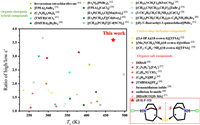
Recently, Xiong et al. proposed the concept of ferroelectrochemistry and elaborated on various targeted chemical design methods for synthesizing molecular ferroelectrics, among which introducing chirality is an effective way to obtain molecular ferroelectrics [66]. This is because chiral materials must crystallize in 11 chiral point groups, 5 of which also are polar point groups, greatly increasing the probability of discovering ferroelectrics [66]. Similarly, according to the 94 species of ferroelastic crystals proposed by Aizu, there are 30 types of chiral-to-chiral ferroelastic phase transition, so introducing chirality also improves the chance of obtaining ferroelastics [1]. Chirality can be generated by the introduction of a fluorine atom into the organic group, and the heavier fluorine atom will increase the potential rotational energy barrier of organic cation, resulting in significant enhancement of Tc [66]. We demonstrated the feasibility of this strategy using organic salt ferroelastic enantiomers (R/S)-F-321 with high Tc. The chiral organic salt ferroelastics (R/S)-F-321 crystallize in P43212 and P41212 chiral space groups at room temperature, respectively, and experience 432F422-type ferroelastic phase transition at 470 K, showing excellent dielectric switching characteristics, which outstrip most molecular-based ferroelastic switching materials (Fig. 1). This work enriches the family of organic salt ferroelastics and switching materials and throws light on the design and synthesis of organic salt ferroelastics with high Tc.
|
Download:
|
| Fig. 1. Tc and the ratio of dielectric switching of (R/S)-F-321 compared with other compounds at 1 MHz. | |

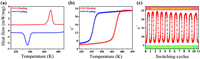
(R/S)-F-321 were easily obtained as bulk crystals by slow evaporation of the ethanol solution containing equimolar (R/S)−4-fluoro-1-azabicyclo[3.2.1]octane and hydrochloric acid at 328 K after several days. As shown in Fig. 2a, the DSC curves of (R)-F-321 exhibit a pair of thermal anomaly peaks at Tc = 470 K (endothermic peak) and 437 K (exothermic peak) with a large thermal hysteresis of 33 K, indicating the first-order phase transition nature. According to the DSC plot, the average enthalpy change (ΔH) is 13.172 kJ/mol, and the average entropy change (ΔS) is 29.063 J mol−1 K−1. Based on the Boltzmann equation ΔS = RlnN (R is the gas constant, and N is the ratio of the number of independent orientations before and after the phase transition), the value of N is evaluated as 33.026. The large N value means that the (R)-F-321 is oriented disorderly in the high-temperature phase. Due to their enantiomeric relationship, (S)-F-321 also exhibits similar DSC curves, showing a pair of endothermic/exothermic peaks that appeared at 470 K/437 K (Fig. S1a in Supporting information).
|
Download:
|
| Fig. 2. (a) DSC curves of (R)-F-321 in a heating-cooling cycle. (b) Temperature-dependent real part (ε′) of the dielectric constant of (R)-F-321 at 1 MHz in a heating-cooling cycle. (c) Temperature-driven ε′ switching of (R)-F-321 at 1 MHz. | |
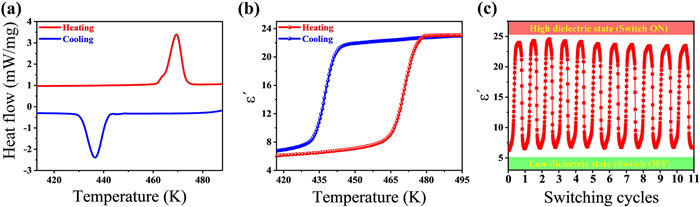
To verify the phase transition behavior of (R/S)-F-321, we conducted dielectric measurements. As shown in Fig. 2b, the real part (ε′) of permittivity at 1 MHz of (R)-F-321 shows reversible step-like anomalies around Tc, which accords with the results from DSC measurement. During the heating process, the value of ε′ increases slowly from 6.1 at 420 K, then rapidly increases to 23 at 480 K, and finally tends to flatten out after the phase transition. In the cooling process, ε′ shows a similar trend, rapidly decreasing from 21.8 at 447 K to 7.5 at 428 K, and then slowing down to 6.9 at 420 K. Below the Tc, the slowly increasing ε′ indicates that the dipole motion is frozen, corresponding to the low dielectric state ("Switch OFF"). As the temperature reaches around Tc, the dipole motion is activated and the dielectric constant sharply increases, corresponding to a disordered phase and high dielectric state ("Switch ON"). Similar dielectric anomalies at the phase transition also occur in (S)-F-321 (Fig. S1b in Supporting information).
Here, (R)-F-321 was selected as a representative for bistable switching measurements at 1 MHz under several sequential cycles to check the stability of switchable dielectric properties. As shown in Fig. 2c, the switching of ε′ between the "ON" and "OFF" state is 23 and 6.4 respectively, and the ratio of high and low dielectric states is 3.6. After 11 heating-cooling cycles, the dielectric constant in the "ON" state remained almost unchanged, demonstrating the reversibility and stability. It is rare and commendable that (R)-F-321 simultaneously has such a high Tc and a large dielectric switching ratio, which is much better than most molecular dielectric switching materials (Fig. 1). This means that it can still work with high dielectric switching sensitivity in extremely high-temperature environments.
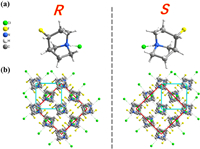
Here, variable-temperature single-crystal X-ray diffractions were carried out to explore the mechanism of the phase transition. At 300 K (RTP), (R/S)-F-321 crystallizes in the chiral enantiomeric space group P43212 and P41212 (point group 422) respectively, with the approximate unit cell parameters (Table S1 in Supporting information). As can be seen from Fig. 3a, the asymmetric unit of (R/S)-F-321 consists of one chiral (R/S)−4-fluoro-1-azabicyclo[3.2.1]octonium cation and one chloride anion, where Cl and N atoms are linked by N—H···Cl hydrogen bond with the donor-acceptor distance of 3.0 Å. The N—H···Cl hydrogen bond interaction was also analyzed by using the Hirshfeld surface and 2D fingerprint plot (Fig. S2 in Supporting information) [68]. The red circular depressions on the Hirshfeld dnorm surface and large spikes in the lower left of the fingerprint plot at di ≈ 0.7 Å and de ≈ 1.3 Å highlights the close contact of Cl···H hydrogen bonds. In RTP, the structure is in a completely ordered state, where C, N, and F atoms are wholly distinguishable. The packing view of (R/S)-F-321 along the c-axis at 300 K is shown in Fig. 3b. It can be seen that it is a zero-dimensional packing, with molecules alternately arranged along the 4-fold screw axis, showing the spiral chiral accumulation brought by chiral molecules. Due to their enantiomeric relationship, the structure of (R)-F-321 and (S)-F-321 display mirror symmetry.
|
Download:
|
| Fig. 3. (a) The asymmetric unit of (R/S)-F-321 at 300 K. (b) Packing view of (R/S)-F-321 along the c-axis at 300 K (outlined in cyan solid lines representing the RTP cell and outlined in red solid lines representing the HTP cell). The hydrogen atoms are omitted for clarity. The black dashed line denotes a mirror plane. | |

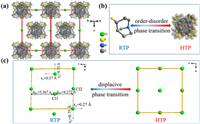
When the temperature increases to 473 K (HTP), (R/S)-F-321 adopts the same cubic space group F432 (point group 432), and the unit cell parameters change significantly with a = b = c = 9.5551(7) Å/9.5815(15) Å, α = β = γ = 90°, V = 872.38(19) Å3/879.6(4) Å3, Z = 4. Compared with the unit cell parameters in RTP, the a- and b-axes lengths in HTP become longer, the c-axis length is greatly shortened, and the cell volume is halved (Fig. 3b and Table S1 in Supporting information). The relation of lattice cells between HTP and RTP is 
|
Download:
|
| Fig. 4. (a) Packing diagram of (R)-F-321 along the c-axis at 473 K. (b) Schematic diagram of order-disorder and (c) displacive phase transition mechanism of (R)-F-321. The hydrogen atoms are omitted for clarity. | |

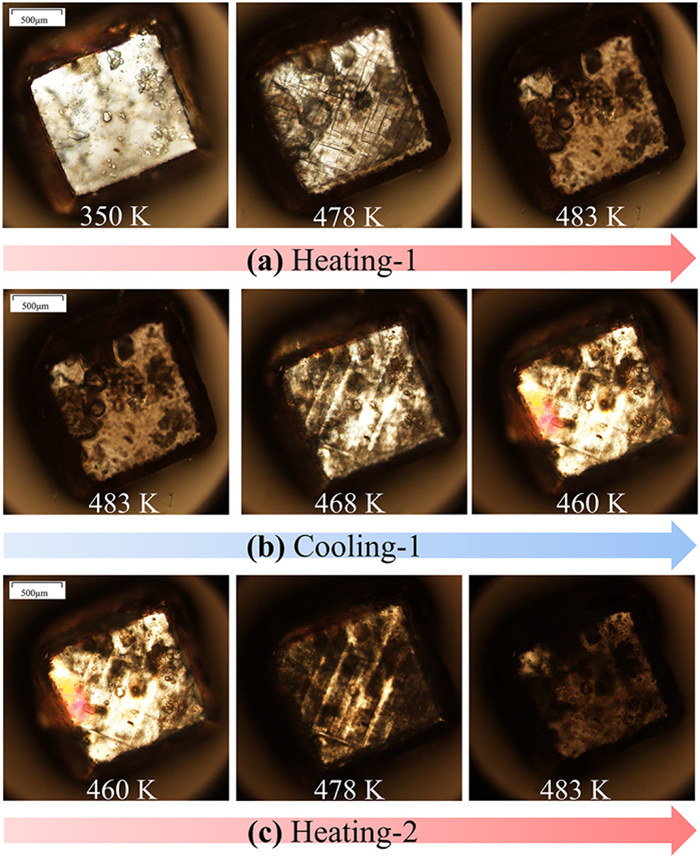
According to the Aizu rule, (R/S)-F-321 undergoes a ferroelastic phase transition with an Aizu notation of 432F422. Due to the birefringence characteristics of crystals, ferroelastic domains exhibit bright and dark alternating patterns under orthogonally polarized light. In order to observe the ferroelastic-paraelastic transformation of (R)-F-321, the single crystal was observed using a polarization microscope during the heating-cooling cycles. As shown in Fig. 5a, no ferroelastic domains were observed in the raw crystal under polarized light at 350 K. When the crystal was heated to 478 K, striped ferroelastic domains with alternating light and dark suddenly appeared. When the temperature rose to 483 K, the crystal underwent a ferroelastic phase transition from the ferroelastic phase to the paraelastic phase, and the domains disappeared completely. Then the crystal was cooled, and as the temperature dropped to 468 K, the streaked ferroelastic domains reappeared, becoming brighter as the temperature decreased (Fig. 5b). After further heating the crystal above Tc, it can be observed that the ferroelastic domains disappeared again (Fig. 5c). The comparison of crystal morphology observed under polarized and depolarized conditions is shown in Fig. S5 (Supporting information), confirming that the existence of ferroelastic domains is independent of morphology. During continuous heating-cooling cycles, the domain structure repeatedly disappeared and appeared, suggesting that the ferroelastic-paraelastic phase transition is reversible.

|
Download:
|
| Fig. 5. Evolution of ferroelastic domains between the paraelastic and ferroelastic phase of (R)-F-321 in the first heating run (a), the first cooling run (b), and the second heating run (c). | |
In summary, we synthesized simple organic salt ferroelastic enantiomers (R/S)-F-321, which undergo a high-temperature structural phase transition with an Aizu notation of 432F422 at 470 K. Due to the synergistic effect of the order-disorder transition of 4-fluoro-1-azabicyclo[3.2.1]octonium cations and displacive change of chloride anions, (R/S)-F-321 exhibit outstanding dielectric switching characteristic around Tc, showing good reversibility and stability. Therefore, they become potential candidate materials for switch applications. The organic enantiomers prove that the introduction of chirality is an effective way to develop multifunctional phase transition materials.
Declaration of competing interestThe authors declare that they have no known competing financial interests or personal relationships that could have appeared to influence the work reported in this paper.
AcknowledgmentThis work was supported by the National Natural Science Foundation of China (No. 22201120).
Supplementary materialsSupplementary material associated with this article can be found, in the online version, at doi:10.1016/j.cclet.2024.109548.
| [1] |
K. Aizu, J. Phys. Soc. Jpn. 27 (1969) 387-396. DOI:10.1143/JPSJ.27.387 |
| [2] |
J. Sapriel, Phys. Rev. B 12 (1975) 5128-5140. DOI:10.1103/PhysRevB.12.5128 |
| [3] |
U. Bismayer, E. Salje, A.M. Glazer, et al., Phase Trans. 6 (1986) 129-151. DOI:10.1080/01411598608221634 |
| [4] |
S.A.T. Redfern, E. Salje, J. Phys. C: Solid State Phys. 21 (1988) 277-285. DOI:10.1088/0022-3719/21/2/011 |
| [5] |
V. Nagarajan, A. Roytburd, A. Stanishevsky, et al., Nat. Mater. 2 (2003) 43-47. DOI:10.1038/nmat800 |
| [6] |
S.H. Baek, H.W. Jang, C.M. Folkman, et al., Nat. Mater. 9 (2010) 309-314. DOI:10.1038/nmat2703 |
| [7] |
M. Liu, B.M. Howe, L. Grazulis, et al., Adv. Mater. 25 (2013) 4886-4892. DOI:10.1002/adma.201301989 |
| [8] |
R. Xu, S. Liu, I. Grinberg, et al., Nat. Mater. 14 (2015) 79-86. DOI:10.1038/nmat4119 |
| [9] |
C. Wang, X. Ke, J. Wang, et al., Nat. Commun. 7 (2016) 10636. DOI:10.1038/ncomms10636 |
| [10] |
X. Lu, Z. Chen, Y. Cao, et al., Nat. Commun. 10 (2019) 3951. DOI:10.1038/s41467-019-11825-2 |
| [11] |
R.G. Xiong, S.Q. Lu, Z.X. Zhang, et al., Angew. Chem. Int. Ed. 59 (2020) 9574-9578. DOI:10.1002/anie.202000290 |
| [12] |
Y. Hu, L. You, B. Xu, et al., Nat. Mater. 20 (2021) 612-617. DOI:10.1038/s41563-020-00875-3 |
| [13] |
J. Li, Y. Zhu, P.Z. Huang, et al., Chem. Eur. J. 28 (2022) e202201005. DOI:10.1002/chem.202201005 |
| [14] |
T. Zhang, K. Xu, J. Li, et al., Natl. Sci. Rev. 10 (2023) nwac240. DOI:10.1093/nsr/nwac240 |
| [15] |
W.Q. Liao, Y.Y. Tang, P.F. Li, et al., J. Am. Chem. Soc. 139 (2017) 18071-18077. DOI:10.1021/jacs.7b10449 |
| [16] |
Y. Nakayama, S. Nishihara, K. Inoue, et al., Angew. Chem. 129 (2017) 9495-9498. DOI:10.1002/ange.201703898 |
| [17] |
M. Wojciechowska, A. G? agor, A. Piecha-Bisiorek, et al., Chem. Mater. 30 (2018) 4597-4608. DOI:10.1021/acs.chemmater.8b00962 |
| [18] |
C. Shi, J.J. Ma, J.Y. Jiang, et al., J. Am. Chem. Soc. 142 (2020) 9634-9641. |
| [19] |
Z.X. Wang, X.G. Chen, X.J. Song, et al., Nat. Commun. 13 (2022) 2379. DOI:10.1038/s41467-022-30085-1 |
| [20] |
Y.L. Zeng, Y. Ai, S.Y. Tang, et al., J. Am. Chem. Soc. 144 (2022) 19559-19566. DOI:10.1021/jacs.2c08667 |
| [21] |
X.G. Chen, Y.Y. Tang, H.P. Lv, et al., J. Am. Chem. Soc. 145 (2023) 1936-1944. DOI:10.1021/jacs.2c12306 |
| [22] |
X. Moya, E. Stern-Taulats, S. Crossley, et al., Adv. Mater. 25 (2013) 1360-1365. DOI:10.1002/adma.201203823 |
| [23] |
A. Bhatnagar, A.Roy Chaudhuri, Y.Heon Kim, et al., Nat. Commun. 4 (2013) 2835. DOI:10.1038/ncomms3835 |
| [24] |
Q. WY, J. ZZ, et al., ACS Nano 2 (2008) 1492-1496. DOI:10.1021/nn800223s |
| [25] |
G.H. Haertling, J. Am. Ceram. Soc. 82 (1999) 797-818. DOI:10.1111/j.1151-2916.1999.tb01840.x |
| [26] |
D.J. Goossens, Acc. Chem. Res. 46 (2013) 2597-2606. DOI:10.1021/ar400073w |
| [27] |
D.W. Fu, H.L. Cai, Y. Liu, et al., Science 339 (2013) 425-428. DOI:10.1126/science.1229675 |
| [28] |
S. Chen, R. Shang, B.W. Wang, et al., Angew. Chem. Int. Ed. 54 (2015) 11093-11096. DOI:10.1002/anie.201504396 |
| [29] |
P.P. Shi, Y.Y. Tang, P.F. Li, et al., J. Am. Chem. Soc. 139 (2017) 1319-1324. DOI:10.1021/jacs.6b12377 |
| [30] |
Z. Sun, X. Yi, K. Tao, et al., Angew. Chem. Int. Ed. 57 (2018) 9833-9837. DOI:10.1002/anie.201805776 |
| [31] |
H.Y. Zhang, Y.Y. Tang, P.P. Shi, et al., Acc. Chem. Res. 52 (2019) 1928-1938. DOI:10.1021/acs.accounts.8b00677 |
| [32] |
J. Long, M.S. Ivanov, V.A. Khomchenko, et al., Science 367 (2020) 671-676. DOI:10.1126/science.aaz2795 |
| [33] |
Y.L. Zeng, X.Q. Huang, C.R. Huang, et al., Angew. Chem. Int. Ed. 60 (2021) 10730-10735. DOI:10.1002/anie.202102195 |
| [34] |
P.F. Li, Y. Ai, Y.L. Zeng, et al., Chem. Sci. 13 (2022) 657-664. DOI:10.1039/D1SC04322F |
| [35] |
Y. Zhang, K. Awaga, H. Yoshikawa, et al., J. Mater. Chem. 22 (2012) 9841-9845. DOI:10.1039/c2jm30581j |
| [36] |
A. Piecha-Bisiorek, A. Bialoska, R. Jakubas, et al., Adv. Mater. 27 (2015) 5023-5027. DOI:10.1002/adma.201501812 |
| [37] |
M. Weclawik, P. Szklarz, W. Medycki, et al., Dalton Trans. 44 (2015) 18447-18458. DOI:10.1039/C5DT02265G |
| [38] |
X.G. Chen, J.X. Gao, X.N. Hua, et al., New J. Chem. 42 (2018) 14909-14913. DOI:10.1039/C8NJ02645A |
| [39] |
K. Mencel, P. Durlak, M. Rok, et al., RSC Adv. 8 (2018) 26506-26516. DOI:10.1039/C8RA03871F |
| [40] |
M.M. Zhao, L. Zhou, P.P. Shi, et al., Chem. Commun. 54 (2018) 13275-13278. DOI:10.1039/C8CC07052K |
| [41] |
Y.J. Cao, L. Zhou, P.P. Shi, et al., Chem. Commun. 55 (2019) 8418-8421. DOI:10.1039/C9CC03857D |
| [42] |
Y. Huang, J. Yang, Z.J. Li, et al., RSC Adv. 9 (2019) 10364-10370. DOI:10.1039/C9RA00804G |
| [43] |
M.M. Zhao, L. Zhou, P.P. Shi, et al., Chem. Eur. J. 25 (2019) 6447-6454. DOI:10.1002/chem.201900771 |
| [44] |
M. Moskwa, E. Ganczar, P. Sobieszczyk, et al., J. Phys. Chem. C 124 (2020) 18209-18218. DOI:10.1021/acs.jpcc.0c05322 |
| [45] |
H.Y. Zhang, C.L. Hu, Z.B. Hu, et al., J. Am. Chem. Soc. 142 (2020) 3240-3245. DOI:10.1021/jacs.9b13446 |
| [46] |
D.W. Fu, J.X. Gao, P.Z. Huang, et al., Angew. Chem. Int. Ed. 60 (2021) 8198-8202. DOI:10.1002/anie.202015219 |
| [47] |
X.Q. Xu, H. Zhang, X.Q. Huang, et al., Inorg. Chem. Front. 8 (2021) 1197-1204. |
| [48] |
Z.X. Zhang, C.Y. Su, J. Li, et al., Chem. Mater. 33 (2021) 5790-5799. DOI:10.1021/acs.chemmater.1c01699 |
| [49] |
X.G. Chen, Z.X. Zhang, Y.L. Zeng, et al., Chem. Commun. 58 (2022) 3059-3062. DOI:10.1039/D2CC00586G |
| [50] |
Y.P. Gong, X.X. Chen, G.Z. Huang, et al., J. Mater. Chem. C 10 (2022) 5482-5488. DOI:10.1039/D2TC00335J |
| [51] |
Y.Y. He, Z. Chen, X.G. Chen, et al., Mater. Chem. Front. 6 (2022) 1292-1300. DOI:10.1039/D2QM00058J |
| [52] |
J.C. Liu, F.F. Di, Y.P. Zeng, et al., Inorg. Chem. Front. 9 (2022) 5799-5804. DOI:10.1039/D2QI01824A |
| [53] |
M.M. Lun, T. Zhang, C.Y. Su, et al., Mater. Chem. Front. 6 (2022) 1929-1937. DOI:10.1039/D2QM00319H |
| [54] |
X. Meng, Z.B. Liu, K. Xu, et al., Inorg. Chem. Front. 9 (2022) 1603-1608. DOI:10.1039/D1QI01533H |
| [55] |
T. Shao, H.F. Ni, C.Y. Su, et al., Chem. Eur. J. 28 (2022) e202202533. DOI:10.1002/chem.202202533 |
| [56] |
P. Szklarz, R. Jakubas, W. Medycki, et al., Dalton Trans. 51 (2022) 1850-1860. DOI:10.1039/D1DT03455C |
| [57] |
N. Zhang, Y. Zhang, H.H. Jiang, et al., Chem. Mater. 34 (2022) 8077-8086. DOI:10.1021/acs.chemmater.2c02290 |
| [58] |
Y.P. Gong, X.X. Chen, B.Q. Zhao, et al., Chin. Chem. Lett. 34 (2023) 108282. DOI:10.1016/j.cclet.2023.108282 |
| [59] |
H.P. Lv, Y.R. Li, X.J. Song, et al., J. Am. Chem. Soc. 145 (2023) 3187-3195. DOI:10.1021/jacs.2c12951 |
| [60] |
J. Mu, K. Xu, L. He, et al., Chem. Commun. 59 (2023) 1209-1212. DOI:10.1039/D2CC05823E |
| [61] |
W.Q. Liao, Y.L. Zeng, Y.Y. Tang, et al., J. Am. Chem. Soc. 143 (2021) 21685-21693. DOI:10.1021/jacs.1c11000 |
| [62] |
S. Sakamoto, T. Sasaki, A. Sato-Tomita, et al., Angew. Chem. Int. Ed. 58 (2019) 13722-13726. DOI:10.1002/anie.201905769 |
| [63] |
T. Sasaki, S. Sakamoto, Y. Takasaki, et al., Angew. Chem. Int. Ed. 59 (2020) 4340-4343. DOI:10.1002/anie.201914954 |
| [64] |
Y.X. Li, Z.K. Liu, J. Cao, et al., Angew. Chem. Int. Ed. 62 (2023) e202217977. DOI:10.1002/anie.202217977 |
| [65] |
D.W. Fu, J.X. Gao, W.H. He, et al., Angew. Chem. Int. Ed. 59 (2020) 17477-17481. DOI:10.1002/anie.202007660 |
| [66] |
H.Y. Liu, H.Y. Zhang, X.G. Chen, et al., J. Am. Chem. Soc. 142 (2020) 15205-15218. DOI:10.1021/jacs.0c07055 |
| [67] |
X. Mu, L. Xu, Y.Y. Xu, et al., Mater. Chem. Front. 5 (2021) 8371-8379. DOI:10.1039/D1QM01157J |
| [68] |
P.R. Spackman, M.J. Turner, J.J. McKinnon, et al., J. Appl. Cryst. 54 (2021) 1006-1011. DOI:10.1107/S1600576721002910 |