 2024, Vol. 35


b College of Materials Science and Engineering, Shenzhen University, Shenzhen 518055, China
The emerging demand for luminescent materials, capable of functioning in diverse optoelectronic devices such as organic light-emitting diodes (OLEDs) or light-emitting electrochemical cells (OLECs), as well as for utility in optical sensing applications in biological and supramolecular systems, continue to drive significant efforts toward discovering novel fluorescent compounds and developing their practical synthetic methods [1-4]. In particular, organoboron complexes have been extensively investigated as fluorescent dyes in recent years [5]. Among them, boron dipyrromethene (BODIPY) stand out for their favorable characteristics, including high quantum yield, narrow emission bands, and excellent photo-stability. These features make them ideal candidates for a myriad of applications, ranging from fluorescence imaging reagents, sensitizers for solar cells, and photodynamic therapy [6-10]. However, the inherent symmetric and planar configuration of BODIPY type compounds often led to small Stokes shifts and aggregation-caused quenching (ACQ), limiting their utility in certain scenarios whereas necessitating the structural engineering to enhance their functions [11,12].
The development of efficient solid-state luminescent materials is also crucial for advancements in optoelectronic materials, devices as well as chemical and biological sensors [13-17]. First identified by Tang and colleagues in 2001, the phenomenon of Aggregation-Induced Emission (AIE) has been extensively observed in molecules possessing highly twisted conformations [18]. These AIE-active luminophores, or 'AIEgens', display subdued luminescence in solution but enhanced emission upon aggregation or transition to the solid-state, primarily due to restricted intramolecular motion (RIM) [19,20]. Accordingly, the applications of AIEgens have been witnessed across various sectors, including bioimaging [21,22], sensing [23], OLEDs [24], and other optically-active technologies [25]. In contrast, BODIPY-derived fluorescent complexes often suffered from ACQ owing to their planar geometries and propensity for intermolecular π-π stacking interactions, significantly curtailing their utilities. Despite substantial advancements in recent years [26-31], the rational design and optimization of structural variations of BODIPYs for better performance remain a challenging yet pivotal endeavor.
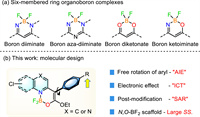
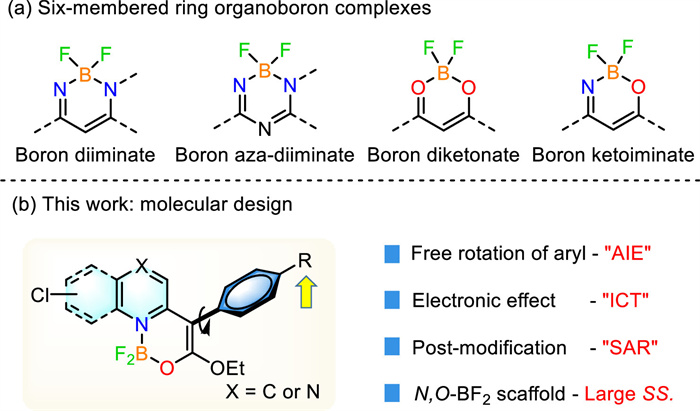
Compared to N,N-bidentate BODIPY counterpart, N,O-bidentate complexes that share structural similarities often possess distinct properties but remained relatively unexplored (Scheme 1a) [32-40]. For instance, research groups led by Wang, Ziessel, and others have respectively demonstrated that phenol-based N, O-chelated boron complexes could display significant fluorescence and thus show promise in applications such as organic light-emitting diodes or fluorescent labeling reagents [41-46]. Chujo et al. reported a series of organoboron dyes with ketoiminate and diiminate as ligands, which exhibited mechanochromic properties [47-50]. Motivated to fill the apparent gap, we recognized that our long-term research on fluorescent materials, as well as recent serendipity finding on N, O-chelated palladium complex might be transferred to boron complexation, eliciting the design and development of new type of fluorescent compounds [51-54]. Specifically, we envisioned the enolizable character of ester group might empower it as a bidentate N,O-ligand to chelate the boron atom, leading to unsymmetrical N,O-BF2 scaffold that might offer improved Stokes shift and mitigate self-absorption issues (Scheme 1b). Besides, the pyridine ring could act as a strong electron acceptor upon coordination with BF2, facilitating the design and construct the D-π-A units [55]. Furthermore, introducing aryl groups to α-position of esters could not only alter the push-pull effect within the complex, but also inhibit intermolecular π-π stacking by inducing twisted propeller-shaped conformations [56]. Nevertheless, we herein would like to report the proof-of-concept execution of the aforementioned ideas, and present a series of readily accessible unsymmetrical BF2 fluorophores that incorporate N-heteroarene derivatives. The streamlined one-pot-two-step synthesis and post-complexation modification enabled the variation of N-heterocyclic framework and α-aryl groups in high efficiency. In addition to offering the carbonyl moiety for coordination, the ester group within the substrate scaffold could serve as an additional reactive site for further modifications. Overall, these new complexes demonstrated excellent photo/pH stability, unique photophysical properties, and showed promise in applications as reversible acidic vapor sensors.
|
Download:
|
| Scheme 1. Working hypothesis. | |
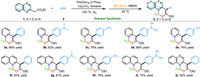
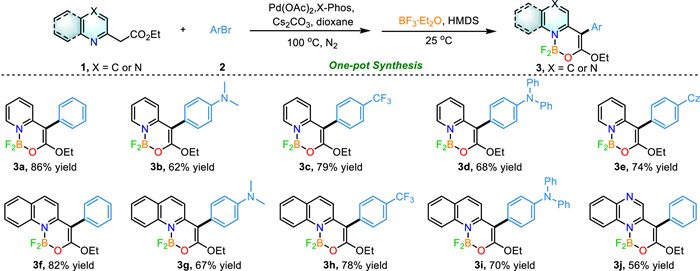
We first telescoped the synthesis cascade comprising Pd-catalyzed α-arylation of α-(2-pyridinyl)acetates and fluorine-boron complexation with BF3·Et2O in the presence of hexamethyldisilazane (HMDS). After extensive investigations, we established a one-pot, two-step protocol, providing the BF2 complex 3a in 86% yields, which displayed strong fluorescence and thus prompted us to further explore their SAR (Scheme 2). Indeed, our method was amenable to both pyridine, quinoline and quinoxaline scaffolds, tolerating both electron-donating groups (EDGs) and electron-withdrawing groups (EWGs). The obtained complexes were stable to and successfully isolated using silica column chromatography, affording solid products with satisfactory yields. Comprehensive structural analyses were performed using 1H NMR, 13C NMR, 19F NMR, HRMS, and X-ray crystal analysis.
|
Download:
|
| Scheme 2. One-pot syntheses of complexes 3 from 1 to 2. Cz = Carbazole. | |
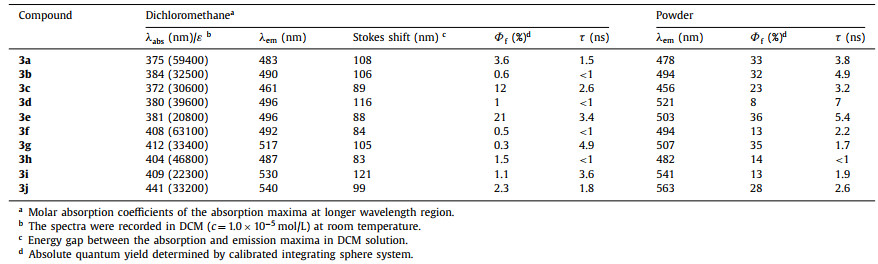
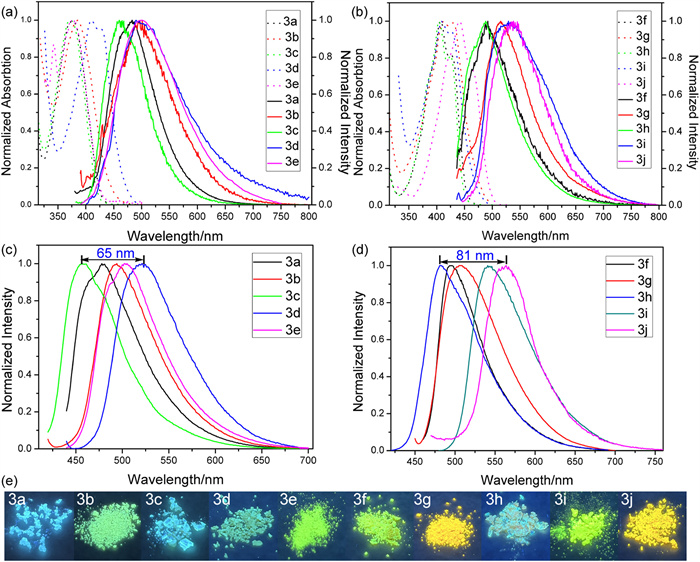
These dyes exhibit excellent optical properties with a strong broad absorption and intense emission in visible regions in dichloromethane (DCM) (Table 1). Compounds 3a-3j displayed two obvious absorption bands in solvents: the one in 310–330 nm range is assigned as π-π* transition, while the other one in the low-energy region corresponds to the intramolecular charge transfer (ICT) transition [57,58]. Compared to the meso-phenyl substituted BODIPY [59], 3a-3j showed similar level of quantum yields in solution, but much larger Stokes shifts (84–121 nm), which was critical for avoiding the detrimental effects of self-absorption. The installation of dimethylamine, diphenylamine, or carbazole group to the para position of aryl ring led to a gradual red shift in the absorption and emission bands (Fig. 1 and Fig. S1 in Supporting information), whereas the electron-withdrawing trifluoromethyl group shifted the emission to blue. In addition, the quinoline or quinoxaline based fluorescent molecules (3f-3j) display longer emission wavelengths than the pyridine-based counterparts (3a-3e). Compared with data in solution, the molecular aggregation effects in solid states restrict the free rotation of the α-aryl groups, empowering more red-shifted emission and significantly improved quantum yields. Moreover, the emission of our fluorophores can be tuned on purpose by modulating the substitution group or ligand scaffold.
|
Table 1 Photophysical properties of compounds 3a-3i in dichloromethane and solid powder. |
|
Download:
|
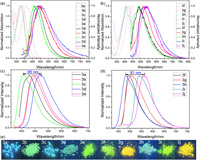
| Fig. 1. (a, b) Absorption (dotted line) and emission (solid line) spectra of 3a-3e and 3f-3i in dichloromethane. (c, d) Emission spectra of 3a-3e and 3f-3i in solid powder state; (e) Insert picture: 3a-3j under the 365 nm UV light. | |
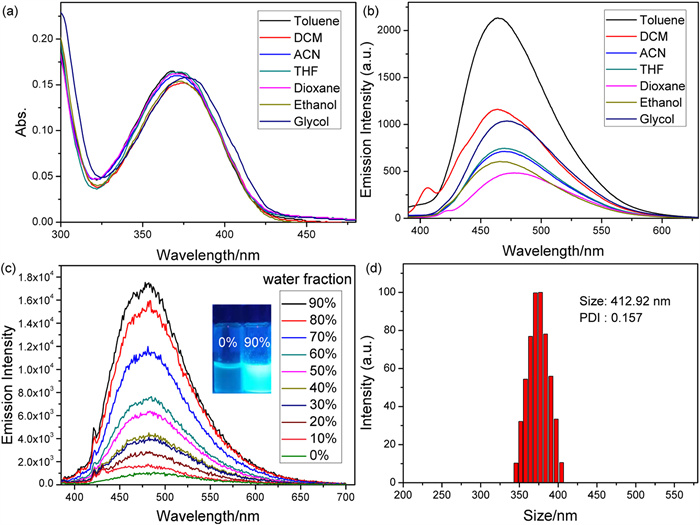
The optical properties of 3a were measured in different solvents. As the solvent polarity increased from toluene to glycol, a tiny shift in the maximum absorption band was observed, indicating a stable ground state [60]. The fluorescence emission maximum of 3a varied with changes in solvent polarity. As the solvent polarity increased from hexane to acetonitrile, a gradual decrease in the emission intensity of 3a was observed (Figs. 2a and b). This decrease could be attributed to the ICT process from the phenyl ring to the boron coordinated pyridine moiety. In high-viscosity solvents such as glycol, 3a exhibited significantly enhanced luminescence intensity (Fig. 2b). In a THF-H2O solvent system, the emission intensity of 3a also increased with increasing water fraction (fw). When the fw exceeded 70%, visible aggregates were formed with a particle diameter of 412 nm (Figs. 2c and d). This observed AIE effect arises from the conformational locking of phenyl rotors in the assembled state, leading to suppressed nonradiative relaxation.
|
Download:
|
| Fig. 2. (a) Absorption and (b)emission spectra of 3a (λex, 375 nm) in various solvents such as toluene, DCM, acetonitrile (ACN), tetrahydrofuran (THF), ethanol and ethylene glycol (glycol), respectively. (c) Emission spectra of compound 3a in THF/water mixtures (50 µmol/L) with varied volumetric fractions of water (fw). (d) Grain size of compound 3a in fw = 90%. | |
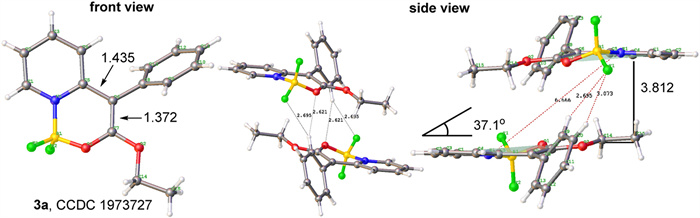
Next, X-ray crystallographic analysis was performed to better understand the relationship between structure and solid-state emission properties (Fig. 3, Tables S1 and S2 in Supporting information). Single crystal analysis reveals that the molecules are stacked in opposite directions, allowing for greater slippage that reduces stacking (slip angel ranges from 37.10° to 60.11°, Figs. S7-S12 in Supporting information). As depicted in Fig. 3a, the C5C6 and C6C7 bond distances are 1.435 and 1.372 Å, respectively. These values suggest that the ester enolization enable the formation of C=C bond between C6 and C7 [61]. The central boron atom has a slightly distorted tetrahedral geometry with B-F, B-N and B-O distances of 1.370, 1.568 and 1.456 Å, respectively (Table S3 in Supporting information). In these dyes, the substituted benzene rings maintain an almost vertical orientation relative to the NBO core, with dihedral angles ranging from 56° to 78°, as indicated in Table S3. Notably, no face-to-face π-π stacking was observed but multiple short interatomic contacts (C9H9···F1 (2.695 Å), (C9H9···O1 (2.621 Å) instead in 3a. These weak interactions can restrict the molecular conformations by locking the molecules into aggregated structures as well as attenuating intermolecular vibrational and rotational modes to mitigate nonradiative energy dissipation pathways, thereby enabling the enhanced radiative in the solid-state fluorescence [56].
|
Download:
|
| Fig. 3. Crystal-packing pattern of 3a between the adjacent interlayered crystals from front and side view. H, light gray; C, gray; N, blue; O, red; F, green; B, yellow. | |
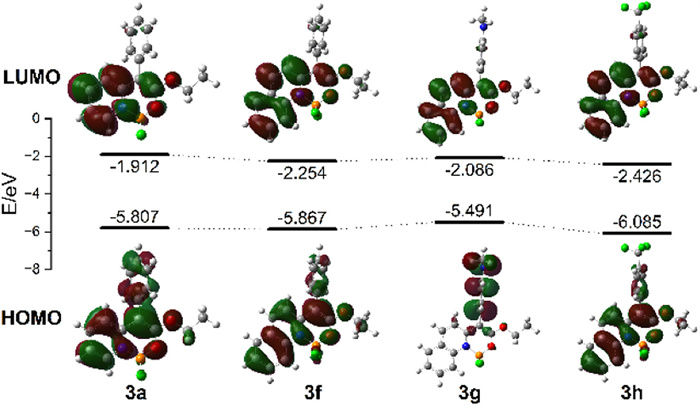
Density functional theory (DFT) calculations on 3a, 3f-3h were performed using the Gaussian 09 software package. All geometrical structures were optimized and molecular orbitals calculated at the B3LYP/6–31G* level. The HOMO and LUMO plots are given in Fig. 4 and Fig. S14 (Supporting information). The LUMO of each molecule is mainly localized on the pyridine and the six-membered boron-containing heterocycles. The HOMOs of 3a, 3f and 3g delocalize over the whole molecules, whereas the electron cloud distribution of the HOMO in 3g mainly localize on the dimethylaniline moiety. Compared to 3a, the LUMO of 3f is lowered due to the expanded π-conjugation of the quinoline versus pyridine. Substitution with the dimethylaniline group is predicted to increase the HOMO and LUMO energy levels of 3g by 0.376 eV and 0.168 eV, respectively, thereby decreasing the net HOMO-LUMO gap and redshifts the absorption when compared to 3f (Table S4 in Supporting information) [62]. Overall, the computational results are consistent with the experimental spectroscopic observations.
|
Download:
|
| Fig. 4. Relative energies of the frontier orbitals, and DFT-predicted frontier orbitals for compounds 3a, 3f-3h. | |
The post-complexation modification was explored to further demonstrate the application value [63,64]. 3f-Cl readily underwent both the Pd-catalyzed C—C and C—N coupling reaction to give complex 4 and 5 in 68% and 53% yield, respectively (Scheme 3a, Fig. S2 in Supporting information). In addition to conjugated skeleton, boron atom and ester group could also be divergently functionalized. We first conducted the nucleophilic substitution reaction between 4-methylphenylmagnesium bromide and 3f, obtaining the tetra-substituted boron complex 6. Due to the steric hindrance and electron-donating effect of the phenyl group [65], it exhibited strong emission in the solid-state and displayed red-shifted emission spectra when compared to 3f. Interestingly, when 3f was reacted with excess amount of propynylmagnesium bromides [66] the ethoxy group, in addition to the fluorine atom, was also propargylated to give the unexpected triple-modified complex 7 (Scheme 3b, Fig. S3 in Supporting information). The exemplificative downstream modifications further indicated the synthetic versatility of our boron fluorophore, empowering fast acceleration for the SAR studies and resulting application-oriented research.
|
Download:
|
| Scheme 3. Synthetic applications. | |
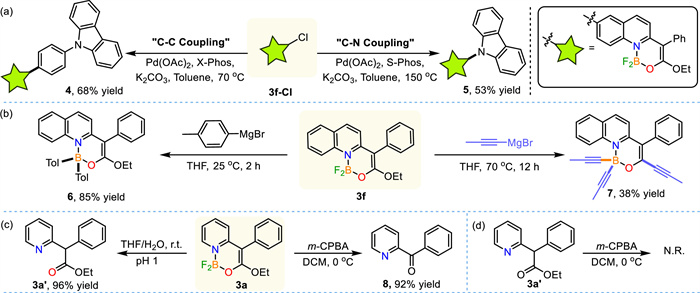
Stability testing was conducted on compound 3a, revealing that it possesses good photostability and thermostability (Fig. S4 in Supporting information). Furthermore, 3a exhibited a broad range of chemo-stability with pH ranging from 3 to 11. Nonetheless, in congruence with typical BODIPYs, 3a decomposed to 3a′ at pH 1 conditions, resulting no fluorescence. Simultaneously, the absorption and emission spectra of solution exhibited a blue shift, indicating a decrease in molecular conjugation in 3a′ (Scheme 3c, Fig. S5 in Supporting information). Interestingly, the C=C bond in the molecule coordinated with BF2 can undergo oxidative cleavage upon treatment with m-CPBA, leading to the formation of ketone 8, whereas 3a′ remains unchanged under the same conditions (Schemes 3c and d). Again, the coordination of boron promotes the ester enolization, leading to the formation of a more reactive double bond that can be oxidized [67], and this unique pathway could potentially serve as a model for cleavage-based detection assays.
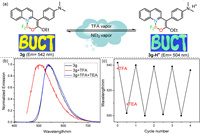
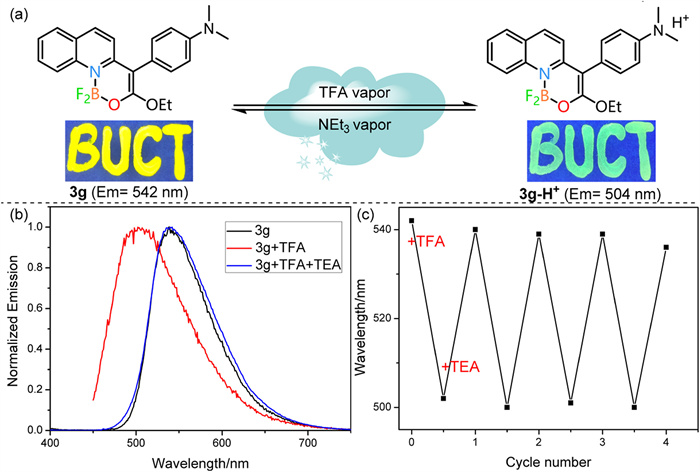
In view of its exceptional stability, we then conducted an exemplificative fluorescence-monitoring experiment employing 3g, in the presence of acids and bases (Fig. 5, Fig. S6 in Supporting information). When subjected to UV irradiation, 3g exhibited a yellow fluorescence. After exposing to trifluoroacetic acid (TFA) vapor, the fluorescence emission undergoes a fast shift to cyan. The mass spectrometry result (m/z = 383.1739) indicated that 3g was protonated in acidic vapors (Fig. S13 in Supporting information). Despite a slight decrease in emission intensity, the cyclic protonation and deprotonation process enabled by alternating acid and base treatments allows for reversible modulation of fluorescence colors.
|
Download:
|
| Fig. 5. (a) Reversible fluorescence switch of 3g under conditions of TFA and TEA fumigation. (Insert picture: "BUCT" scribbled on filter paper with 3g under 365 nm). (b, c) Spectra of 3g before and after fumigation by TFA and TEA. | |
In summary, we have successfully designed and synthesized a series of N-heteroarene-ester enolate based organoboron complexes endowed with AIE characteristics. These novel scaffolds exhibited robust fluorescence, substantial Stokes shift, and outstanding photo/pH stability. X-ray crystallographic analysis revealed that the weak intermolecular interactions, namely C—H⋯F and C—H⋯O, stabilized the molecular conformations of these BF2 chelates, thereby accounting for their pronounced fluorescence in the solid state. DFT calculations demonstrated that the both substituents and π-conjugation have a significant impact on the emission properties. The unique structural attributes of these complexes further allowed for versatile downstream derivatization reactions, thereby opening avenues for rapid exploration of the structural diversity. Furthermore, the emission of the complex showed reversible changes when exposed to acidic gas, paving the way for future research on fluorescent sensors.
Declaration of competing interestThe authors declare that they have no known competing financial interests or personal relationships that could have appeared to influence the work reported in this paper.
AcknowledgmentsJ. Tan (BUCT) is grateful for the support by the National Natural Science Foundation of China (Nos. 21702013, 22271010).
Supplementary materialsSupplementary material associated with this article can be found, in the online version, at doi:10.1016/j.cclet.2024.109532.
| [1] |
X.L. Yang, G.J. Zhou, W.Y. Wong, et al., Chem. Soc. Rev. 44 (2015) 8484-8575. DOI:10.1039/C5CS00424A |
| [2] |
R. Furue, T. Nishimoto, I.S. Park, et al., Angew. Chem. Int. Ed. 55 (2016) 7171-7175. DOI:10.1002/anie.201603232 |
| [3] |
H. Uoyama, K. Goushi, K. Shizu, et al., Nature 492 (2012) 234-238. DOI:10.1038/nature11687 |
| [4] |
Z. Yang, T. Xu, H. Li, et al., Chem. Rev. 123 (2023) 11047-11136. DOI:10.1021/acs.chemrev.3c00186 |
| [5] |
W. Sheng, F. Lv, B. Tang, et al., Chin. Chem. Lett. 30 (2019) 1825-1833. DOI:10.1016/j.cclet.2019.08.004 |
| [6] |
T. Kowada, H. Maeda, K. Kikuchi, Chem. Soc. Rev. 44 (2015) 4953-4972. DOI:10.1039/C5CS00030K |
| [7] |
J. Zhao, K. Xu, W. Yang, et al., Chem. Soc. Rev. 44 (2015) 8904-8939. DOI:10.1039/C5CS00364D |
| [8] |
J. Wang, Q. Gong, L. Jiao, et al., Coord. Chem. Rev. 496 (2023) 215367. DOI:10.1016/j.ccr.2023.215367 |
| [9] |
Z. Wang, X. Teng, C. Lu, Anal. Chem. 87 (2015) 3412. DOI:10.1021/acs.analchem.5b00472 |
| [10] |
Q. Gong, X. Zhang, W. Li, et al., J. Am. Chem. Soc. 144 (2022) 21992-21999. DOI:10.1021/jacs.2c08947 |
| [11] |
F. Ito, T. Nagai, Y. Ono, et al., Chem. Phys. Lett. 435 (2007) 283-288. DOI:10.1016/j.cplett.2007.01.001 |
| [12] |
D. Frath, J. Massue, G. Ulrich, et al., Angew. Chem. Int. Ed. 53 (2014) 2290-2310. DOI:10.1002/anie.201305554 |
| [13] |
Z. Chi, X. Zhang, B. Xu, et al., Chem. Soc. Rev. 41 (2012) 3878-3896. DOI:10.1039/c2cs35016e |
| [14] |
J. Mei, Y. Hong, J.W.Y. Lam, et al., Adv. Mater. 26 (2014) 5429-5479. DOI:10.1002/adma.201401356 |
| [15] |
Z. He, C. Ke, B.Z. Tang, ACS Omega 3 (2018) 3267-3277. DOI:10.1021/acsomega.8b00062 |
| [16] |
C. Chen, C.Z. Du, X.Y. Wang, Adv. Sci. 9 (2022) 2200707. DOI:10.1002/advs.202200707 |
| [17] |
G. Meng, J. Zhou, T. Huang, et al., Angew. Chem. Int. Ed. 62 (2023) e202309923. DOI:10.1002/anie.202309923 |
| [18] |
J. Luo, Z. Xie, J.W.Y. Lam, et al., Chem. Commun. 55 (2001) 1740-1741. |
| [19] |
N.L.C. Leung, N. Xie, W. Yuan, et al., Chem. Eur. J. 20 (2014) 15349-15353. DOI:10.1002/chem.201403811 |
| [20] |
Z. He, E. Zhao, J.W.Y. Lam, B.Z. Tang, Aggregation-Induced Emission: Materials and Applications, 1, American Chemical Society, 2016, pp. 5–20.
|
| [21] |
F. Zhang, X. Wu, B. Liu, et al., Coord. Chem. Rev. 493 (2023) 215337. DOI:10.1016/j.ccr.2023.215337 |
| [22] |
W. Che, L. Zhang, Y. Li, et al., Anal. Chem. 91 (2019) 3467-3474. DOI:10.1021/acs.analchem.8b05024 |
| [23] |
J. Zhuang, Y. Yu, R. Su, et al., Dyes Pigments 208 (2023) 110809. DOI:10.1016/j.dyepig.2022.110809 |
| [24] |
G. Yang, Y. Ran, Y. Wu, et al., Aggregate 3 (2022) e127. DOI:10.1002/agt2.127 |
| [25] |
T. Zhou, R. Hu, L. Wang, et al., Angew. Chem. Int. Ed. 59 (2020) 9952-9956. DOI:10.1002/anie.201916704 |
| [26] |
E. Bodio, C. Goze, Dyes Pigments 160 (2019) 700-710. DOI:10.1016/j.dyepig.2018.08.062 |
| [27] |
J. Mei, N.L.C. Leung, R.T.K. Kwok, et al., Chem. Rev. 115 (2015) 11718-11940. DOI:10.1021/acs.chemrev.5b00263 |
| [28] |
H. Wu, X. Guo, C. Yu, et al., Dyes Pigments 176 (2020) 108209. DOI:10.1016/j.dyepig.2020.108209 |
| [29] |
L.J. Patalag, M. Loch, P.G. Jones, et al., J. Org. Chem. 84 (2019) 7804-7814. DOI:10.1021/acs.joc.9b00603 |
| [30] |
Y. Guo, L. Zhang, C. Li, et al., J. Org. Chem. 86 (2021) 12507-12516. DOI:10.1021/acs.joc.1c00777 |
| [31] |
M. Liu, S. Ma, M. She, et al., Chin. Chem. Lett. 30 (2019) 1815-1824. DOI:10.1016/j.cclet.2019.08.028 |
| [32] |
Z. Yu, Y. Wu, L. Xiao, et al., J. Am. Chem. Soc. 139 (2017) 6376-6381. DOI:10.1021/jacs.7b01574 |
| [33] |
C. Yu, X. Fang, Q. Wu, et al., Org. Lett. 22 (2020) 4588-4592. DOI:10.1021/acs.orglett.0c00940 |
| [34] |
D. Yang, P. Liu, T. Bai, et al., Macromolecules 53 (2020) 3339-3348. DOI:10.1021/acs.macromol.9b02633 |
| [35] |
A.M. Grabarz, B. Jędrzejewska, A. Zakrzewska, et al., J. Org. Chem. 82 (2017) 1529-1537. DOI:10.1021/acs.joc.6b02732 |
| [36] |
B. Jędrzejewska, A. Skotnicka, A.D. Laurent, et al., J. Org. Chem. 83 (2018) 7779-7788. DOI:10.1021/acs.joc.8b00664 |
| [37] |
G. Tan, I. Maisuls, F. Strieth-Kalthoff, et al., Adv. Sci. 8 (2021) 2101814. DOI:10.1002/advs.202101814 |
| [38] |
M.A. Potopnyk, R. Lytvyn, Y. Danyliv, et al., J. Org. Chem. 83 (2018) 1095-1105. DOI:10.1021/acs.joc.7b02239 |
| [39] |
Y. Chen, Z. Liao, T. Cao, et al., Green Synth. Catal. 3 (2022) 89-94. DOI:10.1016/j.gresc.2021.11.001 |
| [40] |
A.C. Murali, P. Nayak, S. Nayak, et al., Angew. Chem. Int. Ed. 62 (2023) e202216871. DOI:10.1002/anie.202216871 |
| [41] |
Z. Zhang, H. Bi, Y. Zhang, et al., Inorg. Chem. 48 (2009) 7230-7236. DOI:10.1021/ic900673s |
| [42] |
C. Yu, E. Hao, X. Fang, et al., J. Mater. Chem. C 7 (2019) 3269-3277. DOI:10.1039/c9tc00316a |
| [43] |
D. Frath, S. Azizi, G. Ulrich, et al., Org. Lett. 13 (2011) 3414-3417. DOI:10.1021/ol2011665 |
| [44] |
N. Zhao, C. Ma, W. Yang, et al., Chem. Commun. 5 (2019) 8494-8497. DOI:10.1039/c9cc04041b |
| [45] |
G. Tan, M.L. Schrader, C. Daniliuc, et al., Angew. Chem. Int. Ed. 59 (2020) 21541-21545. DOI:10.1002/anie.202008311 |
| [46] |
C. Yu, X. Fang, H. Wang, et al., J. Org. Chem. 86 (2021) 11492-11501. DOI:10.1021/acs.joc.1c01042 |
| [47] |
R. Yoshii, A. Nagai, K. Tanaka, et al., Chem. Eur. J. 19 (2013) 4506-4512. DOI:10.1002/chem.201203703 |
| [48] |
R. Yoshii, A. Hirose, K. Tanaka, et al., J. Am. Chem. Soc. 136 (2014) 18131-18139. DOI:10.1021/ja510985v |
| [49] |
P. Su, L. Wen, Y. Zhou, et al., Chem. Eur. J. 28 (2022) e202201372. DOI:10.1002/chem.202201372 |
| [50] |
Y. Kubota, H. Hara, S. Tanaka, et al., Org. Lett. 13 (2011) 6544-6547. DOI:10.1021/ol202819w |
| [51] |
C. Wu, W. Liu, K. Li, et al., Angew. Chem. Int. Ed. 60 (2021) 3994-3998. DOI:10.1002/anie.202013051 |
| [52] |
S. Luo, J. Wang, N. Li, et al., Angew. Chem. Int. Ed. 62 (2023) e202310943. DOI:10.1002/anie.202310943 |
| [53] |
X.F. Song, C. Jiang, N. Li, et al., Chem. Sci. 14 (2023) 12246-12254. DOI:10.1039/d3sc04264b |
| [54] |
C. Jin, K. Xu, X. Fan, et al., Chin. Chem. Lett. 31 (2020) 91-94. DOI:10.1016/j.cclet.2019.06.028 |
| [55] |
J. Huang, L. Bourda, S. Tusupbayev, et al., Dyes Pigments 217 (2023) 111374. DOI:10.1016/j.dyepig.2023.111374 |
| [56] |
X. Wang, F. Qi, Z. Jiang, et al., Dyes Pigments 186 (2021) 108999. DOI:10.1016/j.dyepig.2020.108999 |
| [57] |
H. Yang, K. Ye, J. Sun, et al., Asian J. Org. Chem. 6 (2017) 199-206. DOI:10.1002/ajoc.201600482 |
| [58] |
Z. Huang, A. Ding, J. Yang, et al., Chem. Eur. J. 29 (2023) e202203628. DOI:10.1002/chem.202203628 |
| [59] |
C. Yu, L. Jiao, H. Yin, et al., Eur. J. Org. Chem. 28 (2011) 5460. DOI:10.1002/ejoc.201100736 |
| [60] |
S. Zhang, Y. Huang, L. Kong, et al., Dyes Pigments 181 (2020) 108574. DOI:10.1016/j.dyepig.2020.108574 |
| [61] |
P. Sykes, A Guidebook to Mechanism in Organic Chemistry, 5th edn, 1981.
|
| [62] |
Y. Zhang, A. Ding, S. Guo, et al., J. Mater. Chem. C 10 (2022) 6078-6084. DOI:10.1039/d2tc00350c |
| [63] |
J. Chen, S. liu, S. Su, et al., Sci. Adv. 9 (2023) eadi1370. DOI:10.1126/sciadv.adi1370 |
| [64] |
X. Peng, K. Xu, Q. Zhang, et al., Trends Chem. 4 (2022) 643–657.
|
| [65] |
A.B. More, S. Mula, S. Thakare, et al., J. Org. Chem. 79 (2014) 10981-10987. DOI:10.1021/jo502028g |
| [66] |
L. Li, Y. Gao, C. Dou, et al., Chin. Chem. Lett. 31 (2020) 1193-1196. DOI:10.1016/j.cclet.2019.11.018 |
| [67] |
F.V. Singh, H.M.S. Milagre, M.N. Eberlin, et al., Tetrahedron Lett. 50 (2009) 2312-2316. DOI:10.1016/j.tetlet.2009.02.164 |