 2024, Vol. 35


b College of Chemical Engineering, Sichuan University, Chengdu 610065, China;
c University of Chinese Academy of Sciences, Beijing 100049, China
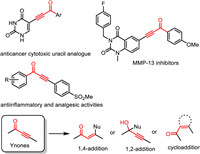
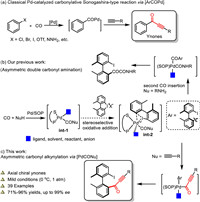
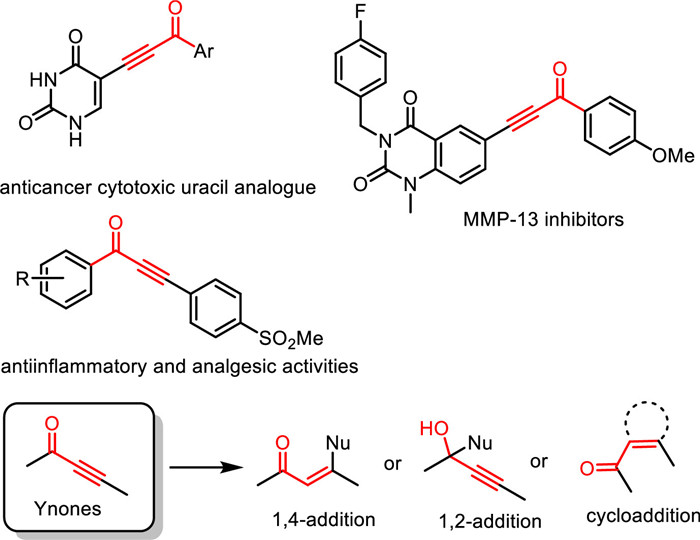
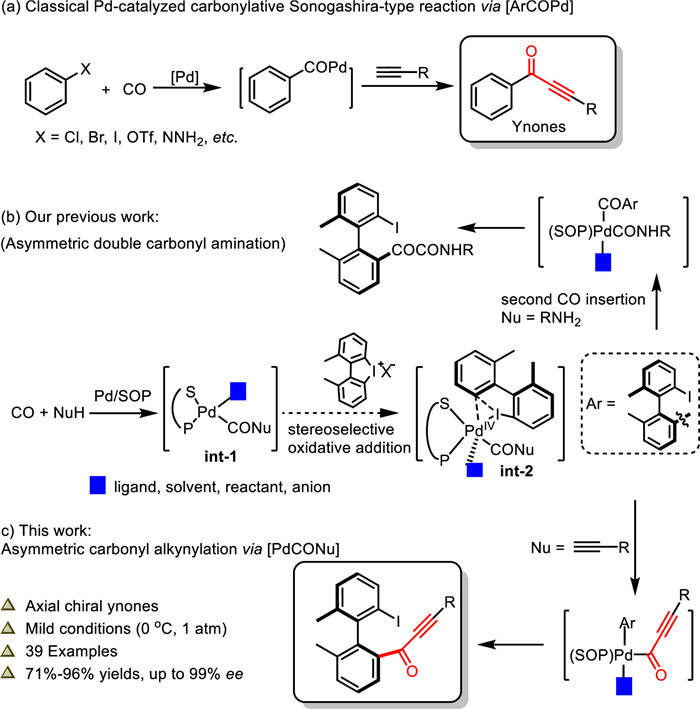
Ynones, also called α,β-acetylenic ketones, are frequently found in natural products and bioactive compounds [1-7]. Bearing with two adjacent functionalities (carbonyl group and C—C triple bond), ynones always exhibit distinctive reactivity due to interaction between these two functional moieties (Scheme 1) [8]. Thus, enormous attention has been devoted to their efficient synthesis. Traditionally, oxidization of propargylic alcohols [9-11], coupling of acyl derivatives with alkynes [12-15] and Pd-catalyzed carbonylation of terminal alkynes have been employed as powerful synthetic tools for structure diverse ynones [16-21]. Among these strategies, Pd-catalyzed carbonylative Sonogashira-type reaction from easily available aryl halides, alkynes, and CO, displayed a directly efficient preparation of ynones. However, this protocol always suffered harsh conditions and substrate limitation. Owing to the great efforts from chemists, impressive progress has been made in recent years. Aryl halides could be already extended to alkyl halides [14,15,22-31], ArOTf [32,33], hypervalent iodines [34-37], arylamines [38], aryl hydrazines [39], etc., meanwhile, the introduction of green chemistry [40] or electrochemistry [39] enable the reaction conditions environmental and mild. Nevertheless, to date, constructing ynones bearing chiral framework through a classical Pd-catalyzed carbonylative Sonogashira-type reaction remains unachievable, which is mainly due to the difficulty of introducing chiral factors and lacking of efficient catalytic system (Scheme 2a).
|
Download:
|
| Scheme 1. Selected bioactive ynones and the typical transformations of ynones. | |
|
Download:
|
| Scheme 2. Pd-catalyzed carbonyl alkynylation to synthesis ynones. | |
As a class of stable, nontoxic and highly reactive reagents, diaryliodonium(Ⅲ) salts were broadly used for preparing various functionalized aryl compounds due to their highly electron-deficient nature and excellent leaving-group ability [41-45]. Particularly, to the topic of this paper, in late of 1990s, Kang [34,35] and Ma [36] verified that diaryliodonium salts can undergo transition-metal (Pd or Cu) catalyzed carbonylative cross coupling with alkynes to give ynones under mild conditions. It is conceivable that an enantioselective carbonylative Sonogashira-type reaction might be realized via ring-opening strategy [44,46-50]. However, it is a challenging task for a long time. In 2004, Hayashi et al. disclosed the feasibility to generate axial chiral skeleton via Pd-catalyzed carboxylation of prechiral cyclic diaryliodonium but unsatisfied result (38% yield, 28% ee) was achieved which probably caused by the incompatibility of ligand [51]. Very recently, by employing sulfoxide phosphines (SOPs) as ligand, we presented a high-valent palladium catalyzed enantioselective double carbonylation of cyclic diaryliodonium salts [52-57]. In that context, the in situ generated acyl-Pd(Ⅱ) intermediate int-1 (SOPPd-CONHR) from the nucleophiles (RNH2) could be further stereoselectively oxidized by cyclic diaryliodonium salts to acyl-Pd(Ⅳ) species int-2 (Scheme 2b). As a part of our continuous interests in enantioselective carbonylations, comparing to the readily formed carbamoylpalladium(Ⅱ) species from N-based nucleophiles (amines) [52,58,59], we envisaged that C-based nucleophile like alkynes could generate the corresponding acyl-Pd(Ⅱ) species [60-64] and was consequently enantioselectively oxidized by cyclic diaryliodonium salts to furnish a non-classical carbonylative Sonogashira-type reaction which acyl-Pd(Ⅱ) species generated from nucleophiles, as a result, functionalized ynones, which bearing an axial chiral framework, could be afforded (Scheme 2c).
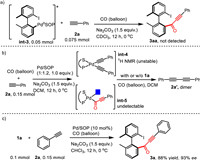
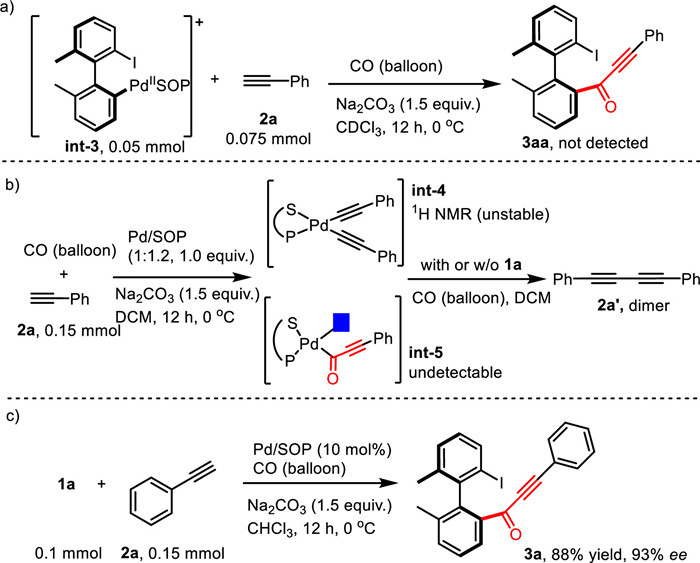
To verify this feasibility, several control experiments were initially conducted (For details, see Supporting information). First, in the presence of ArPd(Ⅱ) int-3 [52] which generated from the oxidation of Pd(0)/SOP by cyclic diaryliodonium salt 1a, phenylacetylene 2a was added under CO atmosphere, there was no desired carbonylation product 3aa was observed. This indicates the catalytic system cannot promote a classical carbonylative Sonogashira-type reaction (Scheme 3a). Second, mixing phenylacetylene 2a and Pd/SOP under the CO atmosphere, the desired acyl-Pd(Ⅱ) species int-5 (SOPPdCOC≡CPh) was not detected and only int-4 (SOPPd(C≡CPh)2) was observed. int-4 is unstable and readily converts to dimerization [65-67] side-product of 2a in the presence or absence of cyclic diaryliodonium salt 1a (Scheme 3b). We speculated that acyl-Pd(Ⅱ) species int-5 could be generated and this complex might be very unstable which need to be reacted with oxidative electrophile immediately once it formed. Then, the following experiment was employing cyclic diaryliodonium salt 1a to capture the possible acyl-Pd(Ⅱ) species int-5. To our delight, once cyclic diaryliodonium salt 1a was added, the desired ynone was obtained as sole product in a high NMR yield and excellent enantioselectivity (88%, 93% ee) (Scheme 3c). The above experiments indicated that this catalysis enable an efficient non-classical carbonylative Sonogashira-type reaction, i.e., under the CO atmosphere, acyl-Pd(Ⅱ) species int-5 (SOPPdCOC≡CPh) was generated from arylacetylene and immediately captured by cyclic diaryliodonium salt via an oxidation process, after a reductive coupling, the desired ynone which bearing a chiral framework was generated.
|
Download:
|
| Scheme 3. Control experiments. | |
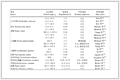
Encouraged by this primary result, using cyclic diaryliodonium salt 1a and phenylacetylene 2a as model substrates, we then systematically optimized the reaction conditions. In the presence of Pd2dba3 (5 mol%), chiral ligand (12 mol%), and Na2CO3 (1.5 equiv.), the reaction was performed in CHCl3 at 0 ℃ for 12 h (Table 1). Ligand evaluation demonstrated that electron-rich ligand is beneficial for the reactivity when employ SOP as ligand (entry 1 vs. entry 2).
|
Table 1 Optimization of reaction conditions.a |
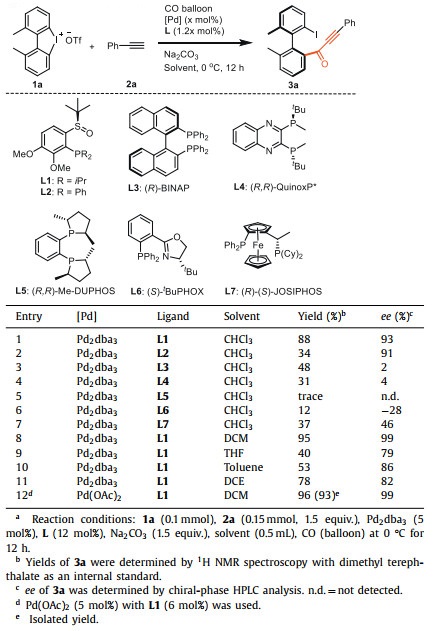
Other employed commercially available chiral P,P-, N,N- and P,N-ligands were not the preferred ligands for this transformation in terms of both reactivities and enantioselectivities (entries 3–7). Furthermore, to enhance the enantio‑control, several solvents were examined (entries 8–11). Delightfully, using DCM as reaction solvent led to excellent yield and enantioselectivity (entry 8, 95% yield, 99% ee). It is worth noting that in our previous carbonylative amination, in-situ generated Pd(Ⅱ)-complex was more beneficial in reactivity than Pd(Ⅱ) source (Pd2dba3: 94% yield vs. Pd(Ⅱ): 35%−56% yields) [52]. In this process, excellent results (93% isolated yield, 99% ee) could be afforded with a reduced amount of catalyst loading when Pd(OAc)2 (5 mol% Pd) was used as metal source (entry 8 vs. entry 12). In the cases of less reactive alkyl alkynes, in-situ generated Pd(Ⅱ)-complex from Pd(0) source was more favourable for high reactivity (3v-3ac).
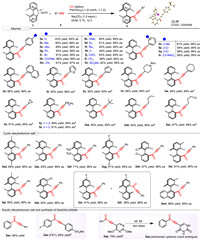
With optimal reaction conditions in hand, we next investigated the substrate scope. Under this protocol, various functionalized axial chiral ynones were afforded in generally good yields and excellent enantioselectivities (Scheme 4, 71%−96% yields, up to 99% ee). For alkynes, substituted phenylacetylenes were firstly tested. The reaction of para-, meta-, and ortho-substituted phenylacetylenes, no matter it is electron-withdrawing group (F, Cl, Br, CN, etc.) or electron-donating group (Me, OMe, Bu, etc.) substituted, all proceeded well and afforded the corresponding ynones in good results (3a-3q, e.g., 3b vs. 3m, 3p vs. 3q). Phenylacetylene with sensitive functional group (CHO) was well tolerated, furnishing 3j in 93% yield and 99% ee, thus providing a possibility for further functionalization. Di-substituted substrates could also successfully undergo the carbonylative alkynylation smoothly (3r). Substrates bearing naphthalenyl or thiophene were candidates under the conditions (3s-3u). Furthermore, cyclic terminal (3v-3x) and aliphatic acyclic alkynes (3y-3ac) could be introduced as substrates under this process with Pd(0) (10 mol% Pd) as metal source, where the chain lengths (3y vs. 3z) and substituents (3ac) have little effect on the results.
|
Download:
|
| Scheme 4. Synthesis of axial chiral ynones via Pd-catalyzed asymmetric carbonylative alkynylation. Reaction conditions: 1 (0.2 mmol), 2 (1.5 equiv.), Pd(OAc)2/L1 (5 mol%, 1:1.2), Na2CO3 (1.5 equiv.), DCM (0.2 mol/L, 1 mL), CO (balloon) at 0 ℃ for 12 h. Isolated yields. Enantioselectivities were determined by chiral-phase HPLC analysis. a Pd2dba3 (5 mol%) with L1 (12 mol%) was used as catalyst. | |
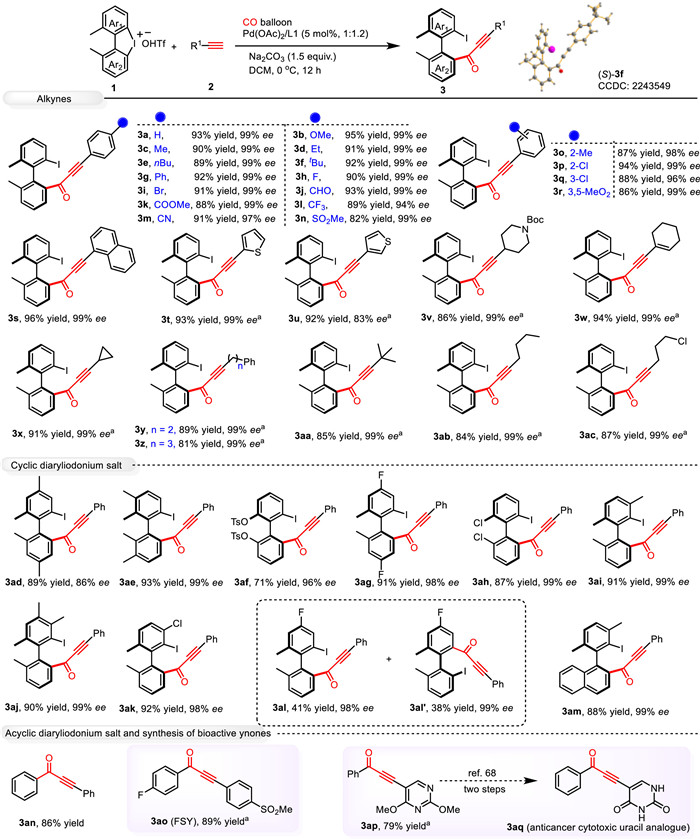
For diaryliodonium salts, symmetric substrates with methyl, F, Cl and OTs groups on aryl rings were tested and had little effects on reactivity and enantioselectivities (3ad-3ah, except 3ad with 86% ee). In the case of unsymmetric diaryliodonium salts, the C-I bond cleavage exclusively occurred at the aromatic ring with the less steric hindrance when ortho-positions of iodine were occupied (3ai-3ak, 3am). On the other hand, the C-I bond cleavage tends to slightly favor the electron-rich aromatic ring side when the meta-position of iodine was substituted by F atom (3al (41% yield) vs. 3al’ (38% yield)). Under the conditions, acyclic diaryliodonium salt (Ph2I+OTf−) was also compatible with this carbonylative alkynylation in good yield (3an). Thus, using this protocol, bioactive ynones (3ao with antiinflammatory and analgesic activities, 3ap could be further transformed to 3aq [68] that process anticancer cytotoxic activity) could be afforded from corresponding acyclic diaryliodonium salts and alkynes in good yields, indicating potential utility in drug synthesis.
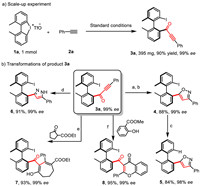
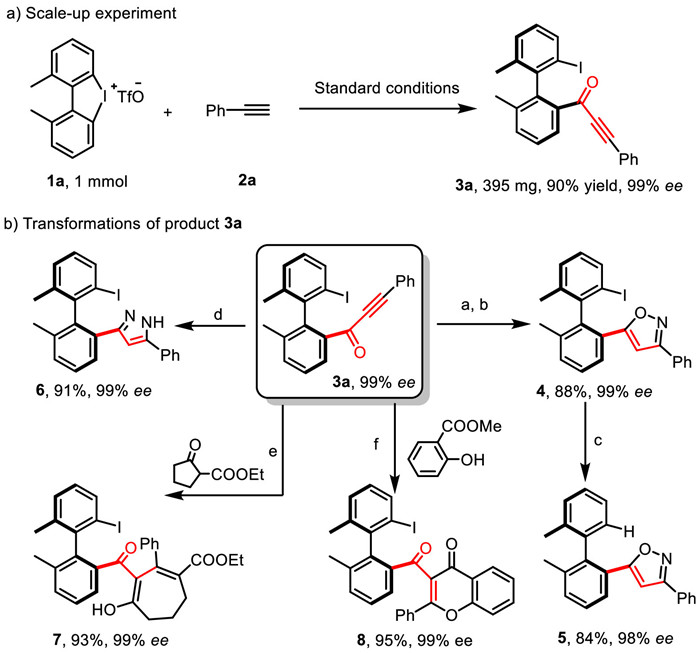
To further demonstrate the synthetic utility of this protocol, scale-up experiment and transformations of product 3a were carried out. As shown in Scheme 4, the reaction could be scale up to 1 mmol of 1a, desired product 3a was delivered with no loss in reactivity and enantio‑control (Scheme 5a, 90% yield, 99% ee). Further, derivatizations of 3a were conducted. When treating with ammonia monohydrate, conjugated ynone was converted to isoxazole 4, in which the iodine atom could be subsequently protonated to provide 5 with high efficiency. Similarly, in the presence of hydrazine hydrate, 3a could be transformed to corresponding pyrazole 6. Interestingly, 7-membered cyclic compound 7 was produced through a ring-expanding reaction of cyclopentanone derivative with ynone 3a. Moreover, compound 8 with valuable scaffold chromone, was obtained via cyclization of methyl salicylate. In general, atropisomeric ynones could be easily converted into various valuable axial chiral compounds in good efficiency and high stereospecificity (84%−95% yield, 98%−99% ee), offering more possibility for bioactive compounds discover (Scheme 5b).
|
Download:
|
| Scheme 5. Scale-up experiment and transformations of 3a. Conditions: (a) NH2OH‧H2O (8 equiv.), DMF, 50 ℃, 2 h. (b) H2SO4 (95%, 2.0 equiv.), DMF, r.t., 2 h. (c) n-BuLi (2.0 equiv.), H2O (2.0 equiv.), THF, 0 ℃~r.t., 0.5 h. (d) NH2NH2‧H2O (1.5 equiv.), DMF, r.t. (e) Cs2CO3 (1.5 equiv.), DMAc, 30 ℃, 5 h. (f) Cs2CO3 (0.2 equiv.), DMF, r.t., 12 h. | |
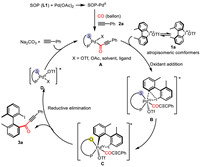
Based on our previous work [52] and control experiments, a reasonable catalytic cycle was proposed (Scheme 6). First, different from classical Pd-catalyzed carbonylative Sonogashira-type reaction, the real active intermediate acyl-Pd(Ⅱ) species A was generated from the nucleophile (CH≡CPh) and Pd complex in the presence of CO and base. Then, stereoselective oxidization by oxidative pro-chiral diaryliodonium salts 1a occurred and provided Pd(Ⅳ) species B, where the axial chirality was determined by the steric interaction between the O atom in the sulfoxide group of the chiral ligand and aryl group of 1a. Subsequently, ligand metamorphism arose between S,P-coordination with Pd(Ⅱ) and O,P-coordination with Pd(Ⅳ) [69], followed by the reductive elimination to give the corresponding product and complete the catalytic cycle.
|
Download:
|
| Scheme 6. Proposed mechanism cycle. | |
In summary, we developed the first highly efficient asymmetric Pd-catalyzed carbonylative alkynylation, in which pentacyclic diaryliodonium salts were employed as prochiral substrates to construct axial chiral ynones. Notably, control experiments were conducted to reveal this transformation undergoes a non-classical carbonylative Sonogashira-type approach. Under the mild conditions, various functionalized ynones were produced in good yields and excellent enantioselectivities (up to 96% yield, 99% ee). Moreover, synthesis of bioactive compounds, scale-up experiment and useful transformations of product were conducted to demonstrate the potential utility in synthetic chemistry.
Declaration of competing interestThe authors declare that they have no known competing financial interests or personal relationships that could have appeared to influence the work reported in this paper.
AcknowledgmentsThis work was supported financially by National Nature Science Foundation of China (No. 22171258), the Youth Innovation Promotion Association CAS (No. 2022375), the Biological Resources Programme, Chinese Academy of Sciences (No. KFJ-BRP-008) and the Sichuan Science and Technology Program (No. 2022ZYD0038).
Supplementary materialsSupplementary material associated with this article can be found, in the online version, at doi:10.1016/j.cclet.2023.109212.
| [1] |
F.A.J. Kerdesky, S.P. Schmidt, D.W. Brooks, J. Org. Chem. 58 (1993) 3516-3520. DOI:10.1021/jo00065a012 |
| [2] |
M.C. Bagley, D.D. Hughes, R. Lloyd, et al., Tetrahedron Lett. 42 (2001) 6585-6588. DOI:10.1016/S0040-4039(01)01297-7 |
| [3] |
P.N. Rao, Q.H. Chen, E.E. Knaus, J. Med. Chem. 49 (2006) 1668-1683. DOI:10.1021/jm0510474 |
| [4] |
L.F. Tietze, R.R. Singidi, K.M. Gericke, et al., Eur. J. Org. Chem. 2007 (2007) 5875-5878. DOI:10.1002/ejoc.200700534 |
| [5] |
M. Ono, H. Watanabe, R. Watanabe, et al., Bioorg. Med. Chem. Lett. 21 (2011) 117-120. DOI:10.1016/j.bmcl.2010.11.058 |
| [6] |
P. Gautam, B.M. Bhanage, ChemistrySelect 1 (2016) 5463-5470. DOI:10.1002/slct.201601266 |
| [7] |
M. Meng, G. Wang, L. Yang, et al., Adv. Synth. Catal. 360 (2018) 1218-1231. DOI:10.1002/adsc.201701469 |
| [8] |
C. Najera, L.K. Sydnes, M. Yus, Chem. Rev. 119 (2019) 11110-11244. DOI:10.1021/acs.chemrev.9b00277 |
| [9] |
Y. Maeda, N. Kakiuchi, S. Matsumura, et al., J. Org. Chem. 67 (2002) 6718-6724. DOI:10.1021/jo025918i |
| [10] |
H. Qi, S. Xu, R. Zhao, et al., J. Org. Chem. 87 (2022) 13726-13733. DOI:10.1021/acs.joc.2c01386 |
| [11] |
J. Baek, T. Si, H. Kim, et al., Org. Lett. 24 (2022) 4982-4986. DOI:10.1021/acs.orglett.2c02037 |
| [12] |
R.B. Davis, D.H. Scheiber, J. Am. Chem. Soc. 78 (1956) 1675-1678. DOI:10.1021/ja01589a050 |
| [13] |
M.W. Logue, K. Teng, J. Org. Chem. 47 (1982) 2549-2553. DOI:10.1021/jo00134a010 |
| [14] |
L. Chen, C. Li, Org. Lett. 6 (2004) 3151-3153. DOI:10.1021/ol048789w |
| [15] |
R.J. Cox, D.J. Ritson, T.A. Dane, et al., Chem. Commun. 2005 (2005) 1037-1039. DOI:10.1039/b414826f |
| [16] |
X.F. Wu, H. Neumann, M. Beller, Chem. Soc. Rev. 40 (2011) 4986-5009. DOI:10.1039/c1cs15109f |
| [17] |
S. Sumino, A. Fusano, T. Fukuyama, I. Ryu, Acc. Chem. Res. 47 (2014) 1563-1574. DOI:10.1021/ar500035q |
| [18] |
P. Gautam, B.M. Bhanage, Catal. Sci. Technol. 5 (2015) 4663-4702. DOI:10.1039/C5CY00691K |
| [19] |
C. Zhu, B. Yang, J.E. Bäckvall, J. Am. Chem. Soc. 137 (2015) 11868-11871. DOI:10.1021/jacs.5b06828 |
| [20] |
B. Yang, Y. Qiu, T. Jiang, et al., Angew. Chem. Int. Ed. 56 (2017) 4535-4539. DOI:10.1002/anie.201612385 |
| [21] |
C. Zhu, J. Liu, M.B. Li, J.E. Bäckvall, Chem. Soc. Rev. 49 (2022) 341-353. DOI:10.3390/catal12030341 |
| [22] |
L. Delaude, A.M. Masdeu, H. Alper, Synthesis 11 (1994) 1149-1151. |
| [23] |
M.S.M. Ahmed, A. Mori, Org. Lett. 5 (2003) 3057-3060. DOI:10.1021/ol035007a |
| [24] |
A.S. Karpov, E. Merkul, F. Rominger, T.J.J. Müller, Angew. Chem. Int. Ed. 44 (2005) 6951-6956. DOI:10.1002/anie.200501703 |
| [25] |
M.T. Rahman, T. Fukuyama, N. Kamata, et al., Chem. Commun. 2006 (2006) 2236-2238. DOI:10.1039/b600970k |
| [26] |
D.M. D’ Souza, T.J. Muller, Nat. Protoc. 3 (2008) 1660-1665. DOI:10.1038/nprot.2008.152 |
| [27] |
Y. Nishihara, E. Inoue, Y. Okada, K. Takagi, Synlett 2008 (2008) 3041-3045. DOI:10.1055/s-0028-1087345 |
| [28] |
J. Liu, X. Peng, W. Sun, et al., Org. Lett. 10 (2008) 3933-3936. DOI:10.1021/ol801478y |
| [29] |
A. Brennfuhrer, H. Neumann, M. Beller, Angew. Chem. Int. Ed. 48 (2009) 4114-4133. DOI:10.1002/anie.200900013 |
| [30] |
K.T. Neumann, S.R. Laursen, A.T. Lindhardt, et al., Org. Lett. 16 (2014) 2216-2219. DOI:10.1021/ol5007289 |
| [31] |
S. Wang, J. Wang, J. Ying, X. Wu, Chin. Chem. Lett. 34 (2023) 107873. DOI:10.1016/j.cclet.2022.107873 |
| [32] |
X.F. Wu, B. Sundararaju, H. Neumann, P.H. Dixneuf, M. Beller, Chem. Eur. J. 17 (2011) 106-110. DOI:10.1002/chem.201002653 |
| [33] |
P. Lagueux-Tremblay, C. Augereau, P. Nair, et al., ACS Catal. 12 (2022) 13394-13399. DOI:10.1021/acscatal.2c04493 |
| [34] |
S. Kang, K. Lim, P. Ho, W. Kim, Synthesis 8 (1997) 874-876. |
| [35] |
S. Kang, P. Ho, S. Yoon, et al., Synthesis 6 (1998) 823-825. |
| [36] |
S. Luo, Y. Liang, C. Liu, Y. Ma, Synth. Commun. 31 (2001) 343-347. DOI:10.1081/SCC-100000522 |
| [37] |
T. Zhou, Z. Chen, Synth. Commun. 32 (2002) 3431-3435. DOI:10.1081/SCC-120014772 |
| [38] |
X.F. Wu, H. Neumann, M. Beller, Angew. Chem. Int. Ed. 50 (2011) 11142-11146. DOI:10.1002/anie.201104653 |
| [39] |
Y. Wu, L. Zeng, H. Li, et al., J. Am. Chem. Soc. 143 (2021) 12460-12466. DOI:10.1021/jacs.1c06036 |
| [40] |
H. Zhao, M. Cheng, J. Zhang, M. Cai, Green Chem. 16 (2014) 2515-2522. DOI:10.1039/c3gc42278j |
| [41] |
T. Wirth, Angew. Chem. Int. Ed. 44 (2005) 3656-3665. DOI:10.1002/anie.200500115 |
| [42] |
R.D. Richardson, T. Wirth, Angew. Chem. Int. Ed. 45 (2006) 4402-4404. DOI:10.1002/anie.200601817 |
| [43] |
E.A. Merritt, B. Olofsson, Angew. Chem. Int. Ed. 48 (2009) 9052-9070. DOI:10.1002/anie.200904689 |
| [44] |
X. Peng, A. Rahim, W. Peng, et al., Chem. Rev. 123 (2023) 1364-1416. DOI:10.1021/acs.chemrev.2c00591 |
| [45] |
Z. Bao, C. Chen, Chin. Chem. Lett. 34 (2023) 107913. DOI:10.1016/j.cclet.2022.107913 |
| [46] |
B. Li, Z. Chao, C. Li, Z. Gu, J. Am. Chem. Soc. 140 (2018) 9400-9403. DOI:10.1021/jacs.8b05743 |
| [47] |
L. Duan, K. Zhao, Z. Wang, F. Zhang, Z. Gu, ACS Catal. 9 (2019) 9852-9858. DOI:10.1021/acscatal.9b03454 |
| [48] |
K. Zhu, K. Xu, Q. Fang, et al., ACS Catal. 9 (2019) 4951-4957. DOI:10.1021/acscatal.9b00695 |
| [49] |
X. Zhang, K. Zhao, N. Li, et al., Angew. Chem. Int. Ed. 59 (2020) 19899-19904. DOI:10.1002/anie.202008431 |
| [50] |
J. Ke, B. Zu, Y. Guo, et al., Org. Lett. 23 (2021) 329-333. DOI:10.1021/acs.orglett.0c03833 |
| [51] |
A. Kina, H. Miki, Y. Cho, T. Hayashi, Adv. Synth. Catal. 346 (2004) 1728-1732. DOI:10.1002/adsc.200404202 |
| [52] |
J. Han, B. Xiao, T. Sun, et al., J. Am. Chem. Soc. 144 (2022) 21800-21807. DOI:10.1021/jacs.2c10559 |
| [53] |
T. Jia, P. Cao, B. Wang, et al., J. Am. Chem. Soc. 137 (2015) 13760-13763. DOI:10.1021/jacs.5b09146 |
| [54] |
T. Jia, M. Wang, J. Liao, Top. Curr. Chem. 377 (2019) 8. DOI:10.1007/s41061-019-0232-9 |
| [55] |
Y. Liao, X. Yin, X. Wang, et al., Angew. Chem. Int. Ed. 59 (2020) 1176-1180. DOI:10.1002/anie.201912703 |
| [56] |
X. Yin, B. Chen, F. Qiu, et al., ACS Catal. 10 (2020) 1954-1960. DOI:10.1021/acscatal.9b05264 |
| [57] |
J. Ye, Y. Liao, H. Huang, et al., Chem. Sci. 12 (2021) 3032-3038. DOI:10.1039/d0sc05425a |
| [58] |
F. Ozawa, H. Soyama, H. Yanagihara, et al., J. Am. Chem. Soc. 107 (1985) 3235-3245. DOI:10.1021/ja00297a033 |
| [59] |
K. Hiwatari, Y. Kayaki, K. Okita, et al., Bull. Chem. Soc. Jpn. 77 (2004) 2237. DOI:10.1246/bcsj.77.2237 |
| [60] |
B. Gabriele, G. Salerno, L. Veltri, M. Costa, J. Organomet. Chem. 622 (2001) 84-88. DOI:10.1016/S0022-328X(00)00795-6 |
| [61] |
C. Zhang, J. Liu, C. Xia, Catal. Sci. Technol. 5 (2015) 4750-4754. DOI:10.1039/C5CY00993F |
| [62] |
Y. Dong, S. Sun, F. Yang, et al., Org. Chem. Front. 3 (2016) 720-724. DOI:10.1039/C6QO00075D |
| [63] |
J. Hwang, J. Choi, K. Park, et al., Eur. J. Org. Chem. 10 (2015) 2235-2243. DOI:10.1002/ejoc.201403644 |
| [64] |
G.K. Rathod, R. Jain, J. Org. Chem. 88 (2023) 7219-7227. DOI:10.1021/acs.joc.3c00460 |
| [65] |
X. Feng, Z. Zhao, F. Yang, et al., J. Organomet. Chem. 696 (2011) 1479-1482. DOI:10.1016/j.jorganchem.2011.01.022 |
| [66] |
S. Perrone, F. Bona, L. Troisi, Tetrahedron 67 (2011) 7386. |
| [67] |
M. Hattori, S. Yamaura, W. Zhang, W. Sakamoto, T. Yogo, Mater. Lett. 303 (2021) 130498. |
| [68] |
N.G. Kundu, B. Das, C.P. Spears, et al., J. Med. Chem. 33 (1990) 1975-1979. DOI:10.1021/jm00169a026 |
| [69] |
R.G. Pearson, J. Am. Chem. Soc. 85 (1963) 3533-3539. DOI:10.1021/ja00905a001 |