 2024, Vol. 35


As precursors of carbene, sulfoxonium ylides were effective substitutes for diazo compounds. The superior thermal stability of sulfoxonium ylides has attracted the attention of researchers. Compared with diazo compounds, sulfoxonium ylides possess significant advantages such as superior stability, easily accessibility, no-gas generation and diverse reactivity profiles [1-4]. Sulfoxonium ylides have been widely used in organic synthesis due to its unique reactivity. At present, metal-catalyzed insertion reaction [5], carbocyclic or heterocyclic formation reaction [6,7] of sulfoxonium ylides have been developed. However, to our best knowledge, the Dolye-Kirmse rearrangement of sulfoxonium ylides as carbene precursor has not been reported yet. Very recently, metal-catalyzed intramolecular [3,3]-rearrangement of sulfoxonium ylides has been reported [8]. In contrast, intermolecular rearrangement reactions of sulfoxonium ylides do not require prior complex functionalization of structures, and have not been systematically studied yet.
[2,3]-Sigmatropic rearrangement reaction has raised increasing attention as effective strategy for constructing complex compounds [9-13]. Doyle-Kirmse rearrangement reaction is an effective [2,3]-sigmatropic rearrangement reaction for the construction of C—C bonds and C—X (X = S, Se) bonds from transition metal carbenes and sulfides/selenide. Sulfides [14-17]/selenides [18-21] are wildly found in food, pharmaceuticals, and organic materials. Sulfur-containing and selenide-containing tetrasubstituted centers are challengeable to construct, yet they are valuable core structure in various biologically active molecules (Fig. 1) [22-25].

|
Download:
|
| Fig. 1. Biologically active molecules with sulfur-containing and selenide-containing tetrasubstituted center moiety. | |
It has been reported that by Doyle−Kirmse rearrangement reaction, sulfur-containing and selenide-containing tetrasubstituted centers can be obtained efficiently and conveniently in one step [26]. The initial Dolye-Kirmse rearrangement reaction is usually performed using diazo compound which is a commonly used carbene precursor in organic chemistry [10,11,13,27-35]. Under simple conditions, diazonium compounds can rapidly coordinate with transition metals to form metal carbenes in situ [36-40]. Transition metals currently play an important role in many reactions [41-45]. But diazonium compounds also have inherent problems [1,46], synthetic inconvenience and potential safety issues limited its application in large scale. Finding an effective alternative to diazo compound has become a very meaningful exploration. Although there have been attempts to react with other carbene precursors (such as conjugated ene-yne-carbonyl compounds) [47], exploring more carbene precursors is still pressingly needed (Scheme 1).

|
Download:
|
| Scheme 1. State of the art in the Doyle-Kirmse rearrangement reaction. | |
Our past researches have successfully realized the B—H insertion reaction [48] and N—H insertion reactions of sulfoxonium ylides [49,50]. We envisaged the possibility of Doyle−Kirmse rearrangement reaction using sulfoxonium ylides as starting materials, providing a straightforward approach towards sulfides/selenides containing a tetrasubstituted center.
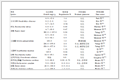
Our initial work was commenced by using sulfoxonium ylide 1a and allyl sulfide 2a as the substrates at 60 ℃ in 1,2-dichloroethane for 12 h. Different transition metals were added separately into the reaction as catalyst. The desired product 3aa was obtained only in the presence of Ir(I), Cu(I) or Rh(II) as the catalyst, and the yield was 25%, 48% and 66%, respectively (Table 1, entries 1–7). When different solvents were screened, it was found that side reactions were significantly inhibited in the DCM and the yield was increased to 73% (Table 1, entries 8–13). Although the reaction was clean enough, the conversion still did not reach the ideal goal. Extending the reaction time to 24 h did not improve the yield effectively (Table 1, entry 14), but the attempt to elevate the reaction temperature to 80 ℃ significantly increased the yield to 93% without any starting materials left (Table 1, entry 15).
|
Table 1 Optimization of the reaction conditions.a |


With the optimal reaction conditions in hand, we next evaluated the scope of the rearrangement reaction (Scheme 2). This reaction tolerated a variety of functional groups. Either electron-donating or -withdrawing groups, such as methyl, methoxy, chloro and trifluoromethyl substituted at different positions of the phenyl ring of allyl sulfides proceeded smoothly, giving the corresponding products in moderate to excellent yields (3aa−3ak). 1-Naphthalene also demonstrated good suitability to produce products in high yields (3al). The reactions with benzylic sulfides and 2-pyridyl substituted sulfides gave the corresponding products in slightly lower yields of 71% and 78%, respectively (3am-3an). The reaction of different substituted sulfoxonuim ylides with allyl(phenyl)sulfane 2a were investigated, and the products were also obtained with high yields (3ba-3ga).

|
Download:
|
| Scheme 2. Scope of sulfoxonium ylides and allyl sulfides. Reaction conditions: 1 (0.1 mmol), 2 (0.2 mmol) and Rh2(OAc)4 (5 mol%) in 2 mL of DCM for 12 h at 80 ℃ under air. Isolated yield by chromatography on silica gel. | |

As an element with excellent properties in many aspects, Se-containing compounds have been applied more and more in recent years [18-21]. To our surprise, the same condition was applied to the reaction with allyl selenide, providing the corresponding product 5aa in 90% yield. To expand the practical value of the reaction, we then investigated the different allyl selenide in this rearrangement reaction. The benzene rings of sulfoxonuim ylides and allyl selenides were modified with different substituents. It was observed that the reaction had good tolerance of both electron-donating groups and electron-withdrawing groups, as well as disubstituted groups. Under standard conditions, the rearrangement products can be obtained in moderate to excellent yields (Scheme 3, 5aa-5am, 5ba-5ga). Unfortunately, the reaction of ortho-methyl substituted sulfoxonuim ylides with allyl sulfide 2a or allyl selenide 4a did not yield the target product.

|
Download:
|
| Scheme 3. Scope of sulfoxonium ylides and allyl selenide. Reaction conditions: 1 (0.1 mmol), 4 (0.2 mmol) and Rh2(OAc)4 (5 mol%) in 2 mL of DCM for 12 h at 80 ℃ under air. Isolated yield by chromatography on silica gel. | |

To investigate the application potential of this reaction, a gram-scale reaction was performed. 4 mmol of 1a was treated with 8 mmol of 2a utilizing DCE as the solvent. After 24 h of reaction, TLC showed the complete conversion of sulfoxonium ylide. The product was purified by silica gel column with a yield of 89% (Scheme 4).

|
Download:
|
| Scheme 4. Large-scale synthesis. | |

Based on our preliminary studies and previous literature [26], we proposed the possible reaction mechanism (Scheme 5). Initially, sulfoxonium ylide reacts with Rh species and extrudes DMSO to generate the rhodium carbene complex B, which combines with allyl sulfides to form sulfur ylide. The rhodium could dissociate from intermediate C leading to a free ylide D. The ylide could then undergo a 2,3-sigmatropic rearrangement to give the rearrangement product.

|
Download:
|
| Scheme 5. Proposed mechanism. | |

In conclusion, we successfully reported the Doyle-Kirmse rearrangement reaction using sulfoxonium ylides with allyl sulfides/allyl selenides to obtain S/Se-containing compounds with a tetrasubstituted center, which has never been disclosed before. This work features excellent functional group tolerance, mild condition and high yields. This reaction expands Doyle-Kirmse rearrangement reaction with a safer and greener method by using sulfoxonium ylides in place of diazo compound. We believe this reaction may have great potentials in many aspects and wild applications.
AcknowledgmentThis work was supported by Sichuan Science and Technology Program (No. 2020YJ0221).
Supplementary materialsSupplementary material associated with this article can be found, in the online version, at doi:10.1016/j.cclet.2023.108834.
| [1] |
A. Kumar, M.S. Sherikar, V. Hanchate, K.R. Prabhu, Tetrahedron 101 (2021) 132478. DOI:10.1016/j.tet.2021.132478 |
| [2] |
A.M. Phelps, V.S. Chan, J.G. Napolitano, et al., J. Org. Chem. 81 (2016) 4158-4169. DOI:10.1021/acs.joc.6b00497 |
| [3] |
D. Clare, B.C. Dobson, P.A. Inglesby, C. Aissa, Angew. Chem. Int. Ed. 58 (2019) 16198-16202. DOI:10.1002/anie.201910821 |
| [4] |
M. He, Y. Chen, Y. Luo, et al., Green. Synth. Catal. 1 (2020) 180-182. DOI:10.1016/j.gresc.2020.10.004 |
| [5] |
W.B. Ma, Y.Q. Tan, Y. Wang, et al., Org. Lett. 23 (2021) 6200-6205. DOI:10.1021/acs.orglett.1c01684 |
| [6] |
P.Y. Ushakov, S.L. Loffe, A.Y. Sukhorukov, Org. Chem. Front. 9 (2022) 5358-5382. DOI:10.1039/D2QO00698G |
| [7] |
J.X. Pian, Q.Q. Chen, Y.J. Luo, et al., Org. Lett. 24 (2022) 5641-5645. DOI:10.1021/acs.orglett.2c01724 |
| [8] |
D.K. Gopalakrishnan, S. Panigrahi, R. Sen, J. Vaitla, Org. Lett. 25 (2023) 1519-1524. DOI:10.1021/acs.orglett.3c00303 |
| [9] |
Y. Zhang, J.B. Wang, Coord. Chem. Rev. 254 (2010) 941-953. DOI:10.1016/j.ccr.2009.12.005 |
| [10] |
W. Kirmse, M. Kapps, Chem. Ber. 101 (1968) 994-1003. DOI:10.1002/cber.19681010333 |
| [11] |
M.Y. Liao, J.B. Wang, Green Chem. 9 (2007) 184-188. DOI:10.1039/B612743F |
| [12] |
W. Pang, S.F. Zhu, H.F. Jiang, S.Z. Zhu, Tetrahedron 63 (2007) 4543-4547. DOI:10.1016/j.tet.2007.03.050 |
| [13] |
R. Hommelsheim, Y.J. Guo, Z. Yang, C. Empel, R.M. Koenigs, Angew. Chem. Int. Ed. 58 (2019) 1203-1207. DOI:10.1002/anie.201811991 |
| [14] |
A.K. Steiger, Y. Zhao, M.D. Pluth, Antioxid. Redox Signal. 28 (2018) 1516-1532. DOI:10.1089/ars.2017.7119 |
| [15] |
B.L. Oliveira, Z. Guo, G.J.L. Bernardes, Chem. Soc. Rev. 46 (2017) 4895-4950. DOI:10.1039/C7CS00184C |
| [16] |
H. van Goor, J.C. van den Born, J.L. Hillebrands, J.A. Joles, Curr. Opin. Nephrol. Hypertens. 25 (2016) 107-113. DOI:10.1097/MNH.0000000000000206 |
| [17] |
Y. Mikhlin, V. Nasluzov, A. Ivaneeva, et al., Mater. Chem. Phys. 255 (2020) 123600. DOI:10.1016/j.matchemphys.2020.123600 |
| [18] |
B. Lonnerdal, E. Vargas-Fernandez, M. Whitacre, Food Funct. 8 (2017) 3856-3868. DOI:10.1039/C7FO00746A |
| [19] |
R. Mousa, R.N. Dardashti, N. Metanis, Angew. Chem. Int. Ed. 56 (2017) 15818-15827. DOI:10.1002/anie.201706876 |
| [20] |
J. Li, B.X. Shen, S.L. Nie, Z.H. Duan, K.S. Chen, et al., Carbohydr. Polym. 206 (2019) 163-173. DOI:10.1016/j.carbpol.2018.10.088 |
| [21] |
N. Bomer, N.G. Beverborg, M.F. Hoes, A A, Eur. J. Heart Fail. 22 (2020) 1415-1423. DOI:10.1002/ejhf.1644 |
| [22] |
T. Zhao, J. Zhang, Y.C. Tao, et al., J. Med. Chem. 65 (2022) 4218-4237. DOI:10.1021/acs.jmedchem.1c02057 |
| [23] |
S. Miyata, N. Ohhata, H. Murai, et al., J. Antibiot. 45 (1992) 1029-1040. DOI:10.7164/antibiotics.45.1029 |
| [24] |
H. Hwang, H. Choi, S.J. Nam, et al., Bull. Korean Chem. Soc. 32 (2011) 4089-4091. DOI:10.5012/bkcs.2011.32.11.4089 |
| [25] |
Y.J. Park, M. Koketsu, J.M. Kim, et al., Biol. Pharm. Bull. 26 (2003) 1657-1660. DOI:10.1248/bpb.26.1657 |
| [26] |
L. Wu, Z.M. Li, P. Lu, Y.G. Wang, J. Org. Chem. 83 (2018) 13956-13964. DOI:10.1021/acs.joc.8b02307 |
| [27] |
M.P. Doyle, W.H. Tamblyn, V. Bagheri, J. Org. Chem. 46 (1981) 5094-5102. DOI:10.1021/jo00338a008 |
| [28] |
C.Y. Zhou, W.Y. Yu, P.W.H. Chan, C.M. Che, J. Org. Chem. 69 (2004) 7072-7082. DOI:10.1021/jo049540v |
| [29] |
J.H. Yang, J.Z. Wang, H.T. Huang, et al., Org. Lett. 21 (2019) 2654-2657. DOI:10.1021/acs.orglett.9b00647 |
| [30] |
Z.Z. Yu, Y.F. Li, J.M. Shi, et al., Angew. Chem. Int. Ed. 55 (2016) 14807-14811. DOI:10.1002/anie.201608937 |
| [31] |
P. Schwab, M.B. France, J.W. Ziller, R.H. Grubbs, Angew. Chem. Int. Ed. 34 (1995) 2039-2041. DOI:10.1002/anie.199520391 |
| [32] |
S.F. Zhu, C. Chen, Y. Cai, Q.L. Zhou, Angew. Chem. Int. Ed. 47 (2008) 932-934. DOI:10.1002/anie.200704651 |
| [33] |
M. Basato, C. Tubaro, A. Biffis, et al., Chem. Eur. J. 15 (2009) 1516-1526. DOI:10.1002/chem.200801211 |
| [34] |
G.K. Murphy, F.Z. Abbas, A.V. Poulton, Adv. Synth. Catal. 356 (2014) 2919-2923. DOI:10.1002/adsc.201400581 |
| [35] |
X. Tian, X. Xu, T. Jing, Z. Kang, W. Hu, Green. Synth. Catal. 2 (2021) 337-344. DOI:10.1016/j.gresc.2021.10.007 |
| [36] |
X. Zhang, H.X. Huang, X. Guo, et al., Angew. Chem. Int. Ed. 47 (2008) 6647-6649. DOI:10.1002/anie.200801510 |
| [37] |
H.Y. Thu, G.S.M. Tong, J.S. Huang, et al., Angew. Chem. Int. Ed. 47 (2008) 9747-9751. DOI:10.1002/anie.200803157 |
| [38] |
Z.S. Chen, X.H. Duan, P.X. Zhou, et al., Angew. Chem. Int. Ed. 51 (2012) 1370-1374. DOI:10.1002/anie.201106619 |
| [39] |
Y.Z. Zhang, S.F. Zhu, L.X. Wang, Q.L. Zhou, Angew. Chem. Int. Ed. 47 (2008) 8496-8498. DOI:10.1002/anie.200803192 |
| [40] |
J.R. Combs, Y.C. Lai, D.L. Van Vranken, Org. Lett. 23 (2021) 2841-2845. DOI:10.1021/acs.orglett.1c00229 |
| [41] |
D. Wen, J. Chen, Q. Zheng, S. Yang, T. Tu, CCS Chem. 5 (2023) 1602-1611. DOI:10.31635/ccschem.022.202202233 |
| [42] |
C. Qian, Q. Zheng, J. Chen, B. Tu, T. Tu, Green Chem. 25 (2023) 1368-1379. DOI:10.1039/D2GC04195B |
| [43] |
Y.X. Tan, X.Y. Liu, S.Q. Zhang, et al., CCS Chem. 3 (2021) 1582-1595. DOI:10.31635/ccschem.020.202000339 |
| [44] |
C.X. Liu, Z.J. Cai, Q. Wang, et al., CCS Chem. 2 (2020) 642-651. |
| [45] |
D. Wang, Y. Zhao, C. Yuan, et al., Angew. Chem. Int. Ed. 58 (2019) 12529-12533. DOI:10.1002/anie.201906975 |
| [46] |
P. Sivaguru, X.H. Bi, Sci. China Chem. 64 (2021) 1614-1629. DOI:10.1007/s11426-021-1052-7 |
| [47] |
Y. Kato, K. Miki, F. Nishino, K. Ohe, S. Uemura, Org. Lett. 5 (2003) 2619-2621. DOI:10.1021/ol034731q |
| [48] |
J.L. Li, H. He, M.Y. Huang, et al., Org. Lett. 21 (2019) 9005-9008. DOI:10.1021/acs.orglett.9b03410 |
| [49] |
Y.Y. Xu, X. Huang, G.H. Lv, et al., Eur. J. Org. Chem. 2020 (2020) 4635-4638. DOI:10.1002/ejoc.202000716 |
| [50] |
H. He, K.C. Yan, J.L. Li, et al., Synthesis-Stuttgart 52 (2020) 3065-3070. |