 2024, Vol. 35


b Key Laboratory of Photochemistry, Institute of Chemistry, Chinese Academy of Sciences, Beijing 100190, China;
c University of Chinese Academy of Sciences, Beijing 100049, China
It has been continued endeavors of researchers to develop stimuli-responsive optical materials for smart display, optical storage and counterfeiting. Great efforts have been placed on photochromic chromophores that present absorption or emission color changes through stimuli-induced chemical structure transformation [1]. Alternatively, the approach of electrophoretic ink which switches between black and white by applying an electric field to shift the ink position, has also played a role in display technology and been commercialized in electronic books achieving mass market success [2,3]. From the perspective of stimuli-responsive luminescence, it is attractive to develop electrophoretic luminescence ink by merging the advantage of being electronic devices and the diversity of luminescence materials [4]. In our continuing exploration of functional triplet-triplet annihilation upconversion (TTA-UC) materials [5–7], we speculated that developing TTA-UC materials with electrophoretic response would provide new opportunities for advanced photonic applications.
TTA-UC is a technology that converts low-energy photons into high-energy photons and has great potentials for a wide range of applications [8–11], such as photovoltaics [12–14], photocatalysis [15,16], biological imaging [17,18] and chiral luminescent materials [19–21]. In addition, upconversion can also be used for biosensing and chemosensing through stimuli response [22,23], which is TTA-UC switching by responding to external stimuli such as temperature [24–27], oxygen [28,29], electric field [30,31] and mechanical force [32] to achieve these applications. Among them, applying an electrical signal is a fast and simple stimulus to achieve TTA-UC switching [30]. TTA process is highly dependent on the triplet concentration of annihilators which provides an opportunity to be steered by external stimuli. In this study, we developed an electric filed response TTA-UC combination using an ionic derivative of 9, 10-diphenyl anthracene (DPA) as the annihilator and Pt(Ⅱ) octaethylporphyrin (PtOEP) as the photosensitizer. Positively charged DPA derivatives migrate toward the cathode and enrich there in the presence of an electric field, generating the imbalanced distribution of the DPA annihilator between the electrodes and resulting the spatial distribution of TTA-UC emission upon electrophoretic actuation. The electrophoretic actuation of TTA-UC material is reversible and a prototype of TTA-UC ink for write and erase is also demonstrated.
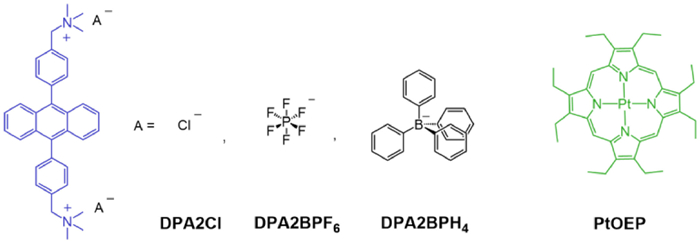
The ionic annihilators were prepared by modifying DPA with ammonium group on the phenyl rings, followed by anion exchange (Scheme S1 in Supporting information). The ionic annihilators of DPA2Cl, DPA2BPF6 and DPA2BPH4 with anion Cl−, PF6− and tetraphenylborate (BPH4−) (Fig. 1), respectively, were characterized by 1H NMR, 13C NMR, MALDI-MS and FTIR spectra (Figs. S1–S6 in Supporting information). The similar absorption, photoluminescence spectra and fluorescence decay of the three annihilators indicate that counter ions have little effect on the photophysics of the annihilator (Figs. S7 and S8 and Table S1 in Supporting information). The electrophoretic response of the ionic annihilators was examined by monitoring the fluorescence intensity change upon applying an electric field. Two platinum electrodes were kept 10 mm apart and immersed in the CH3CN solutions of the three ionic annihilators (20 µmol/L), respectively (Fig. S9 in Supporting information). The annihilator solution showed homogeneous blue fluorescence under 365 nm excitation in the absence of electric field. When a voltage of 10 V was applied, the emission of the solution near the cathode gradually increased while the decreasing intensity near the anode steadily decreased. The phenomenon can be attributed to the movement of positively charged DPA chromophores toward the cathode in the presence of an electric field. The distribution of bright and dark areas in DPA2BPH4 sample is more uniform in comparison to the other two annihilators. This is probably because BPH4− is less basic and has a lower charge density, which makes it easier to separate from the cationic DPA chromophore [33]. Therefore, DPA2BPH4 was selected as the representative annihilator for the following electrophoretic experiments. The applied voltage was optimized with trials at 2, 4, 6, 8, and 10 V. It was found that the higher the applied voltage, the faster the DPA electrophoretic response. Therefore, a voltage of 10 V is applied in the following experiments. The compounds and the ITO glass were not degraded during the test (vide infra).

|
Download:
|
| Fig. 1. Structures of the ionic annihilators and the sensitizer. | |
The electrophoretic response of the annihilator is reversible. When the electric field is turned off, the bright and dark separation disappears and the homogeneous blue emissive solution reappears. The emission intensity distribution is flipped while the applied voltage is inverted (Fig. 2 and Movie S1 in Supporting information). The emission regulation by the electric field was further monitored by photoluminescence spectra from the cathode and anode region before and after applying the voltage, respectively (Fig. 2b). There was about 40% increase in the cathode area and a 25% decrease in the anode area as a result of the electrophoretic shift of DPA chromophores. The absorption, emission, and mass spectra (Figs. S10 and S11 in Supporting information) of DPA2BPH4 did not show obvious change before and after the electrophoretic test, indicating that the chromophore did not undergo chemical transformation. Therefore, the electrophoresis-induced concentration or dilution of DPA2BPH4 provides the potential for further TTA-UC manipulation.

|
Download:
|
| Fig. 2. (a) Schematic illustration of ion migration upon voltage stimulation, and the photographs of electrochromic fluorescence of DPA2BPH4 (20 µmol/L) in CH3CN (λex = 365 nm). (b) Emission spectra of DPA2BPH4 near cathode and anode after applying voltage, together with or without the electric field. | |

A typical sensitizer, PtOEP, was combined with DPA2BPH4 to construct the electric field-responsive TTA-UC system. The individual absorption and emission spectra of DPA2BPH4 and PtOEP in acetonitrile are depicted in Fig. S12 (Supporting information). Upon selectively exciting PtOEP of the TTA-UC system by 532 nm light, the phosphorescence of PtOEP was significantly quenched by DPA2BPH4, accompanied by the appearance of typical upconverted emission from the DPA chromophore. The upconverted emission increased while the phosphorescence of PtOEP decreased as the DPA2BPH4 concentration increased, clearly demonstrating concentration-dependent TTA upconversion. The upconversion emission and quantum yield reached a plateau with DPA2BPH4 of greater than 200 µmol/L (Figs. S13 and S14 in Supporting information). When a voltage of 10 V was applied, the luminescence near the anode turned red and the blue emission near the cathode intensified under the radiation of 365 nm light (Fig. 3a), and a clear boundary in the middle between to electrode appeared. The emission change is attributed to the electrophoretic shift of the cationic DPA chromophores toward the cathode, leading to more quenching of the phosphorescence of PtOEP. The applied voltage had no effect on the phosphorescence distribution in the control experiment with only PtOEP (Figs. S15 and S16 in Supporting information), further confirming that the emission change resulted from the electrophoresis of DPA2BPH4. The effect of electric field on the upconversion emission was observed under the excitation with a 532 nm laser (200 mW/cm2). The emission of TTA-UC solution presented the superposition of the blue upconversion emission and the red phosphorescence of PtOEP, which was visible as magenta emission. The DPA2BPH4/PtOEP system displays a prolonged upconverted emission lifetime of 17 µs in contrast to DPA2BPH4 directly excited by UV laser (5.2 ns, Fig. S8), which is characteristic of delayed fluorescence arising from TTA of the long-lived triplet (Fig. S17 in Supporting information). In the absence of electric field, the upconversion emission and the phosphorescence seen behind a 470 nm and a 660 nm bandpass filter, respectively, were even along the laser pathway (Fig. 3b). After applying the electric field, the upconversion emission near the cathode became more intense while the phosphorescence near the anode became more evident. The mixed color in the corresponding area seen with the naked eye changed as well. The emission spectra collected in the cathode areas gave a ca. 20% increase of upconversion emission and a decrease of phosphorescence under the electric field, whereas the anode area showed the opposite change (Fig. 3c). In the absence of electric field, the QY of the DPA2BPH4 (60 µmol/L)/PtOEP (10 µmol/L) is 1.16%. After applying the voltage, the quantum yields in the cathode and the anode region are estimated to be 1.43% and 0.87%, respectively, based on the percentage of the emission enhancement and reduction.

|
Download:
|
| Fig. 3. (a) Photographs of luminescence change process of PtOEP and DPA2BPH4 in CH3CN within 1 min after applying a voltage of 10 V (λex = 365 nm). (b) Photos of TTA-UC solution taken under excitation 532 nm laser (200 mW/cm2) before and after applying a voltage of 10 V. (c) Normalized emission spectra measured in the anode and cathode regions before and after applying a voltage of 10 V, respectively. | |

We further developed a prototype of electric write-and-erase demonstration based on the aforementioned electrophoretic response of TTA-UC system. A quasi-solid TTA-UC system was prepared by mixing DPA2BPH4, PtOEP, DMSO and silica nanoparticles [34–36] and the immobilization of the annihilator and the sensitizer had no effect on the luminescence distribution compared to that in solution state (Fig. S18 in Supporting information). DMSO and quasi-solid matrix guarantee the TTA-UC is not inactivated by oxygen [37,38]. The quasi-solid TTA-UC showed the same electrophoretic response as the solution sample (Fig. S19 in Supporting information), indicating that the gel-like material did not inhibit the electrophoresis of the annihilator [39]. Then an upconversion device for electrical write-and-erase was developed by coating the quasi-solid TTA-UC film on indium-tin oxide (ITO) glass connected to the anode. A movable Pt needle connected to the cathode was used as a pen (Fig. 4a). As the Pt pen contacts the TTA-UC film and moves, an electric field is applied between the pen and the ITO glass which causes the electrophoresis of the annihilator and consequently record the trace of the Pt pen. When the voltage is reversed, the recorded trace can be erased by the Pt pen (Fig. 4a). As shown in Fig. 4b, a letter 'L' has been written onto the TTA-UC film which is visible as a blue pattern under UV light and 532 nm laser (245 mW/cm2). The intense blue fluorescence of DPA chromophore masks the red phosphorescence of PtOEP under UV irradiation, since the emission quantum yield and concentration of DPA chromophore are much higher than that of PtOEP. The thin film made of only the annihilator showed the "L" letter under UV irradiation but no image upon 532 nm excitation. The thin film with only PtOEP had no active response toward the electrically writing or photoluminescence readout. The demonstration provides a possible approach for electrophoretic display and information encryption.

|
Download:
|
| Fig. 4. (a) An illustration of the electrical recording device and the photos of the quasi-solid film based on electrophoretic upconversion emission, showing handwritten letters "TTA" under 532 nm excitation. (b) The photographs taken under 532 or 365 nm excitation of the letter "L" written under a voltage of 10 V on different electrophoretic films consisting of DPA2BPH4/PtOEP, DPA2BPH4 and PtOEP, respectively. | |

In summary, we have developed an electrophoretic upconversion system capable of reversible modulation under electric field, allowing a fast-response luminescent write-and-erase. Under the electric field, the positively charged annihilator molecules are driven to enrich near the cathode, resulting in localized upconversion emission enhancement. Experiment shows that the electrophoresis of the annihilator leads to an increase of approximately 20% in the upconverted emission from the cathode region. This electrophoretic upconverted emission is reversible. The TTA-UC material has been utilized to fabricate a fast-response electrophoretic ink that enables erasable handwriting under electric field modulation, which shows electrophoretically responsive upconversion feature. This electrophoretic upconversion system provides a potential way for the fabrication of new materials for applications in information encryption and electrophoretic display devices.
Declaration of Competing InterestThe authors declare that they have no known competing financial interests or personal relationships that could have appeared to influence the work reported in this paper.
AcknowledgmentWe are grateful for the financial support from the National Natural Science Foundation of China (Nos. 22273117, 22273110 and 22090012).
Supplementary materialsSupplementary material associated with this article can be found, in the online version, at doi:10.1016/j.cclet.2023.109009.
| [1] |
Y. Ma, Y.X. Yu, J.G. Li, et al., InfoMat 3 (2021) 82-100. DOI:10.1002/inf2.12125 |
| [2] |
B. Comiskey, J.D. Albert, H. Yoshizawa, J. Jacobson, Nature 394 (1998) 253-255. DOI:10.1038/28349 |
| [3] |
L.Q. Chang, F. Chen, X.K. Zhang, et al., ACS Appl. Mater. Int. 9 (2017) 16553-16560. DOI:10.1021/acsami.7b03890 |
| [4] |
Y.M. Wu, J.H. Xu, X. Qin, J. Xu, X.G. Liu, Nat. Commun. 12 (2021) 1. DOI:10.1038/s41467-020-20314-w |
| [5] |
W.X. Yin, T.J. Yu, J.P. Chen, et al., ACS Appl. Mater. Int. 13 (2021) 57481-57488. DOI:10.1021/acsami.1c19181 |
| [6] |
G.W. Luo, Y.Q. Chen, Y. Zeng, et al., J. Phys. Chem. Lett. 12 (2021) 9525-9530. DOI:10.1021/acs.jpclett.1c02717 |
| [7] |
G.W. Luo, Y.P. Liu, Y. Zeng, et al., J. Mater. Chem. C 10 (2022) 8596-8601. DOI:10.1039/D2TC00766E |
| [8] |
T.N. Singh-Rachford, F.N. Castellano, Coord. Chem. Rev. 254 (2010) 2560-2573. DOI:10.1016/j.ccr.2010.01.003 |
| [9] |
J. Zhou, Q. Liu, W. Feng, Y. Sun, F.Y. Li, Chem. Rev. 115 (2015) 395-465. DOI:10.1021/cr400478f |
| [10] |
Y. Zeng, J.P. Chen, T.J. Yu, G.Q. Yang, Y. Li, ACS Energy Lett. 2 (2017) 357-363. DOI:10.1021/acsenergylett.6b00652 |
| [11] |
C. Gao, W.W.H. Wong, Z.S. Qin, et al., Adv. Mater. 33 (2021) e2100704. DOI:10.1002/adma.202100704 |
| [12] |
Y.Y. Cheng, B. Fückel, R.W. MacQueen, et al., Energy Environ. Sci. 5 (2012) 6953-6959. DOI:10.1039/c2ee21136j |
| [13] |
A. Monguzzi, D. Braga, M. Gandini, et al., Nano Lett. 14 (2014) 6644-6650. DOI:10.1021/nl503322a |
| [14] |
T. Dilbeck, K. Hanson, J. Phys. Chem. Lett. 9 (2018) 5810-5821. DOI:10.1021/acs.jpclett.8b02635 |
| [15] |
T. Yu, Y. Liu, Y. Zeng, et al., Chem. Eur. J. 25 (2019) 16270-16276. DOI:10.1002/chem.201904025 |
| [16] |
B.D. Ravetz, A.B. Pun, E.M. Churchill, et al., Nature 565 (2019) 343-346. DOI:10.1038/s41586-018-0835-2 |
| [17] |
Q. Liu, T. Yang, W. Feng, F. Li, J. Am. Chem. Soc. 134 (2012) 5390-5397. DOI:10.1021/ja3003638 |
| [18] |
B. Iyisan, R. Thiramanas, N. Nazarova, et al., Biomacromolecules 21 (2020) 4469-4478. DOI:10.1021/acs.biomac.0c00377 |
| [19] |
D. Yang, J.L. Han, Y.T. Sang, et al., J. Am. Chem. Soc. 143 (2021) 13259-13265. DOI:10.1021/jacs.1c05927 |
| [20] |
X.J. Qin, J.L. Han, D. Yang, et al., Chin. Chem. Lett. 30 (2019) 1923-1926. DOI:10.1016/j.cclet.2019.04.035 |
| [21] |
L.X. Liu, J.P. Chen, T.J. Yu, et al., Chin. Chem. Lett. 34 (2023) 107649. DOI:10.1016/j.cclet.2022.06.072 |
| [22] |
N. Yanai, N. Kimizuka, Angew. Chem. Int. Ed. 59 (2020) 10252-10264. DOI:10.1002/anie.202001325 |
| [23] |
X. Xiao, W. Tian, M. Imran, H.M. Cao, J.Z. Zhao, Chem. Soc. Rev. 50 (2021) 9686-9714. DOI:10.1039/D1CS00162K |
| [24] |
G. Massaro, J. Hernando, D. Ruiz-Molina, C. Roscini, L. Latterini, Chem. Mater. 28 (2016) 738-745. DOI:10.1021/acs.chemmater.5b03532 |
| [25] |
D.C. Thévenaz, A. Monguzzi, D. Vanhecke, et al., Mater. Horiz. 3 (2016) 602-607. DOI:10.1039/C6MH00290K |
| [26] |
N. Nazarova, Y. Avlasevich, K. Landfester, S. Baluschev, ChemPhotoChem 3 (2019) 1020-1026. DOI:10.1002/cptc.201900093 |
| [27] |
L. Li, C. Zhang, L. Xu, et al., Angew. Chem. Int. Ed. 60 (2021) 26725-26733. DOI:10.1002/anie.202110830 |
| [28] |
W. Wu, J. Sun, S. Ji, et al., Dalton Trans. 40 (2011) 11550-11561. DOI:10.1039/c1dt11001b |
| [29] |
S.M. Borisov, C. Larndorfer, I. Klimant, Adv. Funct. Mater. 22 (2012) 4360-4368. DOI:10.1002/adfm.201200794 |
| [30] |
K. Börjesson, P. Rudquist, V. Gray, K. Moth-Poulsen, Nat. Commun. 7 (2016) 12689. DOI:10.1038/ncomms12689 |
| [31] |
X. Yang, M. Zhou, Y. Wang, P. Duan, Adv. Mater. 32 (2020) 2000820. DOI:10.1002/adma.202000820 |
| [32] |
D. Yildiz, C. Baumann, A. Mikosch, et al., Angew. Chem. Int. Ed. 58 (2019) 12919-12923. DOI:10.1002/anie.201907436 |
| [33] |
Y. Ma, S.J. Liu, H.R. Yang, et al., Inorg. Chem. 56 (2017) 2409-2416. DOI:10.1021/acs.inorgchem.6b02319 |
| [34] |
H. Sun, S. Liu, W. Lin, et al., Nat. Commun. 5 (2014) 3601. DOI:10.1038/ncomms4601 |
| [35] |
S. Guo, T. Huang, S. Liu, et al., Chem. Sci. 8 (2017) 348-360. DOI:10.1039/C6SC02837C |
| [36] |
Q. Zhao, W.J. Xu, H.B. Sun, et al., Adv. Opt. Mater. 4 (2016) 1167-1173. DOI:10.1002/adom.201600065 |
| [37] |
M.A. Filatov, S. Baluschev, K. Landfester, Chem. Soc. Rev. 45 (2016) 4668-4689. DOI:10.1039/C6CS00092D |
| [38] |
S.G. Wan, W. Lu, Angew. Chem. Int. Ed. 56 (2017) 1784-1788. DOI:10.1002/anie.201610762 |
| [39] |
P. Wang, S.M. Zakeeruddin, P. Comte, et al., J. Am. Chem. Soc. 125 (2003) 1166-1167. DOI:10.1021/ja029294+ |