 2024, Vol. 35


b State Key Laboratory of Organometallic Chemistry, Shanghai Institute of Organic Chemistry, Chinese Academy of Sciences, Shanghai 200032, China;
c School of Chemistry and Environmental Engineering, Changchun University of Science and Technology, Changchun 130012, China
Catalytic conjugate addition of nucleophiles to electron-deficient olefins has been regarded as one of the most important C–C or C–heteroatom bonds formations methodologies in the modern organic synthesis [1–6]. A myriad of catalytic systems have been well established toward aldehyde, ketone, ester, sulfone, nitrile or nitro-activated alkenes in the past decades and have also been frequently used as key steps in the construction of natural products and bioactive molecules [7–11]. In sharp contrast to these significant advances, the applications of such approaches to carboxamide-activated alkenes remain an ongoing challenge, owing to its intrinsically low electrophilicity. As a matter of fact, the lone pair on nitrogen significant delocalization leads to the orbital overlap with the antibonding, thereby making carboxamide the least electron-deficient carboxylic acid derivative (Scheme 1a) [12]. Moreover, the significant decrease in reactivity associated with sterically hindered β-substituted alkenyl amides further exacerbates the challenge in this domain. As a consequent, the development of corresponding conjugate addition reaction, in particular for β-substituted enamides which represent one class of the most challenging substrates, remains extremely sluggish [13]. In spite of such, some ingenious approaches through introduction of an extra activating group to enhance the reactivity or utilizing some specific alkenyl carboximide substrates, have also been recently disclosed to achieve corresponding conjugate addition with nucleophiles (Scheme 1b) [14–18]. In addition to these methods of increasing the reactivity of enamide partner, another commonly adopting approach is the use of high reactivity of nucleophiles, typically organometallic reagent (e.g., Grignard reagents, organolithium reagents, etc.) [12,13,19]. Despite these elegant approaches, the requirement of preinstallation and subsequent deprotection of stoichiometric quantities of activating auxiliaries or using poor compatibility of organometallics are usually required. Recently, Zhu, Wang et al. have developed NiH-catalyzed regio-reversed, amide-directed asymmetric hydroalkylation and hydroalkynylation of carboxamides, providing intriguing approaches to access β-chiral amides [20,21]. Consequently, exploitation of an economic, sustainable approach to achieve corresponding conjugate addition of common β-substituted alkenyl amides, still constitutes a daunting, so far unsolved challenge, but a highly desirable endeavor.

|
Download:
|
| Scheme 1. Catalytic addition toward alkenyl-substituted carboxamides. | |
Taking advantage of readily available unsaturated hydrocarbons as the surrogates of highly reactive organometallics is an emerging, promising tactics. Because such methodology showcased some unique advantages: 1) using readily available and bench-stable unsaturated hydrocarbons as feedstocks, 2) overcoming the drawbacks associated with traditional organometallics, 3) the ability to modulate reactivity of in-situ formed organometallic intermediates by changing the supporting ligand on metal. In this territory, many impressive transformations through using unsaturated hydrocarbons as the potential nucleophiles to couple with various electrophiles (e.g., ketones, aldehydes, imines, allyl or alkyl electrophiles, (hetero)aryl electrophiles, nitriles, CO2, etc.) by feat of CuH catalysis have been successfully showcased by the groups of Buchwald, Yun, You, Li, Yu and others [22–32]. Our group has also developed some CuH-catalyzed conversions of various unsaturated hydrocarbons with allyl electrophiles, ketones and polyfluoroarenes in the past few years [33–36]. Quite recently, we have successfully achieved the conjugate addition of alkenyl-substituted heteroarenes, one of the most challenging Michael acceptors, with alkenes as the latent nucleophiles under CuH catalysis [37]. In spite of these impressive advances, the corresponding transformations with enamides as the Michael acceptors remains elusive. Inspired by these progresses, we wondered that whether the challenging conjugate addition toward alkenyl carboxamide can be addressed by virtue of CuH chemistry. As described in Scheme 1c, in accordance with previous CuH catalysis [38–41], the insertion of the allene into the ligated CuH species Ⅰ could form the allyl copper intermediate Ⅱ in situ, which would be likely to rapidly isomerize to allyl copper species Ⅲ. Then, a highly regioselective addition of the allyl copper intermediate to unsaturated amides occurred, offering the copper alkoxide Ⅳ, followed by a metathesis with hydrosilane rapidly regeneration of LCuH catalyst, concomitantly affording the silyl enol ether. Finally, the expected product was generated by hydrolysis. However, some problematic issues, such as the chemoselective insertion of CuH catalyst into unsaturated hydrocarbons or enamides, the uncontrollable regioselectivity control, as well as the strong coordination of carboxamide to poison the transition metal, might potentially complicate the implementation of the proposed blueprint. Herein, we reported the successfully implementing first example of CuH-catalyzed conjugate addition of allene-derived nucleophiles to common β-substituted alkenyl amides by carefully screening ligand. This method allows direct the use of as allene as the potential nucleophiles and simple, common β-substituted alkenyl amides as the starting materials, without requirement of preinstallation an extra activating group and highly reactive organometallics.
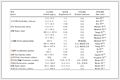
The investigation began with the conjugate addition reaction between 1,1-disubstituted allene 1a and α,β-unsaturated amide 2a in the presence of Dcype as ligand (6 mol%) and Cu(OAc)2 (5 mol%) as catalyst at room temperature, to our delight, providing the desired product 3a in 45% yield with high regioselectivity ratio (rr > 15:1) (Table 1, entry 1). Increasing the amount of catalyst and ligand found that the yield can be significantly improved up to 92% yield, and meanwhile maintains excellent level of rr (Table 1, entry 2). Further screening of solvents indicated that THF was the optimal solvent (Table 1, entries 3–5). The subsequent examination of different silanes showed that TMDS provided better results than DMMS, PhSiH3, PMHS and (EtO)3SiH (Table 1, entries 6–9). It should be noticed that the yield of desired product 3a decreased to 48% by using Dppbz as ligand (Table 1, entry 10). Likewise, replacement of Dcype with other ligands such as bidentate ligands Xantphos, Dppf and monodentate phosphine ligands PPh3 and PCy3, 3a could not be detected (Table 1, entries 11–14).
|
Table 1 Optimization of reaction conditions.a,b. |


With the optimized conditions established, we proceeded to examine the substrate scope of this conjugate addition of unsaturated amides. As indicated in Scheme 2, a range of substituted 1,1-disubstituted allenes 1 were found to be suitable substrates under the optimal reaction conditions. For instance, a variety of electron-donating or electron-withdrawing substituents on the aromatic rings of the allenes, including alkyl (1b-1f), aryl (1e), halogens (-F, -Cl, and -Br) affording corresponding products 3b-3k in the range of 45%−92% yields with over 15:1 rr. In addition, ethyl-phenyl–gem-disubstituted and butyl–phenyl–gem-disubstituted allenes can also be successfully converted into 3l and 3m with 80% and 75% yields, respectively. We next assessed the scope of enamides. A series of β-aryl-N-morpholine substituted enamides, including electron-withdrawing (2n-2s), electron-donating functionalities (2t-2y), as well as thiophene substituted unsaturated amides (2z) were all valid substrates, and can be converted into corresponding products 3n-3z in general excellent yields. Besides, some N,N-dialkyl substituted enamides (2aa-2ae) can also react with allene 1a smoothly, affording desired products 3aa-3ae in generally good yields. In addition to N,N-dialkyl substituted enamides, N-alkyl-N-aryl-substituted unsaturated carboxamides (2af-2ah) also showcased excellent reactivity, delivering corresponding products 3af-3ah in excellent yields. Delightedly, enamides bearing N–H unit can also be transformed into corresponding addition products 3ai-3al in a range of 57%−79% yields, despite the possibility that this unit can potentially react with CuH catalyst. In addition, α,β-unsaturated esters also served as suitable substrates (2am, 2an) under these reaction conditions. However, both aryl and alkyl substituted allenes were invalid substrates for this conversion, leading to corresponding reductive products. Besides, alkyl substituted enamides were also assessed, and the reduction product of allene was observed while enamide was inert. We also try to implement corresponding asymmetric version. After extensively screening of various types of chiral ligands, but unfortunately either almost of them showcased no reactivity profiles for this conversion or no enantiomeric excess (ee) value was observed (see Supporting information).

|
Download:
|
| Scheme 2. Substrate scope for addition of allenes to enamides. Reaction conditions: allene 1 (0.6 mmol, 3.0 equiv.), unsaturated amides 2 (0.2 mmol, 1 equiv.), Cu(OAc)2 (10 mol%), Dcype (12 mol%), and TMDS (0.6 mmol, 3.0 equiv.) in 3 mL dry THF for 12 h at r.t. Isolated yields and rr were determined by 1H NMR spectroscopy of the crude mixture. | |

In order to explore the role of Dcype in this reaction, some control experiments were carried out. As illustrated in Scheme 3, we used Dcype, Xantphos, PPh3 as ligands to investigate the ligand effect, respectively. When the reaction proceeded under the standard reaction conditions (with PCy3 as supporting ligand), we found that the yield of the desired product 3 is gradually increase along the time (blue line). In contrast, the undesired reductive product 5a of enamide is gradually increase along the time (red line, 44% yield at 12 h), and no desired product 3a is obtained, when Xantphos is employed as the supporting ligand. Moreover, we also observed that enamide 2a almost maintained constant during the whole process (reseda line), while only reduction reaction of allene 1a is observed in the presence of PPh3 as the ligand. These experimental results clearly show that the critical role toward the chemoselectivity with different ligands but the insightful ligand effect in this conversion requires further in-depth studies.

|
Download:
|
| Scheme 3. Ligand effects on chemoselectivity of hydrocupration. | |

In summary, we developed an efficient and straightforward approach through Cu-catalyzed conjugate addition of allenes to unactivated unsaturated amides with high regioselectivity. Control experiment shows that Dcype plays an important role in this reaction. Using easily accessible allenes and unsaturated amides as feedstocks, good functional group tolerance and the high chemo- and regioselectivities suggested that this approach might have tremendous potential for further applications. Further study on conversions with base metal hydride catalysis is underway in our lab.
Declaration of competing interestThe authors declare that they have no known competing financial interests or personal relationships that could have appeared to influence the work reported in this paper.
AcknowledgmentsWe gratefully acknowledge the financial support from the National Natural Science Foundation of China (NSFC, Nos. 22171042, 21831002, and 22193012), the Jilin Province Natural Science Foundation (No. 20160520140JH), the Fundamental Research Funds for the Central Universities, and the Ten Thousand Talents Program for generous financial support.
Supplementary materialsSupplementary material associated with this article can be found, in the online version, at doi:10.1016/j.cclet.2023.108372.
| [1] |
T. Hayashi, K. Yamasaki, Chem. Rev. 103 (2003) 2829-2844. DOI:10.1021/cr020022z |
| [2] |
E.B. Rossiter, N.M. Swingle, Chem. Rev. 92 (1992) 771-806. DOI:10.1021/cr00013a002 |
| [3] |
A. Alexakis, J.E. Bäckvall, N. Krause, et al., Chem. Rev. 108 (2008) 2796-2823. DOI:10.1021/cr0683515 |
| [4] |
M.S. Rosello, J.L. Acena, A.S. Fuentes, et al., Chem. Soc. Rev. 43 (2014) 7430-7453. DOI:10.1039/C4CS00156G |
| [5] |
R. Yazaki, N. Kumagai, M. Shibasaki, J. Am. Chem. Soc. 132 (2010) 10275-10277. DOI:10.1021/ja105141x |
| [6] |
K. Zheng, X. Liu, X. Feng, Chem. Rev. 118 (2018) 7586-7656. DOI:10.1021/acs.chemrev.7b00692 |
| [7] |
N. Hayama, R. Kuramoto, T. Földes, et al., J. Am. Chem. Soc. 140 (2018) 12216-12225. DOI:10.1021/jacs.8b07511 |
| [8] |
M. Bandini, A. Eichholzer, M. Tragni, et al., Angew. Chem. Int. Ed. 47 (2008) 3238-3241. DOI:10.1002/anie.200705685 |
| [9] |
Y. Lin, W.J. Hirschi, A. Kunadia, et al., J. Am. Chem. Soc. 142 (2020) 5627-5635. DOI:10.1021/jacs.9b12457 |
| [10] |
N.J. Weise, F. Parmeggiani, S.T. Ahmed, et al., J. Am. Chem. Soc. 137 (2015) 12977-12983. DOI:10.1021/jacs.5b07326 |
| [11] |
A. Greenberg, C.M. Breneman, J.F. Liebman, The Amide Linkage: Structural Significance in Chemistry, Biochemistry and Materials Science, Wiley, New York, 2000.
|
| [12] |
M.R. Fernández, X. Yan, J.F. Collados, et al., J. Am. Chem. Soc. 139 (2017) 14224-14231. DOI:10.1021/jacs.7b07344 |
| [13] |
Y. Li, H. Tian, L. Yin, J. Am. Chem. Soc. 142 (2020) 20098-20106. DOI:10.1021/jacs.0c09654 |
| [14] |
D. Monge, H. Jiang, Y. Alvarez-Casao, Chem. Eur. J. 21 (2015) 4494-4504. DOI:10.1002/chem.201405552 |
| [15] |
B. Weiner, W. Szymański, D.B. Janssen, et al., Chem. Soc. Rev. 39 (2010) 1656-1691. DOI:10.1039/b919599h |
| [16] |
C. Deutsch, N. Krause, B.H. Lipshutz, Chem. Rev. 108 (2008) 2916-2927. DOI:10.1021/cr0684321 |
| [17] |
K.M. Byrd, Beilstein J. Org. Chem. 11 (2015) 530-562. DOI:10.3762/bjoc.11.60 |
| [18] |
M.P. Sibi, J.J. Shay, M. Liu, et al., J. Am. Chem. Soc. 120 (1998) 6615-6616. DOI:10.1021/ja980520i |
| [19] |
N. Bremand, R. Marek, J.F. Normant, Tetrahedron Lett. 40 (1999) 3379-3382. DOI:10.1016/S0040-4039(99)00494-3 |
| [20] |
F. Zhou, S. Zhu, ACS Catal. 11 (2021) 8766-8773. DOI:10.1021/acscatal.1c02299 |
| [21] |
Y. Cheng, Z. Gui, R. Tao, Y. Wang, S. Zhu, Green Synth. Catal. 3 (2022) 377-379. DOI:10.1016/j.gresc.2022.03.009 |
| [22] |
J.T. Han, W.J. Jang, N. Kim, et al., J. Am. Chem. Soc. 138 (2016) 15146-15149. DOI:10.1021/jacs.6b11229 |
| [23] |
Y. Wang, S.L. Buchwald, J. Am. Chem. Soc. 138 (2016) 5024-5027. DOI:10.1021/jacs.6b02527 |
| [24] |
Y. Yang, I.B. Perry, G. Lu, et al., Science 353 (2016) 144-150. DOI:10.1126/science.aaf7720 |
| [25] |
R.Y. Liu, Y. Zhou, Y. Yang, et al., J. Am. Chem. Soc. 141 (2019) 2251-2256. DOI:10.1021/jacs.8b13907 |
| [26] |
M.W. Gribble, S. Guo, S.L. Buchwald, J. Am. Chem. Soc. 140 (2018) 5057-5060. DOI:10.1021/jacs.8b02568 |
| [27] |
M.W. Gribble, R.Y. Liu, S.L. Buchwald, J. Am. Chem. Soc. 142 (2020) 11252-11269. DOI:10.1021/jacs.0c04486 |
| [28] |
F. Xie, B. Shen, X. Li, Org. Lett. 20 (2018) 7154-7157. DOI:10.1021/acs.orglett.8b03093 |
| [29] |
Q. Xu, X. Zhang, S. You, Org. Lett. 21 (2019) 5357-5362. DOI:10.1021/acs.orglett.9b02034 |
| [30] |
Y. Gui, N. Hu, D. Yu, et al., J. Am. Chem. Soc. 139 (2017) 17011-17014. DOI:10.1021/jacs.7b10149 |
| [31] |
X. Chen, L. Zhu, D. Yu, et al., J. Am. Chem. Soc. 141 (2019) 18825-18835. DOI:10.1021/jacs.9b09721 |
| [32] |
K. Ren, R. Yuan, Y.Y. Gui, et al., Org. Chem. Front. 10 (2023) 467-472. DOI:10.1039/D2QO01774A |
| [33] |
G. Xu, Zhao H, T. Xiong, et al., Angew. Chem. Int. Ed. 56 (2017) 13130-13134. DOI:10.1002/anie.201707070 |
| [34] |
G. Xu, B. Fu, H. Zhao, et al., Chem. Sci. 10 (2019) 1802-1806. DOI:10.1039/C8SC04505D |
| [35] |
B. Fu, X. Yuan, Y. Li, et al., Org. Lett. 21 (2019) 3576-3580. DOI:10.1021/acs.orglett.9b00979 |
| [36] |
X. Li, B. Fu, Q. Zhang, et al., Angew. Chem. Int. Ed. 59 (2020) 23056-23060. DOI:10.1002/anie.202010492 |
| [37] |
Y. Wang, J. Yin, Y. Li, et al., ACS. Catal. 12 (2022) 9611-9620. DOI:10.1021/acscatal.2c01629 |
| [38] |
D. Noh, H. Chea, J. Yun, et al., Angew. Chem. Int. Ed. 48 (2009) 6062-6064. DOI:10.1002/anie.200902015 |
| [39] |
X. Feng, H. Jeon, J. Yun, Angew. Chem. Int. Ed. 52 (2013) 3989-3992. DOI:10.1002/anie.201208610 |
| [40] |
Lee H, B.Y. Lee, J. Yun, Org. Lett. 17 (2015) 764-766. DOI:10.1021/ol503598w |
| [41] |
Y. Xi, J.F. Hartwig, J. Am. Chem. Soc. 138 (2016) 6703-6706. DOI:10.1021/jacs.6b02478 |