 2024, Vol. 35


b Wuhan Britain China School, Wuhan 430022, China
2-Cyclopentenone and 2-pyranone derivatives bearing multiple substitutes have drawn tremendous interest since they are often found as structural cores for a variety of natural products and biologically active molecules (Fig. 1) [1-12]. They also have wide application as building blocks in catalytic reaction studies and natural product synthesis due to the α,β-enone or diene functional groups. As such, remarkable progress has been made in the development of synthetic methodologies for efficient construction of highly functionalized 2-cyclopentenone [13,14] including typical Pauson-Khand reaction [15-18] and Nazarov cyclization [19-21], or 2-pyranone cycles [22-26]. However, the existing approaches accessing to two patterns of 2-cyclopentenone or 2-pyranone scaffolds are mainly limited by complicated process or harsh reaction conditions. Moreover, the synthetic protocol for the simultaneous assembly of 2-cyclopentenone and 2-pyranone structures has not been reported so far. Thus, developing novel synthetic methodology for installing both 2-cyclopentenone and 2-pyranone motifs from the same set of starting materials with simple variation of reaction condition is particularly interesting and significant.

|
Download:
|
| Fig. 1. Selected examples of biologically active 2-cyclopentenone and 2-pyranone derivatives. | |
Over the past two decades, Lewis base catalysis employing electron-deficient allenoates has emerged as a versatile tool for the construction of highly functionalized carbo- and heterocycles [27-33]. In this context, allenyl imide bearing a 2-oxazolidinyl group, easily attacked at the C(sp) atom by nucleophiles, has been identified as an important component in diverse annulation reactions [34,35]. For instance, the Lewis acid catalyzed intermolecular [2 + 2] cycloaddition/isomerization utilizing allenyl imides and non-activated aldimines provided a facial access to 1-azadiene derivatives (Scheme 1a) [36]. Subsequently, we discovered that allenyl imides could be attacked by nucleophilic phosphine catalysts to afford 1,4-(bis)electrophilic α,β-unsaturated ketenyl phosphonium species A, which was further used as C4-synthons in the [4 + 1] cycloaddition of methyl ketimine, enamine, and primary amine (Scheme 1b) [34]. Moreover, using P(4-F-Ph)3 as the Lewis base catalyst, the annulation of α-methyl substituted allenyl imide and o-aminotrifluoroacetophenones was realized via the zwitterionic intermediate B to afford highly valuable furo[3,2-b]indol-2-ones bearing a CF3-substituted quaternary stereogenic center (Scheme 1c) [37]. Based on our earlier studies, it can be concluded that allenyl imides bearing a 2-oxazolidinyl group could undergo various novel annulations with activated methylene compounds via the key intermediate A in the presence of nucleophilic phosphine catalyst. And thus other types of nucleophilc substrates can be potentially explored to enrich the synthetic utility and diversity. Furthermore, we are curious about the application of nucleophilic amine catalyst, which may enable the discovery of novel key intermediate (like C) and annulation reaction system [38].

|
Download:
|
| Scheme 1. Working models based on previous works using allenyl imide. | |
As we all know, developing new organocatalytic chemodivergent synthesis remains a challenging task [39-42]. Using allenyl imide as the first substrate, we attempt to explore the adequate second material to achieve the goal of chemodivergent synthesis of 2-cyclopentenone and 2-pyranone derivatives by switching the Lewis base catalyst type. Herein, we choose β,γ-enones [43-46] in terms of the following consideration: (1) the methylene C–H bonds are activated by the adjacent ketyl and alkenyl groups, and easily deprotonated twice to become bisnucleophilic under mild basic condition; (2) multiple functional groups can be decorated in the annulation adduct to the benefit of further derivatisation. To the best of our knowledge, this is the first example to construct both 2-cyclopentenone and 2-pyranone scaffolds from the common starting materials.
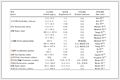
We began our study by investigating the model reaction of allenyl imide 1a and β,γ-enone 2a using PBu3 (20 mol%) as the catalyst in (CH2Cl)2 solvent. Indeed, the reaction occurred to afford the desired [4 + 1] annulation product 3a, albeit in only 21% yield (Table 1, entry 1). Then we investigated the effect of different phosphine catalysts. When PPh3 or P(4-Me-Ph)3 was used, the yield of 2-cyclopentenone 3a was not improved (entries 2 and 3). While P(4-MeO-Ph)3 and MePPh2 were employed, the yields were increased to 33% and 40% yields, respectively (entries 4 and 5). Fixing using MePPh2 catalyst, the further investigation of solvent effect was performed including toluene, MeCN, CHCl3 and CH2Cl2 (entries 6−9); CH2Cl2 was finally found to be the best choice of solvent (entry 9). In addition, base additive was examined (entries 10−15), and 1.2 equiv. of Na2CO3 was proved to be the most efficient, resulting in the formation of product 3a in 66% yield (entry 11). It should be noted that the lower catalyst loading (10 mol%) without Na2CO3 additive provided an accept yield of 46% (entry 16). Finally, the optimized reaction conditions were established as following: 20 mol% of P(4-MeO-Ph)3 and 1.2 equiv. of Na2CO3 in CH2Cl2 (0.1 mol/L) at 30 ℃.
|
Table 1 Optimization of [4 + 1] annulation conditions.a |

With the optimal reaction conditions being established (conditions A), the substrate scope of β,γ-enones 2 in the [4 + 1] annulation reaction was studied. All reactions proceeded smoothly to afford the 2-cyclopentenone products 3 in moderate yields, and the results were depicted in Scheme 2. Substrates 2 bearing electron-rich aryl groups were well tolerated to give products 3b and 3c in 64% and 46% yields, respectively. In addition, the yield of 2-cyclopentenone 3d was decreased to 46%, probably owing to the increased steric hindrance. The reaction was also compatible to the substrates bearing a heteroaryl (2-furyl and 2-thienyl) ketone moiety, and the target products 3e and 3f were isolated in 66% and 58% yields, respectively. The structure of 3e was further determined by X-ray crystallography (CCDC: 2223668). For comparison, inorganic base-free and 10 mol% of P(4-MeO-Ph)3 (conditions B) were also checked. Although lower or compatible yields were observed in all cases, it proved that such type of reaction could proceed without additional Brønsted base even in the presence of lower loading of phosphine catalyst [47].

|
Download:
|
| Scheme 2. Substrate scope for the phosphine-catalyzed [4 + 1] annulation. | |
In order to explore the possible chemodivergent synthesis between allenyl imides 1 and β,γ-enones 2, we attempted the reaction using nucleophilic amine catalyst. To our delight, when DMAP or DBU was used, the tetrasubstituted 2-pyranone 4aa was produced via [3 + 3] annulation, albeit in low yields (Table 2, entries 1 and 2). Compound 4aa was characterized by X-ray single crystallography (CCDC: 2155959). The only use of DABCO or Cs2CO3 was unable to furnish the product 4aa (entries 3 and 4). Then the combination of DBU and inorganic base was examined, and the isolated yield could be improved (entries 5 and 6). Pleasingly, 2-pyranone 4aa was isolated in 74% yield when using DABCO catalyst and 1.2 equiv. of Cs2CO3 together (entry 7). The subsequent screening of the Cs2CO3 loading and solvents revealed that 0.4 equiv. of Cs2CO3 and ethyl acetate solvent were the best choice, and almost quantitative yield of 4aa was observed within 2 h (entry 14).
|
|
Table 2 Optimization of [3 + 3] annulation conditions.a |

Having the optimal [3 + 3] annulation reaction conditions in hand, the substrate scope and limitation were then explored, and the results were summarized in Scheme 3. Regardless of whether R3 in β,γ-enones 2 was an electron-rich or halide group-substituted phenyl ring, α-methyl-substituted allenyl imide 1a underwent [3 + 3] annulation to generate the corresponding 2-pyranones 4aa−4ah in good to excellent yields (79%−99%). The scale-up experiment (1.0 mmol 1a and 1.2 mmol 2a) resulted in identical level of yield (4aa, 97%). Introducing a more sterically bulky 2-naphthyl moiety resulted in a lower yield (4ai, 70%). When R3 was a heteroaromatic group, the yield of 2-thienyl product 4ak (81%) is better than that of the 2-furyl case (4aj, 66%). In addition, the annulation product 4al with a methyl group (R3) was also obtained in 76% yield. Next, the effect of R4 (bearing an electron-rich or halide group at the para-position of phenyl ring) linking to the alkene moiety was briefly investigated, and 2-pyranone products 4am−4ao were delivered in 75%−90% yields. Finally, we turned our attention to the scope of allenyl imides 1 with γ-mono or α,γ-disubstituents. The corresponding products 4ba−4ea were produced in 50%−88% yields, indicating that different alkyl substituents had an obvious influence on the yields.

|
Download:
|
| Scheme 3. Substrate scope for the amine-catalyzed [3 + 3] annulation. | |
According to the above experimental results and our previous work, a plausible mechanism for the phosphine-catalyzed [4 + 1] annulation of allenyl imide and β,γ-enone was outlined in Scheme 4. The reaction may be initiated by the addition of tertiary phosphine to allenyl imde 1a, resulting in the formation of the zwitterionic intermediate Ⅰ. Then the ketenyl vinyl phosphonium species Ⅱ is generated via eliminating a 2-oxazolidinyl anion from Ⅰ, which deprotonates the α-C−H of β,γ-enone 2a (or by Na2CO3) to form the nucleophilic species Ⅲ. Ⅲ attacks the electrophilic C(sp) center of species Ⅱ to generate the zwitterionic intermediate Ⅳ. Subsequently, the 1,3-proton transfer occurs to give species Ⅴ, which undergoes intramolecular Michael addition to provide intermediate Ⅵ. Ⅵ might isomerizes to the more stable intermediate Ⅶ (1,2-proton transfer). Finally, product 3a is produced via the elimination of the phosphine catalyst.

|
Download:
|
| Scheme 4. Possible catalytic cycle for the formation of 3a. | |
Besides, we also proposed a plausible mechanism for the tertiary amine catalyzed [3 + 3] annulation (Scheme 5). Initially, the 1,2-addition of DABCO to allenyl imide 1a generates the intermediate Ⅷ, which then converts into the amide cation Ⅸ with releasing the 2-oxazolidinyl anion. In parallel, Cs2CO3 can deprotonate the α-C−H of β,γ-enone 2a to give the nucleophilic intermediate Ⅲ, and it subsequently attacks the electrophilic C(sp) center of species Ⅸ to afford the zwitterionic intermediate Ⅹ. Ⅹ undergoes 1,2-elimination to produce the ketenyl species XI, which may transform into the enolate anion Ⅻ by Cs2CO3. Then the species Ⅻ undergoes an intramolecular nucleophilic addition (6-endo-dig) to produce the intermediate ⅩⅢ; ⅩⅢ undergoes isomerization and finally abstracts the proton of α-C−H in β,γ-enone 2a to give the product 4aa.

|
Download:
|
| Scheme 5. Possible reaction mechanism for the formation of 4aa. | |
Towards demonstrating the practicality and synthetic utility of the [4 + 1] annulation, the scale-up experiment using substrates 1a (1.0 mmol) and 2a was firstly carried out under the standard conditions, producing compound 3a in 67% yield (Scheme 6). By virtue of the electron-deficient α,β-enone substructure of 3 and the remaining inorganic base, 1,3-dipolar cycloaddition of nitrile imines [48] was considered for the synthetic application. Eventually, the one-pot sequential process of [4 + 1] annulation and 1,3-dipolar cycloaddition has been completed to give a wide range of complex fused pyrazoline derivatives 5 in up to 52% yield. Based on the single crystal X-ray analysis of product 5aa (CCDC: 2246606), heteroallenyl anion rather than heteropropargyl anion intermediate plays a key role in the regioselectivity (Table 3).

|
Download:
|
| Scheme 6. Scale-up [4 + 1] annulation experiment. | |
|
|
Table 3 Sequential [4 + 1] annulation and 1,3-dipolar cycloaddition of nitrile imines.a |


In summary, we have developed a novel nucleophilic catalyst-switched chemodivergent strategy based on allenyl imides and β,γ-enones under mild conditions. P(4-MeO-Ph)3 catalyst enabled the [4 + 1] annulation to build 2-cyclopentenones bearing a quaternary carbon center (up to 66% yield), whereas the utilization of amine catalyst DABCO and Cs2CO3 allowed for an exclusive [3 + 3] annulation to generate tetrasubstituted 2-pyranones in generally high yields (up to 99% yield). Two different ketenyl intermediates were considered as key reactive intermediates in both annulations, and two plausible mechanisms were proposed on the basis of experimental data. Further efforts have been made to develop the one-pot sequential [4 + 1] annulation/1,3-dipolar cycloaddition for the synthesis of various fused pyrazoline derivatives. Further advancing the synthetic concept in asymmetric manner is on-going in our laboratory.
Declaration of competing interestThe authors declare that they have no known competing financial interests or personal relationships that could have appeared to influence the work reported in this paper.
AcknowledgmentsY.Y. Huang gratefully acknowledges the financial support for this investigation from the National Natural Science Foundation of China (No. 22072111), and the Fundamental Research Funds for the Central Universities (No. 2023IVA055).
Supplementary materialsSupplementary material associated with this article can be found, in the online version, at doi:10.1016/j.cclet.2023.108777.
| [1] |
G. Vassilikogiannakis, I. Margaros, T. Montagnon, M. Stratakis, Chem. Eur. J. 11 (2005) 5899-5907. DOI:10.1002/chem.200401311 |
| [2] |
B.R. Lee, M.H. Paing, N. Sharma-Walia, Front. Physiol. 12 (2021) 640374-640391. DOI:10.3389/fphys.2021.640374 |
| [3] |
T. Bui, D.S. Straus, Biochim. Biophys. Acta 1397 (1998) 31-42. DOI:10.1016/S0167-4781(97)00214-5 |
| [4] |
S.M. Roberts, M.G. Santoro, E.S. Sickle, J. Chem. Soc., Perkin Trans. 1 (2002) 1735-1742. |
| [5] |
M.J. Seo, D.K. Oh, Prog. Lipid. Res. 66 (2017) 50-68. DOI:10.1016/j.plipres.2017.04.003 |
| [6] |
J.A. Freemont, S.W. Littler, O.E. Hutt, et al., J. Agric. Food Chem. 64 (2016) 7134-7141. DOI:10.1021/acs.jafc.6b02959 |
| [7] |
T. Ahmad, T. Rasheed, M. Hussain, K. Rizwan, Top. Curr. Chem. 379 (2021) 38. DOI:10.1007/s41061-021-00350-w |
| [8] |
J.M. Dickinson, Nat. Prod. Rep. 10 (1993) 71-98. DOI:10.1039/np9931000071 |
| [9] |
Y. Galeyeva, S. Helbig, M. Morr, et al., Chem. Biodivers. 3 (2006) 935-941. DOI:10.1002/cbdv.200690096 |
| [10] |
A.P.G. Macabeo, A.J.C. Cruz, A. Narmani, et al., Phytochem. Lett. 35 (2020) 147-151. DOI:10.1016/j.phytol.2019.11.010 |
| [11] |
G.P. McGlacken, I.J. Fairlamb, Nat. Prod. Rep. 22 (2005) 369-385. DOI:10.1039/b416651p |
| [12] |
A.C. Giddens, L. Nielsen, H.I. Boshoff, et al., Tetrahedron 64 (2008) 1242-1249. DOI:10.1016/j.tet.2007.11.075 |
| [13] |
S.P. Simeonov, J.P. Nunes, K. Guerra, V.B. Kurteva, C.A. Afonso, Chem. Rev. 116 (2016) 5744-5893. DOI:10.1021/cr500504w |
| [14] |
D. Aitken, H. Eijsberg, A. Frongia, J. Ollivier, P. Piras, Synthesis 46 (2014) 1-24. DOI:10.1055/s-0033-1338586 |
| [15] |
S.E. Gibson, A. Stevenazzi, Angew. Chem. Int. Ed. 42 (2003) 1800-1810. DOI:10.1002/anie.200200547 |
| [16] |
S.J. Chen, C.G. Jiang, N. Zheng, Z. Yang, L.L. Shi, Catalysts 10 (2020) 1199-1223. DOI:10.3390/catal10101199 |
| [17] |
K.M. Brummonda, J.L. Kent, Tetrahedron 56 (2000) 3263-3283. DOI:10.1016/S0040-4020(00)00148-4 |
| [18] |
S. Kitagaki, F. Inagaki, C. Mukai, Chem. Soc. Rev. 43 (2014) 2956-2978. DOI:10.1039/c3cs60382b |
| [19] |
A.J. Frontier, J.J. Hernandez, Acc. Chem. Res. 53 (2020) 1822-1832. DOI:10.1021/acs.accounts.0c00284 |
| [20] |
M.G. Vinogradov, O.V. Turova, S.G. Zlotin, Org. Biomol. Chem. 15 (2017) 8245-8269. DOI:10.1039/C7OB01981E |
| [21] |
H. Pellissier, Tetrahedron 61 (2005) 6479-6517. DOI:10.1016/j.tet.2005.04.014 |
| [22] |
D. Dobler, M. Leitner, N. Moor, O. Reiser, Eur. J. Org. Chem. 2021 (2021) 6180-6205. DOI:10.1002/ejoc.202101112 |
| [23] |
T. Sunazuka, S. Ōmura, Chem. Rev. 105 (2005) 4559-4580. DOI:10.1021/cr040628i |
| [24] |
J.S. Lee, Mar. Drugs 13 (2015) 1581-1620. DOI:10.3390/md13031581 |
| [25] |
Q.F. Zhou, S. Zhao, X. Wang, T. Lu, Chin. J. Org. Chem. 30 (2010) 1652-1663. |
| [26] |
T.F. Schäberle, Beilstein J. Org. Chem. 12 (2016) 571-588. DOI:10.3762/bjoc.12.56 |
| [27] |
H.Z. Ni, W.L. Chan, Y.X. Lu, Chem. Rev. 118 (2018) 9344-9411. DOI:10.1021/acs.chemrev.8b00261 |
| [28] |
H.C. Guo, Y.C. Fan, Z.H. Sun, Y. Wu, O. Kwon, Chem. Rev. 118 (2018) 10049-10293. DOI:10.1021/acs.chemrev.8b00081 |
| [29] |
H. Zhang, R. Zhou, Eur. J. Org. Chem. 2020 (2020) 4098-4107. DOI:10.1002/ejoc.202000023 |
| [30] |
Y.N. Gao, M. Shi, Chin. Chem. Lett. 28 (2017) 493-502. DOI:10.1016/j.cclet.2016.12.001 |
| [31] |
T.L. Wang, X.Y. Han, F.R. Zhong, W.J. Yao, Y.X. Lu, Acc. Chem. Res. 49 (2016) 1369-1378. DOI:10.1021/acs.accounts.6b00163 |
| [32] |
E.Q. Li, Y. Huang, Chem. Commun. 56 (2020) 680-694. DOI:10.1039/c9cc08241g |
| [33] |
X.Z. Li, Y. Zhou, Q.J. Zhao, et al., Green Synth. Catal. 4 (2023) 54-57. DOI:10.1016/j.gresc.2022.10.015 |
| [34] |
Z.H. Cao, Y.H. Wang, S.J. Kalita, U. Schneider, Y.Y. Huang, Angew. Chem. Int. Ed. 59 (2020) 1884-1890. DOI:10.1002/anie.201912263 |
| [35] |
Y.H. Wang, Z.N. Zhao, S.J. Kalita, Y.Y. Huang, Org. Lett. 23 (2021) 8147-8152. DOI:10.1021/acs.orglett.1c02803 |
| [36] |
S. Pang, X. Yang, Z.H. Cao, et al., ACS Catal. 8 (2018) 5193-5199. DOI:10.1021/acscatal.8b01454 |
| [37] |
Y.H. Wang, S.J. Kalita, W.L. Li, et al., Adv. Synth. Catal. 364 (2022) 3690-3696. DOI:10.1002/adsc.202200739 |
| [38] |
M.M. Song, J. Zhao, E.Q. Li, Chin. Chem. Lett. 33 (2022) 2372-2382. DOI:10.1016/j.cclet.2021.11.044 |
| [39] |
I.P. Beletskaya, C. Nájera, M. Yus, Chem. Soc. Rev. 49 (2020) 7101-7166. DOI:10.1039/d0cs00125b |
| [40] |
Y.G. Meng, L.H. Chen, E.Q. Li, Chem. Rec. 22 (2022) e202100276. DOI:10.1002/tcr.202100276 |
| [41] |
L.B. Saunders, S.J. Miller, ACS Catal. 1 (2011) 1347-1350. DOI:10.1021/cs200406d |
| [42] |
X.Y. Chen, R.C. Lin, S. Ye, Chem. Commun. 48 (2012) 1317-1319. DOI:10.1039/C2CC16055B |
| [43] |
C. Curti, L. Battistini, A. Sartori, et al., Chem. Rev. 120 (2020) 2448-2612. DOI:10.1021/acs.chemrev.9b00481 |
| [44] |
P.S. Akula, Y.J. Wang, B.C. Hong, et al., Org. Lett. 23 (2021) 4688-4693. DOI:10.1021/acs.orglett.1c01426 |
| [45] |
L. Cheng, M.D. Wang, Y.J. Yang, et al., Org. Chem. Front. 9 (2022) 3354-3359. DOI:10.1039/d2qo00617k |
| [46] |
H.K. Zhang, J.J. He, Y.Y. Chen, et al., Angew. Chem. Int. Ed. 60 (2021) 19860-19870. DOI:10.1002/anie.202106046 |
| [47] |
Q.Y. Zhang, L. Yang, X.F. Tong, J. Am. Chem. Soc. 132 (2010) 2550-2551. DOI:10.1021/ja100432m |
| [48] |
Z.N. Zhao, Z. Ou, S.J. Kalita, et al., Chin. Chem. Lett. 33 (2022) 3012-3016. DOI:10.1016/j.cclet.2021.12.006 |