 2023, Vol. 34


b Department of Organic and Polymer Chemistry, Hunan Key Laboratory of Micro & Nano Materials Interface Science, College of Chemistry and Chemical Engineering, Central South University, Changsha 410083, China;
c College of Chemistry and Chemical Engineering, Qiannan Normal University for Nationalities, Duyun 558000, China;
d Materials Chemistry & Engineering Laboratory, Department of Polymer Science & Engineering, Dankook University, Yongin, Gyeonggi-do 16890, South Korea
Self-assembly is one of the simplest and most efficient approaches for the construction of complex and advanced structures by aggregating individual simple building blocks into highly ordered species [1,2]. The main driving force of self-assembly is the non-covalent interactions, including metal ion and anion coordination [3–6], hydrogen bonding [7,8], host−guest interactions [9,10], and π-π stacking [11,12]. Chemists are inspired by the symmetry and beautiful topologies that nature has evolved [13–15]. By means of chemical synthesis, many esthetical and symmetrical molecular topologies such as 2D regular/irregular polygons [16–24], molecular knots [25–27], and 3D polyhedrons [28–36] have been successfully realized via metal-coordination-driven self-assembly. In contrast to the synthetic limitation of covalent approaches, supramolecular coordination-driven self-assembly has at least three advantages: the fast and facile formation of sophisticated constructs with high yields, the high directionality to control the geometry for the structures and the inherently self-correcting for the defect-free assemblies. Simple organic ligands containing N, O, S, P atoms have been utilized to coordinate with various transition metals (such as Pd, Pt, Fe, Zn, Ag, Ru) to form a large number of supramolecular architectures [37–39].
Discrete supramolecular coordination complexes (SCCs), including 2D metallacycles and 3D metallacages, have received increasing attention during the recent 30 years not only due to their fascinating molecular aesthetics but also because of their host systems and unique cavities with different sizes and shapes for intriguing applications [40–42]. Many groups—those of Stang [43], Fujita [14,44], Raymond [45], Nitschke [46], and Newkome [47] have independently developed different approaches to construct discrete 2D and 3D supramolecules. These architectures feature different well-defined sizes, shapes and functional sites, which have endowed them with a wide range of properties and applications, such as host–guest chemistry [48–50], molecular recognition [51,52], separation [53,54], supramolecular catalysis [55–57], drug delivery systems [58,59], and biomedical applications [60,61]. The majority thereof, however, their structural features were provided by homoleptic moieties, and therefore suffer from lack of structural diversity. Given the increasing demands for diverse molecular structures and functions, scientists are encouraged to develop unexplored metallo-supramolecular architectures by heteroleptic multi-component but controllable self-assembly [62,63]. It is still a challenge to quantitatively obtain complicated supramolecular structures through heteroleptic self-assembly without troublesome separation processes. The prevalent methods to avoid unexpected resultant products are the use of complementary complexation, steric constraints, and charge separation, which has been illustrated by Lehn [64], Stang [65], Fujita [66], Schmittel [67], Chan [68] and others [69–71].
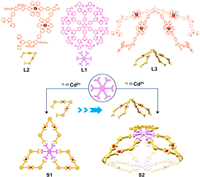
Trefoil-like complexes with perfect C3 symmetry that contain closed metallacycles are synthetically elegant in the field of chemical synthesis [72]. As for achieving 3D metallacages with C3 symmetry and easily modifiable internal cavities while being full of aesthetics and fractals, many cages of trigonal prism have been prepared, whereas rigid 3D trefoil-like metallacages were countable. In this paper, we report the design and synthesis of two discrete trefoil-shaped metallacycle S1 and metallacage S2, which were prepared by the heteroleptic self-assembly of metallo-organic ligands L2 and L3 and a hexaphenylbenzene core ligand L1 with metal ions Cd2+ (Fig. 1). The use of complementary ligand can not only serve as a complementary coordination point that prevent uncontrolled linking of ligands, but also play a role in directing self-assembly [73,74]. metallacycle S1 displayed a star-shaped trefoil that resembles the emblem of the 'Mitsubishi' motif, and metallacage S2 exhibits two S1 kernels in the layers and the bent linker as the edges, which possesses a large cavity and high complexity (Fig. 1). The resulting complexes were characterized by NMR spectroscopy (1H NMR, 2D COSY, and NOESY) and ESI-MS coupled with travelling wave ion mobility spectrometry (ESI-TWIM-MS), transmission electron microscopy (TEM), atomic force microscopy (AFM), as well as computer-generated modeling. Such metallacycle and metallacage might serve as promising hosts for selected guests and substrates.
|
Download:
|
| Fig. 1. Self-assembly of metallacycle S1 and metallacage S2. The trefoil-shaped motifs involve a central hexaphenylbenzene core (L2) and capping units (L1 and L3). The use of complementary ligand and bent spacer promotes the formation of the desired 2D and 3D trefoil-shaped architectures. | |
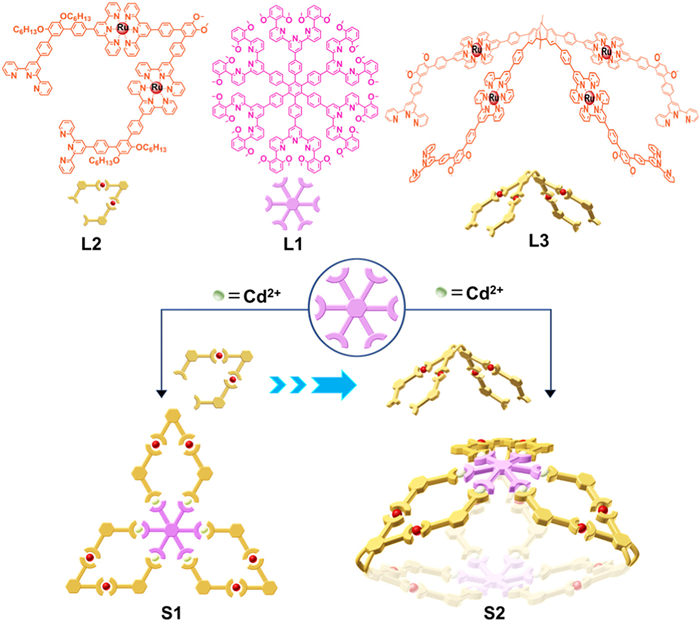
In previous reports, Newkome and co-workers found that the capping-involved heteroleptic multi-component self-assembly afforded the capping dimer as a major byproduct [75]. In our original design, the trefoil-shaped metallacycle possesses a centralhexaphenylbenzene L1 and three capping units L2. In order to prevent the self-sorting process of L2, the 6,6ʺ-positions of terpyridines on L1 were decorated with 2,6-dimethoxyphenyl substituents as the bulky groups. Precursors L1 and L2 were prepared via a multi-fold Suzuki coupling reaction in good yields (the synthetic route is shown in Supporting information). The 1H NMR spectrum of ligands L1 and L2 were shown in Fig. 2a, in which L1 has only one set of tpy-H3′,5′ and L2 exhibited three sets of tpy-H3′,5′ protons. Other evidences for the successful synthesis of L1 and L2 were demonstrated by ESI-MS (see Supporting information).
|
Download:
|
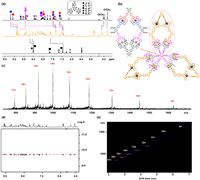
| Fig. 2. Nuclear magnetic resonance (NMR) and Mass spectrometry (MS) for characterization of the Trefoil-shaped metallacycle S1. (a) Comparison of 1H NMR of L2 (top, in MeOD), S1 (middle, in CD3CN) and L1 (bottom, in CDCl3); (b) representative energy-minimized structures from molecular modeling of S1; (c) ESI-MS spectrum, (d) DOSY spectrum (298 K, in CD3CN) and (e) ESI-TWIM-MS plot of S1. | |
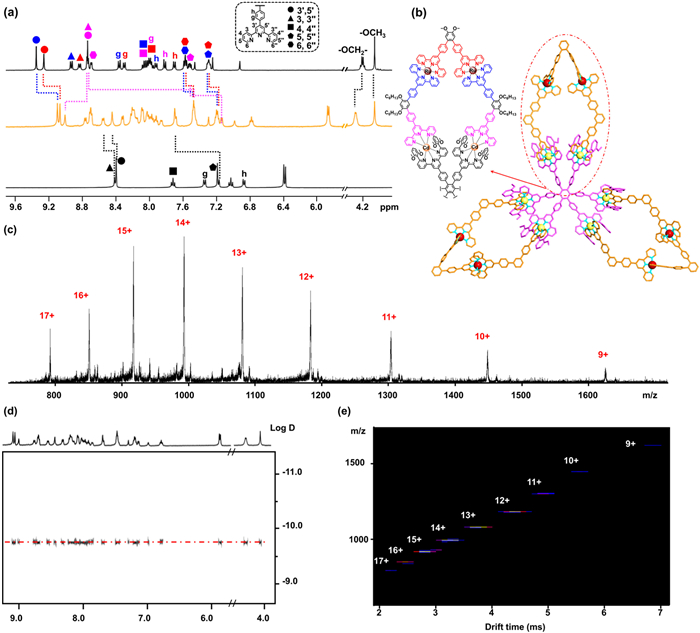
Trefoil-shaped metallacycle S1 was prepared by directly mixing the ligand L1 and L2 with Cd(NO3)2·4H2O in an exact stoichiometric ratio of 1:3:6 in CH3CN/CHCl3 (v/v, 2/1), stirring at 75 ℃ for 8 h, then adding saturated CH3OH solution of Li(NTf2) to exchange counterpart anions, then filtering to obtain red precipitate in nearly quantitative yield. NMR spectra were first employed to determine the structure of metallacycle S1. The 1H NMR spectrum of S1 (Fig. 2a) exhibits four distinguishable sets of clear singlets at 9.09, 9.06, 9.00 and 8.44 ppm, which can be easily assigned to specific protons of tpy-H3′,5′ derived from four types of terpyridine environments. In comparison with the free ligand L1, the significant change upon metal complexation is an upfield shift of tpy-H6,6′′ protons owing to the electron-shielding effects. In aliphatic regions, a sharp singlet at 4.06 ppm and a set of multiple peaks at 4.28 ppm were observed, which assigned to OCH3– and OCH2–, respectively. In addition, no signal peaks from free L1 or L2 were found, providing evidence of the quantitative formation of Trefoil-shaped metallacycle S1. All of the different environment units were completely assigned via the 2D-COSY and 2D-NOESY NMR spectra (see Supporting information). Single and discrete self-assembled structure of S1 was further supported by diffusion-ordered NMR spectroscopy (DOSY) spectrum (Fig. 2d), in which resonance signals for the complex were on a narrow band with logD = −9.75 m2/s, supporting the formation of giant specie in CD3CN. The experimental hydrodynamic radius of S1 derived from the Stokes-Einstein equation was ca. 3.5 nm, which agrees well with the theoretical value (~3.6 nm) given by modeling structures (Fig. 2b).
ESI-MS experiments combined with traveling wave ion mobility mass spectrometry (TWIM-MS) were performed to further investigate the composition and purity of the resultant assembly [76]. From the ESI-MS spectrum of S1, one dominant set of peaks with charge states from 9+ to 17+ was observed (Fig. 2c), resulting from successive loss of the counterions (PF6−). The calculated molecular weight of the resultant assembly is 15,933 Da, in accordance with the formula (Cd6L1L23)24+(PF6)24−, which exactly matched the desired structure of trefoil-shaped metallacycle S1. The isotope patterns of all charge states also agree well with the theoretical values. The narrow drifting time band of complex S1 in the TWIM-MS spectra at charge states from 17+ to 9+ is indicative of no isomers or conformers existed (Fig. 2e). In addition, the molecular stability of S1 was detected by gradient tandem mass spectrometry (gMS2) under different collision energies (see Supporting information). The gMS2 spectrum of S1 reveals that the 12+ ions start to dissociate at collision energy 35 V and completely dissociate at 45 V.
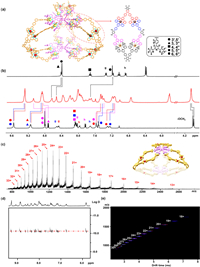
Since the central hexaphenylbenzene core L1 is planar and rigid, a bent spacer between the capping units is necessary for affording a 3D trefoil-shaped metallacage. Metallo-organic ligand L3 that contains an ethano-bridged anthracene moiety was designed and synthesized. Similarly, trefoil-shaped metallacage S2 was prepared by directly mixing the ligand L1 and L3 with Cd(NO3)2·4H2O in an exact stoichiometric ratio of 2:3:12 in CH3CN/CHCl3 (v/v, 2/1). The mixture was refluxed for 8 h, after cooling to ambient temperature, excess bistrifluoromethanesulfonimide lithium salt (LiNTf2) in MeOH was added to get a red precipitate, which was filtered and washed with H2O and MeOH to generate a red solid in nearly quantitative yield (> 95%). The 1H NMR spectrum of S2 displayed two sets of single peaks at 9.07 and 8.52 ppm and two overlapped singlets at 9.27 ppm in a 1:1:2 ratio distributed to specific protons of tpy-H3′,5′ (Fig. 3a). Besides, one multiple peak in the aliphatic region of S2 was observed at 4.05 ppm, which was attributed to a pair of OCH2– protons. The tpy-H6,6′′ protons from free terpyridines dramatically shifted upfield owing to electron-shielding effects, which indicate the formation of bis-tpy metal coordination in comparison with the free ligand L3. All other assignments were successfully confirmed on the basis of 2D COSY and NOESY spectra (see Supporting information). The 2D DOSY spectrum of complex S2 with a distinct narrow band at logD = −10.14 m2/s, supporting the formation of a single assembled product (Fig. 3d).
|
Download:
|
| Fig. 3. Nuclear magnetic resonance and Mass spectrometry for characterization of the Trefoil-shaped metallacage S2. (a) Representative energy-minimized structures from molecular modeling of S2. (b) Comparison of 1H NMR of L1 (top, in CDCl3), S2 (middle, in CD3CN) and L3 (bottom, in DMSO-d6). (c) ESI-MS spectrum, (d) DOSY spectrum (298 K, in DMSO-d6) and (e) ESI-TWIM-MS plot of S2. | |
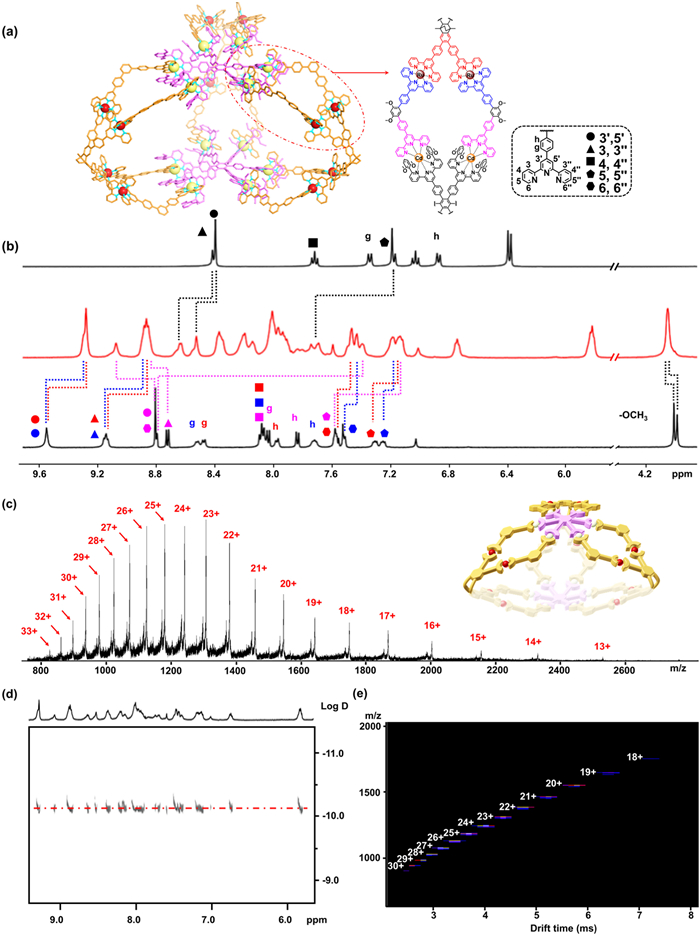
The ESI-MS spectrum of S2 displayed a series of normal distribution signal peaks with successive charge states from 33+ to 13+ due to the loss of different numbers of NTf2− anions during the ionization (Fig. 3c). The calculated molecular weight is 36,547 Da, in accordance with the formula (Cd6L33L12)48+(NTf2)48−, which exactly matched the desired structure of trefoil-shaped metallacage S2. The isotope patterns of S2 could not be obtained, probably because of the immense molecular weight and the incorporation of solvent molecules on its surface or coordination sites. Furthermore, the TWIM-MS spectrum of S2 displayed unique and successive charge states with one narrow drift time distribution, indicating that there were no isomers or conformers exist (Fig. 3e). Similarly, S2 exhibited good stability in which the 21+ ions at m/z 1460.59 starts to dissociate at 35 V and did not fully disappear at 40 V.
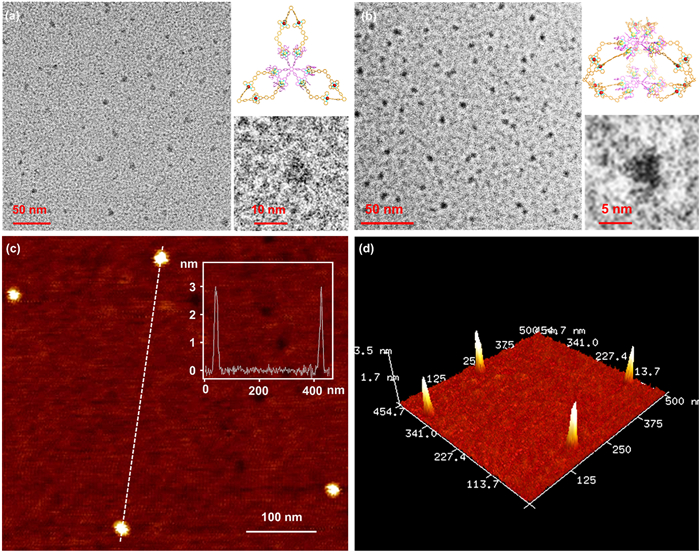
Growing single crystals with ideal quality has been proven to be extremely challenging in terpyridine-based metal-coordination-driven self-assembly field. Attempts to grow crystals of S1 and S2 have been performed but without success to date. Instead, TEM and AFM experiments were further performed to gain additional structural insights into S1 and S2, which displayed both the sizes and shapes of the assembled structures directly. The TEM images were obtained by drop-casting dilute solutions of S1 and S2 (~10−6 mol/L in CH3CN) onto Cu grid. As shown in Fig. 4a, TEM images of S1 revealed individual particles with measured size of 7.0 ± 0.2 nm, which was comparable to the theoretical diameter of molecular modeling. Similarly, the outline of dots from TEM images of S2 with uniform size (6.6 ± 0.2 nm) matched well with the dimensions of the geometry-optimized structure of S2 (Fig. 4b). In the AFM images of S2 (Figs. 4c and d), a series of dots with narrowly distributed heights were observed on the supporting mica surface, the average height is 3.0 nm, which is in accordance with the calculated height from model structure (3.0 nm). These results provide additional evidence for the successful synthesis of trefoil-shaped metallacycle S1 and metallacage S2.

|
Download:
|
| Fig. 4. Characterization of size based on TEM and AFM. TEM images and representative energy-minimized structure from molecular modeling of (a) S1 and (b) S2; (c) AFM images (insert: height histogram from AFM) and (d) 3D AFM images of 3D metallacage S2. | |
In summary, by utilizing a hexa-armed complementary ligand as a template and two metal-organic ligands as capping, two discrete trefoil-shaped metallacycle S1 and metallacage S2 with C symmetry were successfully synthesized by the heteroleptic self-assembly. The 2D trefoil-shaped metallacycle S1 could resemble the emblem of the classic 'Mitsubishi' motif. The use of bent spacer ligand (ethano-bridged anthracene moiety) and complementary ligand (template-oriented moiety) promotes the formation of the desired discrete 3D trefoil-shaped metallacage. S2 exhibits large cavity and high complexity, which might serve as promising hosts for selected guests and substrates in the future. 1H NMR, 2D COSY, 2D NOESY, 2D DOSY, ESI-MS, ESI-TWIM-MS, TEM, AFM as well as molecular modeling were employed to unambiguously support the formation of supramolecular coordination complexes. The success of these supramolecules with precisely controlled shapes and sizes paved the way for the realization of aesthetically multilayered architectures through template-oriented and diversity-oriented synthesis strategies.
Declaration of competing interestThe authors declare that they have no financial and personal relationships with other people or organizations that can inappropriately influence this work, there is no professional or other personal interest of any nature or kind in any product, service and/or company that could be construed as influencing the position presented in, or the review of, the manuscript entitled.
AcknowledgmentsThis research was supported by the National Natural Science Foundation of China (Nos. 22101060 for M.C., and 21971257 for P.W.); the Guangdong Natural Science Foundation (No. 2022A1515012187 to M.C.) and the Science and Technology Research Project of Guangzhou (Nos. 202201020201 for M.C. and 202102010432 for Z.J.). Science and technology support plan of Guizhou Province [2019]2860 for W.L. The authors gratefully acknowledge the Center for Advanced Research in CSU for the NMR measurements.
Supplementary materialsSupplementary material associated with this article can be found, in the online version, at doi:10.1016/j.cclet.2023.108334.
| [1] |
J. Shi, M. Wang, Chem. Asian J. 16 (2021) 4037-4048. DOI:10.1002/asia.202101136 |
| [2] |
K. Ariga, J.P. Hill, M.V. Lee, et al., Sci. Technol. Adv. Mater. 9 (2008) 014109. DOI:10.1088/1468-6996/9/1/014109 |
| [3] |
T. Ghosh, N. Fridman, M. Kosa, G. Maayan, Angew. Chem. Int. Ed. 57 (2018) 7703-7708. DOI:10.1002/anie.201800583 |
| [4] |
E.C. Constable, C.E. Housecroft, J.N. Lambert, D.A. Malarek, Chem. Commun. (2005) 3739-3741. |
| [5] |
A.B. Aletti, S. Blasco, S.J. Aramballi, P.E. Kruger, T. Gunnlaugsson, Chem 5 (2019) 2617-2629. DOI:10.1016/j.chempr.2019.06.023 |
| [6] |
X. Zhao, H. Wang, B. Li, et al., Angew. Chem. Int. Ed. 61 (2022) e202115042. DOI:10.1002/anie.202115042 |
| [7] |
Y. Yu, J. Rebek Jr., Acc. Chem. Res. 51 (2018) 3031-3040. DOI:10.1021/acs.accounts.8b00269 |
| [8] |
Y. Liu, C. Hu, A. Comotti, M.D. Ward, Science 333 (2011) 436-440. DOI:10.1126/science.1204369 |
| [9] |
H. Nie, Z. Wei, X.L. Ni, Y. Liu, Chem. Rev. 122 (2022) 9032-9077. DOI:10.1021/acs.chemrev.1c01050 |
| [10] |
W.J. Li, W. Wang, X.Q. Wang, et al., J. Am. Chem. Soc. 142 (2020) 8473-8482. DOI:10.1021/jacs.0c02475 |
| [11] |
T. Hinoue, M. Miyata, I. Hisaki, N. Tohnai, Angew. Chem. Int. Ed. 51 (2012) 155-158. DOI:10.1002/anie.201106849 |
| [12] |
M. Mahl, M.A. Niyas, K. Shoyama, F. Würthner, Nat. Chem. 14 (2022) 457-462. DOI:10.1038/s41557-021-00861-5 |
| [13] |
Y. Segawa, D.R. Levine, K. Itami, Acc. Chem. Res. 52 (2019) 2760-2767. DOI:10.1021/acs.accounts.9b00402 |
| [14] |
Y. Domoto, M. Fujita, Coord. Chem. Rev. 466 (2022) 214605. DOI:10.1016/j.ccr.2022.214605 |
| [15] |
D. Mössinger, D. Chaudhuri, T. Kudernac, et al., J. Am. Chem. Soc. 132 (2010) 1410-1423. DOI:10.1021/ja909229y |
| [16] |
Y. Wang, H. Wu, J.F. Stoddart, Acc. Chem. Res. 54 (2021) 2027-2039. DOI:10.1021/acs.accounts.1c00108 |
| [17] |
H. Zhu, Q. Li, B. Shi, et al., J. Am. Chem. Soc. 142 (2020) 17340-17345. DOI:10.1021/jacs.0c09598 |
| [18] |
J. Singh, D.H. Kim, E.H. Kim, et al., J. Am. Chem. Soc. 142 (2020) 9327-9336. DOI:10.1021/jacs.0c01406 |
| [19] |
J. Wang, H. Zhao, M. Chen, et al., J. Am. Chem. Soc. 142 (2020) 21691-21701. DOI:10.1021/jacs.0c08020 |
| [20] |
G.Y. Wu, L.J. Chen, L. Xu, X.L. Zhao, H.B. Yang, Coord. Chem. Rev. 369 (2018) 39-75. DOI:10.1016/j.ccr.2018.05.009 |
| [21] |
C. Zhao, J. Zhao, D. Yang, et al., CCS Chem. 4 (2022) 2043-2052. DOI:10.31635/ccschem.021.202100941 |
| [22] |
A. Jana, S. Bähring, M. Ishida, et al., Chem. Soc. Rev. 47 (2018) 5614-5645. DOI:10.1039/C8CS00035B |
| [23] |
M. Chen, J.N. Cao, S. Li, et al., Org. Chem. Front. 8 (2021) 5902-5909. DOI:10.1039/D1QO01316E |
| [24] |
S. Li, H. Zhao, M. Chen, et al., Chem. Commun. 57 (2021) 12832-12835. DOI:10.1039/D1CC05428G |
| [25] |
L. Zhang, D.P. August, J. Zhong, et al., J. Am. Chem. Soc. 140 (2018) 4982-4985. DOI:10.1021/jacs.8b00738 |
| [26] |
J.P. C.arpenter, C.T. M.cTernan, J.L. G.reenfield, et al., Chem 7 (2021) 1534-1543. DOI:10.1016/j.chempr.2021.03.005 |
| [27] |
Z. Cui, G.X. Jin, Nat. Syn. 1 (2022) 635-640. DOI:10.1038/s44160-022-00094-5 |
| [28] |
Y. Fang, J.A. Powell, E. Li, et al., Chem. Soc. Rev. 48 (2019) 4707-4730. DOI:10.1039/C9CS00091G |
| [29] |
C.M. Hong, R.G. Bergman, K.N. Raymond, F.D. Toste, Acc. Chem. Res. 51 (2018) 2447-2455. DOI:10.1021/acs.accounts.8b00328 |
| [30] |
S. Wang, T. Sawada, K. Ohara, K. Yamaguchi, M. Fujita, Angew. Chem. Int. Ed. 55 (2016) 2063-2066. DOI:10.1002/anie.201509278 |
| [31] |
T. Douglas, M. Young, Science 312 (2006) 873-875. DOI:10.1126/science.1123223 |
| [32] |
S. Yuan, J. Wang, D. Zhu, et al., Science 360 (2018) eaao7283. DOI:10.1126/science.aao7283 |
| [33] |
M. Yoshizawa, J.K. Klosterman, M. Fujita, Angew. Chem. Int. Ed. 48 (2009) 3418-3438. DOI:10.1002/anie.200805340 |
| [34] |
X. Jiang, H. Yu, J. Shi, et al., CCS Chem. 4 (2022) 2127-2139. DOI:10.31635/ccschem.021.202100948 |
| [35] |
P. Bhandari, R. Modak, S. Bhattacharyya, E. Zangrando, P.S. Mukherjee, JACS Au 1 (2021) 2242-2248. DOI:10.1021/jacsau.1c00361 |
| [36] |
D. Liu, K. Li, M. Chen, et al., J. Am. Chem. Soc. 143 (2021) 2537-2544. DOI:10.1021/jacs.0c11703 |
| [37] |
R. Chakrabarty, P.S. Mukherjee, P.J. Stang, Chem. Rev. 111 (2011) 6810-6918. DOI:10.1021/cr200077m |
| [38] |
R.W. Saalfrank, H. Maid, A. Scheurer, Angew. Chem. Int. Ed. 47 (2008) 8794-8824. DOI:10.1002/anie.200702075 |
| [39] |
X.W. Zhu, D. Luo, X.P. Zhou, D. Li, Coordin. Chem. Rev. 455 (2022) 214354. DOI:10.1016/j.ccr.2021.214354 |
| [40] |
X.Z. Li, C.B. Tian, Q.F. Sun, Chem. Rev. 122 (2022) 6374-6458. DOI:10.1021/acs.chemrev.1c00602 |
| [41] |
J.A. Davies, T.K. Ronson, J.R. Nitschke, Chem 8 (2022) 1099-1106. DOI:10.1016/j.chempr.2022.01.003 |
| [42] |
H. Wang, Y. Li, N. Li, A. Filosa, X. Li, Nat. Rev. Mater. 6 (2021) 145-167. DOI:10.1038/s41578-020-00257-w |
| [43] |
L. Cao, P. Wang, X. Miao, et al., J. Am. Chem. Soc. 140 (2018) 7005-7011. DOI:10.1021/jacs.8b03856 |
| [44] |
T. Sawada, M. Fujita, Chem 6 (2020) 1861-1876. DOI:10.1016/j.chempr.2020.07.002 |
| [45] |
M. Morimoto, S.M. Bierschenk, K.T. Xia, et al., Nat. Cat. 3 (2020) 969-984. DOI:10.1038/s41929-020-00528-3 |
| [46] |
C.T. McTernan, J.A. Davies, J.R. Nitschke, Chem. Rev. 122 (2022) 10393-10437. DOI:10.1021/acs.chemrev.1c00763 |
| [47] |
S. Chakraborty, G.R. Newkome, Chem. Soc. Rev. 47 (2018) 3991-4016. DOI:10.1039/C8CS00030A |
| [48] |
T. Xiao, R. Elmes, Y. Yao, Front. Chem. 8 (2020) 628200. DOI:10.3389/fchem.2020.628200 |
| [49] |
J.S. Mugridge, A. Zahl, R. van Eldik, R.G. Bergman, K.N. Raymond, J. Am. Chem. Soc. 135 (2013) 4299-4306. DOI:10.1021/ja309949q |
| [50] |
T. Xiao, L. Zhou, X.Q. Sun, et al., Chin. Chem. Lett. 31 (2020) 1-9. DOI:10.1016/j.cclet.2019.05.011 |
| [51] |
C. Jia, W. Zuo, D. Yang, et al., Nat. Commun. 8 (2017) 938. DOI:10.1038/s41467-017-00915-8 |
| [52] |
G. Wu, Y. Chen, S. Fang, et al., Angew. Chem. Int. Ed. 60 (2021) 16594-16599. DOI:10.1002/anie.202104164 |
| [53] |
M. Pan, K. Wu, J.H. Zhang, C.Y. Su, Coordin. Chem. Rev. 378 (2019) 333-349. DOI:10.1016/j.ccr.2017.10.031 |
| [54] |
A.B. Sainaba, M. Venkateswarulu, P. Bhandari, et al., J. Am. Chem. Soc. 144 (2022) 7504-7513. DOI:10.1021/jacs.2c02540 |
| [55] |
X. Chi, W. Cen, J.A. Queenan, et al., J. Am. Chem. Soc. 141 (2019) 6468-6472. DOI:10.1021/jacs.9b01241 |
| [56] |
H. Wu, Y. Chen, L. Zhang, et al., J. Am. Chem. Soc. 141 (2019) 1280-1289. DOI:10.1021/jacs.8b10526 |
| [57] |
Y. Hou, Z. Zhang, L. Ma, et al., CCS Chem. 4 (2022) 2604-2611. DOI:10.31635/ccschem.021.202101382 |
| [58] |
M.J. Webber, E.T. Pashuck, Adv. Drug Deliv. Rev. 172 (2021) 275-295. DOI:10.1016/j.addr.2021.01.006 |
| [59] |
H. Sepehrpour, W. Fu, Y. Sun, P.J. Stang, J. Am. Chem. Soc. 141 (2019) 14005-14020. DOI:10.1021/jacs.9b06222 |
| [60] |
A. Casini, J.D. Crowley, Front. Chem. 7 (2019) 293. DOI:10.3389/fchem.2019.00293 |
| [61] |
S.K. Samanta, L. Isaacs, Coordin. Chem. Rev. 410 (2020) 213181. DOI:10.1016/j.ccr.2020.213181 |
| [62] |
H. Li, Z.J. Yao, D. Liu, G.X. Jin, Coordin. Chem. Rev. 293-294 (2015) 139-157. DOI:10.1016/j.ccr.2014.08.014 |
| [63] |
He L., H.K. Hsu, L. Li, et al., Chem 8 (2022) 494-507. DOI:10.1016/j.chempr.2021.11.013 |
| [64] |
P. Baxter, J.M. Lehn, A. Decian, J. Fischer, Angew. Chem. Int. Ed. 32 (1993) 69-72. DOI:10.1002/anie.199300691 |
| [65] |
Y.R. Zheng, Z. Zhao, M. Wang, et al., J. Am. Chem. Soc. 132 (2010) 16873. DOI:10.1021/ja106251f |
| [66] |
M. Yoshizawa, M. Nagao, K. Kumazawa, M. Fujita, J. Organomet. Chem. 690 (2005) 5383-5388. DOI:10.1016/j.jorganchem.2005.06.022 |
| [67] |
S. De, K. Mahata, M. Schmittel, Chem. Soc. Rev. 39 (2010) 1555-1575. DOI:10.1039/b922293f |
| [68] |
S.Y. Wang, J.H. Fu, Y.P. Liang, et al., J. Am. Chem. Soc. 138 (2016) 3651-3654. DOI:10.1021/jacs.6b01005 |
| [69] |
W.M. Bloch, Y. Abe, J.J. Holstein, et al., J. Am. Chem. Soc. 138 (2016) 13750-13755. DOI:10.1021/jacs.6b08694 |
| [70] |
S. Sudan, R.J. Li, S.M. Jansze, et al., J. Am. Chem. Soc. 143 (2021) 1773-1778. DOI:10.1021/jacs.0c12793 |
| [71] |
Z. Zhang, L. Ma, F. Fang, et al., JACS Au 2 (2022) 1479-1487. DOI:10.1021/jacsau.2c00245 |
| [72] |
L. Zhang, L.Y. Sun, J.P. Chang, et al., Chin. Chem. Lett. 33 (2022) 4567-4571. DOI:10.1016/j.cclet.2022.01.064 |
| [73] |
T.Z. Xie, K.J. Endres, Z. Guo, et al., J. Am. Chem. Soc. 138 (2016) 12344-12347. DOI:10.1021/jacs.6b07969 |
| [74] |
D. Liu, M. Chen, Y. Li, et al., Angew. Chem. Int. Ed. 57 (2018) 14116-14120. DOI:10.1002/anie.201809819 |
| [75] |
T.Z. Xie, J.Y. Li, Z. Guo, et al., Eur. J. Inorg. Chem. 2016 (2016) 1671-1677. DOI:10.1002/ejic.201600048 |
| [76] |
H. Wang, C. Guo, X. Li, CCS Chem. 4 (2022) 785-808. DOI:10.31635/ccschem.021.202101408 |