 2023, Vol. 34


Organoboron compounds play an integral role in synthetic chemistry because C-B bonds can be readily and efficiently converted into a wide variety of useful functional groups. Among all classes of organoboron compounds, alkenylboronates are versatile building blocks for the preparation of tetrasubstituted alkenes that are widely found in biologically active molecules [1–3]. Thus, the synthesis of alkenylboronates continues to be an important research field. The classic approach to the synthesis of alkenylboronates is the reaction of organolithium or Grignard reagents with trialkyl borates, which may suffer from selectivity problems and lack of functional group compatibility [4]. To overcome these problems, various methods for the selective synthesis of alkenylboronates have been developed in the past decade [5–7]. Among them, transition metal-catalyzed especially copper-catalyzed carboboration of internal alkynes has emerged as a powerful strategy for the synthesis of tetrasubstituted alkenylboronates [8–20]. This transformation typically involves the migratory insertion of alkynes into borylcopper complexes [21] to generate nucleophilic β-borylalkenylcopper species, which can react with various electrophiles to form tetrasubstituted alkenylboronates (Scheme 1a). However, the control of regioselectivity remains a challenge, mainly because of the low reactivity of unsymmetrical internal alkynes.

|
Download:
|
| Scheme 1. Synthesis of tetrasubstituted alkenylboronates. | |
On the other hand, transition metal-catalyzed difunctionalization of alkenes has evolved as a powerful engine for the rapid build-up of benzo-fused carbo- and heterocycles with sterically congested quaternary carbon centers. Such transformation, involving intramolecular Heck cyclization followed by intermolecular nucleophilic [22–34] or electrophilic [35–43] capture of the resulting σ-alkyl-metal intermediate, has been extensively studied (Scheme 1b).
Inspired by the copper/palladium dual-catalyzed carboboration of π bonds [44–51] and our continuing interest in developing Ni-catalyzed difunctionalization of alkenes for efficient construction of nitrogen-containing heterocycles [52–61], we envisaged that a β-borylalkenyl copper intermediate could be generated catalytically and exploited in a Ni-catalyzed Heck cyclization/cross-coupling (Scheme 1c). This bimetallic synergistic catalytic system [62–64] would allow the simultaneous activation of alkyne and alkene substrates and provide complete control over the different selectivity factors associated with this transformation, leading to a wide variety of heterocycles bearing a tetrasubstituted alkenylboronate moiety which can be further functionalized.
To achieve the conceptually simple but appealing transformations described above, several competing reaction pathways must be avoided, such as: (1) Intramolecular arylboration of alkenes is known and conversion of 1 to 4 has been reported [65–69] (2) Direct Miyaura borylation of aryl halides [70–73] (3) The reductive Heck cyclization of 1 to 5 using diboron-water as the hydride source was previously developed by us [74].
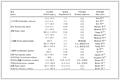
To probe this hypothesis, we started our studies by investigating the catalytic cascade cyclization/borylation/cross-coupling reaction of aryl bromide (1a), alkyne (2a), and B2Pin2 (Table 1). We first examined the strategy of nickel/copper synergistic catalysis, unfortunately, using CuI and Ni(COD)2 as catalysts and LiOtBu as base in THF at 80 ℃, we did not observe the expected product 3aa and only isolated the arylborylated by-product 4aa (entry 1). To our delight, the target product 3aa could be isolated in 4% yield using palladium instead of nickel as the catalyst, demonstrating the feasibility of the concept (entry 2). Subsequently, a survey of the ligands was performed (entries 3–5). And the desired product 3aa could be obtained in 24% yield when PCy3 was employed (entry 4). The copper precursor exerted a profound effect on the reactivity (entries 6–8), and CuCl was found to be the most effective, providing 3aa in 34% yield (entry 7). The effect of solvent on the reaction was also explored (entries 9–11). When the reaction was carried out in toluene, the yield of 3aa was significantly increased to 49% (entry 10). Further fine-tuning the reaction conditions allowed us to define the following optimized conditions: Pd(OAc)2 (10 mol%)/CuCl (10 mol%) as catalyst, PCy3 as ligand, and tBuOLi (2 equiv.) as a base in toluene at 80 ℃. Under these conditions, oxindole 3aa was isolated in 71% yield with high chemoselectivity (entry 12). Finally, controlled experiments confirmed that both palladium and cooper catalysts were essential for the reaction to occur (entries 13 and 14).
|
Table 1 Optimization of reaction conditions.a |


With optimal reaction conditions in hand, we set out to explore the generality of this transformation (Scheme 2). Aryl bromide, aryl iodide, and aryl triflate are all suitable electrophiles, providing oxindole 3aa in 68%−83% yield. The structure of 3aa was unequivocally determined by X-ray single crystal diffraction analysis. Aromatic rings with different substitution patterns, and those with electron-donating (methyl and methoxyl) or electron-withdrawing (chloro, fluoro and trifluoromethyl) groups, were well compatible and provided the corresponding oxindoles 3ba-3ja in 46%−86% yields. The aryl bromide 1k with a sterically hindered isopropyl group at the internal position of the alkene was also tolerated to furnish the corresponding oxindole 3ka in 89%. Notably, in the case of benzyl substitution on the double bond (1l), the alternative process involved the Heck cyclization/intramolecular C—H activation leading to spirooxindole did not occur [75–78]. The N-benzyl protected substrate was also accommodated, providing the corresponding product 3ma in 81% yield. Since the benzyl group is easily removed, this method can be used for the synthesis of N—H oxindoles. In addition, heterocyclic aryl bromides such as quinolin-2-one and azaindole could also be efficiently converted to the corresponding products 3na and 3oa. Excitingly, not only the activated alkenes, but also the unactivated alkene substrates 1p and 1q could effectively participate in the reaction, and the corresponding indoline 3pa and benzofuran 3qa were successfully isolated in 64% and 72% yields, respectively.

|
Download:
|
| Scheme 2. Substrate scope of acrylamides 1. | |

The substrate scope with respect to internal alkynes 2 was next investigated (Scheme 3). Symmetrical diarylalkynes with electron-donating (methoxy) or electron-withdrawing (fluoro) groups were both compatible with this reaction (3ab-3ac). Strikingly, heteroaryl-substituted internal alkyne such as 1,2-bis(thiophen-2-yl)acetylene 2d was also competent substrate, providing the desired product 3ad in 61% yield. Furthermore, this transformation is not limited to aryl-substituted alkynes, but alkyl-substituted alkyne is also applicable. As shown in Scheme 3, oct–4–yne 2e could be coupled with 1a and B2Pin2 to produce the corresponding oxindole 3ae, albeit in moderate yield. We speculate that the copper-borylation of electron-rich alkynes is slower than the intramolecular carbon-palladation of alkenes. The rate mismatch between the two steps resulted in the accumulation of σ-alkyl-palladium species, as we observed various side products generated from aryl-borylation and reductive Heck reaction of alkenes.

|
Download:
|
| Scheme 3. Substrate scope of alkynes 2. | |

The more challenging unsymmetrical alkynes were explored next. We were pleased to find that a variety of unsymmetrical alkynes were tolerated to provide the corresponding oxindoles 3af-3at in moderate to good yields (49%−85% yield) with high regioselectivity (> 20:1). In all cases, only single regioisomers were obtained in which the alkyne carbon with the less electron donating group (Ar/Het) was attached to the terminal carbon of the alkene moiety of 1, and the alkyne carbon with the more electron-donating substituent (alkyl) attached to the boron atom. Alkynes with various substituents such as methoxy, chlorine, fluorine, trifluoromethyl, and boronate ester in the para position of the aromatic ring were efficiently converted into the corresponding products 3ag-3al in 50%−80% yields. The structure of 3ak was unequivocally determined by X-ray single crystal diffraction analysis. Substitution at the meta position of the triple bond was also compatible (3am). To further demonstrate the robustness of this approach, we subsequently examined various heteroaryl-substituted alkynes. Indole, benzothiophene, dibenzothiophene, and dibenzofuran could be successfully intercalated into the corresponding products 3an-3aq in 72%−85% yield with excellent regioselectivity. Finally, alkyl-substituted alkynes including functionalized substituents, such as CH2OMe and CH2CH2CO2Me, were compatible, leading to the corresponding oxindoles 3ar-3at in 74% and 68% yields, respectively.
We performed a gram-scale reaction of 1a using 5 mol% palladium and copper catalysts to provide 3aa in 86% yield (1.82 g), revealing the practical applicability of this Pd/Cu synergistic catalysis (Scheme 4). To further demonstrate the synthetic advantages of our domino cyclization, further transformations of vinylboronate 3aa were conducted. Boron was readily removed by means of Ag-catalyzed hydrogenation reduction to provide the trisubstituted alkene 6 in 87% yield reaction with retained configuration. Suzuki-coupling of vinylboronate 3aa with iodobenzene afforded the triaryl-substituted indoline 7 in 89% yield. Tetrasubstituted alkenyl halides with defined configurations are ideal substrates for many transition metal-catalyzed coupling reactions. Despite their synthetic utility, their synthetic preparation is very challenging and cannot be accessed by simple addition reactions between aryl or acyl halides and internal alkynes [79]. Interestingly, the C-B bond of 3aa could be converted to the corresponding C-X bond (X = Cl, Br, Ⅰ) in a stereoretentive manner, providing tetrasubstituted alkenyl halides 8–10 in synthetically useful yields, thus demonstrating the potential application of our method.

|
Download:
|
| Scheme 4. Synthetic transformations. | |

To gain a deeper insight into the reaction mechanism, alkenylcopper complex 11 was synthesized in 86% yield by reacting NaOtBu, B2Pin2, alkyne 2f with in situ generated Cy3PCuCl (Scheme 5a) [14]. Treatment of complex 11 with 1a under standard conditions afforded the target product 3af in 46% yield and high regioselectivity (> 20:1) in the absence of copper catalyst. This result suggests that the alkenylcopper intermediate 11 is the key intermediate for this transformation (Scheme 5b).

|
Download:
|
| Scheme 5. Mechanistic studies. | |

On the basis of the above results and previous studies on cooperative Pd/Cu catalysis [44–51], a proposed mechanism is outlined in Scheme 6. Oxidative addition of Pd0 to aryl halide 1 followed by intramolecular Heck cyclization affords σ-alkyl-PdⅡX intermediate B (Scheme 6, red cycle). Ligand exchange of the σ-alkyl-PdⅡX intermediate B with B2Pin2 followed by reductive elimination will generate the arylboration by-product 4 [65–69]. Meanwhile, the metathesis reaction between [(Cy3P)CuCl] and LiOtBu will afford [(Cy3P)Cu-OtBu], which reacts with B2Pin2 to generate a borylcopper complex [(Cy3P)Cu-BPin]. Migratory insertion of alkyne into the Cu-B bond in a syn fashion leads to the β-boryl alkenylcopper complex C (Scheme 6, blue cycle). Transmetalation between the β-boryl alkenylcopper complex C and the σ-alkyl-PdⅡX intermediate B will provide the alkyl-PdⅡ-alkenylboron complex D, which undergoes reductive elimination to provide the oxindoles 3 bearing tetrasubstituted alkenylboronate moieties.

|
Download:
|
| Scheme 6. Possible mechanism. | |

Since Pd-catalyzed enantioselective intramolecular Heck cyclization reactions have been well established [22–43], we decided to screen a series of chiral ligands in an attempt to render the reaction asymmetric (see Table S3 in Supporting information for details). We examined chiral sulfinamide monophosphine ligands developed by Zhang's group, which are very effective for this type of cyclization reaction [80, 81]. However, the expected product 3 could not be detected under our reaction conditions and only the arylboration by-product 4 was observed (Table S3 for details). After screening a range of chiral ligands, we were pleased to find that diphenyl-Phox was the most efficient, providing 3ja in 45% yield with 71% enantioselectivity (Scheme 7).

|
Download:
|
| Scheme 7. Pd/Cu-catalyzed enantioselective cyclization/cross-coupling. | |

In summary, we have described a synergistic Cu/Pd-catalyzed three-component reaction of alkynes, B2Pin2 and alkene-tethered aryl halides. This transformation represents the first example of the use of catalytically generated β-borylalkenylcopper species in Pd-catalyzed Heck cyclization/cross-coupling reactions. The reaction provides a wide variety of heterocycles containing tetrasubstituted alkenylboronate moieties in good yields (up to 89% yield) with excellent chemoselectivity and regioselectivity (> 20:1). Furthermore, an enantioselective cascade cyclization/cross-coupling with borylalkenylcopper species has also been developed.
Declaration of competing interestThe authors declare that they have no known competing financial interests or personal relationships that could have appeared to influence the work reported in this paper.
AcknowledgmentsWe are grateful for financial support from the National Natural Science Foundation of China (No. 22171215), the Excellent Youth Foundation of Hubei Scientific Committee (No. 2022CFA092), and the GuangDong Basic and Applied Basic Research Foundation (No. 2022A1515110113). The authors also thank the Core Facility of Wuhan University for X-ray single crystal diffraction analysis.
Supplementary materialsSupplementary material associated with this article can be found, in the online version, at doi:10.1016/j.cclet.2023.108453.
| [1] |
N.F. McKinley, D.F. O'Shea, J. Org. Chem. 71 (2006) 9552-9555. DOI:10.1021/jo061949s |
| [2] |
S.C. Lo, P.L. Burn, Chem. Rev. 107 (2007) 1097-1116. DOI:10.1021/cr050136l |
| [3] |
C.H. Cottart, V. Nivet-Antoine, J.L. Beaudeux, Mol. Nutr. Food Res. 58 (2014) 7-21. DOI:10.1002/mnfr.201200589 |
| [4] |
N. Miyaura, A. Suzuki, Chem. Rev. 95 (1995) 2457-2483. DOI:10.1021/cr00039a007 |
| [5] |
J. Carreras, A. Caballero, P.J. Pérez, Chem. Asian J. 14 (2019) 329-343. DOI:10.1002/asia.201801559 |
| [6] |
J. Altarejos, A. Valero, R. Manzano, et al., Eur. J. Org. Chem. 2022 (2022) e202200521. |
| [7] |
R. Barbeyron, E. Benedetti, J. Cossy, et al., Tetrahedron 70 (2014) 8431-8452. DOI:10.1016/j.tet.2014.06.026 |
| [8] |
R. Alfaro, A. Parra, J. Alemán, et al., J. Am. Chem. Soc. 134 (2012) 15165-15168. DOI:10.1021/ja307670k |
| [9] |
H. Yoshida, I. Kageyuki, K. Takaki, Org. Lett. 15 (2013) 952-955. DOI:10.1021/ol4001526 |
| [10] |
Y.D. Bidal, F. Lazreg, C.S.J. Cazin, ACS Catal. 4 (2014) 1564-1569. DOI:10.1021/cs500130y |
| [11] |
L. Zhang, J. Cheng, B. Carry, Z. Hou, J. Am. Chem. Soc. 134 (2012) 14314-14317. DOI:10.1021/ja3063474 |
| [12] |
Y. Takemoto, H. Yoshida, K. Takaki, Chem. Eur. J. 18 (2012) 14841-14844. DOI:10.1002/chem.201202435 |
| [13] |
P. Liu, Y. Fukui, P. Tian, et al., J. Am. Chem. Soc. 135 (2013) 11700-11703. DOI:10.1021/ja404593c |
| [14] |
Y. Zhou, W. You, K.B. Smith, M.K. Brown, Angew. Chem. Int. Ed. 53 (2014) 3475-3479. DOI:10.1002/anie.201310275 |
| [15] |
T. Itoh, Y. Shimizu, M. Kanai, J. Am. Chem. Soc. 138 (2016) 7528-7531. DOI:10.1021/jacs.6b04646 |
| [16] |
L. Cheng, N.P. Mankad, Angew. Chem. Int. Ed. 57 (2018) 10328-10332. DOI:10.1002/anie.201804883 |
| [17] |
E. Rivera-Chao, M. Fananas-Mastral, Angew. Chem. Int. Ed. 57 (2018) 9945-9949. DOI:10.1002/anie.201806334 |
| [18] |
E. Rivera-Chao, M. Mitxelena, J.A. Varela, et al., Angew. Chem. Int. Ed. 58 (2019) 18230-18234. DOI:10.1002/anie.201910707 |
| [19] |
Q. Xuan, Y. Wei, Q. Song, Chin. Chem. Lett. 28 (2017) 1163-1166. DOI:10.1016/j.cclet.2017.04.031 |
| [20] |
X. Li, X. Ren, H. Wu, et al., Chin. Chem. Lett. 32 (2021) 9-12. DOI:10.1016/j.cclet.2020.11.045 |
| [21] |
K. Takahashi, T. Ishiyama, N. Miyaura, J. Organomet. Chem. 625 (2001) 47-53. DOI:10.1626/jcs.70.47 |
| [22] |
R. Grigg, V. Sridharan, J. Organomet. Chem. 576 (1999) 65-87. DOI:10.1016/S0022-328X(98)01052-3 |
| [23] |
S. KC, R. Giri, J. Org. Chem. 83 (2018) 3013-3022. DOI:10.1021/acs.joc.7b03128 |
| [24] |
Y. Ping, Y. Li, J. Zhu, W. Kong, Angew. Chem. Int. Ed. 58 (2019) 1562-1573. DOI:10.1002/anie.201806088 |
| [25] |
A.D. Marchese, E.M. Larin, B. Mirabi, M. Lautens, Acc. Chem. Res. 53 (2020) 1605-1619. DOI:10.1021/acs.accounts.0c00297 |
| [26] |
R. Liang, Y. Jia, Acc. Chem. Res. 55 (2022) 734-745. DOI:10.1021/acs.accounts.1c00781 |
| [27] |
W. You, M.K. Brown, J. Am. Chem. Soc. 137 (2015) 14578-14581. DOI:10.1021/jacs.5b10176 |
| [28] |
W. Kong, Q. Wang, J. Zhu, Angew. Chem. Int. Ed. 55 (2016) 9714-9718. DOI:10.1002/anie.201603950 |
| [29] |
R. Liu, Y. Wang, Y. Li, et al., Angew. Chem. Int. Ed. 56 (2017) 7475-7478. DOI:10.1002/anie.201703833 |
| [30] |
A. Whyte, J. Bajohr, R. Arora, et al., Angew. Chem. Int. Ed. 60 (2021) 20231-20236. DOI:10.1002/anie.202106518 |
| [31] |
Z. Zhang, B. Xu, Y.Y. Qian, et al., Angew. Chem. Int. Ed. 57 (2018) 10373-10377. DOI:10.1002/anie.201806372 |
| [32] |
L. Zhou, S. Li, B. Xu, et al., Angew. Chem. Int. Ed. 59 (2020) 2769-2775. DOI:10.1002/anie.201913367 |
| [33] |
Y. Wu, B. Xu, G. Zhao, et al., Chin. J. Chem. 39 (2021) 3255-3260. DOI:10.1002/cjoc.202100538 |
| [34] |
M. Shen, T. Wan, X. Huang, et al., Chin. Chem. Lett. 32 (2021) 2297-2300. DOI:10.1016/j.cclet.2021.02.016 |
| [35] |
K.E. Poremba, S.E. Dibrell, S.E. Reisman, ACS Catal. 10 (2020) 8237-8246. DOI:10.1021/acscatal.0c01842 |
| [36] |
Y. Ping, W. Kong, Synthesis 52 (2020) 979-992. DOI:10.1055/s-0039-1690807 |
| [37] |
Q. Pan, Y. Ping, W. Kong, Acc. Chem. Res. 56 (2023) 515-535. DOI:10.1021/acs.accounts.2c00771 |
| [38] |
K. Wang, Z. Ding, Z. Zhou, W. Kong, J. Am. Chem. Soc. 140 (2018) 12364-12368. DOI:10.1021/jacs.8b08190 |
| [39] |
Y. Ping, Q. Pan, Y. Guo, et al., J. Am. Chem. Soc. 144 (2022) 11626-11637. DOI:10.1021/jacs.2c02487 |
| [40] |
Y. Jin, C. Wang, Angew. Chem. Int. Ed. 58 (2019) 6722-6726. DOI:10.1002/anie.201901067 |
| [41] |
Q. Pan, Y. Ping, Y. Wang, et al., J. Am. Chem. Soc. 143 (2021) 10282-10291. DOI:10.1021/jacs.1c03827 |
| [42] |
X. Qin, M.W.Y. Lee, J.S. Zhou, Angew. Chem. Int. Ed. 56 (2017) 12723-12726. DOI:10.1002/anie.201707134 |
| [43] |
T. Ma, X. Li, Y. Ping, W. Kong, Chin. J. Chem. 40 (2022) 2212-2218. DOI:10.1002/cjoc.202200277 |
| [44] |
K. Semba, Y. Nakao, J. Am. Chem. Soc. 136 (2014) 7567-7570. DOI:10.1021/ja5029556 |
| [45] |
K.B. Smith, K.M. Logan, W. You, M.K. Brown, Chem. Eur. J. 20 (2014) 12032-12036. DOI:10.1002/chem.201404310 |
| [46] |
K.M. Logan, K.B. Smith, M.K. Brown, Angew. Chem. Int. Ed. 54 (2015) 5228-5231. DOI:10.1002/anie.201500396 |
| [47] |
J. Mateos, E. Rivera-Chao, M. Fañanás-Mastral, ACS Catal. 7 (2017) 5340-5344. DOI:10.1021/acscatal.7b01833 |
| [48] |
K.M. Logan, M.K. Brown, Angew. Chem. Int. Ed. 56 (2017) 851-855. DOI:10.1002/anie.201609844 |
| [49] |
B. Chen, P. Cao, X. Yin, et al., ACS Catal. 7 (2017) 2425-2429. DOI:10.1021/acscatal.7b00300 |
| [50] |
K.B. Smith, M.K. Brown, J. Am. Chem. Soc. 139 (2017) 7721-7724. DOI:10.1021/jacs.7b04024 |
| [51] |
T. Jia, P. Cao, B. Wang, et al., J. Am. Chem. Soc. 137 (2015) 13760-13763. DOI:10.1021/jacs.5b09146 |
| [52] |
Y. Li, K. Wang, Y. Ping, et al., Org. Lett. 20 (2018) 921-924. DOI:10.1021/acs.orglett.7b03713 |
| [53] |
Y. Ping, K. Wang, Q. Pan, et al., ACS Catal. 9 (2019) 7335-7342. DOI:10.1021/acscatal.9b02081 |
| [54] |
Y. Li, Z. Ding, A. Lei, W. Kong, Org. Chem. Front. 6 (2019) 3305-3309. DOI:10.1039/c9qo00744j |
| [55] |
S. Xu, K. Wang, W. Kong, Org. Lett. 21 (2019) 7498-7503. DOI:10.1021/acs.orglett.9b02788 |
| [56] |
T. Ma, Y. Chen, Y. Li, et al., ACS Catal. 9 (2019) 9127-9133. DOI:10.1021/acscatal.9b03172 |
| [57] |
X. Chen, J. Yue, K. Wang, et al., Angew. Chem. Int. Ed. 60 (2021) 14068-14075. DOI:10.1002/anie.202102769 |
| [58] |
H. Li, J. Chen, J. Dong, W. Kong, Org. Lett. 23 (2021) 6466-6470. DOI:10.1021/acs.orglett.1c02270 |
| [59] |
Z. Ding, Y. Wang, W. Liu, et al., J. Am. Chem. Soc. 143 (2021) 53-59. DOI:10.1021/jacs.0c10055 |
| [60] |
Y. Chen, Z. Ding, Y. Wang, et al., Angew. Chem. Int. Ed. 60 (2021) 5273-5278. DOI:10.1002/anie.202013792 |
| [61] |
Y. Ping, X. Li, Q. Pan, et al., Angew. Chem. Int. Ed. 61 (2022) e202201574. DOI:10.1002/anie.202201574 |
| [62] |
A.E. Allen, D.W. MacMillan, Chem. Sci. 3 (2012) 633-658. DOI:10.1039/c2sc00907b |
| [63] |
D.R. Pye, N.P. Mankad, Chem. Sci. 8 (2017) 1705-1718. DOI:10.1039/C6SC05556G |
| [64] |
Y. Wu, X. Huo, W. Zhang, Chem. Eur. J. 26 (2020) 4895-4916. DOI:10.1002/chem.201904495 |
| [65] |
R. Liang, R. Chen, C. Zhong, et al., Org. Lett. 22 (2020) 3215-3218. DOI:10.1021/acs.orglett.0c00999 |
| [66] |
X. Bai, W. Zheng, S. Ge, Y. Lu, Org. Lett. 24 (2022) 3080-3085. DOI:10.1021/acs.orglett.2c01082 |
| [67] |
D.D. Vachhani, H.H. Butani, N. Sharma, et al., Chem. Commun. 51 (2015) 14862-14865. DOI:10.1039/C5CC05193B |
| [68] |
Z. Kuang, B. Li, Q. Song, Chem. Commun. 54 (2018) 34-37. DOI:10.1039/C7CC07180A |
| [69] |
A. Whyte, K.I. Burton, J.L. Zhang, M. Lautens, Angew. Chem. Int. Ed. 57 (2018) 13927-13930. DOI:10.1002/anie.201808460 |
| [70] |
T. Ishiyama, M. Murata, N. Miyaura, J. Org. Chem. 60 (1995) 7508-7510. DOI:10.1021/jo00128a024 |
| [71] |
G.A. Molander, S.L.J. Trice, S.D. Dreher, J. Am. Chem. Soc. 132 (2010) 17701-17703. DOI:10.1021/ja1089759 |
| [72] |
G.A. Molander, S.L.J. Trice, B. Tschaen, Tetrahedron 71 (2015) 5758-5764. DOI:10.1016/j.tet.2015.04.026 |
| [73] |
T. Ishiyama, N. Miyaura, Chem. Rec. 3 (2004) 271-280. DOI:10.1002/tcr.10068 |
| [74] |
W. Kong, Q. Wang, J. Zhu, Angew. Chem. Int. Ed. 56 (2017) 3987-3991. DOI:10.1002/anie.201700195 |
| [75] |
R.T. Ruck, M.A. Huffman, M.M. Kim, et al., Angew. Chem. Int. Ed. 47 (2008) 4711-4714. DOI:10.1002/anie.200800549 |
| [76] |
G. Satyanarayana, C. Maichle-Mçssmer, M.E. Maier, Chem. Commun. (2009) 1571-1573. DOI:10.1039/b820636h |
| [77] |
T. Piou, L. Neuville, J. Zhu, Org. Lett. 14 (2012) 3760-3763. DOI:10.1021/ol301616w |
| [78] |
T. Piou, L. Neuville, J. Zhu, Angew. Chem. Int. Ed. 51 (2012) 11561-11565. DOI:10.1002/anie.201206267 |
| [79] |
Y.H. Lee, B. Morandi, Angew. Chem. Int. Ed. 58 (2019) 6444-6448. DOI:10.1002/anie.201812396 |
| [80] |
Z. Zhang, B. Xu, L. Wu, et al., Angew. Chem. Int. Ed. 58 (2019) 14653-14659. DOI:10.1002/anie.201907840 |
| [81] |
Z. Zhang, B. Xu, L. Wu, et al., J. Am. Chem. Soc. 141 (2019) 8110-8115. DOI:10.1021/jacs.9b04332 |