 2023, Vol. 34


b Fujian Science & Technology Innovation Laboratory for Optoelectronic Information of China, Fuzhou 350108, China;
c University of Chinese Academy of Sciences, Beijing 100049, China
As the core parts in laser frequency conversion technology, nonlinear optical (NLO) materials have attracted considerable attention because of their capabilities of producing new coherent and tuneable laser source in various ranges [1-5]. To date, the commercially available NLO crystals in IR region are merely ternary chalcopyrite-type AgGaS2 [7], AgGaSe2 [6] and ZnGeP2 [8]. All of them possess sufficient second-harmonic-generation (SHG) coefficient (deff) but exhibit several intrinsic problems, such as unfavorable laser-induced damage threshold (LIDT) or unexpected multi-photon absorption caused by small energy gaps (Eg), which seriously hindering their further application in the high-power laser bands. Among all the key conditions for an ideal IR-NLO candidate, achieving concurrently strong deff and wide Eg is the most challenging due to the plausible incompatibility [9,10]. Consequently, developing new IR-NLO crystals with improved comprehensive performance are critically needed and of great significance.
Metal chalcogenides with non-centrosymmetric (NCS) crystal structure is known to be the richest source of promising IR-NLO candidates [11-26]. A large number of new IR-NLO materials have been obtained in recent years, but only a few phase-matching (PM) metal chalcogenides that are able to display strong deff (> 0.5 × AgGaS2) and large Eg (> 3.5 eV) simultaneously, such as [Li2Cs2Cl][Ga3S6] (deff = 0.7 × AgGaS2, Eg = 4.17 eV) [27], Li4MgGe2S7 (deff = 0.7 × AgGaS2, Eg = 4.12 eV) [28], α-Li2ZnGeS4 (deff = 4.7 × AgGaS2, Eg = 4.07 eV) [29], Cs2Cd2Ga8S15 (deff = 0.5 × AgGaS2, Eg = 3.98 eV) [30], [Ba4Cl2][ZnGa4S10] (deff = 1.1 × AgGaS2, Eg = 3.85 eV) [31], Li2CdSiS4 (deff = 1.0 × AgGaS2, Eg = 3.76 eV) [32], BaLi2GeS4 (deff = 0.5 × AgGaS2, Eg = 3.66 eV) [33], SrZnGeS4 (deff = 0.9 × AgGaS2, Eg = 3.63 eV) [34], Sr2CdGe2OS6 (deff = 0.8 × AgGaS2, Eg = 3.62 eV) [35]. However, the aforementioned compounds are concentrated in complex quaternary or more systems, while simple systems such as ternary compounds are very rare. As far as we know, the existing example is limited to only BaGa4S7 (deff = 0.9 × AgGaS2, Eg = 3.54 eV) [36].
In this work, we focus on the ternary A(AE)/M/S (A = alkali metals; AE = alkaline-earth metals; M = group IIIA metal Ga, In or group IVA metal Si, Ge) system. The [MS4] tetrahedra are the most common NLO-active units in excellent IR-NLO chalcogenides. Meanwhile, the incorporation of highly electropositive A/AE metals in this system may have the additional advantage of increasing the Eg, which may help to enlarge the LIDT once a NCS material is found. Our systematic exploratory efforts have led to the discovery of a new member with 3D framework structure in this family [37-41], namely, Cs5Ga9S16. Notably, it shows impressive IR-NLO properties, such as remarkable deff (0.7 × AgGaS2), and the largest Eg (4.05 eV) among known ternary NCS chalcogenides. These findings are quite encouraging for an excellent IR-NLO candidate (deff > 0.5 × AgGaS2 and Eg > 3.5 eV).
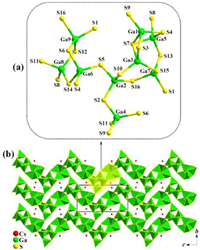
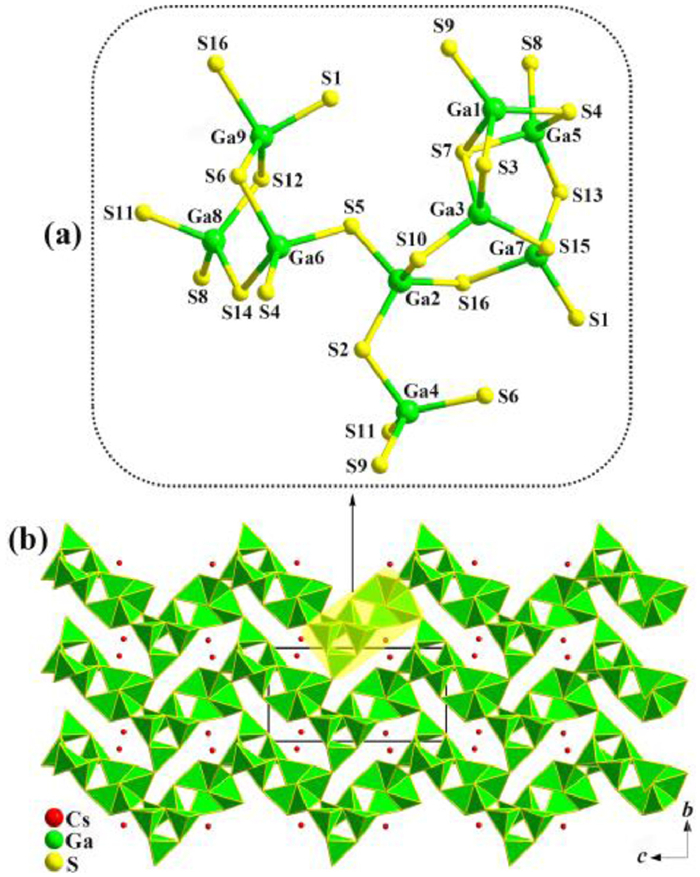
The sulfide Cs5Ga9S16 is a new ternary phase found within the A–M–Q (A = alkali metals; M = group IIIA metal; Q = S, Se, Te) systems. It was obtained through high-temperature solid-phase method with CsCl as flux (detailed synthesis method can be found in Supporting information). The pure phase of the polycrystalline sample was verified based on the powder X-ray diffraction (XRD) results (Fig. S1 in Supporting information). Moreover, TG-DSC studies reveal that Cs5Ga9S16 can be stable up to 1273 K without any obvious endo- or exo-thermal peaks and weight loss (Fig. S2 in Supporting information). Single-crystal XRD suggests that Cs5Ga9S16 belongs to the monoclinic space group Pn (No. 7), with a = 9.467(3) Å, b = 9.719(3) Å, c = 18.835(6) Å, V = 1704.3(9) Å3, Z = 2 (Table S1), and features a 3D [Ga9S16]5– framework with the charge balancing Cs+ ions residing between these voids (Fig. 1). In the structure, 9 crystallographically unique Ga atoms exhibit one type of coordination environment, i.e., the [GaS4] tetrahedral (Table S2 in Supporting information). The fundamental building block (FBB) is super-polyhedral [Ga9S23] cluster which is composed of the vertex-sharing S atoms (Fig. 1a). These FBBs are further interlinked with each other via sharing S atoms (i.e., S2, S5, S6 and S12) along the three axial positions to form a 3D framework with Cs+ cations located in the cavities (Fig. 1b). As listed in Table S3 (Supporting information), the Ga atoms exhibit normal Ga–S bond length, ranging from 2.219(4) Å to 2.483(5) Å [42-45]. There are 5 crystallographically unique Cs atomic positions with four various coordination geometries, i.e., bi-capped trigonal prism (CN = 8 for Cs1 and Cs2, d(Cs–S) = 3.415(4)–4.038(4) Å), distorted quadrangular (CN = 10 for Cs3, d(Cs–S) = 3.398(4)–3.998(4) Å), mono-capped trigonal prism (CN = 7 for Cs4, d(Cs–S) = 3.562(5)–3.860(4) Å), and tri-capped trigonal prism (CN = 9 for Cs5, d(Cs–S) = 3.495(4)–3.952(5) Å) (Fig. S3 in Supporting information). To the best of our knowledge, such diverse coordination modes of Cs atoms have been coexisted in Cs5Ga9S16 together is unprecedented in Cs-based chalcogenides.
|
Download:
|
| Fig. 1. Illustration of the structure of Cs5Ga9S16: (a) Coordination geometry of super-polyhedral [Ga9S23] FBB with the atom number outlined. (b) 3D framework structure of Cs5Ga9S16 viewed along the a direction with the unit cell marked (super-polyhedral [Ga9S23] cluster is outlined by a dashed area). | |
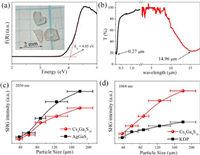
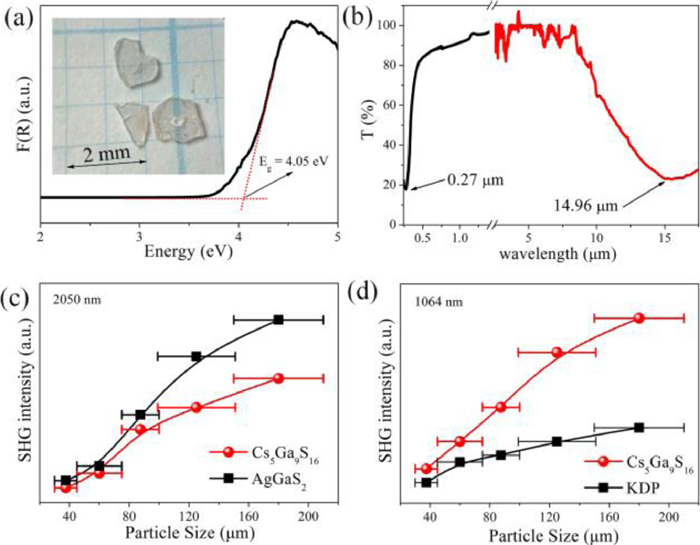
The UV−visible−NIR diffuse reflectance spectrum of Cs5Ga9S16 displays one of the widest Eg (i.e., 4.05 eV) among all IR-NLO chalcogenides (Fig. 2a). Such ultra-wide Eg can effectively avoid multi-photon absorptions at the different laser wavelengths, which can obtain a higher LIDT. Moreover, single crystal of Cs5Ga9S16 with a typical size of 1.5 × 1.0 mm polished down to ~0.1 mm thickness for the optical transmittance spectra. As given in Fig. 2b, Cs5Ga9S16 displays a wide optical transmission from the UV−vis (cut-off wavelength: 0.27 µm) to far-IR band (cut-off wavelength: 14.96 µm). The SHG capability of Cs5Ga9S16 was evaluated through the Kurtz-Perry method [46] using 2050 and 1064 nm laser irradiation, respectively, with the famous IR-NLO crystal AgGaS2 and UV-NLO crystal KDP used for reference. As shown in Figs. 2c and d, the SHG signal tends to attain saturation with the increase of crystal size of sample, which indicates that Cs5Ga9S16 possesses PM features and exhibits sufficient deff of about 0.7 × AgGaS2 at 2050 nm and 2.2 × KDP at 1064 nm, respectively. Furthermore, the powder LIDT as another significant parameter for NLO materials was evaluated by single pulse test method at 1064 nm [47]. Consequently, the experimental results of Cs5Ga9S16 (ca. 89.1 MW/cm2) is about 31.6 time that of reference AgGaS2 (ca. 2.82 MW/cm2) [48-50] and about 2.2 time that of reference KDP (ca. 39.8 MW/cm2) [51-53], respectively.
|
Download:
|
| Fig. 2. Experimental results of Cs5Ga9S16: (a) UV−visible−NIR diffuse reflectance spectrum (inset: polished single crystal wafers). (b) Optical transmisission from UV−vis to IR band. (c, d) SHG signals versus particle size under 2050 nm and 1064 nm Q-switch laser, respectively. | |
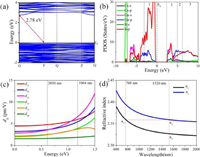
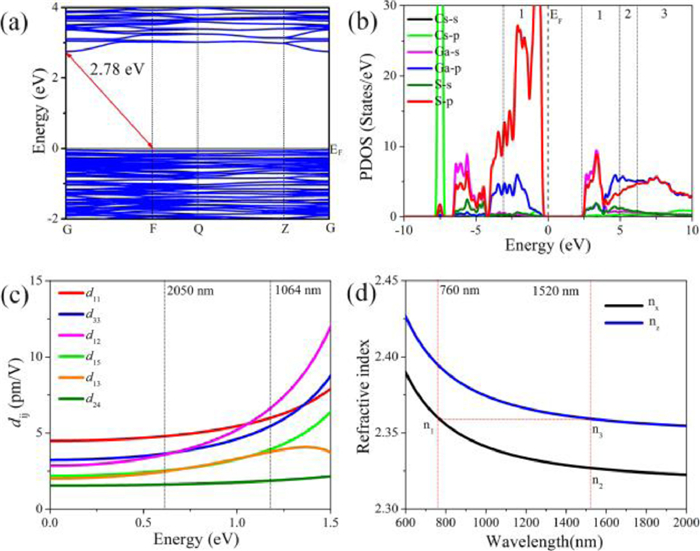
To further investigate the microscopic mechanism of the linear optical and NLO properties of Cs5Ga9S16, first-principles calculations were studied. As displayed in Fig. 3a, the calculated band structure reveals that Cs5Ga9S16 is an indirect Eg compound with the top of the valence band (VB) and the bottom of the conduction band (CB) occupied the different k-point of the G and F, respectively. As anticipated, the calculated value (Eg = 2.7 eV) is underestimated compared to the experimental value (Eg = 4.05 eV), due to the own defects of the exchange-correlation function [54-56]. To obtain an accurate optical Eg, the calculated Eg via the HSE06 method (4.01 eV) was performed [57,58], which is very close to the experimental result. In addition, the first Brillouin zone with high symmetry points of Cs5Ga9S16 is shown in Fig. S5 (Supporting information). The calculated partial densities of states (PDOS) reveal that the Ga-4p and S-3p, states make the main contributions to the lowest of the CB, while the highest of the VB primarily originates from Ga-4s and S-3p states, indicating that the optical Eg of Cs5Ga9S16 is mainly due to the 3D [Ga9S16]5– framework (Fig. 3b). In addition, the SHG coefficients (dij) of Cs5Ga9S16 have been also calculated. Based upon the crystal spatial symmetry and the Kleinman restriction [59], there are 6 independent nonzero dij, i.e., d11, d12, d13, d15, d24 and d36, respectively (Fig. 3c). Among them, the effective SHG coefficient deff at 2050 nm and 1064 nm are about 0.3 × AgGaS2 and 3.9 × KDP, respectively, which is comparable with the experimental results (Figs. 2c and d). Moreover, the minimum phase matching cut-off wavelength were calculated using the equation nx(2ω) = nz(ω). The calculated PM range of the SHG response for Cs5Ga9S16 is 760 nm (Fig. 3d) based on the dispersion curves of refractive indices.
|
Download:
|
| Fig. 3. Theoretical calculation results of Cs5Ga9S16: (a) Electronic band structure; (b) PDOS (the Fermi level (EF) is set at 0.0 eV); (c) Frequency-dependent SHG coefficients (dij); (d) The calculated dispersion of the refractive indices and the shortest type-Ⅰ PM cut-off wavelength. | |
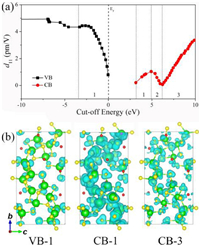
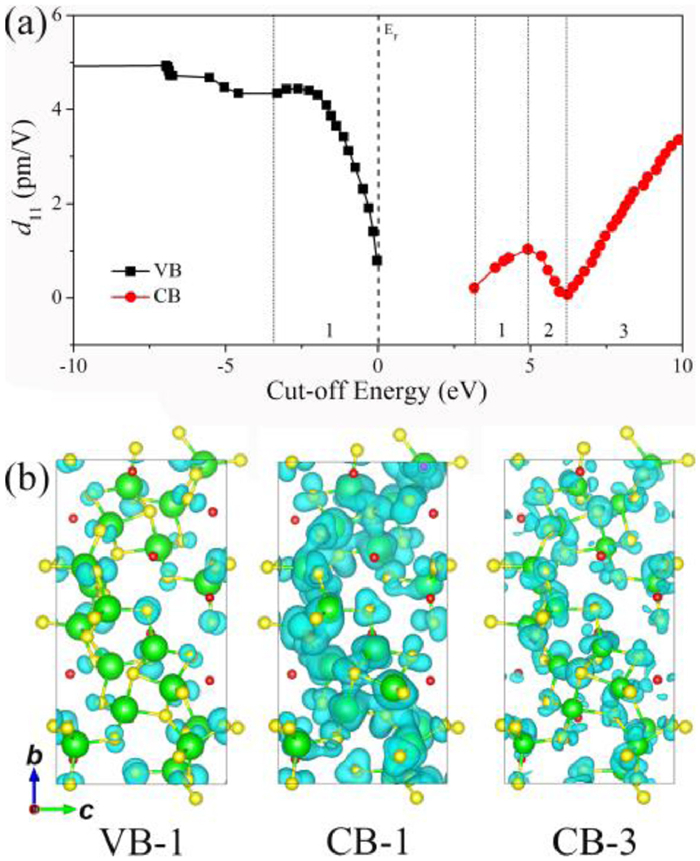
The contributions to the principal source of the SHG response from the constituent units were also investigated based on the length-gage formalism technique [60,61]. As displayed in Fig. 4a, it is clear that in the energy regions of VB-1 (−3.0–0.0 eV), CB-1 (3.0–5.0 eV) and CB-3 (6.2–10.0 eV), the d11 values increased most notably as the cut-off energy increased, which contribute mainly to the SHG effect. In other words, the states in the VB-1 section (i.e., the Ga-4p and S-3p states) and those in the CB-1 and CB-3 sections (i.e., the Ga-3s, Ga-4p and S-3p states together with minor S-3s) are mainly responsible for the d11 (Fig. 4b). These results mean that super-polyhedral [Ga9S23] cluster in 3D [Ga9S16]5– framework, contribute to the SHG effect.
|
Download:
|
| Fig. 4. Theoretical analysis of the NLO source: (a) Cut-off-energy-dependent variation of static coefficient d11; (b) Charge density maps in the VB-1, CB-1 and CB-3 regions along the bc plane. | |
In summary, a novel ternary sulfide, Cs5Ga9S16, is successfully prepared by a facile solid-state method. It adopts a NCS structure featuring a 3D anionic framework formed by vertex-sharing [Ga9S23] super-polyhedral FBBs, with the intervening spaces filled by charge-balanced Cs+ cations. Significantly, Cs5Ga9S16 exhibits excellent IR-NLO performances, such as a favorable PM deff (0.7-fold that of the benchmark AgGaS2), a large LIDTs (31.6-fold that of AgGaS2), a wide transparent regions (0.27−14.96 µm) and the highest Eg (4.05 eV) at known ternary NCS chalcogenides. Moreover, systematic theoretical analysis indicates that the IR-NLO properties of Cs5Ga9S16 mainly originate from the contributions of 3D [Ga9S16]5– framework composed of super-polyhedral [Ga9S23] groups. This finding further extends the study of promising IR-NLO candidates into the simple ternary system and will promote the development of new NCS chalcogenides with wide energy gaps.
Declaration of competing interestThe authors declare that they have no known competing financial interests or personal relationships that could have appeared to influence the work reported in this paper.
AcknowledgmentsThis work was supported by the National Natural Science Foundation of China (Nos. 22175175, 21771179 and 21901246), Fujian Science & Technology Innovation Laboratory for Optoelectronic Information of China (No. 2021ZR118), the Natural Science Foundation of Fujian Province (No. 2019J01133) and the Youth Innovation Promotion Association CAS (No. 2022303). The authors thank Prof. Bing-Xuan Li at FJIRSM for helping with the NLO measurements and Prof. Yong-Fan Zhang at Fuzhou University for helping with the DFT calculations.
Supplementary materialsSupplementary material associated with this article can be found, in the online version, at doi:10.1016/j.cclet.2022.107838.
| [1] |
F.J. Duarte, Tunable Laser Applications, Chapters 2, 9 and 12. Boca Raton, FL: CRC Press, 2008.
|
| [2] |
V. Petrov, Prog. Quantum Electron. 44 (2015) 1-106. DOI:10.1016/j.pquantelec.2015.08.002 |
| [3] |
V.A. Serebryakov, E.V. Boiko, N.N. Petrishchev, et al., J. Opt. Technol. 77 (2010) 6-17. DOI:10.1364/JOT.77.000006 |
| [4] |
X.T. Wu, L. Chen, Struct. Bond. (Berlin, Ger.) 145 (2012) 1-42. |
| [5] |
N.L.B. Sayson, T. Bi, V. Ng, et al., Nat. Photonics 13 (2019) 701-706. DOI:10.1038/s41566-019-0485-4 |
| [6] |
A. Harasaki, K.J. Kato, Appl. Phys. 36 (1997) 700-703. |
| [7] |
G.C. Catella, L.R. Shiozawa, J.R. Hietanen, et al., Appl. Opt. 32 (1993) 3948-3951. DOI:10.1364/AO.32.003948 |
| [8] |
G.D. Boyd, E. Buehler, F.G. Storz, Appl. Phys. Lett. 18 (1971) 301-304. DOI:10.1063/1.1653673 |
| [9] |
H. Chen, W.B. Wei, H. Lin, et al., Coord. Chem. Rev. 448 (2021) 214154. DOI:10.1016/j.ccr.2021.214154 |
| [10] |
K. Wu, S.L. Pan, Coord. Chem. Rev. 377 (2018) 191-208. DOI:10.1016/j.ccr.2018.09.002 |
| [11] |
I. Chung, M.G. Kanatzidis, Chem. Mater. 26 (2013) 849-869. |
| [12] |
H. Lin, L. Chen, L.J. Zhou, et al., J. Am. Chem. Soc. 135 (2013) 12914-12921. DOI:10.1021/ja4074084 |
| [13] |
L. Kang, M.L. Zhou, J.Y. Yao, et al., J. Am. Chem. Soc. 137 (2015) 13049-13059. DOI:10.1021/jacs.5b07920 |
| [14] |
H. Lin, Y.Y. Li, M.Y. Li, et al., J. Mater. Chem. C 7 (2019) 4638-4643. DOI:10.1039/C9TC00647H |
| [15] |
S.P. Guo, Y. Chi, G.C. Guo, Coord. Chem. Rev. 335 (2017) 44-57. DOI:10.1016/j.ccr.2016.12.013 |
| [16] |
P.F. Gong, F. Liang, L. Kang, et al., Coord. Chem. Rev. 380 (2019) 83-102. DOI:10.1016/j.ccr.2018.09.011 |
| [17] |
M.Y. Li, Z.J. Ma, B.X. Li, et al., Chem. Mater. 32 (2020) 4331-4433. DOI:10.1021/acs.chemmater.0c01258 |
| [18] |
M.Y. Ran, Z. Ma, H. Chen, et al., Chem. Mater. 32 (2020) 5890-5896. DOI:10.1021/acs.chemmater.0c02011 |
| [19] |
L. Gao, J.B. Huang, S.R. Guo, et al., Coord. Chem. Rev. 421 (2020) 213379. DOI:10.1016/j.ccr.2020.213379 |
| [20] |
W.K. Wang, D.J. Mei, F. Liang, et al., Coord. Chem. Rev. 421 (2020) 213444. DOI:10.1016/j.ccr.2020.213444 |
| [21] |
H. Lin, W.B. Wei, H. Chen, et al., Coord. Chem. Rev. 406 (2020) 213150. DOI:10.1016/j.ccr.2019.213150 |
| [22] |
D. Mei, W. Cao, N. Wang, et al., Mater. Horiz. 8 (2021) 2330. DOI:10.1039/D1MH00562F |
| [23] |
W. Wang, D. Mei, S. Wen, et al., Chin. Chem. Lett. 33 (2022) 2301-2315. DOI:10.1016/j.cclet.2021.11.089 |
| [24] |
F. Hou, D. Mei, Y. Zhang, et al., J. Alloys Compd. 904 (2022) 163944. DOI:10.1016/j.jallcom.2022.163944 |
| [25] |
M.M. Chen, S.H. Zhou, W.B. Wei, et al., ACS Mater. Lett. 4 (2022) 1264-1269. DOI:10.1021/acsmaterialslett.2c00409 |
| [26] |
H. Chen, M.Y. Ran, W.B. Wei, et al., Coord. Chem. Rev. 470 (2022) 214706. DOI:10.1016/j.ccr.2022.214706 |
| [27] |
B.W. Liu, X.M. Jiang, B.X. Li, et al., Angew. Chem. Int. Ed. 132 (2020) 4886-4889. DOI:10.1002/ange.201912416 |
| [28] |
A. Abudurusuli, J.B. Huang, P. Wang, et al., Angew. Chem. Int. Ed. 60 (2021) 24131-24136. DOI:10.1002/anie.202107613 |
| [29] |
J.H. Zhang, D.J. Clark, J.A. Brant, et al., Chem. Mater. 32 (2020) 8947-8955. DOI:10.1021/acs.chemmater.0c02929 |
| [30] |
L.Q. Yang, X.M. Jiang, S.M. Pei, et al., ACS. Appl. Mater. Interfaces 14 (2022) 4352. DOI:10.1021/acsami.1c23843 |
| [31] |
H. Chen, Y.Y. Li, B.X. Li, et al., Chem. Mater. 32 (2020) 8012. DOI:10.1021/acs.chemmater.0c03008 |
| [32] |
J.H. Zhang, D.J. Clark, J.A. Brant, et al., Chem. Mater. 32 (2020) 8947. DOI:10.1021/acs.chemmater.0c02929 |
| [33] |
K. Wu, B.B. Zhang, Z.H. Yang, et al., J. Am. Chem. Soc. 139 (2017) 14885. DOI:10.1021/jacs.7b08966 |
| [34] |
Q.Q. Liu, X. Liu, L.M. Wu, et al., Angew. Chem. Int. Ed. 61 (2022) e202205587. |
| [35] |
M.Y. Ran, S.H. Zhou, B. Li, et al., Chem. Mater. 34 (2022) 3853-3861. DOI:10.1021/acs.chemmater.2c00385 |
| [36] |
X.S. Lin, G. Zhang, N. Ye, et al., Cryst. Growth Des. 9 (2009) 1186. DOI:10.1021/cg8010579 |
| [37] |
V.V. Atuchin, F. Liang, S. Grazhdannikov, et al., RSC Adv. 8 (2018) 9946-9955. DOI:10.1039/C8RA01079J |
| [38] |
S.F. Li, X.M. Jiang, B.W. Liu, et al., Chem. Mater. 29 (2017) 1796-1804. DOI:10.1021/acs.chemmater.6b05405 |
| [39] |
M.Y. Ran, Z. Ma, X.T. Wu, et al., Inorg. Chem. Front. 8 (2021) 4838-4845. DOI:10.1039/D1QI01012C |
| [40] |
M.M. Chen, S.H. Zhou, W. Wei, et al., Inorg. Chem. 60 (2021) 10038-10046. DOI:10.1021/acs.inorgchem.1c01359 |
| [41] |
W.F. Chen, X.M. Jiang, S.M. Pei, et al., Sci. China. Mater. 66 (2023) 740-747. DOI:10.1007/s40843-022-2181-4 |
| [42] |
H. Lin, L. Chen, J.S. Yu, et al., Chem. Mater. 29 (2017) 499-503. DOI:10.1021/acs.chemmater.6b05026 |
| [43] |
M.Y. Li, B.X. Li, H. Lin, et al., Chem. Mater. 31 (2019) 6268-6275. DOI:10.1021/acs.chemmater.9b02389 |
| [44] |
M.M. Chen, S.H. Zhou, W.B. Wei, et al., Adv. Opt. Mater. 10 (2022) 202102123. |
| [45] |
Y.Y. Li, W.J. Wang, H. Wang, et al., Cryst. Grow. Des. 19 (2019) 4172-4192. DOI:10.1021/acs.cgd.9b00358 |
| [46] |
S.K. Kurtz, T.T. Perry, J. Appl. Phys. 39 (1968) 3798-3813. DOI:10.1063/1.1656857 |
| [47] |
M.J. Zhang, X.M. Jiang, L.J. Zhou, et al., J. Mater. Chem. C 1 (2013) 4754-4760. DOI:10.1039/c3tc30808a |
| [48] |
M.M. Chen, Z. Ma, B.X. Li, et al., J. Mater. Chem. C 9 (2021) 1156-1163. DOI:10.1039/D0TC05952H |
| [49] |
C. Liu, S.H. Zhou, Y. Xiao, et al., J. Mater. Chem. C 9 (2021) 15407-15414. DOI:10.1039/D1TC04498B |
| [50] |
Y. Xiao, M.M. Chen, Y.Y. Shen, et al., Inorg. Chem. Front. 8 (2021) 2835-2843. DOI:10.1039/D1QI00214G |
| [51] |
Y.X. Zhang, B.X. Li, H. Lin, et al., J. Mater. Chem. C 7 (2019) 6217-6221. DOI:10.1039/C9TC01867K |
| [52] |
H.D. Yang, M.Y. Ran, S.H. Zhou, et al., Chem. Sci. 13 (2022) 10725-10733. DOI:10.1039/D2SC03760B |
| [53] |
Y.F. Shi, Z. Ma, B.X. Li, et al., Mater. Chem. Front. 6 (2022) 3054-3061. DOI:10.1039/D2QM00621A |
| [54] |
K.J. Burke, Chem. Phys. 136 (2012) 150901. |
| [55] |
N.E. Christensen, A. Svane, E.L. Peltzery Blancá, Phys. Rev. B: Condens. Matter Mater. Phys. 72 (2005) 014109. DOI:10.1103/PhysRevB.72.014109 |
| [56] |
K. Govaerts, R. Saniz, B. Partoens, et al., Phys. Rev. B: Condens. Matter Mater. Phys. 87 (2013) 235210. DOI:10.1103/PhysRevB.87.235210 |
| [57] |
J. Heyd, G.E. Scuseria, M. Ernzerhof, J. Chem. Phys. 118 (2003) 8207. DOI:10.1063/1.1564060 |
| [58] |
F. Ge, B.H. Li, P. Cheng, et al., Angew. Chem. Int. Ed. 61 (2022) e202115024. |
| [59] |
D.A. Kleinman, Phys. Rev. 126 (1962) 1977-1979. DOI:10.1103/PhysRev.126.1977 |
| [60] |
C. Aversa, J.E. Sipe, Phys. Rev. B 52 (1995) 14636-14645. DOI:10.1103/PhysRevB.52.14636 |
| [61] |
S.N. Rashkeev, W.R.L. Lambrecht, B. Segall, Phys. Rev. B 57 (1998) 3905-3919. |