 2023, Vol. 34


b School of Medical Technology, Beijing Institute of Technology, Beijing 100081, China;
c National Institute of Metrology, Beijing 100029, China;
d Biotree Metabolomics Technology Research Center, Shanghai 201800, China
Identification and quantitation of target molecules in biofluids or tissues are important issues in clinical diagnostics. Among the techniques being used in hospital practices, liquid chromatography tandem mass spectrometry (LC-MS/MS) is superior in terms of sensitivity, selectivity and range of molecules that could be covered [1-3]. At the same time, conventional LC-MS/MS instruments also have large footprint, high price, relatively complex operation and maintenance requirements. These facts limit their applications not only in conventional clinical laboratories, but also in emergency treatment, such as point of care testing (POCT). For instance, many samples collected from patients are actually being sent out to third party testing companies/organizations.
In fact, MS instrument miniaturization is highly demanded in many application scenarios [4-6] besides clinical applications [7-9], and great efforts have been made to the development of miniature mass spectrometers [10, 11]. Generally speaking, there are two types of miniature mass spectrometers: mini-MS instruments for volatile samples analysis [12] and mini-MS instruments capable of analyzing non-volatile samples [13]. Back in the 1960s, a "briefcase" mass spectrometer was constructed by Alfred Nier to measure atmospheric composition for space exploration. Since then, many miniature mass spectrometers were developed for the analysis of volatile compounds, and some of them also coupled with gas chromatography (GC) [14, 15]. Limited by the atmospheric pressure interface, most of these miniature mass spectrometers equip with internal ionization sources, and are mainly used for volatile organic compound (VOC) [16] or chemical warfare agent (CWA) monitoring [17].
In 2008, a miniature mass spectrometer with the discontinuous atmospheric pressure interface (DAPI) was developed in Purdue University [18, 19], which enabled its coupling with atmospheric pressure ionization sources for non-volatile samples analysis. Later in 2015, the continuous atmospheric pressure interface (CAPI) was also realized on a miniature ion trap mass spectrometer [20]. Their coupling with ambient ionization sources could greatly simplify sample preparation procedures, and allow rapid on-site chemical analysis [21, 22]. Although ambient ionization sources could handle samples in complex matrices, their separation and analyte enrichment capabilities are not comparable to conventional chromatography techniques. Up to now, simplified capillary electrophoresis (CE) has been coupled with miniature mass spectrometer to enhance their mixture analysis capability [23, 24]. Interestingly, not much work has been done to integrate LC with miniature mass spectrometers.
Since routine LC-MS/MS is widely applied in clinical diagnosis, an assembled LC was coupled with a miniature ion trap mass spectrometer (LC-MS) for the first time in this work, so that (ⅰ) the existing LC-MS/MS protocols could be directly transferred and (ⅱ) tandem MS performance was maintained. In our experiments, the overall instrument was small in size and easy to operate. It required no gas supply or uninterrupted power supply (UPS) unit, and could be turned on and off in minutes. Then, analytical performances of the LC-MS system were performed and compared with that of the miniature mass spectrometer itself. Finally, the parameters of both the LC and MS parts were optimized for the quantitation of four immunosuppressants in blood samples. After optimization, the compact LC-MS system showed acceptable performances in terms of linearities in the quantitation ranges, accuracy and precision.
Tacrolimus, tacrolimus-13C,d2, everolimus, everolimus-d4, sirolimus, cyclosporin A and cyclosporin A-15N11 were provided by Geno Biotechnology (Jiangsu, China). Sirolimus-d3 and water (HPLC grade) were obtained from Sigma-Aldrich (Shanghai, China). Acetonitrile, methanol and formic acid were purchased from Aladdin Bio-Chem (Shanghai, China). EDTA anticoagulant rabbit blood (SBJ-AC-RAB02) was purchased from Sbjbio Life Science (Nanjing, China).
Separate stock solutions of immunosuppressants tacrolimus, everolimus, sirolimus and cyclosporin A were prepared in acetonitrile at concentrations of 100 µg/mL and stored in a refrigerator at −20 ℃, which could be stable for three months [25]. Sample solutions were prepared from the stock solutions in acetonitrile/water (5:5, v/v; 0.1% formic acid) with concentrations of 1000 ng/mL and 100 ng/mL, respectively. The concentrations of calibration solutions were 1.25, 2.5, 5.0, 12.5, 25, 50, 100, 250, 500, 1000 ng/mL for tacrolimus; 2.0, 3.125, 6.25, 12.5, 25, 50, 100, 250, 500, 1000 ng/mL for everolimus; 2.0, 3.125, 6.25, 12.5, 25, 50, 100, 250, 500, 1000 ng/mL for sirolimus and 2.5, 5.0, 12.5, 25, 50, 100, 250, 500, 1000, 1500 ng/mL for cyclosporin A.
Stock solutions of internal standards were prepared in acetonitrile at concentrations of 100 µg/mL and stored at −20 ℃. Dilutions of the internal standards were prepared in methanol /acetonitrile (2:8, v/v) with concentrations of 50 ng/mL for tacrolimus-13C,d2, 50 ng/mL for everolimus-d4, 50 ng/mL for sirolimus-d3 and 750 ng/mL for cyclosporin A-15N11. The stock solutions of these four immunosuppressants were diluted in acetonitrile/water (5:5, v/v) and added into rabbit blood (EDTA anticoagulant) at the final concentrations of 1.5, 5.0, 25, 50, 75, 100 ng/mL for tacrolimus; 2.5, 10, 25, 50, 75, 100 ng/mL for everolimus; 2.5, 10, 25, 50, 75, 100 ng/mL for sirolimus and 15, 75, 375, 750, 1125, 1500 ng/mL for cyclosporin A. For blood sample preparation, 100 µL of internal standard solution was added to 100 µL of blood sample spiked with immunosuppressant in a 1.5 mL Eppendorf tube. This sample was mixed vigorously by vortex for 5 min. Then the mixture was centrifuged by 15000 r/min for 10 min under 4 ℃, and 100 µL of the supernatant was pipetted into a vial for LC-MS analyses. The concentrations of quality control solutions were 5, 25 and 75 ng/mL for tacrolimus; 10, 25 and 75 ng/mL for everolimus; 10, 25 and 75 ng/mL for sirolimus and 75, 375 and 1125 ng/mL for cyclosporin A.
The compact LC-MS system consisted of three parts (Fig. 1a): (1) a commercial Wayeal LC3000 system (Anhui, China), (2) a home-built miniature mass spectrometer and (3) a customized electrospray ionization (ESI) interface. As shown in Fig. 1b, the overall instrument had a dimension of 69 cm × 31 cm × 31 cm.

|
Download:
|
| Fig. 1. Schematic of the compact LC-MS system with electrospray ionization interface (a). (b-d) Photos of the LC-MS system, continuous atmospheric pressure interface and electrospray ionization source. | |
A basic version of the LC system was assembled, which had a high-pressure pump, a six-port injection valve, and a separation column. The UV detection part of LC was replaced by the time of ion chromatograms (TIC) of the miniature mass spectrometer to minimize instrument size. A ZORBAX Eclipse Plus C18 column (2.1 mm × 150 mm, 5 µm; Agilent) with a ZORBAX SB-C18 1-Pack precolumn (2.1 mm × 30 mm, 3.5 µm; Agilent) were used. The mobile phase consisted of phase A (water containing 0.1% formic acid) and phase B (acetonitrile containing 0.1% formic acid), and the gradient elution method Ⅳ (Figs. S1 and S2 in Supporting information) was 50% of phase A at 0.0-1.0 min, 50%-10% of phase A at 1.0-2.0 min, 10% of phase A at 2.0-9.0 min, 10%-50% of phase A at 9.0-10.0 min and 50% of phase A at 10.0-24.0 min with a flow rate of 0.21 mL/min. The injection volumes were 20 µL for a mixture sample and 100 µL for the calibration samples and blood samples.
After LC separation, analytes were then ionized and detected by a home-built miniature mass spectrometer, and the details of this instrument could be found in our previous publications [26-28]. Briefly, the instrument had a continuous atmospheric pressure interface (Fig. 1c), a miniature ion funnel and a linear ion trap. The mini mass spectrometer was operated in a positive ionization mode with the following settings: funnel DC1: −4 V, funnel DC2: 50 V, dynode voltage: 4 kV and multiplier voltage: 1.20 kV. The ion injection period was set at 300 ms. To perform tandem MS, RF voltage was tuned so that precursor ion secular frequency was ~100 kHz for all of the four compounds. The MS ramping time was set at 200 ms when analyzing these compounds and their corresponding isotope-labeled compounds.
To realize combination of the LC and the miniature mass spectrometer, the customized electrospray ionization interface was built and optimized. First, ESI source was selected to maximize ionization efficiency, in which a glass capillary (i.d. 75 µm) with an opening of ~5-10 µm serves as a spray nozzle (Fig. 1d). And a home-made flow splitter (137:1, w/w) was placed between the LC and the spray needle, so that the final flow rate at the capillary nozzle was about 0.7 µL/min. A DC voltage of ~2.0-2.5 kV was applied to generate electrospray.
Currently, immunosuppressants tacrolimus, everolimus, sirolimus and cyclosporin A are widely used in clinical practice. Since these drugs have narrow therapeutic concentration ranges and significant inter- and intra-individual variabilities, their proper use requires therapeutic drug monitoring [29]. Compared to other analytical technologies including immunoassays, LC-MS/MS has become an advantageous tool for TDM of immunosuppressants [30]. Here, the compact LC-MS system was constructed and its analytical performances were evaluated for the quantitative analyses of all four drugs.
The chemical structures and the mass spectra of these immunosuppressants collected using the miniature mass spectrometer are depicted in Figs. 2a-d. Under the positive ionization mode, the major precursor ions were sodium adduct peaks [M + Na]+ at m/z 826 and potassium adduct peaks [M + K]+ at m/z 842 for tacrolimus, sodium adduct peaks [M + Na]+ at m/z 981 and potassium adduct peaks [M + K]+ at m/z 997 for everolimus, sodium adduct peaks [M + Na]+ at m/z 937 and potassium adduct peaks [M + K]+ at m/z 953 for sirolimus and sodium adduct peaks [M + Na]+ at m/z 1225 for cyclosporin A, respectively. In addition, a characteristic fragmentation peak was also observed at m/z 1203 for cyclosporin A. In previous findings, ammonium adduct peaks or sodium adduct peaks were common ion peaks for these four compounds [31-34]. Figs. 2e-h plot the tandem mass spectra of tacrolimus, everolimus, sirolimus and cyclosporin A collected by the miniature MS system. The most prominent fragment ions were m/z 826 → 768 for tacrolimus, m/z 981 → 909 for everolimus, m/z 937 → 865 for sirolimus and m/z 1225 → 1203 for cyclosporin A, which were consistent with previous findings. Quantitative analyses of these four drugs were performed at m/z 768 for tacrolimus, m/z 909 for everolimus, m/z 865 for sirolimus and m/z 1203 for cyclosporin A, respectively.

|
Download:
|
| Fig. 2. Chemical structures and typical mass spectra of (a) tacrolimus, (b) everolimus, (c) sirolimus and (d) cyclosporin A collected by the mini mass spectrometer in positive ionization mode; (e-h) tandem mass spectra of tacrolimus (m/z 826 → 768) at 100 ng/mL, everolimus (m/z 981 → 909) at 100 ng/mL, sirolimus (m/z 937 → 865) at 100 ng/mL and cyclosporin A (m/z 1225 → 1203) at 100 ng/mL. | |
Mixture analysis capability of the compact LC-MS system was first characterized. A mixture sample of tacrolimus (250 ng/mL), everolimus (250 ng/mL), sirolimus (250 ng/mL) and cyclosporin A (25 ng/mL) was prepared, then it was separated in the C18 column and detected by the following miniature mass spectrometer. Fig. 3 plots the extracted ion chromatograms (EIC) of these four compounds, as well as the corresponding mass spectra at the peak elution time. The results showed that the elution times of tacrolimus, everolimus and sirolimus were 15′35′′, 15′45′′ and 15′55′′, respectively. With similar chemical properties, their elution times were close to each other. Cyclosporin A was eluted later at 17′10′′ showing a wider peak, which may be related to its chemical structure and the composition of the mobile phase. When the mixture sample was analyzed using the miniature mass spectrometer itself, the charge competition effects were found between the four analytes.

|
Download:
|
| Fig. 3. Mass spectra of the immunosuppressants mixture at their individual peak elution time: (a) tacrolimus at 15′35′′, (b) sirolimus at 15′45′′, (c) everolimus at 15′55′′ and (d) cyclosporin A at 17′10′′; (e) extracted ion chromatograms of these four compounds. | |
The LC system could not only separate analytes in mixture, but also improve detection sensitivity of the miniature mass spectrometer. Next, detection sensitivity of the compact LC-MS instrument was compared with that of the miniature mass spectrometer itself. Fig. 4 plots and compares the linearities of calibration curves of the four immunosuppressants using these two setups. All four curves had R2 > 0.98. Lower concentrations of each drug were achieved when using the LC-MS system than using the miniature mass spectrometer itself. Two facts contributed to this sensitivity improvement. First, the LC system could separate background/interference chemicals from analytes, which could minimize the charge competition effects in electrospray and result in cleaner mass spectra with better signal-to-noise ratios (SNR). Second, analytes could be enriched/concentrated in the LC column. Detection sensitivity improvement will be more prominent when analyzing practical samples in complex matrices, treated blood samples for instance, which are normally processed in real clinical practice.

|
Download:
|
| Fig. 4. Calibration curves of (a) tacrolimus, (b) everolimus, (c) sirolimus and (d) cyclosporin A using the compact LC-MS system (blue lines) and the miniature mass spectrometer itself (black lines), respectively. | |
Feasibility of applying the compact LC-MS instrument in clinical practice was then carried out by analyzing immunosuppressants in blood samples, while following the standard sample pre-treatment procedure (as depicted in the Experimental section earlier). The gradient elution method (Fig. S1 in Supporting information) and the overall time (Fig. S2 in Supporting information) were optimized. After optimization, chemical and biological components in blood samples could be further separated (Fig. S3 in Supporting information), and the background/interference caused by these components could be reduced. Then, quantitation of these four drugs in blood samples were performed, as shown in Fig. 5. The red and green lines in the figures outline the reference ranges of effective therapeutic concentrations for each drug in clinical practice. The calibration equations were y = 0.0206x + 0.0265, R2 = 0.982 for tacrolimus; y = 0.0216x + 0.0101, R2 = 0.97 for everolimus; y = 0.021x + 0.0163, R2 = 0.9968 for sirolimus and y = 0.0013x + 0.0232, R2 = 0.9879 for cyclosporin A, where y and x referred to analyte to internal standard ratios (A/IS) and calibration solution concentrations, respectively. Relatively good linearities were obtained in the selected ranges: 1.5–100 ng/mL for tacrolimus, 2.5–100 ng/mL for everolimus, 2.5–100 ng/mL for sirolimus and 15–1500 ng/mL for cyclosporin A. The limits of quantitation (LOQ) for these four immunosuppressants were at concentrations of 1.5 ng/mL for tacrolimus, 2.5 ng/mL for everolimus, 2.5 ng/mL for sirolimus and 15 ng/mL for cyclosporin A, at which the SNR were ≥10. The coupling of ambient ionization methods with miniature mass spectrometers, such as paper spray has also been applied for dry blood spot analysis [35], which is relatively fast in analysis speed. However, the LC-MS system showed superior analytical performance, especially in terms of signal noise ratio and sensitivity.

|
Download:
|
| Fig. 5. Calibration curves for (a) tacrolimus, (b) everolimus, (c) sirolimus and (d) cyclosporin A in blood samples. The red and green lines represented the ranges of effective therapeutic concentrations for each drug. | |
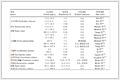
The quality controls (QC) of blood samples were analyzed to assess intra-day (n = 3) and inter-day (n = 3) accuracy and precision, with the results summarized in Table 1. The accuracy for intra-day and inter-day was in the ranges of 94.48%-111.84% and 92.74%-114% for tacrolimus, 94.05%-108.91% and 93.06%-110.06% for everolimus, 94.31%-103.61% and 97.22%-107.28% for sirolimus and 96.53%-113.83% and 90.12%-104.49% for cyclosporin A, respectively. The precision (coefficient of variation, CV) for intra-day and inter-day was ≤6.74% and ≤14.80% for tacrolimus, ≤8.00% and ≤10.13% for everolimus, ≤7.83% and ≤8.79% for sirolimus and ≤6.53% and ≤8.34% for cyclosporin A. The results showed that accuracy and precision for the QC of blood samples were within the acceptable limits, when using the compact LC-MS system. For the assessment of extraction efficiency, the supernatant for the QC of blood samples (n = 3) and the QC diluted by blank supernatant were compared in Table S1 in supporting information.
|
Table 1 Accuracy and precision for intra-day and inter-day of immunosuppressants in whole blood. |


In conclusion, as a first attempt, we integrated a compact LC with a miniature ion trap mass spectrometer in this study. The overall instrument is compact in size and easy to maintain. The LC system in front could effectively improve mixture analysis capability and detection sensitivity of the miniature mass spectrometer. More importantly, the LC interface accommodates standard methods currently employed in clinical practice, which smooths the transfer from conventional lab-scale LC-MS/MS to the compact LC-MS system. As a demonstration, this setup was applied in the analyses of four widely used immunosuppressants. After optimization, quantitative results for immunosuppressants in blood samples were in the linear ranges. And the compact LC-MS system had acceptable performances in terms of linearities, accuracy and precision. As a proof-of-concept demonstration, this work showed that a compact LC-MS instrument could potentially be used in clinical diagnosis, either to fill the gap and alleviate some "pain points" of conventional lab-scale instruments in clinical practice or to be used in POCT applications.
Declaration of competing interestThe authors declare that they have no known competing financial interests or personal relationships that could have appeared to influence the work reported in this paper.
AcknowledgmentsThis work was supported by the National Key Research and Development Program of China (No. 2020YFF01014502) and the National Natural Science of Foundation of China (Nos. 21922401, 201827810).
Supplementary materialsSupplementary material associated with this article can be found, in the online version, at doi:10.1016/j.cclet.2022.07.058.
| [1] |
J.G. van der Gugten, Clin. Mass Spectrom. 15 (2020) 36-43. DOI:10.1016/j.clinms.2019.09.002 |
| [2] |
C. Shu, T. Li, D. Li, et al., Chin. Chem. Lett. 33 (2022) 916-919. DOI:10.1016/j.cclet.2021.07.009 |
| [3] |
A.L. Wong, X. Xiang, P.S. Ong, et al., Pharmaceutics 10 (2018) 221. DOI:10.3390/pharmaceutics10040221 |
| [4] |
G.A. Gomez-Rios, T. Vasiljevic, E. Gionfriddo, et al., Analyst 142 (2017) 2928-2935. DOI:10.1039/C7AN00718C |
| [5] |
H. Brown, B. Oktem, A. Windom, et al., Forensic Chem. 1 (2016) 66-73. DOI:10.1016/j.forc.2016.07.002 |
| [6] |
J. Kissel, K. Altwegg, B.C. Clark, et al., Space Sci. Rev. 128 (2007) 823-867. DOI:10.1007/s11214-006-9083-0 |
| [7] |
R.G. Cooks, N.E. Manicke, A.L. Dill, et al., Faraday Discuss. 149 (2011) 247-267. DOI:10.1039/C005327A |
| [8] |
H. Wang, J. Liu, R.G. Cooks, et al., Angew. Chem. Int. Ed. 49 (2010) 877-880. DOI:10.1002/anie.200906314 |
| [9] |
L. Li, T.C. Chen, Y. Ren, et al., Anal. Chem. 86 (2014) 2909-2916. DOI:10.1021/ac403766c |
| [10] |
D.T. Snyder, C.J. Pulliam, Z. Ouyang, et al., Anal. Chem. 88 (2016) 2-29. DOI:10.1021/acs.analchem.5b03070 |
| [11] |
P. Mielczarek, J. Silberring, M. Smoluch, Mass Spectrom. Rev. 39 (2020) 453-470. DOI:10.1002/mas.21614 |
| [12] |
L.S. Riter, E.C. Meurer, I. Cotte-Rodriguez, et al., Analyst 128 (2003) 1119-1122. DOI:10.1039/b308292j |
| [13] |
W. Wang, S. Wang, C. Xu, et al., Anal. Chem. 91 (2019) 10212-10220. DOI:10.1021/acs.analchem.9b02309 |
| [14] |
A.J. Bednar, A.L. Russell, C.A. Hayes, et al., Chemosphere 87 (2012) 894-901. DOI:10.1016/j.chemosphere.2012.01.042 |
| [15] |
P.E. Leary, B.W. Kammrath, K.J. Lattman, et al., Appl. Spectrosc. 73 (2019) 841-858. DOI:10.1177/0003702819849499 |
| [16] |
Q. Yu, S. Xu, W. Shi, et al., Anal. Methods 12 (2020) 1852-1857. DOI:10.1039/D0AY00175A |
| [17] |
J. Wolf, R. Etter, M. Schaer, et al., J. Am. Soc. Mass Spectrom. 27 (2016) 1197-1202. DOI:10.1007/s13361-016-1374-4 |
| [18] |
L. Gao, R.G. Cooks, Z. Ouyang, Anal. Chem. 80 (2008) 4026-4032. DOI:10.1021/ac800014v |
| [19] |
W. Xu, N Charipar, M.A. Kirleis, et al., Anal. Chem. 82 (2010) 6584-6592. DOI:10.1021/ac101002t |
| [20] |
Y. Zhai, T. Jiang, G. Huang, et al., Analyst 141 (2016) 5404-5411. DOI:10.1039/C6AN00956E |
| [21] |
W. Zhang, X. Wang, Y. Xia, et al., Theranostics 7 (2017) 2968-2981. DOI:10.7150/thno.19410 |
| [22] |
M. Kang, W. Zhang, L. Dong, et al., Anal. Chim. Acta 1101 (2020) 74-80. DOI:10.1016/j.aca.2019.12.028 |
| [23] |
M. He, Z. Xue, Y. Zhang, et al., Anal. Chem. 87 (2015) 2236-2241. DOI:10.1021/ac504868w |
| [24] |
F. Zhang, J. Hong, W. Xu, et al., Talanta 206 (2020) 120183. DOI:10.1016/j.talanta.2019.120183 |
| [25] |
Z. Wu, Z. Gong, X. Jiang, et al., Anal. Instrum. 1 (2021) 11-18. |
| [26] |
Z. Xu, H. Wu, Y. Tang, et al., J. Mass Spectrom. 54 (2019) 583-591. DOI:10.1002/jms.4361 |
| [27] |
Y. Zhai, Y. Feng, Y. Wei, et al., Analyst 140 (2015) 3406-3414. DOI:10.1039/C5AN00462D |
| [28] |
Y. Zhai, Q. Xu, Y. Tang, et al., Anal. Chem. 91 (2019) 7911-7919. DOI:10.1021/acs.analchem.9b01770 |
| [29] |
B. Seyfinejad, A. Jouyban, J. Pharm. Biomed. Anal. 205 (2021) 114315. DOI:10.1016/j.jpba.2021.114315 |
| [30] |
Z. Yang, S. Wang, J. Immunol. Methods 336 (2008) 98-103. DOI:10.1016/j.jim.2008.05.001 |
| [31] |
A.S.B. Goebel, J. Wohlrab, R.H.H. Neubert, Chromatographia 70 (2009) 581-584. DOI:10.1365/s10337-009-1157-1 |
| [32] |
B. Chen, J. Lu, K. Shao, et al., Ther. Drug Monit. 42 (2020) 686-694. DOI:10.1097/FTD.0000000000000765 |
| [33] |
T.T. Nguyen, V.A. Duong, D.K. Vo, et al., Molecules 26 (2021) 425. DOI:10.3390/molecules26020425 |
| [34] |
C. Sottani, E. Grignani, S. Mazzucchelli, et al., J. Pharm. Biomed. Anal. 191 (2020) 113644. DOI:10.1016/j.jpba.2020.113644 |
| [35] |
S. Pandey, Y. Hu, L.R. Bushman, et al., Anal. Bioanal. Chem. 414 (2022) 3387-3395. DOI:10.1007/s00216-022-03954-3 |