 2020, Vol. 31


b School of Chemical Engineering & Light Industry, Guangdong University of Technology, Guangzhou 510006, China;
c State Key Laboratory on Integrated Optoelectronics, College of Electronic Science and Engineering, Jilin University, Changchun 130012, China
Semiconducting metal oxides is well known for its excellent ability in many aspects, such as the catalysis, spintronics and transparent conductor [1-3]. In particular, it is the most popular material used as gas sensor for detecting pollutant gases [4-6]. Over the past decades, gas sensors based on semiconducting metal oxides has attracted great attention [7-10]. Moreover, due to changes in the electrical conductance in response to environmental gases, SnO2 is also the most employed metal oxide semiconductor as a gas sensor for the detection of a wide variety of toxic, combustible and pollutant gases [11-13]. Many routes have been applied in preparing SnO2 gas sensors, including co-precipitation method [14], Sputtering [15], electrospining [16], sol-gel method [17] and hydrothermal method [18]. The potential of these methods was demonstrated that the improved gas sensing properties were traced back to changes in the chemistry and the electronic properties of the material [19]. Maybe small differences in the introduction methods lead to very different chemistry and the electronic properties and thus gas sensing properties. However, it is difficult to characterize the geometric and electronic properties of the surfaces by experiment due to their complexity. In addition, many nanostructures are also used in preparing SnO2 thick-film CO sensors, e.g., nanoparticles, nanosheets, nanotubes, nanowires, hollow spheres and quantum dots.
Carbon monoxide (CO) is a colorless and odorless dangerous gas, which can do severe harm to human beings [20]. Hence, many efforts and investigation have been made to improve the performances of CO gas sensors based on tin oxides [21]. Yin et al. [22] reported a CO gas sensor fabricated from Pd-loaded and Fe-doped SnO2. Kim and coworkers [23] have fabricated reduced graphene oxide-loaded SnO2 with simultaneous Au functionalization for ppm-level CO sensing. Bing et al. [24] prepared Au-loaded SnO2 hollow multilayered nanosheets for detecting 1-200 ppm CO. In addition, the DFT study of CO adsorption and oxidation on the surfaces [25] were also investigated. Under typical gas sensing conditions high background humidity and the presence of interfering gases pure SnO2 materials show a strongly decreased sensor performances and stability. In order to overcome this disadvantage, the SnO2 with noble metals (Pd, Pt, Au) show excellent sensing performance [26, 27], changing its surface chemistry and electrical properties. For SnO2 gas sensing materials, Pt/SnO2 usually shows high sensitivity to CO. The reported results indicate that modifying the surface of oxide semiconductors with noble metal is the most effective approach to prepare highly sensitive CO sensors. In spite of these explorations, the improvement of the response and selectivity to CO gas is still necessary. Moreover, it was found that upon Pt, more active sites for atomic/ molecular oxygen adsorption are generated, which will increase the electron depletion because of more electrons transferred from SnO2 to oxygen species and then show well sensitivity when CO donates electrons to the depletion layer upon interacting with the adsorbed oxygen species [28]. Otherwise, the electromagnetic energy of the microwave could be effectively transferred to the target polar molecules located in a rapidly oscillating electrical field of microwaves. The rapid heating rate and the special heating mechanism might change the reaction mechanism conducted in a microwave heating system.
All the reagents in the experiment were analytical-grade purity (Beijing Chemicals Co., Ltd.) and used as received without any further purification. In our experiment, Pt/SnO2 structures were synthesized by a fast microwave assisted hydrothermal route. In a typical synthesis process, SnCl2·2H2O (0.9 g) and Na3C6H5O7·2H2O (2.94 g) were added into 10 mL deionized water with vigorous stirring for 10 min. After that NaOH (0.08 g) dissolved in 10 mL deionized water was added slowly with continuous stirring for 10 min to form a homogeneous solution. Then certain amount of H2PtCl6 solution was added into above mixture solutions respectively, thus, the corresponding mass ratio between the element Pt and the element Sn are 0.0, 1.5 wt%, 3.0 wt%, 4.5 wt% respectively. Subsequently, the resulting mixture was transferred into 100 mL Teflon-lined autoclave, which was sealed and placed in a microwave oven (Milestone ETHOS-D) with programmed heating profiles. First heated to 180 ℃ at a heating rate of 18 ℃/min from room temperature, and then maintained at 180 ℃ for 60 min, after that cooled down naturally. The maximum heating power of the microwave system is 300 W from the beginning to the end. After the microwave hydrothermal procedure, the resultant precipitates were centrifuged and washed with deionized water and absolute ethanol several times before drying at 80 ℃ for 10 h. Finally, the obtained powder was calcined at 500 ℃ for 2 h in muffle furnace. A series of 0.0 wt%, 1.5 wt%, 3.0 wt% and 4.5 wt% Pt/SnO2 structures were synthesized.
The gas sensors fabrication process based on as-prepared sensing materials were described detailed in our previous works [29], and sensors devices were sintered at 400 ℃ for 2 h to improve its stability and performance. The gas sensing performance of the gas sensors were investigated using a static system under laboratory conditions (40% RH, 25 ℃). The sensors were put into an airtight chamber (50 Lin volume) purged with pure air, and then agiven amount of test gases was injected into the airtight chamber using a microsyringe for the measurement of the gas-sensing performance. The sensor was alternately placed into closed test chambers with pure air or targetgas. Theresponse (Ra/Rg) of the sensor was defined asthe ratio of the resistancesof the sensors in air (Ra) tothatin tested gases(Rg). The response times was defined as the times taken by the sensor to achieve 90% of the total resistance changes in the case of adsorption processes [30].
In this work, Pt/SnO2 with different amount of Pt was prepared by using a facile and efficient one-step microwave assisted method. Characterized by means of XRD, SEM and TEM, we can find that Pt is well dispersed on SnO2 attributed to this in situ method. The carbon monoxide sensing properties of the sensors based on Pt/SnO2 were investigated to find the superior carbon monoxide sensing properties. Results indicated that the sensor based on 3.0 wt% Pt/SnO2 perform good sensing properties with fine response time. Such enhanced gas sensing performances could be attributed to both the contribution of Pt with good dispersion and the in situ method.
The XRD data was shown in Fig. S1 (Supporting information). The morphologies and microstructures of the obtained SnO2 products were characterized by field emission scanning electron microscope (FESEM). The images (Fig. 1) of SnO2 and Pt/SnO2 reveal that they are solids constructed from interconnected nanoparticles. As show in Fig. 1, the overall morphologies of prepared SnO2 and Pt/SnO2 were similar. The samples with different amount of Pt were almost the same morphology. From the Fig. 1, we also can see that the 3.0 wt% and 4.5 wt% Pt/SnO2 possess more pore structure than 0.0 wt% and 1.5 wt% Pt/SnO2. Generally, the noble metals on SnO2 particles prevent their coalescence during thermal treatments and decrease SnO2 particle size [31]. However, an obvious crystallite growth and surface area increment is observed as the concentration of Pt reached to 3.0 wt%, which maybe improve the gas sensing properties. Both the TEM images of 3.0 wt% Pt/SnO2 and the corresponding elemental mapping images (Fig. 2) confirmed that Pt particles show effectively uniform distribution in SnO2.

|
Download:
|
| Fig. 1. SEM images of Pt/SnO2: (a) 0 wt%, (b) 1.5 wt%, (c) 3.0 wt% and (d) 4.5 wt%. | |


|
Download:
|
| Fig. 2. (a) Typical TEM and (b–d) corresponding elemental mapping images of 3.0 wt% Pt/SnO2. | |

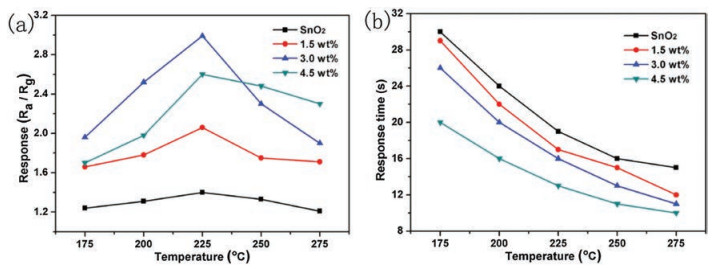
To evaluate the potential applicability in gas sensors for CO, some fundamental gas sensing performances of the as-prepared samples were investigated. Therefore, four gas sensors were fabricated using prepared samples as sensing materials. It is well known that the operating temperature has a great influence on sensing properties, especially the response. There usually exists a temperature region in which the sensor shows the highest gas response with the other conditions kept as the same. In order to determine the optimum operating temperatures, the response of sensors to 100 ppm CO were tested as a function of operating temperature ranging from 175 ℃ to 275 ℃, depicted in Fig. 3a. It is obvious that the response of four sensors varied with operating temperature and exhibited one volcano-shaped curve. The response of sensors reached their maximum and then decreased with further increasing the operating temperature. The gas response toward 100 ppm CO is greatly promoted from 1.4 to 3.0 through the Pt. The maximum response values are 1.4, 2.1, 2.6 and 3.0–100 ppm CO at 225 ℃ respectively. It can be seen that the sensor based on 3.0 wt% Pt/SnO2 displayed the most notably enhanced response to carbon monoxide compared with that based on other samples. At the same time, the optimal operating temperature is 225 ℃ for four sensors of 0.0–4.5 wt% Pt/SnO2, which was applied to further examine the characteristics of sensors. We can see that the optimal operating temperatures are the same, perhaps caused by the smaller difference of them than 25 ℃ temperature interval. But the response values are very different. It is well known that the response time is also important parameters for evaluating a gas sensor as show in Fig. 3b. Rapid response is necessary in practical application. We can see that the response time is faster at higher temperature than those in lower temperature. The response time of Pt/SnO2 sensors is faster than that of SnO2 sensor at different temperatures. In addition, the result indicates that the sensor using Pt/SnO2 had a faster response process with increasing the Pt amount to 100 ppm CO.

|
Download:
|
| Fig. 3. Responses of the sensors base on as-prepared samples vs. operating temperature to 100 ppm CO and their response times. | |
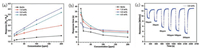
Gas-sensing properties of the sensors were investigated to different concentrations of CO from 10 ppm to 200 ppm at 225 ℃, as shown in Fig. 4a. We can see that the curves of response exhibited approximately linear increase from 10 ppm to 200 ppm. In particular, the discrepancy in response values and slope of the curve indicated that the sensing performance was highly dependent upon the Pt amount. The Pt/SnO2 sensors perform higher response than SnO2 sensor. We also can see that the sensor based on 3.0 wt% Pt/SnO2 exhibited higher response than those of 1.5 wt% and 4.5 wt% Pt/SnO2 sensors to CO at various concentrations. This result can be interpreted in terms of the electric interaction between Pt and SnO2, for which Pt captured electrons from SnO2 and produced electron depleted layer on the surface of SnO2. Thus, a proper content of Pt can improve the response of the senor. However, further increase in the concentration of Pt to 4.5 wt% decreased the response, attributing to a low utilization ratio of sensing body, which suppresses the carbon monoxide oxidation and the sensing reaction. The response time and dynamic curves to different concentrations of CO at 225 ℃ were shown in Figs. 4b and c, which demonstrate that the 3.0 wt% Pt/SnO2 sensor perform good CO sensing properties.
|
Download:
|
| Fig. 4. Responses of the sensors vs. CO concentrations at 225 ℃ (a), their response times (b) and dynamic curve (c). | |

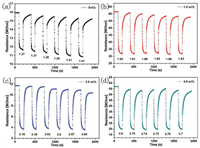
Repeatability is an important parameter which can be used to evaluate the reliability of a sensor. Thus, the repeatability of sensors was investigated six times under the same conditions to 100 ppm CO at 225 ℃ and the response transients curve is shown in Fig. 5. It can be seen that the resistance of the sensor changed when carbon monoxide was injected and then reached a steady state. When the sensor was transferred into air, the resistance recovers accordingly. The gas response keeps almost constant with only small fluctuations respectively. The test time for response is 2 min and that for recover is 4 min respectively. Both of these factors indicate that the CO gas sensing of Pt/SnO2 has good repeatability and reliability.
|
Download:
|
| Fig. 5. Transients curve of the sensor base on as-prepared samples at 225 ℃ to 100 ppm CO. (a) 0 wt%, (b) 1.5 wt%, (c) 3.0 wt% and (d) 4.5 wt%. | |

The selectivity and the long-term stability of sensor were shown in Fig. S2 (Supporting information). The nitrogen adsorption-desorption isotherms and the gas sensing mechanism were also given in Supporting information (Fig. S3 in Supporting information).
In this work, CO gas sensors were fabricated by Pt/SnO2 and they exhibited better response and faster response properties when detecting carbon monoxide gases. It was found that Pt amount of Pt/SnO2 played important roles in determining the CO sensing performance. The sensor of 3.0 wt% performs good CO sensing properties. The mechanism for CO sensing was analyzed in view of facilitating the surface chemical reaction. Also, such enhanced gas sensing performances could be attributed to both the contribution of Pt with good dispersion. This work demonstrated the fundamental role of structure and distribution of noble metals in oxide materials for the surface chemistry, which has a direct link to the materials functionality, in this case, gas sensing. The present result indicates that Pt/SnO2 has strong potential as CO gas sensing material with high response.
AcknowledgmentsThis work is supported by the National Natural Science Foundation of China (No. 61803172) and the Start-up Research Foundation of Hainan University (No. KYQD(ZR)1910).
Appendix A. Supplementary dataSupplementary material related to this article canbe found, in the online version, at doi:https://doi.org/10.1016/j.cclet.2019.12.007.
| [1] |
X. Zhou, X. Cheng, Y. Zhu, et al., Chin. Chem. Lett. 29 (2018) 405-416. DOI:10.1016/j.cclet.2017.06.021 |
| [2] |
Q. Zhang, H. Zhang, Chin. Chem. Lett. 29 (2018) 538-542. DOI:10.1016/j.cclet.2017.09.018 |
| [3] |
R. Arnold, T. Aivar, G. Alar, IEEE Sens. J. 13 (2013) 1648-1655. DOI:10.1109/JSEN.2013.2238227 |
| [4] |
M.B. Mehrabi, Y. Mortazavi, Sens. Actuator. B: Chem. 151 (2010) 140-145. DOI:10.1016/j.snb.2010.09.033 |
| [5] |
S. Liu, M. Xie, Y. Li, Sens. Actuator. B: Chem. 151 (2010) 229-235. DOI:10.1016/j.snb.2010.09.015 |
| [6] |
M. Valeria, S. María, G. Gabriela, IEEE Sens. J. 14 (2014) 1765-1770. DOI:10.1109/JSEN.2014.2303147 |
| [7] |
U. Choi, Sens. Actuator. B: Chem. 98 (2004) 166-173. DOI:10.1016/j.snb.2003.09.033 |
| [8] |
H. Gong, J.Q. Hu, J.H. Wang, Sens. Actuator. B: Chem. 115 (2006) 247-251. DOI:10.1016/j.snb.2005.09.008 |
| [9] |
Y. Zhang, J. Xu, Q. Xiang, P. Xu, J. Phys. Chem. C 113 (2009) 3430-3435. DOI:10.1021/jp8092258 |
| [10] |
S.K. Lim, S.H. Hwang, D. Chang, Sens. Actuator. B: Chem. 149 (2010) 28-33. DOI:10.1016/j.snb.2010.06.039 |
| [11] |
R. Frank, M. Ralf, IEEE Sens. J. 7 (2007) 1490-1497. DOI:10.1109/JSEN.2007.906887 |
| [12] |
D. Meng, D. Liu, G. Wang, et al., Sens. Actuator. B: Chem. 273 (2018) 418-428. DOI:10.1016/j.snb.2018.06.030 |
| [13] |
C. Elisabetta, O. Luca, IEEE Sens. J. 4 (2004) 17-20. DOI:10.1109/JSEN.2003.822216 |
| [14] |
K. Subramanyam, N. Sreelekha, R.D. Maranatha, Superlattices Microstruct. 82 (2015) 207-218. DOI:10.1016/j.spmi.2015.01.043 |
| [15] |
W. Li, J.Y. Liu, Sensors 17 (2017) 2392-2397. DOI:10.3390/s17102392 |
| [16] |
X. Kou, N. Xie, F. Chen, et al., Sens. Actuator. B: Chem. 256 (2018) 861-869. DOI:10.1016/j.snb.2017.10.011 |
| [17] |
W. Chen, J. Li, J. Appl. Phys. 109 (2011) 83930-83938. DOI:10.1063/1.3575316 |
| [18] |
Y.H. Sun, J. Wang, X.G. Li, Sensors 18 (2018) 390-404. DOI:10.3390/s18020390 |
| [19] |
J.H. Kim, Z.U. Abideen, Y.F. Zheng, S.S. Kim, Sensors 16 (2016) 1857-1867. DOI:10.3390/s16111857 |
| [20] |
F.A. Li, J. Zou, X. Zhang, et al., Ionics 24 (2018) 1451-1456. DOI:10.1007/s11581-017-2297-1 |
| [21] |
M. Hübner, N. Bârsan, U. Weimar, Sens. Actuator. B: Chem. 171 (2012) 172-180. |
| [22] |
X.Y. Yin, X.M. Guo, Sens. Actuator. B: Chem. 200 (2014) 213-218. DOI:10.1016/j.snb.2014.04.026 |
| [23] |
K. Jae, K. Akash, Chem. Commun. (Camb.) 52 (2015) 3832-3836. DOI:10.1039/C5CC10482C |
| [24] |
Y. Bing, Y. Zeng, S. Feng, Sens. Actuator. B: Chem. 227 (2016) 362-372. DOI:10.1016/j.snb.2015.12.065 |
| [25] |
V.G. Yyacheslav, IEEE Sens. J. 2 (2002) 416-421. DOI:10.1109/JSEN.2002.806307 |
| [26] |
M. Yuasa, T. Kida, K. Shimanoe, ACS Appl. Mater. Inter. 4 (2012) 4231-4236. DOI:10.1021/am300941a |
| [27] |
W.D. Liu, B. Yang, Chin. Chem. Lett. 28 (2017) 675-690. DOI:10.1016/j.cclet.2016.09.004 |
| [28] |
L. Liang, J. Yin, J. Bao, Chin. Chem. Lett. 30 (2019) 167-170. DOI:10.1016/j.cclet.2018.01.049 |
| [29] |
Q. Wang, H. Sun, Sens. Actuator. B: Chem. 222 (2016) 257-263. DOI:10.1016/j.snb.2015.07.115 |
| [30] |
Q. Wang, X. Li, F. Liu, Sens. Actuator. B: Chem. 230 (2016) 17-24. DOI:10.1016/j.snb.2016.01.147 |
| [31] |
I. Kocemba, J. Rynkowski, Sens. Actuator. B: Chem. 155 (2011) 659-666. DOI:10.1016/j.snb.2011.01.026 |