 2017, Vol. 28


 ,
Guang Dua,
Yong-Hui Zhangb
,
Guang Dua,
Yong-Hui Zhangb
b Hubei Key Laboratory of Natural Medicinal Chemistry and Resource Evaluation, School of Pharmacy, Tongji Medical College, Huazhong University of Science and Technology, Wuhan 430030, China;
c State Key Laboratory of Phytochemistry and Plant Resources in West China, Kunming Institute of Botany, Chinese Academy of Sciences, Kunming 650204, China;
d College of Life Science, Hubei University, Wuhan 430062, China
Acorus tatarinowii Schott (Araceae), widely distributed in the northeast India and the south of China, is a famous traditional Chinese medicine (TCM), the rhizome of which is used as a remedy for various central nervous system related diseases[1]. Previous phytochemical studies indicated that the major constituents of this plant were phenylpropanoids [2, 3] and sesquiterpenoids [4, 5]. Recently, the phenylpropanoids isolated from this plant were reported to exert a broad spectrum of biological activities, such as antiepileptic and neuroprotective effects [6-8], bronchitis [8], anticardiovascular diseases [9].
In the course of our continuing efforts to discover bioactive natural products from A. tatarinowii, a series of norlignans, lignans, and neolignans, including many pairs of enantiomers, were previously reported [10, 11]. In our current study, further investigation on chemical constituents of the rhizomes of A. tatarinowii resulted in the isolation of two pairs of chlorine-containing phenylpropanoid enantiomers (1a/1b and 2a/2b). Herein, we report the extraction and isolation, planar structural elucidation, and the absolute configuration determination of the two pairs of enantiomers, as well as evaluation for their cytotoxic and antioxidant activities.
2. Results and discussionTwo pairs of chlorine-containing phenylpropanoid enantiomers (Fig. 1) were successfully isolated from the EtOAc extract of the air-dried rhizomes of A. tatarinowii through a series of chromatographic separations, including chiral HPLC.

|
Download:
|
| Fig. 1. Structures of 1a/1b and 2a/2b. | |
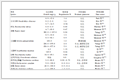
Compound 1 (1a/1b) was isolated as colorless block crystals (MeOH), possessing the molecular formula C13H18ClO5, as determined from NMR data and an HR-ESIMS [M+H]+ ion at m/z 313.0828 (calcd. for C13H19ClO5, 313.0819) along with characteristic isotopic peaks with the ratio of 3:1 at m/z 313.0828/315.0798 suggesting the presence of a chlorine atom. Its IR spectrum indicated the presence of hydroxyl functionality (3452 cm-1) and aromatic ring (1611 and 1510 cm-1). The 13C NMR and DEPT spectra of 1 (Table 1) displayed 13 carbons, corresponding to six aromatic carbons (δC 119.1, 153.6, 98.9, 151.1, 144.6, and 113.8), two oxygenated methine (δC 78.9 and 75.7), one methylene (δC 46.8) and four methoxyl groups (δC 56.7, 56.7, 57.4 and 57.4). The 1H NMR data (Table 1) showed signals of two aromatic protons [δH 6.69 (s, 1H, H-3) and 6.96 (s, 1H, H-6)] attributed to a 1, 2, 4, 5-tetrasubstituted phenyl group, two oxygenated methine protons [δH 4.68 (d, 1H, J = 5.1 Hz, H-1') and 3.82 (m, 1H, H-2')], one methylene group [δH 3.54 (dd, 1H, J = 11.2, 4.8 Hz, H-3'a) and 3.44 (dd, 1H, J = 11.2, 7.0 Hz, H-3'b)], and four methoxy protons [δH 3.23, 3.79, 3.82, and 3.86]. The data mentioned above suggested that the planar structure of 1 was very similar to acoraminol A [12], with the only difference that the C-2' methyl group was halogenated to be CH2Cl. This conclusion was supported by the key HMBC correlations of H-1' to C-1, C-2, C-6, C-2' and C-3'; H-2' to C-1', C-2', and C-1; OMe-2 to C-2, OMe-4 to C-4, OMe-5 to C-5; and OMe-1' to C-1' and the 1H-1H COSY correlations of H-1'/H-2'/H-3'. The chemical shifts of H-3' (3.54 and 3.44) and C-3' (46.8) revealed the chlorine to be on C-3'. Thus, compound 1 was determined to be 3'-chloro-1'-methoxy-1-(2, 4, 5-trimethoxyphenyl)propan-2'-ol.
|
Table 1 13C and 1H NMR data of 1a/1b–2a/2b in CD3OD (400 MHz for 1H, and 100 MHz for 13C). |

The stereochemistry configuration of 1 was determined by a single X-ray diffraction analysis coupled with the modified Mosher's method. detailed single-crystal X-ray diffraction analysis with Cu Kα irradiation revealed that compound 1 was a pair of racemic mixture with the space group P-1 [13], which was supported by its negligible optical activity and an ECD spectrum devoid of Cotton effects. Subsequently, the chiral HPLC resolution of 1 yielded the enantiomers (-)-1a and (+)-1b with ratio of approximately 1:1 (Fig. 2a), showing specific rotations of opposite sign (1a: [α]D20 -43; 1b: [α]D20 +43) and antipodal ECD curves [1a: 234 (Δe-1.38) and 280 (Δε-0.28) nm; 1b: 232 (Δε +1.60) and 286 (Δε +0.21) nm] (Fig. 2c). In order to determine the absolute configuration of the optically pure compound 1b, a modified Mosher's experiment was performed. According to the MTPA shielding/deshielding effects[14, 15], the ΔδH (S—R) values revealed a 2'S configuration for (+)-1b (Fig. 3), Thus, the absolute configuration of 1b was determined as 1'S, 2'R on the basis of 1', 2'-erythro configuration elucidated by single-crystal X-ray diffraction experiment (Fig. 4), and that of 1a was assigned as 1'R, 2'S.

|
Download:
|
| Fig. 2. Chiral HPLC separation profile and experimental ECD spectra of 1a/1b and 2a/2b. | |

|
Download:
|
| Fig. 3. ΔδH (S—R) values (inppm) for the MTPA esters of 1b and 2b. | |

|
Download:
|
| Fig. 4. ORTEP drawing of 1 and 2. | |
Compound 2 (2a/2b) was obtained as colorless block crystals (MeOH). The molecular formula of 2 was established as the same as 1, based on the NMR data and HRESIMS data showing a [M + H]+ ion at m/z 313.0830 (calcd. for C13H19ClO5, 313.0819) along with characteristic isotopic peaks with the ratio of 3:1 at m/z 313.0830/ 315.0795. A comparison of the NMR data of 2 with those of 1 (Table 1) showed that the only difference between 1 and 2 was the small change in chemical shifts from C-1' to C-3' [δH 4.68 (d, 1H, J = 5.1 Hz, H-1'), 3.82 (m, 1H, H-2'), 3.54 (dd, 1H, J = 11.2, 4.8 Hz, H-3'a), and 3.44 (dd, 1H, J = 11.2, 7.0 Hz, H-3'b); δC 78.9 (C-1'), 75.7 (C-2'), and 46.8 (C-3') in 1; d H 4.67 (d, 1H, J = 5.5 Hz, H-1'), 3.94 (m, 1H, H-2'), 3.65 (dd, 1H, J = 11.3, 2.6 Hz, H-3'a), and 3.54 (dd, 1H, J = 11.3, 7.8 Hz, H-3'b); d C 79.8 (C-1'), 75.3 (C-2'), and 47.5 (C-3') in 2]. These findings, combined with the 2D NMR data and the large coupling constant (J1', 2' = 5.5) revealed that 2 was a stereoisomer of 1 with a threo configuration (1'R*, 2R'*).
Similarly, a single X-ray diffraction experiment with Mo Kα irradiation was performed to determine the absolute configuration of 2 (Fig. 4). It is interesting that the crystals of 2 had the space group C2/C [13], indicating its racemic nature, as further confirmed by [α]D20= 0. The subsequent chiral purification of 2 using a Daicel IC column in the same manner as 1, afforded the enantiomers (-)-2a and (+)-2b (Fig. 2b), displaying mirror image ECD curves [2a: 232 (Δε +0.9), 290 (Δε +0.41) nm; 1b: 232 (Δε-0.7), 282 (Δε-0.21) nm.] (Fig. 2d) and opposite specific rotations [2a:[α]D20 -34; 2b: [α]D20 +34]. Finally, the absolute configuration of 2b was determined as 1'S, 2'S on the basis of modified Mosher's method (Fig. 3) and that of 2a was assigned as 1'R, 2'R.
Compounds 1a/1b and 2a/2b were evaluated for their antioxidant activities and cytotoxic activities using the DPPH assay and MTT method, respectively. The results indicated that none of the compounds showed signally antioxidant activities at the concentration of 50.0 μg/mL, while compounds 1a and 2a exhibited weak inhibitory activities against the proliferation of the HL-60, SMMC-7721, A-549, and MCF-7 cell lines with the IC50 values ranging from 23.16 μmol/L to 38.14 μmol/L (Table 2), respectively.
|
|
Table 2 Chiral HPLC separation profile and experimental ECD spectra of 1a/1b and 2a/2b. |


3. Conclusion
Compounds 1a/1b and 2a/2b, four optical isomers with two chiral centers, were obtained simultaneously from the same plant, which were rare reported in natural products. Additionally, this is the first report for natural products containing chlorine atom from the genus Acorus. Their racemic natures were discovered by X-ray diffraction and absolute configurations were determined by modified Mosher's method.
4. Experimental 4.1. GeneralOptical rotations were obtained on a Rudolph Research Analytical Autopol Ⅳ polarimeter equipped with a 1 dm microcell and an odium lamp (589 nm). Melting points were measured on a Beijing Tech X-5 micro-melting point apparatus. 1D and 2D NMR data were recorded on a Bruker AM-400. UV spectra were obtained on a Varian Cary 50. FT-IR spectra were determined using a Brukera Vertex 70 instrument. The ECD spectra were obtained using a JASCO J-810 spectrometer. HRESIMS were acquired in the positiveion mode on a Thermo Scientific LTQ-XL-Orbitrap mass spectrometer. The crystallographic experiments were performed on a Bruker APEX DUO diffractometer equipped with an APEX Ⅱ CCD, using Cu/Mo Kα radiation (λ = 1.54178 Å). Semi-preparative HPLC was performed on a Dionex quaternary system using an RP C18 column (5 μm, 10 mm × 250 mm, SunFireTM Prep C18) and a chiralpak IC column (5 μm, 4.6 mm × 250 mm, Daicel Chiral Technologies Co., Ltd. China). MPLC was carried out with EZ Plus chromatography system (Lisure Science Co., Ltd, China). Column chromatography (CC) were performed on Sephadex LH-20 (40-70μm, Amersham Pharmacia Biotech AB, Uppsala, Sweden), silica gel (200-300 mesh; Qingdao Marine Chemical, Inc., Qingdao, China), and octadecylsilyl (ODS, 50 mm, YMC Co. Ltd., Japan). TLC (thin-layer chromatography) was carried out using glass-precoated silica gel GF254 (Merck, Germany).
4.2. Plant materialThe rhizomes of A. tatarinowii were collected in Qichun County, Hubei Province, China, in September 2012, and were authenticated by Prof. J. Wang from School of Pharmacy, Tongji Medical College, Huazhong University of Science and Technology. A voucher specimen (No. 2012-0913A) has been deposited at the Hubei Key Laboratory of Natural Medicinal Chemistry and Resource Evaluation, School of Pharmacy, Tongji Medical College, Huazhong University of Science and Technology.
4.3. Extraction and isolationThe dried rhizomes of A. tatarinowii (40.0 kg) were extracted with 95% aqueous MeOH (4 ×100 L) three times at room temperature. The solvent was concentrated under vacuum to afford the crude extract (2.6 kg), which was suspended in H2O and successively partitioned with petroleum ether, EtOAc, and n-BuOH, respectively. The EtOAc partition was subjected to a silica gel eluting with petroleum ether-acetone (20:1-1:1, v/v), to give five fractions (Fr. 1-5).
Fr. 3 (30 g) was then chromatographed over a silica gel eluting with a gradient of (PE-EtOAc 15:1→5:1) to give four subfractions (Fr.3.1-Fr.3.4). Fr.3.2 was subjected to a Sephadex LH-20 (MeOH) column to afford three additional fractions (Fr.3.2.1 and Fr.3.2.3). Fr.3.2.2 was then chromatographed over an ODS gel column eluting with MeOH-2O (30:50→50:30, v/v) to yield the major fraction Fr.3.2.2.1. Compounds 1 (17 mg) and 2 (7 mg) were successfully obtained from Fr.3.2.2.1 by semi-preparative HPLC eluting with 30% CH3CN/2O. Finally, compounds 1 was further purified by chiral HPLC using a Daicel IC column eluting with EtOH-n-hexane (20:80) to yield 1a (tR 9.5 min) and 1b (tR 13.2 min). Compounds 2a (tR 12.5 min) and 2b (tR 16.5 min) were successfully separated in the same manner.
Compound 1: Colorless block crystals (MeOH), mp 135-136 ℃; [α]D200 (c 1.0, MeOH); UV (MeOH) λmax (logε) 207 (4.51), 233 (4.10), and 291 (3.85) nm; IR (KBr) νmax 3452, 2934, 2831, 1611, 1510, 1464, 1440, 1399, 1317, 1263, 1205, 1116, 1032, 856, and 762 cm-1; 1H NMR (methanol-d4, 400 MHz) data, see Table 1; 13C NMR (methanol-d4, 100 MHz) data, see Table 1; (+)-HR-EIMS m/z 313.0828 [M+H]+ (calcd. for C13H19ClO5, 313.0819).
Compound 1a: White amorphous powder; [α]D20-43 (c 0.1, MeOH); ECD (MeOH) 234 (Δε -1.38) and 280 (Δε -0.28).
Compound 1b: White amorphous powder; [α]D20+43 (c 0.1, MeOH); ECD (MeOH) 232 (Δε +1.60) and 286 (Δε +0.21).
Compound 2: Colorless block crystals (MeOH), mp 138-139 ℃; [α]D200 (c 1.0, MeOH); UV (MeOH) λmax (loge) 208 (4.51), 232 (4.10), and 291 (3.85) nm; IR (KBr) νmax 3443, 2932, 2830, 1610, 1509, 1463, 1398, 1273, 1205, 1108, 1032, 859, and 764 cm-1; 1H NMR (methanol-d4, 400 MHz) data, see Table 1; 13C NMR (methanol-d4, 100 MHz) data, see Table 1; (+)-HR-EIMS m/z 313.0830 [M+H]+ (calcd. for C13H19ClO5, 313.0819).
Compound 2a: White amorphous powder; [α]D20-34 (c 0.1, MeOH); ECD (MeOH) 232 (Δε +0.9) and 290 (Δε +0.14).
Compound 2b: White amorphous powder; [α]D20 +34 (c 0.1, MeOH); ECD (MeOH) 232 (Δε -0.7) and 282 (Δε -0.21).
(S)-MTPA derivative of 1b: 1H NMR (CDCl3, 100 MHz) δH 7.80-7.30 (5H, overlap, aromatic protons), 6.53(s, 1H, H-2), 6.91 (s, 1H, H-5), 4.83 (d, 1H, J = 7.0 H-1'), 3.54 (dd, 1 H, J = 12.0, 7.0 Hz, H-3'a), 3.51 (dd, 1H, J = 12.0, 3.3 Hz, H-3'b), HR-ESIMS m/z 529.1205 [M +Na]+ (calcd. for C23H26ClF3NaO7, 529.1217).
(R)-MTPA derivative of 1b: 1H NMR (CDCl3, 100 MHz) δH 7.80-7.25 (5H, overlap, aromatic protons), 6.51 (s, 1H, H-2), 6.80 (s, 1H, H-5), 4.67 (d, 1H, J = 6.8 H-1'), 3.64 (dd, 1H, J = 12.3, 8.3 Hz, H-3'a), 3.56 (dd, 1H, J = 12.3, 3.7 Hz, H-3'b), HR-ESIMS m/z 529.1208 [M +Na]+ (calcd. for C23H26ClF3NaO7, 529.1217).
(S)-MTPA derivative of 2b: 1H NMR (CDCl3, 100 MHz) δH 7.80-7.25 (5H, overlap, aromatic protons), 6.37(s, 1H, H-2), 6.68 (s, 1H, H-5), 4.74 (d, 1H, J = 6.2 H-1'), 3.82 (dd, 1H, J = 12.2, 2.9 Hz, H-3'a), 3.79 (dd, 1H, J = 12.2, 6.9 Hz, H-3'b), HR-ESIMS m/z 529.1213[M +Na]+ (calcd. for C23H26ClF3NaO7, 529.1217).
(R)-MTPA derivative of 2b: 1H NMR (CDCl3, 100 MHz) δH 7.80-7.25 (5H, overlap, aromatic protons), 6.49 (s, 1H, H-2), 6.85 (s, 1H, H-5), 4.88 (d, 1H, J = 6.2 H-1'), 3.82 (dd, 1H, J = 12.2, 2.8 Hz, H-3'a), 3.79 (dd, 1H, J = 12.2, 7.2 Hz, H-3'b), HR-ESIMS m/z 529.1220 [M +Na]+ (calcd. for C23H26ClF3NaO7, 529.1217).
Crystallographic data of compound (±)-1: C13H19ClO5, M = 290.73, triclinic, a = 7.7678(8) Å, b = 8.7957(10) Å, c = 11.5257 (13) Å, α = 108.221(5)°, β = 99.424(4)°, γ = 99.406(4)°, V = 718.27 (14) Å3, T = 298(2) K, space group P-1, Z = 2, m(CuKα) = 2.490 mm-1, 9866 reflections measured, 2313 independent reflections (Rint = 0.1054). The final R1 values were 0.0477 (I > 2σ(I)). The final wR(F2) values were 0.1332 (I > 2σ(I)). The final R1 values were 0.1128 (all data). The final wR(F2) values were 0.1457 (all data). The goodness of fit on F2 was 1.052.
Crystallographic data of compound (±)-2: C13H19ClO5, M = 290.73, monoclinic, a = 8.9749(18) Å, b = 14.277(3) Å, c = 22.701(5) Å, α = 90.00°, β = 93.421(3)°, γ = 90.00°, V = 2903.6 (10) Å3, T = 298(2) K, space group C2/c, Z = 8, m(MoKα) = 0.276 mm-1, 9029 reflections measured, 2271 independent reflections (Rint = 0.0345). The final R1 values were 0.0481 (I > 2σ(I)). The final wR(F2) values were 0.1358 (I > 2σ(I)). The final R1 values were 0.0597 (all data). The final wR(F2) values were 0.1538 (all data). The goodness of fit on F2 was 1.089.
Crystallographic data for the structures of (±)-1 and (±)-2 have been deposited in the Cambridge Crystallographic Data Centre [CCDC numbers: 1028830 (1) and 1470927 (2)]. Copies of these data can be obtained free of charge from the Cambridge Crystallographic Data Centre, 12 Union Road, Cambridge CB21EZ, UK; fax: +44 1223 336 033; or e mail: deposit@ccdc cam ac uk
HR-ESIMS, NMR, IR and UV spectra of the compounds can be found in Supporting information.
4.4. Preparation of the R-and S-MTPA esters of 1b and 2bCompound 1b (0.8 mg) was dissolved in 2.0 mL of anhydrous CH2Cl2. DMAP (dimethylaminopyridine) 30 mg, triethylamine 5 μL, and (S)-MTPA chloride (25 μL) were added in sequence. The mixture was stirred for 2.5 h at room temperature. Then, the reaction was quenched by the addition of 1 mL of aqueous CH3OH. Finally, the reaction mixture was evaporated under reduced pressure and the residue was passed through a small silica gel column eluting with petroleum ether-acetone (100:10, v/v) to afford the (R)-MTPA ester of 1b (1.2 mg). The (S)-MTPA ester of 1b (1.1 mg) was prepared in the same manner. The MTPA esters of 2b were prepared in the same manner.
4.5. Antioxidant assayCompounds 1a/1b and 2a/2b were evaluated for their abilities to scavenge DPPH radical using the DPPH assay [16]. Briefly, reaction mixtures included the compounds in EtOH (with 5% DMSO) (final concentrations of 3.125, 6.25, 12.5, 25, and 50 μg/mL) and DPPH (final concentrations of 100 μmol/L). After30 minutes of reaction in the dark at room temperature, the optical density (OD) was measured at 515 nm using a microplate reader. Trolox (vitamin E) was used as positive control. IC50 values were calculated using Reed
4.6. Cytotoxic assayFive human cancer cell lines (HL-60, SW-480, MCF-7, SMMC-7721, BEAS-2 B and A-549) and one noncancerous cell line (Beas-2B) were used in the antiproliferative assay employing the MTT [3-(4, 5-dimethylthiazol-2-yl)-2, 5-diphenyltetrazolium bromide] method [17, 18]. Briefly, 100 μL of adherent cells (1 ×10⁵) were dispensed into 96-well tissue culture plates and incubated in humidified atmosphere at 37 ℃ with 5% CO2 for 24 h. Each tumor cell line was treated with compounds 1a/1b and 2a/2b at various concentrations (0.0625, 0.32, 1.6, 8, and 40 μmol/L). After incubation for 48 h, 15 μL of MTT solution (5 mg/mL) was added to each well and further incubated for 4 h. The formazan crystals produced were solubilized in DMSO. The optical density (OD) was recorded at 595 nm. The experiments were carried out in triplicate and the IC50 values were yielded from the mean OD values and drug concentration curves. Both Taxol (Sigma) and DDP (cis-platin, Sigma) were used as positive controls.
AcknowledgmentsThe authors would like to thank the Analytical and Testing Center at Huazhong University of Science and Technology for assistance in conducting ECD and IR analyses. This work was financially supported by the Program for New Century Excellent Talents in University, State Education Ministry of China (No. NCET-2008-0224), the National Natural Science Foundation of China (Nos. 31370372, 81573316, 31570361, 31200258).
Appendix A. Supplementary dataSupplementary data associated with this article can be found, in the online version, at http://dx.doi.org/10.1016/j.cclet.2017.03.024.
| [1] | Z. Wu, P. Raven, D. Hong, Flora of China. Vol. 23(Acoraceae through Cyperaceae), Science Press Beijing, and Missouri Botanical Garden Press St. Louis, 2010. |
| [2] | J. Hu, X. Feng. Phenylpropanes from Acorus tatarinowii. Planta Med. 66 (2000) 662–664. DOI:10.1055/s-2000-8628 |
| [3] | X.-G. Tong, G.-S. Wu, C.-G. Huang, et al., Compounds from Acorus tatarinowii: determination of absolute configuration by quantum computations and cAMP regulation activity. J. Nat. Prod. 73 (2010) 1160–1163. DOI:10.1021/np900793e |
| [4] | X.-L. Feng, Y. Yu, H. Gao, et al., New sesquiterpenoids from the rhizomes of Acorus tatarinowii. RSC Adv. 4 (2014) 42071–42077. DOI:10.1039/C4RA06481J |
| [5] | X.-G. Tong, B. Qiu, G.-F. Luo, et al., Alkaloids and sesquiterpenoids from Acorus tatarinowii. J. Asian Nat. Prod. Res. 12 (2010) 438–442. DOI:10.1080/10286020.2010.490522 |
| [6] | P. Han, T. Han, W. Peng, et al., Antidepressant-like effects of essential oil and asarone, a major essential oil component from the rhizome of Acorus tatarinowii. Pharm. Biol. 51 (2013) 589–594. DOI:10.3109/13880209.2012.751616 |
| [7] | Y. Shi, Y. Deng. Progress in research of antiepileptic effect of acori tatarinowii rhizoma and the mechanism. Zhongguo Xinyao Zazhi 21 (2012) 385–389. |
| [8] | Z.J. Wang, S.R. Levinson, L. Sun, et al., Identification of both GABAA receptors and voltage-activated Na(+) channels as molecular targets of anticonvulsant alpha-asarone. Front. Pharmacol. 5 (2014) 40. |
| [9] | H.X. Shi, J. Yang, T. Yang, et al., Alpha-asarone protects endothelial cells from injury by angiotensin Ⅱ. Evid.-Based Compl. Alt.: eCAM 2014 (2014) 682041. |
| [10] | Y. Lu, Y. Xue, J. Liu, et al., (±)-Acortatarinowins A-F norlignan, neolignan, and lignan enantiomers from Acorus tatarinowii. J. Nat. Prod. 78 (2015) 2205–2214. DOI:10.1021/acs.jnatprod.5b00328 |
| [11] | Y. Lu, Y. Xue, S. Chen, et al., Antioxidant Lignans and Neolignans from Acorus tatarinowii. Sci. Rep. 6 (2016) 22909. DOI:10.1038/srep22909 |
| [12] | K.H. Kim, E. Moon, H.K. Kim, et al., Phenolic constituents from the rhizomes of Acorus gramineus and their biological evaluation on antitumor and antiinflammatory activities. Bioorg. Med. Chem. Lett. 22 (2012) 6155–6159. DOI:10.1016/j.bmcl.2012.08.016 |
| [13] | K.M. Barkigia, M.D. Berber, J. Fajer, et al., Nonplanar porphyrins. X-ray structures of (23, 7, 8, 12, 13, 17, 18-octaethyl-and-octamethyl-5, 10, 15, 20-tetraphenylporphinato) zinc (Ⅱ). J. Am. Chem. Soc. 112 (1990) 8851–8857. DOI:10.1021/ja00180a029 |
| [14] | I. Ohtani, T. Kusumi, Y. Kashman, et al., High-field FT NMR application of Mosher's method. The absolute configurations of marine terpenoids. J. Am. Chem. Soc. 113 (1991) 4092–4096. DOI:10.1021/ja00011a006 |
| [15] | T. Kusumi, Y. Fujita, I. Ohtani, et al., Anomaly in the modified Mosher's method: absolute configurations of some marine cembranolides. Tetrahedron Lett. 32 (1991) 2923–2926. DOI:10.1016/0040-4039(91)80650-U |
| [16] | H. Yang, P. Protiva, B. Cui, et al., New Bioactive Polyphenols from Theobroma grandiflorum (Cupuaçu). J. Nat. Prod. 66 (2003) 1501–1504. DOI:10.1021/np034002j |
| [17] | T. Mosmann. Rapid colorimetric assay for cellular growth and survival: application to proliferation and cytotoxicity assays. J. Immunol. Methods 65 (1983) 55–63. DOI:10.1016/0022-1759(83)90303-4 |
| [18] | H.-C. Zhu, C.-M. Chen, J.-W. Zhang, et al., Hyperisampsins N and O, two new benzoylated phloroglucinol derivatives from Hypericum sampsonii. Chin. Chem. Lett. 28 (2017) 32–36. DOI:10.1016/j.cclet.2016.05.012 |