


b School of Pharmaceutical Sciences, Nanjing Tech University, Nanjing 211816, China;
c State Key Laboratory of Materials-Oriented Chemical Engineering, Nanjing Tech University, Nanjing 211816, China
Well-defined aliphatic polyesters with end-functionalities, such as poly(ε-caprolactone) (PCL),have been attracted in the last two decades due to the outstanding biodegradability and biocompatibility of the polymer backbone and the characteristics of end groups [1, 2, 3, 4]. Among of them,thiol-terminated PCL (PCLSH) was a significant branch for their potential applications in various fields including click chemistry,nanomaterials and biomedical science owing to the present of thiol [5, 6, 7, 8].
Ring-opening polymerization (ROP) of e-caprolactone (CL) with varied initiator was the main synthetic protocol for endfunctionalized PCL [9, 10, 11]. However,the chemical activities of thiol brought on great challenge to ROP in the presence of mercapto alcohol as initiator [12]. The tedious protecting/ deprotecting steps for thiol were involved because that the thiol could compete with hydroxyl to initiate ROP. The chemoselective catalyst toward hydroxyl and thiol was required to develop direct synthetic approach of PCLSH without protecting.
Enzymatic polymerization has been extensively investigated as the metal-free green strategy for polyester preparation [13, 14]. Various lipases have been developed to conduct ROP of CL,e.g. Candida antarctica lipase B (CALB),porcine pancreatic lipase (PPL), Pseudomonas fluorescens lipase (lipase PF),thermophilic esterase from the archaeon Archaeoglobus fulgidus and lipase from Fervidobacterium nodosum [15, 16, 17, 18, 19, 20, 21]. The distinct advantages of enzymatic process were high efficiency and selectivity which meant that the lipase should be the good potential catalyst for the chemoselective reactions. The window of direct synthetic approach of PCLSH was opened by using CALB catalytic ROP which was the most efficient lipase for polymerization commercially as Novozyme 435 [22]. 2-Mercapto-1-ethanol (ME) without protecting initiated polymerization of CL was carried out in bulk at 60 8C. The thiol fidelity of resulted polymers was about 70% which was not enough for further applications. Moreover,the high cost and instability of CALB was the drawback for industrial scale polyester production.
Metal complexes have been considered as the powerful catalysts for ROP. However,little work had been published for metal catalytic polymerization in the presence of mercapto alcohol as initiator. The chemoselectivity of Sn(OTf)2 was investigated for direct synthesis of PCLSH [23]. The thiol fidelity of product was not detailed addressed. Later,rare earth phenolates were presented to catalyze 6-mercapto-1-hexanol (MH) initiated ROP of CL under mild conditions [24]. The thiol fidelity was limited to around 80% or less. Additionally,the inevitable metal residue in polymers might do harm to their biomedical applications.
There is a need to screen new highly chemoselective and environmental friendly green process for direct synthesis of PCLSH that enable high thiol fidelity over 90%. In the view of this, we take into account the enzymatic polymerization.Recently, low costly lipase from Candida sp. 99-125 developed by Tan’s group has showed well catalytic activity in organic and polymeric reactions [25]. They successfully synthesized aliphatic polyesters via polycondensation of diesters and diols in bulk by using this lipase this lipase with β-cyclodextrin as supporting architecture [26]. Our group identified lipase from Candida sp. 99-125 an effective catalyst for esterification of alcohol and oleic acid at low temperature in solvent-free system [27]. High chemoselectivity toward primary and secondary alcohols was exhibited and high yield was achieved. Inspired by the progress in enzymatic polymerizations and our previous work,we proposed an assumption that lipase from Candida sp. 99-125 might be a plausible chemoselective candidate toward hydroxyl and thiol.
In this paper,we developed a metal-free green synthetic method for direct preparation of thiol-terminated polyester by utilizing low costly lipase from Candida sp. 99-125. CL and MH were employed as model monomer and initiator. High chemoselectivity of lipase was exhibited and quantitative thiol fidelity over 90% was achieved under mild conditions. This highly efficient green synthetic approach would offer a new alternative pathway to thiol-terminated polyesters.
2. Experimentalε-Caprolactone (Acros,99%) was distilled under reduced pressure prior to use. Toluene (Shanghai Lingfeng Chemical Reagent Co.,Ltd.,99.5%) was distilled over sodium. The lipase from Candida sp. 99-125 (supplied by Beijing University of Chemical Technology) was dried over night in vacuum and stored in argon atmosphere. 6-Mercapto-1-hexanol (J&K,97%),benzyl mercaptan (J&K,97%) and other chemicals were purchased and used without purification.
The enzymatic polymerization was carried out via schlenk technique. As an example,the lipase from Candida sp. 99-125 (409.3 mg) was transferred into the ampoule and dried in vacuum for 4 h. The CL (1.6 mL,15.0 mmol),MH (0.1 mL,0.73 mmol) and toluene (5.4 mL) were added via syringe. The suspension was warmed to 40℃ to start the reaction. Aliquots were taken for conversion detection by 1H NMR. The integrals of signals at 4.26 ppm (CL,-CO-OCH2CH2-) and 4.16 ppm (PCL,-CO- OCH2CH2-) in 1H NMR were used to calculate the monomer conversion. After 7 days,polymerization was terminated by adding toluene and filtrated to separate the lipase. The polymer was precipitated in cold methanol,filtrated,and dried in vacuum at room temperature (conversion 64.6%,Yield 40.1%).
1H NMR (400 MHz),1H-1H COSY and 13C NMR (100 MHz) spectra were recorded on a Bruker-400 spectrometer in CDCl3 with tetramethylsilane as the internal reference. The size exclusion chromatography (SEC) was performed on a DionexUltiMate-3000 chromatograph which was composed of a P680 HPLC pump equipped with a MKF-GPC-300 column (7.8 mm,300 mm,7 mm) (Nanjing Microspheres Hi-Efficiency Isolation Carrier Co.,Ltd., Nanjing,China). THF (1.0 mL/min) was used as eluent at room temperature using commercial polystyrene standards for calibration.
3. Results and discussion
The chemoselectivity of lipase from Candida sp. 99-125 toward hydroxyl and thiol was the critical issue for direct synthesis of thiol-terminated polyester. Ring-opening polymerization of CL in the presence of benzyl mercaptan (BnSH) was carried out and the product was demonstrated to be carboxyl-terminated PCL (PCLCOOH) according to 1H NMR (Fig. 1a). The signals of thiolester initiated by BnSH were not observed. The lipase from Candida sp. 99-125 could selectively catalyze hydroxyl (from residue water) rather than thiol to initiate the polymerization. Meanwhile,it was noteworthy that the reaction system should be dried to depress the polymerizations initiated by water to obtain highly functionalized polyesters [14].

|
Download:
|
| Fig. 1.1H NMR spectrum (a) of polymer initiated by benzyl mercaptan (BnSH) ([CL]/[BnSH] = 30,25% amount of lipase,40 8C,10 d); 1H NMR (b),1H-1H COSY (c) and 13C NMR (d) spectra of PCLSH ([CL]/[MH] = 20,25% amount of lipase,40 8C,7 day). | |
Based on the chemoselectivity of lipase from Candida sp. 99-125 toward hydroxyl and thiol,mercapto alcohol was employed as bifunctional initiator to prepare thiol-terminated polyesters. CL and MH were employed as model monomer and initiator (Scheme 1). The structure of obtained polymer was characterized to be thiol-terminated PCL (PCLSH) by 1H NMR. Four main peaks corresponding to the characteristic signals of PCL backbone (Hg, Hh,Hj,Hk and Hp) were clearly shown in Fig. 1b. The quartet peak appearing in 2.46 ppm was belonged to the methylene protons (Hw) adjacent to the thiol group indicating that ROP was initiated by MH which was in consistent with literature [24]. The hydroxyl as the other end group of PCL was confirmed by the triple peak showing at 3.58 ppm (Ha). The other signals of Hx,Hv,Hu,Ht,Hs and Hr attributed to MH were overlapped by those of CL units. The integral ratio between Hw and Ha presented the thiol fidelity (SH% >90%). Besides PCLSH,the residue byproduct was supposed to be PCLCOOH because traces of water could not be removed completely [14].

|
Download:
|
| Scheme 1.Lipase from Candida sp. 99-125 catalyzed ROP of CL. | |
More information was supplied by the 1H-1H COSY and 13C NMR spectra. The coupling signal of Hw and Hx (Fig. 1c,area A) revealed that the Hx signal was overlapped by Hj of CL units confirming that the obtained product had free thiol as end group. The signal of Hv was overlapped by Hh according to the coupling signal of area B. Area C demonstrated that hydroxyl group was attached to the other end of polymer. The structure of CL repeating units and the presence ofMHattached to polymer main chain were validated by 13C NMR in further. Every carbon signals were fullyassigned in Fig. 1d. The polydispersity index (PDI) of PCLSH was measured by SEC. Monomodal distributions (PDI = 2.2) was observed in Fig. 2.

|
Download:
|
| Fig. 2.SEC of PCLSH ([CL]/[MH] = 20,25% amount of lipase,40 8C,7 day). | |
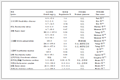
The summary of lipase from Candida sp. 99-125 catalyzed polymerization results were listed in Table 1. Around 70% monomer conversion was generated with 25% amount of lipase by weight for CL at 40℃ after 7 d. The outstanding chemoselectivity toward hydroxyl and thiol was showed and protecting/deprotecting steps for thiol as well as metal residue were avoided. Quantitative thiol fidelity was achieved over 90% compared with CALB system (70%). Number-average molecular weight (Mn) of PCLSH ranged from 3000 to 4700 Da by changing the feed ratio of [CL]/[MH]. The kinetic measurement of lipase-catalyzed ROP of CL was carried out. The monomer conversion as a function of reaction time was plotted in Fig. 3. The consumption rates of CL in both bulk and toluene were closed to each other and the CL conversion was up to 80% after 10 d. The PDI of PCLSH produced in toluene was relative narrower than that in bulk. The reason might be regard to the low monomer concentration and well-dispersed polymerization mixture in the presence of toluene.
|
Table 1 Results of lipase from Candida sp. 99-125 catalyzed ROP of CL with MH as initiator. |


|
Download:
|
| Fig. 3.Conversion of CL as a function of reaction time ([CL]/[MH] = 30,25% amount of lipase,40 8C) in bulk (black square) and in toluene (red round). | |

In the present work,lipase from Candida sp. 99-125 was identified as highly chemoselective and low costly biocatalyst for direct synthesis of thiol-terminated polyester. The lipase could selectively catalyze hydroxyl rather than thiol to initiate polymerization so that the protecting/deprotecting steps for thiol as well as metal residue were avoided. Well-defined thiol-terminated PCL with over 90% thiol fidelity was obtained under mild conditions which was a significant branch of end-functionalized polymers with various potential applications. This work would extend the scope of new lipase catalyzed polymerization in industrial scale and enhance the understanding of chemoselective reaction toward hydroxyl and thiol. Further investigations on immobilization of lipase,optimization of reaction conditions and polymerization mechanism will be taken.
AcknowledgmentsThis work was supported by a grant from the National Basic Research Program of China (Nos. 2012CB725204 and 2011CB710803),the National High Technology Research and Development Program of China (No. 2014AA021201),Natural Science Foundation of China (No. 81302632),the Priority Academic Program Development of Jiangsu Higher Education Institutions and China Postdoctoral Science Foundation (No. 2014M551574).
| [1] | Y.J. Wang, L.J. Chen, L.W. Tan, et al., PEG-PCL based micelle hydrogels as oral docetaxel delivery systems for breast cancer therapy, Biomaterials 35 (2014) 6972-6985. |
| [2] | H. Peng, J. Ling, J.Z. Liu, et al., Controlled enzymatic degradation of poly(ε-caprolactone)-based copolymers in the presence of porcine pancreatic lipase, Polym. Degrad. Stabil. 95 (2010) 643-650. |
| [3] | B. Wang, C. Ma, Z.C. Xiong, et al., Synthesis of novel copolymer: poly(π-dioxanoneco-L-phenylalanine), Chin. Chem. Lett. 24 (2013) 392-396. |
| [4] | L.G. Sun, Z.Y. Xie, Y.J. Zhao, et al., Optical monitoring the degradation of PLGA inverse opal film, Chin. Chem. Lett. 24 (2013) 9-12. |
| [5] | I. Javakhishvili, S. Hvilsted, Gold nanoparticles protected with thiol-derivatized amphiphilic poly(ε-caprolactone)-b-poly(acrylic acid), Biomacromolecules 10 (2009) 74-81. |
| [6] | B. Nottelet, G. Tambutet, Y. Bakkoura, et al., Redox and thiol-ene cross-linking of mercapto poly(epsilon-caprolactone) for the preparation of reversible degradable elastomeric materials, Polym. Chem. 3 (2012) 2956-2963. |
| [7] | Y.J. Wang, C.M. Dong, Bioreducible and core-crosslinked hybrid micelles from trimethoxysilyl-ended poly(ε-caprolactone)-S-S-poly(ethylene oxide) block copolymers: thiol-ene click synthesis and properties, J. Polym. Sci. A: Polym. Chem. 50 (2012) 1645-1656. |
| [8] | H. Chen, Z.L. Zou, S.L. Tan, et al., Efficient synthesis of water-soluble calyx[4]arenes via thiol-ene "click" chemistry, Chin. Chem. Lett. 24 (2013) 367-369. |
| [9] | M. Labet, W. Thielemans, Synthesis of polycaprolactone: a review, Chem. Soc. Rev. 38 (2009) 3484-3504. |
| [10] | Q.J. Zhang, W.P. Zhu, Z.Q. Shen, Synthesis and characterization of biodegradable amphiphilic PEG-grafted poly(DTC-co-CL), Chin. Chem. Lett. 21 (2010) 1255-1258. |
| [11] | S.L. Kan, Y. Jin, H.D. Xia, et al., Imidodiphosphoric acid as a bifunctional catalyst for the controlled ring-opening polymerizationof δ-valerolactone and ε-caprolactone, Polym. Chem. 4 (2013) 5432-5439. |
| [12] | G. Carrot, J. Hilborn, J.L. Hedrick, et al., Novel initiators for atom transfer radical and ring-opening polymerization: a new general method for the preparation of thiol-functional polymers, Macromolecules 32 (1999) 5171-5173. |
| [13] | R.A. Gross, A. Kumar, B. Kalra, Polymer synthesis by in vitro enzyme catalysis, Chem. Rev. 101 (2001) 2097-2124. |
| [14] | S. Kobayashi, Recent developments in lipase-catalyzed synthesis of polyesters, Macromol. Rapid Commun. 30 (2009) 237-266. |
| [15] | S. Kundu, A.S. Bhangale, W.E. Wallace, et al., Continuous flow enzyme-catalyzed polymerization in a microreactor, J. Am. Chem. Soc. 133 (2011) 6006-6011. |
| [16] | A.S. Bhangale, K.L. Beers, R.A. Gross, Enzyme-catalyzed polymerization of end-functionalized polymers in a microreactor, Macromolecules 45 (2012) 7000-7008. |
| [17] | M. Castano, J. Zheng, J.E. Puskas, et al., Enzyme-catalyzed ring-opening polymerization of ε-caprolactone using alkyne functionalized initiators, Polym. Chem. 5 (2014) 1891-1896. |
| [18] | R.T. MacDonald, S.K. Pulapura, Y.Y. Svirkin, et al., Enzyme-catalyzed e-caprolactone ring-opening polymerization, Macromolecules 28 (1995) 73-78. |
| [19] | J.T. Ma, Q.S. Li, B. Song, et al., Ring-opening polymerization of e-caprolactone catalyzed by a novel thermophilic esterase from the archaeon Archaeoglobus fulgidus, J. Mol. Catal. B: Enzym. 56 (2009) 151-157. |
| [20] | Q.S. Li, G.Q. Li, S.S. Yu, et al., Ring-opening polymerization of e-caprolactone catalyzed by a novel thermophilic lipase from Fervidobacterium nodosum, Process Biochem. 46 (2011) 253-257. |
| [21] | Y. Yang, Y. Yu, Y.X. Zhang, et al., Lipase/esterase-catalyzed ring-opening polymerization: a green polyester synthesis technique, Process Biochem. 46 (2011) 1900-1908. |
| [22] | C. Hedfors, E. Östmark, E. MalmstrÖm, et al., Thiol end-functionalization of poly(ε-caprolactone), catalyzed by Candida antarctica lipase B, Macromolecules 38 (2005) 647-649. |
| [23] | N. Xu, R. Wang, F.S. Du, et al., Synthesis of thiol-terminated poly(ε-caprolactone), Chem. J. Chin. Univ. 28 (2007) 1791-1795. |
| [24] | N. Zhu, J. Ling, Y.H. Zhu, et al., Novel direct synthetic approach to thiol-functionalized poly(ε-caprolactone) by highly chemoselective and low costly rare earth phenolate catalysts, J. Polym. Sci. A: Polym. Chem. 48 (2010) 4366-4369. |
| [25] | T.W. Tan, M. Zhang, B. Wang, et al., Screening of high lipase producing Candida sp. and production of lipase by fermentation, Process Biochem. 39 (2003) 459-465. |
| [26] | W.H. Liu, F. Wang, T.W. Tan, B.Q. Chen, Lipase-catalyzed synthesis and characterization of polymers by cyclodextrin as support architecture, Carbohyd. Polym. 92 (2013) 633-640. |
| [27] | H. Zhong, Z. Fang, B.H. Zou, et al., Studies on the lipase-catalyzed esterification of alkyl oleates in solvent-free systems, J. Mol. Catal. B: Enzym. 90 (2013) 114-117. |