


The excellent electronic and mechanical properties of fullerene (C60) make it a promising carbon nanomaterial for advanced energy conversion and storage devices [1, 2, 3, 4]. To improve the performance of devices utilizing them,morphology control of fullerene nanostructures has been considered a crucial factor in tailoring its properties [5, 6, 7]. In this regard,much attention has been paid to controlled construction of diverse nano/microstructures of C60 [8, 9]. For example,rods [10],nanowires [11], nanowhiskers [12],sheets [13],and spheres [14] have been fabricated from pristine C60solution,by direct evaporation [11, 14], liquid-liquid interfacial precipitation [12, 13],and re-precipitation [10]. These approaches,however,are hampered by a very limited numbers of solvents due to the poor solubility of pristine C60in common organic solvents. Alternatively,well-defined supramolecular hierarchical architectures have been fabricated from amphiphilic C60 derivatives with various appends [15, 16, 17]. However,it is necessary to covalently attach insulated appends onto the periphery of the C60cage,which may weaken its intact properties. The controlled fabrication of various architectures of unmodified C60viasimple construction processes is still highly demanded.
Here we report a facile approach for constructing diverse architectures of unmodified C60viasimple evaporation of pure C60 solution in CS2 under various atmospheres. In our approach,CS2 was selected as a good solvent that has a solubility of 8 mg/mL for C60,whereas 19 poor solvents,such as alcohols,tetrahydrofuran, andN,N-dimethylformamide were used as atmosphere to control the self-assembly of C60[18]. Diverse nanostructures such as belts, sheets,and starfishes,were successfully constructed under different experimental conditions. C60belts obtained under EtOH atmosphere were also characterized by TEM and XRD,and a facecentered cubic (fcc) structure was confirmed. We believe that the concept of self-assembly under poor solvent atmosphere represents a novel method for preparation of nanostructures of C60and it could also be applied for other functional organic molecules. 2. Experimental
C60(BuckyUSA,purity 99.5%) and all solvents (anhydrous) were purchased from XFNANO and J&K and used as received. The objects obtained were characterized with SEM (TM-1000,Hitachi),TEM (JEM-2100,JEOL),and XRD (RIGAKU D/max-2550 PC).
Briefly,the typical procedure for fabrication of C60microbelt was as follows: 20 μL C60stock solution (1 mg/mL in CS2) was transferred onto a Si wafer (5 mm×5 mm) and evaporated in a glass petri dish (diameter 70×height 20 mm) under 1 mL EtOH atmosphere at room temperature (ca.20°C),where the Si wafer was simply washed by acetone and dried in air before use; the C60 solution was completely dried within 2 h,and various objects were then obtained for SEM observation. Others architectures were similarly constructed by only changing the solvent atmosphere to the corresponding one. 3. Results and discussion
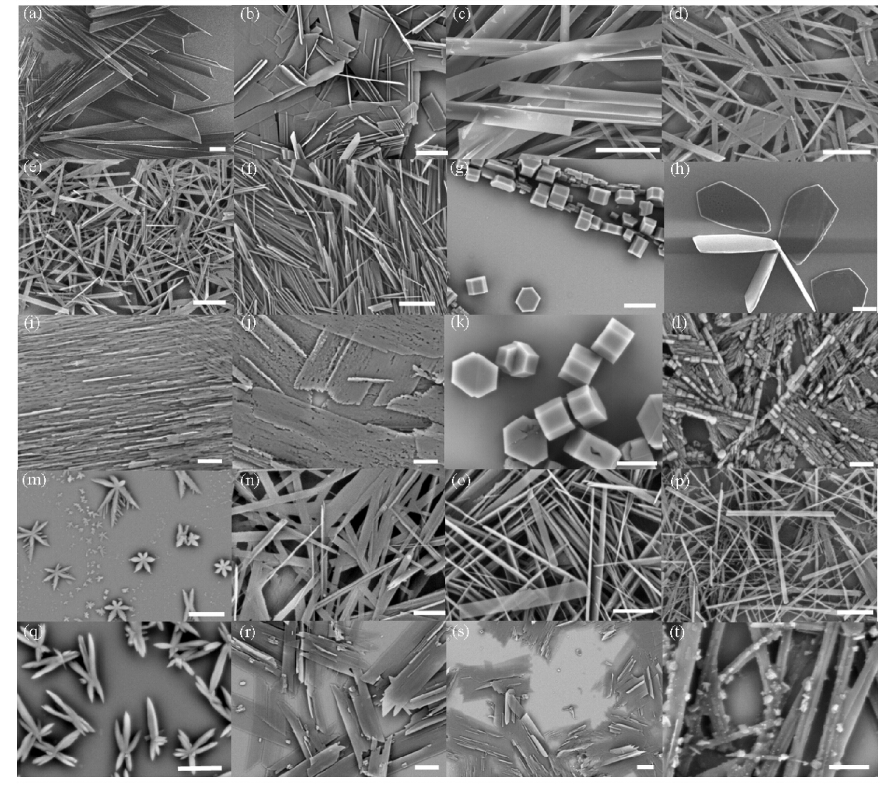
Self-organized objects of C60were prepared by evaporation of carbon disulfide solution of pure C60on Si wafer under various solvent atmospheres,and their SEM images are shown in Fig. 1. The diverse micron-sized morphologies,such as belts,sheets,porous belts,and starfishes were obtained under different experimental conditions (Fig. 1). Evaporation of carbon disulfide solution of pure C60without additional solvent atmosphere leads to formation of flat belts with a width ofca.5-30 μm,where CS2molecules may assist the self-assembly of C60[19]. Some solvent atmospheres did not affect the belt morphology (Fig. 1b-f,n-p,r,and s),but the width distribution was 1-5mm under EtOH atmosphere. The other solvents completely changed the final morphology (Fig. 1g-m,q, and t). These clearly demonstrate that it is possible to control the morphology of pure C60by direct evaporation of its solution in good solvent under poor solvent atmospheres. Although the exact details of how these morphologies are controlled are not well understood now,it has been recognized that a delicate balance among supramolecular interactions [15],the surface free energy of substrate [20],and the solvent geometry structure [21] have critical effects on fullerene self-assembly into various architectures. Therefore,the fabrication of fine shape- and size-controlled architecture could be achieved by comprehensive influences of these factors. The effect of solvent atmosphere on morphology can be classified into three categories. The first one is alcohols,ethyl acetate,acetonitrile,hexane,acetone,and acetic acid,where the belt morphology did not change so much,but the length and width could be tuned. The second one is chloroform,tetrachloromethane, tetrahydrofuran,1,4-dioxane,N,N-dimethylformamide,cyclohex anone,triethylamine,where the morphology changed into sheets, starfishes,and rods with particles,respectively. The third one is toluene and 1,2-dichloroethane,where the porous morphology was obtained. It is noted that these categories seems to be related to the solubility of C60in these solvents,namely,from alcohol, chloroform to toluene series,the solubility of C60 is highly enhanced [18]. Therefore,the solvent atmospheres not only slowed down the evaporation speed,but also reorganized the self-assembly of C60 by partially re-dissolving the formed nanostructure. This approach could be extended to other goodpoor solvents pairs for constructing various nanostructures of pristine C60.
|
Download:
|
| Fig. 1. SEM images of diverse architectures obtained from unmodified C60in CS2under (a) air, (b) MeOH, (c) EtOH, (d) PrOH, (e)i-PrOH, (f) BuOH, (g) chloroform, (h) tetrachloromethane, (i) 1,2-dichloroethane, (j) toluene, (k) tetrahydrofuran, (l) 1,4-dioxane, (m)N,N-dimethylformamide, (n) ethyl acetate, (o) acetonitrile, (p) hexane, (q) cyclohexanone, (r) acetone, (s) acetic acid, and (t) triethylamine atmospheres. The inset bar represents 10μm. | |
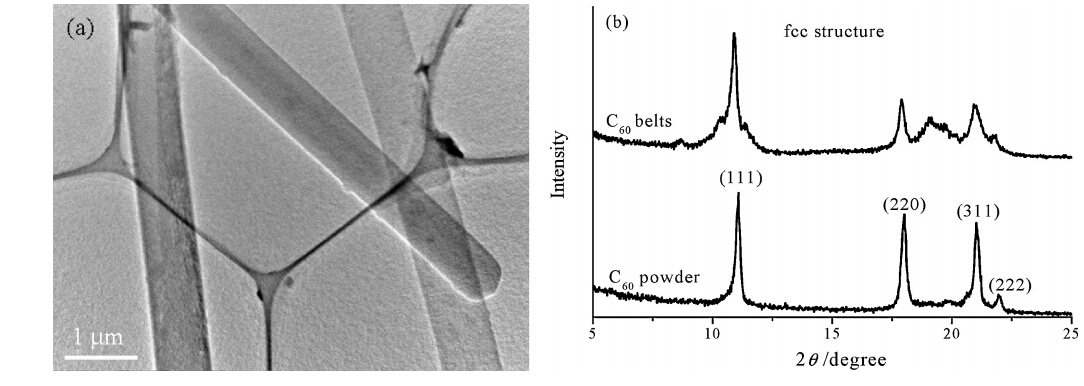
The belt architectures obtained under EtOH atmosphere were also characterized by TEM and XRD. As shown in Fig. 2a,these microbelts are almost transparent under the electron beam, indicating that they are ultrathin in nature. X-ray diffraction (XRD) patterns for belts recorded on a Si substrate are shown in Fig. 2b. The well-defined XRD patterns of microbelts match well with those of pristine C60. Thus,these patterns were readily assigned having a fcc structure,where four strong peaks are indexed as (1 1 1),(2 2 0),(3 1 1),and (2 2 2),indicating that the belt structures are mainly packed in a fcc way.
|
Download:
|
| Fig. 2. TEM image (a) and XRD pattern (b) of belts obtained from C60in CS2 under EtOH atmosphere. The XRD pattern of pristine C60powder was also provided for comparison. | |
A facile approach for constructing diverse architectures of unmodified C60was developedviasimple evaporation of pure C60 solution in CS2 under various solvent atmospheres. In our approach,CS2 was selected as a good solvent for C60,whereas 19 poor solvents such as alcohols,tetrahydrofuran,N,N-dimethylformamide,toluene,and chloroform were used as atmosphere to control the self-assembly. Various architectures such as belts, sheets,and starfishes were successfully constructed under different experimental conditions. The C60belts obtained under EtOH atmosphere were also characterized by TEM and XRD,and a fcc structure was confirmed. The solvent atmospheres not only slowed down the evaporation speed,but also could reorganize the self-assembly of C60by partially re-dissolving the initially formed architectures. This simple but effective strategy could be applied for controlling of the self-assembly of other functional organic molecules. Acknowledgments
This work was financially supported by the Innovation Program of Shanghai Municipal Education Commission (No. 12ZZ067), Shanghai Pujiang Program (No. 11PJ1400200),the Research Fund for the Doctoral Program of Higher Education of China (No. 20120075120018),and the Fundamental Research Funds for the Central Universities
| [1] | L.M. Dai, D.W. Chang, J.B. Baek, W. Lu, Carbon nanomaterials for advanced energy conversion and storage, Small 8 (2012) 1130-1166. |
| [2] | G.V. Dubacheva, C.K. Liang, D.M. Bassani, Functional monolayers from carbon nanostructures-fullerenes, carbon nanotubes, and graphene-as novel materials for solar energy conversion, Coord. Chem. Rev. 256 (2012) 2628-2639. |
| [3] | S.L. Candelaria, Y.Y. Shao, W. Zhou, et al., Nanostructured carbon for energy storage and conversion, Nano Energy 1 (2012) 195-220. |
| [4] | D. Jariwala, V.K. Sangwan, L.J. Lauhon, T.J. Marks, M.C. Hersam, Carbon nanomaterials for electronics, optoelectronics, photovoltaics, and sensing, Chem. Soc. Rev. 42 (2013) 2824-2860. |
| [5] | S. Kouijzer, J.L. Michels, M. van den Berg, et al., Predicting morphologies of solution processed polymer:fullerene blends, J. Am. Chem. Soc. 135 (2013) 12057-12067. |
| [6] | M. Campoy-Quiles, T. Ferenczi, T. Agostinelli, et al., Morphology evolution via selforganization and lateral and vertical diffusion in polymer: fullerene solar cell blends, Nat. Mater. 7 (2008) 158-164. |
| [7] | J. Peet, M.L. Senatore, A.J. Heeger, G.C. Bazan, The role of processing in the fabrication and optimization of plastic solar cells, Adv. Mater. 21 (2009) 1521-1527. |
| [8] | L.K. Shrestha, Q.M. Ji, T. Mori, et al., Fullerene nanoarchitectonics: from zero to higher dimensions, Chem. Asian J. 8 (2013) 1662-1679. |
| [9] | S.S. Babu, H. Möhwald, T. Nakanishi, Recent progresses in morphology control of supramolecular fullerene assemblies and its applications, Chem. Soc. Rev. 39 (2010) 4021-4035. |
| [10] | Z. Tan, A. Masuhara, H. Kasai, H. Nakanishi, H. Oikawa, Multibranched C60 micro/nanocrystals fabricated by reprecipitation method, Jpn. J. Appl. Phys. 47 (2008) 1426-1428. |
| [11] | J. Geng, W. Zhou, P. Skelton, et al., Crystal structure and growth mechanism of unusually long fullerene (C60) nanowires, J. Am. Chem. Soc. 130 (2008) 2527-2534. |
| [12] | K. Miyazawa, Y. Kuwasaki, A. Obayashi, K. Kuwabara, C60 nanowhiskers formed by the liquid-liquid interfacial precipitation method, J. Mater. Res. 17 (2002) 83-88. |
| [13] | M. Sathish, K. Miyazawa, Size-tunable hexagonal fullerene (C60) nanosheets at the liquid-liquid interface, J. Am. Chem. Soc. 129 (2007) 13816-13817. |
| [14] | X. Zhang, M. Takeuchi, Controlled fabrication of fullerene C60 into microspheres of nanoplates through porphyrin-polymer-assisted self-assembly, Angew. Chem. Int. Ed. 48 (2009) 9646-9651. |
| [15] | T. Nakanishi, K. Ariga, T. Michinobu, et al., Flower-shaped supramolecular assemblies: hierarchical organization of a fullerene bearing long aliphatic chains, Small 3 (2007) 2019-2023. |
| [16] | T. Homma, K. Harano, H. Isobe, E. Nakamura, Nanometer-sized fluorous fullerene vesicles in water and on solid surfaces, Angew. Chem. Int. Ed. 49 (2010) 1665-1668. |
| [17] | X. Zhang, T. Nakanishi, T. Ogawa, et al., Flowerlike supramolecular architectures assembled from C60 equipped with a pyridine substituent, Chem. Commun. 46 (2010) 8752-8754. |
| [18] | N.O. Mchedlov-Petrossyan, Fullerenes in liquid media: an unsettling intrusion into the solution chemistry, Chem. Rev. 113 (2013) 5149-5193. |
| [19] | L. Wei, J.N. Yao, H.B. Fu, Solvent-assisted self-assembly of fullerene into singlecrystal ultrathin microribbons as highly sensitive UV-visible photodetectors, ACS Nano 7 (2013) 7573-7582. |
| [20] | M.D. Doganci, H.Y. Erbil, Shape and diameter control of C60 fullerene micro-stains by evaporation of aqueous SDS-fullerene dispersion drops, Colloid Surf. A 432 (2013) 104-109. |
| [21] | C. Park, H.J. Song, H.C. Choi, The critical effect of solvent geometry on the determination of fullerene (C60) self-assembly into dot, wire and disk structures, Chem. Commun. (2009) 4803-4805. |