


b University of Chinese Academy of Sciences, Beijing 100049, China
Polysiloxanes are widely used in textile,leather,construction, coating,cosmetic,and medicine industries due to their unique properties,such as excellent air permeability,hydrophobicity, electrical insulation,weatherability,drug resistance,etc. [1, 2, 3]. Since Hyde and Wehrly [4] disclosed a protocol to synthesize polysiloxanes by cationic ring-opening polymerization (ROP) for the first time in 1959,the ionic ring-opening polymerization has become the most common method to synthesize polysiloxanes. Zhanget al.[5, 6, 7] studied ROP of D4 in emulsion with different initiators,and showed that polymerization rates were independent of the species of initiators and the genuine catalyst was the quaternary ammonium base (R4NOH). In addition,the experiment also found that the molar mass distribution of the polymer was narrow when the conversion of D4 was<60%,which differed from the conventional polycondensation reaction. Based on these findings,they proposed a hypothetical mechanism for the polymerization: the D4,located on the surface of a solubilized micelle was firstly initiated by R4NOH,and a linear polysiloxane with anionic chain-end active center was generated,then the active center initiated the vicinal D4 to form polysiloxanes with a molar mass of 4500 g moL-1 . Finally,the polycondensation reaction occurred between two adjacent terminal hydroxyl polysiloxanes. They also concluded that when the conversion of D4 was<60%,the number of polymeric chains (N) increased dramatically,but the molecular weight remained constant and the molecular weight distribution (MWD) was<1.3,while when the conversion reached to about 75%,Nreached the maximum value and then decreased sharply,in company with the increase of the molar mass of polysiloxane and the broaden of MWD. De Gunzbourget al.[8] investigated the mechanism and kinetics of ROP of D4,calculated the apparent activation energy of the polymerization and the reaction rate constants of chain initiation, propagation and terminationviathe established kinetic model. Furthermore,they proposed a redistribution reaction and studied its effect on the polymerization,and they believed that the redistribution reaction was the reason that MWD broadened and polysiloxane microstructure changed. Barrereet al. [9, 10] also reported an anionic ROP of D4,improved the mechanism model proposed by De Gunzbourg,and believed that when the reaction reached the critical degree of polymerization,chains entered into the particle core,where polycondensation and redistribution reaction occurred. In addition,they proposed a backbiting reaction, which explained why reaction systems existed for small cyclics like D5,D6,and D7. They [11] also believed that the variation ofN was relevant to the ring-opening and polycondensation reactions: when the reaction conversion reached 20%,N reached the maximum value,and the rate of polycondensation became higher than that of the ring-opening reaction at the moment. Zhouet al. [12] used dodecyl dimethyl benzyl ammonium bromide (DBDA) as a cationic emulsifier,KOH as an initiator for the ROP of D4,and studied the effect of reaction temperature,emulsifier and catalyst concentration,stirring speed and water/oil ratio on the rate of polymerization.
Since Stoffer and Bone [13] reported microemulsion polymerization to prepare polymer in 1980,great improvements have been achieved in microemulsion polymerization to synthesize polysiloxanes [10, 14, 15, 16, 17, 18]. However,the content of monomer was relatively low and the content of emulsifier and co-emulsifier were too high in microemulsion. In order to solve these problems,many new approaches have been developed. For example,Barrereet al. [10] dissolved ionic and non-ionic emulsifiers in water at certain ratios,and then added the monomer to the solution drop by drop. After a catalyst was added to initiate the reaction,the microemulsion with relatively low emulsifier content was obtained. Zhanget al.[16] discussed the effect of the nature and the amount of co-emulsifiers on the microemulsion polymerization of D4. Later,some researchers [19, 20, 21] used silicone surfactants as emulsifiers and received desired emulsifying effect. Additionally, some polymerization methods like seeded microemulsion polymerization [22],semi-continuous microemulsion polymerization [23] were also used to improve the solid content.
However,very few groups studied the kinetics or mechanism of polymerization in emulsion. Recently,Jianget al.[24] studied the effect of drop sizes on the polymerization rates in miniemulsion, and proposed a three-layer oil/water interface model. Meanwhile Zhuanget al.[25] investigated the particle kinetics and physical mechanism of polymerization of D4 in microemulsion.
In this work,polysiloxane latexes were prepared by microemulsion polymerization of octamethylcyclotetrasiloxane with octadecyl trimethyl ammonium chloride as a cationic emulsifier and potassium hydrate as an initiator. Particle sizes were determined by the DLS technique. The kinetics was studied by the initial-rate method and the apparent activation energy was determined by the half-life period method,effects of the monomer, emulsifier and initiator concentrations and the reaction temperature on the conversions of octamethylcyclotetrasiloxane were investigated in details. 2. Experimental
Octamethylcyclotetrasiloxane (D4,98%) was used as received from Aldrich without further purification; octadecyl trimethyl ammonium chloride (OTAC,98%) was purchased from Aladdin; potassium hydrate (KOH,AR grade) and glacial acetic acid (CH3COOH,AR grade) were purchased from Sinopharm Chemical Reagent Co.,Ltd. and Guangzhou Chemical Reagent Factory, respectively,and were used as received. Deionized water was purchased from Guangzhou Qianhui Bose Instrument Co.,Ltd. 2.1. Microemulsion polymerization of D4
Polysiloxane microemulsions were prepared by the ROP of D4 in a 500-mL four-neck flask equipped with a mechanical paddle stirring,a condensation reflux tube and a centigrade thermometer.
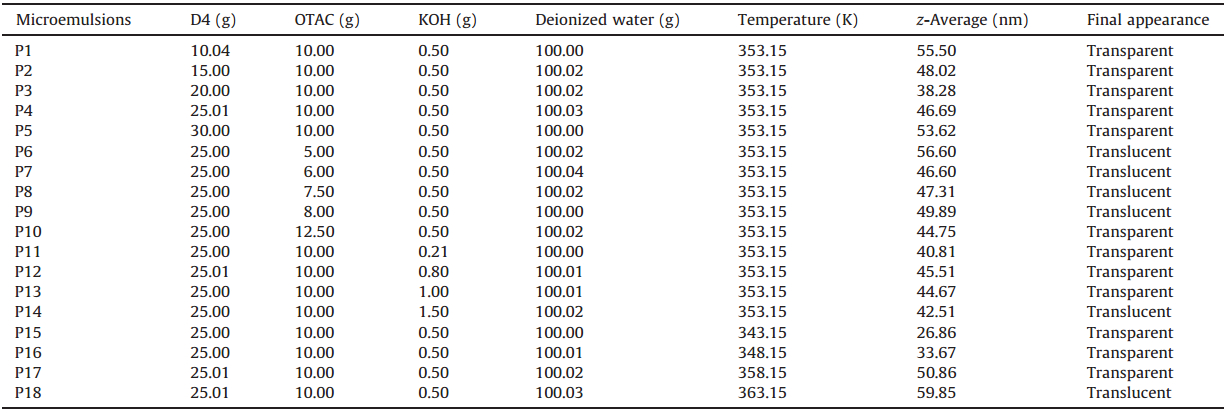
The pre-emulsion was prepared by adding monomer (D4) and emulsifier (OTAC) to deionized water in the flask with the stirring speed at 250 rpm,the pre-emulsion was stirred for 15 min after heated to the indicated temperature,and then KOH solution was added to initiate the reaction. After 6 h,the reaction mixture was cooled down to room temperature naturally,followed by adjusting pH value to 7-8 with glacial acetic acid. Detailed recipes for the preparation of microemulsions,particle sizes and the final appearance of emulsions are given in Table 1.
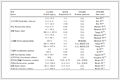
|
The conversion of D4 was determined by the gravimetrical method. Samples,which were withdrawn from the flask,were neutralized by glacial acetic acid to cease the polymerization,and placed in an oven at 1108C to dry the polymer to constant weight, and the conversion of D4 can be calculated by the following equation:

During the whole polymerization,the residual concentration of D4 in the solution can be expressed as:

During the polymerization process,about 4 g of the sample was withdrawn from the flask at scheduled time points and placed to the culture dishes containing calculated glacial acetic acid solution. The sample was dried in an oven until a constant weight was attained,the conversion of monomer was calculated by the gravimetrical method,and the determination of reaction order was carried out by an initial-rate method. By the use of the initial-rate method,the side reaction and the reverse reaction need not to be taken into account,and the rate of polymerization can be expressed as follows:

Take the natural logarithm on both sides of Eq. (3),Eq. (3) is transformed to the logarithm form:

The apparent activation energy,Ea,is calculated via the Arrhenius equation:


Taking natural log of Eq. (7),and Eq. (7) can be rewritten as:

Substituting the value of lnk from Eq. (6),Eq. (8) can be simplified to Eq. (9)

 is a constant.
Therefore,

Thus,Ea can be obtained through the slope of the straight line of ln t1/2~1/T. 2.5. Latex particle size
Thez-average particle size of microemulsion was measured by the DLS technique (Malvern Zetasizer Nano S90) at ambient temperature. 3. Results and discussion 3.1. DLS analysis
The particle size of microemulsion was detected by the DLS technique,and the results (z-average particle size) are shown in Table 1. As can be seen from Table 1,the particle size declines slightly as the amount of monomer increases at the beginning,and reaches its minimum size (38.28 nm) with the D4 mass fraction of 15.32%,from this onwards,the particle size see a marginal rise, Fig. 1 presents the particle size distribution of microemulsions with different amount of monomer. The particle size decreases as the amount of emulsifier increases at first,and when the mass fraction of OTAC amounts to 4.56%,the final particle size of microemulsion remains stable as the concentration of OTAC increases,the concentration of initiator has little effect on final particle size of microemulsion while the particle size increases dramatically as the temperature rises.

|
Download:
|
| Fig. 1.The particle size distribution of microemulsions with different amount of monomer. | |

The reaction order of D4,a,can be measured by varying initial concentrations of D4 as the reaction temperature and concentrations of OTAC and KOH were kept invariant. As a result,Eq. (4) can be simplified to Eq. (11)


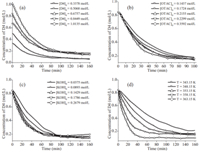
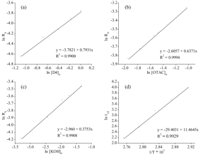
The power of D4 was studied at 808C with the initial concentrations of D4 varied from 0.3378 mol L-1 to 1.0135 mol L-1 as the concentrations of OTAC and KOH remained at 0.2874 mol L-1 and 0.0893 mol L-1,respectively,and the results are shown in Figs. 2(a) and 3(a).
The effect of the amount of D4 on the consumption of monomer
during polymerization is shown in Fig. 2(a),and the slop of the
curve increases as the rise of the concentration of D4 at the
beginning,soR0increases with the increasing amount of D4. As
shown in Fig. 3(a),the dependence between lnR0 and ln[D4]0
appears to be a straight line with a slope of 0.79 (R2= 0.9900,R2 is the linear correlation coefficient),so the relationship between R0 and D4 can be represented as  .
.
|
Download:
|
| Fig. 2.Effect of different factors on the evolution of monomer concentration as a function of polymerization time. (a) [D4]0; (b) [OTAC]0; (c) [KOH]0 and (d) temperature. | |

|
Download:
|
| Fig. 3.Plotsviadifferent operational methods. (a) Plot of lnR0 versus ln[D4]0; (b) plot of lnR0 versus ln[OTAC]0; (c) plot of lnR0 versus ln[KOH]0 and (d) plot of lnt1/2versus1/T. | |

The reaction order of OTAC,b,can be discussed by varying the initial concentrations of OTAC as the reaction temperature and concentrations of D4 and KOH were kept invariant. Eq. (4) can be rewritten as:


The power of OTAC was studied at 808C with initial concentrations of OTAC varied from 0.1437 mol L-1 to 0.3592 mol L-1 as the concentrations of D4 and KOH remained at 0.8446 mol L-1 and 0.0893 mol L-1 ,respectively,and the results are shown in Figs. 2(b) and 3(b).
The effect of OTAC concentration on the evolution of monomer
concentration is shown in Fig. 2(b). Due to the amount of OTAC
increases,the particle size becomes smaller and more particle
forms at the very beginning of the reaction,and the reaction
velocity increases. As shown in Fig. 3(b),the dependence between
lnR0 and ln[OTAC]0 presents to be a straight line with a slope of
0.64 (R2= 0.9994),so the relationship betweenR0and OTAC could
be described as  3.4. The effect of KOH concentration
The reaction order of KOH,g,can be determined by varying the initial concentrations of KOH when the reaction temperature and concentrations of D4 and OTAC were kept invariant. Eq. (4) can be described as:


The power of KOH was studied at 808C with initial concentrations of KOH varied from 0.0375 mol L-1 to 0.2679 mol L-1 as the concentrations of D4 and OTAC remained at 0.8446 mol L-1 and 0.2874 mol L-1 ,respectively,and the results are shown in Figs. 2(c) and 3(c).
The effect of KOH concentration on the evolution of monomer
concentration is shown in Fig. 1(c). With the amount of KOH
increases,more living chain forms per unit time,consequently,the
reaction rate increases. As show in Fig. 2(c),the dependence
between R0 and ln[KOH]0 appears to be a straight line with a
slope of 0.38 (R2= 0.9908),which could be represented as  3.5. The effect of reaction temperature
The influence of the reaction temperature on the polymerization rates was discussed as the concentrations of D4,OTAC and KOH remain constant. The value ofEawas determined with a fixed concentration of other reagents ([D4]0= 0.8446 mol L-1 , [OTAC]0= 0.2874 mol L-1 ,[KOH]0= 0.0893 mol L-1 ),while the temperature ranged from 708Cto908C,the results are shown in Figs. 2(d) and 3(d).
As shown in Fig. 2(d),the change of the temperature has a dramatic effect on the conversion of monomer as the polymerization reaction proceeds. As the temperature increases,molecules move faster and the rate of polymerization accelerates,sot1/2 decreases. The plot of lnt1/2 versus 1/T is shown in Fig. 3(d) and is found to be a straight line with a positive slop of 11.46 (R2= 0.9929),and the apparent activation energy is calculated to be 95.32 kJ moL-1 ,higher than that in conventional emulsion polymerization [8],the reason probably lies in the fact that the more surfactant mass in the microemulsion polymerization compared with the conventional one changes its potential energy surface and causes higher collision energy,rendering nonadiabatic effects increasingly significant [26]. 4. Conclusion
In summary,we synthesized a series of latexesviaring-opening polymerization of octamethylcyclotetrasiloxane in microemulsion. Particle sizes,investigated by DLS technique,were all <100 nm and the final emulsion appearance was either transparent or translucent. The kinetics of polymerization in microemulsion and the apparent activation energy was determined by the initial-rate method and half-life period method,respectively. From the experimental results,the rate equation at 808C can be described as Rp=k[D4]0:79[OTAC]0:64[KOH]0:38 ,and the linear correlation coefficient values,R2 ,are all greater than 0.99,which indicate strong linear relationships between ln R0 and ln[D4]0, between ln R0 and ln[OTAC]0,and between ln R0 and ln[KOH]0,and the apparent activation energyEais 95.32 kJ mol-1.
| [1] | X.Y. Zhang, S.Q. Huang, Development of studies on polysiloxane microemulsion, Polymer Bull. 5 (2006) 52-57 (in Chinese). |
| [2] | P.Y. Yu, J. Zhou, X.L. Zhan, F.Q. Chen, Study of preparation of polysiloxane microemulsion by ring-opening emulsion polymerization of octamethylcyclotetrasiloxane (D4), China Surfact. Deterg. Cosmet. 34 (2004) 17-20 (in Chinese). |
| [3] | Z. Yue, D.X. Wang, J.Q. Liu, J. Zhang, S.Y. Feng, Synthesis of polyacrylonitrile-blockpolydimethylsiloxane- block-polyacrylonitrile triblock copolymers via RAFT polymerization, Chin. Chem. Lett. 23 (2012) 989-992. |
| [4] | J.F. Hyde, J.R. Wehrly, Polymerization of organopolysiloxanes, U.S. Pat. 2,891,920, 1959. |
| [5] | X.H. Zhang, X.L. Liu, D.R. Dai, Studies on emulsion polymerization of siloxanes, Acta Polym. Sin. 2 (1982) 154-157 (in Chinese). |
| [6] | X.H. Zhang, Y.J. Yang, S.F. Liu, Studies on emulsion polymerization of polysiloxanes Ⅱ: mechanism of cationic emulsion polymerization of octamethylcyclotetrasiloxane, Acta Polym. Sin. 4 (1982) 266-270 (in Chinese). |
| [7] | X.H. Zhang, Y.J. Yang, X.L. Liu, Studies on emulsion polymerization of siloxanes ⅡI. The formation of emulsion particles during the cationic emulsion polymerization of octamethylcyclotetrasiloxane, Acta Polym. Sin. 2 (1983) 104-109 (in Chinese). |
| [8] | A. De Gunzbourg, J.-C. Favier, P. Hémery, Anionic polymerization of octamethylcyclotetrasiloxane in aqueous emulsion I: preliminary results and kinetic study, Polym. Int. 35 (1994) 179-188. |
| [9] | M. Barrere, F. Ganachaud, D. Bendejacq, et al., Anionic polymerization of octamethylcyclotetrasiloxane in miniemulsion Ⅱ: molar mass analyses and mechanism scheme, Polymer 42 (2001) 7239-7246. |
| [10] | M. Barrere, S.C. da Silva, R. Balic, R. Balic, F. Ganachaud, Synthesis of monodisperse poly(dimethylsiloxane) micro- and macroemulsions, Langmuir 18 (2002) 941-944. |
| [11] | M. Barrere, C. Maitre, F. Ganachaud, P. Hémery, Kinetic study of a, v-dihydroxy polydimethylsiloxane condensation in aqueous emulsion, Macromol. Symp. 151 (2000) 359-364. |
| [12] | A.A. Zhou, S.Y. Zheng, L.Q. Zhang, G.J. Chen, Study on the rate of cationic emulsion polymerization of octamethylcyclotetrasiloxane, Silicone Mater. 22 (2008) 349- 352 (in Chinese). |
| [13] | J.O. Stoffer, T.J. Bone, Polymerization in water in oil microemulsion systems containing methyl methacrylate, J. Dispersion Sci. Technol. 1 (1980) 37-54. |
| [14] | D.J. Halloran, Method of preparing silicone oil-in-water microemulsions, U.S. Pat. 6,071,975, 2000. |
| [15] | G. Palaprat, F. Ganachaud, Synthesis of polydimethylsiloxane microemulsions by self-catalyzed hydrolysis/condensation of dichlorodimethylsilane, C. R. Chim. 6 (2003) 1385-1392. |
| [16] | D.M. Zhang, X.Q. Jiang, C.Z. Yang, Microemulsion polymerization of siloxane with nonionic surfactants as emulsifiers, J. Appl. Polym. Sci. 89 (2003) 3587- 3593. |
| [17] | J.S. Liu, S.Q. Huang, Microemulsion polymerization of D4, Silicone Mater. 20 (2006) 299-302 (in Chinese). |
| [18] | H. Nazir, P.P. Lv, L.Y. Wang, G.P. Lian, S.P. Zhu, G.H. Ma, Uniform-sized silicone oil microemulsions: preparation, investigation of stability and deposition on hair surface, J. Colloid Interface Sci. 364 (2011) 56-64. |
| [19] | N. Garti, A. Aserin, E. Wachtel, O. Gans, Y. Shaul, Water solubilization in nonionic microemulsions stabilized by grafted siliconic emulsifiers, J. Colloid Interface Sci. 233 (2001) 286-294. |
| [20] | A. Kumar, H. Uddin, H. Kunieda, H. Furukawa, A. Harashima, Solubilization enhancing effect of AB-type silicone surfactants in microemulsions, J. Dispersion Sci. Technol. 22 (2001) 245-253. |
| [21] | R.M. Hill, Silicone surfactants - new developments, Curr. Opin. Colloid Interface Sci. 7 (2002) 255-261. |
| [22] | L. Zhang, C. Zhang, G.M. Li, Synthesis and properties of copolymer microemulsions of siloxane and acrylate with a high solid content, J. Appl. Polym. Sci. 104 (2007) 851-857. |
| [23] | X.J. Xu, L.M. Gan, Recent advances in the synthesis of nanoparticles of polymer latexes with high polymer-to-surfactant ratios by microemulsion polymerization, Curr. Opin. Colloid Interface Sci. 10 (2005) 239-244. |
| [24] | S.J. Jiang, T. Qiu, X.Y. Li, Kinetic study on the ring-opening polymerization of octamethylcyclotetrasiloxane(D4) inminiemulsion,Polymer51(2010)4087-4094. |
| [25] | Y.Q. Zhuang, X. Ke, X.L. Zhan, Z.H. Luo, Particle kinetics and physical mechanism of microemulsion polymerization of octamethylcyclotetrasiloxane, Powder Technol. 201 (2010) 146-152. |
| [26] | T.S. Chu, Y. Zhang, K.L. Han, The time-dependent quantum wave packet approach to the electronically nonadiabatic processes in chemical reactions, Int. Rev. Phys. Chem. 25 (2006) 201-235. |