


b Department of Chemistry, Qaemshahr Branch, Islamic Azad University, Qaemshahr, Iran;
c Department of Chemistry, Facualty of Science, Gonbad Kavous University, Gonbad, Iran
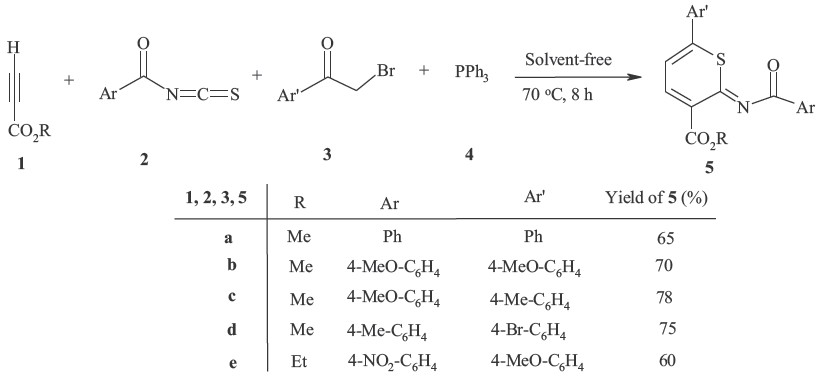
At present, heterocycles with sulfur atoms, like thiopyrans, have attracted increased attention. These compounds have different biological activities [1] that have been recognized [2]. Thiopyrans are used in medicinal chemistry, but receive relatively less attention [3]. Also, thiopyrans are often in the structure of natural products with different pharmaceutical activities such as anti-bacterial [4], anti-hyperplasia [5], anti-psychiatric [6], and anticancer activities [7]. Investigation of anticancer activity of thiopyran derivatives showed that they have antiproliferative activity against tumor cell lines [8]. It has also been described that substituted thiopyrans are powerful inhibitors of deoxyribonucleic acid-protein kinases [9]. However, the methods for synthesis of these important compounds often feature tedious synthetic routes, long reaction time, harsh reaction conditions, and narrow application scope of substrates. In addition, to the best of our knowledge, there have been few reports about the synthesis of thiopyran derivatives [10, 11, 12]. Hence, we describe herein the reaction of alkyl propiolate 1, benzoylisothiocyanate 2 and ahaloketones 3 in the presence of triphenylphosphine 4 under solvent-free conditions to produce substituted thiopyran derivatives 5 in good yield (Scheme 1).

|
Download:
|
| Scheme 1.Reaction of propiolates, aroyl isothiocyanates and α-halo carbonyl compounds in the presence of triphenylphosphine. | |
All chemicals used in this work were purchased from Fluka (Buchs, Switzerland) and were used without further purification. Melting points were measured on an Electrothermal 9100 apparatus. Elemental analyses for C, H, and N were performed using a Heraeus CHN-O-Rapid analyzer. Mass spectra were recorded on a FINNIGAN-MAT 8430 spectrometer operating at an ionization potential of 70 eV. IR spectra were measured on a Shimadzu IR-460 spectrometer. 1H NMR and 13C NMR spectra were measured with a BRUKER DRX-500 AVANCE spectrometer at 500.1MHz and 125.8 MHz, respectively. 1H NMR and 13C NMR spectra were obtained for solutions in CDCl3 using TMS as the internal standard or 85% H3PO4 as the external standard.
General procedure for preparation of compounds 5a-e. α- Haloketones (2-mmol) and triphenylphosphine (2 mmol) were stirred at 70 ℃ for 45 min. After 45 min, triethylamine (2 mmol) and alkyl propiolate (2 mmol) were added to the mixture. Then, arylisothiocyanate (2 mmol) was added after 15 min. The reaction mixture was stirred for 8 h at 70 ℃. After completion of reaction (monitored by TLC), 15 mL H2O was poured into the reaction mixture, and the solid residue was filtered and washed by cold diethylether (Et2O) to afford 5.
Methyl 2-(benzoilimino)-6-phenyl-2H-thiopyran-3-carboxylate (5a): Yellow oil, yield: 0.45 g (65%) IR (KBr, cm-1): υ 1738, 1725, 1695, 1587, 1463, 1348, 1259. 1H NMR (500.1 Hz, CDCl3): δ 3.78 (s, 3 H, MeO), 6.37 (d, 1 H, 3J = 7.8, CH), 7.28 (d, 1 H, 3J = 7.8, CH), 7.38 (t, 1 H, 3J = 7.4, CH), 7.56 (m, 3 H, 3 CH), 7.64 (t, 2 H, 3J = 7.8, 2 CH), 7.78 (d, 2H, 3J = 7.6, 2 CH), 8.14 (d, 2 H, 3J = 7.6, 2 CH). 13C NMR (125.7 Hz, CDCl3): δ 52.4 (MeO), 118.6 (C), 128.2 (CH), 129.4 (CH), 130.2 (2 CH), 130.6 (2 CH), 131.4 (2 CH), 131.8 (2 CH), 133.2 (CH), 134.8 (C), 135.4 (C), 141.7 (C), 143.6 (CH), 160.4 (C=O), 162.7 (C=N), 172.4 (C=O). EI-MS: m/z 349 (10, M+), 318 (86), 105 (100), 77 (88), 31 (100). Anal. Calcd. for C20H15NO3S (349.40): C 68.75, H 4.33, N 4.01; found C 68.83, H 4.42, N 4.12%.
Methyl 2-(4-methoxybenzoilimino)-6-(4-methoxyphenyl)-2Hthiopyran- 3-carboxylate (5b): Yellow oil, yield: 0.57 g (70%). IR (KBr, cm-1): υ 1735, 1728, 1695, 1654, 1588, 1474, 1357. 1H NMR (500.1 Hz, CDCl3): δ 3.75 (s, 3 H, MeO), 3.82 (s, 3 H, MeO), 3.87 (s, 3 H, MeO), 6.29 (d, 1 H, 3J = 7.5, CH), 7.12 (d, 2 H, 3J = 7.6, 2 CH), 7.22 (d, 2 H, 3J = 7.6, 2 CH), 7.30 (d, 1 H, 3J = 7.5, CH), 7.62 (d, 2 H, 3J = 7.6, 2 CH), 8.04 (d, 2 H, 3J = 7.6, 2 CH). 13C NMR (125.7 Hz, CDCl3): δ 51.8 (MeO), 54.5 (MeO), 55.2 (MeO), 115.4 (2 CH), 116.5 (2 CH), 118.3 (C), 128.5 (CH), 129.4 (C), 130.4 (2 CH), 131.2 (2 CH), 142.7 (C), 145.2 (CH), 158.3 (C), 161.4 (C=O), 162.5 (C=N), 164.7 (C), 171.9 (C=O). Anal. Calcd. for C22H19NO5S (409.45): C 64.54, H 4.68, N 3.42; found: C 64.63, H 4.76, N 3.54%.
Methyl 2-(4-methoxybenzoilimino)-6-(4-methylphenyl)-2H-thiopyran- 3-carboxylate (5c): Yellow oil, yield: 0.61 g (78%). IR (KBr, cm-1): υ 1732, 1712, 1687, 1646, 1547, 1485, 1362, 1295. 1H NMR (500.1 Hz, CDCl3): δ 2.36 (s, 3 H, Me), 3.78 (s, 3 H, MeO), 3.85 (s, 3 H, MeO), 6.19 (d, 1H, 3J = 7.4, CH), 7.23 (d, 2 H, 3J = 7.8, 2 CH), 7.34 (d, 1 H, 3J = 7.5, CH), 7.38 (d, 2 H, 3J = 7.5, 2 CH), 7.58 (d, 2 H, 3J = 7.6, 2 CH), 8.14 (d, 2 H, 3J = 7.6, 2 CH). 13C NMR (125.7 Hz, CDCl3): δ 22.3 (Me), 51.8 (MeO), 55.4 (MeO), 114.8 (2 CH), 117.8 (C), 127.4 (CH), 129.6 (2 CH), 130.2 (C), 131.4 (2 CH), 132.3 (2 CH), 133.7 (C), 137.6 (C), 141.6 (C), 144.8 (CH), 161.7 (C=O), 162.8 (C=N), 163.8 (C), 175.4 (C=O). Anal. Calcd. for C22H19NO4S (482.50): C 67.16, H 4.87, N 3.56; found: C 67.04, H 4.76, N 3.45%.
Methyl 2-(4-methylbenzoilimino)-6-(4-bromophenyl)-2H-thiopyran- 3-carboxylate (5d): Yellow oil, yield: 0.66 g (75%). IR (KBr, cm-1): υ 1732, 1715, 1695, 1648, 1537, 1465, 1374, 1283. 1H NMR (500.1 Hz, CDCl3): δ 2.38 (s, 3 H, Me), 3.82 (s, 3H, MeO), 6.23 (d, 1H, 3J = 7.6, CH), 7.35 (d, 1 H, 3J = 7.6, CH), 7.43 (d, 2 H, 3J = 7.6, 2 CH), 7.58 (d, 2 H, 3J = 7.8, 2 CH), 7.63 (d, 2 H, 3J = 7.6, 2 CH), 7.86 (d, 2 H, 3J = 7.8, 2 CH). 13C NMR (125.7 Hz, CDCl3): δ 22.5 (Me), 52.3 (MeO), 118.7 (C), 124.3 (C), 126.2 (CH), 128.6 (2 CH), 129.4 (2 CH), 130.7 (2 CH), 135.2 (2 CH), 135.8 (C), 136.2 (C), 136.8 (C), 143.8 (CH), 144.0 (C), 160.6 (C=O), 162.3 (C=N), 174.6 (C=O). Anal. Calcd. for C21H16BrNO3S (442.32): C 57.02, H 3.65, N 3.17; found: C 57.15, H 3.74, υ 3.26%.
Ethyl 2-(4-nitrobenzoilimino)-6-(4-methoxyphenyl)-2H-thiopyran- 3-carboxylate (5e): Yellow oil, yield: 0.53 g (60%). IR (KBr, cm-1): υ 1733, 1716, 1696, 1675, 1578, 1465, 1385, 1263. 1H NMR (500.1 Hz, CDCl3): δ 1.27 (t, 3 H, 3JHH = 7.4, Me), 3.86 (s, 3 H, MeO), 4.26 (q, 2 H, 3J = 7.4, CH2O), 6.18 (d, 1 H, 3J = 7.5, CH), 7.14 (d, 2 H, 3J = 7.6, 2 CH), 7.38 (d, 1H, 3J = 7.5, CH), 7.56 (d, 2 H, 3J = 7.6, 2 CH), 7.63 (d, 2 H, 3J = 7.6, 2 CH), 8.34 (2 H, d, 3J = 7.8, 2 CH). 13C NMR (125.7 Hz, CDCl3): δ 14.2 (Me), 55.6 (MeO), 61.4 (CH2O), 114.2 (2 CH), 117.8 (C), 124.8 (2 CH), 127.5 (2 CH), 128.6 (CH), 129.6 (C), 130.2 (2 CH), 138.6 (C), 143.2 (CH), 143.8 (C), 152.4 (C), 161.4 (C=O), 161.8 (C), 162.4 (C=N), 176.8 (C=O). Anal. Calcd. for C22H18N2O6S (438.45): C 60.27, H 4.14, N, 6.39; found: C 60.34, H 4.22, N 6.45%.
The reaction of alkyl propiolate 1, benzoyl isothiocyanate 2 and alkyl bromide 3 in the presence of triphenylphosphine 4 under solvent-free conditions produced substituted thiopyran derivatives 5 in good yield (Scheme 1).
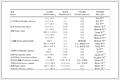
The starting point for our experiments was to optimize the reaction conditions such as solvent and reaction time for the production of 2H-thiopyranes which have anti-bacterial [4], antihyperplasia [5], anti-psychiatric [6], and anticancer activities [7] (see Table 1).
|
Table 1 Optimization of reaction conditions of compound 5a. |


|
Download:
|
| Scheme 2.Proposed mechanism for the synthesis of compound 5. | |

A proposed mechanism for this reaction is shown in Scheme 2. On the basis of phosphorus nucleophile chemistry, it is reasonable to presume that triphenylphosphonium bromide 6 results from initial addition of the triphenylphosphin 4 to α-haloketones 3. Intermediate 6 is reacted with alkyl propiolate 1 in the presence of triethylamine as the base for production of zwitterionic species 7. Then, nucleophilic attack of this intermediate on benzoyl isothiocyanate 2 produces intermediate 8. Finally, by intramolecular cyclization, compound 9 is afforded by elimination of triphenylphosphine oxide, which is converted to 5 as the product.
In conclusion, we found that the reaction of alkyl propiolate with benzoyl isothiocyanate and alkyl bromide in the presence of triphenylphosphine leads to a facile synthesis of some functionalized thiopyrans under solvent-free conditions, without using any catalyst.
| [1] | F. Tavakolinia, T. Baghipour, Z. Hossaini, Antiproliferative activity of novel thiopyran analogs on MCF-7 breast and HCT-15 colon cancer cells: synthesis, cytotoxicity, cell cycle analysis, and DNA-binding, Nucl. Acid Ther. 22 (2012) 265-270. |
| [2] | W. Schneller, Thiochromanones and related compounds, Adv. Heterocycl. Chem. 18 (1975) 59-97. |
| [3] | E. Vedeje, G.A. Krafft, Cyclic sulfides in organic synthesis, Tetrahedron 38 (1982) 2857-2881. |
| [4] | M.J. Brown, P.S. Carter, A.E. Fenwick, et al., Thiopyrans are used as key units in medicinal chemistry and as versatile building blocks in organic synthesis, Bioorg. Med. Chem. Lett. 12 (2002) 3171-3173. |
| [5] | W. Quaglia, M. Pigini, A. Piergentili, Structure-activity relationships in 1,4-benzodioxan-related compounds: selectivity of 4-phenylchroman analogues for a1-adrenoreceptor subtypes, J. Med. Chem. 45 (2002) 1633-1638. |
| [6] | L.A. Van vliet, N. Rodenhuis, Synthesis and pharmacological evaluation of thiopyran analogues of the dopamine D3 receptor-selective agonist (4aR,10bR)-(+)-trans-3,4,4a,10b-tetrahydro-4-n-propyl-2H,5H-[1]benzopyrano[4,3-b]-1,4-oxazin-9-ol (PD 128907), J. Med. Chem. 43 (2000) 2871-2876. |
| [7] | W. Wang, H. Li, J. Wang, L.S. Zu, Organocatalytic Michael addition of N-heterocycles to Michael-Aldol reactions: one-pot synthesis of chiral thiochromenes, J. Am. Chem. Soc. 128 (2006) 10354-10355. |
| [8] | Y. Sugita, H. Hosoya, K. Terasawa, Studies on the anticancer activity of thiopyran analogs showed that they are one of active antiproliferative agents against, Anticancer Res. 21 (2001) 2629-2635. |
| [9] | J.J. Hollick, B.T. Golding, I.R. Hardcastele, 2,6-Disubstituted pyran-4-one and thiopyran-4-one inhibitors of DNA-dependent protein kinase (DNA-PK), Bioorg. Med. Chem. Lett. 13 (2003) 3083-3086. |
| [10] | S.A. Sirya, V.M. Timoshenkoa, J. Bouillon, Synthesis of polyfluoroalkyl containing thiopyran derivatives and their applications in fluoroorganic chemistry, J. Fluorine Chem. 137 (2012) 6-21. |
| [11] | D.V. Kozhinov, S.A. Woznesensky, A.A. Dudinov, M.M. Krayushkin, A new method for synthesis of 6-aryl-2H-thiopyran-2-thiones, Mendeleev Commun. 10 (2000) 76-77. |
| [12] | K.C. Majumdara, S. Ponraa, R.K. Nandia, One-pot efficient green synthesis of spirooxindole-annulated thiopyran derivatives via Knoevenagel condensation followed by Michael addition, Tetrahedron Lett. 53 (2012) 1732-1737. |