


Manufacture of polypropylene could not be accomplished without the contribution of catalysts,whose preparation must involve the participation of electron donor compounds [1, 2]. Addition of electron donor compounds to the catalyst system can enhance the catalytic activity,improve the polymer’s isotacticity and crystallinity,and control the molecular weight and molecular weight distribution of the polymer.
Until recently,Ziegler-Natta catalyst system,which was invented in the 1950s and later named after its finders,is still the main catalyst system for industrial polypropylene preparation. The revolutionary finding of new electron donor compounds caused the Ziegler-Natta catalyst system to evolve from the 1st generation in the very beginning to the 5th generation nowadays [3, 4]. Scientists and researchers never stopped their endeavor to search for new electron donor compounds for the Ziegler-Natta catalyst system. Among these compounds, diethers [5, 6, 7, 8, 9, 10] and diesters [11, 12, 13, 14],developed by Basell (formerly Himont Inc. and Montell) in the last two decades might rank as the most widely studied and used new electron donor compounds. Although some of them demonstrate excellent behavior when used as electron donors,much needs to be done before they can be used in industrial applications on large scale in real world,because of their strict and complicated preparation process and some inherent drawbacks of the catalyst system associated with the chemical structure.
In our recent work,we attempted to synthesize a new kind of promising electron donor compounds. These compounds,which we name as diether-diester conjugated compounds,contain both diether and diester functional groups in the same molecule. Synergetic catalytic properties are expected when they are used as electron donors. To simplify the synthetic work,we first designed a novel model compound,which combines diether group and only one ester group instead of two in the molecule. In this article,a convenient method is presented to synthesize the above mentioned model compound 1,3-dimethoxypropan-2-yl benzoate 2.
1H NMR (300 MHz) and 13C NMR (75 MHz) spectra were measured on Bruker AVANCE 300NMR spectrometer with CDCl3 as a solvent and tetramethylsilane (TMS) as an internal standard. Chemical shifts were reported in units (ppm) by assigning TMS resonance in the 1H spectrum as 0.00 ppm and CDCl3 resonance in the 13C spectrum as 77.0 ppm. 13C NMR was taken under 1H decoupled conditions. Chemical shift of common trace 1H NMR impurity (ppm): CHCl3,7.26. HRMS spectra were recorded on a Waters Q-Tof Micro Quadrupole-Tof MS/MS apparatus in positive ion mode with methanol as a solvent. Elemental analyses were conducted on an EA1112 elemental analyzer from Thermo Fisher Scientific.
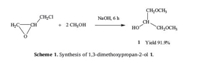
1,3-Dimethoxypropan-2-ol 1 was synthesized by treating epichlorohydrin with methanol and sodium hydroxide according to a modified procedure described in literature [15].
To a 250 mL three-neck flask was added 165 mL of absolute methanol,11.4 g of sodium hydroxide. The mixture was stirred and heated to reflux to form a solution. Epichlorohydrin (25.0 g) was added dropwised within 1 h. Refluxing of the reaction solution continued for another 6 h. The mixture was then cooled to room temperature and its pH value was adjusted to 7 by the addition of concentrated hydrochloric acid. Sodium chloride,which has precipitated out,was filtered off and the filtrate was subjected to a fractional distillation under vacuum to obtain 1 (29.8 g,yield 91.9%).
1H NMR (300 MHz,CDCl3): δ3.92-3.99 (m,1H,CH),3.40-3.49 (m,4H,CH2),3.39 (s,6H,CH3),2.59 (s,1H,OH,the shape,position and intensity of this peak vary with different sample concentration). 13C NMR (75 MHz,CDCl3):δ73.9 (CH2),69.1 (CH),59.0 (CH3). ESI-HRMS: m/z [M+Na]+ calcd. for [C5H12O3+Na]+: 143.0684; found: 143.0684. Elemental analysis: Calcd. for C5H12O3: C49.98,H 10.07; Found: C 49.97,H 9.84.
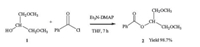
To a 250 mL three-neck flask was added 4 mmol of 4- dimethylaminopryidine (DMAP),20 mmol of 1,26 mmol of triethyl amine,and 20 mL of dry THF. The mixture was stirred and cooled to 10 ℃,and 20 mmol of benzoyl chloride in 10 mL of THF was added drop wise between 10 ℃ and 20℃ under nitrogen protection. The mixture was then warmed to room temperature and refluxed for 7 h to complete the reaction. The THF was removed by rotatory evaporation. The residue was extracted with 50 mL of methylene chloride,washed with 30 mL of water to remove the ammonium salts,then washed with 30 mL of 1 mol/L HCl,50 mL of saturated NaHCO3 solution,and 50 mL of saturated NaCl solution,successively. The organic phase was then dried over anhydrous Na2SO4,and concentrated in vacuo to give 4.42 g of 1,3- dimethoxypropan-2-yl benzoate 2 (yellow liquid,yield 98.7%).
1HNMR (300 MHz,CDCl3): δ 8.06-8.09 (m,2H,Ar-H),7.53-7.58 (m,1H,Ar-H),7.41-7.46 (m,2H,Ar-H),5.35-5.42 (m,1H,CH),3.68 (dd,4H,J = 4.95 Hz,CH2),3.40 (s,6H,CH3). 13C NMR (75 MHz, CDCl3): δ166.1 (C = O),133.0,130.3,129.8,128.3 (Ar-C),72.0 (CH), 71.4 (CH2),59.3 (CH3). ESI-HRMS: m/z [M+Na]+ calcd. for [C12H16O4+Na]+: 247.0946; found: 247.0967. Elemental analysis: Calcd. for C12H16O4: C 64.27,H 7.19; Found: C 64.42,H 7.15.
1H NMR,13C NMR spectra,and ESI-HRMS spectra of compounds 1 and 2 can be found in Supporting information.
MgCl2 (4.8 g),toluene (95 mL),epichlorohydrin (4 mL) and tributyl phosphate (12.5 mL) were added to the reactor under protection of high purity nitrogen. The mixture was heated to 50 ℃ while stirring,and kept for 2.5 h until the solid was dissolved completely. Phthalic anhydride (1.4 g) was added and the reactionmixture was stirred for another 1 h. The solutionwas cooled to 25 ℃,and 56 mL of TiCl4 was added drop wise in 1 h. The mixture was heated to 80℃ slowly,and some solid precipitated as the temperature rose. After adding compound 2 as the electron donor and stirring the reactionmixture for 1 h,the precipitates were filtered off and washed with 70 mL of toluene twice. Toluene (60 mL) and TiCl4 (40 mL) were added to the precipitates,and the mixture was heated to 110 ℃ for 2 h. The above treatment was repeated after filtration. The precipitates were washed with toluene (3×70 mL) at 110℃ for ten minutes and then with hexane (2 ×70 mL). Solid catalyst component was obtained.
A dry three-neck flask was flushed with nitrogen and propylene, and 100 mL of heptane was added. The mixture was heated to 70 ℃. AlEt3 and cyclohexyl methyl dimethoxy silane (CHMMS) were added with a molar ration of Al/Si = 20. Solid catalyst component prepared above was added,and the polymerization of propylene continued for 2 h. Ethanol was added to quench the reaction. The polymer was washed with absolute ethanol and dried under vacuum. The catalyst has a catalytic activity of 200.3 gPP/ (gCat2 h). The polymer obtained has an isotactic index of 97.4%.
The reported and most commonly used synthetic method for diether compounds is O-alkylating the corresponding diols with Oalkylating reagents [6, 7, 8, 9, 10]. However,preparation of the diol intermediates usually requires a long and complicated procedure with a very low chemical yield (e.g. ca 45% in example 1 of reference [7]). Highly toxic chemicals including iodomethane are required in the O-alkylating process,and the reaction should be carried out under strict conditions using strong base as the deprotonating reagent,such as potassium tert-butoxide or sodium hydride [6, 7, 8, 9, 10].
To build diether and ester functional groups in our model compound,we found a new and relatively easy way. Firstly,the diether group was introduced directly into the molecule through an intermediate 1,which was prepared by treating epichlorohydrin with methanol and sodium hydroxide. The one-pot reaction led to the formation of diether bonds (Scheme 1).
|
Download:
|
| Scheme 1 Synthesis of 1,3-dimethoxypropan-2-ol 1. | |

Then,reaction of 1,3-dimethoxypropan-2-ol 1 and benzoyl chloride in the presence of a mixture of triethyl amine and 4- dimethylaminopryidine (DMAP) in the second step resulted in the aimed model compound 1,3-dimethoxypropan-2-yl benzoate 2 (Scheme 2). The reaction proceeded in anhydrous environment under nitrogen protection. DMAP was used to catalyze the reaction and triethyl amine neutralized the formed hydrochloride. It was essential to use DMAP as a catalyst to enhance the reaction activity because the reactants could not convert completely when only triethyl amine was used,even if after a long time of refluxing reaction. The ammonium salts produced was removed after the reaction by the subsequent washing and extracting processes. The product thus obtained was pure enough for spectroscopic analyses without further purification.
|
Download:
|
| Scheme 2 Synthesis of 1,3-dimethoxypropan-2-yl benzoate 2. | |

The structures of 1 and 2 were confirmed by ESI-HRMS,1H NMR and 13C NMR,and elemental analyses. Positive ion ESI-HRMS spectra of both 1 and 2 gave the exact mass peak of [M+Na]+. In the 1H NMR spectrum of 2,the proton peak of the hydroxyl group no longer existed,indicating the complete conversion of 1. Owing to the absence of hydroxyl proton in 2,the splitting of the methine proton became simplified in the 1HNMR spectrum. Benzoylation of 1 resulted in a movement of the 13C chemical shift of the methine group from δ69.1 to lower field at δ 72.0 because of the electron withdrawing effect of the benzoyl group.
Compound 2 was used as an electron donor in the preparation of polypropylene catalyst component. Polymerization of propylene with this catalyst showed that the catalyst containing this electron donor has potential advantages in applications since the catalytic activity and polymer isotacticity were improved.
To the best of our knowledge,1,3-dimethoxypropan-2-yl benzoate 2 is a novel compound possessing both diether groups and an ester group. We provided a new method,with a high yield, to prepare the diether electron donor model compound. It avoids employing the traditional O-alkylation reactions that involves highly toxic O-alkylating chemicals,such as iodomethane,and strong bases,such as alkoxides or metal hydrides. The presented synthetic method is very convenient and easy to operate. No complicated purification processes are required. The reaction can be conducted under very mild conditions using cheap and safe substances. Further synthetic work of the designed diether-diester conjugated compounds as promising electron donors for polypropylene catalyst systems is in progress.
The author thanks SINOPEC and Beijing Research Institute of Chemical Industry for financial support (No. G6001-11-ZS-0215 and No. G6001-12-ZS-0266).
| [1] | J.C. Chadwick, Advances in propene polymerization using MgCl2-supported catalysts, fundamental aspects and the role of electron donors, Macromol. Symp. 173 (2001) 21-36. |
| [2] | M.C. Sacchi, I. Tritto, P. Locatelli, Stereochemical investigation of the effect of Lewis bases in heterogeneous Ziegler-Natta initiator systems, Prog. Polym. Sci. 16 (1991) 331-360. |
| [3] | K. Soga, T. Shiono, Ziegler-Natta catalysts for olefin polymerizations, Prog. Polym. Sci. 22 (1997) 1503-1546. |
| [4] | E. Albizzati, U. Giannini, G. Morini, et al., Recent advances in propylene polymerization with MgCl2 supported catalysts, Macromol. Symp. 89 (1995) 73-89. |
| [5] | E. Iiskola, A. Pelkonen, H.J. Kakkonen, J. Pursiainen, T.A. Pakkanen, A novel MgCl2- supported Ziegler-Natta catalyst composition: stereospecific polymerization of propene without external donor, Macromol. Rapid Commun. 14 (1993) 133-137. |
| [6] | Basell Poliolefin Italia S.P.A. [IT], Components and catalysts for the (co)polymerization of olefins, WO02/100904. 2002-12-19. |
| [7] | Himont Inc. [US], Diethers usable in the preparation of Ziegler-Natta catalysts, EP0361493. 1990-04-04. |
| [8] | Himont Inc. [US], Process for the preparation of diethers, EP0487035. 1992-05-27. |
| [9] | Basell Poliolefin Italia S.P.A. [IT], Process for preparing a diether-based catalyst component, WO03/076480. 2003-09-18. |
| [10] | Montell North America Inc. [US], Diethers suitable for use in the preparation of Ziegler-Natta catalysts, EP0728724. 1996-08-28. |
| [11] | Montell Technology Company B.V. [NL], Components and catalysts for the polymerization of olefins, WO98/56834. 1998-12-17. |
| [12] | Montell Technology Company B.V. [NL], Components and catalysts for the polymerization of olefins, WO00/63261. 2000-10-26. |
| [13] | Basell Poliolefin Italia S.P.A. [IT], Components and catalysts for the polymerization of olefins, WO03/022894. 2003-03-20. |
| [14] | Montell Technology Company B.V. [NL], Components and catalysts for the polymerization of olefins, WO00/55215. 2000-09-21. |
| [15] | Eprova Aktiengesellschaft, Process for the preparation of serinol and of serinol derivatives, and products obtained therefrom, US4503252. 1985-03-05. |