


 , Dun Wangb, Yue-Dong Lib, Xiao-Tian Jib, Xue-Wen Huab, Yun Huangc, Tatiana A. Kalininad, Vasiliy A. Bakulevd, Yury Yu. Morzherinc
b State Key Laboratory of Elemento-Organic Chemistry, Nankai University, Tianjin 300071, China;
c Department of Plant Pathology, Sichuan Agricultural University, Chengdu 611130, China;
d The Ural Federal University Named after the First President of Russia B.N. Yeltsin, Yeltsin UrFU, 620002 Ekaterinburg, Russia
1. Introduction
1,2,3-Thiadiazoles and tetrazoles are important heterocyclic compounds,both present a wide spectrum of biological activities. 1,2,3-Thiadiazoles have antitumor [1],antiviral [2], fungicidal [3, 4],antibacterial [5] and insecticidal [6] activities. Successful commercialization of some 1,2,3-thiadiazoles such as tiadinil (TDL) [7] and acibenzolar-S-methyl (BTH) [8] as elicitors accelerated the studies of their synthesis and systemic acquired resistance (SAR). [9, 10, 11] Tetrazoles and their derivatives have been reported as antibacterial [12],antiviral [13],herbicidal [14], anti-inflammatory [15] antitumor [16],analgesic [17],and antiproliferative [18] agents. There are many reports about each of the two heterocyclics,but the combination of 1,2,3-thiadiazole ring with tetrazole ring in one molecule is seldom reported both in chemistry and their biological activity studies.
Multicomponent reactions (MCRs),in which three or more reactants in one pot generate products containing almost all atoms of the reactant molecules,have been developed extensively as tools to achieve highly atom-,step-,and energy-economic organic synthesis [19]. Among the MCRs,the Ugi four-component condensation reaction (U-4CR) features many applications in organic syntheses and medicinal chemistry [20, 21]. The classical U-4CR between amine,aldehyde,carboxylic acid and isocyanide affords peptidic structures in high diversity. The Ugi-tetrazole synthesis is a variation of the classical Ugi-reaction where azidotrimethylsilane (TMSN3) is employed as an acid component [22] and this synthetic strategy has been applied to the synthesis of various 1,5-disubstituted tetrazoles [23, 24]. To develop novel candidate pesticides with diverse biological activities,tetrazole moiety was introduced into 1,2,3-thiadizole,and a series of novel tetrazole containing 1,2,3-thiadiazole derivatives were designed and synthesized via U-4CR. Their antivirus activities against tobacco mosaic virus (TMV) were also evaluated.
2. ExperimentalMelting points of all compounds were determined on an X-4 binocular microscope (Gongyi Technical Instrument Co.,Henan, China),and the thermometer was not corrected. Proton NMR spectra were obtained using a Bruker AVANCE-400 MHz spectrometer,and chemical shift values (δ) were reported as parts per million (ppm) with deuteron chloroform (CDCl3) as the solvent and tetramethylsilane (TMS) as the internal standard. High resolution mass spectrometry (HRMS) data were obtained on an FTICR-MS Varian 7.0T FTICR-MS instrument. All the reagents were obtained commercially and used after further purification. Column chromatography purification was carried out by using silica gel.
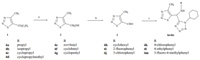
General procedure for synthesis of compounds 4a-4m (Scheme 1): 4-Methyl-1,2,3-thiadiazole-5-carbaldehyde 3 (0.21 g,1.6 mmol) and substituted amine (1.6 mmol) were stirred in 8 mL methanol at room temperature. The imine was precondensated for 0.5-1 h and then cyclohexyl isocyanide (0.21 g, 1.9 mmol) and TMSN3 (0.28 g,2.4 mmol) were added. The reaction mixture was stirred for 12-24 h at room temperature until the reaction was completed (indicated by TLC). Then the organic solvent was evaporated in vacuo.The crude products were purified by a silica gel column using ethyl acetate/petroleumether (1:2-1:3 (v/v),60-90℃) as an eluent to give 4a-4m as white or pale yellow solids in moderate yields.
|
Download:
|
| Scheme 1. General synthetic route of the target compounds 4a-4m. Reagents and conditions: (a) NaBH4 (2.0 equiv.),EtOH,0℃ for 1 h,r.t. for 6 h; (b) pyridinium chlorochromate (2.0 equiv.),CH2Cl2,r.t. for 8 h; (c) (i) R-NH2 (1.0 equiv.),CH3OH,r.t. for 0.5-1 h; (ii) cyclohexyl isocyanide (1.2 equiv.),TMSN3 (1.5 equiv.),r.t. for 12-24 h. | |
Direct anti-TMV activity of target compounds 4a-4m was conducted by half leaf juice robbing methods according to Ref. [25]. Protection effect against TMV in vivo was evaluated onN. tabacum L.leaves [4]. Healthy fresh tobacco plants at the six-leaf stage were selected for the tests. The compound solution was smeared on the whole leaves,and then the leaves were dried in the greenhouse. After 12 h,TMV at a concentration of 5.88×10⁻²μg/ mL was inoculated on the upper three leaves using the conventional juice robbing method,and the solvent was smeared on the lower three leaves as a control. The local lesion numbers were then recorded 2-3 days after inoculation. For each compound,three repetitions were conducted. All compounds were tested at concentrations of 100μg/mL. Ribavirin and ningnanmycin were used as positive control at the same time. The activity data of protection effect against TMV was calculated by the following equation:

The synthesis route of the target compounds was outlined in Scheme 1. The starting material,ethyl 4-methyl-1,2,3-thiadiazole-5-carboxylate 1,was prepared according to Ref. [9]. Cyclohexyl isocyanide was synthesized according to Ref. [4]. The intermediate (4-methyl-1,2,3-thiadiazol-5-yl)methanol 2 was obtained in high yields by reduction of 1 with NaBH4 at 0℃ to room temperature. Treatment of a intermediate 2 with pyridinium chlorochromate at room temperature produced 4-methyl-1,2,3-thiadiazole-5-carbaldehyde 3 in 86% yields. The target compounds 4a-4m were obtained by the U-4CR of 3 with substituted amines,cyclohexyl isocyanide and TMSN3 in methanol in moderate yields,which were white or pale yellow solid after column chromatography purification.
The structures of the target compounds synthesized herein were fully characterized by melting points,1H NMR,IR,and HRMS (ESI) [26]. In the IR spectra of compounds 4a-4m,strong absorptions at about 3300 cm-1were detected,due to the secondary amino group. In the 1H NMR spectra,CH3 of 1,2,3-thiadizole were observed at δ 2.57-2.66. Furthermore,a doublet signal at about δ 4.80 due to the NH proton coupled with the aromatic proton at about δ 7.00 as seen for compounds 4i-4m;as for compounds 4a-4h,the NH proton doublet was not always clearly detected because of overlapping with the aliphatic protons. The HRMS (ESI) spectral data of all compounds are in good agreement with theoretical data.
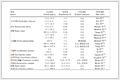
The results of direct anti-TMV activity and protection effect of all target compounds were listed in Table 1. As shown in the data, most compounds have very good anti-TMV activity at 100μg/mL, which were equal to or higher than that of the positive control ribavirin. Among them,compound 4l showed excellent anti-TMV activity with inhibition activity of 48.73%,which was higher than that of ninamycin. Besides possessing good direct anti-TMV activity,compounds 4b,4c and 4i also presented very good protection effect in vivo at 100μg/mL,which were equivalent to the positive control ribavirin. After a structural comparison,it was very clear that the whole molecular structure played an important role in anti-TMV activity rather than one moiety in the molecule. Our results indicate that the combination of 1,2,3-thiadiazole ring with tetrazole ring in one molecule can improve their biological activities. This provides us with useful clues for further research of finding novel leading structures possessing good antivirus activity based on the structure reported in this paper.
|
Table 1Direct antivirus activity and protection effect in vivo against TMV of target compounds at 100μg/mL. |

In summary,a series of novel tetrazole containing 1,2,3-thiadiazole derivatives were synthesized via a simplified Ugitetrazole reaction and easily purified. The bioassay tests indicated that most target compounds have higher anti-TMV activity than that of ribavirin did at 100μg/mL. Compounds 4b,4c and 4i also showed equivalent protection effect to ribavirin in vivo at 100μg/ mL. These studies indicate that the newly synthesized tetrazole containing 1,2,3-thiadiazole derivatives possessed good potential bioactivities,and were worthy of further study in pesticide development.
AcknowledgmentThis study was funded in part by the NSF of Tianjin (No. 10JCZDJC17500),the National Key Project for Basic Research (No. 2010CB126105) and National Key Technology Research and Development Program (No. 2011BAE06B02) and the Foundation of Achievements Transformation and Application of Tianjin Agricultural Science and Technology (No. 201002250),Tianjin Key Technology Research and Development Program (No. 11ZCGYNC00100),The Commonweal Specialized Research Fund of China Agriculture (Nos. nyhyzx3-21,201103016 and 201003029).
| [1] | R. Tripathy, A. Ghose, J. Singh, et al., 1,2,3-Thiadiazole substituted pyrazolones as potent KDR/VEGFR-2 kinase inhibitors, Bioorg. Med. Chem. Lett. 17 (2007) 1793-1798. |
| [2] | W.L. Dong, Z.X. Liu, X.H. Liu, Z.M. Li, W.G. Zhao, Synthesis and antiviral activity of new acrylamide derivatives containing 1,2,3-thiadiazole as inhibitors of hepatitis B virus replication, Eur. J. Med. Chem. 45 (2010) 1919-1926. |
| [3] | Z.J. Fan, Z.K. Yang, H.K. Zhang, et al., Synthesis, crystal structure, and biological activity of 4-methyl-1,2,3-thiadiazole-containing 1,2,4-triazolo[3,4-b][1,3,4]thiadiazoles, J. Agric. Food Chem. 58 (2010) 2630-2636. |
| [4] | X. Zuo, N. Mi, Z.J. Fan, et al., Synthesis of 4-methyl-1, 2,3-thiadiazole derivatives via Ugi reaction and their biological activities, J. Agric. Food Chem. 58 (2010) 2755-2762. |
| [5] | V. Padmavathi, K. Mahesh, A.V. Nagendra Mohan, A. Padmaja, Synthesis and bioassay of oxazolyl/thiazolyl selenadiazoles, thiadiazoles and diazaphospholes, Chem. Pharm. Bull. 57 (2009) 561-566. |
| [6] | H. Wang, Z.K. Yang, Z.J. Fan, et al., Synthesis and insecticidal activity of N-tertbutyl-N,N'-diacylhydrazines containing 1,2,3-thiadiazoles, J. Agric. Food Chem. 59 (2011) 628-634. |
| [7] | M. Yasuda, M. Kusajima, M. Nakajima, et al., Thiadiazole carboxylic acid moiety of tiadinil, SV-03, induces systemic acquired resistance in tobacco without salicylic acid accumulation, J. Pestic. Sci. 31 (2006) 329-334. |
| [8] | Z.J. Fan, Y.W. Ai, J.Y. Chen, et al., Preparation of BTH standard and HPLC analysis of Bion 50%WG, J. Sichuan Normal Univ. (Nat. Sci.) 28 (2005) 608-610. |
| [9] | Z.J. Fan, Z.G. Shi, H.K. Zhang, et al., Synthesis and biological activity evaluation of 1,2,3-thiadiazole derivatives as potential elicitors with highly systemic acquired resistance, J. Agric. Food Chem. 57 (2009) 4279-4286. |
| [10] | Q.S. Du, W.P. Zhu, Z.J. Zhao, X.H. Qian, Y.F. Xu, Novel benzo-1,2,3-thiadiazole-7-carboxylate derivatives as plant activators and the development of their agricultural applications, J. Agric. Food Chem. 60 (2012) 346-353. |
| [11] | W.T. Mao, H. Zhao, Z.J. Fan, et al.,A.B. Vasiliy, Synthesis and bioactivity of N-tertbutyl-N'-acyl-5-methyl-1,2,3-thiadiazole-4-carbohydrazides, Chin. Chem. Lett. 23 (2012) 1233-1236. |
| [12] | S.D. Diwakar, S.S. Bhagwat, M.S. Shingare, C.H. Gill, Substituted 3-((Z)-2-(4-nitrophenyl)-2-(1H-tetrazol-5-yl) vinyl)-4H-chromen-4-ones as novel anti-MRSA agents: synthesis, SAR, and in-vitro assessment, Bioorg. Med. Chem. Lett. 18 (2008) 4678-4681. |
| [13] | K.S. Yeung, Z. Qiu, Z. Yang, et al., Inhibitors of HIV-1 attachment. Part 9. An assessment of oral prodrug approaches to improve the plasma exposure of a tetrazole-containing derivative, Bioorg. Med. Chem. Lett. 23 (2013) 209-212. |
| [14] | Y.P. Luo, Q. Gong, Q. Chen, G.F. Yang, Synthesis and herbicidal activities of tetrazolinone derivatives containing oxime ether, Chin. J. Org. Chem. 28 (2008) 1561-1565. |
| [15] | M. Bertinaria, M.A. Shaikh, C. Buccellati, et al., Designing multitarget anti-inflammatory agents: chemical modulation of the lumiracoxib structure toward dual thromboxane antagonists-COX-2 inhibitors, ChemMedChem 7 (2012) 1647-1660. |
| [16] | R. Romagnoli, P.G. Baraldi, M.K. Salvador, et al., Synthesis and evaluation of 1,5-disubstituted tetrazoles as rigid analogues of combretastatin A-4 with potent antiproliferative and antitumor activity, J. Med. Chem. 55 (2012) 475-488. |
| [17] | C. Trécant, A. Dlubala, P. George, et al., Synthesis and biological evaluation of analogues of M6G, Eur. J. Med. Chem. 46 (2011) 4035-4041. |
| [18] | A.S. Gundugola, K.L. Chandra, E.M. Perchellet, et al., Synthesis and antiproliferative evaluation of 5-oxo and 5-thio derivatives of 1,4-diaryl tetrazoles, Bioorg. Med. Chem. Lett. 20 (2010) 3920-3924. |
| [19] | S. Maeda, S. Komagawa, M. Uchiyama, K. Morokuma, Finding reaction pathways for multicomponent reactions: the passerini reaction is a four-component reaction, Angew. Chem. Int. Ed. 50 (2011) 644-649. |
| [20] | W.H. Wang, X.M. Zou, X. Zhang, Y.Q. Fu, P. Xu, Solid-phase synthesis of PNA monomer by Ugi four-component condensation, Chin. Chem. Lett. 16 (2005) 585-588. |
| [21] | S.S. Van Berkel, B.G.M. Bögels, M.A. Wijdeven, B. Westermann, F.P.J.T. Rutjes, Recent advances in asymmetric isocyanide-based multicomponent reactions, Eur. J. Org. Chem. (2012) 3543-3559. |
| [22] | C. Kalinski, M. Umkehrer, S. Gonnard, et al., A new and versatile Ugi/SNAr synthesis of fused 4,5-dihydrotetrazolo[1,5-a] quinoxalines, Tetrahedron Lett. 47 (2006) 2041-2044. |
| [23] | T. Zhao, A. Boltjes, E. Herdtweck, A. Dömling, Tritylamine as an ammonia surrogate in the ugi tetrazole synthesis, Org. Lett. 15 (2013) 639-641. |
| [24] | F. Medda, C. Hulme, A facile and rapid route for the synthesis of novel 1,5-substituted tetrazole hydantoins and thiohydantoins via a TMSN3-Ugi/RNCX cyclization, Tetrahedron Lett. 53 (2012) 5593-5596. |
| [25] | D.K. Yuan, D.Q. Zhang, R.X. Li, D.Q. Wang, X.L. Yang, Synthesis and anti-TMV activity of novel N-(pyrimidin-5-yl)-N0-phenylureas, Chin. Chem. Lett. 22 (2011) 18-20. |
| [26] | Selected characteristic data for the target compounds. 4a: White solid; yield 59%; mp 75-76 ℃; 1H NMR (400 MHz, CDCl3): δ 0.93 (t, 3H, J = 7.6 Hz, propyl-CH3), 1.26-2.07 (m, 13H, propyl-CH2, 10cyclohexyl-H, NH), 2.45-2.62 (m, 2H, propyl-CH2), 2.65 (s, 3H, thiadiazole-CH3), 4.58-4.66 (m, 1H, cyclobutyl-CH), 5.76 (s, 1H, CH). HRMS: Calcd. for C14H23N7S (M+Na)+: 344.1628, Found: 344.1630; IR (KBr pellet press, cm 1): v3325, 2951, 2863, 1495, 1450, 1229, 1106, 1009, 809, 759. 4b: White solid; yield 47%; mp 96-97 ℃; 1H NMR (400 MHz, CDCl3):δ 1.13 (t, 6H, J = 6.0 Hz, 2 isopropyl-CH3), 1.26-2.07 (m, 11H, 10 cyclohexyl-H, NH), 2.63 (s, 3H, thiadiazole-CH3), 2.64-2.71 (m, 1H, isopropyl-CH), 4.54-4.62 (m, 1H, cyclobutyl-CH), 5.83 (s, 1H, CH). HRMS: Calcd. for C14H23N7S (M+Na)+: 344.1628, Found: 344.1626; IR (KBr pellet press, cm 1): v 3276, 2934, 2857, 1501, 1451, 1241, 1126, 1009, 832. 4c: White solid; yield 51%; mp 96-97 ℃; 1H NMR (400 (M+H)+z, CDCl3): (0.43-0.54 (m, 4H, cyclopropyl-H), 1.33-2.05 (m, 11H, cyclohexyl-H, NH), 2.58 (s, 1H, cyclopropyl-CH), 2.66 (s, 3H, thiadiazole-CH3), 4.27-4.35 (m, 1H, cyclohexyl-CH), 5.58 (s, 1H, CH). HRMS: Calcd. for C14H21N7S (M+H)+: 320.1652, Found: 320.1657; IR (KBr pellet press, cm-1): n 3268, 2938, 2856, 1501, 1446, 1239, 1162, 1022, 801, 680. 4d: White solid; yield 53%; mp 88-89 ℃; 1H NMR (400 (M+H)+z, CDCl3): δ 1.31-2.17 (m, 17H, 5 cyclopropyl-H, 10 cyclohexyl-H, CH2), 2.63 (s, 3H, thiadiazole-CH3), 3.13 (s, 1H, NH), 4.53-4.60 (m, 1H, cyclohexyl-H), 5.72 (s, 1H, CH). HRMS: Calcd. for C15H23N7S (M+Na)+: 356.1628, Found: 356.1623; IR (KBr pellet press, cm 1): v3265, 2941, 2856, 1501, 1466, 1241, 1151, 1009, 810. 4e: White solid; yield 57%; mp 119-120 ℃; 1H NMR (400 (M+H)+z, CDCl3): δ 1.10 (s, 9H, 3t-butyl-CH3), 1.26-2.07 (m, 11H, 10 cyclohexyl-H, NH), 2.57 (s, 3H, thiadiazole-CH3), 4.37-4.45 (m, 1H, cyclohexyl-CH), 5.84 (s, 1H, CH). HRMS: Calcd. for C15H25N7S (M+Na)+: 358.1784, Found: 358.1787; IR (KBr pellet press, cm-1): v3327, 2938, 2865, 1453, 1231, 1103, 1076, 861, 741. 4f: White solid; yield 60%; mp 87-88 ℃; 1H NMR (400 MHz, CDCl3):δ 1.26-2.17 (m, 17H, 6 cyclobutyl-H, 10 cyclohexyl-H, NH), 2.63 (s, 3H, thiadiazole-CH3), 3.11-3.14 (m, 1H, cyclobutyl-CH), 4.49-4.56 (m, 1H, cyclohexyl-CH), 5.70 (s, 1H, CH). HRMS: Calcd. for C15H23N7S (M+Na)+: 356.1628, Found: 356.1629; IR (KBr pellet press, cm 1): v3264, 2941, 2856, 1501, 1451, 1241, 1150, 1105, 1009, 809, 759. 4g: White solid; yield 58%; mp 122-123 ℃; 1H NMR (400 MHz, CDCl3):δ 1.32-2.00 (m, 19H, 8 cyclopentyl-H, 10 cyclohexyl-H, NH), 2.63 (s, 3H, thiadiazole-CH3), 2.89-2.95 (m, 1H, cyclopentyl-CH), 4.53-4.60 (m, 1H, cyclohexyl-CH), 5.72 (s, 1H, CH). HRMS: Calcd. for C16H25N7S (M H) : 346.1819, Found: 346.1814; IR (KBr pellet press, cm 1): v3271, 2938, 2857, 1499, 1449, 1236, 1087, 1005, 844, 732. 4h: White solid; yield 47%; mp 98-99 ℃; 1H NMR (400 (M+H)+z, CDCl3):δ 1.11-2.05 (m, 21H, 20 cyclohexyl-H, NH), 2.30-2.32 (m, 1H, cyclohexyl-CH), 2.62 (s, 3H, thiadiazole-CH3), 4.56-4.64 (m, 1H, cyclohexyl-H), 5.90 (s, 1H, CH). HRMS: Calcd. for C17H27N7S (M H) : 360.1976, Found: 360.1973; IR (KBr pellet press, cm 1): v3286, 2927, 2850, 1451, 1236, 1106, 1012, 824, 686. 4i: White solid; yield 55%; mp 96-97 ℃; 1H NMR(400 (M+H)+z, CDCl3):δ 1.26-1.99 (m, 10H, cyclohexyl-H), 2.65 (s, 3H, thiadiazole-CH3), 4.35-4.41 (m, 1H, cyclohexyl-H), 4.72 (d, 1H, J = 8.0 Hz, NH), 6.32 (d, 1H, J = 8.0 Hz, CH), 6.66-7.09 (m, 4H, Ph-H). HRMS: Calcd. for C17H20FN7S (M+H)+: 374.1558, Found: 374.1555; IR (KBr pellet press, cm 1): v3401, 2936, 2860, 1620, 1527, 1453, 1251, 1191, 1057, 738. 4j: Pale yellow solid; yield 50%; mp 115-116 ℃; 1H NMR (400 (M+H)+z, CDCl3):δ 1.26-1.99 (m, 10H, 10 cyclohexyl-H), 2.66 (s, 3H, thiadiazole-CH3), 4.27-4.33 (m, 1H, cyclohexyl-CH), 5.09 (d, 1H, J = 6.0 Hz, NH), 6.23 (d, 1H, J = 7.6 Hz, CH), 6.56 (d, 1H, J = 8.4 Hz, Ph-H), 6.70 (s, 1H, Ph-H), 6.85 (d, 1H, J = 8.4 Hz, Ph-H), 7.12 (t, 1H, J = 8.0 Hz, Ph-H). HRMS: Calcd. for C17H20ClN7S (M H) : 388.1117, Found: 388.1112; IR (KBr pellet press, cm 1): v3410, 2937, 2861, 1598, 1484, 1446, 1272, 1158, 1012, 845, 759. 4k: Pale yellow solid; yield 46%; mp 152-153 ℃; 1H NMR (400 MHz, CDCl3):δ 1.26-2.01 (m, 10H, 10 cyclohexyl-H), 2.66 (s, 3H, thiadiazole-CH3), 4.25-4.32 (m, 1H, cyclohexyl-CH), 4.80 (d, 1H, J = 7.2 Hz, NH), 6.20 (d, 1H, J = 7.2 Hz, CH), 6.63 (d, 2H, J = 8.8 Hz, Ph-H), 7.18 (d, 2H, J = 8.4 Hz, Ph-H). HRMS: Calcd. for C17H20ClN7S (M H) : 388.1117, Found: 388.1119; IR (KBr pellet press, cm 1): v3285, 2944, 2856, 1598, 1497, 1442, 1296, 1245, 1103, 1011, 837. 4l: White solid; yield 45%; mp 149-150 (oC; 1H NMR (400 MHz, CDCl3):δ 1.17 (t, 3H, J = 7.6 Hz, ethyl-CH3), 1.24-2.00 (m, 10H, 10 cyclohexyl-H), 2.50 (q, 2H, J = 15.2 Hz, ethyl-CH2), 2.63 (s, 3H, thiadiazole-CH3), 4.27-4.34 (m, 1H, cyclohexyl-CH), 4.41 (d, 1H, J = 5.2 Hz, NH), 6.18 (d, 1H, J = 8.0 Hz, CH), 6.63 (d, 2H, J = 8.4 Hz, Ph-H), 7.05 (d, 2H,, J = 8.4 Hz, Ph-H). HRMS: Calcd. for C19H25N7S (M+Na)+: 406.1784, Found: 406.1783; IR (KBr pellet press, cm 1): v3419, 2935, 2862, 1616, 1523, 1446, 1281, 1102, 818, 756. 4m: White solid; yield 48%; mp 143-144 (C; 1H NMR (400 (M+H)+z, CDCl3): δ 1.27-2.00 (m, 10H, cyclohexyl-H), 2.15 (s, 3H, Ph-CH3), 2.65 (s, 3H, thiadiazole-CH3), 4.29-4.34 (m, 1H, cyclohexyl-CH), 4.75 (d, 1H, J = 7.6 Hz, NH), 6.19 (d, 1H, J = 7.6 Hz, CH), 6.36-6.41 (m, 2H, PhH), 7.00 (t, 1H, J = 8.4 Hz, PhH). HRMS: Calcd. for C18H22FN7S (M-H)-: 386.1569, Found: 386.1571; IR (KBr pellet press, cm-1): v3285, 2927, 2849, 1496, 1450, 1236, 1133, 1012, 824, 686. |