


Research interest in 3,4-dihydropyrimidin-2-(1H)-ones (‘Biginelli compounds’,DHPMs),has surged rapidly,owing to the pharmacological properties [1, 2, 3, 4, 5] associated with many derivatives of this privileged hetero-cyclic core. The biological activity [1] of these Biginelli compounds includes antiviral,antitumor, antibacterial and anti-inflammatory properties. In addition,some functionalized DHPMs have emerged as potent calcium channel blockers [2],antihypertensive agents [3],and neuropeptide Y (NPY) antagonists [4]. Several recently isolated marine alkaloids [5] with interesting biological activity also contain the dihydropyrimidinone- 5-carboxylate core. Their applications in the field of drug research have stimulated the development of a wide range of synthetic methods for their preparation and chemical transformations. Out of the five major bases in nucleic acids,three (i.e. cytosine,uracil,and thymine) are pyrimidine derivatives,which are found in DNA and RNA [6, 7, 8]. Because of their involvement as bases in DNA and RNA,they have become very important in the world of synthetic organic chemistry. The best-known method for making DHPMs is the classical Biginelli synthesis [9]. Although it has been known for more than a century,it is still the most useful method for the preparation of this class of compounds. The simple and direct method for the synthesis of DHPMs reported by Biginelli in 1893 involves a one-pot condensation of an aldehyde,a β-diketone and urea under strong acidic conditions [9]. However,this method suffers from low yields,especially in the cases of some substituted (hetero) aromatic aldehydes [10]. To enhance the efficiency of the Biginelli reaction,various catalysts have been studied. In an attempt to prepare DHPMs,different types of acidic catalysts such as H2SO4 [11],BF3.EtOH/CuCl [12],LaCl3.H2O with catalytic amount of concentrated HCl [13],CeCl3.7H2O [14],InCl3 [15],Fe3O4@mesoporous SBA-15 [16],nickel chloride [17], Cu(OTf)2 [18],Iron(III) tosylate [19],LiClO4[20],LiBr [21],InBr3 [22],CAN/HCl [23],FeCl3.6H2O/HCl [24],TMSI [25],CdCl2 [26], CuCl2.2H2O-HCl [27],and ZnBr2 [28] have been used. However,in spite of their potential utility many of the existing methods suffer from some drawbacks,such as the use of strong acidic conditions, long reaction times,tedious workup procedures,environmental disposal difficulties,and lowyields of the products. Here,weutilized silica gel-supported L-pyrrolidine-2-carboxylic acid-4-hydrogen sulfate as an inexpensive mediator for the Biginelli reaction [29].
All solvents and reagents were purchased from Aldrich or Merck with high-grade quality and used without any purification. Melting points were determined on electrothermal apparatus using open capillaries and are uncorrected. Thin-layer chromatography was accomplished on 0.2-mm precoated plates of silica gel (Merck). Visualization was made with UV light (254 nm and 365 nm). 1H NMR and 13C NMR spectra were recorded in DMSO-d6 solutions on a Bruker FX 400 Q spectrometer operating at 400 (1H) and 100 (13C) MHz.
General procedure for the synthesis of 3,4-dihydropyrimidin-2- (1H)-ones: A mixture of aldehyde 1 (1 mmol),ethyl acetoacetate 2 (1.1 mmol),urea (or thiourea) 3 (1.5 mmol),silica gel-supported Lpyrrolidine- 2-carboxylic acid-4-hydrogen sulfate (212 mg),and ethanol (10 mL) was charged into a 25 mL round bottom flask. The mixture was refluxed for 6 h. The reaction was monitored by TLC analysis using n-hexane/acetone (8:2) as eluent. After completion of the reaction,the solid materials were filtered off and the solvent (ethanol) of the filtrate was evaporated. After cooling,20 mL of water was added to the mixture and filtered. The filtrate was dissolved in hot ethanol (25 mL) and the insoluble materials were filtered off. Then,the filtrate was concentrated and dried to obtain the corresponding 3,4-dihydropyrimidin-2-(1H)-ones (DHPMs). The crude product was crystallized from water/ethanol mixture (1:1).
Ethyl 4-(4-methoxyphenyl)-6-methyl-2-oxo-1,2,3,4-tetrahydropyrimidine- 5-carboxylate (4a): 1H NMR (400 MHz,DMSO-d6): δ 9.16 (s,1H),7.68 (s,1H),7.13 (d,2H,J = 8.4 Hz),6.87 (d,2H, J = 8.4 Hz),5.08-5.07 (s,1H),3.97 (q,2H,J = 7.2 Hz),3.71 (s,3H), 2.23 (s,3H),1.09 (t,3H,J = 7.2 Hz).
Ethyl 4-(4-fluorophenyl)-6-methyl-2-oxo-1,2,3,4-tetrahydropyrimidine- 5-carboxylate (4d): 1H NMR (400 MHz,DMSO-d6): δ 9.26 (s, 1H),7.78 (s,1H),7.39-7.22 (m,4H),5.13-5.12 (s,1H),3.97 (q,2H, J = 7.2 Hz),2.23 (s,3H),1.08 (t,3H,J = 7.2 Hz).
Ethyl 4-(4-p-tolyl)-6-methyl-2-oxo-1,2,3,4-tetrahydropyrimidine- 5-carboxylate (4e): 1H NMR (400 MHz,DMSO-d6): δ 9.16 (s, 1H),7.96 (s,1H),7.11 (s,4H),5.09 (s,1H),3.97 (q,2H, J = 7.2 Hz), 2.25 (s,3H),2.23 (s,3H),1.09 (t,3H,J = 7.2 Hz). 13C NMR (100 MHz, DMSO-d6): δ 165.8,152.7,148.6,142.4,136.8,129.3,126.6,99.9, 59.6,54.1,21.1,18.2,14.5.
Ethyl 4-(4-chlorophenyl)-6-methyl-2-oxo-1,2,3,4-tetrahydropyrimidine- 5-carboxylate (4g): 1H NMR (400 MHz,DMSO-d6): δ 9.26 (s, 1H),7.78 (s,1H),7.39-7.22 (m,4H),5.13 (s,1H),3.97 (q,2H, J = 7.2 Hz),2.23 (s,3H),1.08 (t,3H,J = 7.2 Hz).
Ethyl 4-(3,4-dimethoxyphenyl)-6-methyl-2-oxo-1,2,3,4-tetrahydropyrimidine- 5-carboxylate (4h): 1H NMR (400 MHz,DMSO-d6):δ 9.16 (s,1H),7.68 (s,1H),6.89-6.69 (m,3H),5.08 (s,1H),3.99 (q, 2H,J = 7 .2 Hz),3.73-3.7 (s,6H),2.23 (s,3H),1.09 (t,3H,J = 7.2 Hz).
Ethyl 4-phenyl-6-methyl-2-thioxo-1,2,3,4-tetrahydropyrimidine- 5-carboxylate (4i): 1H NMR (400 MHz,DMSO-d6): δ 10.34 (s,1H), 9.66 (s,1H),7.35-7.21 (m,5H),5.16 (s,1H),4 (q,2H,J = 7.2 Hz), 2.27 (s,3H),1.09 (t,3H,J = 7.2 Hz).
Ethyl 4-(4-chlorophenyl)-6-methyl-2-thioxo-1,2,3,4-tetrahydropyrimidine- 5-carboxylate (4j): 1H NMR (400 MHz,DMSO-d6): δ 10.39 (s,1H),9.68 (s,1H),7.42 (d,2H,J = 6.8 Hz),7.22 (d,2H, J = 6.8 Hz),5.16 (s,1H),4 (q,2H,J = 7.2 Hz),2.3 (s,3H),1.09 (t,3H, J = 7.2 Hz). 13C NMR (100 MHz,DMSO-d6): δ 174.7,165.4,145.8, 142.8,132.7,129,128.8,100.7,60.1,53.9,17.7,14.5.
Ethyl 4-(4-p-tolyl)-6-methyl-2-thioxo-1,2,3,4-tetrahydropyrimidine- 5-carboxylate (4k): 1H NMR (400 MHz,DMSO-d6): δ10.30 (s,1H),9.62 (s,1H),7.15-7.08 (m,4H),5.13-5.12 (s,1H),4.00 (q, 2H,J = 7.2 Hz),2.28 (s,3H),2.25 (s,3H),1.1 (t,3H,J = 7.2 Hz). 13C NMR (100 MHz,DMSO-d6): δ 174.6,165.6,145.3,141.1,137.4, 129.5,126.8,126.5,101.3,60,54.3,21.1,17.6,14.5.
1H NMR and 13C NMR spectra of compounds are supplied in Supporting information.
The present work describes our endeavors to develop a simple, economical and highly efficient strategy for the synthesis of dihydropyrimidinones and/or thiones through a three-component one-pot condensation of an aldehyde,ethyl acetoacetate and urea or thiourea using supported L-pyrrolidine-2-carboxylic acid-4- hydrogen sulfate on silica gel as a catalyst in ethanol under reflux conditions.
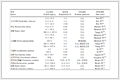
Initially,in order to determine the optimal loading of the catalyst,p-chlorobenzaldehyde was combined with ethyl acetoacetate and urea in the presence of different amounts of supported L-pyrrolidine-2-carboxylic acid-4-hydrogen sulfate on silica gel to afford the corresponding DHPM (4g) (Table 1).
|
Table 1 Synthesis of 4g promoted by different amounts of supported L-pyrrolidine-2-carboxylic acid-4-hydrogen sulfate on silica gel as catalyst.a |

As results shown in Table 1,the highest yield of corresponding DHPM could be achieved using 0.212 g of supported L-pyrrolidine- 2-carboxylic acid-4-hydrogen sulfate on silica gel per mmol of aldehyde. No conversion was observed in the blank run (without catalyst,entry 1,Table 1),indicating that the presence of catalyst is necessary for the formation of dihydropyrimidinones and/or thiones. Also the effects of temperature on the outcome of the reaction were studied. To this end,the reaction of p-methoxybenzaldehyde with urea and ethyl acetoacetate in the presence of supported L-pyrrolidine-2-carboxylic acid-4- hydrogen sulfate on silica gel was conducted at different temperatures (Fig. 1).

|
Download:
|
| Fig. 1. Preparation of ethyl 4-(4-methoxyphenyl)-6-methyl-2-oxo-1,2,3,4-tetrahydropyrimidine-5-carboxylate in gradient temperature. | |
Encouraged by these optimized reaction conditions [aldehyde (1 mmol),ethyl acetoacetate (1.1 mmol),urea/thiourea (1.5 mmol) and catalyst (0.212 g),under refluxing],the reaction of ethyl acetoacetate,and urea/thiourea with different aromatic aldehydes in the presence of a catalytic amount of silica gel-supported Lpyrrolidine- 2-carboxylic acid-4-hydrogen sulfate was investigated (Scheme 1).

|
Download:
|
| Scheme 1. General reaction scheme for the synthesis of DHPMs. | |
The results for the preparation of substituted dihydropyrimidinones and/or thiones 4a-l are summarized in Table 2.
|
|
Table 2 Synthesis of dihydropyrimidine-ones or -thiones (DHPMs) via combination of aromatic aldehydes,ethyl acetoacetate and urea or thiourea in presence of catalytic amount of L-pyrrolidine-2-carboxylic acid-4-hydrogen sulfate (supported on silica gel) in ethanol under reflux conditions.a |

Several 3,4-dihydropyrimidin-2-(1H)-ones were successfully synthesized in high yield by following the above procedure. Aromatic aldehydes bearing both electron-donating and electronwithdrawing groups readily undergo the transformation,giving fair yields of corresponding Biginelli compounds. Also thiourea was used with similar success to provide the corresponding 3,4- dihydropyrimidin-2-(1H)-thiones,which are also of interest with regard to their biological activity.
The proposed mechanism for the Biginelli reaction is outlined in Scheme 2.

|
Download:
|
| Scheme 2. Mechanism for the Biginelli reaction catalyzed by L-pyrrolidine-2-carboxylic acid-4-hydrogen sulfate (supported on silica gel). | |
In order to assess the capability of the present methodology in comparison to the reported procedures for the preparation of 3,4-dihydropyrimidin-2-(1H)-ones or thiones,we compared our results of the preparation of ethyl 6-methyl-2-oxo- 4-phenyl-1,2,3,4-tetrahydropyrimidine-5-carboxylate (as typical examples) with the best from the literature as shown in Table 3.
|
|
Table 3 Comparison of the catalytic efficiency of L-pyrrolidine-2-carboxylic acid-4-hydrogen sulfate supported on silica gel with that of reported catalysts in the preparation of ethyl 6-methyl-2-oxo-4-phenyl-1,2,3,4-tetrahydropyrimidine-5-carboxylate. |


In summary,the present work provides an efficient and improved modification of the Biginelli reaction. Mild reaction conditions,ease of work up,high yields and eco-friendliness are the features of this new procedure. In all cases the pure products were isolated by simple filtration without use of any chromatography or cumbersome reaction workup procedures. The catalyst was easily separated from the reaction mixture by filtration.
Financial support to this work by the Ilam University,Ilam,Iran is gratefully acknowledged.
Supplementary data associated with this article can be found,in the online version,at http://dx.doi.org/10.1016/j.cclet.2013.05.033.
| [1] | C.O. Kappe, 100 years of the Biginelli dihydropyrimidine synthesis, Tetrahedron 49(1993) 6937-6963. |
| [2] | H. Cho, M. Ueda, K. Shima, et al., Dihydropyrimidines: novel calcium antagonists with potent and long-lasting vasodilative and antihypertensive activity, J. Med. Chem. 32(1989) 2399-2406. |
| [3] | K.S. Atwal, B.N. Swanson, S.E. Unger, et al., Dihydropyrimidine calcium channel blockers. 3. 3-Carbamoyl-4-aryl-1, 2,3,4-tetrahydro-6-methyl-5-pyrimidinecarboxylic acid esters as orally effective antihypertensive agents, J. Med. Chem. 34(1991) 806-811. |
| [4] | B. Schnell, U.T. Strauss, P. Verdino, K. Faber, C.O. Kappe, Synthesis of enantiomerically pure 4-aryl-3,4-dihydropyrimidin-2(1H)-ones via enzymatic resolution: preparation of the antihypertensive agent(R)-SQ 32926 Tetrahedron, Asymmetry 11(2000) 1449-1453. |
| [5] | B.B. Snider, Z. Shi, Biomimitic synthesis of(+/-)-carbamine-A, carbamine-B, carbamine-C1 and carbamine-C2 revision of the structures of carbamine-B and carbamine-C1, J. Org. Chem. 58(1993) 3828-3839. |
| [6] | J.H. Clark(Ed.), Catalysis of Organic Reactions by Supported Inorganic Reagents, VCH Publishers, New York, 1994. |
| [7] | R.A. Sheldon, H. VanBekkum, Fine Chemical Through Heterogeneous Catalysis, Wiely-VCH, Weinheim, Germany, 2002. |
| [8] | G.D. Yadav, M.S. Krishnan, An ecofriendly catalytic route for the preparation of perfumery grade methyl anthranilate from anthranilic acid and methanol, Org. Process Res. Dev. 2(1998) 86-95. |
| [9] | P. Biginelli, Aldehyde-urea derivatives of aceto-and oxaloacetic acids, Gazz. Chim. Ital. 23(1893) 360-413. |
| [10] | k. Joseph, S. Jain, Ion exchange resins as recyclable and heterogeneous solid acid catalysts for the Biginelli condensation: an improved protocol for the synthesis of 3,4-dihydropyrimidin-2-ones, J. Mol. Catalyst. 247(2006) 99-102. |
| [11] | K. Folkers, T.B. Johnson, Researches on pyrimidines, CXXXⅢ. Some reactions and derivatives of 2-keto-4-phenyl-5-carbethoxy-6 methyl-1,2,3,4-tetrahydropyrimidine, J. Am. Chem. Soc. 55(1933) 2886-2893. |
| [12] | E.H. Hu, D.R. Sidler, U.H. Dolling, Unprecedented catalytic three component onepot condensation reaction: an efficient synthesis of 5-alkoxycarbonyl-4-aryl-3, 4-dihydropyrimidin-2(1H)-ones, J. Org. Chem. 63(1998) 3454-3457. |
| [13] | J. Lu, Y. Bai, Z. Wang, B. Yang, H. Ma, One-pot synthesis of 3, 4-dihydropyrimidin-2(1H)-ones using lanthanum chloride as a catalyst, Tetrahedron Lett. 41(2000) 9075-9078. |
| [14] | D.S. Bose, L. Fatima, H.B. Mereyala, Green chemistry approaches to the synthesis of 5-alkoxycarbonyl-4-aryl-3, 4-dihydropyrimidin-2(1H)-ones by a three-component coupling of one-pot condensation reaction: comparison of ethanol, water, and solvent-free conditions, J. Org. Chem. 68(2003) 587-590. |
| [15] | B.C. Ranu, A. Hajra, U. Jana, Indium(Ⅲ) chloride-catalyzed one-pot synthesis of dihydropyrimidinones by a three-component coupling of 1,3-dicarbonyl compounds, aldehydes, and urea: an improved procedure for the Biginelli reaction, J. Org. Chem. 65(2000) 6270-6272. |
| [16] | J. Mondal, T. Sen, A. Bhaumik, Fe3O4@mesoporous SBA-15: a robust and magnetically recoverable catalyst for one-pot synthesis of 3, 4-dihydropyrimidin-2(1H)-ones via the Biginelli reaction, Dalton Trans. 41(2012) 6173-6181. |
| [17] | U.B. More, One-pot synthesis of 3,4-dihydropyrimidin-2-(1h)-ones using nickel chloride as a catalyst, Asian J. Chem. 24(2012) 1906-1908. |
| [18] | A.S. Paraskar, G.K. Dewkar, A. Sudalai, Cu(OTf)2: a reusable catalyst for high-yield synthesis of 3,4-dihydropyrimidin-2(1H)-ones, Tetrahedron Lett. 44(2003) 3305-3308. |
| [19] | J.T. Starcevich, T.J. Laughlin, R.S. Mohan, Iron(Ⅲ) tosylate catalyzed synthesis of 3, 4-dihydropyrimidin-2(1H)-ones/thiones via the Biginelli reaction, Tetrahedron Lett. 54(2013) 983-985. |
| [20] | J.S. Yadav, B.V.S. Reddy, R. Srinivas, C. Venugopal, T. Ramalingam, LiClO4-catalyzed one-pot synthesis of dihydropyrimidinones: an improved protocol for Biginelli reaction, Synthesis(2001) 1341-1345. |
| [21] | G. Maiti, P. Kundu, C. Guin, One-pot synthesis of dihydropyrimidinones catalysed by lithium bromide: an improved procedure for the Biginelli reaction, Tetrahedron Lett. 44(2003) 2757-2758. |
| [22] | N.Y. Fu, Y.F. Yuan, Z. Cao, et al., Indium(Ⅲ) bromide-catalyzed preparation of dihydropyrimidinones: improved protocol conditions for the Biginelli reaction, Tetrahedron 58(2002) 4801-4807. |
| [23] | H.N. Karade, J. Acharya, M.P. Kaushik, An efficient and rapid dehydrogenation of 4-aryl-3, 4-dihydropyrimidin-2(1H)-ones(DHPMs) using CAN/HCl, Tetrahedron Lett. 53(2012) 5541-5543. |
| [24] | J. Lu, H. Ma, Iron(Ⅲ)-catalyzed synthesis of dihydropyrimidinones. Improved conditions for the Biginelli reaction, Synlett(2000) 63-64. |
| [25] | G. Sabitha, G.S.K. Reddy, C.S. Reddy, J.S. Yadav, One-pot synthesis of dihydropyrimidinones using iodotrimethylsilane. Facile and new improved protocol for the Biginelli reaction at room temperature, Synlett(2003) 858-860. |
| [26] | A.V. Narsaiah, A.K. Basak, K.Nagaiah, Cadmiumchloride: an efficient catalyst for one-pot synthesis of 3,4-dihydropyrimidin-2(1H)-ones, Synthesis(2004) 1253-1256. |
| [27] | V.N. Pathak, R. Gupta, B. Varshney, An efficient, inexpensive'green chemistry' route to multicomponent Biginelli condensation catalyzed by CuCl2 center dot 2H2O-HCl, Indian J. Chem. 47(2008) 434-438. |
| [28] | A.A. Ashraf, A. Fattah, Expedient synthesis of Biginelli-type dihydropyrimidinones using α-(benzotriazolyl)alkyl urea derivatives, Synthesis(2003) 2358-2362. |
| [29] | A. Ghorbani-Choghamarani, P. Zamani, Synthesis of 2, 3-dihydroquinazolin-4(1H)-ones via one-pot three-component reaction catalyzed by L-pyrrolidine-2-carboxylic acid-4-hydrogen sulfate(supported on silica gel) as novel and recoverable catalyst, J. Iran. Chem. Soc. 9(2012) 607-613. |
| [30] | K.V. Tribhuvannathji, M.D. Babura, Three component reaction: an efficient synthesis of 3,4-dihydropyrimidin-2(1H)-ones and thiones using heterogeneous catalyst, Chin. J. Chem. 28(2010) 388-392. |
| [31] | H. Valizadeh, A. Shockravi, Imidazolium-based phosphinite ionic liquid as reusable catalyst and solvent for one-pot synthesis of 3,4-dihydropyrimidin-2(1H)-(thio)ones, Heteroat. Chem. 20(2009) 284-288. |
| [32] | A.B. Dadhania, V.K. Patel, D.K.A. Raval, A convenient and efficient protocol for the one pot synthesis of 3,4-dihydropyrimidin-2-(1H)-ones catalyzed by ionic liquids under ultrasound irradiation, J. Braz. Chem. Soc. 22(2011) 511-516. |
| [33] | S.H. Chandak, N.P. Lad, P.P. Upare, Recyclable amberlyst-70 as a catalyst for Biginelli reaction: an efficient one-pot green protocol for the synthesis of 3, 4-dihydropyrimidin-2(1H)-ones, Catal. Lett. 131(2009) 469-473. |
| [34] | P. Salehi, M. Dabiri, M.A. Zolfigol, M.A. Bodaghifard, Silica sulfuric acid: an efficient and reusable catalyst for the one-pot synthesis of 3,4-dihydropyrimidin-2(1H)-ones, Tetrahedron Lett. 44(2003) 2889-2891. |
| [35] | D. Ding, C.G. Zhao, Primary amine catalyzed Biginelli reaction for the enantioselective synthesis of 3,4-dihydropyrimidin-2(1H)-ones, Eur. J. Org. Chem.(2010) 3802-3805. |
| [36] | C.J. Liu, J.D. Wang, Ultrasound-assisted synthesis of novel 4-(2-phenyl-1, 2,3-triazol-4-yl)-3,4-dihydropyrimidin-2(1H)-t)ones catalyzed by Sm(ClO4)3, Molecules 15(2010) 2087-2095. |