 2011, 22 (2): 152-157


2. 中国科学院研究生院,北京 100049;
3. 深圳市国家气候观象台,深圳 518040;
4. 中国气象局气象探测中心,北京 100081
2. Graduate University of Chinese Academy of Sciences, Beijing 100049;
3. Shenzhen National Climate Observatory, Shenzhen 518040;
4. Atmospheric Observation Center of CMA, Beijing 100081
大气气溶胶一般指悬浮在大气中直径为10-3~10 μm的微粒,它在整个地气系统中扮演着非常重要的角色,它可以通过散射、吸收影响到达地面的太阳辐射,是重要的辐射强迫因子[1-4]。气溶胶粒子谱分布是决定其辐射效应的重要物理量[5],它会影响气溶胶的散射相函数、单次散射比、光学厚度谱特征等辐射性质。气溶胶粒子大小是重要的气溶胶研究参数,它在很大程度上决定了气溶胶的光学和物理特性。因此, 了解气溶胶粒子大小的信息对于气溶胶研究来说,是一项非常急迫和重要的工作。能够准确地获得这部分信息对于科学评估气溶胶在地气系统中辐射效应而言至关重要。
实际大气中,气溶胶的来源非常广泛,多种人为、自然活动都可以产生气溶胶,如森林火灾[6-7]、能源消耗[8]、海浪飞沫[9]、植物孢子与花粉[10]、火山喷发[11]和地面扬尘[12]都是重要的气溶胶源。不同源的气溶胶有各自典型的粒子大小,大气过程也会影响粒子大小。Reid等[7]研究表明,燃烧产生的气溶胶进入大气后会参与凝结、碰并、气粒转换等大气过程,气溶胶粒径会发生很大变化[13]。Remer等[14]和Kaufman等[15]也有相似的结论,他们观测到由城市生活、工业生产释放的气溶胶的粒径会逐渐增长,这种增长可能与高相对湿度及气溶胶与云之间的联系有关。
一直以来,Angstrom指数 (α) 被认为是最简捷有效地描述气溶胶典型粒子尺度的物理量,它是气溶胶光谱性质的函数,是判断气溶胶粒子大小、地面遥感订正、判断气溶胶类型的重要参数,在气溶胶研究中有着广泛的应用[16-18]。用α描述粒子大小需要满足Junge分布的假设条件,真实大气并不都满足这个假设,尤其对于多峰形谱分布情况,仅用α不够准确。一些研究表明,气溶胶光学厚度 (Aerosol Opertical Depth,AOD) 的谱特征含有粒子尺度信息,用谱线的曲率参数能很好地体现气溶胶粒子尺度特征。本文通过分析北京、香河、兴隆、太湖4个Aeronet站点的观测资料 (其中北京站时间为2001年3月7日—2008年8月31日,香河站时间为2001年3月20日—2008年3月23日,兴隆站时间为2006年2月19日—2008年5月22日,太湖站时间为2005年9月1日—2008年10月2日),对用α判断粒子大小的可靠性以及结合曲率参数判断粒子尺度的可行性进行研究,并给出在粗 (细) 粒子为主时,各参数的判断阈值。
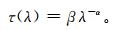
1 Angstrom指数结合AOD曲率判断粒子大小 1.1 Angstrom指数判断粒子大小的局限性Angstrom在1929年提出了Angstrom指数定律[19],建立了AOD与波长间的指数关系:
|
(1) |
式 (1) 中,τ(λ) 是对应波长为λ的气溶胶光学厚度;β是1 μm波长上的光学厚度,也被称为浑浊度系数;α是Angstrom指数[20]。Junge在Angstrom的基础上又提出粒子谱与α之间关系,认为气溶胶粒子半径与数密度之间存在下列指数关系[21]:

|
(2) |
式 (2) 中,A和υ是描述气溶胶谱分布的两个系数。对于α>1的非吸收型气溶胶,υ≈α+2。由此真正建立了光学厚度、粒子谱分布和α三者间的联系。这个简单的粒子谱分布假设关系被广泛应用,这种粒子谱分布也被称为Junge分布[22]。
α最基本的用途是用来描述气溶胶粒子大小[15, 23],当α<1时,表明气溶胶粒子较大 (粒径≥0.5 μm),如沙尘,海盐;α>2,表明气溶胶粒子较小 (粒径≤0.5 μm),如城市污染物、燃烧生成物[5]。但需要注意,用α来描述气溶胶粒子大小的前提是气溶胶谱满足单峰的Junge指数分布[24],真实大气中气溶胶源与生成机制复杂,很少有气溶胶完全符合Junge分布。当气溶胶是多峰分布时,lnτ与lnλ必然不再满足线性关系,此时仅用α作为描述粒子大小的依据就显得不够充分[25-26]。已有研究对不同类型气溶胶的α值做了非常详细的对比[24],结果表明:对于不满足Junge分布的气溶胶,计算波长的选取会对α的计算结果有显著影响,因此,相同α并不意味着相同的粒子谱分布,仅用α来判断粒子大小还显得不够充分。
1.2 AOD曲率判断气溶胶粒子一些学者提出,用高次多项式可以很好地拟合气溶胶光学厚度与波长的关系[5, 23, 27]。式 (3) 是用lnλ拟合lnτ的二次函数表达式,式中a2, a1, a0是拟合参数,代表气溶胶光学厚度光谱特征,其中a2为曲线的曲率,a2>0曲线开口向上,存在气溶胶光学厚度随波长增长而增长的现象,反之开口向下,光学厚度一直随波长增长而递小。式 (4) 和式 (5)[28]给出了a2与α的计算公式,i代表第i个波长。a2=0是一种比较特殊的情形,此时曲率为0,lnτ,lnλ线性相关,粒子谱为Junge分布[29],通过式 (1) 和式 (3) 可以建立a0,a1与α,β之间的关系,即a0=lnβ,a1=-α。

|
(3) |

|
(4) |

|
(5) |
已有的研究表明,参数a2, a1含有粒子大小的信息。Kaufman等[15]和Eck等[5]的研究表明,a2可以作为气溶胶粒子大小的指示参数,当气溶胶以粗粒子为主时,a2>0;当气溶胶以细粒子为主时,a1<0。Schulter等[29]指出,a2, a1的差值可以作为α的一级近似用来判断气溶胶粒子大小,当a2-a1≥2时,表明气溶胶以细粒子为主;当a2-a1≤1时,表明气溶胶以粗粒子为主;当1≤a2-a1≤2,表明细粒子在气溶胶中所占比例变化较大或两种类型粒子均存在。Kedia等[28]以此作为气溶胶粒子大小的判据,通过在孟加拉湾和阿拉伯海的观测认为,前者粗粒子与细粒子并存,76%的观测结果满足1≤a2-a1≤2;后者有大量粗粒子存在,84%的观测结果满足a2-a1≤1。这里值得注意的是,相同的α值并不意味相似的粒子大小,这时可以引入a2作为另一个判据。Schuster等[29]在数值试验中定义了两种谱分布:单峰细粒子为主谱分布 (半径中值为0.21 μm) 和双峰粗粒子为主谱分布 (粗粒子质量浓度/粒子总质量浓度=0.4)。设定两种谱分布的α均为2,分别计算它们的a2值,结果显示:以细粒子为主的谱分布a2<0,以粗粒子为主的谱分布a2>0[29]。这个结果说明,即使α值相同,谱分布类型也可以完全不同,此时a2可以作为一个很好的判断粒子大小的参数。
2 观测结果验证为了验证用参数a2,a1判断气溶胶粒子大小的可行性并得到可靠的判断依据,本文选用地面观测的光学厚度资料计算得到参数a2,a1,α,并结合体积浓度进行分析。计算选取了北京、香河、兴隆、太湖4个Aeronet站时间跨度超过1年的资料,观测仪器为CE318太阳光度计[30],仪器在10 s内对太阳7个波长 (340,480,440,670,870,940,1020 nm) 的直接辐射进行测量同时观测天空辐射的空间分布特征,可以反演得到气溶胶光学厚度、体积谱分布、相函数等气溶胶特征参数。本文选用Level 2.0的AOD资料,数据经过严格的质量控制和除云处理 (http://aeronet.gsfc.nasa.gov)。通过同步观测的天空辐射可以反演得到22个粒径的体积浓度,反演算法不涉及光学厚度曲率[31-32]。这里定义有效半径 (Reff) 小于0.6 μm的为细粒子,大于0.6 μm的为粗粒子,下文提及的Vfine,Vtotal分别指细粒子 (Reff<0.6 μm)、总的粒子体积分数。这里设定气溶胶谱为细粒子谱和粗粒子谱的叠加,比值Vfine/Vtotal可以用来反映气溶胶粗细粒子的比例关系。
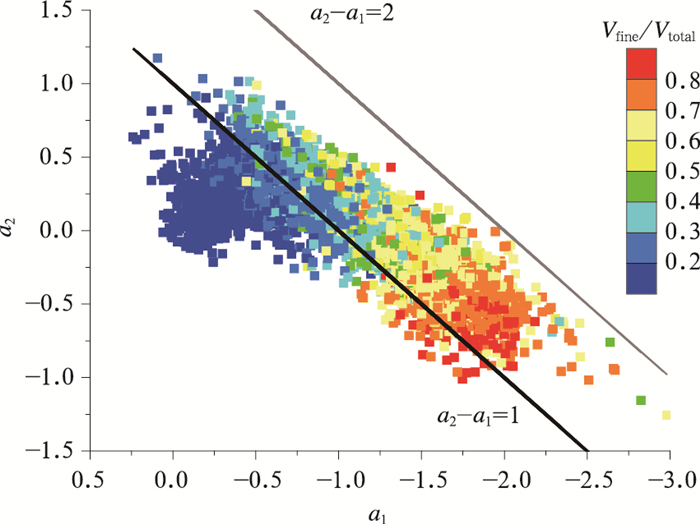
图 1是a2,a1与气溶胶中细粒子体积分数关系图,可以看到代表气溶胶以粗粒子为主的点都集中在图左上部分,代表以细粒子为主的点集中在图右下部分,整体趋势与Schulter等的数值计算[29]的结果一致。从图中不难发现,气溶胶以粗粒子为主时,大部分数据都能满足a2>0,但并不意味着a2一定大于0;相反,a2>0也并不意味着气溶胶一定以粗粒子为主,图中有不少Vfine/Vtotal>0.5的点出现在a2=0的上方。由此可见, 仅用a2还不能判断粒子的大小,还需要给出a1的范围。由图 1可知,Vfine/Vtotal<0.3的粒子 (蓝色点) 都集中在a2>-0.25,a1>-1.0区间;Vfine/Vtotal>0.6的粒子 (浅黄色点)a2多小于0,并且多集中在a1<-1.6区间,尤其在a2<-0.5,a1<-1.0区间细粒子占到总体积的70%以上。这个结果表明,在粗 (细) 粒子体积比较大的情况,参数a2,a1可以很好地反映气溶胶的粒子大小。值得注意的是,图 1没有出现a2-a1>2的数据 (细粒子),这与所选取的站点及各站点主要的气溶胶类型有关,本文选取我国大陆4个资料跨度大于1年的站点,而Schulter等[29]的气溶胶参数来自Aeronet在非洲、美洲的观测结果,不同的气溶胶参数会给结果带来差异。此外,由图 1和Schulter等[29]的结果中都可以发现,在1<a2-a1<2区间有许多红色点 (细粒子含量相当高) 存在,尤其在Schulter等[29]的结果中 (图略) 该区间存在着大量代表完全由细粒子组成的数据点 (细粒子质量浓度/总的粒子质量浓度=1),因此仅用1<a2-a1<2就判定气溶胶为混合型显然是不太合适的。相对而言,a2-a1<1可以较好地判断气溶胶以粗粒子为主的情况,但在该区间仍有少量红色点存在。因此,认为a2-a1仅适合作为判断气溶胶以粗粒子为主时的参考,它并不是一个严格的判断标准。
|
|
| 图 1. 北京、香河、太湖、兴隆a2,a1与气溶胶中细粒子所占体积比的关系 Fig 1. Volume fraction of fine mode aerosols as a function of coefficients a2 and a1 for Beijing, Xianghe, Taihu and Xinglong sites | |
图 2是a2,α与气溶胶中细粒子体积分数关系图。从图 2可以看到,气溶胶以粗粒子为主时 (Vfine/Vtotal<0.2),所有点都能满足α<0.75,这表明,此时仅用α就能很好地判断出粒子大小,α<0.75是判断大粒子气溶胶的很好判据。但是当Vfine/Vtotal>0.2时,α变化范围很大,只用α很难判断气溶胶的粒子大小。此外,还可以看到,在一般认为是以细粒子为主的α>1.5区间[16, 33-34]存在许多代表混合型的数据点 (0.4<Vfine/Vtotal<0.6),而在一般认为是混合型的0.8<α<1.2区间[16, 33-34]也有大量细粒子为主的数据点存在,这表明:当气溶胶以细粒子为主或者为混合型时,只用α来判断粒子大小会有偏差。结合计算得到的a2值发现,当α>0.75且a2<-0.5时,气溶胶以细粒子为主,Vfine/Vtotal>0.7,此时可以较好地判断粒子大小。综上所述,α结合a2可以较好地判断气溶胶粒子大小,其效果要好于仅用α的情况。

|
|
| 图 2. 北京、香河、太湖、兴隆站a2,α与气溶胶中细粒子所占体积比的关系 Fig 2. Volume fraction of fine mode aerosols as a function of coefficients a2 and α for Beijing, Xianghe, Taihu and Xinglong sites | |
3 小结
α是描述气溶胶粒子大小的经典物理量,是气溶胶光谱性质的函数。一般认为,α<1,表明气溶胶粒子较大;α>2, 表明气溶胶粒子较小。但是真实的lnτ与lnλ并不严格满足线性关系,因此用α来判断气溶胶的粒子大小还不够充分。lnτ与lnλ的曲率参数a2,a1含有气溶胶粒子信息,可以帮助判断气溶胶粒子大小。本文通过分析我国4个地面气溶胶观测站点的日平均α、粒子谱分布和参数a2,a1尝试找到判断气溶胶粒子大小的合理判据,具体结论如下:
1) 只用a2还无法判断粒子大小,需要配合其他参数。当a2>-0.25,a1>-1.0时, 气溶胶以粗粒子为主;当a2<-0.5,a1<-1.0时, 气溶胶以细粒子为主。
2) 气溶胶以粗粒子为主时 (Vfine/Vtotal<0.2),用传统的α判据就可以很好地判断粒子大小,此时α<0.75;但当气溶胶以细粒子为主时 (Vfine/Vtotal>0.7),传统的α判据会有较大出入,需要加入a2可以帮助判断。α>0.75且a2<-0.5可以作为气溶胶以细粒子为主的判据。
3) 由于a2-a1仅仅是α的一种近似,因此,通过计算a2与a1差值的范围来判断气溶胶粒子大小的方法并不准确,尤其在1<a2-a1<2的情况下,粒子的组成有多种可能。
本文选取的站点资料在一定程度上可以较好地代表我国北方大城市、城市背景、区域本底地区的气溶胶情况,但仍有一定局限性,在下一步的工作中需要补充其他不同地区的气溶胶参数,建立适用范围更广的判据。
致谢 感谢中国科学院大气物理研究所和Aeronet提供的CE-318观测资料和反演产品| [1] | IPCC. The Physical Science Basis: Contribution of Working Group Ⅰ to the Fourth Assessment Report of the Intergovernmental Panel on Climate Change. Cambridge: Cambridge University Press, 2007. |
| [2] | 赵春生, 彭大勇, 段英. 海盐气溶胶和硫酸盐气溶胶在云微物理过程中的作用. 应用气象学报, 2005, 16, (4): 417–425. |
| [3] | 田华, 马建中, 李维亮, 等. 中国中东部地区硫酸盐气溶胶直接辐射强迫及气候效应的数值模拟. 应用气象学报, 2005, 16, (3): 322–333. |
| [4] | 李树, 王体健, 谢旻, 等. 无机盐热力学平衡模式的简化及其应用. 应用气象学报, 2010, 21, (2): 189–94. |
| [5] | Eck T F, Holben B N, Reid J S, et al. Wavelength dependence of the optical depth of biomass burning, urban, and desert dust aerosols. J Geophys Res, 1999, 104, (D24): 31333–31349. DOI:10.1029/1999JD900923 |
| [6] | Reid J S, Hobbs P V. Physical and optical properties of young smoke from individual biomass fires in Brazil. J Geophys Res, 1998, 103, (D24): 32013–32030. DOI:10.1029/98JD00159 |
| [7] | Reid J S, Hobbs P V, Ferek R J, et al. Physical, chemical, and optical properties of regional hazes dominated by smoke in Brazil. J Geophys Res, 1998, 103, (D24): 32059–32080. DOI:10.1029/98JD00458 |
| [8] | Remer L A, Kaufman Y J, Holben B N, et al. Biomass burning aerosol size distribution and modeled optical properties. J Geophys Res, 1998, 103, (D24): 31879–31891. DOI:10.1029/98JD00271 |
| [9] | Hoppel W A, Fitzgerald J W, Frick G M, et al. Aerosol size distributions and optical-properties found in the marine boundary-layer over the Atlantic-Ocean. J Geophys Res, 1990, 95, (D4): 3659–3686. DOI:10.1029/JD095iD04p03659 |
| [10] | Kavouras I G, Mihalopoulos N, Stephanou E G. Formation of atmospheric particles from organic acids produced by forests. Nature, 1998, 395, (6703): 683–686. DOI:10.1038/27179 |
| [11] | Russell P B, Livingston J M, Dutton E G, et al. Pinatubo and pre-pinatubo optical-depth spectra-Mauna-Loa measurements, comparisons, inferred particle-size distributions, radiative effects, and relationship to lidar data. J Geophys Res, 1993, 98, (D12): 22969–22985. DOI:10.1029/93JD02308 |
| [12] | Dalmeida G A. On the variability of desert aerosol radiative characteristics. J Geophys Res, 1987, 92, (D3): 3017–3026. DOI:10.1029/JD092iD03p03017 |
| [13] | 王开存, 李维亮, 白立杰. 1984~2000年印度洋与中国地区上空对流层中上层及平流层气溶胶变化和输送特征. 应用气象学报, 2004, 15, (1): 32–40. |
| [14] | Remer L A, Kaufman Y J. Dynamic aerosol model: Urban/Industrial aerosol. J Geophys Res, 1998, 103, (D12): 13859–13871. DOI:10.1029/98JD00994 |
| [15] | Kaufman Y J, Smirnov A, Holben B N, et al. Baseline maritime aerosol: Methodology to derive the optical thickness and scattering properties. Geophys Res Lett, 2001, 28, (17): 3251–3254. DOI:10.1029/2001GL013312 |
| [16] | 王跃思, 辛金元, 李占清, 等. 中国地区大气气溶胶光学厚度与Angstrom参数联网观测 (2004-08~2004-12). 环境科学, 2006, (9): 1703–1711. |
| [17] | 田文寿, 黄陈. 兰州西固地区冬季太阳辐射与大气浑浊度. 高原气象, 1995, 14, (4): 459–466. |
| [18] | Nakajima T, Higurashi A. A use of two-channel radiances for an aerosol characterization from space. Geophys Res Lett, 1998, 25, (20): 3815–3818. DOI:10.1029/98GL02151 |
| [19] | Angstrom A. On the atmospheric transmission of sun radiation and on dust in the air. Geografiska Annaler, 1929: 156–166. |
| [20] | Angstrom A. The parameters of atmospheric turbidity. Tellus, 1964, 16, (1): 64–75. DOI:10.3402/tellusa.v16i1.8885 |
| [21] | Junge C. The size distribution and aging of natural aerosols as determined from electrical and optical data on the atmosphere. J Meteor, 1955, 12, (1): 13–25. DOI:10.1175/1520-0469(1955)012<0013:TSDAAO>2.0.CO;2 |
| [22] | Bilbro J W. Review of laser remote-sensing. Bull Amer Meteor Soc, 1984, 65, (9): 990. |
| [23] | Eck T F, Holben B N, Dubovik O, et al. Column-integrated aerosol optical properties over the Maldives during the northeast monsoon for 1998-2000. J Geophys Res, 2001, 106, (D22): 28555–28566. DOI:10.1029/2001JD000786 |
| [24] | Hess M, Koepke P, Schult I. Optical properties of aerosols and clouds: The software package OPAC. Bull Amer Meteor Soc, 1998, 79, (5): 831–844. DOI:10.1175/1520-0477(1998)079<0831:OPOAAC>2.0.CO;2 |
| [25] | O'Neill N T, Dubovik O, and Eck T F. Modified angstrom ngstrom exponent for the characterization of submicrometer aerosols. Appl Opt, 2001, 40, (15): 2368–2375. DOI:10.1364/AO.40.002368 |
| [26] | O'Neill N T, Eck T F, Holben B N, et al. Bimodal size distribution influences on the variation of Angstrom derivatives in spectral and optical depth space. J Geophys Res, 2001, 106, (D9): 9787–9806. DOI:10.1029/2000JD900245 |
| [27] | O'Neill N T, Eck T F, Smirnov A, et al. Spectral discrimination of coarse and fine mode optical depth. J Geophys Res, 2003, 108, (D17): 4559–4573. DOI:10.1029/2002JD002975 |
| [28] | Kedia S, Ramachandran S. Variability in aerosol optical and physical characteristics over the Bay of Bengal and the Arabian Sea deduced from Angstrom exponents. J Geophys Res, 2009, 114. DOI:10.1029/2009JD011950 |
| [29] | Schuster G L, Dubovik O, Holben B N. Angstrom exponent and bimodal aerosol size distributions. J Geophys Res, 2006, 111, (D7): D07207. |
| [30] | 杨志峰, 张小曳, 车慧正, 等. CE318型太阳光度计标定方法初探. 应用气象学报, 2008, 19, (3): 297–306. DOI:10.11898/1001-7313.20080305 |
| [31] | Dubovik O, King M D. A flexible inversion algorithm for retrieval of aerosol optical properties from sun and sky radiance measurements. J Geophys Res, 2000, 105, (D16): 20673–20696. DOI:10.1029/2000JD900282 |
| [32] | Dubovik O, Smirnov A, Holben B N, et al. Accuracy assessments of aerosol optical properties retrieved from Aerosol Robotic Network (AERONET) sun and sky radiance measurements. J Geophys Res, 2000, 105, (D8): 9791–9806. DOI:10.1029/2000JD900040 |
| [33] | Tanré D, Kaufman Y J, Holben B N, et al. Climatology of dust aerosol size distribution and optical properties derived from remotely sensed data in the solar spectrum. J Geophys Res, 2001, 106, (D16): 18205–18217. DOI:10.1029/2000JD900663 |
| [34] | Dubovik O, Holben B N, Eck T F, et al. Variability of absorption and optical properties of key aerosol types observed in worldwide locations. J Atmos Sci, 2002, 59, (3): 590–608. DOI:10.1175/1520-0469(2002)059<0590:VOAAOP>2.0.CO;2 |