 2018, Vol. 38
2. 梁介福(广东)药业有限公司, 佛山 528308;
3. 中山大学公共卫生学院, 广州 510089
2. Leung Kai Fook(Guangdong) Medical Co., Ltd., Foushan 528308, China;
3. Public Health School, Sun Yat-sen University, Guangzhou 510089, China
油樟[Cinnamomum longepaniculatum(Gamble)N.Chao]为樟科(Lauraceae)樟属植物,为四川特有树种[1],主产于四川宜宾,在湖北、湖南、陕西、云南、江西、广西、广东等地均有分布。油樟树干、枝叶均含芳香油[2]。油樟挥发油中主要含有单萜、倍半萜烯以及芳香族化合物[3]。油樟挥发油具有广谱抗菌活性[4-5],杀虫作用[6-7]、镇痛抗炎抗氧化作用[8-9],对肝癌细胞有抑制作用[10-11]。油樟叶挥发对皮肤无刺激无光毒性,皮肤用药安全[12]。油樟能吸收环境中一定浓度的镉,对城市重金属污染地区的园林绿化具有重要意义[13]。油樟叶片含油率高,是主要的含油部位,所提取的挥发油中主要含有桉油精,经精制后所得的提取物符合《中华人民共和国药典》(简称《中国药典》)2015年版中桉油的质量标准,可作为原辅料用于驱风油、风油精等外用制剂的投料生产。
由于部分外用制剂具有芳香气味的特性,因此对于作为原辅料投产的油樟标准提取物的气味、颜色等性状有一定的质量要求。《中国药典》2015年版中收载的桉油质量标准包括性状、鉴别、检查和含量测定项目。然而,性状项目只有文字描述,缺少可量化指标,鉴别和含量测定项目指标成分单一,若将此质量标准用于油樟标准提取物的质量控制,不能全面反映其整体的质量情况。本研究采用气相色谱(GC)法,对油樟标准提取物进行了指纹图谱分析,为油樟标准提取物的质量评价提供依据。
1 仪器与试药 1.1 仪器6890N气相色谱仪,美国Agilent公司,7683B自动进样器,6890N化学工作站(版本A.10.02),氢火焰离子检测器(FID)。
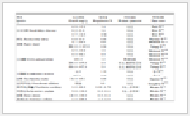
1.2 试药油樟标准提取物样品共35批次(分别从6个香料生产企业收集,样品来源见表 1),均由樟科植物油樟(Cinnamomumlongepaniculatum(Gamble)N.Chao)的新鲜茎、叶经水蒸气蒸馏法提取并精制而成。
|
表 1 油樟叶挥发油提取物样品来源 Table 1 Sources of Cinnamomum Longepaniculatum(Gamble)N.Chao standard extract sample |
石英毛细管HP-5柱(30.0 m×0.32 mm×0.25 μm,交联5%苯基甲基聚硅氧烷为固定相);氢火焰离子化检测器;程序升温:初始温度70 ℃,保持14 min,以1.5 ℃·min-1的速率升温至85 ℃,保持6 min。进样口温度195 ℃;检测器温度230 ℃。进样量0.2 μL。
2.2 样品制备取油樟叶挥发油提取物样品适量于样品瓶中,直接进样。
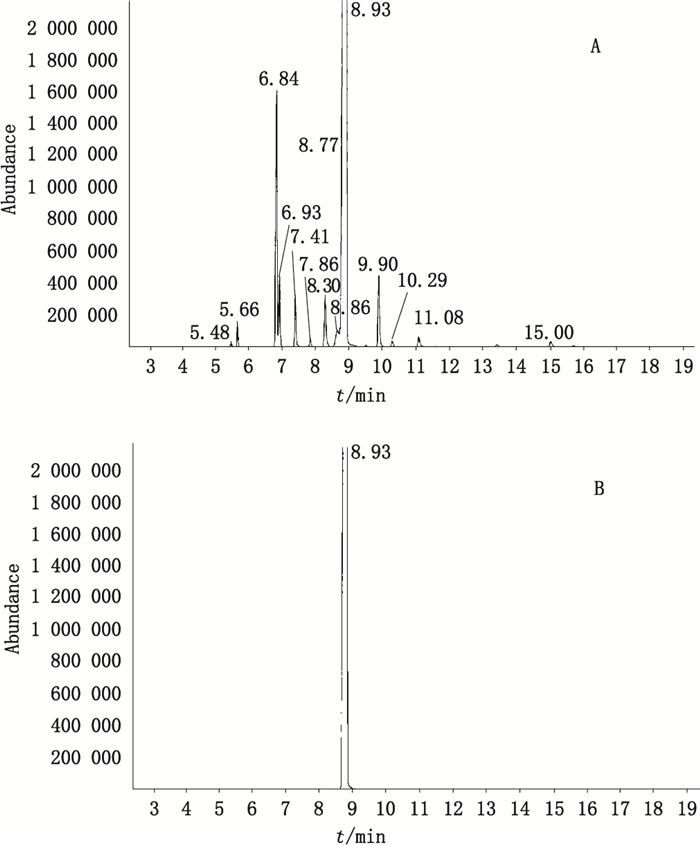
2.3 主要成分的检识取样品批次编号为TD-02的2号样品,按上述分析条件进样分析,得到GC-MS图谱(中国广州分析测试中心检测报告,报告编号PX12001073)。见图 1。
|
图 1 油樟标准提取物(A)和桉油精对照品(B)总离子流图 Figure 1 Total ion chromatograms of Cinnamomum Longepaniculatum(Gamble)N.Chao standard extract(A)and1, 8-cineole(B) |
经计算机质谱检索和人工解析研究各种化学成分,测定了油樟标准提取物含有24种成分,鉴定了其中的14种成分,主要为萜类化合物。通过化学工作站数据处理系统,按峰面积归一化法计算求得14种主要化学成分在油樟标准提取物中的相对含量。所鉴定的油樟标准提取物中的化学成分及所得各种化学成分的相对峰面积百分含量见表 2。
|
|
表 2 油樟标准提取物的化学成分 Table 2 Chemical composition of Cinnamomum Longepaniculatum(Gamble)N.Chao standard extract |
取样品批次编号为TD-02的2号样品,按上述色谱条件连续直接进样5次,各共有色谱峰相对保留时间RSD为0.01%~0.02%,相对峰面积RSD为0.11%~0.70%,均小于3.0%,符合指纹图谱制定的相关要求,表明仪器的精密度良好。
2.4.2 重复性试验分别取样品批次编号为TD-02的2号样品共5份,按上述色谱条件直接进样分析,各共有色谱峰相对保留时间RSD为0.01%~0.02%,相对峰面积RSD为0.01%~2.3%,均小于3.0%,符合指纹图谱制定的相关要求,表明重复性良好。
2.4.3 稳定性试验取样品批次编号为TD-02的2号样品,按上述色谱条件在不同的时间点(0、2、4、8、24 h)分别直接进样分析,各共有色谱峰的相对保留时间RSD为0.00%~0.01%,相对峰面积RSD为0.05%~3.7%,均小于5.0%,表明样品在24 h内稳定性较好。
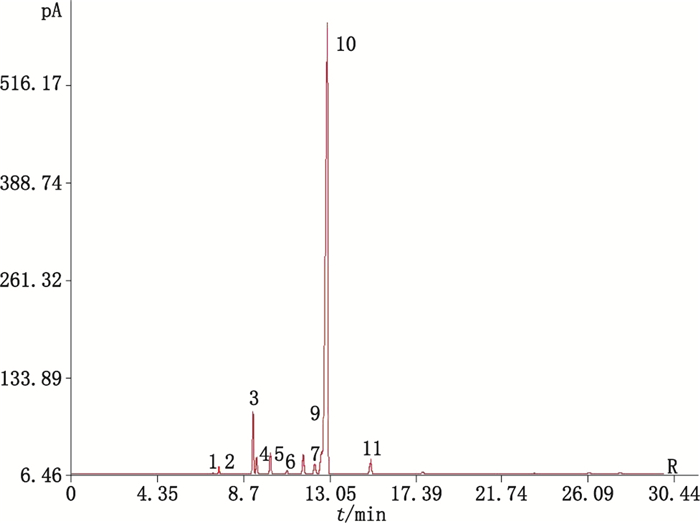
2.5 油樟标准提取物指纹图谱的建立及共有峰的标定取上述35个样品各0.2 μL,按“2.1项”下色谱条件,分别注入气相色谱仪进行分析,并记录30 min内的色谱图。根据35个样品中各个成分相对保留时间的一致性,发现有11个峰是共有的,因此确定其为共有指纹峰。以桉油精(10号峰)为参照峰(S峰),其相对保留时间和相对峰面积分别定为1.000,确定各个共有峰的相对保留时间和相对峰面积(见表 3),从而建立了油樟标准提取物的指纹图谱(见图 2)。
|
|
表 3 Table 3 |
|
1~11.同表 3(same as Tab. 3) 图 2 油樟标准提取物指纹图谱 Figure 2 The common GC fingerprints of 35 batches of Cinnamomum Longepaniculatum(Gamble)N.Chao standard extract |
采用国家药典委员会中药色谱指纹图谱相似性评价系统2004A版,以11个共有指纹峰的相对峰面积作为参数,对35批次样品的气相指纹图谱进行相似度分析,结果见表 4。结果显示,35批次样品的相似度均大于99.0%,说明其指纹图谱相似性较高,主要峰群的特征基本一致,提示35批次样品虽来自于6个厂家,但其成分的比例和含量比较接近,品质相近。本研究建立的GC指纹图谱方法,符合《中国药典》中药质量标准研究制定技术要求,所建立的色谱指纹图谱可作为油樟标准提取物质量控制的标准图谱。
|
|
表 4 35批样品的相似度结果 Table 4 The similarity of 35 batches of of Cinnamomum Longepaniculatum(Gamble)N.Chao standard extract |
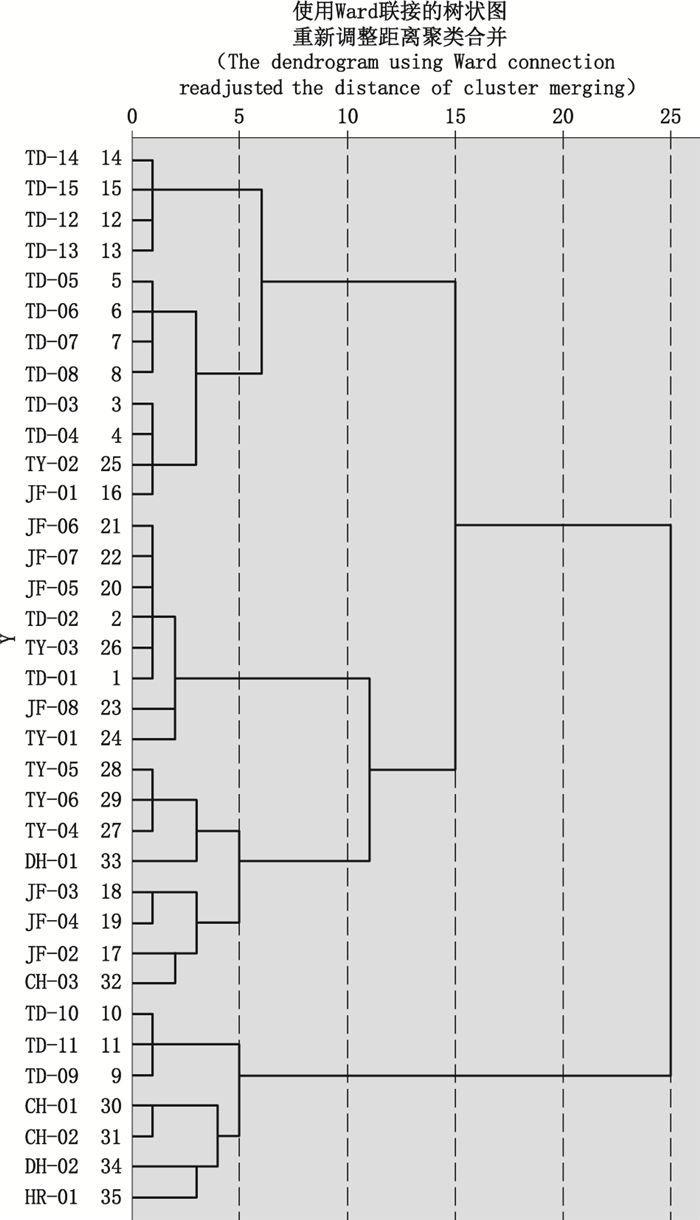
将35批样品的GC指纹图谱的共有峰面积值分别组成35×11阶数据矩阵,运用SPSS 19统计分析软件对其进行系统聚类分析,采用离差平方和法(Ward’s Method),以欧氏距离(Euclidean)作为样品的测度[14]。聚类分析结果见图 3。
|
图 3 35批样品指纹图谱系统聚类分析图 Figure 3 Cluster analysis of 35 batches of Cinnamomum Longepaniculatum(Gamble)N.Chao standard extract |
系统聚类分析结果表明,35批样品可以聚为三类:TD-02~08、TD-12~15厂家相同,与TY-02、JF-01聚为一类,说明TD厂家生产的油樟标准提取物质量比较稳定,且与其他厂家的产品有差异;JF-02~08、TY-01及TY-03~06、TD-01~02、CH-03、DH-01聚为一类,说明大部分的厂家JF和厂家TY及厂家TD、厂家CH的部分样品质量接近;而距离较远的TD-09~11、CH01~02、DH-02、HR-01样品,可聚为一类,说明这几个样品的质量与前两类的质量差异较大。
3 讨论 3.1 色谱柱的选择本研究对比了PEG-20M毛细管柱和HP-5毛细管柱,发现在相同条件下,使用HP-5毛细管柱检测到的成分峰分离度较好,出峰时间比较靠前,所有成分都能在30 min内被检测到,故本实验选用HP-5毛细管柱进行分析。
3.2 程序升温本研究曾按以下柱温进行研究:(1)初始温度70 ℃,保持14 min,以1.5 ℃·min-1的速率升温至85 ℃,保持6 min;(2)初始温度70℃,保持16 min,以3 ℃·min-1的速率升温至85℃,保持6 min;(3)初始温度70 ℃,保持14 min,以1.5℃·min-1的速率升温至85 ℃,再以2 ℃·min-1的速率升温至95℃,保持1 min;(4)恒温60 ℃,保持32 min;(5)恒温70 ℃,保持32 min;(6)恒温80℃,保持32 min。结果方法(1)的出峰个数多,峰分离度好。
3.3 分流比本研究分别对不分流进样和分流进样,分流比300: 1、400: 1、500: 1条件下GC图谱进行对比,结果显示在分流比为500: 1条件下所得图谱的出峰时间、峰分离度、峰形等均较为理想。
【致谢:向为本研究提供帮助的刘太华、何炘炘、袁小星、苏章燕、黎敏儿、梁杏云、张柯、张永表示感谢。】
| [1] |
四川植物志编委会. 四川植物志.第1卷[M]. 成都: 四川人民出版社, 1979: 34. Editorial Committee of Flora of Sichuan. Flora of Sichuan.Flora of Sichuan.VolⅠ[M]. Chengdu: Sichuan People's Publishing House, 1979: 34. |
| [2] |
梁国凌. 油樟的引种栽培与育苗技术[J]. 广东园林, 2002(4): 30. LIANG GL. Cultivation and breeding technology of Cinnamomum longepaniculatum[J]. Guangdong Landscape Archit, 2002(4): 30. DOI:10.3969/j.issn.1671-2641.2002.04.009 |
| [3] |
罗中杰. 宜宾油樟的现状及未来[J]. 四川师范大学学报(自然科学版), 2001, 24(3): 317. LUO ZJ. The status quo and future of Cinnamomum longepaniculatum in Yibin[J]. J Sichuan Normal Univ(Nat Sci), 2001, 24(3): 317. DOI:10.3969/j.issn.1001-8395.2001.03.031 |
| [4] |
陶光复. 湖北樟油化学资源[J]. 长江流域资源与环境, 2003, 12(2): 124. TAO GF. Hubei Cinnamomum essential oil chemical resources[J]. Res Envir Yangtze Basin, 2003, 12(2): 124. DOI:10.3969/j.issn.1004-8227.2003.02.005 |
| [5] |
程必强, 喻学俭, 丁靖垲. 中国樟属植物资源及其芳香成分[M]. 昆明: 云南科学出版社, 1997: 23. CHENG BQ, YU XJ, DING JK. Chinese Cinnamomum Plant Resources and Their Aromatic Constituents[M]. Kunming: Yunnan Science Press, 1997: 23. |
| [6] |
姚安庆, 梁德华. 樟树和黄花蒿浸提物对菜粉蝶幼虫的生物活性[J]. 现代农药, 2004, 3(2): 28. YAO AQ, LIANG DH. The biological activity of Innamomum camphora Sieb and Artemisia annua extracts against Pieris rapre L[J]. Mod Agrochem, 2004, 3(2): 28. DOI:10.3969/j.issn.1671-5284.2004.02.010 |
| [7] |
KIM SI, ROH JY, KIM DH, et al. Insecticidal activities of aromatic plant extracts and essential oils against Sitophilus oryzae and Callosobruchus chinensis[J]. J Stored Prod Res, 2003, 39(3): 293. DOI:10.1016/S0022-474X(02)00017-6 |
| [8] |
SHYLAJA M, RAVINDRAN PN, BABU KN. 15 Other useful species of Cinnamomum[J]. Cinnamon and Cassia:the genus Cinnamomum, 2003, 330. |
| [9] |
丛赢, 张琳, 祖元刚, 等. 油樟(Cinnamomum longepaniculatum)精油的抗炎及抗氧化活性初步研究[J]. 植物研究, 2016, 36(6): 949. CONG Y, ZHANG L, ZU YG, et al. Anti-inflammatory and antioxidant activity of Cinnamomum longepaniculatum essential oil[J]. Bull Bot Res, 2016, 36(6): 949. |
| [10] |
叶奎川.油樟叶提取物的体外抗肝癌活性及其作用机理研究[D].四川: 四川农业大学, 2012 YE KC.Study on the Anticancer Activity and Anti-cancer Mechanism of the Extraction of Cinnamomum longepaniculatum(Gamble)N.Chao[D].Sichuan: Sichuan Agricultural University, 2012 |
| [11] |
杜永华, 叶奎川, 周黎军, 等. 油樟叶提取物对人肝癌BEL-7402细胞增殖的抑制作用[J]. 食品研究与开发, 2014, 35(17): 80. DU YH, YE KC, ZHOU LJ, et al. Effects of the extracts of Cinnamomum longepaniculatum leaves on the proliferation of human hepatocarcinoma cell strain BEL-7402[J]. Food Res Dev, 2014, 35(17): 80. DOI:10.3969/j.issn.1005-6521.2014.17.022 |
| [12] |
张笑乐, 向楠, 殷中琼, 等. 油樟叶挥发油对兔的急性皮肤刺激、眼睛刺激和皮肤光毒性的研究[J]. 中国农学通报, 2011, 27(23): 36. ZHANG XL, XIANG N, YIN ZQ, et al. Research on dermal toxicity and eye toxicity of the volatile oil from the leares of Cinnamomum longepaniculatum[J]. Chin Agric Sci Bull, 2011, 27(23): 36. |
| [13] |
张楠.镉对油樟幼苗生长及C、N、P积累的影响[D].成都: 四川农业大学, 2013 ZHANG N.Effect of Cd Treatment on Growth and C、N、P Accumulation of Cinnamomum longepaniculatum Seedling[D].Chengdu: Sichuan Agricultural University, 2013 |
| [14] |
赵洪芝, 孟宪生, 叶挺祥, 等. 六味地黄丸的HPLC指纹图谱和模式识别研究[J]. 中草药, 2010, 41(1): 48. ZHAO HZ, MENG XS, YE TX, et al. HPLC fingerprint and chemical pattern recognition of Liuwei Dihuang pills[J]. Chin Tradit Herb Drugs, 2010, 41(1): 48. DOI:10.3969/j.issn.1674-6384.2010.01.005 |