 2022, Vol. 38


2. 自然资源实物地质资料中心, 廊坊 065201;
3. 华北地质勘查局综合普查大队, 廊坊 065201
2. Cores and Samples Center of Natural Resources, Langfang 065201, China;
3. Exploration Unit of North China Geological Exploration Bureau, Langfang 065201, China
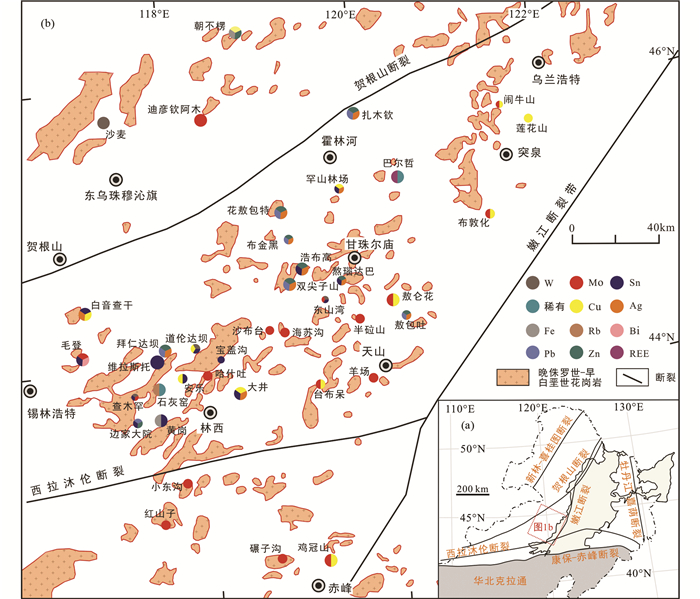
大兴安岭南段位于中亚成矿域的东段,是我国重要矿产地之一,先后经历了古亚洲洋的闭合、古太平洋和蒙古-鄂霍茨克洋板块俯冲等复杂的构造历史,发育众多钨、锡、钼、银、铁多金属及稀有、稀土等矿床(图 1a, b),其中多数矿床的形成与早白垩世高度分异演化的花岗质岩体侵入有关(Engebretson et al., 1985;赵一鸣和张德全,1997;毛景文等,2013;江思宏等,2018)。花岗质岩浆经历高度结晶分异作用后,在演化晚期的残余熔体-热液共存体系中富含挥发分、Na2O+K2O、REE、稀有金属,熔体与热液的相互作用使得W、Sn、Mo、Bi、REE、Nb、Ta、Zr、Be等成矿元素在残余花岗质岩浆中逐渐富集,为形成金属矿床提供物质基础(Jahn et al., 2001;Zhao et al., 2002;Wu et al., 2004;Černý et al., 2005)。前人对大兴安岭南段地区高分异花岗岩体开展了大量的研究,包括成岩年代学、岩石地球化学、同位素地球化学以及成岩构造背景等领域(Fan et al., 2003;王长明等,2006;邵济安等,2010;Ouyang et al., 2015;Zhai et al., 2017),但对高分异花岗岩浆演化过程中详细的物理化学条件研究较为薄弱和缺乏,这在一定程度上制约了花岗岩成岩作用精细刻画及其对成矿制约的评价。
|
图 1 大兴安岭南段晚侏罗世-早白垩世花岗岩及相关矿床分布图(据Wu et al., 2014;Ouyang et al., 2015;姚磊等,2017修改) Fig. 1 The distribution map of Late Jurassic-Early Cretaceous granite and related deposits of the southern segment of Great Xing'an Range (modified after Wu et al., 2014; Ouyang et al., 2015; Yao et al., 2017) |
毛登矿床位于内蒙古锡林浩特市北东约50km,是大兴安岭南段典型的岩浆热液型钼铋锡铜矿床(刘玉强, 1996a, b)。根据以往勘查工作成果可知,该矿床探明锡金属量0.64万t,平均品位0.56%;铜金属量0.22万t,平均品位0.76% (内蒙古自治区第九地质矿产勘查开发院,2009①);钼金属量16.26万t,包括工业矿6.42万t、平均品位0.07%,低品位矿9.84万t、平均品位0.039%;伴生铋金属量11.42万t,平均品位0.033%(河南省有色金属地质勘查总院,2009②)。结合区域成矿作用特点与矿区成矿地质条件,前人普遍认为,毛登钼铋锡铜成矿作用与矿区东部紧邻的阿鲁包格山杂岩体关系密切。阿鲁包格山岩体主要由斑状二长花岗岩组成,岩体边缘部位发育花岗斑岩。为了进一步揭示该岩体的地球化学特征,及其与毛登矿区成矿之间的内在关联,前人针对斑状二长花岗岩和花岗岩斑岩开展了矿物学、年代学、地球化学、Lu-Hf同位素等方面的研究(程天赦等,2014;郭硕等,2019;季根源等, 2021a, b),并取得了一些成果和认识。
① 内蒙古自治区第九地质矿产勘查开发院.2009.内蒙古自治区锡林浩特市毛登锡矿核查矿区资源储量核查报告(内部资料)
② 河南省有色金属地质勘查总院.2009.内蒙古自治区锡林浩特市毛登矿区钼锡铜矿详查报告(内部资料)
2019年,笔者在野外地质调查过程中发现毛登矿区钻孔深部与赋矿地层紧邻的花岗岩体是中粒碱长花岗岩,并非前人认为的阿鲁包格山岩体西部边缘的花岗斑岩(石得凤,2007;张巧梅等,2013)。为了查明碱长花岗岩与斑状二长花岗岩、花岗斑岩之间的内在关联,揭示碱长花岗岩是否参与毛登钼铋锡铜成矿作用,本文选择碱长花岗岩作为研究对象,对其开展了岩石地球化学、Sr-Nd-Hf同位素、锆石U-Pb以及微量元素研究,借此厘定其成岩时代、限定其成岩过程的物理化学条件、揭示岩体的源区特征;在此基础上,初步查明了其与花岗斑岩、斑状二长花岗岩之间的成因、演化关系,探讨了岩体演化及其对毛登钼铋锡铜成矿的制约,从而为进一步认识大兴安岭南段地区燕山晚期高分异花岗岩浆演化及与之关系密切的金属成矿作用提供参考依据。
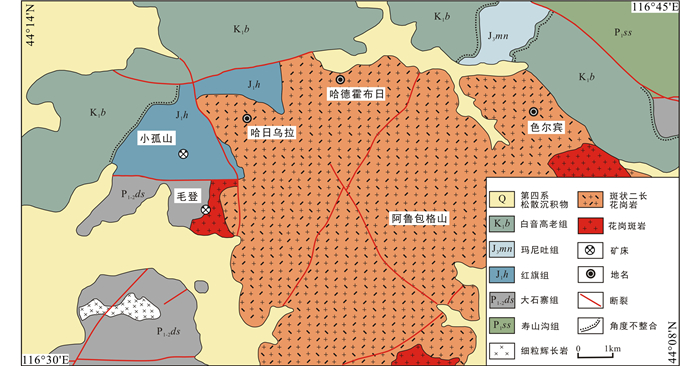
1 矿区与矿床地质毛登矿区地处大兴安岭南段西坡锡林浩特-锡林郭勒Sn-Ag-Cu-Pb-Zn-Mo成矿亚带,位于古亚洲洋、古太平洋和蒙古-鄂霍茨克洋构造体系叠加区域。蒙古-鄂霍茨克洋造山后伸展和古太平洋俯冲的联合作用下强烈的构造-岩浆活动是该成矿域形成的重要原因(Engebretson et al., 1985;刘建明等,2004;江思宏等,2018)。区域内出露地层主要包括下二叠统寿山沟组(P1ss)砂岩、粉砂岩、杂砂岩和砾岩,下-中二叠统大石寨组(P1-2ds)凝灰质粉砂岩、细砂岩、流纹岩、火山角砾岩、安山岩、凝灰岩和玄武岩,下侏罗统红旗组(J1h)砂岩、砂砾岩以及泥岩,上侏罗统玛尼吐组(J3mn)中酸性火山熔岩、火山碎屑岩,下白垩统白音高老组(K1b)流纹岩、火山角砾岩、凝灰岩(图 2)。其中大石寨组酸性-中性-基性火山岩-火山碎屑岩组合以及陆源碎屑沉积岩是区内最主要的赋矿地层。区域内断裂构造较发育,以北东向断裂为主,北西向和近东西向断裂次之;北东向断裂为燕山期花岗岩体的侵位提供了通道,而北西向断裂及不同方向断裂交汇处是本区重要的容矿构造。区域内岩浆活动强烈,侵入岩主要为阿鲁包格山杂岩体,西南局部偶见辉长岩产出(图 2)。阿鲁包格山岩体以斑状二长花岗岩为主,岩体边缘为花岗斑岩,出露面积约49km2,呈近等轴状岩株产出,无明显定向延伸,与大石寨组、白音高老组和红旗组呈侵入接触关系(图 2)。
|
图 2 毛登矿床区域地质简图(据张学斌等,2014;郭硕等,2019修改) Fig. 2 Regional geological sketch map of the Maodeng deposit (modified after Zhang et al., 2014; Guo et al., 2019) |
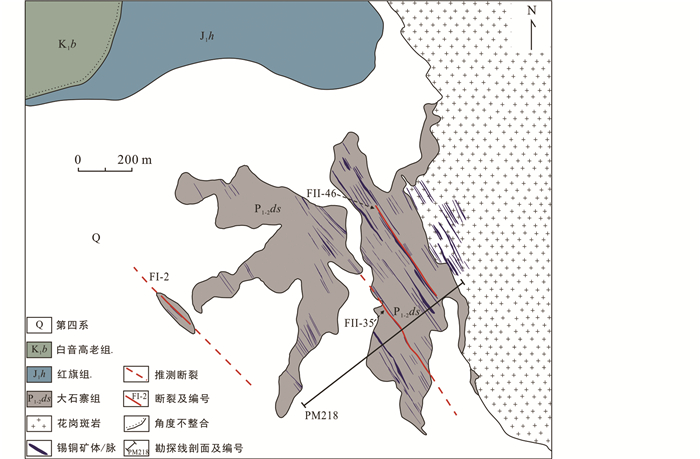
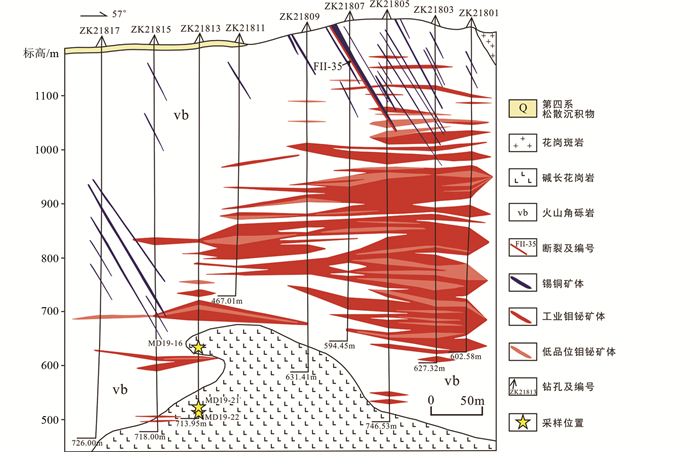
毛登矿区出露地层有下-中二叠统大石寨组(P1-2ds)、下侏罗统红旗组(J1h)、下白垩统白音高老组(K1b)以及第四系(Q)。其中,大石寨组火山角砾岩、含火山角砾熔岩和变质粉砂岩,是矿区钼铋矿体和铜锡矿体最重要的赋矿围岩(图 3、图 4)。矿区内断裂构造以北西向为主,北西向断裂及其伴生的节理裂隙是锡铜矿体最主要的容矿构造(图 3)。矿区地表及浅部紧邻阿鲁包格山岩体西部边缘的花岗斑岩,而深部岩性渐变为碱长花岗岩(图 4)。斑状二长花岗岩具似斑状结构,基质为细粒花岗结构,边缘发育的花岗斑岩具斑状结构,基质为霏细结构,深部碱长花岗岩具中粒花岗结构,三种岩性主要矿物均为钾长石、斜长石、石英和少量黑云母,岩相呈渐变关系,无明显界线,与毛登矿区金属矿化关系紧密。
|
图 3 毛登矿床地质简图(据石得凤,2007;张巧梅等,2013;郭硕等,2019修改) Fig. 3 Geological sketch map of the Maodeng deposit (modified after Shi, 2007; Zhang et al., 2013; Guo et al., 2019) |
|
图 4 毛登矿床218号勘探线剖面图(据河南省有色金属地质勘查总院,2009修改) Fig. 4 The profile of line 218 of the Maodeng deposit |
毛登矿床显示明显的成矿分带性。矿床上部发育Sn-Cu矿体,下部发育Mo-Bi矿体。Sn-Cu矿体大多近地表产出,位于Mo-Bi矿体的外侧或上部;Mo-Bi矿体的顶部常常被后期锡石+石英矿脉所切穿,但对Mo-Bi矿体的形态影响不大(图 4)。Sn-Cu矿体以石英脉状赋存于岩体外接触带大石寨组火山角砾岩,次为花岗斑岩体和变质粉砂岩中;矿体受北西向断裂-裂隙控制,呈陡倾斜平行密集脉状产出;金属矿物主要有锡石、黄铜矿、闪锌矿、毒砂、斑铜矿、黄铁矿、黑钨矿、辉钼矿,少量的黝铜矿、方铅矿、黄锡矿、磁黄铁矿、硫锑铅矿等;非金属矿物主要有黄玉、绢云母、白云母、石英、萤石,少量的独居石、板钛矿等。Mo-Bi矿体以网脉状、微-细脉状和浸染状赋存于岩体外接触带大石寨组火山角砾岩和变质粉砂岩中;岩浆侵入或岩体上拱后的应力作用下,上覆地层火山角砾岩、变质粉砂岩发育密集节理、裂隙微构造,是主要的赋矿、控矿构造;金属矿物主要有辉钼矿、自然铋,少量的毒砂、黄铜矿、方铅矿、闪锌矿、黄铁矿等;非金属矿物主要有石英、绢云母,少量萤石、黄玉、雏晶黑云母、残留斜长石和钾长石、方解石等。
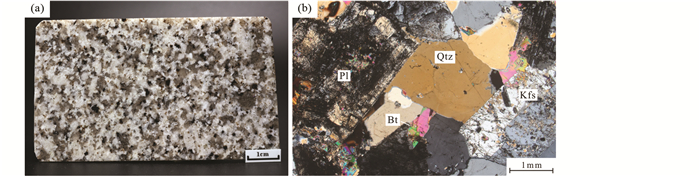
2 样品采集与分析方法本次研究的碱长花岗岩MD19-16等3件样品均采自钻孔ZK21813岩心,具体采样位置详见图 4。碱长花岗岩具中粒花岗结构,块状构造(图 5),主要由斜长石(20%~30%本次鉴定均为钠长石)、钾长石(35%~50%)、石英(20%~30%)和黑云母(<5%)组成。斜长石呈半自形板状结构,杂乱分布,粒径一般2~4mm,少数0.25~2mm,轻微高岭土化、绢云母化,聚片双晶少量发育。钾长石呈近半自形板状结构,粒径一般2~5mm,部分0.3~2mm,少数5~7mm,经鉴定为正长石,轻微高岭土化,见少量交代并包裹斜长石。石英呈他形粒状,杂乱分布,粒径一般2~3.5mm,少数0.2~2mm,粒内轻波状消光。黑云母呈片状,多色性明显,浅黄褐色、褐色,粒径0.2~1.5mm,部分具白云母化。副矿物仅见少量零星分布的锆石。
|
图 5 毛登矿区碱长花岗岩手标本照片(a)和正交偏光镜下照片(b) Bt-黑云母;Kfs-钾长石;Pl-斜长石;Qtz-石英 Fig. 5 Photo of hand specimen (a) and microphotograph under CPL (b) of alkali feldspar granite from the Maodeng deposit Bt-biotite; Kfs-K-feldspar; Pl-plagioclase; Qtz-quartz |
为了开展对比研究,笔者在本人前期工作成果的基础上(季根源等, 2021a, b),补充采集了斑状二长花岗岩(MD19-11与MD19-12,44°11′18″N、116°41′11″E;MD19-74,44°10′39″N、116°38′19.5″E;MD19-75,44°8′50″N、116°39′7″E)和花岗斑岩(MD19-41,44°10′33′N、116°34′9″E)5个样品,对其进行了相关分析测试。
岩石样品清洁、粉碎(200目以下)后,在中国核工业北京地质研究院分析测试研究中心完成全岩主、微量元素分析测试工作。主量元素测试采用X射线荧光光谱法(XRF),使用仪器为Axiosm AX型X射线荧光光谱仪,根据标准岩石样品监控氧化物的分析误差小于1%。微量和稀土元素测试分析采用电感耦合等离子体质谱法(ICP-MS),使用的仪器为Element XR等离子体质谱仪,根据标准岩石样品监控分析误差小于5%。
岩石样品破碎后至合适粒度,经人工淘洗、分选后在双目镜下挑选出自形程度较好的锆石颗粒,用环氧树脂固定、制靶。锆石靶由北京中科矿研检测技术有限公司制备,直径25mm,厚5mm。经透射光、反射光和阴极发光照相,观察、选择合适的锆石单矿物测试点位。锆石U-Pb定年和微量元素原位成分分析测试工作在中国地质科学院矿产资源研究所成矿作用与资源评价重点实验室同时完成,采用单点激光剥蚀等离子质谱(LA-ICP-MS)方式,激光剥蚀系统为RESOlution S-155型193nm准分子激光系统。U-Pb定年数据分析前用锆石GJ-1调试仪器,U、Th含量以锆石M127 (Nasdala et al., 2008)为外标进行校正,测试流程见侯可军等(2009);锆石微量元素含量利用SRM610作为外标、Si作内标的方法进行定量计算(Liu et al., 2008)。分析数据的离线处理采用软件ICPMSDataCal 4.3 (Liu et al., 2008;候可军等,2009)完成,运用Isoplot3.0程序(Ludwig, 2003)计算、绘制锆石年龄谐和图。
全岩Sr-Nd同位素测试分析工作在中国核工业北京地质研究院分析测试研究中心完成,测试仪器为Phoenix型IsoProbe-T热表面电离质谱仪。Sr、Nd同位素比值分别采用86Sr/88Sr=0.1194、146Nd/144Nd=0.7219进行标准化校正。Sr、Nd同位素测试分析工作具体的实验室操作流程见赵海杰等(2010)。
锆石Hf同位素在中国地质科学院矿产资源研究所成矿作用与资源评价重点实验室Finnigan Neptune多接收等离子质谱仪上完成,采用美国Coherent公司生产的193nmArF准分子激光剥蚀系统,分析点与U-Pb年龄测试点相同或尽可能接近,激光束斑直径44μm,能量密度8J/cm2,频率为6Hz,使用锆石标样GJ-1作为参考物质。详细的实验条件、测试流程见侯可军等(2007)。
斜长石电子探针(EPMA)原位主量元素成分分析在河北省区域地质矿产调查研究所实验室JXA-8230 EMPA型电子探针分析仪完成,实验测试加速电压15kV,束流20nA,束斑直径5μm。主量元素的检出限为0.01%,标样矿物分别是K(钾长石),Ca(方解石),Ti(金红石),Na、Al、Si(硬玉),Mg、Ni(镁橄榄石),Cr、Fe(铬铁矿),Mn(蔷薇辉石),F(黄玉),Cl(石盐),P(磷灰石)等。
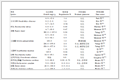
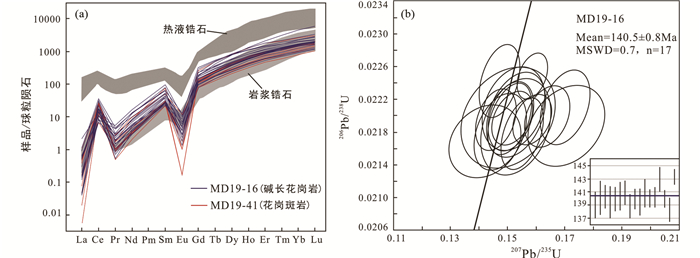
3 测试结果 3.1 锆石微量元素、U-Pb年龄 3.1.1 锆石微量元素锆石微量元素测试结果(表 1)显示:毛登矿区碱长花岗岩锆石稀土总含量ΣREE为392×10-6~1758×10-6,轻稀土含量LREE为11.0×10⁻⁶~39.5×10⁻⁶,重稀土含量HREE为381×10-6~1738×10-6,δCe=5.9~148,δEu=0.03~0.12。花岗斑岩锆石ΣREE为365×10-6~1252×10-6,LREE为9.92×10⁻⁶~30.5×10⁻⁶,HREE为355×10-6~1222×10-6,δCe=7.38~356,δEu=0.003~0.13。碱长花岗岩及花岗斑岩锆石均具LREE亏损、HREE富集,稀土元素配分图呈陡左倾,并呈现明显的Ce正异常和Eu负异常的特征(图 6a)。对比典型岩浆锆石与热液锆石不同变化趋势的稀土配分模型(Hoskin, 2005),可以看出毛登矿区碱长花岗岩、花岗斑岩锆石稀土元素配分曲线均落入岩浆锆石稀土配分曲线区域中(图 6a),显示岩浆来源特征。
|
表 1 毛登矿区花岗岩锆石微量元素含量(×10-6) Table 1 Trace elements (×10-6) of zircons in the granite from the Maodeng deposit |
|
图 6 毛登矿区花岗岩锆石球粒陨石标准化稀土元素配分图(a,标准化值据Sun and McDonough, 1989;阴影区域数据参考自Hoskin, 2005)和锆石U-Pb谐和年龄图(b) Fig. 6 Chondrite-normalized REE patterns (a, normalization values after Sun and McDonough, 1989; the shading area data from Hoskin, 2005) and U-Pb concordia diagram (b) for the zircon of the granite the Maodeng deposit |
碱长花岗岩样品MD19-16中17颗锆石LA-ICP-MS分析结果显示(表 2),Th含量71×10-6~540×10-6,U含量181×10-6~1075×10-6,Th/U值0.29~0.63,属岩浆成因锆石。在U-Pb谐和年龄图中,投点均落在谐和线及其附近,206Pb/238U加权平均年龄为140.5±0.8Ma (MSWD=0.7;n=17)(图 6b),代表了碱长花岗岩的形成年龄。
|
|
表 2 毛登矿区碱长花岗岩(样品MD19-16) LA-ICP-MS锆石U-Pb分析数据 Table 2 LA-ICP-MS zircon U-Pb data of the alkali feldspar granite (Sample MD19-16) from the Maodeng deposit |


主量元素测试分析结果显示(表 3),碱长花岗岩SiO2含量为75.1%~77.18%,Al2O3含量为12.33%~12.81%,Na2O含量为2.5%~3.71%,K2O含量为4.38%~5.29%,(Na2O+K2O)值6.88%~8.61%,分异指数DI值94.27~96.47,固结指数SI值1.02~2.23。斑状二长花岗岩SiO2含量为71.06%~71.6%,Al2O3含量为12.96%~13.75%,Na2O含量为3.52%~3.81%,K2O含量为4.91%~5.2%,(Na2O+K2O)值8.54%~8.85%,DI值92.99~93.9,SI值3.44~4.61。
|
|
表 3 毛登矿床阿鲁包格山岩体主量(wt%)、微量和稀土(×10-6)元素分析结果 Table 3 Major (wt%) and trace and rare earth(×10-6) element analyses of the Alubaogeshan granite in the Maodeng deposit |
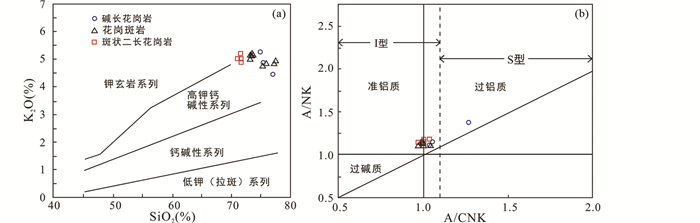
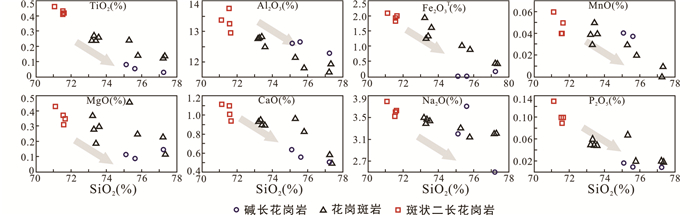
碱长花岗岩、斑状二长花岗岩均具高硅,贫钙、镁、铁、铝特征,富碱,相对高钾低钠,具有较高的分异指数和较低的固结指数,指示两种岩相花岗岩形成过程经历了明显的结晶分异作用。在SiO2-K2O图解中(图 7a),碱长花岗岩、斑状二长花岗岩投点全部落入高K钙碱性岩石区域;在A/NK-A/CNK图解中(图 7b),A/CNK=0.97~1.27,A/NK=1.11~1.39,除1个碱长花岗岩投点落入过铝质区域,其余岩浆岩投点均表现出准铝质向弱过铝质过渡特征。全岩地球化学(表 3、图 7)表明,碱长花岗岩与斑状二长花岗岩、花岗斑岩具相似的主量元素组成特征。Harker图解(图 8)显示三种岩相花岗岩的Al2O3、CaO、Fe2O3T、MgO、MnO、Na2O、P2O5、TiO2含量均随SiO2含量的增加而减少,表明岩体在演化过程中经历了铁镁质矿物、磷灰石、斜长石、钛铁矿物的结晶分离作用;碱长花岗岩、斑状二长花岗岩以及花岗斑岩常量元素投点相关性较好,具有一致演化趋势,表明三者为同一母岩浆不同阶段演化形成的产物,碱长花岗岩靠近演化线末端,指示其演化程度高于另两相花岗岩。
|
图 7 毛登花岗岩SiO2-K2O图解(a,据Peccerillo and Taylor, 1976)和A/NK-A/CNK图解(b,据Maniar and Piccoli, 1989;虚线代表I型和S型花岗岩之间的边界,据Chappell and White, 1992) 花岗斑岩数据来源于季根源等(2021a),后图同 Fig. 7 SiO2 vs. K2O diagram (a, after Peccerillo and Taylor, 1976) and A/NK vs. A/CNK diagram (b, Maniar and Piccoli, 1989; dashed line represents boundary between I- and S-type granitoid, Chappell and White, 1992) of the granite from the Maodeng deposit Data of granite porphyry from Ji et al. (2021a), also in the following figures |
|
图 8 毛登矿床花岗岩哈克图解 Fig. 8 Harker plots of the granite from the Maodeng deposit |
稀土元素测试结果显示(表 3),碱长花岗岩稀土总含量ΣREE为163.0×10⁻⁶~194.5×10⁻⁶,LREE/HREE比值为2.27~4.05,(La/Yb)N为1.02~2.67,(La/Sm)N为1.15~1.73,(Gd/Yb)N为0.5~0.84,δEu=0.01~0.02。斑状二长花岗岩ΣREE为221.6×10-6~263.9×10-6,LREE/HREE比值为10.2~11.94,(La/Yb)N为10.0~12.14,(La/Sm)N为3.23~3.68,(Gd/Yb)N为1.81~2.07,δEu=0.26~0.40。
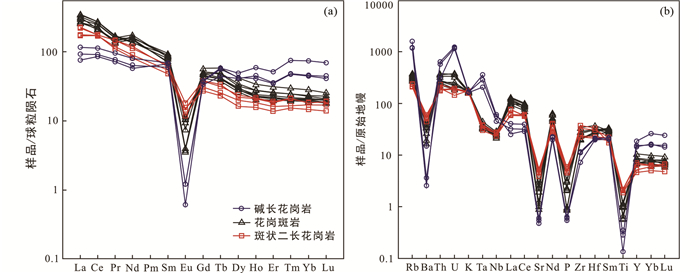
碱长花岗岩与斑状二长花岗岩、花岗斑岩一样,均具较低的(La/Yb)N、(La/Sm)N、(Gd/Yb)N和δEu值,相对亏损LREE、富集HREE等特征。在球粒陨石标准化稀土元素配分图中(图 9a),三种岩相花岗岩稀土元素配分模式图大致相同,反映具同源岩浆演化的特征;略有不同的是,碱长花岗岩整体较平缓,轻重稀土分异较小,轻稀土、重稀土分馏程度均不明显,具有更强的Eu负异常,而斑状二长花岗岩与花岗斑岩的变化趋势更为相似,表现为轻重稀土分异明显,整体右倾,轻稀土、重稀土均轻度分馏且轻稀土分馏相对较强,暗示了相对另两相花岗岩,碱长花岗岩分异演化程度相对更高。
|
图 9 毛登矿床花岗岩球粒陨石标准化稀土元素配分图(a)和原始地幔标准化微量元素蜘蛛网图(b)(标准化值据Sun and McDonough, 1989) Fig. 9 Chondrite-normalized REE patterns (a) and primitive mantle-normalized spider diagrams (b) of the granite from the Maodeng deposit (chondrite and primitive mantle values after Sun and McDonough, 1989) |
岩体微量元素组成特征显示(表 3、图 9b),碱长花岗岩与斑状二长花岗岩、花岗斑岩均富集大离子亲石元素LILE(Rb、Th和Nd)以及Sm、Zr和Hf等,亏损高场强元素HFSE(Ba、Sr、P、Ti、Nb),暗示了花岗岩演化过程中长石、磷灰石和钛铁矿的结晶分离或在源区部分熔融过程中的大量残留。略有不同的是,碱长花岗岩具明显的Ta、U正异常,而斑状二长花岗岩和花岗斑岩具Ta弱负异常,且U无明显异常。另外,相比较而言,碱长花岗岩具更高的W、Rb、Y、Li、Bi、Nb、Ta、U含量,和更低的Sr、Ba、Zr、Hf含量。
总体来说,碱长花岗岩与斑状二长花岗岩、花岗斑岩具有相似的主、微量元素组成特征,暗示三者为同源岩浆在不同阶段演化的产物,碱长花岗岩结晶分异演化程度相对更高,为岩浆演化末阶段的产物,花岗斑岩次之,斑状二长花岗岩结晶分异演化程度相对较低,为演化早阶段的产物。
3.3 锆石Hf同位素及全岩Sr-Nd同位素在锆石U-Pb定年的基础上,进行锆石微区Hf同位素测试,分析结果显示(表 4),碱长花岗岩(MD19-16)的25颗锆石176Hf/177Hf值介于0.282805~0.282952之间,176Lu/177Hf值介于0.000553~0.002231之间,以锆石U-Pb年龄140.5Ma计算获得εHf(t)值介于+4.04~+9.28之间,Hf同位素二阶段模式年龄tHfDMc=600~936Ma。花岗斑岩(MD19-41)的19颗锆石Hf同位素176Hf/177Hf值介于0.282782~0.282930之间,176Lu/177Hf值介于0.000496~0.001028之间,以锆石U-Pb年龄138Ma(季根源等,2021a)计算获得εHf(t)值介于+3.39~+8.52之间,tHfDMc=646~974 Ma。斑状二长花岗岩(MD19-11)的13颗锆石Hf同位素176Hf/177Hf值介于0.282819~0.282904之间,176Lu/177Hf值介于0.000428~0.000864之间,以锆石U-Pb年龄140Ma(季根源等,2021b)计算获得εHf(t)值介于+4.7~+7.71之间,tHfDMc=700~893Ma。
|
|
表 4 毛登矿区花岗岩锆石Hf同位素分析结果 Table 4 Hf isotopic compositions of zircons in the granite from the Maodeng deposit |
为确定岩体Sr-Nd同位素组成,根据本次研究获得的碱长花岗岩锆石U-Pb年龄140Ma,以及斑状二长花岗岩锆石U-Pb年龄140Ma(季根源等,2021b)计算Sr-Nd同位素组成特征,获得结果见表 5。全岩微量元素(表 3)显示碱长花岗岩的Sr同位素过低(<15×10-6),可能造成获得的Sr同位素比值误差较大(Jiang et al., 2016),导致Sr同位素比值不可信,故本文不予使用。Sr-Nd同位素结果(表 5)显示:碱长花岗岩初始(143Nd/144Nd)i值介于0.512452~0.512603之间,εNd(t)值介于-0.1~+2.9之间,Nd同位素两阶段模式年龄tDM2Nd为699~940Ma;斑状二长花岗岩初始(87Sr/86Sr)i值介于0.70557~0.70763之间,(143Nd/144Nd)i值介于0.512482~0.512537之间,εNd(t)值介于+0.5~+1.5之间,tDM2Nd为807~895Ma。
|
|
表 5 毛登矿区花岗岩Sr-Nd同位素组成 Table 5 Sr-Nd isotopic composition of the granit from the Maodeng deposit |


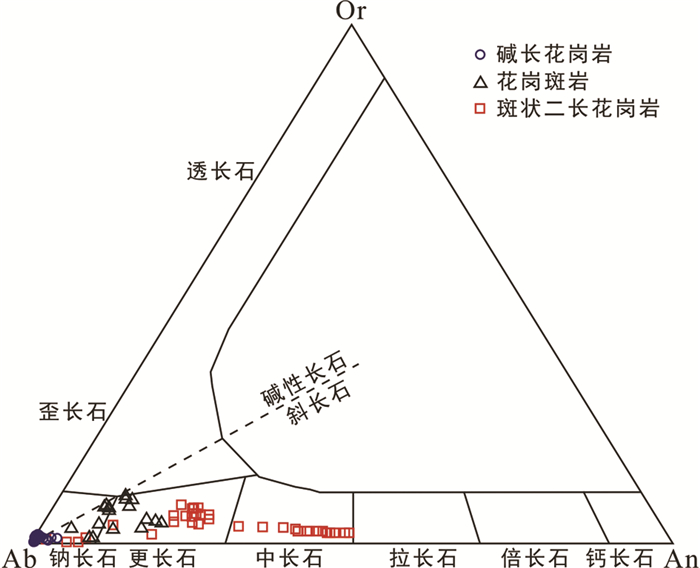
斜长石是碱长花岗岩、斑状二长花岗岩和花岗斑岩中主要的浅色造岩矿物,通常以较大斑晶颗粒产出,呈半自形板状结构。本次开展斜长电子探针(EPMA)原位微区分析共78个点,分析结果汇总见表 6。由表 6可知:碱长花岗岩的斜长石Na2O含量为11.19%~12.01%,K2O含量为0.09%~0.30%,CaO含量为0.003%~0.71%;花岗斑岩斜长石Na2O含量为9.04%~11.19%,K2O含量为0.12%~1.74%,CaO含量为0.05%~3.85%;斑状二长花岗岩的斜长石Na2O含量为5.54%~11.93%,K2O含量为0.1%~1.38%,CaO含量为0.31%~9.88%。长石分类图解(图 10)和斜长石元素组成特征(表 6)显示,碱长花岗岩斜长石成分变化于An0.01~An3.35,斜长石均为钠长石;花岗斑岩斜长石成分变化于An4.12~An17.8之间,变化范围相对较小,斜长石为更长石和钠长石;斑状二长花岗岩斜长石成分变化于An1.39~An48.2之间,变化范围相对较大,绝大多数斜长石为中长石和更长石。整体上从斑状二长花岗岩→花岗斑岩→碱长花岗岩,斜长石An值呈逐渐降低的趋势,碱长花岗岩斜长石An值远远小于另两相花岗岩。
|
|
表 6 毛登矿区花岗岩斜长石电子探针分析统计结果(wt%) Table 6 Summary of electron microprobe analyses in plagioclases of the granite from the Maodeng deposit (wt%) |
|
图 10 毛登矿区花岗岩斜长石三元分类图解(据Deer et al., 1992) Fig. 10 Ternary classification diagram for plagioclase of the granite from the Maodeng deposit (modified after Deer et al., 1992) |
前人对大兴安岭南段成矿带多个典型矿床开展了年代学研究,认为燕山晚期花岗质岩浆侵位与区内Sn、W、Mo、Pb、Zn、Cu、Ag、Fe、Bi、稀有、稀土等成矿作用关系密切(毛景文等, 2005, 2013;王长明等,2006;翟德高等, 2012)。近年来运用锆石LA-ICP-MS U-Pb同位素测年、全岩和单矿物K-Ar和Rb-Sr法测年、辉钼矿Re-Os测年以及锡石U-Pb同位素测年等多种测试手段,获得了诸多矿床矿化年龄及与成矿关系密切的花岗岩体形成年龄。
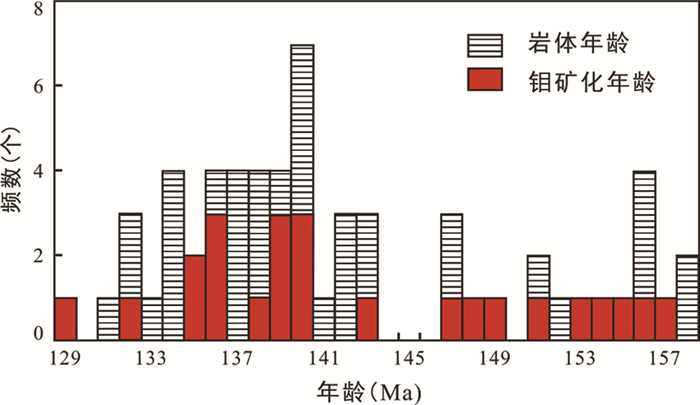
大兴安岭南段钼多金属矿床主要分布在东坡林西-林东-突泉Cu-Mo成矿亚带和西拉沐伦河钼多金属成矿亚带(图 1b),钼多金属矿床成矿(岩)时代以燕山晚期为主,海西期次之(贾盼盼等,2011;陈衍景等,2012)。本文统计了大兴安岭南段燕山晚期主要钼多金属矿床成矿年龄及成矿岩体侵位年龄(图 11),大兴安岭南段主要的钼多金属矿床形成于129~157Ma,成矿时代峰值为135~140Ma,与成矿关系密切的花岗质岩体侵位时代为131~158Ma,成岩时代峰值为134~142Ma。这与区内主要锡多金属矿床的成矿/岩集中产出年代(刘瑞麟,2018)一致,因此认为大兴安岭南段燕山期晚期锡、钼矿化年龄与岩体的侵位年龄具有一致性,暗示了锡、钼等金属成矿与燕山晚期花岗质岩浆侵位联系紧密。
|
图 11 大兴安岭南段主要钼多金属矿床形成年龄及相关的花岗岩侵入体年龄统计直方图 数据来源:聂凤军等,2007;覃锋等, 2008, 2009;马星华等,2009;张作伦等,2009;陈伟军等,2010;张晓静等,2010;曾庆栋等,2009;曾庆栋和刘建明,2010;Wu et al., 2011a, b;闫聪等,2011;张可等,2012;王明艳和何玲,2013;Shu et al., 2014, 2015, 2016;Wu et al., 2014;Zhai et al., 2014;Leng et al., 2015;王玭,2015;Zeng et al., 2015;Zhang et al., 2017;Zhou et al., 2017;郭硕等,2019;Zhang et al., 2019;李睿华,2019;谢元惠等,2020 Fig. 11 Ages of ore-forming and the granitic intrusions associated with the major Mo-polymetallic deposits in the southern Great Xing'an Range Data sources: Nie et al., 2007; Qi et al., 2008, 2009; Ma et al., 2009; Zhang et al., 2009; Chen et al., 2010; Zhang et al., 2010; Zeng et al., 2009; Zeng and Liu., 2010; Wu et al., 2011a, b; Yan et al., 2011; Zhang et al., 2012; Wang and He, 2013; Shu et al., 2014, 2015, 2016; Wu et al., 2014; Zhai et al., 2014; Leng et al., 2015; Wang, 2015; Zeng et al., 2015; Zhang et al., 2017; Zhou et al., 2017; Guo et al., 2019; Li, 2019; Zhang et al., 2019; Xie et al., 2020 |
本次利用LA-ICP-MS锆石U-Pb法获得毛登矿区碱长花岗岩的锆石结晶年龄为140.5±0.8Ma,与同一杂岩体中的花岗斑岩、斑状二长花岗岩锆石结晶年龄在误差范围内一致(郭硕等,2019;李睿华,2019;季根源等, 2021a, b),表明碱长花岗岩、花岗斑岩、斑状二长花岗岩应为同一时期岩浆活动的产物,侵位时间为早白垩世。岩体侵位年龄与Sn-Cu矿体中锡石U-Pb年龄139±3.2Ma(季根源等,2021a),以及Mo-Bi矿体辉钼矿Re-Os同位素等时线年龄139±3.9Ma(笔者未发表数据)在误差范围内基本一致,反映了大兴安岭南段包括毛登在内的多数锡、钼多金属床属于与燕山晚期岩浆-热液活动有关的同一成矿系列,是大兴安岭南段与燕山晚期花岗岩密切相关的锡钨钼铋铜铅锌银铁多金属成矿带的重要组成部分。
4.2 成岩物理化学条件研究表明,岩浆锆石结晶温度较高,结构高度稳定,即使遭受变质作用仍可保留原始地球化学成分信息,因此,可以利用锆石微量元素组成特征来约束成岩母岩浆演化时的物理化学条件,从而探讨岩浆的起源及演化过程(Hoskin and Ireland, 2000;Ballard et al., 2002;Ferry and Watson, 2007;赵振华,2010)。
4.2.1 温度锆石Ti温度计和锆石饱和温度计是岩石学中用来约束火成岩(Fu et al., 2008;Moecher et al., 2014)和深变质岩(Liu et al., 2015)中岩浆锆石结晶温度的常用方法。元素Ti能有效的替换锆石中Zr和Si,且替换过程主要受岩浆环境中温度的约束,与压力关系不大,锆石中Ti含量随着岩浆温度的上升呈逐步增加趋势(Troitzsch and Ellis, 2004, 2005;Watson and Harrison, 2005)。前人利用大量实验测试数据拟合出锆石Ti温度计算方法,可估算锆石晶出时岩浆温度,并广泛应用于岩浆岩、变质岩结晶温度计算(Hoskin and Ireland, 2000;Belousova et al., 2006;Ferry and Watson, 2007)。本次研究获得碱长花岗岩和花岗斑岩锆石Ti含量分别为2.04×10⁻⁶~12.2×10⁻⁶(平均6.27×10⁻⁶)和1.63×10⁻⁶~12.8×10⁻⁶(平均4.93×10⁻⁶);利用Ferry and Watson (2007)提出的锆石Ti温度计,SiO2的活度(αSiO2)和TiO2活度(αTiO2)分别设置为1和0.6 (Hayden and Watson, 2007),计算获得相应的锆石结晶温度分别为654~817℃(平均739℃)和636~817℃(平均710℃)(表 1),与斑状二长花岗岩锆石结晶温度672~805℃(平均734℃)(季根源等,2021b)范围大致相同。锆石Ti温度代表锆石结晶温度,可近似看作为岩浆结晶时的温度(Ferry and Watson, 2007),因此认为,碱长花岗岩和花岗斑岩体形成温度平均值分别为739℃和710℃,与一般中酸性岩浆温度(650~800℃)相符(夏邦栋,1995)。
4.2.2 氧逸度岩浆演化时的氧逸度是金属成矿的重要条件之一,制约成矿元素的迁移和富集(张聚全等,2018),Ballard et al. (2002)研究认为利用锆石中Ce、Eu不同价态含量判定花岗岩结晶时氧逸度值具有较好效果,并得到广泛应用。岩浆锆石Ce以Ce4+和Ce3+两种价态形式存在,且Ce4+和Ce3+分异能力很强,对岩浆氧逸度的变化较为敏感,氧逸度较高时Ce以Ce4+形式易置换锆石中Zr4+,造成Ce4+/Ce3+值增大和Ce正异常(Belousova et al., 2006)。因此,锆石的Ce4+/Ce3+值便成为了岩浆相对氧逸度研究的有效指示指数。前人利用锆石微量元素参数拟定出多种估算岩浆氧逸度的计算方法(Ballard et al., 2002;Belousova et al., 2006;Burnham and Berry, 2012;Trail et al., 2012),较为常用计算方法有Ballard et al. (2002)根据矿物相-熔体相之间Ce元素的不同分配系数,建立计算公式测定岩浆锆石Ce4+/Ce3+值从而反映岩浆的相对氧逸度,但该方法无法量化氧逸度。有学者指出由于天然锆石晶格本质上排斥LREE,尤其是La和Pr,导致La含量通常<0.1×10-6或低于检测下限值,但锆石颗粒常包含微细粒富LREE包裹体(如磷灰石、独居石等)(Corfu et al., 2003;Hoskin and Schaltegger, 2003),致使锆石LREE含量测试数据增大,最终低估了岩浆的氧逸度(Trail et al., 2012;Zhong et al., 2018;Zou et al., 2019)。另外,Trail et al. (2012)根据标定锆石Ce异常、温度和氧逸度之间的关系拟合岩体绝对氧逸度lgf(O2)的经验公式。
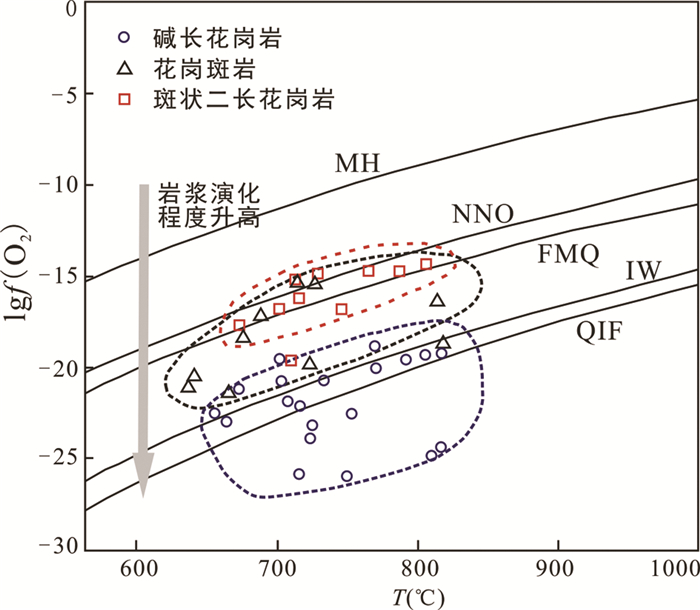
Li et al. (2019)在前人研究中酸性岩浆岩矿物(锆石、角闪石和黑云母)温度计和氧逸度计的基础上编写了Geo-fO2软件,在计算锆石Ce4+/Ce3+比值过程中排除了La和Pr浓度的影响,可较为精确的估算锆石晶出时岩浆的氧逸度。本文利用该Geo-fO2软件计算获得碱长花岗岩和花岗斑岩锆石氧逸度指示值(表 1)有:Ce4+/Ce3+值分别为0.1~19(平均7)和4~46(平均27),远低于含Cu、Mo斑岩氧化型岩浆Ce4+/Ce3+值(>300)(Ballard et al., 2002;Liang et al., 2006;Li et al., 2012),与南岭地区姑婆山(锡矿)、骑田岭(锡钨矿)花岗岩锆石Ce4+/Ce3+值一致(<80)(孙占亮,2014)。碱长花岗岩和花岗斑岩浆氧逸度lgf(O2)分别为-25.7~-18.6(平均-21.7)和-21.3~-15.3(平均-18.4);ΔFMQ分别为-10.5~-2.6(平均-5.9)和-4.7~+1.0(平均-1.8)(表 2)。将计算结果投入岩浆氧逸度lgf(O2)-温度T图解(图 12)中,多数落入NNO和QIF缓冲线之间,近半数碱长花岗岩投点位于QIF缓冲线之下,指示岩体演化环境氧逸度较低。从图 12还可以看出,伴随岩浆演化从早阶段到晚阶段,氧逸度具有逐渐降低的趋势。
|
图 12 毛登矿床花岗岩lgf(O2)-T图解(底图据Wang et al., 2012) 斑状二长花岗岩数据来源于季根源等,2021b. MH-磁铁矿-赤铁矿;NNO-自然镍-绿镍矿;FMQ-铁橄榄石-磁铁矿-石英;IW-自然铁-方铁矿;QIF-石英-自然铁-铁橄榄石 Fig. 12 lgf(O2) vs. T diagram of the granite from the Maodeng deposit (base map after Wang et al., 2012) Data of porphyritic monzogranite from Ji et al., 2021b. MH-magnetite-hematite; NNO-nickel-nickel oxide; FMQ-fayalite-magnetite-quartz; IW-iron-wustite; QIF-quartz-iron-fayalite |
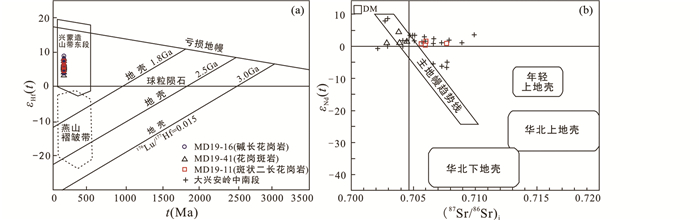
锆石Lu-Hf同位素体系具很高的封闭温度,Hf同位素比值不易受岩浆部分熔融或结晶分离作用而发生变化,因此锆石εHf(t)值可反映岩浆源区的特征(Griffin et al., 2002;Kemp et al., 2007),正εHf(t)值代表花岗岩来源于亏损地幔或新增生年轻地壳物质的部分熔融,负εHf(t)值则代表来源于古老地壳(吴福元等, 2007a, b)。碱长花岗岩、花岗斑岩和斑状二长花岗岩都具有较高的176Hf/177Hf值(平均为0.282872、0.282865和0.282863)和较低的176Lu/177Hf值(平均为0.001087、0.000701和0.000585)(表 4),暗示了锆石形成后基本无明显放射性成因Hf的积累,测试获得的176Lu/177Hf值可代表其晶出时体系的Hf同位素组成(Patchett et al., 1982;Amelin et al., 1999;Knudsen et al., 2001);εHf(t)值均为正值,变化范围为+4.0~+9.3、+3.4~+8.5和+4.7~+7.7,Hf同位素二阶段模式年龄tHfDM2c变化范围为600~936Ma、646~974Ma和700~893Ma。εHf(t)-t图解(图 13a)中样品投点均落入兴蒙造山带东段范围内。锆石的fLu/Hf值(-0.99~-0.93)明显小于镁铁质地壳和硅铝质地壳的fLu/Hf值(分别为-0.34和-0.72)(Vervoort et al., 1996;Jahn et al., 2001),因此阿鲁包格山岩体锆石年轻的Hf同位素二阶段模式年龄(tHfDMc=600~974 Ma)能代表源区物质从亏损地幔被抽取的时间,或者在地壳的平均存留时间。
|
图 13 毛登矿床花岗岩锆石Lu-Hf同位素特征(a,底图据Vervoort et al., 1996)和(87Sr/86Sr)i-εNd(t)图解(b,底图据Zindler and Hart, 1986;Jahn et al., 1999) 数据来源于张德全,1993;赵一鸣等,1994;蔡剑辉等,2004;肖成东等,2004;周振华等,2011;顾玉超等,2017;季根源等,2021a Fig. 13 Lu-Hf isotopic compositions of zircons (a, base map after Vervoort et al., 1996) and (87Sr/86Sr)i vs. εNd(t) diagrams (b, base map after Zindler and Hart, 1986; Jahn et al., 1999) of the granite from the Maodeng deposit Date sources: Zhang, 1993; Zhao et al., 1994; Cai et al., 2004; Xiao et al., 2004; Zhou et al., 2011; Gu et al., 2017; Ji et al., 2021a |
Sr-Nd同位素研究在岩浆岩物质来源方面同样有着重要的示踪作用,可以较为准确的指示成岩物质来源(Zartman and Doe, 1981)。Sr-Nd同位素测试分析显示,毛登矿区斑状二长花岗岩显示较低的初始(87Sr/86Sr)i值(0.70557~0.70763),碱长花岗岩Sr含量过低,计算获得的初始(87Sr/86Sr)i值不可信;碱长花岗岩和斑状二长花岗岩具有较高的初始(143Nd/144Nd)i值(分别为0.512452~0.512603和0.512482~0.512537),较高的εNd(t)值(分别为-0.1~+2.9和+0.5~+1.5),较年轻的Nd同位素二阶段模式年龄(tDM2Nd分别为699~940Ma和807~895Ma)(表 5),反映新生地壳源区特征。在(87Sr/86Sr)i-εNd(t)图解(图 13b)中,斑状二长花岗岩样品投点落于主地幔趋势线附近,靠近亏损地幔单元,远离华北陆块下地壳区域,说明成岩物质来源于地幔,成岩过程中可能受少量地壳物质混染。
大兴安岭地区大多数显生宙花岗岩表现出较高的εHf(t)、εNd(t)值和较低的Hf、Nd同位素模式年龄,常被认为起源于新元古代年轻地壳物质(吴福元等,1999;Jahn et al., 2000;Wu et al., 2000, 2002)。综上认为,毛登矿区阿鲁包格山碱长花岗岩、斑状二长花岗岩和花岗斑岩拥有相同的岩浆源区,可能为新元古代含有大量幔源组分新生地壳的部分熔融。
4.3.2 矿物学证据矿物学研究可以作为判别花岗岩浆结晶分异程度的一种手段,经历高度分异演化的花岗岩中斜长石数量逐渐减少,通常向富Na端元(钠长石)演化(Wu et al., 2018)。斜长石电子探针原位主量元素测试分析结果(表 6、图 10)可知:碱长花岗岩斜长石为钠长石,An值介于An0.01~An3.35之间,远远小于花岗斑岩和斑状二长花岗岩斜长石An值(分别为An4.12~An17.8和An1.39~An48.2)。岩相学研究表明花岗斑岩、斑状二长花岗岩磷灰石发育较好,多呈短柱状或六方柱状,颗粒较小,粒径介于40~260μm之间,而碱长花岗岩中几乎无磷灰石,暗示了相比较另外两种岩相,碱长花岗岩经历了更高的结晶分异演化作用(Chen et al., 2016)。
此外,Breiter et al. (2014)研究认为,锆石是非或低结晶分异花岗岩演化早阶段矿物之一,而在高分异演化花岗岩中则形成于演化晚阶段,前人研究认为锆石的Eu负异常可能由晶出环境还原性较强(Rubatto, 2002)、锆石晶出过程中或结晶前有斜长石存在(Rubatto and Williams, 2000)、或继承寄主岩体Eu异常特征(Hermann et al., 2001)这三方面原因造成。在锆石BSE图像观察和U-Pb年龄测试工作,没有发现继承锆石的存在,因此认为毛登矿区花岗岩锆石强烈的Eu负异常(图 6a)可能是锆石结晶过程中或结晶前,斜长石的结晶分离作用带走了大量的Eu,以及岩浆氧逸度较低共同造成的。除锆石与重稀土元素具相容性(Thomas et al., 2002),磷灰石、褐帘石、石榴石和磷钇矿等副矿物共同对熔体中稀土元素含量起主导作用(Bea, 1996;Ayres and Harris, 1997;Chu et al., 2009),这些副矿物的大量结晶分离,导致了岩体稀土元素大量减少,轻、重稀土分馏减弱,这从岩体稀土含量(表 3)和稀土元素配分模式图(图 9a)得到印证。
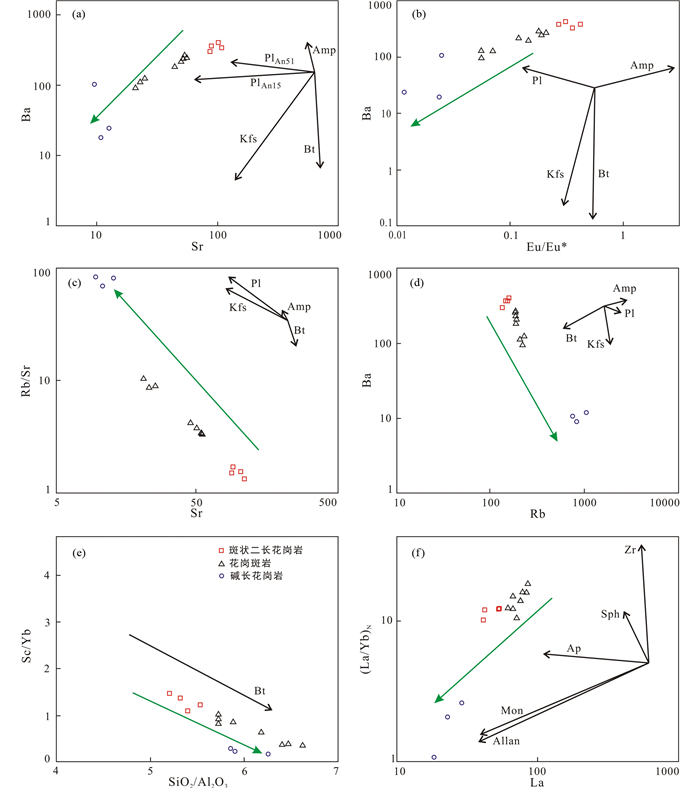
4.3.3 主微量元素地球化学证据花岗岩很难由起源于幔源物质的初始岩浆通过直接结晶分离作用形成(吴福元等,2007a)。主微量元素地球化学特征显示阿鲁包格山岩体具较高的分异指数DI和较低的固结指数SI,碱长花岗岩、花岗斑岩和斑状二长花岗岩DI平均值为95.49、94.4和93.37,SI平均值为1.52、2.64和4.06;在Harker图解中(图 8),主量元素含量与SiO2含量呈负相关性;微量元素富集Rb、Th、Nd、Sm、Zr和Hf,亏损Eu、Ba、Sr、P、Nb和Ti,以上都充分说明了岩体经历了一系列高度的结晶分异演化作用。岩体结晶分异作用过程判别图解Ba-Sr(图 14a)、Eu/Eu*-Ba(图 14b)、Rb/Sr-Sr(图 14c)和Ba-Rb(图 14d)显示岩体Sr、Ba、Eu的强烈亏损以及Rb的富集主要是由钾长石和斜长石的结晶分异作用造成的。SiO2/Al2O3-Sc/Yb(图 14e)显示黑云母是结晶分离的主要矿物之一,La-(La/Yb)N图解(图 14f)显示了稀土元素的变化主要受独居石、褐帘石和磷灰石等副矿物的结晶分异影响较大;磷灰石、榍石(富Ti矿物)结晶分离可导致花岗岩中Nb、Ta、Ti和P的亏损,这在微量元素蜘蛛网图中(图 9b)得到印证。因此,岩体结晶分异作用过程判别图解(图 14)同样也说明了岩体经历了高程度的结晶分异演化作用。
|
图 14 毛登花岗质岩体结晶分异作用过程判别图解(据底图据Blundy and Shimizu, 1991;Ewart and Griffin, 1994;Wu et al., 2003;Janoušek et al., 2004;Yang et al., 2012;Zhang et al., 2015) Amp-角闪石;Bt-黑云母;Kfs-钾长石;PlAn15-斜长石(An=15);PlAn51-斜长石(An=51);Ap-磷灰石;Sph-榍石;Mon-独居石;Allan-褐帘石;Zr-锆石 Fig. 14 Discrimination diagrams showing the fractional crystallization process of the granite from the Maodeng deposit (base map after Blundy and Shimizu, 1991; Ewart and Griffin, 1994; Wu et al., 2003; Janoušek et al., 2004; Yang et al., 2012; Zhang et al., 2015) Amp-amphibole; Bt-biotite; Kfs-K-feldspar; PlAn15-plagiochase(An=15); PlAn51-plagiochase (An=51); Zr-zircon; Sph-sphene; Ap-apatite; Mon-monazite; Allan-allanite |
微量元素含量和关键元素比值常可用来判别花岗岩是否具有明显M型稀土(REE)四分组效应或属于高分异演化花岗岩(Bau, 1996)。研究显示,随着岩浆演化的进行,H2O、Li、F、Cl、B、Rb等在岩浆中含量逐渐增高,导致锂云母、萤石、黄玉、电气石等结晶(Zhu et al., 2002;李小伟等,2010)。毛登矿区黄玉、萤石等蚀变矿物普遍发育,且斑状二长花岗岩、花岗斑岩中磷灰石的F平均含量分别为3.01%和3.53%(笔者未发表数据),反映岩体较高的F含量,意味着岩浆分异演化过程较长。全岩微量元素分析结果(表 3)可知:相对于斑状二长花岗岩和花岗斑岩,碱长花岗岩具有更高的Li、Rb含量,暗示了更高的分异演化程度。研究发现碱长花岗岩中几乎无磷灰石,也暗示了相比较另外两种岩相,碱长花岗岩经历了更强的结晶分异演化作用(Chen et al., 2016)。关键元素Nb/Ta、Rb/Sr比值对判别岩浆结晶分异程度具重要意义,前者随岩浆的分异演化呈明显减小,而后者急剧增加(Bau, 1996;Ballouard et al., 2016)。本文研究显示,相比较花岗斑岩和斑状二长花岗岩,碱长花岗岩具更小的Nb/Ta值,和更大的Rb/Sr值(表 7),显示分异程度更高。稀土元素量化参数TE1, 3和关键元素K/Rb、Zr/Hf、Y/Ho、Eu/Eu*、Sr/Eu的比值(表 7)显示,碱长花岗岩符合具有稀土四分组效应花岗岩相关元素组成特征(TE1, 3>1.10,K/Rb值<100,Zr/Hf值<25,Y/Ho值>28,Eu/Eu*值<0.1,Sr/Eu值>200)(Irber, 1999),而斑状二长花岗岩和花岗斑岩接近或偏离具明显REE四分组效应花岗岩的区间范围。以上表明了岩体在经历充分的结晶分异演化之后,晚期还经历了熔体-流体相互作用,花岗斑岩和斑状二长花岗岩熔体-流体作用较弱,碱长花岗熔体-流体作用较强。
|
|
表 7 毛登矿区花岗岩关键元素比值 Table 7 The ratios of key elements contents of the granite from the Maodeng deposit |
综上所述,毛登矿区阿鲁包格山杂岩体的侵位由两个阶段的成岩过程组成: 第一阶段是含大量幔源组分的新生陆壳部分熔融形成初始岩浆,第二阶段是幔源组分为主的原始岩浆经历高度分异演化过程和熔体-流体作用。岩浆演化晚期形成的碱长花岗岩熔体-流体作用更为强烈,这可能是毛登矿区成矿的重要前提条件之一。
4.4 岩浆作用对成矿制约野外地质调查显示,Sn-Cu矿体主要发育在火山角砾岩和花岗斑岩体中,Mo-Bi矿体主要发育在碱长花岗岩外接触带的火山角砾岩中;年代学研究显示,碱长花岗岩、花岗斑岩和斑状二长花岗岩的成岩年龄与锡、钼矿化年龄在误差范围内一致,表明毛登矿区金属成矿作用与阿鲁包格山岩体侵位时空关系联系紧密。李睿华(2019)通过S-Pb同位素特征研究,认为毛登矿区成矿物质来源于花岗岩体;刘玉强(1996a)通过H-O同位素特征研究,认为毛登矿区成矿流体来自深部花岗体,晚期蚀变和矿化流体中大气降水逐渐增多。这些研究表明阿鲁包格山岩体应是毛登矿床成矿物质和流体来源的主要贡献者。
众所周知,与花岗岩关系密切的矿床主要受岩浆的来源、氧化还原状态和结晶分异演化程度等因素的制约(Lehmann et al., 1990;Sun et al., 2013, 2015)。与锡、钼矿床关系密切的的花岗岩通常经历了较高的岩浆结晶分异演化作用,且具高F含量(大于1%)特征(Candela and Holland, 1986;Lehmann et al., 1990),岩浆中高含量的F元素可促进Sn、Mo、W、Nb、Ta等金属元素在岩浆上侵分异演化过程中逐渐富集,并优先萃取进入出溶流体,有利于矿床形成(Tingle and Fenn, 1984;Scaillet and Macdonald, 2004;Veksler et al., 2005;Vigneresse, 2009;Vigneresse et al., 2011;Nardi et al., 2013;Park et al., 2016)。例如,安徽竹溪岭Mo-W矿床的岩浆体系具高F含量、低氧逸度,有利于Mo等成矿元素迁移和富集(张振等,2019),湖南柿竹园W-Sn-Mo-Bi多金属矿床成矿母岩浆高F特征对Sn、W、Mo等成矿元素的聚集起着重要的作用(Chen et al., 2016)。另外,成矿流体中高含量的F元素利于Sn以Sn(OH)4·F22-、Sn(OH)F3和Na2SnF6等稳定络合物的形式迁移,伴随温压降低、pH值升高,锡的氟络合物会发生分解,晶出锡石(Heinrich, 1990;Bhalla et al., 2005)。前文已阐述毛登矿区花岗岩体富F,这与周边白音查干(刘新等,2017)、维拉斯托(张天福等,2019)、石灰窑(Duan et al., 2020)、小东沟(Zhang et al., 2009)等大兴安岭南段典型Sn、Ag、W、REE、Mo、Rb矿床的成矿岩体高F含量特征一致,有利于矿区锡、钼、铋金属大规模矿化。
全球许多大型-超大型Sn矿床的成矿作用与花岗岩侵入密切相关,而岩浆的氧逸度、温度和岩浆演化制约锡在熔体-流体体系中分配和富集成矿(Štemprok, 1990;Linnen et al., 1995, 1996)。Blevin and Chappell (1992)、Sato (2012)研究认为W、Sn矿床与还原性岩浆的结晶分异作用关系密切,在演化晚期发生锡的富集成矿。前人研究认为华南地区大多数锡矿床成矿岩体具低氧逸度特征,属于还原性花岗岩体,孙占亮(2014)研究南岭地区姑婆山(锡矿)、骑田岭(锡钨矿)成矿岩体,发现锆石Ce4+/Ce3+值均低于80;广西珊瑚W-Sn矿床花岗岩锆石Ce4+/Ce3+值47 (Zhang et al., 2020);Li et al. (2017)研究认为华南燕山期花岗岩中与Cu-(Au)-Mo矿化有关的花岗岩具最高的氧逸度,Cu-Pb-Zn-W次之,W-Sn最低;广东阳春鹦鹉岭W-Sn矿床A型花岗岩锆石Ce4+/Ce3+值8~58 (Zheng et al., 2017);柿竹园W-Sn-Mo-Bi多金属矿床黑云母花岗岩锆石Ce4+/Ce3+值31~49 (Jiang et al., 2019)。花岗岩浆的温度也是制约锡富集成矿的关键条件之一,Štemprok (1990)研究不同温度环境中岩浆SnO2含量变化特征,指出SnO2含量随岩浆结晶时温度的升高而增大。张毓策等(2020)利用个旧锡矿区花岗岩黑云母矿物学特征,研究认为高温、低氧逸度有利于晚期分异的流体形成锡矿床,周云等(2017)对湘东燕山期花岗岩黑云母进行了研究,显示较高温度和较低氧逸度的花岗岩浆有利于锡富集成矿。上述成岩物化条件分析可知,毛登矿区阿鲁包格山杂岩体碱长花岗岩、花岗斑岩和斑状二长花岗岩形成温度平均值为739℃、710℃和734℃,相关氧逸度指标值Ce4+/Ce3+平均值为7、27和31,lgf(O2)平均值为-21.7、-18.7和-16.0,ΔFMQ平均值为-5.9、-1.8和-0.2。可以看出,毛登矿区岩浆演化的早-晚阶段均处于氧逸度较低、温度较高的环境,随着岩浆的演化氧逸度呈逐渐降低的趋势,有利于Sn在残余熔体中富集。
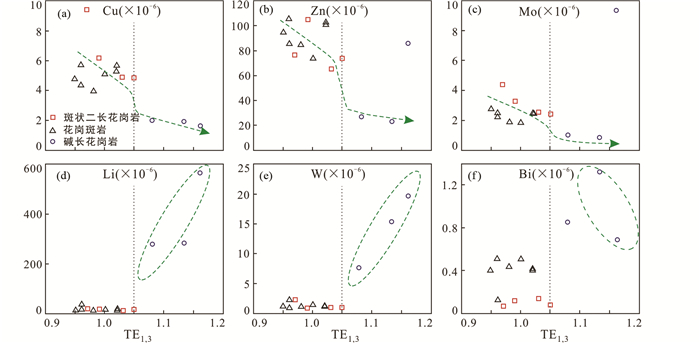
全岩主、微量地球化学特征分析表明,毛登矿区不同岩相花岗岩显示出不同程度的REE四分组效应,表明经历了强、弱不同的熔体-流体作用,在熔体-流体作用下一些金属成矿元素可能被带入熔体内,而另外一些元素可能从熔体中淋滤进入流体中,最终造成了某些元素的富集、成矿。从图 15a-c可以看出,岩体中Cu、Zn、Mo元素含量随着岩浆演化程度升高呈逐渐降低的趋势,暗示了这些元素在岩浆演化过程中可能进入出溶流体中,进而降低熔体中含量;碱长花岗岩中的含量明显低于趋势线正常演化的值,暗示了强烈的熔体-流体交代作用(TE1, 3>1.05)加剧了这些成矿元素从岩体中进一步淋滤萃取进入流体中,形成含矿流体,最终在一定条件下沉淀、富集成矿。岩体中成矿元素含量Mo<Cu<Zn,根据流体中成矿元素演化特征,推测在矿区外围还有寻找Pb-Zn矿化的潜力。从图 15d-e可以看出,在斑状二长花岗岩和花岗斑岩(TE1, 3<1.05)中,Li、W元素含量随着岩浆演化无明显波动,而在高分异碱长花岗岩(TE1, 3>1.05)中的含量明显高于趋势线正常演化的值,且随着TE1, 3值的增大Li、W元素含量明显升高。因此推测,较小程度的结晶分异作用对岩浆中Li、W元素的含量影响不大,如斑状二长花岗岩→花岗斑岩,岩体中Li、W元素含量几乎无变化;而岩浆结晶分异演化程度升高导致残余熔体中Li、W元素富集,或者强烈的熔体-流体相互作用导致Li、W元素大量分配进入熔体造成岩体中含量进一步升高而流体中含量贫化,抑或是两者兼有,这与矿区内Li、W矿化不发育或规模不大相吻合。从图 15f可以看出在斑状二长花岗岩和花岗斑岩(TE1, 3<1.05)中,Bi元素含量波动范围较大,与TE1, 3值无明显关联性,而在高分异碱长花岗岩(TE1, 3>1.05)中,Bi元素含量明显高于TE1, 3<1.05区间,且在碱长花岗岩中,随着TE1, 3值的增大Bi元素含量呈降低趋势。因此推测,岩浆结晶分异演化作用造成了Bi在岩浆中逐渐富集,但就碱长花岗岩来说,Bi在岩浆中的含量分配可能以熔体-流体相互作用为主,强烈的熔体-流体交代作用造成大量的Bi元素进入流体中以及在熔体中相对贫化,即使碱长花岗岩残余熔体中Bi的含量高于斑状二长花岗岩、花岗斑岩,从熔体分配进入流体中的部分Bi元素也足以造成矿区大规模Bi矿化。
|
图 15 毛登花岗质岩体TE1, 3与成矿元素协变图解 Fig. 15 Covariation diagrams of TE1, 3 and ore-forming elements of the granite from the Maodeng deposit |
综上表明,强烈的熔体-流体相互作用造成岩体中不同成矿元素含量急剧上升或下降,以及热液流体中成矿元素的富集或贫化,可能是毛登Mo-Bi-Sn-Cu矿床形成的重要原因之一。
年代学研究结果表明,阿鲁包格山三种岩相花岗岩形成时间一致,与锡、钼、铋金属成矿时间联系紧密;野外地质调查和岩石学研究表明,Sn-Cu矿体、Mo-Bi矿体赋存空间与碱长花岗岩、花岗斑岩侵位关系密切。因此,从成矿(岩)年代学、矿体与岩体接触关系等方面,很难判别出哪种岩相花岗岩为主要的成矿岩体。相比较而言,碱长花岗岩微量元素蜘蛛网图展现出更明显的Eu、Sr、Ba、P和Ti负异常和U、Ta正异常(图 9b),更高的W、Rb、F、Li、Bi、Ta、Nb含量和较低的Ba、Sr、Zr、Hf含量,未发现磷灰石,以及明显的稀土四分组效应,均表明碱长花岗岩经历了更高的分异演化作用以及更强的熔体-流体作用。中国南岭地区燕山晚期千里山复式岩体与柿竹园W-Sn-Mo-Bi多金属矿床成矿关系密切,岩体主要包括斑状黑云母花岗岩、等粒黑云母花岗岩和花岗斑岩三种岩相花岗岩体,区别于斑状黑云母花岗岩和花岗斑岩的是,等粒黑云母花岗岩具较高的W、Sn、Rb、F、Nb、Ta含量和较低的Ba、Sr、Zr、Hf含量,经历了更强的结晶分异演化和熔体-流体作用,微量元素蜘蛛网图显示更强的Eu、Sr、Ba、P负异常和U、Ta正异常,且未发现磷灰石矿物,反映了等粒黑云母花岗岩是柿竹园矿床可能性最大的潜在成矿岩体(Chen et al., 2016;Jiang et al., 2019)。大兴安岭南段维拉斯托矿区发育燕山晚期隐伏斑状碱长花岗岩和北大山岩体,相比较北大山岩体,斑状碱长花岗岩体与矿体的赋存空间关系更为紧密,且经历了更强的分异演化以及晚期的熔体-流体相互作用,是维拉斯托矿床成矿岩体(Wang et al., 2017;刘瑞麟,2018;张天福等,2019)。将阿鲁包格山杂岩体中碱长花岗岩与千里山复式岩体中等粒黑云母花岗岩、维拉斯托斑状碱长花岗岩对比,发现三者在岩石地球化学、矿物学特征方面类似,在各自岩浆-成矿系统中起到相似的作用,因此认为碱长花岗岩可能是毛登矿床最主要的成矿岩体。
5 结论(1) 阿鲁包格山杂岩体中碱长花岗岩的锆石结晶年龄为140.5±0.8Ma,与杂岩体中斑状二长花岗岩和花岗斑岩的形成年龄基本一致,表明三者应为同一时期岩浆活动的产物,岩浆侵位时间为早白垩世。
(2) 碱长花岗岩具高硅、富碱、较高的分异指数和较低的固结指数,富集Rb、Th、Nd、Sm、Zr、Hf和Ta,亏损Ba、Sr、P、Nb、Ti,轻、重稀土分馏较小,并具显著的稀土四分组效应和Eu负异常,斜长石An值介于An0.01~An3.35之间,为钠长石,指示碱长花岗岩为高分异花岗岩。
(3) 碱长花岗岩锆石Ti温度为654~817℃(平均739℃),Ce4+/Ce3+值为0.1~19(平均7),岩浆氧逸度lgf(O2)为-25.7~-18.6(平均-21.7),表明原生岩浆具有低氧逸度的特征。
(4) 碱长花岗岩具正的εHf(t)值(+4.0~+9.3)和年轻的Hf二阶段同位素模式年龄(600~936Ma)、较高的εNd(t)值(+0.5~+1.5)和年轻的Nd二阶段同位素模式年龄(807~895Ma),表明岩浆源区来自含大量幔源组分的新生地壳部分熔融。
(5) 通过对比研究,认为碱长花岗岩是阿鲁包格山杂岩体高分异演化的最晚阶段产物,具高F,低氧逸度特征,对毛登矿床的形成具有重要意义。
致谢 两位审稿人和终审副主编对本文提出了宝贵的建议和修改意见,使本文整体质量得到很大的提升,在此深表谢意。
Amelin Y, Lee DC, Halliday AN and Pidgeon RT. 1999. Nature of the Earth's earliest crust from hafnium isotopes in single detrital zircons. Nature, 399(6733): 252-255 DOI:10.1038/20426
|
Ayres M and Harris N. 1997. REE fractionation and Nd-isotope disequilibrium during crustal anatexis: Constraints from Himalayan leucogranites. Chemical Geology, 139(1-4): 249-269 DOI:10.1016/S0009-2541(97)00038-7
|
Ballard JR, Palin MJ and Campbell IH. 2002. Relative oxidation states of magmas inferred from Ce(Ⅳ)/Ce(Ⅲ) in zircon: Application to porphyry copper deposits of northern Chile. Contributions to Mineralogy and Petrology, 144(3): 347-364 DOI:10.1007/s00410-002-0402-5
|
Ballouard C, Poujol M, Boulvais P, Branquet Y, Tartèse R and Vigneresse JL. 2016. Nb-Ta fractionation in peraluminous granites: A marker of the magmatic-hydrothermal transition. Geology, 44(3): 231-234 DOI:10.1130/G37475.1
|
Bau M. 1996. Controls on the fractionation of isovalent trace elements in magmatic and aqueous systems: Evidence from Y/Ho, Zr/Hf, and lanthanide tetrad effect. Contributions to Mineralogy and Petrology, 123(3): 323-333 DOI:10.1007/s004100050159
|
Bea F. 1996. Residence of REE, Y, Th and U in granites and crustal protoliths: Implications for the chemistry of crustal melts. Journal of Petrology, 37(3): 521-552 DOI:10.1093/petrology/37.3.521
|
Belousova EA, Griffin WL and O'Reilly SY. 2006. Zircon crystal morphology, trace element signatures and Hf isotope composition as a tool for petrogenetic modelling: Examples from eastern Australian granitoids. Journal of Petrology, 47(2): 329-353 DOI:10.1093/petrology/egi077
|
Bhalla P, Holtz F, Linnen RL and Behrens H. 2005. Solubility of cassiterite in evolved granitic melts: Effect of T, fO2, and additional volatiles. Lithos, 80(1-4): 387-400 DOI:10.1016/j.lithos.2004.06.014
|
Blevin PL and Chappell BW. 1992. The role of magma sources, oxidation states and fractionation in determining the granite metallogeny of eastern Australia. Earth and Environmental Science Transactions of the Royal Society of Edinburgh, 83(1-2): 305-316 DOI:10.1017/S0263593300007987
|
Blundy JD and Shimizu N. 1991. Trace element evidence for plagioclase recycling in calc-alkaline magmas. Earth and Planetary Science Letters, 102(2): 178-197 DOI:10.1016/0012-821X(91)90007-5
|
Breiter K, Lamarão CN, Borges RMK and Dall'Agnol R. 2014. Chemical characteristics of zircon from A-type granites and comparison to zircon of S-type granites. Lithos, 192-195: 208-225 DOI:10.1016/j.lithos.2014.02.004
|
Burnham AD and Berry AJ. 2012. An experimental study of trace element partitioning between zircon and melt as a function of oxygen fugacity. Geochimica et Cosmochimica Acta, 95: 196-212 DOI:10.1016/j.gca.2012.07.034
|
Cai JH, Yan GH, Xiao CD, Wang GY, Mu BL and Zhang RH. 2004. Nd, Sr, Pb isotopic characteristics of the Mesozoic intrusive rocks in the Taihang-Da Hinggan mountains tectonomagmatic belt and their source region. Acta Petrologica Sinica, 20(5): 1225-1242 (in Chinese with English abstract)
|
Candela PA and Holland HD. 1986. A mass transfer model for copper and molybdenum in magmatic hydrothermal systems: The origin of porphyry-type ore deposits. Economic Geology, 81(1): 1-19 DOI:10.2113/gsecongeo.81.1.1
|
Černý P, Blevin PL, Cuney M and London D. 2005. Granite-related ore deposits. Economic Geology 100th Anniversary Volume, 337-370
|
Chappell BW and White AJR. 1992. I- and S-type granites in the Lachlan fold belt. Transactions of the Royal Society of Edinburgh, Earth Sciences, 83(1-2): 1-26 DOI:10.1017/S0263593300007720
|
Chappell BW, White AJR, Williams IS and Wyborn D. 2004. Low- and high-temperature granites. Earth and Environmental Science Transactions of the Royal Society of Edinburgh, 95(1-2): 125-140 DOI:10.1017/S0263593300000973
|
Chen WJ, Liu JM, Liu HT, Sun XG, Zhang RB, Zhang ZL and Qin F. 2010. Geochronology and fluid inclusion study of the Jiguanshan porphyry Mo deposit, Inner Mongolia. Acta Petrologica Sinica, 26(5): 1423-1436 (in Chinese with English abstract)
|
Chen YJ, Zhang C, Li N, Yang YF and Deng K. 2012. Geology of the Mo deposits in Northeast China. Journal of Jilin University (Earth Science Edition), 42(5): 1223-1268 (in Chinese with English abstract)
|
Chen YX, Li H, Sun WD, Ireland T, Tian XF, Hu YB, Yang WB, Chen C and Xu DR. 2016. Generation of Late Mesozoic Qianlishan A2-type granite in Nanling Range, South China: Implications for Shizhuyuan W-Sn mineralization and tectonic evolution. Lithos, 266-267: 435-452 DOI:10.1016/j.lithos.2016.10.010
|
Cheng TS, Yang WJ and Wang DH. 2014. Zircon U-Pb age and geochemical characteristics of the Alubaoge A-type granite in Xiwuqi, Inner Mongolia and its geological significance. Geotectonica et Metallogenia, 38(3): 718-728 (in Chinese with English abstract)
|
Chu MF, Wang KL, Griffin WL, Chung SL, O'Reilly SY, Pearson NJ and Iizuka Y. 2009. Apatite composition: Tracing petrogenetic processes in Transhimalayan granitoids. Journal of Petrology, 50(10): 1829-1855 DOI:10.1093/petrology/egp054
|
Corfu F, Hanchar JM, Hoskin PWO and Kinny P. 2003. Atlas of zircon textures. Reviews in Mineralogy and Geochemistry, 53(1): 469-500 DOI:10.2113/0530469
|
Deer WA, Howie RA and Zussman J. 1992. An Introduction to the Rock-Forming Minerals. 2nd Edition. Harlow, UK: Longman Group
|
Duan ZP, Jiang SY, Su HM, Zhu XY, Zou T and Cheng XY. 2020. Trace and rare earth elements, and Sr isotopic compositions of fluorite from the Shihuiyao rare metal deposit, Inner Mongolia: Implication for its origin. Minerals, 10(10): 882 DOI:10.3390/min10100882
|
Engebretson DC, Cox A and Gordon RG. 1985. Relative motions between oceanic and continental plates in the Pacific basin. Geological Society of America Specical Paper, 206: 1-59
|
Ewart A and Griffin WL. 1994. Application of proton-microprobe data to trace-element partitioning in volcanic rocks. Chemical Geology, 117(1-4): 251-284 DOI:10.1016/0009-2541(94)90131-7
|
Fan WM, Guo F, Wang YJ and Lin G. 2003. Late Mesozoic calc-alkaline volcanism of post-orogenic extension in the northern Da Hinggan Mountains, northeastern China. Journal of Volcanology and Geothermal Research, 121(1-2): 115-135 DOI:10.1016/S0377-0273(02)00415-8
|
Ferry JM and Watson EB. 2007. New thermodynamic models and revised calibrations for the Ti-in-zircon and Zr-in-rutile thermometers. Contributions to Mineralogy and Petrology, 154(4): 429-437 DOI:10.1007/s00410-007-0201-0
|
Fu B, Page FZ, Cavosie AJ, Fournelle J, Kita NT, Lackey JS, Wilde SA and Valley JW. 2008. Ti-in-zircon thermometry: Applications and limitations. Contributions to Mineralogy and Petrology, 156(2): 197-215 DOI:10.1007/s00410-008-0281-5
|
Griffin WL, Wang X, Jackson SE, Pearson NJ, O'Reilly SY, Xu XS and Zhou XM. 2002. Zircon chemistry and magma mixing, SE China: In-situ analysis of Hf isotopes, Tonglu and Pingtan igneous complexes. Lithos, 61(3-4): 237-269 DOI:10.1016/S0024-4937(02)00082-8
|
Gu YC, Chen RY, Jia B, Song WB, Yu CT and Ju N. 2017. Zircon U-Pb dating and geochemistry of the syenogranite from the Bianjiadayuan Pb-Zn-Ag deposit of Inner Mongolia and its tectonic implications. Geology in China, 44(1): 101-117 (in Chinese with English abstract)
|
Guo S, He P, Zhang XB, Cui YR, Zhang TF, Zhang K, Lai L and Liu CB. 2019. Geochronology and geochemistry of Maodeng-Xiaogushan tin-polymetallic ore-field in southern Da Hinggan Mountains and their geological significances. Mineral Deposits, 38(3): 509-525 (in Chinese with English abstract)
|
Hayden LA and Watson EB. 2007. Rutile saturation in hydrous siliceous melts and its bearing on Ti-thermometry of quartz and zircon. Earth and Planetary Science Letters, 258(3-4): 561-568 DOI:10.1016/j.epsl.2007.04.020
|
Heinrich CA. 1990. The chemistry of hydrothermal tin(-tungsten) ore deposition. Economic Geology, 85(3): 457-481 DOI:10.2113/gsecongeo.85.3.457
|
Hermann J, Rubatto D, Korsakov A and Shatsky VS. 2001. Multiple zircon growth during fast exhumation of diamondiferous, deeply subducted continental crust (Kokchetav Massif, Kazakhstan). Contributions to Mineralogy and Petrology, 141(1): 66-82 DOI:10.1007/s004100000218
|
Hoskin PWO and Ireland TR. 2000. Rare earth element chemistry of zircon and its use as a provenance indicator. Geology, 28(7): 627-630 DOI:10.1130/0091-7613(2000)28<627:REECOZ>2.0.CO;2
|
Hoskin PWO and Schaltegger U. 2003. The composition of zircon and igneous and metamorphic petrogenesis. Reviews in Mineralogy and Geochemistry, 53(1): 27-62 DOI:10.2113/0530027
|
Hoskin PWO. 2005. Trace-element composition of hydrothermal zircon and the alteration of Hadean zircon from the Jack Hills, Australia. Geochimica et Cosmochimica Acta, 69(3): 637-648 DOI:10.1016/j.gca.2004.07.006
|
Hou KJ, Li YH, Zou TR, Qu XM, Shi YR and Xie GQ. 2007. Laser ablation-MC-ICP-MS technique for Hf isotope microanalysis of zircon and its geological applications. Acta Petrologica Sinica, 23(10): 2595-2604 (in Chinese with English abstract)
|
Hou KJ, Li YH and Tian YR. 2009. In situ U-Pb zircon dating using laser ablation-multi ion counting-ICP-MS. Mineral Deposits, 28(4): 481-492 (in Chinese with English abstract)
|
Irber W. 1999. The lanthanide tetrad effect and its correlation with K/Rb, Eu/Eu*, Sr/Eu, Y/Ho, and Zr/Hf of evolving peraluminous granite suites. Geochimica et Cosmochimica Acta, 63(3-4): 489-508 DOI:10.1016/S0016-7037(99)00027-7
|
Jahn BM, Wu FY, Lo CH and Tsai CH. 1999. Crust-mantle interaction induced by deep subduction of the continental crust: Geochemical and Sr-Nd isotopic evidence from post-collisional mafic-ultramafic intrusions of the northern Dabie complex, central China. Chemical Geology, 157(1-2): 119-146 DOI:10.1016/S0009-2541(98)00197-1
|
Jahn BM, Wu FY and Chen B. 2000. Massive granitoid generation in Central Asia: Nd isotope evidence and implication for continental growth in the Phanerozoic. Episodes, 23(2): 82-92 DOI:10.18814/epiiugs/2000/v23i2/001
|
Jahn BM, Wu FY, Capdevila R, Martineau F, Zhao ZH and Wang YX. 2001. Highly evolved juvenile granites with tetrad REE patterns: The Woduhe and Baerzhe granites from the Great Xing'an Mountains in NE China. Lithos, 59(4): 171-198 DOI:10.1016/S0024-4937(01)00066-4
|
Janoušek V, Finger F, Roberts M, Fryda J, Pin C and Dolejš D. 2004. Deciphering the petrogenesis of deeply buried granites: Whole-rock geochemical constraints on the origin of largely undepleted felsic granulites from the Moldanubian Zone of the Bohemian Massif. Earth and Environmental Science Transactions of the Royal Society of Edinburgh, 95(1-2): 141-159 DOI:10.1017/S0263593300000985
|
Ji GY, Jiang SH, Li GF, Yi JJ, Zhang LL and Liu YF. 2021a. Metallogenetic control of magmatism on the Maodeng Sn-Cu deposit in the southern Great Xing'an Range: Evidence from geochronology, geochemistry, and Sr-Nd-Pb isotopes. Geotectonica et Metallogenia, 45(4): 681-704 (in Chinese with English abstract)
|
Ji GY, Jiang SH, Zhang LS, Li GF, Liu YF, Yi JJ and Zhang SJ. 2021b. Petrogenic and metallogenic significance of Alubaogeshan granite in Maodeng deposit of southern Da Hinggan Mountains: Evidence from mineralogy of zircon, amphibole and biotite. Mineral Deposits, 40(3): 449-474 (in Chinese with English abstract)
|
Jia PP, Wei HJ, Gong QW and Zhao WL. 2011. Analysis of geological background and ore-searching prospect for the copper-molybdenum deposits in the Da Hingan Ling area. Geology and Prospecting, 47(2): 151-162 (in Chinese with English abstract)
|
Jiang SH, Bagas L, Hu P, Han N, Chen CL, Liu Y and Kang H. 2016. Zircon U-Pb ages and Sr-Nd-Hf isotopes of the highly fractionated granite with tetrad REE patterns in the Shamai tungsten deposit in eastern Inner Mongolia, China: Implications for the timing of mineralization and ore genesis. Lithos, 261: 322-339 DOI:10.1016/j.lithos.2015.12.021
|
Jiang SH, Zhang LL, Liu YF, Liu CH, Kang H and Wang FX. 2018. Metallogeny of Xing-Meng orogenic belt and some related problems. Mineral Deoposits, 37(4): 671-711 (in Chinese with English abstract)
|
Jiang WC, Li H, Evans NJ and Wu JH. 2019. Zircon records multiple magmatic-hydrothermal processes at the giant Shizhuyuan W-Sn-Mo-Bi polymetallic deposit, South China. Ore Geology Reviews, 115: 103160 DOI:10.1016/j.oregeorev.2019.103160
|
Kemp AIS, Hawkesworth CJ, Foster GL, Paterson BA, Woodhead JD, Hergt JM, Gray CM and Whitehouse MJ. 2007. Magmatic and crustal differentiation history of granitic rocks from Hf-O isotopes in zircon. Science, 315(5814): 980-983 DOI:10.1126/science.1136154
|
Knudsen TL, Griffin W, Hartz E, Andresen A and Jackson S. 2001. In-situ hafnium and lead isotope analyses of detrital zircons from the Devonian sedimentary basin of NE Greenland: A record of repeated crustal reworking. Contributions to Mineralogy and Petrology, 141(1): 83-94 DOI:10.1007/s004100000220
|
Lehmann B, Ishihara S, Michel H, Miller J, Rapela CW, Sanchez A, Tistl M and Winkelmann L. 1990. The Bolivian tin province and regional tin distribution in the central Andes: A reassessment. Economic Geology, 85(5): 1044-1058 DOI:10.2113/gsecongeo.85.5.1044
|
Leng CB, Zhang XC, Huang ZL, Huang QY, Wang SX, Ma DY, Luo TY, Li C and Li WB. 2015. Geology, Re-Os ages, sulfur and lead isotopes of the Diyanqinamu porphyry Mo deposit, Inner Mongolia, NE China. Economic Geology, 110(2): 557-574 DOI:10.2113/econgeo.110.2.557
|
Li CY, Zhang H, Wang FY, Liu JQ, Sun YL, Hao XL, Li YL and Sun WD. 2012. The formation of the Dabaoshan porphyry molybdenum deposit induced by slab rollback. Lithos, 150: 101-110 DOI:10.1016/j.lithos.2012.04.001
|
Li RH. 2019. Mineralization of tin-copper polymetallic deposits in Xilinhot area of southern Great Xing'an Range. Ph. D. Dissertation. Beijing: Peking University, 1-240 (in Chinese with English abstract)
|
Li WK, Cheng YQ and Yang ZM. 2019. Geo-fO2: Integrated software for analysis of magmatic oxygen fugacity. Geochemistry, Geophysics, Geosystems, 20(5): 2542-2555
|
Li XW, Mo XX, Zhao ZD and Zhu DC. 2010. A discussion on how to discriminate A-type granite. Geological Bulletin of China, 29(2-3): 278-285 (in Chinese with English abstract)
|
Li XY, Chi GX, Zhou YZ, Deng T and Zhang JR. 2017. Oxygen fugacity of Yanshanian granites in South China and implications for metallogeny. Ore Geology Reviews, 88: 690-701 DOI:10.1016/j.oregeorev.2017.02.002
|
Liang HY, Campbell IH, Allen C, Sun WD, Liu CQ, Yu HX, Xie YW and Zhang YQ. 2006. Zircon Ce4+/Ce3+ratios and ages for Yulong ore-bearing porphyries in eastern Tibet. Mineralium Deposita, 41(2): 152-159 DOI:10.1007/s00126-005-0047-1
|
Linnen RL, Pichavant M, Holtz F and Burgess S. 1995. The effect of fO2 on the solubility, diffusion, and speciation of tin in haplogranitic melt at 850℃ and 2kbar. Geochimica et Cosmochimica Acta, 59(8): 1579-1588 DOI:10.1016/0016-7037(95)00064-7
|
Linnen RL, Pichavant M and Holtz F. 1996. The combined effects of fO2 and melt composition on SnO2 solubility and tin diffusivity in haplogranitic melts. Geochimica et Cosmochimica Acta, 60(24): 4965-4976 DOI:10.1016/S0016-7037(96)00295-5
|
Liu JM, Zhang R and Zhang QZ. 2004. The regional metallogeny of Da Hinggan Ling, China. Earth Science Frontiers, 11(1): 269-277 (in Chinese with English abstract)
|
Liu RL. 2018. Metallogenesis of the Weilasituo rare metals-tin polymetallic metallogenic system in Inner Mongolia. Ph. D. Dissertation. Beijing: Peking University, 1-240 (in Chinese with English abstract)
|
Liu X, Wang JB, Zhu XY, Sun YL, Jiang HY, Jiang BB, Wang H and Cheng XY. 2017. Mineralization process of the Baiyinchagan tin polymetallic deposit in Inner Mongolia I: Metallic mineral assemblage and metallogenic mechanism. Mineral Exploration, 8(6): 967-980 (in Chinese with English abstract)
|
Liu YC, Deng LP, Gu XF, Groppo C and Rolfo F. 2015. Application of Ti-in-zircon and Zr-in-rutile thermometers to constrain high-temperature metamorphism in eclogites from the Dabie orogen, Central China. Gondwana Research, 27(1): 410-423 DOI:10.1016/j.gr.2013.10.011
|
Liu YQ. 1996a. Geology and origin of the Maodeng tin-copper deposit, Inner Mongolia. Mineral Deposits, 15(2): 133-143 (in Chinese with English abstract)
|
Liu YQ. 1996b. Metallogenic zoning and origin of the Maodeng tin copper deposit. Mineral Deposits, 15(4): 318-329 (in Chinese with English abstract)
|
Liu YS, Hu ZC, Gao S, Günther D, Xu J, Gao CG and Chen HH. 2008. In situ analysis of major and trace elements of anhydrous minerals by LA-ICP-MS without applying an internal standard. Chemical Geology, 257(1-2): 34-43 DOI:10.1016/j.chemgeo.2008.08.004
|
Ludwig KR. 2003. Isoplot 3.00: A Geochronological Toolkit for Microsoft Excel. Berkeley: Berkeley Geochronology Center Special Publication, 1-70
|
Ma XH, Chen B, Lai Y and Lu YH. 2009. Petrogenesis and mineralization chronology study on the Aolunhua porphyry Mo deposit, Inner Mongolia, and its geological implications. Acta Petrologica Sinica, 25(11): 2939-2950 (in Chinese with English abstract)
|
Maniar PD and Piccoli PM. 1989. Tectonic discrimination of granitoids. Geological Society of America Bulletin, 101(5): 635-643 DOI:10.1130/0016-7606(1989)101<0635:TDOG>2.3.CO;2
|
Mao JW, Xie GQ, Zhang ZH, Li XF, Wang YT, Zhang CQ and Li YF. 2005. Mesozoic large-scale metallogenic pulses in North China and corresponding geodynamic settings. Acta Petrologica Sinica, 21(1): 169-188 (in Chinese with English abstract)
|
Mao JW, Zhou ZH, Wu G, Jiang SH, Liu CL, Li HM, Ouyang HG and Liu J. 2013. Metallogenic regularity and minerogenetic series of ore deposits in Inner Mongolia and adjacent areas. Mineral Deposits, 32(4): 715-729 (in Chinese with English abstract)
|
Moecher DP, McDowell SM, Samson SD and Miller CF. 2014. Ti-in-zircon thermometry and crystallization modeling support hot Grenville granite hypothesis. Geology, 42(3): 267-270 DOI:10.1130/G35156.1
|
Nardi LVS, Formoso MLL, Müller IF, Fontana E, Jarvis K and Lamarão C. 2013. Zircon/rock partition coefficients of REEs, Y, Th, U, Nb, and Ta in granitic rocks: Uses for provenance and mineral exploration purposes. Chemical Geology, 335: 1-7 DOI:10.1016/j.chemgeo.2012.10.043
|
Nasdala L, Hofmeister W, Norberg N, Martinson JM, Corfu F, Dörr W, Kamo SL, Kennedy AK, Kronz A, Reiners PW, Frei D, Kosler J, Wan YS, Götze J, Häger T, Kröner A and Valley JW. 2008. Zircon M257: A homogeneous natural reference material for the ion microprobe U-Pb analysis of zircon. Geostandards and Geoanalytical Research, 32(3): 247-265 DOI:10.1111/j.1751-908X.2008.00914.x
|
Nie FJ, Zhang WY, Du AD, Jiang SH and Liu Y. 2007. Re-Os isotopic dating on molybdenite separates from the Xiaodonggou porphyry Mo deposit, Hexigten Qi, Inner Mongolia. Acta Geologica Sinica, 81(7): 898-905 (in Chinese with English abstract)
|
Ouyang HG, Mao JW, Zhou ZH and Su HM. 2015. Late Mesozoic metallogeny and intracontinental magmatism, southern Great Xing'an Range, northeastern China. Gondwana Research, 27(3): 1153-1172 DOI:10.1016/j.gr.2014.08.010
|
Park C, Song Y, Chung D, Kang IM, Khulganakhuu C and Yi K. 2016. Recrystallization and hydrothermal growth of high U-Th zircon in the Weondong deposit, Korea: Record of post-magmatic alteration. Lithos, 260: 268-285 DOI:10.1016/j.lithos.2016.05.026
|
Patchett PJ, Kouvo O, Hedge CE and Tatsumoto M. 1982. Evolution of continental crust and mantle heterogeneity: Evidence from Hf isotopes. Contributions to Mineralogy and Petrology, 78(3): 279-297 DOI:10.1007/BF00398923
|
Peccerillo A and Taylor SR. 1976. Geochemistry of Eocene calc-alkaline volcanic rocks from the Kastamonu area, northern Turkey. Contributions to Mineralogy and Petrology, 58(1): 63-81 DOI:10.1007/BF00384745
|
Qin F, Liu JM, Zeng QD and Zhang RB. 2008. The metallogenic epoch and source of ore-forming materials of the Xiaodonggou porphyry molybdenum deposit, Inner Mongolia. Geoscience, 22(2): 173-180 (in Chinese with English abstract)
|
Qin F, Liu JM, Zeng QD and Luo ZH. 2009. Petrogenetic and metallogenic machenism of the Xiaodonggou porphyry molybdenum deposit in Hexigten Banner, Inner Mongolia. Acta Petrologica Sinica, 25(12): 3357-3368 (in Chinese with English abstract)
|
Rubatto D and Williams IS. 2000. Imaging, trace element geochemistry and mineral inclusions: Linking U-Pb ages with metamorphic conditions. EOS, 21: 25
|
Rubatto D. 2002. Zircon trace element geochemistry: Partitioning with garnet and the link between U-Pb ages and metamorphism. Chemical Geology, 184(1-2): 123-138 DOI:10.1016/S0009-2541(01)00355-2
|
Sato K. 2012. Sedimentary crust and metallogeny of granitoid affinity: Implications from the geotectonic histories of the Circum-Japan sea region, central Andes and southeastern Australia. Resource Geology, 62(4): 329-351 DOI:10.1111/j.1751-3928.2012.00200.x
|
Scaillet B and Macdonald R. 2004. Fluorite stability in silicic magmas. Contributions to Mineralogy and Petrology, 147(3): 319-329 DOI:10.1007/s00410-004-0559-1
|
Shao JA, Mu BL, Zhu HZ and Zhang LQ. 2010. Material source and tectonic settings of the Mesozoic mineralization of the Da Hinggan Mts. Acta Petrologica Sinica, 26(3): 649-656 (in Chinese with English abstract)
|
Shi DF. 2007. The geological feature and metallogenic model of Maodeng polymetallic ore deposit. Master Degree Thesis. Changsha: Central South University, 1-72 (in Chinese with English abstract)
|
Shu QH, Lai Y, Wang C, Xu JJ and Sun Y. 2014. Geochronology, geochemistry and Sr-Nd-Hf isotopes of the Haisugou porphyry Mo deposit, Northeast China, and their geological significance. Journal of Asian Earth Sciences, 79: 777-791 DOI:10.1016/j.jseaes.2013.05.015
|
Shu QH, Lai Y, Zhou YT, Xu JJ and Wu HY. 2015. Zircon U-Pb geochronology and Sr-Nd-Pb-Hf isotopic constraints on the timing and origin of Mesozoic granitoids hosting the Mo deposits in northern Xilamulun district, NE China. Lithos, 238: 64-75 DOI:10.1016/j.lithos.2015.09.014
|
Shu QH, Chang ZS, Lai Y, Zhou YT, Sun Y and Yan C. 2016. Regional metallogeny of Mo-bearing deposits in northeastern China, with new Re-Os dates of porphyry Mo deposits in the northern Xilamulun district. Economic Geology, 111(7): 1783-1798 DOI:10.2113/econgeo.111.7.1783
|
Štemprok M. 1990. Solubility of tin, tungsten and molybdenum oxides in felsic magmas. Mineralium Deposita, 25(3): 205-212 DOI:10.1007/BF00190382
|
Sun SS and McDonough WF. 1989. Chemical and isotopic systematics of oceanic basalts: Implications for mantle composition and processes. In: Sauders AD and Norry MJ (eds.). Magmatism in the Ocean Basins. Geological Society, London, Special Publications, 42(1): 313-345
|
Sun WD, Liang HY, Ling MX, Zhan MZ, Ding X, Zhang H, Yang XY, Li YL, Ireland TR, Wei QR and Fan WM. 2013. The link between reduced porphyry copper deposits and oxidized magmas. Geochimica et Cosmochimica Acta, 103: 263-275 DOI:10.1016/j.gca.2012.10.054
|
Sun WD, Huang RF, Li H, Hu YB, Zhang CC, Sun SJ, Zhang LP, Ding X, Li CY, Zartman RE and Ling MX. 2015. Porphyry deposits and oxidized magmas. Ore Geology Reviews, 65: 97-131 DOI:10.1016/j.oregeorev.2014.09.004
|
Sun ZL. 2014. Geochronology and oxygen fugacity of Mesozoic granites in Nanling area of South China. Journal of Earth Sciences and Environment, 36(1): 141-151 (in Chinese with English abstract)
|
Thomas JB, Bodnar RJ, Shimizu N and Sinha AK. 2002. Determination of zircon/melt trace element partition coefficients from SIMS analysis of melt inclusions in zircon. Geochimica et Cosmochimica Acta, 66(16): 2887-2901 DOI:10.1016/S0016-7037(02)00881-5
|
Tingle TN and Fenn PM. 1984. Transport and concentration of molybdenum in granite molybdenite systems: Effects of fluorine and sulfur. Geology, 12(3): 156-158 DOI:10.1130/0091-7613(1984)12<156:TACOMI>2.0.CO;2
|
Trail D, Watson EB and Tailby ND. 2012. Ce and Eu anomalies in zircon as proxies for the oxidation state of magmas. Geochimica et Cosmochimica Acta, 97: 70-87 DOI:10.1016/j.gca.2012.08.032
|
Troitzsch U and Ellis DJ. 2004. High-PT study of solid solutions in the system ZrO2-TiO2: The stability of srilankite. European Journal of Mineralogy, 16(4): 577-584 DOI:10.1127/0935-1221/2004/0016-0577
|
Troitzsch U and Ellis DJ. 2005. The ZrO2-TiO2 phase diagram. Journal of Materials Science, 40: 4571-4577 DOI:10.1007/s10853-005-1116-7
|
Veksler IV, Dorfman AM, Kamenetsky M, Dulski P and Dingwell DB. 2005. Partitioning of lanthanides and Y between immiscible silicate and fluoride melts, fluorite and cryolite and the origin of the lanthanide tetrad effect in igneous rocks. Geochimica et Cosmochimica Acta, 69(11): 2847-2860 DOI:10.1016/j.gca.2004.08.007
|
Vervoort JD, Patchett PJ, Gehrels GE and Nutman AP. 1996. Constraints on early Earth differentiation from hafnium and neodymium isotopes. Nature, 379(6566): 624-627 DOI:10.1038/379624a0
|
Vigneresse JL. 2009. Evaluation of the chemical reactivity of the fluid phase through hard-soft acid-base concepts in magmatic intrusions with applications to ore generation. Chemical Geology, 263(1-4): 69-81 DOI:10.1016/j.chemgeo.2008.11.019
|
Vigneresse JL, Duley S and Chattaraj PK. 2011. Describing the chemical character of a magma. Chemical Geology, 287(1-2): 102-113 DOI:10.1016/j.chemgeo.2011.06.003
|
Wang CM, Zhang ST and Deng J. 2006. The metallogenic space-time structure of copper-polymetallic deposits in the southern segment of Da Hinggan Mountains, China. Journal of Chengdu University of Technology (Science & Technology Edition), 33(5): 478-484 (in Chinese with English abstract)
|
Wang FX, Bagas L, Jiang SH and Liu YF. 2017. Geological, geochemical, and geochronological characteristics of Weilasituo Sn-polymetal deposit, Inner Mongolia, China. Ore Geology Reviews, 80: 1206-1229 DOI:10.1016/j.oregeorev.2016.09.021
|
Wang MY and He L. 2013. Re-Os dating of molybdenites from Chamuhan W-Mo deposit, Inner Mongolia and its geological implications. Geotectonica et Metallogenia, 37(1): 49-56 (in Chinese with English abstract)
|
Wang P. 2015. Comparative study of porphyry Mo mineralization in continental collision and magmatic arc-insights from Yaochong and Diyanqinamu porphyry Mo deposits. Ph. D. Dissertation. Guangzhou: Guangzhou Institute of Geochemistry, Chinese Academy of Sciences, 1-217 (in Chinese with English abstract)
|
Wang YF, Zhang JF, Jin ZM and Kohlstedt DL. 2012. Low oxygen fugacity dependency for the deformation of partially molten lherzolite. Tectonophysics, 580: 114-123 DOI:10.1016/j.tecto.2012.09.001
|
Watson EB and Harrison TM. 2005. Zircon thermometer reveals minimum melting conditions on earliest earth. Science, 308(5723): 841-844 DOI:10.1126/science.1110873
|
Wu FY, Sun DY and Lin Q. 1999. Petrogenesis of the Phanerozoic granites and crustal growth in Northeast China. Acta Petrologica Sinica, 15(2): 181-189 (in Chinese with English abstract)
|
Wu FY, Jahn BM, Wilde SA and Sun DY. 2000. Phanerozoic crustal growth: U-Pb and Sr-Nd isotopic evidence from the granites in northeastern China. Tectonophysics, 328(1-2): 89-113 DOI:10.1016/S0040-1951(00)00179-7
|
Wu FY, Sun DY, Li HM, Jahn BM and Wilde S. 2002. A-type granites in northeastern China: Age and geochemical constraints on their petrogenesis. Chemical Geology, 187(1-2): 143-173 DOI:10.1016/S0009-2541(02)00018-9
|
Wu FY, Jahn BM, Wilde SA, Lo CH, Yui TF, Lin Q, Ge WC and Sun DY. 2003. Highly fractionated I-type granites in NE China (I): Geochronology and petrogenesis. Lithos, 66(3-4): 241-273 DOI:10.1016/S0024-4937(02)00222-0
|
Wu FY, Sun DY, Jahn BM and Wilde S. 2004. A Jurassic garnet-bearing granitic pluton from NE China showing tetrad REE patterns. Journal of Asian Earth Sciences, 23(5): 731-744 DOI:10.1016/S1367-9120(03)00149-4
|
Wu FY, Li XH, Yang JH and Zheng YF. 2007a. Discussions on the petrogenesis of granites. Acta Petrologica Sinica, 23(6): 1217-1238 (in Chinese with English abstract)
|
Wu FY, Li XH, Zheng YF and Gao S. 2007b. Lu-Hf isotopic systematics and their applications in petrology. Acta Petrologica Sinica, 23(2): 185-220 (in Chinese with English abstract)
|
Wu HY, Zhang LC, Wan B, Chen ZG, Xiang P, Pirajno F, Du AD and Qu WJ. 2011a. Re-Os and 40Ar/39Ar ages of the Jiguanshan porphyry Mo deposit, Xilamulun metallogenic belt, NE China, and constraints on mineralization events. Mineralium Deposita, 46(2): 171-185 DOI:10.1007/s00126-010-0320-9
|
Wu HY, Zhang LC, Wan B, Chen ZG, Zhang XJ and Xiang P. 2011b. Geochronological and geochemical constraints on Aolunhua porphyry Mo-Cu deposit, Northeast China, and its tectonic significance. Ore Geology Reviews, 43(1): 78-91 DOI:10.1016/j.oregeorev.2011.07.007
|
Wu HY, Zhang LC, Pirajno F, Xiang P, Wan B, Chen ZG and Zhang XJ. 2014. The Jiguanshan porphyry Mo deposit in the Xilamulun metallogenic belt, northern margin of the North China Craton, U-Pb geochronology, isotope systematics, geochemistry and fluid inclusion studies: Implications for a genetic model. Ore Geology Reviews, 56: 549-565 DOI:10.1016/j.oregeorev.2013.02.004
|
Wu SH, Mao JW, Yuan SD, Dai P and Wang XD. 2018. Mineralogy, fluid inclusion petrography, and stable isotope geochemistry of Pb-Zn-Ag veins at the Shizhuyuan deposit, Hunan Province, southeastern China. Mineralium Deposita, 53: 89-103 DOI:10.1007/s00126-017-0725-9
|
Xia BD. 1995. General Geology. 2nd Edition. Beijing: Geological Publishing House, 1-82 (in Chinese)
|
Xiao CD, Zhang ZL and Zhao LQ. 2004. Nd, Sr and Pb isotope geochemistry of Yanshanian granitoids in eastern Inner Mongolia and their origins. Geology in China, 31(1): 57-63 (in Chinese with English abstract)
|
Xie YH, Li XW, Zhu XY, Huang XK, Liu T, Xu Q and Liu Z. 2020. Petrogenesis and mineralization chronology study on the Mo deposit of the Haisugou intrusive mass, Inner Mongolia, and its geological implications. Earth Science, 45(1): 43-60 (in Chinese with English abstract)
|
Yan C, Sun Y, Lai Y and Ma XH. 2011. LA-ICP-MS zircon U-Pb and molybdenite Re-Os isotope ages and metallogenic geodynamic setting of Banlashan Mo deposit, Inner Mongolia. Mineral Deposits, 30(4): 616-634 (in Chinese with English abstract)
|
Yang JH, Peng JT, Zhao JH, Fu YZ, Yang C and Hong YL. 2012. Petrogenesis of the Xihuashan granite in southern Jiangxi Province, South China: Constraints from zircon U-Pb geochronology, geochemistry and Nd isotopes. Acta Geologica Sinica (English Edition), 86(1): 131-152 DOI:10.1111/j.1755-6724.2012.00617.x
|
Yao L, Lü ZC, Ye TZ, Pang ZS, Jia HX, Zhang ZH, Wu YF and Li RH. 2017. Zircon U-Pb age, geochemical and Nd-Hf isotopic characteristics of quartz porphyry in the Baiyinchagan Sn polymetallic deposit, Inner Mongolia, southern Great Xing'an Range, China. Acta Petrologica Sinica, 33(10): 3183-3199 (in Chinese with English abstract)
|
Zartman RE and Doe BR. 1981. Lead-isotope evolution. U.S. Geological Survey Professional Paper, 169-170
|
Zeng QD, Liu JM, Zhang ZL, Chen WJ, Qin F, Zhang RB, Yu WB, Zhang XH and Zhai MG. 2009. Mineralizing types, geological characteristics and geodynamic background of molybdenum deposits in Xilamulun molybdenum polymetal metallogenic belt on northern margin of North China Craton. Acta Petrologica Sinica, 25(5): 1225-1238 (in Chinese with English abstract)
|
Zeng QD and Liu JM. 2010. Zircon SHRIMP U-Pb dating and geological significance of the granite porphyry from Banlashan porphyry molybdenum deposit in Xilamulun molybdenum metallogenic belt. Journal of Jilin University (Earth Science Edition), 40(4): 828-834 (in Chinese with English abstract)
|
Zeng QD, Sun Y, Chu SX, Duan XX and Liu JM. 2015. Geochemistry and geochronology of the Dongshanwan porphyry Mo-W deposit, Northeast China: Implications for the Late Jurassic tectonic setting. Journal of Asian Earth Sciences, 97: 472-485 DOI:10.1016/j.jseaes.2014.07.027
|
Zhai DG, Liu JJ, Yang YQ, Wang JP, Ding L, Liu XW, Zhang M, Yao MJ, Su L and Zhang HY. 2012. Petrogenetic and metallogentic ages and tectonic setting of the Huanggangliang Fe-Sn deposit, Inner Mongolia. Acta Petrologica et Mineralogica, 31(4): 513-523 (in Chinese with English abstract)
|
Zhai DG, Liu JJ, Wang JP, Yang YQ, Zhang HY, Wang XL, Zhang QB, Wang GW and Liu ZJ. 2014. Zircon U-Pb and molybdenite Re-Os geochronology, and whole-rock geochemistry of the Hashitu molybdenum deposit and host granitoids, Inner Mongolia, NE China. Journal of Asian Earth Sciences, 79: 144-160 DOI:10.1016/j.jseaes.2013.09.008
|
Zhai DG, Liu JJ, Zhang AL and Sun YQ. 2017. U-Pb, Re-Os, and 40Ar/39Ar geochronology of porphyry Sn±Cu±Mo and polymetallic (Ag-Pb-Zn-Cu) vein mineralization at Bianjiadayuan, Inner Mongolia, Northeast China: Implications for discrete mineralization events. Economic Geology, 112(8): 2041-2059 DOI:10.5382/econgeo.2017.4540
|
Zhang D, Zhao KD, Wang BD, Cheng KD, Luo XL, Zhang W, Li Q and Jiang SY. 2020. Cretaceous granitic magmatism and mineralization in the Shanhu W-Sn ore deposit in the Nanling Range in South China. Ore Geology Reviews, 126: 103758 DOI:10.1016/j.oregeorev.2020.103758
|
Zhang DH, Wei JH, Fu LB, Chen HY, Tan J, Li YJ, Shi WJ and Tian N. 2015. Formation of the Jurassic Changboshan-Xieniqishan highly fractionated I-type granites, northeastern China: Implication for the partial melting of juvenile crust induced by asthenospheric mantle upwelling. Geological Journal, 50(2): 122-138 DOI:10.1002/gj.2531
|
Zhang DQ. 1993. Geological characteristics of the Aonaodaba porphyry tin-polymetallic deposit. Mineral Deposits, 12(1): 10-19 (in Chinese with English abstract)
|
Zhang JQ, Li SR and Lu J. 2018. Calculation of oxygen fugacity for intermediate-acidic intrusive rocks. Acta Mineralogica Sinica, 38(1): 1-14 (in Chinese with English abstract) DOI:10.1016/j.chnaes.2017.02.003
|
Zhang K, Nie FJ, Hou WR, Li C and Liu Y. 2012. Re-Os isotopic age dating of molybdenite separates from Hashitu Mo deposit in Linxi County of Inner Mongolia and its geological significance. Mineral Deposits, 31(1): 129-138 (in Chinese with English abstract)
|
Zhang LC, Wu HY, Wan B and Chen ZG. 2009. Ages and geodynamic settings of Xilamulun Mo-Cu metallogenic belt in the northern part of the North China Craton. Gondwana Research, 16(2): 243-254 DOI:10.1016/j.gr.2009.04.005
|
Zhang LL, Jiang SH, Bagas L, Han N, Liu Y and Liu YF. 2019. Element behaviour during interaction of magma and fluid: A case study of Chamuhan Granite, and implications on the genesis of W-Mo mineralisation. Lithos, 342-343: 31-44 DOI:10.1016/j.lithos.2019.05.025
|
Zhang QM, Zhai DX and Li H. 2013. Geological characteristics and deposit genesis of Maodeng molybdenum-tin-copper deposit, Inner Mongolia. Mineral Exploration, 4(3): 248-256 (in Chinese with English abstract)
|
Zhang TF, Guo S, Xin HT, Zhang Y, He P, Liu WG, Zhang K, Liu CB, Wang KX and Zhang C. 2019. Petrogenesis and magmatic evolution of highly fractionated granite and their constraints on Sn-(Li-Rb-Nb-Ta) mineralization in the Weilasituo deposit, Inner Mongolia, southern Great Xing'an Range, China. Earth Science, 44(1): 248-267 (in Chinese with English abstract)
|
Zhang XB, Zhou CH, Jia XQ, Wu RZ, Xu C, Yang J, Wang MM and Fan C. 2014. LA-ICP-MS zircon U-Pb dating and geochemical characteristics of the porphyroclastic lava in Maodeng area of Inner Mongolia. Geological Bulletin of China, 33(7): 974-983 (in Chinese with English abstract)
|
Zhang XB, Wang KY, Wang CY, Li W, Yu Q, Wang YC, Li JF, Wan D and Huang GH. 2017. Age, genesis, and tectonic setting of the Mo-W mineralized Dongshanwan granite porphyry from the Xilamulun metallogenic belt, NE China. Journal of Earth Science, 28(3): 433-446 DOI:10.1007/s12583-016-0934-1
|
Zhang XJ, Zhang LC, Jin XD, Wu HY, Xiang P and Chen ZG. 2010. U-Pb ages, geochemical characteristics and their implications of Banlashan molybdenum deposit. Acta Petrologica Sinica, 26(5): 1411-1422 (in Chinese with English abstract)
|
Zhang YC, Chen SY, Zhao JN, Zhao YH and Li J. 2020. Compositional characteristics and petrogentic and metallogenic significance of biotite in granite in Gejiu tin polymetallic ore concentration area, Yunnan Province. Mineralogy and Petrology, 40(1): 76-88 (in Chinese with English abstract)
|
Zhang Z, Duan XX, Chen B, Wang ZQ, Sun KK and Yan X. 2019. Implications of biotite geochemical characteristics for difference of ore-related magmatic system between Wushan copper deposit and Zhuxiling tungsten deposit. Acta Petrologica et Mineralogica, 38(5): 673-692 (in Chinese with English abstract)
|
Zhang ZL, Zeng QD, Qu WJ, Liu JM, Sun XG, Zhang RB, Chen WJ and Qin F. 2009. The molybdenite Re-Os dating from the Nianzigou Mo deposit, Inner Mongolia and its geological significance. Acta Petrologica Sinica, 25(1): 212-218 (in Chinese with English abstract)
|
Zhao HJ, Mao JW, Xiang JF, Zhou ZH, Wei KT and Ke YF. 2010. Mineralogy and Sr-Nd-Pb isotopic compositions of quartz diorite in Tonglushan deposit, Hubei Province. Acta Petrologica Sinica, 26(3): 768-784 (in Chinese with English abstract)
|
Zhao YM, Wang DW, Zhang DQ, Fu XZ, Bao XP, Li HN and Ai YF. 1994. Ore-Controlling Factors and Ore-Prospecting Models for Copper-Polymetallic Ore Deposits in Southeastern Inner Mongolia. Beijing: Seismological Press, 1-234 (in Chinese with English abstract)
|
Zhao YM and Zhang DQ. 1997. Metallogeny and Prospective Evaluation of Copper-Polymetallic Deposits in the Da Hinggan Mountains and its Adjacent Regions. Beijing: Seismological Press, 1-318 (in Chinese with English abstract)
|
Zhao ZH, Xiong XL, Han ZD, Wang YX, Wang Q, Bao ZW and Jahn B. 2002. Controls on the REE tetrad effect in granites: Evidence from the Qianlishan and Baerzhe granites, China. Geochemical Journal, 36(6): 527-543 DOI:10.2343/geochemj.36.527
|
Zhao ZH. 2010. Trace element geochemistry of accessory minerals and its applications in petrogenesis and metallogenesis. Earth Science Frontiers, 17(1): 267-286 (in Chinese with English abstract)
|
Zheng W, Mao JW, Zhao HJ, Zhao CS and Yu XF. 2017. Two Late Cretaceous A-type granites related to the Yingwuling W-Sn polymetallic mineralization in Guangdong Province, South China: Implications for petrogenesis, geodynamic setting, and mineralization. Lithos, 274-275: 106-122 DOI:10.1016/j.lithos.2017.01.002
|
Zhong SH, Feng CY, Seltmann R, Li DX and Qu HY. 2018. Can magmatic zircon be distinguished from hydrothermal zircon by trace element composition? The effect of mineral inclusions on zircon trace element composition. Lithos, 314-315: 646-657 DOI:10.1016/j.lithos.2018.06.029
|
Zhou Y, Liang XQ, Cai YF and Fu W. 2017. Petrogenesis and mineralization of Xitian tin-tungsten polymetallic deposit: Constraints from mineral chemistry of biotite from Xitian A-type granite, eastern Hunan Province. Earth Science, 42(10): 1647-1657 (in Chinese with English abstract)
|
Zhou YT, Lai Y, Shu QH, Sun Y, Xu JJ and Liang YW. 2017. Geochronology and fluid inclusion study of the Shabutai porphyry Mo deposit, Inner Mongolia. Ore Geology Reviews, 81: 745-759 DOI:10.1016/j.oregeorev.2016.10.027
|
Zhou ZH, Lü LS and Wang AS. 2011. Deep source characteristics and tectonic-magmatic evolution of granites in the Huanggang Sn-Fe Deposit, Inner Mongolia: Constraint from Sr-Nd-Pb-Hf multiple isotopes. Geological Science and Technology Information, 30(1): 1-14 (in Chinese with English abstract)
|
Zindler A and Hart S. 1986. Chemical geodynamics. Annual Review of Earth and Planetary Sciences, 14(1): 493-571 DOI:10.1146/annurev.ea.14.050186.002425
|
Zou XY, Qin KZ, Han XL, Li GM, Evans NJ, Li ZZ and Yang W. 2019. Insight into zircon REE oxy-barometers: A lattice strain model perspective. Earth and Planetary Science Letters, 506: 87-96 DOI:10.1016/j.epsl.2018.10.031
|
蔡剑辉, 阎国翰, 肖成东, 王关玉, 牟保磊, 张任祜. 2004. 太行山-大兴安岭构造岩浆带中生代侵入岩Nd、Sr、Pb同位素特征及物质来源探讨. 岩石学报, 20(5): 1225-1242. |
陈伟军, 刘建明, 刘红涛, 孙兴国, 张瑞斌, 张作伦, 覃锋. 2010. 内蒙古鸡冠山斑岩钼矿床成矿时代和成矿流体研究. 岩石学报, 26(5): 1423-1436. |
陈衍景, 张成, 李诺, 杨永飞, 邓轲. 2012. 中国东北钼矿床地质. 吉林大学学报(地球科学版), 42(5): 1223-1268. |
程天赦, 杨文静, 王登红. 2014. 内蒙古西乌旗阿鲁包格山A型花岗岩锆石U-Pb年龄、地球化学特征及地质意义. 大地构造与成矿学, 38(3): 718-728. |
顾玉超, 陈仁义, 贾斌, 宋万兵, 余昌涛, 鞠楠. 2017. 内蒙古边家大院铅锌银矿床深部正长花岗岩年代学与形成环境研究. 中国地质, 44(1): 101-117. |
郭硕, 何鹏, 张学斌, 崔玉荣, 张天福, 张阔, 来林, 刘传宝. 2019. 大兴安岭南段毛登-小孤山锡多金属矿田年代学、地球化学特征及其地质意义. 矿床地质, 38(3): 509-525. |
侯可军, 李延河, 邹天人, 曲晓明, 石玉若, 谢桂青. 2007. LA-MC-ICP-MS锆石Hf同位素的分析方法及地质应用. 岩石学报, 23(10): 2595-2604. DOI:10.3969/j.issn.1000-0569.2007.10.025 |
侯可军, 李延河, 田有荣. 2009. LA-MC-ICP-MS锆石微区原位U-Pb定年技术. 矿床地质, 28(4): 481-492. DOI:10.3969/j.issn.0258-7106.2009.04.010 |
季根源, 江思宏, 李高峰, 易锦俊, 张莉莉, 刘翼飞. 2021a. 大兴安岭南段毛登Sn-Cu矿床岩浆作用对成矿制约: 年代学、地球化学及Sr-Nd-Pb同位素证据. 大地构造与成矿学, 45(4): 681-704. |
季根源, 江思宏, 张龙升, 李高峰, 刘翼飞, 易锦俊, 张苏江. 2021b. 大兴安岭南段毛登矿区阿鲁包格山岩体成岩成矿意义――锆石、角闪石和黑云母矿物学证据. 矿床地质, 40(3): 449-474. |
贾盼盼, 魏俊浩, 巩庆伟, 赵万莉. 2011. 大兴安岭地区铜钼矿床成矿区带背景及找矿前景分析. 地质与勘探, 47(2): 151-162. |
江思宏, 张莉莉, 刘翼飞, 刘春花, 康欢, 王丰翔. 2018. 兴蒙造山带成矿规律及若干科学问题. 矿床地质, 37(4): 671-711. |
李睿华. 2019. 大兴安岭南段锡林浩特地区锡铜多金属矿床的成矿作用. 博士学位论文. 北京: 北京大学, 1-240
|
李小伟, 莫宣学, 赵志丹, 朱弟成. 2010. 关于A型花岗岩判别过程中若干问题的讨论. 地质通报, 29(2-3): 278-285. |
刘建明, 张锐, 张庆洲. 2004. 大兴安岭地区的区域成矿特征. 地学前缘, 11(1): 269-277. DOI:10.3321/j.issn:1005-2321.2004.01.024 |
刘瑞麟. 2018. 内蒙古维拉斯托稀有金属-锡多金属成矿系统的成矿作用. 博士学位论文. 北京: 北京大学, 1-185
|
刘新, 王京彬, 祝新友, 孙雅琳, 蒋昊原, 蒋斌斌, 王海, 程细音. 2017. 内蒙古白音查干锡多金属矿床成矿作用研究Ⅰ: 金属矿物组合及其成因机制. 矿产勘查, 8(6): 967-980. DOI:10.3969/j.issn.1674-7801.2017.06.007 |
刘玉强. 1996a. 内蒙古毛登锡铜矿床地质及成因. 矿床地质, 15(2): 133-143. |
刘玉强. 1996b. 毛登锡铜矿床成矿分带及其成因讨论. 矿床地质, 15(4): 318-329. |
马星华, 陈斌, 赖勇, 鲁颖淮. 2009. 内蒙古敖仑花斑岩钼矿床成岩成矿年代学及地质意义. 岩石学报, 25(11): 2939-2950. |
毛景文, 谢桂青, 张作衡, 李晓峰, 王义天, 张长青, 李永峰. 2005. 中国北方中生代大规模成矿作用的期次及其地球动力学背景. 岩石学报, 21(1): 169-188. |
毛景文, 周振华, 武广, 江思宏, 刘成林, 李厚民, 欧阳荷根, 刘军. 2013. 内蒙古及邻区矿床成矿规律与成矿系列. 矿床地质, 32(4): 715-729. DOI:10.3969/j.issn.0258-7106.2013.04.006 |
聂凤军, 张万益, 杜安道, 江思宏, 刘妍. 2007. 内蒙古小东沟斑岩型钼矿床辉钼矿铼-锇同位素年龄及地质意义. 地质学报, 81(7): 898-905. DOI:10.3321/j.issn:0001-5717.2007.07.004 |
覃锋, 刘建明, 曾庆栋, 张瑞斌. 2008. 内蒙古小东沟斑岩型钼矿床的成矿时代及成矿物质来源. 现代地质, 22(2): 173-180. DOI:10.3969/j.issn.1000-8527.2008.02.004 |
覃锋, 刘建明, 曾庆栋, 罗照华. 2009. 内蒙古克什克腾旗小东沟斑岩型钼矿床成岩成矿机制探讨. 岩石学报, 25(12): 3357-3368. |
邵济安, 牟保磊, 朱慧忠, 张履桥. 2010. 大兴安岭中南段中生代成矿物质的深部来源与背景. 岩石学报, 26(3): 649-656. |
石得凤. 2007. 内蒙古锡林浩特市毛登多金属矿区地质特征及成矿模式研究. 硕士学位论文. 长沙: 中南大学, 1-72
|
孙占亮. 2014. 华南南岭地区中生代花岗岩体年代学及氧逸度特征. 地球科学与环境学报, 36(1): 141-151. |
王长明, 张寿庭, 邓军. 2006. 大兴安岭南段铜多金属矿成矿时空结构. 成都理工大学学报(自然科学版), 33(5): 478-484. DOI:10.3969/j.issn.1671-9727.2006.05.008 |
王明艳, 何玲. 2013. 内蒙古查木罕钨钼多金属矿床辉钼矿Re-Os同位素年龄及其地质意义. 大地构造与成矿学, 37(1): 49-56. DOI:10.3969/j.issn.1001-1552.2013.01.006 |
王玭. 2015. 大陆碰撞与岩浆弧背景斑岩钼矿对比研究――以姚冲和迪彦钦阿木钼矿床为例. 博士学位论文. 广州: 中国科学院广州地球化学研究所, 1-217
|
吴福元, 孙德有, 林强. 1999. 东北地区显生宙花岗岩的成因与地壳增生. 岩石学报, 15(2): 181-189. |
吴福元, 李献华, 杨进辉, 郑永飞. 2007a. 花岗岩成因研究的若干问题. 岩石学报, 23(6): 1217-1238. |
吴福元, 李献华, 郑永飞, 高山. 2007b. Lu-Hf同位素体系及其岩石学应用. 岩石学报, 23(2): 185-220. |
夏邦栋. 1995. 普通地质学. 第2版. 北京: 地质出版社, 1-82.
|
肖成东, 张忠良, 赵利青. 2004. 东蒙地区燕山期花岗岩Nd、Sr、Pb同位素及其岩石成因. 中国地质, 31(1): 57-63. |
谢元惠, 李小伟, 祝新友, 黄行凯, 刘腾, 徐巧, 刘孜. 2020. 内蒙古海苏沟岩体中钼矿床成岩成矿年代学、地球化学及地质意义. 地球科学, 45(1): 43-60. |
闫聪, 孙艺, 赖勇, 马星华. 2011. 内蒙古半拉山钼矿LA-ICP-MS锆石U-Pb与辉钼矿Re-Os年龄及其成矿动力学背景. 矿床地质, 30(4): 616-634. DOI:10.3969/j.issn.0258-7106.2011.04.003 |
姚磊, 吕志成, 叶天竺, 庞振山, 贾宏翔, 张志辉, 吴云峰, 李睿华. 2017. 大兴安岭南段内蒙古白音查干Sn多金属矿床石英斑岩的锆石U-Pb年龄、地球化学和Nd-Hf同位素特征及地质意义. 岩石学报, 33(10): 3183-3199. |
曾庆栋, 刘建明, 张作伦, 陈伟军, 覃锋, 张瑞斌, 于文斌, 张晓晖, 翟明国. 2009. 华北克拉通北缘西拉沐沦钼多金属成矿带钼矿化类型、特征及地球动力学背景. 岩石学报, 25(5): 1225-1238. |
曾庆栋, 刘建明. 2010. 西拉沐伦钼矿带半拉山斑岩钼矿床花岗斑岩锆石SHRIMP U-Pb测年及其地质意义. 吉林大学学报(地球科学版), 40(4): 828-834. |
翟德高, 刘家军, 杨永强, 王建平, 定立, 刘星旺, 张梅, 要梅娟, 苏犁, 张红雨. 2012. 内蒙古黄岗梁铁锡矿床成岩、成矿时代与构造背景. 岩石矿物学杂志, 31(4): 513-523. DOI:10.3969/j.issn.1000-6524.2012.04.004 |
张德全. 1993. 敖瑙达巴斑岩型锡多金属矿床地质特征. 矿床地质, 12(1): 10-19. |
张聚全, 李胜荣, 卢静. 2018. 中酸性侵入岩的氧逸度计算. 矿物学报, 38(1): 1-14. |
张可, 聂凤军, 侯万荣, 李超, 刘勇. 2012. 内蒙古林西县哈什吐钼矿床辉钼矿铼-锇年龄及其地质意义. 矿床地质, 31(1): 129-138. DOI:10.3969/j.issn.0258-7106.2012.01.011 |
张巧梅, 翟东兴, 李华. 2013. 内蒙古毛登钼锡铜矿床地质特征及成因探讨. 矿产勘查, 4(3): 248-256. DOI:10.3969/j.issn.1674-7801.2013.03.004 |
张天福, 郭硕, 辛后田, 张云, 何鹏, 刘文刚, 张阔, 刘传宝, 王可祥, 张超. 2019. 大兴安岭南段维拉斯托高分异花岗岩体的成因与演化及其对Sn-(Li-Rb-Nb-Ta)多金属成矿作用的制约. 地球科学, 44(1): 248-267. |
张学斌, 周长红, 贾晓青, 吴荣泽, 徐翠, 杨菊, 王明明, 范超. 2014. 内蒙古毛登地区碎斑熔岩LA-ICP-MS锆石U-Pb年龄与地球化学特征. 地质通报, 33(7): 974-983. DOI:10.3969/j.issn.1671-2552.2014.07.005 |
张晓静, 张连昌, 靳新娣, 吴华英, 相鹏, 陈志广. 2010. 内蒙古半砬山钼矿含矿斑岩U-Pb年龄和地球化学及其地质意义. 岩石学报, 26(5): 1411-1422. |
张毓策, 陈守余, 赵江南, 赵月华, 李姜. 2020. 云南个旧锡多金属矿集区花岗岩中黑云母的成分特征及成岩成矿意义. 矿物岩石, 40(1): 76-88. |
张振, 段晓侠, 陈斌, 王志强, 孙克克, 严翔. 2019. 黑云母地球化学特征对武山铜矿和竹溪岭钨矿成矿岩浆体系差异的指示. 岩石矿物学杂志, 38(5): 673-692. DOI:10.3969/j.issn.1000-6524.2019.05.006 |
张作伦, 曾庆栋, 屈文俊, 刘建明, 孙兴国, 张瑞斌, 陈伟军, 覃锋. 2009. 内蒙碾子沟钼矿床辉钼矿Re-Os同位素年龄及其地质意义. 岩石学报, 25(1): 212-218. |
赵海杰, 毛景文, 向君峰, 周振华, 魏克涛, 柯于富. 2010. 湖北铜绿山矿床石英闪长岩的矿物学及Sr-Nd-Pb同位素特征. 岩石学报, 26(3): 768-784. |
赵一鸣, 王大畏, 张德全, 傅先政, 鲍修坡, 李鹤年, 艾永富. 1994. 内蒙古东南部铜多金属成矿地质条件及找矿模式. 北京: 地震出版社, 1-234.
|
赵一鸣, 张德全. 1997. 大兴安岭及其邻区铜多金属矿床成矿规律与远景评价. 北京: 地震出版社, 1-318.
|
赵振华. 2010. 副矿物微量元素地球化学特征在成岩成矿作用研究中的应用. 地学前缘, 17(1): 267-286. |
周云, 梁新权, 蔡永丰, 付伟. 2017. 湘东锡田燕山期A型花岗岩黑云母矿物化学特征及其成岩成矿意义. 地球科学, 42(10): 1647-1657. |
周振华, 吕林素, 王挨顺. 2011. 内蒙古黄岗锡铁矿床花岗岩深部源区特征与构造岩浆演化: Sr-Nd-Pb-Hf多元同位素制约. 地质科技情报, 30(1): 1-14. |