 2022, Vol. 38


2. 中国地质科学院地球深部探测中心, 北京 100037;
3. 中国地质科学院地质力学研究所, 北京 100081
2. SinoProbe Center, Chinese Academy of Geological Sciences, Beijing 100037, China;
3. Institute of Geomechanics, Chinese Academy of Geological Sciences, Beijing 100081, China
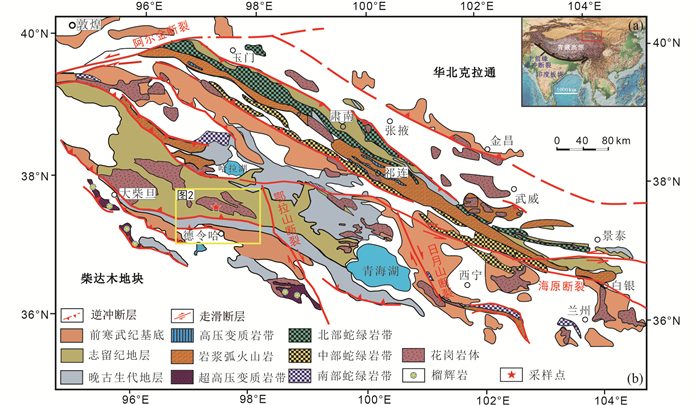
祁连造山带作为一个典型的加里东期造山带(黄汲清等,1977;宋述光,1997;张建新等, 1997, 1998)是华北板块与柴达木地块之间经过碰撞、汇聚、造山作用形成的复合造山带。现今的祁连造山带位于青藏高原东北缘,呈北西西向展布,北以河西走廊盆地为界与华北板块相邻,南以宗务隆山北缘断裂与柴达木地块相隔,西端则被阿尔金断裂截切,东端可延伸至六盘山一带(图 1)。祁连造山带由北向南依次由北祁连缝合带、中祁连地块和南祁连增生杂岩三个构造单元组成(Song et al., 2017; Zhang et al., 2017a;宋述光等,2019),其构造演化经历了早古生代的造山运动(Yin and Harrison, 2000;宋述光等,2004; Xiao et al., 2009;宋述光, 2009;Song et al., 2013, 2014;Wu et al., 2017), 并形成了北祁连蛇绿岩带(王荃和刘雪亚,1976;肖序常等,1978;Song et al., 2013;李冰等, 2016, 2017)、柴北缘超高压变质带(杨经绥等, 1998, 2000;张建新等,2002;Yin et al., 2007;宋述光等, 2013, 2015)和大量的碰撞前、同碰撞和碰撞后的岩浆岩(Gehrels et al., 2003;Yang et al., 2012);中生代伸展作用导致侏罗纪和白垩纪伸展盆地的广泛发育(Vincent and Allen, 1999; Chen et al., 2003; Yin et al., 2008a, b; Zuza and Yin, 2016);新生代以来,受青藏高原东北缘的地壳缩短、挤压变形(Gehrels et al., 2003;Yin et al., 2007;Zuza and Yin, 2016;Zaza et al., 2018)和大规模走滑断裂运动的影响(Duvall et al., 2013; Zuza and Yin, 2016;Li et al., 2019),导致一系列北西向逆冲断裂和走滑断裂发育,并形成了现今的盆-山构造地貌格局(张会平等,2012;戚帮申等,2013;Zhang et al., 2017b)。
|
图 1 祁连造山带大地构造位置图(a)和区域构造简图(b)(据Song et al., 2013;Zhang et al., 2017a修改) Fig. 1 Tectonic location (a) and regional geologic map (b) of Qilian orogen (modified after Song et al., 2013; Zhang et al., 2017a) |
南祁连增生杂岩带作为祁连造山带的构造单元之一(Song et al., 2017;Zhang et al., 2017a),夹持于中祁连地块和宗务隆构造带之间。由于该区域是“祁-秦增生杂岩带”的重要组成部分(Song et al., 2017),同时也是研究祁连造山带与柴达木地块之间构造演化与盆山耦合关系的关键地区之一(陈宣华等,2010),近年来受到了国内外学者的广泛关注。尤其是柴北缘超高压变质带榴辉岩的发现,促进了祁连山造山带构造演化的研究,取得了大量研究成果(杨经绥等,1998;张建新等, 1999, 2008;Song et al., 2004;吴才来等,2004;宋述光等,2011)。但前人对南祁连增生杂岩带早古生代以来的构造热演化历史研究相对较少,且缺少相对准确的年代学数据约束。本文在南祁连增生杂岩带哈拉湖南侧的阿腊郭勒花岗岩体采取了4个二长花岗岩样品,对其进行了LA-ICP-MS锆石U-Pb、岩石主微量元素、锆石和磷灰石裂变径迹的测试分析;在此基础上,结合野外地质调查和构造演化特征,揭示南祁连哈拉湖地区早古生代花岗岩类岩浆侵入事件及其构造热演化历史。
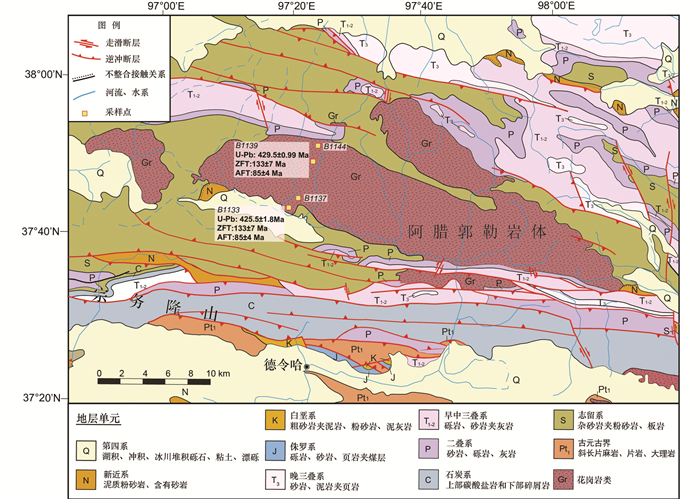
1 区域地质概况南祁连增生杂岩带呈北西西向位于中祁连南缘断裂与宗务隆-青海南山断裂之间,西端在阿克塞一带与阿尔金走滑断裂相交,东端则尖灭于临夏西一带。研究区位于哈拉湖南部地区(图 1b,图 2),该区出露的最老地层为古元古界斜长片麻岩、片岩和大理岩等,大面积出露地层为志留系的杂砂岩和板岩,同时分布石炭系海陆过渡相沉积和中生代陆相碎屑沉积,新生代地层则发育了新近系红层和第四系沉积。区域内发育一系列新生代北西西向逆冲断层和近南北向的走滑断层。
|
图 2 南祁连哈拉湖南部地区地质构造简图 Fig. 2 Geological sketch map of the southern Hala Lake area in southern Qilian |
阿腊郭勒岩体位于青海省德令哈市以北约50km处,该岩体侵入于志留系巴龙贡噶尔组(Sb)地层中,出露面积约2200km2,为南祁连增生杂岩带内出露面积最大的侵入岩体之一。该岩体形态呈扁平状,长轴延伸大于100km,指向北西西向,与区域内构造方向相一致(图 2)。该岩体呈岩基状产出,沿加里东褶皱带复背斜轴部侵入巴龙贡噶尔组围岩中,北部被二叠系紫红色砾岩夹砂岩呈不整合覆盖。岩体主要由黑云母二长花岗岩组成,岩体与围岩接触界线较清楚,围岩蚀变显著,具有同化混染现象。
2 样品采集与分析方法 2.1 样品采集及岩石学特征本次工作在南祁连增生杂岩带哈拉湖南部的阿腊郭勒岩体采集了4个二长花岗岩样品(B1133、B1137、B1139和B1144),用于锆石U-Pb、全岩地球化学、锆石和磷灰石裂变径迹的测试分析(表 1)。
|
表 1 二长花岗岩样品信息及测试分析方法 Table 1 Summary of samples and analytical methods |
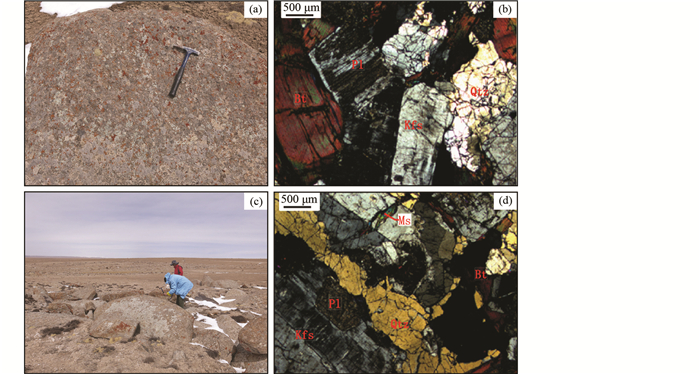
野外观察,岩体呈灰白色,球形风化,块状构造。镜下,采集的岩样呈半自形粒状、似斑状结构(图 3a,c);矿物组成主要包括碱性长石(35%~40%)、斜长石(25%~30%)、石英(20%~25%)、黑云母(8%~10%)和白云母(3%~4%);副矿物可见磁铁矿、锆石、磷灰石。其中,碱性长石多为他形粒状,可见条纹长石和微斜长石,似斑状;斜长石呈半自形柱状,可见聚片双晶,轻微的绢云母化;石英多为他形粒状;黑云母则呈自形片状,边部绿泥石化(图 3b,d)。
|
图 3 岩石样品野外露头照片(a、c)与正交偏光镜下显微照片(b、d) 矿物缩写:Bt-黑云母;Kfs-钾长石;Ms-白云母;Pl-斜长石;Qtz-石英 Fig. 3 Field outcrop (a, c) and microscopic photographs under crossed polars (b, d) of samples Mineral abbreviations: Bt-biotit; Kfs-potassium feldspar; Ms-muscovite; Pl-plagioclase; Qtz-quartz |
样品经人工破碎后,按常规重力和磁选方法分选,并在双目镜下挑选出锆石。将待测样品锆石颗粒、数粒锆石标准M257和TEM置于环氧树脂制靶,用于透射、反射、阴极发光CL和U-Pb定年分析。锆石阴极发光在北京锆年领航科技有限公司日立HITACHIS3000-N型扫描电子显微镜上完成。
锆石U-Pb定年在中国地质科学院矿产资源研究所自然资源部成矿作用与资源评价重点实验室完成,所用仪器为Finnigan Neptune型MC-ICP-MS及与之配套的NewwaveUP213激光剥蚀系统。激光剥蚀所用斑束直径为30μm,频率为10Hz,能量密度约为2.5J/cm2,以He为载气。LA-MC-ICPMS激光剥蚀的采样应用单点剥蚀的方式,锆石U-Pb定年以锆石GJ-1为外标,U、Th含量以锆石M127(U=923×10-6;Th=439×10-6;Th/U=0.475,Nasdala et al., 2008)为外标进行校正。测试过程中,每测定5个点重复测定1个标样锆石GJ1对所获数据进行校正,同时测量一个标样锆石Plesovice,以观察仪器的状态和测试的重现性。所有标样锆石测试值的重现性均在1%(2σ)左右。数据处理采用ICPMS DataCal程序(Liu et al., 2008);测量过程中绝大多数测点的206Pb/204Pb>1000,故未进行普通铅校正;204Pb由离子计数器检测,204Pb含量异常高的分析点可能受包体等普通Pb的影响,对204Pb含量异常高的分析点在计算时剔除;锆石年龄谐和图用Isoplot程序获得, 表达式中所列单个数据点的误差均为1σ,加权平均年龄具95%的置信度。详细实验测试过程可参见侯可军等(2009)。
2.3 岩石地球化学分析样品的全岩主量及微量元素测试在中国地质科学院国家地质实验测试中心完成。主量元素含量由PW4400型X射线荧光光谱仪测定,FeO的检测方法依据GB/T 14506.14—2010,其它主要氧化物的检测方法依据GB/T 14506.28—2010。主量元素的测试分析误差在1%~5%之间。稀土及微量元素含量由PE300D型等离子质谱仪测定,检测方法依据GB/T 14506.30—2010,其分析误差范围在5%以内。
2.4 锆石、磷灰石裂变径迹分析将筛选和分离出的磷灰石和锆石单矿物颗粒分别用环氧基树脂和聚四氟乙丙烯透明塑料片将磷灰石和锆石矿粒固定,制作成光薄片,并研磨抛光揭示矿物颗粒内表面。磷灰石样片在恒温21℃的5.5N HNO3溶液中蚀刻20s以揭示自发径迹;锆石样片在210℃下,使用KOH+NaOH高温熔融物蚀刻20~35h揭示自发径迹(Yuan et al., 2003, 2006)。将低铀白云母片(<4×10⁻⁹) 作为外探测器盖在光薄片上,紧密接触矿粒内表面,与CN5(磷灰石)和CN2(锆石)标准铀玻璃(Bellemans et al., 1995)一并接受热中子辐照(Yuan et al., 2006),照射工作在中国原子能科学研究院的原子反应堆进行。然后在25℃条件下的40% HF中蚀刻白云母外探测器20min揭示诱发径迹。最后需要在高精度光学显微镜100倍干物镜下观测统计裂变径迹。应用IUGS推荐的Zeta常数标定法计算出裂变径迹中心年龄。实验中根据标准磷灰石矿物的测定,加权平均得出Zeta常数值(Hurford and Green, 1983; Hurford, 1990)。本次实验获得的锆石样品和磷灰石样品的Zeta常数分别为90.9±2.8y/cm2和410±17.6y/cm2。磷灰石中裂变径迹退火存在各向异性(Green et al., 1986),选择平行c轴的柱面来测定水平封闭径迹长度、自发径迹密度和诱发径迹密度。
2.5 热历史模拟为了进一步探讨阿腊郭勒岩体花岗岩体及南祁连增生杂岩带的热历史演化过程,本文利用HeFTy v1.9.3软件(Ketcham et al., 2005)及Ketcham et al.(2007)的Multi-kinetic退火模型,同时加入Dpar值作为约束参数进行磷灰石样品的热历史模拟。每个样品的模拟次数均为10000次,通过多次模拟得出可接受的和好的拟合结果,以及最佳模拟曲线。模拟结果的评价标准为GOF检测:当GOF≥0.05, 模拟曲线被认为是可接受的;当GOF≥0.5,模拟曲线被认为是好的模拟曲线(Ketcham, 2005)。基于磷灰石样品裂变径迹的参数(径迹年龄、长度和Dpar值等),每次模拟设定如下约束条件:(1)初始温度设置在实测锆石裂变径迹年龄对应的封闭温度区间(200±20℃);(2) 实测磷灰石裂变径迹年龄的时间,使样品处于部分退火带(PAZ;110~60℃)的温度区间;(3)现今状态使样品处于20±5℃地表温度。
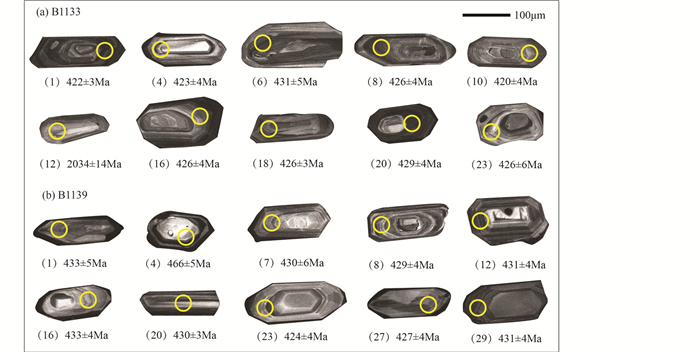
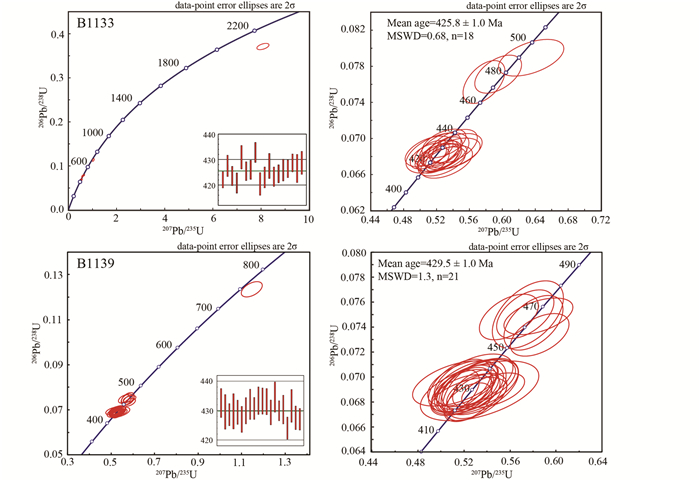
3 分析结果 3.1 LA ICP-MS锆石U-Pb定年二长花岗岩样品B1133中锆石颗粒大小均匀、自形、透明、短柱-长柱状,长约100~250μm,宽约50~100μm,发育岩浆振荡环带(图 4a)。在276颗锆石上进行了25点分析(表 2),其U、Th含量分别为164×10-6~1619×10-6和53×10-6~ 573×10-6,Th/U比值介于0.12~1.02之间,说明测试颗粒均为岩浆型锆石。其中18个测点十分谐和且聚集成簇(图 5),206Pb/238U年龄的加权平均值为425.8±1.0Ma(MSWD=0.68),代表该岩体的结晶年龄在中志留世。点2(693±7Ma)、12(2034±14Ma)、24(737±128Ma)的表面年龄明显偏老,分析点位置同时覆盖了岩浆震荡环带的锆石核及其外部锆石幔(图 4),可能反映捕获性锆石核与岩浆阶段锆石幔的混合年龄。点17(479±5Ma)、点18(474±6Ma)和点21(490±5Ma)虽然谐和性较好,但明显偏老,而且早于柴北缘超高压变质带的形成时间(440~420Ma;Song et al., 2014),因此推测是捕获的早期岩浆锆石。
|
图 4 二长花岗岩锆石阴极发光(CL)图像及测点位置 Fig. 4 Representative CL images and sites of analyzed points of zircons of monzonitic granites |
|
|
表 2 二长花岗岩LA-ICP-MS锆石U-Pb同位素年龄测定结果 Table 2 LA-ICP-MS zircon U-Pb data of monzonitic granites |


|
图 5 二长花岗岩LA-ICP-MS锆石U-Pb谐和图 Fig. 5 Concordia diagrams of LA-ICP-MS zircon U-Pb from monzonitic granites |
二长花岗岩样品B1139中锆石颗粒大小均匀、自形、透明、短柱-长柱状,长约100~250μm,宽约50~100μm,具有明显的岩浆振荡环带(图 4b)。在279颗锆石上进行了29点分析(表 2),其U、Th含量分别为158×10-6~738×10-6和57×10-6~393×10-6,Th/U比值介于0.16~1.06之间,说明测试颗粒均为岩浆型锆石。其中21个测点十分谐和且聚集成簇(图 5),其206Pb/238U年龄的加权平均值为429.5±1.0Ma(MSWD=1.30),代表了该岩体的结晶年代为中志留世。点2(435±5Ma)由于谐和度较低,不予采用。点4、5、15、18、22、25独立成簇且较谐和,206Pb/238U年龄的加权平均值为463.4±3.7Ma(MSWD=3.7),该年龄明显偏老,同样早于柴北缘超高压变质带的形成时间(440~420Ma;Song et al., 2014),推测是捕获的早期岩浆锆石。点28(751±8Ma)明显偏老,分析点位同时覆盖了锆石核及其外部锆石幔,可能反映捕获性锆石核与岩浆阶段锆石幔的混合年龄。
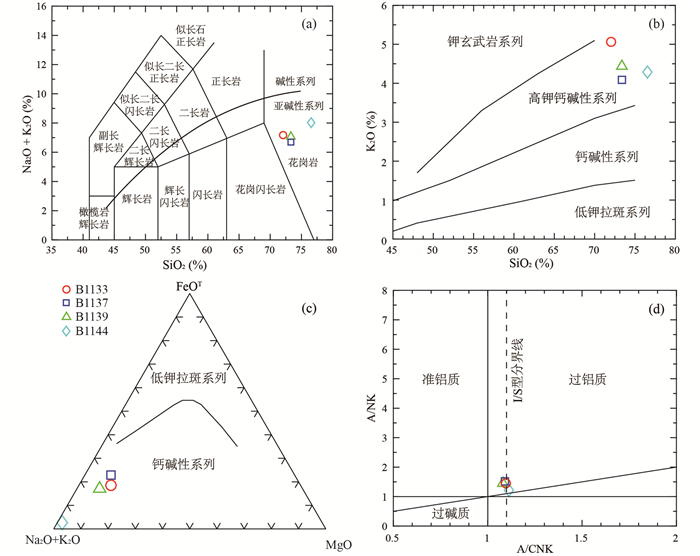
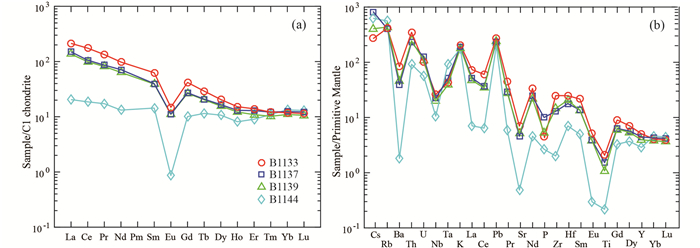
3.2 岩石地球化学特征南祁连增生杂岩带哈拉湖南部阿腊郭勒岩体二长花岗岩样品的主量元素和微量元素分析结果见表 3。可以看出,样品具有高SiO2(72.06%~76.51%)、富Al2O3(13.07%~13.29%)、富碱(ALK=6.68%~8.02%)的特征,并且相对富K2O(4.09%~5.05%,K2O/Na2O=1.14~2.36),过铝质(A/CNK=1.08~1.11),属于高钾钙碱性系列(图 6)。样品(B1133、B1137和B1139)的稀土总量较高(ΣREE=152.1×10⁻⁶~247.1×10⁻⁶),轻稀土富集,(La/Yb)N比值较高(12.07~17.93),Eu负异常明显(δEu=0.20~0.24, 图 7a)。样品B1144的稀土总量则较低为36.31×10⁻⁶,轻稀土不够富集,(La/Yb)N比值很低(1.53),Eu负异常明显(δEu=0.05, 图 7a)。样品球粒陨石标准化稀土元素配分曲线呈现左高右低的L型,同时具有极强的负Eu异常,显示出明显的“V”字型样式。
|
|
表 3 二长花岗岩主量元素(wt%)和微量元素(×10-6)分析结果 Table 3 Analysis results of the major (wt%) and trace (×10-6) elements of the monzonitic granites |
|
图 6 二长花岗岩主量元素特征图 (a)岩浆岩TAS图解(Middlemost, 1994;Le Maitre, 2002);(b)SiO2-K2O分类图解(Rickwood, 1989);(c)AFM分类图解(Irvine and Baragar, 1971);(d)A/CNK-A/NK图解(Maniar and Piccoli, 1989) Fig. 6 Diagrams showing major element features of the monzonitic granites (a) TAS diagram of magmatic rocks (Middlemost, 1994; Le Maitre, 2002); (b) SiO2 vs. K2O diagram (Rickwood, 1989); (c) AFM diagram (Irvine and Baragar, 1971); (d) A/CNK vs. A/NK diagram (Maniar and Piccoli, 1989) |
|
图 7 二长花岗岩球粒陨石标准化稀土元素配分图(a)和原始地幔标准化微量元素蛛网图(b)(标准化值据Sun and McDonough, 1989) Fig. 7 Chondrite-normalized REE patterns (a) and primitive mantle-normalized trace element spider diagrams (b) for the monzonitic granites (normalization values after after Sun and McDonough, 1989) |
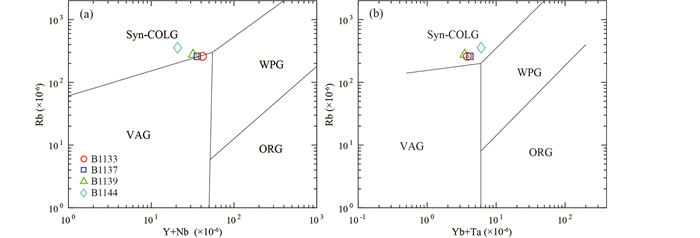
二长花岗岩样品的原始地幔标准化微量元素蛛网图显示(图 7b),岩石相对富集大离子亲石元素(Cs、Rb、K、Th、U),强烈亏损大离子亲石元素(Ba、Sr)和高场强元素(Nb、Ta、Ti、Zr)。Nb、Ta、Ti的亏损以及Zr的相对富集表明岩石的源区中应以陆壳成分为主,而P的亏损和K的富集则反映出阿腊郭勒岩体具有大陆地壳的性质。Rb、Th富集也是上地壳岩石的特点,Ba、Sr、Ti的亏损可以说明成岩过程中斜长石、磷灰石、钛铁矿发生了分离结晶。因此,南祁连增生杂岩带阿腊郭勒岩体的二长花岗岩可能源于壳源物质部分熔融,并且产出于同碰撞的构造环境(图 8)。
|
图 8 二长花岗岩Rb-(Y+Nb)图解(a)和Rb-(Yb+Ta)图解(b)(据Pearce et al., 1984) Syn-COLG-同碰撞型花岗岩;VAG-火山弧型花岗岩;WPG-板内型花岗岩;ORG-洋脊型花岗岩 Fig. 8 Diagrams of the Rb vs. Yb+Nb (a) and Rb vs. Yb+Ta (b) of the monzonitic granites (after Pearce et al., 1984) Syn-COLG-syn-collision granite; VAG-volcanic arc granite; WPG-within-plate granite; ORG-ocean ridge granite |
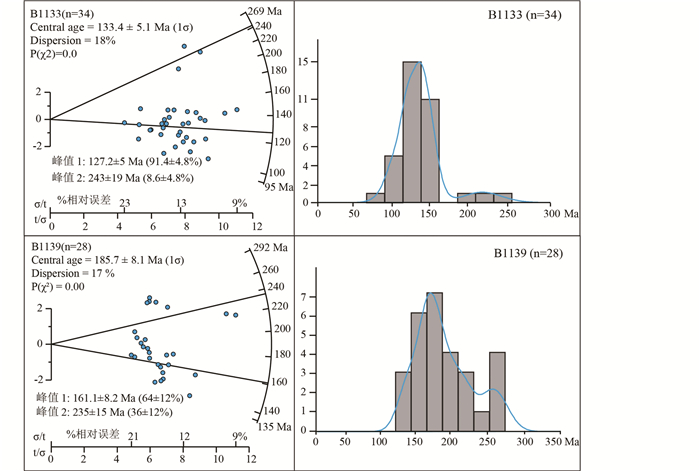
二长花岗岩样品的锆石和磷灰石裂变径迹测年结果见表 4。结果表明:样品B1133和B1139的锆石裂变径迹(ZFT)年龄分别为133±7Ma(±1σ)和186±10Ma(± 1σ)(表 4),明显小于岩浆侵入年龄(425.8±1.0Ma和429.5±1.0Ma;见表 1和图 4),处于早侏罗世至早白垩世时期。样品测试的锆石颗粒数分别为35和28,满足实验要求。同时,2个二长花岗岩样品锆石裂变径迹的P(χ2)值均为0(表 4),表示各单颗粒年龄相对分散,径迹年龄采用中心年龄(Sobel et al., 2006a, b)。单颗粒年龄放射图和直方图显示(图 9),样品B1133的单颗粒年龄离散度为18%,峰值年龄分别为127.2±5Ma(91.4±4.8%)和243±19Ma(8.6±4.8%)。样品B1139的单颗粒年龄离散度为17%,峰值年龄分别为161.1±8.2Ma(64±12%)和235±15Ma(36±12%)。
|
|
表 4 二长花岗岩样品的锆石和磷灰石裂变径迹年龄 Table 4 Zircon- and apatite-fission tracks data of the monzonitic granites |
|
图 9 二长花岗岩锆石裂变径迹年龄辐射图(左)和直方图(右) 左为放射图,其左侧坐标为误差范围,右侧坐标为年龄,横坐标上为相对误差经度,图中圆点为所测试颗粒,直观标明中心年龄、离散度、P(χ2)检验值;右为单颗粒年龄直方图,直观标明样品号和测试颗粒数、曲线为拟合中心年龄趋势 Fig. 9 Zircon fission track age radio plots (left) and histograms (right) of monzonitic granites The left panels are the ZFT radial plots, in which the left, right and horizontal axises indicate age error, ZFT ages and relative error, respectively; the blue circles resprent each measured age; also shown are sample name, central age, dispersion, and chi-squre value, respectively. The right panels are single grain age histogram, the blue curve shows the trend of the fitting center age |
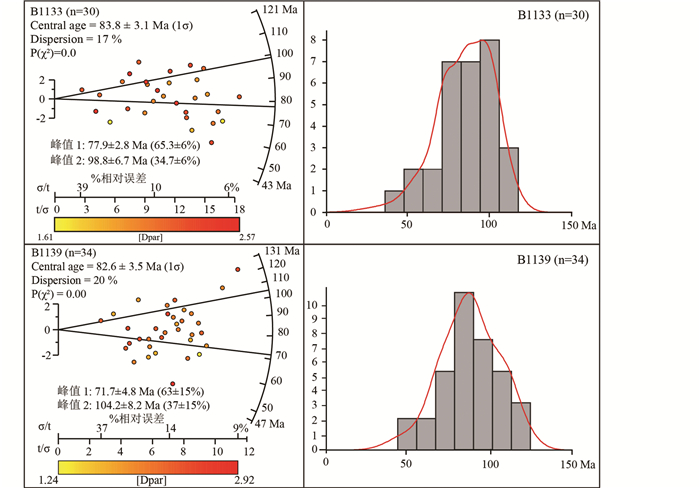
样品的磷灰石裂变径迹(AFT)的年龄分别为85±4Ma(±1σ,B1133)和82± 5Ma(± 1σ,B1139),为晚白垩世早期。样品测试的磷灰石单颗粒数分别为30和34,其P(χ2)值为0,小于5%,表示各单颗粒年龄相对分散,磷灰石裂变径迹年龄同样采用中心年龄(Sobel et al., 2006a, b)。单颗粒年龄放射图和直方图显示(图 10),样品B1133的单颗粒年龄离散度为17%,峰值年龄分别为77.9±2.8Ma(65.3±6%)和98.8±6.7Ma(34.7 ± 6%)。样品B1139的单颗粒年龄离散度为20%,峰值年龄分别为71.1±4.8Ma(63 ± 15%)和104.2±8.2Ma(37±15%),表明样品自早白垩世晚期以来经历了多期热事件的影响。
|
图 10 二长花岗岩磷灰石裂变径迹年龄辐射图(左)和直方图(右) 说明见图 9 Fig. 10 Apatite fission track age radio plots (left) and histograms (right) of monzonitic granites See Fig. 9 for caption note |
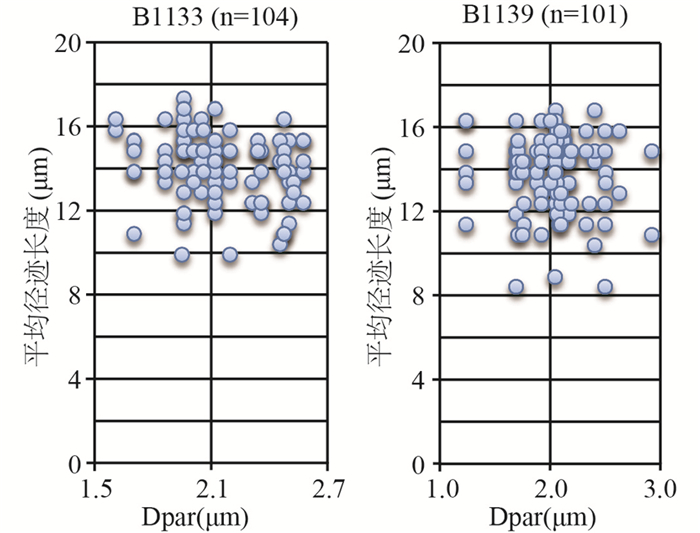
样品的磷灰石围限平均径迹长度(MTL)分别为14.1±1.6μm和13.8±1.9μm(表 4),且围限径迹测试条数均超过100条,表明数据质量较好。该径迹平均长度小于原始径迹长度(16.3±0.9μm;陈刚等,2005),也小于快速冷却至地表温度的裂变径迹平均长度(14.5~15.5μm;Green et al., 1989)。与结晶C轴平行的裂变径迹蚀象的最大直径(Dpar)的平均值分别是2.18和2.12(表 4),但样品的磷灰石裂变径迹年龄辐射图显示,Dpar值稍有分散。样品B1133的Dpar值分布为1.61~2.57μm,样品B1139的Dpar值分布则为1.24~2.92μm,这可能与花岗岩样品数据采集的偏差有关。为了进一步分析样品Dpar值的离散度,本文将2个磷灰石裂变径迹样品的Dpar值与平均径迹长度的关系进行了进一步分析(图 11)。结果显示,样品B1133和B1139的Dpar值分布并未呈现出较明显的不同动力学性质的区间,Dpar值均主要集中在1.8~2.6μm,说明样品中的各组分经历了相同或相似的隆升过程(图 11)。
|
图 11 磷灰石裂变径迹样品的平均径迹长度与Dpar值的关系 Fig. 11 Mean track lengths plotted against Dpar value of the AFT samples |
在任何一地表岩石的长期隆升剥蚀过程中,在由外探测器裂变径迹定年分析中获得的样品径迹年龄可能不具有简单的地质意义,而代表其长期处于部分退火带(PAZ)或者缓慢隆升突破部分退火带的过程(Gleadow and Brown, 2000;张志诚和王雪松,2004)。封闭径迹长度及其分布记录了岩石经历的最高古地温及热历史过程, 是裂变径迹分析中最重要的参数。裂变径迹长度的差异记录了不同样品经历的时间-温度信息,利用径迹年龄和径迹长度,选择一定的退火模型,进行热历史的反演模拟,可以揭露出样品表观年龄下定量的、更详尽的热演化信息,为区域构造热演化历史分析提供更多的依据(张志诚和王雪松,2004;Ketcham et al., 2007)。
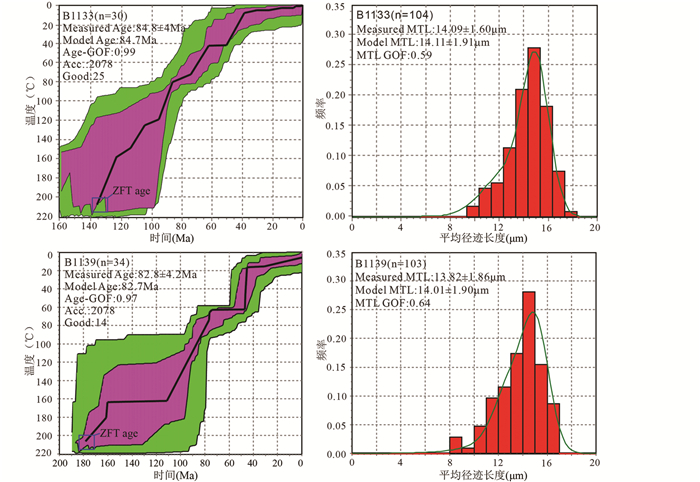
样品B1133和B1139的热历史模拟结果显示,所有样品的GOF(拟合度)检测均大于0.5,模拟质量较高且较为可信。南祁连地区阿腊郭勒岩体经历了3期冷却历史:早白垩世以来,自锆石裂变径迹部分退火带隆升至磷灰石裂变径迹部分退火带的顶部;经过晚白垩世至古新世的构造平静阶段后;于始新世早期以来的再次进入快速隆升阶段(图 12)。
|
图 12 二长花岗岩的热历史模拟图 左侧为时间-温度模拟曲线,紫红色和绿色区域分别代表可接受的和好的拟合结果,黑色实线代表最佳拟合时间-温度曲线,直观标明测试年龄颗粒数、实测径迹年龄、模拟径迹年龄、径迹年龄GOF值、可接受的模拟曲线数和好的曲线数;ZFT age为锆石裂变径迹年龄. 右侧为样品内径迹长度直方图,直观标明测试径迹条数、实测径迹长度、模拟径迹长度和平均径迹长度GOF值 Fig. 12 Thermal history models of monzonitic granites The left panels are modeled time-temperature path: the purple and green areas represent good and acceptable fits, respectively; the dark black curve indicates the best fit; Also shown are sample name, numbers of analysed single grain, measured fission track ages, modeled fission track ages, GOF (Good of fit) value, number of acceptable fits, and number of good fits, respectively.The right panels are modeled mean track length distribution histogram: Also shown are sample name, numbers of measured track length, measured mean track length, modeled mean track length and its GOF value, respectively |
锆石U-Pb定年结果显示,哈拉湖南部的二长花岗岩B1133和B1139的侵位年龄分别为425.8±1.0Ma(MSWD=0.68)和429.5±1.0Ma(MSWD=1.30),表明阿腊郭勒岩体形成于中志留世。
前人的研究表明:由于祁连洋洋壳的俯冲,祁连山到柴北缘地区在520~440Ma主要发育岛弧岩浆作用(Song et al., 2013, 2014, 2017;Xia et al., 2003, 2012),而在440~360Ma则主要发育与大陆碰撞和碰撞后的造山带垮塌有关的岩浆作用(Song et al., 2014;Wang et al., 2014;宋述光等,2019)。前人在南祁连地区获得的花岗岩类侵入年龄的峰值主要集中在446~440Ma(吴才来等,2001;Gehrels et al., 2003;卢欣祥等,2007;张照伟等, 2012),且岩石地球化学特征显示南祁连增生杂岩带存在该时期的洋壳俯冲环境下岛弧岩浆活动形成的Ⅰ型花岗岩(罗志文等,2015),证明其与祁连洋闭合早期大洋俯冲作用导致的岛弧岩浆活动密切相关。而本文获得的哈拉湖南部阿腊郭勒岩体的LA-ICP-MS锆石U-Pb年龄显示该岩体的侵位时代为中志留世(425~429Ma),岩石地球化学特征显示阿腊郭勒岩体的二长花岗岩可能源于壳源物质部分熔融,且产出于同碰撞的构造环境,并且南祁连-柴北缘地区在同时期(440~420Ma)发生了大陆深俯冲引起的超高压变质作用(Song et al., 2014),表明该期岩浆事件是与祁连洋洋壳俯冲结束后的柴北缘大陆碰撞过程中的岩浆活动有关,代表了柴北缘超高压变质带大陆俯冲折返过程中大陆地壳的深熔作用(宋述光等, 2013, 2015)。该结果也与柴北缘绿梁山和锡铁山地区的花岗岩形成的时代与构造环境相一致(孟繁聪和张建新,2008;Yang et al., 2020)。
4.2 南祁连哈拉湖南部地区早白垩世以来的冷却历史南祁连哈拉湖地区阿腊郭勒岩体二长花岗岩样品的锆石和磷灰石裂变径迹年龄及热历史模拟结果表明,南祁连哈拉湖南部地区自早白垩世以来经历了至少3个阶段的冷却历史:(1)早白垩世以来的快速隆升阶段;(2)晚白垩世-古新世的构造平静阶段;(3)始新世早期以来的快速隆升阶段。
中生代中晚期的构造活动影响了青藏高原北缘及东北缘的大部分地区(Vincent and Allen, 1999;Jolivet et al., 2001;Chen et al., 2003;李海兵等, 2004, 2006;Yin et al., 2007, 2008a, b;蒋荣宝等,2008;Cheng et al., 2019; Zhang et al., 2020; Wang et al., 2022),南祁连增生杂岩带哈拉湖南部地区早白垩世以来也发育了一期快速冷却的事件(图 12)。该期构造活动反映了白垩纪的地壳隆升,与该区缺失白垩纪地层相一致,是一次区域性的隆升事件。地震剖面显示柴北缘和南祁连地区发育早白垩世逆冲断层(Zhang et al., 2020),而祁连山北缘榆木山地区则发育有系列早白垩世早期的走滑双重构造、逆冲推覆和飞来峰构造(陈宣华等,2019;Wang et al., 2022),这些变形均说明早白垩世早期的区域性挤压构造活动规模巨大。同时,阿尔金断裂东段地区在100~120Ma和~82Ma发育的两期岩浆活动(李海兵等,2004),河西走廊地区早白垩世碎屑岩层序地层及沉积特征则较好地记录了早白垩世祁连山隆升过程(唐玉虎等,2008;梅冥相和苏德辰, 2014a, b;郭荣涛等, 2015, 2016)。祁连山白垩纪早期的快速隆升可能主要受拉萨地块与欧亚板块沿班公湖-怒江缝合带碰撞远程效应的影响(Vincent and Allen, 1999;Jolivet et al., 2001;李海兵等,2004;Cheng et al., 2019),并初步构成了青藏高原雏形的东北部边界。
前人用磷灰石裂变径迹方法获得的南祁连地区的隆升过程表明,南祁连地区经历了晚白垩世-古新世期间短暂的构造夷平阶段后,于始新世早期再次转入快速隆升阶段(Qi et al., 2016;戚帮申等,2016)。柴达木盆地中新生代沉积岩的碎屑磷灰石裂变径迹方法也同样获得了54~47Ma的快速剥蚀与沉积记录,南祁连山和柴北缘地区则为此提供了沉积物源(Jian et al., 2018)。南祁连地区始新世的区域性构造运动最终导致哈拉湖地区早期发育的夷平面在34Ma的解体(贾丽云等,2018)。同时,中祁连地区、阿尔金北缘山脉和党河南山在约40Ma的快速冷却剥蚀(Jolivet et al., 2001;孙岳等,2014;Li et al., 2020),以及始新世晚期-渐新世河西走廊盆地和中祁连木里盆地内火烧沟组(E2-3h)与上覆白杨河组(E3N1b)均呈微角度不整合接触(戴霜等,2005;戚帮申等,2013),这些证据均显示出青藏高原北部在始新世-渐新世存在构造变形与隆升。同时,青藏高原东北缘新生代陆内变形过程所导致的地壳增厚使得南祁连增生杂岩带的地壳厚度达到了区域内的最大值(Gao et al., 1999),并具有向南北两侧(柴达木盆地和中祁连地块)逐渐减薄的趋势,因此南祁连增生杂岩带应该是祁连山地区新生代以来最早发生地壳缩短的关键地区(Gao et al., 1999;He et al., 2018;Huang et al., 2021)。祁连山在新生代早期的挤压变形可能与早古生代祁连洋闭合时向南俯冲的化石俯冲带作为先存构造薄弱带而导致的印度与欧亚板块碰撞的远程效应有关(Chen et al., 2020;Li et al., 2021)。受这一系列强烈构造活动的影响,祁连山及其周缘地区主要以系列逆冲断层的形式协调青藏高原向北东方向的生长(Tapponnier et al., 1990;Burchfiel et al., 1991;Vincent and Allen, 1999;Zhang et al., 2004;Yuan et al., 2013;Zuza and Yin, 2016;Allen et al., 2017;Li et al., 2019),同时也开启了青藏高原东北缘自印度板块和欧亚板块碰撞以来的初始隆升与地壳增厚(Meyer et al., 1998; Lease et al., 2012; Zuza and Yin, 2016;Zuza et al., 2018)。
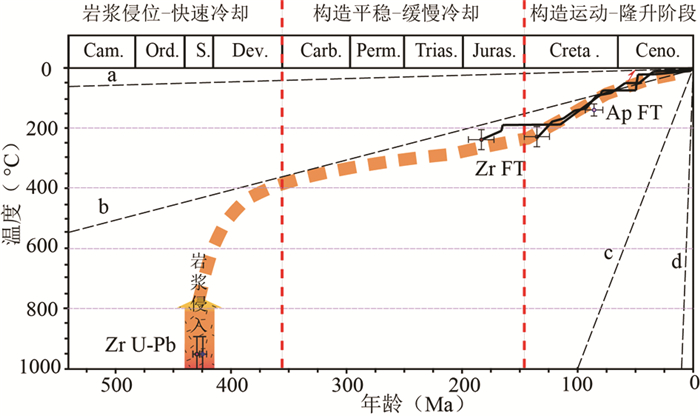
4.3 南祁连哈拉湖南部地区构造热演化历史构造热年代学以构造地质学理论为指导,可以为大陆内部不同块体的构造变形时间、山体抬升和盆地沉降速率等提供精细的年代与热作用制约(王瑜,2004)。其中,矿物封闭温度是认识地质体形成与剥露作用的热演化历史的重要依据(陈宣华等,2010)。矿物年龄的封闭温度取自前人有关实验资料:锆石U-Pb年代学封闭温度取>900℃(Cherniak and Watson, 2001, 2003),锆石裂变径迹法的封闭温度为240~210℃(Zaun and Wagner, 1985;Bernet et al., 2009),磷灰石裂变径迹法封闭温度为110~60℃(Gleadow and Duddy, 1981;Ketcham et al., 2007)。将不同方法的测年数据、封闭温度和地温梯度联系在一起形成热年代学曲线,并结合区域构造演化特征,揭示南祁连增生杂岩带哈拉湖南部地区的热演化历史和山脉隆升过程。
根据南祁连哈拉湖地区阿腊郭勒岩体二长花岗岩的LA-ICP-MS锆石U-Pb年龄、岩石地球化学特征、锆石和磷灰石裂变径迹年龄和热历史模拟结果,并结合区域构造演化特征,得到该地区的构造热年代学演化历史曲线图(图 13)。结果表明,该区域在中志留世(425~429Ma)发生了一期与祁连洋洋壳俯冲结束后的大陆碰撞过程有关的岩浆侵位过程,并伴随有榴辉岩相超高压变质作用(宋述光等,2013;Song et al., 2014),在晚志留世-早泥盆世期间受强烈的造山运动影响而快速冷却,使得志留纪残余海盆相复理石建造和泥盆纪磨拉石不整合的沉积覆盖于基岩之上(Zuza et al., 2018)。自晚泥盆世至侏罗纪,南祁连地区进入了陆表海和海陆交互相沉积的构造平稳阶段,岩体进入缓慢冷却阶段。自早白垩世以来,该地区再次进入快速隆升阶段,并初步构成了青藏高原雏形的东北部边界。经过晚白垩世-古新世短暂的构造平静期,受印度板块与欧亚板块挤压作用远程效应的影响,祁连山地区以发育一系列褶皱、逆冲断层、走滑断层和区域地层角度不整合的方式协调青藏高原向北东方向的隆升与扩展。
|
图 13 南祁连哈拉湖地区早古生代岩浆侵入事件和构造热演化历史图解(据陈宣华等,2010;Chen et al., 2015) a、b、c、d分别为冷却速率0.1℃/Myr、1℃/Myr、10℃/Myr和100℃/Myr线;其余虚线为推测冷却曲线 Fig. 13 Temperature-time-depth diagram showing the tectonic thermal evolution history of the Early Paleozoic intrusive magmatism in Hala Lake area, southern Qilian (modified after Chen et al., 2010, 2015) a, b, c, d indicate the cooling rate of 0.1℃/Myr, 1℃/Myr, 10℃/Myr and 100℃/Myr, respectively. The bold dashed line represents speculative cooling curve |
通过南祁连增生杂岩带哈拉湖地区阿腊郭勒岩体的LA-ICP-MS锆石U-Pb年龄、岩石地球化学特征、锆石和磷灰石裂变径迹年龄以及热历史模拟结果,结合前人研究成果得出如下结论:
(1) 锆石U-Pb定年结果和岩石地球化学特征显示,南祁连增生杂岩带哈拉湖南部阿腊郭勒岩体的二长花岗岩(B1133和B1139)侵位年龄分别为425.5±1.0Ma(MSWD=0.68)和429.5±1.0Ma(MSWD=1.30),代表了阿腊郭勒岩体的侵入时代,表明南祁连哈拉湖地区在中志留世发生一期岩浆侵入事件。岩石地球化学特征显示该岩体具有壳源花岗岩特征,且产出于同碰撞的构造环境,说明该期岩浆事件是与祁连洋洋壳俯冲结束后的柴北缘地区大陆碰撞过程中的岩浆活动有关。
(2) 锆石和磷灰石裂变径迹年龄、热历史模拟结果和区域构造变形特征显示,哈拉湖地区自早白垩世以来经历了至少3个阶段的冷却历史:早白垩世以来的快速隆升阶段;晚白垩世-古新世的构造平静阶段;始新世早期以来的快速隆升阶段。
(3) 揭示了南祁连哈拉湖地区在中志留世-晚泥盆世的区域深成岩浆侵入和快速隆升过程、晚泥盆世-侏罗纪的构造平稳与缓慢冷却阶段以及早白垩世以来的中低温冷却和快速隆升的构造热演化历史。
致谢 LA-ICP-MS锆石U-Pb测年分析得到了中国地质大学(北京)邵浩浩硕士和中国地质科学院苗慧心硕士的帮助;图件绘制工作得到了中国地质科学院丁伟翠高级工程师和徐盛林助理研究员的指导与帮助;锆石和磷灰石裂变径迹测试由中国地质大学(北京)袁万明教授协助完成;北京大学宋述光教授和另外一位匿名审稿专家的细致审稿,给本文提出了诸多建设性意见;作者对他们谨表衷心感谢。
Allen MB, Walters RJ, Song SG, Saville C, De Paola N, Ford J, Hu ZX and Sun WL. 2017. Partitioning of oblique convergence coupled to the fault locking behavior of fold-and-thrust belts: Evidence from the Qilian Shan, northeastern Tibetan Plateau. Tectonics, 36(9): 1679-1698 DOI:10.1002/2017TC004476
|
Bellemans F, De Corte F and van Den Haute P. 1995. Composition of SRM and CN U-doped glasses: Significance for their use as thermal neutron fluence monitors in fission track dating. Radiation Measurements, 24(2): 153-160 DOI:10.1016/1350-4487(94)00100-F
|
Bernet M, Brandon M, Garver J, Balestieri ML, Ventura B and Zattin M. 2009. Exhuming the Alps through time: Clues from detrital zircon fission-track thermochronology. Basin Research, 21(6): 781-798 DOI:10.1111/j.1365-2117.2009.00400.x
|
Burchfiel BC, Zhang PZ, Wang YP, Zhang WQ, Song FM, Deng QD, Molnar P and Royden L. 1991. Geology of the Haiyuan fault zone, Ningxia Hui Autonomous Region, China, and its relation to the evolution of the northeastern margin of the Tibetan Plateau. Tectonics, 10(6): 1091-1110 DOI:10.1029/90TC02685
|
Chen G, Zhao ZY, Li PL, Ren ZL, Chen JP and Tan MY. 2005. Fission track evidence for the tectonic-thermal history of the Hefei basin. Chinese Journal of Geophysics, 48(6): 1366-1374 (in Chinese with English abstract)
|
Chen L, Liu LJ, Capitanio FA, Gerya TV and Li Y. 2020. The role of pre-existing weak zones in the formation of the Himalaya and Tibetan Plateau: 3-D thermomechanical modelling. Geophysical Journal International, 221(3): 1971-1983 DOI:10.1093/gji/ggaa125
|
Chen XH, Yin A, Gehrels GE, Cowgill ES, Grove M, Harrison TM and Wang XF. 2003. Two phases of Mesozoic north-south extension in the eastern Altyn Tagh range, northern Tibetan Plateau. Tectonics, 22(5): 1053
|
Chen XH, Dang YQ, Yin A, Wang LQ, Jiang WM, Jiang RB, Zhou SP, Liu MD, Ye BY, Zhang M, Ma LX and Li L. 2010. Basin-Mountain Coupling and Tectonic Evolution of Qaidam Basin and Its Adjacent Orogenic Belts. Beijing: Geological Publishing House, 1-365 (in Chinese)
|
Chen XH, Wang ZH, Chen ZL, Seitmuratova E, Han SQ, Zhou Q and Ye BY. 2015. SHRIMP U-Pb, Ar-Ar and fission-track geochronology of W-Mo deposits in the Balkhash Metallogenic Belt (Kazakhstan), Central Asia, and the geological implications. Journal of Asian Earth Sciences, 110: 19-32 DOI:10.1016/j.jseaes.2014.07.016
|
Chen XH, Shao ZG, Xiong XS, Gao R, Xu SL, Zhang YP, Li B and Wang Y. 2019. Early Cretaceous overthrusting of Yumu mountain and hydrocarbon prospect on the northern margin of the Qilian orogenic belt. Acta Geoscientia Sinica, 40(3): 377-392 (in Chinese with English abstract)
|
Cheng F, Jolivet M, Guo ZJ, Lu HY, Zhang B, Li XZ, Zhang DW, Zhang CH, Zhang HZ, Wang L, Wang ZQ and Zhang QQ. 2019. Jurassic-Early Cenozoic tectonic inversion in the Qilian Shan and Qaidam Basin, North Tibet: New insight from seismic reflection, isopach mapping, and drill core data. Journal of Geophysical Research: Solid Earth, 124(11): 12077-12098 DOI:10.1029/2019JB018086
|
Cherniak DJ and Watson EB. 2001. Pb diffusion in zircon. Chemical Geology, 172(1-2): 5-24 DOI:10.1016/S0009-2541(00)00233-3
|
Cherniak DJ and Watson EB. 2003. Diffusion in zircon. Reviews in Mineralogy and Geochemistry, 53(1): 113-143 DOI:10.2113/0530113
|
Dai S, Fang XM, Song CH, Gao JP, Gao DL and Li JJ. 2005. Early uplift of northern Qinghai-Tibet Plateau. Chinese Science Bulletin, 50(7): 673-683 (in Chinese) DOI:10.1360/csb2005-50-7-673
|
Duvall AR, Clark MK, Kirby E, Farley KA, Craddock WH, Li CY and Yuan DY. 2013. Low-temperature thermochronometry along the Kunlun and Haiyuan faults, NE Tibetan Plateau: Evidence for kinematic change during late-stage orogenesis. Tectonics, 32(5): 1190-1211 DOI:10.1002/tect.20072
|
Gao R, Cheng X and Wu G. 1999. Lithospheric structure and geodynamic model of the Golmud-Ejn transect in northern Tibet. In: Macfarlane A, Sorkhabi RB and Quade J (eds.). Himalaya and Tibet: Mountain Roots to Mountain Tops. Boulder, Colorado: Geological Society of America Special Paper, 328: 9-17
|
Gehrels GE, Yin A and Wang XF. 2003. Magmatic history of the northeastern Tibetan Plateau. Journal of Geophysical Research, 108(B9): 2423
|
Gleadow AJW and Duddy IR. 1981. A natural long-term track annealing experiment for apatite. Nuclear Tracks, 5(1-2): 169-174 DOI:10.1016/0191-278X(81)90039-1
|
Gleadow AJW and Brown RW. 2000. Fission track thermochronology and the long-term denudational response to tectonics. In: Summerfield MA (ed.). Geomorphology and Global Tectonics. New York: John Wiley, 57-75
|
Green PF, Duddy IR, Gleadow AJW, Tingate PR and Laslett GM. 1986. Thermal annealing of fission tracks in apatite: 1. A qualitative description. Chemical Geology: Isotope Geoscience Section, 59: 237-253 DOI:10.1016/0168-9622(86)90074-6
|
Green PF, Duddy IR, Laslett GM, Hegarty KA, Gleadow AJW and Lovering JF. 1989. Thermal annealing of fission tracks in apatite: 4. Quantitative modelling techniques and extension to geological timescales. Chemical Geology: Isotope Geoscience Section, 79(2): 155-182 DOI:10.1016/0168-9622(89)90018-3
|
Guo RT, Guo LN, Zhou SY, Zhang YS and Zhao J. 2015. Sequence stratigraphic succession of the Cretaceous clastic rock system in Zhangye City: Sedimentological response to the Cretaceous uplift of the Qilian Mountains. Acta Sedimentologica Sinica, 33(5): 878-890 (in Chinese with English abstract)
|
Guo RT, Zhao X, Liu HG, Shi KB, Liu J and Jiang QC. 2016. Sequence stratigraphic succession of the Lower Cretaceous clastic rock system in Lanzhou Basin: Sedimentological response to the Early Cretaceous uplift of Qilian Mountains. Journal of Jilin University (Earth Science Edition), 46(2): 321-335 (in Chinese with English abstract)
|
He PJ, Song CH, Wang YD, Meng QQ, Chen LH, Yao LH, Huang RH, Feng W and Chen S. 2018. Cenozoic deformation history of the Qilian Shan (northeastern Tibetan Plateau) constrained by detrital apatite fission-track thermochronology in the northeastern Qaidam Basin. Tectonophysics, 749(6): 1-11
|
Hou KJ, Li YH and Tian YR. 2009. In situ U-Pb zircon dating using laser ablation-multi ion counting-ICP-MS. Mineral Deposits, 28(4): 481-492 (in Chinese with English abstract)
|
Huang JQ, Ren JS, Jiang CF, Zhang ZM and Xu ZQ. 1977. An outline of the tectonic characteristics of China. Acta Geologica Sinica, (2): 117-135 (in Chinese with English abstract)
|
Huang XF, Gao R, Li WH and Xiong XS. 2021. Seismic reflection evidence of crustal duplexing and lithospheric underthrusting beneath the western Qilian mountains, northeastern margin of the Tibetan Plateau. Science China (Earth Sciences), 64(1): 96-109 DOI:10.1007/s11430-020-9677-y
|
Hurford AJ and Green PF. 1983. The zeta age calibration of fission-track dating. Chemical Geology, 41: 285-317 DOI:10.1016/S0009-2541(83)80026-6
|
Hurford AJ. 1990. Standardization of fission track dating calibration: Recommendation by the Fission Track Working Group of the I.U.G.S. Subcommission on Geochronology. Chemical Geology: Isotope Geoscience Section, 80(2): 171-178 DOI:10.1016/0168-9622(90)90025-8
|
Irvine TN and Baragar WRA. 1971. A guide to the chemical classification of the common volcanic rocks. Canadian Journal of Earth Sciences, 8(5): 523-548 DOI:10.1139/e71-055
|
Jia LY, Wang CQ, Shen YX, Hu DG, Zhao XT, Qi BS, Zhao TL and Tao T. 2018. Formaiton age of the planation surface in Qilian Mountasins: Evidence from the electron spin resonance (ESR) dating. Quaternary Sciences, 38(3): 668-679 (in Chinese with English abstract)
|
Jian X, Guan P, Zhang W, Liang HH, Feng F and Fu L. 2018. Late Cretaceous to Early Eocene deformation in the northern Tibetan Plateau: Detrital apatite fission track evidence from northern Qaidam Basin. Gondwana Research, 60: 94-104 DOI:10.1016/j.gr.2018.04.007
|
Jiang RB, Chen XH, Dang YQ, Yin A, Wang LQ, Jiang WM, Wan JL, Li L and Wang XF. 2008. Apatite fission track evidence for two phases Mesozoic-Cenozoic thrust faulting in eastern Qaidam Basin. Chinese Journal of Geophysics, 51(1): 116-124 (in Chinese with English abstract)
|
Jolivet M, Brunel M, Seward D, Xu Z, Yang J, Roger F, Tapponnier P, Malavieille J, Arnaud N and Wu C. 2001. Mesozoic and Cenozoic tectonics of the northern edge of the Tibetan Plateau: Fission-track constraints. Tectonophysics, 343(1-2): 111-134 DOI:10.1016/S0040-1951(01)00196-2
|
Ketcham RA. 2005. Forward and inverse modeling of low-temperature thermochronometry data. Reviews in Mineralogy and Geochemistry, 58(1): 275-314 DOI:10.2138/rmg.2005.58.11
|
Ketcham RA, Carter A, Donelick RA, Barbarand J and Hurford AJ. 2007. Improved modeling of fission-track annealing in apatite. American Mineralogist, 92(5-6): 799-810 DOI:10.2138/am.2007.2281
|
Lease RO, Burbank DW, Zhang HP, Liu JH and Yuan DY. 2012. Cenozoic shortening budget for the northeastern edge of the Tibetan Plateau: Is lower crustal flow necessary?. Tectonics, 31(3): TC3011
|
Le Maitre RW. 2002. Igneous Rocks: A Classification and Glossary of Term. 2nd Edition. Cambridge: Cambridge University Press, 1-236
|
Li B, Zhang YL, Wang CQ and Hu DG. 2016. Geochemical characteristics of the Youhulugou basalts in the suture zone of the North Qilian Mountain. Journal of Geomechanics, 22(1): 48-55 (in Chinese with English abstract)
|
Li B, Hu DG, Chen XH, Zhang YL, Wu HH and Wang CQ. 2017. Zircon U-Pb age of granite porphyry within Youhulugou ophiolite in the suture zone of North Qilian Mountains and its geological implications. Geoscience, 31(6): 1170-1176 (in Chinese with English abstract)
|
Li B, Chen XH, Zuza AV, Hu DG, Ding WC, Huang PH and Xu SL. 2019. Cenozoic cooling history of the North Qilian Shan, northern Tibetan Plateau, and the initiation of the Haiyuan fault: Constraints from apatite- and zircon-fission track thermochronology. Tectonophysics, 751: 109-124 DOI:10.1016/j.tecto.2018.12.005
|
Li B, Zuza AV, Chen XH, Hu DG, Shao ZG, Qi BS, Wang ZZ, Levy DA and Xiong XS. 2020. Cenozoic multi-phase deformation in the Qilian Shan and out-of-sequence development of the northern Tibetan Plateau. Tectonophysics, 782-783: 228423 DOI:10.1016/j.tecto.2020.228423
|
Li B, Zuza AV, Chen XH, Wang ZZ, Shao ZG, Levy DA, Wu C, Xu SL and Sun YJ. 2021. Pre-Cenozoic evolution of the northern Qilian Orogen from zircon geochronology: Framework for early growth of the northern Tibetan Plateau. Palaeogeography, Palaeoclimatology, Palaeoecology, 562: 110091 DOI:10.1016/j.palaeo.2020.110091
|
Li HB and Yang JS. 2004. Evidence for Cretaceous uplift of the northern Qinghai-Tibetan Plateau. Earth Science Frontiers, 11(4): 345-359 (in Chinese with English abstract)
|
Liu YS, Hu ZC, Gao S, Günther D, Xu J, Gao CG and Chen HH. 2008. In situ analysis of major and trace elements of anhydrous minerals by LA-ICP-MS without applying an internal standard. Chemical Geology, 257(1-2): 34-43 DOI:10.1016/j.chemgeo.2008.08.004
|
Liu ZW, Wang CL and Shi XH. 2006. Granitoids characteristics and tectonic setting of Danghenanshan area in South Qilian Mountains. Geoscience, 20(4): 545-554 (in Chinese with English abstract)
|
Lu XX, Sun YG, Zhang XT, Xiao QH, Wang XX, Wei XD and Gu DM. 2007. The SHRIMP age of Tatalin rapakivi granite at the north margin of Qaidam Basin. Acta Geologica Sinica, 81(5): 626-634 (in Chinese with English abstract)
|
Luo ZW, Zhang ZC, Li JF, Feng ZS and Tang WH. 2015. Geochronology of two kinds of Paleozoic granitic plutons from Sangewatang in Subei, the western margin of central-South Qilian and their geological implications. Acta Petrologica Sinica, 31(1): 176-188 (in Chinese with English abstract)
|
Mei MX and Su DC. 2014a. Cretaceous sedimentary succession of eolian sandstones in Zhangye region of Gansu Province: Sedimentological response to the Cretaceous uplift of Qilian Mountains. Journal of Palaeogeography, 16(2): 143-156 (in Chinese with English abstract)
|
Mei MX and Su DC. 2014b. Sequence-stratigraphic succession for the course clastic rock system of the Hekou Group in the Gulang County of Gansu Province: Sedimentological response to the Cretaceous uplift of the Qilian Mountains. Geological Review, 60(3): 541-554 (in Chinese with English abstract)
|
Meng FC and Zhang JX. 2008. Contemporaneous of Early Palaeozoic granite and high temperature metamorphism, North Qaidam Mountains, western China. Acta Petrologica Sinica, 24(7): 1585-1594 (in Chinese with English abstract)
|
Meyer B, Tapponnier P, Bourjot L, Metivier F, Gaudemer Y, Peltzer G, Guo SM and Chen ZT. 1998. Crustal thickening in Gansu-Qinghai, lithospheric mantle subduction, and oblique, strike-slip controlled growth of the Tibet Plateau. Geophysical Journal International, 135(1): 1-47 DOI:10.1046/j.1365-246X.1998.00567.x
|
Maniar PD and Piccoli PM. 1989. Tectonic discrimination of granitoids. Geological Society of America Bulletin, 101(5): 635-643 DOI:10.1130/0016-7606(1989)101<0635:TDOG>2.3.CO;2
|
Middlemost EAK. 1994. Naming materials in the magma/igneous rock system. Earth Science Reviews, 37(3-4): 215-224 DOI:10.1016/0012-8252(94)90029-9
|
Nasdala L, Hofmeister W, Norberg N, Martinson JM, Corfu F, Dörr W, Kamo SL, Kennedy AK, Kronz A, Reiners PW, Frei D, Kosler J, Wan YS, Götze J, Häger T, Kröner A and Valley JW. 2008. Zircon M257: A homogeneous natural reference material for the ion microprobe U-Pb analysis of zircon. Geostandards & Geoanalytical Research, 32(3): 247-265
|
Pearce JA, Harris NBW and Tindle AG. 1984. Trace element discrimination diagrams for the tectonic interpretation of granitic rocks. Journal of Petrology, 25(4): 956-983 DOI:10.1093/petrology/25.4.956
|
Qi BS, Hu DG, Wang JS, Zhao XT, Zhang XJ, Zhang YL, Yang XX and Gao XM. 2013. ESR dating of the palaeogene in Muli basin in the middle of Qilian Mountains and its geological significance. Journal of Geomechanics, 19(4): 392-402 (in Chinese with English abstract)
|
Qi BS, Hu DG, Yang XX, Zhang XJ and Zhao XT. 2015. Paleoelevation of the Qilian Mountain inferred from carbon and oxygen isotopes of Cenozoic strata. Acta Geoscientica Sinica, 36(3): 323-332 (in Chinese with English abstract)
|
Qi BS, Hu DG, Yang XX, Zhang YL, Tan CX, Zhang P and Feng CJ. 2016. Apatite fission track evidence for the Cretaceous-Cenozoic cooling history of the Qilian Shan (NW China) and for stepwise northeastward growth of the northeastern Tibetan Plateau since Early Eocene. Journal of Asian Earth Sciences, 124: 28-41 DOI:10.1016/j.jseaes.2016.04.009
|
Qi BS, Hu DG, Yang XX, Zhang YL, Tan CX, Zhang P and Feng CJ. 2016. Apatite fission track study of the Cretaceous-Cenozoic stepwise uplift of the middle segment of the Qilian Mountain. Acta Geoscientica Sinica, 37(1): 46-58 (in Chinese with English abstract)
|
Rickwood P C. 1989. Boundary lines within petrologic diagrams which use oxides of major and minor elements. Lithos, 22(4): 247-263 DOI:10.1016/0024-4937(89)90028-5
|
Sobel ER, Chen J and Heermance RV. 2006a. Late Oligocene-Early Miocene initiation of shortening in the Southwestern Chinese Tian Shan: Implications for Neogene shortening rate variations. Earth and Planetary Science Letters, 247(1-2): 70-81 DOI:10.1016/j.epsl.2006.03.048
|
Sobel ER, Oskin M, Burbank D and Miskolaichuk A. 2006b. Exhumation of basement-cored uplifts: Example of the Kyrgyz range quantified with apatite fission track thermochronology. Tectonics, 25(2): TC2008
|
Song SG. 1997. Tectonic evolution of subductive complex belts in the North Qilian Mountains. Advance in Earth Sciences, 12(4): 351-365 (in Chinese with English abstract)
|
Song SG, Zhang LF and Niu YL. 2004. Ultra-deep origin of garnet peridotite from the North Qaidam ultrahigh-pressure belt, northern Tibetan Plateau, NW China. American Mineralogist, 89(8-9): 1330-1336 DOI:10.2138/am-2004-8-922
|
Song SG, Zhang LF, Niu YL, Song B, Zhang GB and Wang QJ. 2004. Zircon U-Pb SHRIMP ages of eclogites from the North Qilian Mountains in NW China and their tectonic implication. Chinese Science Bulletin, 49(6): 592-595 (in Chinese) DOI:10.1360/csb2004-47-6-592
|
Song SG. 2009. High-pressure metamorphic rocks in the North Qilian oceanic subduction zone, China: A review. Geological Bulletin of China, 28(12): 1769-1778 (in Chinese with English abstract)
|
Song SG, Zhang C, Li XH and Zhang LF. 2011. HP/UHP metamorphic time of eclogite in the Xitieshan terrane, North Qaidam UHPM belt, NW China. Acta Petrologica Sinica, 27(4): 1191-1197 (in Chinese with English abstract)
|
Song SG, Niu YL, Su L and Xia XH. 2013. Tectonics of the North Qilian orogen, NW China. Gondwana Research, 23(4): 1378-1401 DOI:10.1016/j.gr.2012.02.004
|
Song SG, Zhang GB, Zhang C, Zhang LF and Wei CJ. 2013. Dynamic process of oceanic subduction and continental collision: Petrological constraints of HP-UHP belts in Qilian-Qaidam, the northern Tibetan Plateau. Chinese Science Bulletin, 58(23): 2240-2245 (in Chinese) DOI:10.1360/972013-586
|
Song SG, Niu YL, Su L, Zhang C and Zhang LF. 2014. Continental orogenesis from ocean subduction, continent collision/subduction, to orogen collapse, and orogen recycling: The example of the North Qaidam UHPM belt, NW China. Earth-Science Reviews, 129: 59-84 DOI:10.1016/j.earscirev.2013.11.010
|
Song SG, Wang MJ, Wang C and Niu YL. 2015. Magmatism during continental collision, subduction, exhumation and mountain collapse in collisional orogenic belts and continental net growth: A perspective. Science China (Earth Sciences), 58(8): 1284-1304 DOI:10.1007/s11430-015-5102-x
|
Song SG, Yang LM, Zhang YQ, Niu YL, Wang C, Su L and Gao YL. 2017. Qi-Qin accretionary belt in central China Orogen: Accretion by trench jam of oceanic plateau and formation of intra-oceanic arc in the Early Paleozoic Qin-Qi-Kun Ocean. Science Bulletin, 62(15): 1035-1038 DOI:10.1016/j.scib.2017.07.009
|
Song SG, Wu ZZ, Yang LM, Su L, Xia XH, Wang C, Dong JL, Zhou CA and Bi HZ. 2019. Ophiolite belts and evolution of the Proto-Tethys Ocean in the Qilian Orogen. Acta Petrologica Sinica, 35(10): 2948-2970 (in Chinese with English abstract) DOI:10.18654/1000-0569/2019.10.02
|
Sun SS and McDonough W. 1989. Chemical and isotopic systematics of oceanic basalts: Implications for mantle composition and processes. In: Saunders AD and Norry MJ (eds.). Magmatism in the Ocean Basins. Geological Society, London, Special Publications, 42(1): 313-345
|
Sun Y, Chen ZL, Chen BL, Han FB, Zhou YG, Hao RX and Li SB. 2014. Cenozoic uplift and denudation of the EW-trending range of northern Altun Mountains: Evidence from apatite fission track data. Acta Geoscientica Sinica, 35(1): 67-75 (in Chinese with English abstract)
|
Tang YH, Dai S, Huang YB, Zhu Q, Fang XM, Hu HF, Liu JW, Kong L, Zhao J and Liu X. 2008. The Early Cretaceous tectonic uplift of Qilian mountains: Evidence from the sedimentary facies and susceptibility of rocks of the Hekou Group, Lanzhou-Minhe basin. Earth Science Frontiers, 15(2): 261-271 (in Chinese with English abstract)
|
Tapponnier P, Meyer B, Avouac JP, Peltzer G, Gaudemer Y, Guo SM, Xiang HF, Yin KL, Chen ZT, Cai SH and Dai HG. 1990. Active thrusting and folding in the Qilian Shan, and decoupling between upper crust and mantle in northeastern Tibet. Earth and Planetary Science Letters, 97(3-4): 382-383, 387-403 DOI:10.1016/0012-821X(90)90053-Z
|
Vincent SJ and Allen MB. 1999. Evolution of the Minle and Chaoshui basins, China: Implications for Mesozoic strike-slip basin formation in Central Asia. Geological Society of America Bulletin, 111(5): 725-742 DOI:10.1130/0016-7606(1999)111<0725:EOTMAC>2.3.CO;2
|
Wang MJ, Song SG, Niu YL and Su L. 2014. Post-collisional magmatism: Consequences of UHPM terrane exhumation and orogen collapse, N. Qaidam UHPM belt, NW China. Lithos, 210-211: 181-198
|
Wang Q and Liu XY. 1976. Paleo-oceanic crust of the Qilianshan region, western China and its tectonic significance. Scientia Geologica Sinica, 11(1): 42-55 (in Chinese with English abstract)
|
Wang Y. 2004. Some thoughts on tectono-thermochronology. Earth Sciences Frontiers, 11(4): 435-443 (in Chinese with English abstract)
|
Wang Y, Chen XH, Zhang YY, Yin Z, Zuza AV, Yin A, Wang YC, Ding WC, Xu SL, Zhang YP, Li B and Shao ZG. 2022. Superposition of Cretaceous and Cenozoic deformation in northern Tibet: A far-field response to the tectonic evolution of the Tethyan orogenic system. Geological Society of America Bulletin, 134(1-2): 501-525 DOI:10.1130/B35944.1
|
Wu C, Zuza AV, Yin A, Liu CF, Reith R, Zhang JY, Liu WC and Zhou ZG. 2017. Geochronology and geochemistry of Neoproterozoic granitoids in the central Qilian Shan of northern Tibet: Reconstructing the amalgamation processes and tectonic history of Asia. Lithosphere, 9(4): 609-636
|
Wu CL, Yang JS, Ireland T, Wooden J, Li HB, Wan YS and Shi RD. 2001. Zircon SHRIMP ages of Aolaoshan granite from the south margin of Qilianshan and its geological significance. Acta Petrologica Sinica, 17(2): 215-221 (in Chinese with English abstract)
|
Wu CL, Yang JS, Xu ZQ, Wooden JL, Ireland T, Li HB, Shi RD, Meng FC, Chen SY, Persing H and Meibom A. 2004. Granitic magmatism on the Early Paleozoic UHP belt of northern Qaidam, NW China. Acta Geologica Sinica, 78(5): 658-674 (in Chinese with English abstract)
|
Xia LQ, Xia ZC and Xu XY. 2003. Magmagenesis in the Ordovician backarc basins of the northern Qilian Mountains, China. Geological Society of America Bulletin, 115(12): 1510-1522 DOI:10.1130/B25269.1
|
Xia XH, Song SG and Niu YL. 2012. Tholeiite-boninite terrane in the North Qilian suture zone: Implications for subduction initiation and back-arc basin development. Chemical Geology, 328: 259-277 DOI:10.1016/j.chemgeo.2011.12.001
|
Xiao WJ, Windley BF, Yong Y, Yan Z, Yuan C, Liu CZ and Li JL. 2009. Early Paleozoic to Devonian multiple-accretionary model for the Qilian Shan, NW China. Journal of Asian Earth Sciences, 35(3-4): 323-333 DOI:10.1016/j.jseaes.2008.10.001
|
Xiao XC, Chen GM and Zhu ZZ. 1978. A preliminary study on the tectonics of ancient ophiolites in the Qilian mountain, Northwest China. Acta Geologica Sinica, (4): 281-295 (in Chinese with English abstract)
|
Yang JH, Du YS, Cawood PA and Xu YJ. 2012. From subduction to collision in the northern Tibetan Plateau: Evidence from the Early Silurian clastic rocks, northwestern China. The Journal of Geology, 120(1): 49-67 DOI:10.1086/662717
|
Yang JS, Xu ZQ, Li HB, Wu CL, Cui JW, Zhang JX and Chen W. 1998. The eclogites have been found in the northern Qaidam Basin, western China. Science in Bulletin, 43(14): 1544-1549 (in Chinese)
|
Yang JS, Xu ZQ, Song SG, Wu CL, Shi RD, Zhang JX, Wan YS, Li HB, Jin XC and Jolivet M. 2000. Discovery of eclogite in Dulan, Qinghai Province and its significance for studying the HP-UHP metamorphic belt along the Central Orogenic Belt of China. Acta Geologica Sinica, 74(2): 156-168 (in Chinese with English abstract)
|
Yang SX, Su L, Song SG, Allen MB, Feng D, Wang MJ, Wang C and Zhang HY. 2020. Melting of subducted continental crust during collision and exhumation: Insights from granitic rocks from the North Qaidam UHP metamorphic belt, NW China. Lithos, 378-379: 105794 DOI:10.1016/j.lithos.2020.105794
|
Yin A and Harrison TM. 2000. Geologic evolution of the Himalayan-Tibetan orogen. Annual Review of Earth and Planetary Sciences, 28: 211-280 DOI:10.1146/annurev.earth.28.1.211
|
Yin A, Manning CE, Lovera O, Menold CA, Chen XH and Gehrels GE. 2007. Early Paleozoic tectonic and thermomechanical evolution of ultrahigh-pressure (UHP) metamorphic rocks in the northern Tibetan Plateau, Northwest China. International Geology Review, 49(8): 681-716 DOI:10.2747/0020-6814.49.8.681
|
Yin A, Dang YQ, Wang LC, Jiang WM, Zhou SP, Chen XH, Gehrels GE and McRivette MW. 2008a. Cenozoic tectonic evolution of Qaidam Basin and its surrounding regions (part 1): The southern Qilian Shan-Nan Shan thrust belt and northern Qaidam Basin. Geological Society of America Bulletin, 120(7-8): 813-846 DOI:10.1130/B26180.1
|
Yin A, Dang YQ, Zhang M, Chen XH and McRivette MW. 2008b. Cenozoic tectonic evolution of the Qaidam Basin and its surrounding regions (Part 3): Structural geology, sedimentation, and regional tectonic reconstruction. Geological Society of America Bulletin, 120(7-8): 847-876 DOI:10.1130/B26232.1
|
Yuan DY, Ge WP, Chen ZW, Li CY, Wang ZC, Zhang HP, Zhang PZ, Zheng DW, Zheng WJ, Craddock WH, Dayem KE, Duvall AR, Hough BG, Lease RO, Champagnac JD, Burbank DW, Clark MK, Farley KA, Garzione CN, Kirby E, Molnar P and Roe GH. 2013. The growth of northeastern Tibet and its relevance to large-scale continental geodynamics: A review of recent studies. Tectonics, 32(5): 1358-1370 DOI:10.1002/tect.20081
|
Yuan WM, Zhang XT, Dong JQ, Tang YH, Yu FS and Wang SC. 2003. A new vision of the intracontinental evolution of the eastern Kunlun Mountains, northern Qinghai-Tibet Plateau, China. Radiation Measurements, 36(1-6): 357-362 DOI:10.1016/S1350-4487(03)00151-3
|
Yuan WM, Carter A, Dong JQ, Bao ZK, An YC and Guo ZJ. 2006. Mesozoic-Tertiary exhumation history of the Altai Mountains, northern Xinjiang, China: New constraints from apatite fission track data. Tectonophysics, 412(3-4): 183-193 DOI:10.1016/j.tecto.2005.09.007
|
Zaun PE and Wagner GA. 1985. Fission-track stability in zircons under geological conditions. Nuclear Tracks and Radiation Measurements, 10(3): 303-307 DOI:10.1016/0735-245X(85)90119-X
|
Zhang CY, Wu L, Chen WK, Zhang YS, Xiao AC, Zhang JY, Chen SY and Chen HL. 2020. Early Cretaceous foreland-like Northeastern Qaidam Basin, Tibetan Plateau and its tectonic implications: Insights from sedimentary investigations, detrital zircon U-Pb analyses and seismic profiling. Palaeogeography, Palaeoclimatology, Palaeoecology, 557: 109912 DOI:10.1016/j.palaeo.2020.109912
|
Zhang HP, Zhang PZ, Zheng DW, Zheng WJ, Chen ZW and Wang WT. 2012. Tectonic geomorphology of the Qilian Shan: Insights into the Late Cenozoic landscape evolution and deformation in the northeastern Tibetan Plateau. Quaternary Sciences, 32(5): 907-920 (in Chinese with English abstract)
|
Zhang HP, Zhang PZ, Prush V, Zheng DW, Zheng WJ, Wang WT, Liu CC and Ren ZK. 2017b. Tectonic geomorphology of the Qilian Shan in the northeastern Tibetan Plateau: Insights into the plateau formation processes. Tectonophysics, 706-707: 103-115 DOI:10.1016/j.tecto.2017.04.016
|
Zhang JX, Xu ZQ, Li HB and Xu HF. 1997. The transition of orogenic mechanism from compression to extension in northern Qilian orogenic belt. Journal of Changchun University of Earth Sciences, 27(3): 277-283 (in Chinese with English abstract)
|
Zhang JX, Xu ZQ, Xu HF and Li HB. 1998. Framework of north Qilian Caledonian subduction-accretionary wedge and its deformation dynamics. Scientia Geologica Sinica, 33(3): 290-299 (in Chinese with English abstract)
|
Zhang JX, Zhang ZM, Xu ZQ, Yang JS and Cui JW. 1999. The ages of U-Pb and Sm-Nd for eclogite from the western segment of Altyn Tagh tectonic belt: Evidence for existence of Caledonian orogenic root. Chinese Science Bulletin, 44(24): 2256-2259 DOI:10.1007/BF02885933
|
Zhang JX, Meng FC and Qi XX. 2002. Comparison of garnet zoning between eclogites in Da Qaidam and Xitieshan on the northern margin of the Qaidam Basin. Geological Bulletin of China, 21(3): 123-129 (in Chinese with English abstract)
|
Zhang JX, Yu SY and Meng FC. 2008. Metamorphic and deformational evolution of the Iqe-Luofengpo eclogite-gneiss unit in the North Qaidam Mountains, China. Geological Bulletin of China, 27(9): 1468-1474 (in Chinese with English abstract)
|
Zhang PZ, Shen ZK, Wang M, Gan WJ, Bürgmann R, Molnar P, Wang Q, Niu ZJ, Sun JZ, Wu JC, Sun HR and You XZ. 2004. Continuous deformation of the Tibetan Plateau from global positioning system data. Geology, 32(9): 809-812 DOI:10.1130/G20554.1
|
Zhang YQ, Song SG, Yang LM, Su L, Niu YL, Allen MB and Xu X. 2017a. Basalts and picrites from a plume-type ophiolite in the South Qilian Accretionary Belt, Qilian Orogen: Accretion of a Cambrian Oceanic Plateau?. Lithos, 278-281: 97-110 DOI:10.1016/j.lithos.2017.01.027
|
Zhang ZC and Wang XS. 2004. The issues of application for the fission track dating and its geological significance. Acta Scientiarum Naturalium Universitatis Pekinensis, 40(6): 895-905 (in Chinese with English abstract)
|
Zhang ZW, Li WY, Gao YB, Zhang JW, Guo ZP and Li K. 2012. ID-TIMS zircon U-Pb age of Yulonggou intrusive rocks in southern Qilian Mountain and its geological significance. Geological Bulletin of China, 31(2): 455-462 (in Chinese with English abstract)
|
Zuza AV and Yin A. 2016. Continental deformation accommodated by non-rigid passive bookshelf faulting: An example from the Cenozoic tectonic development of northern Tibet. Tectonophysics, 677-678: 227-240 DOI:10.1016/j.tecto.2016.04.007
|
Zuza AV, Wu C, Reith RC, Yin A, Li JH, Zhang JY, Zhang YX, Wu L and Liu WC. 2018. Tectonic evolution of the Qilian Shan: An Early Paleozoic orogen reactivated in the Cenozoic. Geological Society of America Bulletin, 130(5-6): 881-925 DOI:10.1130/B31721.1
|
陈刚, 赵重远, 李丕龙, 任战利, 陈建平, 谭明友. 2005. 合肥盆地构造热演化的裂变径迹证据. 地球物理学报, 48(6): 1366-1374. DOI:10.3321/j.issn:0001-5733.2005.06.020 |
陈宣华, 党玉琪, 尹安, 汪立群, 蒋武明, 蒋荣宝, 周苏平, 刘明德, 叶宝莹, 张敏, 马立协, 李丽. 2010. 柴达木盆地及其周缘山系盆山耦合与构造演化. 北京: 地质出版社, 1-365.
|
陈宣华, 邵兆刚, 熊小松, 高锐, 徐盛林, 张义平, 李冰, 王叶. 2019. 祁连山北缘早白垩世榆木山逆冲推覆构造与油气远景. 地球学报, 40(3): 377-392. |
戴霜, 方小敏, 宋春晖, 高军平, 高东林, 李吉均. 2005. 青藏高原北部的早期隆升. 科学通报, 50(7): 673-683. DOI:10.3321/j.issn:0023-074X.2005.07.011 |
郭荣涛, 郭丽娜, 周生友, 张玉双, 赵婧. 2015. 张掖鹦鸽嘴剖面白垩系碎屑岩层序地层序列: 祁连山白垩纪隆升的沉积学响应. 沉积学报, 33(5): 878-890. |
郭荣涛, 赵习, 刘红光, 石开波, 刘婧, 蒋启财. 2016. 兰州盆地下白垩统碎屑岩层序地层序列: 祁连山早白垩世隆升的沉积学响应. 吉林大学学报(地球科学版), 46(2): 321-335. |
侯可军, 李延河, 田有荣. 2009. LA-MC-ICP-MS锆石微区原位U-Pb定年技术. 矿床地质, 28(4): 481-492. DOI:10.3969/j.issn.0258-7106.2009.04.010 |
黄汲清, 任纪舜, 姜春发, 张之孟, 许志琴. 1977. 中国大地构造基本轮廓. 地质学报, (2): 117-135. |
贾丽云, 王超群, 沈燕绪, 胡道功, 赵希涛, 戚帮申, 张耀玲, 陶涛. 2018. 祁连山夷平面形成时代的ESR年龄证据. 第四纪研究, 38(3): 668-679. |
蒋荣宝, 陈宣华, 党玉琪, 尹安, 汪立群, 蒋武明, 万景林, 李丽, 王小凤. 2008. 柴达木盆地东部中新生代两期逆冲断层作用的FT定年. 地球物理学报, 51(1): 116-124. DOI:10.3321/j.issn:0001-5733.2008.01.015 |
李冰, 张耀玲, 王超群, 胡道功. 2016. 北祁连缝合带油葫芦沟玄武岩地球化学特征. 地质力学学报, 22(1): 48-55. DOI:10.3969/j.issn.1006-6616.2016.01.005 |
李冰, 胡道功, 陈宣华, 张耀玲, 吴环环, 王超群. 2017. 北祁连缝合带油葫芦沟蛇绿岩中花岗斑岩锆石U-Pb年龄及地质意义. 现代地质, 31(6): 1170-1176. DOI:10.3969/j.issn.1000-8527.2017.06.006 |
李海兵, 杨经绥. 2004. 青藏高原北部白垩纪隆升的证据. 地学前缘, 11(4): 345-359. DOI:10.3321/j.issn:1005-2321.2004.04.002 |
卢欣祥, 孙延贵, 张雪亭, 肖庆辉, 王晓霞, 尉向东, 谷德敏. 2007. 柴达木盆地北缘塔塔楞环斑花岗岩的SHRIMP年龄. 地质学报, 81(5): 626-634. DOI:10.3321/j.issn:0001-5717.2007.05.006 |
罗志文, 张志诚, 李建锋, 冯志硕, 汤文豪. 2015. 中南祁连西缘肃北三个洼塘地区古生代两类花岗质侵入岩年代学及其地质意义. 岩石学报, 31(1): 176-188. |
梅冥相, 苏德辰. 2014a. 甘肃张掖地区白垩系风成砂岩沉积序列: 祁连山白垩纪隆升的沉积学响应. 古地理学报, 16(2): 143-156. |
梅冥相, 苏德辰. 2014b. 甘肃古浪河口群粗碎屑岩系的层序地层序列: 祁连山白垩纪隆升的沉积学响应. 地质论评, 60(3): 541-554. |
孟繁聪, 张建新. 2008. 柴北缘绿梁山早古生代花岗岩浆作用与高温变质作用的同时性. 岩石学报, 24(7): 1585-1594. |
戚帮申, 胡道功, 王进寿, 赵希涛, 张绪教, 张耀玲, 杨肖肖, 高雪咪. 2013. 中祁连木里盆地古近系ESR年龄及地质意义. 地质力学学报, 19(4): 392-402. DOI:10.3969/j.issn.1006-6616.2013.04.005 |
戚帮申, 胡道功, 杨肖肖, 张耀玲, 谭成轩, 张鹏, 丰成君. 2016. 祁连山中段白垩纪以来阶段性构造抬升过程的磷灰石裂变径迹证据. 地球学报, 37(1): 46-58. |
宋述光. 1997. 北祁连山俯冲杂岩带的构造演化. 地球科学进展, 1997(04): 49-63. |
宋述光, 张立飞, Niu YL, 宋彪, 张贵宾, 王乾杰. 2004. 北祁连山榴辉岩锆石SHRIMP定年及其构造意义. 科学通报, 49(6): 592-595. DOI:10.3321/j.issn:0023-074X.2004.06.017 |
宋述光. 2009. 北祁连山古大洋俯冲带高压变质岩研究评述. 地质通报, 28(12): 1769-1778. DOI:10.3969/j.issn.1671-2552.2009.12.010 |
宋述光, 张聪, 李献华, 张立飞. 2011. 柴北缘超高压带中锡铁山榴辉岩的变质时代. 岩石学报, 27(4): 1191-1197. |
宋述光, 张贵宾, 张聪, 张立飞, 魏春景. 2013. 大洋俯冲和大陆碰撞的动力学过程: 北祁连-柴北缘高压-超高压变质带的岩石学制约. 科学通报, 58(23): 2240-2245. |
宋述光, 王梦珏, 王潮, 牛耀龄. 2015. 大陆造山带碰撞-俯冲-折返-垮塌过程的岩浆作用及大陆地壳净生长. 中国科学(地球科学), 45(7): 916-940. |
宋述光, 吴珍珠, 杨立明, 苏犁, 夏小洪, 王潮, 董金龙, 周辰傲, 毕衡哲. 2019. 祁连山蛇绿岩带和原特提斯洋演化. 岩石学报, 35(10): 2948-2970. DOI:10.18654/1000-0569/2019.10.02 |
孙岳, 陈正乐, 陈柏林, 韩凤彬, 周永贵, 郝瑞祥, 李松彬. 2014. 阿尔金北缘EW向山脉新生代隆升剥露的裂变径迹证据. 地球学报, 35(1): 67-75. |
唐玉虎, 戴霜, 黄永波, 朱强, 方小敏, 胡鸿飞, 刘俊伟, 孔立, 赵杰, 刘学. 2008. 兰州-民和盆地河口群沉积相和岩石磁化率――祁连山白垩纪隆升的记录. 地学前缘, 15(2): 261-271. DOI:10.3321/j.issn:1005-2321.2008.02.029 |
王荃, 刘雪亚. 1976. 我国西部祁连山区的古海洋地壳及其大地构造意义. 地质科学, 11(1): 42-55. |
王瑜. 2004. 构造-热年代学――发展与思考. 地学前缘, 11(4): 435-443. DOI:10.3321/j.issn:1005-2321.2004.04.010 |
吴才来, 杨经绥, Ireland T, Wooden J, 李海兵, 万渝生, 史仁灯. 2001. 祁连南缘嗷唠山花岗岩SHRIMP锆石年龄及其地质意义. 岩石学报, 17(2): 215-221. |
吴才来, 杨经绥, 许志琴, Wooden JL, Ireland T, 李海兵, 史仁灯, 孟繁聪, 陈松永, Persing H, Meibom A. 2004. 柴达木盆地北缘古生代超高压带中花岗质岩浆作用. 地质学报, 78(5): 658-674. DOI:10.3321/j.issn:0001-5717.2004.05.010 |
肖序常, 陈国铭, 朱志直. 1978. 祁连山古蛇绿岩带的地质构造意义. 地质学报, (4): 281-295. |
杨经绥, 许志琴, 李海兵, 吴才来, 崔军文, 张建新, 陈文. 1998. 我国西部柴北缘地区发现榴辉岩. 科学通报, 43(14): 1544-1549. DOI:10.3321/j.issn:0023-074X.1998.14.023 |
杨经绥, 许志琴, 宋述光, 吴才来, 史仁灯, 张建新, 万渝生, 李海兵, 金小赤, Jolivet M. 2000. 青海都兰榴辉岩的发现及对中国中央造山带内高压――超高压变质带研究的意义. 地质学报, 74(2): 156-168. |
张会平, 张培震, 郑德文, 郑文俊, 陈正位, 王伟涛. 2012. 祁连山构造地貌特征: 青藏高原东北缘晚新生代构造变形和地貌演化过程的启示. 第四纪研究, 32(5): 907-920. DOI:10.3969/j.issn.1001-7410.2012.05.08 |
张建新, 许志琴, 李海兵, 徐惠芬. 1997. 北祁连加里东造山带从挤压到伸展造山机制的转换. 长春地质学院学报, 27(3): 277-283. |
张建新, 许志琴, 徐惠芬, 李海兵. 1998. 北祁连加里东期俯冲-增生楔结构及动力学. 地质科学, 33(3): 290-299. |
张建新, 张泽明, 许志琴, 杨经绥, 崔军文. 1999. 阿尔金构造带西段榴辉岩的Sm-Nd及U-Pb年龄――阿尔金构造带中加里东期山根存在的证据. 科学通报, 44(10): 1109-1112. DOI:10.3321/j.issn:0023-074X.1999.10.021 |
张建新, 孟繁聪, 戚学祥. 2002. 柴达木盆地北缘大柴旦和锡铁山榴辉岩中石榴子石环带对比及地质意义. 地质通报, 21(3): 123-129. DOI:10.3969/j.issn.1671-2552.2002.03.003 |
张建新, 于胜尧, 孟繁聪. 2008. 柴达木北缘鱼卡-落凤坡榴辉岩-片麻岩单元的变质变形演化. 地质通报, 27(9): 1468-1474. DOI:10.3969/j.issn.1671-2552.2008.09.009 |
张志诚, 王雪松. 2004. 裂变径迹定年资料应用中的问题及其地质意义. 北京大学学报(自然科学版), 40(6): 898-905. DOI:10.3321/j.issn:0479-8023.2004.06.007 |
张照伟, 李文渊, 高永宝, 张江伟, 郭周平, 李侃. 2012. 南祁连裕龙沟岩体ID-TIMS锆石U-Pb年龄及其地质意义. 地质通报, 31(2): 455-462. DOI:10.3969/j.issn.1671-2552.2012.02.031 |