 2022, Vol. 38


2. 中国地质调查局中国地质科学院地球深部探测中心, 北京 100037;
3. 中国地质大学(北京), 北京 100083;
4. 自然资源部深地动力学重点实验室, 中国地质科学院地质研究所, 北京 100037
2. China Deep Exploration Center, China Geological Survey & Chinese Academy of Geological Sciences, Beijing 100037, China;
3. China University of Geosciences, Beijing 100083, China;
4. MNR Key Laboratory of Deep-Earth Dynamics, Institute of Geology, Chinese Academy of Geological Sciences, Beijing 100037, China
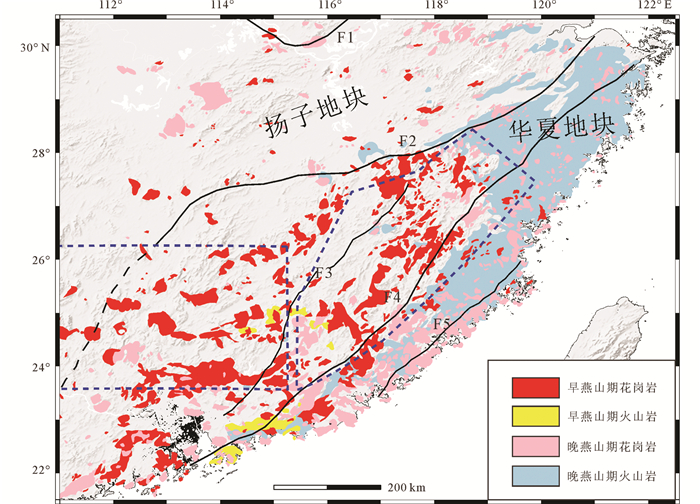
武夷山Cu-Pb-Zn多金属成矿带(武夷山成矿带)地处华夏地块东部,在整体上表现为南西-北东走向的梭子形(丁建华等,2016;林吉焱等,2020;图 1)。受长期构造演化和变形的影响,武夷山成矿带自燕山期以来经历了岩石圈减薄以及多期次、大规模的岩浆活动,形成了良好的成矿条件,成为多种金属矿产资源的富集区(舒良树,2012;丁建华等,2016;林吉焱等,2020;Yan et al., 2021;赵正等,2022)。已有的研究结果表明,武夷山成矿带燕山期花岗质火山-侵入岩十分发育(Zhou et al., 2006;毛建仁等,2014;郭良辉等,2016;阳杰华等,2017;Guo and Gao, 2018;Guo et al., 2019;Zhang et al., 2021b;Zhao et al., 2021;图 2),且Cu、Pb、Zn、Au、Ag、Sn、Fe等金属矿产资源异常丰富,目前已发现约110余种矿产,超过1200余处矿产地(丁建华等,2016),包括著名的紫金山金铜矿(张德全等, 2001a, b)、马坑铁钼矿(张承帅等,2012)以及大排铁铅锌矿(赵希林等,2017),等等。

|
图 1 研究区域构造简图及台站分布图 不同三角形代表不同的地震台站:红色实心三角形代表固定台站(CDSN); 蓝色空心三角形代表中国地质科学院矿产资源研究所布设的流动台站(IMR); 蓝色实心三角形代表北京大学布设的流动台站(PKU).黑色线段代表主要断裂:F1-郯城-庐江断裂、F2-江山-绍兴-萍乡断裂、F3-邵武-河源断裂、F4-政和-大埔断裂、F5-长乐-南澳断裂.红色半透明区域代表华夏地块内主要成矿带的大致范围:1-武夷山成矿带、2-南岭成矿带.黄色虚线代表海南地幔柱可能的位置(参考自Huang,2014;Xia et al., 2016;吕作勇等,2017) Fig. 1 Sketch map of our study area and the distribution of seismic stations used in our study Different triangles indicate different seismic networks: The red triangles indicate the permanent seismic stations from the China Digital Seismic Network (CDSN); the transparent triangles with blue frame indicate the temporary seismic stations from the Institute of Mineral Resources, Chinese Academy of Geological Sciences (IMR); and the blue triangles indicate the temporary seismic stations from the Peking University (PKU). The bold black lines indicate the major faults: F1-Tancheng-Lujiang fault, F2-Jiangshan-Shaoxing-Pingxiang fault, F3-Shaowu-Heyuan fault, F4-Zhenghe-Dabu fault, F5-Changle-Nan'ao fault. The red transparent areas indicate the sketch range of major metallogenic belts in the Cathaysia Block: 1-Wuyishan metallogenic belt, 2-Nanling metallogenic belt. The yellow dashed line represents the possible location of the Hainan Mantle Plume (reference from Huang, 2014; Xia et al., 2016; Lü et al., 2017) |
|
图 2 华夏地块燕山期花岗-火山岩分布图(据Zhou et al., 2006;Zhang et al., 2021b修改) 黑色线段代表主要断裂,蓝色虚线区域代表华夏地块内主要成矿带的大致范围,断裂和成矿带的具体信息详见图 1 Fig. 2 Distribution of Yanshanian granite-volcanic rocks in the Cathaysia Block (modified after Zhou et al., 2006;Zhang et al., 2021b) The bold black lines indicate the major faults and the blue dashed areas indicate the sketch range of major metallogenic belts in the Cathaysia Block. Detail information of the faults and the metallogenic belts can be found in Fig. 1 |
武夷山成矿带燕山期岩浆-成矿活动的动力学过程一直是学者们研究的热点。毛建仁等(2010)根据地质构造演化、岩浆活动以及矿种类型等特征,将武夷山成矿带燕山期构造-岩浆-成矿活动划分为四个主要的阶段:即早燕山裂陷扩张期、早燕山陆块挤压重熔期、晚燕山底侵伸展期及晚燕山扩张裂解期。近些年来,随着地球科学的不断发展,越来越多的证据表明,浅地表的岩浆-成矿活动可能受控于深部地球动力学过程(吕庆田等, 2014, 2015, 2019, 2020),深部物质与能量交换的地球动力学过程,控制着自然资源的分布情况,是理解岩浆-成矿活动的核心(董树文等,2014)。作为华南板块(华夏地块)的重要组成部分之一(张永谦等,2019;Zhang et al., 2021a),武夷山成矿带地处欧亚板块与西太平洋板块、印澳板块汇聚拼合的最前端(丁建华等,2016),因此其燕山期岩浆-成矿活动必然受到了诸多动力学过程的影响和制约。目前,已有不少学者构建了武夷山成矿带燕山期岩浆-成矿活动的深部动力学过程和模式,并且多认为武夷山成矿带燕山期岩浆-成矿活动发生于岩石圈伸展减薄的构造背景下,且与幔源物质的上涌以及壳幔物质的相互作用密切相关(Zhou and Li, 2000;张德全等, 2001a, b;毛建仁等, 2004a, b,2010;毛景文等, 2004, 2008;Zhou et al., 2006;张承帅等,2012;He and Santosh, 2016;阳杰华等,2017;赵希林等,2017;Guo et al., 2019;罗凡等,2019;张永谦等,2019;Zhang et al., 2020, 2021a, b;Lin et al., 2021;Yan et al., 2021;刘鹏等,2021)。
然而学者们关于武夷山成矿带燕山期岩浆-成矿活动深部动力学过程的研究,大量证据主要来自岩石学、地球化学以及同位素测年的结果(Zhou and Li, 2000;毛建仁等, 2004a, b,2010;毛景文等, 2004, 2008;Zhou et al., 2006;刘鹏等,2021;Zhao et al., 2021),来自地球物理的证据仍略显不足,且缺乏针对性(He and Santosh, 2016;罗凡等,2019;张永谦等,2019;Zhang et al., 2020, 2021a, b;Lin et al., 2021;Yan et al., 2021;席家骥等,2021)。与岩石学、地球化学等方法不同,地球物理方法在探测地球深部结构方面具有明显的优势,可获得来自地壳乃至地幔的物性结构信息。通过在成矿带开展多尺度的综合地球物理探测,不仅有助于理解成矿带成矿的深部动力学过程,同时还有助于建立成矿模型,开展深部找矿预测,这一思路已经在长江中下游成矿带取得了较为成功的应用(吕庆田等, 2014, 2015, 2019, 2020)。因此,在武夷山成矿带开展类似的工作也十分必要。基于以上原因,本研究通过搜集武夷山成矿带及邻区宽频地震台站的数据,采用远震走时层析成像的方法构建了武夷山成矿带及邻区上地幔P波速度结构,为探讨武夷山成矿带燕山期岩浆-成矿活动的深部动力学过程提供新的证据和约束。
1 武夷山成矿带及邻区天然地震层析成像研究现状迄今为止,学者们在武夷山成矿带及邻区开展了大量的天然地震层析成像工作,不少学者的大区域层析成像研究均不同程度涉及武夷山成矿带及邻区(朱介寿等,2002;Huang and Zhao, 2006;Li and van der Hilst,2010;Zhao et al., 2012;Jiang et al., 2015, 2021;He and Santosh, 2016;Sun et al., 2016;Xia et al., 2016;He and Zheng, 2018;Li et al., 2018;张昌榕等,2018;Huang et al., 2021)。在这些大区域层析成像研究中,无论是传统的体波走时层析成像(He and Santosh, 2016;He and Zheng, 2018;Huang et al., 2021)、有限频层析成像(Sun et al., 2016)、面波层析成像(朱介寿等,2002),还是P波各向异性层析成像(Jiang et al., 2021),均表明武夷山成矿带及邻区的上地幔存在着比较显著的低速异常,且这些低速异常几乎覆盖了整个华夏地块,不少学者据此认为华夏地块的软流层物质较为发育,且岩石圈较热,可能存在来自上地幔底部或者地幔过渡带,甚至是下地幔的热物质的上涌(朱介寿等,2002;Jiang et al., 2015;Sun et al., 2016;Li et al., 2018;张昌榕等,2018;Huang et al., 2021)。部分学者认为这些热物质的上涌可能与海南地幔柱有关(Huang,2014;Jiang et al., 2021)。也有一些学者发现武夷山成矿带及邻区上地幔的低速异常与地表的矿床在空间上具有很好的对应关系,暗示着这些上地幔的热物质可能在一定程度上控制着地表的岩浆-成矿活动(He and Santosh, 2016)。
小区域层析成像可对武夷山成矿带及邻区上地幔的低速异常进行更加精细的约束(Huang et al., 2010;Zheng et al., 2013;吕作勇等,2017;曲平等,2020;席家骥等,2021),但由于使用的成像方法、研究区域以及原始数据的不同,不同学者对低速异常结构及空间位置的刻画还存在着差异,进而导致对其认识仍然存在着分歧。如一些学者认为武夷山成矿带上地幔的低速异常可能代表了晚中生代期间的岩浆房和岩浆通道,是晚中生代大规模岩浆活动的深部物质来源(Huang et al., 2010)。这些学者同时指出,新生代的大地幔对流会引起下地幔物质进入上地幔,同样会沿着该岩浆通道上涌到浅部形成低速异常(于大勇等,2016)。另有一些学者认为,武夷山成矿带上地幔的低速异常代表了上涌的软流圈热物质,但这些热物质上涌的机制受控于南海海盆的演化以及海南地幔柱向北东方向的运移,并且可能为新生代的岩浆活动提供了深部物质来源(吕作勇等,2017;曲平等,2020)。此外,已有的小区域层析成像研究仍存在着一些不足。如席家骥等(2021)仅使用了一条天然地震剖面的数据进行壳幔速度结构研究,因此其成像结果无法较好地反映三维立体结构;而吕作勇等(2017)使用的台站大部分位于华夏地块西部(武夷山以西),因此其结果对武夷山成矿带深部结构的约束会略显不足,且他们更侧重于海南地幔柱的演化过程,并未对武夷山成矿带燕山期岩浆-成矿活动的深部动力学机制进行探讨。综上,仍需在武夷山成矿带及邻区开展针对性的天然地震层析成像工作,以便厘清上地幔低速异常的结构,进而探讨其起源和演化机制以及对地表岩浆-成矿活动的影响和制约。
2 方法和数据本研究采用Zhao et al.(1992, 1994, 2009)提出的天然地震层析成像方法(TOMOG3D)构建武夷山成矿带及邻区上地幔速度结构。TOMOG3D是目前较为成熟的体波走时层析成像方法之一,通过对研究空间进行三维网格剖分,采用LSQR(Paige and Saunders, 1982a,b)反演每个网格节点的速度异常进行成像,已经被广泛地应用于地球深部结构探测和深部动力学的研究中(Huang and Zhao, 2006;Jiang et al., 2013, 2015;Zheng et al., 2013;Huang,2014;张昌榕等,2018;Huang et al., 2021)。
本研究的研究区域位于112°~122°E、22°~30°N之间,所用到的地震台站如图 1所示,这些台站均位于华夏地块,共计157个。其中固定台站共计98个(CDSN;图 1红色实心三角形),这批数据来自中国地震局地球物理研究所国家测震台网数据备份中心(国家测震台网数据备份中心,2007①;郑秀芬等,2009),数据记录的时间为2016.01-2016.12。流动台站共计59个,由两部分组成:第一部分流动台站呈线性分布,其平均间距约为10km,共计40个(IMR;图 1蓝色空心三角形),由中国地质科学院矿产资源研究所布设,数据记录的时间为2017.03-2018.04;第二部分流动台站呈面状分布,其平均间距约为40km,共计19个(PKU;图 1蓝色实心三角形),由北京大学布设,数据记录的时间为2017.04-2018.04。
① 国家测震台网数据备份中心. 2007. 国家测震台网地震波形数据. 中国地震局地球物理研究所. doi: 10.11998/SeisDmc/SN, http://www.seisdmc.ac.cn
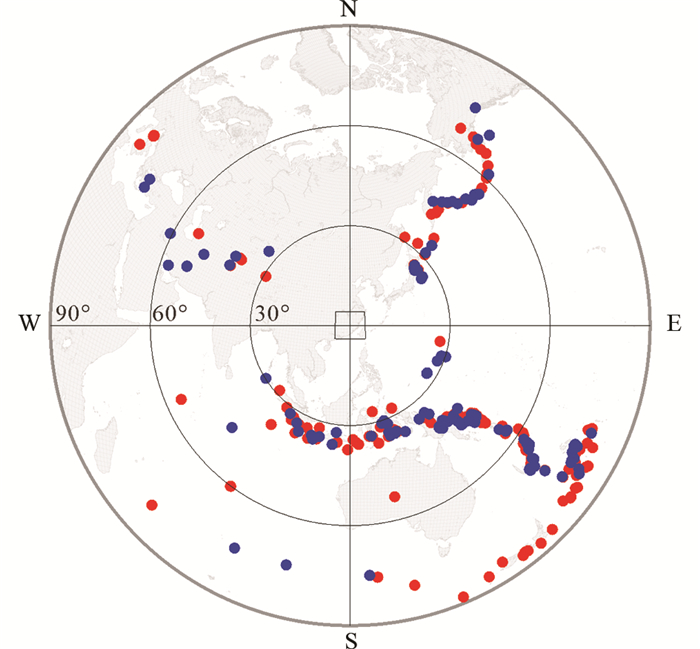
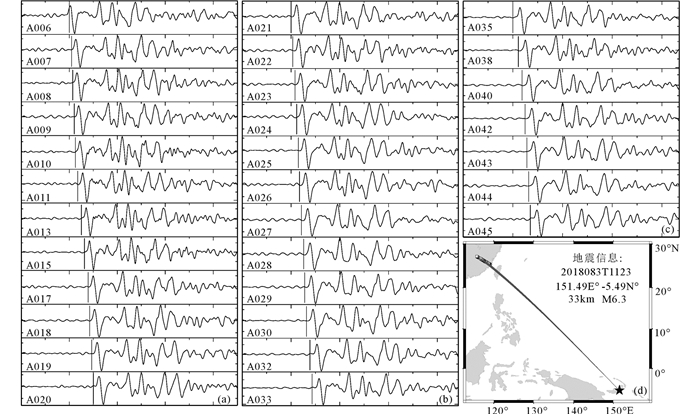
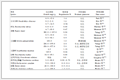
为获得高质量的走时数据,主要采取以下流程进行数据处理:(1)对远震事件进行筛选,选取震中距位于28°~90°之间,且震级大于M5.5的远震事件,同时每个远震事件至少被10个台站所记录。满足条件的远震事件共计278个,其中固定和流动台站记录到的远震事件个数分别为145个和133个(图 3);(2)对记录的垂向分量波形数据进行去均值、去趋势以及带通滤波(0.05~1Hz)(图 4a-c),剔除信噪比较低的波形数据,并手动拾取P波到时(精度约0.10s);(3)利用Zhao et al.(1994)提出的方法计算相对走时残差,剔除绝对值大于2.0s的相对走时残差;(4)对获得的相对走时残差数据重新分析(即质量控制),剔除不合理的相对走时残差数据,提高数据质量。以图 4所示的某远震事件波形为例(具体数据见表 1),台站A006的相对走时残差在进行质量控制前为-1.60s,虽然满足绝对值小于2.0s的要求,但是通过进一步分析发现,除台站A006以外,所有台站的相对走时残差的绝对值均未超过0.6s,且台站A006与A007记录到的地震波应该具有几乎相同的射线路径(图 4d;两个台站的间距只有10km),因此本研究认为台站A006的相对走时残差虽然满足筛选条件,但不合理。由图 4a可以看出:相对其他台站,台站A006记录波形的理论到时与实际到时更加接近,推测可能是由于台站的GPS授时产生误差所导致。故本研究将A006的数据剔除,然后再重新计算相对走时残差,此时剩余台站的相对走时残差减小0.05s(表 1)。
|
图 3 远震地震事件分布 红色圆圈和蓝色圆圈分别代表固定台站和流动台站接收到的远震事件震中;图中心的梯形代表研究区域;同心圆旁边的数字代表距圆心的距离(单位:度) Fig. 3 Epicentral locations of the teleseismic events used in our study Red and blue circles donate the teleseismic events received by permanent stations and temporary stations, respectively. The trapezoid in center indicates the present study area. Numbers beside the concentric circles indicate the distances from the center of our study area (Unit: degree) |
|
图 4 某远震波形垂向分量示例图 (a-c)经过滤波后的垂向地震记录,短竖线代表由IASP91模型(Kennett and Engdahl, 1991)计算得到的理论到时;(d)远震事件位置,黑色五角星和白色正方形分别代表发震位置和地震台站的分布,远震事件信息见右上角 Fig. 4 Example of vertical seismograms of a teleseismic event used in our study (a-c) vertical seismograms after filtered, the short vertical lines indicate the calculated arrival time from IASP91 model (Kennett and Engdahl, 1991); (d) location of the teleseismic event, the black star and the white squares indicate the locations of the teleseismic event and the seismic stations, respectively. The information of the teleseismic event is shown on the top right corner |
|
表 1 质量控制前后各台站的相对走时残差(图 4示例波形) Table 1 The relative travel time residuals before and after quality control (seismograms in Fig. 4) |
经过以上步骤的数据处理,最终共获得15154条高质量的相对走时残差数据,其中固定和流动台站记录的数据分别为10442条和4712条。图 5a为各台站的平均相对走时残差分布图,大致以115°E为界,位于华夏地块西部的台站的平均相对走时残差以正值为主,而位于华夏地块东部的台站的平均相对走时残差则以负值为主,与已有的结果比较吻合(吕作勇等,2017)。说明华夏地块西部地壳和上地幔顶部的平均速度结构以低速为主,而华夏地块东部地壳和上地幔顶部的平均速度结构以高速为主,这与层析成像结果也具有很好的对应关系(图 5b, c)。

|
图 5 水平剖面层析成像结果 (a)各台站平均相对走时残差分布图,蓝色和红色分别代表负平均相对走时残差和正平均相对走时残差;(b-i)各水平层的层析成像结果,红色和蓝色分别代表低速和高速异常. 黑色线段代表华夏地块内主要断裂,蓝色虚线区域代表华夏地块内主要成矿带的大致范围,断裂和成矿带的具体信息详见图 1 Fig. 5 Plan views of tomography obtained in our study (a) the distribution of mean relative travel time residuals of each station. Blue and red represent negative and positive mean relative travel time residuals, respectively; (b-i) the tomographic results at each layer. Red and blue colors indicate low and high velocity anomalies, respectively. The bold black lines and the blue dashed areas indicate the major faults and the sketch range of major metallogenic belts in the Cathaysia Block, respectively, detail information of the faults and the metallogenic belts can be found in Fig. 1 |
在利用TOMOG3D方法对实测数据进行反演之前,需要确定最佳的网格剖分间距(Zhao et al., 1992, 1994)。检测板测试是获得最佳网格剖分间距的一种有效方法。首先在网格节点赋予正、负相间的速度扰动(通常相对全球一维速度模型,如PREM模型(Dziewonski and Anderson, 1981)或IASP91模型(Kennett and Engdahl, 1991)等),建立一个复杂三维速度理论模型(图 6a);然后按照台站(图 1)和地震事件(图 3)的实际位置在复杂三维速度理论模型(记为理论模型)里进行三维射线追踪,生成“理论走时数据”;接着利用“理论走时数据”进行反演,从而获得三维速度模型(记为反演模型);最后对比理论模型与反演模型之间的差异,确定各网格节点速度异常的恢复程度(图 6b-i)。如果理论模型能够被很好的恢复,则说明网格剖分间距比较合理,进而表明反演结果的可信性;否则,需要调整网格的剖分间距,直到获得合理的恢复度(席家骥等,2021)。

|
图 6 检测板测试结果 (a)输入模型(10km水平层),黑框内的分辨率为0.8°×0.75°;(b-i)各水平层的检测板结果. 空心圆和实心圆分别代表负速度扰动异常和正速度扰动异常 Fig. 6 Results of checkerboard resolution test (a) the input model (10km layer), the resolution in the black box is 0.8°×0.75°; (b-i) the results of checkerboard resolution test at each layer. The open and solid circles indicate negative and positive velocity perturbations, respectively |
本研究的检测板测试采用IASP91模型(Kennett and Engdahl, 1991)作为初始速度,在相邻网格节点上分别赋予±3%的速度扰动进行射线追踪得到理论走时数据,并对理论走时数据添加方差为0.10s的随机误差用于模拟随机噪声。图 6b-i显示了最佳网格剖分模型的检测板测试结果:在水平方向上,网格间距在黑框内为0.8°×0.75°,在黑框外均为1°(图 6a);在垂向上,共设置了8个水平层,分别设置在10km、50km、120km、200km、280km、360km、440km和500km的深度(图 6b-i)。由图 6b-c可以看出,10km和50km两个水平层的检测板测试结果相对较差,仅台站下方的分辨率较好,这是因为远震射线几乎近垂直经过上地幔顶部及地壳到达台站,导致射线在地壳内的交叉程度较差且分布不均匀(江国明等,2014;徐峣等,2014)。随着深度的增加,检测板测试结果逐渐得到改善(图 6d-i),并在200~500km的深度范围内比较稳定,大部分地区的速度扰动可以很好地被恢复出来。从整体上看,虽然部分地区浅部未能得到有效的检测板测试结果,但华夏地块,特别是武夷山成矿带及邻区的检测板测试结果均比较理想,能够满足研究需要。
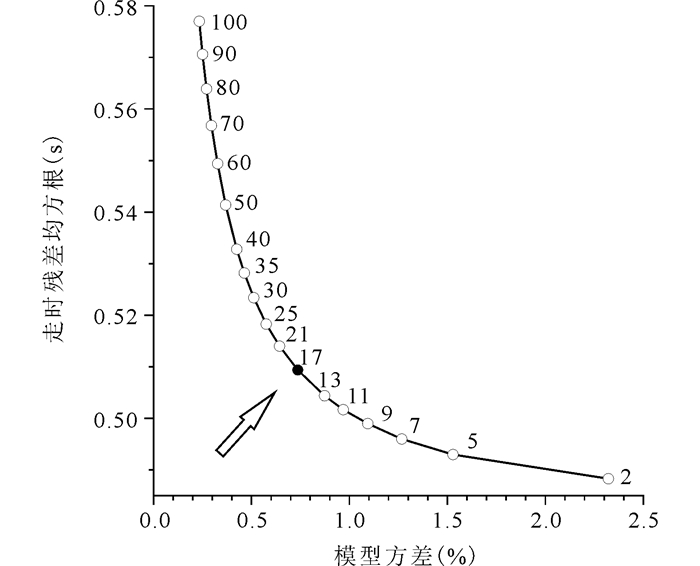
4 层析成像结果在反演时,阻尼因子可用于平衡走时残差均方根和模型方差之间的关系,因此选取合适的阻尼因子至关重要。经过多次测试,本研究选取17作为最佳的阻尼因子(图 7)。
|
图 7 最佳阻尼系数折中曲线图 圆圈旁边的数字代表不同的阻尼因子,箭头和实心圆代表最佳的阻尼因子 Fig. 7 Trade-off curve between the root-mean-square (RMS) of travel time residuals and the variance of velocity anomalies The numbers beside the circles indicate the damping parameters, both the arrow and the solid circle indicate the optimal damping parameter |
图 5展示了水平剖面的层析成像结果。由图中可以看出,华夏地块地壳和上地幔顶部的速度结构比较一致(图 5b, c)。东部(武夷山成矿带及其东侧)以高速异常为主,而西部(南岭成矿带)则表现为大范围的低速异常。这与台站的平均相对走时残差分布情况基本一致(图 5a)。推测华夏地块东部上地壳(图 5b)的高速异常可能反映了武夷山成矿带地表大范围的隆起特征或者无沉积层覆盖(刘建华等,1995),而华夏地块西部上地壳的低速异常(图 5b),可能与上地幔热物质上涌有关(图 5c-g和图 8b)。

|
图 8 垂直剖面层析成像结果 (a、b)剖面的层析成像结果; (c、d)剖面的可恢复测试结果. 剖面位置显示在图 5b中. 红色和蓝色分别代表低速和高速异常,黑色虚线为410km速度间断面. SHF-邵武-河源断裂; ZDF-政和-大埔断裂; WYMB-武夷山成矿带; NLMB-南岭成矿带 Fig. 8 Vertical cross-sections of tomography obtained in our study (a, b) the tomographic results along two profiles; (c, d) results of restored resolution test along two profiles. The locations of profiles are shown in Fig. 5b. Red and blue colors indicate low and high velocity anomalies, respectively; The black dashed line indicates the 410km discontinuity. SHF-Shaowu-Heyuan fault; ZDF-Zhenghe-Dabu fault; WYMB-Wuyishan metallogenic belt; NLMB-Nanling metallogenic belt |
随着深度的增加,华夏地块上地幔表现为大范围的低速异常(图 5d-g),与已有的层析成像结果基本一致(朱介寿等,2002;Li and van der Hilst,2010;Jiang et al., 2015;He and Santosh, 2016;Xia et al., 2016;张昌榕等,2018;曲平等,2020;Huang et al., 2021),说明华夏地块上地幔存在着大规模的热物质。上地幔内的高速异常则主要位于台湾岛以及扬子地块部分地区(图 5d-g)。这些高速异常在已有的层析成像结果中也有相应的表现(Huang et al., 2010, 2021;Zhao et al., 2012;Zheng et al., 2013;Jiang et al., 2015, 2021;He and Santosh, 2016;He and Zheng, 2018;张昌榕等,2018;曲平等,2020)。结合已有的研究,本研究推测台湾岛下方上地幔内的高速异常可能为新生代以来向菲律宾海板块下方俯冲并发生断离的欧亚板块(图 5f-g)。而扬子地块内的高速异常则可能为晚中生代以来扬子地块岩石圈发生变形改造所留下的痕迹(Huang et al., 2010;图 5f),或者指示了来自华夏地块的地幔热物质对扬子地块岩石圈的“侵蚀”的过程(曲平等,2020;图 5g)。
在440km水平层(图 5h),华夏地块下方的低速异常开始逐渐收缩,并在500km的水平层向南迁移(图 5i)。此外,研究区域内的扬子地块下方的地幔过渡带内存在大范围的高速异常,该高速异常在500km水平层仍然比较清晰,且主要位于26°N以北的地区(图 5h, i)。结合已有的层析成像和CCP叠加结果,本研究认为该高速异常为中生代以来向华南板块俯冲并且滞留在地幔过渡带内的古太平洋板块(Huang and Zhao, 2006;Huang et al., 2014, 2021;Jiang et al., 2015, 2021;He and Santosh, 2016;He and Zheng, 2018;张昌榕等,2018;Han et al., 2020)。
4.2 垂直剖面层析成像结果图 8a-b为垂直剖面的层析成像结果,剖面的位置如图 5b所示。剖面AA’为北西-南东走向,与流动台站的位置重合;剖面BB’为南西-北东走向,与华夏地块的走向基本一致。不难发现,武夷山成矿带及其东侧的上地幔存在着两个比较显著的低速异常(L1、L2;图 8a, b)。这两个低速异常主要位于200~400km的深度且互相连通,说明华夏地块东部上地幔的热物质存在着大规模的横向流动和能量交换。东南沿海地幔过渡带同样存在着一个显著的低速异常(L3;图 8a),表现为自南东向北西上涌的趋势,并在上地幔与L1相连通,说明武夷山成矿带深部可能存在着一个向北西倾斜的地幔柱或者热物质上涌的通道。此外,南岭成矿带下方的低速异常也比较显著,从上地壳一直向下延伸到上地幔(L4;图 8b),说明南岭成矿带在深部可能同样存在着一个热物质上涌的通道。
除了低速异常,在武夷山成矿带上地幔的顶部同时还存在着一个显著的高速异常,该高速异常的厚度约为100km,且在东南端相对较薄(图 8a, b)。S波接收函数结果表明(Li et al., 2013;叶卓等,2014;张耀阳等,2018),武夷山成矿带的岩石圈厚度在70~100km左右。据此可推测该高速异常可能代表了武夷山成矿带下方的岩石圈。与S波接收函数结果相比,远震层析成像对岩石圈结构的分辨能力不是很敏感,但仍能还原出部分信息,如Jiang et al.(2013)利用相同的方法,得到了长江中下游成矿带现存岩石圈的痕迹。另一个比较显著的高速异常则位于东南沿海地区约80~250km的深度(图 8a)。该地区位于欧亚板块与菲律宾海板块碰撞俯冲的最前端,推测其下方的高速异常可能表征了欧亚板块与菲律宾海板块碰撞俯冲后遗留的痕迹(Huang et al., 2010, 2021;Zheng et al., 2013)。
4.3 可恢复测试为进一步验证层析成像结果的可靠性,本研究进行了可恢复测试。可恢复测试的思路和流程与检测板测试基本一致,只是网格节点上的速度扰动值由检测板测试中的±3%替换成实际的反演结果值(或稍作修改后的结果)。相对检测板测试,可恢复测试的优点在于更加接近真实情况。通过分析主要速度异常的恢复程度,可进一步检验其可靠性,提高了对复杂速度结构的检测效果。为模拟随机噪声的影响,对理论计算得到的走时数据仍然加入了方差为0.10s的随机误差。图 8c-d为两条剖面的可恢复测试结果。通过与图 8a-b进行对比,主要的速度异常均能够被恢复出来,进一步佐证了本研究获得的速度异常的可靠性。
5 讨论 5.1 华夏地块东部上地幔低速异常(L1、L2)本研究最主要的结果是在武夷山成矿带及其东侧上地幔200~400km的深度范围识别出显著的低速异常(L1、L2),这些低速异常基本涵盖了华夏地块东部(图 5e-g),与已有的研究比较一致(朱介寿等,2002;Huang and Zhao, 2006;Huang et al., 2010, 2021;Li and van der Hilst,2010;Zhao et al., 2012;Jiang et al., 2015, 2021;He and Santosh, 2016;Sun et al., 2016;曲平等,2020;席家骥等,2021)。这些速度结构反映出华夏地块东部上地幔目前仍存在着热物质的富集区,且热物质在这些富集区之间进行着大规模的横向流动(图 8a, b),进而导致华夏地块东部的上地幔表现为大范围的低速异常(图 5e-g)。但关于这些热物质的起源,学者们的意见并未统一。有些学者认为可能与海南地幔柱有关(吕作勇等,2017;曲平等,2020),这一认识主要基于华夏地块上地幔的低速异常与海南地幔柱相连通(Huang,2014;Xia et al., 2016;吕作勇等,2017)。但从本研究的结果看,海南地幔柱对华夏地块东部的影响似乎有限。如图 5和图 8b所示,华夏地块西部(L4)受海南地幔柱的影响相对较多,而在华夏地块东部,L1受海南地幔柱的影响可能仅限于L4与L1之间热物质的横向流动,L2受到的影响则会更小。因此,似乎无法将L1、L2的起源均归因于海南地幔柱。另一方面,来自地球物理、地球化学、矿物化学以及数值模拟的大量证据表明(鄢全树和石学法,2007),南海的形成演化以及海南地幔柱对华夏地块产生显著影响的时期主要发生在新生代,而武夷山成矿带及邻区在燕山期已发生了多期次、大规模的岩浆-成矿活动(图 2)。因此,如果将L1、L2的起源归因于海南地幔柱,那就意味着L1、L2与武夷山成矿带及邻区燕山期岩浆-成矿活动没有太大的关系,这与一些学者的发现也不相符(He and Santosh, 2016)。综上,本研究认为海南地幔柱可能对L1、L2目前的结构和形态、甚至对武夷山成矿带及其东侧新生代以来的岩浆活动起到了影响,但并非是L1、L2起源的深部机制。
除了海南地幔柱的观点,还有部分学者认为热物质的起源与古太平洋板块的俯冲有关(Sun et al., 2016)。中生代以来,古太平洋板块向华南大陆下方的低角度俯冲导致整个中国东部地区发生了大规模的弧后伸展作用(舒良树,2012),目前,俯冲的古太平洋板块已经部分滞留在地幔过渡带中(Huang and Zhao, 2006;Huang et al., 2014;Jiang et al., 2015, 2021;He and Santosh, 2016;He and Zheng, 2018;张昌榕等,2018;Han et al., 2020;图 5h, i)。该过程不仅造成了华南板块的岩石圈发生大规模伸展减薄,这在本研究的结果中也有所表现——武夷山成矿带岩石圈的厚度目前仅为100km左右(图 8a, b),推测为岩石圈经历减薄后所残留的痕迹,同时在岩石圈伸展减薄的背景之下,还会引起巨量花岗岩浆的上升侵位(舒良树,2012)。Jiang et al.(2015, 2021)指出,低速异常可在上地幔存在超过100~150Myr甚至更久,因此,燕山期以来形成的热物质状态仍可被天然地震层析成像方法识别出来。据此,本研究推测L1、L2的起源可能与古太平洋板块的俯冲有关。古太平洋板块的快速俯冲导致上地幔底部及地幔过渡带内产生大量水,进而出现部分熔融并且上涌(Zhao et al., 2009;Zhao and Ohtani, 2009)。上涌的热物质在上地幔某区域内富集,从而形成地幔楔,且热物质在这些地幔楔之间也进行着横向流动(图 8b)。在本研究中,L2位于俯冲的古太平洋板块的上方,是板块俯冲脱水导致热物质上涌的直接证据(图 8b)。这些幔源热物质继续上升侵位,并与地壳物质发生相互作用,进而导致武夷山成矿带及邻区爆发大规模的岩浆-成矿活动。H-κ接收函数结果显示武夷山成矿带相对较高的波速比(Vp/Vs)很可能是晚中生代基性岩浆底侵的结果(He et al., 2013;Guo et al., 2019;张永谦等,2019;Zhang et al., 2021a, b;杨晓瑜和李永华,2021),这一观点不仅得到了重力资料的支持(Yan et al., 2021),且非常契合本研究的推断。此外,岩石学和地球化学证据也支持了本研究的观点(张德全等, 2001a, b;毛建仁等, 2004a, b,2010;赵希林等,2017;刘鹏等,2021)。毛建仁等(2004a1,b1)在闽西南开展的同位素年代学和地球化学的研究结果表明,四方岩体的形成与幔源的基性岩浆有关;刘鹏等(2021)对东南沿海早白垩世Sn(W)成矿事件进行了系统的总结,发现与成矿有关的黑云母花岗岩和花岗斑岩在成岩过程中有较多新生地壳和地幔物质的加入,推测可能形成于岩石圈的伸展背景之下。
至于为何未在L1的下方发现俯冲的古太平洋板块,本研究认为可能与古太平洋板块的后撤有关(Zhang et al., 2021b),这一过程不仅导致华夏地块地幔过渡带俯冲板块的缺失(Huang and Zhao, 2006;Huang et al., 2014;He and Santosh, 2016;He and Zheng, 2018;Han et al., 2020;图 5h, i),同时还造成了成矿活动从内陆到沿海逐渐发生的趋势。Zhou and Li(2000)的研究结果表明,武夷山成矿带及邻区存在着一个巨型花岗质火山-侵入岩带,且带内燕山期火山-侵入岩的年龄表现为自西北内陆向东南沿海逐渐减小的趋势,说明武夷山成矿带及邻区燕山期岩浆-成矿活动逐步从内陆向沿海地区进行迁移。该现象可能在深部机制上受控于古太平洋板块的后撤(Zhou et al., 2006;刘鹏等,2021)。随着古太平洋板块的后撤,前期形成的地幔楔(L1)被保留了下来,并持续对地表的岩浆-成矿活动产生影响。在闽西南地区开展的一系列地球化学和同位素测试的结果表明越至晚期形成的岩石中地幔组分含量越高,随着时间的推移,幔源岩浆在岩浆形成过程中的参与程度逐渐加大,壳幔作用更加剧烈(毛建仁等, 2004a, b;赵希林等,2017)。此外,古太平洋板块的后撤还导致上地幔产生横向的应力,进一步加强了热物质在地幔楔之间的横向流动和能量交换(图 8b)。
5.2 东南沿海地幔过渡带及华夏地块西部上地幔低速异常(L3、L4)除了L1、L2两个显著的低速异常,本研究还分别在东南沿海地幔过渡带及华夏地块西部上地幔发现了显著的低速异常(L3和L4)。在图 8a中,L3与L1相连通,表现出自南东向北西逐渐上倾的趋势。自新生代以来,欧亚板块与菲律宾海板块在琉球岛弧、台湾岛等地发生了复杂的碰撞俯冲(Li and van der Hilst,2010),特别是在台湾岛下方,向下俯冲的欧亚板块发生了断离,并且断离的板块已经进入了地幔过渡带当中(Huang et al., 2010;Zheng et al., 2013;图 5f, g),导致地幔过渡带产生大尺度的地幔对流以及热物质的上升侵位,引起地幔过渡带甚至下地幔的物质进入上地幔(Huang et al., 2010;于大勇等,2016)。因此,本研究认为L3可能代表新生代以来欧亚板块与菲律宾海板块碰撞俯冲所产生的热物质。从整体来看,L3和L1组成了热物质上涌的通道,新生代热物质沿着通道上涌,然后再通过地幔楔进行横向扩散,或者进一步上涌,对武夷山成矿带及邻区新生代的岩浆活动起到了一定的影响。
L4主要位于南岭成矿带南部及其以南的地区(图 5和图 8b),且L4可从上地壳一直向下追溯,结合已有的结果(Huang,2014;Xia et al., 2016;吕作勇等,2017;图 1),L4在上地幔与L1及海南地幔柱相连通,在地幔过渡带与L3相连通。已有的研究结果表明,南岭成矿带及其邻区W-Sn等金属矿产资源比较发育(毛景文等,2007;Zhao et al., 2018a, b,2021),毛景文等(2007)认为,南岭地区中生代大规模W-Sn成矿活动主要爆发在中晚侏罗世,在时间上与古太平洋板块俯冲所导致的花岗岩活跃期具有很好的相关性(张永谦等,2019)。但中晚白垩世以来,华夏地块西部并未出现大规模火山-岩浆活动,造成这一现象的主要原因可能与古太平洋板块停止俯冲有关(毛景文等,2007)。层析成像及CCP叠加的结果也未在华夏地块西部的地幔过渡带发现俯冲的古太平洋板块的痕迹(Huang et al., 2014;Jiang et al., 2015;Han et al., 2020;图 5)。因此本研究推测,L4最初的形成可能受控于古太平洋板块的俯冲,并与华夏地块东部上地幔的地幔楔(L1、L2)进行着热物质的交换(图 8b),但晚燕山期以来受古太平洋板块俯冲的影响逐渐减弱。本研究认为L4目前更可能代表了一个热物质上涌的通道,其形成与古太平洋板块的俯冲有关,但随着时间的推移,海南地幔柱、欧亚板块与菲律宾海板块碰撞俯冲所产生的热物质陆续加入并沿着该通道上涌(图 5和图 8b)。L4为何可以一直向上进入上地壳?华夏地块西部相对较低的波速比(Vp/Vs)和相对较薄的地壳暗示着该地区基性下地壳物质的缺失,可能发生过下地壳的拆沉(He et al., 2013;Zhang et al., 2021a;杨晓瑜和李永华,2021),从而在地壳内形成大范围的低速异常。由于南岭成矿带不是本研究的重点,故在此不再进行深入的探讨。
6 结论本研究利用15154条高质量远震P波到时数据,针对武夷山成矿带及邻区开展了远震体波走时层析成像研究,构建了武夷山成矿带及邻区深至500km的上地幔三维速度结构模型。
(1)武夷山成矿带及其东侧上地幔内的低速异常主要位于200~400km深度范围内,代表了热物质富集的地幔楔,其形成可能与古太平洋板块的俯冲和脱水有关,同时可能还受到了新生代海南地幔柱以及欧亚板块与菲律宾海板块碰撞俯冲所产生的热物质的影响。
(2)东南沿海地幔过渡带的低速异常代表了新生代以来欧亚板块与菲律宾海板块碰撞俯冲所产生的热物质;而南岭成矿带下方的低速异常一直从上地幔延伸到上地壳,其形成演化受到了古太平洋板块俯冲、海南地幔柱以及欧亚板块与菲律宾海板块碰撞俯冲的共同影响,可能代表了一个热物质上涌的通道。
(3)武夷山成矿带燕山期大规模的岩浆-成矿活动可能与古太平洋板块的俯冲和后撤有关。
致谢 感谢匿名审稿专家提供的宝贵意见和建议;感谢日本东北大学赵大鹏教授提供的层析成像程序;感谢中国地震局地球物理研究所国家测震台网数据备份中心提供的远震波形数据资料(doi: 10.11998/SeisDmc/SN,http://www.seisdmc.ac.cn);感谢北京大学盖增喜副教授、冯永革老师提供的部分流动台站的波形数据资料;本研究的图件由GMT6绘制,感谢Wessel et al.(2019)提供的免费作图软件;感谢罗凡等人在野外数据采集过程中的辛苦付出。
Ding JH, Fan JF, Yin JN and Liu YL. 2016. Geological characteristics and mineral resource potential of the Wuyishan Cu-Pb-Zn polymetallic metallogenic belt. Acta Geologica Sinica, 90(7): 1537-1550 (in Chinese with English abstract)
|
Dong SW, Li TD, Chen XH, Gao R, Lü QT, Shi YL, Huang DN, Yang JS, Wang XQ, Wei WB and Chen QC. 2014. SinoProbe revealed crustal structures, deep processes, and metallogenic background within China continent. Earth Science Frontiers, 21(3): 201-225 (in Chinese with English abstract)
|
Dziewonski AM and Anderson DL. 1981. Preliminary reference Earth model. Physics of the Earth and Planetary Interiors, 25(4): 297-356 DOI:10.1016/0031-9201(81)90046-7
|
Guo LH, Gao R, Zhang JS and Xiong XS. 2016. The geosuture between the Yangtze and Cathaysia blocks, South China, during Neoproterozoic era revealed from gravity and magnetic data. Chinese Journal of Geology, 51(3): 682-693 (in Chinese with English abstract)
|
Guo LH and Gao R. 2018. Potential-field evidence for the tectonic boundaries of the central and western Jiangnan belt in South China. Precambrian Research, 309: 45-55 DOI:10.1016/j.precamres.2017.01.028
|
Guo LH, Gao R, Shi L, Huang ZR and Ma YW. 2019. Crustal thickness and Poisson's ratios of South China revealed from joint inversion of receiver function and gravity data. Earth and Planetary Science Letters, 510: 142-152 DOI:10.1016/j.epsl.2018.12.039
|
Han RB, Li QS, Huang R and Zhang HS. 2020. Detailed structure of mantle transition zone beneath southeastern China and its implications for thinning of the continental lithosphere. Tectonophysics, 789: 228480 DOI:10.1016/j.tecto.2020.228480
|
He CS, Dong SW, Santosh M and Chen XH. 2013. Seismic evidence for a geosuture between the Yangtze and Cathaysia blocks, South China. Scientific Reports, 3(1): 2200 DOI:10.1038/srep02200
|
He CS and Santosh M. 2016. Crustal evolution and metallogeny in relation to mantle dynamics: A perspective from P-wave tomography of the South China Block. Lithos, 263: 3-14 DOI:10.1016/j.lithos.2016.06.021
|
He CS and Zheng YF. 2018. Seismic evidence for the absence of deeply subducted continental slabs in the lower lithosphere beneath the Central Orogenic Belt of China. Tectonophysics, 723: 178-189 DOI:10.1016/j.tecto.2017.12.018
|
Huang JL and Zhao DP. 2006. High-resolution mantle tomography of China and surrounding regions. Journal of Geophysical Research: Solid Earth, 111(B9): B09305 DOI:10.1029/2005JB004066
|
Huang JL. 2014. P- and S-wave tomography of the Hainan and surrounding regions: Insight into the Hainan plume. Tectonophysics, 633: 176-192 DOI:10.1016/j.tecto.2014.07.007
|
Huang R, Xu YX, Luo YH and Jiang XH. 2014. Mantle transition zone structure beneath southeastern China and its implications for stagnant slab and water transportation in the mantle. Pure and Applied Geophysics, 171(9): 2129-2136 DOI:10.1007/s00024-014-0837-4
|
Huang ZC, Wang LS, Zhao DP, Xu MJ, Mi N, Yu DY, Li H and Li C. 2010. Upper mantle structure and dynamics beneath Southeast China. Physics of the Earth and Planetary Interiors, 182(3-4): 161-169 DOI:10.1016/j.pepi.2010.07.010
|
Huang ZC, Gou T and Wang LS. 2021. P and S wave tomography of east-central China: Insight into past and present mantle dynamics. Tectonophysics, 809: 228859 DOI:10.1016/j.tecto.2021.228859
|
Jiang GM, Zhang GB, Lü QT, Shi DN and Xu Y. 2013. 3-D velocity model beneath the Middle-Lower Yangtze River and its implication to the deep geodynamics. Tectonophysics, 606: 36-47 DOI:10.1016/j.tecto.2013.03.026
|
Jiang GM, Zhang GB, Lü QT, Shi DN and Xu Y. 2014. Deep geodynamics of mineralization beneath the Middle-Lower Reaches of Yangtze River: Evidence from teleseismic tomography. Acta Petrologica Sinica, 30(4): 907-917 (in Chinese with English abstract)
|
Jiang GM, Zhang GB, Zhao DP, Lü QT, Li HY and Li XF. 2015. Mantle dynamics and Cretaceous magmatism in east-central China: Insight from teleseismic tomograms. Tectonophysics, 664: 256-268 DOI:10.1016/j.tecto.2015.09.019
|
Jiang GM, Zhang GB, Zhao DP, Lü QT, Shi DN, Li HY and Li XF. 2021. Mantle flow and dynamics beneath central-east China: New insights from P-wave anisotropic tomography. Journal of Geophysical Research: Solid Earth, 126(5): e2020JB020070 DOI:10.1029/2020JB020070
|
Kennett BLN and Engdahl ER. 1991. Traveltimes for global earthquake location and phase identification. Geophysical Journal International, 105(2): 429-465 DOI:10.1111/j.1365-246X.1991.tb06724.x
|
Li C and van der Hilst RD. 2010. Structure of the upper mantle and transition zone beneath Southeast Asia from traveltime tomography. Journal of Geophysical Research: Solid Earth, 115(B7): B07308 DOI:10.1029/2009JB006882
|
Li HY, Song XD, Lü QT, Yang XY, Deng YF, Ouyang LB, Li JP, Li XF and Jiang GM. 2018. Seismic imaging of lithosphere structure and upper mantle deformation beneath east-central China and their tectonic implications. Journal of Geophysical Research: Solid Earth, 123(4): 2856-2870 DOI:10.1002/2017JB014992
|
Li QS, Gao R, Wu FT, Guan Y, Ye Z, Liu QM, Kuo-Chen H, He RZ, Li WH and Shen XZ. 2013. Seismic structure in the southeastern China using teleseismic receiver functions. Tectonophysics, 606: 24-35 DOI:10.1016/j.tecto.2013.06.033
|
Lin JY, Tang GB, Xu T, Cai HT, Lü QT, Bai ZM, Deng YF, Huang MF and Jin X. 2020. P-wave velocity structure in upper crust and crystalline basement of the Qinhang and Wuyishan metallogenic belts: Constraint from the Wanzai-Hui'an deep seismic sounding profile. Chinese Journal of Geophysics, 63(12): 4396-4409 (in Chinese with English abstract)
|
Lin JY, Xu T, Cai HT, Lü QT, Bai ZM, Deng YF, Zhang YQ, Huang MF, Badal J and Jin X. 2021. Crustal velocity structure of Cathaysia Block from an active-source seismic profile between Wanzai and Hui'an in SE China. Tectonophysics, 811: 228874 DOI:10.1016/j.tecto.2021.228874
|
Liu JH, Liu FT, Sun RM, Wu H and Wu D. 1995. Seismic tomography beneath the Qinling-Dabie orogenic belts and both the northern and southern fringes. Chinese Journal of Geophysics, 38(1): 46-54 (in Chinese with English abstract)
|
Liu P, Mao JW, Wang LM, Zeng ZL, Bu A, Gao FY and Xu DK. 2021. Geological characteristics, geodynamic setting of magmatism and metallogeny of Early Cretaceous Sn (W) deposits in southeastern coastal belt of China, and their implication for exploration. Acta Petrologica Sinica, 37(3): 683-697 (in Chinese with English abstract) DOI:10.18654/1000-0569/2021.03.03
|
Luo F, Yan JY, Fu GM, Wang H, Tao X and Luo L. 2019. Crust thickness and its apocalyptic of mineralization in South China: Constraint from satellite gravity data. Geology in China, 46(4): 759-774 (in Chinese with English abstract)
|
Lü QT, Dong SW, Shi DN, Tang JT, Jiang GM, Zhang YQ, Xu T and SinoProbe-03-CJ Group. 2014. Lithosphere architecture and geodynamic model of Middle and Lower Reaches of Yangtze Metallogenic Belt: A review from SinoProbe. Acta Petrologica Sinica, 30(4): 889-906 (in Chinese with English abstract)
|
Lü QT, Dong SW, Tang JT, Shi DN, Chang YF and SinoProbe-03-CJ Group. 2015. Multi-scale and integrated geophysical data revealing mineral systems and exploring for mineral deposits at depth: A synthesis from SinoProbe-03. Chinese Journal of Geophysics, 58(12): 4319-4343 (in Chinese with English abstract)
|
Lü QT, Meng GX, Yan JY, Zhang K, Zhao JH and Gong XJ. 2019. Multi-scale exploration of mineral system: Concept and progress: A case study in the Middle and Lower Reaches of the Yangtze River Metallogenic Belt. Geology in China, 46(4): 673-689 (in Chinese with English abstract)
|
Lü QT, Meng GX, Yan JY, Zhang K, Gong XJ and Gao FX. 2020. The geophysical exploration of Mesozoic iron-copper mineral system in the Middle and Lower Reaches of the Yangtze River Metallogenic Belt: A synthesis. Earth Science Frontiers, 27(2): 232-253 (in Chinese with English abstract)
|
Lü ZY, Qiu XL, Ma XJ and Fang LH. 2017. Teleseismic P-wave travel time tomography for the Leiqiong volcano and Cathaysia Block. Chinese Journal of Geophysics, 60(12): 4569-4579 (in Chinese with English abstract)
|
Mao JR, Xu NZ, Hu Q, Li JY and Xie FG. 2004a. Geochronology and geochemical characteristics in Mesozoic granodioritic rocks in southwestern Fujian, and their tectonic evolution. Journal of Jilin University (Earth Science Edition), 34(1): 12-20 (in Chinese with English abstract)
|
Mao JR, Xu NZ, Hu Q, Xing GF and Yang ZL. 2004b. The Mesozoic rock-forming and ore-forming processes and tectonic environment evolution in Shanghang-Datian region, Fujian. Acta Petrologica Sinica, 20(2): 285-296 (in Chinese with English abstract)
|
Mao JR, Zhao XL, Ye HM, Hu Q, Liu K and Yang F. 2010. Tectonomagmatic mineralization and evolution in Wuyishan Metallogenic Belt. Shanghai Geology, 31(Suppl.1): 140-144 (in Chinese)
|
Mao JR, Li ZL and Ye HM. 2014. Mesozoic tectono-magmatic activities in South China: Retrospect and prospect. Science China (Earth Sciences), 57(12): 2853-2877 DOI:10.1007/s11430-014-5006-1
|
Mao JW, Xie GQ, Li XF, Zhang CQ and Mei YX. 2004. Mesozoic large scale mineralization and multiple lithospheric extension in South China. Earth Science Frontiers, 11(1): 45-55 (in Chinese with English abstract)
|
Mao JW, Xie GQ, Guo CL and Chen YC. 2007. Large-scale tungsten-tin mineralization in the Nanling region, South China: Metallogenic ages and corresponding geodynamic processes. Acta Petrologica Sinica, 23(10): 2329-2338 (in Chinese with English abstract)
|
Mao JW, Xie GQ, Guo CL, Yuan SD, Cheng YB and Chen YC. 2008. Spatial-temporal distribution of Mesozoic ore deposits in South China and their metallogenic settings. Geological Journal of China Universities, 14(4): 510-526 (in Chinese with English abstract)
|
Paige CC and Saunders MA. 1982a. LSQR: An algorithm for sparse linear equations and sparse least squares. ACM Transactions on Mathematical Software, 8(1): 43-71 DOI:10.1145/355984.355989
|
Paige CC and Saunders MA. 1982b. Algorithm 583:LSQR: Sparse linear equations and least squares problems. ACM Transactions on Mathematical Software, 8(2): 195-209 DOI:10.1145/355993.356000
|
Qu P, Chen YS, Yu Y, Ge ZX, Li QS and Dong SW. 2020. 3D velocity structure of upper mantle beneath South China and its tectonic implications: Evidence from finite frequency seismic tomography. Chinese Journal of Geophysics, 63(8): 2954-2969 (in Chinese with English abstract)
|
Shu LS. 2012. An analysis of principal features of tectonic evolution in South China Block. Geological Bulletin of China, 31(7): 1035-1053 (in Chinese with English abstract)
|
Sun Y, Liu JX, Tang YC, Chen JW, Zhou KP and Chen B. 2016. Structure of the upper mantle and transition zone beneath the South China Block imaged by finite frequency tomography. Acta Geologica Sinica, 90(5): 1637-1652 DOI:10.1111/1755-6724.12807
|
Wessel P, Luis JF, Uieda L, Scharroo R, Wobbe F, Smith WHF and Tian D. 2019. The generic mapping tools version 6. Geochemistry, Geophysics, Geosystems, 20(11): 5556-5564 DOI:10.1029/2019GC008515
|
Xi JJ, Jiang GM and Zhang GB. 2021. Study on deep velocity structure along a broadband seismic profile below the middle part of the Cathaysia Block. Acta Geologica Sinica, 95(3): 779-790 (in Chinese with English abstract)
|
Xia SH, Zhao DP, Sun JL and Huang HB. 2016. Teleseismic imaging of the mantle beneath southernmost China: New insights into the Hainan plume. Gondwana Research, 36: 46-56 DOI:10.1016/j.gr.2016.05.003
|
Xu Y, Zhang GB, Jiang GM and Yao YB. 2014. Application of crust correction to the teleseismic tomography in the Middle and Lower Reaches of Yangtze River Region. Geoscience, 28(1): 224-233 (in Chinese with English abstract)
|
Yan JY, Lü QT, Luo F, Cheng SB, Zhang K, Zhang YQ, Xu Y, Zhang C, Liu ZD, Ruan S and Wang X. 2021. A gravity and magnetic study of lithospheric architecture and structures of South China with implications for the distribution of plutons and mineral systems of the main metallogenic belts. Journal of Asian Earth Sciences, 221: 104938 DOI:10.1016/j.jseaes.2021.104938
|
Yan QS and Shi XF. 2007. Hainan mantle plume and the formation and evolution of the South China Sea. Geological Journal of China Universities, 13(2): 311-322 (in Chinese with English abstract)
|
Yang JH, Liu L and Liu J. 2017. Current progresses and prospect for genesis of extensive Mesozoic granitoid and granitoid-related multi-metal mineralization in Southern China. Acta Mineralogica Sinica, 37(6): 791-800 (in Chinese with English abstract)
|
Yang XY and Li YH. 2021. Crustal thicknesses and Vp/Vs ratios beneath South China estimated from receiver function analysis and their geological implications. Chinese Journal of Geophysics, 64(1): 146-156 (in Chinese with English abstract)
|
Ye Z, Li QS, Gao R, Zhang HS, He RZ, Wang HY and Li WH. 2014. A thinned lithosphere beneath coastal area of southeastern China as evidenced by seismic receiver functions. Science China (Earth Sciences), 57(11): 2835-2844 DOI:10.1007/s11430-014-4863-y
|
Yu DY, Mi N, Huang H, Huang ZC, Li H, Wang LS and Xu MJ. 2016. Crust and upper mantle structure and geodynamics beneath Southeast China revealed by broadband seismic observation data. Chinese Journal of Geology, 51(1): 99-115 (in Chinese with English abstract)
|
Zhang CR, Zhang GB, Jiang GM, Lü QT and Xu Y. 2018. Study on Poisson's ratio structure beneath the Lower Yangtze Block and its surrounding region and constraints on the deep dynamic process. Chinese Journal of Geophysics, 61(11): 4418-4435 (in Chinese with English abstract)
|
Zhang CS, Su HM, Yu M and Hu ZG. 2012. Zircon U-Pb age and Nd-Sr-Pb isotopic characteristics of Dayang-Juzhou granite in Longyan, Fujian Province and its geological significance. Acta Petrologica Sinica, 28(1): 225-242 (in Chinese with English abstract)
|
Zhang DQ, Li DX, Feng CY and Dong YJ. 2001a. The temporal and spatial framework of the Mesozoic magmatic system in Zijinshan area and its geological significance. Acta Geoscientia Sinica, 22(5): 403-408 (in Chinese with English abstract)
|
Zhang DQ, She HQ, Yan SH and Xu WY. 2001b. Geochemistry of Mesozoic magmatites in the Zijinshan region and implication on regional tectonic inversion. Geological Review, 47(6): 608-616 (in Chinese with English abstract)
|
Zhang K, Lü QT, Zhao JH, Yan JY, Hu H, Luo F, Fu GM and Tao X. 2020. Magnetotelluric evidence for the multi-microcontinental composition of eastern South China and its tectonic evolution. Scientific Reports, 10(1): 13105 DOI:10.1038/s41598-020-69777-3
|
Zhang YQ, Xu Y, Yan JY, Xu ZW and Zhao JH. 2019. Crustal thickness, properties and its relations to mineralization in the southeastern part of South China: Constraint from the teleseismic receiver functions. Geology in China, 46(4): 723-736 (in Chinese with English abstract)
|
Zhang YQ, Shi DN, Lü QT, Xu Y, Xu ZW, Yan JY, Chen CX and Xu T. 2021a. The crustal thickness and composition in the eastern South China Block constrained by receiver functions: Implications for the geological setting and metallogenesis. Ore Geology Reviews, 130: 103988 DOI:10.1016/j.oregeorev.2021.103988
|
Zhang YQ, Shi DN, Lü QT, Xu Y, Xu ZW, Gong XJ, Yan JY and Xu T. 2021b. A fine crustal structure and geodynamics revealed by receiver functions along the Guangchang-Putian line in the Cathaysia Block, South China. Tectonophysics, 815: 229007 DOI:10.1016/j.tecto.2021.229007
|
Zhang YY, Chen L, Ai YS, Jiang MM, Xu WW and Shen ZY. 2018. Lithospheric structure of the South China Block from S-receiver function. Chinese Journal of Geophysics, 61(1): 138-149 (in Chinese with English abstract)
|
Zhao DP, Hasegawa A and Horiuchi S. 1992. Tomographic imaging of P and S wave velocity structure beneath northeastern Japan. Journal of Geophysical Research: Solid Earth, 97(B13): 19909-19928 DOI:10.1029/92JB00603
|
Zhao DP, Hasegawa A and Kanamori H. 1994. Deep structure of Japan subduction zone as derived from local, regional, and teleseismic events. Journal of Geophysical Research: Solid Earth, 99(B11): 22313-22329 DOI:10.1029/94JB01149
|
Zhao DP and Ohtani E. 2009. Deep slab subduction and dehydration and their geodynamic consequences: Evidence from seismology and mineral physics. Gondwana Research, 16(3-4): 401-413 DOI:10.1016/j.gr.2009.01.005
|
Zhao DP, Tian Y, Lei JS, Liu L and Zheng SH. 2009. Seismic image and origin of the Changbai intraplate volcano in East Asia: Role of big mantle wedge above the stagnant Pacific slab. Physics of the Earth and Planetary Interiors, 173(3-4): 197-206 DOI:10.1016/j.pepi.2008.11.009
|
Zhao L, Allen RM, Zheng TY and Zhu RX. 2012. High-resolution body wave tomography models of the upper mantle beneath eastern China and the adjacent areas. Geochemistry, Geophysics, Geosystems, 13(6): Q06007 DOI:10.1029/2012GC004119
|
Zhao XL, Jiang Y, Xing GF, Huang WC, Yu MG, Liu K and Wang CZ. 2017. Geochemical characteristics of magmatic rocks in the Dapai Fe-Pb-Zn polymetallic deposit in Yongding County, Fujian Province and its implications. Bulletin of Mineralogy, Petrology and Geochemistry, 36(1): 154-165 (in Chinese with English abstract)
|
Zhao Z, Zhou XP, Guo NX, Zhang HY, Liu ZY, Zheng YL, Zeng ZL and Chen YC. 2018a. Superimposed W and Ag-Pb-Zn (-Cu-Au) mineralization and deep prospecting: Insight from a geophysical investigation of the Yinkeng orefield, South China. Ore Geology Reviews, 93: 404-412 DOI:10.1016/j.oregeorev.2018.01.017
|
Zhao Z, Liu C, Guo NX, Zhao WW, Wang PA and Chen ZH. 2018b. Temporal and spatial relationships of granitic magmatism and W mineralization: Insights from the Xingguo orefield, South China. Ore Geology Reviews, 95: 945-973 DOI:10.1016/j.oregeorev.2018.03.022
|
Zhao Z, Fu TY, Gan JW, Liu C, Wang DH, Sheng JF, Li WB, Wang PA, Yu ZF and Chen YC. 2021. A synthesis of mineralization style and regional distribution and a proposed new metallogenic model of Mesozoic W-dominated polymentallic deposits in South China. Ore Geology Reviews, 133: 104008 DOI:10.1016/j.oregeorev.2021.104008
|
Zhao Z, Chen YC, Wang DH, Li JK, Liu SB, Chen ZY, Guo CL and Wang PA. 2022. Transformation of Mesozoic dynamic systems and superposition of metallogenic series of W-Sn-Li-Be-Nb-Ta-REE mineral deposits in South China. Acta Petrologica Sinica, 38(2): 301-322 (in Chinese with English abstract) DOI:10.18654/1000-0569/2022.02.01
|
Zheng HW, Gao R, Li TD, Li QS and He RZ. 2013. Collisional tectonics between the Eurasian and Philippine Sea plates from tomography evidences in Southeast China. Tectonophysics, 606: 14-23 DOI:10.1016/j.tecto.2013.03.018
|
Zheng XF, Ouyang B, Zhang DN, Yao ZX, Liang JH and Zheng J. 2009. Technical system construction of Data Backup Centre for China Seismograph Network and the data support to researches on the Wenchuan earthquake. Chinese Journal of Geophysics, 52(5): 1412-1417 (in Chinese with English abstract)
|
Zhou XM and Li WX. 2000. Origin of Late Mesozoic igneous rocks in southeastern China: Implications for lithosphere subduction and underplating of mafic magmas. Tectonophysics, 326(3-4): 269-287 DOI:10.1016/S0040-1951(00)00120-7
|
Zhou XM, Sun T, Shen WZ, Shu LS and Niu YL. 2006. Petrogenesis of Mesozoic granitoids and volcanic rocks in South China: A response to tectonic evolution. Episodes, 29(1): 26-33 DOI:10.18814/epiiugs/2006/v29i1/004
|
Zhu JS, Cao JM, Cai XL, Yan ZQ and Cao XL. 2002. High resolution surface wave tomography in East Asia and West Pacific marginal seas. Chinese Journal of Geophysics, 45(5): 646-664 (in Chinese with English abstract)
|
丁建华, 范建福, 阴江宁, 刘亚玲. 2016. 武夷山Cu-Pb-Zn多金属成矿带主要成矿地质特征及潜力分析. 地质学报, 90(7): 1537-1550. DOI:10.3969/j.issn.0001-5717.2016.07.019 |
董树文, 李廷栋, 陈宣华, 高锐, 吕庆田, 石耀霖, 黄大年, 杨经绥, 王学求, 魏文博, 陈群策. 2014. 深部探测揭示中国地壳结构、深部过程与成矿作用背景. 地学前缘, 21(3): 201-225. |
郭良辉, 高锐, 张季生, 熊小松. 2016. 新元古代扬子-华夏陆块拼合带: 来自华南重磁异常的启示. 地质科学, 51(3): 682-693. |
江国明, 张贵宾, 吕庆田, 史大年, 徐峣. 2014. 长江中下游地区成矿深部动力学机制: 远震层析成像证据. 岩石学报, 30(4): 907-917. |
林吉焱, 唐国彬, 徐涛, 蔡辉腾, 吕庆田, 白志明, 邓阳凡, 黄敏夫, 金星. 2020. 钦杭-武夷山成矿带上地壳速度结构与基底特征: 万载-惠安宽角反射/折射地震剖面约束. 地球物理学报, 63(12): 4396-4409. DOI:10.6038/cjg2020O0158 |
刘建华, 刘福田, 孙若昧, 吴华, 吴丹. 1995. 秦岭-大别造山带及其南北缘地震层析成像. 地球物理学报, 38(1): 46-54. DOI:10.3321/j.issn:0001-5733.1995.01.006 |
刘鹏, 毛景文, 汪礼明, 曾载淋, 卜安, 高凤颖, 许典葵. 2021. 东南沿海早白垩世锡(钨)矿床地质特征、成岩成矿背景及找矿勘查启示. 岩石学报, 37(3): 683-697. |
罗凡, 严加永, 付光明, 王昊, 陶鑫, 罗磊. 2019. 华南地区地壳厚度变化及对成矿类型的制约: 来自卫星重力数据的约束. 中国地质, 46(4): 759-774. |
吕庆田, 董树文, 史大年, 汤井田, 江国明, 张永谦, 徐涛, SinoProbe-03-CJ项目组. 2014. 长江中下游成矿带岩石圈结构与成矿动力学模型——深部探测(SinoProbe)综述. 岩石学报, 30(4): 889-906. |
吕庆田, 董树文, 汤井田, 史大年, 常印佛, SinoProbe-03-CJ项目组. 2015. 多尺度综合地球物理探测: 揭示成矿系统、助力深部找矿——长江中下游深部探测(SinoProbe-03)进展. 地球物理学报, 58(12): 4319-4343. DOI:10.6038/cjg20151201 |
吕庆田, 孟贵祥, 严加永, 张昆, 赵金花, 龚雪婧. 2019. 成矿系统的多尺度探测: 概念与进展——以长江中下游成矿带为例. 中国地质, 46(4): 673-689. |
吕庆田, 孟贵祥, 严加永, 张昆, 龚雪婧, 高凤霞. 2020. 长江中下游成矿带铁-铜成矿系统结构的地球物理探测: 综合分析. 地学前缘, 27(2): 232-253. |
吕作勇, 丘学林, 马晓静, 房立华. 2017. 雷琼火山与华夏块体的远震P波走时成像. 地球物理学报, 60(12): 4569-4579. DOI:10.6038/cjg20171204 |
毛建仁, 许乃政, 胡青, 李寄嵎, 谢芳贵. 2004a. 闽西南地区中生代花岗闪长质岩石的同位素年代学、地球化学及其构造演化. 吉林大学学报(地球科学版), 34(1): 12-20. |
毛建仁, 许乃政, 胡青, 邢光福, 杨祝良. 2004b. 福建省上杭-大田地区中生代成岩成矿作用与构造环境演化. 岩石学报, 20(2): 285-296. |
毛建仁, 赵希林, 叶海敏, 胡青, 刘凯, 杨芳. 2010. 武夷山成矿带构造-岩浆-成矿作用与演化. 上海地质, 31(增1): 140-144. |
毛建仁, 厉子龙, 叶海敏. 2014. 华南中生代构造-岩浆活动研究: 现状与前景. 中国科学(地球科学), 44(12): 2593-2617. |
毛景文, 谢桂青, 李晓峰, 张长青, 梅燕雄. 2004. 华南地区中生代大规模成矿作用与岩石圈多阶段伸展. 地学前缘, 11(1): 45-55. DOI:10.3321/j.issn:1005-2321.2004.01.003 |
毛景文, 谢桂青, 郭春丽, 陈毓川. 2007. 南岭地区大规模钨锡多金属成矿作用: 成矿时限及地球动力学背景. 岩石学报, 23(10): 2329-2338. DOI:10.3969/j.issn.1000-0569.2007.10.002 |
毛景文, 谢桂青, 郭春丽, 袁顺达, 程彦博, 陈毓川. 2008. 华南地区中生代主要金属矿床时空分布规律和成矿环境. 高校地质学报, 14(4): 510-526. DOI:10.3969/j.issn.1006-7493.2008.04.005 |
曲平, 陈永顺, 于勇, 盖增喜, 李秋生, 董树文. 2020. 华南地区上地幔P波三维速度结构和动力学意义: 来自有限频层析成像的证据. 地球物理学报, 63(8): 2954-2969. |
舒良树. 2012. 华南构造演化的基本特征. 地质通报, 31(7): 1035-1053. DOI:10.3969/j.issn.1671-2552.2012.07.003 |
席家骥, 江国明, 张贵宾. 2021. 华夏地块中部宽频地震剖面深部速度结构研究. 地质学报, 95(3): 779-790. DOI:10.3969/j.issn.0001-5717.2021.03.012 |
徐峣, 张贵宾, 江国明, 姚永波. 2014. 地壳校正在长江中下游地区远震层析成像中的应用. 现代地质, 28(1): 224-233. DOI:10.3969/j.issn.1000-8527.2014.01.025 |
鄢全树, 石学法. 2007. 海南地幔柱与南海形成演化. 高校地质学报, 13(2): 311-322. DOI:10.3969/j.issn.1006-7493.2007.02.014 |
阳杰华, 刘亮, 刘佳. 2017. 华南中生代大花岗岩省成岩成矿作用研究进展与展望. 矿物学报, 37(6): 791-800. |
杨晓瑜, 李永华. 2021. 中国华南地区地壳厚度与波速比分布特征及其地质意义. 地球物理学报, 64(1): 146-156. |
叶卓, 李秋生, 高锐, 张洪双, 贺日政, 王海燕, 李文辉. 2014. 中国东南沿海岩石圈减薄的地震接收函数证据. 中国科学(地球科学), 44(11): 2451-2460. |
于大勇, 米宁, 黄晖, 黄周传, 李华, 王良书, 徐鸣洁. 2016. 华南壳幔结构与动力学的宽频地震观测研究. 地质科学, 51(1): 99-115. |
张昌榕, 张贵宾, 江国明, 吕庆田, 徐峣. 2018. 下扬子及周边地区深部泊松比结构及深部动力过程约束研究. 地球物理学报, 61(11): 4418-4435. DOI:10.6038/cjg2018L0357 |
张承帅, 苏慧敏, 于淼, 胡兆国. 2012. 福建龙岩大洋-莒舟花岗岩锆石U-Pb年龄和Sr-Nd-Pb同位素特征及其地质意义. 岩石学报, 28(1): 225-242. |
张德全, 李大新, 丰成友, 董英君. 2001a. 紫金山地区中生代岩浆系统的时空结构及其地质意义. 地球学报, 22(5): 403-408. |
张德全, 佘宏全, 阎升好, 徐文艺. 2001b. 福建紫金山地区中生代构造环境转换的岩浆岩地球化学证据. 地质论评, 47(6): 608-616. |
张耀阳, 陈凌, 艾印双, 姜明明, 许卫卫, 申中寅. 2018. 利用S波接收函数研究华南块体的岩石圈结构. 地球物理学报, 61(1): 138-149. |
张永谦, 徐峣, 严加永, 徐志伍, 赵金花. 2019. 华南东南部地壳厚度、属性及其与成矿的关系: 基于地震接收函数的约束. 中国地质, 46(4): 723-736. |
赵希林, 姜杨, 邢光福, 黄文成, 余明刚, 刘凯, 王存智. 2017. 福建永定大排铁铅锌多金属矿区岩浆岩地球化学特征及其地质意义. 矿物岩石地球化学通报, 36(1): 154-165. DOI:10.3969/j.issn.1007-2802.2017.01.018 |
赵正, 陈毓川, 王登红, 李建康, 刘善宝, 陈振宇, 郭春丽, 王平安. 2022. 华南中生代动力体制转换与钨锡锂铍铌钽稀土矿床成矿系列的叠加演化. 岩石学报, 38(2): 301-322. |
郑秀芬, 欧阳飚, 张东宁, 姚志祥, 梁建宏, 郑洁. 2009. "国家数字测震台网数据备份中心"技术系统建设及其对汶川大地震研究的数据支撑. 地球物理学报, 52(5): 1412-1417. DOI:10.3969/j.issn.0001-5733.2009.05.031 |
朱介寿, 曹家敏, 蔡学林, 严忠琼, 曹小林. 2002. 东亚及西太平洋边缘海高分辨率面波层析成像. 地球物理学报, 45(5): 646-664. DOI:10.3321/j.issn:0001-5733.2002.05.007 |