 2022, Vol. 38


2. 福建省地质矿产勘查开发局,福州 350003;
3. 山东省地质科学研究院,自然资源部金矿成矿过程与资源利用重点实验室,济南 250013;
4. 湖南黄金洞矿业有限责任公司,岳阳 414507
2. Fujian Bureau of Geology and Mineral Resources Exploration and Development, Fuzhou 350003, China;
3. MNR Key Laboratory of Gold Mineralization and Resource Utilization, Shandong Academy of Geological Sciences, Jinan 250013, China;
4. Hunan Huangjindong Ming Co Ltd, Yueyang 414507, China
江南造山带位于华夏板块与扬子板块的交界部位(Wang et al., 2010;Deng and Wang, 2016),其内发育金矿床250余个,包括金山、黄金洞、万古、沃溪等金矿床,金资源总量>970t,是我国第三大金矿带(Xu et al., 2017)。其中,万古金矿床位于该带中部的长沙-平江断裂带,受NNE向深大断裂与近EW向九岭-清水韧性剪切带联合控制,金资源量约85t,平均品位为3.55~11.87g/t,为大型-超大型金矿床(文志林等,2016)。
前人对该区金矿床地质特征、构造控矿机理、成矿物质来源与成矿时代已有较为深入研究(毛景文等,1997;肖拥军和陈广浩,2004;顾江年,2009;文志林等,2016;Deng et al., 2017;Zhang et al., 2018, 2020),但成矿机制研究仍较为薄弱。其中,孙思辰等(2018)和邓腾(2018)通过岩相学观察和电子探针分析,分别指出黄金洞和万古金矿床金主要以自然金、晶格金和纳米级金颗粒的形式赋存;刘育等(2017)通过成矿期热液石英流体包裹体岩相学分析与显微测温,认为硫化作用和流体相分离作用是黄金洞金矿床的主要金沉淀机制;段阳杰(2017)基于石英中流体包裹体H-O同位素分析,认为万古金矿床经历了变质/岩浆流体与大气降水混合,但流体混合是否导致了金成矿还有待研究;安江华等(2011)通过流体包裹体显微测温,获得万古金矿床成矿流体均一温度为240±20℃,小于黄金洞金矿床320~240℃的均一温度(刘育等,2017),可作为该矿床成矿温度的下限;Deng et al.(2017)运用毒砂矿物温度计估算得到万古金矿床成矿温度为245±20℃,与该矿床流体包裹体测温数据较为接近。然而,万古金矿床的成矿阶段的划分、金的赋存状态与沉淀机制仍缺乏有效约束,制约了对其成矿过程与机制的理解。
毒砂和黄铁矿是热液矿床中重要的载金矿物(Deng et al., 2003;张静等,2009;杨立强等,2014)。不同物理化学环境下形成的黄铁矿和毒砂,其晶体形态、微量元素等有一定的差异(Reich et al., 2005;Yang et al., 2016a, b;Verdugo-Ihl et al., 2021;许杨等,2021)。研究载金硫化物的标形特征、形成温度和主微量元素,对探讨金在硫化物中赋存状态和沉淀机制均具有重要意义(Su et al., 2012;Yang et al., 2016c, 2017;Shu et al., 2017;Deng et al., 2018;Qiu et al., 2020)。电子探针分析技术(EPMA)具有分析光束小、可测元素范围广、无损、迅速简便等特点,可以进行点分析、线/面扫描分析,在矿床地球化学研究中具有广泛的应用(Pang et al., 2018;Ma et al., 2021)。因此,本文拟通过详细的岩相学和矿相学工作划分万古金矿床成矿阶段,并据此开展不同阶段毒砂与黄铁矿的电子探针点分析和面扫描,分析金的赋存状态,利用毒砂矿物温度计估算成矿温度,并进一步探讨金沉淀机制。
1 区域与矿床地质 1.1 区域地质江南造山带呈反“S”形展布于扬子板块与华夏板块交界部位,主要由一套浅变质、强变形的新元古代巨厚沉积-火山岩系及时代相当的侵入体构成(图 1;黄汲清,1954;Charvet et al., 1996;薛怀民等,2010);其晚中生代以来经历了强烈的构造-岩浆活动和金及金多金属成矿作用(许德如等,2009;Xu et al., 2017)。

|
图 1 长沙-平江金成矿带区域地质图(据Xu et al., 2017修编) Fig. 1 Regional geological map of the Changsha-Pingjiang gold belt (modified after Xu et al., 2017) |
长沙-平江断裂带位于江南造山带中部,是该区重要的金成矿带之一。主要发育新元古界冷家溪群板岩,三叠系-泥盆系灰岩、白云岩、砂岩、泥岩、粉砂岩等地层,新元古代、晚志留世和晚三叠世花岗岩等岩体。区域构造格架主要由NEE-EW向九岭-清水、连云山-长沙和青草-株洲三条韧性剪切带,以及NNE-NE向新宁-灰汤、长沙-平江和醴陵-衡东断裂组成(李振红,2017;孙思辰等,2020)。带内万古、黄金洞与醴陵三大金矿田分布于NNE-NE向深大断裂与近EW向韧性剪切带交汇部位,矿体受次级断裂控制,赋存于新元古界冷家溪群板岩中(孙思辰等,2018;Zhang et al., 2019)。
1.2 矿床地质万古金矿田位于长沙-平江深大断裂带北西部,幕阜山花岗岩体与望湘、金井花岗岩体的隆起带之间(盛柏伟,2016)。矿田内发育数个金矿床,规模不等,主要受NNE向长沙-平江断裂带和近EW向九岭-清水韧性剪切带联合控制(图 1)。
万古金矿床是该矿田内最大的金矿床,已探明金储量约85t,其赋存于新元古界冷家溪群条带状砂质板岩、变质细砂岩与绢云母板岩内。区内构造以断裂为主,赋矿NW-NWW向断裂与板岩层理近平行,严格控制了蚀变岩和石英脉的产出(图 2;韩凤彬等,2010;文志林等,2016)。大多数NWW向断裂的倾角相似,均为40°左右,并表现出韧性-脆性变形历史(毛景文等,1997;肖拥军和陈广浩,2004)。NW-NWW向F16、F25、F29为三条主要容矿断裂,倾向NE,倾角为36°~45°,被NE向F1和F2断裂错断。目前该矿床V2、V3、V8、V10号矿体为主要开采对象,长约430~1060m,厚约数米至十几米。万古金矿床中未出露岩浆岩,但较大面积的正航磁和低重力异常表明其深部可能存在隐伏侵入体(毛景文等,1997;文志林等,2016)。

|
图 2 万古金矿床地质图(据毛景文等,1997) Fig. 2 Geological map of the Wangu gold deposit (modified after Mao et al., 1997) |
万古金矿床内发育有硅化、绢云母化、碳酸盐化等围岩蚀变。硅化较弱,一般发育于断裂带内弱矿化板岩中。绢云母化较为普遍,表现为定向或非定向排列的细鳞片状绢云母。碳酸盐化主要为方解石化,方解石常呈脉状切穿石英脉或硫化物细脉。金属矿化主要为毒砂矿化和黄铁矿化、少量辉锑矿化、白钨矿化和闪锌矿化等。黄铁矿化和毒砂矿化在断裂带内蚀变岩与不同矿化样式矿石内均有发育。白钨矿主要与贫矿石英脉共生,在V3号矿体中较为发育。
2 矿石矿物学特征 2.1 矿石类型万古金矿床矿石类型主要有毒砂-黄铁绢英岩型(图 3a, d)、石英-硫化物脉型(图 3b, e),其次为构造角砾岩型(图 3c, f)。毒砂-黄铁绢英岩型矿石主要发育在石英脉两侧和断裂破碎带中,矿化较为明显,黄铁矿与毒砂主要呈浸染状或星点状分布。成矿Ⅰ阶段乳白色石英脉经历构造破碎作用,产生裂隙,成矿流体沿裂隙充填,形成烟灰色条带状石英-硫化物细脉或石英角砾岩型矿石。石英-硫化物脉型沿裂隙发育,大多分布在断裂破碎带中以及两旁的羽状裂隙发育的蚀变板岩中。构造角砾岩型矿石发育较少,可分为石英-绢云母-含金硫化物胶结不规则板岩角砾(图 3c, f)或早期贫矿石英脉角砾。

|
图 3 万古金矿床矿石类型 (a、d)毒砂-黄铁绢英岩型;(b、e)石英-硫化物脉型;(c、f)构造角砾岩型 Fig. 3 Mineralization styles in the Wangu gold deposit |
万古金矿床毒砂-黄铁绢英岩型、石英-硫化物脉型、构造角砾岩型三类矿石发育有黄铁矿、毒砂、黄铜矿、闪锌矿、方铅矿、辉锑矿等金属矿物,及石英、绢云母、方解石等非金属矿物。少数自形黄铁矿呈浸染状分布在毒砂-黄铁绢英岩型矿石中(图 4a, b),多数黄铁矿呈他形结构充填于毒砂的孔隙中(图 4c),或者包裹自形-半自形的毒砂(图 4d)。毒砂呈放射状或半自形-他形,多数充填石英脉裂隙,或被黄铁矿交代(图 4e-g)。黄铜矿呈细脉状充填毒砂裂隙,或呈乳滴状与闪锌矿共生,形成固溶体结构(图 4d, h, i)。闪锌矿溶蚀黄铁矿形成溶蚀边,常呈他形结构充填于黄铁矿或毒砂的孔隙、裂隙中,与黄铜矿等金属硫化物共生(图 4d, i)。方铅矿多呈半自形-他形结构充填于黄铜矿或闪锌矿的孔隙或裂隙中(图 4i)。方解石充填辉锑矿脉的裂隙,或呈脉状充填进石英脉(图 4j, k)。成矿Ⅱ阶段的绢云母较为发育,常充填石英脉裂隙中(图 4l)。

|
图 4 万古金矿床矿物镜下特征 (a)浸染状他形黄铁矿颗粒和五角十二面体黄铁矿(Py-2);(b) Ⅲ阶段黄铁矿(Py-2)包裹Ⅱ阶段黄铁矿(Py-1)形成增生环带;(c)黄铁矿(Py-2)充填进入毒砂(Apy-1)的孔隙中;(d)黄铁矿(Py-2)包裹毒砂(Apy-1),裂隙中发育黄铜矿与闪锌矿;(e)自形-半自形毒砂(Apy-1)切割石英细脉;(f)黄铁矿(Py-2)交代毒砂(Apy-2);(g)毒砂由中心向外生长形成放射状毒砂,Apy-2充填Apy-1的核部;(h)黄铜矿充填菱形毒砂(Apy-1)的裂隙;(i)黄铁矿(Py-2)、闪锌矿、黄铜矿、方铅矿的矿物共生组合;(j)方解石充填辉锑矿孔隙,脉状辉锑矿切割石英细脉;(k)方解石充填石英脉裂隙,且包裹少量Ⅱ阶段毒砂(Apy-1);(l)毒砂-黄铁绢英岩中石英裂隙中发育Ⅲ阶段的绢云母. Apy-毒砂;Cal-方解石;Ccp-黄铜矿;Gn-方铅矿;Py-黄铁矿;Qtz-石英;Ser-绢云母;Sp-闪锌矿;Sti-辉锑矿 Fig. 4 Mineral associations of the Wangu gold deposit |
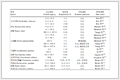
根据野外、手标本和镜下观察到的切割关系和矿物共生组合,将万古金矿床成矿过程中矿物生成顺序划分为以下4个阶段(图 5、表 1):I,乳白色石英-绢云母-白钨矿阶段;Ⅱ,烟灰色石英-绢云母-毒砂(Apy-1)-黄铁矿(Py-1)-金阶段;Ⅲ,烟灰色石英-绢云母-黄铁矿(Py-2)-毒砂(Apy-2)-多金属硫化物-金阶段,多金属硫化物主要为闪锌矿、方铅矿、黄铜矿和辉锑矿;Ⅳ,石英-方解石阶段,方解石充填辉锑矿裂隙,辉锑矿细脉切割石英脉或方解石包裹硫化物颗粒(图 4j, k)。

|
图 5 万古金矿床矿物生成顺序图 Fig. 5 Mineral formation sequence diagram of the Wangu gold deposit |
|
表 1 万古金矿床毒砂与黄铁矿特征 Table 1 Features of arsenopyrite and pyrite in the Wangu gold deposit |


毒砂是万古金矿床主要载金矿物之一。毒砂在毒砂-黄铁绢英岩型矿石中常呈结晶完好的斜方柱状或碎屑粒状,颗粒普遍较细,在石英-硫化物脉型矿石中主要以粒径 < 2mm的他形颗粒产出。成矿Ⅱ阶段毒砂(Apy-1)较为发育,主要以长针状为主,部分呈菱形粒状结构(图 4h);Apy-2发育较少,常呈半自形-他形发育于放射状毒砂核部,或被Py-2交代(图 4f, g)。毒砂Apy-1常被黄铁矿Py-2包裹(图 4d)。此外,毒砂孔隙内通常充填有细粒方铅矿、黄铜矿和闪锌矿等矿物。
2.4.2 黄铁矿黄铁矿也是万古金矿床主要载金矿物之一,分布较广,在近矿围岩、蚀变岩和不同矿化样式矿石中均有分布(图 3)。黄铁矿形态多样,结构各异,其中包括有:自形-粒状结构(图 4a, b)、半自形-他形粒状结构(图 4c)、环带结构(图 4b)、交代结构(图 4f)、包含结构(图 4d)等。毒砂-黄铁绢英岩中黄铁矿粒径可达1cm,小则几十微米,多呈半自形-他形粒状。石英-硫化物脉中黄铁矿呈半自形-他形粒状,粒径多在3mm以下。Ⅱ阶段Py-1含量较少,常呈半自形-他形多孔结构,多发育在环带黄铁矿的核-幔部,被边部Py-2包裹。Py-2含量较多,多呈半自形-他形,部分Py-2包裹毒砂,少部分包裹并改造Py-1形成环带结构(图 4b)。
3 样品选择与分析方法本次采集万古金矿床69件样品用于研究,优选9件样品进行电子探针点分析和面扫描,以限定载金硫化物中元素含量及其矿物尺度空间分布规律。分析测试在山东省地质科学研究院自然资源部金矿成矿过程与资源利用重点实验室进行。电子探针(EPMA)实验仪器为日本电子JXA-8230,运行条件为:加速电压20kV,加速电流2×10⁻⁸A,束斑为1μm,检出限为0.001%。具体实验流程参照李荣华(2020)。
4 分析结果 4.1 毒砂主微量元素万古金矿床毒砂电子探针点分析数据见表 2。Apy-1的S元素含量在20.07%~21.96%之间,平均值21.2%;Fe元素含量在34.05%~36.48%之间,平均值35.43%;Apy-2的S元素含量在21.26%~23.06%之间,平均值为22.03%,要高于Apy-1的S含量;Fe元素含量为35.17%~36.16%,平均值为35.08%。S-Fe元素比值总体无太明显相关关系,S元素不随Fe元素的增加而变化。75个毒砂点分析中有60个测点Au元素高于检出限,其中Apy-1中Au含量在0.004%~0.656%之间,平均值为0.087%;Apy-2中Au含量在0.02%~0.256%之间,平均值为0.073%。Au含量与As和S元素含量没有明显相关性。Co-Ni元素含量较低,且Ni元素近半数测点低于检出限,故Co/Ni比值较大。Te、Ag、Sb元素含量较低,多数测点数据低于检出限。
|
|
表 2 万古金矿床毒砂电子探针分析主微量元素组成(wt%) Table 2 Major and trace element compositions of arsenopyrite in the Wangu gold deposit(wt%) |
该矿床Apy-1的56个点分析结果显示As元素含量在42.19%~44.84%之间,算得原子百分数为30.11 (at%)~31.91(at%),平均值为30.91(at%),均大于30(at%)。Apy-2的19个点分析结果显示As元素含量在40.08%~43.36%之间,计算得到原子百分数为28.19(at%)~30.75(at%),平均值为29.81(at%)。Apy-1中的As含量明显要高于Apy-2(表 2、图 6a)。砷元素含量可以在一定程度上反映毒砂的形成条件(Sharp et al., 1985),通过图 6a可知,Apy-1和Apy-2中S与As原子百分数含量呈现负相关关系,推测成矿流体中的S元素通过类质同象置换了晶格中的As元素。Apy-1的S-As相关系数为-0.8352,R2为0.5563;Apy-2的S-As相关系数为-0.8771,R2为0.9287。

|
图 6 万古金矿床Apy-1、Apy-2电子探针主微量元素图解 Fig. 6 Electron Probe Micro Analysis (EPMA) diagram of major and trace elements of Apy-1 and Apy-2 in the Wangu gold deposit |
黄铁矿电子探针点分析数据见表 3。黄铁矿中Fe含量较高,其中Py-1的Fe含量范围为43.88%~46.53%,平均为45.60%;Py-2的Fe含量范围为44.23%~46.56%,平均为45.60%。Py-1的S元素含量可达51.03%~55.12%,平均为53.42%;Py-2的S元素含量为50.00%~53.81%,平均为51.90%。Py-1的As含量为0.01%~2.77%,平均为0.95%,Py-2的As元素含量为0.54%~2.39%,平均为2.40%。Co、Ni、Ag、Te、Bi、Se等元素含量较低,多数测点数据处于检出限之下。
|
|
表 3 万古金矿床黄铁矿主微量元素组成(wt%) Table 3 Major and trace element compositions of pyrite in the Wangu gold deposit(wt%) |
根据点分析结果,选取S、Fe、Ag、As、Au、Ni、Pb、Zn元素对黄铁矿环带进行面扫描来分析不同元素在黄铁矿中的含量与空间分布规律(图 7a)。发育环带的黄铁矿从结构上可以分为表面光滑的核部、孔隙发育的幔部和表面光滑的边部,并且不同部分主微量元素含量各不相同。表示Ⅱ阶段黄铁矿(Py-1)的核部和Ⅲ阶段黄铁矿(Py-2)的边部S元素含量较高,Ⅱ阶段黄铁矿(Py-1)的幔部被改造为孔隙发育,S元素含量较少,形成明显的核-幔-边元素环带(图 7b)。主量元素Fe分布较为均匀(图 7c)。黄铁矿Ni含量较低,只有靠近边部和核部,图像元素才显示的更为密集(图 7g)。Zn元素含量极低,黄铁矿核部孔隙因充填闪锌矿而显示明显高含量(图 7i)。As元素主要分布在孔隙发育的幔部,形成明显的环带(图 7e)。Ag、Au、Pb元素在黄铁矿中含量较低,多数都低于检测线(图 7d, f, h)。

|
图 7 黄铁矿电子探针(EPMA)元素面扫描分析 (a)黄铁矿环带背散射图像;(b-i)黄铁矿主微量元素S、Fe、Ag、As、Au、Ni、Pb、Zn空间分布 Fig. 7 Electron Probe Micro Analysis (EPMA) scanning of pyrite |
万古金矿床可见金主要发育于石英-硫化物脉内石英裂隙与晶隙间,偶见自然金与金属硫化物共生(Deng et al., 2017)。本文研究所采用的69件矿石样品在光学显微镜或扫描电镜下均未在硫化物中发现可见金,且大多数黄铁矿和毒砂的电子探针分析测试点Au含量高于检出限(表 2、表 3),说明毒砂和黄铁矿中的金主要以不可见金的形式赋存,其中矿石中可见金占14.05%~22.53%。部分毒砂和黄铁矿电子探针元素分析低于检出限,且同一颗粒不同分析点Au含量具有明显差异,表明Au在硫化物中分布不均匀。
Deditius et al.(2014)基于大量统计分析,提出了造山型金矿黄铁矿中Au的溶解度方程(CAu=0.004×CAs+2×10⁻⁷);认为Au在黄铁矿中的含量超过其溶解度极限时,Au就会发生过饱和而以纳米级颗粒的形式沉淀。根据Au-As元素的相互关系,处于金溶解曲线上方的测点可能为纳米级金颗粒(Au0),而处于曲线下方的测点则可能代表了固溶体金或晶格金(Au+)。万古金矿床Ⅱ、Ⅲ两个阶段黄铁矿中As的含量最高达到5.387%,在Au-As溶解度关系图解中(图 8a):Py-1电子探针测点数据大多投在金溶解曲线的上方,只有少部分处于曲线的下方,Py-2测点数据约一半在金溶解曲线上方,一半位于下方;说明Py-1中金大多数是以纳米级微颗粒金(Au0)形式赋存,少数以固溶体金或晶格金(Au+)的形式赋存;Py-2中金约一半是以纳米级微颗粒金(Au0)的形式赋存,另一半以固溶体金或晶格金(Au+)的形式赋存(Cook and Chryssoulis, 1990;Fleet and Mumin, 1997;Deditius et al., 2008;Hastie et al., 2021)。

|
图 8 万古金矿床Py-1、Py-2的电子探针(EPMA)主微量元素图解 (a) Au-As;(b) Au-S;(c) Co-Ni;(d) S-As;(e) Fe-As;(f) S-Fe;所有数据均高于检出限.图a中的黑色实线为造山型金矿床金的溶解度曲线(Deditius et al., 2014) Fig. 8 Electron Probe Micro Analysis (EPMA) diagram of major and trace elements in Py-1 and Py-2 from the Wangu gold deposit |
黄铁矿的Co/Ni比值是判别其成因的重要指示标志(Loftus-Hills and Solomon, 1967;Price,1972;Zhao et al., 2011)。根据表 3得知万古金矿床Ⅱ、Ⅲ两个阶段黄铁矿中Ni元素约半数都低于检出限,故Co/Ni比值大于1。Py-1中的Co、Ni元素含量普遍高于Py-2,少部分远高于Py-2(表 3、图 7g、图 8c),Py-2的Co、Ni数据较为集中(图 8c)。以往研究认为热液成因黄铁矿Co/Ni比值>1,而沉积成因黄铁矿Co/Ni比值<1(Bralia et al., 1979)。万古金矿床黄铁矿Co/Ni比值大多>1,表明成矿Ⅱ、Ⅲ阶段的黄铁矿为热液成因的。
Kretschmar and Scott(1976)首次提出可以通过矿物共生组合与毒砂中Fe-As-S含量限定毒砂的形成温度。后经Sharp et al.(1985)重新验证,毒砂温度计不断在不同形成环境的热液矿床中得以应用(Stanley and Vaughan, 1982;Kerr et al., 1999)。Deng et al.(2017)通过电子探针测得万古金矿床毒砂的As元素含量在39.16%~43.35%,平均值为40.96%。As原子百分数为28.6(at%),通过投图估算的成矿温度为245±20℃,与安江华等(2011)使用流体包裹体测得均一温度相似。在前人研究基础上,针对万古金矿床的毒砂更为精细地划分为Ⅱ、Ⅲ两个阶段,其中Ⅱ阶段毒砂的As元素含量在42.19%~44.84%之间,平均值为43.42%。Ⅲ阶段毒砂的As元素含量为40.08%~43.36%,平均值为42.08%,使得对毒砂的世代划分更加清晰,并且挑选了不同阶段与世代的毒砂进行电子探针分析,基于精细岩相学工作所得到的数据相对较为可靠并且更加系统、全面。并且使用流体包裹体测出的均一温度普遍偏低,可作为成矿温度的下限,对比之下,毒砂矿物温度计估算的温度更能精确的反映该阶段毒砂形成时的温度。
万古金矿床成矿主阶段的金属矿物共生组合为毒砂和黄铁矿;据此,将毒砂中的主量元素Fe、S、As的原子百分数(表 2)投图于Kretschmar and Scott(1976)和Sharp et al.(1985)提出并验证的毒砂稳定区域lgf(S2)-温度(T)的关系图解(图 9),以此获取毒砂的形成物理化学条件信息。毒砂电子探针分析结果得出As元素原子百分数(表 2),得出Ⅱ阶段(Apy-1)As原子百分数为30.11(at%)~31.91(at%),均值为30.91(at%),均方差为0.48(at%)。Ⅲ阶段(Apy-2)As原子百分数为28.19(at%)~30.75(at%),均值为29.81(at%),均方差为0.55(at%),投图估算得到Ⅱ阶段毒砂(Apy-1)的形成温度为343~385℃,略高于Ⅲ阶段毒砂(Apy-2)的297~341℃,即成矿Ⅱ、Ⅲ阶段温度分别为364±21℃与319±22℃。Apy-1和Apy-2的硫逸度分别为10-9.7~10-7和10-11.5~10-8.6;成矿Ⅱ阶段至Ⅲ阶段硫逸度降低,这可能是成矿Ⅱ阶段大量毒砂形成并消耗流体中的S所导致的。

|
图 9 毒砂稳定区域lgf(S2)-温度(T)关系图解(据Kretschmar and Scott, 1976;Sharp et al., 1985) Py-黄铁矿;Apy-毒砂;Po-磁黄铁矿;Lo-斜方砷铁矿 Fig. 9 Activity of lgf (S2) vs. temperature (T) projection in the stability range of arsenopyrite (after Kretschmar and Scott, 1976; Sharp et al., 1985) |
矿床的形成需要成矿流体在特定条件下沉淀出大量成矿物质,形成具有经济价值的矿物质富集体。国内外学者研究表明导致金沉淀的因素有很多,比如,水岩反应(Evans et al., 2006;Yasuhara et al., 2006;Zhong et al., 2012)、流体相分离(Neyedley et al., 2017;Deng et al., 2020a;Sun et al., 2020)、流体混合(Xavier and Foster, 1999;Bateman and Hagemann, 2004)、硫化作用(Stenger et al., 1998;Sun et al., 2019)和电化学吸附(Möller and Kersten, 1994)等都能够快速、高效地使金发生沉淀。
万古金矿床黄铁矿(Py-1、Py-2)的S/As元素比值均呈现明显的负相关关系(图 8d),说明黄铁矿中As3-以类质同象的方式取代了S-,为保持电价平衡,Au+同时进入了黄铁矿晶格。其中Py-2中Fe和As元素含量呈负相关关系,表明在Ⅲ阶段As3-取代S-的同时,部分Au+置换了Fe2+。毒砂电子探针数据也显示其中As与S元素含量呈现明显负相关关系,推断As3-取代了S2-进入毒砂晶格,为保持电价平衡,Au+进入毒砂中形成晶格金(Arehart et al., 1993)。由于黄铁矿中Au的含量超过其溶解度极限,部分Au以纳米级微颗粒金(Au0)的形式沉淀,其中Py-1中纳米级金颗粒占比要多于Py-2。

|
(1) |

|
(2) |

|
(3) |
万古金矿床成矿早阶段(Ⅰ阶段)主要形成贫矿石英-白钨矿-绢云母脉,主阶段(Ⅱ、Ⅲ阶段)大规模石英-绢云母-毒砂-黄铁矿-多金属硫化物-金叠加,晚阶段(Ⅳ阶段)石英-方解石脉形成标志着金成矿作用进入尾声。硫化作用是水岩反应的重要组成部分,其本质是能够导致金高效沉淀的化学反应,成矿作用过程中,围岩与富含Au、As与S等元素的成矿流体相互作用,赋矿围岩中大量的含铁矿物与成矿流体中的H2S发生反应,生成黄铁矿与毒砂等硫化物(反应式1、2)。毒砂温度计限定成矿Ⅱ阶段的成矿温度和流体硫逸度分别为364±21℃和10-9.7~10-7,随着水岩反应的进行,Ⅱ阶段至Ⅲ阶段成矿温度和流体硫逸度分别降低为319±22℃和10-11.5~10-8.6。强烈的硫化作用迅速消耗成矿流体中的硫,降低Au(HS)2-溶解度,并释放H+,导致流体pH值降低,破坏了还原性S2-的稳定性,引起Au(HS)2-失稳并释放金,金以置换的方式进入硫化物晶格中或以显微-超显微金颗粒的形式沉淀,形成含金的硫化物(反应式3)。因此,硫化作用是导致万古矿床不可见金沉淀的机制,这与世界范围内众多造山型金矿床的金沉淀机制相同(Velásquez et al., 2014;Yang et al., 2016d;Zhang and Zhu, 2016,2019;Deng et al., 2020b)。
6 结论(1) 万古金矿床成矿作用可分为四个阶段:I,乳白色石英-绢云母-白钨矿阶段;Ⅱ,烟灰色石英-绢云母-毒砂(Apy-1)-黄铁矿(Py-1)-金阶段;Ⅲ,烟灰色石英-绢云母-黄铁矿(Py-2)-毒砂(Apy-2)-多金属硫化物-金阶段,多金属硫化物主要为闪锌矿、方铅矿、黄铜矿和辉锑矿;Ⅳ,石英-方解石阶段。
(2) 主成矿Ⅱ、Ⅲ阶段成矿温度和硫逸度具有明显下降趋势,Ⅱ、Ⅲ阶段成矿温度和硫逸度分别为364±21℃、319±22℃和10-9.7~10-7、10-11.5~10-8.6。
(3) 万古金矿床毒砂和黄铁矿中金主要以纳米级微颗粒金(Au0)和固溶体金或晶格金(Au+)的形式赋存,其中Py-1中纳米级金颗粒占比多于Py-2。
(4) 硫化作用是万古金矿床不可见金的主导沉淀机制。
致谢 论文的完成得益于中国地质大学(北京)邓军院士、杨立强教授、邱昆峰教授、和文言副教授和李楠副研究员以及山东省地质科学研究院李大鹏研究员的指导和帮助;野外工作得到湖南黄金集团黄金洞矿业有限责任公司相关工作人员的大力支持及帮助,研究生魏喻吉、刘银龙和赵博等也参与了部分研究工作;两位审稿人提出了宝贵的审稿建议;谨此致谢。
An JH, Li J, Chen BH, Tang FP, Tan SM and He CP. 2011. Fluid inclusion study of Wangu gold deposit, northeastern Hunan Province. Geology and Mineral Resources of South China, 27(2): 169-173 (in Chinese with English abstract)
|
Arehart GB, Chryssoulis SL and Kesler SE. 1993. Gold and arsenic in iron sulfides from sediment-hosted disseminated gold deposits: Implications for depositional processes. Economic Geology, 88(1): 171-185 DOI:10.2113/gsecongeo.88.1.171
|
Bateman R and Hagemann S. 2004. Gold mineralisation throughout about 45Ma of Archaean orogenesis: Protracted flux of gold in the Golden Mile, Yilgarn craton, western Australia. Mineralium Deposita, 39(5-6): 536-559 DOI:10.1007/s00126-004-0431-2
|
Bralia A, Sabatini G and Troja F. 1979. A revaluation of the Co/Ni ratio in pyrite as geochemical tool in ore genesis problems. Mineralium Deposita, 14(3): 353-374
|
Charvet J, Shu LS, Shi YS, Guo LZ and Faure M. 1996. The building of South China: Collision of Yangzi and Cathaysia blocks, problems and tentative answers. Journal of Southeast Asian Earth Sciences, 13(3-5): 223-235 DOI:10.1016/0743-9547(96)00029-3
|
Cook NJ and Chryssoulis SL. 1990. Concentrations of invisible gold in the common sulfides. The Canadian Mineralogist, 28(1): 1-16
|
Deditius AP, Utsunomiya S, Renock D, Ewing RC, Ramana CV, Becker U and Kesler SE. 2008. A proposed new type of arsenian pyrite: Composition, nanostructure and geological significance. Geochimica et Cosmochimica Acta, 72(12): 2919-2933 DOI:10.1016/j.gca.2008.03.014
|
Deditius AP, Reich M, Kesler SE, Utsunomiya S, Chryssoulis SL, Walshe J and Ewing RC. 2014. The coupled geochemistry of Au and As in pyrite from hydrothermal ore deposits. Geochimica et Cosmochimica Acta, 140: 644-670 DOI:10.1016/j.gca.2014.05.045
|
Deng J, Yang LQ, Sun ZS, Wang JP, Wang QF, Xin HB and Li XJ. 2003. A metallogenic model of gold deposits of the Jiaodong granite-greenstone belt. Acta Geologica Sinica, 77(4): 537-546
|
Deng J and Wang QF. 2016. Gold mineralization in China: Metallogenic provinces, deposit types and tectonic framework. Gondwana Research, 36: 219-274 DOI:10.1016/j.gr.2015.10.003
|
Deng J, Wang CM, Bagas L, Santosh M and Yao EY. 2018. Crustal architecture and metallogenesis in the southeastern North China Craton. Earth-Science Reviews, 182: 251-272 DOI:10.1016/j.earscirev.2018.05.001
|
Deng J, Qiu KF, Wang QF, Goldfarb RJ, Yang LQ, Zi JW, Geng JZ and Ma Y. 2020a. In situ dating of hydrothermal monazite and implications for the geodynamic controls on ore formation in the Jiaodong gold province, eastern China. Economic Geology, 115(3): 671-685 DOI:10.5382/econgeo.4711
|
Deng J, Yang LQ, Groves DI, Zhang L, Qiu KF and Wang QF. 2020b. An integrated mineral system model for the gold deposits of the giant Jiaodong province, eastern China. Earth-Science Reviews, 208: 103274 DOI:10.1016/j.earscirev.2020.103274
|
Deng T, Xu DR, Chi GX, Wang ZL, Jiao QQ, Ning JT, Dong GJ and Zou FH. 2017. Geology, geochronology, geochemistry and ore genesis of the Wangu gold deposit in northeastern Hunan Province, Jiangnan Orogen, South China. Ore Geology Reviews, 88: 619-637 DOI:10.1016/j.oregeorev.2017.01.012
|
Deng T. 2018. Introcontinental tectono-magmatic reactivation and its control over gold mineralization in northeastern Hunan Province, South China. Ph. D. Dissertation. Beijing: University of Chinese Academy of Sciences (in Chinese with English abstract)
|
Duan YJ. 2017. Characteristics and metallogenic model of Wangu gold deposit. Western Resources, (4): 61-62 (in Chinese)
|
Evans KA, Phillips GN and Powell R. 2006. Rock-buffering of auriferous fluids in altered rocks associated with the Golden Mile-style mineralization, Kalgoorlie Gold Field, Western Australia. Economic Geology, 101(4): 805-817 DOI:10.2113/gsecongeo.101.4.805
|
Fleet ME and Mumin AH. 1997. Gold-bearing arsenian pyrite and marcasite and arsenopyrite from Carlin Trend gold deposits and laboratory synthesis. American Mineralogist, 82(1-2): 182-193 DOI:10.2138/am-1997-1-220
|
Gu JN. 2009. Study on geological characteristics and metallogenic regularity of Wangu gold deposit in Pingjiang County. Guangdong Building Materials, (4): 26-29 (in Chinese)
|
Han FB, Chang L, Cai MH, Liu SY, Zhang SQ, Chen Y, Peng ZA and Xu M. 2010. Ore-forming epoch of gold deposits in northeastern Hunan. Mineral Deposits, 29(3): 563-571 (in Chinese with English abstract)
|
Hastie ECG, Schindler M, Kontak DJ and Lafrance B. 2021. Transport and coarsening of gold nanoparticles in an orogenic deposit by dissolution-reprecipitation and Ostwald ripening. Communications Earth & Environment, 2(1): 57
|
Huang JQ. 1954. Main Tectonic Units of China. Beijing: Geological Publishing House (in Chinese)
|
Kerr LC, Craw D and Youngson JH. 1999. Arsenopyrite compositional variation over variable temperatures of mineralization, Otago Schist, New Zealand. Economic Geology, 94(1): 123-128 DOI:10.2113/gsecongeo.94.1.123
|
Kretschmar U and Scott SD. 1976. Phase relations involving arsenopyrite in the system Fe-As-S and their application. The Canadian Mineralogist, 14(3): 364-386
|
Li RH. 2020. Origin of Huangjindong gold deposit, Jiangnan Orogen: Constraints from texture and composition of gold-bearing pyrite. Master Degree Thesis. Beijing: China University of Geosciences (Beijing) (in Chinese with English abstract)
|
Li ZH. 2017. Brief analysis on the tectonic orientation mechanism of the Huangjindong-Wangu gold deposit in Northeast Hunan Province. Land & Resources Herald, 14(3): 45-49 (in Chinese with English abstract)
|
Liu Y, Zhang L, Sun SC, Qi P, Wu SG and Gao L. 2017. Mineralization mechanism of Yangshanzhuang gold deposit, northeastern Hunan Province. Acta Petrologica Sinica, 33(7): 2273-2284 (in Chinese with English abstract)
|
Loftus-Hills G and Solomon M. 1967. Cobalt, nickel and selenium in sulphides as indicators of ore genesis. Mineralium Deposita, 2(3): 228-242
|
Ma L, Xi SC, Zhang X, Luan ZD, Du ZF, Li LF and Yan J. 2021. Influence of vapor-phase fluids on the geochemical characterization of hydrothermal sulfides in the shimmering waters of the southern Okinawa Trough. Ore Geology Reviews, 139: 104496 DOI:10.1016/j.oregeorev.2021.104496
|
Mao JW, Li HY, Xu J, Luo FT, Li YS, Yi ZS and Gu JN. 1997. Geology and Genesis of the Wangu Gold Deposit in Hunan Province, China. Beijing: Atomic Energy Press, 1-33 (in Chinese with English abstract)
|
Möller P and Kersten G. 1994. Electrochemical accumulation of visible gold on pyrite and arsenopyrite surfaces. Mineralium Deposita, 29(5): 404-413 DOI:10.1007/BF01886958
|
Neyedley K, Hanley JJ, Fayek M and Kontak DJ. 2017. Textural, fluid inclusion, and stable oxygen isotope constraints on vein formation and gold precipitation at the 007 deposit, Rice Lake greenstone belt, Bissett, Manitoba, Canada. Economic Geology, 112(3): 629-660 DOI:10.2113/econgeo.112.3.629
|
Pang RL, Harries D, Pollok K, Zhang AC and Langenhorst F. 2018. Vestaite, (Ti4+Fe2+)Ti34+O9, a new mineral in the shocked eucrite Northwest Africa 8003. American Mineralogist, 103(9): 1502-1511 DOI:10.2138/am-2018-6522
|
Price BJ. 1972. Minor Elements in Pyrites from the Smithers Map Area, B.C. and Exploration Applications of Minor Element Studies. Vancouver: University of British Columbia, 32-33
|
Qiu KF, Yu HC, Deng J, McIntire D, Gou ZY, Geng JZ, Chang ZS, Zhu R, Li KN and Goldfarb R. 2020. The giant Zaozigou Au-Sb deposit in West Qinling, China: Magmatic- or metamorphic-hydrothermal origin?. Mineralium Deposita, 55(2): 345-362 DOI:10.1007/s00126-019-00937-w
|
Reich M, Kesler SE, Utsunomiya S, Palenik CS, Chryssoulis SL and Ewing RC. 2005. Solubility of gold in arsenian pyrite. Geochimica et Cosmochimica Acta, 69(11): 2781-2796 DOI:10.1016/j.gca.2005.01.011
|
Sharp ZD, Essene EJ and Kelly WC. 1985. A re-examination of the arsenopyrite geothermometer: Pressure considerations and applications to natural assemblages. The Canadian Mineralogist, 23(4): 517-534
|
Sheng BW. 2016. Geological characteristics and genesis of deep gold deposits in Wangu mining area, Pingjiang County, Hunan Province. Low Carbon World, (21): 76-77 (in Chinese)
|
Shu QH, Chang ZS, Hammerli J, Lai Y and Huizenga JM. 2017. Composition and evolution of fluids forming the Baiyinnuo'er Zn-Pb Skarn deposit, northeastern China: Insights from laser ablation ICP-MS study of fluid inclusions. Economic Geology, 112(6): 1441-1460 DOI:10.5382/econgeo.2017.4516
|
Stanley CJ and Vaughan DJ. 1982. Copper, lead, zinc and cobalt mineralization in the English Lake District: Classification, conditions of formation and genesis. Journal of the Geological Society, 139(5): 569-579 DOI:10.1144/gsjgs.139.5.0569
|
Stenger DP, Kesler SE, Peltonen DR and Tapper CJ. 1998. Deposition of gold in Carlin-type deposits: The role of sulfidation and decarbonation at Twin Creeks, Nevada. Economic Geology, 93(2): 201-215 DOI:10.2113/gsecongeo.93.2.201
|
Su WC, Zhang HT, Hu RZ, Ge X, Xia B, Chen YY and Zhu C. 2012. Mineralogy and geochemistry of gold-bearing arsenian pyrite from the Shuiyindong Carlin-type gold deposit, Guizhou, China: Implications for gold depositional processes. Mineralium Deposita, 47(6): 653-662 DOI:10.1007/s00126-011-0328-9
|
Sun SC, Zhang L, Wu SG, Gao L, Peng JS and Wen T. 2018. Metallogenic mechanism of the Huangjindong gold deposit, Jiangnan Orogenic Belt: Constraints from mineral formation environment and physicochemical conditions of metallogenesis. Acta Petrologica Sinica, 34(5): 1469-1483 (in Chinese with English abstract)
|
Sun SC, Zhang L, Li RH, Wen T, Xu H, Wang JY, Li ZQ, Zhang F, Zhang XJ and Guo H. 2019. Process and mechanism of gold mineralization at the Zhengchong gold deposit, Jiangnan Orogenic Belt: Evidence from the arsenopyrite and chlorite mineral thermometers. Minerals, 9(2): 133 DOI:10.3390/min9020133
|
Sun SC, Yang LQ, Zhang L, Olin P, Gao X, Li RH, Wang JY, Li ZQ, Zhang F and Wen T. 2020. In-situ trace elements on pyrite and arsenopyrite of the Zhengchong gold deposit, Jiangnan Orogen: Insights for the mineralization mechanism. Ore Geology Reviews, 122: 103486 DOI:10.1016/j.oregeorev.2020.103486
|
Sun SC, Yang LQ, Zhang L, Wang JY, Han SH, Li ZQ, Zhang F and Lin FQ. 2020. Origin of Zhengchong gold deposit, northeastern Hunan Province, China: Constraints from sulfur and lead isotopes. Acta Petrologica Sinica, 36(5): 1461-1476 (in Chinese with English abstract) DOI:10.18654/1000-0569/2020.05.09
|
Verdugo-Ihl MR, Ciobanu CL, Cook NJ, Ehrig K, Slattery A, Courtney-Davies L and Dmitrijeva M. 2021. Nanomineralogy of hydrothermal magnetite from Acropolis, South Australia: Genetic implications for iron-oxide copper gold mineralization. American Mineralogist, 106(8): 1273-1293 DOI:10.2138/am-2021-7557
|
Velásquez G, Béziat D, Salvi S, Siebenaller L, Borisova AY, Pokrovski GS and Parseval PD. 2014. Formation and deformation of pyrite and implications for gold mineralization in the El Callao District, Venezuela. Economic Geology, 109(2): 457-486 DOI:10.2113/econgeo.109.2.457
|
Wang YJ, Zhang FF, Fan WM, Zhang GW, Chen SY, Cawood PA and Zhang AM. 2010. Tectonic setting of the South China Block in the Early Paleozoic: Resolving intracontinental and ocean closure models from detrital zircon U-Pb geochronology. Tectonics, 29(6): TC6020
|
Wen ZL, Deng T, Dong GJ, Zou FH, Xu DR, Wang ZL, Lin G and Chen GW. 2016. Characteristics of ore controlling structures of Wangu gold deposit in northeastern Hunan Province. Geotectonica et Metallogenia, 40(2): 281-294 (in Chinese with English abstract)
|
Xavier RP and Foster RP. 1999. Fluid evolution and chemical controls in the Fazenda Maria Preta (FMP) gold deposit, Rio Itapicuru Greenstone Belt, Bahia, Brazil. Chemical Geology, 154(1-4): 133-154 DOI:10.1016/S0009-2541(98)00128-4
|
Xiao YJ and Chen GH. 2004. Preliminary study on the tectono-metallogenic orientation mechanism of the Dadong-Wangu gold deposit zone, northeastern Hunan Province. Geotectonica et Metallogenia, 28(1): 38-44 (in Chinese with English abstract)
|
Xu DR, Wang L, Li PC, Chen GH, He ZL, Fu GG and Wu J. 2009. Petrogenesis of the Lianyunshan granites in northeastern Hunan Province, South China, and its geodynamic implications. Acta Petrologica Sinica, 25(5): 1056-1078 (in Chinese with English abstract)
|
Xu DR, Deng T, Chi GX, Wang ZL, Zou FH, Zhang JL and Zou SH. 2017. Gold mineralization in the Jiangnan Orogenic Belt of South China: Geological, geochemical and geochronological characteristics, ore deposit-type and geodynamic setting. Ore Geology Reviews, 88: 565-618 DOI:10.1016/j.oregeorev.2017.02.004
|
Xu Y, Lan TG, Shu L, Hu HL, Chen YH and Wang H. 2021. Enrichment mechanisms of arsenic in pyrite from Sanshandao gold deposit (Jiaodong Peninsula, China) and implications for gold metallogenesis. Mineral Deposits, 40(3): 419-431 (in Chinese with English abstract)
|
Xue HM, Ma F, Song YQ and Xie YP. 2010. Geochronology and geochemisty of the Neoproterozoic granitoid association from eastern segment of the Jiangnan Orogen, China: Constraints on the timing and process of amalgamation between the Yangtze and Cathaysia blocks. Acta Petrologica Sinica, 26(11): 3215-3244 (in Chinese with English abstract)
|
Yang LQ, Deng J, Wang ZL, Zhang L, Guo LN, Song MC and Zheng XL. 2014. Mesozoic gold metallogenic system of the Jiaodong gold province, eastern China. Acta Petrologica Sinica, 30(9): 2447-2467 (in Chinese with English abstract)
|
Yang LQ, Deng J, Li N, Zhang C, Ji XZ and Yu JY. 2016a. Isotopic characteristics of gold deposits in the Yangshan Gold Belt, West Qinling, central China: Implications for fluid and metal sources and ore genesis. Journal of Geochemical Exploration, 168: 103-118 DOI:10.1016/j.gexplo.2016.06.006
|
Yang LQ, Deng J, Wang ZL, Guo LN, Li RH, Groves DI, Danyushevsky LV, Zhang C, Zheng XL and Zhao H. 2016b. Relationships between gold and pyrite at the Xincheng gold deposit, Jiaodong Peninsula, China: Implications for gold source and deposition in a brittle epizonal environment. Economic Geology, 111(1): 105-126 DOI:10.2113/econgeo.111.1.105
|
Yang LQ, Deng J, Dilek Y, Meng JY, Gao X, Santosh M, Wang D and Yan H. 2016c. Melt source and evolution of I-type granitoids in the SE Tibetan Plateau: Late Cretaceous magmatism and mineralization driven by collision-induced transtensional tectonics. Lithos, 245: 258-273 DOI:10.1016/j.lithos.2015.10.005
|
Yang LQ, Deng J, Guo LN, Wang ZL, Li XZ and Li JL. 2016d. Origin and evolution of ore fluid, and gold-deposition processes at the giant Taishang gold deposit, Jiaodong Peninsula, eastern China. Ore Geology Reviews, 72: 585-602 DOI:10.1016/j.oregeorev.2015.08.021
|
Yang LQ, Deng J, Gao X, He WY, Meng JY, Santosh M, Yu HJ, Yang Z and Wang D. 2017. Timing of formation and origin of the Tongchanggou porphyry-skarn deposit: Implications for Late Cretaceous Mo-Cu metallogenesis in the southern Yidun Terrane, SE Tibetan Plateau. Ore Geology Reviews, 81: 1015-1032 DOI:10.1016/j.oregeorev.2016.03.015
|
Yasuhara H, Polak A, Mitani Y, Grader AS, Halleck PM and Elsworth D. 2006. Evolution of fracture permeability through fluid-rock reaction under hydrothermal conditions. Earth and Planetary Science Letters, 244(1-2): 186-200 DOI:10.1016/j.epsl.2006.01.046
|
Zhang HC and Zhu YF. 2016. Geology and geochemistry of the Huilvshan gold deposit, Xinjiang, China: Implications for mechanism of gold precipitation. Ore Geology Reviews, 79: 218-40 DOI:10.1016/j.oregeorev.2016.04.025
|
Zhang HC and Zhu YF. 2019. Mechanism of gold precipitation in the Gezigou gold deposit, Xinjiang, NW China: Evidence from fluid inclusions and thermodynamic modeling. Journal of Geochemical Exploration, 199: 60-74 DOI:10.1016/j.gexplo.2019.01.014
|
Zhang J, Yang Y, Hu HZ, Wang ZG, Li GP and Li ZL. 2009. C-S-Pb isotope geochemistry of the Yindonggou orogenic type silver deposit in Henan Province. Acta Petrologica Sinica, 25(11): 2833-2842 (in Chinese with English abstract)
|
Zhang L, Yang LQ, Groves DI, Liu Y, Sun SC, Qi P, Wu SG and Peng JS. 2018. Geological and isotopic constraints on ore genesis, Huangjindong gold deposit, Jiangnan Orogen, southern China. Ore Geology Reviews, 99: 264-281 DOI:10.1016/j.oregeorev.2018.06.013
|
Zhang L, Yang LQ, Groves DI, Sun SC, Liu Y, Wang JY, Li RH, Wu SG, Gao L, Guo JL, Chen XG and Chen JH. 2019. An overview of timing and structural geometry of gold, gold-antimony and antimony mineralization in the Jiangnan Orogen, southern China. Ore Geology Reviews, 115: 103173 DOI:10.1016/j.oregeorev.2019.103173
|
Zhang L, Groves DI, Yang LQ, Sun SC, Weinberg RF, Wang JY, Wu SG, Gao L, Yuan LL and Li RH. 2020. Utilization of pre-existing competent and barren quartz veins as hosts to later orogenic gold ores at Huangjindong gold deposit, Jiangnan Orogen, southern China. Mineralium Deposita, 55(2): 363-380 DOI:10.1007/s00126-019-00904-5
|
Zhao HX, Frimmel HE, Jiang SY and Dai BZ. 2011. LA-ICP-MS trace element analysis of pyrite from the Xiaoqinling gold district, China: Implications for ore genesis. Ore Geology Reviews, 43(1): 142-153 DOI:10.1016/j.oregeorev.2011.07.006
|
Zhong R, Li WB, Chen YJ and Huo HL. 2012. Ore-forming conditions and genesis of the Huogeqi Cu-Pb-Zn-Fe deposit in the northern margin of the North China Craton: Evidence from ore petrologic characteristics. Ore Geology Reviews, 44: 107-120 DOI:10.1016/j.oregeorev.2011.09.008
|
安江华, 李杰, 陈必河, 唐分配, 谭仕敏, 贺春平. 2011. 湘东北万古金矿的流体包裹体特征. 华南地质与矿产, 27(2): 169-173. DOI:10.3969/j.issn.1007-3701.2011.02.014 |
邓腾. 2018. 湘东北地区陆内构造-岩浆活化及其对金成矿作用的控制. 博士学位论文. 北京: 中国科学院大学
|
段阳杰. 2017. 万古金矿成矿作用特征及成矿模式浅析. 西部资源, (4): 61-62. |
顾江年. 2009. 平江县万古金矿地质特征及成矿规律研究. 广东建材, (4): 26-29. |
韩凤彬, 常亮, 蔡明海, 刘孙泱, 张诗启, 陈艳, 彭振安, 徐明. 2010. 湘东北地区金矿成矿时代研究. 矿床地质, 29(3): 563-571. DOI:10.3969/j.issn.0258-7106.2010.03.017 |
黄汲清. 1954. 中国主要地质构造单位. 北京: 地质出版社.
|
李荣华. 2020. 江南造山带黄金洞金矿床成矿物质来源: 载金黄铁矿结构与组成约束. 硕士学位论文. 北京: 中国地质大学(北京)
|
李振红. 2017. 湘东北黄金洞-万古地区金矿体构造定位机制浅析. 国土资源导刊, 14(3): 45-49. |
刘育, 张良, 孙思辰, 綦鹏, 吴胜刚, 高磊. 2017. 湘东北杨山庄金矿床流体成矿机制. 岩石学报, 33(7): 2273-2284. |
毛景文, 李红艳, 徐珏, 罗福廷, 李玉书, 易祖水, 顾江年. 1997. 湖南万古地区金矿地质与成因. 北京: 原子能出版社
|
盛柏伟. 2016. 湖南省平江县万古矿区边深部金矿地质特征及其矿床成因探讨. 低碳世界, (21): 76-77. |
孙思辰, 张良, 吴圣刚, 高磊, 彭劲松, 文亭. 2018. 江南造山带黄金洞金矿床成矿机制: 矿物形成环境与金成矿物理化学条件制约. 岩石学报, 34(5): 1469-1483. |
孙思辰, 杨立强, 张良, 王久懿, 韩松昊, 李智琪, 张福, 蔺福强. 2020. 湘东北正冲金矿床成矿物质来源的S-Pb同位素示踪. 岩石学报, 36(5): 1461-1476. |
文志林, 邓腾, 董国军, 邹凤辉, 许德如, 王智琳, 林舸, 陈根文. 2016. 湘东北万古金矿床控矿构造特征与控矿规律研究. 大地构造与成矿学, 40(2): 281-294. |
肖拥军, 陈广浩. 2004. 湘东北大洞-万古地区金矿构造成矿定位机制的初步研究. 大地构造与成矿学, 28(1): 38-44. |
许德如, 王力, 李鹏春, 陈广浩, 贺转利, 符巩固, 吴俊. 2009. 湘东北地区连云山花岗岩的成因及地球动力学暗示. 岩石学报, 25(5): 1056-1078. |
许杨, 蓝廷广, 舒磊, 胡换龙, 陈应华, 王洪. 2021. 胶东三山岛金矿床黄铁矿As富集机制及其对金成矿作用的指示. 矿床地质, 40(3): 419-431. |
薛怀民, 马芳, 宋永勤, 谢亚平. 2010. 江南造山带东段新元古代花岗岩组合的年代学和地球化学: 对扬子与华夏地块拼合时间与过程的约束. 岩石学报, 26(11): 3215-3244. |
杨立强, 邓军, 王中亮, 张良, 郭林楠, 宋明春, 郑小礼. 2014. 胶东中生代金成矿系统. 岩石学报, 30(9): 2447-2467. |
张静, 杨艳, 胡海珠, 王志光, 李国平, 李忠烈. 2009. 河南银洞沟造山型银矿床碳硫铅同位素地球化学. 岩石学报, 25(11): 2833-2842. |