 2022, Vol. 38


2. 中国地质科学院矿产资源研究所, 自然资源部成矿作用与资源评价重点实验室,北京 100037;
3. 中国地质调查局国际矿业研究中心,北京 100037;
4. 中国矿业报社,北京 100037
2. MNR Key Laboratory of Metallogeny and Mineral Assessment, Institute of Mineral Resources, Chinese Academy of Geological Sciences, Beijing 100037, China;
3. International Mining Research Center, China Geological Survey, Beijing 100037, China;
4. China Mining News Agency, Beijing 100037, China
矽卡岩型矿床是地球上最常见的成矿类型之一,大多产于中酸性侵入体与碳酸盐岩的接触带上,是钨、锡等金属矿产的主要来源(Meinert, 1992; 赵一鸣等,2017; Chang et al., 2019; Mao et al., 2019)。据统计,我国矽卡岩型矿床提供了超过6.6Mt的钨金属,占全国钨资源总量的71%(Chang et al., 2019)。我国南岭钨锡多金属成矿带广泛发育钨、锡矿床,是全球规模最大的钨锡多金属成矿带之一(Deng et al., 2017, 2019; Mao et al., 2019)。湘南钨锡矿集区位于南岭成矿带中段,构造位置上隶属扬子地块与华夏地块的拼接地带,有着多旋回构造演化历史和广泛的岩浆活动记录(袁顺达等,2012),发育有一系列大型、超大型矽卡岩型钨锡矿床,如柿竹园钨多金属矿床、瑶岗仙钨矿床、新田岭钨矿床、芙蓉锡矿床、香花岭锡矿床等(Chang et al., 2019; Mao et al., 2019)。其中,新田岭钨矿床产于骑田岭大岩体的北东侧,是矿集区内的一处大型矽卡岩钨矿床,其钨资源量在该区仅次于柿竹园矿床。新田岭钨金属量为0.25Mt,钨平均品位约0.27%,是我国第四大矽卡岩型钨矿床(Chang et al., 2019)。早在20世纪80年代,学者们就开始对新田岭矿床进行了相关研究,积累了丰富的岩石学、矿物学、岩石地球化学、年代学以及同位素地球化学等方面的资料(毕承思等,1988;殷顺生和王昌烈,1994;蔡明海等,2008;袁顺达等,2012;Zhang et al., 2014;唐鹰和刘朝,2016;杨梧等,2016;韦宁,2019)。
虽然前人对新田岭矿床的研究已经取得了很多认识,但多数都围绕花岗岩体展开,探讨其岩石和矿床的成因、成岩成矿年代、成矿流体来源等,相对缺少对矽卡岩矿物(如石榴子石)的关注。石榴子石是矽卡岩中最常见的矿物之一,其环带、成分特征及变化往往能够反映流体中的地质信息,指示流体的物理-化学属性、流体成分变化以及金属矿化过程等,同时还被应用于矽卡岩型矿床的识别与勘探(Jamtveit, 1993; Smith et al., 2004; Gaspar et al., 2008; Shu et al., 2013; Zhai et al., 2014; Zhou et al., 2017; Fei et al., 2019; Tian et al., 2019; Yang et al., 2020)。本文在前人研究工作的基础上,运用LA-ICP-MS技术对新田岭矿床的石榴子石进行了微区原位成分分析,测定了其主、微量元素的含量,并据此探讨了新田岭矿床石榴子石的生长环境。此外,结合前人已报道的其它矽卡岩型矿床的石榴子石成分数据,通过对比分析揭示了石榴子石中微量元素对矽卡岩型矿床(尤其是矽卡岩钨矿床)矿化金属类型的指示作用,并提出了石榴子石的成分特征在评价矽卡岩成矿潜力方面的潜在应用价值。
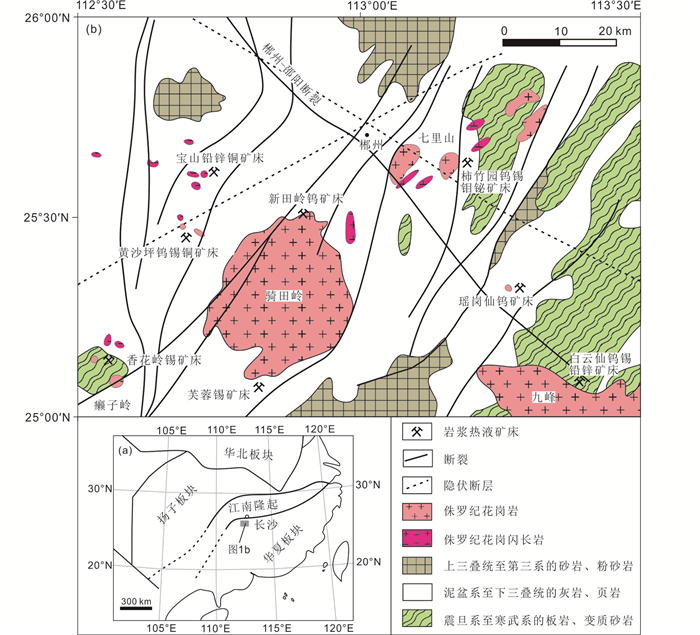
1 区域地质背景湘南地区位于华夏板块与扬子板块缝合带(图 1a),地处东西向南岭成矿带和北东向钦杭成矿带的交汇处,是南岭成矿带的重要组成部分(毛景文等,2019)。区域内矿产资源丰富,发育的矿化金属包括钨、锡、铋、钼、铅、锌、铜、银、锰、铁及少量金(Mao and Li, 1995; Mao et al., 2013),其中代表性的矿床包括柿竹园、香花岭、瑶岗仙、芙蓉和新田岭等(图 1b)。
|
图 1 湘南地区大地构造位置(a)及区域地质简图及主要岩浆热液矿床分布(b)(据袁顺达等,2008修改) Fig. 1 Sketch maps of geotectonic location (a) and tectonic-magmatic framework of the southern Hunan (b) showing the distribution of intrusive rocks and major deposits (modified after Yuan et al., 2008) |
湘南地区地层总体上呈现出东老西新的特征,具体表现为:在其东部和中南部,出露地层为震旦系和寒武系;在中部,主要出露泥盆系地层;在东南部、西部和北部,主要出露石炭系地层;而在西部主要出露二叠系地层。中生代地层较少见,主要包括少量集中于该地区西北部的侏罗系地层。第四系受到地势及基岩岩性的控制,在东部以山麓堆积、洪积和冲积为主,在中部、西部则主要是洪积和残积物(弥佳茹,2016)。研究区燕山期之前的构造活动被侏罗-白垩纪的构造事件所叠加,形成了与裂谷相关的盆地和深大断裂(Li et al., 2018),其中北西向和北东向的两条深大断裂构成了研究区的主要构造格架,而郴州-邵阳断裂和茶陵-临武断裂是控制区内花岗岩体和矿床分布的主要构造单元(图 1b;袁顺达等,2008)。
湘南地区岩浆岩分布广泛,并且具有多期性,主要形成于志留纪、三叠纪和侏罗纪,其中以侏罗纪最为发育(Yuan et al., 2018)。各时期形成的岩浆岩类型具有不同的特征,如古生代形成的岩体主要是花岗闪长岩、辉石闪长岩和英云闪长岩;三叠纪以黑云母花岗闪长岩、黑云母二长花岗岩和二云母二长花岗岩为主;而侏罗-白垩纪则主要是黑云母二长花岗岩、黑云母正长花岗岩和黑云母花岗闪长岩(Zhang et al., 2015)。该区的侏罗纪花岗岩侵入到三叠纪岩体中,形成了王仙岭、邓福县等复式岩体(Liang et al., 2014; Yuan et al., 2015)。区域上的大规模成矿作用主要与这一侏罗纪岩浆活动有关(Mao et al., 2013, 2019; Zhao et al., 2016; Ding et al., 2018; Yuan et al., 2019)。
2 矿床地质特征新田岭矿床是南岭成矿带中的一个大型矽卡岩型钨矿床(袁顺达等,2012),位于南岭构造带中段和耒阳-临武构造带的交汇处,地理位置为112°55′ E~112°57′ E,25°39′ N~25°41′ N(图 1b)。矿区内主要出露的地层为石炭系和第四系,石炭系从老到新依次为下石炭统岩关阶、下石炭统大塘阶、中上石炭统壶天群。其中,下石炭统大塘阶自下而上分为石磴子组、测水组和梓门桥组。矿区的东侧为壶天群白云质灰岩和梓门桥组砂岩,厚度分别为约250m和60m;中部为石磴子组砂岩和测水组灰岩,厚度分别为约250m和150m;西北部主要出露下石炭统岩关阶,其上段岩性为钙质页岩、砂页岩和白云质灰岩,下段为白云质灰岩和钙质页岩(图 2)。

|
图 2 新田岭矿区地质简图(据章荣清,2015修改) Fig. 2 Schematic geological map of the Xintianling ore district (modified after Zhang, 2015) |
矿区内构造活动强烈,褶皱和断层发育,丹凤坪复式背斜为矿区主要褶皱构造(韦宁,2019),断裂构造主要发育有南北向、北东向、东西向以及北西向四组,且其形成时代均早于区域的燕山期岩浆活动和成矿作用,为岩浆侵位和成矿热液运移提供了良好的通道和空间(胡加斌,2012)。同时,由于矿区中部测水组砂页岩具有较好的屏蔽作用,有利于下伏石磴子组灰岩与岩体侵入接触形成矽卡岩,致使石磴子组不纯的灰岩单元为矿区内白钨矿的主要赋矿地层(蔡明海等,2008)。区内的骑田岭复式岩体出露面积约为520km2(韦宁,2019),岩体在空间上呈现出过渡特征,依次包括细粒斑状黑云母花岗岩、中粒黑云母花岗岩、粗粒黑云母花岗岩。成岩作用主要发生在中侏罗世,年龄集中于153~162Ma(双燕等,2016)。此外,矿区内还发育一系列脉岩,岩性主要为花岗斑岩、石英斑岩和细晶岩(章荣清,2015)。
新田岭矿床位于骑田岭岩体东北端(图 1b),矿体大多以不规则的饼状、豆状、似层状产出,主要分布在花岗岩体与围岩的内、外接触带上以及花岗岩体内灰岩捕掳体中,围岩以砂页岩和灰岩为主。新田岭大小矿体总计85个(胡加斌,2012),产出钨金属0.25Mt,并含伴生金属4725t钼和3139t铋(方芳,2020)。矿区内金属矿物以白钨矿为主,次为辉钼矿、磁黄铁矿、黄铁矿、黄铜矿、辉铋矿、方铅矿、闪锌矿、斑铜矿和毒砂。主要脉石矿物包括石榴子石、硅灰石、透辉石、绿泥石、绿帘石、符山石、透闪石、阳起石、萤石、方解石和石英。根据矿物的穿插、交代关系,新田岭矿床的蚀变矿化作用分为三个阶段:矽卡岩阶段(发育石榴子石、透辉石、角闪石和磁铁矿等矿物组合),白钨矿阶段(发育白钨矿、辉钼矿、黄铁矿、磁黄铁矿、石英、斜长石及绿帘石等矿物组合),以及石英硫化物阶段(发育黄铜矿、黄铁矿、方铅矿、闪锌矿、石英及方解石等矿物组合)(殷顺生和王昌烈,1994)。新田岭矿床中的含矿石英Rb-Sr年龄为157.4±3.2Ma(蔡明海等,2008),辉钼矿Re-Os年龄为159.4±1.1Ma(袁顺达等,2012),矽卡岩退化蚀变阶段的铁云母40Ar-39Ar年龄为157.1±0.3Ma(毛景文等,2004)。这些成矿年代学数据与骑田岭岩体的结晶年龄一致,暗示了成岩和成矿作用在时空和成因上的相关性。
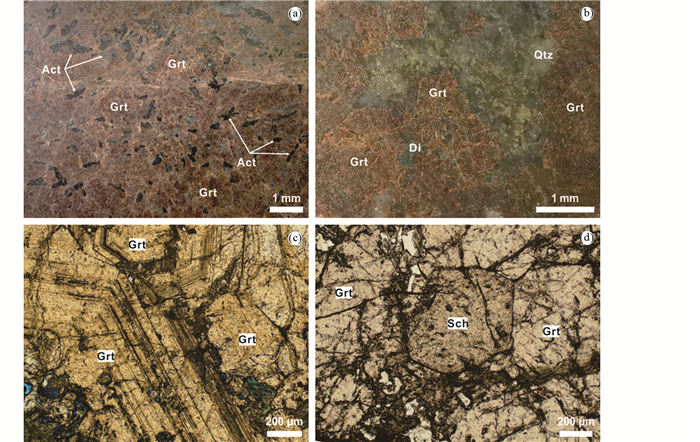
3 样品及分析方法本次用于LA-ICP-MS成分分析的4件矽卡岩样品(XTL-2-1,XTL-2-2,XTL-1-2,XTL-3-2)采自新田岭钨矿区(图 2),其矿物组成主要包括石榴子石、阳起石、方解石和石英,含有一定的白钨矿化和少量辉钼矿化,其中白钨矿主要呈浸染状分布。石榴子石的颜色呈红色或红褐色,以粒状或致密块状产出(图 3a, b)。石榴子石整体较为自形,其晶体粒径变化较大(0.1~2mm),部分受后期热液蚀变影响而呈现出半自形特征。这些石榴子石可大致分成两类,一类粒径大于2mm,具有明显的振荡环带(图 3c),与石英和阳起石伴生;另一类粒径通常较小,不具有振荡环带且相对均质(图 3d),与白钨矿、石英以及方解石等矿物伴生。
|
图 3 新田岭矽卡岩型钨矿床石榴子石手标本及显微照片 (a)含石榴子石和阳起石的矽卡岩;(b)石榴子石矽卡岩,被后期石英叠加;(c)具有振荡环带的石榴子石;(d)均质石榴子石,并与白钨矿伴生. Act-阳起石;Grt-石榴子石;Di-透辉石;Qtz-石英;Sch-白钨矿 Fig. 3 Photo(micro)graphs of typical garnet-bearing samples from the Xintianling deposit (a) garnet- and actinolite-bearing skarn; (b) garnet skarn overprinted by later quartz; (c) garnet crystal with oscillatory zones; (d) homogeneous garnet without significant zoning containing scheelite mineralization. Act-actinolite; Grt-garnet; Di-diopside; Qtz-quartz; Sch-scheelite |
石榴子石成分分析在南京聚谱检测科技有限公司完成,采用的是激光剥蚀电感耦合等离子体质谱分析(LA-ICP-MS)方法。测试仪器型号为Analyte Excite,选用的准分子激光剥蚀系统是由Teledyne Cetac Technologies生产的193nm ArF,搭配安捷伦科技(Agilent Technologies)的Agilent 7700x四极杆电感耦合等离子体质谱仪。激光剥蚀过程中,采用氦气(流量为0.9L/min)作为载气,氩气(流量为0.87L/min)作为补偿气,束斑直径为40μm,能量密度为6.06J/cm2,频率为6Hz。单个测点一次测试时间共80s,包括20s背景采集、40s激光剥蚀以及20s吹扫清洁。本次测试采用了BIR-1G、BHVO-2G和BCR-2G作为标样。分析元素包括Mg、Al、Si、Ca、Ti、Mn、Fe、Cu、Zn、Y、Mo、Sn、La、Ce、Pr、Nd、Sm、Eu、Gd、Tb、Dy、Ho、Er、Tm、Yb、Lu、W、Pb以及U。原始数据经ICPMSDataCal软件离线处理,元素含量采用“无内标-基本归一法”进行定量计算(Liu et al., 2008)。在测试过程中,使用CGSC-1和CGSG-2标样作为盲样,以监测分析结果的准确度(Hu et al., 2011)。
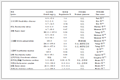
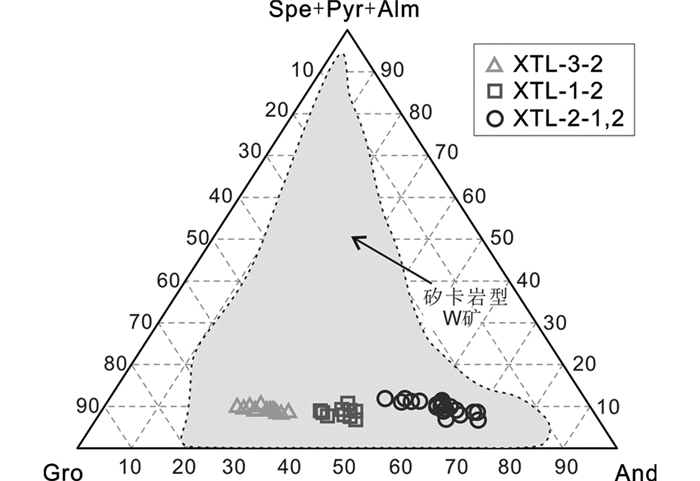
4 分析结果新田岭钨矿床石榴子石的主量元素Si和Ca变化较小(表 1):SiO2含量为33.70%~36.43%,平均值为34.66%;CaO含量为32.20%~36.51%,平均含量是34.58%。石榴子石的Al2O3含量为5.06%~17.09%,平均值为10.86%;全铁(FeOT)含量为8.87%~22.90%,平均含量是16.08%;MnO含量为2.06%~4.07%,平均值为3.10%。MgO和TiO2含量非常低,其平均值分别为0.03%和0.14%。总体而言,同一个石榴子石晶体的核部到边部未表现出明显的成分分带现象。样品XTL-2-1和XTL-2-2整体富Fe,钙铁榴石端元含量为50.76%~70.54%,对应钙铝榴石端元含量为21.99%~37.52%(图 4);样品XTL-1-2的成分由富Fe过渡为富Al,钙铁榴石与钙铝榴石端元含量相近,其平均值分别为44.34%和47.15%;样品XTL-3-2的特征为富Al,其钙铝榴石端元含量为57.09%~65.86%,对应钙铁榴石端元含量为24.25%~34.50%。本研究获得的新田岭钨矿床石榴子石成分特征与全球范围内大多数矽卡岩型钨矿床的石榴子石成分一致(图 4;Meinert, 1992)。
|
表 1 新田岭钨矿床石榴子石主量元素成分(wt%) Table 1 Major element compositions (wt%) of the garnets from the Xintianling tungsten deposit |
|
图 4 新田岭石榴子石成分端元三角图解(底图据Meinert, 1992) And-钙铁榴石;Gro-钙铝榴石;Spe-锰铝榴石;Pyr-镁铝榴石;Alm-铁铝榴石 Fig. 4 Triangular classification diagram of the Xianghualing garnets (after Meinert, 1992) And-andradite; Gro-grossular; Spe-spessartine; Pyr-pyrope; Alm-almandine |
新田岭矿床石榴子石的微量和稀土元素分析结果如表 2所示。就常见成矿金属元素而言,所有石榴子石均显著富集Sn,较富集W和Zn,而相对亏损Cu、Mo和Pb。其中,Sn元素含量明显高于其它元素,为78.57×10⁻⁶~986.7×10⁻⁶,平均425.1×10⁻⁶;W含量为0.80×10⁻⁶~22.87×10⁻⁶,平均为6.55×10⁻⁶;Zn含量为7.14×10⁻⁶~22.72×10⁻⁶,平均为14.34×10⁻⁶;Cu、Mo和Pb元素的含量平均值分别为0.13×10⁻⁶、0.31×10⁻⁶和0.07×10⁻⁶。石榴子石中的稀土元素含量平均值均小于8×10⁻⁶,且多数在1×10⁻⁶左右。不过,有部分测试点的La、Ce含量具有明显正异常,其中La含量最高可达1356×10-6,Ce含量最高可达2427×10-6(表 2),可能暗示富La、Ce等元素的稀土矿物微粒包体的存在。剔除这些异常点,新田岭矽卡岩中石榴子石的REE总量在8.90×10⁻⁶~49.29×10⁻⁶之间,平均为21.73×10⁻⁶(图 5)。LREE/HREE比值范围为0.31~62.41,平均13.22。值得一提的是,大多数测试点的LREE/HREE比值远大于1,而少数小于1的情况都集中在样品XTL-3-2中。Eu/Eu*比值异常情况与轻重稀土比值情况相似,仅在样品XTL-3-2中表现出Eu负异常(即Eu/Eu* < 1)。总体而言,Eu/Eu*比值分布在0.49~6.15之间,平均值为1.81。
|
|
表 2 新田岭钨矿床石榴子石稀土、微量元素成分(×10-6) Table 2 Trace element compositions (×10-6) of the garnets from the Xintianling deposit |

|
图 5 新田岭矿区不同石榴子石的球粒陨石标准化稀土元素配分模式(标准化值据Pourmand et al., 2012) Fig. 5 Chondrite-normalized REE patterns of different garnets from Xintianling (normalization values after Pourmand et al., 2012) |
石榴子石的化学通式为X3Y2[SiO4]3,其中X代表占据八次配位的二价阳离子(如Ca2+、Mn2+、Mg2+或Fe2+),而Y位置通常由三价阳离子(如Fe3+、Al3+或Cr3+)占据(Menzer, 1926; Meinert, 1997)。微量元素通过替代机制进入矿物晶体中,主要受控于晶体化学结构(McIntire, 1963),通常稀土元素进入石榴子石遵循戈尔德施密特定律(晶体化学第一定律),即被替代阳离子与其替代离子之间的离子半径和电荷配比在替代机制中起主要控制作用(Gaspar et al., 2008; Peng et al., 2014)。稀土元素的离子半径由La(1.19Å)至Lu(0.94Å)依次减小,其离子半径范围与Ca2+(1.12Å)相近,而远大于Y位置上的Fe3+(0.67Å)和Al3+(0.54Å)(Gaspar et al., 2008),这意味着REE3+通常只通过替代X位置上的Ca2+进入到石榴子石晶格中(Wen et al., 2020)。据此,常见的替代机制包括:(1)一价阳离子(如Na+)与REE3+结合,共同替代X位置上的二价阳离子(Enami et al., 1995; Sepidbar et al., 2017);(2)两个REE3+离子替代3个Ca2+离子,同时产生一个X位置上的空缺(Ismail et al., 2014; Fei et al., 2019)。
一般情况下,热液体系中的稀土元素在石榴子石与流体之间的分配系数具有DHREE>DLREE的特点,且相对于半径较大的轻稀土元素(LREE)来说,石榴子石晶体的结构性质更适合于半径较小的重稀土元素(HREE)进入(Irving, 1978; Van Westrenen et al., 1999; Gaspar et al., 2008; 姚远等,2013)。但是从本文研究结果来看,不同样品之间的端元成分和稀土元素配分模式呈现出明显差异性(图 4、图 5):样品XTL-2-1、XTL-2-2以钙铁榴石为主,稀土元素呈现出右倾型配分模式,亏损HREE而富集LREE;样品XTL-3-2以钙铝榴石为主,表现出富集HREE、亏损LREE的平缓左倾型配分模式;而样品XTL-1-2中钙铁榴石与钙铝榴石的含量相近,配分模式为右倾型。以上结果反映出钙铝榴石以富集HREE而相对亏损LREE的左倾型稀土配分模式为主,而钙铁榴石则以富集LREE、亏损HREE的右倾型稀土配分模式为主(图 6)。可见,新田岭矽卡岩石榴子石中稀土元素的配分并不完全遵循晶体化学的替代规律,还与其具体成分(端元组分)密切相关。相比多数生长于岩浆岩和变质岩中的富铝石榴子石(Zhang et al., 2000; Boyd et al., 2004),矽卡岩中的石榴子石不仅有钙铝榴石端元,还常见钙铁榴石端元组分,这也导致了其更为复杂的稀土配分模式。前人也指出,矽卡岩石榴子石中稀土配分不仅仅受控于晶体化学结构,热液流体中的一些物理化学参数也将影响稀土元素在流体和石榴子石中的迁移,包括流体成分、盐度、酸碱度、氧逸度、温度、压力以及水/岩比等(Jiang et al., 2004; Williams-Jones et al., 2012; Xu et al., 2020),同时,源区稀土元素含量和外部流体汇入也会影响石榴子石的稀土元素组成(Ranjbar et al., 2016; Zhao et al., 2018)。

|
图 6 新田岭矿区石榴子石的LREE/HREE比值与其钙铁榴石端元含量(a)和钙铝榴石端元含量(b)的关系图解 Fig. 6 Variations of LREE/HREE with andradite (a) and grossular (b) compositions of the garnets from Xintianling |
石榴子石稀土元素的地球化学特征对示踪成矿物质和流体的性质、来源及其演化过程也有较好的指示作用(Gaspar et al., 2008; Carlson et al., 2014; Ranjbar et al., 2016; Xu et al., 2020)。Eu是一个变价元素,与大多其它REE3+不同,其在自然界中存在Eu2+和Eu3+两种价态,氧化条件下Eu3+较为稳定,但在还原条件下Eu2+就会占据主导地位(Sverjensky et al., 1984; Fan et al., 2019)。因此,一般认为石榴子石中的Eu能够反映流体的氧化还原状态(Gaspar et al., 2008; Xiao et al., 2018)。从本文测试结果来看(图 4、图 5),新田岭矿床石榴子石的Eu在钙铝榴石端元主导的石榴子石(XTL-3-2)中,呈现出负异常,此外这类石榴子石不发育明显的振荡环带,可认为其生长于相对稳定的还原性流体中。这是因为,在还原性流体中Eu2+占主导,考虑到其离子半径(1.25Å)相较于Eu3+(1.07Å)与石榴子石八配位上Ca2+离子半径(1.12Å)差异更大,更难以置换,导致石榴子石中出现Eu负异常(Kato, 1999; Tian et al., 2019)。而在以钙铁榴石为主的石榴子石(XTL-2-1、XTL-2-2和XTL-1-2)中呈现明显的Eu正异常,可能暗示了其形成于较氧化的环境。不过,由于发育振荡环带的钙铁榴石通常生长速率较快,稀土元素在石榴子石和热液流体之间难以达到完全平衡(Jamtveit and Hervig, 1994; Peng et al., 2016),晶体化学结构的作用不足以充分解释Eu正异常的现象(Allen and Seyfried Jr, 2005; Mayanovic et al., 2007; Zhai et al., 2014; Fan et al., 2019)。对此,有学者认为表面吸附作用或富Eu矿物的分解可能是形成石榴子石中Eu正异常的关键(任涛等,2010;朱乔乔等,2014;Xiao et al., 2018)。本次研究的新田岭矿床中的Eu正异常石榴子石(XTL-2-1、XTL-2-2和XTL-1-2)均发育显著的振荡环带(图 3c),记录了高水/岩比环境下晶体的快速生长过程,而这一过程中,吸附作用主导了REE在石榴子石和流体间的分配(Jamtveit and Hervig, 1994; Gaspar et al., 2008)。一般而言,半径越小、电价越高的离子越容易被矿物吸附(Bau, 1991),相比于Eu2+离子,Eu3+离子半径更小,电价更高,因此在氧化环境下,大量Eu3+离子被吸附于石榴子石晶体表面,从而导致明显的Eu正异常。此外,在吸附作用之下,石榴子石的REE配分模式更可能继承了流体中REE的配分模式,因此往往呈现出富集LREE、亏损HREE的右倾模式,这也能较好地解释上述钙铁榴石的稀土特征(图 5;Jamtveit and Hervig, 1994)。
5.2 石榴子石微量元素对矿化的指示作用新田岭矿床石榴子石中的W含量较高(平均值为6.55×10⁻⁶),这一特征在其它含W矽卡岩型矿床中也较普遍,如香花岭W-Sn矿床石榴子石中W平均含量为11.39×10⁻⁶(Yu et al., 2020)、朱溪W-Cu矿床约6.64×10⁻⁶(贺晓龙等,2018;Sun et al., 2019)、翠宏山Fe-Mo-W矿床约79.77×10⁻⁶(Fei et al., 2019)、红山Cu-Mo-W矿床约45.85×10⁻⁶(Tian et al., 2019),而韩国Weondong W-Fe矿床和Sangdong W-Mo矿床中石榴子石W的平均含量分别高达206.6×10⁻⁶和193.5×10⁻⁶(Park et al., 2017a, b)。除此之外,包括新田岭矿床在内,这些矽卡岩型含W矿床中石榴子石也都具有相对高Sn的特点。为了更好地探讨石榴子石中W、Sn元素含量对矿床矿化金属类型的指示作用,本文将上述矿床与一些不含W矿化的矽卡岩型矿床(包括Sangan Fe矿床和铁山Fe-Cu矿床)进行了对比(图 7),结果表明,含有W矿化的矿床无论是石榴子石中的W还是Sn的含量,通常都高于不含W矿化的矿床;不含W矿化矿床中石榴子石的平均W含量仅1.83×10⁻⁶(Sepidbar et al., 2017; Wang et al., 2019),整体上呈现出了低Sn、低W的特征。因此,本文认为石榴子石的W、Sn含量可以作为矽卡岩型矿床是否具有成W矿潜力的判别工具。不过值得一提的是,因受到统计矿床数量有限的影响,本研究结论的可靠性仍有待未来大量工作的检验。

|
图 7 不同矽卡岩型矿床中石榴子石钨-锡含量关系图 数据来源:Yu et al. (2020), 贺晓龙等, (2018), Sun et al. (2019), Fei et al. (2019), Tian et al. (2019), Park et al.(2017a, b), Wang et al. (2019), Sepidbar et al. (2017)及本文 Fig. 7 W and Sn concentrations in garnets from different types of skarn deposits Data sources: Yu et al. (2020), He et al. (2018), Sun et al. (2019), Fei et al. (2019), Tian et al. (2019), Park et al.(2017a, b), Wang et al. (2019), Sepidbar et al. (2017), and this study |
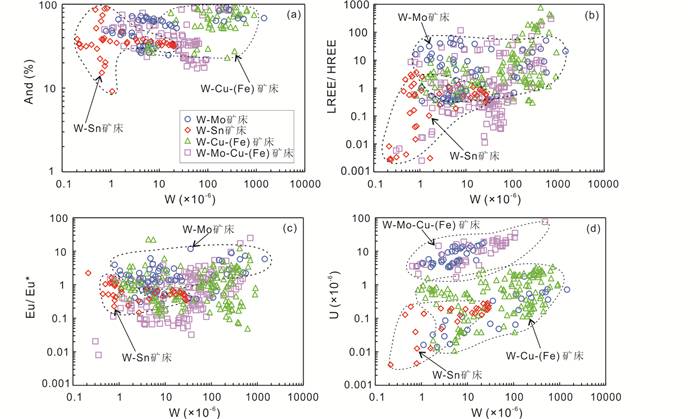
为进一步探索石榴子石中微量元素对矽卡岩型W矿床中伴生金属矿化类型的指示意义,本文还将含有W矿化的矽卡岩型矿床按其伴生金属组成划分为W-Mo矿床(新田岭矿床、韩国Sangdong矿床)、W-Sn矿床(香花岭矿床、白干湖矿床)、W-Cu-(Fe)矿床(朱溪矿床、韩国Weondong矿床)以及W-Mo-Cu-(Fe)矿床(翠宏山矿床、红山矿床)四个亚类并进行对比分析。在石榴子石钙铁榴石端元比例和W含量的对比图中(图 8a),矽卡岩型W-Sn矿床与W-Cu-(Fe)矿床落在了两个相对独立的区域,其中W-Sn矿床的石榴子石W含量整体上低于W-Cu-(Fe)矿床,而且其钙铁榴石含量大多低于50%,而W-Cu-(Fe)矿床钙铁榴石含量大多高于50%。换言之,W-Sn矿床石榴子石整体更富Al,而W-Cu-(Fe)矿床石榴子石更富Fe,这也暗示了富Fe石榴子石可能具有富集W的能力。实际上,W6+离子半径为0.68Å,与Fe3+的离子半径(0.67Å)相近,而远大于Al3+的离子半径(0.54Å),这可能导致了W更倾向于替代Fe3+进入石榴子石,进而造成富Fe石榴子石相对富W的现象(Xu et al., 2016; Park et al., 2017a; Fei et al., 2019)。相似的特征在图 8b中也得到了验证,富Al石榴子石通常富集HREE亏损LREE,而富Fe石榴子石则与其相反,呈现出富集LREE亏损HREE的特征(王伟等,2016);对应地,W-Sn矿床中石榴子石LREE/HREE比值一般小于1,而W-Mo矿床通常大于1(图 8b)。可见,石榴子石中W和Fe的含量可在一定程度上用于区分W-Sn矿床和其它含W矿化类型。大量事实表明,与Sn矿化相关的矽卡岩型矿床一般形成于相对还原环境的条件,而与Mo和Cu矿化相关的矽卡岩型矿床则多形成于氧化环境(Meinert et al., 2005; Chang et al., 2019)。对于矽卡岩型W矿床而言,基于其围岩成分、共生矿物和成矿深度的区别,可分为氧化型W矿和还原型W矿两种类型(Newberry and Einaudi, 1981)。即是说,与W矿化有关的矽卡岩型矿床既可以在氧化环境下形成,也可在还原环境下形成。基于这一认识,本文试图通过变价元素Eu和U来区分W矿化种类,因为变价元素往往可以动态地反映矿物生长的氧化还原条件(Tian et al., 2019)。从图 8c中可以看到,石榴子石的Eu/Eu*比值在W-Sn矿床中通常小于1,而在W-Mo矿床中多数大于1。虽然两者的W含量并没有特别悬殊的差距,但借助与Eu/Eu*比值的对比,可以被较好地区分开来。此外,通过石榴子石中U和W含量的对比,也可以较明显地区分开矽卡岩型W-Mo-Cu-(Fe)矿床、W-Cu-(Fe)矿床以及W-Sn矿床(图 8d)。可见,矽卡岩型矿床中石榴子石的微量元素(如W、Sn、Eu、U等)对于金属矿化类型具有一定的指示作用,这在勘查找矿实践中或可应用于成矿金属类型的预测和潜力评价。
|
图 8 不同矽卡岩型含钨多金属矿床中石榴子石钨含量与钙铁榴石成分(a)、LREE/HREE比值(b)、Eu异常(c)以及铀含量(d)的关系图 数据来源:Park et al.(2017a, b), Yu et al. (2020), Zhou et al. (2017), 贺晓龙等, (2018), Sun et al. (2019), Fei et al. (2019), Tian et al. (2019)及本文 Fig. 8 Diagrams of W concentrations vs. andradite (a), LREE/HREE(b), Eu/Eu*(c) and U (d) concentrations in garnets from different types of W-bearing skarn deposits Data source: Park et al.(2017a, b), Yu et al. (2020), Zhou et al. (2017), He et al. (2018), Sun et al. (2019), Fei et al. (2019), Tian et al. (2019), and this study |
(1) 新田岭矽卡岩型W矿床的石榴子石属于钙铁榴石-钙铝榴石固溶体系列,且石榴子石端元组分与稀土元素配分密切相关,在钙铁榴石中以右倾型稀土配分模式为主,而在钙铝榴石中以左倾型为主。Eu呈现出正异常与负异常两种状态,暗示石榴子石结晶过程中热液流体的氧化还原状态和环境中的水/岩比值存在差异性。
(2) 通过对不同矽卡岩型矿床中石榴子石W、Sn含量的对比发现,含W矿化矿床石榴子石中W、Sn的含量整体高于不含W矿化矿床,表明石榴子石中W、Sn含量可在一定程度上用于预测矽卡岩成W矿潜力。
(3) 通过对比分析石榴子石中W含量与钙铁榴石含量、LREE/HREE比值、Eu/Eu*比值以及U含量之间的关系,可以进一步区分矽卡岩型W-Mo、W-Sn、W-Cu-(Fe)以及W-Mo-Cu-(Fe)矿床,表明石榴子石中的元素含量可用于判断矽卡岩型W矿床中潜在的伴生金属类型。
Allen DE and Seyfried Jr WE. 2005. REE controls in ultramafic hosted MOR hydrothermal systems: An experimental study at elevated temperature and pressure. Geochimica et Cosmochimica Acta, 69(3): 675-683 DOI:10.1016/j.gca.2004.07.016
|
Bau M. 1991. Rare-earth element mobility during hydrothermal and metamorphic fluid-rock interaction and the significance of the oxidation state of europium. Chemical Geology, 93(3-4): 219-230 DOI:10.1016/0009-2541(91)90115-8
|
Bi CS, Wu JS, Wang MY and Ai SZ. 1988. Stable isotope geology of the Xintianling scheelite deposit. Mineral Deposits, 7(2): 39-48 (in Chinese with English abstract)
|
Boyd FR, Pearson DG, Hoal KO, Hoal BG, Nixon PH, Kingston MJ and Mertzman SA. 2004. Garnet lherzolites from Louwrensia, Namibia: Bulk composition and P/T relations. Lithos, 77(1-4): 573-592 DOI:10.1016/j.lithos.2004.03.010
|
Cai MH, Han FB, He LQ, Liu GQ, Chen KX and Fu JM. 2008. He, Ar isotope characteristics and Rb-Sr dating of the Xintianling skarn scheelite deposit in southern Hunan, China. Acta Geoscientica Sinica, 29(2): 167-173 (in Chinese with English abstract)
|
Carlson WD, Gale JD and Wright K. 2014. Incorporation of Y and REEs in aluminosilicate garnet: Energetics from atomistic simulation. American Mineralogist, 99(5-6): 1022-1034 DOI:10.2138/am.2014.4720
|
Chang ZS, Shu QH and Meinert L. 2019. Skarn deposits of China. In: Chang ZS and Goldfarb RJ (eds. ). Mineral Deposits of China. Littleton: Society of Economic Geologists, 189-234
|
Deng J, Wang QF and Li GJ. 2017. Tectonic evolution, superimposed orogeny, and composite metallogenic system in China. Gondwana Research, 50: 216-266 DOI:10.1016/j.gr.2017.02.005
|
Deng J, Zhai YS, Mo XX and Wang QF. 2019. Temporal-spatial distribution of metallic ore deposits in China and their geodynamic settings. In: Chang Z and Goldfarb RJ (eds. ). Mineral Deposits of China. Littleton: Society of Economic Geologists, 103-132
|
Ding T, Ma DS, Lu JJ and Zhang RQ. 2018. Garnet and scheelite as indicators of multi-stage tungsten mineralization in the Huangshaping deposit, southern Hunan Province, China. Ore Geology Reviews, 94: 193-211 DOI:10.1016/j.oregeorev.2018.01.029
|
Enami M, Cong BL, Yoshida T and Kawabe I. 1995. A mechanism for Na incorporation in garnet: An example from garnet in orthogneiss from the Su-Lu Terrane, eastern China. American Mineralogist, 80(5-6): 475-482 DOI:10.2138/am-1995-5-608
|
Fan XJ, Wang XD, Lü XB, Wei W and Chen W. 2019. Garnet composition as an indicator of skarn formation: LA-ICP-MS and EPMA studies on oscillatory zoned garnets from the Haobugao skarn deposit, Inner Mongolia, China. Geological Journal, 54(4): 1976-1992 DOI:10.1002/gj.3273
|
Fang F. 2020. Prospecting significance of Xintianling tungsten deposit in Chenzhou City, Hunan Province. World Nonferrous Metals, (18): 72-73 (in Chinese with English abstract)
|
Fei XH, Zhang ZC, Cheng ZG and Santosh M. 2019. Factors controlling the crystal morphology and chemistry of garnet in skarn deposits: A case study from the Cuihongshan polymetallic deposit, Lesser Xing'an Range, NE China. American Mineralogist, 104(10): 1455-1468 DOI:10.2138/am-2019-6968
|
Gaspar M, Knaack C, Meinert LD and Moretti R. 2008. REE in skarn systems: A LA-ICP-MS study of garnets from the Crown Jewel gold deposit. Geochimica et Cosmochimica Acta, 72(1): 185-205 DOI:10.1016/j.gca.2007.09.033
|
He XL, Zhang D, Chen GH, Di YJ, Huo HL, Li N, Zhang ZH, Rao JF, Wei J and Ouyang YP. 2018. Genesis of Zhuxi copper-tungsten deposit in Jiangxi Province: Insights from mineralogy and chronology. Journal of Jilin University (Earth Science Edition), 48(4): 1050-1070 (in Chinese with English abstract)
|
Hu JB. 2012. The characteristic and prospecting significance of tungsten-bearing granitoids of Xintianling skarn deposit, southern Hunan Province, Nanling Range. Master Degree Thesis. Nanjing: Nanjing University (in Chinese with English abstract)
|
Hu MY, Fan XT, Stoll B, Kuzmin D, Liu Y, Liu YS, Sun WD, Wang G, Zhan XC and Jochum KP. 2011. Preliminary characterisation of new reference materials for microanalysis: Chinese geological standard glasses CGSG-1, CGSG-2, CGSG-4 and CGSG-5. Geostandards and Geoanalytical Research, 35(2): 235-251 DOI:10.1111/j.1751-908X.2010.00097.x
|
Irving AJ. 1978. A review of experimental studies of crystal/liquid trace element partitioning. Geochimica et Cosmochimica Acta, 42(6): 743-770 DOI:10.1016/0016-7037(78)90091-1
|
Ismail R, Ciobanu CL, Cook NJ, Teale GS, Giles D, Mumm AS and Wade B. 2014. Rare earths and other trace elements in minerals from skarn assemblages, Hillside iron oxide-copper-gold deposit, Yorke Peninsula, South Australia. Lithos, 184-187: 456-477 DOI:10.1016/j.lithos.2013.07.023
|
Jamtveit B, Wogelius RA and Fraser DG. 1993. Zonation patterns of skarn garnets: Records of hydrothermal system evolution. Geology, 21(2): 113-116 DOI:10.1130/0091-7613(1993)021<0113:ZPOSGR>2.3.CO;2
|
Jamtveit B and Hervig RL. 1994. Constraints on transport and kinetics in hydrothermal systems from zoned garnet crystals. Science, 263(5146): 505-508 DOI:10.1126/science.263.5146.505
|
Jiang SY, Yu JM and Lu JJ. 2004. Trace and rare-earth element geochemistry in tourmaline and cassiterite from the Yunlong tin deposit, Yunnan, China: Implication for migmatitic-hydrothermal fluid evolution and ore genesis. Chemical Geology, 209(3-4): 193-213 DOI:10.1016/j.chemgeo.2004.04.021
|
Kato Y. 1999. Rare earth elements as an indicator to origins of skarn deposits: Examples of the Kamioka Zn-Pb and Yoshiwara-Sannotake Cu (-Fe) deposits in Japan. Resource Geology, 49(4): 183-198 DOI:10.1111/j.1751-3928.1999.tb00045.x
|
Li H, Wu JH, Evans NJ, Jiang WC and Zhou ZK. 2018. Zircon geochronology and geochemistry of the Xianghualing A-type granitic rocks: Insights into multi-stage Sn-polymetallic mineralization in South China. Lithos, 312-313: 1-20 DOI:10.1016/j.lithos.2018.05.001
|
Liang XQ, Jiang Y, Dong CG, Fu JG, Wang C and Zhou Y. 2014. LA-ICPMS zircon U-Pb and molybdenite Re-Os isotopic dating of the tungsten deposits in the Dengfuxian W-Sn orefield, eastern Hunan Province, South China, and their geological implications. Acta Geologica Sinica, 88(Suppl.2): 99-100
|
Liu YS, Hu ZC, Gao S, Günther D, Xu J, Gao CG and Chen HH. 2008. In situ analysis of major and trace elements of anhydrous minerals by LA-ICP-MS without applying an internal standard. Chemical Geology, 257(1-2): 34-43 DOI:10.1016/j.chemgeo.2008.08.004
|
Mao JW and Li HY. 1995. Evolution of the Qianlishan granite stock and its relation to the Shizhuyuan polymetallic tungsten deposit. International Geology Review, 37(1): 63-80 DOI:10.1080/00206819509465393
|
Mao JW, Li XF, Lehmann B, Chen W, Lan XM and Wei SL. 2004. 40Ar-39Ar dating of tin ores and related granite in Furong tin orefield, Hunan Province, and its geodynamic significance. Mineral Deposits, 23(2): 164-175 (in Chinese with English abstract)
|
Mao JW, Cheng YB, Chen MH and Franco P. 2013. Major types and time-space distribution of Mesozoic ore deposits in South China and their geodynamic settings. Mineralium Deposita, 48(3): 267-294 DOI:10.1007/s00126-012-0446-z
|
Mao JW, Ouyang HG, Song SW, Santosh M, Yuan SD, Zhou ZH, Zheng W, Liu H, Liu P, Cheng YB and Chen MH. 2019. Geology and metallogeny of tungsten and tin deposits in China. In: Chang ZS and Goldfarb RJ (eds. ). Mineral Deposits of China. Littleton: Society of Economic Geologists, 441-482
|
Mao JW, Yuan SD, Xie GQ, Song SW, Zhou Q, Gao YB, Liu X, Fu XF, Cao J, Zeng ZL, Li TG and Fan XY. 2019. New advances on metallogenic studies and exploration on critical minerals of China in 21st century. Mineral Deposits, 38(5): 935-969 (in Chinese with English abstract)
|
Mayanovic RA, Anderson AJ, Bassett WA and Chou IM. 2007. On the formation and structure of rare-earth element complexes in aqueous solutions under hydrothermal conditions with new data on Gadolinium Aqua and Chloro complexes. Chemical Geology, 239(3-4): 266-283 DOI:10.1016/j.chemgeo.2006.10.004
|
McIntire WL. 1963. Trace element partition coefficients: A review of theory and applications to geology. Geochimica et Cosmochimica Acta, 27(12): 1209-1264 DOI:10.1016/0016-7037(63)90049-8
|
Meinert LD. 1992. Skarns and skarn deposits. Geoscience Canada, 19(4): 145-162
|
Meinert LD. 1997. Application of skarn deposit zonation models to mineral exploration. Exploration and Mining Geology, 6(2): 185-208
|
Meinert LD, Dipple GM and Nicolescu S. 2005. World skarn deposits. In: Hedenquist JW, Thompson FH, Goldfarb RJ and Richards JP (eds. ). One Hundredth Anniversary Volume. Littleton: Society of Economic Geologists, 299-336
|
Menzer G. 1926. Die kristallstructure von granat. Zeitschift Fur Kristallographie, 63: 157-158
|
Mi JR. 2016. The study of genetic difference between Cu and W deposits in southern Hunan: Take the Baoshan and Huangshaping deposits as an example. Master Degree Thesis. Beijing: China University of Geosciences (Beijing) (in Chinese with English abstract)
|
Newberry RJ and Einaudi MT. 1981. Tectonic and geochemical setting of tungsten skarn mineralization in the Cordillera. Arizona Geological Society Digest, 14: 99-111
|
Park C, Choi W, Kim H, Park MH, Kang IM, Lee HS and Song YG. 2017a. Oscillatory zoning in skarn garnet: Implications for tungsten ore exploration. Ore Geology Reviews, 89: 1006-1018 DOI:10.1016/j.oregeorev.2017.08.003
|
Park C, Song Y, Kang IM, Shim J, Chung D and Park CS. 2017b. Metasomatic changes during periodic fluid flux recorded in Grandite garnet from the Weondong W-skarn deposit, South Korea. Chemical Geology, 451: 135-153 DOI:10.1016/j.chemgeo.2017.01.011
|
Peng HJ, Hou L, Zhang CQ and Guang T. 2014. Formation of the Hongniu-Hongshan porphyry-skarn copper deposit, Zhongdian area, Yunnan Province, China. Acta Geologica Sinica, 88(Suppl.2): 587-588
|
Peng HJ, Mao JW, Hou L, Shu QH, Zhang CQ, Liu H and Zhou YM. 2016. Stable isotope and fluid inclusion constraints on the source and evolution of ore fluids in the Hongniu-Hongshan Cu skarn deposit, Yunnan Province, China. Economic Geology, 111(6): 1369-1396 DOI:10.2113/econgeo.111.6.1369
|
Ranjbar S, Manesh SMT, Mackizadeh MA, Tabatabaei SH and Parfenova OV. 2016. Geochemistry of major and rare earth elements in garnet of the Kale Kafi skarn, Anarak Area, Central Iran: Constraints on processes in a hydrothermal system. Geochemistry International, 54(5): 423-438 DOI:10.1134/S0016702916050098
|
Ren T, Zhong H, Zhang XC and Zhu WG. 2010. REE geochemistry of garnets from the Langdu skarn copper deposit. Earth Science Frontiers, 17(2): 348-358 (in Chinese with English abstract)
|
Sepidbar F, Mirnejad H, Li JW, Wei CJ, George LL and Burlinson K. 2017. Mineral geochemistry of the Sangan skarn deposit, NE Iran: Implication for the evolution of hydrothermal fluid. Geochemistry, 77(3): 399-419 DOI:10.1016/j.chemer.2017.07.008
|
Shu QH, Lai Y, Sun Y, Wang C and Meng S. 2013. Ore genesis and hydrothermal evolution of the Baiyinnuo'er zinc-lead skarn deposit, Northeast China: Evidence from isotopes (S, Pb) and fluid inclusions. Economic Geology, 108(4): 835-860 DOI:10.2113/econgeo.108.4.835
|
Shuang Y, Gong YC, Li H, Tian XF, Mao LL and Chen W. 2016. Fluid-inclusion geochemistry of the large-sized Xintianling tungsten deposit, Hunan Province, China. Geochimica, 45(6): 569-581 (in Chinese with English abstract)
|
Smith MP, Henderson P, Jeffries TER, Long J and Williams CT. 2004. The rare earth elements and uranium in garnets from the Beinn an Dubhaich Aureole, Skye, Scotland, UK: Constraints on processes in a dynamic hydrothermal system. Journal of Petrology, 45(3): 457-484 DOI:10.1093/petrology/egg087
|
Sun KK, Chen B and Deng J. 2019. Ore genesis of the Zhuxi supergiant W-Cu skarn polymetallic deposit, South China: Evidence from scheelite geochemistry. Ore Geology Reviews, 107: 14-29 DOI:10.1016/j.oregeorev.2019.02.017
|
Sverjensky DA. 1984. Europium redox equilibria in aqueous solution. Earth and Planetary Science Letters, 67(1): 70-78 DOI:10.1016/0012-821X(84)90039-6
|
Tang Y and Liu C. 2016. Study on geological characteristics and metallogenic law of ore body in one ore section of Xintianling tungsten mine, Hunan Province. Low Carbon World, (24): 34-35, 36 (in Chinese)
|
Tian ZD, Leng CB, Zhang XC, Zafar T, Zhang LJ, Hong W and Lai CK. 2019. Chemical composition, genesis and exploration implication of garnet from the Hongshan Cu-Mo skarn deposit, SW China. Ore Geology Reviews, 112: 103016 DOI:10.1016/j.oregeorev.2019.103016
|
Van Westrenen W, Blundy J and Wood B. 1999. Crystal-chemical controls on trace element partitioning between garnet and anhydrous silicate melt. American Mineralogist, 84(5-6): 838-847 DOI:10.2138/am-1999-5-617
|
Wang MF, Shang XY, Zhang FC, Wei KT and Wang W. 2019. In-situ major and trace element chemistry of melanite from Tieshan Fe-Cu skarn deposit, Hubei Province, eastern China: Implications for hydrothermal fluid evolution. Ore Geology Reviews, 111: 102996 DOI:10.1016/j.oregeorev.2019.102996
|
Wang W, Wang MF, Liu K and Guo XN. 2016. The current status and prospects of the study of garnet in skarn for hydrothermal fluid evolution tracing and mineralization zoning. Acta Petrologica et Mineralogica, 35(1): 147-161 (in Chinese with English abstract)
|
Wei N. 2019. Geological characteristics and prospecting indications of Xintianling scheelite deposit in Hunan Province. World Nonferrous Metals, (12): 40-42 (in Chinese with English abstract)
|
Wen G, Li JW, Hofstra AH, Koenig AE and Cui BZ. 2020. Textures and compositions of clinopyroxene in an Fe skarn with implications for ore-fluid evolution and mineral-fluid REE partitioning. Geochimica et Cosmochimica Acta, 290: 104-123 DOI:10.1016/j.gca.2020.08.020
|
Williams-Jones AE, Migdisov AA and Samson IM. 2012. Hydrothermal mobilisation of the rare earth elements: A tale of "Ceria" and "Yttria". Elements, 8(5): 355-360 DOI:10.2113/gselements.8.5.355
|
Xiao X, Zhou TF, White NC, Zhang LJ, Fan Y, Wang FY and Chen XF. 2018. The formation and trace elements of garnet in the skarn zone from the Xinqiao Cu-S-Fe-Au deposit, Tongling ore district, Anhui Province, eastern China. Lithos, 302-303: 467-479 DOI:10.1016/j.lithos.2018.01.023
|
Xu J, Ciobanu CL, Cook NJ, Zheng YY, Sun X and Wade BP. 2016. Skarn formation and trace elements in garnet and associated minerals from Zhibula copper deposit, Gangdese Belt, southern Tibet. Lithos, 262: 213-231 DOI:10.1016/j.lithos.2016.07.010
|
Xu J, Ciobanu CL, Cook NJ, Zheng YY, Li XF, Wade BP, Verdugo-Ihl MR, Gao WY and Zhu QQ. 2020. Numerical modelling of rare earth element fractionation trends in garnet: A tool to monitor skarn evolution. Contributions to Mineralogy and Petrology, 175(4): 30 DOI:10.1007/s00410-020-1670-7
|
Yang W, Dai TG and Zhang ML. 2016. Research on geochemical characteristics of Xintianling tungsten deposit in Hunan. Land and Resources Herald, 13(4): 8-13, 19 (in Chinese with English abstract)
|
Yang YL, Ni P, Wang Q, Wang JY and Zhang XL. 2020. In situ LA-ICP-MS study of garnets in the Makeng Fe skarn deposit, eastern China: Fluctuating fluid flow, ore-forming conditions and implication for mineral exploration. Ore Geology Reviews, 126: 103725 DOI:10.1016/j.oregeorev.2020.103725
|
Yao Y, Chen J, Lu JJ, Zhang RQ and Zhao LH. 2013. Composition, trace element and infrared spectrum of garnet from three types of W-Sn bearing skarns in the south of China. Acta Mineralogica Sinica, 33(3): 315-328 (in Chinese with English abstract)
|
Yin SS and Wang CL. 1994. Xingtianling scheelite deposit in Chenzhou County. Hunan Geology, 13(4): 205-211 (in Chinese with English abstract)
|
Yu F, Shu QH, Niu XD, Xing K, Li LL, Lentz DR, Zeng QW and Yang WJ. 2020. Composition of garnet from the Xianghualing skarn Sn deposit, South China: Its petrogenetic significance and exploration potential. Minerals, 10(5): 456 DOI:10.3390/min10050456
|
Yuan SD, Peng JT, Li XQ, Peng QL, Fu YZ, Shen NP and Zhang DL. 2008. Carbon, oxygen and strontium isotope geochemistry of calcites from the Xianghualing tin-polymetallic deposit, Hunan Province. Acta Geologica Sinica, 82(11): 1522-1530 (in Chinese with English abstract)
|
Yuan SD, Zhang DL, Shuang Y, Du AD and Qu WJ. 2012. Re-Os dating of molybdenite from the Xintianling giant tungsten-molybdenum deposit in southern Hunan Province, China and its geological implications. Acta Petrologica Sinica, 28(1): 27-38 (in Chinese with English abstract)
|
Yuan SD, Mao JW, Cook NJ, Wang XD, Liu XF and Yuan YB. 2015. A Late Cretaceous tin metallogenic event in Nanling W-Sn metallogenic Province: Constraints from U-Pb, Ar-Ar geochronology at the Jiepailing Sn-Be-F deposit, Hunan, China. Ore Geology Reviews, 65: 283-293 DOI:10.1016/j.oregeorev.2014.10.006
|
Yuan SD, Mao JW, Zhao PL and Yuan YB. 2018. Geochronology and petrogenesis of the Qibaoshan Cu-polymetallic deposit, northeastern Hunan Province: Implications for the metal source and metallogenic evolution of the intracontinental Qinhang Cu-polymetallic belt, South China. Lithos, 302-303: 519-534 DOI:10.1016/j.lithos.2018.01.017
|
Yuan SD, Williams-Jones AE, Romer RL, Zhao PL and Mao JW. 2019. Protolith-related thermal controls on the decoupling of Sn and W in Sn-W metallogenic Provinces: Insights from the Nanling Region, China. Economic Geology, 114(5): 1005-1012 DOI:10.5382/econgeo.4669
|
Zhai DG, Liu JJ, Zhang HY, Wang JP, Su L, Yang XA and Wu SH. 2014. Origin of oscillatory zoned garnets from the Xieertala Fe-Zn skarn deposit, northern China: In situ LA-ICP-MS evidence. Lithos, 190-191: 279-291 DOI:10.1016/j.lithos.2013.12.017
|
Zhang HF, Menzies MA, Lu FX and Zhou XH. 2000. Major and trace element studies on garnets from Palaeozoic kimberlite-borne mantle xenoliths and megacrysts from the North China Craton. Science in China (Series D), 43(4): 423-430 DOI:10.1007/BF02959453
|
Zhang RQ, Lu JJ, Wang RC, Hu JB and Zhang HF. 2014. Redox state of the granitic rocks and formation of the scheelite skarn in the Xintianling deposit, Nanling Range, South China. Acta Geologica Sinica, 88(Suppl.2): 64-65
|
Zhang RQ. 2015. Petrogenesis and metallogeny of the W- and Sn-bearing granites in southern Hunan Province: Case study from Wangxianling and Xintianling. Ph. D. Dissertation. Nanjing: Nanjing University (in Chinese with English abstract)
|
Zhang RQ, Lu JJ, Wang RC, Yang P, Zhu JC, Yao Y, Gao JF, Li C, Lei ZH, Zhang WL and Guo WM. 2015. Constraints of in situ zircon and cassiterite U-Pb, molybdenite Re-Os and muscovite 40Ar-39Ar ages on multiple generations of granitic magmatism and related W-Sn mineralization in the Wangxianling area, Nanling Range, South China. Ore Geology Reviews, 65: 1021-1042 DOI:10.1016/j.oregeorev.2014.09.021
|
Zhao PL, Yuan SD, Mao JW, Santosh M, Li C and Hou KJ. 2016. Geochronological and petrogeochemical constraints on the skarn deposits in Tongshanling ore district, southern Hunan Province: Implications for Jurassic Cu and W metallogenic events in South China. Ore Geology Reviews, 78: 120-137 DOI:10.1016/j.oregeorev.2016.03.004
|
Zhao WW, Zhou MF, Williams-Jones AE and Zhao Z. 2018. Constraints on the uptake of REE by scheelite in the Baoshan tungsten skarn deposit, South China. Chemical Geology, 477: 123-136 DOI:10.1016/j.chemgeo.2017.12.020
|
Zhao YM, Feng CY and Li DX. 2017. New progress in prospecting for skarn deposits and spatial-teporal distribution of skarn deposits in China. Mineral Deposits, 36(3): 519-543 (in Chinese with English abstract)
|
Zhou JH, Feng CY and Li DX. 2017. Geochemistry of the garnets in the Baiganhu W-Sn orefield, NW China. Ore Geology Reviews, 82: 70-92 DOI:10.1016/j.oregeorev.2016.11.019
|
Zhu QQ, Xie GQ, Li W, Zhang F, Wang J, Zhang P and Yu BF. 2014. In situ analysis of garnets from the Jingshandian iron skarn deposit, Hubei Province, and its geological implications. Geology in China, 41(6): 1944-1963 (in Chinese with English abstract)
|
毕承思, 吴静淑, 王美玉, 艾上铮. 1988. 新田岭白钨矿床稳定同位素地质学研究. 矿床地质, 7(2): 39-48. |
蔡明海, 韩凤彬, 何龙清, 刘国庆, 陈开旭, 付建明. 2008. 湘南新田岭白钨矿床He、Ar同位素特征及Rb-Sr测年. 地球学报, 29(2): 167-173. DOI:10.3321/j.issn:1006-3021.2008.02.006 |
方芳. 2020. 湖南省郴州市新田岭钨矿找矿意义. 世界有色金属, (18): 72-73. DOI:10.3969/j.issn.1002-5065.2020.18.034 |
贺晓龙, 张达, 陈国华, 狄永军, 霍海龙, 李宁, 张志辉, 饶建锋, 魏锦, 欧阳永棚. 2018. 江西朱溪铜钨矿床成因: 来自矿物学和年代学的启示. 吉林大学学报(地球科学版), 48(4): 1050-1070. |
胡加斌. 2012. 湘南新田岭含钨花岗岩特征及找矿意义. 硕士学位论文. 南京: 南京大学
|
毛景文, 李晓峰, Lehmann B, 陈文, 蓝晓明, 魏绍六. 2004. 湖南芙蓉锡矿床锡矿石和有关花岗岩的40Ar-39Ar年龄及其地球动力学意义. 矿床地质, 23(2): 164-175. DOI:10.3969/j.issn.0258-7106.2004.02.005 |
毛景文, 袁顺达, 谢桂青, 宋世伟, 周琦, 高永宝, 刘翔, 付小方, 曹晶, 曾载淋, 李通国, 樊锡银. 2019. 21世纪以来中国关键金属矿产找矿勘查与研究新进展. 矿床地质, 38(5): 935-969. |
弥佳茹. 2016. 湘南铜钨矿成矿岩体差异性研究——以宝山及黄沙坪矿床为例. 硕士学位论文. 北京: 中国地质大学(北京)
|
任涛, 钟宏, 张兴春, 朱维光. 2010. 浪都夕卡岩型铜矿床中石榴子石稀土元素地球化学研究. 地学前缘, 17(2): 348-358. |
双燕, 龚业超, 李航, 田旭峰, 毛玲玲, 陈威. 2016. 湘南新田岭大型钨矿流体包裹体地球化学特征. 地球化学, 45(6): 569-581. DOI:10.3969/j.issn.0379-1726.2016.06.002 |
唐鹰, 刘朝. 2016. 湖南省新田岭钨矿一矿段矿体地质特征及成矿规律研究. 低碳世界, (24): 34-35, 36. |
王伟, 王敏芳, 刘坤, 郭晓南. 2016. 矽卡岩中石榴子石在示踪热液流体演化和矿化分带中的研究现状及其展望. 岩石矿物学杂志, 35(1): 147-161. DOI:10.3969/j.issn.1000-6524.2016.01.011 |
韦宁. 2019. 湖南新田岭矿区地质特佂及找矿标志. 世界有色金属, (12): 40-42. DOI:10.3969/j.issn.1002-5065.2019.12.021 |
杨梧, 戴塔根, 张蒙龙. 2016. 湖南新田岭白钨矿床花岗岩地球化学特征研究. 国土资源导刊, 13(4): 8-13, 19. DOI:10.3969/j.issn.1672-5603.2016.04.003 |
姚远, 陈骏, 陆建军, 章荣清, 赵令浩. 2013. 华南三类含钨锡矽卡岩中石榴子石的成分、微量元素及红外光谱. 矿物学报, 33(3): 315-328. |
殷顺生, 王昌烈. 1994. 郴县新田岭钨矿床地质特征. 湖南地质, 13(4): 205-211. |
袁顺达, 彭建堂, 李向前, 彭麒麟, 符亚洲, 沈能平, 张东亮. 2008. 湖南香花岭锡多金属矿床C、O、Sr同位素地球化学. 地质学报, 82(11): 1522-1530. DOI:10.3321/j.issn:0001-5717.2008.11.007 |
袁顺达, 张东亮, 双燕, 杜安道, 屈文俊. 2012. 湘南新田岭大型钨钼矿床辉钼矿Re-Os同位素测年及其地质意义. 岩石学报, 28(1): 27-38. |
章荣清. 2015. 湘南含钨和含锡花岗岩成因及成矿作用——以王仙岭和新田岭为例. 博士学位论文. 南京: 南京大学
|
赵一鸣, 丰成友, 李大新. 2017. 中国矽卡岩矿床找矿新进展和时空分布规律. 矿床地质, 36(3): 519-543. |
朱乔乔, 谢桂青, 李伟, 张帆, 王建, 张平, 于炳飞. 2014. 湖北金山店大型矽卡岩型铁矿石榴子石原位微区分析及其地质意义. 中国地质, 41(6): 1944-1963. DOI:10.3969/j.issn.1000-3657.2014.06.012 |