 2021, Vol. 37


2. 自然资源部金矿成矿过程与资源利用重点实验室, 山东省金属矿产成矿地质过程与资源利用重点实验室, 山东省地质科学研究院, 济南 250013;
3. 河北地质大学地球科学学院, 河北省战略性关键矿产资源重点实验室, 石家庄 050031
2. MNR Key Laboratory of Gold Mineralization Processes and Resources Utilization, Shandong Key Laboratory of Mineralization Geological Processes and Resources Utilization in Metallic Minerals, Shandong Institute of Geological Science, Jinan 250013;
3. Hebei Key Laboratory of Strategic Critical Mineral Resources, College of Earth Sciences, Hebei GEO University, Shijiazhuang 050031, China
花岗岩作为地球大陆地壳的主要组成部分,记录了地壳生长和演化的重要信息(Hawkesworth and Kemp, 2006;Kemp et al., 2007;Moyen et al., 2017)。因此,花岗岩源区性质以及对其岩浆演化过程的研究,可以为地壳生长、物质再循环和岩浆分异提供重要的约束(Clemens et al., 2011;Clemens and Stevens, 2012;Bailie et al., 2020)。普遍认为,花岗岩类地球化学特征的多样性受控于多种因素,如源区组成的不同,熔融条件和过程的差异,同化混染及分离结晶作用(Patiño Douce, 1999;Clemens and Stevens, 2012),不同批次地壳或地幔来源熔体的混合(Kemp et al., 2007;Perugini et al., 2008;Appleby et al., 2010;Wang et al., 2013a)等。其中,不同的源区组成包含变泥质岩、变云母片岩、变硬砂岩、榴辉岩和变玄武岩(变辉长岩、角闪岩)、变英云闪长岩、变安山岩、变英安岩等(Sisson et al., 2005;Gao et al., 2016;Zhu et al., 2019a);熔融条件的差异包括不同的温度、压力和水含量(Clemens, 2003, 2018;Clemens and Stevens, 2012)等;而花岗岩熔融过程的差异则包括平衡熔融与非平衡熔融过程(Tang et al., 2014;Wang et al., 2018;Zhu et al., 2019b)。源区转熔矿物的选择性带入(peritectic assemblage entrainment,PAE,Stevens et al., 2007)被认为是影响花岗岩成分变化的重要控制因素(Stevens et al., 2007;Clemens et al., 2011;Hu et al., 2019;Bailie et al., 2020;Zhu et al., 2020, 2021;王洛娟等,2021),如国外对南非埃迪卡拉纪中期至早寒武世开普花岗岩套的研究(Cape Granite Suite,CGS;Stevens et al., 2007;Clemens et al., 2011;Clemens and Stevens, 2012)、国内对扬子板块西部中元古代晚期过铝质花岗岩(Zhu et al., 2020)和新元古代高镁铁质I型花岗岩(Zhu et al., 2021)的研究等。这些研究认为,PAE模型是造成花岗岩高的镁铁指数(摩尔Fe+Mg)以及Ti、Ca、Zr、Th、Hf等元素含量变化的重要影响因素。
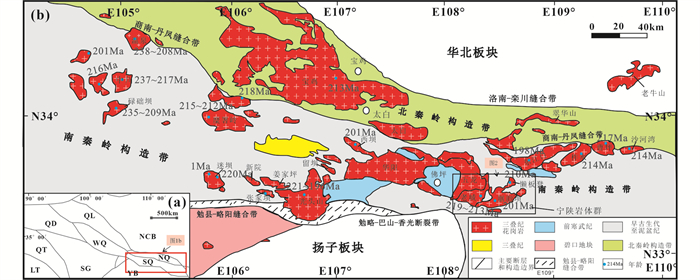
南秦岭构造带中段发育有大规模的早中生代花岗质岩体群,包括光头山岩体群、宁陕岩体群和五龙岩体群等(图 1),它们是探究花岗岩源区组成和PAE模型影响酸性侵入岩成分变化的良好对象。前人对宁陕岩体的岩石成因进行了很多研究(张宏飞等,1997;骆金诚等,2010;Deng et al., 2016;Lu et al., 2016, 2017),但仍存在不同的认识,归纳起来,主要有:(1)宁陕岩体是碰撞背景下南秦岭构造带的深部地壳物质部分熔融的产物(张宏飞等,1997);(2)宁陕岩体早期岩浆(222~216Ma)由元古代变玄武岩部分熔融的岩浆与亏损地幔岩浆混合形成,而晚期岩浆(~210Ma)形成于沉积岩源区的部分熔融,该岩体形成于同碰撞至后碰撞的过渡阶段(Yang et al., 2012);(3)宁陕岩体中胭脂坝花岗岩是由具有扬子板块属性的新元古代地壳物质重熔形成的(韦龙猛等,2016;方博文等,2017)。可以看出,目前对影响宁陕岩体岩浆成分变化的主控因素和成因机制尚未有定论。如前文所述,除源区物质组成的影响外,PAE模型是否影响岩浆成分的变化尚需评估。
|
图 1 中国中部区域地质简图(a, 据Yang et al., 2012)和秦岭造山带构造单元、沉积层序和早中生代花岗岩类的分布(b, 据Dong et al., 2011修改) 年龄数据据胡健民等,2004;张宗清等,2006;Yang et al., 2012;Deng et al., 2016;黄雄飞,2016;韦龙猛等,2016;方博文等,2017. WQ-西秦岭;SG-松潘-甘孜地体;QD(QDM)-柴达木地体;QL-祁连山造山带;NQ-北秦岭;SQ-南秦岭;YB-扬子板块;NCB-华北陆块;QT-羌塘地体;LT-拉萨地体 Fig. 1 Geological map of main blocks and orogenic belts in central China (a, after Yang et al., 2012) and geological sketch of tectonic units, sedimentary sequences and distribution of Early Mesozoic granitoids in the Qinling orogenic belt (b, modified after Dong et al., 2011) Age data according to Hu et al., 2004; Zhang et al., 2006; Yang et al., 2012; Deng et al., 2016; Huang, 2016; Wei et al., 2016; Fang et al., 2017. WQ-West Qinling; SG-Songpan-Garzê Terrane; QD (QDM)-Qaidam; QL-Qilian Terrane; NQ-North Qinling; SQ-South Qinling; YB-Yangtze Block; NCB-North China Block; QT-Qiangtang Terrane; LT-Lhasa Terrane |
本文选择宁陕花岗岩中代表性岩体为主要研究对象,对其开展了详细的野外地质调查,通过锆石U-Pb-Hf同位素和独居石U-Pb同位素分析,以及全岩主、微量元素和Sr-Nd同位素地球化学分析,对其侵位时代、源区组成、岩浆演化过程如何影响岩浆成分变化进行了较为深入的探讨,以期查明上述岩体的起源与演化过程,进一步丰富酸性侵入岩的成因机制。
1 地质背景秦岭造山带夹持于太平洋构造域、特提斯构造域和古亚洲洋构造域三者之间,呈近东西向展布。其西侧与祁连-昆仑造山带相邻,北侧以灵宝-鲁山-舞阳断裂带为界与华北地块相邻,南侧以勉略-巴山-襄樊断裂带为边界与扬子板块相接壤,东接大别-苏鲁超高压变质带(Dong et al., 2011)。秦岭造山带及其邻区由北到南可划分为:华北板块、北秦岭构造带、商南-丹凤缝合带、南秦岭构造带、勉县-略阳缝合带和扬子板块(图 1a;张国伟等,1995)六个构造单元。秦岭造山带主要经历了新元古代至早中生代的多期构造-岩浆热事件, 奠定了现今该造山带的主体构造格架(张成立等,2008)。
秦岭造山带大规模产出的酸性侵入岩具有多期次、多旋回的特点(王晓霞等,2011;Wang et al., 2013a),它们的岩浆作用时代主要集中在:新元古代(980~710Ma)、古生代(510~400Ma)、早中生代(250~185Ma)和晚中生代(160~100Ma)(Wang et al., 2013b)。早中生代花岗岩类以岩体群的形式发育于南秦岭构造带内(图 1b),其中包括光头山岩体群、宁陕岩体群和五龙岩体群等。
本文研究区位于南秦岭构造带南部的勉县-略阳缝合带北部,该缝合带是由勉略洋盆于古生代至中生代演化而成(Mattauer et al., 1985;Șengör, 1985;Kröner et al., 1993; Meng and Zhang, 1999, 2000;张国伟等,2001)。具体而言,其形成包括2个阶段:古生代中期,勉略洋盆逐渐打开,并演化出独立的秦岭微地块;古生代晚期开始,勉略古洋盆持续向北俯冲,至早中生代时期秦岭微地块与南部扬子板块发生碰撞而形成勉县-略阳缝合带。区内发育太古宇佛坪杂岩与陡岭杂岩等结晶基底,沉积盖层主要为震旦纪-早古生代巨厚的被动陆缘沉积体系和晚古生代至中三叠纪秦岭微板块内陆表海沉积体系(图 1b;张国伟等,2001;Dong et al., 2015)。研究区内出露有大面积的酸性侵入岩类组合,它们侵位于新元古代到古生代地层中,沿勉略缝合带北侧展布,共同构成了一条东西向的印支期花岗岩带,该花岗岩带被认为是扬子板块北部与秦岭造山带碰撞的产物(Sun et al., 2002)。
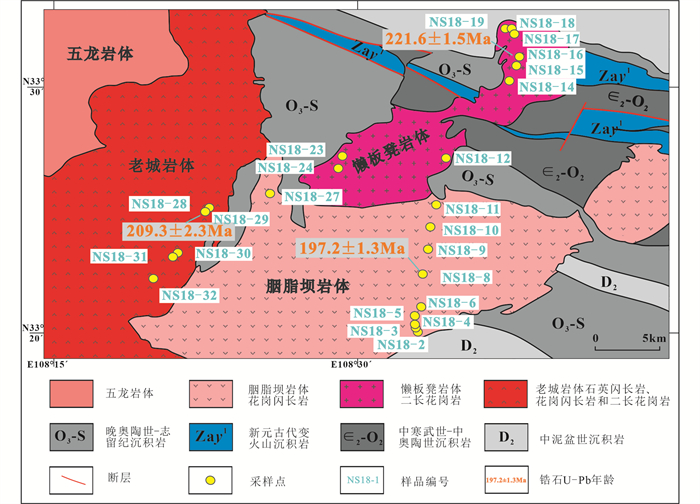
2 岩相学特征宁陕花岗岩位于南秦岭构造带的蜂腰部位,总体呈东西向展布的不规则椭圆形,出露面积约为1160km2(图 1b),该岩体侵入至寒武纪-泥盆纪沉积盖层中。宁陕花岗岩主要由胭脂坝、懒板凳和老城岩体组成,其中胭脂坝岩体位于宁陕花岗岩的东南部,北部为懒板凳岩体,西部为老城岩体(图 2)。
|
图 2 西秦岭宁陕岩体群地质简图(据Yang et al., 2012;韦龙猛等,2016) Fig. 2 Geological map of Ningshan rock group in West Qinling (after Yang et al., 2012; Wei et al., 2016) |
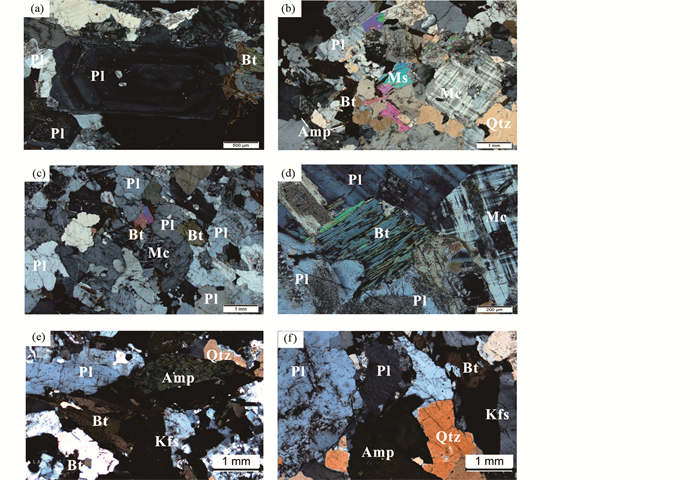
胭脂坝岩体(~530km2)的主体岩性为中粗粒花岗闪长岩,主要矿物组成为石英(25%~30%)、斜长石(40%~45%)和钾长石(20%~25%);次要矿物为黑云母(~5%)、白云母(~1%)和角闪石(1%~5%);副矿物为独居石、锆石、磷灰石及其他不透明矿物等。石英呈他形粒状,部分颗粒可见波状消光;斜长石呈自形-半自形板状,发育韵律环带;微斜长石发育格子双晶;黑云母呈自形片状,发育一组极完全解理,局部发生蚀变(图 3a-c)。
|
图 3 宁陕岩体花岗岩正交偏光显微镜下照片 (a-c)胭脂坝花岗闪长岩中具有环带结构的斜长石斑晶、具有格子双晶的微斜长石;(d)懒板凳二长花岗岩中具有格子双晶的微斜长石;(e、f)老城二长花岗岩中具有卡斯巴双晶的钾长石. Pl-斜长石;Kfs-钾长石;Mc-微斜长石;Amp-角闪石;Bt-黑云母;Ms-白云母;Qtz-石英 Fig. 3 Microphotographs under CPL showing the mineral assemblages of the granite in the Ningshan granitoids (a-c) plagioclase phenocrysts with zoning texture and microcline with cross-hatch twinning from Yanzhiba granodiorite; (d) microcline with cross-hatch twinning from Langbandeng monzogranite; (e, f) K-feldspar with Carlsbad twinnings from Laocheng monzogranite. Pl-plagioclase; Kfs-K-feldspar; Mc-microcline; Amp-amphibole; Bt-biotite; Ms-muscovite; Qtz-quartz |
懒板凳岩体(~80km2)主体岩性为含二云母二长花岗岩,主要矿物组成包括石英(25%~30%)、斜长石(25%~30%)和钾长石(30%~40%);次要矿物有黑云母(1%~5%)和白云母(1%~2%);副矿物见独居石、锆石等(图 3d)。
老城岩体(~550km2)主要由石英闪长岩、花岗闪长岩和二长花岗岩组成,其中二长花岗岩主要由石英(22%~25%)、斜长石(30%~35%)和钾长石(25%~35%)组成,钾长石发育卡斯巴双晶;次要矿物为黑云母(~5%)和角闪石(~2%);副矿物与上述两个岩体类似(图 3e, f)。
3 样品及测试方法本次研究共选取23件样品(胭脂坝岩体10件、懒板凳岩体9件、老城岩体4件)进行了全岩主微量元素分析,并对其中的6件样品进行了全岩Sr-Nd同位素分析。此外,对3件花岗岩类样品(NS18-8、NS18-16和NS18-29)进行了锆石U-Pb及Lu-Hf同位素分析,并对7件花岗岩类样品(NS18-2、NS18-7、NS18-8、NS18-12、NS18-16、NS18-27和NS18-29)进行了独居石U-Pb同位素测定。
岩石样品中锆石与独居石颗粒分选采用了常规的重选法和磁选法,在双目显微镜下手工挑选无色透明、没有裂隙、不含包体的锆石、独居石颗粒并使用环氧树脂制靶,抛光后拍摄阴极发光(CL)图像及透射光与反射光图像,用以观察锆石颗粒的外部和内部结构。锆石颗粒与独居石颗粒的分选在河北省廊坊市诚信地质服务有限公司完成,在北京中科矿研检测技术有限公司完成锆石与独居石的制靶和阴极发光(CL)显微照相,在中国地质大学(北京)显微矿物实验室完成了独居石的透、反射光照相。
3.1 锆石U-Pb-Hf同位素分析样品的锆石U-Pb同位素分析由桂林理工大学广西隐伏金属矿产勘查重点实验室完成,分析所用仪器为New Wave Research研发的213nm的激光剥蚀系统,联用Agilent 7500s型ICP-MS。激光束斑直径为32μm,激光频率为5Hz,以He为载气。Plesovice锆石(337Ma)为年龄外标,锆石样品中的微量元素含量利用SRM610作为外标、Si做内标,使用单内标多外标法进行校正,分析流程和具体参数设置可参见Liu et al.(2010)。测试过程中每8个测试样品前后,均需测定2个锆石标样Plesovice,并在每30个样品中间插入3个GJ-1标准样品点,以监控仪器状态,以保证测试的精确度。数据处理采用ICPMSDataCal程序(Liu et al., 2010)完成,锆石U-Pb谐和图的绘制及加权平均年龄的计算采用Isoplot3.0程序完成。
样品NS18-8、NS18-16、NS18-29原位微区锆石Lu-Hf同位素测试在山东省地质科学研究院利用激光剥蚀多接收杯电感耦合等离子体质谱(LA-MC-ICP-MS)完成。激光剥蚀系统为193nm准分子激光Coherent GeoLas Pro,MC-ICP-MS为Thermo Fisher Neptune Plus。前人的研究表明,激光剥蚀过程中采用氦气作为载气,比起氩气可以将信号灵敏度提高2倍(Hu et al., 2008a);同时,少量氮气的引入还可进一步提升大部分元素的灵敏度(Hu et al., 2008b)。为了提高Hf同位素的分析灵敏度,本实验采用氦气作为载气,并引入了适量的氮气(8ml/min),同时使用了Neptune Plus配备的高灵敏度Jet采样锥和X截取锥组合。另外,激光剥蚀系统配置了一个信号平滑装置,确保即使在激光脉冲频率低达1Hz的情况下,也能获得光滑的分析信号(Hu et al., 2012a)。分析测试采用单点剥蚀模式,激光的输出能量密度为5~8J/cm2,束斑直径为44μm,激光频率为6~8Hz。详细的仪器操作条件和分析方法可参照Hu et al. (2012b)。
采用LA-MC-ICP-MS准确测试锆石Hf同位素的难点在于扣除176Yb和176Lu对176Hf的同量异位素的干扰。在本次实验中,笔者实时获取了锆石样品自身的βYb用于干扰校正。179Hf/177Hf=0.7325和173Yb/171Yb=1.132685 (Fisher et al., 2014)被用于计算Hf和Yb的质量分馏系数βHf和βYb。179Hf/177Hf和173Yb/171Yb的比值被用于计算Hf (βHf)和Yb (βYb)的质量偏差。使用176Yb/173Yb=0.79639(Fisher et al., 2014)来扣除176Yb对176Hf的同量异位干扰;176Lu/175Lu=0.02656(Blichert-Toft et al., 1997)被用来扣除干扰程度相对较小的176Lu对176Hf的同量异位干扰。由于Yb和Lu具有相似的物理化学属性,因此在本实验中采用Yb的质量分馏系数βYb来校正Lu的质量分馏行为。锆石91500作为外标用来校正仪器的时间漂移。利用软件ICPMSDataCal (Liu et al., 2010)完成分析数据(包括对样品和空白信号的选择、同位素质量分馏校正参数的选择)的离线处理。
3.2 独居石U-Pb年代学分析独居石微区原位U-Pb同位素分析在中国地质调查局天津地质矿产研究所同位素实验室完成,所用仪器为激光剥蚀多接收等离子体质谱仪(LA-MC-ICP-MS)。采用的激光剥蚀系统为美国ESI公司生产的NEW WAVE 193nm FX ArF准分子激光器。激光剥蚀的束斑直径为20μm,能量密度为10~11J/cm2,频率为5Hz,所用载气为氦气。测试过程中每5个测试样品前后均需测定2个独居石标准样品。处理数据时,用独居石标样44069来校正U-Pb同位素分馏。由TIMS给出的独居石标准样品44069的206Pb/238U年龄为424.9±0.4Ma(万渝生等,2004)。根据不同时间和不同的仪器状态下用LA-MC-ICP-MS所测得的该独居石标样的206Pb/238U年龄加权平均值与用TIMS所测得的206Pb/238U年龄值的差距来计算U-Pb同位素分馏系数,其计算公式为:K=t1/t2。式中:K为用LA-MC-ICP-MS测定时的U-Pb同位素分馏系数,t1为由LA-MC-ICP-MS所测得的该独居石标样的206Pb/238U年龄加权平均值;t2为用TIMS所测得的该独居石标样的206Pb/238U年龄值。研究对象样品的206Pb/238U年龄计算公式为:T=t1/K。式中:T为研究对象样品的206Pb/238U年龄值;t1为用LA-MC-ICP-MS测得的该研究对象样品的206Pb/238U年龄加权平均值;K为用LA-MC-ICP-MS测定时的U-Pb同位素分馏系数。本文报道的独居石样品采用207Pb校正法和等时线法对普通铅进行校正(Andersen,2002)。
3.3 全岩元素地球化学分析本研究共选取了23件新鲜样品用于全岩元素地球化学分析。全岩主量元素分析在中国地质大学(北京)科学研究院实验中心完成,分析仪器为岛津X射线荧光光谱仪(XRF-1800),具体分析步骤参考Liu et al. (2021)。在本次分析中,每10件样品间穿插了一件平衡样,用以监测数据质量,分析精度优于±5%。
全岩微量元素含量分析由武汉上谱分析科技有限责任公司完成,分析仪器为Agilent 7700e ICP-MS,具体分析流程参考Liu et al. (2021)和刘颖等(1996),分析精度优于±5%。用于校准测量样品元素浓度的标准样品为AGV-2,BHVO-2,BCR-2和RGM-2。
3.4 全岩Sr-Nd同位素分析选择具有代表性的6件样品进行了Sr和Nd同位素组成分析。Rb-Sr和Sm-Nd同位素的化学分离及同位素测试在武汉上谱分析科技有限责任公司完成,采用的仪器为美国Thermo Fisher Scientific公司的MC-ICP-MS(Neptune Plus),所有分析样品的86Sr/88Sr和146Nd/144Nd比值分别采用86Sr/88Sr=0.1194和146Nd/144Nd=0.7219进行质量分馏校正。分别使用USGS标准样品NBS987和GSB校正所测样品的Sr和Nd同位素比值。本次测得的NBS987 87Sr/86Sr比值为0.710241±0.000012(2σ, N=4),GSB 146Nd/144Nd比值为0.512441±0.000007(2σ, N=6),与先前发表的数据(87Sr/86Sr=0.710241±0.000012和143Nd/144Nd=0.512439±0.000007),在误差范围内一致(Thirlwall, 1991;Li et al., 2017)。
此外,本次分析的标准物质BCR-2(玄武岩)和RGM-2(流纹岩)87Sr/86Sr比值分别为0.705002±0.000008(2σ, N=1)和0.704144±0.000008(2σ, N=1),143Nd/144Nd比值分别为0.512640±0.000007(2σ,N=1)和0.512806±0.000007(2σ,N=1),与之前发布的数值(BCR-2: 87Sr/86Sr=0.705026±0.000020, 143Nd/144Nd=0.512638±0.000015;RGM-2: 87Sr/86Sr=0.704184±0.000020, 143Nd/144Nd=0.512803±0.000015;Weis et al., 2006;Li et al., 2012)在误差范围内一致。详细的分析步骤参考Yang et al. (2019)。
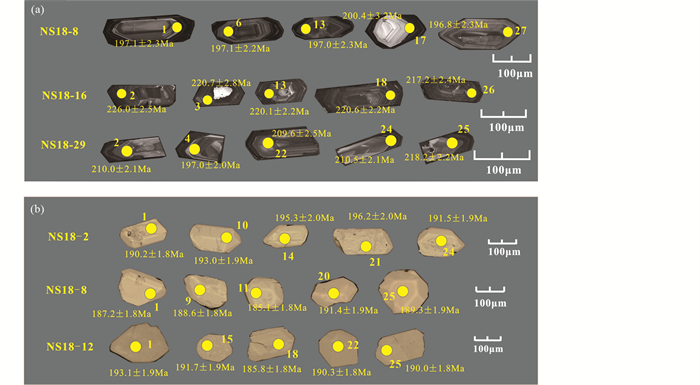
4 数据分析结果 4.1 锆石U-Pb-Hf同位素分析本研究选择了3件宁陕花岗岩锆石样品进行U-Pb-Hf同位素分析,样品分别为NS18-8(胭脂坝岩体)、NS18-16(懒板凳岩体)和NS18-29(老城岩体)。锆石U-Pb同位素数据结果见表 1。3件花岗岩样品中的锆石具有相似的结构和形态特征,均表现为自形到半自形,粒度在100~300μm之间,长/宽比在1 : 1.5~1 : 3之间。在CL图像中,这些锆石颗粒均具有明显的震荡环带以及扇形环带,且多数锆石颗粒无继承核(图 4a),属于典型的岩浆成因锆石。
|
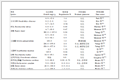
表 1 宁陕花岗岩锆石U-Th-Pb定年数据 Table 1 Zircon U-Th-Pb isotopic data of the Ningshan granitoids |
|
图 4 宁陕岩体锆石阴极发光(CL)图像(a)及独居石反射光图像(b) Fig. 4 Zircon cathodoluminescence (CL) images (a) and monazite reflected light images (b) for the Ningshan granitoids |
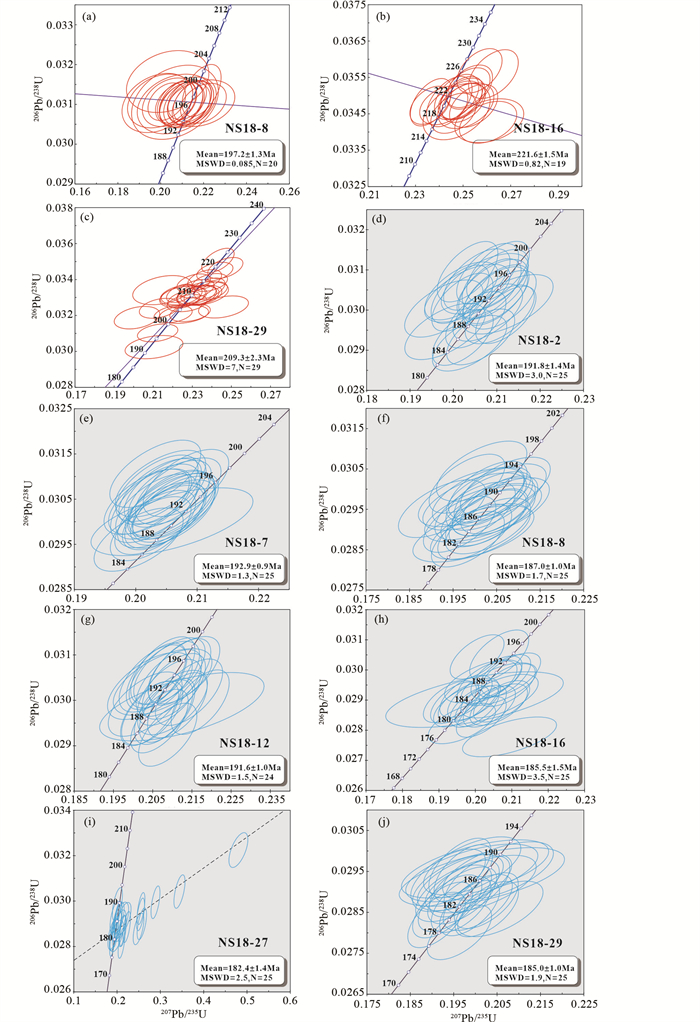
胭脂坝岩体中锆石(NS18-8)的Th含量在182×10-6~620×10-6之间,U的含量变化范围较大(351×10-6~2944×10-6),Th/U比值在0.10~0.58之间(表 1)。共获得30个测点数据,除其中2个测点谐和度较低,8颗锆石具有较老的206Pb/238U年龄(207~234Ma)外,其余20个测点的206Pb/238U年龄较为集中,获得加权平均年龄为197.2±1.3Ma(N=20,MSWD=0.085)(图 5a)。懒板凳岩体中锆石(NS18-16)具有较高的Th(1581×10-6~5101×10-6)和U(3211×10-6~7388×10-6)含量,Th/U比值在0.40~1.20之间(表 1)。共获得30个测点数据,除去谐和度较低的6个测点,及具有较老的206Pb/238U年龄(230~235Ma)的5个测点外,其余19个测点的206Pb/238U年龄较为集中,加权平均年龄为221.6±1.5Ma(N=19,MSWD=0.82)(图 5b)。老城岩体中锆石(NS18-29)的Th(136×10-6~5097×10-6)和U(863×10-6~9360×10-6)含量较高且变化范围较大,对应的Th/U比值为0.09~0.65(表 1)。共获得30个测点数据,除其中1个测点的谐和度较低外,其余29个测点的206Pb/238U年龄较为集中,加权平均年龄为209.3±2.3Ma(N=29,MSWD=1.9)(图 5c)。上述锆石206Pb/238U加权平均年龄与前人报道的花岗岩的结晶年龄在误差范围内一致(Yang et al., 2011;韦龙猛等,2016;方博文等,2017)。
|
图 5 宁陕花岗岩锆石(a-c)与独居石(d-j)的U-Pb谐和图 Fig. 5 Zircon (a-c) and monazite (d-j) U-Pb concordant diagrams of the Ningshan granitoids |
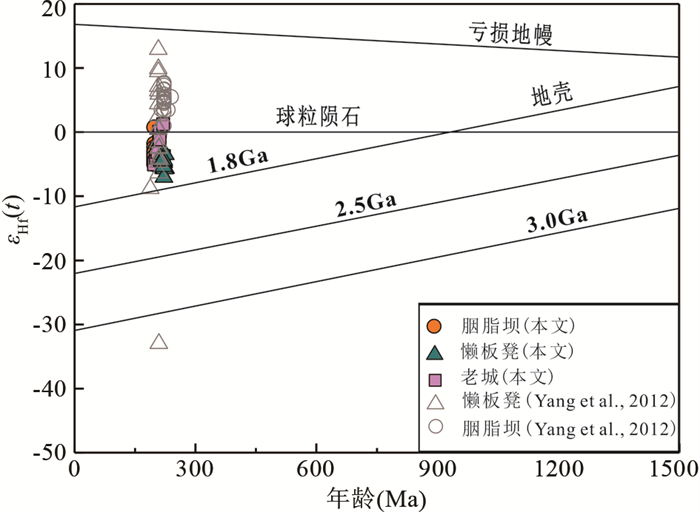
对采自胭脂坝(NS18-8)、懒板凳(NS18-16)和老城岩体(NS18-29)的3件锆石样品进行了Hf同位素分析,根据锆石结晶年龄分别计算了初始176Hf/177Hf比值、εHf(t)值和Hf模式年龄,分析结果见表 2。3件样品中锆石的176Yb/177Hf比值分别在0.020472~0.044924、0.038339~0.110436和0.029547~0.066995之间,176Lu/177Hf比值分别在0.000832~0.001901、0.001502~0.004371和0.001197~0.002653之间,εHf(t)值分别在-5.0~+0.8、-7.1~-3.5和-5.1~+1.2之间(图 6)。3件锆石样品均具有较老的Hf同位素二阶段模式年龄(tDM2=1384~1061Ma,N=19;tDM2=1514~1316Ma,N=13;tDM2=1386~1055Ma,N=13)。
|
|
表 2 宁陕花岗岩锆石Hf同位素数据 Table 2 Zircon Hf isotopic data of the Ningshan granitoids |
|
图 6 南秦岭宁陕花岗岩中锆石εHf(t)值与锆石U-Pb年龄关系图(据Liu et al., 2021) Fig. 6 Zircon εHf (t) values versus U-Pb age diagram for the Ningshan granitoids in South Qinling (after Liu et al., 2021) |
本研究对胭脂坝(NS18-2、NS18-7、NS18-8、NS18-12和NS18-27)、懒板凳(NS18-16)和老城岩体(NS18-29)的7件独居石样品进行了LA-MC-ICP-MS U-Pb同位素分析,分析结果见表 3。测试的独居石颗粒自形程度较好,粒径在50~100μm之间(图 4b)。
|
|
表 3 宁陕花岗岩独居石U-Th-Pb定年数据 Table 3 Monazite U-Th-Pb isotopic data of the Ningshan granitoids |
采集自胭脂坝岩体的5件样品NS18-2、NS18-7、NS18-8、NS18-12和NS18-27,加权平均年龄分别为191.8±1.4Ma(N=25,MSWD=3.0)、192.9±0.9Ma(N=25,MSWD=1.3)、187.0±1.0Ma(N=25,MSWD=1.7)、191.6±1.0Ma(N=24,MSWD=1.5)和182.4±1.4Ma(N=25,MSWD=2.5)(图 5d-g, i);分析的独居石颗粒具有较高含量的Th和U,对应的Th/U比值分别为0.29~41.54、6.45~15.24、20.00~36.57、21.69~47.40和14.32~36.42。懒板凳岩体独居石样品(NS18-16)的Th和U含量分别在85276×10-6~300341×10-6和3718×10-6~9382×10-6之间,Th/U比值为16.66~37.39,获得的加权平均年龄为185.5±1.5Ma(N=25,MSWD=3.5)(图 5h)。老城岩体独居石样品(NS18-29)的Th和U含量分别为123230×10-6~206899×10-6和4715×10-6~9372×10-6,Th/U比值范围在18.01~34.79之间,加权平均年龄为185.0±1.0Ma(N=25,MSWD=1.9)(图 5j)。
4.3 全岩主量和微量元素地球化学特征本文测试了10件胭脂坝、9件懒板凳和4件老城岩体样品的全岩元素地球化学组成,结果见表 4。
|
|
表 4 宁陕花岗岩元素地球化学组成(主量元素:wt%;微量元素:×10-6) Table 4 Geochemical compositions of the Ningshan granitoids (major elements: wt%; trace elements: ×10-6) |
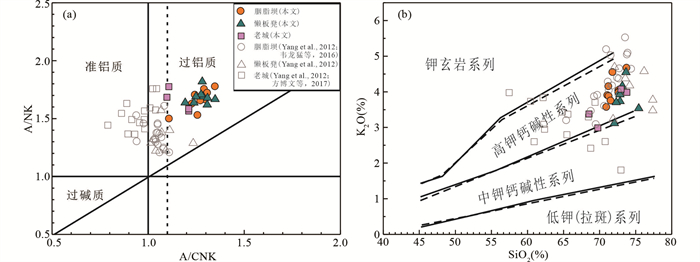
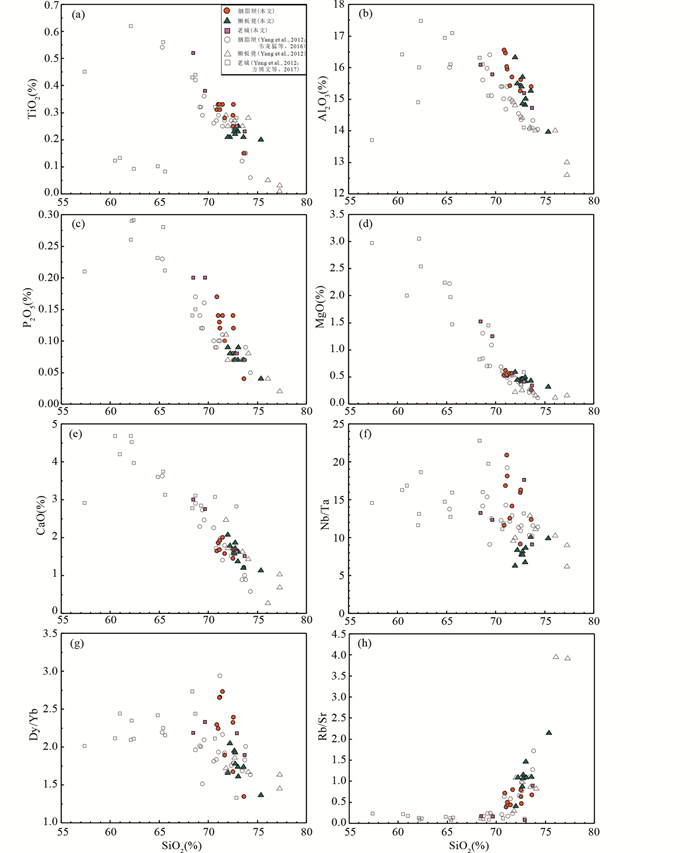
宁陕花岗岩样品整体具有富硅(SiO2=68.46%~75.36%)、富铝(Al2O3=13.96%~16.55%)、高钾(K2O=3.00%~4.69%)和低Mg#(31~51)的特征,Na2O含量为2.56%~3.76%,CaO含量为1.13%~3.00%。相比之下,前人研究中老城岩体样品的SiO2含量变化范围较大,同时包含中性岩和酸性岩样品;此外,前人的老城岩体样品数据表现出更高的CaO和MgO含量(Yang et al., 2012;方博文等, 2017)。在A/CNK-A/NK图解上,宁陕花岗岩样品均落于过铝质系列范围内(A/CNK=1.10~1.35)(图 7a);从SiO2-K2O岩石系列划分图(图 7b)上看,大部分样品落入高钾钙碱性系列中。在哈克图解中(图 8),随着SiO2含量的增加,TiO2、Al2O3、P2O5、MgO和CaO含量降低,Nb/Ta、Dy/Yb比值降低,而Rb/Sr比值增加。
|
图 7 宁陕花岗岩的岩石分类和系列图解 (a)A/NK-A/CNK图解(据Maniar and Piccoli, 1989);(b)K2O-SiO2图解(据Rickwood, 1989) Fig. 7 Rock classification and series diagrams of the Ningshan granitoids (a) A/NK vs. A/CNK diagram (after Maniar and Piccoli, 1989); (b) K2O vs. SiO2 diagram (after Peccerillo, 1989) |
|
图 8 宁陕花岗岩SiO2与主量元素和微量元素比值图解 Fig. 8 Diagrams of ratio of SiO2 against major and trace elements of the Ningshan granitoids |
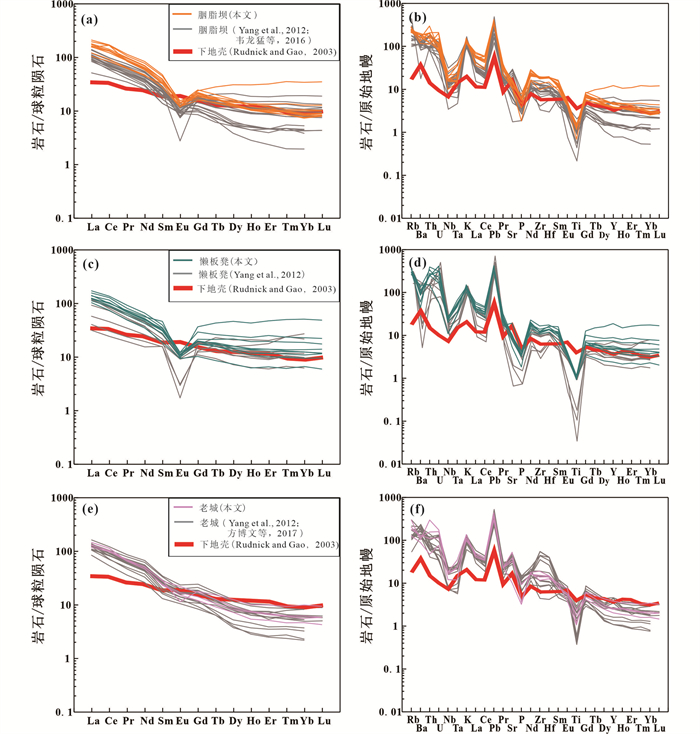
在球粒陨石标准化稀土元素配分图(图 9a,c,e)中,宁陕花岗岩样品轻、重稀土分异明显,具有富集轻稀土元素,亏损重稀土元素的特征,(La/Yb)N为2.48~31.63。胭脂坝与懒板凳岩体花岗岩的稀土元素总含量(∑REE)分别为138×10-6~228×10-6和102×10-6~195×10-6,均具有明显Eu负异常,Eu/Eu*分别为0.41~0.60和0.23~0.67;老城岩体花岗岩的稀土元素总含量(∑REE)较低(134×10-6~145×10-6),无明显Eu异常。在原始地幔标准化微量元素蜘蛛图(图 9b,d,f)中,所有宁陕花岗岩样品均表现出富集Rb、Ba、Th、K、Pb和Sr等元素,而亏损Ta、Nb、P和Ti等元素的特征。
|
图 9 宁陕花岗岩球粒陨石标准化稀土元素配分图(a、c、e)和原始地幔标准化微量元素蜘蛛图(b、d、f)(标准化值据Sun and McDonough, 1989) Fig. 9 Chondrite-normalized REE patterns (a, c, e) and primitive mantle-normalized trace element spider diagrams (b, d, f) for the Ningshan granitoids (normalization values after Sun and McDonough, 1989) |
宁陕花岗岩的Sr-Nd同位素分析结果详见表 5。其中,胭脂坝(~197Ma)、懒板凳(~221Ma)和老城(~209Ma)三个岩体的锆石206Pb/238U加权平均年龄分别用于计算各自的初始Sr-Nd同位素比值。
|
|
表 5 宁陕花岗岩的Sr-Nd同位素组成 Table 5 Sr and Nd isotope compositions of the Ningshan granitoids |


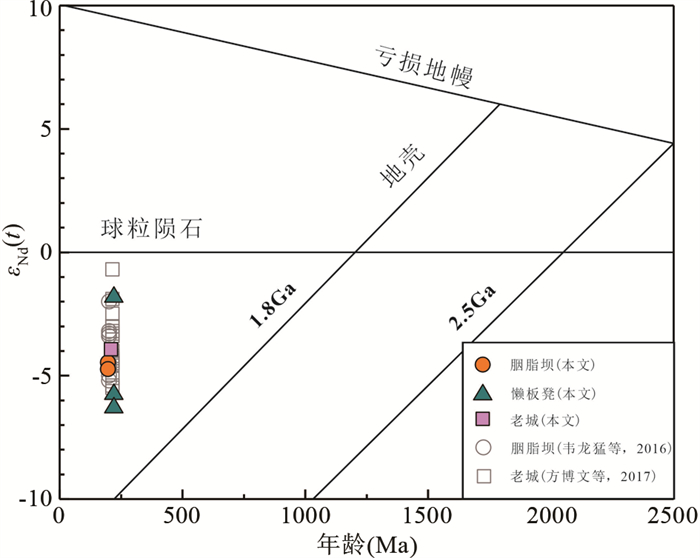
胭脂坝岩体样品Sr、Nd含量分别在294.10×10⁻⁶~351.85×10⁻⁶、28.33×10⁻⁶~32.94×10⁻⁶之间,具有较为均一的初始Sr同位素比值(87Sr/86Sr(t)=0.705348~0.705483), εNd(t) 值为-4.5~-4.7(图 10),二阶段模式年龄范围为1365~1343Ma。懒板凳岩体的样品具有变化较大的Sr(111.81×10⁻⁶~408.16×10⁻⁶)和Nd(16.29×10⁻⁶~26.22×10⁻⁶)含量,初始87Sr/86Sr同位素比值在0.703337~0.705214之间,εNd(t)值(-1.8~-6.3)变化范围较大(图 10),二阶段模式年龄为1511~1147Ma。老城岩体样品的Sr(815.15×10⁻⁶)含量较高,Nd含量为22.13×10⁻⁶,初始87Sr/86Sr同位素比值与εNd(t)值分别为0.704873和-3.9(图 10),二阶段模式年龄为1309Ma。
|
图 10 宁陕花岗岩的εNd(t)与年龄的关系图解(据刘桂萍等,2021) Fig. 10 Diagram of εNd(t) vs. age of the Ningshan granitoids (after Liu et al., 2021) |
造山带的形成记录了板块汇聚和造山过程的演化历史(Zhang et al., 2015, 2017;王晓霞等,2015;Deng et al., 2017)。秦岭造山带作为我国中央造山带的重要组成部分,自中生代以来经历了一系列重要的地质事件,包括大陆裂解-洋盆产生、大洋俯冲-大陆增生、大陆碰撞、板内构造演化等(张国伟等,2001;张成立等,2008;Dong et al., 2011;Deng et al., 2016)。这些地质事件的发生往往伴随着广泛而强烈的岩浆活动,使得秦岭造山带中发育大量的早中生代花岗岩(张成立等,2008;Deng et al., 2016)。
近几十年来,前人对秦岭造山带的地球动力学背景和演化过程进行了大量研究,但对南秦岭构造带三叠纪岩浆活动的构造环境的认识仍然存在较大争议,具体可以概括如下:(1)张成立等(2008)基于对早中生代花岗岩地球化学特征的研究,结合同时代煌斑岩和基性岩脉的双峰式岩浆作用特点,认为秦岭早中生代花岗岩(245~200Ma)属于后碰撞阶段的产物;(2)~211Ma古特斯洋盆闭合(Jiang et al., 2010),扬子板块北缘与南秦岭构造带于晚三叠世发生碰撞(Liu et al., 2005;刘少峰和张国伟,2008);(3)252~234Ma期间南秦岭构造带中的勉略洋仍处于洋内俯冲阶段(黄雄飞,2016;Deng et al., 2016;Hu et al., 2019;Xing et al., 2020;Liu et al., 2021),~230Ma开始碰撞造山(黄雄飞,2016),同碰撞阶段为228~215Ma,后碰撞阶段为215~200Ma(Dong et al., 2011)。然而,秦岭造山带的变形变质事件表明勉略洋盆闭合时间应早于215Ma(黄雄飞,2016)。王晓霞等(2015)对秦岭早中生代花岗岩开展了综合研究,指出南秦岭到北秦岭不同地区花岗质岩石的年龄、岩石类型以及地球化学特征均没有显示出俯冲极性;杨朋涛等(2013)对南秦岭何家庄花岗闪长岩(~248Ma)开展了详细的研究,并提出勉略洋壳的俯冲在~248Ma之前就已启动, 并且南秦岭地区在早三叠世仍处于洋壳俯冲动力学背景。
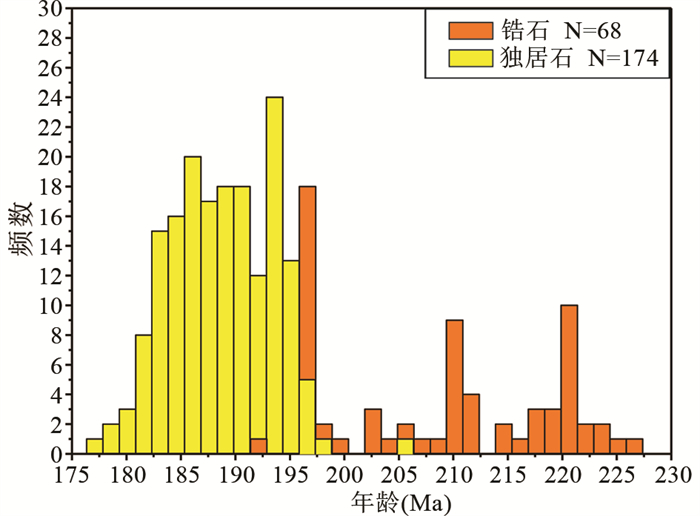
胭脂坝、懒板凳和老城岩体独居石样品的U-Pb年龄分别为194~181Ma、187~184Ma和~185Ma,均小于锆石U-Pb年龄(图 11)。样品NS18-16和NS18-29的锆石与独居石U-Pb年龄分别相差36Myr和24Myr。独居石U-Pb体系的封闭温度比锆石低,因此独居石可以记录相对年轻的结晶年龄;此外,独居石的U-Pb体系易受到后期热事件的扰动,因此独居石定年结果可能存在多解性(陈旭等,2009;吴黎光和李献华,2020)。
|
图 11 宁陕花岗岩的独居石和锆石年龄的频数分布 Fig. 11 Probability distributions of monazite and zircon ages of Ningshan granitoids |
本研究的锆石及独居石的年龄结果指示宁陕花岗岩为晚三叠世到早侏罗世岩浆作用的产物,结合前人研究的定年结果(Yang et al., 2011;韦龙猛等, 2016;方博文等, 2017),本文将宁陕花岗质岩浆活动大体划分为2个期次:早期为懒板凳岩体的二长花岗岩,形成时代约为223~220Ma;晚期为胭脂坝和老城岩体的石英闪长岩-花岗闪长岩,形成时代约为211~196Ma。与Dong et al.(2011)、黄雄飞(2016)、Deng et al.(2016)、Hu et al.(2019)、Xing et al.(2020)和Liu et al.(2021)等研究者对南秦岭早中生代花岗岩的年龄划分结果相近,故而本研究认为宁陕花岗岩中较早期的花岗岩类(懒板凳岩体)是南秦岭构造带与扬子板块碰撞阶段的产物,而宁陕岩体较晚期的花岗岩类(胭脂坝岩体和老城岩体)形成于后碰撞阶段。
5.2 岩浆过程与岩浆源区花岗岩成分变化的控制因素主要包括源区组成、PAE和岩浆过程等(Zheng et al., 2008;Gao et al., 2014)。具体而言,岩浆过程包括分离结晶作用、岩浆混合作用和地壳混染作用等。
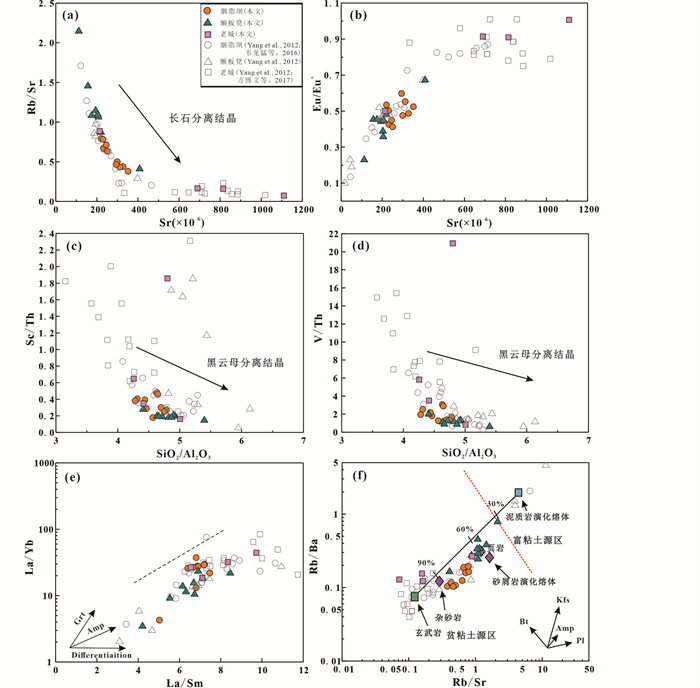
胭脂坝与懒板凳岩体的样品具有明显的Eu负异常,且随着Sr含量的减少Rb/Sr比值增加(图 12a),这表明它们可能经历了斜长石的分离结晶作用(Yang et al., 2016)。此外,Eu/Eu*与Sr之间的正相关性,以及Rb/Ba与Rb/Sr的关系图解进一步证明斜长石分离结晶作用的影响(图 12b, f,Hu et al., 2017;Bailie et al., 2020)。对于角闪石,KD(Nb)/ KD(Ta)和KD(Dy)/ KD(Yb)值均超过1.0,且胭脂坝与懒板凳岩体的样品中Nb/Ta与Dy/Yb比值随着SiO2含量的增加而减少,暗示了角闪石的分离结晶(图 8f、g,Nash and Crecraft, 1985;Stepanov and Hermann, 2013;Hu et al., 2019)。此外,La/Yb与La/Sm的关系图解(图 12e),进一步证明胭脂坝与懒板凳岩体在岩浆演化过程中存在角闪石的分离结晶(Chen et al., 2018)。黑云母的分离结晶会导致Nb/Ta比值的减少,以及Ti的亏损(Stepanov et al., 2014),这与本文数据结果是一致的(图 8f、图 9b, d, f);V与Sc在黑云母中具有较高的分配系数,Th的分配系数较低(Bea et al., 1994),胭脂坝与懒板凳岩体的样品中Sc/Th和V/Th与SiO2/Al2O3之间呈负相关关系(图 12c, d),表明岩浆组分的变化与黑云母的分离结晶密切相关(Yang et al., 2016)。
|
图 12 宁陕花岗岩熔体分离结晶与初始熔体的源区特征辨别图 (a)Rb/Sr-Sr(×10-6)图解(据Yang et al., 2016);(b)Eu/Eu*-Sr(×10-6)图解;(c)Sc/Th-SiO2/Al2O3图解(据Yang et al., 2016);(d)V/Th-SiO2/Al2O3图解(据Yang et al., 2016);(e)La/Yb-La/Sm图解(据Chen et al., 2018);(f)Rb/Ba-Rb/Sr图解(据Bailie et al., 2020). 玄武岩和泥质岩衍生熔体之间的混合曲线据Patiño Douce and Harris (1998)和Sylvester (1998) Fig. 12 Discrimination diagrams of rock genesis and source characteristics of initial melt in Ningshan rock mass (a) Rb/Sr vs. Sr (×10-6) (after Yang et al., 2016); (b) Eu/Eu*vs. Sr (×10-6); (c) Sc/Th vs. SiO2/Al2O3(after Yang et al., 2016); (d) V/Th vs. SiO2/Al2O3(after Yang et al., 2016); (e) La/Yb vs. La/Sm (after Chen et al., 2018); (f) Rb/Ba vs. Rb/Sr (after Bailie et al., 2020). The mixing curve between basalt- and pelite-derived melts is from Patiño Douce and Harris (1998) and Sylvester (1998) |
老城岩体的样品中无明显Eu异常,且Rb/Sr和Eu/Eu*与Sr之间无明显相关性(图 12a, b),表明在岩浆演化过程中可能长石未发生明显分离结晶。Nb/Ta与Dy/Yb比值随着SiO2含量的增加而减少,指示角闪石的分离结晶(图 8 f, g,Nash and Crecraft, 1985;Stepanov and Hermann, 2013;Hu et al., 2019)。La/Yb与La/Sm的关系图解(图 12e),也反映出存在角闪石的分离结晶(Chen et al., 2018)。图 12c和图 12d中Sc/Th和V/Th与SiO2/Al2O3之间呈负相关关系,这表明在老城岩体的岩浆演化过程中存在黑云母的分离结晶(Yang et al., 2016)。
宁陕花岗岩SiO2含量较高且变化范围较大(SiO2=68.46%~75.36%),同时它们还具有较低的Cr(0.94×10⁻⁶~36.76×10⁻⁶)和Ni(0.91×10⁻⁶~16.59×10⁻⁶)含量,这些特征表明这些高硅花岗岩可能并未受到明显的幔源组分的影响。
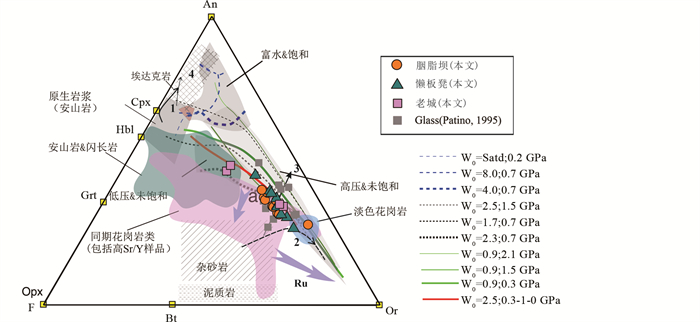
如F-An-Or图所示(图 13),Castro (2013)整合了不同中酸性熔体的实验数据,不同曲线代表了不同实验条件下熔体的演化路径。此外,F-An-Or图解还可用于指示地壳混染过程的影响;如果岩浆受到显著的地壳混染,这将导致熔体成分显著向远离An端员的方向演化(Castro,2013),例如杂砂岩与泥质岩类围岩通常具有较低含量的钙和较高含量的铝。宁陕花岗岩样品似乎主要沿着熔体分离结晶演化趋势线分布,指示这些花岗岩可能受到同化混染的影响较小。此外,宁陕花岗岩具有比较均一的Sr-Nd同位素组成,也指示了同化混染作用不显著。
|
图 13 宁陕地区花岗岩类F(FeO+MgO+MnO)-An-Or图解 a-混染;Ru-残留-未混合(据Castro, 2013);参考数据来自Xing et al. (2020),Liu and Han (2018),张宏飞等(2005);Luo et al. (2018),Patiño Douce and Beard(1995) Fig. 13 F (FeO+MgO+MnO) -An-Or diagram of Ningshan granitoids a-assimilation; Ru-restite unmixing (after Castro, 2013). Reference data from Xing et al. (2020), Liu and Han (2018), Zhang et al. (2005), Luo et al. (2018), and Patiño Douce and Beard (1995) |
归纳而言,宁陕花岗岩类可能经历了斜长石、黑云母、角闪石等矿物相的分离结晶,并且未遭受显著的地壳混染及幔源组分的影响。
实验岩石学的结果表明:(1)地壳岩石(如泥质变质岩、变质杂砂岩等)脱水熔融形成的深熔熔体具有高Si,低Fe、Mg、Ca、Ti的地球化学特征(Stevens et al., 2007);(2)变玄武岩和变安山岩的部分熔融可以产生过铝质熔体(Sisson et al., 2005);(3)变泥质岩与变杂砂岩(硬砂岩)部分熔融亦可产生过铝质熔体(Vielzeuf and Holloway, 1988;Patiño Douce and Johnston, 1991;Stevens et al., 1997;Pickering and Johnston, 1998)。
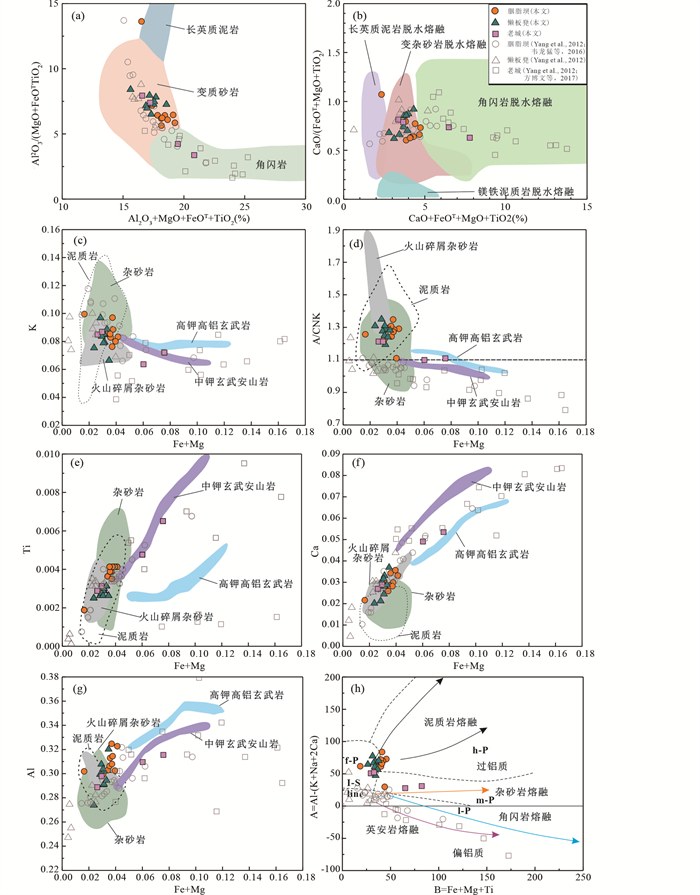
本文所研究的高硅岩石样品(SiO2>68%)具有较高的K2O(>3.00%)和LREE,较低的CaO(1.13%~3.00%)含量(表 4),初始Sr同位素比值为0.703337~0.705483,εNd(t)值介于-6.3~-1.8之间。在陆内造山带中,弱过铝质(l-P区域)至中等过铝质花岗岩(m-P区域)的原岩可能是泥质变质岩、变质火成岩和变质杂砂岩(图 14h;Villaseca et al., 1998)。胭脂坝岩体样品在高硅过铝质到强过铝质(f-P至h-P)区域内均有分布,懒板凳岩体样品主要分布于高硅过铝质(f-P)区域内(图 14h);而老城岩体样品在偏铝质,中到强过铝质(m-P至h-P)的区域内均有分布(图 14h)。如图 12f所示,宁陕花岗岩中的高硅样品(SiO2>68%),源区组分主要为杂砂岩或砂屑岩,其中胭脂坝岩体的源区组分中主要含砂屑岩与杂砂岩,懒板岩体的源区组分中砂屑岩含量较高,老城岩体花岗岩(SiO2>68%,A/CNK>1.1)源区组分主要为杂砂岩。
|
图 14 南秦岭宁陕花岗岩源区组成判别图解 (a、b)南秦岭宁陕花岗岩化学组成图解(据Patiño Douce, 1999;Kaygusuz et al., 2010);(c-h)南秦岭宁陕花岗岩与无水实验熔体成分的比较(据Farina et al., 2012),高、中、低和高长英质过铝质花岗岩分别用h-P、m-P、l-P和f-P表示. 在图a-e中,区域来自使用不同天然原始材料在一定的温度(T < 950℃)和压力(0.5~1.5GPa)条件下进行的实验. 这些区域表示≈95%的实验熔体成分,排除了趋势中明显的异常值. 变质杂砂岩衍生熔体来自Gardien et al.(1995),Montel and Vielzeuf(1997),Patiño Douce and Beard(1995),Stevens et al.(1997);变质泥质岩衍生熔体来自Patiño Douce and Harris(1998),Patiño Douce and Johnston(1991),Pickering and Johnston(1998),Stevens et al.(1997),Vielzeuf and Holloway(1988);变质火山碎屑变质杂砂岩衍生熔体来自Skjerlie and Johnston(1992); 高钾高铝玄武岩和中钾玄武岩安山岩的熔体来自Sisson et al.(2005). 在图f中,箭头表示不同地壳岩石的实验熔融产生的渐进熔体组分的成分(Villaseca et al., 1998及其中的参考文献) Fig. 14 Discrimination diagrams of source area compositions of Ningshan granitoids in South Qinling (a, b) diagrams of chemical compositions of the Ningshan granitoids in South Qinling (after Patiño Douce, 1999; Kaygusuz et al., 2010); (c-h) comparison between the composition of fluid-absent experimental melts and Ningshan granitoids in South Qinling. Highly, moderately, low and highly felsic peraluminous granitoids, are indicated by h-P, m-P, l-P and f-P respectively. In Fig. 14a-e, the fields are from experiments performed using different natural starting materials at T<950℃ and P=0.5~1.5 GPa. The fields represent≈95% of experimental melt compositions, with obvious outlier from trends having been excluded. Metagreywacke-derived melts are from Gardien et al. (1995), Montel and Vielzeuf (1997), Patiño Douce and Beard (1995), Stevens et al. (1997); metapelite-derived melts are from Patiño Douce and Harris (1998), Patiño Douce and Johnston (1991), Pickering and Johnston (1998), Stevens et al. (1997), Vielzeuf and Holloway (1988); metavolcanoclastic metagreywacke-derived melt is from Skjerlie and Johnston (1992). Melts from high-K high-alumina basalts and medium-K basaltic andesites are from Sisson et al. (2005). In Fig. 14f, the arrows represent the compositions of progressive melt fractions produced by experimental melting of different crustal rocks (Villaseca et al., 1998 and references therein) |
笔者将宁陕花岗岩类与各种无水实验熔体组分进行对比(图 14,T < 950℃,P=0.5~1.5GPa)。在Yang et al.(2012)和方博文等(2017)的研究中,宁陕花岗岩样品的源区可能是以变玄武岩或新元古代基性下地壳物质为主;而本文研究中低铁镁质的宁陕高硅花岗岩(SiO2>68%)在地球化学组分上表现出较高的A/CNK值和K含量,和较低的Ca和Al含量,与基性下地壳物质组分差距较大,而与杂砂岩、火山碎屑杂砂岩和泥质岩的成分更为匹配(图 14)。因此,本文推测宁陕高硅花岗岩样品(SiO2>68%)的源区物质可能主要以杂砂岩或砂屑岩为主(如Patiño Douce and Beard (1996)和Montel and Vielzeuf (1997)的实验熔体;图 12、图 14)。
此外,胭脂坝、懒板凳与老城岩体花岗岩的εHf(t)值分别在-7.1~-3.5、-5.0~+0.8和-5.1~+1.2之间(图 6),二两阶段的Hf模式年龄分别为tDM2=1514~1316Ma (N=13);tDM2=1384~1061Ma (N=19);和tDM2=1386~1055Ma (N=13),这可能指示了来自古老地壳源区的贡献(Xing et al., 2020;Liu et al., 2021)。结合同位素分析结果及源区物质特征,本研究认为宁陕花岗岩主要为中元古代地壳来源。
5.3 转熔矿物组合的选择性带入(PAE)花岗岩成分变化的控制因素大体可以分为以下五种类型:(1)源区的不均一性,如Clemens and Stevens(2012)的研究指出源区物质是花岗质岩浆化学组分的最主要控制因素,不同批次花岗岩中高度不均一的同位素组成也可以反映出源区物质的高度不均一性(Wang et al., 2013b);(2)熔融条件(P-T-H2O-fO2) 的变化,多种实验岩石学结果表明熔融温度和H2O含量可以控制花岗岩体成分变化(Weinberg and Hasalová, 2015;Zhao et al., 2015;Gao et al., 2016);(3)岩浆混合,多数学者认为花岗岩是由幔源基性岩浆与壳源酸性岩浆混合形成,其成分受控于二者的混合比例(Collins, 1996;Yang et al., 2007;Shaw and Flood, 2009);(4)分离结晶和同化混染,花岗岩成分变化受到围岩的混染比例以及分离结晶程度的影响(Kemp et al., 2007;Castro et al., 2021); (5)转熔矿物组合的选择性带入(PAE,Peritectic Assemblage Entrainment)亦可对花岗质岩浆成分造成影响,该过程主要受控于转熔矿物类型和被花岗质熔体选择性带入的比例(Clemens and Stevens, 2012;Bailie et al., 2020;Zhu et al., 2020, 2021)等。
PAE模型是指源区矿物的不一致熔融后形成一些转熔矿物和熔体,二者同时存在,其中转熔矿物组合是从岩浆源区被携带进入花岗岩熔体中的,并且是花岗质熔体镁铁质组分变化的主要控制因素(Clemens and Stevens, 2012;Bailie et al., 2020;Zhu et al., 2020, 2021)。PAE模型的地球化学依据是主、微量元素(如Ti、Ca)与镁铁指数(摩尔Fe+Mg)的相关性,转熔矿物相是指由含水矿物相(如地壳源区中黑云母和角闪石矿物相)不一致熔融产生的镁铁矿物和斜长石(如黑云母+角闪石+石英+斜长石1=熔体+斜长石2+单斜辉石+斜方辉石+钛铁矿±石榴子石(斜长石1:反应矿物相中的斜长石;斜长石2:转熔矿物相的斜长石),Skjerlie and Johnston, 1992;Stevens et al., 2007;Clemens et al., 2011;Clemens and Stevens, 2012)。
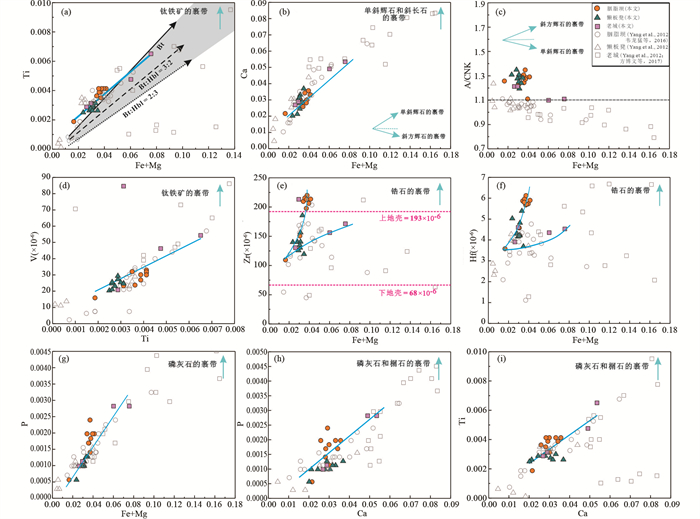
胭脂坝、懒板凳与老城岩体中的花岗岩具有高的SiO2含量(SiO2>68%),这些花岗岩中Ti和Ca均显示出与Fe+Mg值的高度正相关性(图 15a, b),以及A/CNK显示出与Fe+Mg值的负相关性(图 15c),反映出转熔镁铁质组分增加对花岗岩成分的显著影响,故而PAE很可能是宁陕花岗岩全岩地球化学成分变化的一个重要控制因素(Clemens et al., 2011;Clemens and Stevens, 2012;Farina et al., 2012)。前文指出,宁陕花岗岩主要为地壳来源,而黑云母或角闪石是地壳熔融过程中的主要含K矿物相,胭脂坝、懒板凳与老城高硅花岗岩(SiO2>68%)中K2O/Na2O比值分别为0.92~1.78、1.00~1.66和0.81~1.31(主要集中在1.00~1.78之间),表明在3个单元花岗岩的源区熔融反应过程中黑云母或角闪石是主要的反应矿物(Clemens et al., 2011;Farina et al., 2012)。此外,V与Fe+Mg值之间明显的正相关性也表明宁陕花岗岩的地壳源区中黑云母或/和角闪石的含量相对较高(图 15d,Bailie et al., 2020)。图 14h表明,宁陕花岗岩熔融反应中可能没有角闪石的参与(Villaseca et al., 1998;Bailie et al., 2020)。此外,Clemens et al. (2011)的模拟结果显示(图 15),地壳源区中不同黑云母/角闪石的比例可能导致花岗质熔体中Ti与Fe+Mg值的斜率范围存在差异,胭脂坝、懒板凳与老城岩体的高硅花岗岩样品(SiO2>68%)明显更偏向于含黑云母的地壳源区(Clemens et al., 2011;Clemens and Stevens, 2012)。
|
图 15
南秦岭宁陕岩体中生代花岗岩的Ti-(Fe+Mg)(a)、Ca-(Fe+Mg)(b)、A/CNK-(Fe+Mg)(c)、V-Ti(d)、Zr-(Fe+Mg)(e)、Hf-(Fe+Mg)(f)、P-(Fe+Mg)(g)、P-Ca(h)和Ti-Ca(i)的关系图(据Clemens et al., 2011)
图 15a(据 |
如图 15b, c所示,单斜辉石作为转熔矿物夹带将会导致Ca与Fe+Mg值的呈正相关关系,以及向偏铝质和高Fe+Mg值方向演化的趋势(Clemens et al., 2011;Farina et al., 2012)。本文样品中Ca与Fe+Mg值的高度正相关性,以及A/CNK与Fe+Mg值之间的明显负相关性,表明宁陕花岗岩(SiO2>68%)可能经历了单斜辉石转熔矿物的裹带。
除了主要的转熔矿物相之外,含黑云母源区的不一致熔融也会产生转熔副矿物相的裹带(Clemens et al., 2011;Clemens and Stevens, 2012;Farina et al., 2012;Bailie et al., 2020)。本文中,宁陕花岗岩(SiO2>68%)的Ti与Fe+Mg值的高度正相关性可能反映了转熔矿物钛铁矿的裹带(图 15a;Bailie et al., 2020;Zhu et al., 2021)。La Tourrette et al.(1991)和Farina et al.(2012)的研究表明,V在钛铁矿中具有很高的相容性(KD≈80),而宁陕花岗岩中Ti和V的正相关关系也反应出转熔钛铁矿的裹带(图 15d;Clemens and Stevens, 2012;Farina et al., 2012;Bailie et al., 2020;Zhu et al., 2021)。胭脂坝与懒板凳岩体中Zr和Hf与Fe+Mg值之间存在正相关性(图 15e, f),暗示源区中有转熔锆石的存在(Stevens et al., 2007;Bailie et al., 2020;Zhu et al., 2020, 2021),而老城岩体(SiO2>68%)中Zr和Hf与Fe+Mg值之间无明显正相关关系,表明其源区可能不存在转熔锆石。此外,图 15g-i中宁陕花岗岩的P与Fe+Mg值、P与Ca以及Ti与Ca的正相关关系,可能反映了源区存在含Ca副矿物相(如磷灰石和榍石)的裹带(Farina et al., 2012;Bailie et al., 2020;Zhu et al., 2020, 2021)。
综上所述,本研究认为,宁陕花岗岩是由含黑云母的壳源岩石部分熔融形成的,母岩浆内可能存在单斜辉石和副矿物(如钛铁矿、锆石、磷灰石和榍石)等转熔矿物组合的选择性带入,老城岩体的母岩浆中可能没有转熔锆石。
6 结论根据锆石U-Pb年龄结果,可将宁陕花岗岩的岩浆作用划分为2个期次:早期为懒板凳岩体的二长花岗岩,形成时代约为223~220Ma;晚期为胭脂坝和老城岩体的石英闪长岩-花岗闪长岩,形成时代约为211~196Ma,为晚三叠世到早侏罗世岩浆作用的产物。推断较早期花岗岩(懒板凳岩体)形成于南秦岭构造带与扬子板块同碰撞阶段,而较晚期的花岗岩(胭脂坝岩体和老城岩体)形成于后碰撞阶段。
将宁陕花岗岩与多种无水实验熔体组分进行对比,并结合主、微量元素与镁铁质(摩尔Fe+Mg)的相关性,本研究认为胭脂坝岩体源区组成以含黑云母砂屑岩和杂砂岩为主,懒板凳岩体的源区组成以含黑云母砂屑岩为主,二者演化过程中都伴随有单斜辉石以及副矿物(如钛铁矿+锆石+磷灰石+榍石)等转熔矿物组合的选择性带入,且岩浆演化过程中都存在斜长石、角闪石与黑云母的分离结晶。老城岩体的源岩类型主要为含黑云母杂砂岩,演化过程中伴有单斜辉石以及副矿物(钛铁矿+磷灰石+榍石)等转熔矿物组合的选择性带入,岩浆演化过程中存在角闪石和黑云母的分离结晶。
致谢 感谢周红英教授级高级工程师、陈育晓博士、朱毓博士、谢元惠博士和豆敬兆博士在研究过程中的帮助以及指导;感谢审稿人提出的建议。
Andersen T. 2002. Correction of common lead in U-Pb analyses that do not report 204Pb. Chemical Geology, 192(1-2): 59-79 DOI:10.1016/S0009-2541(02)00195-X
|
Appleby SK, Gillespie MR, Graham CM, Hinton RW, Oliver GJH and Kelly NM. 2010. Do S-type granites commonly sample infracrustal sources? New results from an integrated O, U-Pb and Hf isotope study of zircon. Contributions to Mineralogy and Petrology, 160(1): 115-132 DOI:10.1007/s00410-009-0469-3
|
Bailie R, Adriaans L and Le Roux P. 2020. Peritectic assemblage entrainment as the main compositional driver in the I-type Vredenburg Granite, north-western Pan-African Saldania Belt, South Africa: A whole-rock chemical perspective. Lithos, 364-365: 105522 DOI:10.1016/j.lithos.2020.105522
|
Bea F, Pereira MD and Stroh A. 1994. Mineral/leucosome trace-element partitioning in a peraluminous migmatite (a laser ablation-ICP-MS study). Chemical Geology, 117(1-4): 291-312 DOI:10.1016/0009-2541(94)90133-3
|
Blichert-Toft J and Albarède F. 1997. The Lu-Hf isotope geochemistry of chondrites and the evolution of the mantle-crust system. Earth and Planetary Science Letters, 148(1-2): 243-258 DOI:10.1016/S0012-821X(97)00040-X
|
Blichert-Toft J, Chauvel C and Albarède F. 1997. Separation of Hf and Lu for high-precision isotope analysis of rock samples by magnetic sector-multiple collector ICP-MS. Contributions to Mineralogy and Petrology, 127(3): 248-260 DOI:10.1007/s004100050278
|
Castro A. 2013. Tonalite-granodiorite suites as cotectic systems: A review of experimental studies with applications to granitoid petrogenesis. Earth-Science Reviews, 124: 68-95 DOI:10.1016/j.earscirev.2013.05.006
|
Castro A, Rodríguez C, Díaz-Alvarado J, Fernández C and García-Moreno O. 2021. Magma differentiation and contamination: Constraints from experimental and field evidences. In: Masotta M, Beier C and Mollo S (eds. ). Crustal Magmatic System Evolution: Anatomy, Architecture, and Physico-Chemical Processes. American Geophysical Union, 264: 107-124
|
Chen S, Niu YL and Xue QQ. 2018. Syn-collisional felsic magmatism and continental crust growth: A case study from the North Qilian Orogenic Belt at the northern margin of the Tibetan Plateau. Lthos, 308-309: 53-64 DOI:10.1016/j.lithos.2018.03.001
|
Chen X, Liu SW, Li QG, Wu FH, Yang K, Zhang F and Chen YZ. 2009. EPMA monazite U-Th-Pb chemical dating for monzogranites from Guangtoushan intrusion in western Qinling Mountains, Central China and its geological significance. Geological Bulletin of China, 28(7): 888-895 (in Chinese with English abstract)
|
Clemens JD. 2003. S-type granitic magmas-petrogenetic issues, models and evidence. Earth-Science Reviews, 61(1-2): 1-18 DOI:10.1016/S0012-8252(02)00107-1
|
Clemens JD, Stevens G and Farina F. 2011. The enigmatic sources of I-type granites: The peritectic connexion. Lithos, 126(3-4): 174-181 DOI:10.1016/j.lithos.2011.07.004
|
Clemens JD and Stevens G. 2018. What controls chemical variation in granitic magmas?. Lithos, 134-135: 317-329
|
Clemens JD. 2018. Granitic magmas with I-type affinities, from mainly metasedimentary sources: The Harcourt batholith of southeastern Australia. Contributions to Mineralogy and Petrology, 173(11): 93 DOI:10.1007/s00410-018-1520-z
|
Collins WJ. 1996. Lachlan Fold Belt granitoids: Products of three-component mixing. Earth and Environmental Science Transactions of the Royal Society of Edinburgh, 87(1-2): 171-181 DOI:10.1017/S0263593300006581
|
Deng J, Wang QF and Li GJ. 2017. Tectonic evolution, superimposed orogeny, and composite metallogenic system in China. Gondwana Research, 50: 216-266 DOI:10.1016/j.gr.2017.02.005
|
Deng ZB, Liu SW, Zhang WY, Hu FY and Li QG. 2016. Petrogenesis of the Guangtoushan granitoid suite, central China: Implications for Early Mesozoic geodynamic evolution of the Qinling Orogenic Belt. Gondwana Research, 30: 112-131 DOI:10.1016/j.gr.2015.07.012
|
Dong YP, Zhang GW, Neubauer F, Liu XM, Genser J and Hauzenberger C. 2011. Tectonic evolution of the Qinling orogen, China: Review and synthesis. Journal of Asian Earth Sciences, 41(3): 213-237 DOI:10.1016/j.jseaes.2011.03.002
|
Dong YP, Zhang XN, Liu XM, Li W, Chen Q, Zhang GW, Zhang HF, Yang Z, Sun SS and Zhang FF. 2015. Propagation tectonics and multiple accretionary processes of the Qinling Orogen. Journal of Asian Earth Sciences, 104: 84-98 DOI:10.1016/j.jseaes.2014.10.007
|
Fang BW, Zhang H, Ye RS, Wang Y and Chen FK. 2017. Petrogenesis of Laocheng granite in South Qinling: Constraints from zircon U-Pb age and Sr-Nd isotopic composition. Journal of Earth Sciences and Environment, 39(5): 633-651 (in Chinese with English abstract)
|
Farina F, Stevens G, Dini A and Rocchi S. 2012. Peritectic phase entrainment and magma mixing in the Late Miocene Elba Island laccolith-pluton-dyke complex (Italy). Lithos, 153: 243-260 DOI:10.1016/j.lithos.2012.05.011
|
Fisher CM, Vervoort JD and Hanchar JM. 2014. Guidelines for reporting zircon Hf isotopic data by LA-MC-ICPMS and potential pitfalls in the interpretation of these data. Chemical Geology, 363: 125-133 DOI:10.1016/j.chemgeo.2013.10.019
|
Gao P, Zhao ZF and Zheng YF. 2014. Petrogenesis of Triassic granites from the Nanling Range in South China: Implications for geochemical diversity in granites. Lithos, 210-211: 40-56 DOI:10.1016/j.lithos.2014.09.027
|
Gao P, Zheng YF and Zhao ZF. 2016. Experimental melts from crustal rocks: A lithochemical constraint on granite petrogenesis. Lithos, 266-267: 133-157 DOI:10.1016/j.lithos.2016.10.005
|
Gardien V, Thompson AB, Grujic D and Ulmer P. 1995. Experimental melting of biotite+plagioclase+quartz±muscovite assemblages and implications for crustal melting. Journal of Geophysical Research: Solid Earth, 100(B8): 15581-15591 DOI:10.1029/95JB00916
|
Griffin WL, Pearson NJ, Belousova E, Jackson SE, van Achterbergh E, O'Reilly SY and Shee SR. 2000. The Hf isotope composition of cratonic mantle: LAM-MC-ICPMS analysis of zircon megacrysts in kimberlites. Geochimica et Cosmochimica Acta, 64(1): 133-147 DOI:10.1016/S0016-7037(99)00343-9
|
Hawkesworth CJ and Kemp AIS. 2006. The differentiation and rates of generation of the continental crust. Chemical Geology, 226(3-4): 134-143 DOI:10.1016/j.chemgeo.2005.09.017
|
Hu FY, Liu SW, Ducea MN, Zhang WY and Deng ZB. 2017. The geochemical evolution of the granitoid rocks in the South Qinling Belt: Insights from the Dongjiangkou and Zhashui intrusions, central China. Lithos, 278-281: 195-214 DOI:10.1016/j.lithos.2017.01.021
|
Hu JM, Cui JT, Meng QR and Zhao CY. 2004. The U-Pb age of zircons separated from the Zhashui Granite in Qinling orogen and its significance. Geological Review, 50(3): 323-329 (in Chinese with English abstract)
|
Hu JQ, Li XW, Xu JF, Mo XX, Wang FY, Yu HX, Shan W, Xing HQ, Huang XF and Dong GC. 2019. Generation of coeval metaluminous and muscovite-bearing peraluminous granitoids in the same composite pluton in West Qinling, NE Tibetan Plateau. Lithos, 344-345: 374-392 DOI:10.1016/j.lithos.2019.06.034
|
Hu ZC, Liu YS, Gao S, Hu SH, Dietiker R and Günther D. 2008a. A local aerosol extraction strategy for the determination of the aerosol composition in laser ablation inductively coupled plasma mass spectrometry. Journal of Analytical Atomic Spectrometry, 23(9): 1192-1203 DOI:10.1039/b803934h
|
Hu ZC, Gao S, Liu YS, Hu SH, Chen HH and Yuan HL. 2008b. Signal enhancement in laser ablation ICP-MS by addition of nitrogen in the central channel gas. Journal of Analytical Atomic Spectrometry, 23(8): 1093-1101 DOI:10.1039/b804760j
|
Hu ZC, Liu YS, Gao S, Xiao SQ, Zhao LS, Günther D, Li M, Zhang W and Zong KQ. 2012a. A "wire" signal smoothing device for laser ablation inductively coupled plasma mass spectrometry analysis. Spectrochimica Acta Part B: Atomic Spectroscopy, 78: 50-57 DOI:10.1016/j.sab.2012.09.007
|
Hu ZC, Liu YS, Gao S, Liu WG, Zhang W, Tong XR, Lin L, Zong KQ, Li M, Chen HH, Zhou L and Yang L. 2012b. Improved in situ Hf isotope ratio analysis of zircon using newly designed X skimmer cone and jet sample cone in combination with the addition of nitrogen by laser ablation multiple collector ICP-MS. Journal of Analytical Atomic Spectrometry, 27(9): 1391-1399 DOI:10.1039/c2ja30078h
|
Huang XF. 2016. Petrogenesis of the Indosinian granitic magmatism and tectonic evolution of the West Qinling Orogenic Belt. Ph. D. Dissertation. Beijing: China University of Geosciences (Beijing) (in Chinese with English summary)
|
Jacobsen SB and Wasserburg GJ. 1980. Sm-Nd isotopic evolution of chondrites. Earth and Planetary Science Letters, 50(1): 139-155 DOI:10.1016/0012-821X(80)90125-9
|
Jiang YH, Jin GD, Liao SY, Zhou Q and Zhao P. 2010. Geochemical and Sr-Nd-Hf isotopic constraints on the origin of Late Triassic granitoids from the Qinling orogen, central China: Implications for a continental arc to continent-continent collision. Lithos, 117(1-4): 183-197 DOI:10.1016/j.lithos.2010.02.014
|
Kaygusuz A, Siebel W, Ilbeyli N, Arslan M, Satlr M and Sen C. 2010. Insight into magma genesis at convergent plate margins: A case study from the eastern Pontides (NE Turkey). Neues Jahrbuch für Mineralogie: Abhandlungen, 187(3): 265-287 DOI:10.1127/0077-7757/2010/0178
|
Kemp AIS, Hawkesworth CJ, Foster GL, Paterson BA, Woodhead JD, Hergt JM, Gray CM and Whitehouse MJ. 2007. Magmatic and crustal differentiation history of granitic rocks from Hf-O isotopes in zircon. Science, 315(5814): 980-983 DOI:10.1126/science.1136154
|
Kröner A, Zhang GW and Sun Y. 1993. Granulites in the Tongbai area, Qinling belt, China: Geochemistry, petrology, single zircon geochronology, and implications for the tectonic evolution of eastern Asia. Tectonics, 12(1): 245-255 DOI:10.1029/92TC01788
|
La Tourrette TZ, Burnet DS and Bacon CR. 1991. Uranium and minor-element partitioning in Fe-Ti oxides and zircon from partially melted granodiorite, Crater Lake, Oregon. Geochimica et Cosmochimica Acta, 55(2): 457-469 DOI:10.1016/0016-7037(91)90004-O
|
Li CF, Li XH, Li QL, Guo JH, Li XH and Yang YH. 2012. Rapid and precise determination of Sr and Nd isotopic ratios in geological samples from the same filament loading by thermal ionization mass spectrometry employing a single-step separation scheme. Analytica Chimica Acta, 727: 54-60 DOI:10.1016/j.aca.2012.03.040
|
Li J, Tang SH, Zhu XK and Pan CX. 2017. Production and certification of the reference material GSB 04-3258-2015 as a 143Nd/144Nd isotope ratio reference. Geostandards and Geoanalytical Research, 41(2): 255-262 DOI:10.1111/ggr.12151
|
Liu GP, Guo QR, Wei Z, Sun MJ, Cui T, Wu HN and Song ZH. 2021. Geochemical characteristics and significance of the whole rock Sr-Nd and zircon Hf isotopic in the Paleozoic granite-plutons in Kuruktag, Xinjiang. Northwestern Geology, 54(3): 39-50 (in Chinese with English abstract)
|
Liu HN, Li XW, Mo XX, Xu JF, Liu JJ, Dong GC, Shan W, Zhang Y, Wang K and Yu HX. 2021. Early Mesozoic crustal evolution in the NW segment of West Qinling, China: Evidence from diverse intermediate-felsic igneous rocks. Lithos, 396-397: 106187 DOI:10.1016/j.lithos.2021.106187
|
Liu SF, Steel R and Zhang GW. 2005. Mesozoic sedimentary basin development and tectonic implication, northern Yangtze Block, eastern China: Record of continent-continent collision. Journal of Asian Earth Sciences, 25(1): 9-27 DOI:10.1016/j.jseaes.2004.01.010
|
Liu SF and Zhang GW. 2008. Evolution and geodynanamics of basin/mountain systems in East Qinling-Dabieshan and its adjacent regions, China. Geological Bulletin of China, 27(12): 1943-1960 (in Chinese with English abstract)
|
Liu Y, Liu HC and Li XH. 1996. Simultaneous and precise determination of 40 trace elements in rock samples using ICP-MS. Geochimica, 25(6): 552-558 (in Chinese)
|
Liu YH and Han YX. 2018. Geochemistry, geochronology, and petrogenesis of leucogranites in the Xiaogouli gold deposit in the West Qinling Orogen. Geological Journal, 53: 124-135 DOI:10.1002/gj.3116
|
Liu YS, Gao S, Hu ZC, Gao CG, Zong KQ and Wang DB. 2010. Continental and oceanic crust recycling-induced melt-peridotite interactions in the Trans-North China Orogen: U-Pb dating, Hf isotopes and trace elements in zircons from mantle xenoliths. Journal of Petrology, 51(1-2): 537-571 DOI:10.1093/petrology/egp082
|
Lu YH, Zhao ZF and Zheng YF. 2016. Geochemical constraints on the source nature and melting conditions of Triassic granites from South Qinling in central China. Lithos, 264: 141-157 DOI:10.1016/j.lithos.2016.08.018
|
Lu YH, Zhao ZF and Zheng YF. 2017. Geochemical constraints on the nature of magma sources for Triassic granitoids from South Qinling in central China. Lithos, 284-285: 30-49 DOI:10.1016/j.lithos.2017.03.028
|
Lugmair GW and Marti K. 1978. Lunar initial 143Nd/144Nd: Differential evolution of the lunar crust and mantle. Earth and Planetary Science Letters, 39(3): 349-357 DOI:10.1016/0012-821X(78)90021-3
|
Luo BJ, Zhang HF, Xu WC, Yang H, Zhao JH, Guo L, Zhang LQ, Tao L, Pan FB and Gao Z. 2018. The magmatic plumbing system for Mesozoic high-Mg andesites, garnet-bearing dacites and porphyries, rhyolites and leucogranites from West Qinling, central China. Journal of Petrology, 59(3): 447-482 DOI:10.1093/petrology/egy035
|
Luo JC, Lai SC, Qin JF, Li HB, Li XJ and Zang WJ. 2010. Geochemistry and geological significance of Late Triassic Yanzhiba pluton from the southern Qinling orogenic belt. Geological Review, 56(6): 792-800 (in Chinese with English abstract)
|
Maniar PD and Piccoli PM. 1989. Tectonic discrimination of granitoids. Geological Society of America Bulletin, 101(5): 635-643 DOI:10.1130/0016-7606(1989)101<0635:TDOG>2.3.CO;2
|
Mattauer M, Matte PH, Malavieille J, Tapponnier P, Maluski H, Qin XZ, Lun LY and Qin TY. 1985. Tectonics of the Qinling belt: Build-up and evolution of eastern Asia. Nature, 317(6037): 496-500 DOI:10.1038/317496a0
|
Meng QR and Zhang GW. 1999. Timing of collision of the North and South China blocks: Controversy and reconciliation. Geology, 27(2): 123-126 DOI:10.1130/0091-7613(1999)027<0123:TOCOTN>2.3.CO;2
|
Meng QR and Zhang GW. 2000. Geologic framework and tectonic evolution of the Qinling orogen, Central China. Tectonophysics, 323(3-4): 183-196 DOI:10.1016/S0040-1951(00)00106-2
|
Montel JM and Vielzeuf D. 1997. Partial melting of metagreywackes, Part II. Compositions of minerals and melts. Contributions to Mineralogy and Petrology, 128(2): 176-196 DOI:10.1007%2Fs004100050302
|
Moyen JF, Laurent O, Chelle-Michou C, Couzinié S, Vanderhaeghe O, Zeh A, Villaros A and Gardien V. 2017. subduction-related magmatism: Two contrasting ways of granite formation and implications for crustal growth. Lithos, 277: 154-177
|
Nash WP and Crecraft HR. 1985. Partition coefficients for trace elements in silicic magmas. Geochimica et Cosmochimica Acta, 49(11): 2309-2322 DOI:10.1016/0016-7037(85)90231-5
|
Patiño Douce AE and Johnston AD. 1991. Phase equilibria and melt productivity in the pelitic system: Implications for the origin of peraluminous granitoids and aluminous granulites. Contributions to Mineralogy and Petrology, 107(2): 202-218 DOI:10.1007/BF00310707
|
Patiño Douce AE and Beard JS. 1995. Dehydration-melting of biotite gneiss and quartz amphibolite from 3 to 15kbar. Journal of Petrology, 36(3): 707-738 DOI:10.1093/petrology/36.3.707
|
Patiño Douce AE and Beard JS. 1996. Effects of P, f(O2) and Mg/Fe ratio on dehydration melting of model metagreywackes. Journal of Petrology, 37(5): 999-1024 DOI:10.1093/petrology/37.5.999
|
Patiño Douce AE and Harris N. 1998. Experimental constraints on Himalayan anatexis. Journal of Petrology, 39(4): 689-710 DOI:10.1093/petroj/39.4.689
|
Patiño Douce AE. 1999. What do experiments tell us about the relative contributions of crust and mantle to the origin of granitic magmas. Geological Society, London, Special Publications, 168(1): 55-75 DOI:10.1144/GSL.SP.1999.168.01.05
|
Perugini D, De Campos CP, Dingwell DB, Petrelli M and Poli G. 2008. Trace element mobility during magma mixing: Preliminary experimental results. Chemical Geology, 256(3-4): 146-157 DOI:10.1016/j.chemgeo.2008.06.032
|
Pickering JM and Johnston DA. 1998. Fluid-absent melting behavior of a two-mica metapelite: Experimental constraints on the origin of Black Hills Granite. Journal of Petrology, 39(10): 1787-1804 DOI:10.1093/petroj/39.10.1787
|
Rickwood PC. 1989. Boundary lines within petrologic diagrams which use oxides of major and minor elements. Lithos, 22(4): 247-263 DOI:10.1016/0024-4937(89)90028-5
|
Rudnick RL and Gao S. 2003. Composition of the continental crust. In: Holland HD and Turekian KK (eds. ). Treatise on Geochemistry. Vol. 3: The Crust. Oxford: Elsevier, 1-64
|
Șengör AMC. 1985. Geology: East Asian tectonic collage. Nature, 318(6041): 16-17 DOI:10.1038/318016a0
|
Shaw SE and Flood RH. 2009. Zircon Hf isotopic evidence for mixing of crustal and silicic mantle-derived magmas in a zoned granite pluton, eastern Australia. Journal of Petrology, 50(1): 147-168 DOI:10.1093/petrology/egn078
|
Sisson TW, Ratajeski K, Hankins WB and Glazner AF. 2005. Voluminous granitic magmas from common basaltic sources. Contributions to Mineralogy and Petrology, 148(6): 635-661 DOI:10.1007/s00410-004-0632-9
|
Skjerlie KP and Johnston AD. 1992. Vapor-absent melting at 10kbar of a biotite- and amphibole-bearing tonalitic gneiss: Implications for the generation of A-type granites. Geology, 20(3): 263-266 DOI:10.1130/0091-7613(1992)020<0263:VAMAKO>2.3.CO;2
|
Söderlund U, Patchett PJ, Vervoort JD and Isachsen CE. 2004. The 176Lu decay constant determined by Lu-Hf and U-Pb isotope systematics of Precambrian mafic intrusions. Earth and Planetary Science Letters, 219(3-4): 311-324 DOI:10.1016/S0012-821X(04)00012-3
|
Steiger RH and Jäger E. 1977. Subcommission on geochronology: Convention on the use of decay constants in geo- and cosmochronology. Earth and Planetary Science Letters, 36(3): 359-362 DOI:10.1016/0012-821X(77)90060-7
|
Stepanov A, Mavrogenes JA, Meffre S and Davidson P. 2014. The key role of mica during igneous concentration of tantalum. Contributions to Mineralogy and Petrology, 167(6): 1009 DOI:10.1007/s00410-014-1009-3
|
Stepanov AS and Hermann J. 2013. Fractionation of Nb and Ta by biotite and phengite: Implications for the "missing Nb paradox". Geology, 41(3): 303-306 DOI:10.1130/G33781.1
|
Stevens G, Clemens JD and Droop GTR. 1997. Melt production during granulite-facies anataxis: Experimental data from "primitive" metasedimentary protoliths. Contributions to Mineralogy and Petrology, 128(4): 352-370 DOI:10.1007/s004100050314
|
Stevens G, Villaros A and Moyen JF. 2007. Selective peritectic garnet entrainment as the origin of geochemical diversity in S-type granites. Geology, 35(1): 9-12 DOI:10.1130/G22959A.1
|
Sun SS and McDonough WF. 1989. Chemical and isotopic systematics of oceanic basalts: Implications for mantle composition and processes. In: Saunders AD and Norry MJ (eds. ). Magmatism in the Ocean Basins. Geological Society, London, Special Publications, 42(1): 313-345
|
Sun WD, Li SG, Chen YD and Li YJ. 2002. Timing of synorogenic granitoids in the South Qinling, central China: Constraints on the evolution of the Qinling-Dabie Orogenic Belt. The Journal of Geology, 110(4): 457-468 DOI:10.1086/340632
|
Sylvester PJ. 1998. Post-collisional strongly peraluminous granites. Lithos, 45(1-4): 29-44 DOI:10.1016/S0024-4937(98)00024-3
|
Tang M, Wang XL, Shu XJ, Wang D, Yang T and Gopon P. 2014. Hafnium isotopic heterogeneity in zircons from granitic rocks: Geochemical evaluation and modeling of "zircon effect" in crustal anatexis. Earth and Planetary Science Letters, 389: 188-199 DOI:10.1016/j.epsl.2013.12.036
|
Thirlwall MF. 1991. Long-term reproducibility of multicollector Sr and Nd isotope ratio analysis. Chemical Geology: Isotope Geoscience Section, 94(2): 85-104 DOI:10.1016/0168-9622(91)90002-E
|
Vervoort JD and Blichert-Toft J. 1999. Evolution of the depleted mantle: Hf isotope evidence from juvenile rocks through time. Geochimica et Cosmochimica Acta, 63(3-4): 533-556 DOI:10.1016/S0016-7037(98)00274-9
|
Vielzeuf D and Holloway JR. 1988. Experimental determination of the fluid-absent melting relations in the pelitic system: Consequences for crustal differentiation. Contributions to Mineralogy and Petrology, 98: 257-276 DOI:10.1007/BF00375178
|
Villaseca C, Barbero L and Herreros V. 1998. A re-examination of the typology of peraluminous granite types in intracontinental orogenic belts. Transactions of the Royal Society of Edinburgh: Earth Sciences, 89(2): 113-119 DOI:10.1017/S0263593300007045
|
Wan YS, Liu DY and Jian P. 2004. Comparison of SHRIMP U-Pb dating of monazite and zircon. Chinese Science Bulletin, 49(12): 1185-1190 (in Chinese) DOI:10.1360/csb2004-49-12-1185
|
Wang D, Wang XL, Cai Y, Goldstein SL and Yang T. 2018. Do Hf isotopes in magmatic zircons represent those of their host rocks?. Journal of Asian Earth Sciences, 154: 202-212 DOI:10.1016/j.jseaes.2017.12.025
|
Wang LJ, Guo JH and Peng P. 2021. Petrogenesis of Paleoproterozoic Liangcheng garnet granitoids in the Khondalite Belt, North China Craton. Acta Petrologica Sinica, 37(2): 375-390 (in Chinese with English abstract) DOI:10.18654/1000-0569/2021.02.04
|
Wang XL, Zhou JC, Wan YS, Kitajima K, Wang D, Bonamici C, Qiu JS and Sun T. 2013a. Magmatic evolution and crustal recycling for Neoproterozoic strongly peraluminous granitoids from southern China: Hf and O isotopes in zircon. Earth and Planetary Science Letters, 366: 71-82 DOI:10.1016/j.epsl.2013.02.011
|
Wang XX, Wang T, Qi QJ and Li S. 2011. Temporal-spatial variations, origin and their tectonic significance of the Late Mesozoic granites in the Qinling, central China. Acta Petrologica Sinica, 27(6): 1573-1593 (in Chinese with English abstract)
|
Wang XX, Wang T and Zhang CL. 2013b. Neoproterozoic, Paleozoic, and Mesozoic granitoid magmatism in the Qinling Orogen, China: Constraints on orogenic process. Journal of Asian Earth Sciences, 72: 129-151 DOI:10.1016/j.jseaes.2012.11.037
|
Wang XX, Wang T and Zhang CL. 2015. Granitoid magmatism in the Qinling orogen, central China and its bearing on orogenic evolution. Scientia Sinica (Terrae), 45(8): 1109-1125 (in Chinese) DOI:10.1360/zd2015-45-8-1109
|
Wei LM, Yang YZ, Zhang H, He JF and Chen FK. 2016. Petrogenesis of Yanzhiba Granite in South Qinling: Constraints from zircon U-Pb ages, geochemistry and Sr-Nd-Pb isotope. Journal of Earth Sciences and Environment, 38(4): 527-546 (in Chinese with English abstract)
|
Weinberg RF and Hasalová P. 2015. Water-fluxed melting of the continental crust: A review. Lithos, 212-215: 158-188 DOI:10.1016/j.lithos.2014.08.021
|
Weis D, Kieffer B, Maerschalk C, Barling J, Jong JD, Williams GA, Hanano D, Pretorius W, Mattielli N, Scoates JS, Goolaerts A, Friedman RM and Mahoney JB. 2006. High-precision isotopic characterization of USGS reference materials by TIMS and MC-ICP-MS. Geochemistry, Geophysics, Geosystems, 7(8): Q08006
|
Wu LG and Li XH. 2020. Isotopic and elemental microanalyses of monazite and its geological application. Bulletin of Mineralogy, Petrology and Geochemistry, 39(6): 1077-1094 (in Chinese with English abstract)
|
Xing HQ, Li XW, Xu JF, Mo XX, Shan W, Yu HX, Hu JQ, Huang XF and Dong GC. 2020. The genesis of felsic magmatism during the closure of the northeastern Paleo-Tethys ocean: Evidence from the Heri batholith in west Qinling, China. Gondwana Research, 84: 38-51 DOI:10.1016/j.gr.2020.02.014
|
Yang HT, Yang DB, Mu MS, Wang AQ, Quan YK, Hao LR, Xu WL and Yang DH. 2019. Sr-Nd-Hf isotopic compositions of lamprophyres in western Shandong, China: Implications for the nature of the Early Cretaceous lithospheric mantle beneath the eastern North China Craton. Lithos, 336-337: 1-13 DOI:10.1016/j.lithos.2019.03.030
|
Yang JH, Wu FY, Wildee SA, Xie LW, Yang YH and Liu XM. 2007. Tracing magma mixing in granite genesis: In situ U-Pb dating and Hf-isotope analysis of zircons. Contributions to Mineralogy and Petrology, 153(2): 177-190
|
Yang JH, Peng JT, Zheng YF, Hu RZ, Bi XW, Zhao JH, Huang JC and Zhang BL. 2016. Petrogenesis of the Mesozoic Shuikoushan peraluminous I-type granodioritic intrusion in Hunan Province, South China: Middle-lower crustal reworking in an extensional tectonic setting. Journal of Asian Earth Sciences, 123: 224-242 DOI:10.1016/j.jseaes.2016.04.008
|
Yang PT, Liu SW, Li QG, Zhang F, Wang ZQ, Wang DS, Wang RT, Yan QR and Yan Z. 2011. Ages of the Laocheng granitoids and crustal growth in the South Qinling tectonic domain, Central China: Zircon U-Pb and Lu-Hf isotopic constraints. Acta Geologica Sinica, 85(4): 854-869 DOI:10.1111/j.1755-6724.2011.00490.x
|
Yang PT, Liu SW, Li QG, Wang ZQ, Wang RT and Wang W. 2012. Geochemistry and zircon U-Pb-Hf isotopic systematics of the Ningshan granitoid batholith, middle segment of the South Qinling Belt, Central China: Constraints on petrogenesis and geodynamic processes. Journal of Asian Earth Sciences, 61: 166-186 DOI:10.1016/j.jseaes.2012.09.013
|
Yang PT, Liu SW, Li QG, Wang ZQ, Zhang F and Wang W. 2013. Chronology and petrogenesis of the Hejiazhuang granitoid pluton and its constraints on the Early Triassic tectonic evolution of the South Qinling Belt. Scientia Sinica (Terrae), 43(11): 1874-1892 (in Chinese) DOI:10.1360/zd-2013-43-11-1874
|
Zhang CL, Wang T and Wang XX. 2008. Origin and tectonic setting of the Early Mesozoic granitoids in Qinling orogenic belt. Geological Journal of China Universities, 14(3): 304-316 (in Chinese with English abstract)
|
Zhang GW, Meng QR and Lai SC. 1995. Tectonics and structure of Qinling orogenic belt. Science in China (Series B), 25(9): 994-1003 (in Chinese)
|
Zhang GW, Zhang BR and Yuan XC, et al. 2001. Qingling Orogenic Belt and Continental Dynamics. Beijing: Science Press (in Chinese with English abstract)
|
Zhang HF, Ouyang JP, Ling WL and Chen YL. 1997. Pb, Sr, Nd isotope composition of Ningshan granitoids, South Qinling and their deep geological information. Acta Petrrologica et Mineralogica, 16(1): 22-32 (in Chinese with English abstract)
|
Zhang HF, Jin LL, Zhang Li, Nigel Harris, Zhou L, Hu SH and Zhang BR. 2005. Limitations of geochemistry and Pb-Sr-Nd isotopic composition of granitoids in the West Qinling Mountains on the properties of the base and its tectonic attributes. Science in China (Series D), 16(1): 22-32
|
Zhang JQ, Li SR, Santosh M, Li Q, Niu SD, Li ZD, Zhang XG and Jia LB. 2015. Timing and origin of Mesozoic magmatism and metallogeny in the Wutai-Hengshan region: Implications for destruction of the North China Craton. Journal of Asian Earth Sciences, 113: 677-694 DOI:10.1016/j.jseaes.2015.05.004
|
Zhang RQ, Lu JJ, Lehmann B, Li CY, Li GL, Zhang LP, Guo J and Sun WD. 2017. Combined zircon and cassiterite U-Pb dating of the Piaotang granite-related tungsten-tin deposit, southern Jiangxi tungsten district, China. Ore Geology Reviews, 82: 268-284 DOI:10.1016/j.oregeorev.2016.10.039
|
Zhang ZQ, Zhang GW, Liu DY, Wang ZQ, Tang SH and Wang JH. 2006. Isotopic Chronology and Geochemistry of Ophiolite, Granite and Clastic Sedimentary Rocks in Qinling Orogenic Belt. Beijing: Geological Publishing House, 176-302 (in Chinese)
|
Zhao ZF, Gao P and Zheng YF. 2015. The source of Mesozoic granitoids in South China: Integrated geochemical constraints from the Taoshan batholith in the Nanling Range. Chemical Geology, 395: 11-26 DOI:10.1016/j.chemgeo.2014.11.028
|
Zheng YF, Wu RX, Wu YB, Zhang SB, Yuan HL and Wu FY. 2008. Rift melting of juvenile arc-derived crust: Geochemical evidence from Neoproterozoic volcanic and granitic rocks in the Jiangnan Orogen, South China. Precambrian Research, 163(3-4): 351-383 DOI:10.1016/j.precamres.2008.01.004
|
Zhu Y, Lai SC, Qin JF, Zhu RZ, Zhang FY and Zhang ZZ. 2019a. Geochemistry and zircon U-Pb-Hf isotopes of the 780Ma I-type granites in the western Yangtze Block: Petrogenesis and crustal evolution. International Geology Review, 61(10): 1222-1243 DOI:10.1080/00206814.2018.1504330
|
Zhu Y, Lai SC, Qin JF, Zhu RZ, Zhang FY, Zhang ZZ and Gan BP. 2019b. Petrogenesis and geodynamic implications of Neoproterozoic gabbro-diorites, adakitic granites, and A-type granites in the southwestern margin of the Yangtze Block, South China. Journal of Asian Earth Sciences, 183: 103977 DOI:10.1016/j.jseaes.2019.103977
|
Zhu Y, Lai SC, Qin JF, Zhu RZ, Zhang FY and Zhang ZZ. 2020. Petrogenesis and geochemical diversity of Late Mesoproterozoic S-type granites in the western Yangtze Block, South China: Co-entrainment of peritectic selective phases and accessory minerals. Lithos, 352-353: 105326
|
Zhu Y, Lai SC, Qin JF, Zhu RZ, Liu M, Zhang FY, Zhang ZZ and Yang H. 2021. Neoproterozoic metasomatized mantle beneath the western Yangtze Block, South China: Evidence from whole-rock geochemistry and zircon U-Pb-Hf isotopes of mafic rocks. Journal of Asian Earth Sciences, 206: 104616 DOI:10.1016/j.jseaes.2020.104616
|
陈旭, 刘树文, 李秋根, 吴峰辉, 杨凯, 张帆, 陈友章. 2009. 西秦岭勉县北部光头山二长花岗岩独居石电子探针U-Th-Pb化学法定年及其地质意义. 地质通报, 28(7): 888-895. DOI:10.3969/j.issn.1671-2552.2009.07.008 |
方博文, 张贺, 叶日胜, 王岩, 陈福坤. 2017. 南秦岭老城花岗岩成因: 锆石U-Pb年龄和Sr-Nd同位素的制约. 地球科学与环境学报, 39(5): 633-651. DOI:10.3969/j.issn.1672-6561.2017.05.003 |
胡健民, 崔建堂, 孟庆任, 赵长缨. 2004. 秦岭柞水岩体锆石U-Pb年龄及其地质意义. 地质论评, 50(3): 323-329. DOI:10.3321/j.issn:0371-5736.2004.03.016 |
黄雄飞. 2016. 西秦岭印支期花岗质岩浆作用与造山带演化. 博士学位论文. 北京: 中国地质大学(北京)
|
刘桂萍, 郭瑞清, 魏震, 孙敏佳, 崔涛, 吴华楠, 宋志豪. 2021. 新疆库鲁克塔格地区古生代花岗质侵入岩全岩Sr-Nd和锆石Hf同位素地球化学特征及其意义. 西北地质, 54(3): 39-50. |
刘少峰, 张国伟. 2008. 东秦岭-大别山及邻区盆-山系统演化与动力学. 地质通报, 27(12): 1943-1960. DOI:10.3969/j.issn.1671-2552.2008.12.001 |
刘颖, 刘海臣, 李献华. 1996. 用ICP-MS准确测定岩石样品中的40余种微量元素. 地球化学, 25(6): 552-558. DOI:10.3321/j.issn:0379-1726.1996.06.004 |
骆金诚, 赖绍聪, 秦江锋, 李海波, 李学军, 臧文娟. 2010. 南秦岭晚三叠世胭脂坝岩体的地球化学特征及地质意义. 地质论评, 56(6): 792-800. |
万渝生, 刘敦一, 简平. 2004. 独居石和锆石SHRIMP U-Pb定年对比. 科学通报, 49(12): 1185-1190. DOI:10.3321/j.issn:0023-074X.2004.12.013 |
王洛娟, 郭敬辉, 彭澎. 2021. 华北克拉通孔兹岩带古元古代凉城石榴石花岗岩成因机制及其岩石学意义. 岩石学报, 37(2): 375-390. |
王晓霞, 王涛, 齐秋菊, 李舢. 2011. 秦岭晚中生代花岗岩时空分布、成因演变及构造意义. 岩石学报, 27(6): 1573-1593. |
王晓霞, 王涛, 张成立. 2015. 秦岭造山带花岗质岩浆作用与造山带演化. 中国科学(地球科学), 45(8): 1109-1125. |
韦龙猛, 杨一增, 张贺, 贺剑峰, 陈福坤. 2016. 南秦岭胭脂坝花岗岩成因: 锆石U-Pb年龄、地球化学和Sr-Nd-Pb同位素的制约. 地球科学与环境学报, 38(4): 527-546. DOI:10.3969/j.issn.1672-6561.2016.04.009 |
吴黎光, 李献华. 2020. 独居石微区同位素和元素分析及地质应用. 矿物岩石地球化学通报, 39(6): 1077-1094. |
杨朋涛, 刘树文, 李秋根, 王宗起, 张帆, 王伟. 2013. 何家庄岩体的年龄和成因及其对南秦岭早三叠世构造演化的制约. 中国科学(地球科学), 43(11): 1874-1892. |
张成立, 王涛, 王晓霞. 2008. 秦岭造山带早中生代花岗岩成因及其构造环境. 高校地质学报, 14(3): 304-316. DOI:10.3969/j.issn.1006-7493.2008.03.003 |
张国伟, 孟庆任, 赖绍聪. 1995. 秦岭造山带的结构构造. 中国科学(B辑), 25(9): 994-1003. |
张国伟, 张本仁, 袁学诚, 等. 2001. 秦岭造山带与大陆动力学. 北京: 科学出版社.
|
张宏飞, 靳兰兰, 张利, Nigel Harris, 周炼, 胡圣虹, 张本仁. 2005. 西秦岭花岗岩类地球化学和Pb-Sr-Nd同位素组成对基地性质及其构造属性的限制. 中国科学(D辑), 35(10): 914-926. |
张宏飞, 欧阳建平, 凌文黎, 陈岳龙. 1997. 南秦岭宁陕地区花岗岩类Pb、Sr、Nd同位素组成及其深部地质信息. 岩石矿物学杂志, 16(1): 22-32. |
张宗清, 张国伟, 刘敦一, 王宗起, 唐索寒, 王进辉. 2006. 秦岭造山带蛇绿岩、花岗岩和碎屑沉积岩同位素年代学和地球化学. 北京: 地质出版社, 176-302.
|