 2021, Vol. 37


2. 地质过程与矿产资源国家重点实验室, 中国地质大学科学研究院, 北京 100083
2. State Key Laboratory of Geological Processes and Mineral Resources, and Institute of Earth Sciences, China University of Geosciences, Beijing 100083, China
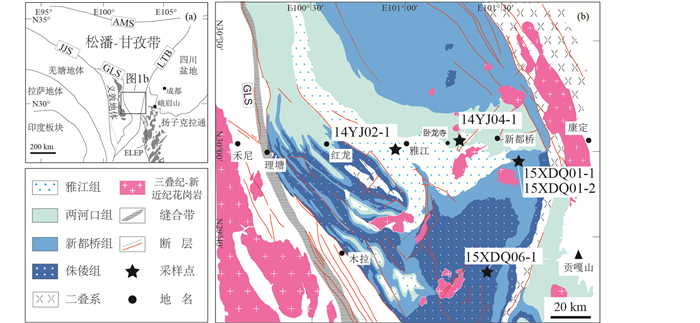
锆石是一种广泛存在于各类岩石中的副矿物,具有封闭温度高、难熔且硬度大的特点,不仅很好保留了原岩的地球化学特征,也不易在沉积物搬运或后期的地质事件中被改造,因此被广泛运用在追溯沉积物源区、恢复剥蚀历史和限定大陆碰撞时限的研究中(Fedo et al., 2003; Finch and Hanchar, 2003; Cai et al., 2012; Liu et al., 2020)。松潘-甘孜褶皱带位于青藏高原东北部,广泛出露晚三叠世复理石,其覆盖面积超过30万km2,是世界上出露面积最大的复理石沉积区之一(图 1a)。松潘-甘孜褶皱带广泛发育晚三叠世岩浆作用,还伴随发育伟晶岩型锂矿床(付小方等, 2017; 许志琴等, 2018),具有重要的战略经济意义。然而,由于区域内地层岩性和化石类型的单一,且叠加了后期的构造变形、倒转(Harrowfield and Wilson, 2005),使得地层的沉积时代没有得到很好限定。此外,由于松潘-甘孜褶皱带夹持在多地体(华北板块、华南板块、羌塘地体和柴达木微陆块)之间,其复杂的沉积历史和巨量的沉积物质来源仍然存在争议。前人将松潘-甘孜褶皱带划分为中部、南部以及北部(可可西里地区)等不同的沉积中心(Weislogel et al., 2006),推测的沉积物源区涵盖了周围所有地体和造山带,其中有:(1)秦岭-大别造山带(Nie et al., 1994; Weislogel et al., 2006, 2010; Enkelmann et al., 2007; Dong et al., 2016);(2)华北克拉通(Bruguier et al., 1997; Ding et al., 2013; Tang et al., 2017; Jian et al., 2019);(3)华南板块(Bruguier et al. 1997; Tang et al., 2017; Jian et al., 2019);(4)东昆仑、羌塘地体(She et al., 2006; Zhang et al., 2008; Tang et al., 2017);(5)义敦岩浆弧(Enkelmann et al., 2007)。对不同沉积中心的划分是前人研究的重点,而南部沉积中心的研究程度相对中部和北部沉积中心的研究较弱,因此,松潘-甘孜褶皱带南部沉积中心的物源区仍值得进一步讨论。此外,松潘-甘孜褶皱带缺乏三叠系以后的中生代地层(四川省地质矿产局, 1984①),而周缘地体则发育完整的中生界(如四川盆地, Meng et al., 2005; Shao et al., 2016)。侵位于松潘-甘孜褶皱带南部的晚三叠世中-酸性岩体与上三叠统的沉积时代十分接近(Zhan et al., 2021及其参考文献),这些现象指示周缘地体的抬升与剥蚀历史尚不清晰。
|
图 1 松潘-甘孜褶皱带地质简图与采样位置 (a)松潘-甘孜褶皱带构造划分图(据She et al., 2006改绘);(b)松潘-甘孜褶皱带南部地质简图(据四川省地质矿产局, 1984改绘). GLS-甘孜-理塘缝合带; JJS-金沙江缝合带; AMS-阿尼玛卿缝合带; LTB-龙门山断裂带; ELEP-峨眉山大火成岩省 Fig. 1 Simplified geological maps of the Songpan-Ganzi fold belt and sampling location (a) tectonic subdivision of the Songpan-Ganzi fold belt (modified after She et al., 2006); (b) simplified geological map of southern Songpan-Ganzi fold belt. GLS-Ganzi-Litang suture zone; JJS-Jinshajiang suture zone; AMS-A'nyemaqen suture zone; LTB-Longmenshan thrust belt; ELEP-Emeishan large igneous province |
① 四川省地质矿产局. 1984. 1:20万康定幅区域地质调查报告
为此,本文对松潘-甘孜褶皱带南部上三叠统砂岩进行了碎屑锆石U-Pb年龄测试和Hf同位素分析,结合前人已发表的研究结果,限定了松潘-甘孜褶皱带南部上三叠统的最大沉积年龄,并示踪了上三叠统沉积物的主要物源区,进而探讨了松潘-甘孜褶皱带在晚三叠世的快速抬升与剥蚀历史。
1 地质背景和样品描述松潘-甘孜褶皱带位于中国西南部。其北部以阿尼玛卿缝合带为界与东昆仑岩浆弧和西秦岭造山带相邻,东部以龙门山断裂带为界与扬子克拉通相隔,西侧以金沙江缝合带为界与羌塘地体相邻,义敦地体位于松潘-甘孜褶皱带西南,二者以甘孜-理塘缝合带为界。
秦岭造山带位于华北、华南板块之间,向东延伸为大别造山带,向西延伸为东昆仑造山带,是一条以超高压变质岩广泛出露为特点的复合型造山带,其形成与华南和华北克拉通在三叠纪的碰撞相关(Li et al., 1993; Mao et al., 2008; Liao et al., 2017)。西秦岭从北至南可以分为三个构造带,分别为中秦岭地体、淘河凹陷和白龙江地体(Zhang et al., 2014)。西秦岭发育地层以三叠系为主,主要为一套陆源碎屑岩、少量碳酸盐和丰富的中酸性火山岩组合(Mao et al., 2008; 闫臻等, 2012; Wu et al., 2019)。西秦岭地区广泛发育的印支期岩浆作用可以分为两期:第一期为245~230Ma,主要分布在西秦岭的中部和西部;第二期为230~205Ma,在整个西秦岭地区均有分布(骆必继, 2013; 豆敬兆, 2020)。
东昆仑造山带是一条巨型构造岩浆带,东西延伸约1500km,南邻松潘-甘孜褶皱带,东邻柴达木盆地,其内部以断裂为界又可划分为北、中、南三个构造带(莫宣学等, 2007)。东昆仑岩基出露面积约48400km2,几乎完全覆盖了中部昆仑构造带,其中以早古生代-中生代的岩浆作用为主,峰期岩浆作用为400~390Ma和260~220Ma,其中以三叠系的花岗岩最为发育(Huang et al., 2014; He et al., 2016; Dong et al., 2018)。
华南板块位于松潘-甘孜褶皱带东侧,新元古代时期扬子克拉通从罗迪尼亚超大陆裂离并与华夏地体碰撞共同组成了华南板块,同时在地体缝合处发生剧烈的岩浆作用,使得区域内广泛出露新元古代的花岗质和基性-超基性侵入岩,主要为两个峰期:830~795Ma和785~745Ma (Chen et al., 1991; Li et al., 2003; 赵军红等, 2015)。扬子克拉通西缘同样也出露一条南北走向长度超过700km的新元古代岩浆岩和变质岩带,变质岩主要为花岗质片麻岩,原岩年龄在860~750Ma之间(Sun et al., 2007; Roberts and Searle, 2019)。
松潘-甘孜褶皱带广泛出露巨厚的中-晚三叠世复理石沉积岩。雅江地区出露的地层除有少量寒武系、志留系-三叠系和第三系-第四系之外,三叠系出露面积占整个区域的88%。该地区三叠系中、下部为海相碎屑岩、火山岩和碳酸盐岩,上部为海陆交互相碎屑岩。周缘地体强烈的汇聚作用使得松潘-甘孜褶皱带地层形成强烈褶皱变形和大量断裂(四川省地质矿产局, 1984; 许志琴等, 1992; Yin and Harrison, 2000)。对于松潘-甘孜褶皱带基底的认识,不同学者秉持不同的观点,Yin and Nie (1993)认为是残留洋盆,Gu (1994)和Roger et al. (2008)则提出松潘-甘孜复理石沉积于金沙江洋北向俯冲的弧后盆地中。
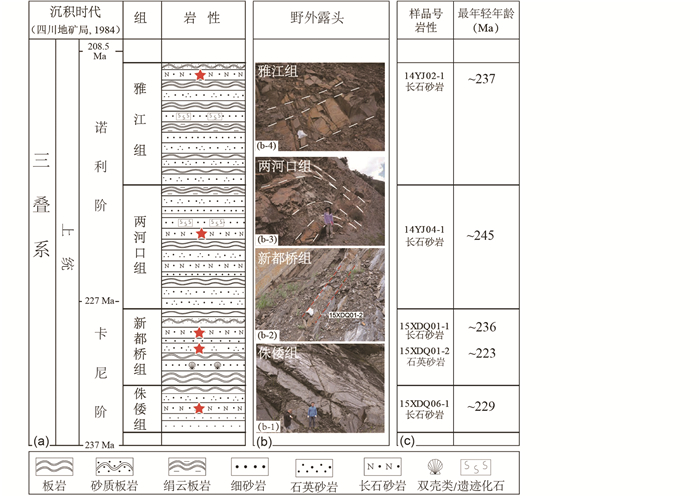
本文的研究区域雅江陆内盆地位于松潘-甘孜褶皱带的南部,西部紧邻义敦地体,北部受控于鲜水河断裂。该区内出露的晚三叠世复理石地层被称作西康群,其上三叠统由老至新分别为侏倭组、新都桥组、两河口组和雅江组,各组之间均为整合接触(图 2)。侏倭组(T3zh)上部以石英砂岩为主,下部以板岩为主夹石英砂岩及砂岩透镜体;新都桥组(T3xd)主要岩性为板岩,上下两段均以板岩为主夹少许变质砂岩,深水遗迹化石表明侏倭组和新都桥组都形成于晚三叠世卡尼期(237~227Ma)(杨逢清和熊伟, 2000);两河口组(T3l)分为3个岩性段:下段主要为石英砂岩,整合覆盖于新都桥组之上;中段和上段以板岩为主,含石英砂岩夹层。根据双壳化石组合限定该组的时代为晚三叠世卡尼期(235~228Ma)-诺利克(228~204Ma)早期(梁斌等, 2003);雅江组(T3y)分为3个岩性段:下段为石英砂岩与板岩互层,与下伏两河口组整合接触;中段和上段以板岩为主,含不等厚石英砂岩夹层。双壳化石组合限定该组的时代为诺利克(228~204Ma)早-中期(梁斌等, 2003)。
|
图 2 松潘-甘孜褶皱带南部上三叠统地层柱状图(a, 据四川省地质矿产局, 1984; 杨逢清和熊伟,2000; 梁斌等, 2003改绘)、野外露头(b)及本文最年轻碎屑锆石年龄(c) Fig. 2 Stratigraphic column of Late Triassic strata in the southern Songpan-Ganzi fold belt (a, modified after Yang and Xiong, 2000; Liang et al., 2003), field occurrences (b) and the youngest detrital zircon ages (c) |
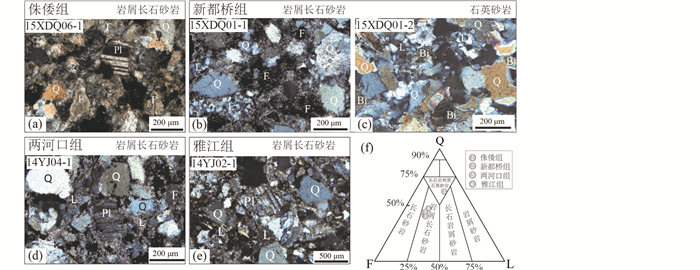
本文5件样品采集自松潘-甘孜褶皱带南部地区三叠系顶部的侏倭组、新都桥组、两河口组和雅江组(图 1b和图 2)。侏倭组样品(15XDQ06-1)采集自新都桥镇南86km处(图 1b和图 2b-1)颗粒支撑结构,粒度为100~200μm,棱角状-次圆状,分选差。碎屑颗粒包含石英(30%)、长石(30%)、岩屑(15%)、白云母(3%),杂基含量约5%,具有5%铁质胶结物(图 3a),其中长石普遍发生蚀变,岩性为浅灰色中粒岩屑长石砂岩(图 3f)。
|
图 3 砂岩样品镜下照片(a-e)及石英-长石-岩屑(QFL)图解(f) Q-石英;Pl-斜长石;F-长石;L-岩屑;Bi-黑云母 Fig. 3 Photomicrographs (a-e) and QFL diagram (f) of the samples Q-quartz; Pl-plagioclase; F-feldspar; L-lithic fragment; Bi-biotite |
新都桥组2件砂岩样品采集自新都桥镇东南15km处同一地点的不同层位(图 1b和图 2b-2)。样品15XDQ01-1为颗粒支撑结构,粒度为100~250μm,次棱角-次圆状,分选一般。碎屑颗粒包含石英(40%)、长石(35%)、石英岩屑(15%)、白云母(1%),杂基含量约5% (图 3b),岩性为深灰色细粒岩屑长石砂岩(图 3f)。样品15XDQ01-2为粒状变晶结构,矿物粒度为50~250μm。由石英(80%)、岩屑(10%)和黑云母(5%~10%)组成,颗粒间干净不具有杂基(图 3c),岩性为浅灰色细粒变质岩屑石英砂岩(图 3f)。
两河口组中段样品14YJ04-1采集自雅江县卧龙寺东北约2km处(图 1b和图 2b-3),粒度约50~200μm,次棱角-次圆状,分选一般。碎屑颗粒包含石英(35%~40%)、长石(30%~35%)、粉砂质岩屑(10%)、含粉砂泥质岩屑(5%),杂基含量约5% (图 3d),岩性为灰色细粒岩屑长石砂岩(图 3f)。
雅江组上段样品14YJ02-1采集自雅江县西南约6km处(图 1b和图 2b-4),为颗粒支撑结构,粒度约50~150μm,棱角-次棱角状,分选差。碎屑颗粒包括石英(35%~40%)、长石(30%),岩屑(15%~25%)、白云母(2%),杂基含量约5%,具有约10%铁质胶结物(图 3e),岩性为灰黄色细粒岩屑长石砂岩(图 3f)。
2 分析方法 2.1 锆石U-Pb年龄分析方法锆石在北京锆年领航科技有限公司采用浮选和电磁方法挑选。选出锆石单矿物后,在双目镜下将锆石单矿物粘贴在双面胶带上,用无色透明环氧树脂材料固定在锆石靶上,环氧树脂固化后进行抛光,暴露锆石内部结构。锆石的阴极发光显微照相(Cathodeluminescence,后文简称CL)是在中国地质科学院地质研究所电子探针实验室完成,用于了解每个锆石的内部结构及选取合适的分析点位置。CL图像采集是在Leo 4500电子扫描显微镜下完成,电压为15kV,分析电流据锆石发光强弱而定。
碎屑锆石U-Pb同位素年龄分析在中国地质大学(北京)矿物激光微区分析实验室(Milma Lab)通过LA-ICP-MS方法完成,同时完成锆石微量元素含量的测试。所有样品靶在放进样品靶托前,均用低浓度硝酸和无水乙醇反复擦拭多次,尽量排除普通Pb的干扰。激光剥蚀斑束直径为35μm,激光剥蚀深度为5μm。实验过程中采用NIST 610作为元素含量外标,锆石91500作为U-Pb同位素比值外标,锆石GJ-1 (Jackson et al., 2004)和Plešovice (Sláma et al., 2008)作为未知样品进行分析来监控数据质量,29Si作为内标元素进行校正。样品的同位素比值和元素含量数据处理采用ICPMSDataCal软件(Liu et al., 2008)完成,包括背景值和信号区间的选择、时间漂移校正、U-Pb数据以及微量元素标准化。普通铅校正是在Andersen (2002)程序中完成的,年龄计算、谐和图及年龄频谱图采用ISOPLOT (ver.3.7; Ludwig, 2000)宏程序完成,频谱图的年龄数据使用2σ误差,程序输出为1σ误差。本文只讨论3Ga以内的年龄峰值,极少数大于3Ga的数据点没有在频谱图上予以呈现。
本文使用207Pb/235U年龄和206Pb/238U年龄的比值来代表单点年龄的协和度,采用年龄测点的谐和度均大于90%。206Pb/238U年龄大于等于1000Ma的锆石采用207Pb/206Pb年龄,年龄小于1000Ma的锆石采用206Pb/238U年龄(Griffin et al. 2004)。
2.2 锆石Hf同位素分析方法锆石Hf同位素测试工作是在中国地质大学(北京)矿物激光微区分析实验室(Milma Lab)通过LA-MC-ICP-MS方法完成。实验中采用NewWave 193UC型ArF准分子激光器进行剥蚀取样,使用Thermal Fisher Neptune Plus多接收电感耦合等离子体质谱仪接受离子信号。激光在传输过程中,用N2作为光路保护气以防止能量衰减和光线衍射。所有样品靶在放进样品靶托前,均需用低浓度硝酸和无水乙醇反复擦拭多次。大样品室中央还有一个中心杯,其通过马达传送与物镜(剥蚀区)时刻保持中心对准,用来接收被剥蚀出的样品颗粒,并通过软管+钢管的连接方式传送到MC-ICP-MS。在实验过程中,利用氦气作为载气,氩气作为补偿气,两种气体通过T型三通连接并按一定比例混合后进入到MC-ICP-MS。气溶胶从激光中心杯管路通过后,再传输到MC-ICP-MS。
实验过程中MC-ICP-MS使用了L4-H3法拉第杯,分别接收171Yb、173Yb、175Lu、176Hf、177Hf、178Hf、179Hf和180Hf信号,积分时间为0.131s。实验过程中采用锆石91500 (Blichert-Toft, 2008)作为Hf同位素比值外标,锆石Plešovice (Sláma et al., 2008)和GJ-1 (Morel et al., 2008)作为未知样品进行分析来监控数据质量。每组样品有数个循环,每个循环内有1个外标91500、1个监测标Plešovice和GJ-1以及6~10个样品。每个点位的分析具有50s的背景空白和50s的样品剥蚀时间,其余时间为信号稳定时间。每个点位的数据首先通过Neptune Plus的数据处理软件来进行转化,生成每个点位的信号-时间关系文件。数据处理采用Iolite软件(Paton et al., 2011),选取信号平稳的区间进行计算。
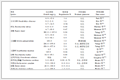
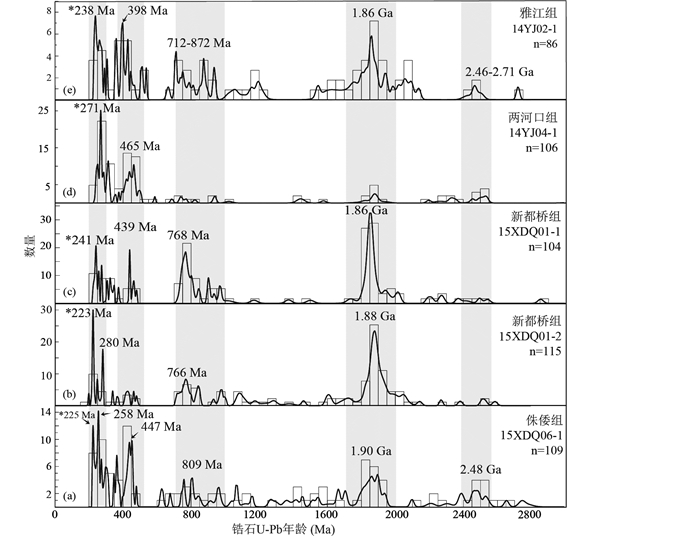
3 数据结果 3.1 锆石U-Pb年龄本文报道了4个地层5件砂岩样品共515颗锆石U-Pb年龄(详细数据见电子版附表 1、图 4)。除两河口组外,雅江组、新都桥组和侏倭组样品都具有明显的新元古代(872~712Ma)和古元古代(1.9~1.8Ga)峰值。在显生宙,四个地层的样品都表现出奥陶纪-泥盆纪(465~398Ma)和二叠纪-三叠纪(271~225Ma)的年龄峰值。雅江组和侏倭组具有较小的太古代峰值(~2.5Ga) (图 5)。
|
附表 1 松潘-甘孜褶皱带南部上三叠统砂岩碎屑锆石U-Pb测年分析结果 Appendix Table 1 U-Pb age data of detrital zircons from the Upper Triassic sandstones of southern Songpan-Ganzi fold belt |


|
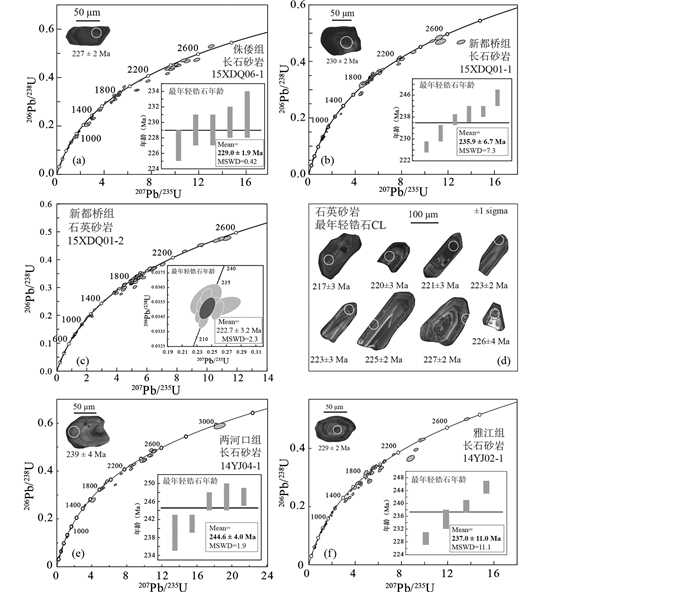
图 4 松潘-甘孜褶皱带南部样品碎屑锆石年龄谐和图及最年轻锆石均值图 Fig. 4 The concordia plots and weighted mean age plots of the youngest detrital zircons for samples from southern Songpan-Ganzi fold belt |
|
图 5 松潘-甘孜褶皱带南部上三叠统砂岩碎屑锆石年龄频谱图 侏倭组长石砂岩(a)、新都桥组石英砂岩(b)、新都桥组长石砂岩(c)、两河口组长石砂岩(d)和雅江组长石砂岩(e)年龄频谱图. n为测年锆石颗粒数;重要年龄用灰色条带标示;*号表示最年轻峰值 Fig. 5 Probability density plots (PDP) of detrital zircons from Upper Triassic sandstones in southern Songpan-Ganzi fold belt PDP of feldspathic sandstone from Zhuwo Formation (a), quartz sandstone from Xinduqiao Formation (b), feldspathic sandstone from Xinduqiao Formation (c), feldspathic sandstone from Lianghekou Formation (d) and feldspathic sandstone from Yajiang Formation (e). n is the number of dated zircons; age peak is denoted as gray band; * denote the youngest age peak |
侏倭组样品15XDQ06-1的锆石长度约50~100μm,常见自形和次圆状锆石,发育震荡环带(图 4a)。侏倭组具有上述古元古代至三叠纪的五个峰值,但新元古代的两期峰值(1.9Ga和809Ma)明显小于雅江组和新都桥组,太古代峰值(~2.5Ga)也十分小,最年轻峰值为225 Ma (图 5a)。锆石Th/U比值范围为0.13 ~ 2.03。
新都桥组样品15XDQ01-1的锆石颗粒平均长度约100μm,以次圆状锆石居多,少部分锆石呈长柱状且发育环带(图 4b)。新都桥组样品与雅江组样品相比缺失太古代峰值(~2.5Ga),新元古代和显生宙峰值与雅江组一致。最年轻峰值为241Ma (图 5c)。Th/U比值范围为0.09~3.53,其中99% (103/104颗)大于0.1。相比之下,样品15XDQ01-2奥陶纪-泥盆纪(465~398Ma)的峰值较小(图 5b),小于230Ma的8颗锆石具有典型的岩浆锆石特征,长度为150~200μm,矿物自形且震荡环带发育(图 4d)。年龄范围集中在227~217Ma,加权平均年龄为222.7±3.2Ma (2σ, MSWD=2.3, n=8) (图 4c)。
两河口组样品14YJ04-1的锆石颗粒平均长度约60μm,常见长柱状和次圆状晶形,发育震荡环带(图 4e)。年龄频谱图显示其仅有~465Ma和~271Ma两个主要峰值,新元古代颗粒(9/108)和古元古代-新太古代颗粒(23/108)占比较低,最年轻峰值为271Ma (图 5d)。锆石Th/U比值范围为0.03~1.80,其中96% (102/106颗)大于0.1。
雅江组样品14YJ01-1碎屑锆石平均长度约20~50μm,以圆状颗粒为主,伴随少量棱角状锆石,部分颗粒发育震荡环带(图 4f)。除具有上述四个峰值外,雅江组还具有较小的太古代峰值(2.71~2.46Ga),最年轻为238Ma (图 5e)。Th/U比值范围为0.05~1.51,其中97% (83/86颗)大于0.1,具有岩浆锆石的特征(Hoskin and Ireland, 2000)。
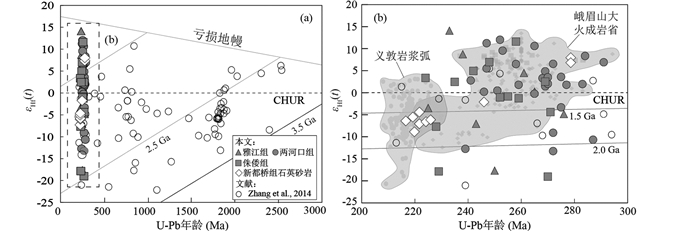
3.2 锆石Hf同位素本文测定了雅江组、两河口组、新都桥组和侏倭组4件砂岩中小于300Ma的锆石的Hf同位素特征,共计得到58个锆石Hf同位素数据(电子版附表 2;图 6)。侏倭组长石砂岩(14YJ06-1) 13颗锆石εHf(t)值变化范围-19.0~+11.6,其中6/13颗锆石为正值。新都桥组中石英砂岩(15XDQ01-2) 10颗锆石εHf(t)值变化范围为-7.3~+8.0,其中8颗锆石εHf(t)值为负值。两河口组长石砂岩(14YJ04-1) 27颗锆石的εHf(t)值变化范围-13.3~+12.0,其中21颗锆石的εHf(t)值为正。雅江组长石砂岩(14YJ02-1) 8颗碎屑锆石的εHf(t)值变化范围为-17.7~+14.1。
|
|
附表 2 松潘-甘孜褶皱带南部上三叠统砂岩碎屑锆石Hf同位素分析结果 Appendix Table 2 Hf isotopic data of detrital zircons of the Upper Triassic sandstones from southern Songpan-Ganzi fold belt |
|
图 6 松潘-甘孜褶皱带南部上三叠统砂岩碎屑锆石εHf(t)-年龄图解 (a)松潘-甘孜褶皱带南部上三叠统砂岩碎屑锆石Hf同位素特征;(b)松潘-甘孜褶皱带南部上三叠统砂岩小于300Ma碎屑锆石和峨眉山大火成岩省基性-酸性岩浆岩(Xu et al., 2008; Zhong et al., 2009, 2011; Tang et al., 2015)及义敦岩浆弧(Reid et al., 2007; He et al., 2013; Peng et al., 2014; Wu et al., 2017)Hf同位素特征对比 Fig. 6 Zircon εHf(t) vs. ages plots for the Upper Triassic sandstones of southern Songpan-Ganzi fold belt (a) the Hf isotope of detrital zircons from Late Triassic sandstones of southern Songpan-Ganzi fold belt; (b) the data of shallow region in Fig. b are mafic to felsic igneous rocks in Emeishan large igneous province (LIP) (Xu et al., 2008; Zhong et al., 2009, 2011; Tang et al., 2015) and Yidun magmatic arc (Reid et al., 2007; He et al., 2013; Peng et al., 2014; Wu et al., 2017) |
一般认为,除火山碎屑沉积物外,地层沉积物或沉积岩中最年轻的碎屑锆石一定比地层沉积开始的时代要老,因此可以将最年轻的碎屑锆石年龄作为地层开始沉积的最大时限(Barton et al., 1990; Nelson, 2001; Fedo et al., 2003)。由于分析方法的系统误差和Pb丢失的影响,单颗粒碎屑锆石作为最年轻年龄的误差较大(Gehrels et al., 2011)。Dickinson and Gehrels (2009)通过对比科罗拉多高原已知沉积时代的中生界和对应地层砂岩的最年轻碎屑锆石年龄的耦合程度,证明了最年轻碎屑锆石加权平均年龄限定地层最大沉积时限的可靠性。因此本文使用Dickinson and Gehrels (2009)推荐的方法,即以两颗或两颗以上最年轻碎屑锆石群组在1σ误差下的加权平均年龄值作为地层沉积的最大时限。同时本文对比了Isoplot计算的最年轻年龄(YDZ)、最年轻单颗粒年龄(YSG)、最年轻频谱图峰值年龄(YPP)和通过Dickinson and Gehrels (2009)推荐的方法计算的最年轻年龄[YC1σ(2+)],结果展示在表 1中。
|
|
表 1 通过不同方法得到的松潘-甘孜褶皱带南部上三叠统砂岩最年轻年龄对比 Table 1 The comparison of youngest detrital zircon ages calculated by different methods of sandstones from southern Songpan-Ganzi fold belt |
新获得的结果显示,侏倭组砂岩样品(15XDQ06-1)最年轻锆石加权平均年龄为229.0±1.9Ma (2σ, MSWD=0.4, n=5) (图 4a)。新都桥组长石砂岩样品(15XDQ01-1)最年轻锆石年龄的加权平均年龄为235.9±6.7Ma (2σ, MSWD=7.3, n=6) (图 4b)。石英砂岩最年轻锆石的加权平均年龄为222.7±3.2Ma (2σ, MSWD=2.3, n=8) (图 4c)。最小单颗粒锆石(197±2Ma)可能受到Pb丢失影响,未计入加权平均值中。两河口组样品(14YJ04-1)最年轻锆石的加权平均年龄为244.6±4.0Ma (2σ, MSWD=1.9, n=5) (图 4e)。雅江组样品(14YJ02-1)最年轻锆石的加权平均年龄为237±11Ma (2σ, MSWD=11.1, n= 4) (图 4f)。
马尔康地区侏倭组和新都桥组被划分为晚三叠世卡尼阶(237~227Ma),两河口组和雅江组被归属于诺利阶(227~ 208.5Ma) (四川省地质矿产局, 1984)。双壳类和遗迹化石也指示四川壤塘县内的侏倭组和新都桥组的沉积时代为晚三叠世卡尼阶(237~227Ma; 杨逢清和熊伟, 2000)。本文报道的侏倭组最年轻锆石年龄与前人通过化石限定的沉积时代接近,说明侏倭组应该晚于229.0±1.9Ma开始沉积(图 2)。
新都桥组最年轻碎屑锆石均值年龄指示其沉积作用晚于222.7±3.2Ma开始。Gong et al. (2021)报道的松潘-甘孜褶皱带东北部的新都桥组最年轻年龄为222.4±2.5Ma,与本文的定年结果在误差范围一致。新都桥组上部的两河口组和雅江组则具有~238Ma至~245Ma的最年轻年龄,与Jian et al. (2019)报道的松潘-甘孜褶皱带中部和南部地层最年轻锆石年龄一致。其最年轻年龄老于下伏新都桥组和侏倭组的原因可能是没有记录到年轻的岩浆活动。
4.2 物源区分析晚三叠世时期,松潘-甘孜洋周缘的构造单元有华北克拉通、华南板块、义敦地体、羌塘地体、东昆仑造山带和西秦岭造山带(尹安, 2001; Enkelmann et al., 2007; Roger et al., 2008; Weislogel et al., 2010; Ding et al., 2013)。如前文所述,这些地体单元都可能在晚三叠世时期为松潘-甘孜褶皱带南部的沉积地层提供碎屑物质。
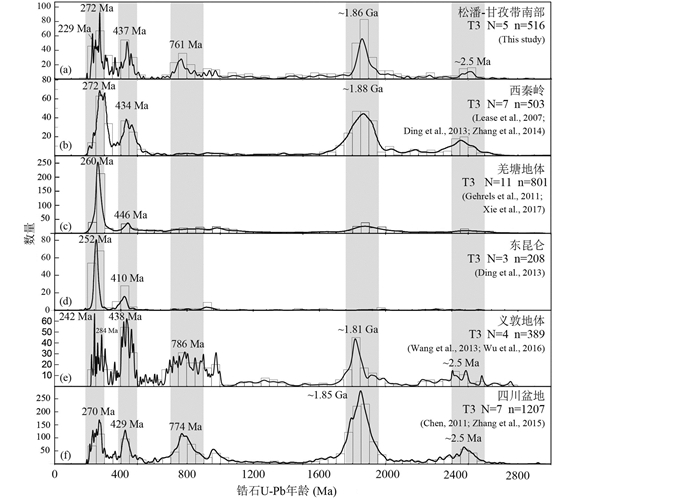
在本文样品中,除了两河口组外都显示出明显的古元古代峰值(~1.8Ga),而太古代碎屑锆石(~2.50Ga)在5件样品中占比都很低。前人研究显示华北克拉通沉积地层具有显著的古元古代(2.08~1.80Ga)和新太古代(2.71~2.50Ga)年龄峰值(Darby and Gehrels, 2006; 胡波等, 2009; Jian et al., 2019)。形成于华北、华南板块碰撞挤压的秦岭-大别造山带也继承了华北板块这两期峰值(Li et al., 1993; 陈岳龙等, 2008)。西秦岭造山带位于秦岭-大别造山带的西端、松潘-甘孜褶皱带北部沉积中心以北。该地区的三叠系碎屑锆石年龄具有新太古代-古元古代(~2.5Ga和~1.8Ga)、志留纪(434Ma)和二叠纪(270Ma) 4个明显峰值,与松潘-甘孜褶皱带不同的是不具有新元古代的年龄峰值(图 7b)。其次,秦岭-大别造山带早古生代到中生代的造山作用形成了大量的超高压变质岩(吴元保和郑永飞, 2013),这与松潘-甘孜带南部碎屑锆石的岩浆锆石特征也不符(Th/U>0.1)。此外,考虑到西秦岭造山带与松潘-甘孜褶皱带南部距离遥远,相隔中部和北部沉积中心,因此可以排除西秦岭造山带作为松潘-甘孜褶皱带南部地层主要物源区的可能性。
|
图 7 松潘-甘孜褶皱带南部砂岩与物源区上三叠统碎屑锆石年龄频谱对比 (a)松潘-甘孜褶皱带南部样品年龄频谱图(本文);(b)西秦岭上三叠统年龄频谱图(Lease et al., 2007; Ding et al., 2013; Zhang et al., 2014);(c)羌塘地体上三叠统年龄频谱图(Gehrels et al., 2011; Xie et al., 2017);(d)东昆仑上三叠统年龄频谱图(Ding et al., 2013);(e)义敦地体上三叠统年龄频谱图(Wang et al., 2013; Wu et al., 2016);(f)四川盆地上三叠统年龄频谱图(陈扬, 2011; Zhang et al., 2015).N为样品数; n为测年锆石颗粒数; 重要年龄用灰色条带标示 Fig. 7 Comparison of probability density plots (PDP) of detrital zircons from southern Songpan-Ganzi fold belt and source region (a) the PDP of Late Triassic sandstones from Songpan-Ganzi fold belt (this study); (b) the PDP of Late Triassic sandstones from West Qinling (Lease et al., 2007; Ding et al., 2013; Zhang et al., 2014); (c) the PDP of Late Triassic sandstones from Qiangtang Block (Gehrels et al., 2011; Xie et al., 2017); (d) the PDP of Late Triassic sandstones from East Kunlun (Ding et al., 2013); (e) the PDP of Late Triassic sandstones from Yidun Terrane (Wang et al., 2013; Wu et al., 2016); (f) the PDP of Late Triassic sandstones from Sichuan Basin (Chen, 2011; Zhang et al., 2015). N is the number of samples; n is the number of dated zircons, age peak is denoted as gray band |
羌塘三叠系碎屑锆石年龄的主要峰值为260Ma,次一级峰值为446Ma和1.89Ga,2.5G的碎屑颗粒很少(图 7c; Gehrels et al., 2011; Xie et al., 2017)。羌塘地体三叠系中二叠纪(263Ma)与奥陶纪(446Ma)的峰值与松潘-甘孜褶皱带频谱图相符,但它缺乏明显的新元古代峰值。这说明在晚三叠世,羌塘地体和松潘-甘孜褶皱带接受了不同的碎屑物源,羌塘地体可能不是松潘-甘孜褶皱带南部地层的主要物源区。
松潘-甘孜褶皱带北部东昆仑造山带的上三叠统碎屑锆石频谱图具252Ma和410Ma两个峰值(图 7d; Ding et al., 2013),与松潘-甘孜带上三叠统年龄频谱中最年轻的两个峰值一致,但明显缺少前寒武纪年龄峰值,这说明在晚三叠世东昆仑地区的碎屑物源与松潘-甘孜带不同。东昆仑造山带与西秦岭造山带一样位于松潘-甘孜褶皱带的最北部,与南部沉积中心距离遥远。东昆仑造山带广泛发育晚泥盆世-晚三叠世花岗岩,并以260~220Ma为主(莫宣学等, 2007; Huang et al., 2014),其中,< 300Ma的侵入体大多数都表现为富集的锆石Hf同位素组成(熊富浩, 2014; 罗明非, 2015),不同于松潘-甘孜带南部砂岩同期碎屑锆石以亏损Hf同位素组成为主的特征(图 6b),这些差异可能暗示松潘-甘孜褶皱带南部的主要物源区并不是东昆仑带造山带。
新元古代年龄是区分华北、华南板块碎屑物质的标志(Weislogel et al., 2010)。罗迪尼亚大陆的组合和裂解使扬子克拉通产生大量新元古代岩浆作用(870~740Ma) (Li, 1999; Zhao and Zhou, 2007; Wang and Zhou, 2012),这些岩体的出露与风化剥蚀为克拉通盖层本身以及周围沉积盆地提供了大量的新元古代碎屑物质。晚三叠世华南板块的西缘和北缘均为被动大陆边缘(Roger et al., 2008),与松潘-甘孜洋的地势差异为碎屑物质的沉积提供了条件。雅江组、新都桥组和侏倭组均以明显的新元古代年龄峰值(809~760Ma)为特征,与华南板块展现了较强的物源相关性。此外,松潘-甘孜褶皱带南部砂岩碎屑锆石Hf同位素特征进一步证明华南板块是主要物源区之一。在锆石年龄和εHf(t)值图解上(图 6b),本文碎屑锆石εHf(t)值与同期峨眉山大火成岩省岩浆岩εHf(t)值(Xu et al., 2008; Zhong et al., 2009, 2011; Tang et al., 2015)相似,这说明峨眉山大火成岩省相关的中酸性岩浆活动为松潘-甘孜褶皱带南部上三叠统砂岩300~240Ma的锆石颗粒提供了主要的物源。因此,本文认为华南板块是松潘-甘孜褶皱带南部沉积中心的主要物源区。
东部义敦地体主要被复理石和火山岩组成的三叠纪义敦群覆盖(侯增谦等, 2001; 戴宗明和孙传敏, 2008; Wang et al., 2013; Wu et al., 2016),发育大量侵位于上三叠统中的晚三叠世岩浆作用(235~206Ma),其岩浆作用峰期为~216Ma (侯增谦等, 2001; He et al., 2013; Peng et al., 2014; Wu et al., 2017; Zhan et al., 2021)。义敦地体南部的上三叠统具有与松潘-甘孜褶皱带南部地层十分相似的年龄频谱特征,显著的古元古代峰值(~1.8Ga)以及新元古代(786Ma)、志留纪(438Ma)和二叠纪-三叠纪(284~242Ma)的年龄峰值(图 7e; Wang et al., 2013; Wu et al., 2016)。另外,本文石英砂岩样品15XDQ01-2最年轻的碎屑锆石群(227~217Ma)富集的Hf同位素组成(εHf(t)值=-7.3~-4.7)与位于松潘-甘孜带西侧义敦地体广泛发育的晚三叠世岩浆作用相似(图 6b)。以上证据表明义敦地体可能在~223Ma为松潘-甘孜褶皱带南部沉积中心提供了碎屑物质。值得注意的是,松潘-甘孜带只记录到了义敦地体晚三叠世早期的岩浆作用,并未记录到峰期岩浆作用(~216Ma)及其以后的锆石颗粒,这说明义敦地体在晚三叠世晚期停止了对松潘-甘孜带南部的物源供给,这一现象可能说明松潘-甘孜褶皱带在216Ma已经发生了一定隆升,与西侧的义敦地体抬升至接近或更高海拔从而停止了来自西侧的沉积作用。
4.3 隆升与剥蚀历史除新近纪和第四纪地层外,松潘-甘孜褶皱带并不发育三叠纪以后的地层(四川省地质矿产局, 1984),而在其东侧的四川盆地则发育大量三叠纪-白垩纪沉积地层(Meng et al., 2005; Shao et al., 2016)。松潘-甘孜褶皱带内广泛出露侵位于三叠系复理石中的晚三叠世中酸性侵入体,其峰期岩浆作用(~210Ma)(Zhan et al., 2021及其参考文献)略晚于本文限定的沉积时代(约229Ma),说明在210Ma之前松潘-甘孜褶皱带南部的沉积作用就已经停止。三叠纪时期,由于华北、华南板块、羌塘和义敦等地体之间的汇聚作用,在这些地体之间形成了强烈的变形与造山作用(许志琴等, 1992; Harrowfield and Wilson, 2005; Zhang et al., 2007; Yan et al., 2011),引起了松潘-甘孜褶皱带在晚三叠世时期的增厚(许志琴等, 1992; Chen et al., 1995; Jian et al., 2019; 朱弟成等, 2021)。大约在211Ma时,青藏高原东部边缘(即松潘-甘孜褶皱带东部区域)已经具有平均55±2km的地壳厚度和2600±300m的海拔高度(Zhan et al., 2018),地体内部也发育大量同时期的岩浆作用。本文新获得的最年轻锆石年龄数据显示松潘-甘孜褶皱带南部上三叠统地层最早从~229Ma才开始沉积(图 2c),而~211Ma已经具有了较厚的地壳和较高的海拔,这说明松潘-甘孜褶皱带可能在小于~18Myr内发生了快速的隆升作用,导致构造环境从沉积盆地转换为了褶皱造山带。
造山作用的快速隆升会导致强烈的剥蚀作用,同时期沉积在周缘盆地的碎屑物质就是剥蚀历史的直接记录。Zhu et al. (2017)对四川盆地西南缘的中三叠统雷口坡组与上三叠统须家河组的物源对比研究中发现,上三叠统砂岩具有与松潘-甘孜褶皱带相似的年龄峰值(图 7f,240~210Ma、290~260Ma、460~410Ma、650Ma、880~710Ma、1900~1600Ma和2600~2400Ma),明显不同于以峨眉山大火成岩省和康定杂岩为主要源区的中三叠统雷口坡组砂岩的碎屑锆石年龄峰值(~257Ma、650~500Ma、880~710Ma和1000~900Ma)。这可以说明四川盆地西缘晚三叠世的物源区可能已经转换为隆升起来的松潘-甘孜褶皱带。
5 结论(1) 最年轻碎屑锆石年龄对地层沉积的时代做出了新的限定,侏倭组的沉积作用晚于229.0±1.9Ma发生,而新都桥组的沉积作用则晚于222.7±3.2Ma发生。这个时限比前人通过古生物限定的沉积时代更年轻。
(2) 碎屑锆石年龄频谱与锆石Hf同位素特征显示,松潘-甘孜褶皱带南部的沉积物源区主要为华南板块和义敦地体。义敦地体峰期岩浆作用记录(216Ma)在松潘-甘孜褶皱带南部的缺失说明松潘-甘孜褶皱带此时已经抬升至与义敦地体接近或更高海拔。
(3) 受到周缘块体强烈汇聚作用的影响,松潘-甘孜褶皱带在小于~18Myr的时间内从沉积盆地转换为造山带环境,发生了快速的隆升和剥蚀,剥蚀产生的碎屑物质在四川盆地西缘再沉积。
致谢 感谢潘桂棠研究员在野外工作中的细心指导;感谢戴紧根教授对岩性鉴定工作的指导;感谢金鹭、宋琬婧、田园、周士旭、刘颖、安宇同学在野外和室内工作的大力帮助;感谢两位审稿人对本文提出的宝贵修改意见。
Andersen T. 2002. Correction of common lead in U-Pb analyses that do not report 204Pb. Chemical Geology, 192(1-2): 59-79 DOI:10.1016/S0009-2541(02)00195-X
|
Barton ES, Compston W, Williams IS, Bristow JW, Hallbauer DK and Smith CB. 1990. Provenance ages for the Witwatersrand Supergroup and the Ventersdorp contact reef: Constraints from ion microprobe U-Pb ages of detrital zircons: Reply. Economic Geology, 85(8): 1951-1952 DOI:10.2113/gsecongeo.85.8.1951
|
Blichert-Toft J. 2008. The Hf isotopic composition of zircon reference material 91500. Chemical Geology, 253(3-4): 252-257 DOI:10.1016/j.chemgeo.2008.05.014
|
Bruguier O, Lancelot JR and Malavieille J. 1997. U-Pb dating on single detrital zircon grains from the Triassic Songpan-Ganze flysch (Central China): Provenance and tectonic correlations. Earth and Planetary Science Letters, 152(1-4): 217-231 DOI:10.1016/S0012-821X(97)00138-6
|
Cai FL, Ding L, Leary RJ, Wang HQ, Xu Q, Zhang LY and Yue YH. 2012. Tectonostratigraphy and provenance of an accretionary complex within the Yarlung-Zangpo suture zone, southern Tibet: Insights into subduction-accretion processes in the Neo-Tethys. Tectonophysics, 574-575(29): 181-192
|
Chen JF, Foland KA, Xing FM, Xu X and Zhou TX. 1991. Magmatism along the southeast margin of the Yangtze block: Precambrian collision of the Yangtze and Cathysia blocks of China. Geology, 19(8): 815-818 DOI:10.1130/0091-7613(1991)019<0815:MATSMO>2.3.CO;2
|
Chen SFA, Wilson CJL and Worley BA. 1995. Tectonic transition from the Songpan-Garzê Fold Belt to the Sichuan Basin, south-western China. Basin Research, 7(3): 235-253 DOI:10.1111/j.1365-2117.1995.tb00108.x
|
Chen Y. 2011. The formation of western Sichuan foreland basin and its significance in oil-gas exploration during Late Triassic. Ph. D. Dissertation. Chengdu: Chengdu University of Technology (in Chinese with English summary)
|
Chen YL, Li DP, Zhou J, Zhang HF, Liu F, Nie LS, Jiang LT and Liu XM. 2008. U-Pb ages of zircons in Western Qinling Mountain, China, and their tectonic implications. Earth Science Frontiers, 15(4): 88-107 (in Chinese with English abstract) DOI:10.1016/S1872-5791(08)60042-1
|
Darby BJ and Gehrels G. 2006. Detrital zircon reference for the North China Block. Journal of Asian Earth Science, 26(6): 637-648 DOI:10.1016/j.jseaes.2004.12.005
|
Dai ZM and Sun CM. 2008. Sedimentary facies and paleogeography of the Upper Triassic Qugasi Formation in Yidun, Sichuan. Acta Geologica Sichuan, 28(4): 266-271 (in Chinese with English abstract)
|
Dickinson WR and Gehrels GE. 2009. Use of U-Pb ages of detrital zircons to infer maximum depositional ages of strata: A test against a Colorado Plateau Mesozoic database. Earth and Planetary Science Letters, 288(1-2): 115-125 DOI:10.1016/j.epsl.2009.09.013
|
Ding L, Yang D, Cai FL, Pullen A, Kapp P, Gehrels GE, Zhang LY, Zhang QH, Lai QZ, Yue YH and Shi RD. 2013. Provenance analysis of the Mesozoic Hoh-Xil-Songpan-Ganzi turbidites in northern Tibet: Implications for the tectonic evolution of the eastern Paleo-Tethys Ocean. Tectonics, 32(1): 34-48 DOI:10.1002/tect.20013
|
Dong YP and Santosh M. 2016. Tectonic architecture and multiple orogeny of the Qinling Orogenic Belt, Central China. Gondwana Research, 29(1): 1-40 DOI:10.1016/j.gr.2015.06.009
|
Dong YP, He DF, Sun SS, Liu XM, Zhou XH, Zhang FF, Yang Z, Cheng B, Zhao GC and Li JH. 2018. Subduction and accretionary tectonics of the East Kunlun Orogen, western segment of the Central China Orogenic System. Earth-Science Reviews, 186: 231-261 DOI:10.1016/j.earscirev.2017.12.006
|
Dou JZ. 2020. On the compositional diversity of the Early Mesozoic granitic magmatism in the West Qinling Orogenic Belt in Central China. Ph. D. Dissertation. Hefei: University of Science and Technology of China (in Chinese with English summary)
|
Enkelmann E, Weislogel A, Ratschbacher L, Eide E, Renno A and Wooden J. 2007. How was the Triassic Songpan-Ganzi basin filled? A provenance study. Tectonics, 26(4): TC4007
|
Fedo CM, Sircombe KN and Rainbird RH. 2003. Detrital zircon analysis of the sedimentary record. Reviews in Mineralogy and Geochemistry, 53(1): 277-303 DOI:10.2113/0530277
|
Finch RJ and Hanchar JM. 2003. Structure and chemistry of zircon and zircon-group minerals. Reviews in Mineralogy and Geochemistry, 53(1): 1-25 DOI:10.2113/0530001
|
Fu XF, Hou LW and Liang B, et al. 2017. Metallogenic Model and Three-Dimensional Exploration Model of Jiajika Granitic Pegmatite Lithium Deposit. Beijing: Science Press (in Chinese)
|
Gehrels G, Kapp P, Decelles P, Pullen A, Blakey R, Weislogel A, Ding L, Guynn J, Martin A, McQuarrie N and Yin A. 2011. Detrital zircon geochronology of pre-Tertiary strata in the Tibetan-Himalayan orogen. Tectonics, 30(5): TC5016
|
Gong DX, Wu CH, Zou H, Zhou X, Zhou Y, Tan HQ and Yue XY. 2021. Provenance analysis of Late Triassic turbidites in the eastern Songpan-Ganzi Flysch Complex: Sedimentary record of tectonic evolution of the eastern Paleo-Tethys Ocean. Marine and Petroleum Geology, 126: 104927 DOI:10.1016/j.marpetgeo.2021.104927
|
Griffin WL, Belousova EA, Shee SR, Pearson NJ and O'Reilly SY. 2004. Archean crustal evolution in the northern Yilgarn Craton: U-Pb and Hf-isotope evidence from detrital zircons. Precambrian Research, 131(3-4): 231-282 DOI:10.1016/j.precamres.2003.12.011
|
Gu XX. 1994. Geochemical characteristics of the Triassic Tethys turbidites in northwestern Sichuan, China: Implications for provenance and interpretation of the tectonic setting. Geochimica et Cosmochimica Acta, 58(21): 4615-4631 DOI:10.1016/0016-7037(94)90195-3
|
Harrowfield MJ and Wilson CJL. 2005. Indosinian deformation of the Songpan Garzê Fold Belt, northeast Tibetan Plateau. Journal of Structural Geology, 27(1): 101-117 DOI:10.1016/j.jsg.2004.06.010
|
He DF, Zhu WG, Zhong H, Ren T, Bai ZJ and Fan HP. 2013. Zircon U-Pb geochronology and elemental and Sr-Nd-Hf isotopic geochemistry of the Daocheng granitic pluton from the Yidun Arc, SW China. Journal of Asian Earth Sciences, 67-68: 1-17 DOI:10.1016/j.jseaes.2013.02.002
|
He DF, Dong YP, Liu XM, Yang Z, Sun SS, Cheng B and Li W. 2016. Tectono-thermal events in East Kunlun, Northern Tibetan Plateau: Evidence from zircon U-Pb geochronology. Gondwana Research, 30: 179-190 DOI:10.1016/j.gr.2015.08.002
|
Hou ZQ, Qu XM, Zhou JR, Yang YQ, Huang DH, Lu QT, Tang SH, Yu JJ, Wang HP and Zhao JH. 2001. Collision-orogenic process of the Yidun Arc in the Sanjiang region: Record of granites. Acta Geologica Sinica, 75(4): 484-497 (in Chinese with English abstract)
|
Hoskin PWO and Ireland TR. 2000. Rare earth element chemistry of zircon and its use as a provenance indicator. Geology, 28(7): 627-630 DOI:10.1130/0091-7613(2000)28<627:REECOZ>2.0.CO;2
|
Hu B, Zhai MG, Guo JH, Peng P, Liu F and Liu S. 2009. LA-ICP-MS U-Pb geochronology of detrital zircons from the Huade Group in the northern margin of the North China Craton and its tectonic significance. Acta Petrologica Sinica, 25(1): 193-211 (in Chinese with English abstract)
|
Huang H, Niu YL, Nowell G, Zhao ZD, Yu XH, Zhu DC, Mo XX and Ding S. 2014. Geochemical constraints on the petrogenesis of granitoids in the East Kunlun orogenic belt, northern Tibetan Plateau: Implications for continental crust growth through syn-collisional felsic magmatism. Chemical Geology, 370(26): 1-18
|
Jackson SE, Pearson NJ, Griffin WL and Belousova EA. 2004. The application of laser ablation-inductively coupled plasma-mass spectrometry to in situ U-Pb zircon geochronology. Chemical Geology, 211(1-2): 47-69 DOI:10.1016/j.chemgeo.2004.06.017
|
Jian X, Weislogel A and Pullen A. 2019. Triassic sedimentary filling and closure of the eastern Paleo-Tethys Ocean: New insights from detrital zircon geochronology of Songpan-Ganzi, Yidun, and West Qinling flysch in eastern Tibet. Tectonics, 38(2): 767-787 DOI:10.1029/2018TC005300
|
Lease RO, Burbank DW, Gehrels GE, Wang ZC and Yuan DY. 2007. Signatures of mountain building: Detrital zircon U/Pb ages from northeastern Tibet. Geology, 35(3): 239-242 DOI:10.1130/G23057A.1
|
Li SG, Xiao YL, Liou DL, Chen YZ, Ge NJ, Zhang ZQ, Sun SS, Cong BL, Zhang RY, Hart SR and Wang SS. 1993. Collision of the North China and Yangtse blocks and formation of coesite-bearing eclogites: Timing and processes. Chemical Geology, 109(1-4): 89-111 DOI:10.1016/0009-2541(93)90063-O
|
Li XH. 1999. U-Pb zircon ages of granites from the southern margin of the Yangtze Block: Timing of Neoproterozoic Jinning: Orogeny in SE China and implications for Rodinia assembly. Precambrian Research, 97(1-2): 43-57 DOI:10.1016/S0301-9268(99)00020-0
|
Li ZX, Li XH, Kinny PD, Wang J, Zhang S and Zhou H. 2003. Geochronology of Neoproterozoic syn-rift magmatism in the Yangtze Craton, South China and correlations with other continents: Evidence for a mantle superplume that broke up Rodinia. Precambrian Research, 122(1-4): 85-109 DOI:10.1016/S0301-9268(02)00208-5
|
Liang B, Yang FQ, Guo JQ, Zhong CH and Li ZJ. 2003. Discovery of deep water trace fossils from Late Triassic Yajiang Formation and Lianghekou Formation in Yajiang County, Sichuan Province. Geological Science and Technology Information, 22(3): 41-44 (in Chinese with English abstract)
|
Liao XY, Wang YW, Liu L, Wang C and Santosh M. 2017. Detrital zircon U-Pb and Hf isotopic data from the Liuling Group in the South Qinling belt: Provenance and tectonic implications. Journal of Asian Earth Sciences, 134: 244-261 DOI:10.1016/j.jseaes.2016.11.020
|
Liu YM, Dai JG, Wang CS, Li HA, Wang Q and Zhang LL. 2020. Provenance and tectonic setting of Upper Triassic turbidites in the eastern Tethyan Himalaya: Implications for early-stage evolution of the Neo-Tethys. Earth-Science Reviews, 200: 103030 DOI:10.1016/j.earscirev.2019.103030
|
Liu YS, Hu ZC, Gao S, Günther D, Xu J, Gao CG and Chen HH. 2008. In situ analysis of major and trace elements of anhydrous minerals by LA-ICP-MS without applying an internal standard. Chemical Geology, 257(1-2): 34-43 DOI:10.1016/j.chemgeo.2008.08.004
|
Ludwig KR. 2000. User's Manual for Isoplot/EX, Version 2:A Geochronological Toolkit Microsoft Excel. Berkeley Geochronology Centre Special Publication, No. 1a: 56
|
Luo BJ. 2013. Petrogenesis and geodynamic processes of the Indosinian magmatism in the West Qinling Orogenic belt, central China. Ph. D. Dissertation. Wuhan: China University of Geoscience (in Chinese with English summary)
|
Luo MF. 2015. Spatial-temporal patter and geological implications of Early Paleozoic-Early Mesozoic granitoids in the East Kunlun Orogenic Belt (eastern segment). Ph. D. Dissertation. Beijing: China University of Geoscience, Beijing (in Chinese with English summary)
|
Mao JW, Xie GQ, Bierlein F, Qü WJ, Du AD, Ye HS, Pirajno F, Li HM, Guo BJ, Li YF and Yang ZQ. 2008. Tectonic implications from Re-Os dating of Mesozoic molybdenum deposits in the East Qinling-Dabie orogenic belt. Geochimica et Cosmochimica Acta, 72(18): 4607-4626 DOI:10.1016/j.gca.2008.06.027
|
Meng QR, Wang E and Hu JM. 2005. Mesozoic sedimentary evolution of the Northwest Sichuan basin: Implication for continued clockwise rotation of the South China block. Geological Society of America Bulletin, 117(3-4): 396-410
|
Mo XX, Luo ZH, Deng JF, Yu XH, Liu CD, Zhan HW, Yuan WM and Liu YH. 2007. Granitoids and crustal growth in the East-Kunlun Orogenic belt. Geological Journal of China Universities, 13(3): 403-414 (in Chinese with English abstract)
|
Morel MLA, Nebel O, Nebel-Jacobsen YJ, Miller JS and Vroon PZ. 2008. Hafnium isotope characterization of the GJ-1 zircon reference material by solution and laser-ablation MC-ICPMS. Chemical Geology, 255(1-2): 231-235 DOI:10.1016/j.chemgeo.2008.06.040
|
Nelson DR. 2001. An assessment of the determination of depositional ages for Precambrian clastic sedimentary rocks by U-Pb dating of detrital zircons. Sedimentary Geology, 141-142(1): 37-60
|
Nie SY, Yin A, Rowley DB and Jin YG. 1994. Exhumation of the Dabie Shan ultra-high-pressure rocks and accumulation of the Songpan-Ganzi flysch sequence, central China. Geology, 22(11): 999-1002 DOI:10.1130/0091-7613(1994)022<0999:EOTDSU>2.3.CO;2
|
Paton C, Hellstrom J, Paul B, Woodhead J and Hergt J. 2011. Iolite: Freeware for the visualization and processing of mass spectrometric data. Journal of Analytical Atomic Spectrometry, 26(12): 2508-2518 DOI:10.1039/c1ja10172b
|
Peng TP, Zhao GC, Fan WM, Peng BX and Mao YS. 2014. Zircon geochronology and Hf isotopes of Mesozoic intrusive rocks from the Yidun Terrane, eastern Tibetan Plateau: Petrogenesis and their bearings with Cu mineralization. Journal of Asian Earth Sciences, 80(5): 18-33
|
Reid A, Wilson CJL, Shun L, Pearson N and Belousova E. 2007. Mesozoic plutons of the Yidun arc, SW China: U/Pb geochronology and Hf isotopic signature. Ore Geology Reviews, 31(1-4): 88-106 DOI:10.1016/j.oregeorev.2004.11.003
|
Roberts NMW and Searle MP. 2019. Zircon U-Pb-Hf constraints from Gongga Shan granites on young crustal melting in eastern Tibet. Geoscience Frontiers, 10(3): 885-894 DOI:10.1016/j.gsf.2018.02.010
|
Roger F, Jolivet M and Malavieille J. 2008. Tectonic evolution of the Triassic fold belts of Tibet. Comptes Rendus Geosciences, 340(2-3): 180-189 DOI:10.1016/j.crte.2007.10.014
|
Shao TB, Cheng NF and Song MS. 2016. Provenance and tectonic-paleogeographic evolution: Constraints from detrital zircon U-Pb ages of Late Triassic-Early Jurassic deposits in the northern Sichuan basin, central China. Journal of Asian Earth Sciences, 127(1): 12-31
|
She ZB, Ma CQ, Mason R, Li JW, Wang GC and Lei YH. 2006. Provenance of the Triassic Songpan-Ganzi flysch, West China. Chemical Geology, 231(1-2): 159-175 DOI:10.1016/j.chemgeo.2006.01.001
|
Sláma J, Košler J, Condon DJ, Crowley JL, Gerdes A, Hanchar JM, Horstwood MSA, Morris GA, Nasdala L, Norberg N, Schaltegger U, Schoene B, Tubrett MN and Whitehouse MJ. 2008. Plešovice zircon: A new natural reference material for U-Pb and Hf isotopic microanalysis. Chemical Geology, 249(1-2): 1-35 DOI:10.1016/j.chemgeo.2007.11.005
|
Soderlund U, Patchett PJ, Vervoort JD and Isachsen CE. 2004. The 176Lu decay constant determined by Lu-Hf and U-Pb isotope systematics of Precambrian mafic intrusions. Earth and Planetary Science Letters, 219(3-4): 311-324 DOI:10.1016/S0012-821X(04)00012-3
|
Sun WH, Zhou MF and Zhao JH. 2007. Geochemistry and tectonic significance of basaltic lavas in the Neoproterozoic Yanbian Group, southern Sichuan Province, Southwest China. International Geology Review, 49(6): 554-571 DOI:10.2747/0020-6814.49.6.554
|
Tang QY, Li CS, Zhang MJ and Lin Y. 2015. U-Pb age and Hf isotopes of zircon from basaltic andesite and geochemical fingerprinting of the associated picrites in the Emeishan large igneous province, SW China. Mineralogy and Petrology, 109(1): 103-114 DOI:10.1007/s00710-014-0349-z
|
Tang Y, Zhang YP and Tong LL. 2017. Provenance of Middle to Late Triassic sedimentary rocks in the Zoige Depression in the NE part of the Songpan-Ganzi flysch basin: Petrography, heavy minerals, and zircon U-Pb geochronology. Geological Journal, 52(Suppl.1): 449-462
|
Wang BQ, Zhou MF, Chen WT, Gao JF and Yan DP. 2013. Petrogenesis and tectonic implications of the Triassic volcanic rocks in the northern Yidun Terrane, Eastern Tibet. Lithos, 175-176(15): 285-301
|
Wang W and Zhou MF. 2012. Sedimentary records of the Yangtze Block (South China) and their correlation with equivalent Neoproterozoic sequences on adjacent continents. Sedimentary Geology, 265-266(15): 126-142
|
Weislogel AL, Graham SA, Chang EZ, Wooden JL, Gehrels GE and Yang HS. 2006. Detrital zircon provenance of the Late Triassic Songpan-Ganzi complex: Sedimentary record of collision of the North and South China blocks. Geology, 34(2): 97-100 DOI:10.1130/G21929.1
|
Weislogel AL, Graham SA, Chang EZ, Wooden JL and Gehrels GE. 2010. Detrital zircon provenance from three turbidite depocenters of the Middle-Upper Triassic Songpan-Ganzi complex, central China: Record of collisional tectonics, erosional exhumation, and sediment production. Geological Society of America Bulletin, 122(11-12): 2041-2062 DOI:10.1130/B26606.1
|
Wu T, Xiao L and Ma CQ. 2016. U-Pb geochronology of detrital and inherited zircons in the Yidun arc belt, eastern Tibet Plateau and its tectonic implications. Journal of Earth Science, 27(3): 461-473 DOI:10.1007/s12583-016-0675-5
|
Wu T, Xiao L, Wilde SA, Ma CQ and Zhou JX. 2017. A mixed source for the Late Triassic Garzê-Daocheng granitic belt and its implications for the tectonic evolution of the Yidun arc belt, eastern Tibetan plateau. Lithos, 288-289: 214-230 DOI:10.1016/j.lithos.2017.07.002
|
Wu YB and Zheng YF. 2013. Southward accretion of the North China Block and the tectonic evolution of the Qinling-Tongbai-Hong'an orogenic belt. Chinese Science Bulletin, 58(23): 2246-2250 (in Chinese) DOI:10.1360/972013-662
|
Wu YF, Li JW, Evans K, Fougerouse D and Rempel K. 2019. Source and possible tectonic driver for Jurassic-Cretaceous gold deposits in the West Qinling Orogen, China. Geoscience Frontiers, 10(1): 107-117 DOI:10.1016/j.gsf.2018.09.005
|
Xie CM, Li C, Ren YS, Wang M and Su L. 2017. Detrital provenance, depositional environment, and palaeogeographic implications of Lower Triassic marine sediments in central Tibet. International Geology Review, 60(4): 418-430
|
Xiong FH. 2014. Spatial-temporal pattern, petrogenesis and geological implications of Paleo-Tethyan granitoids in the East Kunlun Orogenic Belt (eastern segment). Ph. D. Dissertation. Wuhan: China University of Geoscience (in Chinese with English summary)
|
Xu YG, Luo ZY, Huang XL, He B, Xiao L, Xie LW and Shi YR. 2008. Zircon U-Pb and Hf isotope constraints on crustal melting associated with the Emeishan mantle plume. Geochimica et Cosmochimica Acta, 72(13): 3084-3104 DOI:10.1016/j.gca.2008.04.019
|
Xu ZQ, Hou LW and Wang ZX, et al. 1992. Orogenic Processes of the Songpan Ganze Orogenic Belt of China. Beijing: Geological Publishing House (in Chinese)
|
Xu ZQ, Wang RC, Zhao ZB and Fu XF. 2018. On the structural backgrounds of the large-scale "Hard-rock Type" Lithium ore belts in China. Acata Geologica Sinica, 92(6): 1091-1106 (in Chinese with English abstract)
|
Yan DP, Zhou MF, Li SB and Wei GQ. 2011. Structural and geochronological constraints on the Mesozoic-Cenozoic tectonic evolution of the Longmen Shan thrust belt, eastern Tibetan Plateau. Tectonics, 30(6): TC6005
|
Yan Z, Wang ZQ, Li JL, Xu ZQ and Deng JF. 2012. Tectonic settings and accretionary orogenesis of the West Qinling Terrane, northeastern margin of the Tibet Plateau. Acta Petrologica Sinica, 28(6): 1808-1828 (in Chinese with English abstract)
|
Yang FQ and Xiong W. 2000. Late Triassic deep water trace fossils and their sedimentary environment in the Jinmuda, Rangtang, Sichuan. Acta Sedimentologica Sinica, 18(1): 73-79 (in Chinese with English abstract)
|
Yin A and Nie SY. 1993. An indentation model for the North and South China collision and the development of the Tanlu and Honam fault systems, eastern Asia. Tectonics, 12(4): 801-813 DOI:10.1029/93TC00313
|
Yin A and Harrison TM. 2000. Geologic evolution of the Himalayan-Tibetan Orogen. Annual Review of Earth and Planetary Science, 28(1): 211-280 DOI:10.1146/annurev.earth.28.1.211
|
Yin A. 2001. Geologic evolution of the Himalayan-Tibetan orogen in the context of Phanerozoic continental growth of Asia. Acta Geoscientia Sinica, 22(3): 193-230 (in Chinese with English abstract)
|
Zhan QY, Zhu DC, Wang Q, Cawood PA, Xie JC, Li SM, Wang R, Zhang LL, Zhao ZD and Deng J. 2018. Constructing the Eastern Margin of the Tibetan Plateau during the Late Triassic. Journal of Geophysical Research: Solid Earth, 123(12): 10449-10459
|
Zhan QY, Zhu DC, Wang Q, Cawood PA, Xie JC, Liu X, Li SM, Zhang LL and Zhao ZD. 2021. Imaging the Late Triassic lithospheric architecture of the Yidun Terrane, eastern Tibetan Plateau: Observations and interpretations. GSA Bulletin, 133(11-12): 2279-2290
|
Zhang HF, Parrish R, Zhang L, Xu WC, Yuan HL, Gao S and Crowley QG. 2007. A-type granite and adakitic magmatism association in Songpan-Garze fold belt, eastern Tibetan Plateau: Implication for lithospheric delamination. Lithos, 97(3-4): 323-335 DOI:10.1016/j.lithos.2007.01.002
|
Zhang KJ, Li B, Wei QG, Cai JX and Zhang YX. 2008. Proximal provenance of the western Songpan-Ganzi turbidite complex (Late Triassic, eastern Tibetan Plateau): Implications for the tectonic amalgamation of China. Sedimentary Geology, 208(1-2): 36-44 DOI:10.1016/j.sedgeo.2008.04.008
|
Zhang Y, Jia D, Shen L, Yin HW, Chen ZX, Li HB, Li ZG and Sun C. 2015. Provenance of detrital zircons in the Late Triassic Sichuan foreland basin: Constraints on the evolution of the Qinling Orogen and Longmen Shan thrust-fold belt in central China. International Geology Review, 57(14): 1806-1824 DOI:10.1080/00206814.2015.1027967
|
Zhang YX, Zeng L, Zhang KJ, Li ZW, Wang CS and Guo TL. 2014. Late Palaeozoic and Early Mesozoic tectonic and palaeogeographic evolution of central China: Evidence from U-Pb and Lu-Hf isotope systematics of detrital zircons from the western Qinling region. International Geology Review, 56(3): 351-392 DOI:10.1080/00206814.2013.864475
|
Zhao JH, Wang W and Liu H. 2015. Geological evolution of the southeastern Yangtze Block during the Neoproterozoic. Bulletin of Mineralogy, Petrology and Geochemistry, 34(2): 227-233 (in Chinese with English abstract)
|
Zhao JH and Zhou MF. 2007. Geochemistry of Neoproterozoic mafic intrusions in the Panzhihua district (Sichuan Province, SW China): Implications for subduction-related metasomatism in the upper mantle. Precambrian Research, 152(1-2): 27-47 DOI:10.1016/j.precamres.2006.09.002
|
Zhong H, Zhu WG, Hu RZ, Xie LW, He DF, Liu F and Chu ZY. 2009. Zircon U-Pb age and Sr-Nd-Hf isotope geochemistry of the Panzhihua A-type syenitic intrusion in the Emeishan large igneous province, southwest China and implications for growth of juvenile crust. Lithos, 110(1-4): 109-128 DOI:10.1016/j.lithos.2008.12.006
|
Zhong H, Campbell IH, Zhu WG, Allen CM, Hu RZ, Xie LW and He DF. 2011. Timing and source constraints on the relationship between mafic and felsic intrusions in the Emeishan large igneous province. Geochimica et Cosmochimica Acta, 75(5): 1374-1395 DOI:10.1016/j.gca.2010.12.016
|
Zhu DC, Wang Q, Zhan QY and Xie JC. 2021. Late Triassic tectono-magmatism of northern Sanjiang and associated several scientific problems. Sedimentary Geology and Tethyan Geology, 41(2): 232-245 (in Chinese with English abstract)
|
Zhu M, Chen HL, Zhou J and Yang SF. 2017. Provenance change from the Middle to Late Triassic of the southwestern Sichuan basin, Southwest China: Constraints from the sedimentary record and its tectonic significance. Tectonophysics, 700-701(20): 92-107
|
陈扬. 2011. 川西晚三叠世前陆盆地的形成演化过程及油气勘探意义. 博士学位论文. 成都: 成都理工大学
|
陈岳龙, 李大鹏, 周建, 张宏飞, 刘飞, 聂兰仕, 蒋丽婷, 柳小明. 2008. 中国西秦岭碎屑锆石U-Pb年龄及其构造意义. 地学前缘, 15(4): 88-107. DOI:10.3321/j.issn:1005-2321.2008.04.011 |
戴宗明, 孙传敏. 2008. 四川义敦地区上三叠统曲嘎寺组岩相古地理研究. 四川地质学报, 28(4): 266-271. DOI:10.3969/j.issn.1006-0995.2008.04.002 |
豆敬兆. 2020. 西秦岭造山带早中生代花岗质岩浆作用与成分多样性研究. 博士学位论文. 合肥: 中国科学技术大学
|
付小方, 侯立玮, 梁斌, 等. 2017. 甲基卡式花岗伟晶岩型锂矿床成矿模式与三维勘查找矿模型. 北京: 科学出版社.
|
侯增谦, 曲晓明, 周继荣, 杨岳清, 黄典豪, 吕庆田, 唐绍华, 余今杰, 王海平, 赵金花. 2001. 三江地区义敦岛弧碰撞造山过程: 花岗岩记录. 地质学报, 75(4): 484-497. DOI:10.3321/j.issn:0001-5717.2001.04.008 |
胡波, 翟明国, 郭敬辉, 彭澎, 刘富, 刘爽. 2009. 华北克拉通北缘化德群中碎屑锆石的LA-ICP-MS U-Pb年龄及其构造意义. 岩石学报, 25(1): 193-211. |
梁斌, 杨逢清, 郭建秋, 钟长洪, 李振江. 2003. 四川雅江县上三叠统雅江组和两河口组深水遗迹化石的发现. 地质科技情报, 22(3): 41-44. DOI:10.3969/j.issn.1000-7849.2003.03.008 |
骆必继. 2013. 西秦岭造山带印支期岩浆作用及深部过程. 博士学位论文. 武汉: 中国地质大学
|
罗明非. 2015. 东昆仑东段早古生代-早中生代花岗岩类时空格架及构造意义. 博士学位论文. 北京: 中国地质大学
|
莫宣学, 罗照华, 邓晋福, 喻学惠, 刘成东, 谌宏伟, 袁万明, 刘云华. 2007. 东昆仑造山带花岗岩及地壳生长. 高校地质学报, 13(3): 403-414. DOI:10.3969/j.issn.1006-7493.2007.03.010 |
吴元保, 郑永飞. 2013. 华北陆块古生代南向增生与秦岭-桐柏-红安造山带构造演化. 科学通报, 58(23): 2246-2250. |
熊富浩. 2014. 东昆仑造山带东段古特提斯域花岗岩类时空分布、岩石成因及其地质意义. 博士学位论文. 武汉: 中国地质大学
|
许志琴, 侯立炜, 王宗秀, 等. 1992. 中国松潘-甘孜造山带的造山过程. 北京: 地质出版社.
|
许志琴, 王汝成, 赵中宝, 付小方. 2018. 试论中国大陆"硬岩型"大型锂矿带的构造背景. 地质学报, 92(6): 1091-1106. DOI:10.3969/j.issn.0001-5717.2018.06.001 |
闫臻, 王宗起, 李继亮, 许志琴, 邓晋福. 2012. 西秦岭楔的构造属性及其增生造山过程. 岩石学报, 28(6): 1808-1828. |
杨逢清, 熊伟. 2000. 四川省壤塘县金木达晚三叠世深水沉积中的遗迹化石及沉积环境分析. 沉积学报, 18(1): 73-79. DOI:10.3969/j.issn.1000-0550.2000.01.013 |
尹安. 2001. 喜马拉雅-青藏高原造山带地质演化——显生宙亚洲大陆生长. 地球学报, 22(3): 193-230. DOI:10.3321/j.issn:1006-3021.2001.03.001 |
赵军红, 王伟, 刘航. 2015. 扬子东南缘新元古代地质演化. 矿物岩石地球化学通报, 34(2): 227-233. DOI:10.3969/j.issn.1007-2802.2015.02.03 |
朱弟成, 王青, 詹琼窑, 谢锦程. 2021. 三江北段晚三叠世构造-岩浆作用和几个相关的科学问题. 沉积与特提斯地质, 41(2): 232-245. |