 2021, Vol. 37


2. 北京大学地球与空间科学学院, 北京 100871;
3. 南方海洋科学与工程广东省实验室(广州), 广州 511458
2. School of Earth and Space Sciences, Peking University, Beijing 100871, China;
3. Southern Marine Science and Engineering Guangdong Laboratory (Guangzhou), Guangzhou 511458, China
断裂带的岩石组成、内部结构和地球化学特征包含有断裂活动过程中滑移性质、力学状态和流体作用等重要信息(Faulkner et al., 2010),是认识断裂变形行为、滑移机制和地震破裂过程的关键(Schleicher et al., 2010; Gratier et al., 2011; Holdsworth et al., 2011)。断层泥作为断裂活动过程中在浅部形成的重要物质(Sibson,1977),其内部结构和矿物组成是断裂变形行为的直接表现。为了更进一步了解地震活动与断裂变形机制,国内外学者开展了大量的有关断层泥的研究。2008年MW7.9汶川地震发生在青藏高原东缘的龙门山构造带中,震后龙门山构造带成为地震断裂研究的热点之一。汶川地震造成龙门山映秀-北川断裂带和灌县-安县断裂带同时破裂,而且沿映秀-北川断裂带具有斜向逆冲运动性质,其中南段(映秀段断裂带)以逆冲伴随右旋走滑性质为特征,北段(北川段断裂带)以右旋走滑伴随逆冲性质为特征;而沿灌县-安县断裂带为纯逆冲性质(付碧宏等,2008a;李传友等,2008;李海兵等,2008;刘静等,2008;徐锡伟等,2008)。
目前,对汶川地震断裂带开展了许多工作,包括断裂带中断层泥粒度分析(陈建业等,2014)、矿物分析(Togo et al., 2011b;党嘉祥等,2012;Chen et al., 2013a;袁仁茂等,2013;Si et al., 2018)、渗透率变化(陈建业等, 2011, 2014;段庆宝等,2014;Duan et al., 2016)、流体作用和断层愈合作用(Chen et al., 2013b;Xue et al., 2013;Gong et al., 2015, 2017;郭瑾等,2019)、断层岩石磁学研究(Yang et al., 2012a, b;Pei et al., 2014a, b;Liu et al., 2014;Zhang et al., 2017, 2018;张蕾等, 2017, 2018;Cai et al., 2019)、摩擦实验研究(Verberne et al., 2010;Togo et al., 2011a, 2016;Hou et al., 2012;Yao et al., 2013a, b)、同震弱化机制认识(Wang et al., 2015;Chen et al., 2017)和假玄武玻璃研究(Wang et al., 2015;Zhang et al., 2017;李成龙等,2020)等等,特别是断裂带地表露头由南向北,从虹口深溪沟、虹口八角庙、茶坪肖家桥、北川擂鼓赵家沟到平武平溪矿坪子等地断裂岩,进行了大量的特征观察与研究(李传友等,2008;韩亮等,2010;陈建业等,2011;Hou et al., 2012;Pan et al., 2014;Wang et al., 2014a, b)。在映秀-北川断裂带南段虹口段,断裂带宽约240m,由碎裂岩、断层泥、断层角砾岩和多期次假玄武玻璃组成(Li et al., 2013;Wang et al., 2014a, 2015),是一条多核结构(Togo et al., 2011a, b,2017;Li et al., 2013, 2014;Wang et al., 2014a;Liu et al., 2016)、经常发生大地震的断裂带(Wang et al., 2019)。在北段南坝段,断裂带宽约30m,由断层泥、假玄武玻璃和断层角砾岩组成(李成龙等,2020),具有单核结构;在北川段,对断裂带中显微构造和黏土矿物特征也作了详细研究(袁仁茂等, 2013, 2014)。然而,映秀-北川断裂带北段断裂变形行为、滑移机制和地震活动性等方面的认识仍不清楚,这制约着对汶川地震机制的全面认识。
汶川地震发生之后,中国地震局地质研究所在北川沙坝村进行了同震地表破裂带的探槽挖掘与研究(史翔,2009;袁仁茂等, 2013, 2014),对该段古地震和断裂岩进行了研究,并取得了初步认识。为了深入认识北川断裂带的变形行为与地震滑移机制,本文以映秀-北川断裂带北段(北川断裂带)北川沙坝村探槽中的断层泥为研究对象,通过野外调查及样品采集,借助显微镜、扫描电镜(SEM)、X射线衍射仪(XRD)、矿物自动化定量分析仪(TIMA)和X射线荧光光谱分析仪(μXRF)等多种仪器设备对断层泥样品进行显微构造观察和地球化学分析等,认识北川断裂带的物质组成和结构特征,探讨北川断裂带的变形行为和滑移机制,为了解龙门山断裂带地震破裂机制和断裂动力学提供科学依据。
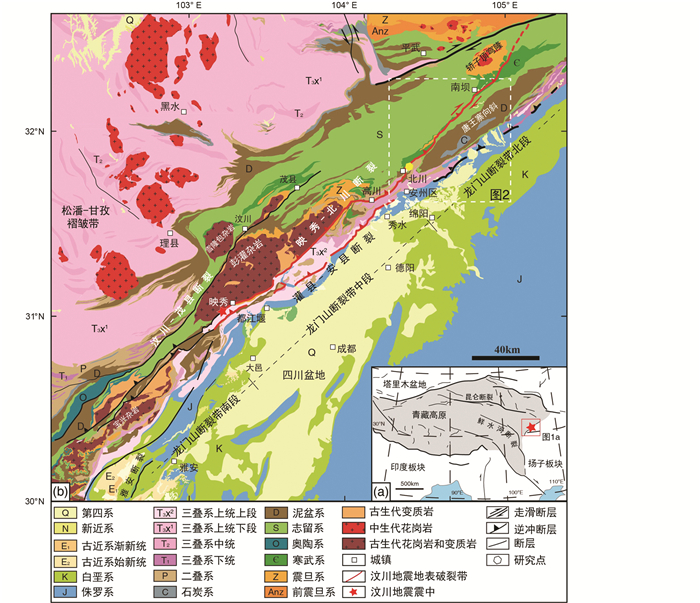
1 构造背景龙门山位于青藏高原东缘,其构造带呈NE-SW向展布,是青藏高原和四川盆地之间的边界过渡区,其两侧的地貌景观和地质构造并不相同;从南部的泸定-天全地区为起点,向北经宝兴-芦山、汶川-都江堰、北川-江油、青川-广元等地,最终止于陕西勉县;北东与秦岭构造带相望,南西与康滇南北带相截,且位于古特提斯洋东延地域,是中国少有的经向构造带;全长约500km,东西宽30~50km(图 1)(许志琴等,1992;Dirks et al., 1994;林茂炳等,1996;李智武等,2008)。其在不到50km的范围内,从四川盆地向青藏高原东缘方向的平均海拔从~500m陡增至4~5km,成为地形梯度最大的陡变带(Godard et al., 2009)。
|
图 1 青藏高原及其邻区构造简图(a)及龙门山构造地质图(b)(据四川省地质局,1967①,1975②,1977③修改) Fig. 1 Sketch tectonic map of the Tibetan Plateau and its adjacent areas (a) and geological map of the Longmen Shan fault belt (b) |
① 四川省地质局. 1967. 1∶20万广元幅地质图
② 四川省地质局. 1975. 1∶20万松潘幅地质图
③ 四川省地质局. 1977. 1∶20万平武幅地质图
龙门山构造带以怀远和安县为界,可以划分为南、中、北三段(图 1)。怀远至雅安为南段、怀远至安县为中段、安县至广元为北段(李智武等,2008;刘树根等,2008;杨长清等,2011)。自北西向南东发育有四条逆冲断裂带:茂县-汶川断裂、映秀-北川断裂、安县-灌县断裂、广元-大邑隐伏断裂(或称关口断裂)(金文正等,2007;李智武等,2008),且断裂走向与构造带的走向(北东-南西向)一致。映秀-北川断裂属于龙门山中央断裂系,走向NE,倾向NW,倾角50°~70°,其北西侧地层变形层次较深且多已变质,南东侧地层变形层次浅且无明显变质(林茂炳和吴山,1991;林茂炳, 1994, 1996),地表上以脆性变形为主,运动特征为北西向南东的逆冲推覆兼具右旋走滑(罗志立,1994)。映秀-北川断裂带是龙门山构造最主要的断裂带之一,人们对于它的研究已经有了诸多认识,有认为在小鱼洞、高川与擂鼓等地的断裂弯曲分叉形成了明显的阶区,以北川-安县为界分为中段和北段,中段出露彭灌杂岩并发育一系列飞来峰,北段出露轿子顶杂岩和唐王寨向斜(李智武等,2008)。
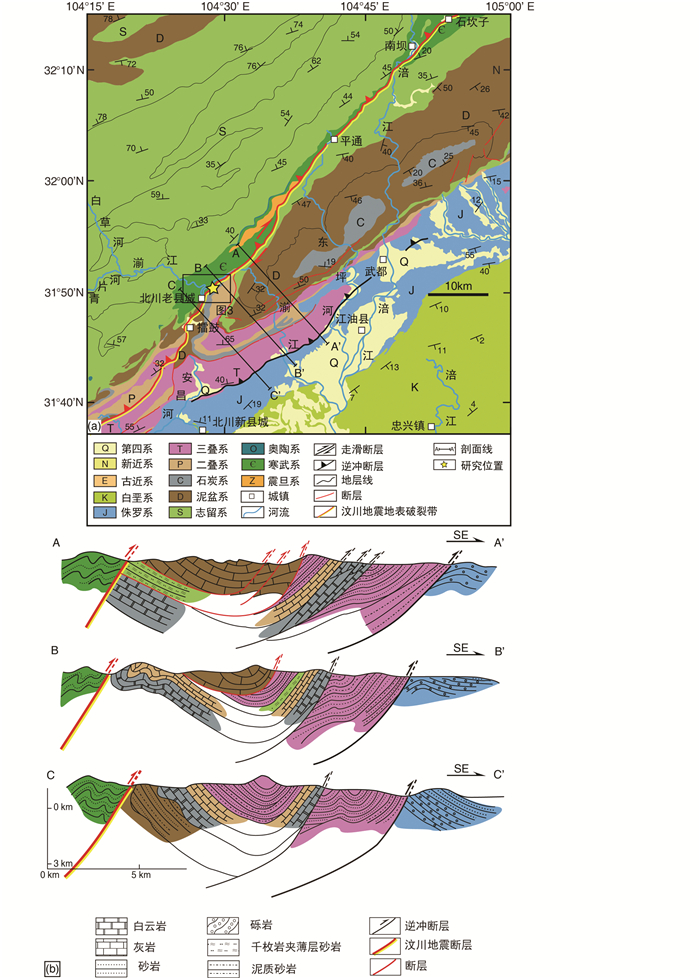
本文研究区位于四川省北川县,是汶川地震中受灾最严重的县之一,原县城曲山镇受到严重损毁,后县城迁至永昌镇。汶川地震的同震破裂带通过北川县老县城,经曲山中学后沿县城东侧靠近山脚的半山腰向北东方向延伸(史翔,2009)。北川老县城属于映秀-北川断裂带北段的北川断裂带,其内主要发育有寒武系、石炭系和泥盆系的岩石(图 2),寒武系主要发育碳质泥页岩和砂页岩,石炭系则发育灰岩和白云岩(图 2a),探槽横跨汶川地震破裂带,位于寒武系中(图 2b)。
|
图 2 映秀-北川断裂带北川段构造地质图(a, 据四川省地质局,1971①,1977修改)及地质剖面(b) Fig. 2 Tectonic and geological map (a) and cross section (b) of the Beichuan segment of the Yingxiu-Beichuan fault belt |
① 四川省地质局. 1971. 1∶20万绵阳幅地质图
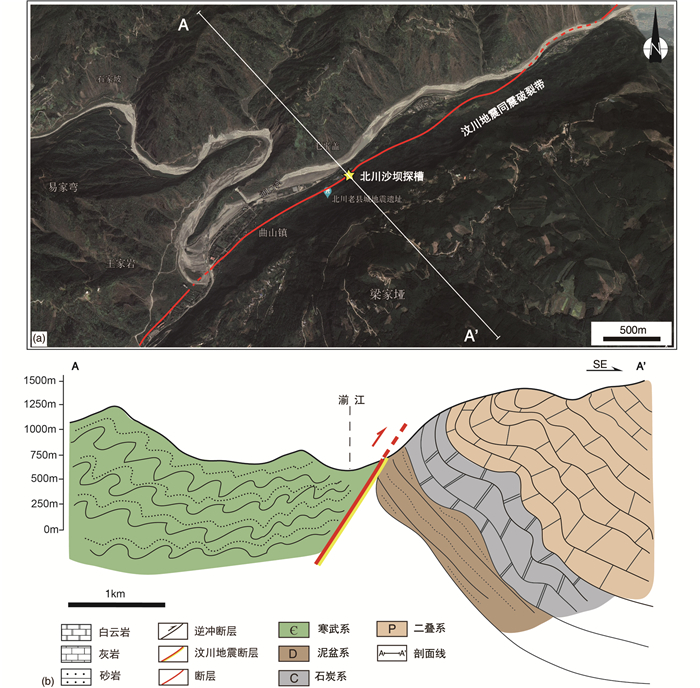
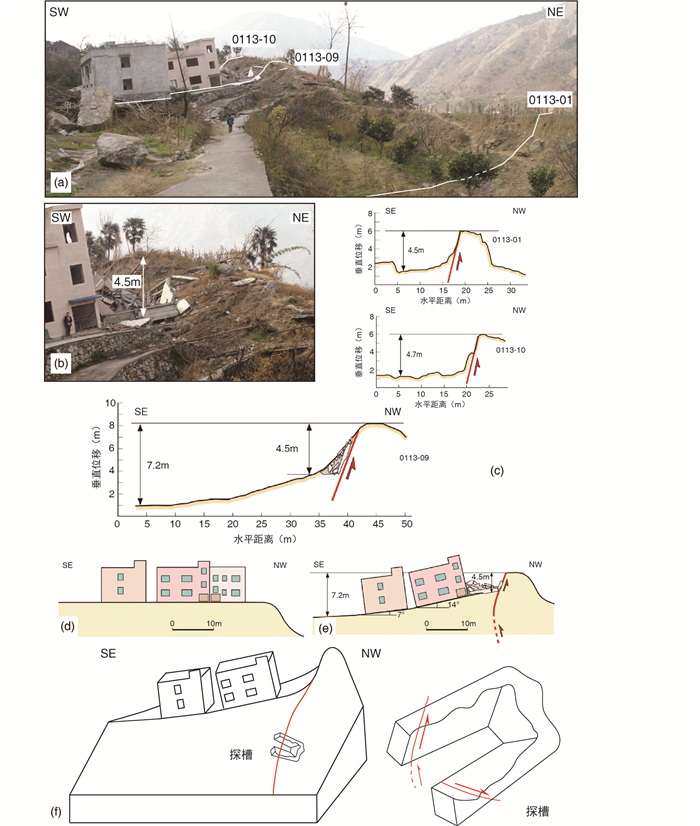
2 北川断裂带沙坝探槽的宏观特征沙坝探槽位于北川县曲山镇沙坝村(图 3),通过汶川地震后对北川断裂带的地表破裂的观测可以发现,在该处破裂段的最大垂直位移为10~12m,为整个汶川地震地表破裂最大滑移量,是汶川地震的宏观震中(李海兵等,2009;史翔,2009;Ran et al., 2013)。探槽处同震地表破裂带总体呈NE65°~70°走向,表现为连续延伸的断层陡坎,垂直位移量为~7.2m(图 4)(李海兵等,2009),其NW盘为寒武系青平组碳质泥页岩、砂页岩,SE盘为石炭系砂岩或灰岩和白云岩(袁仁茂等,2013),上覆是未固结至半固结状态的黄色粉砂质黏土层和砂石层。同震地表破裂带从山腰处穿过,由于近地表断层面倾向反转,在地貌上表现为向南东倾的正断走滑断层形式(李海兵等,2009),在山坡中形成坡中谷地貌(Deng et al., 2011)。
|
图 3 北川地表破裂分布图(a)及北川沙坝地质剖面图(b) Fig. 3 Surface rupture distribution map of the Beichuan (a) and geological section of the Beichuan Shaba (b) |
|
图 4 北川沙坝村同震破裂及探槽特征(据李海兵等,2009修改) (a)沙坝村同震地表破裂及其地表变形特征;(b)靠近断裂陡坎的高度约4.5m;(c)横跨地表破裂带的3条地形剖面,近断裂陡坎的垂直位移约4.5m,远的垂直位移为7.2m;(d、e)该处地震前未变形和震后变形的地表剖面示意图;(f)汶川地震断裂带和沙坝探槽位置与形态 Fig. 4 The characters of the co-seismic rupture and the trench at the Beichuan (modified after Li et al., 2009) (a) coseismic surface rupture in Shaba Village and characteristics of its surface deformation; (b) the height of the near fault scarp is about 4.5m; (c) three topographic sections across the surface rupture zone. The vertical displacement of the near fault scarp is about 4.5m, and the far vertical displacement is 7.2m; (d, e) the schematic diagram of the undeformed and post-earthquake-deformed surface section; (f) the location and shape of the Wenchuan earthquake fault zone in the Shaba trench |
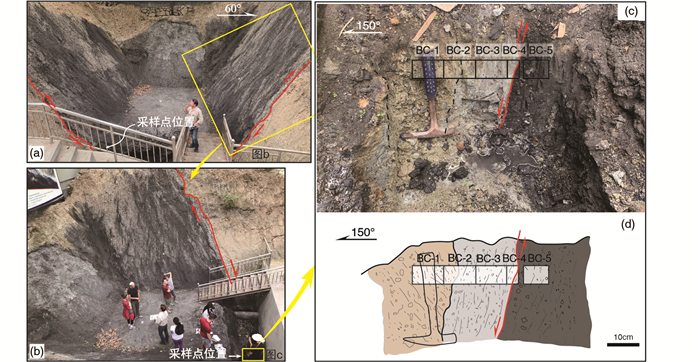
在沙坝探槽中,可见明显的黑色断层角砾岩和黄色粉砂质黏土层,在交界带附近有三个颜色区分明显的断层泥条带约25cm厚,分别为:上盘的断层泥条带为黄色和灰色,下盘的断层泥条带主要呈现为黑色(图 5),断层泥有明显的面理构造。汶川地震破裂面沿灰色断层泥和黑色断层泥边界分布(图 5c,d),断裂带上盘为黄色粉砂质黏土层、下盘物质为黑色泥页岩和板岩(图 5)。前人基于该区域探槽已完成了断层泥样品的显微构造、黏土矿物及组构分析,认为该处Y剪切面分布的微米-纳米级颗粒形态结构是地震断层滑动的记录,可作为判定古地震断层的标准之一,并探讨了古地震活动(史翔等,2009;袁仁茂等, 2013, 2014)。
|
图 5 北川沙坝村探槽特征特征 (a)沙坝探槽的宏观特征;(b)沙坝探槽左侧的宏观特征;(c)断裂带野外照片;(d)断裂带素描,红色线为汶川地震地表破裂带 Fig. 5 Characteristics of Beichuan Shaba trench (a) the macro-characteristics of the Shaba trench; (b) the macro-characteristics of the Shaba trench on the left side; (c) field photos of the fault zone; (d) sketch of the fault zone, the red line is the surface rupture zone of the Wenchuan earthquake |
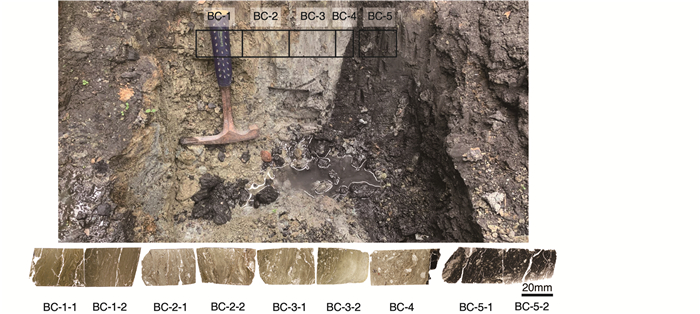
我们对北川沙坝村探槽内出露的黄色、灰色和黑色断层泥进行了连续采样,共采集样品五块,制成了连续的薄片(图 6)。首先将断层泥薄片在光学显微镜下观察,然后对代表性样品薄片在扫描电镜(SEM)下进行详细观测,包括矿物组成、颗粒大小、结构构造等特征,分析其微观构造特征;使用TESCAN自动矿物分析系统(TIMA)观察断层泥样品中的矿物分布;通过微区X射线荧光分析仪(μXRF)对重要样品薄片开展化学成分面扫描,分析元素分布特征;利用拉曼光谱仪确定断层泥中的碳质成分。按照1cm间隔对连续断层泥块状样品进行粉末样品采集,并利用粉末样品进行X射线衍射分析(XRD)其矿物成分及含量等信息。SEM、TIMA、μXRF和拉曼光谱实验分析在自然资源部深地动力学重点实验室进行,XRD实验在北京北达智汇微构分析测试中心进行。
|
图 6 北川沙坝探槽断层泥薄片特征 Fig. 6 Thin section photos showing the features of the fault gouge in the Beichuan Shaba trench |
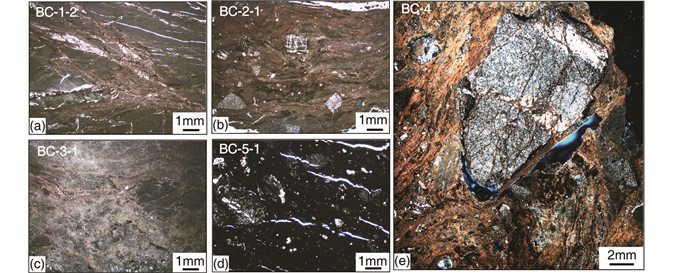
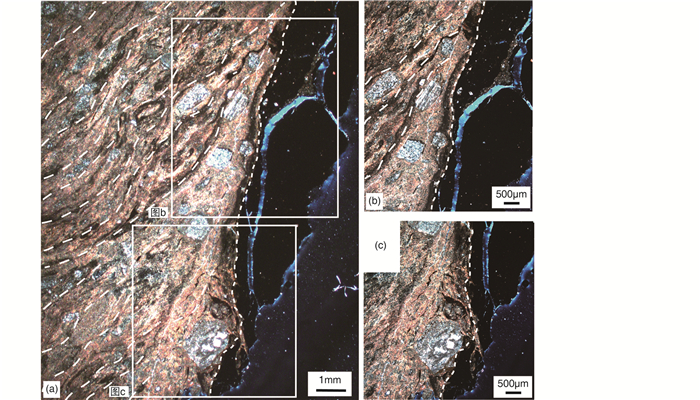
我们对黄色、灰色和黑色断层泥进行了连续切制薄片(图 6),对其显微构造进行分析。断层上盘黄色断层泥(BC-1)(图 6、图 7a)中面理明显发育,可见石英-长石透镜体和条带集合体;其他断层泥(BC-2~5)(图 6、图 7b-e)中也发育面理,并发育棱角状、大小不一的碎块,可见个别碎块被方解石脉体填充(图 7e)。在灰色与黑色断层泥(BC-4)之间有0.5~1mm厚的滑移带(图 8、图 9),灰色断层泥中变形强烈,可见明显的拖曳构造(图 8)和次级剪切破裂R1(图 9),显示出上盘下滑的运动特征。
|
图 7 北川沙坝探槽断层泥样品光学显微照片 (a)黄色断层泥薄片,具有明显面理,可见石英-长石透镜体和条带集合体;(b)黄色断层泥薄片,发育有面理,可见大小不一的碎块;(c)灰色断层泥薄片,面理发育,可见碎块;(d)黑色断层泥薄片,可见面理与碎块;(e)滑移带附近灰色断层泥薄片,大块碎块部分被方解石脉体填充 Fig. 7 Microstructural features of the fault gouge in the Beichuan Shaba trench Thin sections of some typical fault gouge from the studied section. (a) yellow fault gouge, with developed foliations, quartz-feldspar lenses and band aggregates; (b) yellow fault gouge, with foliations and fragments of various sizes; (c) grey fault gouge, with developed foliations and fragments; (d) black fault gouge, with foliations and fragments; (e) gray fault gouge near the slip zone, with large fragments partially filled with calcite veins |
|
图 8 北川沙坝探槽断层泥(BC-4)光学显微照片(Ⅰ) (a)同震滑移带光学显微特征,可见明显的拖曳构造,上盘的断层泥中有大小不一的碎块角砾,下盘的断层泥中碎块明显较小;(b、c)同震滑移带光学显微特征,可见一条薄层的滑移带 Fig. 8 Optical micrograph of fault gouge (BC-4) in Beichuan Shaba trench (Ⅰ) (a) optical microscopic characteristics of the coseismic slip zone, showing obvious drag structures. There are fragments of different sizes in the fault gouge on the hanging wall, and the fragments in the fault gouge on the foot wall are obviously smaller; (b, c) optical microscopic features of the coseismic slip zone, a thin slip zone can be observed |

|
图 9 北川沙坝探槽断层泥(BC-4)光学显微照片(Ⅱ) (a)同震滑移带附近光学显微特征,可见次级R1剪切破裂;(b-e)同震滑移带附近光学显微特征 Fig. 9 Optical micrograph of fault gouge (BC-4) in Beichuan Shaba trench (Ⅱ) (a) optical microscopic features near the coseismic slip zone, showing secondary R1 shear fracture; (b-e) optical microscopic features near the coseismic slip zone |
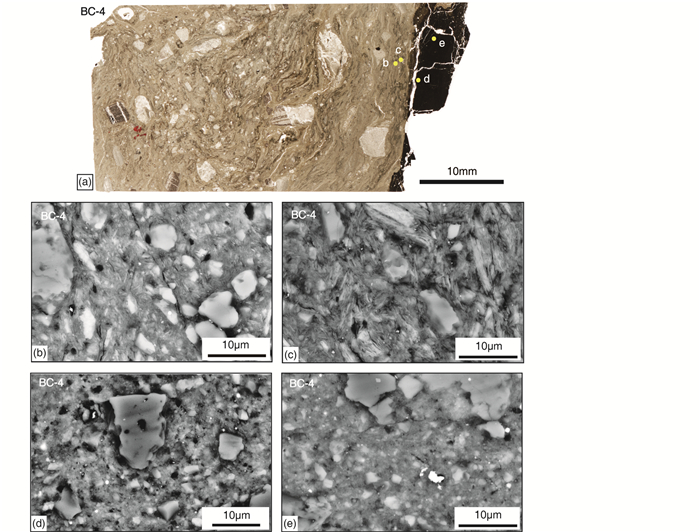
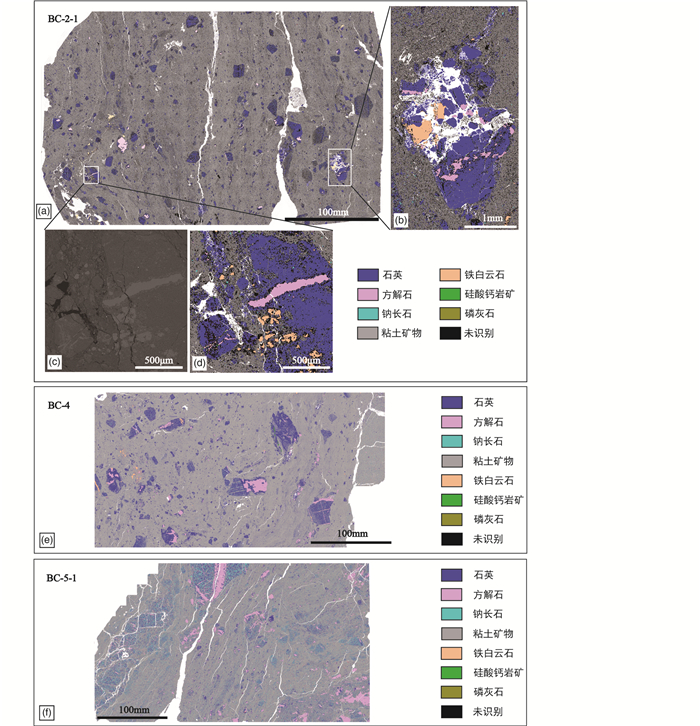
薄片观察显示断层上下盘(灰色和黑色)的断层泥(BC-4)结构并不相同,上盘的断层泥(图 10a)靠近不同颜色边界带附近面理平直清晰,具有一定的方向性,远离部分面理弯曲,方向性不好。在扫描电镜(SEM)下可见灰色断层泥中(图 10b,c)黏土矿物含量明显比黑色断层泥中(图 10d,e)更高,且定向生长,而黑色断层泥中石英碎块棱角状更明显。在TIMA下可以发现断层泥的主要矿物为黏土矿物,碎块主要为石英(图 11a),很多石英碎块被方解石和铁白云石胶结(图 11b,d),越接近滑移面断层泥中的碎块越少(图 11a,e,f),滑移带附近主要为黏土矿物,下盘黑色断层泥(图 11f)中的钠长石含量明显高于上盘(图 11a,e), 石英含量略低于上盘(图 11a,e)。
|
图 10 北川沙坝探槽断层泥样品(BC-4)薄片和SEM特征 (a)断层泥样品(BC-4)薄片图;(b、c)上盘断层泥的黏土矿物SEM特征,可以见到定向生长的黏土矿物;(d、e)上盘断层泥的黏土矿物SEM特征 Fig. 10 Thin section and SEM characteristics of fault gouge (BC-4) in the Beichuan Shaba trench (a) scanning image of fault gouge sample (BC-4); (b, c) SEM characteristics of clay minerals of hanging wall fault gouge, showing directional growth of clay minerals; (d, e) SEM characteristics of clay minerals of hanging wall fault gouge |
|
图 11 北川沙坝探槽断层泥样品(BC-2-1、BC-4、BC-5-1)TIMA分析图像 (a)上盘灰色断层泥薄片BC-2-1的矿物分布特征;(b)上盘灰色断层泥薄片BC-2-1的局部矿物分布特征;(c、d)上盘灰色断层泥薄片BC-2-1的局部SEM和矿物分布特征;(e)滑动带附近断层泥样品薄片BC-4的矿物分布特征;(f)下盘黑的断层泥薄片BC-5-1的矿物分布特征 Fig. 11 TIMA images of fault gouge in the Beichuan Shaba trench (BC-1-1, BC-4, BC-5-1) (a) the mineral distribution characteristics of the gray fault gouge (BC-2-1) in the hanging wall; (b) the local mineral distribution characteristics of the gray fault gouge (BC-2-1) in the hanging wall; (c, d) the local SEM and mineral distribution characteristics of the gray fault gouge (BC-2-1) in the hanging wall; (e) the mineral distribution characteristics of the fault gouge (BC-4) near the sliding zone; (f) the mineral distribution characteristics of the black fault gouge (BC-5-1) in the footwall |
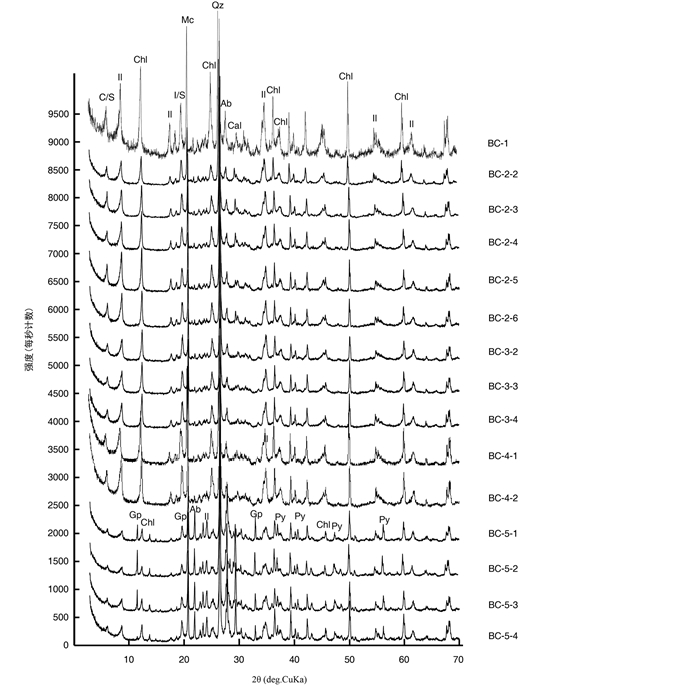
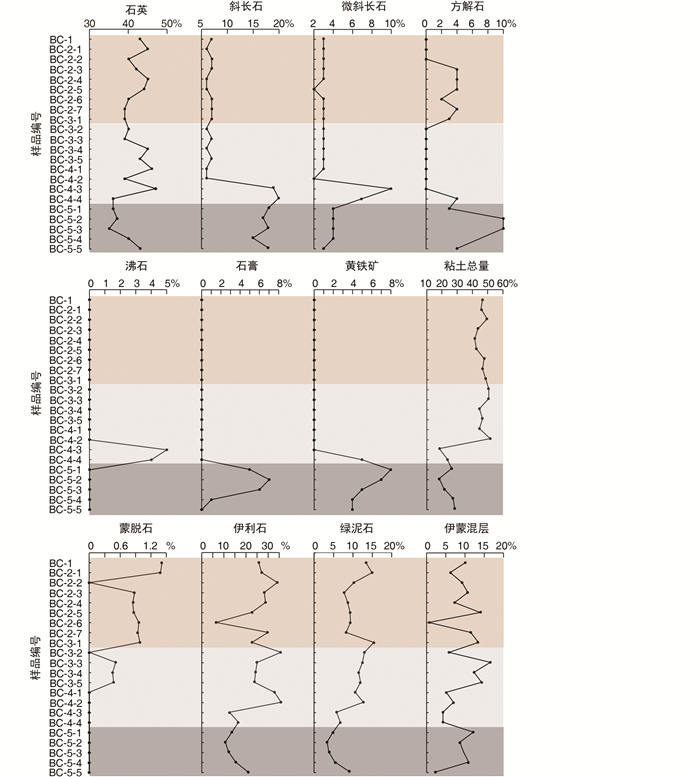
通过对沙坝探槽中的断层泥样品进行粉末XRD测试分析(图 12),确定了断层泥的主要矿物成分为:石英、微斜长石、斜长石、方解石、黄铁矿、石膏以及黏土矿物等(表 1)。总体来看,黄色断层泥中石英含量39%~45%,长石含量8%~10%,黏土矿物成分含量42%~50%;灰色断层泥中石英含量36%~47%,长石含量8%~29%,黏土矿物成分含量19%~52%;黑色断层泥中石英含量35%~43%,长石含量19%~22%,黏土矿物成分含量19%~29%。从黄色断层泥到灰色断层泥再到黑色断层泥,石英含量变化不大,但是长石含量上盘断层泥明显低于下盘的黑色断层泥,黏土矿物含量上盘断层泥明显高于下盘黑色断层泥。不同断层泥中矿物含量有明显变化(图 13):(1)上盘石英含量整体略高于下盘。黄色断层泥中石英整体含量较高;灰色断层泥石英含量先是增加,但越接近滑移面石英含量越低;黑色断层泥的含量略低于黄色断层泥和灰色断层泥。(2)上盘断层泥的斜长石含量明显低于下盘断层泥的斜长石含量。黄色断层泥中的斜长石含量整体变化不大,都偏低;灰色断层泥越接近滑移面斜长石含量越高;黑色断层泥中的斜长石含量明显高于黄色、灰色断层泥。(3)微斜长石含量整体变化不大,只有在灰色断层泥中间有一个升高又降低的变化。(4)方解石基本只存在于黄色断层泥中和黑色断层泥中,黑色断层泥中方解石含量高于黄色断层泥。(5)沸石只存于灰色断层泥中。(6)石膏只存在于黑色断层泥中。(7)黄铁矿主要存在于黑色断层泥中,并且越远离滑移面含量越低;灰色断层泥只有接近滑移面处含有少量黄铁矿。(8)黏土矿物总量从黄色断层泥到灰色断层泥再到黑色断层泥逐渐降低。(9)蒙脱石只存在于黄色断层泥和灰色断层泥中,且离滑移带越近含量越低。(10)伊利石存在于整个上下盘的断层泥中。(11)绿泥石也存在于整个上下盘的断层泥中,且变化趋势与伊利石相近。(12)伊蒙混层存在于整个上下盘的断层泥中。
|
图 12 北川地区沙坝探槽断层泥的XRD图谱 Qz-石英;Ab-斜长石;Mc-微斜长石;Il-伊利石;Chl-绿泥石;I/S-伊蒙混层;Gy-石膏;Cal-方解石;Py-黄铁矿 Fig. 12 XRD patterns of fault rocks in the Beichuan Shaba trench Qz-quartz; Ab-albite; Mc-microcline; Il-illite; Chl-clinochlore; I/S-illite/smectite; Gy-gypsum; Cal-calcite; Py-pyrite |
|
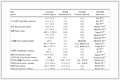
表 1 北川断裂带沙坝探槽露头断层泥矿物含量 Table 1 Mineral content of fault rocks in the Beichuan fault zone at Shaba trench |
|
图 13 北川沙坝探槽断层泥的主要矿物含量图 Fig. 13 Main mineral content map of fault gouge in the Beichuan Shaba trench |
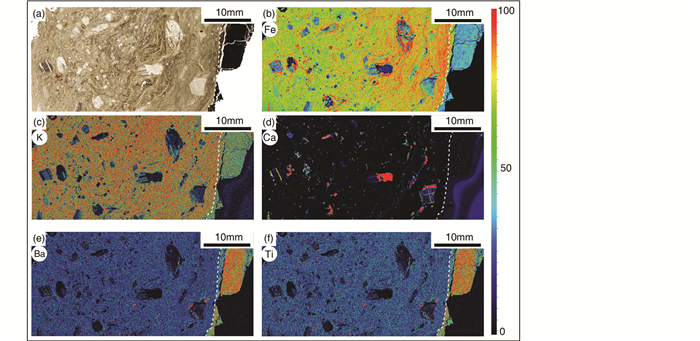
采用μXRF无损检测技术对沙坝探槽中的灰色和黑色断层泥(BC-4)薄片进行表面元素扫描。其测试结果如图 14所示,上盘灰色断层泥中Fe、K含量明显高于下盘黑色断层泥,而Ba、Ti含量明显低于下盘黑色断层泥,Ca的含量变化不大。在灰色断层泥中越靠近滑移带(边界带)(图 14)Fe含量明显增高。
|
图 14 北川沙坝探槽断层泥薄片BC-4表面μXRF测试化学元素分布特征 (a)BC-4薄片扫描图;(b-f)Fe, K, Ca, Ba和Ti的单元素分布图,彩色柱自下而上定性指示元素相对含量的增加 Fig. 14 μXRF mapping of the element distribution of the fault gouge in the Beichuan Shaba trench (a) scanned image of the fractured black material; (b-f) single element distribution diagrams of Fe, K, Ca, Ba and Ti. Color bars represent the strength of XRF. The color column indicates the increase of the relative content of the element from bottom to top |
断裂带的岩石中保存了断层滑动过程中的特征信息,通过野外调查结合室内实验研究可以深入理解断裂带的变形行为。地表断裂带露头从断裂活动到剥露于地表,在长期过程中发育有众多断裂变形的构造证据。
断层泥是断裂活动的产物,它是地震滑动或无震蠕滑过程中的岩石记录。因此,详细研究断层泥的显微构造特征可以获得有关断裂变形行为的重要信息(Sibson et al., 1975;Lin,1999)。通过本文的研究发现,北川沙坝探槽的断层泥样品中面理发育,并发育棱角状、大小不一的碎块,显示出典型的断裂快速滑动的特征,也即地震粘滑行为。另外,断层不同变形方式产生的断层泥,其粒度特征也不同(Lin,1994),根据断层泥的粒度特征可初步判断断层的活动性质:断层泥粗粒含量高于45%、细粒级含量低于30%,以粘滑为主(邵顺妹和邹谨敞,2000)。沙坝探槽中的断层泥粒径在TIMA下可知断层泥中的粗粒径组分明显占主导地位(图 11a,e,f),粗颗粒大小从0.01~6mm不等,粒径差距较大,且各个颗粒之间无明显规律,基本都呈棱角状,磨圆一般,大约占60%,细颗粒的低于30%,反映出主要为粘滑的特征。在北川沙坝探槽滑移带附近的断层泥,一方面上盘的断层泥中有大小不一的碎块,大的能达到8mm(图 7e),小的碎块只有十几微米(图 11a,e),下盘的断层泥中碎块相比上盘更小(图 7d、图 8a、图 9a)。在靠近滑移带附近的灰色断层泥中的碎块沿着一定的方向形成了拖曳构造(图 8a);另一方面断层泥具有较强的剪切组构,在灰色断层泥中的分布着次级剪切破裂R1(图 9)。这些变形特征显示出了探槽中断层上盘下滑的“正断”运动特征,这是由于在北川沙坝探槽中呈现的断层上下盘是经历了断层面在浅表的“反转”(图 4e),探槽中的断层上、下盘实际为深部断裂的下、上盘,实际反映为断裂的逆冲性质。
断层泥的主要成分为黏土矿物,其次为原岩粉碎后的产物,断层泥形成时间越长,黏土含量越高(付碧宏等,2008b)。在沙坝探槽中上盘黄色和灰色断层泥的黏土含量普遍较高(高于42%),而到下盘的黑色断层泥中黏土含量骤降(普遍低于20%),这不仅与上下盘的围岩不同有关,而且与流体作用的强弱有着明显的联系,从黑色断层泥到灰色断层泥再到黄色断层泥,其内部碎块的棱角程度逐渐减弱(图 7、图 8、图 10),反映出流体作用下蚀变作用逐渐增强。TIMA分析结果显示有方解石脉体充填其中(图 11a,b),可能是滑移中伴随着碳酸盐流体在碎块裂隙中沉淀所产生。在断裂带中存在着元素含量与原岩相比发生亏损和与原岩相比发生富集的两种类型元素(Tanaka et al., 2001),图 14中显示在沙坝探槽断层泥中,上盘灰色断层泥的K相比下盘黑色断层泥更为富集(图 14c),下盘的Ba、Ti(图 14e,f)则更为富集,这种元素的变化可能是由于在活动断裂带中由于有流体的作用导致活动性强的元素会发生亏损,而较为稳定的元素则在断层的流体作用下发生了富集。在灰色断层泥中靠近滑移带(边界带)Fe含量趋于明显增高(图 14b),一方面当流体进入到断层中,会导致部分含铁矿物溶解并发生迁移,另一方面在不同的高温条件下,黄铁矿将逐渐转化成磁铁矿、赤铁矿甚至单质铁(Lowrie and Heller, 1982;Zhang et al., 2018)。黄铁矿铁离子为Fe2+,磁铁矿的铁离子为Fe2+和Fe3+,赤铁矿的铁离子主要以Fe3+,因此在北川沙坝探槽中越靠近滑移带位置温度越高,说明在断层滑动中产生了摩擦热,断层曾经发生过快速滑动。
Carpenter et al.(2011)发现断裂带含有弱蒙脱石矿物可以降低断层的强度,使断裂破裂之后不会愈合。Janssen et al.(2015)发现断层泥的低强度是因为其中含有大量的黏土矿物(蒙脱石和伊利石),在沙坝探槽的断层泥中含有大量的伊利石,特别是在滑移带附近的伊利石含量最高达到32.24%,在上盘中含有少量的蒙脱石,但是越靠近滑动带,蒙脱石的含量逐渐减少直到消失,含有大量的伊利石以及部分蒙脱石可能使得北川断裂在震间期产生蠕滑,蠕滑可能主要发生在黄色和灰色断层泥中。另外,由于断层泥中的纳米级孔隙度随着黏土矿物含量的增加而增加(Janssen et al., 2011),因此,沙坝探槽断层泥中XRD显示上盘(黄色和灰色断层泥)的黏土矿物含量(42%~52%)高于下盘的黏土矿物含量(19%~29%),在SEM照片中沙坝探槽上盘灰色的断层泥的孔隙度(图 10b,c)也高于下盘黑色断层泥(图 10d,e)。
6.2 北川断裂带内的石墨化作用与断裂弱化机制碳质物是断层带常见的富集物质之一,有的会以碳单质的形式存在,其存在形式主要有石墨和非晶型碳等。石墨的结构稳定并且摩擦系数很低;而非晶型碳的自身结构不稳定,来源也更多样。在近些年的全球发生的地震研究中,发现碳质广泛富集于各个强震的断层滑移带中,如日本南海海槽地震带(Hirono et al., 2009;Sakaguchi et al., 2011; Fulton and Harris, 2012)、中国台湾车笼埔地震(Chu et al., 2012)及汶川地震(王萍等,2009;Kuo et al., 2013, 2014, 2017, 2018;Liu et al., 2016)。对于断层滑移带内存在的碳质物的相关研究已经成为国内外研究断层的关注重点之一。断层滑移带中碳质物与地震断层之间的存在着多种关系,一方面断层滑移带碳质物的来源和赋存状态与断层活动和断层带结构有关,另一方面断层滑移带碳的富集使得断层力学性质发生了变化,正常岩石摩擦系数为0.60~0.85(Byerlee,1978),而石墨的摩擦系数(~0.08)远远低于断层泥的初始摩擦系数(0.5~0.6)(Rutter et al., 2013),碳质物的存在会导致断层摩擦系数显著降低(Janssen et al., 2010),降低摩擦力使得断层更易发生滑动;并且碳是记录断层滑移带在地震过程中物理、化学条件信息的重要载体,因为碳的变形方式与断层面摩擦热有关,不稳定的碳质物随埋藏与变质过程会逐渐转变为稳定的石墨(Beyssac and Rumble, 2014),碳质物受摩擦加热后不断增高直至石墨化(Kuo et al., 2017),石墨化程度仅与岩石经历的峰期变质温度有关,这一过程不可逆且与应力和应变无关(Beyssac et al., 2004)。因此断层滑移带碳质物的赋存特征为研究地震断层滑移机制提供重要证据。通过测定碳质物的石墨化程度便可量化其经历的峰期变质温度,拉曼散射与物质的成分和结构紧密相关,碳质物的石墨化程度不同其拉曼光谱特征差异显著,具有特征峰G峰和D峰(Aoya et al., 2010)。地震发生时,断层发生错动,极短的时间内在狭窄的空间里产生了大量的热,在此过程中产生的断层泥与传统的区域性变质作用并不相同,断层的温度、压力、滑动速率以及含水量等因素均会影响断层泥内碳质拉曼光谱信号,因此碳质物质的拉曼光谱分析也可以被用于断层泥的研究(Hirono et al., 2015;Kuo et al., 2017;田野和田云涛,2020)。
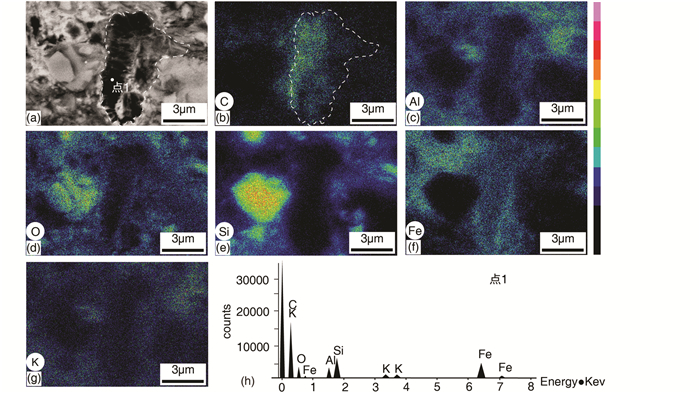
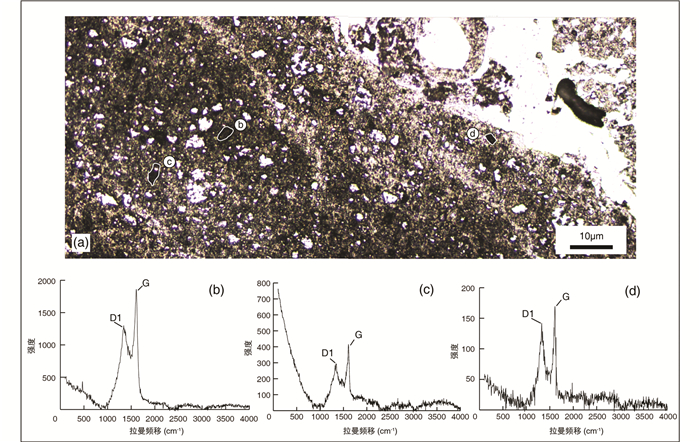
北川沙坝探槽黑色断层泥样品薄片中,可见有很多黑色不透明物质,在SEM下其形状主要为边缘不规则的长方形状,大小基本都在几微米内(图 15a、图 16a),为了对其成分进行确定,在扫描电镜下进行了能谱分析,结果显示这些黑色不透明物的C含量较高,Al、O、K、Al含量较低,含有一定量的Fe但仍然远低于C的含量,可以确定这些黑色碎块主要为碳质物(图 15)。利用拉曼光谱对这些碳质物进行进一步分析可以发现,部分黑色晶体具有明显的缺陷峰(D1)和石墨峰(G)(图 16),图 16b中的D1吸收谱带拉曼位移值为1368cm-1,G峰吸收谱带拉曼位移值为1645cm-1,图 16c中D1吸收谱带拉曼位移值为1333cm-1,G峰吸收谱带拉曼位移值为1618cm-1,图 16d中D1吸收谱带拉曼位移值为1327cm-1,G峰吸收谱带拉曼位移值为1623cm-1,分别位于1327~1368cm-1和1618~1645cm-1之间,符合碳质物D峰(1350cm-1)和G峰(1580cm-1)的特征峰值。暗示断层滑移期间可能存在石墨化作用。前人利用摩擦实验发现非晶形碳特别是石墨在断层的滑移过程中起着明显的弱化作用(Di Toro et al., 2011),在南段映秀断裂带中同样发现了碳质物因摩擦加热而形成的石墨,石墨的存在不仅使断层摩擦系数降低,而且反映出断层滑移过程中具有热增压的弱化机制(Zhang and He, 2013;Kuo et al., 2014;Li et al., 2015)。因此,北川沙坝探槽黑色断层泥样品中石墨的存在,说明北川断层具有热增压弱化机制特征;另一方面,由于样品拉曼光谱显示出的G峰还要明显高于D峰,说明断层已有相当长的活动历史,可能经历了多次石墨化过程及之后的改造。
|
图 15 北川沙坝探槽黑色断层泥样品(BC-5-2)中SEM照片(a)及其元素丰度分布图(b-g) 元素丰度图中可见白色虚线内的碳丰度明显偏高(h)点1的能谱图 Fig. 15 SEM images (a) and element abundance distribution (b-g) of graphite in gouge sample (BC-5-2), and energy spectrum of point 1 (h) |
|
图 16 北川沙坝探槽黑色断层泥样品光学镜下照片(a)及拉曼光谱特征(b-d) 可见G峰(石墨峰),D峰(缺陷峰)D1峰低于G峰 Fig. 16 Optical image (a) and Raman spectral characteristics (b-d) of black gouge in Beichuan Shaba trench |
映秀-北川断裂带可分为南北两段,北段即北川断裂,南段为映秀断裂。在北川断裂带,通过研究发现北川沙坝探槽所发现的断裂带发育有断层角砾岩和断层泥,角砾岩的厚度由于探槽的规模不够而揭示不清,但至少有5m,断层泥约25cm厚;在北东段的南坝地区,北川断裂带宽度约为30m,由假玄武玻璃、断层泥、断层角砾岩和破碎带组成(李成龙等,2020),两地特征较为相似。南坝地区的断裂带是以含假玄武玻璃/断层泥带为核心,两侧均发育厚度不等的断层角砾岩带和破碎带,构成近对称的单核断裂结构。在映秀断裂南西段虹口地区断裂带宽~240m,地表出露的断裂岩带可划分为五个单元: 碎裂岩带、黑色断层泥和角砾岩带、灰色断层角砾岩带、深灰色断层角砾岩带以及黑色断层泥和角砾岩带的多核结构,断裂岩带宽~240m(Wang et al., 2014a),从~220Ma初期形成以来(Zheng et al., 2016),具有演化历史长特征。因此,映秀-北川断裂带的北段北川断裂带宽度明显远窄于南段映秀断裂带的宽度,可能指示北段北川断裂的构造演化历史相比南段映秀断裂带较短,它们原先并不属于同一条具有相同演化历史的断裂带。
不仅南北段的断裂带宽度有着明显变化,断层泥的矿物组成也有着一定差异。通过地表断裂带断层岩的XRD测试可以发现,南段虹口地表断裂带的断层泥黏土含量主要在54%~66%之间(Wang et al., 2014a),而在北段南坝地区断层泥的黏土含量在24%~36%之间(李成龙等,2020),北川沙坝探槽中断层泥的黏土含量为19%~52%之间(表 1),可见映秀-北川断裂带北段的断层泥的黏土含量普遍低于南段,这一方面是由于围岩的差异,另一方面可能与南北段不同的演化历史和流体作用有关。但是,南北段的断层泥中均含石墨,地震过程中断层的石墨化作用都存在,断层摩擦系数低,并且都具有断层热增压弱化机制。这可能也是汶川地震使映秀-北川断裂带南北段贯通的原因之一。
7 结论本文通过对映秀-北川断裂带北段北川沙坝村探槽的断层泥研究,结合显微构造、XRD、μXRF、拉曼、TIMA等手段对探槽内断层泥进行综合分析,得出以下几点结论:
(1) 北川沙坝村探槽中可见三个不同颜色的断层泥条带:SE盘的黄色、灰色断层泥和NW盘黑色断层泥条带,总厚约25cm,汶川地震破裂面沿灰色断层泥和黑色断层泥边界分布。
(2) 不同颜色断层泥有着明显的面理构造,断层泥中的碎块呈棱角状大小不均一,显示出地震快速滑动特征,具有粘滑行为。在滑移带附近可见明显的拖曳构造与R1次级剪切破裂,指示了逆冲滑动的性质。断裂SE盘黄色、灰色断层泥中黏土矿物含量(42%~52%)高于NW盘黑色断层泥中黏土矿物含量,且碎块棱角程度逐渐减弱,反映出流体作用SE盘强于NW盘。
(3) 在探槽断层的NW盘黑色断层泥中发现了石墨,表明断层地震滑移过程中存在石墨化作用,并且断层具有热增压弱化机制特征。
(4) 映秀-北川断裂带南北段对比发现,北段北川断裂带宽度远窄于南段映秀断裂带宽度,暗示着北段断裂带演化历史短与南段演化历史,它们不属于同一条具有相同演化历史的断裂带。
致谢 感谢中国地震局地质所在汶川地震之后对于北川沙坝村探槽的科学挖掘以及大量的科学研究,为本文的研究提供了良好的研究基础。感谢应急管理部国家自然灾害防治研究院何祥丽助理研究员,中国地质科学院地质研究所云锟博士、李春锐博士和赖亚博士等在野外和室内工作中给予的诸多帮助。衷心感谢评审专家和编辑对本文提出宝贵的建设性意见和建议,使文章质量得以提升。
Aoya M, Kouketsu Y, Endo S, Shimizu H, Mizukami T, Nakamura D and Wallis S. 2010. Extending the applicability of the Raman carbonaceous-material geothermometer using data from contact metamorphic rocks. Journal of Metamorphic Geology, 28(9): 895-914 DOI:10.1111/j.1525-1314.2010.00896.x
|
Beyssac O, Bollinger L, Avouac JP and Goffé B. 2004. Thermal metamorphism in the Lesser Himalaya of Nepal determined from Raman spectroscopy of carbonaceous material. Earth and Planetary Science Letters, 225(1-2): 233-241 DOI:10.1016/j.epsl.2004.05.023
|
Beyssac O and Rumble D. 2014. Graphitic carbon: A ubiquitous, diverse, and useful geomaterial. Elements, 10(6): 415-420 DOI:10.2113/gselements.10.6.415
|
Byerlee JD. 1978. Friction of rocks. Pure and Applied Geophysics, 116(4): 615-629
|
Cai YH, Pei JL, Wang H, Sheng M and Si JL. 2019. Paleo-earthquakes revealed by rock magnetic evidence from the Anxian-Guanxian fault, Sichuan Province, China. Tectonophysics, 752: 68-80 DOI:10.1016/j.tecto.2018.12.027
|
Carpenter BM, Marone C and Saffer DM. 2011. Weakness of the San Andreas fault revealed by samples from the active fault zone. Nature Geoscience, 4(4): 251-254 DOI:10.1038/ngeo1089
|
Chen JY, Yang XS, Dang JX, He CR, Zhou YS and Ma SL. 2011. Internal structure and permeability of Wenchuan earthquake fault. Chinese Journal of Geophysics, 54(7): 1805-1816 (in Chinese with English abstract)
|
Chen JY, Yang XS, Yao L, Ma SL and Shimamoto T. 2013a. Frictional and transport properties of the 2008 Wenchuan earthquake fault zone: Implications for coseismic slip-weakening mechanisms. Tectonophysics, 603: 237-256 DOI:10.1016/j.tecto.2013.05.035
|
Chen JY, Yang XS, Duan QB Shimamoto T and Spiers CJ. 2013b. Importance of thermochemical pressurization in the dynamic weakening of the Longmenshan Fault during the 2008 Wenchuan earthquake: Inferences from experiments and modeling. Journal of Geophysical Research: Solid Earth, 118: 4145-4169 DOI:10.1002/jgrb.50260
|
Chen JY and Yang XS. 2014. Characteristics of particle size distribution of the Wenchuan earthquake fault zone: Insights for cataclastic mechanisms. Seismology and Geology, 36(2): 368-379 (in Chinese with English abstract)
|
Chen JY, Niemeijer A, Yao L and Ma SL. 2017. Water vaporization promotes coseismic fluid pressurization and buffers temperature rise. Geophysical Research Letters, 44(5): 2177-2185 DOI:10.1002/2016GL071932
|
Chu HT, Hwang SL, Shen P and Yui TF. 2012. Pseudotachylyte in the Tananao metamorphic complex, Taiwan: Occurrence and dynamic phase changes of fossil earthquakes. Tectonophysics, 581: 62-75 DOI:10.1016/j.tecto.2012.01.017
|
Dang JX, Zhou YS, Han L, He CR, Chen JY, Dang XZ and Yang XS. 2012. X-ray diffraction analysis result of co-seismic fault gouge in carbon mudstone at outcrops of Bajiaomiao and Shenxigou in Hongkou. Seismology and Geology, 34(1): 17-27 (in Chinese with English abstract)
|
Deng QD, Chen GH and Zhu AL. 2011. Discussion of rupture mechanisms on the seismogenic fault of the 2008 MS8.0 Wenchuan earthquake. Science China (Earth Sciences), 54(9): 1360 DOI:10.1007/s11430-011-4230-1
|
Di Toro G, Han R, Hirose T, De Paola N, Nielsen S, Mizoguchi K, Ferri F, Cocco M and Shimamoto T. 2011. Fault lubrication during earthquakes. Nature, 471(7339): 494-498 DOI:10.1038/nature09838
|
Dirks PHGM, Wilson CJL, Chen S, Luo Z and Liu S. 1994. Tectonic evolution of the NE margin of the Tibetan Plateau: Evidence from the central Longmen Mountains, Sichuan Province, China. Journal of Southeast Asian Earth Sciences, 9(1-2): 181-192 DOI:10.1016/0743-9547(94)90074-4
|
Duan QB and Yang XS. 2014. Experimental studies on gas and water permeability of fault rocks from the rupture of the 2008 Wenchuan earthquake, China. Scientia Sinica (Terrae), 44(10): 2274-2284 (in Chinese) DOI:10.1360/zd-2014-44-10-2274
|
Duan QB, Yang XS, Ma SL, Chen JY and CJY. 2016. Fluid-rock interactions in seismic faults: Implications from the structures and mineralogical and geochemical compositions of drilling cores from the rupture of the 2008 Wenchuan earthquake, China. Tectonophysics, 666: 260-280 DOI:10.1016/j.tecto.2015.11.008
|
Faulkner DR, Jackson CAL, Lunn RJ, Schlische RW, Shipton ZK, Wibberley CAJ and Withjack MO. 2010. A review of recent developments concerning the structure, mechanics and fluid flow properties of fault zones. Journal of Structural Geology, 32(11): 1557-1575 DOI:10.1016/j.jsg.2010.06.009
|
Fu BH, Shi PL and Zhang ZW. 2008a. Spatial characteristics of the surface rupture produced by the MS8.0 Wenchuan earthquake using high-resolution remote sensing imagery. Acta Geologica Sinica, 82(12): 1679-1687 (in Chinese with English abstract)
|
Fu BH, Wang P, Kong P, Zheng GD, Wang G and Shi PL. 2008b. Preliminary study of coseismic fault gouge occurred in the slip zone of the Wenchuan MS8.0 earthquake and its tectonic implications. Acta Petrologica Sinica, 24(10): 2237-2243 (in Chinese with English abstract)
|
Fulton PM and Harris RN. 2012. Thermal considerations in inferring frictional heating from vitrinite reflectance and implications for shallow coseismic slip within the Nankai Subduction Zone. Earth and Planetary Science Letters, 335: 206-215
|
Gong Z, Li HB, Lao CL, Zhang L and Li L. 2015. Real-time drilling mud gas monitoring records seismic damage zone from the 2008 MW7.9 Wenchuan earthquake. Tectonophysics, 639: 109-117
|
Gong Z, Li HB, Tang LJ, Lao CL, Zhang L and Li L. 2017. Real time drilling mud gas response to small-moderate earthquakes in Wenchuan earthquake Scientific Drilling Hole-1 in SW China. Journal of Asian Earth Sciences, 138: 416-426 DOI:10.1016/j.jseaes.2017.02.026
|
Gratier JP, Richard J, Renard F, Mittempergher S, Doan ML, Di Toro G, Hadizadeh J and Boullier AM. 2011. Aseismic sliding of active faults by pressure solution creep: Evidence from the San Andreas fault observatory at depth. Geology, 39(12): 1131-1134 DOI:10.1130/G32073.1
|
Guo J, Yan XB, Li ZH, Chen H and Hu GR. 2019. Carbon and oxygen isotope fractionation of carbonate rocks in the fault zone of Wenchuan earthquake: Implications for the mechanism of fault healing. Geological Bulletin of China, 38(6): 959-966 (in Chinese with English abstract)
|
Godard V, Pik R, Lavé J, Cattin R, Tibari B, De Sigoyer J, Pubellier M and Zhu J. 2009. Late Cenozoic evolution of the central Longmen Shan, eastern Tibet: Insight from (U-Th)/He thermochronometry. Tectonics, 28(5)
|
Han L, Zhou YS, Chen JY, Ma SL, Yang XS, He CR and Dang JX. 2010. Structural characters of co-sesimic fault gouge in bed rocks during the Wenchuan earthquake. Quaternary Sciences, (4): 745-758 (in Chinese with English abstract)
|
Hirono T, Ujiie K, Ishikawa T, Mishima T, Hamada Y, Tanimizu M, Soh W and Kinoshita M. 2009. Estimation of temperature rise in a shallow slip zone of the Megasplay fault in the Nankai Trough. Tectonophysics, 478(3-4): 215-220 DOI:10.1016/j.tecto.2009.08.001
|
Hirono T, Maekawa Y and Yabuta H. 2015. Investigation of the records of earthquake slip in carbonaceous materials from the Taiwan Chelungpu fault by means of Infrared and Raman spectroscopies. Geochemistry, Geophysics, Geosystems, 16(5): 1233-1253 DOI:10.1002/2014GC005622
|
Holdsworth RE, Van Diggelen EWE, Spiers CJ, De Bresser JHP, Walker RJ and Bowen L. 2011. Fault rocks from the SAFOD core samples: Implications for weakening at shallow depths along the San Andreas Fault, California. Journal of Structural Geology, 33(2): 132-144 DOI:10.1016/j.jsg.2010.11.010
|
Hou L, Ma SL, Shimamoto T, Chen JY, Yao L, Yang XS and Okimura Y. 2012. Internal structures and high-velocity frictional properties of a bedding-parallel carbonate fault at Xiaojiaqiao outcrop activated by the 2008 Wenchuan earthquake. Earthquake Science, 25(3): 197-217 DOI:10.1007/s11589-012-0846-2
|
Janssen C, Wirth R, Rybacki E, Naumann R, Kemnitz H, Wenk HR and Dresen G. 2010. Amorphous material in Safod core samples (San Andreas Fault): Evidence for crush-origin pseudotachylytes?. Geophysical Research Letters, 37(1): 73-78
|
Janssen C, Wirth R, Reinicke A, Rybacki E, Naumann R, Wenk HR and Dresena G. 2011. Nanoscale porosity in SAFOD core samples (San Andreas Fault). Earth and Planetary Science Letters, 301(1-2): 179-189 DOI:10.1016/j.epsl.2010.10.040
|
Janssen C, Naumann R, Morales L, Wirth R, Rhede D and Dresen G. 2015. Co-seismic and/or a-seismic microstructures of JFAST 343 core samples from the Japan Trench. Marine Geology, 362: 33-42 DOI:10.1016/j.margeo.2015.01.013
|
Jin WZ, Tang LJ, Yang KM, Wan GM, Lü ZZ and Yu YX. 2007. Deformation and zonation of the Longmenshan fold and thrust zone in the western Sichuan basin. Acta Geologica Sinica, 81(8): 1073-1080 (in Chinese with English abstract)
|
Kuo LW, Li HB, Smith SAF, Toro GD, Suppe J, Song SR and Si JL. 2013. Gouge graphitization and dynamic fault weakening during the 2008 MW7.9 Wenchuan earthquake. Geology, 42(1): 47-50
|
Kuo LW, Li HB, Smith SAF, Di Toro G, Suppe J, Song SR, Nielsen S, Sheu HS and Si JL. 2014. Gouge graphitization and dynamic fault weakening during the 2008 MW7.9 Wenchuan earthquake. Geology, 42: 47-50
|
Kuo LW, Felice FD, Spagnuolo E, Toro GD, Song SR, Aretusini S, Li HB, Suppe J, Si JL and Wen CY. 2017. Fault gouge graphitization as evidence of past seismic slip. Geology, 45(11): 979-982 DOI:10.1130/G39295.1
|
Kuo LW, Huang JR, Fang JN, Fang JN, Si JL, Song SR, Li HB and Yeh EC. 2018. Carbonaceous materials in the fault zone of the Longmenshan Fault Belt: 2. Characterization of fault gouge from deep drilling and implications for fault maturity. Minerals, 8(9): 393
|
Li CL, Li HB, Wang H, Zhang L, Zheng Y, Sun ZM, Zhang JJ, Yun K and Zhang JJ. 2020. Rock characteristics and internal structure of the Beichuan fault zone at Nanba outcrop in the northeastern segment of the 2008 Wenchuan seismogenic fault. Acta Petrologica Sinica, 36(10): 282-298 (in Chinese with English abstract)
|
Li CY, Ye JQ, Xie FR, Zheng WJ, Han YP, Liu YF, Wang WT, Wei ZY, Zhao D, Ma BQ and Ren JJ. 2008. Characteristics of the surface rupture zone of the MS8.0 Wenchuan earthquake, China along the segment north to Beichuan. Seismology and Geology, 30(3): 683-696 (in Chinese with English abstract)
|
Li HB, Fu XF, Van der Woerd J, Si JL, Wang ZX, Hou LW, Qiu ZL, Li N, Wu FY, Xu ZQ and Tapponnier P. 2008. Co-seisimic surface rupture and dextral-slip oblique thrusting of the MS8.0 Wenchuan earthquake. Acta Geologica Sinica, 82(12): 1623-1643 (in Chinese with English abstract)
|
Li HB, Si JL, Fu XF, Qiu ZL, Li N, Van der Woerd J, Pei JL, Wang ZX, Hou LW and Wu FR. 2009. Co-seismic rupture and maximum displacement of the 2008 Wenchuan earthquake and its tectonic implications. Quaternary Sciences, 29(3): 387-402 (in Chinese with English abstract)
|
Li HB, Wang H, Xu ZQ, Si JL, Pei JL, Li TF, Huang Y, Song SR, Kuo LW, Sun ZM, Chevalier ML and Liu DL. 2013. Characteristics of the fault-related rocks, fault zones and the principal slip zone in the Wenchuan Earthquake Fault Scientific Drilling Project Hole-1 (WFSD-1). Tectonophysics, 584: 23-42 DOI:10.1016/j.tecto.2012.08.021
|
Li HB, Xu ZQ, Niu YX, Kong GS, Huang Y, Wang H, Si JL, Sun ZM, Pei JL, Gong Z, Chevalier ML and Liu DL. 2014. Structural and physical property characterization in the Wenchuan earthquake Fault Scientific Drilling Project-Hole 1 (WFSD-1). Tectonophysics, 619: 86-100
|
Li HB, Xue L, Brodsky EE, Mori JJ, Fulton PM, Wang H, Kano Y, Yun K, Harris RN, Gong Z, Li CL, Si JL, Sun ZM, Pei JL, Zheng Y and Xu ZQ. 2015. Long-term temperature records following the MW7.9 Wenchuan (China) earthquake are consistent with low friction. Geology, 43(2): 163-166
|
Li ZW, Liu SG, Chen HD, Liu S, Guo B and Tian XB. 2008. Structural segmentation and zonation and differential deformation across and along the Lomgmen thrust belt, West Sichuan, China. Journal of Chengdu University of Technology (Science & Technology Edition), 35(4): 440-454 (in Chinese with English abstract)
|
Lin AM. 1994. Glassy pseudotachylyte veins from the Fuyun fault zone, Northwest China. Journal of Structural Geology, 16(1): 71-83 DOI:10.1016/0191-8141(94)90019-1
|
Lin AM. 1999. Roundness of clasts in pseudotachylytes and cataclastic rocks as an indicator of frictional melting. Journal of Structural Geology, 21(5): 473-478 DOI:10.1016/S0191-8141(99)00030-9
|
Lin MB and Wu S. 1991. Deformational features of nappe structures in the Longmenshan Mountains. Journal of Chengdu College of Geology, 18(1): 46-55 (in Chinese with English abstract)
|
Lin MB. 1994. A discussion on the basic textural style of the nappe tectonic belt in Longmen Mountains. Journal of Chengdu Institute of Technology, 21(3): 1-7 (in Chinese with English abstract)
|
Lin MB. 1996. A primary discussion on the orogenic model for inner continental orogenic belts: On the example of Longmenshan orogenic belt. Acta Geologica Sichuan, 16(3): 193-198 (in Chinese with English abstract)
|
Liu DL, Li HB, Lee TQ, Chou YM, Song SR, Sun ZM, Chevaliera ML and Si JL. 2014. Primary rock magnetism for the Wenchuan earthquake fault zone at Jiulong outcrop, Sichuan Province, China. Tectonophysics, 619-620: 58-69 DOI:10.1016/j.tecto.2013.08.028
|
Liu J, Zhang ZH, Wen L, Sun J, Xing XC, Hu GY, Xu Q, Tapponnier P, Zeng LS, Ding L and Liu YL. 2008. The MS8.0 Wenchuan earthquake co-seismic rupture and its tectonic implications: An out-of-sequence thrusting event with slip partitioned on multiple faults. Acta Geologica Sinica, 82(12): 1707-1722 (in Chinese with English abstract)
|
Liu J, Li HB, Zhang JJ and Zhang B. 2016. Origin and formation of carbonaceous material veins in the 2008 Wenchuan earthquake fault zone. Earth, Planets and Space, 68(1): 19 DOI:10.1186/s40623-016-0399-z
|
Liu SG, Tian XB, Li ZW, Sun W, Guo B and Liu S. 2008. Structural features of the central Longmen Mountains and the Wenchuan earthquake in Sichuan, China. Journal of Chengdu University of Technology (Science & Technology Edition), 35: 388-397 (in Chinese with English abstract)
|
Lowrie W and Heller F. 1982. Magnetic properties of marine limestones. Reviews of Geophysics, 20(2): 171-192 DOI:10.1029/RG020i002p00171
|
Luo ZL. 1994. The Rise of the Longmenshan Orogenic Belt and the Formation and Evolution of the Sichuan Basin. Chengdu: Chengdu University of Science and Technology Press, 1-564 (in Chinese)
|
Pan JW, Li HB, Si JL, Pei JL, Fu XF, Chevalier ML and Liu DL. 2014. Rupture process of the Wenchuan earthquake (MW7.9) from surface ruptures and fault striations characteristics. Tectonophysics, 619: 13-28
|
Pei JL, Li HB, Wang H, Si JL, Sun ZM and Zhou ZZ. 2014a. Magnetic properties of the Wenchuan earthquake fault scientific drilling project Hole-1 (WFSD-1), Sichuan Province, China. Earth, Planets and Space, 66(1): 23 DOI:10.1186/1880-5981-66-23
|
Pei JL, Zhou ZZ, Dong SG and Tang L. 2014b. Magnetic evidence revealing frictional heating from fault rocks in granites. Tectonophysics, 637: 207-217 DOI:10.1016/j.tecto.2014.10.008
|
Ran YK, Chen WS, Xu XW, Chen LC, Wang H, Yang CC and Dong SP. 2013. Paleoseismic events and recurrence interval along the Beichuan-Yingxiu fault of Longmenshan fault zone, Yingxiu, Sichuan, China. Tectonophysics, 584: 81-90 DOI:10.1016/j.tecto.2012.07.013
|
Rutter EH, Hackson AJ, Yeatman E, Brodie KH, Mecklenburgh J and May SE. 2013. Reduction of friction on geological faults by weak-phase smearing. Journal of Structural Geology, 51: 52-60 DOI:10.1016/j.jsg.2013.03.008
|
Sakaguchi A, Chester F, Curewitz D, Fabbri O, Goldsby D, Kimura G, Gaku Kimura, Li CF, Masaki Y, Screaton EJ, Tsutsumi A, Ujiie K and Yamaguchi A. 2011. Seismic slip propagation to the up-dip end of plate boundary subduction interface faults: Vitrinite reflectance geothermometry on Integrated Ocean Drilling Program NanTro SEIZE cores. Geology, 39(4): 395-398 DOI:10.1130/G31642.1
|
Schleicher AM, van der Pluijm BA and Warr LN. 2010. Nanocoatings of clay and creep of the San Andreas fault at Parkfield, California. Geology, 38(7): 667-670 DOI:10.1130/G31091.1
|
Shao SM and Zou JC. 2000. Research on the grain size distribution and fractal characteristics of fault gouge in West Qinling northern-edge fault and Haiyuan fault belt. Inland Earthquake, 14(1): 30-37 (in Chinese with English abstract)
|
Shi X. 2009. Structural deformation style and study of the paleoearthquake at the Beichuan-Dengjia segment along the central fault, Longmen Mountain China. Ph. D. Dissertation. Beijing: Institute of Geology, China Earthquake Administrator (in Chinese with English summary)
|
Sibson RH, Moore JMM and Rankin AH. 1975. Seismic pumping: A hydrothermal fluid transport mechanism. Journal of the Geological Society, 131(6): 653-659 DOI:10.1144/gsjgs.131.6.0653
|
Sibson RH. 1977. Fault rocks and fault mechanisms. Journal of the Geological Society, 133(3): 191-213 DOI:10.1144/gsjgs.133.3.0191
|
Si JL, Li HB, Kuo LW, Huang JR, Song SR, Pei JL, Wang H, Song L, Fang JN and Sheu HS. 2018. Carbonaceous materials in the Longmenshan Fault Belt Zone: 3. Records of seismic slip from the trench and implications for faulting mechanisms. Minerals, 8(10): 457
|
Tanaka H, Fujimoto K, Ohtani T and Ito H. 2001. Structural and chemical characterization of shear zones in the freshly activated Nojima fault, Awaji Island, southwest Japan. Journal of Geophysical Research, 106(B5): 8789-8810 DOI:10.1029/2000JB900444
|
Tian Y and Tian YT. 2020. Fundamentals and applications of Raman Spectroscopy of Carbonaceous Material(RSCM)thermometry. Advances in Earth Science, 35(3): 259-274 (in Chinese with English abstract)
|
Togo T, Shimamoto T, Ma SL and Hirose T. 2011a. High-velocity frictional behavior of Longmenshan fault gouge from Hongkou outcrop and its implications for dynamic weakening of fault during the 2008 Wenchuan earthquake. Earthquake Science, 24(3): 267-281 DOI:10.1007/s11589-011-0790-6
|
Togo T, Shimamoto T, Ma SL, Wen XZ and He HL. 2011b. Internal structure of Longmenshan fault zone at Hongkou outcrop, Sichuan, China, that caused the 2008 Wenchuan earthquake. Earthquake Science, 24(3): 249-265 DOI:10.1007/s11589-011-0789-z
|
Togo T, Yao L, Ma SL and Shimamoto T. 2016. High-velocity frictional strength of Longmenshan fault gouge and its comparison with an estimate of friction from the temperature anomaly in WFSD-1 drill hole. Journal of Geophysical Research: Solid Earth, 121(7): 5328-5348 DOI:10.1002/2016JB012880
|
Verberne BA, He CR and Spiers CJ. 2010. Frictional properties of sedimentary rocks and natural fault gouge from the Longmen Shan Fault Zone, Sichuan, China. Bulletin of the Seismological Society of America, 100(5B): 2767-2790 DOI:10.1785/0120090287
|
Wang H, Li HB, Si JL, Sun ZM and Huang Y. 2014a. Internal structure of the Wenchuan earthquake fault zone, revealed by surface outcrop and WFSD-1 drilling core investigation. Tectonophysics, (619-620): 101-114
|
Wang H, Li HB, Janssen C, Sun ZM and Si JL. 2015. Multiple generations of pseudotachylyte in the Wenchuan fault zone and their implications for coseismic weakening. Journal of Structural Geology, 74: 159-171 DOI:10.1016/j.jsg.2015.03.007
|
Wang H, Li HB, Zhang L, Zheng Y, Si JL and Sun ZM. 2019. Paleoseismic slip records and uplift of the Longmen Shan, eastern Tibetan Plateau. Tectonics, 38: 354-373 DOI:10.1029/2018TC005278
|
Wang P, Fu BH, Zhang B, Kong P and Wang G. 2009. Relationships between surface ruptures and lithologic characteristics of the Wenchuan MS8.0 earthquake. Chinese Journal of Geophysics, 52(1): 131-139 (in Chinese with English abstract)
|
Wang Y, Ma SL, Shimamoto T, Yao L, Chen JY, Yang XS, He HL, Dang JX, Hou LF and Togo T. 2014b. Internal structures and high-velocity frictional properties of Longmenshan fault zone at Shenxigou activated during the 2008 Wenchuan earthquake. Earthquake Science, 27: 499-528 DOI:10.1007/s11589-014-0096-6
|
Xue L, Li HB, Brodsky EE, Xu ZQ Kano Y, Wang H, Mori JJ, Si JJ, Pei JL, Zhang W, Yang G, Sun ZM and Huang Y. 2013. Continuous permeability measurements record healing inside the Wenchuan earthquake fault zone. Science, 340(6140): 1555-1559 DOI:10.1126/science.1237237
|
Xu XW, Wen XZ, Ye JQ, Ma BQ, Chen J, Zhou RJ, He HL, Tian QJ, He YL, Wang ZC, Sun ZM, Feng XJ, Yu GH, Chen LC, Chen GH, Yu SE, Ran YK, Li XG, Li CX and An YF. 2008. The MS8.0 Wenchuan earthquake surface ruptures and its seismogenic structure. Seismology and Geology, 30(3): 597-629 (in Chinese with English abstract)
|
Yang CQ, Liu SG and Yu FS. 2011. Tectonic deformation history and physical modeling in the middle piedmont zone of Longmen Mountains. Journal of Mineralogy and Petrology, 31(2): 61-65 (in Chinese with English abstract)
|
Yang T, Chen JY, Wang HQ and Jin HQ. 2012a. Magnetic properties of fault rocks from the Yingxiu-Beichuan fault: Constraints on temperature rise within the shallow slip zone during the 2008 Wenchuan earthquake and their implications. Journal of Asian Earth Sciences, 50: 52-60 DOI:10.1016/j.jseaes.2012.01.013
|
Yang T, Chen JY, Wang HQ and Jin HQ. 2012b. Rock magnetic properties of fault rocks from the rupture of the 2008 Wenchuan earthquake, China and their implications: Preliminary results from the Zhaojiagou outcrop, Beichuan County (Sichuan). Tectonophysics, 530: 331-341
|
Yao L, Shimamoto T, Ma SL, Han R and Mizoguchi K. 2013a. Rapid postseismic strength recovery of Pingxi fault gouge from the Longmenshan fault system: Experiments and implications for the mechanisms of high-velocity weakening of faults. Journal of Geophysical Research, Solid Earth, 118(8): 4547-4563 DOI:10.1002/jgrb.50308
|
Yao L, Ma SL, Shimamoto T and Togo T. 2013b. Structures and high-velocity frictional properties of the Pingxi fault zone in the Longmenshan fault system, Sichuan, China, activated during the 2008 Wenchuan earthquake. Tectonophysics, 599: 135-156 DOI:10.1016/j.tecto.2013.04.011
|
Yuan RM, Zhang BL, Xu XW and Lin CY. 2013. Microstructural features and mineralogy of clay-rich fault gouge at the northern segment of the Yingxiu-Beichuan fault, China. Seismology and Geology, 35(4): 685-700 (in Chinese with English abstract)
|
Yuan RM, Zhang BL, Xu XW, Lin CY, Shi LB and Li X. 2014. Features and genesis of micro-nanometer-sized grains on shear slip surface of the 2008 Wenchuan earthquake. Scientia Sinica (Terrae), 44(8): 1821-1832 (in Chinese) DOI:10.1360/zd-2014-44-8-1821
|
Zhang L and He CR. 2013. Frictional properties of natural gouges from Longmenshan fault zone ruptured during the Wenchuan MW7.9 earthquake. Tectonophysics, 594: 149-164 DOI:10.1016/j.tecto.2013.03.030
|
Zhang L, Sun ZM, Li HB, Zhao LS, Song SR, Chou YM, Cao Y, Ye XZ, Wang H and He XL. 2017. Rock record and magnetic response to large earthquakes within Wenchuan Earthquake Fault Scientific Drilling cores. Geochemistry, Geophysics, Geosystems, 18(5): 1889-1906 DOI:10.1002/2017GC006822
|
Zhang L, Sun ZM, Li HB, Zhao LS, Cao Y, Ye XZ, Wang LZ, Wang H, He XL, Han S, Bai MK, Ge CL and ZY. 2017. Magnetic susceptibility of WFSD-2 borehole cores from the Longmenshan thrust belt and its implications for great seismic activity. Chinese Journal of Geophysics, 60(1): 225-239 (in Chinese with English abstract)
|
Zhang L, Li HB, Sun ZM, Chou YM, Cao Y and Wang H. 2018. Metallic iron formed by melting: A new mechanism for magnetic highs in pseudotachylyte. Geology, 46(9): 779-782 DOI:10.1130/G40153.1
|
Zhang L, Li HB, Sun ZM, Chou YM, Cao Y, Wang H, Ye XZ and He XL. 2018. Rock magnetic evidence for the seismogenic setting of large earthquakes in the Longmen Shan fault zone. Chinese Journal of Geophysics, 61(5): 1715-1727 (in Chinese with English abstract)
|
Zheng Y, Li HB, Sun ZM, Wang H, Zhang JJ, Li CL and Cao Y. 2016. New geochronology constraints on timing and depth of the ancient earthquakes along the Longmen Shan fault belt, eastern Tibet. Tectonics, 35(12): 2781-2806 DOI:10.1002/2016TC004210
|
陈建业, 杨晓松, 党嘉祥, 何昌荣, 周永胜, 马胜利. 2011. 汶川地震断层带结构及渗透率. 地球物理学报, 54(7): 1805-1816. DOI:10.3969/j.issn.0001-5733.2011.07.014 |
陈建业, 杨晓松. 2014. 汶川地震断裂带粒度分布特征: 对地震碎裂机制的约束. 地震地质, 36(2): 368-379. DOI:10.3969/j.issn.0253-4967.2014.02.008 |
党嘉祥, 周永胜, 韩亮, 何昌荣, 陈建业, 党新增, 杨晓松. 2012. 虹口八角庙-深溪沟炭质泥岩同震断层泥的X射线衍射分析结果. 地震地质, 34(1): 17-27. DOI:10.3969/j.issn.0253-4967.2012.01.003 |
段庆宝, 杨晓松. 2014. 汶川地震断层岩气体和液体渗透率实验研究. 中国科学(地球科学), 44(10): 2274-2284. |
付碧宏, 时丕龙, 张之武. 2008a. 四川汶川MS8.0大地震地表破裂带的遥感影像解析. 地质学报, 82(12): 1679-1687. |
付碧宏, 王萍, 孔屏, 郑国东, 王刚, 时丕龙. 2008b. 四川汶川5.12大地震同震滑动断层泥的发现及构造意义. 岩石学报, 24(10): 2237-2243. |
郭瑾, 闫小兵, 李自红, 陈慧, 扈桂让. 2019. 汶川地震断层带中碳酸盐岩碳氧同位素分异对断层愈合机制的启示. 地质通报, 38(6): 959-966. |
韩亮, 周永胜, 陈建业, 马胜利, 杨晓松, 何昌荣, 党嘉祥. 2010. 汶川地震基岩同震断层泥结构特征. 第四纪研究, 30(4): 745-758. DOI:10.3969/j.issn.1001-7410.2010.04.10 |
金文正, 汤良杰, 杨克明, 万桂梅, 吕志洲, 余一欣. 2007. 川西龙门山褶皱冲断带分带性变形特征. 地质学报, 81(8): 1073-1080. |
李成龙, 李海兵, 王焕, 张蕾, 孙知明, 张佳佳, 云锟, 张进江. 2020. 2008年汶川地震断裂带北东段南坝地区岩石特征与内部结构. 岩石学报, 36(10): 282-298. |
李传友, 叶建青, 谢富仁, 郑文俊, 韩用兵, 刘玉法, 王伟涛, 魏占玉, 赵冬, 马保起. 2008. 汶川MS8.0地震地表破裂带北川以北段的基本特征. 地震地质, 30(3): 683-696. |
李海兵, 付小方, Van der Woerd J, 司家亮, 王宗秀, 侯立玮, 邱祝礼, 李宁, 吴富峣, 许志琴, Tapponnier P. 2008. 汶川地震(MS8.0)地表破裂及其同震右旋斜向逆冲作用. 地质学报, 82(12): 1623-1643. |
李海兵, 司家亮, 付小方, 邱祝礼, 李宁, Van der Woerd J, 裴军令, 王宗秀, 侯立玮, 吴富峣. 2009. 2008年汶川地震同震滑移特征、最大滑移量及构造意义. 第四纪研究, 29(3): 387-402. DOI:10.3969/j.issn.1001-7410.2009.03.001 |
李智武, 刘树根, 陈洪德, 刘顺, 郭兵, 田小彬. 2008. 龙门山冲断带分段-分带性构造格局及其差异变形特征. 成都理工大学学报(自然科学版), 35(4): 440-454. DOI:10.3969/j.issn.1671-9727.2008.04.014 |
林茂炳, 吴山. 1991. 龙门山推覆构造变形特征. 成都地质学院学报, 18(1): 46-55. |
林茂炳. 1994. 初论龙门山构造带的基本结构样式. 成都理工学院学报, 21(3): 1-7. |
林茂炳. 1996. 初论陆内造山带的造山模式——以四川龙门山为例. 四川地质学报, 16(3): 193-198. |
刘静, 张智慧, 文力, 孙杰, 邢秀臣, 胡古月, 许强, Tapponnier P, 曾令森, 丁林. 2008. 汶川8级大地震同震破裂的特殊性及构造意义——一多条平行断裂同时活动的反序型逆冲地震事件. 地质学报, 82(12): 1707-1722. DOI:10.3321/j.issn:0001-5717.2008.12.007 |
刘树根, 田小彬, 李智武, 孙玮, 郭兵, 刘顺. 2008. 龙门山中段构造特征与汶川地震. 成都理工大学学报(自然科学版), 35: 388-397. DOI:10.3969/j.issn.1671-9727.2008.04.008 |
罗志立. 1994. 龙门山造山带的崛起和四川盆地的形成与演化. 成都: 成都科技大学出版社, 1-564.
|
李智武, 刘树根, 陈洪德, 刘顺, 郭兵, 田小彬. 2008. 龙门山冲断带分段-分带性构造格局及其差异变形特征. 成都理工大学学报(自然科学版), 35(4): 106-120. |
邵顺妹, 邹谨敞. 2000. 西秦岭北缘断裂带和海原断裂带断层泥粒度分布和分形研究. 内陆地震, 14(1): 30-37. DOI:10.3969/j.issn.1001-8956.2000.01.005 |
史翔. 2009. 龙门山中央断裂带北川-邓家地区构造变形样式及古地震研究. 博士学位论文. 北京: 中国地震局地质研究所 http://cdmd.cnki.com.cn/article/cdmd-85402-2009251657.htm
|
田野, 田云涛. 2020. 石墨化碳质物质拉曼光谱温度计原理与应用. 地球科学进展, 35(3): 259-274. |
王萍, 付碧宏, 张斌, 孔屏, 王刚. 2009. 汶川8.0级地震地表破裂带与岩性关系. 地球物理学报, 52(1): 131-139. |
徐锡伟, 闻学泽, 叶建青, 马保起, 陈杰, 周荣军, 何宏林, 田勤俭, 何玉林, 王志才. 2008. 汶川MS8.0地震地表破裂带及其发震构造. 地震地质, 30(3): 597-629. |
许志琴. 1992. 中国松潘-甘孜造山带的造山过程. 北京: 地质出版社, 1-288.
|
杨长清, 刘树根, 于福生. 2011. 龙门山中段山前带构造变形历史与物理模拟. 矿物岩石, 31(2): 61-65. DOI:10.3969/j.issn.1001-6872.2011.02.009 |
袁仁茂, 张秉良, 徐锡伟, 林传勇. 2013. 汶川地震北川-映秀断裂北段断层泥显微构造和黏土矿物特征及其意义. 地震地质, 35(4): 685-700. DOI:10.3969/j.issn.0253-4967.2013.04.001 |
袁仁茂, 张秉良, 徐锡伟, 林传勇, 史兰斌, 李萧. 2014. 汶川地震剪切滑动面微-纳米级颗粒的特征、形成机制及地震意义. 中国科学(地球科学), 44(8): 1821-1832. |
张蕾, 孙知明, 李海兵, 赵来时, 曹勇, 叶小舟, 王雷振, 王焕, 何祥丽, 韩帅. 2017. 龙门山构造带WFSD-2钻孔岩心磁化率特征及其对大地震活动的响应. 地球物理学报, 60(1): 225-239. |
张蕾, 李海兵, 孙知明, 周祐民, 曹勇, 王焕, 叶小舟, 何祥丽. 2018. 龙门山断裂带大地震孕震环境的岩石磁学证据. 地球物理学报, 61(5): 1715-1727. |