 2021, Vol. 37


2. 中国地质科学院矿产资源研究所, 北京 100037
2. Institute of Mineral Resources, Chinese Academy of Geological Sciences, Beijing 100037, China
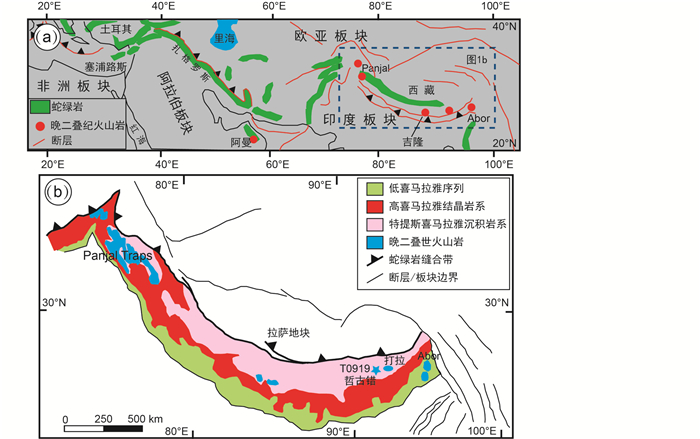
二叠纪-三叠纪这一地质历史时期是地质演化历史中极为重要的一个阶段,表现为古特提斯洋俯冲消减、冈瓦纳大陆裂解、新特提斯洋的开启与扩张,是一个地质构造复杂期。古特提斯洋俯冲到最终关闭在不同地区有着不同的时限(Audley-Charles, 1988; Deng et al., 2014; Cheng et al., 2015; 吴福元等, 2020),例如在拉萨地块古特提斯洋的最终闭合大约在230Ma(Cheng et al., 2015),特提斯东段的古特提斯洋在250Ma左右基本关闭(吴福元等, 2020)。根据古地理重建,冈瓦纳大陆初始裂解和新特提斯洋的开启与扩张始于中-晚二叠世(Torsvik et al., 2012, 2014; Svensen et al., 2017),与地幔柱活动相关,产生了大规模的岩浆作用,其中以溢流玄武岩最为常见(Kent et al., 1992; Courtillot et al., 1999; Lapierre et al., 2004)。此次裂解导致多个微陆块从冈瓦纳大陆北缘裂解,其中喜马拉雅造山带也保存了与此次裂解相关的岩浆作用记录(Acharyya, 1992; Vannay and Spring, 1993; Garzanti, 1993, 1999; Garzanti et al., 1999; Corfield et al., 1999; 曾令森等, 2012),主要分布在西部的Panjal,中部的吉隆地区和东部的隆子-Abor地区(图 1a)。
|
图 1 新特提斯带简要地质图(a)和喜马拉雅地区晚二叠世岩浆作用分布图(b) Fig. 1 Simplified geological map of the Neo-Theyan belt showing the major ophiolite sequences and the Late Permian volcanic rocks (a) and the distribution of Permian magmatism in the Himalayas (b) |
特提斯喜马拉雅带作为冈瓦纳大陆的重要组成部分,位于大印度地块与澳大利亚地块连接的边缘,保存有冈瓦纳大陆多期裂解的记录,吸引了国内外众多学者的关注(Norton and Sclater, 1979; Coffin and Rabinowitz, 1987; Lawver and Scotese, 1987; Storey, 1995; Metcalfe, 1996; Chatterjee et al., 2013; Svensen et al., 2017; Sensarma et al., 2018; 王亚莹等, 2016; Wang et al., 2018, 2020, 2021; Tian et al., 2019; 田怡红, 2019)。揭示这些岩浆作用的时代和地球化学性质是刻画特提斯喜马拉雅构造演化过程的关键,对于深化理解冈瓦纳大陆北缘的构造动力学过程及其深部驱动机制也具有重要意义。另外,了解冈瓦纳大陆和新特提斯洋的形成及演化的过程对重塑地球演化和板块运动过程至关重要(Jokat et al., 2003; Upchurch, 2008; Eagles and König, 2008; Tian et al., 2019; 田怡红, 2019)。
在本次研究中,我们利用特提斯喜马拉雅哲古错地区晚二叠世花岗闪长岩来限定特提斯洋和冈瓦纳大陆的演化阶段。花岗闪长岩成因机制有三种:第一种理论认为长英质熔体来自于地壳部分熔融(Draper, 1991; Borg and Clynne, 1998; He et al., 2011; Tian et al., 2019; 田怡红, 2019);第二种理论认为酸性岩是由单一地幔岩浆源区经历不同程度的分离结晶而形成(Barker and Arth, 1976; Mccurry et al., 2008);第三种理论认为它是由长英质熔体和镁铁质熔体混合形成(Vernon, 1990; Bateman, 1995)。本文在详实的野外考察和系统采样的基础上,通过对其中代表性样品(T0919-B)花岗闪长岩进行了野外产出关系、岩相学、U-Pb锆石年代学和地球化学分析,来确定其形成时代和成因机制,探讨晚二叠世新特提斯洋和冈瓦纳大陆的演化历史和地球动力学意义。
1 地质背景和岩相学特征喜马拉雅造山带包括三个北向倾斜的构造单元,即特提斯喜马拉雅沉积岩系(THS)、高喜马拉雅结晶岩系(GHC)和低喜马拉雅序列(LHS)(图 1b, Yin and Harrison, 2000; Yin, 2006; Tian et al., 2019; 田怡红, 2019)。
特提斯喜马拉雅沉积岩系(THS),位于印度-雅鲁藏布缝合带(ITS)和藏南拆离断层系(STDS)之间,呈东西向弧形带状展布,宽达100~120km(田怡红, 2019)。雅鲁藏布缝合带是青藏高原上最年轻的一条缝合带;藏南拆离断层系是一北倾低角度断层系(Burg and Chen, 1984; Burchfiel et al., 1992),为特提斯喜马拉雅沉积岩系和高喜马拉雅结晶岩系的分界线。在地层上,特提斯喜马拉雅沉积岩系主要是元古界到始新统(1840~40Ma)的沉积序列,该沉积序列又分成四个主要序列:(1)由横向扩展的岩相单元所组成的元古界到泥盆系的前裂谷序列;(2)从石炭系到下侏罗统的裂谷和后裂谷序列;(3)从侏罗系到白垩系的被动大陆边缘序列;(4)从晚白垩系到始新统的同碰撞序列(Liu and Einsele, 1994; Garzanti, 1999; Yin, 2006; Tian et al., 2019; 田怡红, 2019)。在岩性上,THS由发育于早新生代南上褶皱冲断带上的晚元古代-显生宙(变质)沉积岩和寒武-奥陶纪花岗岩体组成(Gaetani and Garzanti, 1991; Corfield and Searle, 2000; Aikman et al., 2008)。特提斯喜马拉雅沉积岩系的前寒武系结晶基底由以片麻岩和片岩为代表的角闪岩相变质岩、混合岩、中新元古代片麻岩和古元古代花岗片麻岩组成(Liao et al., 2008; 田怡红, 2019),出露于北喜马拉雅穹隆中。
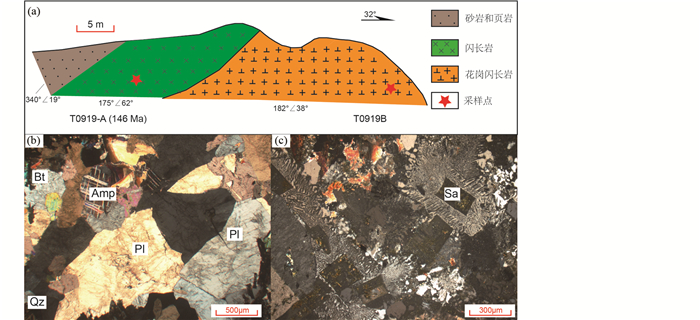
在特提斯喜马拉雅哲古错地区,通过野外观测,我们识别出一套花岗闪长岩,命名为哲古错花岗闪长岩。该花岗闪长岩侵入特提斯喜马拉雅沉积岩系砂岩和页岩中,同时,该岩体又被时代为~146Ma的闪长岩(T0919-A,图 2a)侵入,该闪长岩可能是东冈瓦纳大陆初始裂解的产物,可能与哲拉组和维美组的熔岩流(Bian et al., 2019)、错那基性岩墙群(Zhu et al., 2008; 王亚莹等, 2016; Wang et al., 2018, 2020, 2021)和双峰式岩浆岩(Tian et al., 2019)属于同一期岩浆事件。该花岗闪长岩样品呈浅灰色,半自形中粒结构,块状构造。主要矿物成分为石英、斜长石和角闪石,可见少量黑云母(图 2b),在镜下还可见透长石和微文象结构(图 2c),与碱性花岗岩类似。
|
图 2 哲古错花岗闪长岩的野外素描图(a)和显微镜下照片(b、c) Qz-石英;Pl-斜长石;Amp-角闪石;Bt-黑云母;Sa-透长石 Fig. 2 Field sketch map (a) and photomicrographs (b, c) of granodiorite (Sample T0919-B) from Zhegu Co area |
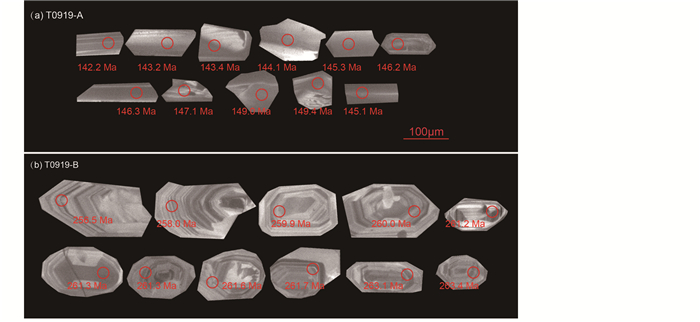
为确定样品闪长岩T0919-A和花岗闪长岩T0919-B的年龄,进行了锆石年代学分析。首先,样品锆石通过重液和磁选进行分离,之后在双目镜下挑选晶型较好、无明显裂纹和基本无包裹体的锆石。选定的锆石颗粒被嵌入到25mm的环氧树脂圆盘中,之后将环氧树脂靶进行粗磨和细磨,直到锆石内核部出露,之后进行抛光、清洗并做成样品靶。阴极发光图像是在中国地质科学院北京离子探针中心获得的。阴极发光图像(图 3)和背散射电子成像显示了锆石晶粒的内部生长结构。
|
图 3 哲古错地区闪长岩(样品T0919-A) (a)和花岗闪长岩(样品T0919-B) (b)的锆石阴极发光照片及点位和测试年龄 Fig. 3 Cathodoluminescence (CL) images showing the texture, spots, and ages of zircon U-Pb dating for diorite (Sample T0919-A) (a) and granodiorite (Sample T0919-B) (b) from Zhegu Co area |
在中国地质科学院矿产资源研究所采用激光烧蚀多接收电感耦合等离子体质谱仪(LA-MC-ICP-MS)对锆石进行了U、Th和Pb分析,分析离子束直径为25μm,每测定5个未知点插入一次标样,标样为锆石GJ-1(599.8±1.7Ma, Jackson et al., 2004)和锆石Plesovice(337.13±0.37Ma, Sláma et al., 2008)。数据由M257标准锆石校准(U: 840×10-6, Nasdala et al., 2008),数据处理采用ICPMSDataCal程序(Liu et al., 2010),锆石年龄协和图使用Isoplot在95%置信水平下计算得出(Ludwig, 2003)。
2.2 全岩地球化学分析为测定样品T0919-B的全岩组分和地球化学组成,进行了全岩地球化学分析。测试在中国地质科学院国家地质实验测试中心完成。全岩的主量元素含量和微量元素含量分别使用X荧光光谱仪3080E(XRF)和电感耦合等离子体质谱仪(ICP-MS)获得。主量元素含量的测试误差小于5%,微量元素含量小于10×10-6的测试误差为10%,微量元素含量大于10×10-6的测试误差为5%。
2.3 全岩Sr-Nd同位素分析样品的Rb-Sr和Sm-Nd同位素分析在中国地质科学院地质研究所同位素分析实验室完成。采用同位素稀释法,利用FinniganMaT-262质谱仪测定全岩Sr同位素组成及元素Rb、Sr、Sm和Nd的含量;利用Nu Plasma HR多接收等离子质谱仪(MC-ICP-MS)获得全岩Nd同位素组成。Sr和Nd同位素分析结果分别按87Sr/86Sr=0.1194和146Nd/144Nd=0.7219进行标准化,之后再进行质量分馏校正。在样品分析过程中,Sr同位素测试标样为NBS987,Nd同位素监测标样为JMC Nd。详细的分析测试方法和流程常参考Chen et al.(2002, 2007)。之后根据锆石U-Pb年龄计算其Sr和Nd同位素初始组成。哲古错花岗闪长岩的结晶年龄约为260.3Ma,分析样品的Sr和Nd同位素的初始值按t=260.3Ma来计算。
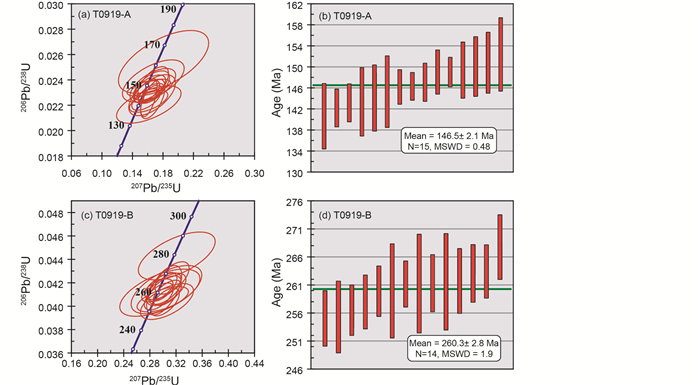
3 数据和结果 3.1 花岗闪长岩和闪长岩的年龄为限定侵入花岗闪长岩中的闪长岩脉(T0919-A)的形成时代,对该岩脉也进行了锆石U-Pb定年。闪长岩的锆石颗粒多为自形,呈灰白色短柱状,长100~200μm,长宽比在2∶1和5∶1之间(图 3a)。所有锆石含有较高的U(161×10-6~2087×10-6)和Th(189×10-6~915×10-6),并且所有锆石颗粒的Th/U比值在0.29~2.01之间(表 1),表明该闪长岩锆石为岩浆成因(Hoskin and Schaltegger, 2003)。根据样品的U-Pb年龄谐和图和206Pb/238U加权平均年龄图(图 4a, b),闪长岩年龄为146.5±2.1Ma(N=15,MSWD=0.48),是闪长岩的结晶年龄。其中有一颗锆石的年龄为161.8Ma,且落在谐和线上,可能代表早期发生的岩浆活动。
|
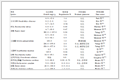
表 1 哲古错地区闪长岩(T0919-A)和花岗闪长岩(T0919-B)的锆石U-Pb同位素测试结果 Table 1 Zircon U-Pb isotopic data of the diorite (T0919-A) and granodiorite (T0919-B) from Zhegu Co area |
|
图 4 哲古错地区闪长岩(T0919-A)(a、b)和花岗闪长岩(T0919-B)(c、d)的锆石U-Pb定年谐和图和加权平均年龄图 Fig. 4 U-Pb concordia diagrams and weighted average age diagrams for diorite (T0919-A) (a, b) and granodiorite (T0919-B) (c, d) from Zhegu Co area |
花岗闪长岩的锆石颗粒大多是自形的,呈黑灰色短柱状,长100~250μm,长宽比在1∶1和2∶1之间,并且在CL图像中有环带结构出现(图 3b)。所有的锆石含有相似的U(78×10-6~806×10-6)和Th(165×10-6~593×10-6),并且所有锆石颗粒的Th/U>0.1(表 1),表明该花岗闪长岩的锆石为岩浆成因(Hoskin and Schaltegger, 2003)。结合样品的U-Pb年龄谐和图和206Pb/238U加权平均年龄图(图 4c, d),该花岗闪长岩样品的年龄为260.3±2.8Ma(N=14,MSWD=1.9),代表花岗闪长岩的结晶年龄。其中有一颗锆石的年龄为279.4Ma,且落在谐和线上,可能代表早期发生的岩浆活动。
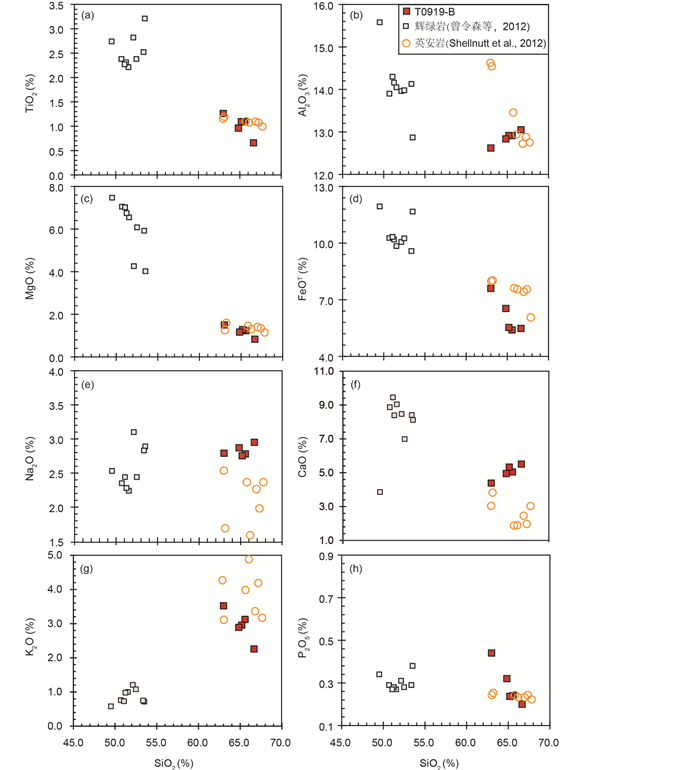
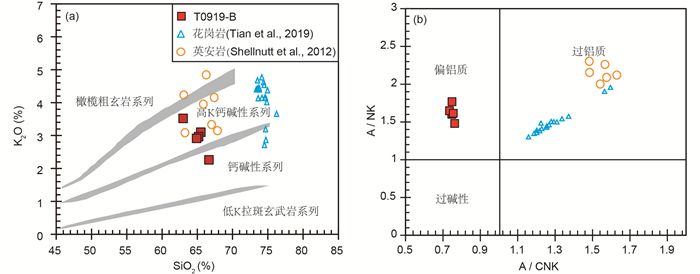
3.2 全岩地球化学结果花岗闪长岩样品在主量元素上表现为含有较高的SiO2(63.00%~66.66%)、MgO(0.83%~1.50%)、CaO(4.39%~5.51%)、Na2O(2.75%~2.95%)、K2O(2.26%~3.52%)和Al2O3(12.62%~13.05%)含量,以及较低的烧失量(LOI=1.62%~1.78%)(表 2、图 5),表明该花岗闪长岩样品较为新鲜。从图 5可见Al2O3、Na2O、CaO和SiO2有明显的正相关关系,而TiO2、MgO、FeOT(=FeO+Fe2O3×0.8998)、K2O、P2O5和SiO2有明显的负相关关系。在SiO2-K2O图解(图 6a)上,花岗闪长岩样品大多数都落在了高K钙碱性系列区域,结合A/NK比值大于1.0(1.87~2.72),而A/CNK比值小于1.0(0.74~0.76,图 6b),表明该花岗闪长岩具有高钾钙碱性、偏铝质花岗岩的特征。
|
|
表 2 哲古错花岗闪长岩的主量元素(wt%)和微量元素(×10-6)分析测试结果 Table 2 Analysis results of major elements (wt%) and trace elements (×10-6) of the granodiorites from Zhegu Co area |
|
图 5 哲古错花岗闪长岩及同时代辉绿岩和英安岩的主量元素TiO2 (a)、Al2O3 (b)、MgO (c)、FeOT (d)、Na2O (e)、CaO (f)、K2O (g)、P2O5 (h)与SiO2之间的协变图 Fig. 5 Co-variation diagram of major elements TiO2 (a), Al2O3 (b), MgO (c), FeOT (d), Na2O (e), CaO (f), K2O (g) and P2O5 (h) against SiO2 in granodiorite from Zhegu Co and contemporaneous diabase and dacite |
|
图 6 哲古错花岗闪长岩的K2O-SiO2 (a, 据Le Maitre et al., 1989; Rickwood, 1989)和A/NK-A/CNK (b, 据Maniar and Piccoli, 1989)关系图解 Fig. 6 Plots of K2O vs. SiO2 (a, after Le Maitre et al., 1989; Rickwood, 1989) and A/NK vs. A/CNK (b, after Maniar and Piccoli, 1989) for granodiorite from Zhegu Co |
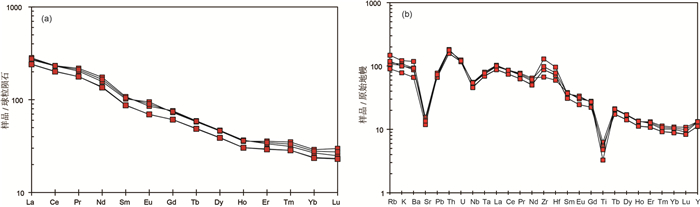
花岗闪长岩样品在稀土元素上富集LREE而亏损HREE(图 7a),轻重稀土分馏明显((La/Yb)N=9.27~10.58,表 2),但没有明显的Eu异常(Eu/Eu*=0.94~1.10),表明斜长石分离结晶作用不明显。在原始地幔标准化微量元素蛛网图解中(图 7b),所有花岗闪长岩样品显示出富集大离子亲石元素(LILE),特别是K、Rb、Ba、Th;亏损Nb、Ta、Ti等高场强元素(HFSE),具有明显的Zr、Hf正异常和Sr负异常。同时具有较高的Rb/Sr比值(0.21~0.29)和Zr/Hf比值(41.66~50.07),较低的Sr/Y比值(4.15~6.45),Nb/Ta比值(11.76~12.69)。
|
图 7 哲古错花岗闪长岩的球粒陨石标准化稀土元素配分图解(a)和原始地幔标准化蜘蛛网图(b)(标准化值据Sun and McDonough, 1989) Fig. 7 Chondrite-normalized rare earth elements distribution pattern (a) and primitive mantle (PM)-normalized trace elements spider diagrams (b) for granodiorite from Zhegu Co (normalization values after Sun and McDonough, 1989) |
为确定花岗闪长岩的Sr-Nd同位素组成特征,对其进行了Sr-Nd同位素分析测试。测试结果见表 3。
|
|
表 3 哲古错花岗闪长岩的全岩Sr-Nd同位素分析测试结果 Table 3 Analysis results of whole-rock Sr-Nd isotopic compositions of the granodiorites from Zhegu Co area |


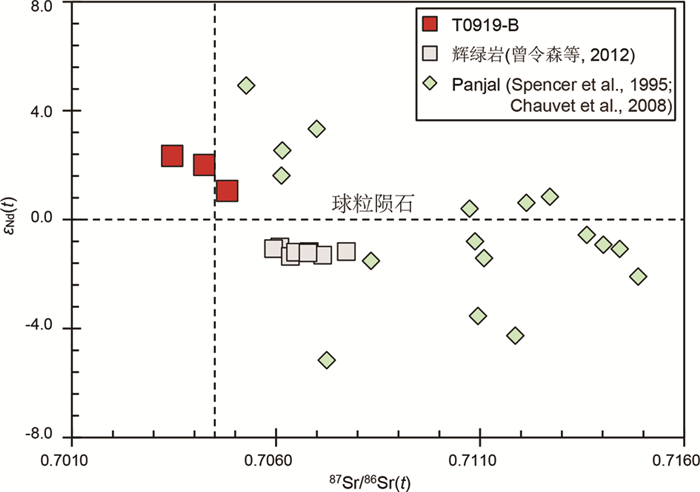
花岗闪长岩具有较低的Rb(54.1×10⁻⁶~88.7×10⁻⁶)和Sr(237×10-6~308×10-6),较高的Sm(12.6×10⁻⁶~14.7×10⁻⁶)和Nd(63.5×10⁻⁶~80.7×10⁻⁶),较高的Rb/Sr比值(0.63~0.85)和较低的Sm/Nd比值(0.116~0.122)。现今87Sr/86Sr比值较高为0.706588~0.707126,而初始(t=260.3Ma)87Sr/86Sr(t)比值较低,为0.703456~0.704804,Nd同位素组成较亏损(εNd(t)=+1.1~+2.3,图 8)。
|
图 8 特提斯喜马拉雅带内晚二叠世岩浆岩εNd(t)-87Sr/86Sr(t)关系图解 Fig. 8 Plot of εNd(t) vs. 87Sr/86Sr(t) of Late Permian magmatic rocks from the Tethyan Himalayan |
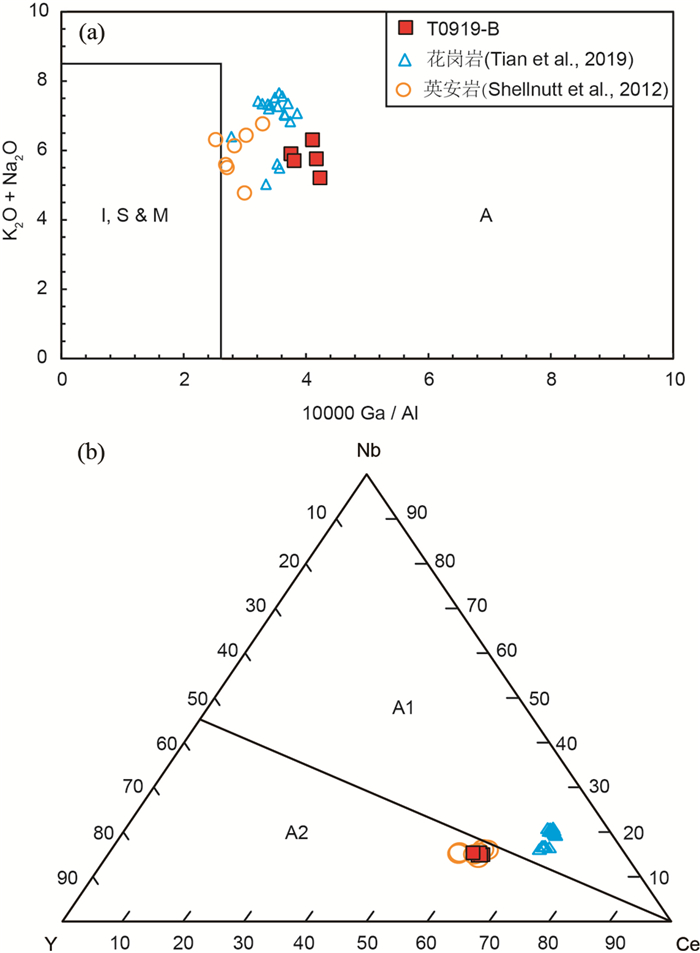
花岗闪长岩具有高SiO2、Na2O+K2O、Nb、Y和Ce,低CaO和Sr,Zr和Hf正异常等特征,这和A型花岗岩的特征类似(Whalen et al., 1987)。在主量元素对图解中(图 5),花岗闪长岩的Al2O3、Na2O、CaO和SiO2有明显的正相关关系,而TiO2、MgO、FeOT、K2O、P2O5和SiO2有明显的负相关关系,与同时代基性岩对比(曾令森等, 2012),除Al2O3和P2O5之外,其余主量元素都显现出一定的相关关系,表明二者可能具有成因上的联系。与此同时,在与Panjal Traps的英安岩(Shellnutt et al., 2012)对比中,发现二者SiO2含量几乎一致,且在TiO2、MgO、FeOT和P2O5上极为相似,但在Al2O3、Na2O、CaO和K2O上有较大区别,表明二者可能经过不同的分离结晶过程。在SiO2-K2O关系图解中(图 6a),绝大多数花岗闪长岩样品都落在高K钙碱性区域,这和显微文象结构(图 2c)相一致,表明其具有碱性花岗岩属性,与A型花岗岩相似。与错那~137Ma的花岗岩(Tian et al., 2019)及同时代英安岩(Shellnutt et al., 2012)对比,可见三者都基本属于高K钙碱性系列(图 6a)。在A/CNK-A/NK关系图解中(图 6b),花岗闪长岩样品和英安岩落在了偏铝质区域,而错那花岗岩则落在了过铝质区域,表明三者源区物质存在一定区别。在(K2O+Na2O)-10000Ga/Al判别图解(图 9a)中,该花岗闪长岩样品、英安岩和错那花岗岩都落在了A型花岗岩区域,揭示了其三者A型花岗岩的属性。但在Ce-Nb-Y三角判别图解中(图 9b),所有的花岗闪长岩样品和英安岩都落在了A2型花岗岩区域,表明这些花岗闪长岩和英安岩具有A2型花岗岩属性;而所有的错那花岗岩都落在了A1型花岗岩区域。
|
图 9 哲古错花岗闪长岩(K2O+Na2O)-10000 Ga/Al判别图解(a, 据Whalen et al., 1987)和Nb-Y-Ce判别图解(b, 据Eby, 1992) Fig. 9 Plots of (K2O+Na2O) vs. 10000 Ga/Al (a, after Whalen et al., 1987) and Nb-Y-Ce discrimination diagram (b, after Eby, 1992) of granodiorite from Zhegu Co |
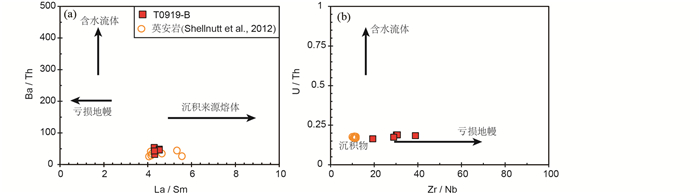
A型花岗岩是花岗岩类(ISAM)的典型类别之一,具有碱性、贫水的特征,是非造山作用背景下的产物(Eby, 1990)。根据源区和构造环境的不同,A型花岗岩又被细分为A1型和A2型花岗岩,一般来说,A1型花岗岩与热点、地幔柱或非造山环境的大陆裂谷带相关。A2型花岗岩则表明其岩浆源区为经历过陆-陆碰撞或弧岩浆作用旋回的陆壳或下地壳(Eby, 1992)。一般认为酸性岩有三种成因机制:(1)长英质熔体来自于镁铁质下地壳部分熔融(Draper, 1991; Borg and Clynne, 1998; He et al., 2011);(2)酸性岩是由单一地幔岩浆源区经历不同程度的分离结晶而形成(Barker and Arth, 1976; Mccurry et al., 2008);(3)长英质熔体和镁铁质熔体混合形成(Vernon, 1990; Bateman, 1995)。哲古错花岗闪长岩都显示出高的A/NK比值,在A/CNK-A/NK图解中(图 6b),所有的花岗闪长岩样品都表现出偏铝质组成。结合微量元素对比值La/Sm-Ba/Th(图 10a)关系图解和Zr/Nb-U/Th(图 10b)关系图解,表明岩浆来自沉积来源熔体,但有一定的亏损地幔物质加入。所有样品的εNd(t)=+1.1~+2.3,同样表明可能有地幔物质的加入。而同时代的英安岩(Shellnutt et al., 2012)则没有地幔物质的加入(图 10b)。所有样品富集LREE而亏损HREE(图 7a),但没有明显的Eu异常(Eu/Eu*=0.94~1.10),表明斜长石分离结晶作用不明显,样品与初始岩浆接近。在原始地幔标准化微量元素图解中(图 7b),所有样品显示出富集LILE,特别是K、Rb、Ba、Th等元素,高场强元素Nb、Ta、Ti负异常,但Zr和Hf为正异常,与典型的弧岩浆岩不同,但与伸展构造背景下形成的岩浆岩类似。
|
图 10 哲古错花岗闪长岩不相容元素对La/Sm-Ba/Th(a, 据Elliott, 2003)和Zr/Nb-U/Th(b, 据Stern et al., 2006)关系图解 Fig. 10 Plots of incompatible trace elements La/Sm vs. Ba/Th (a, after Elliott, 2003) and Zr/Nb vs. U/Th (b, after Stern et al., 2006) of granodiorite from Zhegu Co |
终上所述,哲古错花岗闪长岩与英安岩和错那花岗岩的构造背景相似,都形成于伸展构造背景,但三者物质源区不同,英安岩来源于中地壳部分熔融(Shellnutt et al., 2012),错那花岗岩来源于上地壳含石榴子石变泥质岩的部分熔融(Tian et al., 2019),哲古错花岗闪长岩的源区为被亏损地幔物质改造过的沉积岩或变沉积岩。
4.2 地球动力学意义在中-晚二叠世,特提斯喜马拉雅带内广泛发育着以Panjal溢流玄武岩为代表的基性岩浆作用(Spencer et al., 1995; Chauvet et al., 2008),藏南打拉地区也发现了相同时代的辉绿岩(曾令森等, 2012),吉隆Bhote Kosi玄武岩以及东喜马拉雅的Abor火山岩(Garzanti et al., 1999; 朱同兴等, 2002; 朱弟成等, 2009)也是同一时期的岩浆活动产物。这些岩浆活动被认为代表冈瓦纳大陆北缘裂解和新特提斯洋开启相关的岩浆活动。在拉萨地块江达地区发现的267Ma的A1型花岗岩(王海涛, 2021)也被认为和上述岩浆作用的动力学背景相同。在羌塘地块的羌塘大火成岩省被认为和Panjal大火成岩省是同一个大火成岩省,同时期的岩浆作用也被认为与冈瓦纳大陆北缘裂解和新特提斯洋开启相关(Dan et al., 2021)。
哲古错花岗闪长岩属于高K钙碱性岩石,这类岩石形成过程中通常需要异常高的地温梯度使源区物质发生部分熔融,经过上述讨论,可知中-晚二叠世存在一大火成岩省,哲古错花岗闪长岩形成所需的热源可能就来自于此时的地幔柱。花岗闪长岩岩浆源区中混入的基性幔源物质可能也与二叠纪基性大火成岩省有成因上的联系,地幔柱(Hill et al., 1992; Hill, 1993)既可以为地壳物质的熔融直接提供热源,又可以提供基性岩浆的混入以改造源区沉积岩或变沉积岩的部分熔融(Huppert and Sparks, 1988; Annen and Sparks, 2002)。哲古错花岗闪长岩与英安岩和错那花岗岩同属高K钙碱性岩石,其最大的区别在于源区物质不同(图 6b),哲古错花岗闪长岩的源区为经亏损地幔物质改造过的沉积岩或变沉积岩,而英安岩来源于中地壳部分熔融(Shellnutt et al., 2012),错那花岗岩的源区则为上地壳含石榴子石变泥质岩(Tian et al., 2019),不过三者都是产于伸展构造背景中,哲古错花岗闪长岩和英安岩与冈瓦纳大陆北缘裂解和新特提斯洋的开启有关,而错那花岗岩与东冈瓦纳大陆的初始裂解有关(Tian et al., 2019)。
本次研究中的酸性岩浆活动与二叠纪基性岩浆活动发生时期相近,也有着一样的构造背景。所以本研究中的花岗闪长岩是伸展构造背景下的产物,同时地幔柱为地壳物质的熔融提供了热源和混入的基性岩浆,这一次酸性岩浆事件活动代表了与冈瓦纳大陆北缘裂解和新特提斯洋开启有关的岩浆活动。这一期裂解事件在不同地区导致的岩浆活动时期不完全一致,可能说明冈瓦纳大陆北缘裂解不是同时进行的,西部裂解时间可能早于东部。
5 结论哲古错花岗闪长岩形成于260.3±2.8Ma,为晚二叠世。样品富集LREE,亏损HREE;富集Th、K、Rb、Ba等大离子亲石元素;亏损Nb、Ta、Ti等高场强元素,具有明显的Zr、Hf正异常和Sr负异常。花岗闪长岩有较低的87Sr/86Sr(t)=0.703456~0.704804,较亏损的Nd同位素组成,εNd(t)=+1.1~+2.3。
该花岗闪长岩具有A型花岗岩特征,代表了伸展构造背景下的岩浆作用,其源区为经亏损地幔物质改造过的沉积岩或变沉积岩,地幔柱为地壳物质的熔融提供了热源和亏损地幔物质。此次酸性岩浆事件代表了与冈瓦纳大陆北缘裂解和新特提斯洋的开启有关的岩浆活动。
致谢 感谢中国地质科学院地质研究所董昕研究员和中国科学院地质与地球物理研究所纪伟强副研究员的细致审稿,提出诸多建设性修改意见。
Acharyya SK. 1992. Pan-Indian Gondwana Plate Break-up, rewelding and evolution of the Himalaya, Indo-Burmese Range and Andaman Island Arc. In: Sinha AK (ed. ). Himalayan Orogen and Global Tectonics. Hoboken: Wiley, 77-89
|
Aikman AB, Harrison TM and Lin D. 2008. Evidence for early (>44Ma) Himalayan crustal thickening, Tethyan Himalaya, southeastern Tibet. Earth and Planetary Science Letters, 274(1-2): 14-23 DOI:10.1016/j.epsl.2008.06.038
|
Annen C and Sparks RSJ. 2002. Effects of repetitive emplacement of basaltic intrusions on thermal evolution and melt generation in the crust. Earth and Planetary Science Letters, 203(3-4): 937-955 DOI:10.1016/S0012-821X(02)00929-9
|
Audley-Charles MG. 1988. Evolution of the southern margin of Tethys (North Australian region) from Early Permian to Late Cretaceous. Geological Society, London, Special Publications, 37(1): 79-100 DOI:10.1144/GSL.SP.1988.037.01.07
|
Barker F and Arth JG. 1976. Generation of trondhjemitic-tonalitic liquids and Archean bimodal trondhjemite-basalt suites. Geology, 4(10): 596-600 DOI:10.1130/0091-7613(1976)4<596:GOTLAA>2.0.CO;2
|
Bateman R. 1995. The interplay between crystallization, replenishment and hybridization in large felsic magma chambers. Earth-Science Reviews, 39(1-2): 91-106 DOI:10.1016/0012-8252(95)00003-S
|
Bian WW, Yang TS, Ma YM, Jin JJ, Gao F, Wang S, Peng WX, Zhang SH, Wu HC, Li HY, Cao LW and Shi YR. 2019. Paleomagnetic and geochronological results from the Zhela and Weimei formations lava flows of the eastern Tethyan Himalaya: New insights into the breakup of eastern Gondwana. Journal of Geophysical Research: Solid Earth, 124(1): 44-64 DOI:10.1029/2018JB016403
|
Borg LE and Clynne MA. 1998. The petrogenesis of felsic calc-alkaline magmas from the southernmost Cascades, California: Origin by partial melting of basaltic lower crust. Journal of Petrology, 39(6): 1197-1222 DOI:10.1093/petroj/39.6.1197
|
Burchfiel BC, Chen ZL, Hodges KV, Liu YP, Royden LH, Deng CR and Xu J. 1992. The South Tibetan Detachment System, Himalayan Orogen: Extension contemporaneous with and parallel to shortening in a collisional mountain belt. Geological Society of American Special Paper, 269: 1-41
|
Burg JP and Chen GM. 1984. Tectonics and structural zonation of southern Tibet, China. Nature, 311(5983): 219-223 DOI:10.1038/311219a0
|
Chatterjee S, Goswami A and Scotese CR. 2013. The longest voyage: Tectonic, magmatic, and paleoclimatic evolution of the Indian plate during its northward flight from Gondwana to Asia. Gondwana Research, 23(1): 238-267 DOI:10.1016/j.gr.2012.07.001
|
Chauvet F, Lapierre H, Bosch D, Guillot S, Mascle G, Vannay JC, Cotten J, Brunet P and Keller F. 2008. Geochemistry of the Panjal Traps basalts (NW Himalaya): Records of the Pangea Permian break-up. Bulletin de la Société Géologique de France, 179(4): 383-395 DOI:10.2113/gssgfbull.179.4.383
|
Chen F, Siebel W, Satir M, Terzio ǧ lu M and Saka K. 2002. Geochronology of the Karadere basement (NW Turkey) and implications for the geological evolution of the Istanbul zone. International Journal of Earth Sciences, 91(3): 469-481 DOI:10.1007/s00531-001-0239-6
|
Chen FK, Li XH, Wang XL, Li QL and Siebel W. 2007. Zircon age and Nd-Hf isotopic composition of the Yunnan Tethyan belt, southwestern China. International Journal of Earth Sciences, 96(6): 1179-1194 DOI:10.1007/s00531-006-0146-y
|
Cheng H, Liu YM, Vervoort JD and Lu HH. 2015. Combined U-Pb, Lu-Hf, Sm-Nd and Ar-Ar multichronometric dating on the Bailang eclogite constrains the closure timing of the Paleo-Tethys Ocean in the Lhasa terrane, Tibet. Gondwana Research, 28(4): 1482-1499 DOI:10.1016/j.gr.2014.09.017
|
Coffin MF and Rabinowitz PD. 1987. Reconstruction of Madagascar and Africa: Evidence from the Davie Fracture Zone and Western Somali Basin. Journal of Geophysical Research: Solid Earth, 92(B9): 9385-9406 DOI:10.1029/JB092iB09p09385
|
Corfield RI, Searle MP and Green OR. 1999. Photang thrust sheet: An accretionary complex structurally below the Spontang ophiolite constraining timing and tectonic environment of ophiolite obduction, Ladakh Himalaya, NW India. Journal of the Geological Society, 156(5): 1031-1044 DOI:10.1144/gsjgs.156.5.1031
|
Corfield RI and Searle MP. 2000. Crustal shortening estimates across the north Indian continental margin, Ladakh, NW India. Geological Society, London, Special Publications, 170(1): 395-410 DOI:10.1144/GSL.SP.2000.170.01.21
|
Courtillot V, Jaupart C, Manighetti I, Tapponnier P and Besse J. 1999. On causal links between flood basalts and continental breakup. Earth and Planetary Science Letters, 166(3-4): 177-195 DOI:10.1016/S0012-821X(98)00282-9
|
Dan W, Wang Q, Murphy JB, Zhang XZ, Xu YG, White WM, Jiang ZQ, Ou Q, Hao LL and Qi Y. 2021. Short duration of Early Permian Qiangtang-Panjal large igneous province: Implications for origin of the Neo-Tethys Ocean. Earth and Planetary Science Letters, 568: 117054 DOI:10.1016/j.epsl.2021.117054
|
Deng J, Wang QF, Li GJ, Li CS and Wang CM. 2014. Tethys tectonic evolution and its bearing on the distribution of important mineral deposits in the Sanjiang region, SW China. Gondwana Research, 26(2): 419-437 DOI:10.1016/j.gr.2013.08.002
|
Draper DS. 1991. Late cenozoic bimodal magmatism in the northern basin and range province of southeastern Oregon. Journal of Volcanology and Geothermal Research, 47(3-4): 299-328 DOI:10.1016/0377-0273(91)90006-L
|
Eagles G and König M. 2008. A model of plate kinematics in Gondwana breakup. Geophysical Journal International, 173(2): 703-717 DOI:10.1111/j.1365-246X.2008.03753.x
|
Eby GN. 1990. The A-type granitoids: A review of their occurrence and chemical characteristics and speculations on their petrogenesis. Lithos, 26(1-2): 115-134 DOI:10.1016/0024-4937(90)90043-Z
|
Eby GN. 1992. Chemical subdivision of the A-type granitoids: Petrogenetic and tectonic implications. Geology, 20(7): 641-644 DOI:10.1130/0091-7613(1992)020<0641:CSOTAT>2.3.CO;2
|
Elliott T. 2003. Tracers of the slab. In: Eiler J (ed. ). Inside the Subduction Factory, Geophysical Monograph Series. Washington, D.C. : American Geophysical Union, 138: 23-45
|
Gaetani M and Garzanti E. 1991. Multicyclic history of the Northern India continental margin (Northwestern Himalaya). AAPG Bulletin, 75(9): 1427-1446
|
Garzanti E. 1993. Sedimentary evolution and drowning of a passive margin shelf (Giumal Group; Zanskar Tethys Himalaya, India): Palaeoenvironmental changes during final break-up of Gondwanaland. Geological Society, London, Special Publications, 74(1): 277-298 DOI:10.1144/GSL.SP.1993.074.01.20
|
Garzanti E. 1999. Stratigraphy and sedimentary history of the Nepal Tethys Himalaya passive margin. Journal of Asian Earth Sciences, 17(5-6): 805-827 DOI:10.1016/S1367-9120(99)00017-6
|
Garzanti E, Le Fort P and Sciunnach D. 1999. First report of Lower Permian basalts in South Tibet: Tholeiitic magmatism during break-up and incipient opening of Neotethys. Journal of Asian Earth Sciences, 17(4): 533-546 DOI:10.1016/S1367-9120(99)00008-5
|
He YS, Li SG, Hoefs J, Huang F, Liu SA and Hou ZH. 2011. Post-collisional granitoids from the Dabie orogen: New evidence for partial melting of a thickened continental crust. Geochimica et Cosmochimica Acta, 75(13): 3815-3838 DOI:10.1016/j.gca.2011.04.011
|
Hill RI, Campbell IH, Davies GF and Griffiths RW. 1992. Mantle plumes and continental tectonics. Science, 256(5054): 186-193 DOI:10.1126/science.256.5054.186
|
Hill RI. 1993. Mantle plumes and continental tectonics. Lithos, 30(3-4): 193-206 DOI:10.1016/0024-4937(93)90035-B
|
Hoskin PWO and Schaltegger U. 2003. The composition of zircon and igneous and metamorphic petrogenesis. Reviews in Mineralogy and Geochemistry, 53(1): 27-62 DOI:10.2113/0530027
|
Huppert HE and Sparks RSJ. 1988. The generation of granitic magmas by intrusion of basalt into continental crust. Journal of Petrology, 29(3): 599-624 DOI:10.1093/petrology/29.3.599
|
Jackson SE, Pearson NJ, Griffin WL and Belousova EA. 2004. The application of laser ablation-inductively coupled plasma-mass spectrometry to in situ U-Pb zircon geochronology. Chemical Geology, 211(1-2): 47-69 DOI:10.1016/j.chemgeo.2004.06.017
|
Jokat W, Boebel T, König M and Meyer U. 2003. Timing and geometry of early Gondwana breakup. Journal of Geophysical Research: Solid Earth, 108(B9): 2428
|
Kent RW, Storey M and Saunders AD. 1992. Large igneous provinces: Sites of plume impact or plume incubation?. Geology, 20(10): 891-894 DOI:10.1130/0091-7613(1992)020<0891:LIPSOP>2.3.CO;2
|
Lapierre H, Samper A, Bosch D, Maury RC, Béchennec F, Cotton J, Demant A, Brunet P, Keller F and Marcoux J. 2004. The Tethyan plume: Geochemical diversity of Middle Permian basalts from the Oman rifted margin. Lithos, 74(3-4): 167-198 DOI:10.1016/j.lithos.2004.02.006
|
Lawver LA and Scotese CR. 1987. A revised reconstruction of Gondwanaland. In: Mckenzie GD (ed. ). Gondwana Six: Structure, Tectonics, and Geophysics. American Geophysical Union, 40: 17-23
|
Le Maitre RW, Bateman P, Dudek A, Keller J, Lameyre J, Le Bas MJ, Sabine PA, Schmid R, Sorensen H, Streckeisen A, Wooley AR and Zanettin B. 1989. A Classification of Igneous Rocks and Glossary of Terms. Oxford: Blackwell
|
Liao QA, Li DW, Lu L, Yuan YM and Chu LL. 2008. Paleoproterozoic granitic gneisses of the Dinggye and LhagoiKangri areas from the higher and northern Himalaya, Tibet: Geochronology and implications. Science in China (Series D), 51(2): 240-248 DOI:10.1007/s11430-008-0002-y
|
Liu GH and Einsele G. 1994. Sedimentary history of the Tethyan basin in the Tibetan Himalayas. Geologische Rundschau, 83(1): 32-61 DOI:10.1007/BF00211893
|
Liu YS, Gao S, Hu ZC, Gao CG, Zong KQ and Wang DB. 2010. Continental and oceanic crust recycling-induced melt-peridotite interactions in the Trans-North China Orogen: U-Pb dating, Hf isotopes and trace elements in zircons from mantle xenoliths. Journal of Petrology, 51(1-2): 537-571 DOI:10.1093/petrology/egp082
|
Ludwig KR. 2003. Isoplot 3.00:A geochronological toolkit for Microsoft Excel. Berkeley Geochronology Center Special Publication, 4: 70
|
Maniar PD and Piccoli PM. 1989. Tectonic discrimination of granitoids. GSA Bulletin, 101(5): 635-643 DOI:10.1130/0016-7606(1989)101<0635:TDOG>2.3.CO;2
|
Mccurry M, Hayden KP, Morse LH and Mertzman S. 2008. Genesis of post-hotspot, A-type rhyolite of the Eastern Snake River Plain volcanic field by extreme fractional crystallization of olivine tholeiite. Bulletin of Volcanology, 70(3): 361-383 DOI:10.1007/s00445-007-0143-4
|
Metcalfe I. 1996. Gondwanaland dispersion, Asian accretion and evolution of eastern Tethys. Australian Journal of Earth Sciences, 43(6): 605-623 DOI:10.1080/08120099608728282
|
Nasdala L, Hofmeister W, Norberg N, Martinson JM, Corfu F, Dörr W, Kamo SL, Kennedy AK, Kronz A, Reiners PW, Frei D, Kosler J, Wan YS, Götze J, Häger T, Kröner A and Valley JW. 2008. Zircon M257:A homogeneous natural reference material for the ion microprobe U-Pb analysis of zircon. Geostandards and Geoanalytical Research, 32(3): 247-265 DOI:10.1111/j.1751-908X.2008.00914.x
|
Norton IO and Sclater JG. 1979. A model for the evolution of the Indian Ocean and the breakup of Gondwanaland. Journal of Geophysical Research: Solid Earth, 84(B12): 6803-6830 DOI:10.1029/JB084iB12p06803
|
Rickwood PC. 1989. Boundary lines within petrologic diagrams which use oxides of major and minor elements. Lithos, 22(4): 247-263 DOI:10.1016/0024-4937(89)90028-5
|
Sensarma S, Storey BC and Malviya VP. 2018. Gondwana Large Igneous Provinces (LIPs): Distribution, diversity and significance. Geological Society, London, Special Publications, 463(1): 1-16 DOI:10.1144/SP463.11
|
Shellnutt JG, Bhat GM, Wang KL, Brookfield ME, Dostal J and Jahn BM. 2012. Origin of the silicic volcanic rocks of the Early Permian Panjal Traps, Kashmir, India. Chemical Geology, 334: 154-170 DOI:10.1016/j.chemgeo.2012.10.022
|
Sláma J, Košler J, Condon DJ, Crowley JL, Gerdes A, Hanchar JM, Horstwood MSA, Morris GA, Nasdala L, Norberg N, Schaltegger U, Schoene B, Tubrett MN and Whitehouse MJ. 2008. Plešovice zircon: A new natural reference material for U-Pb and Hf isotopic microanalysis. Chemical Geology, 249(1-2): 1-35 DOI:10.1016/j.chemgeo.2007.11.005
|
Spencer DA, Tonarini S and Pognante U. 1995. Geochemical and Sr-Nd isotopic characterisation of Higher Himalayan eclogites (and associated metabasites). European Journal of Mineralogy, 7: 89-102 DOI:10.1127/ejm/7/1/0089
|
Stern RJ, Kohut E, Bloomer SH, Leybourne M, Fouch M and Vervoort J. 2006. Subduction factory processes beneath the Guguan cross-chain, Mariana arc: No role for sediments, are serpentinites important?. Contributions to Mineralogy and Petrology, 151(2): 202-221 DOI:10.1007/s00410-005-0055-2
|
Storey BC. 1995. The role of mantle plumes in continental breakup: Case histories from Gondwanaland. Nature, 377(6547): 301-308 DOI:10.1038/377301a0
|
Sun SS and McDonough WF. 1989. Chemical and isotopic systematics of oceanic basalts: Implications for mantle composition and processes. In: Saunders AD and Norry MJ (eds. ). Magmatism in the Ocean Basins. Geological Society, London, Special Publications, 42(1): 313-345
|
Svensen HH, Torsvik TH, Callegaro S, Augland L, Heimdal TH, Jerram DA, Planke S and Pereira E. 2017. Gondwana large igneous provinces: Plate reconstructions, volcanic basins and sill volumes. Geological Society, London, Special Publications, 463(1): 17-40
|
Tian YH. 2019. Early Cretaceous bimodal magmatism in the eastern Tethyan Himalayas, Tibet: Indicative of records on precursory continental rifting and initial breakup of eastern Gondwana. Master Degree Thesis. Hangzhou: Zhejiang University, 1-9 (in Chinese with English summary)
|
Tian YH, Gong JF, Chen HL, Guo LS, Xu QQ, Chen L, Lin XB, Cheng XG, Yang R, Zhao L and Yang SF. 2019. Early Cretaceous bimodal magmatism in the eastern Tethyan Himalayas, Tibet: Indicative of records on precursory continental rifting and initial breakup of eastern Gondwana. Lithos, 324-325: 699-715 DOI:10.1016/j.lithos.2018.12.001
|
Torsvik TH, van der Voo R, Preeden U, Mac Niocaill C, Steinberger B, Doubrovine PV, van Hinsbergen DJJ, Domeier M, Gaina C, Tohver E, Meert JG, Mccausland PJA and Cocks LRM. 2012. Phanerozoic polar wander, palaeogeography and dynamics. Earth-Science Reviews, 114(3-4): 325-368 DOI:10.1016/j.earscirev.2012.06.007
|
Torsvik TH, van der Voo R, Doubrovine PV, Burke K, Steinberger B, Ashwal LD, Trønnes RG, Webb SJ and Bull AL. 2014. Deep mantle structure as a reference frame for movements in and on the Earth. Proceedings of the National Academy of Sciences of the United States of America, 111(24): 8735-8740 DOI:10.1073/pnas.1318135111
|
Upchurch P. 2008. Gondwanan break-up: Legacies of a lost world?. Trends in Ecology and Evolution, 23(4): 229-236 DOI:10.1016/j.tree.2007.11.006
|
Vannay JC and Spring L. 1993. Geochemistry of the continental basalts within the Tethyan Himalaya of Lahul-Spiti and SE Zanskar, Northwest India. Geological Society, London, Special Publications, 74(1): 237-249 DOI:10.1144/GSL.SP.1993.074.01.17
|
Vernon RH. 1990. Crystallization and hybridism in microgranitoid enclave magmas: Microstructural evidence. Journal of Geophysical Research: Solid Earth, 95(B11): 17849-17859 DOI:10.1029/JB095iB11p17849
|
Wang HT. 2021. Magmatic evolution of the Lhasa terrane during the Middle Permian-Late Jurassic, South Tibet. Ph. D. Dissertation. Beijing: Chinese Academy of Geological Sciences, 16-35 (in Chinese with English summary)
|
Wang YY, Gao LE, Zeng LS, Chen FK, Hou KJ, Wang Q, Zhao LH and Gao JH. 2016. Multiple phases of Cretaceous mafic magmatism in the Gyangze-Kangma area, Tethyan Himalaya, southern Tibet. Acta Petrologica Sinica, 32(12): 3572-3596 (in Chinese with English abstract)
|
Wang YY, Zeng LS, Asimow PD, Gao LE, Ma C, Antoshechkina PM, Guo CL, Hou KJ and Tang SH. 2018. Early Cretaceous high-Ti and low-Ti mafic magmatism in Southeastern Tibet: Insights into magmatic evolution of the Comei Large Igneous Province. Lithos, 296-299: 396-411 DOI:10.1016/j.lithos.2017.11.014
|
Wang YY, Zeng LS, Zhao LH, Gao LE, Gao JH, Hu ZP, Wang HT, Li GX, Di YL, Shen Y and Xu Q. 2020. Baddeleyite and zircon U-Pb ages of the ultramafic rocks in Chigu Tso area, Southeastern Tibet and their constraints on the timing of Comei Large Igneous Province. China Geology, 3(2): 262-268
|
Wang YY, Zeng LS, Hou KJ, Gao LE, Wang Q, Zhao LH, Gao JH and Li GX. 2021. Mantle source components and magmatic evolution for the Comei Large Igneous Province: Evidence from the early Cretaceous Niangzhong mafic magmatism in Tethyan Himalaya. Journal of Earth Science, in press
|
Whalen JB, Currie KL and Chappell BW. 1987. A-type granites: Geochemical characteristics, discrimination and petrogenesis. Contributions to Mineralogy and Petrology, 95(4): 407-419 DOI:10.1007/BF00402202
|
Wu FY, Wan B, Zhao L, Xiao WJ and Zhu RX. 2020. Tethyan geodynamics. Acta Petrologica Sinica, 36(6): 1627-1674 (in Chinese with English abstract) DOI:10.18654/1000-0569/2020.06.01
|
Yin A and Harrison TM. 2000. Geologic evolution of the Himalayan-Tibetan Orogen. Annual Review of Earth and Planetary Sciences, 28(1): 211-280 DOI:10.1146/annurev.earth.28.1.211
|
Yin A. 2006. Cenozoic tectonic evolution of the Himalayan orogen as constrained by along-strike variation of structural geometry, exhumation history, and foreland sedimentation. Earth-Science Reviews, 76(1-2): 1-131 DOI:10.1016/j.earscirev.2005.05.004
|
Zeng LS, Gao LE, Hou KJ and Tang SH. 2012. Late Permian mafic magmatism along the Tethyan Himalayan Belt, southern Tibet and tectonic implications. Acta Petrologica Sinica, 28(6): 1731-1740 (in Chinese with English abstract)
|
Zhu DC, Mo XX, Pan GT, Zhao ZD, Dong GC, Shi YR, Liao ZL, Wang LQ and Zhou CY. 2008. Petrogenesis of the earliest Early Cretaceous mafic rocks from the Cona area of the eastern Tethyan Himalaya in South Tibet: Interaction between the incubating Kerguelen plume and the eastern Greater India lithosphere?. Lithos, 100(1-4): 147-173 DOI:10.1016/j.lithos.2007.06.024
|
Zhu DC, Mo XX, Zhao ZD, Niu YL, Pan GT, Wang LQ and Liao ZL. 2009. Permian and Early Cretaceous tectonomagmatism in southern Tibet and Tethyan evolution: New perspective. Earth Science Frontiers, 16(2): 1-20 (in Chinese with English abstract)
|
Zhu TX, Pan GT, Feng XT, Zou GF and Li JZ. 2002. Discovery and tectonic significance of Permian basic volcanic rocks in the Selong area on the northern slope of the Himalayas, southern Tibet. Geological Bulletin of China, 21(11): 717-722 (in Chinese with English abstract)
|
田怡红. 2019. 特提斯喜马拉雅东段早白垩世双峰式岩浆作用: 大陆裂谷及东冈瓦纳初始裂解的标志. 硕士学位论文. 杭州: 浙江大学, 1-9
|
王海涛. 2021. 西藏南部拉萨地块中二叠世-晚侏罗世的岩浆作用演化特征. 博士学位论文. 北京: 中国地质科学院, 16-35
|
王亚莹, 高利娥, 曾令森, 陈福坤, 侯可军, 王倩, 赵令浩, 高家昊. 2016. 藏南特提斯喜马拉雅带内江孜-康马地区白垩纪多期基性岩浆作用. 岩石学报, 32(12): 3572-3596. |
吴福元, 万博, 赵亮, 肖文交, 朱日祥. 2020. 特提斯地球动力学. 岩石学报, 36(6): 1627-1674. |
曾令森, 高利娥, 侯可军, 唐索寒. 2012. 藏南特提斯喜马拉雅带晚二叠纪基性岩浆作用及其构造地质意义. 岩石学报, 28(6): 1731-1740. |
朱弟成, 莫宣学, 赵志丹, 牛耀龄, 潘桂堂, 王立全, 廖忠礼. 2009. 西藏南部二叠纪和早白垩世构造岩浆作用与特提斯演化: 新观点. 地学前缘, 16(2): 1-20. DOI:10.3321/j.issn:1005-2321.2009.02.001 |
朱同兴, 潘桂棠, 冯心涛, 邹光富, 李建忠. 2002. 藏南喜马拉雅北坡色龙地区二叠系基性火山岩的发现及其构造意义. 地质通报, 21(11): 717-722. DOI:10.3969/j.issn.1671-2552.2002.11.004 |