 2021, Vol. 37


2. 地幔研究中心, 自然资源部深地动力学重点实验室, 中国地质科学院地质研究所, 北京 100037;
3. 中国冶金地质总局第二地质勘查院, 福州 350108;
4. 河北省地矿局第四地质大队, 承德 067000;
5. 南京大学地球科学与工程学院, 南京 210023
2. CARMA (Center for Advanced Research on Mantle), Key Laboratory of Deep-Earth Dynamics of Ministry of Natural Resources, Institute of Geology, Chinese Academy of Geological Sciences, Beijing 100037, China;
3. The Second Geo-Exploration Institute of CMGB, Fuzhou 350108, China;
4. The 4th Geological Team of Hebei Geology and Mining Bureau, Chengde 067000, China;
5. School of Earth Sciences and Engineering, Nanjing University, Nanjing 210023, China
班公湖-怒江缝合带是青藏高原一条重要的板块缝合带,是羌塘地块和拉萨地块拼接的缝合带(Girardeau et al., 1984;Pearce and Deng, 1988;Yin and Harrison, 2000),可能还是冈瓦纳大陆的北界(王鸿祯,1983;潘桂棠等,2004)。该缝合带自西向东延伸超过2000km,从西部的班公湖经改则、东巧、安多向东延伸,然后在丁青向南转向怒江,通常依照其分布位置,可以划分为西段(班公湖至改则)、中段(安多至东巧)、东段(丁青至怒江)三部分(王希斌等,1987;Dewey et al., 1988)。该缝合带是中生代班公湖-怒江洋经历扩张、俯冲消减、地体拼合后残留的大洋岩石圈残片,在建立青藏高原构造格架和恢复青藏高原演化历史方面具有重要地质意义。
班公湖-怒江缝合带蛇绿岩研究程度较高,但对于班公湖-怒江洋成因、时代以及演化模式等方面还存在较大争议,包括以下几种观点:(1)关于班公湖-怒江洋盆的打开时间,目前存在晚二叠世-早三叠世(任纪舜和肖黎薇,2004;Pan et al., 2012;Zhu et al., 2013;Chen et al., 2017;Zhang et al., 2017)、三叠纪(Kapp et al., 2003;Fan et al., 2018)、早侏罗世(邱瑞照等,2004;曲晓明等,2010;宋扬等,2019)和中-晚侏罗世(王希斌等,1987;Zhang et al., 2007;Wang et al., 2008;范建军等,2019)等多种意见,也有学者在班公湖-怒江缝合带内发现了古特提斯洋壳的残余,认为班公湖-怒江缝合带所代表的中特提斯洋在晚古生代-中生代很可能连续存在(陈玉禄等,2005;潘桂棠等,2020;Pan et al., 2012);(2)对于班公湖-怒江洋盆的俯冲方向以及俯冲时间分歧更大,有人认为它向北往羌塘地块之下俯冲(Pearce and Deng, 1988;Matte et al., 1996;王玉净等,2002;Kapp et al., 2003;曲晓明等,2009),也有人认为其向南往拉萨地块之下俯冲(郭铁鹰等,1991;邱瑞照等,2004;陈玉禄等,2005;朱弟成等,2006;潘桂棠等,2020;Zhong et al., 2018;Yu et al., 2021),还有人认为它是向南向北双向俯冲(许荣科等,2007;杜德道等,2011;Pan et al., 2012);而Zhu et al.(2013)则认为班-怒古洋盆260Ma向南俯冲,210Ma开始双向俯冲,140Ma左右仅保存南向俯冲, 到晚白垩世洋盆完全关闭。可以看出,前人对班公湖-怒江洋盆的开启时间和模式、规模、俯冲极性和闭合机制等关键构造问题还存在较明显的分歧。
丁青蛇绿岩位于班公湖-怒江缝合带的东段,是班公湖-怒江缝合带中较早开展研究的地区之一(郑一义,1982),也是该缝合带中规模最大的蛇绿岩体,它记录了班公湖-怒江缝合带东段不同构造背景、不同时代和多期岩浆演化的重要信息。已有研究包括蛇绿岩的形成年龄、构造环境及丁青蛇绿岩体的划分等:比如,有人认为丁青蛇绿岩体可能形成于晚三叠世-中侏罗世(李红生,1988;刘文斌等,2002;王玉净等,2002;强巴扎西等,2009;林靓,2015;Wang et al., 2016;薄容众等,2019);游再平(1997)利用40Ar -39Ar法获得丁青蛇绿混杂岩中发现的辉长质碎斑糜棱岩块年龄为197.3±3.3Ma(早侏罗世),提出其代表丁青蛇绿岩的侵位年龄;前人根据丁青蛇绿岩的岩石地球化学特征,提出其形成于四种不同的构造环境,包括俯冲带环境(张旗和杨瑞英, 1985, 1987;刘文斌等,2002)、洋中脊叠加洋岛环境(邹光富,1993;韦振权等,2007)、大洋中脊环境(强巴扎西等,2009)和洋岛环境(Wang et al., 2016)。综上研究可以看到丁青蛇绿岩形成时间、成因及构造演化的复杂性,需要对丁青蛇绿岩的不同组成岩石单元开展一个系统的研究,以获得对丁青蛇绿岩的形成和演化的完整评价。
为查明丁青蛇绿岩岩体成因,划分铬铁矿成矿异常区,中国冶金地质总局第二地质勘查院在岩体铬铁矿矿化点分布较多的位置实施了一口165.19m的钻孔。除上部约0.5m厚的第四系残坡积物外,其余均为地幔橄榄岩。钻孔的实施为我们提供了从深部了解丁青地幔橄榄岩岩性空间展布和成分变化的机会,为研究蛇绿岩岩体地幔橄榄岩成因提供了重要基础。
本文通过丁青蛇绿岩钻孔ZK02的系统研究,根据岩相学、矿物学等特征,结合岩石地球化学数据分析,识别岩相的变化规律和分带性,岩石成分和矿物变化的规律,探讨丁青蛇绿岩地幔橄榄岩组合,评价部分熔融过程和熔体-岩石反应,从而获得丁青蛇绿岩形成期间岩石学过程的新结果,并讨论俯冲环境中形成的蛇绿岩地幔橄榄岩占主导地位的部分熔融和熔体-地幔相互作用过程。
1 地质概况丁青蛇绿岩位于班公湖-怒江缝合带由东西转南东方向的弯部,是班公湖-怒江缝合带中研究历史较早、研究程度较高的蛇绿岩带,该蛇绿岩岩石组合出露齐全,包括地幔橄榄岩、堆晶岩、辉长岩和斜长花岗岩,地表出露较多铬铁矿矿化点(郑一义,1982;张旗和杨瑞英, 1985, 1987;刘文斌等,2002;李永飞和王娟,2005;韦振权等,2007)。
丁青蛇绿岩呈窄带状展布,宽约5~10km,长度超过150km,出露面积约550km2,是该缝合带出露面积最大的蛇绿岩(图 1)。以丁青县为界,丁青蛇绿岩分为东岩体和西岩体。东岩体分布于丁青县协雄乡至类乌齐县卡玛多乡之间,地理坐标:95°42′00″E~96°33′00″E、31°24′30″N~31°06′00″N。岩体东西长88.5km,南北宽2~6km,最宽部位达8km,面积约400km2。岩体平面形态为一长条带状,呈北西西-南东东走向,岩体地表倾向变化较大。岩体东部拉拉卡测区,南界倾向北东,倾角50°~55°,北界亦倾向北东,倾角70°~80°;岩体中部角莫龙段南界北倾,倾角30°~45°,北界南倾,倾角50°~70°。本次钻孔位置就位于丁青东岩体的拉拉卡测区。

|
图 1 青藏高原大地构造划分图及班公湖-怒江缝合带内蛇绿岩的分布(a,据Liu et al., 2010)和班公湖-怒江缝合带东段丁青地幔橄榄岩岩体地质简图(b,据薄容众等,2019) BNS-班公湖-怒江缝合带;IYS- 印度-雅鲁藏布江缝合带 Fig. 1 Tectonic division of the Tibetan Plateau and ophiolites outcropping along the Bangong-Nujiang Suture Zone (a, after Liu et al., 2010) and simplified geological map of the Dingqing mantle peridotite in the eastern segment of the Bangong-Nujiang suture zone (b, after Bo et al., 2019) BNS-Bangong-Nujiang suture zone; IYS- Indus-Yarlung Zangbo suture zone |
丁青东蛇绿岩体各单元组合齐全,以方辉橄榄岩为主,少量纯橄岩,均发育蛇纹石化;见少量堆晶辉长岩、堆晶辉石岩、辉绿岩、玄武岩、角闪苏长岩、石英闪长岩、斜长花岗岩、硅质岩等。方辉橄榄岩与两侧地层为构造接触关系,接触带内岩石强烈蚀变,主要为石英菱镁岩。在丁青东蛇绿岩南部边界断层带内可见方辉橄榄岩岩块出露在石英菱镁岩中(图 2a)。极少量的方辉橄榄岩以团块状分布于纯橄岩中,直径为数米。方辉橄榄岩野外观察表面比较粗糙,为黄褐色、暗绿色和黑色等,可见辉石定向排列。丁青蛇绿岩的纯橄岩规模较小,野外观察为土黄色为主,大多蛇纹石化严重,可以呈薄壳状、透镜状或条带状产出于方辉橄榄岩中。纯橄岩与方辉橄榄岩和铬铁矿大多直接接触,可见致密块状铬铁矿产于纯橄岩中(图 2b)。

|
图 2 丁青蛇绿岩地幔橄榄岩野外露头照片 (a)方辉橄榄岩岩块产于南部边界断层带;(b)致密块状铬铁矿呈条带状产于纯橄岩中 Fig. 2 Field photos of the mantle peridotite in the Dingqing ophiolite (a) harzburgite occur in the southern boundary fault zone; (b) dense massive chromitite occurs in dunite in strips |
丁青东蛇绿岩拉拉卡测区ZK02钻孔进尺共计165.19m,除了钻孔上部约0.5m厚的第四系残坡积,岩心的岩性主要有方辉橄榄岩、纯橄岩及含浸染状铬铁矿的纯橄岩,蛇纹石化蚀变严重。
按照岩性的不同初步划分为17个岩性单元层(图 3),单元层具体的起始位置及长度以及简要的岩性特征描述如下。

|
图 3 班公湖-怒江缝合带东段丁青地幔橄榄岩钻孔ZK02岩心柱状图 Fig. 3 The core column of the mantle peridotite in the Dingqing drilling hole (ZK02), eastern of the Bangong-Nujiang suture zone |
单元层1:岩心起止深度0~0.5m,层厚0.5m,第四系残坡积物,土黄色、灰绿色,松散结构。见少量灰绿色方辉橄榄岩风化产物。
单元层2:岩心起止深度0.5~2.7m,层厚2.2m,纯橄岩,深灰绿色,粒状结构,块状构造。主要成分为橄榄石,显微镜下几乎全蛇纹石化,见星点状铬尖晶石。
单元层3:岩心起止深度2.7~9.78m,层厚7.08m,方辉橄榄岩,深灰绿色,粒状结构,块状构造。主要造岩矿物为橄榄石和斜方辉石,蛇纹石化严重,偶见单斜辉石。
单元层4:岩心起止深度9.78~18.95m,层厚9.17m,纯橄岩,深灰绿色,粒状镶嵌结构、碎斑结构。主要由橄榄石组成,灰绿色,他形粒状,大部分蛇纹石化。
单元层5:岩心起止深度18.95~22.25m,层厚3.3m,方辉橄榄岩,深灰绿色,粒状结构,块状构造。主要由橄榄石和斜方辉石组成,橄榄石为灰绿色,他形粒状,含量在80%左右;斜方辉石,黑色,灰白色,半自形粒状,含量在20%左右,蛇纹石化严重。
单元层6:岩心起止深度22.25~24.75m,层厚2.5m,纯橄岩,深灰绿色,粒状结构,块状构造。主要造岩矿物为橄榄石,灰绿色,他形粒状,大部分蛇纹石化,含量在95%以上。见少量星点状细粒铬尖晶石,含量1%左右。
单元层7:岩心起止深度24.75~72.91m,层厚48.16m,方辉橄榄岩,深灰绿色,碎斑结构。主要由橄榄石和斜方辉石组成,含少量单斜辉石。其中橄榄石为灰绿色,他形粒状,含量达80%左右,大部分蛇纹石化;辉石为黑色,半自形粒状,粒径可达2mm,含量为20%左右。
单元层8:岩心起止深度72.91~83m,层厚10.09m,纯橄岩,深灰绿色,粒状结构,块状构造。该层蛇纹石化蚀变严重,主要造岩矿物为橄榄石,灰绿色,他形粒状,含量在95%以上。
单元层9:岩心起止深度83~90.82m,层厚7.82m,方辉橄榄岩,岩心破碎,强蛇纹石化,可见斜方辉石假象和橄榄石残余颗粒。
单元层10:岩心起止深度90.82~93.75m,层厚2.93m,纯橄岩,碎斑结构,中度蛇纹石化,呈网状结构,橄榄石颗粒破碎,多呈孤岛状。
单元层11:岩心起止深度93.75~126.62m,层厚32.87m,方辉橄榄岩,岩心破碎,中度到强蛇纹石化。橄榄石(60%~70%)沿裂纹和粒间发育蛇纹石化蚀变,斜方辉石约15%~25%,可见少量单斜辉石(1%左右)和铬尖晶石(0.1~1mm,约1%~4%)。
单元层12:岩心起止深度126.62~131.07m,层厚4.45m,纯橄岩,粒状结构,块状构造。主要造岩矿物为橄榄石,蛇纹石化严重,可见少量星点状细粒铬尖晶石,含量小于1%。裂隙发育,见灰绿色蛇纹石细脉。
单元层13:岩心起止深度131.07~144.54m,层厚13.47m,方辉橄榄岩,粒状碎斑结构。主要由橄榄石和斜方辉石组成,其中橄榄石为灰绿色,他形粒状,辉石为半自形粒状。
单元层14:岩心起止深度144.54~149.65m,层厚5.11m,纯橄岩,深灰绿色,粒状结构,块状构造。主要由橄榄石组成,灰绿色,他形粒状,蛇纹石化蚀变严重。见少量星点状细粒铬尖晶石。
单元层15:岩心起止深度149.65~152.68m,层厚3.03m,含浸染状铬铁矿纯橄岩,碎斑结构,不等粒结构。主要由橄榄石和尖晶石组成,橄榄石蛇纹石蚀变严重,浸染状铬尖晶石见他形、半自形和自形,粒径0.1~1.5mm之间。层内发育沿裂隙分布的蛇纹石化蚀变。
单元层16:岩心起止深度152.68~153.9m,层厚1.22m,纯橄岩,粒状镶嵌结构,碎斑结构。主要由橄榄石和少量尖晶石组成,岩石多沿裂隙脉两侧发育中等至强蛇纹石化蚀变。
单元层17:岩心起止深度153.9~165.19m,层厚11.29m,方辉橄榄岩,该层有不同程度的蛇纹石化蚀变,橄榄石沿裂纹和粒间发育蛇纹石化,见少量单斜辉石和星点状铬尖晶石。
丁青钻孔岩心各岩性岩相学特征如下:
纯橄岩 丁青岩体的纯橄岩大多以薄壳状、透镜状或条带状产出于方辉橄榄岩中,与方辉橄榄岩直接接触。丁青钻孔中的纯橄岩大多蛇纹石蚀变严重,主要由橄榄石组成,显微镜下橄榄石颗粒破碎,新鲜橄榄石多呈孤岛状,半自形粒状,波状消光,粒径0.1~0.5mm之间(图 4a)。铬尖晶石呈星点状分布,粒径最大可达1.2mm,边缘可见磁铁矿化(图 4b)。本次岩心中的纯橄岩未见新鲜单斜辉石。

|
图 4 班公湖-怒江缝合带东段丁青地幔橄榄岩钻孔ZK02代表性岩心显微照片 (a)纯橄岩,新鲜橄榄石呈孤岛状分布;(b)纯橄岩,粗粒铬尖晶石分布于孤岛状橄榄石颗粒之间,边缘磁铁矿化;(c)方辉橄榄岩,大颗粒斜方辉石发育扭折带;(d)方辉橄榄岩,斜方辉石边缘蛇纹石化,橄榄石发育碎裂结构;(e)方辉橄榄岩,半自形粒状新鲜斜方辉石,边缘蛇纹石化;(f)方辉橄榄岩,粒径达2mm的斜方辉石包裹橄榄石和单斜辉石包裹体;(g)方辉橄榄岩,单斜辉石以填隙状或以包裹体形式存在于斜方辉石中;(h)方辉橄榄岩,单斜辉石以出溶条纹形式存在于斜方辉石中. Ol-橄榄石,Opx-斜方辉石,Cpx-单斜辉石,Cr-铬尖晶石 Fig. 4 Photomicrographs of the mantle peridotite in the Dingqing drilling hole (ZK02), eastern of the Bangong-Nujiang suture zone (a) dunite, fresh olivine are distributed in island shape; (b) dunite, coarse chromite distributed between olivine particles, magnetization at the edge; (c) harzburgite, coarse orthopyroxene shows kink; (d) harzburgite, coarse orthopyroxene is serpentinized at the edge, and olivine develops cataclastic structure; (e) harzburgite, subhedron fresh orthopyroxene, edge serpentinization; (f) harzburgite, olivine and clinopyroxene inclusions are encapsulated by orthopyroxene with a particle size of 2mm; (g) harzburgite, clinopyroxene exists in orthopyroxene in the form of interstitial or inclusion; (h) harzburgite, clinopyroxene exists in orthopyroxene in the form of exsolution. Ol- olivine; Opx-orthopyroxene; Cpx- clinopyroxene; Cr-chromite |
方辉橄榄岩 丁青钻孔中的方辉橄榄岩蛇纹石化蚀变严重,碎斑结构。其中橄榄石大部分蛇纹石化,见扭折带和波状消光,发育碎裂结构,显微镜下可见新鲜橄榄石。斜方辉石普遍发生较强的塑性变形,波状消光,扭折带发育(图 4c),粒径可达3mm,边缘或者裂隙发育蛇纹石化(图 4d, e),可见斜方辉石包裹橄榄石和单斜辉石(4f),大颗粒斜方辉石常出溶针状单斜辉石。而单斜辉石多以填隙状分布或以内部出溶体形式存在,或以斜方辉石包裹体形式存在(图 4g, h),见少量星点状铬尖晶石分布在单斜辉石裂隙中或者作为包裹体存在(图 4g)。
含铬铁矿的纯橄岩 碎斑结构,产于纯橄岩和方辉橄榄岩之间,厚度约3m,由橄榄石和尖晶石组成,橄榄石蛇纹石蚀变严重,未见新鲜橄榄石颗粒;浸染状铬尖晶石见自形、半自形和他形,粒径0.1~1.5mm之间。
丁青东蛇绿岩拉拉卡测区ZK02钻孔岩心整体蚀变严重,总的来说,含铬铁矿纯橄岩蚀变最重,次之为纯橄岩,最轻为方辉橄榄岩。在方辉橄榄岩中可见新鲜橄榄石、斜方辉石、单斜辉石和铬尖晶石;在纯橄岩中仅见新鲜橄榄石和铬尖晶石;而在含铬铁矿的纯橄岩中只见新鲜铬尖晶石,未见新鲜橄榄石颗粒。
3 分析方法本文精选丁青钻孔ZK02中的26件地幔橄榄岩样品进行了矿物电子探针和全岩地球化学分析。在显微镜下进行岩相学观察后,选择新鲜矿物进行电子探针成分测试,测试在东华理工大学核资源与环境国家重点实验室完成。仪器为JEOL-JXA8530F型,工作条件如下:工作电压15kV,加速电流20nA,电子束斑直径2μm。所有测试数据均采用ZAF程序进行校正处理。
在国家地质实验测试中心完成全岩地球化学分析,其中主量元素是用熔片X-射线荧光光谱法(XRF)测定,并用化学法和等离子光谱法互检;稀土元素和铂族元素用ICP-MS法测定;除稀土元素外的微量元素用熔片XRF和酸溶等离子质谱(ICP-MS)法测定。为了保证分析质量,同时分析2个国家标准样(GSR3和GSR5)和3个平行样品。
4 分析结果 4.1 地幔橄榄岩矿物化学特征对丁青东蛇绿岩岩体拉拉卡测区ZK02钻孔中的主要岩性方辉橄榄岩和纯橄岩中的橄榄石、辉石和铬尖晶石等矿物进行了详细的电子探针成分研究,分析结果如下。
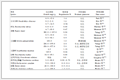
4.1.1 橄榄石共分析方辉橄榄岩和纯橄岩中8个样品的54个橄榄石电子探针成分,代表性样品的分析结果见表 1。数据显示橄榄石均属于镁橄榄石,Fo值变化于88.79~93.73,其中纯橄岩的橄榄石Fo值变化在88.79~91.5之间,平均为89.55,而方辉橄榄岩中的橄榄石Fo值比纯橄岩变化范围更大,在90.15~93.73,平均值为92.25。橄榄石的Fo值越大,代表其熔融程度越高(Dick and Natland, 1995),丁青钻孔岩心两种地幔橄榄岩的橄榄石Fo值呈连续变化(图 5、表 1)。
|
表 1 丁青地幔橄榄岩中代表性样品的橄榄石电子探针分析结果(wt%) Table 1 Representative microprobe analysis results (wt%) of olivines from the mantle peridotite in the Dingqing drilling hole |

|
图 5 西藏丁青钻孔岩心不同岩相中橄榄石的成分图解 红色箭头表示部分熔融趋势线(Ozawa, 1994);FAP-弧前地幔橄榄岩;ABP-深海地幔橄榄岩(Pagé et al., 2008) Fig. 5 Olivine composition of the mantle peridotite in the Dingqing drilling hole Red arrow represent partial melting trend line (Ozawa, 1994); FAP-forearc mantle peridotite; ABP-abyssal mantle peridotite (Pagé et al., 2008) |
此外纯橄岩中的橄榄石NiO含量为0.28%~0.4%、平均值为0.33%,MnO含量为0.13%~0.21%、平均值为0.16%。而方辉橄榄岩中的橄榄石NiO含量为0.32%~0.4%、平均值为0.37%,MnO含量为0.07%~0.15%、平均值为0.11%。可见两种岩性中橄榄石的NiO含量比较接近,Fo值与NiO呈正相关,而Fo值与MnO呈负相关(图 5)。NiO、MnO等组分在不同岩相中的分布差异性可能说明其形成条件的不同,这与丁青地幔橄榄岩的演化过程相关。
4.1.2 辉石辉石常在各岩相带中均有分布,丁青东岩体拉拉卡钻孔ZK02岩心蚀变严重,本次工作只在方辉橄榄岩中见到新鲜的斜方辉石和单斜辉石,共获得5个样品的37个斜方辉石探针数据,代表性样品的电子探针分析结果见表 2,其成分En端员的含量变化于87.02~91.68,平均值为90.38,为顽火辉石。斜方辉石成分显示NiO含量很低,大多为0.06%~0.12%,Cr2O3含量为0.27%~1.03%。而Al2O3含量变化范围较宽,在1.02%~3.18%之间,平均值为1.89%。斜方辉石中的Al2O3含量可作为部分熔融程度的标志,Al2O3含量越低,表明其熔融程度也越大(Dick,1977),而低Al2O3含量和高Mg#特征意味着丁青地幔橄榄岩经历了较高程度的部分熔融(Dick and Bullen, 1984)。
|
|
表 2 丁青方辉橄榄岩中代表性样品的斜方辉石电子探针分析结果(wt%) Table 2 Representative microprobe analysis results (wt%) of orthopyroxene from the harzburgites in the Dingqing drilling hole |
本岩心可见新鲜单斜辉石很少,共获得3个样品的34个单斜辉石探针数据,表 3列出了代表性样品的分析结果,其成分En端员的含量变化于49.78~51.85,主要为透辉石,整体主要以高钙(22.33%~25.68%)、低铝(0.26%~2.34%)、高Mg#(93.57~96.12)为特征。
|
|
表 3 丁青方辉橄榄岩中代表性样品的单斜辉石电子探针分析结果(wt%) Table 3 Representative microprobe analyseis results (wt%) of clinopyroxene from the harzburgites in the Dingqing drilling hole |
从Mg#-Al2O3成分演化图解上来看(图 6),方辉橄榄岩中的Al2O3与Mg#呈负相关关系,位于熔融趋势线上。

|
图 6 西藏丁青钻孔岩心方辉橄榄岩中辉石的成分图解 (a)斜方辉石Al2O3-Mg#图解;(b)斜方辉石Al2O3-Cr2O3图解;(c)单斜辉石Mg#-Al2O3图解;(d)单斜辉石Al2O3-Cr2O3图解.FAP-弧前地幔橄榄岩;ABP-深海地幔橄榄岩(Pagé et al., 2008) Fig. 6 Pyroxene compositions of the harzburgites in the Dingqing drilling hole (a) Al2O3 vs. Mg# diagram of orthopyroxene; (b) Al2O3 vs. Cr2O3 diagram of orthopyroxene; (c) Mg# vs. Al2O3 diagram of clinopyroxene; (d) Al2O3 vs. Cr2O3 diagram of clinopyroxene. FAP-fore-arc peridotite and ABP-abyssal peridotite (from Pagé et al., 2008) |
副矿物铬尖晶石在纯橄岩和方辉橄榄岩中普遍存在,但含量低,不均匀零星分布,一般小于5%,边缘部分大多发生磁铁矿化。本文分析了不同岩相中的67个铬尖晶石的化学成分,代表性结果见表 4。
|
|
表 4 丁青地幔橄榄岩中代表性样品的铬尖晶石电子探针分析结果(wt%) Table 4 Representative microprobe analysis results (wt%) of chromites from the mantle peridotite in the Dingqing drilling hole |
结果显示各岩相单元中铬尖晶石的Cr2O3含量为35.97%~63.5%、平均值为51.31%,Al2O3含量为9.41%~30.31%、平均值为18.87%。铬尖晶石的Cr#值在44.33~81.66之间,其中纯橄岩中的铬尖晶石Cr#值变化于44.33~75.29,平均值为55.86;含铬铁矿的纯橄岩中的铬尖晶石Cr#值非常集中,在81.1~81.66之间;而方辉橄榄岩中Cr#值变化于48.6~75.06,平均值为59.75。纯橄岩和方辉橄榄岩的Cr#值变化范围相似,大多都落入弧前地幔橄榄岩区域中,铬尖晶石的Cr#值与Mg#呈负相关性,与阿尔卑斯型超镁铁岩特征相似,即Cr#值随Mg#值升高随之降低(Leblanc,1980),而含铬铁矿的纯橄岩落入玻安岩区域中(图 7a)。

|
图 7 丁青钻孔地幔橄榄岩岩心不同岩相尖晶石成分图解 (a)Mg#-Cr#图解(据Irvine,1967);(b)TiO2-Cr#图解(据Pearce et al., 2000);(c)Cr#-NiO图解;(d)橄榄石Fo-铬尖晶石Cr#图解(据Dick and Bullen, 1984;OSMA和熔融趋势线据Arai,1994). BON-玻安岩;IAT-岛弧拉斑玄武岩;MORB-大洋中脊玄武岩;FMM-富集地幔;OSMA-橄榄石-尖晶石地幔序列 Fig. 7 Compositions of the spinel of the mantle peridotite in the Dingqing drilling hole (a) Mg# vs. Cr# diagram of the spinel (fields in the diagram are from Irvine, 1967); (b) TiO2 vs. Cr# diagram of the spinel (the partial melting trend after Pearce et al., 2000); (c) Cr# vs. NiO diagram of the spinel; (d) plot of spinel Cr# against olivine Fo (fields in the diagram from Dick and Bullen (1984), and the olivine-spinel mantle array (OSMA) and melting tend of Arai (1994) are also shown. BON-boninite; IAT-island arc tholeiite; MORB-Mid-ocean ridge basalt; FMM-fertile MORB mantle; OSMA-olivine-spinel mantle array |
在尖晶石TiO2与Cr#的对比图(图 7b)中,丁青纯橄岩和方辉橄榄岩的数据接近或与部分熔融曲线部分重叠,部分熔融程度为20%以上。纯橄岩的NiO的含量稍高于方辉橄榄岩中的NiO含量,并呈不明显减少的趋势(图 7c)。
通过研究共生矿物组合的化学成分相互关系,可对其形成的大地构造背景、部分熔融程度等提供依据(Dick and Bullen, 1984;Arai,1994;Pearce et al., 2000)。将丁青地幔橄榄岩中尖晶石Cr#值与其共生的橄榄石的Fo值进行投图(图 7d),可以看出丁青方辉橄榄岩可能经历了约20%~40%的部分熔融,其成分特征与橄榄石-尖晶石地幔序列(OSMA)中的弧前地幔橄榄岩相似。
4.2 地幔橄榄岩全岩地球化学特征此次全岩地球化学分析包括:8件纯橄岩、1件含铬铁矿的纯橄岩和17件方辉橄榄岩。其主量元素和微量元素代表性成分见表 5。
|
|
表 5 丁青钻孔岩心地幔橄榄岩全岩地球化学分析数据(主量元素:wt%;稀土和微量元素:×10-6) Table 5 Chemical composition of the mantle peridotite from the Dingqing drilling hole (major element: wt%; trace element: ×10-6) |
在显微镜观察的基础上,尽量选择蚀变较弱的样品进行地球化学分析。但丁青钻孔岩心整体蚀变比较严重,烧失量在12.11%~20.35%之间,为消除蚀变的影响,扣除烧失量之后对主量元素结果再进行归一化,下面依据归一化后的“干”成分进行讨论(表 5)。计算后的纯橄岩SiO2含量为39.63%~41.94%,Al2O3含量为0.19%~0.87%,CaO含量为0.30%~0.45%,Fe2O3含量为8.8%~12.4%,FeO的含量为3.53%~4.4%,MgO的含量为46.64%~49.45%,从上可以看出纯橄岩的成分比较稳定,属于高镁型地幔橄榄岩;计算后的含铬铁矿纯橄岩SiO2含量为38.22%,Al2O3含量为1.37%,CaO含量为0.54%,Fe2O3含量为10.76%,FeO的含量为4.35%,MgO的含量为49.06%;计算后的方辉橄榄岩SiO2含量为39.64%~44.84%,Al2O3含量为0.27%~0.83%,CaO含量为0.28%~0.7%,Fe2O3含量为7.52%~11.11%,FeO的含量为1.84%~4.42%,MgO的含量为45.98%~49.16%,成分类似于纯橄岩。
丁青地幔橄榄岩中的CaO含量很低(0.28%~0.70%),这与在岩心中少见单斜辉石的现象相一致。岩心均富镁贫铝,MgO值位于45.98%~49.45%之间,Al2O3位于0.19%~1.37%之间。TiO2含量极低,为≤0.01%,这一特征与阿尔卑斯地区的蛇绿岩相似(Melcher et al., 2002)。
将丁青钻孔地幔橄榄岩的主量元素对MgO含量进行投图,发现丁青MgO含量显著高于原始地幔,而其易熔组分SiO2、CaO、TiO2和Al2O3的含量明显低于原始地幔,并与MgO含量呈负相关性(图 8)。对比于深海型地幔橄榄岩和俯冲型地幔橄榄岩,丁青钻孔两种岩性均落于俯冲型地幔橄榄岩区域中。在图 8c上可以看出丁青地幔橄榄岩的部分熔融程度较高,为26%~35%之间,并且纯橄岩和方辉橄榄岩近乎重叠,这说明丁青蛇绿岩体具较高的地幔部分熔融程度,这与狮泉河蛇绿岩体的特征比较相似(邱瑞照等,2005)。

|
图 8 丁青钻孔不同岩性的全岩成分Harker图解 深海地幔橄榄岩和俯冲型地幔橄榄岩数据分别据Niu et al.(1997)和Parkinson and Pearce(1998); 原始地幔值据McDonough and Sun (1995);原始地幔显示了溶化后的残余成分(在10kb和20kb)(Palme and O’Neil,2003); 使用pMELTS程序计算原始地幔最高40%的熔融程度(Ghiorso et al., 2002). 熔融曲线显示单斜辉石在压力10kb和MgO=44%,20kb和MgO=42%条件下消失 Fig. 8 Harker diagrams showing the whole-rock compositions of the mantle peridotite in the Dingqing drilling hole Abyssal and forearc peridotite fields are after Niu et al. (1997) and Parkinson and Pearce (1998), respectively.Primitve mantle values are from McDonough and Sun (1995). Also shown are residual compositions after from melting (at 10kb and 20kb) of the primitive mantle (Palme and O'Neil, 2003) calculated using the pMELTS program for a maximum 40% melting degree (Ghiorso et al., 2002). Clinopyroxene disappear after MgO=44% for 10kb and MgO=42% for 20kb (indicated by ticks on the melting curves) |
26件丁青钻孔岩心的地幔橄榄岩中的稀土元素总丰度(∑REE)极低为0.07×10⁻⁶~0.71×10⁻⁶,远低于原始地幔的含量,表明发生了明显的亏损,可能是由于高度的部分熔融导致(表 5)。
纯橄岩中的LREE/HREE=2.81~12.19,(La/Yb)N为2.26~12.31,(La/Sm)N为0.91~14.99,(Ce/Yb)N为1.74~8.01;含铬铁矿的纯橄岩的LREE/HREE=2.01,(La/Yb)N为0.8,(La/Sm)N为0.99,(Ce/Yb)N为0.79;方辉橄榄岩样品除ZK02.63.01数值比较高以外,其他16个样品比较接近,LREE/HREE=1.67~6.09,(La/Yb)N为1.04~6.83,(La/Sm)N为1.85~6.69,(Ce/Yb)N为0.69~24.92。
地幔橄榄岩原始地幔(McDonough and Sun, 1995)标准化的稀土元素配分模式近似为“V”或“U”型(图 9a),LREE均富集型,富集程度稍有差异,纯橄岩的δEu=0.26~1.53,含铬铁矿纯橄岩的δEu值是0.66,而方辉橄榄岩的δEu=0.02~2.6,Eu从亏损到富集均有且不强烈,说明后期改造不强。

|
图 9 丁青钻孔地幔橄榄岩的原始地幔标准化稀土元素配分模式图(原始地幔值据McDonough and Sun, 1995) Fig. 9 Primitive mantle-normalized rare-earth element patterns of the mantle peridotite in the Dingqing drilling hole (normalization values after McDonough and Sun, 1995) |
丁青钻孔地幔橄榄岩的稀土元素配分模式与阿尔卑斯橄榄岩的稀土配分模式明显不同,后者为轻稀土亏损型(Dymek et al., 1988)。而丁青钻孔地幔橄榄岩稀土轻稀土富集,且稀土元素总量低。结合主量元素MgO含量高,推测岩体后期可能发生地幔交代作用(邱瑞照等,2005)。
4.2.3 微量元素蛇纹石化蚀变通常会影响微量元素含量的变化,而微量元素的低含量会影响分析精度(杨经绥等,2008)。在MgO与含量相对较高的Cr、Ni和Co等微量元素的丰度变异图上(图 8),可以看出它们的含量与MgO具正相关性,Cr、Ni和Co含量高,且高于原始地幔值,分别为1842×10-6~39632×10-6、2030×10-6~3430×10-6和91×10-6~144 ×10-6(表 5,图 8d-f),说明这些元素可能不受蛇纹石化的影响;而大离子亲石元素Rb(0.08×10⁻⁶~1.39×10⁻⁶)和Ba(0.52×10⁻⁶~12.79×10⁻⁶)等含量较低(表 5),与世界典型蛇绿岩相似,反映了地幔残留岩石的特征(张旗和周国庆,2001)。
丁青钻孔地幔橄榄岩微量元素总体显示一个左高右低的斜坡特征(图 10),其中指示俯冲带壳源流体作用的大离子亲石元素富集;另外半数高场强元素亏损,如Nb、La、Nd;而半数高场强元素相对富集,如Ta、Ce、U,表明丁青地幔橄榄岩具亏损地幔源区的特点,也参与了不同程度的俯冲带流体交代作用。

|
图 10 丁青钻孔地幔橄榄岩的原始地幔标准化微量元素蛛网图(原始地幔值据McDonough and Sun, 1995) Fig. 10 Primitive mantle-normalized spider diagrams of the mantle peridotite in the Dingqing drilling hole (normalization values after McDonough and Sun, 1995) |
PGE是铂族元素(Platinum-group elements)的简称,包括元素Ru、Rh、Pd、Os、Ir和Pt,长期作为重要的金属资源进行研究(Keays and Davison, 1976;Naldrett and Duke, 1980)。PGE是高度的亲铁元素,在地球演化的初期PGE富集在地核,而在地壳和地幔中含量极低,往往低于一般检测限的下线(Borisov et al., 1994)。Garuti et al.(1997)认为地表出露的富含PGE的岩石,主要源于地幔,经历壳幔相互作用后进入地壳,并有可能产生PGE的分异,故PGE已成为研究地球深部地幔过程的一种重要手段。根据元素组合,PGE可以分成两个亚组:Ir亚组(即IPGE:Os、Ir和Ru)和Pd亚组(即PPGE:Rh、Pt和Pd)。对丁青钻孔岩心地幔橄榄岩的26件铂族元素进行地球化学分析(表 6),显示含铬铁矿纯橄岩的PGE总量最高为168.4×10⁻⁹,纯橄岩的PGE总量相对较低,为12.8×10⁻⁶~52.38×10⁻⁹,而方辉橄榄岩的PGE总量除样品ZK02.54.01较高为116.51×10⁻⁹,其余为9.56×10⁻⁶~48.7×10⁻⁹。
|
|
表 6 丁青钻孔岩心地幔橄榄岩铂族元素全岩地球化学分析数据(×10-9) Table 6 Whole-rock PGE concentrations(×10-9) in the mantle peridotite from the Dingqing drilling hole |
从图 11和图 12中表明丁青方辉橄榄岩和纯橄岩的铂族元素特征基础近似于原始地幔,含铬铁矿的纯橄岩铂族元素特征与原始地幔有较大差异。含铬铁矿的纯橄岩中Pd/Ir=2.72,Pt/Pd=2.14,纯橄岩中的Pd/Ir=0.27~20.14,Pt/Pd=0.41~4.1,而方辉橄榄岩中Pd/Ir=0.17~12.72,Pt/Pd=0.43~15.89,Pd/Ir与Pt/Pd呈负相关性,多数低于原始地幔值,少量高于原始地幔值(图 12)。对丁青地幔橄榄岩的原始地幔标准化显示(McDonough and Sun, 1995),部分纯橄岩和方辉橄榄岩的IPGE与原始地幔相同,PPGE低于原始地幔而呈现右倾的特征;部分纯橄岩和方辉橄榄岩尤其是含铬铁矿纯橄岩的铂族元素特征与此相反,PPGE含量高于IPGE含量,呈现左倾特征。

|
图 11 丁青钻孔地幔橄榄岩的原始地幔标准化铂族元素图(原始地幔值据McDonough and Sun, 1995) Fig. 11 Primitive mantle-normalized PGE patterns of the mantle peridotite in the Dingqing drilling hole (normalization values after McDonough and Sun, 1995) |

|
图 12 丁青钻孔地幔橄榄岩的铂族元素特征图(原始地幔值据McDonough and Sun, 1995) Fig. 12 PGE diagrams of the mantle peridotite in the Dingqing drilling hole (normalization values after McDonough and Sun, 1995) |
基于铬尖晶石中Al2O3含量仅为母熔体中Al2O3含量函数的假设,利用铬尖晶石的主要成分可以来计算铬尖晶石结晶的母体熔体的成分和熔体的FeO/MgO比(Maurel and Maurel, 1982;Mondal et al., 2006)。公式如下:

|
(1) |

|
(2) |
式中,YspinelAl=Al/(Al+Cr+Fe3+),YliquidFe3+=Fe3+/(Al+Cr+Fe3+),MgO和FeO值以重量百分比表示。
结果表明,纯橄岩、含铬铁矿纯橄岩和方辉橄榄岩结晶所用熔体的Al2O3(液态)含量分别为11.48%~16.36%、10.09%~10.29%和11.23%~16.29%,相对应的FeO/MgO值分别为1.39~2.06、1.75~1.82和1.03~5.49。
Mondal et al.(2006)认为由于玻安质岩浆的高Cr和水含量使得大量富Cr尖晶石形成。将计算的母岩浆成分与来自不同构造环境的原始岩浆成分进行比较,发现它们都落在玻安岩和洋中脊玄武岩区域中(图 13a)。

|
图 13 丁青钻孔岩心地幔橄榄岩计算的(FeO/MgO)熔体-Al2O3熔体图解(a,据Barnes and Roeder, 2001)和氧逸度ΔlogfO2(FMQ)-尖晶石Cr#值图解(b,据Parkinson and Pearce, 1998;Dare et al., 2009) Fig. 13 (FeO/MgO)melt vs. (Al2O3)melt(%) calculated on the basis of the chemical composition of the mantle peridotite from the Dingqing drilling hole (a, after Barnes and Roeder, 2001) and plot of ΔlogfO2(FMQ) vs. Cr# of spinels from the dunites and harzburgites (b, after Parkinson and Pearce, 1998;Dare et al., 2009) |
地幔氧逸度是制约幔源岩浆岩演化的关键变量。从低氧化状态到高氧化状态上地幔fO2显示大规模非均质性,主要受再循环过程和氧化地壳物质加入到中度还原环境下控制(Ballhaus et al., 1991)。已发现俯冲带上的地幔楔比其它构造环境中的地幔更富氧(Ballhaus et al., 1990;Parkinson and Arculus, 1999)。豆荚状铬铁矿及围岩地幔橄榄岩为地幔中发生的深层物理和化学过程提供了直接证据。因此,对这些岩石利用热力学数据获得的氧逸度fO2数据,可以来确定岩石圈地幔的氧化还原条件。
对于某一特定的氧化还原反应,体系的氧逸度与温度和压力密切相关。温度和压力固定时,该氧化还原反应所限定的氧逸度也固定,这样的氧化还原反应又被称作氧逸度缓冲对。对同一个氧逸度缓冲对而言,体系的氧逸度与温度密切相关, 表明抛开温度单独谈氧逸度是没有意义的,因此本文使用相对氧逸度来消除氧逸度比较中样品的温度差异所带来的不便。
经过前人不断研究,利用橄榄岩中共存的橄榄石、斜方辉石和铬尖晶石(Mg-Fe交换)温度计,可以很容易地估算形成豆荚状铬铁矿及其共生橄榄岩的岩浆系统的氧逸度fO2(O'Neill and Wall, 1987;Ballhaus et al., 1990, 1991;Sack and Ghiosro, 1991)。由于丁青钻孔岩心中纯橄岩和方辉橄榄岩中的斜方辉石含量很少,以及含铬铁矿纯橄岩的强蛇纹石化,本文将利用共存的橄榄石和铬尖晶石对的电子探针成分来估算丁青钻孔中的纯橄岩和方辉橄榄岩的地幔氧逸度(fO2)(表 7)(Ballhaus et al., 1990, 1991;Sack and Ghiosro, 1991)。公式如下:

|
(3) |
|
|
表 7 与丁青钻孔岩心地幔橄榄岩平衡的母熔体的FeO/MgO、Al2O3(wt%)和ΔlogfO2(FMQ)含量范围 Table 7 Range of FeO/MgO ratio, Al2O3 (wt%) and ΔlogfO2(FMQ) contents of the parental melts in equilibrium with the mantle peridotite from the Dingqing drilling holes |
式中,T为温度,单位为K;P为压力,单位为GPa;XFeOl=Fe2+/(Fe2++Mg)(橄榄石);XFe2+Sp=Fe2+/(Fe2++Mg)(铬尖晶石)、XFe3+Sp=Fe3+/(Fe2++Fe3+)(铬尖晶石)和XAlSp=Al/(Al+Cr+Fe3+)(铬尖晶石)。
fO2值以相对于FMQ(橄铁铝石-磁铁矿-石英)缓冲对单位表示,其中ΔlogfO2(FMQ)表示给定温度和压力条件下,实际氧逸度与FMQ缓冲对所代表的氧逸度之间的差值。对比于MOR和SSZ构造背景的火山岩,地幔橄榄岩中铬尖晶石的Cr#值与ΔlogfO2(FMQ)呈现明显不同的构造区间(Parkinson and Pearce, 1998;Pearce et al., 2000;Dare et al., 2009)。结果显示丁青钻孔岩心中纯橄岩氧逸度整体介于FMQ=-3.05~-0.71,而方辉橄榄岩氧逸度整体介于FMQ=-3.89~+1.47(图 13b;表 7)。可以看出丁青钻孔岩心中的纯橄岩和方辉橄榄岩都记录了不同程度的氧化作用,其氧化作用或多或少与大洋岛弧橄榄岩的氧化状态一致,并且与俯冲带环境中地幔楔的氧化状态相同(Parkinson and Arculus, 1999;Pearce et al., 2000)。同样值得注意的是,纯橄岩和方辉橄榄岩中铬尖晶石的fO2值落于洋中脊地幔-俯冲带岩浆相互作用带上,这种现象被解释为方辉橄榄岩熔体(记录洋中脊或弧后盆地特征)和俯冲带熔体(记录较高fO2值)之间相互作用的结果(Parkinson and Pearce, 1998;Dare et al., 2009;Uysal et al., 2012, 2017)。
丁青钻孔岩心中纯橄岩和方辉橄榄岩的橄榄石Fo值有一定差异(图 5),Fo值变化于88.79~93.73,橄榄石的Fo值越高代表部分熔融程度越高(Dick and Natland, 1995)。斜方辉石的Al2O3含量低,在1.02%~3.18%之间,低Al2O3含量和高Mg#特征意味着丁青地幔橄榄岩经历了较高程度的部分熔融(Dick,1977;Dick and Bullen, 1984)。单斜辉石被认为是快速消耗的矿物,至少在尖晶石相二辉橄榄岩中是这样(Jaquesand Green,1980),地幔橄榄岩中单斜辉石的比例越低代表此岩石发生部分熔融的程度越高(Dick and Bullen, 1984;Kostopoulos,1991)。丁青钻孔中方辉橄榄岩极少见新鲜单斜辉石,而纯橄岩和含铬铁矿纯橄岩中不含新鲜单斜辉石,指示丁青地幔橄榄岩总体部分熔融程度较高,与含水熔融实验一致(Gaetani and Grove, 1998)。从尖晶石成分图解中可以看出丁青地幔橄榄岩可能经历了约20%~40%的部分熔融作用(图 7)。
地幔橄榄岩中MgO含量高低代表其地幔亏损程度或部分熔融程度,MgO含量越高,CaO、Al2O3和SiO2等易熔组分含量越低,说明其部分熔融程度越高(Coleman,1977;Nicolas and Prinzhofer, 1983;Hartmann and Wedepohl, 1993)。从丁青钻孔岩心中主要组成岩石类型方辉橄榄岩和纯橄岩的MgO和Al2O3含量来看(图 8c),丁青地幔橄榄岩应经历了大于25%以上的中高程度部分熔融作用,这与铬铁矿成分图解解释相一致。
此外,丁青钻孔岩心中各岩相的Pt/Pd=0.41~15.89,Pd/Ir=0.17~20.14,其中含铬铁矿的纯橄岩中Pd/Ir=2.72,Pt/Pd=2.14,纯橄岩中的Pd/Ir=0.27~20.14,Pt/Pd=0.41~4.1,而方辉橄榄岩中Pd/Ir=0.17~12.72,Pt/Pd=0.43~15.89,且Pd/Ir与Pt/Pd呈负相关性,大多低于原始地幔值(图 12c)。这可能是由于地幔橄榄岩及铬铁矿中Ir、Pd分配系数要高于Pt(Borisov et al., 1994)。对丁青钻孔岩心中的地幔橄榄岩原始地幔标准化显示(McDonough and Sun, 1995),部分纯橄岩和方辉橄榄岩的铂族元素特征基本类似于原始地幔,后期岩浆作用或部分熔融作用不明显,与已报道的蛇绿岩中的地幔橄榄岩特征相似(Talkington and Watkinson, 1986;Zhou et al., 1998)。
5.2 丁青蛇绿岩的构造环境随着蛇绿岩研究程度的不断深入,Pearce et al.(1984)将蛇绿岩分为洋中脊(MOR)型和俯冲带(SSZ)型。而在造山带中出露的蛇绿岩非常复杂,并非仅单一的某种形式(Dick and Bullen, 1984;王希斌等,1995)。目前,有关班公湖-怒江缝合带东段丁青蛇绿岩形成的构造环境还存在明显分歧,如在丁青东岩体发现玻镁安山岩类,认为它产生于洋内消减带之上的弧前环境(张旗和杨瑞英, 1985, 1987;刘文斌等,2002;邱瑞照等,2005);另外也有学者提出洋中脊叠加洋岛环境(邹光富,1993;韦振权等,2007)、大洋中脊环境(强巴扎西等,2009)和洋岛环境(Wang et al., 2016)。
由于橄榄石和熔体之间的平衡伴随水的加入能保持不变(Gaetani and Grove, 1998),因此橄榄石的Fo成分可以揭示地幔橄榄岩经历的部分熔融程度。丁青钻孔岩心中的地幔橄榄岩含有不同数量铬尖晶石和高镁橄榄石(Fo88.79-93.73),经历了不同程度的部分熔融(图 5)。斜方辉石以低Al2O3含量为特征,与这些矿物平衡的尖晶石颗粒具有高Cr#值,丁青钻孔岩心中方辉橄榄岩中的斜方辉石和单斜辉石均落入弧前地幔橄榄岩区域中(图 6;Pagé et al., 2008)。丁青地幔橄榄岩中尖晶石的Cr#值与橄榄石Fo值之间的相关性遵循典型的橄榄石-尖晶石地幔序列(Arai,1994),方辉橄榄岩和纯橄岩均落入弧前地幔橄榄岩成分区域中(图 7d)。
根据橄榄岩熔融反应和铬铁矿矿物化学的证据,我们认为丁青地幔橄榄岩发生过与玻安质岩浆有关的流体交代事件。在岩浆条件下,尖晶石的Mg#和Al2O3含量是尖晶石结晶时熔体中Mg#值和Al2O3含量的函数,因此尖晶石的Al2O3含量取决于熔体的成分(Kamenetsky et al., 2001)。根据铬尖晶石成分及其FeO/MgO比率可以确定母体熔体中的Al2O3和TiO2含量(Kamenetsky et al., 2001)。丁青地幔橄榄岩中的铬尖晶石具高Cr#值和低Al2O3、TiO2含量,通常与保存在岛弧中的铬铁矿相关。在铬尖晶石的Mg#-Cr#和TiO2-Cr#图解中(图 7a,7b),含铬铁矿的纯橄岩均落入玻安岩中,这可能是高温熔体地幔交代成因(Batanova et al., 1998),也可能为玻安质熔体与方辉橄榄岩反应的结果(Zhou et al., 1996)。
此外,丁青钻孔岩心中方辉橄榄岩的斜方辉石呈现Al2O3含量与Mg#值呈弱负相关性,Al2O3与Cr2O3呈正相关性(图 6a, b)。单斜辉石也显示显著的部分熔融趋势,Mg#值和Al2O3呈明显负相关性(表 3、图 6c)。结合斜方辉石极低的CaO含量(≤2.67%)表明至少在部分熔融的后期阶段单斜辉石不饱和。在部分熔融过程中,作为相容元素的Cr2O3从斜方辉石中萃取出来导致单斜辉石中含较高的Cr2O3。丁青岩心中橄榄石的Fo值为88.79~93.73,与残余地幔橄榄岩中橄榄石相似(Takahashi,1986)。相比于正常地幔橄榄岩中的橄榄石有更高的NiO含量,认为高NiO含量的橄榄石可能是岩石-熔体反应的结果(图 5a,Ishimaru and Arai, 2008)。Kelemen et al.(1998)还观察到橄榄石Ni的含量和斜方辉石的含量有正相关性。在SSZ环境中的熔体或富H2O-SiO2流体的渗透作用,形成富NiO的橄榄石(Nakamura and Kushiro, 1974)。在橄榄石的Fo-NiO和Fo-MnO图解中显示并不在部分熔融趋势线上(图 5),目前尚不清晰这种富Ni的流体来源。
另外从图 6-图 8可知丁青钻孔岩心中地幔橄榄岩多落入弧前地幔橄榄岩或俯冲型地幔橄榄岩区域中,部分熔融程度较高达~30%,岩石/熔体的相互作用明显。与其对应的是不同岩相间氧逸度值也主要落于洋中脊地幔-俯冲带岩浆相互作用带上(图 13b)。
丁青钻孔岩心中地幔橄榄岩的稀土元素总丰度(∑REE)极低为0.07×10⁻⁶~0.71×10⁻⁶,远低于原始地幔的含量,显然是当部分熔融程度较大时,富含稀土元素的主要矿物相已全部进入熔体,从而导致了稀土元素总量较低的现象。丁青钻孔岩石组合研究表明方辉橄榄岩和纯橄岩为熔融程度较高的上地幔熔融残余物质,应该亏损稀土元素,而丁青钻孔中的地幔橄榄岩均显示轻稀土富集,可能的解释是后期发生地幔交代作用(邱瑞照等,2005)。因此结合岩石组合及其全岩地球化学特征,推测丁青钻孔岩心中的方辉橄榄岩和纯橄岩先经历了较强的部分熔融,后经历了俯冲消减过程中的流体交代,导致轻稀土元素富集。
在对丁青蛇绿岩中出露的玄武岩、辉长岩和辉绿岩进行详细的岩相学和地球化学研究后,提出玄武岩形成于洋岛环境,辉长岩形成于大陆边缘裂谷环境,而辉绿岩兼具N-MORB和E-MORB的特征,形成于弧后扩张脊环境(薄容众等,2019)。
前人(张旗和杨瑞英,1987;刘文斌等,2002)通过对丁青东岩体中辉长岩、辉绿岩及斜长花岗岩的地球化学特征进行分析,认为丁青东岩体形成于俯冲带之上的弧前环境。本文通过丁青钻孔岩心的研究,同样验证了丁青东岩体可能形成于俯冲带之上的弧前环境这一观点,这不同于雅鲁藏布江缝合带普兰、当穷、罗布莎岩体,后者被认为形成于MOR和SSZ两种构造环境(Liu et al., 2010;Xu et al., 2011, 2019;徐向珍等,2011;Li et al., 2015;Xiong et al., 2020)。
6 结论(1) 丁青钻孔岩心中的地幔橄榄岩以方辉橄榄岩为主,含少量的纯橄岩和含铬铁矿纯橄岩。岩石化学具有富镁、贫铝和贫钙特点,属于熔融程度较高的地幔残余物质。岩石具有明显不同于阿尔卑斯蛇绿岩的轻稀土元素富集特点,说明丁青地幔橄榄岩先经历了较强程度的部分熔融,后经历了俯冲消减过程中的流体交代。
(2) 丁青钻孔地幔橄榄岩的矿物学分析数据揭示丁青方辉橄榄岩可能经历了约20%~40%的部分熔融。由于熔融-岩石反应,尖晶石的成分有从地幔部分熔融残余成分端元向玻安岩成分端元演化的趋势。
(3) 丁青钻孔岩心中地幔橄榄岩的铬尖晶石成分计算不同岩性对应的母熔体Al2O3含量分别为11.48%~16.36%(纯橄岩)、10.09%~10.29%(含铬铁矿的纯橄岩)和11.23%~16.29%(方辉橄榄岩),对应的FeO/MgO值分别为1.39~2.06、1.75~1.82和1.03~5.49,与不同构造环境原始岩浆成分相比较,发现丁青地幔橄榄岩大多处于玻安岩范围。
(4) 丁青钻孔岩心中纯橄岩氧逸度整体介于FMQ=-3.05~-0.71,方辉橄榄岩氧逸度整体介于FMQ=-3.89~+1.47,与其对应的是不同岩相间氧逸度值主要落于洋中脊地幔-俯冲带岩浆相互作用带上,可能指示了俯冲带之上的弧前环境。
致谢 东华理工大学核资源与环境国家重点实验室李凯旋老师协助完成了矿物电子探针分析测试;东华理工大学郭国林教授和中国地质大学(武汉)张鹏飞教授认真审阅了本文并提出了宝贵的修改意见;在此一并表示感谢!
Arai S. 1994. Characterization of spinel peridotites by olivine-spinel compositional relationships: Review and interpretation. Chemical Geology, 113(3-4): 191-204 DOI:10.1016/0009-2541(94)90066-3
|
Ballhaus C, Berry RF and Green DH. 1990. Oxygen fugacity controls in the Earth's upper mantle. Nature, 348(6300): 437-440 DOI:10.1038/348437a0
|
Ballhaus C, Berry RF and Green DH. 1991. High pressure experimental calibration of the olivine-orthopyroxene-spinel oxygen geobarometer: Implications for the oxidation state of the upper mantle. Contributions to Mineralogy and Petrology, 107(1): 27-40 DOI:10.1007/BF00311183
|
Barnes SJ and Roeder PL. 2001. The range of spinel compositions in terrestrial mafic and ultramafic rocks. Journal of Petrology, 42(12): 2279-2302 DOI:10.1093/petrology/42.12.2279
|
Batanova VG, Suhr G and Sobolev AV. 1998. Origin of geochemical heterogeneity in the mantle peridotites from the Bay of Islands ophiolite, Newfoundland, Canada: Ion probe study of clinopyroxenes. Geochimica et Cosmochimica Acta, 62(5): 853-866 DOI:10.1016/S0016-7037(97)00384-0
|
Bo RZ, Yang JS, Li GL, Rui HC, Xiong FH, Zhang CJ, Dong YF, Lu YX and Chen XJ. 2019. Geochronology and tectonic setting of mafic rocks in the Dingqing ophiolite in the eastern segment of the Bangongco-Nujiang suture zone. Acta Geologica Sinica, 93(10): 2617-2638 (in Chinese with English abstract)
|
Borisov A, Palme H and Spettel B. 1994. Solubility of palladium in silicate melts: Implications for core formation in the Earth. Geochimica et Cosmochimica Acta, 58(2): 705-716 DOI:10.1016/0016-7037(94)90500-2
|
Chen SS, Shi RD, Fan WM, Gong XH and Wu K. 2017. Early Permian mafic dikes in the Nagqu area, central Tibet, China, associated with embryonic oceanic crust of the Meso-Tethys Ocean. Journal of Geophysical Research: Solid Earth, 122(6): 4172-4190 DOI:10.1002/2016JB013693
|
Chen YL, Zhang KZ, Li GQ, Nimaciren, Zhao SR and Chen GR. 2005. Discovery of a uniformity between the Upper Triassic Quehala Group and its underlying rock series in the central segment of the Bangong Co-Nujiang junction zone, Tibet, China. Geological Bulletin of China, 24(7): 621-624 (in Chinese with English abstract)
|
Coleman RG. 1977. Ophiolites. Berlin, Heidelberg: Spring-Verlag
|
Dare SAS, Pearce JA, McDonald I and Styles MT. 2009. Tectonic discrimination of peridotites using fO2-Cr# and Ga-Ti-FeⅢ systematics in chrome-spinel. Chemical Geology, 261(3-4): 199-216 DOI:10.1016/j.chemgeo.2008.08.002
|
Dewey JF, Shackleton RM, Chang CF and Sun YY. 1988. The tectonic evolution of the Tibetan Plateau. Philosophical Transactions of the Royal Society of London. Series A, Mathematical and Physical Sciences, 327(1594): 379-413 DOI:10.1098/rsta.1988.0135
|
Dick HJB. 1977. Partial melting in the Josephine peridotite: 1.The effect on mineral composition and its consequence for geobarometry and geothermometry. American Journal of Science, 277(7): 801-832
|
Dick HJB and Bullen T. 1984. Chromian spinel as a petrogenetic indicator in abyssal and Alpine-type peridotites and spatially associated lavas. Contributions to Mineralogy and Petrology, 86(1): 54-76 DOI:10.1007/BF00373711
|
Dick HJB and Natland JH. 1995. Late-stage melt evolution and transport in the shallow mantle beneath the East Pacific Rise. In: Mével C, Gillis KM, Allan JF and Meyer PS(eds. ). Proceedings of the Ocean Drilling Program, Scientific Results. College Station, TX: Ocean Drilling Program, 147: 103-134
|
Du DD, Qu XM, Wang GH, Xin HB and Liu ZB. 2011. Bidirectional subduction of the Middle Tethys oceanic basin in the west segment of Bangonghu-Nujiang suture, Tibet: Evidence from zircon U-Pb LAICPMS dating and petrogeochemistry of arc granites. Acta Petrologica Sinica, 27(7): 1993-2002 (in Chinese with English abstract)
|
Dymek RF, Brothers SC and Schiffries CM. 1988. Petrogenesis of ultramafic metamorphic rocks from the 3800Ma Isua Supracrustal Belt, West Greenland. Journal of Petrology, 29(6): 1353-1397 DOI:10.1093/petrology/29.6.1353
|
Fan JJ, Li C, Liu JH, Wang M, Liu YM and Xie CM. 2018. The Middle Triassic evolution of the Bangong-Nujiang Tethyan Ocean: Evidence from analyses of OIB-type basalts and OIB-derived phonolites in northern Tibet. International Journal of Earth Sciences, 107(5): 1755-1775 DOI:10.1007/s00531-017-1570-x
|
Fan JJ, Zhang BC, Liu HY, Liu YM, Yu YP, Hao YJ and Awang DZ. 2019. Early-Middle Jurassic intra-oceanic subduction of the Bangong-Nujiang oceanic lithosphere: Evidence of the Dong Co ophiolite. Acta Petrologica Sinica, 35(10): 3048-3064 (in Chinese with English abstract) DOI:10.18654/1000-0569/2019.10.06
|
Gaetani GA and Grove TL. 1998. The influence of water on melting of mantle peridotite. Contributions to Mineralogy and Petrology, 131(4): 323-346 DOI:10.1007/s004100050396
|
Garuti G, Fershtater G, Bea F, Montero P, Pushkarev EV and Zaccarini F. 1997. Platinum-group elements as petrological indicators in mafic-ultramafic complexes of the central and southern Urals: Preliminary results. Tectonophysics, 276: 181-194 DOI:10.1016/S0040-1951(97)00050-4
|
Ghiorso MS, Hirschmann MM, Reiners PW and Kress VC III. 2002. The pMELTS: A revision of MELTS for improved calculation of phase relations and major element partitioning related to partial melting of the mantle to 3GPa. Geochemistry, Geophysics, Geosystems, 3(5): 1-35
|
Girardeau J, Marcoux J, Allègre CJ, Bassoullet JP, Tang YK, Xiao XC, Zao YG and Wang XB. 1984. Tectonic environment and geodynamic significance of the Neo-Cimmerian Donqiao ophiolite, Bangong-Nujiang suture zone, Tibet. Nature, 307(5946): 27-31 DOI:10.1038/307027a0
|
Guo TY, Liang DY, Zhang YZ and Zhao CH. 1991. Geology of Ngari Tibet (Xizang). Wuhan: China University of Geosciences Press: 1-464 (in Chinese with English abstract)
|
Hartmann G and Wedepohl KH. 1993. The composition of peridotite tectonites from the Ivrea complex, northern Italy: Residues from melt extraction. Geochimica et Cosmochimica Acta, 57(8): 1761-1782 DOI:10.1016/0016-7037(93)90112-A
|
Irvine TN. 1967. Chromian spinel as a petrogenetic indicator. Canadian Journal of Earth Sciences, 4(1): 71-103 DOI:10.1139/e67-004
|
Ishimaru S and Arai S. 2008. Nickel enrichment in mantle olivine beneath a volcanic front. Contributions to Mineralogy and Petrology, 156(1): 119-131 DOI:10.1007/s00410-007-0277-6
|
Jaques AL and Green DH. 1980. Anhydrous melting of peridotite at 0~15kb pressure and the genesis of tholeiitic basalts. Contributions to Mineralogy and Petrology, 73(3): 287-310 DOI:10.1007/BF00381447
|
Kamenetsky VS, Crawford AJ and Meffre S. 2001. Factors controlling chemistry of magmatic spinel: An empirical study of associated olivine, Cr-spinel and melt inclusions from primitive rocks. Journal of Petrology, 42(4): 655-671 DOI:10.1093/petrology/42.4.655
|
Kapp P, Murphy MA, Yin A, Harrison TM, Ding L and Guo JH. 2003. Mesozoic and Cenozoic tectonic evolution of the Shiquanhe area of Western Tibet. Tectonics, 22(4): 1029 DOI:10.1029/2001TC001332
|
Keays RR and Davison RM. 1976. Palladium, iridium, and gold in the ores and host rocks of nickel sulfide deposits in Western Australia. Economic Geology, 71(7): 1214-1228 DOI:10.2113/gsecongeo.71.7.1214
|
Kelemen PB, Hart SR and Bernstein S. 1998. Silica enrichment in the continental upper mantle via melt/rock reaction. Earth and Planetary Science Letters, 164(1-2): 387-406 DOI:10.1016/S0012-821X(98)00233-7
|
Kostopoulos DK. 1991. Melting of the shallow upper mantle: A new perspective. Journal of Petrology, 32(4): 671-699 DOI:10.1093/petrology/32.4.671
|
Leblanc M. 1980. Chromite growth, dissolution and deformation from a morphological view point: SEM investigations. Mineralium Deposita, 15(2): 201-210 DOI:10.1007/BF00206514
|
Li HS. 1988. Early Jurassic (Late Pliensbachian) radiolaria from the Dengqen area, Xizang (Tibet). Acta Micropalaeontologica Sinica, 5(3): 323-330 (in Chinese with English abstract)
|
Li XP, Chen HK, Wang ZL, Wang LJ, Yang JS and Robinson P. 2015. Spinel peridotite, olivine websterite and the textural evolution of the Purang ophiolite complex, western Tibet. Journal of Asian Earth Sciences, 110: 55-71 DOI:10.1016/j.jseaes.2014.06.023
|
Li YF and Wang J. 2005. Geochemistry of the volcanic rock association from Bangong Lake-Dingqing suture zone of the south boundary in Qiangtang block and its tectonic setting. Northwestern Geology, 38(1): 15-25 (in Chinese with English abstract)
|
Lin L. 2015. Formation age and geochemical characteristics of the Dingqing ophiolite, Tibet. Master Degree Thesis. Beijing: University of Chinese Academy of Sciences (in Chinese)
|
Liu CZ, Wu FY, Wilde SA, Yu LJ and Li JL. 2010. Anorthitic plagioclase and pargasitic amphibole in mantle peridotites from the Yungbwa ophiolite (southwestern Tibetan Plateau) formed by hydrous melt metasomatism. Lithos, 114(3-4): 413-422 DOI:10.1016/j.lithos.2009.10.008
|
Liu WB, Qian Q, Yue GL, Li QS, Zhang Q and Zhou MF. 2002. The geochemical characteristics of fore-arc ophiolite from Dingqing area, Tibet. Acta Petrologica Sinica, 18(3): 392-400 (in Chinese with English abstract)
|
Matte P, Taponnie P, Arnaud N, Bourjot L, Avouac JP, Vidal P, Liu Q, Pan YS and Wang Y. 1996. Tectonics of Western Tibet, between the Tarim and the Indus. Earth and Planetary Science Letters, 142(3-4): 311-330 DOI:10.1016/0012-821X(96)00086-6
|
Maurel C and Maurel P. 1982. étude expérimentale de la distribution del'aluminium entre bain silicate basique et spinelle chromifère. Implications pétrogénétiques: Teneuren chrome des spinelles. Bulletin de Mineralogie, 105: 197-202
|
McDonough WF and Sun SS. 1995. The composition of the Earth. Chemical Geology, 120(3-4): 223-253 DOI:10.1016/0009-2541(94)00140-4
|
Melcher F, Meisel T, Puhl J and Koller F. 2002. Petrogenesis and geotectonic setting of ultramafic rocks in the Eastern Alps: Constraints from geochemistry. Lithos, 65(1-2): 69-112 DOI:10.1016/S0024-4937(02)00161-5
|
Mondal SK, Ripley EM, Li CS and Frei R. 2006. The genesis of Archaean chromitites from the Nuasahi and Sukinda massifs in the Singhbhum Craton, India. Precambrian Research, 148(1-2): 45-66 DOI:10.1016/j.precamres.2006.04.001
|
Nakamura Y and Kushiro I. 1974. Composition of the gas phase in Mg2SiO4-SiO2-H2O at 15kbar. In: Carnegie Institution of Washington Yearbook. Washington, D.C. : Carnegie Institution of Washington, 73: 266-268
|
Naldrett AJ and Duke JM. 1980. Platinum metals magmatic sulfide ores. Science, 208(4451): 1417-1424 DOI:10.1126/science.208.4451.1417
|
Nicolas A and Prinzhofer A. 1983. Cumulative or residual origin for the transition zone in ophiolites: Structural evidence. Journal of Petrology, 24(2): 188-206 DOI:10.1093/petrology/24.2.188
|
Niu YL, Langmuir CH and Kinzler RJ. 1997. The origin of abyssal peridotites: A new perspective. Earth and Planetary Science Letters, 152(1-4): 251-265 DOI:10.1016/S0012-821X(97)00119-2
|
O'Neill HSC and Wall VJ. 1987. The olivine-orthopyroxene-spinel oxygen geobarometer, the nickel precipitation curve, and the oxygen fugacity of the Earth's upper mantle. Journal of Petrology, 28(6): 1169-1191 DOI:10.1093/petrology/28.6.1169
|
Ozawa K. 1994. Melting and melt segregation in the mantle wedge above a subduction zone: Evidence from the chromite-bearing peridotites of the Miyamori Ophiolite Complex, northeastern Japan. Journal of Petrology, 35(3): 647-678 DOI:10.1093/petrology/35.3.647
|
Pagé P, Bédard JH, Schroetter JM and Tremblay A. 2008. Mantle petrology and mineralogy of the Thetford Mines ophiolite complex. Lithos, 100(1-4): 255-292 DOI:10.1016/j.lithos.2007.06.017
|
Palme H and O'Neill HSC. 2003. Cosmochemical estimates of mantle composition. In: Holland HD and Turrekian KK (eds. ). Treatise on Geochemistry. Oxford: Elsevier, 1-39
|
Pan GT, Zhu DC, Wang LQ, Liao ZL, Geng QR and Jiang XS. 2004. Bangong Lake-Nu River suture zone, the northern boundary of Gondwanaland: Evidence from geology and geophysics. Earth Science Frontiers, 11(4): 371-382 (in Chinese with English abstract)
|
Pan GT, Wang LQ, Li RS, Yuan SH, Ji WH, Yin FG, Zhang WP and Wang BD. 2012. Tectonic evolution of the Qinghai-Tibet Plateau. Journal of Asian Earth Sciences, 53: 3-14 DOI:10.1016/j.jseaes.2011.12.018
|
Pan GT, Wang LQ, Geng QR, Yin FG, Wang BD, Wang DB, Peng ZM and Ren F. 2020. Space-time structure of the Bangonghu-Shuanghu-Nujiang-Changning-Menglian mega-suture zone: A discussion on geology and evolution of the Tethys Ocean. Sedimentary Geology and Tethyan Geology, 40(3): 1-19 (in Chinese with English abstract)
|
Parkinson IJ and Pearce JA. 1998. Peridotites from the Izu-Bonin-Mariana forearc (ODP Leg 125): Evidence for mantle melting and melt-mantle interaction in a supra-subduction zone setting. Journal of Petrology, 39(9): 1577-1618 DOI:10.1093/petroj/39.9.1577
|
Parkinson IJ and Arculus RJ. 1999. The redox state of subduction zones: Insights from arc-peridotites. Chemical Geology, 160(4): 409-423 DOI:10.1016/S0009-2541(99)00110-2
|
Pearce JA, Lippard SJ and Robert S. 1984. Characteristics and tectonic significance of supra-subduction zone ophiolites. In: Kokelaar BP and Howells MF (eds. ). Marginal Basin Geology, Volcanic and Ancient Marginal Basins. London: Blackwell Scientific Publication, 77-94
|
Pearce JA and Deng WM. 1988. The ophiolites of the Tibetan geotraverses, Lhasa to Golmud (1985) and Lhasa to Kathmandu (1986). Philosophical Transactions of the Royal Society A: Mathematical, Physical and Engineering Sciences, 327(1594): 215-238
|
Pearce JA, Barker PF, Edwards SJ, Parkinson IJ and Leat PT. 2000. Geochemistry and tectonic significance of peridotites from the South Sandwich arc-basin system, South Atlantic. Contributions to Mineralogy and Petrology, 139(1): 36-53 DOI:10.1007/s004100050572
|
Qiangba ZX, Xie YW, Wu YW, Xie CM, Li QL and Qiu JQ. 2009. Zircon SIMS U-Pb dating and its significance of cumulate gabbro from Dengqen ophiolite, eastern Tibet, China. Geological Bulletin of China, 28(9): 1253-1258 (in Chinese with English abstract)
|
Qiu RZ, Zhou S, Deng JF, Li JF, Xiao QH and Cai ZY. 2004. Dating of gabbro in the Shemalagou ophiolite in the western segment of the Bangong Co-Nujiang ophiolite belt, Tibet: With a discussion of the age of the Bangong Co-Nujiang ophiolite belt. Geology in China, 31(3): 262-268 (in Chinese with English abstract)
|
Qiu RZ, Deng JF, Zhou S, Li TD, Xiao QH, Guo TY, Cai ZY, Li GL, Huang GC and Meng XJ. 2005. Ophiolite types in western Qinghai-Tibetan Plateau: Evidences from petrology and geochemistry. Earth Science Frontiers, 12(2): 277-291 (in Chinese with English abstract)
|
Qu XM, Wang RJ, Xin HB, Zhao YY and Fan XT. 2009. Geochronology and geochemistry of igneous rocks related to the subduction of the Tethys oceanic plate along the Bangong Lake arc zone, the western Tibetan Plateau. Geochimica, 38(6): 523-535 (in Chinese with English abstract)
|
Qu XM, Xin HB, Zhao YY, Wang RJ and Fan XT. 2010. Opening time of Bangong Lake Middle Tethys oceanic basin of the Tibet Plateau: Constraints from petro-geochemistry and zircon U-Pb LAICPMS dating of mafic ophiolites. Earth Science Frontiers, 17(3): 53-63 (in Chinese with English abstract)
|
Ren JS and Xiao LW. 2004. Lifting the mysterious veil of the tectonics of the Qinghai-Tibet Plateau by 1/250000 geological mapping. Geological Bulletin of China, 23(1): 1-11 (in Chinese with English abstract)
|
Sack RO and Ghiosro MS. 1991. Chromianspinels as petrogenetic indicators: Thermodynamics and petrological applications. American Mineralogist, 76: 827-847
|
Song Y, Zeng QG, Liu HY, Liu ZB, Li HF and Dexi YZ. 2019. An innovative perspective for the evolution of Bangong-Nujiang Ocean: Also discussing the Paleo- and Neo-Tethys conversion. Acta Petrologica Sinica, 35(3): 625-641 (in Chinese with English abstract) DOI:10.18654/1000-0569/2019.03.02
|
Takahashi E. 1986. Origin of basaltic magmas: Implications from peridotite melting experiments and an olivine fractionation model. Bulletin of the Volcanological Society of Japan, 30: S17-S40
|
Talkington RW and Watkinson DH. 1986. Whole rock platinum-group element trends in chromite-rich rocks in ophiolitic and stratiform igneous complexes. In: Gallagher MJ, Ixer RA, Neary CR and Prichard HM (eds. ). Metallogeny of the Basic and Ultrabasic Rocks. London: Prichard. Institution of Mining and Metallurgy, 427-440
|
Uysal I, Ersoy EY, Karslı O, Dilek Y, Sadıklar MB, Ottley CJ, Tiepolo M and Meisel T. 2012. Coexistence of abyssal and ultra-depleted SSZ type mantle peridotites in a Neo-Tethyan ophiolite in SW Turkey: Constraints from mineral composition, whole-rock geochemistry (major-trace-REE-PGE), and Re-Os isotope systematics. Lithos, 132-133: 50-69 DOI:10.1016/j.lithos.2011.11.009
|
Uysal I, Dokuz A, Kapsiotis A, Saka S, Karslı O, Kaliwoda M and Müller D. 2017. Petrogenesis of ultramafic rocks from the eastern Orhaneli ophiolite, NW Turkey: Hints on the initiation and evolution of melt-peridotite interaction processes within a heterogeneously depleted mantle section. Journal of Asian Earth Sciences, 148: 51-64 DOI:10.1016/j.jseaes.2017.08.012
|
Wang BD, Wang LQ, Chung SL, Chen JL, Yin FG, Liu H, Li XB and Chen LK. 2016. Evolution of the Bangong-Nujiang Tethyan ocean: Insights from the geochronology and geochemistry of mafic rocks within ophiolites. Lithos, 245: 18-33 DOI:10.1016/j.lithos.2015.07.016
|
Wang HZ. 1983. On the geotectonic units of Xizang (Tibet) region. Earth Science, (1): 3-10 (in Chinese with English abstract)
|
Wang JP, Li QS, Liu YM and Pei F. 2003. Tethys Geology in the Eastern of Tibet. Beijing: Science Press, 1-330 (in Chinese)
|
Wang WL, Aitchison JC, Lo CH and Zeng QG. 2008. Geochemistry and geochronology of the amphibolite blocks in ophiolitic mélanges along Bangong-Nujiang Suture, Central Tibet. Journal of Asian Earth Sciences, 33(1-2): 122-138 DOI:10.1016/j.jseaes.2007.10.022
|
Wang XB, Bao PS, Deng WM and Wang FG. 1987. Tectonic Evolution of Himalayan Lithosphere: Tibet Ophiolite. Beijing: Geological Publishing House (in Chinese)
|
Wang XB, Bao PS and Rong H. 1995. Rare earth elements geochemistry of the mantle peridotite in the ophiolite suites of China. Acta Petrologica Sinica, 11(Suppl.): 24-41 (in Chinese with English abstract)
|
Wang YJ, Wang JP, LiuYM, Li QS and Pei F. 2002. Characteristics and age of the Dingqing ophiolite in Xizang (Tibet) and their geological significance. Acta Micropalaeontologica Sinica, 19(4): 417-420 (in Chinese with English abstract)
|
Wei ZQ, Xia B, Zhou GQ, Zhong LF, Wang R, Hu JR and Chen GJ. 2007. Geochemical characteristics and its origin for mid-ocean ridge superposing oceanic island of Chongbe ophiolitic mélange, Dingqing, Xizang (Tibet). Geological Review, 53(2): 187-197 (in Chinese with English abstract)
|
Xiong FH, Yang JS, Schertl HP, Liu Z and Xu XZ. 2020. Multistage origin of dunite in the Purang ophiolite, southern Tibet, documented by composition, exsolution and Li isotope characteristics of constituent minerals. European Journal of Mineralogy, 32(1): 187-207 DOI:10.5194/ejm-32-187-2020
|
Xu RK, Zheng YY, Zhao PJ, Shan L, Zhang YL, Cao L, Qi JH, Zhang GY and Dai FH. 2007. Definition and geological significance of the Gacangjian volcanic arc north of Dongqiao, Tibet. Geology in China, 34(5): 768-777 (in Chinese with English abstract)
|
Xu XZ, Yang JS, Ba DZ, Guo GL, Robinson PT and Li JY. 2011. Petrogenesis of the Kangjinla peridotite in the Luobusa ophiolite, Southern Tibet. Journal of Asian Earth Sciences, 42(4): 553-568 DOI:10.1016/j.jseaes.2011.05.007
|
Xu XZ, Yang JS, Guo GL and Li JY. 2011. Lithological research on the Purang mantle peridotite in western Yarlung-Zangbosuture zone in Tibet. Acta Petrologica Sinica, 27(11): 3179-3196 (in Chinese with English abstract)
|
Xu XZ, Yang JS, Xiong FH and Guo GL. 2019. Petrology and geochemistry of the Dangqiong ophiolite, western Yarlung-Zangbo suture zone, Tibet, China. Acta Geologica Sinica, 93(2): 344-361 DOI:10.1111/1755-6724.13806
|
Yang JS, Shi RD, Wu CL, Su DC, Chen SY, Wang XB and Wooden J. 2008. Petrology and SHRIMP age of the Hongliugou ophiolite at Milan, North Altun, at the northern margin of the Tibetan Plateau. Acta Petrologica Sinica, 24(7): 1567-1584 (in Chinese with English abstract)
|
Yin A and Harrison TM. 2000. Geologic evolution of the Himalayan-Tibetan Orogen. Annual Review of Earth and Planetary Sciences, 28: 211-280 DOI:10.1146/annurev.earth.28.1.211
|
You ZP. 1997. 40Ar/39Ar geochronology of Dêngqên ophiolitic mélange in Xizang. Tibet Geology, (2): 24-30 (in Chinese with English abstract)
|
Yu SM, Ma XD, HU YC, Chen W, Liu QP, Song Y and Tang JX. 2021. Post-subdution evolution of the Northern Lhasa Terrane, Tibet: constraints from geochemical anomalies, chronology and petrogeochemical characteristics. China Geology, doi: 10.31035/cg2021045
|
Zhang Q and Yang RY. 1985. The geological significance of plutonic intrusion of boninitic series from Dingqing, Xizang. Chinese Science Bulletin, (16): 1243-1245 (in Chinese)
|
Zhang Q and Yang RY. 1987. The geochemical characteristics of intrusion of boninitic series from Dingqing, Xizang. Acta Petrologica Sinica, 3(2): 64-74 (in Chinese with English abstract)
|
Zhang Q and Zhou GQ. 2001. Ophiolites of China. Beijing: Science Press, 85-89 (in Chinese with English abstract)
|
Zhang XZ, Wang Q, Dong YS, Zhang CF, Li QY, Xia XP and Xu W. 2017. High-pressure granulite facies overprinting during the exhumation of eclogites in the Bangong-Nujiang suture zone, central Tibet: Link to flat-slab subduction. Tectonics, 36(12): 2918-2935 DOI:10.1002/2017TC004774
|
Zhang YX, Zhang KJ, Li B, Wang Y, Wei QG and Tang XC. 2007. Zircon SHRIMP U-Pb geochronology and petrogenesis of the plagiogranites from the Lagkor Lake ophiolite, Gerze, Tibet, China. Chinese Science Bulletin, 52(5): 651-659 DOI:10.1007/s11434-007-0084-5
|
Zheng YY. 1982. Discovery of an ophiolite-melange association in Dengqen area, Xizang (Tibet). In: Geological Articles of the Qinghai-Xizang Plateau. Beijing: Geological Publishing House, 177-188 (in Chinese)
|
Zhong Y, Hu XC, Liu WL, Xia B, Zhang X, Huang W, Fu YB and Wang YG. 2018. Age and nature of the Jurassic-Early Cretaceous mafic and ultramafic rocks from the Yilashan area, Bangong-Nujiang suture zone, central Tibet: Implications for petrogenesis and tectonic evolution. International Geology Review, 60(10): 1244-1266 DOI:10.1080/00206814.2017.1385033
|
Zhou MF, Robinson PT, Malpas J and Li ZJ. 1996. Podiform chromitites in the Luobusa ophiolite (southern Tibet): Implications for melt-rock interaction and chromite segregation in the upper mantle. Journal of Petrology, 37(1): 3-21 DOI:10.1093/petrology/37.1.3
|
Zhou MF, Sun M, Keays RR and Kerrich RW. 1998. Controls on platinum-group elemental distributions of podiform chromitites: A case study of high-Cr and high-Al chromitites from Chinese orogenic belts. Geochimica et Cosmochimica Acta, 62(4): 677-688 DOI:10.1016/S0016-7037(97)00382-7
|
Zhu DC, Pan GT, Mo XX, Wang LQ, Zhao ZD, Liao ZL, Geng QR and Dong GC. 2006. Identification for the Mesozoic OIB-type basalts in Central Qinghai-Tibetan Plateau: Geochronology, geochemistry and their tectonic setting. Acta Geologica Sinica, 80(9): 1312-1328 (in Chinese with English abstract)
|
Zhu DC, Zhao ZD, Niu YL, Dilek Y, Hou ZQ and Mo XX. 2013. The origin and pre-Cenozoic evolution of the Tibetan Plateau. Gondwana Research, 23(4): 1429-1454 DOI:10.1016/j.gr.2012.02.002
|
Zou GF. 1993. The characteristic of rock geochemistry and origin for Dingqing ophiolite in Tibet. Tibet Geology, (2): 46-58 (in Chinese with English abstract)
|
薄容众, 杨经绥, 李观龙, 芮会超, 熊发挥, 张承杰, 董玉飞, 卢雨潇, 陈晓坚. 2019. 班-怒带东段丁青蛇绿岩中镁铁质岩石年代学及构造背景. 地质学报, 93(10): 2617-2638. DOI:10.3969/j.issn.0001-5717.2019.10.015 |
陈玉禄, 张宽忠, 李关清, 尼玛次仁, 赵守仁, 陈国荣. 2005. 班公湖-怒江结合带中段上三叠统确哈拉群与下伏岩系角度不整合关系的发现及意义. 地质通报, 24(7): 621-624. DOI:10.3969/j.issn.1671-2552.2005.07.005 |
杜德道, 曲晓明, 王根厚, 辛洪波, 刘治博. 2011. 西藏班公湖-怒江缝合带西段中特提斯洋盆的双向俯冲: 来自岛弧型花岗岩锆石U-Pb年龄和元素地球化学的证据. 岩石学报, 27(7): 1993-2002. |
范建军, 张博川, 刘海永, 刘一鸣, 于云鹏, 郝宇杰, 阿旺旦增. 2019. 班公湖-怒江洋早-中侏罗世洋内俯冲: 来自洞错蛇绿岩的证据. 岩石学报, 35(10): 3048-3064. DOI:10.18654/1000-0569/2019.10.06 |
郭铁鹰, 梁定益, 张宜智, 赵崇贺. 1991. 西藏阿里地质. 武汉: 中国地质大学出版社, 1-464.
|
李红生. 1988. 西藏丁青地区早侏罗世放射虫. 微体古生物学报, 5(3): 323-330. |
李永飞, 王娟. 2005. 羌塘地块南界班公湖-丁青断裂构造带火山岩地球化学及其形成构造环境. 西北地质, 38(1): 15-25. DOI:10.3969/j.issn.1009-6248.2005.01.002 |
林靓. 2015. 西藏丁青蛇绿岩的形成时代与岩石地球化学特征. 硕士学位论文. 北京: 中国科学院大学
|
刘文斌, 钱青, 岳国利, 李秋生, 张旗, 周美付. 2002. 西藏丁青弧前蛇绿岩的地球化学特征. 岩石学报, 18(3): 392-400. |
潘桂棠, 朱弟成, 王立全, 廖忠礼, 耿全如, 江新胜. 2004. 班公湖-怒江缝合带作为冈瓦纳大陆北界的地质地球物理证据. 地学前缘, 11(4): 371-382. DOI:10.3321/j.issn:1005-2321.2004.04.004 |
潘桂棠, 王立全, 耿全如, 尹福光, 王保弟, 王冬兵, 彭智敏, 任飞. 2020. 班公湖-双湖-怒江-昌宁-孟连对接带时空结构-特提斯大洋地质及演化问题. 沉积与特提斯地质, 40(3): 1-19. |
强巴扎西, 谢尧武, 吴彦旺, 解超明, 李秋立, 邱军强. 2009. 藏东丁青蛇绿岩中堆晶辉长岩锆石SIMS U-Pb定年及其意义. 地质通报, 28(9): 1253-1258. DOI:10.3969/j.issn.1671-2552.2009.09.013 |
邱瑞照, 周肃, 邓晋福, 李金发, 肖庆辉, 蔡志勇. 2004. 西藏班公湖-怒江西段舍马拉沟蛇绿岩中辉长岩年龄测定——兼论班公湖-怒江蛇绿岩带形成时代. 中国地质, 31(3): 262-268. DOI:10.3969/j.issn.1000-3657.2004.03.004 |
邱瑞照, 邓晋福, 周肃, 李廷栋, 肖庆辉, 郭铁鹰, 蔡志勇, 李国良, 黄圭成, 孟祥金. 2005. 青藏高原西部蛇绿岩类型: 岩石学与地球化学证据. 地学前缘, 12(2): 277-291. DOI:10.3321/j.issn:1005-2321.2005.02.029 |
曲晓明, 王瑞江, 辛洪波, 赵元艺, 樊兴涛. 2009. 西藏西部与班公湖特提斯洋盆俯冲相关的火成岩年代学和地球化学. 地球化学, 38(6): 523-535. DOI:10.3321/j.issn:0379-1726.2009.06.002 |
曲晓明, 辛洪波, 赵元艺, 王瑞江, 樊兴涛. 2010. 西藏班公湖中特提斯洋盆的打开时间: 镁铁质蛇绿岩地球化学与锆石U-Pb LAICPMS定年结果. 地学前缘, 17(3): 53-63. |
任纪舜, 肖黎薇. 2004. 1:25万地质填图进一步揭开了青藏高原大地构造的神秘面纱. 地质通报, 23(1): 1-11. DOI:10.3969/j.issn.1671-2552.2004.01.006 |
宋扬, 曾庆高, 刘海永, 刘治博, 李海峰, 德西央宗. 2019. 班公湖-怒江洋形成演化新视角: 兼论西藏中部古-新特提斯转换. 岩石学报, 35(3): 625-641. |
王鸿祯. 1983. 试论西藏地质构造分区问题. 地球科学, (1): 3-10. |
王希斌, 鲍佩声, 邓万明, 王方国. 1987. 喜马拉雅岩石圈构造演化——西藏蛇绿岩. 北京: 地质出版社.
|
王希斌, 鲍佩声, 戎合. 1995. 中国蛇绿岩中变质橄榄岩的稀土元素地球化学. 岩石学报, 11(增): 24-41. |
王玉净, 王建平, 刘彦明, 李秋生, 裴放. 2002. 西藏丁青蛇绿岩特征、时代及其地质意义. 微体古生物学报, 9(4): 417-420. DOI:10.3969/j.issn.1000-0674.2002.04.009 |
韦振权, 夏斌, 周国庆, 钟立峰, 王冉, 胡敬仁, 陈国结. 2007. 西藏丁青宗白蛇绿混杂岩地球化学特征及其洋中脊叠加洋岛的成因. 地质论评, 53(2): 187-197. DOI:10.3321/j.issn:0371-5736.2007.02.006 |
许荣科, 郑有业, 赵平甲, 陕亮, 张雨莲, 曹亮, 齐建宏, 张刚阳, 代芳华. 2007. 西藏东巧北尕苍见岛弧的厘定及地质意义. 中国地质, 34(5): 768-777. DOI:10.3969/j.issn.1000-3657.2007.05.003 |
徐向珍, 杨经绥, 郭国林, 李金阳. 2011. 雅鲁藏布江缝合带西段普兰蛇绿岩中地幔橄榄岩的岩石学研究. 岩石学报, 27(11): 3179-3196. |
杨经绥, 史仁灯, 吴才来, 苏德辰, 陈松永, 王希斌, Wooden J. 2008. 北阿尔金地区米兰红柳沟蛇绿岩的岩石学特征和SHRIMP定年. 岩石学报, 24(7): 1567-1584. |
游再平. 1997. 西藏丁青蛇绿混杂岩40Ar/39Ar年代学. 西藏地质, (2): 24-30. |
张旗, 杨瑞英. 1985. 西藏丁青蛇绿岩中玻镁安山岩类的深成岩及其地质意义. 科学通报, (16): 1243-1245. |
张旗, 杨瑞英. 1987. 西藏丁青蛇绿岩中玻镁安山岩类侵入岩的地球化学特征. 岩石学报, 3(2): 64-74. DOI:10.3321/j.issn:1000-0569.1987.02.006 |
张旗, 周国庆. 2001. 中国蛇绿岩. 北京: 科学出版社, 85-89.
|
郑一义. 1982. 西藏丁青地区蛇绿岩-混杂岩的发现. 见: 青藏高原地质文集. 北京: 地质出版社, 177-188.
|
朱弟成, 潘桂棠, 莫宣学, 王立全, 赵志丹, 廖忠礼, 耿全如, 董国臣. 2006. 青藏高原中部中生代OIB型玄武岩的识别: 年代学、地球化学及其构造环境. 地质学报, 80(9): 1312-1328. DOI:10.3321/j.issn:0001-5717.2006.09.008 |
邹光富. 1993. 西藏丁青蛇绿岩岩石地球化学特征及其成因意义. 西藏地质, (2): 46-58. |