 2021, Vol. 37


2. 中国地质大学, 构造与油气资源教育部重点实验室, 武汉 430074;
3. 中国地质大学(北京)地球科学与资源学院, 北京 100083;
4. 中国科学院广州地球化学研究所, 同位素地球化学国家重点实验室, 广州 510640
2. MOE Key Laboratory of Tectonics and Petroleum Resources, China University of Geosciences, Wuhan 430074, China;
3. School of Earth Sciences and Resources, China University of Geosciences (Beijing), Beijing 100083, China;
4. State Key Laboratory of Isotope Geochemistry, Guangzhou Institute of Geochemistry, Chinese Academy of Sciences, Guangzhou 510640, China
地球历史时期超大陆循环是固体地球科学研究的热点问题之一(Condie, 1998; Hawkesworth and Kemp, 2006)。目前,被广泛接受的最早超大陆为古-中元古代的Columbia (或Nuna)超大陆,通常认为它形成于2.1~1.8Ga全球碰撞造山事件(McDonough et al., 2000; Zhao et al., 2002; Rogers and Santosh, 2003; Evans and Mitchell, 2011)。然而,Columbia超大陆形成过程中不同陆块间拼贴时序及其重建方案仍存在不同认识(Zhao et al., 2004; Hou et al., 2008; Zhang et al., 2012; Gibson et al., 2018)。由于南华纪以来的沉积覆盖,扬子板块太古宙-古元古代变质岩仅大面积出露于黄陵地区(图 1; Zhao and Cawood, 2012),它们因遭受强烈变质改造而变得难以识别(Zhang and Zheng, 2013),导致对扬子板块早期陆壳形成与演化的认识较为模糊。目前流行的Columbia再造方案中扬子板块的角色和位置也并不明确,有时甚至被忽略(Zhao et al., 2002, 2004; Rogers and Santosh, 2003; Hou et al., 2008; Meert, 2012; Zhang et al., 2012; Pisarevsky et al., 2014)。

|
图 1 扬子板块太古宙-古元古代岩石分布(据Zhao and Cawood, 2012修改) 图中,隐伏于梵净山之下的古元古代碰撞带(Dong et al., 2015)、于四川盆地之下的华蓥-重庆俯冲带(Xiong et al., 2016)为地球物理资料解释的成果 Fig. 1 Sketch geological map of the Yangtze Block showing the distribution of the Archean-Paleoproterozoic rocks (modified after Zhao and Cawood, 2012) The buried collisional orogen beneath the Fanjingshan is inferred by Dong et al. (2015). The frozen subduction zone along Huayinshan near Chongqing City is suggested by Xiong et al. (2016) |
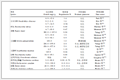
近年来,随着调查和研究程度的逐渐深入和高精度测年数据的积累,在扬子板块的西南缘和北缘分别识别出多个太古宙-古元古代杂岩体(见电子版附表 1),它们共同记录了:(1) 2.15~2.0Ga洋壳俯冲有关的弧岩浆事件(Wu et al., 2012; Han et al., 2017, 2018);(2) 2.0~1.95Ga弧-陆或陆-陆碰撞相关的岩浆-变质事件(Zhang et al., 2006; Wu et al., 2008; Yin et al., 2013; Li et al., 2014; Guo et al., 2015; Wang et al., 2015; Li et al., 2016);(3) ~1.87Ga后碰撞背景下岩浆事件(Peng et al., 2012; Chen and Xing, 2016; Zhou et al., 2017; Han et al., 2019);(4) 1.8~1.6Ga板内拉张背景下岩浆事件(Zhao et al., 2010; Chen et al., 2013b; 邓奇等, 2017; Liu et al., 2019; Lu et al., 2019)。这些新的发现趋向于将扬子古元古代构造演化与全球Columbia超大陆演化相关联(Wang et al., 2016; Zhou et al., 2017; Chen et al., 2019; Cui et al., 2020; Qiu et al., 2020)。但由于这些露头只是零星出露(图 1),且目前古元古代地质体识别和研究也十分有限,扬子板块古元古代岩石的时空展布规律、造山作用转换与演化、及其与超大陆聚散的响应关系仍不清楚。继续识别古元古代时期的地质记录,进一步研究这一时期的岩浆-变质-沉积-构造事件,是研究扬子板块古元古代构造演化的基础,也是探讨重建该陆块在Columbia超大陆中位置的前提。
|
附表 1 扬子陆块代表性太古宙-古元古代岩石锆石U-Pb年龄与Hf-Nd同位素数据汇总表 Appendix Table 1 Summarized zircon U-Pb ages and Hf-Nd isotope data from the Archean-Paleoproterozoic rocks of the Yangtze Block, China |
最近,在红安造山带南缘金盆水库地区的区调工作中,我们新识别出一个面积近4km2新太古代-古元古代的岩石-构造单元,其野外接触关系明确、岩性丰富多样,为进一步研究扬子板块古陆壳的形成与演化提供了新的素材。本文在最新区调成果的基础上,对金盆杂岩体中古元古代基性、酸性岩浆岩开展了锆石U-Pb-Hf同位素、全岩主-微量元素和Sr-Nd同位素分析,并结合区域上古元古代岩浆-变质事件,探讨了扬子板块东部古元古代造山作用演化过程及其参与Columbia超大陆重建的可能位置。
1 地质背景中国大陆的主体格局是由华北和华南两大克拉通于三叠纪沿秦岭-桐柏-红安-大别-苏鲁造山带碰撞而形成。其中,华南克拉通则被认为是由扬子和华夏板块在新元古代沿着NNE向江南造山带拼贴而成(图 1; Zheng, 2012; Zhang et al., 2013)。与华北克拉通不同,扬子板块太古宙-古元古代岩石仅大面积出露于扬子北缘的黄陵地区(Zhao and Cawood, 2012; Zhang and Zheng, 2013)。另外,最新发现了一些零星分布的露头(图 1),包括:(1)西北缘的后河(Wu et al., 2012)和鱼洞子(Hui et al., 2017; Zhou et al., 2018; Chen et al., 2019);(2)北部的崆岭(Qiu et al., 2000; Zhang et al., 2006; Zheng et al., 2006; Chen et al., 2013a; Li et al., 2014, 2016)、钟祥(Wang et al., 2015; Zhou et al., 2015, 2017)和黄土岭(Wu et al., 2008);(3)东北部的董岭(Chen and Xing, 2016);(4)西南缘康滇的大红山-东川-河口(Zhao et al., 2010; Chen et al., 2013b; 郭阳等, 2014; 邓奇等, 2017; Cui et al., 2019, 2020; Liu et al., 2019; Lu et al., 2019);以及(5)越南北部(Lan et al., 2001; Anh et al., 2015; Wang et al., 2016; Zhao et al., 2019a, b)。
红安造山带位于中央造山带中段,其东、西分别以麻城、大悟断裂与大别、桐柏地块相邻;南界襄樊-广济断裂分隔了造山带前震旦系变质岩与扬子北缘震旦系以来的沉积盖层;北界龟山-梅山断裂代表了华北-华南克拉通在红安造山带的分界线(徐扬,2017)。基于岩石组合、变质程度、构造变形等特征,通常将红安造山带自北而南划分为6个岩石-构造单元(Wu and Zheng, 2013):(1)南湾复理石建造;(2)八里畈混杂岩带;(3)浒湾高压榴辉岩带;(4)新县超高压榴辉岩带;(5)红安高压榴辉岩带;和(6)木兰山蓝片-绿片岩带。大量年代学和地球化学研究表明,虽然变质-变形程度不同,但以上各单元的变质岩石原岩年龄主要集中在新元古代,且记录了古生代或三叠纪与HP-UHP变质有关的变质年龄。虽然一些变质沉积岩出现古元古代碎屑锆石的年龄峰值,但该区新元古代以前的岩石鲜有报道(Wu and Zheng, 2013; Liu et al., 2015; 及其参考文献)。
木兰山蓝片-绿片岩带是红安造山带最南缘的浅变质区,其主体由大磊山和双峰尖为核部的两个片麻岩穹隆构造组成(图 2; 湖北地质调查院, 2018①)。两个穹隆的核部均为青白口纪片麻状的二长花岗岩类,分别称之为大磊山岩体(~800Ma)和双峰尖岩体(~810Ma);穹窿的翼部为中低变质带程度的新元古代红安岩群,近NNE向基性岩脉侵入其中。核部正片麻岩与翼部表壳岩系之间多为构造接触。红安岩群的岩性复杂多样,其原岩包括钙碱性火山岩、双峰式火山岩和含碳-磷的陆源碎屑沉积岩(徐扬, 2017)。新调查研究发现,大磊山岩体内部铁铺村可见一闪长质岩块,它近南北向产出,长900m、宽约250~400m,大磊山岩体的二长花岗岩侵入其中,其锆石U-Pb定年结果为~1970Ma (Xu et al., 2020)。
① 湖北地质调查院. 2018. 1:50000小河镇幅矿产图

|
图 2 红安造山带南缘金盘杂岩体地质简图(据湖北地质调查院, 2018修改) 图中标注有*年龄值引自湖北地质调查院(2018) Fig. 2 Simplified geological map of the Jinpen Complex in the southern Hong'an orogenic belt |
新识别的金盆杂岩体位于湖北大悟县以南的金盆水库北岸(图 2),其南北长近2km、东西宽1~2km,面积近4km2。金盆杂岩体的围岩主要为红安岩群的大理岩岩性段,其主要岩性为白云石大理岩、含磷灰石白云母大理岩、白云石英片岩及变粒岩,二者之间为构造接触。根据岩性不同,大体沿着汪家大凹-郭家湾一线可以将金盆杂岩体一分为二,西部为表壳岩系,岩性包括二云石英片岩(碎屑锆石年龄主峰值位于~2500Ma左右)、钠长变粒岩(岩浆锆石年龄为2492±12Ma, MSWD=4.1)和白云(绢云)石英片岩(湖北地质调查院, 2018);东部主要为片麻状二长花岗岩(图 3a)、弱面理化的奥长花岗岩、黑云母二长花岗岩等多种岩性。在郭家湾东侧,可见弱变形的奥长花岗岩的脉体侵入到片麻状二长花岗岩之中(图 3b)。杂岩体内可见多处基性岩侵入体/脉体,其规模大小不一,从几十厘米到几米宽不等(图 2)。在金盆水库东北岸的露头(图 3c),上部出露为淡色的弱变形的奥长花岗岩,下部为糜棱岩化黑云二长花岗岩,二者之间为厚约1m的辉绿岩侵入体(基性岩脉)。辉绿岩与奥长花岗岩界线起伏,为岩浆侵入接触关系。糜棱岩化黑云二长花岗岩可见S-C组构和各类旋转碎斑(图 3d),该露头的基性岩脉与下伏糜棱岩化黑云二长花岗岩为构造接触关系。

|
图 3 金盘杂岩体野外照片和显微照片 (a)片麻状二长花岗岩(JP1-01); (b)弱变形的细粒奥长花岗岩(JP1-02)侵入于片麻状二长花岗岩中; (c)基性岩脉侵入到奥长花岗岩和糜棱岩化黑云二长花岗岩之间; (d)糜棱岩化黑云二长花岗岩; (e)细粒奥长花岗岩显微照片; (f)基性岩脉显微照片. 矿物缩写:Amp-角闪石; Bt-黑云母; Cpx-单斜辉石; Ep-绿帘石; Kfs-钾长石; Mag-磁铁矿; Pl-斜长石; Qz-石英 Fig. 3 Representative photographs and photomicrographs for the Jinpen Complex (a) gnessic monzogranite (JP1-01); (b) weakly deformed fine-grained trondhjemite (JP1-02) intrude gneissic monzogranite; (c) mafic dyke intrude trondhjemite and monzogranite; (d) mylonitized biotite monzogranite; (e) photomicrograph for trondhjemite; (f) photomicrograph for mafic dyke. Mineral abbreviation: Amp-amphibole; Bt-biotite; Cpx-clinopyroxene; Ep-epidote; Kfs-K-feldspar; Mag-magnetite; Pl-plagioclase; Qz-quartz |
本文样品主要采自金盆水库以北(图 2),挑选新鲜、低蚀变、无脉体的岩石用于地球化学分析和锆石分选。
片麻状二长花岗岩采集于金盆水库北侧张家湾一带,沿露头风化严重,样品松散易碎,片面理发育(图 3a, b),已不宜用于全岩地球化学成分分析。其片麻理倾角平缓,主要矿物组成为斜长石(20%~25%)(体积百分含量,下同)、正长石(25%~30%)、石英(20%~25%)、云母(5%~10%)和堇青石(4%~7%),副矿物可见锆石。其中,堇青石无色,他形粒状或呈卵形,粒径多为0.1~0.2 mm,个别堇青石发育聚片双晶,其内部可见夕线石包裹体。
奥长花岗岩为细粒半自形粒状结构,块状构造为主、局部可见弱面理构造(图 3b)。其矿物组成以几乎不含暗色矿物为特征,主要由斜长石(50%~55%)、石英(30%~35%)、正长石(5%~10%)组成,还可见少量白云母和黑云母(图 3e),副矿物为立方体状的黄铁矿。斜长石多为半自形板状或粒状、最大可达0.8mm,发育聚片双晶,可见有较弱的黏土化。正长石多为他形粒状,粒度较细。
基性岩脉为粒状鳞片变晶结构,弱的片状构造或块状构造(图 3c),主要由斜长石(35%~40%)、角闪石(15%~20%)、黑云母(15%~20%)、绿帘石(10%)和单斜辉石(4%~7%)组成。单斜辉石为粒状(粒径1~1.5mm),角闪石为长柱状,它们的边部可见细鳞片状的黑云母和绿帘石(图 3f);斜长石为半自形短柱状,普遍见黏土化。
3 分析方法本文锆石阴极发光图像(CL)照相、U-Pb定年和Hf同位素分析以及部分样品的全岩主、微量元素分析在武汉上谱分析科技有限责任公司完成;另有一部分样品的全岩主、微量元素分析以及4件全岩Sr-Nd同位素比值分析在武汉地质调查中心完成。
3.1 锆石U-Pb定年和Lu-Hf同位素分析测年的样品采用标准重矿物分离技术分选出锆石,在双目镜下尽量挑选透明、晶形完好、无裂隙且具有代表性的锆石颗粒制成环氧树脂样靶,打磨抛光后进行CL显微结构观察、并选取合适的锆石颗粒和部位进行U-Pb定年。CL图像仪器为高真空扫描电子显微镜(JSM-IT100),配备有GATAN MINICL系统;其工作电场电压为10.0~13.0kV,钨灯丝电流为80~85μA。
锆石U-Pb定年详细的仪器参数和分析流程见Zong et al. (2017)。GeolasPro激光剥蚀系统由COMPexPro 102 ArF 193nm准分子激光器和MicroLas光学系统组成,ICP-MS型号为Agilent 7700e。本次分析的激光束斑为32μm。U-Pb同位素定年和微量元素含量处理中采用锆石标准91500和玻璃标准物质NIST610作外标分别进行同位素和微量元素分馏校正。每个时间分辨分析数据包括大约20~30s空白信号和50s样品信号。对分析数据的离线处理采用软件ICPMSDataCal (Liu et al., 2010)完成。锆石样品的U-Pb年龄谐和图绘制和年龄加权平均计算采用Isoplot/Ex_ver3 (Ludwig, 2003)完成。
原位微区锆石Hf同位素分析点布置在U-Pb定年点上或其附近具有相似结构的微区。使用的激光剥蚀多接收杯等离子体质谱(LA-MC-ICP-MS)完成,激光剥蚀系统为Geolas HD (Coherent),MC-ICP-MS为Neptune Plus (Thermo Fisher Scientific)。采用单点剥蚀模式,斑束固定为44μm。详细仪器操作条件和分析方法可参照Hu et al. (2012)。91500和GJ-1两个国际锆石标准与实际样品同时分析。分析数据的离线处理采用软件ICPMSDataCal (Liu et al., 2010)完成。计算εHf(t)值时,球粒陨石的176Hf/177Hf比值为0.282772,176Lu/177Hf的比值为0.0332 (Blichert-Toft and Albarède, 1997)。一阶段Hf模式年龄计算时,亏损地幔值采用Griffin et al. (2000)的结果;两阶段Hf模式年龄计算时,采用平均地壳的176Lu/177Hf比值为0.015 (Griffin et al., 2000)。
3.2 全岩主量、微量元素分析岩石地球化学主、微量元素分析样品,尽量选择新鲜均一代表性的样品,经表面去皮、清洗、自然晾干后碎成小块体,并在盘式振动研磨仪RS 200中粉碎至200目。全岩主量元素含量利用PrimusⅡ X射线荧光光谱仪(XRF)分析完成,并用等离子光谱法进行校正,检测方法依据GB/T 14506—1993精度优于3%。微量元素含量利用Agilent 7700e ICP-MS和X series 2 ICP-MS上分析完成,微量元素测试条件及详细流程参见文献(Liu et al., 2010)。
3.3 全岩Sr-Nd同位素分析选择新鲜均一的样品去皮、清洗,然后磨碎至200目,称重约100mg作为同位素分析对象。加入适量的87Rb-84Sr和149Sm-150Nd混合稀释剂和纯化的HF-HNO3-HClO4酸混合酸后,在高温下完全溶解。Sm-Nd同位素地球化学分析在武汉地质调查中心Triton Ti型热电离质谱计完成,流程标样所测的87Sr/86Sr和143Nd/144Nd值与参考值在误差范围内一致。
4 分析结果 4.1 锆石U-Pb定年和Hf同位素组成 4.1.1 片麻状二长花岗岩(JP1-01)片麻状二长花岗岩中锆石多呈暗紫红色自形晶,绝大部分为柱状、少量为粒状。该样品的锆石颗粒粒径集中在50~300μm,其长短轴之比大多为1:1.5~1:3。阴极发光图像揭示大部分锆石颗粒可见清晰或者略微模糊的韵律环带,显示为典型的岩浆锆石结构特征(图 4a)。部分锆石颗粒具有核边结构,由狭窄的强发光的变质边和环带模糊的发光的核部组成。

|
图 4 金盆杂岩体代表性锆石阴极发光图像(a、c、e)及锆石稀土元素分布模式图(b、d、f, 标准化值据Sun and McDonough, 1989) 黄色圆圈和数值分别代表定年分析点位置及其207Pb/206Pb点年龄值(Ma); 绿色圆圈和数值分别为Hf同位素分析点位置及其εHf(t)值 Fig. 4 Cathodoluminescence images (a, c, e) for representative zircon grains showing their internal structures and chondrite-normalized REE patterns (b, d, f, normalized values from Sun and McDonough, 1989) for all dated zircons for the Jinpen Complex Circles and surrounding numbers represent analytical locations, apparent 207Pb/206Pb ages (Ma, yellow number) and εHf(t) values (green number) |
对该样品环带相对清晰的36个锆石微区进行了U-Pb定年和稀土元素分析(表 1)。其结果显示,它们具有较低的Th (45×10-6~271×10-6)和U (98×10-6~561×10-6)含量,对应的Th/U比值范围为0.18~1.23。36个微区的稀土元素总量平均值为582×10-6,球粒陨石标准化稀土元素配分曲线显示重稀土明显富集、而轻稀土相对亏损,具有强烈的负Eu异常和正Ce异常,这些特征与典型岩浆锆石一致(图 4b)。36个分析点获得207Pb/206Pb年龄变化范围较大(图 5a),获得的不一致线上交点年龄为2486±9Ma (MSWD=1.4)。除去8个谐和度较低的分析点,剩余28个谐和锆石记录的207Pb/206Pb年龄较为相似,集中在2457~2517Ma,其加权平均值为2478±5Ma (MSWD=1.3),它与上交点年龄在误差范围内一致,前者应代表了该样品原岩的形成时代。
|
|
表 1 金盘杂岩LA-ICP-MS锆石U-Pb定年结果 Table 1 LA-ICP-MS zircon U-Pb data for the Jinpen Complex |

|
图 5 金盆杂岩锆石U-Pb年龄谐和图(a、c、e)及其εHf(t)值柱状图(b、d、f) Fig. 5 Zircon U-Pb concordia diagrams (a, c, e) and histograms of εHf(t) values (b, d, f) for the Jinpen Complex |
34个锆石Hf同位素分析结果表明(表 2),JP1-01样品具有均一的Hf同位素组成(176Hf/177Hf=0.281096~0.281258)。使用其锆石U-Pb年龄(t=2486Ma)计算的εHf(t)值为-5.1~-0.3 (图 5b),其对应的一阶段(tDM1)和二阶段模式(tDM2)年龄分别为2.99~2.80Ga和3.19~2.93Ga。
|
|
表 2 金盘杂岩LA-ICP-MS锆石Lu-Hf同位素组成分析结果 Table 2 Zircon Lu-Hf isotopic data for the Jinpeng Complex |


样品JP1-02中的锆石呈暗紫红色,大多为柱状自形晶,它们的阴极发光图像上可见清晰的振荡环带,其特征与酸性岩浆中结晶的锆石特征一致(图 4c, d)。少量锆石颗粒的粒度较小,呈浑圆状或者粒状(如2、9、14号锆石),阴极发光图像上无明显分带,或呈现斑杂状、海绵状等不规则的内部结构,这些颗粒可能遭受了后期变质或者流体作用的改造(Tomaschek et al., 2003)。
选取样品中20个代表性锆石微区进行了U-Pb同位素定年(表 1)。其Th和U含量分别为53×10-6~420×10-6和83×10-6~1069×10-6,其对应的Th/U的比值为0.2~1.13。除去5个U-Pb年龄不谐和的分析点(1、2、3、9和14号点),剩余14个分析点的稀土元素配分模式与典型岩浆锆石的稀土元素模式一致(图 4d),它们获得的207Pb/206Pb年龄值变化于1998~2083Ma之间,其对应的加权平均值为2049±16Ma (MSWD=4.1),该年龄被解释为原岩的形成时代(图 5c)。另外,17号点分析在一颗不规则锆石的暗色核部,获得了较老的207Pb/206Pb年龄(2102±15Ma),其成因可能为残留锆石,指示源区存在21亿年物质。
样品JP1-02进行了17个Hf同位素分析,其176Hf/177Hf比值变化于0.281132~0.281396 (表 2),具有负的εHf(t)值(-13.1~-3.4)(图 5d),其相对应的tDM1和tDM2分别为2.92~2.60Ga和3.28~2.80Ga。
4.1.3 基性岩脉(JP2-02)从30kg基性岩脉样品(JP2-02)中分选出78颗锆石,锆石晶形、颗粒大小较为均匀,它们大多为柱状,其长轴多为40~180μm。阴极发光图像上,大部分自形晶锆石发育板状环带结构或者均匀的内部结构(图 4e),与基性岩浆中结晶的锆石的特征一致(Finch and Hanchar, 2003)。这类锆石上的17个分析点获得的Th和U含量分别集中于30×10-6~138×10-6和48×10-6~176×10-6,Th/U比值一般大于0.6; 207Pb/206Pb年龄值集中在1979~2013Ma (图 5e),加权平均值为1999±8Ma (MSWD=0.3),代表了该样品的原岩年龄。
另外,有少量锆石颗粒具有不规则边界(如:16、20和21号锆石),可见相对细密的中酸性岩浆的震荡环带(图 4e, f)。位于这类锆石中的3个分析点获得的Th、U含量变化较小,分别为58×10-6~88×10-6、77×10-6~128×10-6,其Th/U比值为0.5~0.8,对应的207Pb/206Pb年龄值稍老,介于2017~2033Ma之间,加权平均值为2024±19Ma (MSWD=0.28),这与围岩奥长花岗岩的原岩年龄在误差范围内一致(图 5)。综合以上特征,推测这3颗锆石为捕获自围岩的锆石颗粒。第10号锆石呈浑圆状,阴极发光图像呈深色、无环带结构(图 4f),具有相对较高的U含量(1419×10-6)、低的Th/U比值(0.11)以及不谐和的U-Pb年龄值,可能是遭受后期变质作用改造发生重结晶所致(图 4f)。该点年龄不谐和度高,不参与后续讨论。
3颗捕获锆石的Hf同位素组成变化不大(表 2),εHf(t)值分别为-9.2、-8.2和-9.0,对应的tDM1分别为2.74Ga、2.73Ga和2.74Ga。16颗同岩浆作用的锆石的εHf(t)值变化范围稍大(-11~-5.6)(图 5f),对应的tDM1和tDM2分别为2.60~2.80Ga和2.84~3.13Ga。
4.2 全岩主量、微量元素组成 4.2.1 片麻状二长花岗岩挑选了1件较为新鲜的片麻状二长花岗岩(JP1-01) 用于全岩地球化学分析(表 3)。该样品的SiO2、Na2O、K2O含量分别为68.69%、3.32%、2.13%(质量百分含量,下同),具有较高的Al2O3含量(15.28%),其对应的铝饱和指数(A/CNK)高达1.20,属于强过铝质的钙碱性系列。同时,样品具有较低的TiO2 (0.76%)、FeOT (3.53%)和MgO (0.80%)含量,其对应的Mg#值为29。微量元素方面,具有较高的Sr (342×10-6)、低的Y (6.20×10⁻⁶)含量,对应的Sr/Y比值高达55。在球粒陨石标准化稀土元素配分图和原始地幔标准化微量元素蛛网图上(图 6a, b),表现为富集轻稀土(LREE)和大离子亲石元素(LILE,如Ba、U、Pb),而亏损重稀土(HREE)和高场强元素(HFSE,如Nb、Ta、Ti)。
|
|
表 3 金盘杂岩全岩主量元素(wt%)和微量元素(×10-6)含量分析结果 Table 3 Analytical results of major (wt%) and trace (×10-6) elements and related parameters for representative samples from the Jinpen Complex |

|
图 6 金盆杂岩球粒陨石标准化稀土元素配分图和原始地幔标准化微量元素蛛网图(标准化值据Sun and McDonough, 1989) 大陆地壳元素组成的平均值(CC)来自Rudnick and Gao (2003); 富HREE TTG和贫HREE TTG组成来自Halla et al. (2009) Fig. 6 Chondrite-normalized REE patterns and primitive mantle-normalized spider diagrams for the Jinpeng Complex (normalization values after Sun and McDonough, 1989) The average values of the Continental Crust (CC) from Rudnick and Gao (2003); the high- and low-HREE TTGs from Halla et al. (2009) |
10件样品的SiO2含量较高,集中在71.62%~76.92%。样品具有较高的Na2O (4.58%~6.47%)、较低的K2O (0.50%~1.06%)和Al2O3 (13.09%~14.13%)含量,对应的K2O/Na2O比值十分低(< 0.18),A/CNK值介于0.74~1.12,为准铝质-弱过铝质的钙碱性花岗岩类(图 7a, b)。在An-Ab-Or和K-Na-Ca分类图解上,所有样品都落入奥长花岗岩的范围内(图 7d, e)。所有样品具有十分低的MgO (0.19%~1.11%)、FeOT (0.61%~2.75%)含量及Mg#值(29~42),在MgO-SiO2图解(图 7c)上,它们都投入玄武岩部分熔融的熔体范围内。
样品的稀土元素含量较低,其总含量在42.8×10⁻⁶~131×10-6。在球粒陨石标准化稀土元素配分模式图(图 6a)上,显示出LREE相对HREE轻微的富集,其(La/Yb)N=4.7~21.6;并显示变化的Eu异常(Eu/Eu*=0.8~1.3)。在原始地幔标准化微量元素蛛网图(图 6b)上,富集Ba、Th、U、Pb,而亏损Nb、Sr、Zr和Ti。
4.2.3 基性岩脉7件基性岩获得SiO2和MgO含量变化不大,为47.36%~51.60%和4.57%~6.64%。样品总碱含量(K2O+Na2O)为3.64%~5.05%,在TAS图解上都在亚碱性基性岩区域(图 7a)。不活泼元素的岩石分类图解上(图 7b),所有样品也都投在亚碱性的基性岩区域。样品具有较高的FeOT/MgO比值(2.58~3.23),属于拉斑玄武岩系列(图 7f),这与不活泼微量元素的岩石分类结果一致(图 7g)。

|
图 7 金盆杂岩岩石分类图解 (a)碱-硅(TAS)图解; (b) SiO2-Zr/TiO2图解(Floyd and Winchester, 1978); (c) MgO-SiO2图解(Moyen and Martin, 2012); (d) An-Ab-Or图解(Barker, 1979); (e) K-Na-Ca图解(Moyen and Martin, 2012); (f) FeOT/MgO-SiO2图解; (g) Th/Yb-Zr/Y图解(Ross and Bédard, 2009) Fig. 7 Geochemical classifications for the rocks from the Jinpen Complex (a) Total alkali vs. silica (TAS); (b) SiO2 vs. Zr/TiO2 (Floyd and Winchester, 1978); (c) MgO vs. SiO2 (Moyen and Martin, 2012); (d) An-Ab-Or (Barker, 1979); (e) K-Na-Ca (Moyen and Martin, 2012); (f) FeOT/MgO vs. SiO2; (g) Th/Yb vs. Zr/Y (Ross and Bédard, 2009) |
基性岩脉的稀土元素含量总量为110×10-6~156×10-6。在球粒陨石标准化稀土元素配分模式图(图 6c)上,轻稀土、重稀土元素之间的分异较弱((La/Yb)N=2.9~4.0),具有弱的Eu异常(Eu/Eu*=0.8~1.0)。在原始地幔标准化微量元素蛛网图(图 6d)上,相对其相邻元素,可见明显的Rb、Ba、Pb的正异常和Nb、Ta、Sr和Ti的负异常。
4.3 全岩Sr-Nd同位素组成4件代表性基性岩脉进行了全岩Sr-Nd同位素分析,其结果见表 4。获得的87Sr/86Sr比值变化于0.721505~0.721724,以2000Ma的年龄计算,其(87Sr/86Sr)i值为0.68204~0.68684。143Nd/144Nd比值的变化范围较小(0.51187~0.511966),其对应的εNd(t)值为-3.47~-2.47,对应的亏损地幔模式年龄为3275~2969Ma。
|
|
表 4 金盘杂岩基性岩脉全岩Sr-Nd同位素组成分析结果 Table 4 Whole-rock Sr-Nd isotopic compositions for the mafic dykes from the Jinpen Complex |


用于分析的奥长花岗岩样品相对新鲜,元素含量分析过程中烧失量较小(< 1%),具有一致的稀土、微量元素配分模式(图 6a, b)。样品的Ti、Mg、Na、Ca、P、La、Ce、Nb、Sr、Ta、Sm、Y和Yb等元素与极不活泼元素Zr显示一定线性关系(图 8)。这些特征表明成岩后变质蚀变作用对样品的元素组成的改造较小。不同样品的TiO2、MgO、Al2O3、FeOT含量变化不大,CaO、P2O5、Sr、Zr以及REE含量虽有变化,但大多与SiO2的含量呈线性演化关系(图 9),指示它们含量变化主要受控于岩浆演化过程中矿物结晶分异,受变质蚀变的影响较小。因此,上述元素(REE、HREE、Ti、Mg、Na、Ca、P、Sr)含量将和锆石铪同位素一起用于岩石成因的讨论。

|
图 8 金盆杂岩蚀变和变质过程中Zr与部分元素活动对比图 Fig. 8 Plots of selected elements against Zr for the rocks from the Jinpen Complex to evaluate the mobility of these elements during alteration and metamorphism |

|
图 9 金盆杂岩部分元素及元素比值与SiO2相关图解 Fig. 9 Plots of major and trace elements and their ratios against SiO2 for the rocks from the Jinpen Complex |
奥长花岗岩多以弱变形的淡色岩脉产出,在矿物组成上富含斜长石和石英,未见角闪石、石榴石、金红石、绿帘石等深色矿物(图 3e)。地球化学组成上,分析样品显示高硅高钠、贫镁、铁、钾,主要具有准铝质的特点。REE配分模式表现为右倾模式,但不同样品之间的轻、重稀土元素分异程度不尽相同,(La/Yb)N比值变化于4.7~21.6之间(图 6a)。样品亏损Y (5.34×10⁻⁶~14.7×10⁻⁶)和Yb (0.55×10⁻⁶~1.07×10⁻⁶),具有变化的Sr含量(97.2×10⁻⁶~238×10-6),其Sr/Y比值(10.9~28.5)略低于典型TTG/埃达克岩的该比值(图 10a)。但是,在(La/Yb)N-YbN图解(图 10b)上,所有样品均落入典型TTG/埃达克岩系的成分区(Defant and Drummond, 1990)。

|
图 10 金盘奥长花岗岩岩石成因判别图解 (a、b) Sr/Y-Y和(La/Yb)N-YbN图解(Defant and Drummond, 1990; Martin et al., 2005); (c) Dy/Yb-(La/Yb)N图解; (d) (Dy/Yb)N-(La/Sm)N (Klein et al., 1997); (e、f) Nb/Ta-Zr/Sm和Nb/La-Zr/Sm图解(Hoffmann et al., 2011). 图(d)中角闪石、石榴石结晶分异的演化趋势参考Klein et al. (1997) Fig. 10 Petrogenesis discrimination diagrams for the Jinpen trondhjemites (a, b) Sr/Y vs. Y and (La/Yb)N vs. YbN (Defant and Drummond, 1990; Martin et al., 2005); (c) Dy/Yb vs. (La/Yb)N; (d) (Dy/Yb)N vs. (La/Sm)N(Klein et al., 1997); (e, f) Nb/Ta vs. Zr/Sm and Nb/La vs. Zr/Sm (Hoffmann et al., 2011). Rayleigh fractional crystallization trends of garnet and amphibole in Fig. 10d from Klein et al. (1997) |
TTG质岩浆通常被认为是含水的中-基性岩石部分熔融形成的(Martin et al., 2005; Moyen and Martin, 2012)。本文金盆奥长花岗岩高硅低镁(图 7c),具有极低的相容元素含量(Cr=0.9×10⁻⁶~4.9×10⁻⁶、Ni=0.9×10⁻⁶~5.4×10⁻⁶),说明了其岩浆形成演化过程中没有地幔物质的加入、也不曾与地幔楔橄榄岩发生过反应,其成因不是俯冲洋壳、或者拆沉地壳的部分熔融,而是加厚下地壳的部分熔融(Smithies, 2000; Gao et al., 2004)。样品具有低的K2O (0.50%~1.06%)、高的Nb (9.32×10⁻⁶~21.3×10⁻⁶)、以及负的εHf(t)值(-13.1~-3.4),Nb含量高于大陆地壳的平均值(8×10⁻⁶,Rudnick and Gao, 2003)。与之类似,黄陵2053~2015Ma基性岩脉具有低的钾(0.31%~1.42%)、高Nb(3.62×10⁻⁶~33.2×10⁻⁶)和负的εHf(t)值(-12.6~+3.4)(Li et al., 2019; Han and Peng, 2020)。这些特征表明,奥长花岗岩可能是由区域上类似于黄陵低钾基性岩脉的陆壳物质低程度部分熔融的产物。与黄陵基性岩脉相比,奥长花岗岩明显富集LREE而亏损HREE,具有相对较高的Sr/Y、La/Yb和Ta/Nb比值以及更显著的Ti的负异常(图 6a-d),这些类似TTG或埃达克岩的地球化学特征可能与源区熔融、岩浆演化过程中斜长石、石榴石、角闪石和金红石等矿物的贡献有关(Drummond and Defant, 1990; Martin et al., 2005; Moyen, 2011)。
Sr和Eu在斜长石中具有较高的矿物/熔体分配系数;斜长石在源区残留或者TTG质岩浆经历斜长石的分离结晶将降低残浆的Sr含量以及Sr/Y、Eu/Eu*比值,但不能造成LREE与HREE之间的分异(Bédard, 2006)。奥长花岗岩具有高的、变化的SiO2 (71.62%~76.92%),其TiO2、MgO、Al2O3和FeOT含量较低且变化范围不大(图 9a, b),表明岩浆演化中角闪石、石榴石、金红石等矿物结晶分离并不重要。样品具有变化的CaO (0.71%~3.85%)、Sr (97.2×10⁻⁶~238×10-6)含量,可见Sr负异常(图 6b)。随着SiO2增加,大部分样品的CaO、Sr含量和Eu/Eu*值明显降低(图 9h, r, q),CaO、Sr含量与Eu/Eu*值呈明显的负相关关系(图 9i, s),这些特征指示岩浆中发生了斜长石分离。样品JP1-02a具有Eu正异常和高Sr/Y比值,可能与岩石中存在斜长石的堆晶有关(Huang et al., 2010)。另一方面,高硅样品同时具有低的P和LREE含量,La、Ce、Pr等元素与P2O5之间具有正相关关系(图 9l, n, p),可能与岩浆演化晚期有磷灰石/独居石等磷酸盐矿物的结晶分离有关。
斜长石的分离显著地降低了Eu/Eu*和Sr/Y值(图 9q和图 10a),但对Dy/Yb和La/Yb比值的影响较小(图 10b)。样品JP2020-1和JP2020-4具有相对低的SiO2,高的CaO、P2O5、Sr和LREE含量,其组分最接近初始岩浆的组分。这两件低分异样品的未见Eu的负异常(Eu/Eu*=1.03~1.06),这与黄陵基性岩脉相似(图 6a),指示了斜长石没有大量地残留于源区;它们中等的YbN和(La/Yb)N值也进一步指示一个含石榴石的角闪岩源区(图 10b)。
角闪石对中稀土元素的相容性强于重、轻稀土元素,它的分离则会降低熔体/残浆的Dy/Yb比值(Davidson et al., 2007);石榴石对REE的相容性随着原子序数的升高而升高,它在分异REE时会显著提升Dy/Yb比值,因此高的(Dy/Yb)N值能更有效地反映石榴石的贡献(Klein et al., 1997; Barth et al., 2002)。奥长花岗岩的(Dy/Yb)N值变化于0.97~2.28,低分异样品JP2020-1和JP2020-4具有更高的(Dy/Yb)N值(2.20~2.21),明显高于黄陵基性岩脉(1.50~1.92,Li et al., 2019)和高压TTG的平均值(1.67,Halla et al., 2009),指示源区存在石榴石的残留。Dy/Yb-(La/Yb)N及(Dy/Yb)N-(La/Sm)N之间正相关关系也进一步说明部分熔融过程中REE的分异是受到石榴石的控制(图 10c, d)。
金红石和富钛角闪石均能吸收Nb-Ta-Ti,并造成“双胞胎”元素Nb-Ta之间的分异。金红石一般具有低于球粒陨石的Nb/Ta比值,它在部分熔融或岩浆分异过程中分离将提升Nb/Ta比值(Aulbach et al., 2008; Hoffmann et al., 2011);角闪石的分离则会降低Dy/Yb和Nb/Ta比值、而提升Zr/Sm比值(Foley et al., 2002; Klemme et al., 2005)。奥长花岗岩具有显著的Ti的负异常,其Nb/Ta比值(6.33~9.43)较小,明显低于球粒陨石和黄陵基性岩脉中的该值,这样的特征不能用金红石的分离来解释(金红石在源区残留或从岩浆中结晶将提升该比值),而与角闪石残留于源区特征一致(图 10e)。Nb/La与Zr/Sm比值呈正相关,也不符合角闪石结晶分异趋势(图 10f),高硅样品高的Nb/La比值可能与磷酸盐矿物的结晶有关。因此,本文样品中强烈的Ti负异常和低的Nb/Ta比值与角闪石在源区的残留有关。
综上所述,金盆奥长花岗岩为区域上类似黄陵基性岩脉的陆壳物质在加厚地壳源区部分熔融的产物,其类似TTG岩的地球化学特征主要受控于部分熔融过程中石榴石+角闪石在源区的残留;斜长石结晶分异作用降低了岩浆体系的Sr含量和Sr/Y比值。
5.2 ~2.0Ga基性岩脉岩石成因用于本文分析的基性岩脉样品相对新鲜,除高蚀变样品JP6外(其LOI=2.04%,不参与后续讨论),其余样品的烧失量较小(< 1.79%)。其绝大部分主量和微量元素含量变化范围较小(图 9),且具有平行一致的稀土、微量元素配分模式(图 6c, d)。Ti、Mg、Na、Ca、REE、HFSE、Th、U、Ba等元素与Zr显示一定线性关系(图 8),表明这些元素并没有遭受成岩后变质作用的显著影响,可以用来反映其原始组成。另一方面,样品获得了低的全岩(87Sr/86Sr)i比值(0.68204~0.68684),该比值与其Rb/Sr比值呈负的相关性(图略),指示Rb-Sr同位素系统遭受了后期变质-蚀变作用改造。不同样品的Sm/Nd (0.25~0.26)和143Nd/144Nd (0.51187~0.51197)比值变化较小,全岩εNd(t)值(-3.47~-2.47)和锆石εHf(t)值(-11~-5.6)均为一致的负值,表明相对稳定的Sm-Nd同位素能够反映其原始组成。因此,上述相对稳定的元素以及铪-钕同位素组成将一起用于探讨金盆基性岩脉的岩石成因。
未经分异的幔源基性岩浆通常具有高的Ni (>300×10-6)、Cr (>300×10-6)含量和Mg#值(68~72)(Frey et al., 1978)。而金盆基性岩脉具有低的MgO (4.57%~6.64%)、Cr (60×10-6~102×10-6)、Ni (62×10-6~176×10-6)含量和Mg#值(36~41),指示其母岩浆可能经历了橄榄石、辉石等矿物的结晶分离。样品中Cr、Ni、Co含量随着MgO含量的降低而降低,也支持了橄榄石、辉石的结晶分离(图 9c, e, g)。而样品中TiO2、FeOT、V与SiO2之间呈负相关(图 9a, d),则可能与铁钛的氧化物分离有关,Eu的负异常(图 6c)则可能与斜长石的分离有关。
金盆基性岩脉富集不相容元素,LREE、LILE相对HREE、HFSE富集(图 6c, d),具有富集的Hf-Nd同位素组成(εHf(t)=-11~-5.6,εNd(t)=-3.47~-2.47)。高的LILE/HFSE或LREE/HFSE比值(如:Ba/La=86~128、Ba/Nb=133~216、La/Nb=1.53~1.87、Th/Ta=4.00~4.34)以及高的Zr/Nb比值(12.5~17.2),明显区别于洋岛玄武岩和洋中脊玄武岩(Fitton, 1995; Leybourne et al., 1999),显示出弧型(陆壳型)地球化学特征,这样富集的特征既可能继承自一个富集的地幔源区、也可能是由地壳混染造成的(图 11)。野外可见基性岩脉侵入奥长花岗岩和片麻状二长花岗岩之中,它们都具有相似的弧型地球化学特征(图 6)和富集的Hf同位素组成(图 5),暗示了基性岩浆就位过程中可能同化了围岩物质。样品JP2-02中的捕获锆石具有与围岩奥长花岗岩锆石一致的年龄值和εHf(t)值(图 5),也进一步支持了本地围岩混染的存在。然而,本地围岩混染不能解释样品中具有高于围岩的K2O和HREE元素含量和La/Nb、La/Ta比值(表 3和图 6)。对地壳混染反应敏感的εNd(t)、Nb/La、Nb/U、Nb/Th、Ta/Th等比值并没有随着SiO2含量增加而急剧减低(图 12a, b)。这些特征表明,地壳混染作用不强烈并没有显著改变地球化学组成,金盆基性岩脉的弧型的地球化学特征和富集的Hf-Nd同位素组成可能主要继承自一个富集的地幔源区。

|
图 11 金盆杂岩源区性质判别图解 (a) La/Ba-La/Nb图解(洋岛玄武岩范围引用自Fitton, 1995); (b) (Nb/La)PM-(La/Sm)N图解; (c) Nb/La-(Th/Nb)N图解; (d) La/Nb-La图解(d, 据李曙光, 1993). 图中球粒陨石、原始地幔、正常洋中脊玄武岩、富集玄武岩、洋岛玄武岩元素含量引用Sun and McDonough (1989),大陆地壳元素组成的平均值(CC)来自Rudnick and Gao (2003) Fig. 11 Trace element discrimination diagrams to inferc mantle source of the Jinpen Complex (a) La/Ba vs. La/Nb (OIBs are from Fitton, 1995); (b) (Nb/La)PM vs. (La/Sm)N; (c) Nb/La vs. (Th/Nb)N; (d) La/Nb vs. La (d, after Li, 1993). The chondrite, primitive mantle, NMORB, EMORB and OIB from Sun and McDonough (1989). The average values of the Continental Crust (CC) from Rudnick and Gao (2003) |

|
图 12 金盆基性岩脉岩石成因判别图解 (a)全岩εNd(t)-SiO2图解; (b)全岩εNd(t)-Nb/La图解; (c) Nb/La-MgO图解(Kepezhinskas et al., 1996); (d) Nb/U-Nb图解; (e) (Nb/Th)PM-(Nb/La)PM图解(Sajona et al., 1996; Kepezhinskas et al., 1997; Aguillón-Robles et al., 2001); (f) Nb/Zr-Th/Zr图解(Kepezhinskas et al., 1997) Fig. 12 Petrogenesis discrimination diagrams for the Jinpen mafic dykes (a) whole-rock εNd(t) vs. SiO2; (b) whole-rock εNd(t) vs. Nb/La; (c) Nb/La vs. MgO (after Kepezhinskas et al., 1996); (d) Nb/U vs. Nb; (e) (Nb/Th)PM vs. (Nb/La)PM (Sajona et al., 1996; Kepezhinskas et al., 1997; Aguillón-Robles et al., 2001); (f) Nb/Zr vs. Th/Zr (Kepezhinskas et al., 1997) |
一般而言,俯冲板片释放的流/熔体对上覆地幔楔的交代作用是大陆岩石圈地幔富集的主要机制,遭受俯冲带流体交代的地幔以相对富集LILE和LREE而亏损HFSE和HREE为主要特征;遭受熔体交代地幔源区则以富集HFSE和流体不活泼元素为主要特征(如:Zr、Hf、Nb、Ta、REE等)(Kepezhinskas et al., 1997; Class et al., 2000)。金盆基性岩脉的Zr、Hf、HREE等元素含量明显高于围岩和陆壳平均值(图 6),指示了一个富集高场强元素的源区。高的Nb含量(11.4×10⁻⁶~14.8×10⁻⁶)和Nb/U (19.2~23.6)、Nb/La (0.53~0.65)、Nb/Th (3.71~4.67)和Zr/Th (54.1~64.9)比值,与俯冲带上的富铌玄武岩一致(图 12c-e),指示了其源区遭受了再循环沉积物熔体的交代(Kepezhinskas et al., 1996; Sajona et al., 1996; Aguillón-Robles et al., 2001)。事实上,2.05~2.03Ga和~1.87Ga黄陵富铌基性岩脉也具有类似的富集特征(Nb=10.9×10⁻⁶~24.2×10⁻⁶、εHf(t)=-12.6~-10.5、εNd(t)=-4.9~+2.5,Qiu et al., 2020; Han and Peng, 2020);本文金盆杂岩体以北17km的铁铺碱性闪长岩(~1.97Ga)也强烈地富集Nb元素和Hf-Nd同位素(Nb=20.9×10⁻⁶~34.4×10⁻⁶、εHf(t)=-12.5~-3.1、εNd(t)=-6.53~-4.08,Xu et al., 2020)。它们的Th/Zr比值较低、且变化范围不大,而Nb/Zr比值变化范围较大,在常用的判断交代介质性质的图解(图 12f)上显示熔体交代的特点(Kepezhinskas et al., 1997)。综上所述,金盆基性岩浆遭受一定程度的地壳混染,上述弧型地球化学特征、富集的Nb元素和Hf-Nd同位素组成主要源自古老沉积物熔体对源区的交代,区域上的这些富铌岩石共同指示当时(2.05~2.0 Ga)在扬子北缘已经出现一个遭受了古老陆壳物质交代的富集地幔(图 13)。

|
图 13 扬子板块东部古元古代锆石U-Pb年龄与Hf-Nd同位素相关图 图中,球粒陨石(CHUR)和亏损地幔(DM)的Hf同位素演化线引自Blichert-Toft and Albarède (1997)和Griffin et al. (2006). 前人报道的代表性古元古代岩石:黄陵水月寺蛇绿混杂岩(Han et al., 2017); 黄陵高镁安山岩(Han et al., 2018); 黄陵I型花岗岩(Han et al., 2017, 2019); 黄陵S型花岗岩(Guo et al., 2015); 钟祥I型花岗岩(Wang et al., 2015); 黄陵A型花岗岩(Peng et al., 2012; Han et al., 2019); 钟祥A型花岗岩(Zhou et al., 2017); 董岭A型花岗岩(Chen and Xing, 2016); 黄陵基性岩脉(Peng et al., 2009; Li et al., 2014, 2019; Han and Peng, 2020; Qiu et al., 2020); 黄陵幔源闪长岩脉(Han and Peng, 2020); 桐柏大河口斜长角闪岩(周光颜, 2018) Fig. 13 Zircon εHf(t) and whole-rock εNd(t) values corrected to the zircon ages for the Paleoproterozoic rocks from the eastern Yangtze Block Reference lines representing meteoritic Hf evolution (CHUR, and depleted mantle) are from Blichert-Toft and Albarède (1997) and Griffin et al. (2006). Literature data sources: Shuiyuesi mélange belt (Han et al., 2017); Huangling high Mg-andesite (Han et al., 2018); Huangling Ⅰ-type grantie (Han et al., 2017, 2019); Huangling S-type grantie (Guo et al., 2015); Zhongxiang Ⅰ-type grantie (Wang et al., 2015); Huangling A-type grantie (Peng et al., 2012; Han et al., 2019); Zhongxiang A-type grantie (Zhou et al., 2017); Dongling A-type grantie (Chen and Xing, 2016); Huangling mafic dyke (Peng et al., 2009; Li et al., 2014, 2019; Han and Peng, 2020; Qiu et al., 2020); Huangling mantle-derived diorites (Han and Peng, 2020); Tongbai Dahekou plagioclase amphibolite (Zhou, 2018) |
虽然对扬子板块太古宙-古元古代的古构造格局和古陆壳形成过程仍不完全清楚,但目前趋向于认为古元古代早期扬子内部可能由多个相互独立的块体组成的(Wu et al., 2012; Wang et al., 2016; Cui et al., 2019)。基于锆石年龄谱的差异,早期Wu et al. (2012)提出在太古宙-古元古代早期扬子板块的西部与东部具有不同的陆壳演化历史,二者在早古元代之前分属不同(微)陆块。之后随着调查研究的深入,新识别的古元古代地质体越来越多(附表 1),扬子板块内部不同单元的古元古代岩浆-变质-沉积事件得到了更多的揭示。从其时空分布特征看(图 1): (1)扬子西南缘、西北缘以记录2.5~2.2Ga岩浆活动为其鲜明特色,同时古元古代记录多期次(2.50Ga、2.36Ga、1.96Ga、1.85Ga)的区域变质作用(Nam et al., 2003; Wang et al., 2016; Hui et al., 2017; Zhou et al., 2018; Chen et al., 2019; Cui et al., 2019; Zhao et al., 2019a);(2)与之不同,扬子东部的黄陵背斜和东北部则以2.15~1.80Ga俯冲-碰撞-后碰撞过程有关的岩浆作用为主,并记录了包括高压麻粒岩相变质在内的造山带变质事件,其变质年代集中在2.0~1.90Ga (图 13; Zhang et al., 2006; Wu et al., 2008; Yin et al., 2013; Li et al., 2014; Guo et al., 2015; Wang et al., 2015; Han et al., 2017, 2018,2019; Hui et al., 2017; Li et al., 2019; Liu et al., 2019)。因此,扬子板块在在元古代早期可以分为东部和西部等两个独立的(微)陆块(图 1; Wu et al., 2012; Cui et al., 2019)。地球物理数据也反映出扬子东、西部在重力磁力场上的差异,深地震反射剖面则揭示了隐伏于四川盆地东缘的古元古代俯冲带和碰撞带的存在(Dong et al., 2015; Xiong et al., 2016),支持了地质上划分东、西陆块的方案。与之一致,黄陵穹窿也可以划分为西部的中太古代块体和东部的新太古代地体(Qiu et al., 2000; Guo et al., 2014, 2015),二者之间为新厘定的2.14~2.0Ga水月寺蛇绿混杂岩带沿着北东向展布,混杂岩带内不同性质岩片的配置关系进一步约束其俯冲极性是向东南方向(Han et al., 2017),这与地震反射剖面揭示俯冲极性一致(图 1)。
现有研究成果(附表 1)表明,古元古代扬子东部和西部陆块之间的汇聚、拼贴过程可以划分为以下几个阶段(图 13):
(1) 2.14~2.0Ga水月寺蛇绿混杂岩带(Han et al., 2017)、2.15~2.12Ga玄武岩-高镁安山岩-闪长岩脉(Han et al., 2018; Han and Peng, 2020)、俯冲有关的2.08Ga钙碱性花岗岩(Wu et al., 2012)和2.05~2.02Ga基性岩脉(Li et al., 2019; Han and Peng, 2020)均指示了古元古代早期(2.2~2.0 Ga)存在大洋的俯冲作用。这一阶段幔源岩石具有MORB型或者弧型地球化学特征,其锆石大部分具有正的εHf(t)值(图 13),表明当时扬子北缘存在一个Hf同位素亏损的地幔源区,交代地幔的介质主要为年轻洋壳物质释放的流/熔体。而~2.15Ga黄陵闪长岩(Han and Peng, 2020)和一些遭受俯冲带流体改造的基性岩锆石(Han et al., 2017)显示亏损或弱富集的Hf-Nd同位素组成,表明在洋壳俯冲阶段只有少量的古老地壳物质卷入俯冲带隧道中。2.05~2.0Ga黄陵(Li et al., 2019; Han and Peng, 2020)和本文的富铌基性岩脉强烈富集不相容元素和Hf-Nd同位素,共同指示了一个遭受古老陆壳沉积物熔体交代的地幔源区的出现,这可能与洋壳俯冲晚期洋盆缩减、陆(微)块靠近,已有越来越多的古老陆壳物质卷入俯冲隧道有关,构造环境将由俯冲向碰撞转换。
(2) 2.0~1.95Ga高压麻粒岩相-角闪岩相变质事件(Zhang et al., 2006; Wu et al., 2008; Yin et al., 2013; Li et al., 2016; Han et al., 2017)、~1.99Ga混合岩化作用(Li et al., 2014; 邱啸飞等, 2020)、2.0~1.99Ga S型花岗岩(Yin et al., 2013; Li et al., 2014; Guo et al., 2015)和1.96~1.94Ga同碰撞高钾花岗岩(Wang et al., 2015)标志在2.0~1.95Ga进入了陆-陆碰撞阶段。这些花岗岩大多具有非常富集的Sr-Nd同位素组成(εHf(t)和εNd(t)值大多小于-12),表明不同成分古老陆壳物质在碰撞阶段的重熔。
(3) 挤压造山阶段向后造山伸展阶段转化的主要标志是在黄陵、钟祥、董岭等地的1.87~1.84Ga的A型花岗岩(Peng et al., 2012; Chen and Xing, 2016; Zhou et al., 2017; Han et al., 2019)和桐柏、苏鲁地区1.85~1.84Ga高温、高压变质事件(Xiang et al., 2014; Zhang et al., 2020)。这一阶段的1.87~1.78Ga基性岩具有弧型地球化学特征和富集的Nd-Hf同位素组成(Peng et al., 2009; Li et al., 2014; 周光颜, 2018; Qiu et al., 2020),指示了前述富集的大陆岩石圈地幔在后造山伸展环境下的部分熔融。
本文新发现的金盆奥长花岗岩(~2.05Ga)和基性岩脉(~2.0Ga)形成于区域上限定的俯冲阶段末,它们是由俯冲背景下加厚陆壳和大陆岩石圈地幔的部分熔融形成的。以本文2.05~2.0Ga金盆和黄陵富铌基性岩脉为标志,已有越来越多的古老陆壳物质卷入俯冲隧道,预示着该区洋壳消减殆尽、即将进入碰撞阶段(图 12)。综合考虑到区域上与2.2~1.8Ga与俯冲-碰撞-后造山伸展有关的岩石的时空关系(图 1),我们推测黄陵地区的2.14~2.0Ga水月寺蛇绿混杂岩带与钟祥1.96~1.94Ga同碰撞花岗岩成一条NE向展布的俯冲-碰撞带,并与深部隐伏的古元古代俯冲带对应(图 1)。再往北越过襄樊-广济断裂后,由于该带卷入了桐柏-红安-大别造山带,遭受后期强烈的构造-岩浆作用的肢解和改造,导致最终以残片或岩块(如凤凰咀、武胜关、金盆、铁铺、木子店、黄土岭、宿松等)的形式就位于造山带内部,已经失去原始产状信息(图 1)。综合来看,扬子东、西陆块沿着2.15~1.95Ga黄陵-钟祥俯冲-碰撞带拼合,与全球范围内的2.1~1.9Ga造山事件在时间上一致,这可能与当时Columbia超大陆的聚合有关(Hoffman, 1989; Rogers and Santosh, 2003; Zhao et al., 2004; Zhang et al., 2012)。
在前Columbia时期,Laurentia大陆Rae克拉通周缘的岩浆-变质事件频发。扬子西南(包括越北)2.40~2.29Ga火山岩浆-变质事件(Nam et al., 2003; Cui et al., 2019, 2020;Zhao et al., 2019a)是Rae克拉通西缘2.40~2.29Ga Arrowsmith造山事件在扬子板块的响应。而二者同步记录的2.28~2.08Ga多期边缘增生岩浆侵位活动(Wu et al., 2012; Wang et al., 2016; Lu et al., 2019; Cui et al., 2020),再次说明扬子板块是在Arrowsmith造山带时期增生拼贴到Rae克拉通。我们将扬子板块2.1~1.95Ga俯冲-碰撞事件与Rae和Slave克拉通沿着Taltson-Thelon造山事件(McDonough et al., 2000; Hoffman, 2014)进行对比:(1)二者具有同步的2.1~2.0Ga俯冲相关的岩浆活动(Han et al., 2018; Li et al., 2019);(2) 2.0~2.5Ga麻粒岩相变质作用过程具有相同的顺时针轨迹(Zhang et al., 2006; Wu et al., 2008; Yin et al., 2013; Li et al., 2016);(3) 2.0~1.94Ga同碰撞花岗质岩浆的侵位(Yin et al., 2013; Li et al., 2014; Guo et al., 2015; Wang et al., 2015)。因此,扬子东西陆块拼贴很可能与Laurentia大陆西北缘2.0~1.95Ga Taltson-Thelon造山带对应。基于以上同步事件,前人和本文数据支持扬子板块卷入了Columbia超大陆的汇聚,位置很可能位于Laurentia大陆的西北缘(Wang et al., 2016; Chen et al., 2019; Cui et al., 2019; Qiu et al., 2020)。
需要指出的是,由于南华纪以来的沉积覆盖和强烈改造,古元古代变质岩在扬子板块仅有零星出露。基于前述零星露头,仍无法全面刻画扬子古元古代构造格局和造山过程,今后仍需继续识别区内的古元古代地质实体和地质事件,以提升对扬子古元古代陆壳演化的认识。
6 结论(1) 锆石U-Pb定年结果表明,新厘定的古元古代金盘杂岩体中片麻状二长花岗岩、奥长花岗岩和基性岩脉侵位的时代分别为2478Ma、2049Ma和1999Ma。
(2) 全岩主、微量元素及锆石Hf同位素表明,金盆奥长花岗岩为陆壳物质在加厚地壳源区部分熔融的产物,其类似TTG岩的地球化学特征主要受控于部分熔融过程中石榴石+角闪石在源区的残留。
(3) 金盆基性岩脉具有弧型地球化学特征和富集Hf-Nd同位素组成,是由地壳混染和富集地幔源区共同造成的;其富铌的特征与源区遭受再循环沉积物熔体的交代有关。
(4) 综合前人和本文的数据推测,扬子东、西陆块在2.15~2.0Ga不断汇聚,并在2.0~1.95Ga沿着黄陵-钟祥一线拼贴,最终形成古元古代统一的基底,这一过程可能与全球Columbia超大陆的汇聚有关。
致谢 两位匿名评审专家提出了许多有益的意见和建议,在此表示衷心感谢!
Aguillón-Robles A, Calmus T, Benoit M, Bellon H, Maury RC, Cotten J, Bourgois J and Michaud F. 2001. Late Miocene adakites, Nb-enriched basalts from Vizcaino Peninsula, Mexico: Indicators of East Pacific Rise subduction below southern Baja California?. Geology, 29(6): 531-534 DOI:10.1130/0091-7613(2001)029<0531:LMAANE>2.0.CO;2
|
Anh HTH, Hieu PT, Le Tu V, Son LM, Choi SH and Yu Y. 2015. Age, tectonic implications of Paleoproterozoic Deo Khe granitoids within the Phan Si Pan Zone, Vietnam. Journal of Asian Earth Sciences, 111: 781-791 DOI:10.1016/j.jseaes.2015.07.014
|
Aulbach S, O'Reilly SY, Griffin WL and Pearson NJ. 2008. Subcontinental lithospheric mantle origin of high niobium/tantalum ratios in eclogites. Nature Geoscience, 1(7): 468-472 DOI:10.1038/ngeo226
|
Barker F. 1979. Trondhjemite: Definition, environment and hypotheses of origin. In: Barker F (ed.). Trondhjemites, Dacites, and Related Rocks. Amsterdam: Elsevier, 1-12
|
Barth MG, Foley SF and Horn I. 2002. Partial melting in Archean subduction zones: Constraints from experimentally determined trace element partition coefficients between eclogitic minerals, tonalitic melts under upper mantle conditions. Precambrian Research, 113(3-4): 323-340 DOI:10.1016/S0301-9268(01)00216-9
|
Bédard JH. 2006. Trace element partitioning in plagioclase feldspar. Geochimica et Cosmochimica Acta, 70(14): 3717-3742 DOI:10.1016/j.gca.2006.05.003
|
Blichert-Toft J and Albarède F. 1997. The Lu-Hf isotope geochemistry of chondrites, the evolution of the mantle-crust system. Earth and Planetary Science Letters, 148(1-2): 243-258 DOI:10.1016/S0012-821X(97)00040-X
|
Chen K, Gao S, Wu YB, Guo JL, Hu ZC, Liu YS, Zong KQ, Liang ZW and Geng XL. 2013a. 2.6~2.7Ga crustal growth in Yangtze Craton, South China. Precambrian Research, 224: 472-490 DOI:10.1016/j.precamres.2012.10.017
|
Chen Q, Sun M, Zhao GC, Zhao JH, Zhu WL, Long XP and Wang J. 2019. Episodic crustal growth, reworking of the Yudongzi terrane, South China: Constraints from the Archean TTGs and potassic granites and Paleoproterozoic amphibolites. Lithos, 326-327: 1-18 DOI:10.1016/j.lithos.2018.12.005
|
Chen WT, Zhou MF and Zhao XF. 2013b. Late Paleoproterozoic sedimentary, mafic rocks in the Hekou area, SW China: Implication for the reconstruction of the Yangtze Block in Columbia. Precambrian Research, 231: 61-77 DOI:10.1016/j.precamres.2013.03.011
|
Chen ZH and Xing GF. 2016. Geochemical, zircon U-Pb-Hf-O isotopic evidence for a coherent Paleoproterozoic basement beneath the Yangtze Block, South China. Precambrian Research, 279: 81-90 DOI:10.1016/j.precamres.2016.04.002
|
Class C, Miller DM, Goldstein SL and Langmuir CH. 2000. Distinguishing melt, fluid subduction components in Umnak volcanics, Aleutian Arc. Geochemistry, Geophysics, Geosystems, 1(6): 1004
|
Condie KC. 1998. Episodic continental growth, supercontinents: A mantle avalanche connection?. Earth and Planetary Science Letters, 163(1-4): 97-108 DOI:10.1016/S0012-821X(98)00178-2
|
Cui XZ, Wang J, Sun ZM, Wang W, Deng Q, Ren GM, Liao SY, Huang MD, Chen FL and Ren F. 2019. Early Paleoproterozoic (ca. 2.36Ga) post-collisional granitoids in Yunnan, SW China: Implications for linkage between Yangtze, Laurentia in the Columbia supercontinent. Journal of Asian Earth Sciences, 169: 308-322 DOI:10.1016/j.jseaes.2018.10.026
|
Cui XZ, Wang J, Ren GM, Deng Q, Sun ZM, Ren F and Chen FL. 2020. Paleoproterozoic tectonic evolution of the Yangtze Block: New evidence from ca. 2.36 to 2.22Ga magmatism, 1.96Ga metamorphism in the Cuoke complex, SW China. Precambrian Research, 337: 105525 DOI:10.1016/j.precamres.2019.105525
|
Davidson J, Macpherson C and Turner S. 2007. Amphibole control in the differentiation of arc magmas. Geochimica et Cosmochimica Acta, 71: A204
|
Defant MJ and Drummond MS. 1990. Derivation of some modern arc magmas by melting of young subducted lithosphere. Nature, 347(6294): 662-665 DOI:10.1038/347662a0
|
Deng Q, Wang ZJ, Wang J, Cui XZ, Ma L and Xiong XH. 2017. Discovery of the Baiyu ~1.79Ga A-type granite in the Beiba area of the northwestern margin of Yangtze Block: Constraints on tectonic evolution of South China. Acta Geologica Sinica, 91(7): 1454-1466 (in Chinese with English abstract)
|
Dong SW, Zhang YQ, Gao R, Su JB, Liu M and Li JH. 2015. A possible buried Paleoproterozoic collisional orogen beneath central South China: Evidence from seismic-reflection profiling. Precambrian Research, 264: 1-10 DOI:10.1016/j.precamres.2015.04.003
|
Drummond MS and Defant MJ. 1990. A model for trondhjemite-dacite genesis, crustal growth via slab melting: Archean to modern comparisons. Journal of Geophysical Research, 95(B13): 21503-21521 DOI:10.1029/JB095iB13p21503
|
Evans DAD and Mitchell RN. 2011. Assembly, breakup of the core of Paleoproterozoic-Mesoproterozoic supercontinent Nuna. Geology, 39(5): 443-446 DOI:10.1130/G31654.1
|
Finch RJ and Hanchar JM. 2003. Structure, chemistry of zircon and zircon-group minerals. Reviews in Mineralogy and Geochemistry, 53(1): 1-25 DOI:10.2113/0530001
|
Fitton JG. 1995. Coupled molybdenum, niobium depletion in continental basalts. Earth and Planetary Science Letters, 136(3-4): 715-721 DOI:10.1016/0012-821X(95)00171-8
|
Floyd PA and Winchester JA. 1978. Identification, discrimination of altered and metamorphosed volcanic rocks using immobile elements. Chemical Geology, 21(3-4): 291-306 DOI:10.1016/0009-2541(78)90050-5
|
Foley S, Tiepolo M and Vannucci R. 2002. Growth of early continental crust controlled by melting of amphibolite in subduction zones. Nature, 417(6891): 837-840 DOI:10.1038/nature00799
|
Frey FA, Green DH and Roy SD. 1978. Integrated models of basalt petrogenesis: A study of quartz tholeiites to olivine melilitites from south eastern Australia utilizing geochemical, experimental petrological data. Journal of Petrology, 19(3): 463-513 DOI:10.1093/petrology/19.3.463
|
Gao S, Rudnick RL, Yuan HL, Liu XM, Liu YS, Xu WL, Ling WL, Ayers J, Wang XC and Wang QH. 2004. Recycling lower continental crust in the North China craton. Nature, 432(7019): 892-897 DOI:10.1038/nature03162
|
Gibson GM, Champion DC, Withnall IW, Neumann NL and Hutton LJ. 2018. Assembly, breakup of the Nuna supercontinent: Geodynamic constraints from 1800 to 1600Ma sedimentary basins and basaltic magmatism in northern Australia. Precambrian Research, 313: 148-169 DOI:10.1016/j.precamres.2018.05.013
|
Griffin WL, Pearson NJ, Belousova E, Jackson SE, van Achterbergh E, O'Reilly SY and Shee SR. 2000. The Hf isotope composition of cratonic mantle: LAM-MC-ICP MS analysis of zircon megacrysts in kimberlites. Geochimica et Cosmochimica Acta, 64(1): 133-147 DOI:10.1016/S0016-7037(99)00343-9
|
Griffin WL, Pearson NJ, Belousova EA and Saeed A. 2006. Comment: Hf-isotope heterogeneity in zircon 91500. Chemical Geology, 233(3-4): 358-363 DOI:10.1016/j.chemgeo.2006.03.007
|
Guo JL, Gao S, Wu YB, Li M, Chen K, Hu ZC, Liang ZW, Liu YS, Zhou L, Zong KQ, Zhang W and Chen HH. 2014. 3.45Ga granitic gneisses from the Yangtze Craton, South China: Implications for Early Archean crustal growth. Precambrian Research, 242: 82-95 DOI:10.1016/j.precamres.2013.12.018
|
Guo JL, Wu YB, Gao S, Jin ZM, Zong KQ, Hu ZC, Chen K, Chen HH and Liu YS. 2015. Episodic Paleoarchean-Paleoproterozoic (3.3~2.0Ga) granitoid magmatism in Yangtze Craton, South China: Implications for Late Archean tectonics. Precambrian Research, 270: 246-266 DOI:10.1016/j.precamres.2015.09.007
|
Guo Y, Wang SW, Sun XM, Wang ZZ, Yang B, Liao ZW, Zhou BG, Jiang XF, Hou L and Yang B. 2014. The Paleoproterozoic Breakup Event in the Southwest Yangtze Block: Evidence from U-Pb zircon age, geochemistry of Diabase in Wuding, Yunnan Province, SW China. Acta Geologica Sinica, 88(9): 1651-1665 (in Chinese with English abstract)
|
Halla J, van Hunen J, Heilimo E and Hölttä P. 2009. Geochemical, numerical constraints on Neoarchean plate tectonics. Precambrian Research, 174(1-2): 155-162 DOI:10.1016/j.precamres.2009.07.008
|
Han QS, Peng SB, Kusky T, Polat A, Jiang XF, Cen Y, Liu SF and Deng H. 2017. A Paleoproterozoic ophiolitic mélange, Yangtze Craton, South China: Evidence for Paleoproterozoic suturing, microcontinent amalgamation. Precambrian Research, 293: 13-38 DOI:10.1016/j.precamres.2017.03.004
|
Han QS, Peng SB, Polat A, Kusky T, Deng H and Wu TY. 2018. A ca.1Ga Andean type margin built on metasomatized lithosphere in the northern Yangtze Craton, China: Evidence from high-Mg basalts, andesites. Precambrian Research, 309: 309-324 DOI:10.1016/j.precamres.2017.05.015
|
Han QS, Peng SB, Polat A and Kusky T. 2019. Petrogenesis, geochronology of Paleoproterozoic magmatic rocks in the Kongling complex: Evidence for a collisional orogenic event in the Yangtze Craton. Lithos, 342-343: 513-529 DOI:10.1016/j.lithos.2019.05.015
|
Han QS and Peng SB. 2020. Paleoproterozoic subduction within the Yangtze Craton: Constraints from Nb-enriched mafic dikes in the Kongling complex. Precambrian Research, 340: 105634 DOI:10.1016/j.precamres.2020.105634
|
Hawkesworth CJ and Kemp AIS. 2006. Evolution of the continental crust. Nature, 443(7113): 811-817 DOI:10.1038/nature05191
|
Hoffmann JE, Münker C, Næraa T, Rosing MT, Herwartz D, Garbe-Schönberg D and Svahnberg H. 2011. Mechanisms of Archean crust formation inferred from high-precision HFSE systematics in TTGs. Geochimica et Cosmochimica Acta, 75(15): 4157-4178 DOI:10.1016/j.gca.2011.04.027
|
Hoffman PF. 1989. Speculations on Laurentia's first gigayear (2.0 to 1.0Ga). Geology, 17(2): 135-138 DOI:10.1130/0091-7613(1989)017<0135:SOLSFG>2.3.CO;2
|
Hoffman PF. 2014. The origin of Laurentia: Rae craton as the backstop for proto-Laurentian amalgamation by slab suction. Geoscience Canada, 41(3): 313-320 DOI:10.12789/geocanj.2014.41.049
|
Hou GT, Santosh M, Qian XL, Lister GS and Li JH. 2008. Configuration of the Late Paleoproterozoic supercontinent Columbia: Insights from radiating mafic dyke swarms. Gondwana Research, 14(3): 395-409 DOI:10.1016/j.gr.2008.01.010
|
Hu J, Liu XC, Qu W and Cui JJ. 2012. Zircon U-Pb ages of Paleoproterozoic metabasites from the Tongbai Orogen, their geological significance. Acta Geoscientica Sinica, 33(3): 305-315 (in Chinese with English abstract)
|
Hu ZC, Liu YS, Gao S, Liu WG, Zhang W, Tong XR, Lin L, Zong KQ, Li M, Chen HH, Zhou L and Yang L. 2012. Improved in situ Hf isotope ratio analysis of zircon using newly designed X skimmer cone, Jet sample cone in combination with the addition of nitrogen by laser ablation multiple collector ICP-MS. Journal of Analytical Atomic Spectrometry, 27(9): 1391-1399 DOI:10.1039/c2ja30078h
|
Huang XL, Niu YL, Xu YG, Yang QJ and Zhong JW. 2010. Geochemistry of TTG, TTG-like gneisses from Lushan-Taihua complex in the southern North China Craton: Implications for Late Archean crustal accretion. Precambrian Research, 182(1-2): 43-56 DOI:10.1016/j.precamres.2010.06.020
|
Hui B, Dong YP, Cheng C, Long XP, Liu XM, Yang Z, Sun SS, Zhang FF and Varga J. 2017. Zircon U-Pb chronology, Hf isotope analysis, whole-rock geochemistry for the Neoarchean-Paleoproterozoic Yudongzi complex, northwestern margin of the Yangtze Craton, China. Precambrian Research, 301: 65-85 DOI:10.1016/j.precamres.2017.09.003
|
Kepezhinskas P, Defant MJ and Drummond MS. 1996. Progressive enrichment of isl, arc mantle by melt-peridotite interaction inferred from Kamchatka xenoliths. Geochimica et Cosmochimica Acta, 60(7): 1217-1229 DOI:10.1016/0016-7037(96)00001-4
|
Kepezhinskas P, McDermott F, Defant MJ, Hochstaedter A, Drummond MS, Hawkesworth CJ, Koloskov A, Maury RC and Bellon H. 1997. Trace element, Sr-Nd-Pb isotopic constraints on a three-component model of Kamchatka Arc petrogenesis. Geochimica et Cosmochimica Acta, 61(3): 577-600 DOI:10.1016/S0016-7037(96)00349-3
|
Klein M, Stosch HG and Seck HA. 1997. Partitioning of high field-strength, rare-earth elements between amphibole and quartz-dioritic to tonalitic melts: An experimental study. Chemical Geology, 138(3-4): 257-271 DOI:10.1016/S0009-2541(97)00019-3
|
Klemme S, Prowatke S, Hametner K and Günther D. 2005. Partitioning of trace elements between rutile, silicate melts: Implications for subduction zones. Geochimica et Cosmochimica Acta, 69(9): 2361-2371 DOI:10.1016/j.gca.2004.11.015
|
Lan CY, Chung SL, Lo CH, Lee TY, Wang PL, Li HM and van Toan D. 2001. First evidence for Archean continental crust in northern Vietnam, its implications for crustal and tectonic evolution in Southeast Asia. Geology, 29(3): 219-222 DOI:10.1130/0091-7613(2001)029<0219:FEFACC>2.0.CO;2
|
Leybourne M, van Wagoner N and Ayres LD. 1999. Partial melting of a refractory subducted slab in a Paleoproterozoic isl, arc: Implications for global chemical cycles. Geology, 27(8): 731-734 DOI:10.1130/0091-7613(1999)027<0731:PMOARS>2.3.CO;2
|
Li LM, Lin SF, Davis DW, Xiao WJ, Xing GF and Yin CQ. 2014. Geochronology, geochemistry of igneous rocks from the Kongling terrane: Implications for Mesoarchean to Paleoproterozoic crustal evolution of the Yangtze Block. Precambrian Research, 255: 30-47 DOI:10.1016/j.precamres.2014.09.009
|
Li QW, Zhao JH and Wang W. 2019. Ca. 2.0Ga mafic dikes in the Kongling Complex, South China: Implications for the reconstruction of Columbia. Journal of Asian Earth Sciences, 169: 323-335 DOI:10.1016/j.jseaes.2018.09.022
|
Li SG. 1993. Ba-Th-Nb-La diagrams used to identify tectonic environments of ophiolite. Acta Petrologica Sinica, 9(2): 146-157 (in Chinese with English abstract)
|
Li YH, Zheng JP, Xiong Q, Wang W, Ping XQ, Li XY and Tang HY. 2016. Petrogenesis, tectonic implications of Paleoproterozoic metapelitic rocks in the Archean Kongling Complex from the northern Yangtze Craton, South China. Precambrian Research, 276: 158-177 DOI:10.1016/j.precamres.2016.01.028
|
Liu B, Zhai MG, Zhao L, Cui XH and Zhou LG. 2019. Zircon U-Pb-Hf isotope studies of the Early Precambrian metasedimentary rocks in the Kongling terrane of the Yangtze Block, South China. Precambrian Research, 320: 334-349 DOI:10.1016/j.precamres.2018.08.017
|
Liu XC, Li SZ and Jahn BM. 2015. Tectonic evolution of the Tongbai-Hong'an orogen in central China: From oceanic subduction/accretion to continent-continent collision. Science China (Earth Sciences), 58(9): 1477-1496 DOI:10.1007/s11430-015-5145-z
|
Liu YS, Gao S, Hu ZC, Gao CG, Zong KQ and Wang DB. 2010. Continental, oceanic crust recycling-induced melt-peridotite interactions in the Trans-North China Orogen: U-Pb dating, Hf isotopes and trace elements in zircons from mantle xenoliths. Journal of Petrology, 51(1-2): 537-571 DOI:10.1093/petrology/egp082
|
Lu GM, Wang W, Ernst RE, Söderlund U, Lan ZF, Huang SF and Xue EK. 2019. Petrogenesis of Paleo-Mesoproterozoic mafic rocks in the southwestern Yangtze Block of South China: Implications for tectonic evolution, paleogeographic reconstruction. Precambrian Research, 322: 66-84 DOI:10.1016/j.precamres.2018.12.019
|
Ludwig KR. 2003. ISOPLOT 3.00:A Geochronological Toolkit for Microsoft Excel. Berkeley, California: Berkeley Geochronology Center, 1-39
|
Martin H, Smithies RH, Rapp R, Moyen JF and Champion D. 2005. An overview of adakite, tonalite-trondhjemite-granodiorite (TTG), , sanukitoid: Relationships and some implications for crustal evolution. Lithos, 79(1-2): 1-24 DOI:10.1016/j.lithos.2004.04.048
|
McDonough MR, McNicoll VJ, Schetselaar EM and Grover TW. 2000. Geochronological, kinematic constraints on crustal shortening and escape in a two-sided oblique-slip collisional and magmatic orogen, Paleoproterozoic Taltson magmatic zone, northeastern Alberta. Canadian Journal of Earth Sciences, 37(11): 1549-1573 DOI:10.1139/e00-089
|
Meert JG. 2012. What's in a name? The Columbia (Paleopangaea/Nuna) supercontinent. Gondwana Research, 21(4): 987-993 DOI:10.1016/j.gr.2011.12.002
|
Moyen JF. 2011. The composite Archaean grey gneisses: Petrological significance, , evidence for a non-unique tectonic setting for Archaean crustal growth. Lithos, 123(1-4): 21-36 DOI:10.1016/j.lithos.2010.09.015
|
Moyen JF and Martin H. 2012. Forty years of TTG research. Lithos, 148: 312-336 DOI:10.1016/j.lithos.2012.06.010
|
Nam TN, Toriumi M, Sano Y, Terada K and Thang TT. 2003. 2.9, 2.36, , 1.96Ga zircons in orthogneiss south of the Red River shear zone in Viet Nam: Evidence from SHRIMP U-Pb dating and tectonothermal implications. Journal of Asian Earth Sciences, 21(7): 743-753 DOI:10.1016/S1367-9120(02)00089-5
|
Peng M, Wu YB, Wang J, Jiao WF, Liu XC and Yang SH. 2009. Paleoproterozoic mafic dyke from Kongling terrain in the Yangtze Craton, its implication. Chinese Science Bulletin, 54(6): 1098-1104
|
Peng M, Wu YB, Gao S, Zhang HF, Wang J, Liu XC, Gong HJ, Zhou L, Hu ZC, Liu YS and Yuan HL. 2012. Geochemistry, zircon U-Pb age, Hf isotope compositions of Paleoproterozoic aluminous A-type granites from the Kongling terrain, Yangtze Block: Constraints on petrogenesis and geologic implications. Gondwana Research, 22(1): 140-151 DOI:10.1016/j.gr.2011.08.012
|
Pisarevsky SA, Elming SÅ, Pesonen LJ and Li ZX. 2014. Mesoproterozoic paleogeography: Supercontinent, beyond. Precambrian Research, 244: 207-225 DOI:10.1016/j.precamres.2013.05.014
|
Qiu XF, Jiang T, Wu NW, Zhao XM and Xu Q. 2020. Neoarchean crustal rocks, Paleoproterozoic migmatzation in the Dabie orogen: Evidence from zircon U-Pb age and Hf isotopes. Acta Geologica Sinica, 94(3): 729-738 (in Chinese with English abstract)
|
Qiu XF, Jiang T, Zhao XM, Lu SS and Xiao ZB. 2020. Baddeleyite U-Pb geochronology, geochemistry of Late Paleoproterozoic mafic dykes from the Kongling complex of the northern Yangtze block, South China. Precambrian Research, 337: 105537 DOI:10.1016/j.precamres.2019.105537
|
Qiu YM, Gao S, McNaughton NJ, Groves DI and Ling WL. 2000. First evidence of >3.2Ga continental crust in the Yangtze Craton of south China, its implications for Archean crustal evolution and Phanerozoic tectonics. Geology, 28(1): 11-14 DOI:10.1130/0091-7613(2000)028<0011:FEOGCC>2.0.CO;2
|
Rogers JJW and Santosh M. 2003. Supercontinents in Earth history. Gondwana Research, 6(3): 357-368 DOI:10.1016/S1342-937X(05)70993-X
|
Ross PS and Bédard JH. 2009. Magmatic affinity of modern, ancient subalkaline volcanic rocks determined from trace-element discriminant diagrams. Canadian Journal of Earth Sciences, 46(11): 823-839 DOI:10.1139/E09-054
|
Rudnick RL and Gao S. 2003. Composition of the continental crust. Treatise on Geochemistry, 3: 1-64
|
Sajona FG, Maury RC, Bellon H, Cotten J and Defant M. 1996. High field strength element enrichment of Pliocene-Pleistocene isl, arc basalts, Zamboanga Peninsula, Western Mindanao (Philippines). Journal of Petrology, 37(3): 693-726 DOI:10.1093/petrology/37.3.693
|
Smithies RH. 2000. The Archaean tonalite-trondhjemite-granodiorite (TTG) series is not an analogue of Cenozoic adakite. Earth, Planetary Science Letters, 182(1): 115-125 DOI:10.1016/S0012-821X(00)00236-3
|
Sun SS and McDonough WF. 1989. Chemical and isotopic systematics of oceanic basalts: Implications for mantle composition and processes. In: Saunders AD and Norry MJ (eds. ). Magmatism in Ocean Basins. Geological Society, London, Special Publications, 42(1): 313-345
|
Tomaschek F, Kennedy AK, Villa IM, Lagos M and Ballhaus M. 2003. Zircons from Syros, Cyclades, Greece-recrystallization, mobilization of zircon during high-pressure metamorphism. Journal of Petrology, 44(11): 1977-2002 DOI:10.1093/petrology/egg067
|
Wang W, Cawood PA, Zhou MF and Zhao JH. 2016. Paleoproterozoic magmatic, metamorphic events link Yangtze to Northwest Laurentia in the Nuna supercontinent. Earth and Planetary Science Letters, 433: 269-279 DOI:10.1016/j.epsl.2015.11.005
|
Wang YS, Bai Q, Tian ZQ and Du H. 2020. Detrital zircon U-Pb dating in the southern Hefei Basin: Evidence for exhumation of HP-UHP rocks of the Dabie Orogen. Science China (Earth Sciences), 63: 954-968 DOI:10.1007/s11430-019-9565-3
|
Wang ZJ, Wang J, Deng Q, Du QD, Zhou XL, Yang F and Liu H. 2015. Paleoproterozoic Ⅰ-type granites, their implications for the Yangtze block position in the Columbia supercontinent: Evidence from the Lengshui Complex, South China. Precambrian Research, 263: 157-173 DOI:10.1016/j.precamres.2015.03.014
|
Wu YB, Zheng YF, Gao S, Jiao WF and Liu YS. 2008. Zircon U-Pb age, trace element evidence for Paleoproterozoic granulite-facies metamorphism and Archean crustal rocks in the Dabie Orogen. Lithos, 101(3-4): 308-322 DOI:10.1016/j.lithos.2007.07.008
|
Wu YB, Gao S, Gong HJ, Xiang H, Jiao WF, Yang SH and Liu YS. 2009. Zircon U-Pb age trace element, Hf isotope composition of Kongling terrane in the Yangtze Craton: Refining the timing of Palaeoproterozoic high-grade metamorphism. Journal of Metamorphic Geology, 27: 461-477 DOI:10.1111/j.1525-1314.2009.00826.x
|
Wu YB, Gao S, Zhang HF, Zheng JP, Liu XC, Wang H, Gong HJ, Zhou L and Yuan HL. 2012. Geochemistry, zircon U-Pb geochronology of Paleoproterozoic arc related granitoid in the northwestern Yangtze Block and its geological implications. Precambrian Research, 200-203: 26-37 DOI:10.1016/j.precamres.2011.12.015
|
Wu YB and Zheng YF. 2013. Tectonic evolution of a composite collision orogen: An overview on the Qinling-Tongbai-Hong'an-Dabie-Sulu orogenic belt in central China. Gondwana Research, 23(4): 1402-1428 DOI:10.1016/j.gr.2012.09.007
|
Xiang H, Zhang ZM, Lei HC, Qi M, Dong X, Wang W and Lin YH. 2014. Paleoproterozoic ultrahigh-temperature pelitic granulites in the northern Sulu orogen: Constraints from petrology, geochronology. Precambrian Research, 254: 273-289 DOI:10.1016/j.precamres.2014.09.004
|
Xiong XS, Gao R, Wang HY, Zhang JS and Guo LH. 2016. Frozen subduction in the Yangtze block: Insights from the deep seismic profiling, gravity anomaly in east Sichuan fold belt. Earthquake Science, 29(2): 61-70 DOI:10.1007/s11589-016-0140-9
|
Xu Y. 2017. Neoproterozoic (900~780Ma) magmatism during the evolution of the Suiying Terrane in the northern margin of the Yangtze Block. Ph. D. Dissertation. Wuhan: China University of Geosciences, 1-195 (in Chinese with English summary)
|
Xu Y, Polat A, Deng X, Liu H and Yang KG. 2020. The ~1.97Ga dioritic block in the Hong'an Terrane, central China: Syncollisional alkaline magmatism at the northern margin of the Yangtze Block. Precambrian Research, 342: 105713 DOI:10.1016/j.precamres.2020.105713
|
Yin CQ, Lin SF, Davis DW, Zhao GC, Xiao WJ, Li LM and He YH. 2013. 2.1~1.85Ga tectonic events in the Yangtze Block, South China: Petrological, geochronological evidence from the Kongling Complex and implications for the reconstruction of supercontinent Columbia. Lithos, 182-183: 200-210 DOI:10.1016/j.lithos.2013.10.012
|
Zhang GW, Guo AL, Wang YJ, Li SZ, Dong YP, Liu SF, He DF, Cheng SY, Lu RK and Yao AP. 2013. Tectonics of South China Continent, its implications. Science China (Earth Sciences), 56(11): 1804-1828 DOI:10.1007/s11430-013-4679-1
|
Zhang QQ, Gao XY, Zhang SB and Zheng YF. 2020. Paleoproterozoic tectonic evolution of the northern Yangtze Craton from oceanic subduction through continental collision to continental rifting: Geochronological, geochemical records of metabasites from the Tongbai orogen in central China. Precambrian Research, 350: 105920 DOI:10.1016/j.precamres.2020.105920
|
Zhang SB, Zheng YF, Wu YB, Zhao ZF, Gao S and Wu FY. 2006. Zircon U-Pb age, Hf-O isotope evidence for Paleoproterozoic metamorphic event in South China. Precambrian Research, 151(3-4): 265-288 DOI:10.1016/j.precamres.2006.08.009
|
Zhang SB and Zheng YF. 2013. Formation, evolution of Precambrian continental lithosphere in South China. Gondwana Research, 23(4): 1241-1260 DOI:10.1016/j.gr.2012.09.005
|
Zhang SH, Li ZX, Evans DAD, Wu HC, Li HY and Dong J. 2012. Pre-Rodinia supercontinent Nuna shaping up: A global synthesis with new paleomagnetic results from North China. Earth, Planetary Science Letters, 353-354: 145-155 DOI:10.1016/j.epsl.2012.07.034
|
Zhao GC, Cawood PA, Wilde SA and Sun M. 2002. Review of global 2.1~1.8Ga orogens: Implications for a pre-Rodinia supercontinent. Earth Science Review, 59(1-4): 125-162 DOI:10.1016/S0012-8252(02)00073-9
|
Zhao GC, Sun M, Wilde SA and Li SZ. 2004. A Paleo-Mesoproterozoic supercontinent: Assembly, growth, breakup. Earth-Science Reviews, 67(1-2): 91-123 DOI:10.1016/j.earscirev.2004.02.003
|
Zhao GC and Cawood PA. 2012. Precambrian geology of China. Precambrian Research, 222-223: 13-54 DOI:10.1016/j.precamres.2012.09.017
|
Zhao TY, Cawood PA, Zi JW, Wang K, Feng QL, Nguyen QM and Tran DM. 2019a. Early Paleoproterozoic magmatism in the Yangtze Block: Evidence from zircon U-Pb ages, Sr-Nd-Hf isotopes, geochemistry of ca. 2.3Ga and 2.1Ga granitic rocks in the Phan Si Pan Complex, North Vietnam. Precambrian Research, 324: 253-268 DOI:10.1016/j.precamres.2019.01.012
|
Zhao TY, Cawood PA, Wang K, Zi JW, Feng QL, Nguyen QM and Tran DM. 2019b. Neoarchean, Paleoproterozoic K-rich granites in the Phan Si Pan Complex, North Vietnam: Constraints on the early crustal evolution of the Yangtze Block. Precambrian Research, 332: 105395 DOI:10.1016/j.precamres.2019.105395
|
Zhao XF, Zhou MF, Li JW, Sun M, Gao JF, Sun WH and Yang JH. 2010. Late Paleoproterozoic to Early Mesoproterozoic Dongchuan Group in Yunnan, SW China: Implications for tectonic evolution of the Yangtze Block. Precambrian Research, 182(1-2): 57-69 DOI:10.1016/j.precamres.2010.06.021
|
Zheng JP, Griffin WL, O'Reilly SY, Zhang M, Pearson N and Pan YM. 2006. Widespread Archean basement beneath the Yangtze Craton. Geology, 34(6): 417-420 DOI:10.1130/G22282.1
|
Zheng YF. 2012. Metamorphic chemical geodynamics in continental subduction zones. Chemical Geology, 328: 5-48 DOI:10.1016/j.chemgeo.2012.02.005
|
Zhou GY, Wu YB, Gao S, Yang JZ, Zheng JP, Qin ZW, Wang H and Yang SH. 2015. The 2.65Ga A-type granite in the northeastern Yangtze Craton: Petrogenesis, geological implications. Precambrian Research, 258: 247-259 DOI:10.1016/j.precamres.2015.01.003
|
Zhou GY, Wu YB, Wang H, Qin ZW, Zhang WX, Zheng JP and Yang SH. 2017. Petrogenesis of the Huashanguan A-type granite complex, its implications for the early evolution of the Yangtze Block. Precambrian Research, 292: 57-74 DOI:10.1016/j.precamres.2017.02.005
|
Zhou GY. 2018. The nature of Late Archean to Paleoproterozoic basement in the northern Yangtze and its geological implication. Ph. D. Dissertation. Wuhan: China University of Geosciences, 1-168 (in Chinese with English summary)
|
Zhou GY, Wu YB, Li L, Zhang WX, Zheng JP, Wang H and Yang SH. 2018. Identification of ca. 2.65Ga TTGs in the Yudongzi complex, its implications for the early evolution of the Yangtze Block. Precambrian Research, 314: 240-263 DOI:10.1016/j.precamres.2018.06.011
|
Zong KQ, Klemd R, Yuan Y, He ZY, Guo JL, Shi XL, Liu YS, Hu ZC and Zhang ZM. 2017. The assembly of Rodinia: The correlation of Early Neoproterozoic (ca. 900Ma) high-grade metamorphism, continental arc formation in the southern Beishan Orogen, southern Central Asian Orogenic Belt (CAOB). Precambrian Research, 290: 32-48 DOI:10.1016/j.precamres.2016.12.010
|
邓奇, 汪正江, 王剑, 崔晓庄, 马龙, 熊小辉. 2017. 扬子地块西北缘碑坝地区白玉~1.79Ga A型花岗岩的发现及其对构造演化的制约. 地质学报, 91(7): 1454-1466. DOI:10.3969/j.issn.0001-5717.2017.07.004 |
郭阳, 王生伟, 孙晓明, 王子正, 杨斌, 廖震文, 周邦国, 蒋小芳, 侯林, 杨波. 2014. 扬子地台西南缘古元古代末的裂解事件——来自武定地区辉绿岩锆石U-Pb年龄和地球化学证据. 地质学报, 88(9): 1651-1665. |
胡娟, 刘晓春, 曲玮, 崔建军. 2012. 桐柏造山带古元古代变质基性岩的锆石U-Pb年龄及其地质意义. 地质学报, 33(3): 305-315. DOI:10.3969/j.issn.1004-9665.2012.03.001 |
李曙光. 1993. 蛇绿岩生成构造环境的Ba-Th-Nb-La判别图. 岩石学报, 9(2): 146-157. DOI:10.3321/j.issn:1000-0569.1993.02.005 |
邱啸飞, 江拓, 吴年文, 赵小明, 徐琼. 2020. 大别造山带新太古代地壳岩石和古元古代混合岩化作用——来自锆石U-Pb年代学和Hf同位素证据. 地质学报, 94(3): 729-738. DOI:10.3969/j.issn.0001-5717.2020.03.005 |
徐扬. 2017. 扬子北缘随应地块及邻区新元古代900~780Ma岩浆事件及其构造意义. 博士学位论文. 武汉: 中国地质大学, 1-195
|
周光颜. 2018. 扬子北缘晚太古代至古元古代基底性质及其地质意义. 博士学位论文. 武汉: 中国地质大学, 1-168
|
Chen C, Yuan JL, Guo P, Li FY, Kong LY, Yang JX and Mao XW. 2020. ~2.0Ga regional metamorphic event in Yangtze black, its heuristic significance to the differences in geological evolutionary between North and South Huangling, Hubei Province. Geology in China, 47(4): 899-913 (in Chinese with English abstract)
|
Gao S, Yang J, Zhou L, Li M, Hu ZC, Guo JL, Yuan HL, Gong HJ, Xiao GQ and Wei JQ. 2011. Age, growth of the Archean Kongling terrain South China with emphasis on 33Ga granitoid gneisses. American Journal of Science, 311(2): 153-182 DOI:10.2475/02.2011.03
|
Greentree MR and Li ZX. 2008. The oldest known rocks in south-western China: SHRIMP U-Pb magmatic crystallisation age, detrital provenance analysis of the Paleoproterozoic Dahongshan Group. Journal of Asian Earth Sciences, 33(5-6): 289-302 DOI:10.1016/j.jseaes.2008.01.001
|
Guan JL, Zheng LL, Lui JL, Sun ZM and Cheneg WH. 2011. Zircons SHRIMP U-Pb dating of diabase from Hekou, Sichuan Province, China, its geological significance. Acta Geologica Sinica, 85(4): 482-490 (in Chinese with English abstract)
|
Han QS, Peng SB and Jiao SJ. 2020. Discovery, tectonic implications of Paleoproterozoic cold subduction low- temperature/high- pressure eclogitic metapelites, Yangtze Craton. Earth Science, 45(6): 1986-1998 (in Chinese with English abstract)
|
Hu J, Liu XC, Chen LY, Qu W, Li HK and Geng JZ. 2013. A ~2.5Ga magmatic event at the northern margin of the Yangtze craton: Evidence from U-Pb dating, Hf isotope analysis of zircons from the Douling Complex in the South Qinling orogen. Chinese Science Bulletin, 58: 3564-3579 (in Chinese) DOI:10.1007/s11434-013-5904-1
|
Jiao WF, Wu YB, Yang SH, Peng M and Wang J. 2009. The oldest basement rock in the Yangtze Craton revealed by zircon U-Pb age, Hf isotope composition. Science in China (Series D), 52(9): 1393-1399 DOI:10.1007/s11430-009-0135-7
|
Kou CH, Zhang ZC, Santosh M, Huang H and Zhu J. 2017. Oldest volcanic-hosted submarine iron ores in South China: Evidence from zircon U-Pb geochronology, geochemistry of the Paleoproterozoic Dahongshan iron deposit. Gondwana Research, 49: 182-204 DOI:10.1016/j.gr.2017.05.016
|
Li YH, Zheng JP, Ping XQ, Qing X, Xiang L and Zhang H. 2018. Complex growth, reworking processes in the Yangtze cratonic nucleus. Precambrian Research, 311: 262-277 DOI:10.1016/j.precamres.2018.04.016
|
Ling WL, Gao S, Zhang BR, Zhou L and Xu QD. 2001. The recognizing of ca. 1.95Ga tectono-thermal event in Kongling nucleus, its significance for the evolution of Yangtze Block, South China. Chinese Science Bulletin, 46(4): 326-329 DOI:10.1007/BF03187196
|
Liu K, Lu GM, Wang ZZ, Huang SF, Xue EK and Wang W. 2019b. The Paleoproterozoic bimodal magmatism in the SW Yangtze block: Implications for initial breakup of the Columbia supercontinent. Lithos, 332-333: 23-28 DOI:10.1016/j.lithos.2019.02.021
|
Qiu XF, Zhao XM, Yang HM, Wei YX, Wu NW, Lu SS, Jiang T and Peng LH. 2017. Paleoproterozoic metamorphic event in the nucleus of the Yangtze craton: Evidence from U-Pb geochronology of the metamorphic zircons from the khondalite. Geological Bulletin of China, 36(5): 706-714 (in Chinese with English abstract)
|
Sun M, Chen NS, Zhao GC, Wilde SA, Ye K, Guo JH, Chen Y and Yuan C. 2008. U-Pb Zircon, Sm-Nd isotopic study of the Huangtuling granulite Dabie-Sulu belt China: Implication for the Paleoproterozoic tectonic history of the Yangtze craton. American Journal of Science, 308(4): 469-483 DOI:10.2475/04.2008.03
|
Wang SW, Liao ZW, Sun XM, Jiang XF, Zhou BG, Guo Y, Luo MJ, Zhu HP and Ma D. 2013. Geochemistry of Paleoproterozoic diabases in the Dongchuan copper deposit, Yunnan, SW China: Response to breakup of the Columbia Supercontinent in the southwestern margin of Yangtze Block. Acta Geologica Sinica, 87(12): 1834-1852 (in Chinese with English abstract)
|
Wang Z, Deng Q, Duan T, Yang F, Du Q, Xiong X, Liu H and Cao B. 2018. 2.85Ga, 2.73Ga A-type granites and 2.75Ga trondhjemite from the Zhongxiang Terrain: Implications for early crustal evolution of the Yangtze Craton, South China. Gondwana Research, 61(1): 1-19
|
Wang ZZ, Guo Y, Yang B, Wang SW, Sun XM, Hou L, Zhou BG and Liao ZW. 2013. Discovery of the 1.73Ga Haizi anorogenic type granite in the western margin of Yantze Craton, , its geological significance. Acta Geoscientica Sinica, 87(7): 931-942 (in Chinese with English abstract)
|
Wu YB, Zhou GY, Gao S, Liu XC, Qin ZW, Wang H, Yang JZ and Yang SH. 2014. Petrogenesis of Neoarchean TTG rocks in the Yangtze Craton, its implication for the formation of Archean TTGs. Precambrian Research, 254: 73-86 DOI:10.1016/j.precamres.2014.08.004
|
Xiong Q, Zheng JP, Yu CM, Su YP, Tang H and Zhang ZH. 2009. Zircon U-Pb age, Hf isotope of Quanyishang A-type granite in Yichang: Signification for the Yangtze continental cratonization in Paleoproterozoic. Chinese Science Bulletin, 54(3): 436-446
|
Yang H, Liu FL, Du LL, Liu PH and Wang F. 2012. Zircon U-Pb dating for metavolcanites in the Laochanghe Formation of the Dahongshan Group in southwestern Yangtze Block, , its geological significance. Acta Petrologica Sinica, 28(9): 2994-3014 (in Chinese with English abstract)
|
Zhang H, Gao LZ, Zhang CH, Ding XZ, Li TD, Song B, Liu HG, Gong CQ and Zhang JB. 2019. Paleoproterozoic magmatic, metamorphic events in southwestern Yangtze Block: The position and evolution of the Yangtze Block within the Nuna supercontinent. Geological Bulletin of China, 38(11): 1777-1789 (in Chinese with English abstract)
|
Zhang LJ, Ma CQ, Wang LX, She ZB and Wang SM. 2011. Discovery of Paleoproterozoic rapakivi granite on the northern margin of the Yangtze block, its geological significance. Chinese Science Bulletin, 56(3): 306-318 DOI:10.1007/s11434-010-4236-7
|
Zhou BG, Wang SW, Sun XM, Liao ZW, Guo Y, Jiang XF, Zhu HP, Luo MJ, Liu CZ, Ma D, Shen ZW and Zhang H. 2012. SHRIMP U-Pb age, its significance of zircons in welded tuff of the Wangchang Formation in Dongchuan area, Yunnan Province, SW China. Geological Review, 58: 359-368 (in Chinese with English abstract)
|
Zhu HP, Fan WY, Zhou BG, Wang SW, Luo MJ, Liao ZW and Guo Y. 2011. Assessing Precambrian stratigraphic sequence of Dongchuan area: Evidence from zircon SHRIMP, LA-ICP-MS dating. Earth Science (Journal of China University of Geosciences), 17(3): 452-461 (in Chinese with English abstract)
|
陈超, 苑金玲, 郭盼, 黎芳云, 孔令耀, 杨金香, 毛新武. 2020. 扬子陆块~2.0Ga的区域变质事件对南北黄陵古元古代差异演化的启示. 中国地质, 47(4): 899-913. |
关俊雷, 郑来林, 刘建辉, 孙志明, 程万华. 2011. 四川省会理县河口地区辉绿岩体的锆石SHRIMP U-Pb年龄及其地质意义. 地质学报, 85(4): 482-490. |
韩庆森, 彭松柏, 焦淑娟. 2020. 扬子克拉通古元古代冷俯冲低温-高压榴辉岩相变泥质岩的发现及其大地构造意义. 地球科学, 45(6): 1986-1998. |
胡娟, 刘晓春, 陈龙耀, 曲玮, 李怀坤, 耿建珍. 2013. 扬子克拉通北缘约2.5Ga岩浆事件: 来自南秦岭陡岭杂岩锆石U-Pb年代学和Hf同位素证据. 科学通报, 58: 3564-3579. |
邱啸飞, 赵小明, 杨红梅, 魏运许, 吴年文, 卢山松, 江拓, 彭练红. 2017. 扬子陆核古元古代变质事件——来自孔兹岩系变质锆石U-Pb同位素年龄的证据. 地质通报, 36(5): 706-714. DOI:10.3969/j.issn.1671-2552.2017.05.003 |
王生伟, 廖震文, 孙晓明, 蒋小芳, 周邦国, 郭阳, 罗茂金, 朱华平, 马东. 2013. 云南东川铜矿区古元古代辉绿岩地球化学——Columbia超级大陆裂解在扬子陆块西南缘的响应. 地质学报, 87(12): 1834-1852. |
王子正, 郭阳, 杨斌, 王生伟, 孙晓明, 侯林, 周邦国, 廖震文. 2013. 扬子克拉通西缘1.73Ga非造山型花岗斑岩的发现及其地质意义. 地质学报, 87(7): 931-942. DOI:10.3969/j.issn.0001-5717.2013.07.003 |
杨红, 刘福来, 杜利林, 刘平华, 王舫. 2012. 扬子地块西南缘大红山群老厂河组变质火山岩的锆石U-Pb定年及其地质意义. 岩石学报, 28(9): 2994-3014. |
张恒, 高林志, 张传恒, 丁孝忠, 李廷栋, 宋彪, 刘昊岗, 龚成强, 张继彪. 2019. 扬子板块西南部古元古代岩浆及变质事件——兼论扬子板块对Nuna超大陆事件的响应. 地质通报, 38(11): 1777-1789. |
周邦国, 王生伟, 孙晓明, 廖震文, 郭阳, 蒋小芳, 朱华平, 罗茂金, 刘才泽, 马东, 沈战武, 张海. 2012. 云南东川望厂组熔结凝灰岩锆石SHRIMP U-Pb年龄及其意义. 地质论评, 58: 359-368. DOI:10.3969/j.issn.0371-5736.2012.02.018 |
朱华平, 范文玉, 周邦国, 王生伟, 罗茂金, 廖震文, 郭阳. 2011. 论东川地区前震旦系地层层序: 来自锆石SHRIMP及LA-ICP-MS测年的证据. 高校地质学报, 17(3): 452-46. DOI:10.3969/j.issn.1006-7493.2011.03.010 |