 2021, Vol. 37


2. 自然资源部第一海洋研究所, 海洋地质与成矿作用重点实验室, 青岛 266061;
3. 青岛海洋科学与技术试点国家实验室, 海洋地质过程与环境功能实验室, 青岛 266061
2. Key Laboratory of Marine Geology and Metallogeny, First Institute of Oceanography, Ministry of Natural Resources, Qingdao 266061, China;
3. Laboratory for Marine Geology, Qingdao National Laboratory for Marine Science and Technology, Qingdao 266061, China
全球汇聚板块边缘根据上覆板块剥蚀物质(前缘剥蚀及底部剥蚀)和增生物质(前缘增生及底侵增生)之间的平衡关系,可以划分为剥蚀边缘和增生边缘(von Huene and Scholl, 1991; Clift et al., 2009a; Straub et al., 2020; 赵仁杰等, 2020)。在剥蚀边缘,上覆板块弧前区域可能经历剥蚀和结构坍塌形成前缘剥蚀,同时其底部可能经历由水压致裂和磨蚀造成的底部剥蚀,这些过程将地壳物质带入俯冲带(Pichon et al., 1993; von Huene et al., 2004; Clift et al., 2009b; Scholl and von Huene, 2009; Saffer and Tobin, 2011)。通常认为俯冲剥蚀过程只将大陆地壳物质带入地幔中,然而随着对上覆板块弧前结构及组分研究的不断深入,弧前剥蚀的物质可能还包含增生洋壳以及增生沉积物,这些剥蚀再循环物质对俯冲带岩浆作用以及地幔不均一性作出重要的贡献(Plank and Langmuir, 1998; Workman et al., 2004; Goss and Kay, 2006; Willbold and Stracke, 2006; Straub et al., 2015, 2020)。因此,确定俯冲剥蚀物质组分是研究剥蚀型汇聚板块边缘物质再循环的先决条件。
自早中新世以来,中美洲俯冲带已经从增生边缘演化成典型的剥蚀边缘(Vannucchi et al., 2003)。目前中美洲海沟走向在哥斯达黎加南部发生向陆的弯曲,这可能与科科斯脊的俯冲有关(Vannucchi et al., 2013; Li et al., 2018)。前人对哥斯达黎加南部弧前陆架层序重建的研究表明,科科斯脊俯冲造成弧前大量的俯冲剥蚀,并在初始的0.3Ma期间移除了体积达1.2×10⁶km3的物质,形成典型的“弧前沉积(弧前由于底部被俯冲剥蚀移除,陆源沉积物直接在弧前沉积)”,接受了大量的陆源沉积(Vannucchi et al., 2013, 2016a)。尽管从构造地质学和地球物理角度的研究指出该区域上覆板块基底存在明显的剥蚀现象,但是由于钻探取样技术有限,人们仍未获得中美洲俯冲带南部弧前的基底岩石样品。前人在俯冲再循环的研究中使用中美洲俯冲带南部(中美洲俯冲带南部指哥斯达黎加中部到巴拿马之间的区域,分界线见图 1a中黄色实线)弧前露头中的蛇绿岩套组分代表剥蚀端元组分(Goss and Kay, 2006),但该观点还存在争议。此外,在中美洲俯冲带的“俯冲物质浅部再循环产物”(大陆弧火山岩)中可能保存了俯冲剥蚀物质参与俯冲物质再循环的直接证据(Straub et al., 2020)。
|
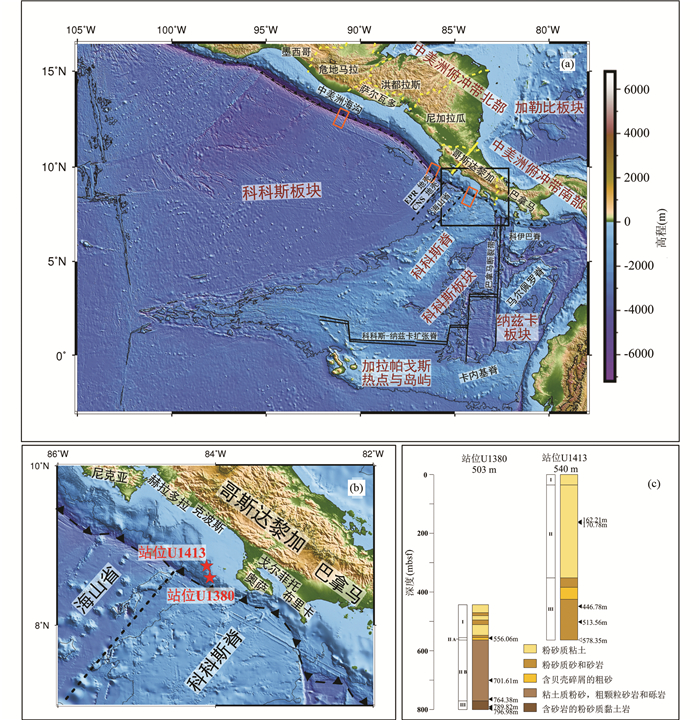
图 1 地质背景及样品描述 (a)中美洲海沟地质简图及主要地质单元(据Carr et al., 1990; Gazel et al., 2009, 2011; Walker and Gazel, 2014修改),图中红色框表示DSDP、ODP、IODP钻孔位置,EPR-东太平洋海隆,CNS-科科斯-纳兹卡扩张中心;(b)站位U1380和U1413的位置图(Harris et al., 2013b, c );(c)站位U1380和U1413的岩性图(Harris et al., 2013b, c ). 图中实心三角形指示的主、微量和同位素测试深度,空心三角形指示同位素测试深度 Fig. 1 Geological background and sample description (a) geological map and main geologic units of the Middle American Trench (modified after Carr et al., 1990; Gazel et al., 2009, 2011; Walker and Gazel, 2014). The red box are the locations of the DSDP, ODP and IODP. EPR-East Pacific Rise, CNS-Cocos-Nazca spreading center; (b) the locations of Sites U1380 and U1413 (Harris et al., 2013b, c ). (c) the sedimentary records from Site U1380 and U1413 (Harris et al., 2013b, c ). The solid triangle indicated the depth of whole-sample element and Sr-Nd-Pb-Hf isotopes analysis, while the hollow triangle indicated the depth of the Sr-Nd-Pb-Hf isotopes analysis |
本文对综合大洋钻探计划344航次两个站位(U1380和U1413)所获得的沉积物样品进行研究。由于两个站位均未获得基底岩石,本文对钻孔中沉积物的粗碎屑层位开展了系统的主、微量元素及Sr-Nd-Pb-Hf同位素地球化学分析,将其与中美洲俯冲带南部不同年龄的大陆弧火山岩、中美洲俯冲带南部弧前基底(Goss and Kay (2006)选用的俯冲剥蚀端元)、加勒比大火成岩省基底组分及古加拉帕戈斯热点轨迹组分进行对比,确定中美洲俯冲带南部上覆板块基底组分。此外,本文还探讨了俯冲剥蚀物质对中美洲俯冲带南部大陆弧火山岩成因的可能影响。
1 地质背景和样品描述在东太平洋海隆东侧,两个次一级的构造板块(科科斯板块和纳兹卡板块)正沿着中美洲海沟向加勒比板块俯冲,是研究俯冲剥蚀边缘的典型区域(图 1a)(Carr et al., 2004; 李永祥等, 2013; 鄢全树和石学法, 2014)。沿中美洲海沟走向,输入板块的汇聚速率、火山弧地壳厚度、俯冲角度、年龄、组分等均存在显著的差异(Carr et al., 1990; Lyle et al., 1995; Barckhausen et al., 2001; DeMets, 2001)。从危地马拉到哥斯达黎加,科科斯板块和加勒比板块之间的汇聚速率从60mm/yr增加到90mm/yr(DeMets, 2001)。弧下地壳厚度从危地马拉(48km)向尼加拉瓜(32km)逐渐减小,然后向南又逐渐增厚,在哥斯达黎加其厚度达到32~40km(Carr et al., 1990)。俯冲角度从尼加拉瓜的60°减小到哥斯达黎加中部的40°(Lyle et al., 1995),而在哥斯达黎加南部接近平板俯冲。从危地马拉到哥斯达黎加北部(中美洲俯冲带北部,分界线见图 1a中黄色实线),俯冲洋壳年龄大约为24.0Ma,是东太平海隆扩张形成的科科斯板块,其组分类似于大洋玄武岩(Barckhausen et al., 2001; Walker and Gazel, 2014)。然而,自哥斯达黎加中部到巴拿马(中美洲俯冲带南部,分界线见图 1a中黄色实线),俯冲板块被科科斯脊及西北侧海山群覆盖,其组分为洋岛玄武岩,年龄大约为13.0~14.5Ma(Carr et al., 1990; Dzierma et al., 2011; Walker and Gazel, 2014)。科科斯脊及西北侧海山群是加拉帕戈斯热点与科科斯-纳兹卡扩张中心相互作用形成,科科斯脊长约1000km,宽200~300km,比周围海底高2km(Werner et al., 2003; Harpp et al., 2005)。俯冲洋壳地形的差异造成中美洲海沟俯冲剥蚀速率的不同,中美洲俯冲带北部自早中新世正常洋壳俯冲以来,剥蚀速率为11.3~13.4km3/Myr/km;而中美洲俯冲带南部,自科科斯脊开始俯冲,短期的俯冲剥蚀速率可达1125km3/Myr/km,平均为108~123km3/Myr/km (Vannucchi et al., 2013, 2016b)。同时,在中美洲火山弧南部,大陆弧火山岩在晚中新世发生显著变化,钙碱性的火山岩在~6Ma停止,同时出现碱性玄武岩和埃达克质岩,这些火山岩均具有加拉帕戈斯热点的同位素和微量元素特征,可能是由于俯冲样式变化造成的(Abratis and Wörner, 2001; Gazel et al., 2009, 2011; Morell et al., 2012; Morell, 2015)。最近根据火山岩的同位素地球化学数据和地震各向异性的综合分析,发现从哥斯达黎加到尼加拉瓜的弧下地幔楔中存在平行于海沟的物质流(Hoernle et al., 2008)。
为了探索大地震的成因机理与破坏过程,综合大洋钻探计划334和344航次在中美洲俯冲带南部哥斯达黎加西部奥萨半岛附近的海域实施了钻探,站位分布在俯冲板块和上覆板块(Harris et al., 2013a)。其中站位U1380(8°35.99′N、84°4.39′W,水深502.7m)和U1413(8°44.46′N、84°6.80′W,水深540.0m)分别位于上覆板块陆坡的中部和上部。两站位的科学目标之一均为获得上覆板块基底岩石的性质、组分及物理特征,然而在实际实施过程中均未获得基底岩石(图 1b),两个站位详细的岩性单元见图 1c(Harris et al., 2013b, c)。本文选取U1380站位中5个层位:1个位于岩性单元ⅡA(深度为556.01m,岩性为含贝壳碎屑的粗砂)、2个位于岩性单元ⅡB(深度分别为701.61m和764.38m,岩性分别为粘土质粉砂和粉砂岩)、2个位于岩性单元Ⅲ中(深度为789.82m和796.98m,岩性均为粉砂质粘土岩),对以上层位进行主、微量元素和Sr-Nd-Pb-Hf同位素测试;选取U1413站位中5个层位:2个位于岩性单元Ⅱ(深度为162.21m和170.78m,岩性均为粉砂质粘土岩)、3个位于岩性单元Ⅲ(深度分别为446.78m、513.56m和578.35m,岩性分别为粉砂岩,砂岩以及砂质粉砂岩),其中上部的四个层位分别进行主、微量元素和Sr-Nd-Pb-Hf同位素测试,最底部的层位只进行Sr-Nd-Pb-Hf同位素测试。
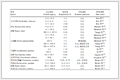
2 分析方法 2.1 主、微量元素分析实验将冻干后的样品研磨成200目,在105℃的烘箱中烘干3小时,取0.05g的样品加入特氟龙熔样内胆中,然后加入1.50mL高纯HNO3和1.50mL高纯HF,加盖及钢套密闭,放入195℃的烘箱48小时,将冷却后的熔样内胆取出放在电热板上蒸干。然后再加入1mL HNO3并再次蒸干。最后加入3mL高纯HNO3和0.5mL Rh内标溶液,置于150℃的烘箱中24小时,冷却后,将提取液转移至聚酯瓶中,用Mill-Q水稀释待测。主量元素除了SiO2外,在自然资源部海洋地质与成矿作用重点实验室利用电感耦合等离子光学发射光谱法(ICP-OES)测定;SiO2是在山东第四地质矿产勘查院利用X射线荧光光谱法测试。微量元素在自然资源部海洋地质与成矿作用重点实验室利用电感耦合等离子质谱仪(ICP-MS)完成。对于含量>1.0%的主量元素,精度为±0.2%~2%,微量元素的精度 < 10%。同时测定了烧失量。标样为BHVO-2,测定值与推荐值在误差范围内是一致的(见表 1)。
|
表 1 站位U1380和U1413各层位主量(wt%)、微量(×10-6)元素分析结果 Table 1 Compositions of major (wt%) and trace (×10-6) element of each layer from sites U1380 and U1413 |
称取50mg研磨至200目的样品于聚四氟乙烯(PTFE)熔样瓶中,加入2mL HF、1.5mL HNO3和0.2mL HClO4,拧紧瓶盖,将熔样瓶置于120℃电热板上加热约一周至其完全溶解。熔样完全后,开盖蒸干,再升温至180℃,去除残余HClO4。用于Sr、Nd同位素测试的样品蒸干后,用2.5mL/L的HCl将样品溶解,然后转移到离心管中,离心后吸取上清液,采用AG50W-X12树脂离子交换柱进行Sr和REE的化学分离,接收下来的REE再用P5O7萃淋树脂离子交换柱分离Sm和Nd;用于Pb同位素测试的样品蒸干后,用0.6mL/L的HBr溶解样品,离心后吸取上清液,采用AG1-X8树脂离子交换柱进行Pb同位素的化学分离。沉积物Hf同位素采用碱熔法溶样,称取0.5g研磨至200目的样品粉末与1g的Li2B4O7混合均匀,在铂金坩埚中用Rigaku高频全自动熔样机在1250℃熔融并冷却制成玻璃片,然后用高压压片机将玻璃片压碎,称取0.3~0.4g上述样品于样品瓶中,加入6~8mL 2.5M HCl,将样品并置于60℃的电热板上加热直至完全溶解。将溶解好的样品离心,以备上柱分离Hf。分离Hf和基体元素以及干扰元素采用HCl-单柱Ln-Spec提取色谱方法。
Sr、Nd、Pb同位素测试采用高精度多接收电感耦合等离子体质谱仪(MC-ICP MS)完成,该测试工作在自然资源部海洋地质与成矿作用重点实验室完成。在测试过程中Sr同位素测试的标样为NBS987,测定值为87Sr/86Sr=0.710268±7(2σ),Nd同位素测试的标样为Shin Etsu JNdi-1,测定值为143Nd/144Nd=0.512120±3(2σ),Pb同位素测试的标样为NBS981,测定值为206Pb/204Pb=16.938,207Pb/204Pb=15.493,208Pb/204Pb=36.725(见表 2)。Hf同位素采用多接收电感耦合等离子体质谱仪(MC-ICP-MS)完成测试,该测试工作在中国科学院广州地球化学研究所同位素地球化学国家重点实验室完成,标样为BHVO-2,其测定值为176Hf/177Hf=0.282877±10(2σ)(见表 2)。
|
|
表 2 站位U1380和U1413各层位Sr-Nd-Pb-Hf同位素比值 Table 2 Sr-Nd-Pb-Hf isotopes ratios of each layer from sites U1380 and U1413 |
站位U1380和U1413沉积物主量元素中含量最高的为SiO2,其平均含量为53.47%;其次从高到低依次为Al2O3、Fe2O3T、MgO、CaO、Na2O、K2O、TiO2、P2O5以及MnO;同时,两站位的烧失量均较高,平均为9.31%,数据详见表 1。
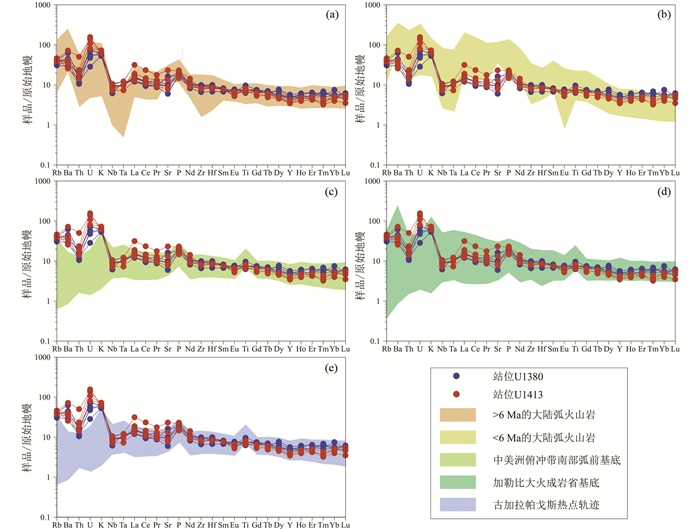
根据站位U1380和U1413沉积物中各层位原始地幔标准化后的微量元素蛛网图(图 2)可以看出,两站位中各层位微量元素变化范围相对较小,均呈现出Rb、Ba、U、K元素的富集,以及Nb、Ta、Th的亏损。相比于站位U1380,站位U1413更富集不相容元素,更亏损相容元素。
|
图 2 站位U1380和U1413各层位原始地幔标准化微量元素蛛网图(标准化值据Sun and McDonough, 1989) 中美洲俯冲带南部大陆弧火山岩数据来自Gazel et al.(2009, 2011);中美洲俯冲带南部弧前基底、加勒比大火成岩省以及古老加拉帕戈斯热点轨迹的数据来自Hauff et al. (2000)和Hoernle et al. (2002);图 3数据来源同 Fig. 2 Primitive mantle-normalized trace element spider diagrams for each layer from sites U1380 and U1414 (normalization values after Sun and McDonough, 1989) The data of the SCA volcanic lavas from Gazel et al.(2009, 2011); The data of the SCA basement, CLIP basement and Paleo-Galapagos track from Hauff et al. (2000) and Hoernle et al. (2002); also in Fig. 3 |
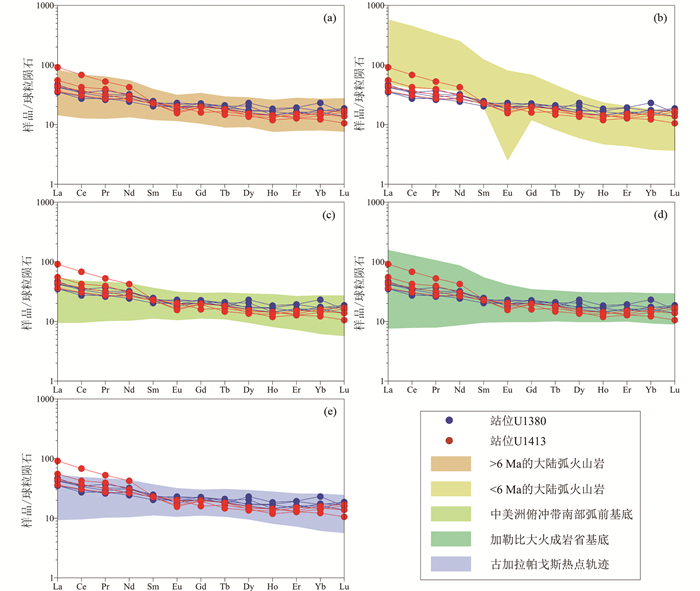
根据站位U1380和U1413沉积物中各层位球粒陨石标准化后的稀土元素配分图(图 3)可以看出,两站位均呈现出轻微的轻稀土富集,其配分模式较为平坦。相比于站位U1380,站位U1413相对富集轻稀土,亏损重稀土,但是亏损和富集程度相对较低。
|
图 3 站位U1380和U1413各层位球粒陨石标准化稀土元素配分图(标准化值据Sun and McDonough, 1989) Fig. 3 Chondrite-normalized REE distributional patterns for each layer from sites U1380 and U1414 (normalization values after Sun and McDonough, 1989) |
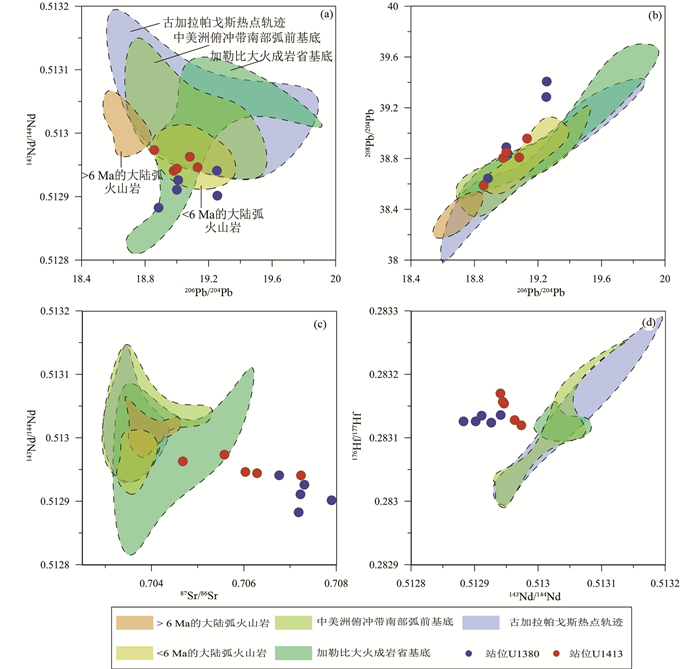
各层位的同位素数据见表 2。沉积物样品中,87Sr/86Sr(0.704679~0.707899),206Pb/204Pb(18.858~19.255),207Pb/204Pb(15.597~15.930),208Pb/204Pb(38.588~39.408)的变化范围较大。但143Nd/144Nd(0.512883~0.512973)与176Hf/177Hf(0.283120~0.283170)的变化范围较小。沉积物Sr-Nd-Pb-Hf同位素相关性图解(图 4)显示:沉积物组分与CLIP基底的Nd(143Nd/144Nd:0.512823~0.513104)、Pb(206Pb/204Pb:18.714~19.903;207Pb/204Pb:15.551~15.623;208Pb/204Pb:38.526~39.673)、Hf(176Hf/177Hf:0.283101~0.283153)同位素组分(Geldmacher et al., 2003; Hauff et al., 2000)基本一致。
|
图 4 站位U1380和U1413各层位同位素图解 中美洲俯冲带南部大陆弧火山岩数据来自Hoernle et al. (2008)和Gazel et al.(2009, 2011);中美洲俯冲带南部弧前基底、加勒比大火成岩省以及古加拉帕戈斯热点轨迹的数据来自Hauff et al. (2000), Hoernle et al. (2002)和Geldmacher et al. (2003) Fig. 4 The isotopes ratios diagrams for each layer from sites U1380 and U1414 The data of the SCA volcanic lavas from Hoernle et al. (2008) and Gazel et al.(2009, 2011); The data of the SCA basement, CLIP basement and Paleo-Galapagos track from Hauff et al. (2000), Hoernle et al. (2002) and Geldmacher et al. (2003) |
研究剥蚀型汇聚板块边缘物质再循环的首要条件之一是确定上覆板块基底组分。中美洲俯冲带上覆板块为加勒比板块,该板块位于南美洲和北美洲之间,大部分被加勒比大火成岩省覆盖,其起源目前仍存在一定争议(Hoernle et al., 2002; James, 2005; Dürkefälden et al., 2019)。最初的“原位模型”研究认为加勒比大火成岩省(CLIP)在南北美洲之间形成(Meschede and Frisch, 1998; James, 2005)。然而随着在小安的列斯岛弧(加勒比板块西侧)中发现了侏罗纪时期太平洋种属的放射虫,并且其年龄比南北美洲板块分离的时间更早,因此越来越多的学者支持加勒比板块起源于太平洋(Hoernle et al., 2002; Dürkefälden et al., 2019)。该模型认为,加勒比大火成岩省是加拉帕戈斯地幔柱的头部在法拉隆板块上形成,然后与加勒比巨型弧碰撞,由于其具有浮力阻塞俯冲带,使俯冲极性发生由东向西的反转,随后插入南北美洲之间(Hoernle et al., 2002; Dürkefälden et al., 2019)。
目前认为加勒比板块沿太平洋侧(中美洲俯冲带)岩浆杂岩体的起源较为复杂,可能由增生的太平洋海山组分、残余的古俯冲带物质、上升的加勒比大火成岩省基底组分以及增生的古加拉帕戈斯热点物质组成(Hauff et al., 2000; Hoernle et al., 2002)。因此,以上组分都可能作为上覆板块被俯冲剥蚀的物质。例如,Goss and Kay (2006)研究中美洲俯冲带南部物质再循环时,选择哥斯达黎加弧前布里卡(Burica)、戈尔菲托(Golfito)、奥萨(Osa)和克波斯(Quepos)处的蛇绿岩代表俯冲剥蚀物质。前人研究指出戈尔菲托和布里卡为加勒比火成岩省基底上升暴露的部分,而奥萨和克波斯则是由加拉帕戈斯热点形成的无震脊和海山(Hauff et al., 2000)。Goss and Kay (2006)的研究清晰表明中美洲哥斯达黎加处晚中新世以来埃达克质岩的形成受到俯冲剥蚀物质的影响。然而,随后的研究表明戈尔菲托可能并非加勒比大火成岩省基底组分,而是75~66Ma的岛弧组分(Buchs et al., 2010)。因此,Goss and Kay (2006)选择的端元是否能够真实代表弧前基底组分,前人并没有给出充分的证据。
本研究将弧前钻孔沉积物中的粗碎屑层位组分与弧前各种构造单元组分对比,以期获得真实的弧前基底组分。根据钻孔位置,研究推测钻孔中物质来源可能为中美洲火山弧组分、中美洲俯冲带南部弧前基底组分(Goss and Kay (2006)研究中选择的俯冲剥蚀端元),古加拉帕戈斯热点组分以及加勒比大火成岩省基底组分。本文主要探讨各俯冲端元对中美洲俯冲带南部大陆弧岩浆作用的影响,所有测试结果为全岩样品数据,然而在沉积过程中,陆源物质和海洋自生组分共同沉积,因此,我们重点关注不受沉积过程影响的碱金属元素(Rb、K)以及高场强元素(Nb、Ta、Ti、Zr和Hf)(Plank and Langmuir, 1998; Plank, 2014)。从元素蛛网图(图 2)中可以看出,两个站位的元素含量较为均一,表明其物质源区是相同的;沉积物粗碎屑层位中碱金属元素和高场强元素落在中美洲俯冲带南部>6Ma大陆弧火山岩、中美洲俯冲带南部 < 6Ma大陆弧火山岩以及加勒比大火成岩省基底组分的区域(图 2a, b, d);相比于中美洲俯冲带南部弧前基底和古加拉帕戈斯热点轨迹,沉积中粗碎屑层位具有较高的碱金属含量(图 2c, e)。研究表明位于大陆边缘快速沉积形成的海洋沉积物稀土元素主要受陆源物质影响(Mclennan et al., 1990; Plank and Langmuir, 1998)。中美洲俯冲带南部弧前由于俯冲剥蚀形成了典型的“弧前沉积”,接受了大量的陆源沉积(Vannucchi et al., 2013),因此本研究中沉积物粗碎屑层位组分的稀土配分模式主要受陆源物质影响。从图 3中我们排除中美洲俯冲带南部 < 6Ma大陆弧火山岩来源的可能性。我们进一步从Sr-Nd-Pb-Hf同位素角度进行对比,从图 4中可以看出,沉积物Sr同位素变化范围较大,这是由于沉积物中碳酸盐对Sr同位素的影响(孟宪伟等, 2000),因此在本文中Sr同位素并不用于源区判断;从图 4a中,我们发现,中美洲俯冲带南部>6Ma大陆弧火山岩的Pb同位素明显低于沉积物粗碎屑层位的Pb同位素特征,结合Nd-Hf同位素特征(在Nd-Hf同位素图解中,沉积物未落在任何区域,这可能是由于前人缺乏对低Nd含量样品开展Hf同位素测试造成的),我们认为沉积物中的粗碎屑可能来自出露在中美洲俯冲带南部的加勒比大火成岩省基底组分。综上,尽管上覆板块的钻孔未达到基底,然而上覆板块中沉积物中粗碎屑层位可代表上覆板块基底组分。
4.2 中美洲俯冲带南部物质循环模型 4.2.1 中美洲俯冲带南部俯冲再循环组分的可能端元俯冲剥蚀机制中,俯冲再循环物质一般包括俯冲洋壳,下伏岩石圈地幔、俯冲沉积物以及俯冲剥蚀物质(Scholl and von Huene, 2009; Straub et al., 2020),这些再循环物质可能影响着俯冲带岛弧岩浆成因。因此,俯冲带岛弧火山岩成因的研究中,首先应明确可能的俯冲输入端元组分。前人研究表明,中美洲俯冲带南部大陆弧火山岩岩性在晚中新世时发生显著变化,岩性由钙碱性火山岩转变碱性玄武岩和埃达克质岩,其组分具有类似加拉帕戈斯热点的同位素和微量元素的特征,目前存在利用不同俯冲输入端元来解释该区域大陆弧火山岩岩性的变化(Abratis and Wörner, 2001; Goss and Kay, 2006; Gazel et al., 2009, 2011)。Abratis and Wörner (2001)认为厚的有浮力的无震脊(科科斯脊)俯冲在中美洲俯冲带南部形成构造板片窗,同时俯冲科科斯脊的前缘发生部分熔融对地幔楔产生影响。随后,Gazel et al. (2011)进一步提出板片拆沉模型,该模型认为科科斯脊俯冲造成先前俯冲的板片拆沉,致使受加拉帕戈斯热点影响的软流圈物质进入地幔楔,因此科科斯脊及西北侧海山群对中美洲俯冲带南部晚中新世大陆弧火山岩的形成起重要作用。以上模型均将中美洲俯冲带南部碱性火山岩和埃达克质岩的形成与科科斯脊俯冲联系起来,但是板块重建和低温热年代学研究指出,科科斯俯冲时间不可能早于3Ma(MacMillan et al., 2004; Morell et al., 2012)。近期,对334和344航次上覆板块钻孔(站位U1380和U1379)的沉积层序和古地磁研究将该时间进一步确定在1.8Ma(Li et al., 2018)。因此,Morell et al. (2012)和Morell (2015)认为中美洲俯冲带南部晚中新世火山岩岩性变化与俯冲样式的变化有关,而科科斯脊与海山俯冲不对该时期火山岩的变化产生影响。Goss and Kay (2006)从地球化学角度证明中美洲俯冲带南部埃达克质岩的形成与俯冲剥蚀有关。同时,Vannucchi et al.(2013, 2016b)从构造地质学和地球物理的角度证明哥斯达黎加处确实存在大量的俯冲剥蚀。然而,目前造成上述争论的主要原因是人们目前仍未直接获得上覆板块基底组分。本文对上覆板块沉积物钻孔中粗碎屑层位的研究表明,上覆板块基底组分可能为加勒比大火成岩省基底组分。因此,目前中美洲俯冲带南部俯冲输入端元包含俯冲科科斯脊,俯冲海山,俯冲剥蚀地壳物质(加勒比大火成岩省基底)以及俯冲沉积物。
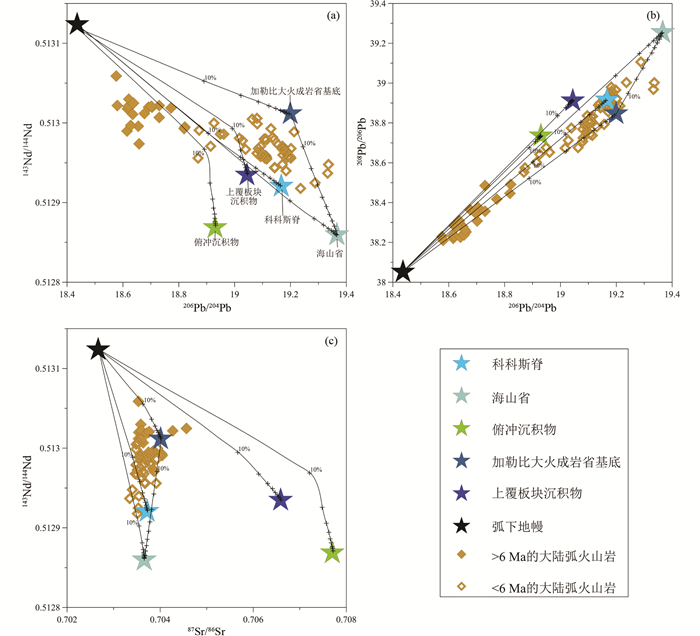
4.2.2 俯冲带物质再循环及其对中美洲俯冲带南部大陆弧火山岩成因的启示在俯冲过程中,俯冲输入物质随着俯冲深度的增加会释放流体、熔体或者超临界流体,这些物质都会加入岛弧岩浆的源区,对岛弧火山岩的化学组分造成影响(Spandler and Pirard, 2013; Plank, 2014; 赵仁杰等, 2020; 张泽明等, 2020)。放射性同位素通常在岩浆演化过程中不发生分馏,因此被广泛应用于示踪地壳和地幔之间的物质循环(Hauff et al., 2003; Carpentier et al., 2008; Chauvel et al., 2009; Yan et al., 2012)。我们根据所有可能的俯冲输入端元重新探讨中美洲俯冲带南部大陆弧火山岩晚中新世的岩性变化的原因,根据俯冲输入与大陆弧输出的同位素图解(图 5)可以看出,中美洲俯冲带南部晚中新世以来的大陆弧火山岩受到了加勒比大火成岩省基底端元和海山端元的影响。根据元素在俯冲过程中的行为,由于轻稀土元素(Nd)一般只在熔体中迁移(Chauvel et al., 2009),我们推测俯冲剥蚀物质以熔体的形式影响该区域大陆弧岩浆作用。不同于Gazel et al. (2011)的研究,我们选择加勒比火成岩省基底代替俯冲科科斯脊的端元:首先科科斯脊俯冲时间存在争议,其俯冲时间可能为更晚的更新世;其次结合Yan and Shi (2016)对344航次钻孔获得的科科斯脊基底岩石同位素分析,以及前人发表的同位素数据(Hoernle et al., 2000; Werner et al., 2003),我们发现新获得的样品Nd同位素范围更大,且具有更高的Sr同位素及低的208Pb/204Pb和206Pb/204Pb比值,使得科科斯脊和海山的同位素特征并不能解释中美洲俯冲带南部晚中新世以来火山岩的同位素组成。
|
图 5 中美洲俯冲带南部俯冲输入与大陆弧输出物质循环同位素图解 俯冲科科脊和海山的数据来自Hoernle et al. (2000),Werner et al. (2003),Harpp et al. (2005)和Yan and Shi (2016);中美洲俯冲带南部岛弧火山岩数据来自Hoernle et al. (2008)和Gazel et al.(2009, 2011);俯冲沉积物的数据来自Zhao et al.(2021);弧下地幔数据来自Gazel et al. (2011);图 6数据来源同 Fig. 5 The isotopic diagrams of subduction input and continental-arc output material cycling at SCA subduction zone The data of subduction Cocos Ridge and Seamount Provinces from Hoernle et al. (2000), Werner et al. (2003), Harpp et al. (2005), and Yan and Shi (2016); The data of the SCA volcanic lavas from Hoernle et al. (2008) and Gazel et al.(2009, 2011); The data of the subducting sediments from Zhao et al. (2021); And the data of sub-arc mantle from Gazel et al. (2011); also in Fig. 6 |
|
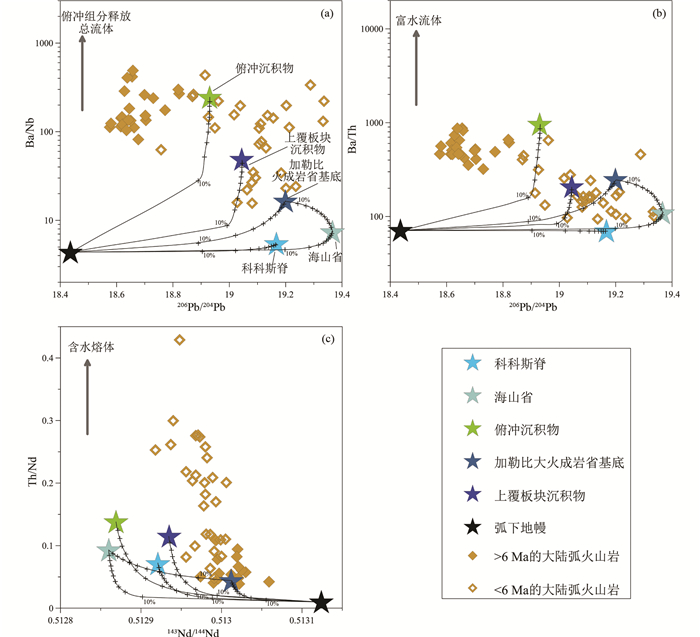
图 6 中美洲俯冲带南部俯冲输入与大陆弧输出物质循环同位素及特征元素比值图解 Fig. 6 The isotopic diagrams and characteristic element ratios of subduction input and continental-arc output material cycling at SCA subduction zone |
同时,由于特征元素在俯冲系统中具有不同的行为,也常被用于示踪俯冲物质循环(Pearce et al., 2005; Yan et al., 2019)。在俯冲过程中,Ba等大离子亲石元素在俯冲流体中迁移,而Th、Nb以及轻稀土则只在熔体中移动(Johnson and Plank, 1999)。因此,特征元素比值可以用来辨别俯冲组分(Pearce et al., 2005; Pearce and Stern, 2006; Zhang et al., 2019; Yan et al., 2019)。为了消除结晶分异的影响,利用Ba/Th示踪富水流体,利用Th/Nd来辨别含水熔体,利用Ba/Nb来计算俯冲组分释放的总流体(Pearce et al., 2005; Yan et al., 2019)。根据特征元素和同位素比值图解中可以看出,俯冲沉积物对中美洲俯冲带南部大陆弧火山岩产生影响(图 6a, b);同时,在晚中新世中美洲俯冲带南部大陆弧火山岩岩性发生变化时,其Th/Nd比值显著升高,该变化可能是由于俯冲熔体组分的变化引起的(Zhang et al., 2019; Yan et al., 2019)。在所有俯冲输入端元中,俯冲沉积物具有最高的Th/Nd比值,因此我们认为俯冲沉积物以熔体的形式对该地区火山岩产生影响,该结论与前人根据热力学模型计算的哥斯达黎加弧下俯冲沉积物发生部分熔融的认识相吻合(Peacock et al., 2005)。尽管前人通过Be和Tl同位素的研究指出,中美洲俯冲带南部俯冲沉积物对大陆弧火山岩的影响有限(Tera et al., 1986; Nielsen et al., 2017),但是从特征元素比值可以看出俯冲沉积物的确参与大陆弧物质再循环过程。相对其他端元,俯冲沉积物中富集Ba、Th等特征元素,因此其加入很小的量足以影响该地区火山岩微量元素比值,但是其加入量不足以改变其同位素特征(Gazel et al., 2009; Nielsen et al., 2017; Zhao et al. in print)。同时,我们并不能排除俯冲科科斯脊对近期中美洲俯冲带南部火山岩的影响,但是综合科科斯脊俯冲时间,我们推测晚中新世以来火山岩中类似加拉帕戈斯热点的物质主要受俯冲剥蚀物质的影响(Goss and Kay, 2006)。在晚中新世(~9Ma),巴拿马三联点(Panama Triple Junction)位于尼克亚半岛的离岸处,由于俯冲倾角和汇聚速率变化,巴拿马三联点向东南迁移,由于俯冲角度的改变,俯冲板块释放的俯冲组分减少,造成中美洲俯冲带南部钙碱性火山岩的停止喷发(MacMillan et al., 2004; Morell et al., 2012; Morell, 2015)。同时,在其向东南迁移过程中造成明显的俯冲剥蚀(MacMillan et al., 2004; Sak et al., 2009),该过程将大量的弧前物质带入地幔楔,其与俯冲海山及俯冲沉积物共同影响中美洲俯冲带南部大陆弧火山岩的岩浆过程。尽管本文从地球化学角度初步证明了俯冲剥蚀对中美洲俯冲带南部大陆弧岩浆作用的影响,但是并未定量解释不同端元对中美洲俯冲带南部不同岩性火山岩的影响,未来的工作中,我们将结合非传统同位素(Li,Ba等)共同探讨中美洲俯冲带南部俯冲循环过程。
5 结论本研究对位于汇聚板块边缘上覆板块弧前钻孔中沉积物的粗碎屑层位进行了详细的全岩主、微量元素和Sr-Nd-Pb-Hf同位素分析研究,获得了如下三点新认识:
(1) 研究中的粗碎屑层位组分可代表上覆板块基底组分,是剥蚀型汇聚板块边缘中物质俯冲再循环的一个重要端元,因此,弧前钻孔中沉积物的粗碎屑层位组分可为研究浅部和深部地幔地球化学变化提供重要线索。
(2) 结合中美洲俯冲带南部大陆弧火山岩化学组分,我们识别出了俯冲剥蚀物质对该大陆弧火山岩成因的贡献,为俯冲剥蚀机制的存在提供了地球化学制约。
(3) 自晚中新世以来,巴拿马三联点向东南的迁移引起中美洲俯冲带南部弧前大量的俯冲剥蚀,可能导致俯冲剥蚀物质、海山及俯冲沉积物共同进入了大陆弧地幔源区。
致谢 感谢“决心号”科学钻探船上的全体船员、IODP-USIO技术人员以及中国IODP办公室。在研究期间,与哥伦比亚大学Susanne Staub教授进行了有益的讨论。同时,感谢两位匿名审稿人及俞良军老师对本文提出的宝贵修改意见。
Abratis M and Wörner G. 2001. Ridge collision, slab-window formation, and the flux of Pacific asthenosphere into the Caribbean realm. Geology, 29(2): 127-130 DOI:10.1130/0091-7613(2001)029<0127:RCSWFA>2.0.CO;2
|
Barckhausen U, Ranero CR, von Huene R, Cande SC and Roeser HA. 2001. Revised tectonic boundaries in the Cocos Plate off Costa Rica: Implications for the segmentation of the convergent margin and for plate tectonic models. Journal of Geophysical Research: Solid Earth, 106(B9): 19207-19220 DOI:10.1029/2001JB000238
|
Buchs DM, Arculus RJ, Baumgartner PO, Baumgartner-Mora C and Ulianov A. 2010. Late Cretaceous arc development on the SW margin of the Caribbean Plate: Insights from the Golfito, Costa Rica, and Azuero, Panama, complexes. Geochemistry, Geophysics, Geosystems, 11(7): Q07S24
|
Carpentier M, Chauvel C and Mattielli N. 2008. Pb-Nd isotopic constraints on sedimentary input into the Lesser Antilles arc system. Earth and Planetary Science Letters, 272(1-2): 199-211 DOI:10.1016/j.epsl.2008.04.036
|
Carr MJ, Feigenson MD and Bennett EA. 1990. Incompatible element and isotopic evidence for tectonic control of source mixing and melt extraction along the Central American arc. Contributions to Mineralogy and Petrology, 105(4): 369-380 DOI:10.1007/BF00286825
|
Carr MJ, Feigenson MD, Patino LC and Walker JA. 2004. Volcanism and geochemistry in central America: Progress and problems. In: Eiler J (ed. ). Inside the Subduction Factory, Volume 138. Washington, DC: American Geophysical Union
|
Chauvel C, Marini JC, Plank T and Ludden JN. 2009. Hf-Nd input flux in the Izu-Mariana subduction zone and recycling of subducted material in the mantle. Geochemistry, Geophysics, Geosystems, 10(1): Q01001
|
Clift PD, Vannucchi P and Morgan JP. 2009a. Crustal redistribution, crust-mantle recycling and Phanerozoic evolution of the continental crust. Earth-Science Reviews, 97(1-4): 80-104 DOI:10.1016/j.earscirev.2009.10.003
|
Clift PD, Schouten H and Vannucchi P. 2009b. Arc-continent collisions, sediment recycling and the maintenance of the continental crust. Geological Society, London, Special Publications, 318(1): 75-103 DOI:10.1144/SP318.3
|
DeMets C. 2001. A new estimate for present-day Cocos-Caribbean Plate motion: Implications for slip along the Central American Volcanic Arc. Geophysical Research Letters, 28(21): 4043-4046 DOI:10.1029/2001GL013518
|
Dürkefälden A, Hoernle K, Hauff F, Werner R and Garbe-Schönberg D. 2019. Second-stage Caribbean Large Igneous Province volcanism: The depleted Icing on the enriched Cake. Chemical Geology, 509: 45-63 DOI:10.1016/j.chemgeo.2019.01.004
|
Dzierma Y, Rabbel W, Thorwart MM, Flueh ER, Mora MM and Alvarado GE. 2011. The steeply subducting edge of the Cocos Ridge: Evidence from receiver functions beneath the northern Talamanca Range, south-central Costa Rica. Geochemistry, Geophysics, Geosystems, 12(4): Q04S30
|
Gazel E, Carr MJ, Hoernle K, Feigenson MD, Szymanski D, Hauff F and van den Bogaard P. 2009. Galapagos-OIB signature in southern Central America: Mantle refertilization by arc-hot spot interaction. Geochemistry, Geophysics, Geosystems, 10(2): Q02S11
|
Gazel E, Hoernle K, Carr MJ, Herzberg C, Saginor I, van den Bogaard P, Hauff F, Feigenson M and Swisher Ⅲ C. 2011. Plume-subduction interaction in southern Central America: Mantle upwelling and slab melting. Lithos, 121(1-1): 117-134
|
Geldmacher J, Hanan BB, Blichert-Toft J, Harpp K, Hoernle K, Hauff F, Werner R and Kerr AC. 2003. Hafnium isotopic variations in volcanic rocks from the Caribbean Large Igneous Province and Galápagos hot spot tracks. Geochemistry, Geophysics, Geosystems, 4(7): 1062
|
Goss AR and Kay SM. 2006. Steep REE patterns and enriched Pb isotopes in southern Central American arc magmas: Evidence for forearc subduction erosion?. Geochemistry, Geophysics, Geosystems, 7(5): Q05016
|
Harpp KS, Wanless VD, Otto RH, Hoernle K and Werner R. 2005. The Cocos and Carnegie aseismic ridges: A trace element record of long-term plume-spreading center interaction. Journal of Petrology, 46(1): 109-133 DOI:10.1093/petrology/egh064
|
Harris RN, Sakaguchi A, Petronotis K, Baxter AT, Berg R, Burkett A, Charpentier D, Choi J, Diz Ferreiro P, Hamahashi M, Hashimoto Y, Heydolph K, Jovane L, Kastner M, Kurz W, Kutterolf SO, Li Y, Malinverno A, Martin KM, Millan C, Nascimento DB, Saito S, Sandoval Gutierrez MI, Screaton EJ, Smith-Duque CE, Solomon EA, Straub SM, Tanikawa W, Torres ME, Uchimura H, Vannucchi P, Yamamoto Y, Yan Q and Zhao X. 2013a. Expedition 344 summary. In: Harris RN, Sakaguchi A, Petronotis K, and the Expedition 344 Scientists (eds. ). Proceedings of the IODP, 344. College Station, TX, doi: 10.2204/iodp.proc.344.101.2013
|
Harris RN, Sakaguchi A, Petronotis K, Baxter AT, Berg R, Burkett A, Charpentier D, Choi J, Diz Ferreiro P, Hamahashi M, Hashimoto Y, Heydolph K, Jovane L, Kastner M, Kurz W, Kutterolf SO, Li Y, Malinverno A, Martin KM, Millan C, Nascimento DB, Saito S, Sandoval Gutierrez MI, Screaton EJ, Smith-Duque CE, Solomon EA, Straub SM, Tanikawa W, Torres ME, Uchimura H, Vannucchi P, Yamamoto Y, Yan Q and Zhao X. 2013b. Input site U1381. In: Harris RN, Sakaguchi A, Petronotis K and the Expedition 344 Scientists (eds. ). Proceedings of the IODP, 344. College Station, TX, doi: 10.2204/iodp.proc.344.103.2013
|
Harris RN, Sakaguchi A, Petronotis K, Baxter AT, Berg R, Burkett A, Charpentier D, Choi J, Diz Ferreiro P, Hamahashi M, Hashimoto Y, Heydolph K, Jovane L, Kastner M, Kurz W, Kutterolf SO, Li Y, Malinverno A, Martin KM, Millan C, Nascimento DB, Saito S, Sandoval Gutierrez MI, Screaton EJ, Smith-Duque CE, Solomon EA, Straub SM, Tanikawa W, Torres ME, Uchimura H, Vannucchi P, Yamamoto Y, Yan Q and Zhao X. 2013c. Input site U1414. In: Harris RN, Sakaguchi A, Petronotis K and the Expedition 344 Scientists (eds. ). Proceedings of the IODP, 344. College Station, TX, doi: 10.2204/iodp.proc.344.104.2013
|
Hauff F, Hoernle K, van den Bogaard P, Alvarado G and Garbe-Schönberg D. 2000. Age and geochemistry of basaltic complexes in western Costa Rica: Contributions to the geotectonic evolution of Central America. Geochemistry, Geophysics, Geosystems, 1(5): 1009
|
Hauff F, Hoernle K and Schmidt A. 2003. Sr-Nd-Pb composition of Mesozoic Pacific oceanic crust (Site 1149 and 801, ODP Leg 185): Implications for alteration of ocean crust and the input into the Izu-Bonin-Mariana subduction system. Geochemistry, Geophysics, Geosystems, 4(8): 8913
|
Hoernle K, Werner R, Morgan JP, Garbe-Schönberg D, Bryce J and Mrazek J. 2000. Existence of complex spatial zonation in the Galápagos plume for at least 14m.y. Geology, 28(5): 435-438 DOI:10.1130/0091-7613(2000)28<435:EOCSZI>2.0.CO;2
|
Hoernle K, van den Bogaard P, Werner R, Lissinna B, Hauff F, Alvarado G and Garbe-Schönberg D. 2002. Missing history (16~71Ma) of the Galápagos hotspot: Implications for the tectonic and biological evolution of the Americas. Geology, 30(9): 795-798 DOI:10.1130/0091-7613(2002)030<0795:MHMOTG>2.0.CO;2
|
Hoernle K, Abt DL, Fischer KM, Nichols H, Hauff F, Abers GA, van den Bogaard P, Heydolph K, Alvarado G, Protti M and Strauch W. 2008. Arc-parallel flow in the mantle wedge beneath Costa Rica and Nicaragua. Nature, 451(7182): 1094-1097 DOI:10.1038/nature06550
|
James KH. 2005. Arguments for and against the Pacific origin of the Caribbean Plate and arguments for an in situ origin. Caribbean Journal of Earth Science, 39: 47-67
|
Johnson MC and Plank T. 1999. Dehydration and melting experiments constrain the fate of subducted sediments. Geochemistry, Geophysics, Geosystems, 1(12): 1007
|
Li YX, Yan QS, Zhao XX and Shipboard Science Party. 2013. Research on seismogenesis at erosive convergent margins: Report from IODP Expedition 344. Advances in Earth Science, 28(6): 728-736 (in Chinese with English abstract)
|
Li YX, Zhao XX, Xie SY, Jovane L and Petronotis K. 2018. Paleomagnetism of IODP Site U1380:Implications for the forearc deformation in the costa Rican erosive convergent margin. Scientific Reports, 8(1): 11430 DOI:10.1038/s41598-018-29243-7
|
Lyle MW, Dadey KA and Farrell JW. 1995. The Late Miocene (11~8Ma) eastern Pacific carbonate crash: Evidence for reorganization of deep-water circulation by the closure of the Panama gateway. In: Pisias NG, Mayer LA, Janecek TR, Palmer-Julson A and van Andel TH (eds. ). Proceedings of the Ocean Drilling Program, Scientific Results. College Station, TX: 821-838
|
MacMillan I, Gans PB and Alvarado G. 2004. Middle Miocene to present plate tectonic history of the southern Central American Volcanic Arc. Tectonophysics, 392(1-4): 325-348 DOI:10.1016/j.tecto.2004.04.014
|
Mclennan SM, Taylor SR, McCulloch MT and Maynard JB. 1990. Geochemical and Nd-Sr isotopic composition of deep-sea turbidites: Crustal evolution and plate tectonic associations. Geochimica et Cosmochimica Acta, 54(7): 2015-2050 DOI:10.1016/0016-7037(90)90269-Q
|
Meng XW, Du DW, Chen ZH and Wang XQ. 2000. Factors controlling spatial variation of 87Sr/86Sr in the fine-grained sediments from the overbanks of the Yellow River and Yangtze River and its implication for provenance of marine sediments. Geochimica, 29(6): 562-570 (in Chinese with English abstract)
|
Meschede M and Frisch W. 1998. A plate-tectonic model for the Mesozoic and Early Cenozoic history of the Caribbean plate. Tectonophysics, 296(3-4): 269-291 DOI:10.1016/S0040-1951(98)00157-7
|
Morell KD, Kirby E, Fisher DM and van Soest M. 2012. Geomorphic and exhumational response of the Central American Volcanic Arc to Cocos Ridge subduction. Journal of Geophysical Research: Solid Earth, 117(B4): B04409
|
Morell KD. 2015. Late Miocene to recent plate tectonic history of the southern Central America convergent margin. Geochemistry, Geophysics, Geosystems, 16(10): 3362-3382 DOI:10.1002/2015GC005971
|
Nielsen SG, Prytulak J, Blusztajn J, Shu YC, Auro M, Regelous M and Walker J. 2017. Thallium isotopes as tracers of recycled materials in subduction zones: Review and new data for lavas from Tonga-Kermadec and Central America. Journal of Volcanology and Geothermal Research, 339: 23-40 DOI:10.1016/j.jvolgeores.2017.04.024
|
Peacock SM, van Keken PE, Holloway SD, Hacker BR, Abers GA and Fergason RL. 2005. Thermal structure of the Costa Rica-Nicaragua subduction zone. Physics of the Earth and Planetary Interiors, 149(1-2): 187-200 DOI:10.1016/j.pepi.2004.08.030
|
Pearce JA, Stern RJ, Bloomer SH and Fryer P. 2005. Geochemical mapping of the Mariana arc-basin system: Implications for the nature and distribution of subduction components. Geochemistry, Geophysics, Geosystems, 6(7): Q07006
|
Pearce JA and Stern RJ. 2006. Origin of back-arc basin magmas: Trace element and isotope perspectives. In: Christie DM, Fisher CR, Lee SM and Givens S (eds. ). Back-Arc Spreading Systems: Geological, Biological, Chemical, and Physical Interactions, Volume 166. Washington, DC: American Geophysical Union, 63-86
|
Pichon XL, Henry P and Lallemant S. 1993. Accretion and erosion in subduction zones: The role of fluids. Annual Review of Earth and Planetary Sciences, 21: 307-331 DOI:10.1146/annurev.ea.21.050193.001515
|
Plank T and Langmuir CH. 1998. The chemical composition of subducting sediment and its consequences for the crust and mantle. Chemical Geology, 145(3-4): 325-394 DOI:10.1016/S0009-2541(97)00150-2
|
Plank T. 2014. The chemical composition of subducting sediments. In: Holland HD and Turekian KK (eds. ). Treatise on Geochemistry. 2nd Edition. Amsterdam: Elsevier Science, 607-629
|
Saffer DM and Tobin HJ. 2011. Hydrogeology and mechanics of subduction zone forearcs: Fluid flow and pore pressure. Annual Review of Earth and Planetary Sciences, 39: 157-186 DOI:10.1146/annurev-earth-040610-133408
|
Sak PB, Fisher DM, Gardner TW, Marshall JS and LaFemina PC. 2009. Rough crust subduction, forearc kinematics, and Quaternary uplift rates, Costa Rican segment of the Middle American Trench. Geological Society of America Bulletin, 121(7-8): 992-1012 DOI:10.1130/B26237.1
|
Scholl DW and von Huene R. 2009. Implications of estimated magmatic additions and recycling losses at the subduction zones of accretionary (non-collisional) and collisional (suturing) orogens. Geological Society, London, Special Publications, 318(1): 105-125 DOI:10.1144/SP318.4
|
Spandler C and Pirard C. 2013. Element recycling from subducting slabs to arc crust: A review. Lithos, 170-171: 208-223 DOI:10.1016/j.lithos.2013.02.016
|
Straub SM, Gómez-Tuena A, Bindeman IN, Bolge LL, Brandl PA, Espinasa-Perena R, Solari L, Stuart FM, Vannucchi P and Zellmer GF. 2015. Crustal recycling by subduction erosion in the central Mexican Volcanic Belt. Geochimica et Cosmochimica Acta, 166: 29-52 DOI:10.1016/j.gca.2015.06.001
|
Straub SM, Gómez-Tuena A and Vannucchi P. 2020. Subduction erosion and arc volcanism. Nature Reviews Earth & Environment, 1(11): 574-589
|
Sun SS and McDonough. 1989. Chemical and isotopic systematics of oceanic basalts: Implications for mantle composition and process. In: Sanders AD and Norry MJ (eds. ). Magmatism in Ocean Basins. Geological Society, London, Special Publications, 42(1): 313-345
|
Tera F, Brown L, Morris J, Sacks IS, Klein J and Middleton R. 1986. Sediment incorporation in island-arc magmas: Inferences from 10Be. Geochimica et Cosmochimica Acta, 50(4): 535-550 DOI:10.1016/0016-7037(86)90103-1
|
Vannucchi P, Ranero CR, Galeotti S, Straub SM, Scholl DW and McDougall-Ried K. 2003. Fast rates of subduction erosion along the Costa Rica Pacific margin: Implications for nonsteady rates of crustal recycling at subduction zones. Journal of Geophysical Research: Solid Earth, 108(B11): 2511 DOI:10.1029/2002JB002207
|
Vannucchi P, Sak PB, Morgan JP, Ohkushi K, Ujiie K and the IODP Expedition 334 Shipboard Scientists. 2013. Rapid pulses of uplift, subsidence, and subduction erosion offshore Central America: Implications for building the rock record of convergent margins. Geology, 41(9): 995-998 DOI:10.1130/G34355.1
|
Vannucchi P, Morgan JP, Silver EA and Kluesner JW. 2016a. Origin and dynamics of depositionary subduction margins. Geochemistry, Geophysics, Geosystems, 17(6): 1966-1974 DOI:10.1002/2016GC006259
|
Vannucchi P, Morgan JP and Balestrieri ML. 2016b. Subduction erosion, and the de-construction of continental crust: The Central America case and its global implications. Gondwana Research, 40: 184-198 DOI:10.1016/j.gr.2016.10.001
|
von Huene R and Scholl DW. 1991. Observations at convergent margins concerning sediment subduction, subduction erosion, and the growth of continental crust. Reviews of Geophysics, 29(3): 279-316 DOI:10.1029/91RG00969
|
von Huene R, Ranero CR and Vannucchi P. 2004. Generic model of subduction erosion. Geology, 32(10): 913-916 DOI:10.1130/G20563.1
|
Walker JA and Gazel E. 2014. Igneous rock associations 13. focusing on the central American subduction zone. Geoscience Canada, 41(1): 57-74
|
Werner R, Hoernle K, Barckhausen U and Hauff F. 2003. Geodynamic evolution of the Galápagos hot spot system (Central East Pacific) over the past 20 m. y.: Constraints from morphology, geochemistry, and magnetic anomalies. Geochemistry, Geophysics, Geosystems, 4(12): 1108
|
Willbold M and Stracke A. 2006. Trace element composition of mantle end-members: Implications for recycling of oceanic and upper and lower continental crust. Geochemistry, Geophysics, Geosystems, 7(4): Q04004
|
Workman RK, Hart SR, Jackson M, Regelous M, Farley KA, Blusztajn J, Kurz M and Staudigel H. 2004. Recycled metasomatized lithosphere as the origin of the Enriched Mantle Ⅱ (EM2) end-member: Evidence from the Samoan Volcanic Chain. Geochemistry, Geophysics, Geosystems, 5(4): Q04008
|
Yan QS, Castillo PR and Shi XF. 2012. Geochemistry of basaltic lavas from the southern Lau Basin: Input of compositionally variable subduction components. International Geology Review, 54(12): 1456-1474 DOI:10.1080/00206814.2012.664031
|
Yan QS and Shi XF. 2014. Geological effects of aseismic ridges or seamount chains subduction on the supra-subduction zone. Acta Oceanologica Sinica, 36(5): 107-123 (in Chinese with English abstract)
|
Yan QS and Shi XF. 2016. Data report: major and trace element and Sr-Nd-Pb isotope analyses for basement rocks from the CRISP-A transect drilled during Expeditions 334 and 344. In: Harris RN, Sakaguchi A, Petronotis K and the Expedition 344 Scientists (eds. ). Proceedings of the Integrated Ocean Drilling Program, 344. College Station, TX
|
Yan QS, Zhang PY, Metcalfe I, Liu YG, Wu SY and Shi XF. 2019. Geochemistry of axial lavas from the mid- and southern Mariana Trough, and implications for back-arc magmatic processes. Mineralogy and Petrology, 113(6): 803-820 DOI:10.1007/s00710-019-00683-x
|
Zhang HT, Yan QS, Li CS, Zhu ZW, Zhao RJ and Shi XF. 2019. Geochemistry of diverse lava types from the Lau Basin (Southwest Pacific): Implications for complex back-arc mantle dynamics. Geological Journal, 54(6): 3643-3659 DOI:10.1002/gj.3354
|
Zhang ZM, Ding HX, Dong X and Tian ZL. 2020. Partial melting of subduction zones. Acta Petrologica Sinica, 36(9): 2589-2615 (in Chinese with English abstract) DOI:10.18654/1000-0569/2020.09.01
|
Zhao RJ, Yan QS, Zhang HT, Guan YL, Ge ZM, Yuan L and Yan SS. 2020. The chemical composition of global subducting sediments and its geological significance. Advances in Earth Science, 35(8): 789-803 (in Chinese with English abstract)
|
Zhao RJ, Yan QS, Zhang HT, Guan YL and Shi XF. 2021. Chemical composition of sediments from the subducting Cocos Ridge segment at the southern Central American subduction zone. Acta Oceanologica Sinica, in press
|
李永祥, 鄢全树, 赵西西, 全体船上科学家. 2013. 剥蚀型汇聚板块边缘大地震成因机理研究: 来自国际综合大洋钻探344航次的报告. 地球科学进展, 28(6): 728-736. |
孟宪伟, 杜德文, 陈志华, 王湘芹. 2000. 长江、黄河流域泛滥平原细粒沉积物87Sr/86Sr空间变异的制约因素及其物源示踪意义. 地球化学, 29(6): 562-570. DOI:10.3321/j.issn:0379-1726.2000.06.008 |
鄢全树, 石学法. 2014. 无震脊或海山链俯冲对超俯冲带处的地质效应. 海洋学报, 36(5): 107-123. DOI:10.3969/j.issn.0253-4193.2014.05.012 |
张泽明, 丁慧霞, 董昕, 田作林. 2020. 俯冲带部分熔融. 岩石学报, 36(9): 2589-2615. |
赵仁杰, 鄢全树, 张海桃, 关义立, 葛振敏, 袁龙, 闫施帅. 2020. 全球俯冲沉积物组分及其地质意义. 地球科学进展, 35(8): 789-803. |