 2021, Vol. 37


花岗伟晶岩能够提供大量的金属资源,包括稀有金属(如:Be、Nb、Ta、Li、Rb、Cs)和放射性金属(如:U、Th),因此相关矿床具有重要的战略地位和经济价值(Glover et al., 2012; Linnen et al., 2012)。作为侵入岩型铀矿床的重要代表,伟晶岩型铀矿床在含矿岩性、铀矿物种类和矿化成因等方面都有其独特性(Cuney, 2009; 金若时等, 2014)。该类矿床的矿石矿物主要为岩浆成因的晶质铀矿(少数情况下可含铀钍石),含矿围岩主要为黑云母花岗伟晶岩,与富含Be、Li、Nb、Ta等稀有金属元素的白云母-锂云母伟晶岩区别明显(London, 2018; Yuan et al., 2020)。研究表明,尽管铀元素在长英质岩浆中具有高度的不相容性,但仅通过单一的岩浆作用(如:分离结晶或深熔作用)很难形成工业级别的矿化(Cuney, 2014; 王鲲等, 2020)。多数情况下,铀元素“预富集”的酸性岩浆岩后期可被热液作用,淋滤其中的铀元素,进而形成与岩体有成因联系的次生铀矿化(Cuney, 2014; 胡瑞忠等, 2019)。对于伟晶岩型铀矿床来说,相比于岩浆中铀元素的浓度,含铀氧化物(如:晶质铀矿、铀钍石)的含量更能影响其铀矿化的程度(Cuney, 2009; Ballouard et al., 2017)。因此,对伟晶质岩浆中含铀氧化物富集与沉淀机制的研究显得格外重要。
尽管伟晶岩型铀矿床中矿石平均品位较低,多数不超过0.1%(Ballouard et al., 2017; Chen et al., 2019),但个别矿床具有大面积的矿化范围,故受到了矿床学者的广泛关注,相关报道包括:西班牙的Sierra Albarrana地区(Bonales et al., 2015),加拿大的Trans-Hudson和Grenville造山带(Lentz, 1992; 1996),中国的北秦岭造山带(袁峰等, 2017; Yuan et al., 2020; 王江波等, 2020),以及位于纳米比亚达马拉造山带的罗辛铀矿(Nex et al., 2001; Kinnaird and Nex, 2007; 左立波等, 2015)。
纳米比亚达马拉造山带的南部中央带产出大量铀矿床,提供全世界约7%的铀矿资源(Kinnaird and Nex, 2007)。湖山铀矿床位于罗辛矿床南部5~7km处,是纳米比亚境内发现的又一世界级伟晶岩型铀矿床(荣建锋等, 2016; 张怀峰和陆建军, 2018)。目前已掌握的铀资源量近30万吨(U3O8),为全球第二大单金属铀矿床(宁福俊等, 2018)。近年来,不少学者对湖山地区及其周边的矿点开展了岩石学(Nex et al., 2001; 陈金勇等, 2016)、铀矿物学(陈金勇等, 2013)、成矿流体(Nex et al., 2002; 范洪海等, 2015)和控矿因素(Kinnaird and Nex, 2007; 高阳等, 2012; 顾大钊等, 2016)等方面的研究,在成矿规律和矿产分布方面取得了进展。对于伟晶岩的矿化过程,以往的研究对象多为单一地层(即罗辛组)内的矿体,内部矿石具有花岗伟晶结构,铀元素的平均浓度为430×10-6 U3O8(荣建锋等, 2016),矿化强度受岩浆的结晶分异作用影响(高阳等, 2012; 陈金勇等, 2016)。但部分研究者也注意到,不同地层之间(即罗辛组和可汗组)的不整合面/接触带内往往也有矿化现象(Kinnaird and Nex, 2007),内部矿石的结构不均一,矿物组合复杂,黑云母和金属副矿物的含量远高于单一地层内的矿石(Corvino and Pretorius, 2013; 吕荣平等, 2015; 张怀峰和陆建军, 2018)。虽然该类矿体仅占总体积的20%左右,但相比于由单一地层所控制的矿体,其具有极高的铀平均浓度(> 2000×10-6 U3O8)(荣建锋等, 2016),故同样具有重要的经济效应。这些高铀矿体中独特的矿物组合,可能为揭示铀元素的极度富集机制提供关键信息,但目前尚未得到较好的约束。
本次研究中,我们在湖山铀矿床ML171采矿权区中的1号矿带内采集了典型的伟晶岩型矿石(E型伟晶岩)样品,包括花岗伟晶结构的矿石样品和黑云母富集的矿石样品。通过对样品的全岩元素含量和矿物电子探针分析,研究伟晶质岩浆的演化,探讨铀元素的富集与沉淀机制,力求为矿床成因研究和进一步勘探提供科学依据。
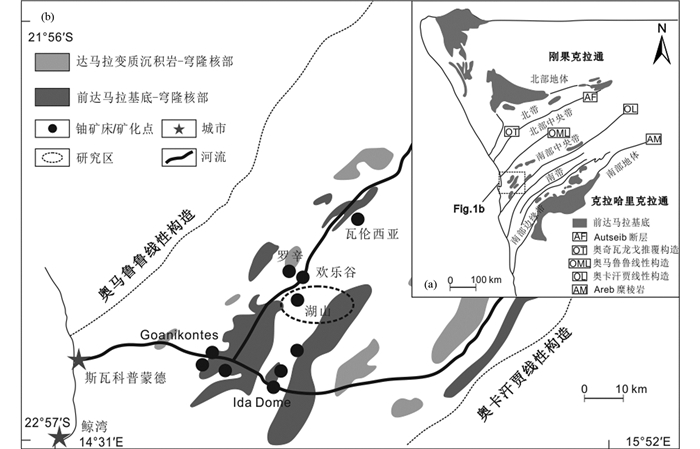
1 区域地质概况纳米比亚的大地构造单元由达马拉造山带所控制,为北部刚果克拉通与南部克拉哈里克拉通碰撞的产物,于新元古代至早古生代(650~460 Ma)形成(Goscombe et al., 2018)。从北向南可细分为北部地体、北带、北部中央带、南部中央带、南带、南部边缘带和南部地体(图 1a)。
|
图 1 纳米比亚境内达马拉造山带陆内分支构造示意图(a,据Goscombe et al., 2005修改)及达马拉造山带南部中央带各穹窿和铀矿床分布图(b,据Kinnaird and Nex, 2007修改) Fig. 1 The inland branch of the Damara Orogen showing different zones and bounding lineaments (a, modified after Goscombe et al., 2005) and simplified map of part of the southern Central Zone of the Damara Orogen showing the locations of domes and uranium deposits (b, modified after Kinnaird and Nex, 2007) |
南部中央带被南北两侧的奥马鲁鲁线型构造和奥卡汉贾线性构造所限制,内部发育众多铀矿床和铀矿化点(宁福俊等, 2018),如瓦伦西亚矿化点、罗辛矿床、欢乐谷矿床、Ida Dome和Goanikontes矿化点,以及湖山铀矿床。由于风化剥蚀的作用,矿区内前达马拉基底和达马拉变质沉积地层均以穹窿核部的形式出露于地表(图 1b),而具有放射性异常的前达马拉基底是主矿化期的成矿物质来源(Fan et al., 2017; Nex et al., 2002; 陈金勇等, 2020)。在造山带晚期的背景下,基底中的铀元素通过重熔作用在伟晶质岩浆中富集,最终在达马拉变质沉积地层的薄弱带内结晶沉淀,形成伟晶岩型铀矿化(Kinnaird and Nex, 2007; 高阳等, 2012; 陈金勇等, 2017)。
在湖山铀矿床内,新元古代的达马拉沉积地层不整合覆盖于前达马拉片麻岩基底之上,前者进一步可划分为诺斯比群和斯瓦科普群,它们之间为不整合接触(张怀峰和陆建军, 2018)。诺斯比群的地层单元为可划分为埃图西斯组和可汗组,而斯瓦科普群由罗辛组,楚斯组,卡里比组以及卡塞布组组成(表 1)。
|
表 1 达马拉造山带内湖山地区地层简表(据荣建锋等, 2016;张怀峰和陆建军, 2018修改) Table 1 Stratigraphic succession of Husab area in Damara Orogen (modified after Rong et al., 2016; Zhang and Lu, 2018) |
达马拉造山带南部中央带发育的多期次花岗质侵入体(Shanyengana et al., 2020)记录了达马拉造山带新元古代至早古生代的演化过程(Kinnaird and Nex, 2007)。湖山铀矿床内出露的侵入岩主要为早寒武纪至晚新元古代的花岗岩类,时代从早到晚依次为:Salem花岗岩、红色花岗岩、灰色花岗岩,以及具有放射性的伟晶岩/淡色花岗岩(张怀峰和陆建军, 2018)。Nex et al. (2001)根据岩石的颜色、矿物组成和放射性等宏观地质特征将伟晶岩/淡色花岗岩进一步划分为A至F六种类型,虽然该方案是在研究区西南部的Goanikontes地区内建立,但同样适用于罗辛、欢乐谷和湖山地区(Basson and Greenway, 2004; 荣建锋等, 2016; 陈金勇等, 2017)。此外,详细的地质调查表明,严格受罗辛组和可汗组控制的D型和E型伟晶岩是区域内具有经济效应铀矿化的主要载体,表现出一定的成矿专属性(Kinnaird and Nex, 2007; 张怀峰和陆建军, 2018)。
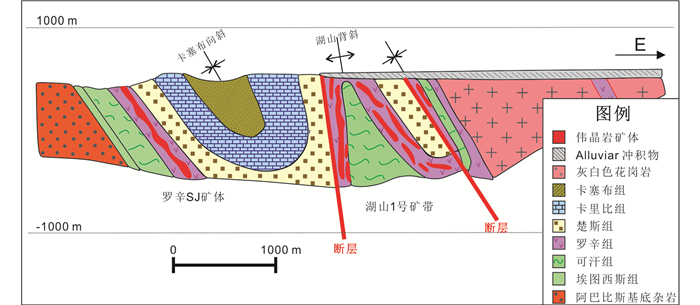
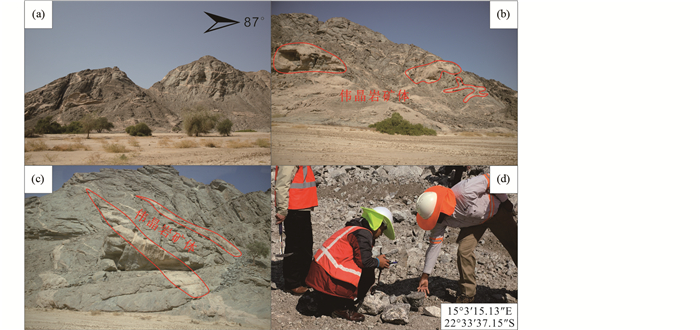
在湖山铀矿床1号矿带内,伟晶岩型矿体多产于湖山背斜的罗辛组中(图 2)。其中,位于翼部的矿体呈似层状、脉状或透镜状,延伸方向大致与地层的走向或层理平行,没有明显的变形特征(荣建锋等, 2016; 张怀峰和陆建军, 2018),而在转折端处,矿体的延伸方向与地层层理斜交,破碎严重,并出露于地表(图 3a-c)。矿石的矿物组成包括酸性长石、黑云母和烟灰色石英,表现出典型的花岗伟晶结构。由于含铀矿物放射性的影响,矿石中的石英往往变成烟灰色(Holden, 1925; Shanyengana et al., 2020),若其颜色越深,含量越高,往往指示铀矿化程度也越高(Nex et al., 2001; Kinnaird and Nex, 2007)。值得注意的是,罗辛组和可汗组的不整合面/接触带内也有少量矿体产出,其中矿石内以大量黑云母富集为典型特征(张怀峰和陆建军, 2018)。尽管该类矿体仅占总体积的20%左右,但铀矿化程度极高,故其经济效应同样不可忽视(荣建锋等, 2016)。类似的矿体在Ida Dome矿化点和欢乐谷矿床内也有报道(Corvino and Pretorius, 2013; 吕荣平等, 2015)。此外,整个铀矿省内岩芯钻孔和放射性地球物理勘探的结果显示,地层的不整合接触带内往往具有较高程度的放射性异常(荣建锋等, 2016; Shanyengana et al., 2020),暗示着带内可能存在不同的成矿元素富集机制。
|
图 2 湖山铀矿床1号带地质横剖面示意图(据荣建锋等,2016修改) Fig. 2 Geological section of Zone 1 in Husab uranium deposit (modified after Rong et al., 2016) |
为了研究不同矿石中铀元素富集与沉淀机制的差异,本次研究系统地采集了矿化的E型伟晶岩样品(图 3d)。依据样品的矿物组合和矿化程度,进一步划分为三种类型:(1)高铀含量伟晶岩(E-HUP),含有大量黑云母和烟灰色石英;(2)中等铀含量伟晶岩(E-MUP),黑云母较少,长石增多,石英呈淡烟灰色;(3)低铀含量伟晶岩(E-LUP),黑云母和烟灰色石英的含量最少,长石最多。E-HUP多产于不整合接触带内,具有独特的矿物组合和成矿金属元素极度富集的特征,因而受到了广泛的关注(Lentz, 1992; Yuan et al., 2018; 王江波等, 2020),在其它伟晶岩型铀矿床中被称为“复杂类型”伟晶岩(Lentz, 1996);而E-MUP和E-LUP一般沿地层的层理或薄弱带产出,矿物组合与一般的花岗岩类无异,故被称为“简单类型”伟晶岩(Lentz, 1996)。采集的样品包括4件E-HUP、4件E-MUP和5件E-LUP。
|
图 3 湖山铀矿1号矿带(a)和位于达马拉变质沉积地层内的伟晶岩矿体(b,c)的宏观照片及1号矿带采样照片(d) Fig. 3 Photographs of the outcrop of ore zone in Zone 1 (a), the pegmatite-bodies occurring in the Damaran metasediment strata (b, c) and the samples in Zone 1 (d) |
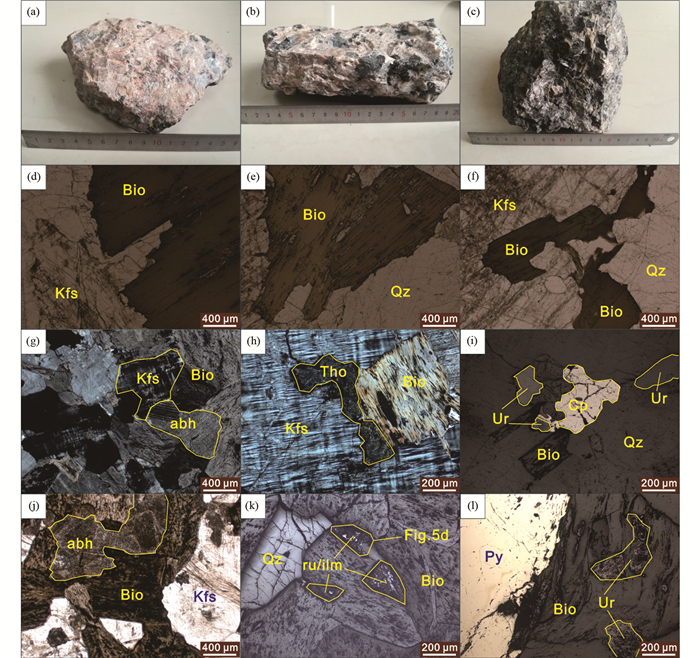
E-LUP的主要矿物为淡红色钾长石、淡色石英和棕色黑云母,矿物组成均匀,无环带,为花岗伟晶结构,其中黑云母呈片状分布于长石和石英之中(图 4a, d-f)。E-MUP具有与E-LUP相似的造岩矿物组合(图 4b),但黑云母具有两种不同的产出形态:其一,多个暗棕色黑云母以团块状聚集产出,附近可见微斜长石和钠长石共生的现象(图 4g),占总黑云母含量的40%左右;其二,与E-LUP类似,单个黑云母呈鳞片状产出(图 4h, i),周围无钠长石,二者的总含量高于E-LUP,约为20%~25%。与上述“简单类型的伟晶岩”不同,E-HUP的岩石结构具有独特性:烟灰色石英的含量最高,黑云母均呈团块状产出,且含量高达40%左右,内部可见他形石英颗粒,共生矿物有钠长石、金红石、钛铁矿和黄铁矿等(图 4c, j-l)。此外,E-MUP和E-HUP中大部分黑云母经历了较高程度的绿泥石化,但依旧保持着原有的晶体形态(即:黑云母假象绿泥石)。
|
图 4 湖山铀矿床E型伟晶岩的代表性手标本及显微照片 (a-c)E-LUP、E-MUP和E-HUP的手标本照片;(d-f)E-LUP单偏光镜下照片;(g、h)E-MUP正交偏光镜下照片;(i)E-MUP反射光镜下照片;(j)E-HUP单偏光镜下照片;(k、l)E-HUP反射光镜下照片.ilm-钛铁矿;ru-金红石;abh-钠长石;Kfs-钾长石;Bio-黑云母;Qz-石英;Ur-晶质铀矿;Tho-铀钍石;Py-黄铁矿;Cp-黄铜矿 Fig. 4 Representative hand specimen and photomicrographs of the E- type pegmatites from Husab uranium deposit (a-c) hand specimen photos of E-LUP, E-MUP and E-HUP respectively; (d-f) single-polarized photomicrographs of E-LUP; (g, h) cross-polarized photomicrographs of E-MUP; (i) reflected photomicrographs of E-MUP; (j) single-polarized photomicrographs of E-HUP; (k, l) reflected photomicrographs of E-HUP. ilm-ilmenite; ru-rutile; abh-albite; Kfs-potassic feldspar; Bio-biotite; Qz-quartz; Ur-uraninite; Tho-thorite; Py-pyrite; Cp-chalcopyrite |
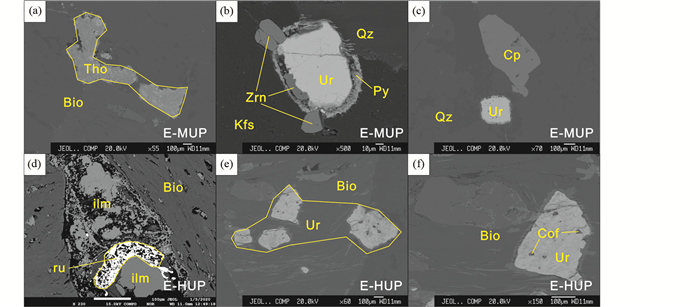
在E-LUP中,未见含铀氧化物的生成。在E-MUP中,含铀氧化物的种类主要为晶质铀矿,局部可见铀钍石,多赋存于长石,云母等造岩矿物之间,与金属硫化物(黄铜矿、黄铁矿)存在共生关系(图 4h, i;图 5a-d),含量 < 5%。在E-HUP中,主要含铀氧化物——晶质铀矿与团块状黑云母有明显的空间联系,多分布于黑云母团块的边部,或者被黑云母所包裹(图 4l、图 5e, f),分布极不均匀,含量高于E-MUP。E-MUP和E-HUP中的晶质铀矿在矿物形态及大小上区别不大,呈自形-半自形粒状,平均粒径为200μm左右,个别可达400μm(图 5e)。值得注意的是,部分晶质铀矿被黄铁矿细脉所包裹,在形态上表现出放射性晕圈(图 5b)。此外,相比于E-MUP,E-HUP中晶质铀矿表面更加粗糙,裂隙更为发育,部分颗粒的内部可见次生的铀矿物——铀石(图 5f),为原生矿物溶解的产物,但含量较低,对大部分晶质铀矿的形态没有太大的影响。总的来说,样品内含铀氧化物的种类、形态和产出形式表明矿石的铀矿化是岩浆作用的结果。
|
图 5 E型伟晶岩中代表性金属矿物背散射照片 Zrn-锆石;Cof-铀石 Fig. 5 Representative backscattered scanning electron microscope images of iron oxides in E-type pegmatites Zrn-zircon Cof-coffinite |
矿石样品经表面去污、人工破碎、清洗烘干、机械细碎等前期处理后,获得粒径小于200目的粉末。由河北省区域地质矿产调查研究所实验室承担全岩主量元素和微量元素的分析测试工作,其中主量元素的测定由荷兰帕纳科公司生产的AxiosMAX X射线荧光光谱仪分析完成,而微量元素的测定由赛默飞世尔科技公司生产的X Series2电感耦合等离子体质谱仪分析完成。主量元素的测试流程如下:(1)将200目粉末置于105℃的烘箱中烘干12小时以上;(2)称取约1.0g的烘干样品,放置坩埚中,在1000℃的马弗炉中灼烧2小时,取出并冷却至室温,称量后计算烧失量;(3)称取约0.7g的烘干样品,置于25mL坩埚中,先后加入混合溶剂(5.2g无水四硼酸锂、0.4g氟化锂、0.3g硝酸铵)和15g/L溴化锂溶液2~3滴,搅拌均匀,装于铂金坩埚后,在1250℃左右的熔样炉中熔融约15分钟;(4)取出,倒入模具中冷却,待模具与玻璃片剥离后,以备XRF测试。FeO含量的测定采用酸分解滴定法,检查方法代号为:GB/T 14506.14—2010。微量元素的处理流程如下:(1)准确称取烘干后的粉末50mg,加水润湿,依次加入1mL的高纯氢氟酸和0.5mL的高纯硝酸,置于封闭溶样器内罐中;(2)将溶样器置于185℃的烘箱中24小时以上,取出后在140℃的电热板上蒸干,加入0.5mL硝酸后再蒸干,重复一次;(3)加入5mL硝酸后密封,置于130℃的烘箱中12小时以上;(4)待冷却后,将溶液用水定容至50mL,以备ICP-MS测试。主量元素的测试误差优于2%,微量元素优于10%。
3.2 矿物化学测试方法借助光学显微镜观察矿石的结构特征,用记号笔圈出待测矿物。在实验室内对探针片喷碳,并借助扫描电镜拍摄背散射照片。依据背散射图片中矿物的表面形态,合理布置探针点,确保测试结果的准确性。长石、黑云母和绿泥石的电子探针定量分析在河北省区域地质矿产调查研究所实验室完成,设备型号为JEOL EPMA-8230,工作条件为:加速电压15kV,加速电流20nA,束斑直径1~2μm,元素的特征峰测量时间为10s,背景测量时间为5s,所有测试数据均进行了背景修正,死时间修正以及ZAF矫正,矿物标样为:钠长石(Na,Al,Si),正长石(K),方解石(Ca),金红石(Ti),橄榄石(Mg, Fe),蔷薇辉石(Mn),钽铁矿(Nb, Ta),托帕石(F),石盐(Cl)。晶质铀矿和铀钍石的电子探针定量分析在核工业北京地质研究院分析测试研究所完成,设备型号为JXA-8100,工作条件为:加速电压20kV,加速电流100nA,束斑直径 < 1μm,元素的特征峰测量时间为10s,背景测量时间为5s,所有测试数据均进行了背景修正,死时间修正以及ZAF矫正,对于放射性元素,矿物标样为:金属铀单质(U)、ThO2单质(Th)和方铅矿(Pb)。详细的测试方法参考葛祥坤(2013)。
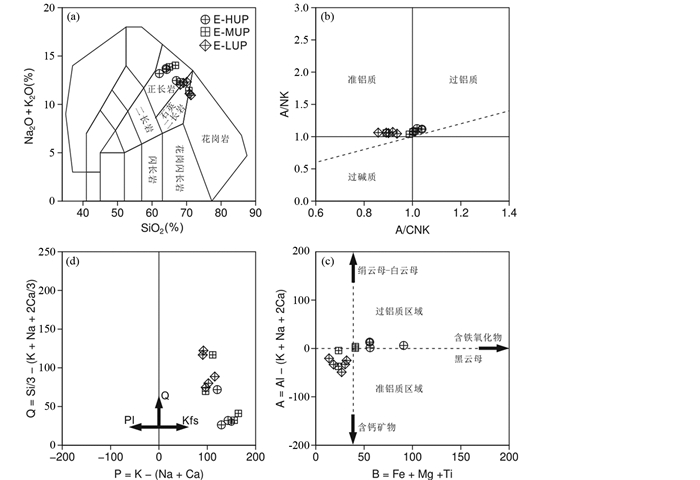
4 分析结果 4.1 主量元素分析结果样品的主微量元素测试结果列于表 2。从E-LUP到E-HUP,SiO2含量表现出下降的趋势,分别为67.73%~70.81%、64.28%~69.85%和59.97%~65.88%;K2O含量略有升高,分别为8.73%~9.86%、9.07%~11.61%和9.84%~11.17%;Na2O含量基本保持不变,分别为2.14%~2.45%、2.23%~2.55%和2.34%~2.44%。在TAS图解中,样品落于正长岩-石英二长岩-花岗岩区域内(图 6a),变化范围较大。三类样品的利特曼指数[δ=(Na2O+K2O)2/(SiO2-43)]分别为4.25~5.76(E-LUP)、4.76~8.83(E-MUP)和6.56~9.55(E-MUP),属于碱性-过碱性系列。铝饱和指数(A/CNK值)从E-LUP到E-HUP逐渐上升,分别为0.86~0.94、0.89~1.01和1.01~1.04,属于准铝质-过铝质系列(图 6b)。三类样品的化学-矿物图解反映了其结构和矿物组成的不均一,在Q-P图解中,所有样品均位于石英-钾长石(Q-Kfs)象限中(图 6c),表明矿石的分异程度高,具有岩浆演化后期的特点;A-B图解显示,从E-LUP到E-HUP,样品逐渐从准铝质区域过渡到过铝质区域,与铝饱和指数的结果一致,同时在B轴上的延伸范围也逐渐升高(图 6d),代表了黑云母和金属氧化物逐渐富集的趋势。
|
|
表 2 湖山铀矿床E型伟晶岩主量元素(wt%)和微量元素(×10-6)组成 Table 2 Major elements (wt%) and trace elements (×10-6) compositions of E-type pegmatites from Husab uranium deposit |
|
图 6 湖山铀矿床E型伟晶岩的主量元素判别图解 (a)TAS图解(据Middlemost, 1994);(b)A/CNK-A/NK图解(据Maniar and Piccoli, 1989);(c)矿物-化学Q-P图解(据Debon and Le Fort, 1983);(d)矿物-化学A-B图解(据Debon and Le Fort, 1983) Fig. 6 Discrimination diagrams for E-type pegmatites from Husab uranium deposit (a) total alkalis vs. SiO2 (after Middlemost, 1994); (b) A/CNK vs. A/NK (after Maniar and Piccoli, 1989); (c) Q vs. P classification diagram (after Debon and Le Fort, 1983); (d) A vs. B classification diagram (after Debon and Le Fort, 1983) |
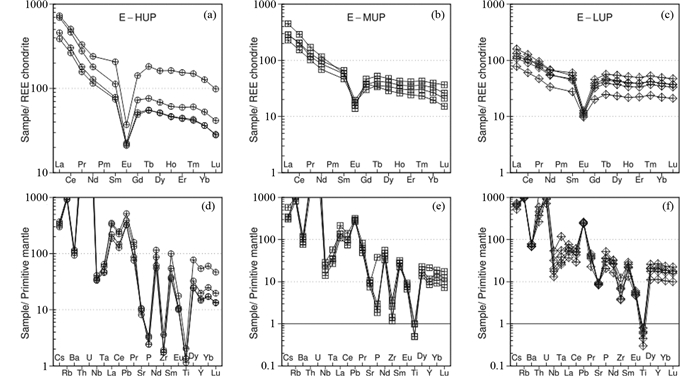
E型伟晶岩的稀土配分曲线具有一定的相似性,表现出轻稀土富集的右倾模式和Eu元素的负异常(图 7a-c),但相关稀土指标存在差异。从E-LUP到E-HUP,稀土元素总量(ΣREE)分别为131.2×10⁻⁶~264.3×10⁻⁶、295.2×10⁻⁶~509.3×10⁻⁶和491.6×10⁻⁶~1040×10-6,随着矿化程度的增加有升高的趋势(王伟等, 2020);轻稀土富集程度也略微升高,(La/Yb)N比值分别为2.51~4.36、7.68~9.30和6.12~14.02(除E-MUP-1外),但δEu值变化不大,分别为0.42~0.24、0.48~0.25和0.35~0.22,表明长石的分离结晶不明显。从原始地幔标准化蛛图解中可以看出(图 7d-f),三类样品同样具有相似的分布模式,均表现出Rb、U、Th、Pb等大离子亲石元素的正异常和Nb、Ta、Ti等高场强元素的负异常。稀土元素配分曲线和多元素蛛图解的相似性,说明三类样品可能为同源岩浆演化的产物。
|
图 7 湖山铀矿床E型伟晶岩球粒陨石标准化稀土元素配分模式图(a-c, 标准化值据Sun and McDonough, 1989)和原始地幔标准化微量元素蛛网图(d-f, 标准化值据McDonough and Sun, 1995) Fig. 7 Chondrite-normalized REE distribution patterns (a-c, normalization values after Sun and McDonough, 1989) and primitive mantle-normalized spider diagrams (d-f, normalization values after McDonough and Sun, 1995) of E-type pegmatites from Husab uranium deposit |
E-MUP和E-HUP中代表性含铀氧化物的电子探针分析结果列于表 3。E-MUP中含铀氧化物为晶质铀矿和铀钍石(图 4h, i、图 5a-c),其中铀钍石内UO2的含量变化范围较大,为13.13%~67.86%。而在E-HUP中,含铀氧化物主要为晶质铀矿(图 5e, f)。以往研究表明,自然界中不存在具有理想化学计量组成的晶质铀矿,矿物总含量的缺失和其它元素的加入通常是由α-放射性衰变和离子交换过程所导致(Janeczek and Ewing, 1992),常见的其它阳离子种类有:Th、Pb、Fe、Ca、Si、Zr和部分稀土元素(Finch and Ewing, 1992)。分析结果表明,E-MUP和E-HUP中晶质铀矿的元素总含量为93.41%~95.43%,尽管E-MUP中UO2含量高于E-HUP,但二者的ThO2和PbO2含量差别不大(图 8a, b),表明E-HUP中的晶质铀矿可能经历了更高程度的后期蚀变,从而导致其UO2含量和Σ(FeO+MgO+SiO2+CaO) (%)与Σ(Y2O3+Ce2O3+Nd2O3)(%)表现出更显著的负相关性(图 8c, d),与矿物表面的裂隙和内部次生铀矿物的生成互为印证(图 4l、图 5f)。
|
|
表 3 湖山铀矿床E型伟晶岩代表性含铀氧化物的化学组成(wt%) Table 3 Representative chemical composition of uranium-bearing oxides in E-type pegmatites from Husab uranium deposit (wt%) |

|
图 8 E型伟晶岩中晶质铀矿主量元素含量图解 (a)UO2-ThO2图解;(b)UO2-PbO图解;(c)UO2-(FeO+MgO+SiO2+CaO)图解;(d)UO2-(Y2O3+Ce2O3+Nd2O3)图解 Fig. 8 Concentrations of different major elements of uraninite in E-type pegmatites |
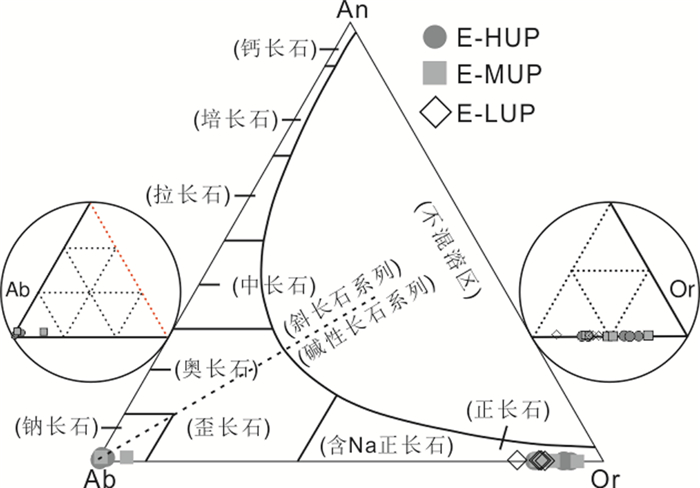
E型伟晶岩样品中代表性长石矿物的电子探针分析结果列于表 4。镜下观察和分析结果表明,E-LUP中仅存在钾长石,其正长石组分(Or)的含量为82.81~88.36,明显低于E-MUP和E-HUP(分别为86.62~94.84和86.27~93.52)(图 9),表明后者具有更高的岩浆演化程度。在E-MUP中,钠长石含量较少,且仅分布于团块黑云母周围(图 4g),其中钙长石组分(An)的含量为0.94~0.98;而E-HUP中与团块黑云母共生的钠长石较多(图 4j),An组分的含量为0.29~0.83(除E-HUP-7测点外),低于E-MUP样品(图 9)。上述长石组分的规律变化在其它伟晶岩型铀矿床中也有所体现,即随着岩浆的不断分异,钾长石的Or组分和斜长石的Ab组分会不断“纯化”(冯张生, 2012; Chen et al., 2019)。该特征也间接指示了三类样品之间具有岩浆演化关系,与主、微量元素的结果一致。
|
|
表 4 湖山铀矿床E型伟晶岩代表性长石矿物的化学组成(wt%) Table 4 Representative chemical composition of feldspar in E-type pegmatites from Husab uranium deposit (wt%) |
|
图 9 E型伟晶岩长石分类图解(底图据Chen et al., 2019修改) Fig. 9 Classification diagrams of feldspars in E-type pegmatites (base map modified after Chen et al., 2019) |
E-LUP中代表性黑云母矿物的电子探针分析结果列于表 5。E-MUP和E-HUP中代表性绿泥石矿物的电子探针分析结果列于表 6。从2.2节的讨论中可知,E-MUP中黑云母假象绿泥石具有两种产出形态,即团块状和鳞片状,在此分别用E-MUP-C(团块状)和E-MUP-S(鳞片状)以示区别。由于电子探针分析技术无法直接区分FeO和Fe2O3,故基于所测得的FeOT值,采用郑巧荣(1983)提出的剩余氧原子法,来计算样品中FeO和Fe2O3的含量。
|
|
表 5 E-LUP中代表性黑云母矿物的化学组成(wt%) Table 5 Representative chemical composition of biotite in E-LUP (wt%) |
|
|
表 6 E-MUP和E-HUP中代表性绿泥石矿物的化学组成(wt%) Table 6 Representative chemical composition of chlorite in E-MUP and E-HUP (wt%) |
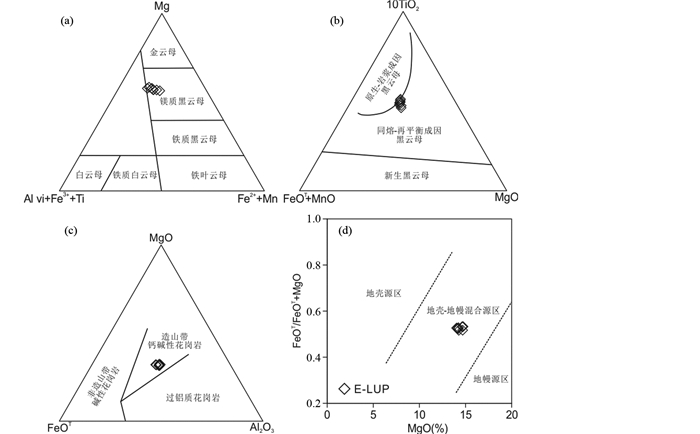
E-LUP黑云母的CaO含量均低于0.03%,Fe2+/(Fe2++Mg2+)比值为0.37~0.39,变化范围小,表明矿物基本未受后期蚀变的影响(Stone, 2000)。矿物的分类和成因图解显示,E-LUP黑云母为镁质黑云母(图 10a),属同熔-再平衡成因(图 10b),与北秦岭造山带产铀伟晶岩中黑云母的特征类似(Yuan et al., 2018; 陈佑纬等, 2013)。在FeOT-MgO-Al2O3图解中,测点位于造山带钙碱性岩石的区域内(图 10c),与围岩产出的构造背景一致(顾大钊等, 2016; 陈金勇等, 2017; 张怀峰和陆建军, 2018),而FeO/(FeO+MgO)-MgO图解指示矿石的岩浆源区具有壳幔混合的特征(图 10d),可能与该成矿省内花岗岩类源区的复杂性有关(Fan et al., 2017)。
|
图 10 E-LUP中黑云母地球化学图解 (a)Mg-(Alvi+Fe3++Ti)-(Fe2++Mn)分类图解(据Foster, 1960);(b)10TiO2-(FeOT+MnO)-MgO判别图解(据Nachit et al., 2005);(c)MgO-FeOT-Al2O3判别图解(据Abdel-Rahman, 1994);(d)FeOT/(FeOT+MgO)-MgO图解(据周作侠, 1988) Fig. 10 Selected geochemical diagrams of the biotite in E-LUP (a) Mg-(Alvi+Fe3++Ti)-(Fe2++Mn) classification diagram (after Foster, 1960); (b) 10TiO2-(FeOT+MnO)-MgO ternary discrimination (after Nachit et al., 2005); (c) MgO-FeOT-Al2O3 ternary discrimination (after Abdel-Rahman, 1994); (d) FeOT/(FeOT+MgO) vs. MgO diagram (after Zhou, 1988) |
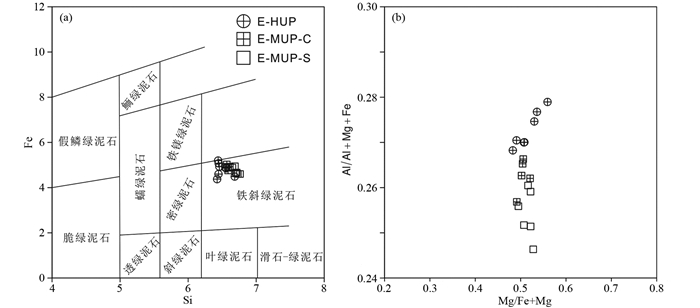
镜下鉴定结果表明,E-MUP和E-HUP中的绿泥石均由黑云母的绿泥石化形成,并保留了原生矿物的假象(图 4g-l)。多数研究者使用Na2O+K2O+CaO (%)来判别单个绿泥石受后期混染的程度(Zang and Fyfe, 1995),而本次研究中绿泥石的Na2O+K2O+CaO值为0.05%~0.45%,均满足进一步分析研究的标准(< 0.5%)。绿泥石分类图解表明样品中的绿泥石均为铁斜绿泥石(图 11a)。绿泥石的Mg/(Fe+Mg)-Al/(Al+Mg+Fe)图解被广泛用于判别矿物与其母岩的关系,当Al/(Al+Mg+Fe)小于0.35时,绿泥石源于铁镁质硅酸盐矿物的转化,反之,则为泥质/黏土岩蚀变形成(Laird, 1988)。E-MUP和E-HUP绿泥石的Mg/(Fe+Mg)变化稳定,且二者的Al/(Al+Mg+Fe)均小于0.30,与镜下观察结果相符,但整体而言,团块状产出的绿泥石(E-MUP-C和E-HUP)中Al含量要高于鳞片状的绿泥石(E-MUP-S)(图 11b)。
|
图 11 E-MUP和E-HUP中绿泥石的分类图解(a, 据Deer et al., 1962)和Mg/(Fe+Mg)-Al/(Al+Mg+Fe)图解(b) Fig. 11 Classification diagram (a, after Deer et al., 1962) and Mg/(Fe+Mg) vs. Al/(Al+Mg+Fe) diagram (b) of the chlorite in E-MUP and E-HUP |
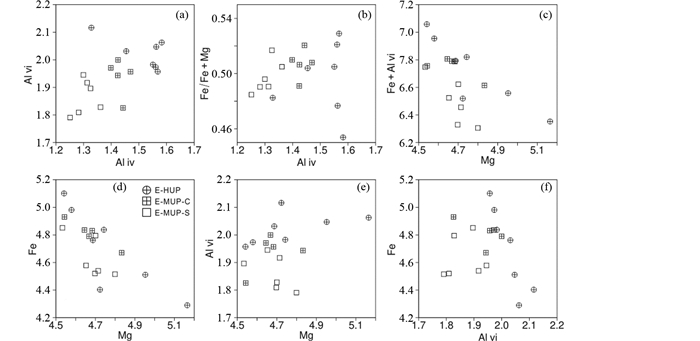
绿泥石矿物分子式的组成特征,如Aliv、Alvi、Mg、Fe等,能够指示其形成过程和条件(Bryndzia and Scott, 1987; Jahren and Aagaard, 1989)。在Aliv-Alvi图解中,E-MUP和E-HUP绿泥石都不具备明显的线性关系(图 12a),而在Aliv-Fe/(Fe+Mg)图解中也是如此(图 12b),说明矿物晶格中Mg、Fe原子的替换不伴随着Aliv对Siiv的替换(Xie et al., 1997),即四面体位置上的Si-Al替换与八面体位置上的替换相互独立,为一次蚀变作用的结果(夏菲等, 2016)。进一步考虑八面体位置上的替换过程,(Fe+Alvi)-Mg图解中绿泥石的负线性相关性明显(图 12c),表明其八面体位置主要被Al、Fe、Mg三种元素占据(Xie et al., 1997; 张展适等, 2007),同时注意到,Fe-Mg图解中的线性关系明显强于Alvi-Mg和Alvi-Fe图解(图 12d-f),说明八面体位置上主要发生Fe-Mg替换,Al基本未参与替换。
|
图 12 E-MUP和E-HUP中绿泥石主要阳离子替换过程图解 Fig. 12 Correlative plots of major cations substitution in chlorites in E-MUP and E-HUP |
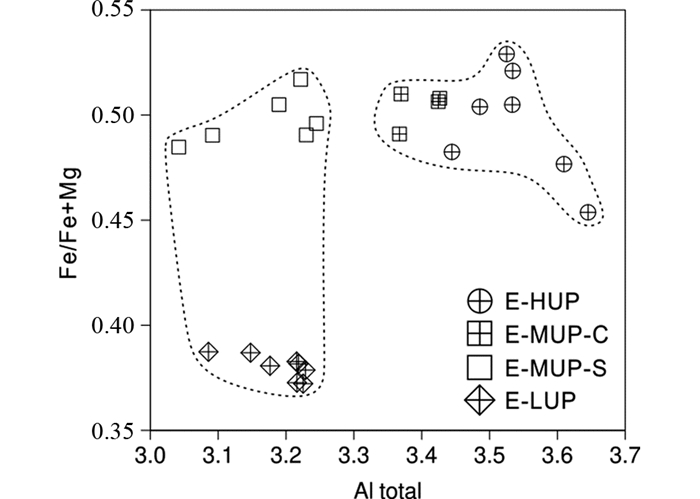
黑云母的绿泥石化在高分异的花岗岩类中十分普遍(Ferry, 1979; Nishimoto and Yoshida, 2010)。通常,黑云母的绿泥石化是一个体积增加的反应,需要外来Fe、Mg组分的加入(Parry and Downey, 1982),因此矿物的Fe/(Fe+Mg)比值会发生明显变化(Parneix et al., 1985; 张龙等, 2017)。相比于Fe、Mg等活动性元素,Al在热液流体中的活度较低,故在多数蚀变反应中可以作为严格的惰性组分(Helgeson, 1971)。因而不少学者认为,在矿物尺度下,黑云母的绿泥石化可视为“Al-保守”反应(Ferry, 1979; Parry and Downey, 1982; Veblen and Ferry, 1983),特别是对于保留了黑云母假象的绿泥石而言,在成因上遵循原地“溶解-沉淀”的机制,能够保留原生矿物的信息(张展适等, 2007; Yamini et al., 2017)。Mg/(Fe+Mg)-Al/(Al+Mg+Fe)图解(图 11b)和阳离子替换图解(图 12)表明,Al在绿泥石化过程中主要作为矿物晶格骨架,在阳离子替换过程中的参与度较低,基本不受后期蚀变的影响,故能反映原生黑云母的相关信息。通过对比三种样品中的铁镁质硅酸盐矿物数据,可以看出,从E-LUP到E-HUP,矿物的Fe/(Fe+Mg)比值逐渐上升,但全Al含量(Al total)则分为两组(图 13):E-LUP中黑云母与E-MUP中鳞片状绿泥石(E-MUP-S)的全Al含量相近,且均低于团块状绿泥石(E-MUP-C和E-HUP)。上述结果表明,在未发生绿泥石化之前,E-MUP中鳞片状黑云母可能和E-LUP中黑云母有成因联系,而团块状黑云母的成因可能有别于前者。
|
图 13 E型伟晶岩中铁镁质矿物的全Al-Fe/Fe+Mg图解 黑云母的分子式基于28个阳离子重新计算 Fig. 13 Total Al vs. Fe/Fe+Mg diagram of mafic minerals in E-type pegmatites Major cations in biotite are recalculated on an anhydrous 28 oxygen-atom per-formula-unit base |
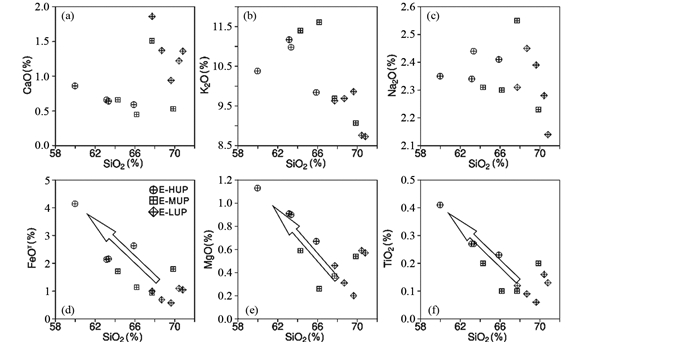
铀矿床的岩芯钻探工作表明,产于湖山背斜中的E型伟晶岩是铀矿化的主要载体之一(张怀峰和陆建军, 2018)。矿石中的工业铀矿物主要为岩浆成因的晶质铀矿(少量铀钍石),因此在探讨铀元素富集与沉淀机制之前,有必要对伟晶岩的岩浆演化过程进行研究。在主量元素哈克图解中,样品SiO2与酸性组分(CaO、K2O、Na2O)之间的协变关系不明显(图 14a-c),但与基性组分(FeOT、MgO、TiO2)之间具有一定的相关性(图 14d-f)。一方面,从E-LUP到E-HUP,SiO2的逐渐降低和FeOT、MgO、TiO2的逐渐升高与黑云母和金属副矿物(黄铁矿、黄铜矿、金红石、钛铁矿)含量的增加相对应;另一方面,铝饱和指数、稀土元素配分模式,以及长石类矿物的化学性质表明,相比于E-LUP,E-MUP和E-HUP的岩浆分异程度更高,因此岩浆的分离结晶过程无法解释主量元素的演化趋势。
|
图 14 湖山铀矿床E型伟晶岩主量元素哈克图解 Fig. 14 The Harker plots of major elements of E-type pegmatites from Husab uranium deposit |
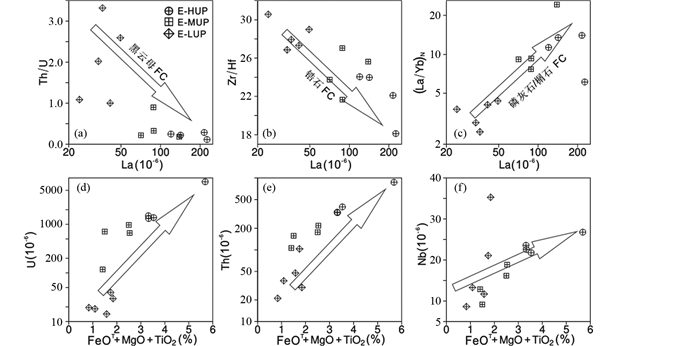
由于矿物的粒径和相对含量变化较大,不少学者认为,与主量元素相比,微量元素的协变关系更能反映伟晶质岩浆的演化过程(Mckeough et al., 2013; Chen et al., 2019)。黑云母是样品中唯一的铁镁质硅酸盐矿物,尽管在E-MUP和E-HUP中已蚀变为绿泥石,但任保持着黑云母的假象。在酸性岩浆中,Th相对于U更加容易进入黑云母,而U更倾向于在残余岩浆中富集(Nash and Crecraft, 1985),因而Th/U-La图解中的负相关趋势(图 15a)可以指示黑云母的分离结晶(Zhu et al., 2006),同时,Zr/Hf-La和(La/Yb)N-La图解中的变化趋势(图 15b, c)可以代表酸性岩浆中副矿物(如:锆石、磷灰石、榍石)的分离结晶(Li et al., 2007)。值得注意的是,从E-LUP到E-HUP,样品中黑云母的含量逐渐上升,与Th/U-La图解中的变化趋势不符。结合图 13所示的结果,图 15a中的负相关关系可能只是E-LUP和E-MUP中鳞片状黑云母分离结晶作用的反映,而E-HUP中Th/U值的下降可能与晶质铀矿的大量沉淀有关,同时也说明团块状黑云母的成因需要用其它岩浆过程来解释。
|
图 15 湖山铀矿床E型伟晶岩分离结晶和同化混染过程图解 FC-分离结晶;FeOT+MgO+TiO2-混染指数 Fig. 15 Fractional crystallization and assimilation processes of E-type pegmatites from Husab uranium deposit FC-fractional crystallization; FeOT+MgO+TiO2-hybridization index |
研究区内,以团块状黑云母为典型特征的高品位铀矿体通常产于地层接触带内(荣建锋等, 2016; 张怀峰和陆建军, 2018),类似现象在Ida Dome和欢乐谷地区也有报道(Corvino and Pretorius, 2013; 吕荣平等, 2015)。以往的研究中,与E-HUP类似的、组成不均一的“复杂类型”矿体,通常被认为是伟晶质岩浆同化混染围岩物质的产物(Mckeough et al., 2013; Yuan et al., 2018; 王江波等, 2020)。除了矿物组成的复杂性外,“复杂类型”矿体在化学成分上也具有明显的“混合特征”,即混染组分与成矿金属元素之间具有明显的正相关性(Lentz, 1996; 刘刚等, 2017; 袁峰等, 2017)。本次研究中,基于主量元素的变化趋势(图 6d、图 14),借鉴Lentz (1996)所提出的方法,选取“FeOT+MgO+TiO2”作为“混染指数”,与U、Th和Nb做相关性分析。结果表明,从E-LUP到E-HUP,U、Th和Nb与“混染指数”之间具有同步富集的趋势(图 15d-f),印证了晶质铀矿、金属副矿物(金红石、钛铁矿、黄铁矿等)和团块状黑云母的空间联系。此外,团块黑云母中的它形石英颗粒(图 4k)也能为混染过程提供一定的矿物学证据(Yuan et al., 2018; 刘刚等, 2017; 袁峰等, 2017)。
综上,E型伟晶岩矿物组成和化学性质的演变是同化混染与分离结晶(AFC)作用的结果。岩浆演化过程受外来基性组分(FeO、MgO、TiO2)的混入,并直接影响到相关矿化元素(U、Th、Nb)的富集,导致金属矿物的沉淀。该过程能有效地解释哈克图解中元素的异常变化趋势。
5.2 高铀矿体中团块黑云母的形成如上文所述,E型伟晶岩中含铀氧化物具有两种产出形式。第一种为E-MUP中所见,晶质铀矿/铀钍石呈浸染状分布于石英、长石和黑云母之间,矿化分散(图 4h-i、图 5a-c)。第二种常见于E-HUP中,晶质铀矿与团块黑云母有明显的空间联系,且钠长石、Fe-Ti氧化物和金属硫化物与之共生(图 4j-l、图 5d-f),矿化集中,程度极高。故一些学者将侵入体中黑云母的含量作为圈定找矿靶区的标准之一(Corvino and Pretorius, 2013; 赵希刚等, 2015)。因此,在探讨铀元素的富集和沉淀之前,有必要对团块黑云母的成因进行研究。
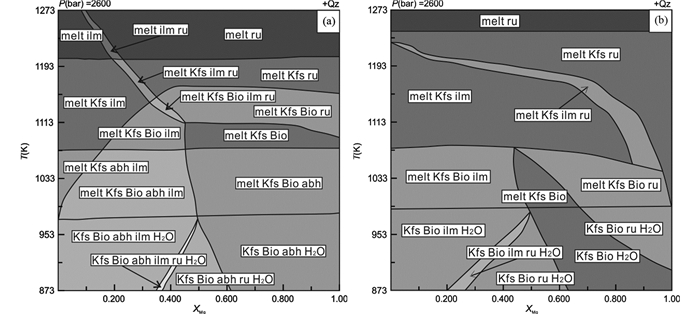
由4.1节可知,E型伟晶岩的岩浆演化受到了外来基性组分(FeO、MgO、TiO2)的混染,因而有必要讨论基性组分的加入对矿物结晶过程的影响。矿物相平衡模拟是预测岩石体系中矿物组成演变的常用方法(魏春景和周喜文, 2003; 魏春景和王伟, 2007),而硅酸质熔体模型的加入,使得利用矿物固溶体数据库模拟酸性岩浆的演化成为可能(White et al., 2001, 2007)。本次研究选取E-HUP的平均主量元素组成作为“混染体系”,E-LUP的平均主量元素组成作为“正常体系”,考虑SiO2-Al2O3-FeO-MgO-TiO2-CaO-Na2O-K2O-H2O的体系组成,利用温度-成分(T-X)混合变量图解,计算不同熔体冷却过程中矿物的结晶过程(Connolly, 1990; White et al., 2001)。由于石英与所有矿物共生,故SiO2在计算中被视为饱和组分。模拟计算的压力取2.6kbar,为欢乐谷地区矿化伟晶岩中流体包裹体的研究结果,可代表岩浆成矿期的平均压力(范洪海等, 2015)。使用的固溶体模型包括melt(HP)(硅酸质岩浆)、三端元长石固溶体feldspar(碱性长石和斜长石系列)和Bio(HP)(黑云母)。端元矿物及固溶体的物理化学性质参照Holland & Powell数据库(Holland and Powell, 2011),计算软件为Perple_x,版本为6.8.6,结果如图 16所示。
|
图 16 E-HUP混染体系(a)和E-LUP正常体系(b)的温度-成分图解 XMg=MgO/(MgO+FeOT). melt-硅酸盐熔体;ilm-钛铁矿;ru-金红石;abh-钠长石;Kfs-钾长石;Bio-黑云母;Qz-石英 Fig. 16 Temperature-component diagrams for E-HUP (a) and E-LUP (b) system XMg=MgO/(MgO+FeOT). melt- silicate melt; ilm- ilmenite; ru-rutile; abh-albite; Kfs-potassic feldspar; Bio-biotite; Qz-quartz |
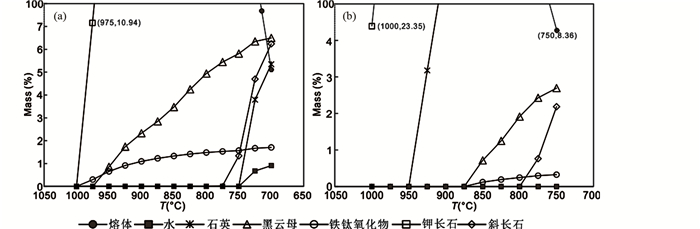
在“混染体系”中(图 16a),钾长石(Kfs)的初始结晶温度约为1193K,黑云母(Bio)的初始结晶温度约为1153K。随着温度的降低,约在1073K时,两种长石(钾长石Kfs和钠长石abh)开始与黑云母和熔体共存。在“正常体系”中(图 16b),钾长石在1233 K时就已经出现,而黑云母在~1073K时才开始结晶。上述现象表明,外来基性组分的混入不仅为黑云母的大量晶出提供了物质条件,而且升高了黑云母在岩浆中的初始结晶温度,延长了结晶时间。再者,相比于“混染体系”,“正常体系”中钾长石的初始结晶温度较高,大量钾长石的优先结晶会占据更多的结晶空间,不利于后续黑云母的生长。在rhyolite-MELTS岩浆模拟体系中也能得出上述结论(图 17)。E-HUP和E-LUP岩浆中黑云母的初始结晶温度约为950℃和850℃,并随着温度的降低,“混染体系”中黑云母和铁钛氧化物的含量明显高于“正常体系”,与岩矿鉴定结果一致,同时,E-LUP岩浆在1000℃时已有大量的钾长石结晶(23.35%),远远高于E-HUP岩浆(975℃时钾长石含量为10.94%)。值得注意的是,样品中团块黑云母的Al含量普遍高于鳞片状黑云母(图 13),而E-HUP中钾长石的Al含量普遍低于E-MUP和E-LUP(Al原子数分别为0.990~0.997和0.994~1.012),进而从矿物学的角度证明了在E-HUP中黑云母相对“优先结晶”,而钾长石相对“延后结晶”,因此黑云母具有更充足的结晶空间和时间,倾向于以团块状聚集的形态产出。
|
图 17 E-HUP混染体系(a)和E-LUP正常体系(b)的温度-矿物成分图解 体系组成计算同图 16,计算模型基于Gualda et al. (2012) Fig. 17 Temperature vs. mineral compositions diagrams for E-HUP (a) and E-LUP (b) system Calculation of system composition is as same as Fig. 16, calculation model after Gualda et al. (2012) |
此外,“捕虏晶混染”模型可以解释团块黑云母周围金红石、钛铁矿和钠长石的成因(Beard et al., 2005; Clarke, 2007; Erdmann et al., 2007)。研究发现,具有含水矿物(如云母、角闪石等)的捕掳体在接触带往往发生脱水熔融作用,分解为不含水的矿物组合(如金属氧化物、斜长石等)与含水熔体(Erdmann et al., 2010; Dill and Skoda, 2015)。随着捕掳体的不断消耗,含水熔体会逐渐进入岩浆,而不含水矿物会在混合岩浆固结过程中以副矿物的形式保留,因而与团块黑云母共生的金红石、钛铁矿和钠长石也是同化混染过程的有力证据之一(Beard et al., 2004; Farris and Paterson, 2007)。湖山铀矿床中,E-HUP多产于罗辛组和可汗组的不整合接触带,而上述地层中均含有黑云-角闪片岩的岩性单元(荣建锋等, 2016; 张怀峰和陆建军, 2018),可能为岩浆混染过程提供基性物质。
5.3 铀矿化机制的探讨铀元素为高度不相容的大离子亲石元素,具有亲氧、氟和氯元素的特性,趋向于在残余岩浆中富集(Cuney, 2009; 2010)。本次研究中,E-MUP的晶质铀矿/铀钍石以独立副矿物的形式存在,矿化程度不高,铀元素在岩浆分异过程中逐步富集,达到饱和浓度后以氧化物的形式沉淀(赵希刚等, 2015; 陈金勇等, 2017)。然而,E-HUP中的晶质铀矿往往集中分布于团块黑云母附近,矿化程度极高,很难通过岩浆的结晶分异作用形成(Cuney, 2014; Ballouard et al., 2017)。故有必要通过E-HUP中独特的矿物组合来揭示其铀矿化的过程。
晶质铀矿是典型的高温成因矿物,在样品中常与金属硫化物共生(图 4i, l、图 5b, c),表明其岩浆具有较高的温度和较低的氧逸度(Mercadier et al., 2011; Dill, 2015)。在高温低氧的岩浆中,铀主要以U4+或UOn4-2n的形式存在,在岩浆演化的晚期倾向于和卤族元素结合(Peiffert et al., 1996)。研究表明,U4+与F-结合形成的UFm4-m络合物是岩浆成因的铀矿床中铀元素的主要迁移形式(Cuney, 2010; Redkin and Velichkin, 2013; Yuan et al., 2020),而在演化后期的残余熔体中,F的富集也会使铀元素的丰度随之增长(Kovalenko et al., 2012)。在纳米比亚成矿省内,主成矿期(岩浆期)的流体中检测出了大量的F-和Cl-,证实了铀以卤化物的形式迁移(陈金勇等, 2015)。由4.2节可知,基性组分的混入会导致E-HUP中黑云母的大量沉淀,而花岗质熔体中黑云母等含羟基矿物是F的主要载体(曾令交和金景福, 1994),故该过程会造成岩浆中F含量的快速下降,同时也降低了铀元素的溶解度,促使UFm4-m络合物发生水解,铀元素达到过饱和状态,进而在团块黑云母周围析出晶质铀矿。用方程式可简要表示为:UFm4-m(aq)+2H2O(l) → UO2(s)+mF-(aq)+4H+(aq)。
花岗质岩浆能够降低接触带内围岩物质的固相线温度,有利于发生大规模的同化混染作用(Lentz, 1996; Mckeough et al., 2013)。该过程中外来物质的混入对矿石的矿化程度有促进作用(图 15d, e),因此在罗辛组和可汗组的不整合带/接触带内往往具有更显著的矿化异常(Shanyengana et al., 2020; 荣建锋等, 2016)。综上所述,E型伟晶岩矿石中铀元素的富集与沉淀受同化混染与分离结晶(AFC)作用的控制,外来基性组分(FeO、MgO、TiO2)的混入是形成高品位矿体的必要条件。
6 结论(1) 湖山铀矿床E型伟晶岩中的含铀氧化物主要为岩浆成因的晶质铀矿,含少量铀钍石。根据矿物组合和铀矿化程度,E型伟晶岩矿石可以分为“简单类型”伟晶岩(E-LUP和E-MUP)和“复杂类型”伟晶岩(E-HUP)。前者具有花岗伟晶结构,铀矿化程度低到中等,而后者以大量团块状黑云母为典型特征,铀矿化程度极高。
(2) 全岩主微量元素和矿物电子探针分析结果显示,E-LUP和E-MUP之间具有成因联系,为同源岩浆经过分离结晶作用的产物,铀元素随着岩浆的分异演化富集,最终以独立矿物的形式沉淀。分离结晶作用是控制“简单类型”伟晶岩矿化程度的主要因素。
(3) E-HUP的岩浆演化主要受同化混染过程的影响,外来基性组分(FeO、MgO、TiO2)的加入导致熔体中矿物的初始结晶温度发生改变,黑云母的“优先结晶”和钾长石的“延后结晶”为黑云母提供了更充足的结晶时间和生长空间,促使黑云母以团块状聚集的形式产出,并大量消耗体系中的F离子。F离子浓度的下降会引发残余岩浆中UFm4-m络合物的水解,导致晶质铀矿在团块黑云母内部或周围大量沉淀,进而形成高品位的铀矿体。
致谢 野外调查及采样工作得到了中国地质大学(北京)蔡敏、张帆博士、岳文教授、郑新奇教授和中广核铀业斯科有限公司(Swakop Uranium)的蔡于胜总经理、向伟东副总经理、张怀峰、谢成龙地质师的支持与帮助;刘典波博士提供了野外地质图;室内分析测试得到了河北省区域地质矿产调查研究所实验室修迪老师的帮助;三位匿名审稿专家的精心审阅使得本文质量显著提高;在此一并致以衷心的感谢!
Abdel-Rahman AFM. 1994. Nature of biotites from alkaline, calc-alkaline, and peraluminous magmas. Journal of Petrology, 35(2): 525-541 DOI:10.1093/petrology/35.2.525
|
Ballouard C, Poujol M, Boulvais P, Mercadier J, Tartèse R, Venneman T, Deloule E, Jolivet M, Kéré I, Cathelineau M and Cuney M. 2017. Magmatic and hydrothermal behavior of uranium in syntectonic leucogranites: The uranium mineralization associated with the Hercynian Guérande granite (Armorican Massif, France). Ore Geology Reviews, 80: 309-331 DOI:10.1016/j.oregeorev.2016.06.034
|
Basson IJ and Greenway G. 2004. The Rössing uranium deposit: A product of late-kinematic localization of uraniferous granites in the Central Zone of the Damara Orogen, Namibia. Journal of African Earth Sciences, 38(5): 413-435 DOI:10.1016/j.jafrearsci.2004.04.004
|
Beard JS, Ragland PC and Rushmer T. 2004. Hydration crystallization reactions between anhydrous minerals and hydrous melt to yield amphibole and biotite in igneous rocks: Description and implications. The Journal of Geology, 112(5): 617-621 DOI:10.1086/422670
|
Beard JS, Ragland PC and Crawford ML. 2005. Reactive bulk assimilation: A model for crust-mantle mixing in silicic magmas. Geology, 33(8): 681-684 DOI:10.1130/G21470AR.1
|
Bonales LJ, Menor-Salván C and Cobos J. 2015. Study of the alteration products of a natural uraninite by Raman spectroscopy. Journal of Nuclear Materials, 462: 296-303 DOI:10.1016/j.jnucmat.2015.04.017
|
Bryndzia LT and Scott SD. 1987. The composition of chlorite as a function of sulfur and oxygen fugacity: An experimental study. American Journal of Science, 287(1): 50-76 DOI:10.2475/ajs.287.1.50
|
Chen JY, Fan HH, Chen DH, Gu DZ and Wang SY. 2013. Research on the characteristics of uranium minerals of alaskite-type uranium deposit in the Gaudeanmus area, Namibia. Geological Review, 59(5): 962-970 (in Chinese with English abstract)
|
Chen JY, Fan HH, Wang SY and Gu DZ. 2015. Ore-forming fluids and stable isotopes geochemistry of alaskite-type uranium deposit in the Gaudeanmus area, Namibia. Progress Report on China Nuclear Science & Technology, 4(9): 51-57 (in Chinese with English abstract)
|
Chen JY, Fan HH, Wang SY and Gu DZ. 2016. Trace element and REE geochemical characteristics of alaskites and their relations with uranium mineralization around Gaudeanmus, Namibia. Geochimica, 45(5): 486-498 (in Chinese with English abstract)
|
Chen JY, Fan HH, Wang SY and Gu DZ. 2017. Discussion on mineralization mechanism of leucogranite-type uranium deposit in Gaudeanmus area, Namibia. Geological Journal of China Universities, 23(2): 202-212 (in Chinese with English abstract)
|
Chen JY, Fan HH, Wang SY, Gu DZ, Zhang C and Chen DH. 2020. The sulfide characteristics and S-Pb isotopic composition of leucogranite-type uranium deposit in the Gaudeanmus area, central Damarabelt, Namibia. Acta Geologica Sinica, 94(2): 587-598 (in Chinese with English abstract)
|
Chen YW, Bi XW, Hu RZ, Dong SH, Cheng DJ and Feng ZS. 2013. Mineral chemistry of biotite and its implications for uranium mineralization in Guangshigou pegmatite-type uranium deposit, South Shaanxi Province. Journal of Mineralogy and Petrology, 33(4): 17-28 (in Chinese with English abstract)
|
Chen YW, Hu RZ, Bi XW and Luo JC. 2019. Genesis of the Guangshigou pegmatite-type uranium deposit in the North Qinling Orogenic Belt, China. Ore Geology Reviews, 115(4): 103165
|
Clarke DB. 2007. Assimilation of xenocrysts in granitic magmas: Principles, processes, proxies, and problems. The Canadian Mineralogist, 45(1): 5-30 DOI:10.2113/gscanmin.45.1.5
|
Connolly JAD. 1990. Multivariable phase diagrams: An algorithm based on generalized thermodynamics. American Journal of Science, 290(6): 666-718 DOI:10.2475/ajs.290.6.666
|
Corvino AF and Pretorius LE. 2013. Uraniferous leucogranites south of Ida dome, central Damara belt, Namibia: Morphology, distribution and mineralisation. Journal of African Earth Sciences, 80: 60-73 DOI:10.1016/j.jafrearsci.2013.01.003
|
Cuney M. 2009. The extreme diversity of uranium deposits. Mineralium Deposita, 44(1): 3-9 DOI:10.1007/s00126-008-0223-1
|
Cuney M. 2010. Evolution of uranium fractionation processes through time: Driving the secular variation of uranium deposit types. Economic Geology, 105(3): 553-569 DOI:10.2113/gsecongeo.105.3.553
|
Cuney M. 2014. Felsic magmatism and uranium deposits. Bulletin de la Societe Geologique de France, 185(2): 75-92 DOI:10.2113/gssgfbull.185.2.75
|
Debon F and Le Fort P. 1983. A chemical-mineralogical classification of common plutonic rocks and associations. Earth and Environmental Science Transactions of The Royal Society of Edinburgh, 73(3): 135-149 DOI:10.1017/S0263593300010117
|
Deer WA, Howie RA and Iussman J. 1962. Rock-forming Minerals: Sheet silicates. London: Longman, 270 pp
|
Dill HG. 2015. Pegmatites and aplites: Their genetic and applied ore geology. Ore Geology Reviews, 69: 417-561 DOI:10.1016/j.oregeorev.2015.02.022
|
Dill HG and Skoda R. 2015. The new Nb-P aplite at Reinhardsrieth: A keystone in the lateral and depth zonations of the Hagendorf-Pleystein pegmatite field, SE Germany. Ore Geology Reviews, 70: 208-227 DOI:10.1016/j.oregeorev.2015.04.015
|
Erdmann S, London D, Morgan GB and Clarke DB. 2007. The contamination of granitic magma by metasedimentary country-rock material: An experimental study. The Canadian Mineralogist, 45(1): 43-61 DOI:10.2113/gscanmin.45.1.43
|
Erdmann S, Scaillet B and Kellett DA. 2010. Xenocryst assimilation and formation of peritectic crystals during magma contamination: An experimental study. Journal of Volcanology and Geothermal Research, 198(3-4): 355-367 DOI:10.1016/j.jvolgeores.2010.10.002
|
Fan HH, Chen JY, Gu DZ and Wang SY. 2015. Fluid inclusions and metallogenesis of alaskite-type uranium deposits in Gaudeanmus area, Namibia. Mineral Deposits, 34(1): 189-199 (in Chinese with English abstract)
|
Fan HH, Chen JY, Wang SY, Zhao JY, Gu DZ and Meng YN. 2017. Genesis and uranium sources of leucogranite-hosted uranium deposits in the Gaudeanmus area, Central Damara Belt, Namibia: Study of element and Nd isotope geochemistry. Acta Geologica Sinica, 91(6): 2126-2137 DOI:10.1111/1755-6724.13453
|
Farris DW and Paterson SR. 2007. Contamination of silicic magmas and fractal fragmentation of xenoliths in paleocene plutons on Kodiak island, Alaska. The Canadian Mineralogist, 45(1): 107-129 DOI:10.2113/gscanmin.45.1.107
|
Feng ZS. 2012. The preliminary research on feldspar of Guangshigou pegmatite-type uranium deposit, South Shaanxi Province. Geology of Chemical Minerals, 34(2): 71-76 (in Chinese with English abstract)
|
Ferry JM. 1979. Reaction mechanisms, physical conditions, and mass transfer during hydrothermal alteration of mica and feldspar in granitic rocks from south-central Maine, USA. Contributions to Mineralogy and Petrology, 68(2): 125-139 DOI:10.1007/BF00371895
|
Finch RJ and Ewing RC. 1992. The corrosion of uraninite under oxidizing conditions. Journal of Nuclear Materials, 190: 133-156 DOI:10.1016/0022-3115(92)90083-W
|
Foster MD. 1960. Interpretation of the composition of trioctahedral micas. Geological Survey Professional Paper, 354: 11-49
|
Gao Y, Fan HH, Chen DH, Nie JT and Wang SY. 2012. The alaskite-type uranium deposit: A product of coupling of tectonism with magmatism. Geology and Exploration, 48(5): 1058-1066 (in Chinese with English abstract)
|
Ge XK. 2013. Development and research of electron microprobe dating method in the age research of uranium and uranium bearing minerals. Ph. D. Dissertation. Beijing: Beijing Research Institute of Uranium Geology, 1-202 (in Chinese)
|
Glover AS, Rogers WZ and Barton JE. 2012. Granitic pegmatites: Storehouses of industrial minerals. Elements, 8(4): 269-273 DOI:10.2113/gselements.8.4.269
|
Goscombe B, Foster DA, Gray D and Wade B. 2018. The Evolution of the Damara Orogenic System: A Record of West Gondwana Assembly and Crustal Response. In: Geology of Southwest Gondwana. Springer, 303-352
|
Goscombe B, Gray D and Hand M. 2005. Extrusional tectonics in the core of a transpressional orogen: The Kaoko Belt, Namibia. Journal of Petrology, 46(6): 1203-1241 DOI:10.1093/petrology/egi014
|
Gu DZ, Fan HH, Shu LS, Xu XS, Yao JL, Zhao K and Chen JY. 2016. Structural evolution and its restriction on uranium mineralization in Gaudeanmus area, Namibia. Geological Review, 62(1): 83-93 (in Chinese with English abstract)
|
Gualda GAR, Ghiorso MS, Lemons RV and Carley TL. 2012. Rhyolite-MELTS: A modified calibration of MELTS optimized for silica-rich, fluid-bearing magmatic systems. Journal of Petrology, 53(5): 875-890 DOI:10.1093/petrology/egr080
|
Helgeson HC. 1971. Kinetics of mass transfer among silicates and aqueous solutions. Geochimica et Cosmochimica Acta, 35(5): 421-469 DOI:10.1016/0016-7037(71)90043-3
|
Hoffmann KH, Condon DJ, Bowring SA and Crowley JL. 2004. U-Pb zircon date from the Neoproterozoic Ghaub Formation, Namibia: Constraints on Marinoan glaciation. Geology, 32(9): 817-820 DOI:10.1130/G20519.1
|
Holden E. 1925. The cause of color in smoky quartz and amethyst. American Mineralogist, 10(9): 203-252
|
Holland TJB and Powell R. 2011. An improved and extended internally consistent thermodynamic dataset for phases of petrological interest, involving a new equation of state for solids. Journal of Metamorphic Geology, 29(3): 333-383 DOI:10.1111/j.1525-1314.2010.00923.x
|
Hu RZ, Luo JC, Chen YW and Pan LC. 2019. Several progresses in the study of uranium deposits in South China. Acta Petrologica Sinica, 35(9): 2625-2636 (in Chinese with English abstract) DOI:10.18654/1000-0569/2019.09.01
|
Jahren JS and Aagaard P. 1989. Compositional variations in diagenetic chlorites and illites, and relationships with formation-water chemistry. Clay Minerals, 24(2): 157-170 DOI:10.1180/claymin.1989.024.2.04
|
Janeczek J and Ewing RC. 1992. Structural formula of uraninite. Journal of Nuclear Materials, 190: 128-132 DOI:10.1016/0022-3115(92)90082-V
|
Jin RS, Miao PS, Sima XZ, Feng XX, Tang C, Zhu Q and Li GY. 2014. Discussion on the classification about uranium deposits. Geological Survey And Research, 37(1): 1-5 (in Chinese with English abstract)
|
Kinnaird JA and Nex PAM. 2007. A review of geological controls on uranium mineralisation in sheeted leucogranites within the Damara Orogen, Namibia. Applied Earth Science: Transactions of the Institutions of Mining and Metallurgy, 116(2): 68-85
|
Kovalenko NI, Ryzhenko BN, Prisyagina NI and Bychkova YV. 2012. Experimental determination of uranium (Ⅳ) speciation in HF solutions at 500℃ and 1000bar. Geochemistry International, 50(1): 18-25 DOI:10.1134/S0016702912010053
|
Laird J. 1988. Chlorites: Metamorphic petrology. Reviews in Mineralogy and Geochemistry, 19(1): 405-453
|
Lentz D. 1992. Petrogenesis and geochemical composition of biotites in rare-element granitic pegmatites in the southwestern Grenville Province, Canada. Mineralogy and Petrology, 46(3): 239-256 DOI:10.1007/BF01164649
|
Lentz D. 1996. U, Mo, and REE mineralization in late-tectonic granitic pegmatites, southwestern Grenville Province, Canada. Ore Geology Reviews, 11(4): 197-227 DOI:10.1016/0169-1368(95)00034-8
|
Li XH, Li ZX, Li WX, Liu Y, Yuan C, Wei GJ and Qi CS. 2007. U-Pb zircon, geochemical and Sr-Nd-Hf isotopic constraints on age and origin of Jurassic I- and A-type granites from central Guangdong, SE China: A major igneous event in response to foundering of a subducted flat-slab?. Lithos, 96(1-2): 186-204 DOI:10.1016/j.lithos.2006.09.018
|
Linnen RL, Van Lichtervelde M and Černý P. 2012. Granitic pegmatites as sources of strategic metals. Elements, 8(4): 275-280 DOI:10.2113/gselements.8.4.275
|
Liu G, Liu JJ, Yuan F, Zhang S, Sha YZ, Zhang HY and Wang GW. 2017. The magmatic evolution and its constraints on uranium mineralization in the Xiaohuacha uranium deposit, Shaanxi Province. Geoscience, 31(5): 990-1005 (in Chinese with English abstract)
|
London D. 2018. Ore-forming processes within granitic pegmatites. Ore Geology Reviews, 101: 349-383 DOI:10.1016/j.oregeorev.2018.04.020
|
Longridge L. 2012. Tectonothermal evolution of the southwestern Central Zone, Damara Belt, Namibia. Ph. D. Dissertation. Johannesburg Namibia: University of the Witwatersrand, 1-525
|
Lü RP, Jin YJ, Gu DZ, Zhu XY and Du M. 2015. Analysis on uranium metallogenic condition and evaluation of prospecting potential in Happy Valley region of Namibia. World Nuclear Geoscience, 32(3): 125-131 (in Chinese with English abstract)
|
Maniar PD and Piccoli P. 1989. Tectonic discrimination of granitoids. Geological Society of America Bulletin, 101(5): 635-643 DOI:10.1130/0016-7606(1989)101<0635:TDOG>2.3.CO;2
|
McDonough WF and Sun SS. 1995. The composition of the Earth. Chemical Geology, 120(3-4): 223-253 DOI:10.1016/0009-2541(94)00140-4
|
Mckeough MA, Lentz DR, Mcfarlane CRM and Brown J. 2013. Geology and evolution of pegmatite-hosted U-Th±REE-Y-Nb mineralization, Kulyk, Eagle, and Karin Lakes region, Wollaston Domain, northern Saskatchewan, Canada: Examples of the dual role of extreme fractionation and hybridization processes. Journal of Geosciences, 58: 321-346
|
Mercadier J, Cuney M, Lach P, Boiron MC, Bonhoure J, Richard A, Leisen M and Kister P. 2011. Origin of uranium deposits revealed by their rare earth element signature. Terra Nova, 23(4): 264-269 DOI:10.1111/j.1365-3121.2011.01008.x
|
Middlemost EAK. 1994. Naming materials in the magma/igneous rock system. Earth-Science Reviews, 37(3-4): 215-224 DOI:10.1016/0012-8252(94)90029-9
|
Nachit H, Ibhi A, Abia EH and Ben Ohoud M. 2005. Discrimination between primary magmatic biotites, reequilibrated biotites and neoformed biotites. Comptes Rendus Geoscience, 337(16): 1415-1420 DOI:10.1016/j.crte.2005.09.002
|
Nash WP and Crecraft HR. 1985. Partition coefficients for trace elements in silicic magmas. Geochimica et Cosmochimica Acta, 49(11): 2309-2322 DOI:10.1016/0016-7037(85)90231-5
|
Nex PAM, Kinnaird JA and Oliver GJH. 2001. Petrology, geochemistry and uranium mineralisation of post-collisional magmatism around Goanikontes, southern Central Zone, Damaran Orogen, Namibia. Journal of African Earth Sciences, 33(3-4): 481-502 DOI:10.1016/S0899-5362(01)00096-3
|
Nex PAM, Herd D and Kinnaird J. 2002. Fluid extraction from quartz in sheeted leucogranites as a monitor to styles of uranium mineralization: An example from the Rössing area, Namibia. Geochemistry: Exploration, Environment, Analysis, 2(1): 83-96 DOI:10.1144/1467-787302-009
|
Ning FJ, Wang J, Ren JP, Liu XY, Zuo LB, Gu AL, Sun HW, He SF and He FQ. 2018. A preliminary study on the geodynamic evolution and mineralization in Damara Belt, Namibia. Geological Survey And Research, 41(2): 113-120 (in Chinese with English abstract)
|
Nishimoto S and Yoshida H. 2010. Hydrothermal alteration of deep fractured granite: Effects of dissolution and precipitation. Lithos, 115(1-4): 153-162 DOI:10.1016/j.lithos.2009.11.015
|
Parneix JC, Beaufort D, Dudoignon P and Meunier A. 1985. Biotite chloritization process in hydrothermally altered granites. Chemical Geology, 51(1-2): 89-101 DOI:10.1016/0009-2541(85)90089-0
|
Parry WT and Downey LM. 1982. Geochemistry of hydrothermal chlorite replacing igneous biotite. Clays and Clay Minerals, 30(2): 81-90 DOI:10.1346/CCMN.1982.0300201
|
Peiffert C, Nguyen-Trung C and Cuney M. 1996. Uranium in granitic magmas: Part 2. Experimental determination of uranium solubility and fluid-melt partition coefficients in the uranium oxide-haplogranite-H2O-NaX (X=Cl, F) system at 770℃, 2kbar. Geochimica et Cosmochimica Acta, 60(9): 1515-1529 DOI:10.1016/0016-7037(96)00039-7
|
Redkin AF and Velichkin VI. 2013. Uranium fluorides in hydrothermal-magmatic systems. Doklady Earth Sciences, 450(1): 544-547 DOI:10.1134/S1028334X13050218
|
Rong JF, Lin YZ and Wang ZL. 2016. Geologic features of the Husab uranium deposit, Namibia. Acta Geologica Sichuan, 36(1): 101-106 (in Chinese with English abstract)
|
Shanyengana SH, Fan HH, Xue CJ, Shanyengana ES, Mapani B, Shilongo E and Chen JY. 2020. An example of uraniferous leucogranites in the Rössing South-West Deposit, Namibia. Journal of African Earth Sciences, 162: 103698 DOI:10.1016/j.jafrearsci.2019.103698
|
Stone D. 2000. Temperature and pressure variations in suites of archean felsic plutonic rocks, Berens River area, Northwest Superior Province, Ontario, Canada. The Canadian Mineralogist, 38(2): 455-470 DOI:10.2113/gscanmin.38.2.455
|
Sun SS and McDonough WF. 1989. Chemical and isotopic systematics of oceanic basalts: Implications for mantle composition and processes. In: Saunders AD and Norry MJ (eds. ). Magmatism in the Ocean Basins. Geological Society, London, Special Publications, 42(1): 313-345
|
Tischendorf G, Rieder M, Förster HJ, Gottesmann B and Guidotti CV. 2004. A new graphical presentation and subdivision of potassium micas. Mineralogical Magazine, 68(4): 649-667 DOI:10.1180/0026461046840210
|
Veblen DR and Ferry JM. 1983. A TEM study of the biotite-chlorite reaction and comparison with petrologic observations. American Mineralogist, 68: 1160-1168
|
Wang JB, Hou XH, Li WH, Zhang L, Zhao YD, Chen HB and Li WH. 2020. Metallogenic characteristics and metallogenic model of the pegmatite-type uranium deposit in Danfeng area, eastern Qinling Mountains. Earth Science, 45(1): 61-71 (in Chinese with English abstract)
|
Wang K, Deng JH and Hao XL. 2020. The geochemical behavior of uranium and mineralization: South China uranium province as an example. Acta Petrologica Sinica, 36(1): 35-43 (in Chinese with English abstract) DOI:10.18654/1000-0569/2020.01.05
|
Wang W, Wang SY, Liu T, Li TS, Chen YJ, Ma L, Zhao RY and Song ZT. 2020. Geological, geochemical characteristics and genesis of the pegmatite-type uranium deposit in Hongshiquan, Gansu Province. Geoscience, 34(2): 244-253 (in Chinese with English abstract)
|
Wei CJ and Zhou XW. 2003. Progress in the study of metamorphic phase equilibrium. Earth Science Frontiers, 10(4): 341-351 (in Chinese with English abstract)
|
Wei CJ and Wang W. 2007. Phase equilibria of anatexis in high-grade metapelites. Earth Science Frontiers, 14(1): 125-134 (in Chinese with English abstract) DOI:10.1016/S1872-5791(07)60006-2
|
White RW, Powell R and Holland TJB. 2001. Calculation of partial melting equilibria in the system Na2O-CaO-K2O-FeO-MgO-Al2O3-SiO2-H2O (NCKFMASH). Journal of Metamorphic Geology, 19(2): 139-153 DOI:10.1046/j.0263-4929.2000.00303.x
|
White RW, Powell R and Holland TJB. 2007. Progress relating to calculation of partial melting equilibria for metapelites. Journal of Metamorphic Geology, 25(5): 511-527 DOI:10.1111/j.1525-1314.2007.00711.x
|
Xia F, Meng H, Nie FJ, Yan ZB, Zhang CY and Li MG. 2016. Characteristics of chlorite from the Nalinggou uranium deposit in the Ordos basin and its geological significance. Acta Geologica Sinica, 90(12): 3473-3482 (in Chinese with English abstract)
|
Xie XG, Byerly GR and Ferrell RE Jr. 1997. Ⅱb trioctahedral chlorite from the Barberton greenstone belt: Crystal structure and rock composition constraints with implications to geothermometry. Contributions to Mineralogy and Petrology, 126(3): 275-291 DOI:10.1007/s004100050250
|
Yamini MA, Tutti F, Yamini MRA, Ahmadian J and Wan B. 2017. Examination of chloritization of biotite as a tool for reconstructing the physicochemical parameters of mineralization and associated alteration in the Zafarghand porphyry copper system, Ardestan, Central Iran: Mineral-chemistry and stable isotope analyses. Mineralogy and Petrology, 111(5): 747-759 DOI:10.1007/s00710-016-0486-7
|
Yuan F, Liu JJ, Lü GX, Sha YZ, Zhang S, Zhai DG, Wang GW, Zhang HY, Liu G, Yang SS, Wang JC and Ren WR. 2017. Zircon U-Pb geochronology, geochemistry and petrogenesis of the granites and pegmatites from the Guangshigou uranium deposit in the northern Qinling Orogen, China. Earth Science Frontiers, 24(6): 25-45 (in Chinese with English abstract)
|
Yuan F, Liu JJ, Carranza EJM, Zhai DG, Wang YH, Zhang S, Sha YZ, Liu G and Wu J. 2018. The Guangshigou uranium deposit, northern Qinling Orogen, China: A product of assimilation-fractional crystallization of pegmatitic magma. Ore Geology Reviews, 99(3): 17-41
|
Yuan F, Jiang SY, Liu JJ, Liu G, Zhang S and Sha YZ. 2020. Origin and evolution of uraniferous pegmatite: A case study from the Xiaohuacha granite-pegmatite system and related country rocks in the Shangdan uranium mineralization district of North Qinling Orogenic Belt, China. Lithos, 356-357: 105379 DOI:10.1016/j.lithos.2020.105379
|
Zang W and Fyfe WS. 1995. Chloritization of the hydrothermally altered bedrock at the igarapé Bahia gold deposit, Carajás, Brazil. Mineralium Deposita, 30(1): 30-38
|
Zeng LJ and Jin JF. 1994. Discussion on the migration and precipitation mechanism of the uranium in some granite-pegmatite type uranium deposit. Journal of East China Geological Institute, 17(3): 264-269 (in Chinese with English abstract)
|
Zhang HF and Lu JJ. 2018. Geological characteristics, ore-controlling factors and genesis analysis of Husab uranium deposit in Namibia. Global Geology, 37(1): 105-123 (in Chinese with English abstract)
|
Zhang L, Chen ZY, Tian ZJ, Huang GL and Tian XL. 2017. Chemical composition of biotite and chlorite in the uranium-bearing and barren granites, northern Guangdong Province, South China: Implications for uranium mineralization. Earth Science Frontiers, 24(5): 62-75 (in Chinese with English abstract)
|
Zhang ZS, Hua RM, Ji JF, Zhang YC, Guo GL and Yin ZP. 2007. Characteristics and formation conditions of chlorite in No.201 and No.361 uranium deposits. Acta Mineralogica Sinica, 27(2): 161-172 (in Chinese with English abstract)
|
Zhao XG, Zhu XY, Yang YJ, Zheng SZ and Fu JS. 2015. Metallogenetic regulation of alaskite-type uranium deposit and its prospecting method for Damala orogenic belt in Namibia. Uranium Geology, 31(4): 445-452 (in Chinese with English abstract)
|
Zheng QR. 1983. Calculation of the Fe3+ and Fe2+ contents in silicate and Ti-Fe oxide minerals from EPMA data. Acta Mineralogica Sinica, (1): 55-62 (in Chinese with English abstract)
|
Zhou ZX. 1988. Chemical characteristics of mafic mica in intrusive rocks and its geological meaning. Acta Petrologica Sinica, (3): 63-73 (in Chinese with English abstract)
|
Zhu YF, Zeng YS and Gu LB. 2006. Geochemistry of the rare metal-bearing pegmatite No.3 vein and related granites in the Keketuohai region, Altay Mountains, Northwest China. Journal of Asian Earth Sciences, 27(1): 61-77 DOI:10.1016/j.jseaes.2005.01.007
|
Zuo LB, Ren JP, Qiu JW, Liu XY, Sun K, Wang J, Xu KK and Gong PH. 2015. Geological and geochemical characteristics and metallogenic model of the Rössing uranium deposit in Namibia. Contributions to Geology and Mineral Resources Research, 30(Suppl.1): 137-145, 180 (in Chinese with English abstract)
|
陈金勇, 范洪海, 陈东欢, 顾大钊, 王生云. 2013. 纳米比亚欢乐谷地区白岗岩型铀矿矿物特征研究. 地质论评, 59(5): 962-970. |
陈金勇, 范洪海, 王生云, 顾大钊. 2015. 纳米比亚欢乐谷地区白岗岩型铀矿成矿流体成分与稳定同位素特征. 中国核科学技术进展报告, 4(9): 51-57. |
陈金勇, 范洪海, 王生云, 顾大钊. 2016. 纳米比亚欢乐谷地区白岗岩微量元素、稀土元素地球化学特征及与铀矿化关系. 地球化学, 45(5): 486-498. DOI:10.3969/j.issn.0379-1726.2016.05.005 |
陈金勇, 范洪海, 王生云, 顾大钊. 2017. 纳米比亚欢乐谷地区白岗岩型铀矿成矿机理剖析. 高校地质学报, 23(2): 202-212. |
陈金勇, 范洪海, 王生云, 顾大钊, 张闯, 陈东欢. 2020. 纳米比亚欢乐谷地区白岗岩型铀矿中硫化物特征及S-Pb同位素示踪. 地质学报, 94(2): 587-598. DOI:10.3969/j.issn.0001-5717.2020.02.015 |
陈佑纬, 毕献武, 胡瑞忠, 董少花, 程德进, 冯张生. 2013. 陕南光石沟伟晶岩型铀矿床黑云母矿物化学研究及其对铀成矿的启示. 矿物岩石, 33(4): 17-28. DOI:10.3969/j.issn.1001-6872.2013.04.003 |
范洪海, 陈金勇, 顾大钊, 王生云. 2015. 纳米比亚欢乐谷地区白岗岩型铀矿床流体包裹体特征及成矿作用. 矿床地质, 34(1): 189-199. |
冯张生. 2012. 陕南光石沟伟晶岩型铀矿床中长石矿物化学初步研究. 化工矿产地质, 34(2): 71-76. DOI:10.3969/j.issn.1006-5296.2012.02.002 |
高阳, 范洪海, 陈东欢, 聂江涛, 王生云. 2012. 白岗岩型铀矿床: 构造和岩浆作用耦合的产物. 地质与勘探, 48(5): 1058-1066. |
葛祥坤. 2013. 电子探针定年技术在铀及含铀矿物测年中的开发与研究. 博士学位论文. 北京: 核工业北京地质研究院, 1-202
|
顾大钊, 范洪海, 舒良树, 徐夕生, 姚金龙, 赵凯, 陈金勇. 2016. 纳米比亚欢乐谷地区构造演化对铀成矿的制约. 地质论评, 62(1): 83-93. |
胡瑞忠, 骆金诚, 陈佑纬, 潘力川. 2019. 华南铀矿床研究若干进展. 岩石学报, 35(9): 2625-2636. |
金若时, 苗培森, 司马献章, 冯晓曦, 汤超, 朱强, 李光耀. 2014. 铀矿床分类初步探讨. 地质调查与研究, 37(1): 1-5. DOI:10.3969/j.issn.1672-4135.2014.01.001 |
刘刚, 刘家军, 袁峰, 张帅, 沙亚洲, 张宏远, 王功文. 2017. 陕西小花岔铀矿床岩浆演化及其对铀成矿作用的制约. 现代地质, 31(5): 990-1005. DOI:10.3969/j.issn.1000-8527.2017.05.010 |
吕荣平, 金永吉, 顾大钊, 朱西养, 杜默. 2015. 纳米比亚欢乐谷地区铀成矿条件分析及找矿潜力评价. 世界核地质科学, 32(3): 125-131. DOI:10.3969/j.issn.1672-0636.2015.03.001 |
宁福俊, 王杰, 任军平, 刘晓阳, 左立波, 古阿雷, 孙宏伟, 何胜飞, 贺福清. 2018. 纳米比亚达马拉构造带演化和成矿研究综述. 地质调查与研究, 41(2): 113-120. DOI:10.3969/j.issn.1672-4135.2018.02.006 |
荣建锋, 林泳钊, 王照良. 2016. 纳米比亚湖山铀矿床地质概况. 四川地质学报, 36(1): 101-106. DOI:10.3969/j.issn.1006-0995.2016.01.022 |
王江波, 侯晓华, 李万华, 张良, 赵友东, 陈宏斌, 李卫红. 2020. 东秦岭丹凤地区伟晶岩型铀矿矿化特征与成矿模式. 地球科学, 45(1): 61-71. |
王鲲, 邓江洪, 郝锡荦. 2020. 铀的地球化学性质与成矿——以华南铀成矿省为例. 岩石学报, 36(1): 35-43. |
王伟, 王生云, 刘涛, 李天石, 陈云杰, 马骊, 赵如意, 宋振涛. 2020. 甘肃红石泉伟晶岩型铀矿床地质、地球化学特征及成因探讨. 现代地质, 34(2): 244-253. |
魏春景, 周喜文. 2003. 变质相平衡的研究进展. 地学前缘, 10(4): 341-351. DOI:10.3321/j.issn:1005-2321.2003.04.003 |
魏春景, 王伟. 2007. 高级变质岩中深熔作用的相平衡研究. 地学前缘, 14(1): 125-134. DOI:10.3321/j.issn:1005-2321.2007.01.012 |
夏菲, 孟华, 聂逢君, 严兆彬, 张成勇, 李满根. 2016. 鄂尔多斯盆地纳岭沟铀矿床绿泥石特征及地质意义. 地质学报, 90(12): 3473-3482. DOI:10.3969/j.issn.0001-5717.2016.12.014 |
袁峰, 刘家军, 吕古贤, 沙亚洲, 张帅, 翟德高, 王功文, 张宏远, 刘刚, 杨尚松, 王菊婵, 仁王瑞. 2017. 北秦岭光石沟铀矿区花岗岩、伟晶岩锆石U-Pb年代学、地球化学及成因意义. 地学前缘, 24(6): 25-45. |
曾令交, 金景福. 1994. 某花岗伟晶岩型铀矿床铀迁移沉淀机制探讨. 华东地质学院学报, 17(3): 264-269. |
张怀峰, 陆建军. 2018. 纳米比亚湖山铀矿地质特征、控矿因素及其成因探讨. 世界地质, 37(1): 105-123. DOI:10.3969/j.issn.1004-5589.2018.01.009 |
张龙, 陈振宇, 田泽瑾, 黄国龙, 田晓龙. 2017. 粤北产铀与不产铀花岗岩中黑云母和绿泥石矿物化学特征及其与铀成矿的关系. 地学前缘, 24(5): 62-75. |
张展适, 华仁民, 季峻峰, 张彦春, 郭国林, 尹征平. 2007. 201和361铀矿床中绿泥石的特征及其形成环境研究. 矿物学报, 27(2): 161-172. DOI:10.3321/j.issn:1000-4734.2007.02.011 |
赵希刚, 朱西养, 杨永记, 郑仕忠, 傅俭生. 2015. 纳米比亚达马拉造山带白岗岩型铀矿成矿规律及找矿思路. 铀矿地质, 31(4): 445-452. DOI:10.3969/j.issn.1000-0658.2015.04.005 |
郑巧荣. 1983. 由电子探针分析值计算Fe3+和Fe2+. 矿物学报, (1): 55-62. DOI:10.3321/j.issn:1000-4734.1983.01.009 |
周作侠. 1988. 侵入岩的镁铁云母化学成分特征及其地质意义. 岩石学报, (3): 63-73. DOI:10.3321/j.issn:1000-0569.1988.03.007 |
左立波, 任军平, 邱京卫, 刘晓阳, 孙凯, 王杰, 许康康, 龚鹏辉. 2015. 纳米比亚罗辛铀矿床地质特征、地球化学特征及成矿模式. 地质找矿论丛, 30(增1): 137-145, 180. |