 2021, Vol. 37


2. 自然资源部东北亚矿产资源评价重点实验室, 长春 130026;
3. 中国海洋大学海底科学与探测技术教育部重点实验室, 海洋高等研究院, 海洋地球科学学院, 青岛 266100;
4. 青岛海洋科学与技术国家实验室海洋矿产资源评价与探测技术功能实验室, 青岛 266237;
5. 吉林大学地球科学学院, 长春 130061
2. MNR Key Laboratory of Mineral Resources Education in Northeast Asia, Changchun 130026, China;
3. MOE Key Lab of Submarine Geosciences and Prospecting Techniques, Institute for Advanced Ocean Study, College of Marine Geosciences, Ocean University of China, Qingdao 266100, China;
4. Laboratory for Marine Mineral Resources, Qingdao National Laboratory for Marine Science and Technology, Qingdao 266237, China;
5. College of Earth Sciences, Jilin University, Changchun 130061, China
东北地区处于中亚造山带的东段,地处西伯利亚、华北和西太平洋三大板块交汇部位(图 1a),由不同时代、不同性质的微地块及缝合带拼贴而成,因涉及古亚洲洋构造域微地块的拼贴聚合、中生代构造域的叠加改造以及两大构造域的时空转换等重大地质科学问题,一直备受国内外地质学家关注而成为热点地区(黄汲清和姜春发,1962;李春昱,1980;Tang.,1990)。近年来,前人在该造山带的物质组成、蛇绿岩分类、古地磁特征、洋-陆俯冲、弧/陆-陆碰撞及相关构造-岩浆-沉积等领域取得了一系列的进展,并初步建立了东北大地构造单元框架,自东向西大致划分为佳木斯、松嫩-锡林浩特、兴安和额尔古纳地块(图 1a, b;王成文等,2009;徐备等,2014;Liu et al., 2017;Xiao et al., 2018;许文良等,2019)。

|
图 1 东北地区大地构造图(a)及大兴安岭北段古生代地层分布简图(b)(据Liu et al., 2017) 引用数据来源于Han et al., 2011;Wu et al., 2015 Fig. 1 Tectonic subdivision of NE China (a) and distribution of Early Paleozoic strata of the northern Great Xing'an Range (b) (after Liu et al., 2017) Reference data after Han et al., 2011; Wu et al., 2015 |
传统观点认为,东北地区微地块群存在较大面积的前寒武纪结晶基底(李春昱,1980;任纪舜等, 1999),然而近年通过先进的测年手段发现,该区原定为前寒武纪的基底地质体多数形成于显生宙,如佳木斯地块上新太古代的麻山群和黑龙江群,前者实际上大部分形成于古生代或中生代(Wilde et al., 2000;Wu et al., 2007),只有少部分为新元古代(Yang et al., 2017),而黑龙江群变质岩的原岩时代则被限定为古生代或中生代(Li et al., 2011);松嫩-锡林浩特地块上黄松群和张广才岭群早期被认为是新元古代,但实际为古生代-中生代时期的构造混杂岩或与弧相关的岩石组合(郝文丽等,2015;于介江等,2015)。再者,位于兴安和额尔古纳地块上的扎兰屯群、风水沟河群、新开岭群和落马湖群,年代学资料显示绝大部分形成于晚古生代-早中生代,而非前寒武纪(苗来成等,2007;Sun et al., 2014;Feng et al., 2018a)。
那么,东北地区微地块群的基底构造属性是具有大面积前寒武纪结晶基底?还是造山带?这一重要科学问题再次引起热议(李锦轶等, 2019a, b;刘永江等,2019;许文良等,2019),其中尤以兴安地块为代表。一种观点认为兴安地块具有前寒武纪古老结晶基底,构造属性属于微地块或复合地块的一部分(李双林和欧阳自远,1998;周建波等,2009);另一种观点则认为其为大兴安岭造山带的重要组成单元(Li,2006;李锦轶等,2019b),具有明显增生地体(Wu et al., 2011;Miao et al., 2015)、褶皱带(唐克东等,2011)或岛弧地体特征(Sun et al., 2014),我们以下称之为兴安增生地体(刘永江等,2019)。目前,关于兴安增生地体基底属性的探讨主要来自侵入岩、基底杂岩等方面的证据,然而地层学、沉积学方面的依据较少。因此,本文选择大兴安岭北段地区奥陶系多宝山组为研究对象,拟通过岩石学、碎屑锆石年代学、地球化学等研究手段,分析其形成环境及物质来源,结合相关岩浆-构造证据,探讨兴安增生地体早古生代地层源区特征,从而为兴安增生地体的早期构造演化提供证据。
1 区域地质背景及样品 1.1 区域地质背景兴安增生地体是中亚造山带东段的重要构造单元之一,主体坐落于大兴安岭山脉。大地构造位置上,北与中生代蒙古-鄂霍茨克构造带(Tang et al., 2015)相依,向东以二连浩特-贺根山-黑河缝合带为界与松嫩-锡林浩特地块相接(Ma et al., 2019),向西以新林-喜桂图缝合带为界与额尔古纳地块相邻(Feng et al., 2018b),即西部边界大致沿头道桥-阿里河-新林-呼玛一线展布。兴安增生地体出露的地质单元(图 1b)包括基底变质杂岩、古-中生界花岗质岩石及沉积岩系。其中,基底变质杂岩主要包括分布于扎兰屯地区的扎兰屯群、呼玛-宽河-五大连池一线的落马湖群、沿风水沟河流域展布的风水沟河群、嫩江附近的新开岭群和新林大乌苏河流域的倭勒根群,这些岩群总体由遭受低级岩相变质改造的陆源碎屑岩-火山碎屑岩构成。新的定年结果表明,扎兰屯群原岩形成于寒武纪晚期至早志留世(506±3Ma:苗来成等,2007;439~480Ma:杨现力,2007;周建波等,2014),落马湖群形成时代不早于晚志留世(420±4Ma:Sun et al., 2014),风水沟河群和新开岭群形成时代被置于晚古生代-中生代(~255Ma、183~185Ma:苗来成等,2003;Xu et al., 2012;Sun et al., 2014),倭勒根群形成时代不晚于中奥陶世(孙巍等,2014)。
该区古生界地层分布广泛,奥陶系地层具有岛弧、弧后盆地火山-沉积建造特征,包括铜山组、多宝山组、裸河组和爱辉组,志留系地层普遍相对缺失(苏养正,1996)。近期有学者在全胜林场附近限定佳疙瘩组和卧都河组的形成时代分别为晚奥陶世-早泥盆世(374~457Ma)和晚志留世(429±4Ma;Cui et al., 2015)。泥盆系地层发育,下部泥鳅河组以发育浅海相的碎屑岩-碳酸盐岩建造为主,局部含基性-中性火山岩,其中变质砂岩碎屑锆石最小年龄为432±6Ma(Han et al., 2011);上部大民山组为一套海相火山-沉积建造,主要包括玄武岩、安山岩、英安岩及安山质凝灰岩,夹少量碳酸岩,含菊石群化石(盛怀斌,1999),其中免渡河玄武岩锆石U-Pb年龄为373±5Ma(赵芝等,2010)。刘娜(2012)对大民山组岩石组合和地球化学进行了详细研究,提出大民山组应给予解体,将其重新划分为狭义大民山组和蛇绿混杂岩,前者形成于岛弧环境,而后者可能形成于弧后扩张洋盆。下石炭统地层基本延续了晚泥盆世的沉积特征,由海相碎屑岩和中-酸性火山岩组成。早石炭世末期沉积环境发生改变,由海相转变为陆相沉积,如下石炭统海相红水泉组(~366Ma;杨明春等,2011)和上石炭统陆相宝力高庙组。赵英利等(2018)限定兴安增生地体上蘑菇气地区上石炭统宝力高庙组砂岩的沉积下限为早二叠世。兴安增生地体内岩浆岩类以花岗岩出露为主,其次包括少量基性岩,主要形成于古生代和中生代,至今未见前寒武纪岩浆出露。早古生代岩浆发育较少,自北向南主要分布于多宝山(480±5Ma)、伊克特(435±1Ma)、大石寨(439±3Ma)、锡林浩特(421~458Ma)和苏尼特左旗(423~490Ma)(徐备等,2014);晚古生代则呈面状分布,包括辉长岩、花岗闪长岩、二长花岗岩等,形成时代主要集中于299~320Ma(Feng et al., 2015;Zhang et al., 2018);中生代侵入岩则以花岗岩为主(Wu et al., 2011;Wang et al., 2016)。
1.2 样品采集与岩相学特征本文研究的变质砂岩分别位于兴安增生地体北部大扬气镇南、花朵山南部及伊尔施西北部,前人曾将其划为奥陶系多宝山组,具体采样位置如图 2和图 3。

|
图 2 研究区地质图 Fig. 2 Simplified geological map of the study area |

|
图 3 伊尔施(a)和花朵山地区(b)奥陶系多宝山组综合地层柱状图 Fig. 3 Ordovician Duobaoshan Formation stratigraphic columns from the Yiershi (a) and Huaduoshan (b) areas |
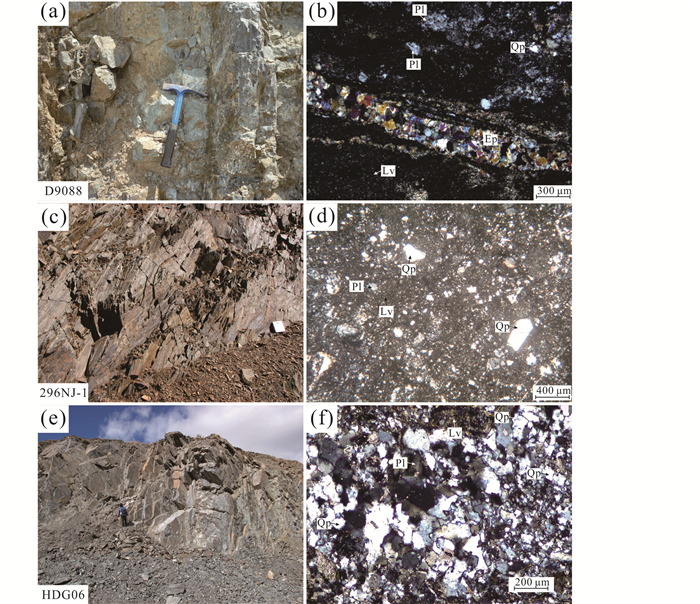
大扬气南部地区多宝山组岩性包括糜棱岩化流纹岩、变安山岩和糜棱岩化安山质晶屑凝灰岩等,局部发育泥质粉砂岩、泥质板岩、砂砾岩和硅质岩等,被后期中生代花岗岩所侵入,前人曾将该地层归属于奥陶-志留系(图 2a)。样品D9088为片理化凝灰岩(50°50′10.8″N、124°20′4.8″E;图 2a),凝灰结构,片状构造,主要由凝灰物和次要矿物晶屑组成,绢云母和绿泥石少量。凝灰物为火山灰,镜下颗粒极为细小且不易分辨;晶屑成分为斜长石,具绢云母化,局部基质部分重结晶形成微晶状长英质,后期被绿帘石-沸石脉贯入(图 4a, b)。
|
图 4 大兴安岭北段多宝山组测试样品野外及显微照片 Q-石英;Pl-斜长石;Lv-火山岩岩屑;Ep-绿帘石 Fig. 4 Field photographs and photomicrographs of studied samples from the Duobaoshan Formation in the northern Great Xing'an Range |
花朵山南部地区多宝山组为火山爆发相与沉积相叠置形成的火山岩与沉积岩的组合,自下至上可划分为三个岩段(图 3a)。底部主要为凝灰岩夹大理岩、砂岩;中段为流纹质凝灰岩夹板岩、砂岩;上段为安山质凝灰岩,总厚约2178m(曲关生,1997)。样品296NJ-1(50°20′7.0″N、125°42′22.0″E;图 2b)采自下段变质砂岩,中-细粒碎屑结构,颗粒分选中等、磨圆较差,次圆-次棱角状,颗粒支撑,主要矿物包括石英(~25%),长石(~15%),岩屑为火山质岩屑(~50%)(图 4c, d)。
伊尔施西部多宝山组整体变形强烈,与周围志留系地层呈平行不整合接触(图 2c),自下而上大致分为三个岩段(图 3b),底部由灰绿色变质粉砂岩、粉砂质板岩、凝灰质板岩夹灰岩透镜体组成,向上变为板岩和砂岩,总厚大于1300m(李文国,1996)。样品HDG06采自多宝山组下部灰绿色变质粉砂岩(47°19′36.1″N、119°32′21.8″E;图 2c),主要由长英质矿物(~45%)、绿泥石(~25%)、火山岩岩屑(~20%)和较少的斜长石组成,含少量黑云母及绿帘石等副矿物(图 4e, f)。
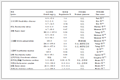
2 测试方法 2.1 锆石LA-ICP-MS U-Pb测年本文测年锆石的分选在河北廊坊地质调查院完成;锆石U-Pb同位素定年在西北大学地质学系大陆动力学国家重点实验室(样品HDG06和296NJ-1)和中国地质调查局天津地质调查中心(样品D9088)分别进行。将人工重砂分选的锆石颗粒用环氧树脂固定并抛光,使锆石颗粒露出核部。在测定之前,用体积分数为3%的HNO3清洗样品表面,以除去表面污垢,然后进行透射光和反射光照相,并在英国Gatan公司生产的Mono CL3+阴极发光装置系统上进行阴极发光(CL)照相(图 5)。采用美国国家标准技术研究院研制的人工合成硅酸盐玻璃标准参考物质NIST SRM610进行仪器最佳化,利用哈佛大学国际标准锆石91500作为外部校正(柳小明等,2007)。样品的同位素比值计算采用GLITTER(ver4.0 Macquarie University)程序。年龄计算采用Isoplot程序(Ver3.23)。实验数据运用Andersen的方法进行同位素比值校正(袁洪林等,2003),以消除普通204Pb的影响,详见表 1。

|
图 5 大兴安岭北段变质砂岩代表性碎屑锆石CL图像及LA-ICP-MS U-Pb年龄(a-c)和球粒陨石标准化锆石稀土元素配分图(d, 标准化值据Wilde et al., 2000) 实线圆表示年龄测点位置,虚线圆表示Hf同位素测点位置;图a-c中年龄单位为Ma Fig. 5 CL images and age probability diagrams (a-c) and chondrite-normalized REE diagram of the zircons from meta-sandstones in the northern Great Xing'an Range (d, normalizing values after Wilde et al., 2000) The solid and dashed circles indicate the spots of LA-ICP-MS U-Pb dating and Hf analyses, respectively. Age unit in Fig. 5a-c is Ma |
|
表 1 大兴安岭北段多宝山组变质砂岩碎屑锆石LA-ICP-MS U-Pb年龄 Table 1 Detrital zircon LA-ICP-MS U-Pb ages for meta-sandstones from the Duobaoshan Formation in the northern Great Xing'an Range |


在经过无污染碎样的前提下,选择新鲜样品于中国科学院地质与地球物理研究所完成微量(包括稀土元素)分析,先用Teflon熔样罐进行熔样,然后采用Finnigan MAT公司生产的双聚焦高分辨等离子体质谱仪ICP-MS进行测定,准确度和精度>10%,分析结果详见表 2。
|
|
表 2 多宝山组变质砂岩微量元素(×10-6)分析结果 Table 2 Trace elements(×10-6)for meta-sandstones from the Duobaoshan Formation |
锆石Lu-Hf同位素测试在中国科学院地质与地球物理研究所多接收-电感耦合等离子体质谱实验室完成,实验仪器为配有193nm激光取样系统的Neptune多接收电感耦合等离子体质谱仪(LA-MC-ICP MS),分析点位置与U-Pb定年位置基本保持一致,剥蚀时间30s,激光剥蚀束斑直径50μm。仪器运行条件、详细分析流程、数据校正方法、锆石εHf(t)和模式年龄计算参考值详见文献(Yang et al., 2006),分析结果详见表 3。
|
|
表 3 多宝山组变质砂岩(样品D9088)锆石Lu-Hf同位素分析结果 Table 3 Zircon Lu-Hf isotopic compositions for meta-sandstones (Sample D9088) from the Duobaoshan Formation |


本文对上述3个代表性样品中的146颗锆石做了详细的U-Pb年代学工作。锆石主要呈自形或半自形,粒度为40~130μm,长宽比介于1:1~2:1(图 5a-c)。锆石内部结构清晰,均发育典型岩浆震荡环带,且具有较高的Th/U比值(0.06~3.16;表 1)。尽管D9088样品中3颗锆石Th/U较低(0.06~0.09),但结合其锆石稀土元素中明显的Eu负异常(0.01~3.23)及Ce正异常(0.22~235),表明它们均为典型的岩浆成因锆石(表 1、图 5d)。
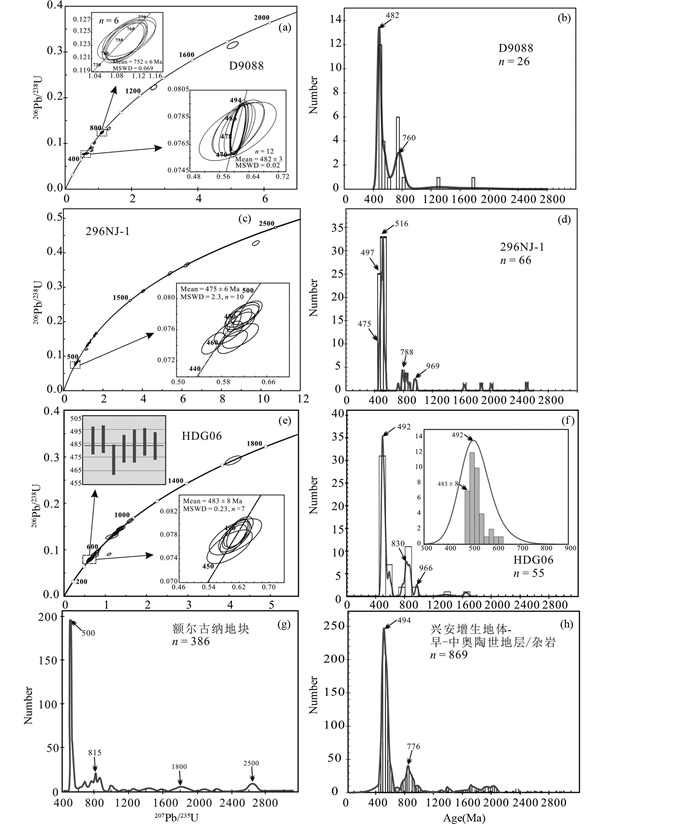
样品D9088测试结果均分布在谐和线附近(图 6a, b),26个测点的年龄值介于481±5Ma~1765±17Ma之间,形成了482±3Ma(MSWD=0.02,n=12)和752±6Ma(MSWD=0.069,n=6)两组206Pb/238U加权平均年龄;另外6颗锆石的年龄分别为521Ma、554Ma、620Ma、801Ma、1294Ma和1765Ma。
|
图 6 大兴安岭北段变质砂岩碎屑锆石U-Pb谐和曲线图及碎屑锆石年龄频谱 图(g、h)数据引自Han et al., 2011;Liu et al., 2017 Fig. 6 U-Pb concordia diagrams and age histograms of detrital zircons from metasandstones in the northern Great Xing'an Range Data in Fig. 6g, h after Han et al., 2011; Liu et al., 2017 |
样品296NJ-1的66颗锆石的年龄值介于462±5Ma~2506±9Ma(图 6c, d)。其中 < 1.0Ga的锆石206Pb/238U年龄分为2组:第一组在462±5Ma~559±6Ma之间(n=49),主要峰值为516Ma,次要峰值为497Ma,其中10颗锆石206Pb/238U加权年龄为475±6Ma(MSWD=2.3,n=10);第二组在792±10Ma~980±10Ma之间(n=12),主要峰值为788Ma,次要峰值为840Ma和969Ma。其中>1.0Ga的锆石207Pb/206Pb谐和年龄为1643±12Ma~2506±9Ma(n=5),表明物源区存在大量古元古代-中元古代的古老物质。
样品HDG06的55颗锆石的年龄值介于473±11Ma~1654±29Ma,具体分为:(1)7颗锆石年龄分布在473±11Ma~487±10Ma之间,其中206Pb/238U加权平均年龄为483±8Ma(MSWD=0.23,n=7);(2)28颗锆石年龄分布在488±10Ma~562±14Ma之间,峰值年龄为492Ma;(3)19颗锆石年龄在584±14Ma~971±19Ma之间,主要峰值年龄为830Ma,次要峰值年龄为966Ma。另外>1.0Ga的2颗锆石,其207Pb/206Pb谐和年龄分别为1373±70Ma和1654±29Ma(图 6e, f)。
3.2 全岩地球化学分析沉积碎屑岩中的微量元素因受后期改造作用影响较小,因而成为研究沉积物源区的重要媒介(Han et al., 2011)。由图 7可见,研究区多宝山组变质砂岩稀土总量较高,∑REE=70.11×10⁻⁶~149.1×10⁻⁶,平均为76.22×10⁻⁶,球粒陨石标准化配分曲线总体呈现出右倾的特点(图 7a),LREE富集,HREE亏损,轻重稀土分馏明显,具有不明显的负Eu异常,δEu=0.75~0.87,平均为0.78,与大陆岛弧平均值(δEu=0.78;Wu et al., 2015)基本一致;δCe=0.91~0.98,平均为0.97,表现为弱的Ce异常。从表 4的不同构造环境砂岩的稀土元素特征值对比和图 7a可以看出,研究区的多宝山组变质砂岩构造背景与大陆岛弧较为接近,部分类似活动大陆边缘。前人研究指出铜山组砂岩地球化学更接近活动大陆边缘,裸河组则介于活动大陆边缘和大陆岛弧之间,类似于弧后沉积构造背景(图 7b;陈安霞等,2016;蒋立伟等,2018)。总体来看,兴安增生地体的奥陶系构造沉积环境,可能形成于活动大陆边缘相关的弧-盆体系。

|
图 7 兴安增生地体下-中奥陶统地层变质砂岩地球化学特征(标准化值据Boynton, 1984) 已发表多宝山组、铜山组和裸河组数据据蒋立伟等,2018;大洋岛弧、大陆岛弧、活动大陆边缘和被动大陆边缘数据据Han et al., 2011 Fig. 7 Chondrite-normalized REE patterns of the Lower-Middle Ordovician meta-sandstones in the Xing'an accretionary Terrane (normalizing values after Boynton, 1984) Published data of the Duobaoshan, Tongshan and Luohe formations from Jiang et al., 2018; Another data from Han et al., 2011 |
|
|
表 4 研究区变质砂岩样品与不同构造背景砂岩稀土元素特征对比 Table 4 Comparison of REE characteristics between meta-sandstone samples in studied area and different tectonic background |
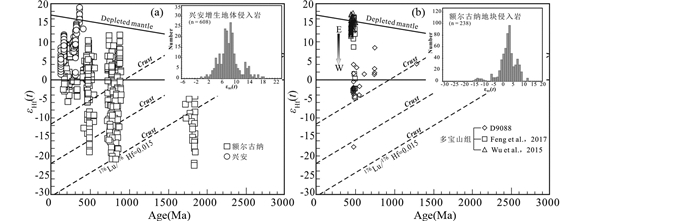
在对片理化凝灰岩(样品D9088)中锆石进行LA-ICP-MS U-Pb定年的基础上,对所对应锆石进行了微区原位Hf同位素分析。分析结果表明,其176Hf/177Hf值为0.281985~0.28259,εHf(t)值为-17.6~+8.6,Hf同位素一阶段模式年龄tDM1和二阶段模式年龄tDM2分别为749~1790Ma和906~2561Ma (图 8)。
|
图 8 额尔古纳与兴安增生地体侵入岩(a)和多宝山组砂岩碎屑锆石年龄(b)与Hf同位素关系(底图据Feng et al., 2019) 额尔古纳与兴安增生地体侵入岩数据据刘永江,2019 Fig. 8 Correlations between Hf isotopic compositions and ages of zircons from the Erguna Massif and Xing'an accretionary Terrane intrusions (a) and Duobaoshan Formation (b) (base map after Feng et al., 2019) Related data of intrusive rock of Erguna-Xing'an after Liu et al., 2019 |
多宝山组是王颖和彭云彪1958年于嫩江县多宝山创建(任纪舜等,1999)。1966年唐克东和苏养正确定其为灰绿色安山玢岩夹千枚岩,时代定为中奥陶世(薛春汀等,1980)。1976年张海驲等确定其包含熔岩及火山碎屑岩(Wu et al., 2015)。1981年陈德森等将多宝山组定义为整合于中奥陶世铜山组之上,由英安质、安山质熔岩、火山角砾岩和凝灰岩等组成(薛春汀等,1980)。随后《黑龙江省区域地质志》和《黑龙江省岩石地层》保留了该组,时代仍依据前人厘定结果(曲关生,1997)。在多宝山组沉积时限和形成环境的确定过程中,早期主要依据岩石组合和区域地层对比,一直缺乏同位素年代学依据。近年来,不同学者利用地质年代学测试技术对多宝山组进行了年代学研究,但结果不尽相同。
杜琦(1980)通过K-Ar法获得多宝山组伴生花岗岩和花岗闪长斑岩的年龄分别为292Ma和283Ma,限定多宝山组时代应为二叠纪。而部分学者利用与多宝山组成矿相关的辉钼矿Re-Os等时线年龄(475±5Ma~506±14Ma;Liu et al., 2012;Zeng et al., 2014),以及多宝山组伴生花岗闪长岩锆石U-Pb年龄(475±5Ma~485±8Ma)(葛文春等,2007),确定多宝山组形成时代为早奥陶世,形成环境为活动大陆边缘。另一方面,邵学峰(2018)确定内蒙古杜拉尔桥奥陶系多宝山组主要岩性为变质安山岩、玄武安山岩、变质砂岩、板岩、千枚岩、结晶灰岩及变质沉凝灰岩,其中变质玄武岩锆石U-Pb年龄为463±6Ma,为成熟岛弧带产物。Wu et al.(2015)根据多宝山组火山岩的锆石U-Pb年龄(447±2Ma和450±2Ma),认为多宝山组应形成于晚奥陶世。此外,杨仲杰等(2018)又在大兴安岭绰源地区多宝山组中识别出429~435Ma的云母片岩,认为该区多宝山组可予以解体。
本次测试获得的最年轻锆石年龄分别为481±5Ma (D9088)、462±5Ma (296NJ-1)和473±11Ma (HDG06),类似其对应加权平均年龄482±3Ma (n=12)、475±6Ma (n=10)和483±8Ma (n=7),可以限定多宝山组中变质砂岩的沉积下限为早-中奥陶世,加之上覆裸河组地层中发现的三叶虫化石,以及结合多宝山地区多宝山组中新识别的高镁玄武岩(506±3Ma)和高镁安山岩(485±4Ma)(Zhao et al., 2019),我们认为多宝山组形成时限为早-中奥陶世。
4.2 多宝山组地层的沉积环境花朵山地区的多宝山组为火山爆发相与沉积相叠置形成的火山岩与沉积岩的组合,以火山爆发相的中酸性火山碎屑岩为主,沉积岩相对较少(图 3a),说明多宝山组沉积期该区火山爆发强烈。由于岛弧隆起,少量砂岩、泥岩及灰岩可能是盆地火山间歇弧盆浅海沉积的产物。大扬气南部与花朵山组地区的多宝山组岩性类似,但泥质板岩、硅质岩和泥质粉砂岩数量明显增多,可能由于远离主要岛弧区,沉积水体变深所致。
伊尔施多宝山组下段为灰绿色变质粉砂岩和粉砂质板岩(图 3b),显示多宝山组早期为滨海相沉积环境,相对于花朵山和多宝山组地区,该区多宝山组主要以沉积岩为主,火山碎屑岩少量,水平层理发育,碎屑粒度较粗,反映该区多宝山组沉积水体较深,可能与弧后浅海-半深海沉积有关。最近,Zhang et al.(2020)通过黑河-大石寨地区早古生代碎屑锆石详细研究,也认为大兴安岭北段在早古生代时期存在完整的沟-弧-盆体系。因此,结合多宝山组野外及地球化学特征,笔者认为由花朵山-大扬气到伊尔施地区,由东向西,多宝山组早期沉积环境由滨浅海演变为浅海-半深海,晚期由暴露地表、滨海过渡为浅海环境,反映了由岛弧区向弧后盆地过渡的构造环境,虽然不同地区表现不同,但整体处于活动大陆边缘。
4.3 物源区特征锆石具有较高的封闭温度及高硬度,在经历各种复杂地质过程中保持稳定的U-Pb同位素体系,所以根据碎屑锆石的年龄频谱及与已发表相关年代学数据类比分析,可成功用于判断地层物源(Zhang et al., 2020)。本文多宝山组样品的146个年龄分布范围比较广,介于462±5Ma~2506±9Ma之间,说明多宝山组物源区复杂。为了更好的探讨多宝山组的年龄谱信息,本文收集了兴安增生地体上早-中奥陶世大量变质砂岩的碎屑锆石U-Pb年龄(n=869;杨现力,2007;李仰春等,2013;孙巍等,2014;周建波等,2014;图 6h),主要可分为3组:
(1) 寒武-中奥陶世(462~541Ma):这组年龄峰值为494~500Ma,其中早-中奥陶世年龄(462~485Ma)约占该组总量的32%。研究表明,研究区内仅多宝山地区存在467~485Ma的花岗质岩石,而额尔古纳地块上则大量发育,额尔古纳地块北部的十八站-内河-白银纳岩体(467~481Ma;葛文春等,2007)、塔河岩体(~485Ma;葛文春等,2005)、中部莫尔道嘎岩体(~467Ma;佘宏全等,2012)、恩和-阿龙山(446~464Ma;Zhao et al., 2014)和南部阿尔山(469~475Ma;Wang et al., 2014)。486~505Ma约占该组总量的25%,此区间年龄与东北地区大量的泛非期(约500Ma)年龄一致。另外,大量研究显示(Miao et al., 2015;Feng et al., 2019),额尔古纳地块与兴安增生地体于~500Ma完成陆-弧拼贴,相关的岩浆事件与该区间年龄也基本一致。506~541Ma约占该组43%,与额尔古纳北部洛古河及头道桥后碰撞花岗岩相吻合(武广等,2005;Zhou et al., 2015)。
(2) 中新元古代晚期(557~998Ma):峰值年龄为~776Ma,该年龄组在额尔古纳地块中北部大量发育,与大扬气闪长岩(557±2Ma;Feng et al., 2018a)、阿里河蛇绿混杂岩带(620~690Ma;Feng et al., 2019)、恩和-满归岩体(737~929Ma;Gou et al., 2013;Tang et al., 2013;Zhao et al., 2016)、凤凰山岩体(808±2Ma;郭宇飞等,2016)和玻乌勒山片麻状花岗岩(915±3Ma;杨华本等,2017)完全吻合(图 6g)。
(3) 中元古代-中太古代(1025~3143Ma):峰值年龄~1764Ma,该碎屑锆石年龄则与韩家园子花岗片麻岩(1741~1854Ma)、十七站黑云斜长片麻岩(1847±4Ma;孙立新等,2013)、漠河花岗岩片麻岩(2464±26Ma;Hou et al., 2020)和额尔古纳南部矿区片麻状二长花岗岩岩芯(2549~2562Ma;邵军等,2015)可以对比。截止目前未见中元古代岩体报道,但在新元古代地层额尔古纳河组和佳疙瘩组中可见大量中元古代年龄(Zhao et al., 2016)。近期,张超等(2018)在龙江地区新识别出新太古代-中元古代的二长花岗岩(1808±14Ma和2699±17Ma),引起学者对早古生代碎屑锆石中元古代物源区的争议。第一,绝大部分学者认为龙江岩体属于松嫩-锡林浩特地块,并非兴安增生地体(Wu et al., 2011;Liu et al., 2017);第二,大量研究表明(Wu et al., 2011;刘永江等,2019),额尔古纳地块与兴安增生地体已于~500Ma完成陆-弧拼贴,说明额尔古纳地块同时代岩体完全可以提供物源。第三,多宝山地区晚寒武世末-早奥陶世弧前高镁玄武岩和安山岩(485~506Ma)的识别,以及最新多宝山地区泥鳅河组古地磁数据,可以证明此时额尔古纳-兴安与松嫩-锡林浩特地块仍被大洋分割(张东海等,2018;Zhao et al., 2019),即松嫩-锡林浩特地块难以提供物源。
此外,本次获得靠近额尔古纳地块大扬气多宝山组片理化凝灰岩中26颗锆石微区Lu-Hf同位素测试分析结果,二阶段模式年龄变化范围较大,为906~2561Ma,εHf(t)值为-17.6~+8.6,绝大部分表现为负值(图 8、表 3),表明源区以古老地壳的组分为主,而少量来自新生地壳的组分;而离额尔古纳地块较远的多宝山地区多宝山组的火山岩碎屑锆石εHf(t)值全为正值(+11.5~+17.1),二阶段模式年龄范围更窄(480~697Ma),基于兴安增生地体至今无大量前寒武纪的岩浆记录(图 8),我们认为多宝山组及下-中奥陶统地层的物源区主要来自于额尔古纳地块,由东向西总体表现为,越靠近额尔古纳地块,碎屑锆石中古老物质占比越大。
4.4 地质意义中亚造山带内众多微地块的基底构造属性一直是地学界研究的前沿及热点,包括西段吉尔吉斯斯坦天山、阿尔泰、伊犁-中天山、图瓦-蒙古、北山和东段兴蒙造山带内的东北微地块群,兴安增生地体为其东段重要单元之一(肖文交等,2019)。目前,大量年代学数据已揭示兴安增生地体原定“前寒武纪变质岩系”的原岩形成时代均为显生宙(Sun et al., 2014;Feng et al., 2019;刘永江等,2019),加之兴安增生地体前寒武纪岩浆记录大量缺失(Wu et al., 2011;图 8),奥陶纪地层分布、沉积环境及岩浆作用对兴安增生地体基底构造属性及演化的限定至关重要。
大部分学者认为兴安增生地体奥陶纪时期处于大陆边缘岛弧或弧后环境(Wu et al., 2015;Zhao et al., 2019)。薛春汀(1980)认为多宝山地区的奥陶纪地层为一套岛弧火山沉积序列,且该岛弧建造中大量陆源碎屑的存在,说明多宝山组是发育在陆壳基底之上。孟祥化和葛铭(1995)将小兴安岭奥陶纪火山沉积序列归入俯冲岛弧弧后盆地的建造类型。苏养正(1996)认为大兴安岭地区奥陶系存在南北差异,南带属岛弧带,北带属弧后盆地,弧后盆地与岛弧无绝对的界限。唐克东等(2011)认为兴安增生地体为早古生代褶皱带,是增生于额尔古纳地块南缘的早古生代陆缘火山弧,奥陶纪地层为陆缘火山弧典型代表。李锦轶等(2019b)提出时限性是构造单元划分的重要依据,强调不同时间段内,构造单元构造属性的不同,进一步认为东北地区所谓的地块,可能仅限于新元古代至寒武纪,从奥陶纪时期开始,这些地块都已转化为岛弧造山带。部分学者则认为其可能形成于后碰撞伸展环境(葛文春等,2007)。此外,Wu et al.(2011)认为多宝山组及相关奥陶纪岩浆事件可能与洋内弧有关。
本文结果表明,包括多宝山组在内的整个兴安增生地体的奥陶系地层碎屑锆石均以482~516Ma和760~830Ma为主要峰期,与额尔古纳地块的碎屑锆石主特征峰相似,沉积物源为额尔古纳地块同期岩浆岩体。另外,据Feng et al.(2019)对额尔古纳地块和兴安增生地体的Hf同位素对比发现(图 8),前者以εHf(t)负值为主(图 8a),后者以εHf(t)正值为显著特征(图 8b),而且位于兴安增生地体东西部的多宝山组变质砂岩锆石εHf(t)值和Hf同位素明显不同,自东向西越靠近额尔古纳地块,εHf(t)值越小,二阶段模式年龄越老,说明物源区基底古老物质逐渐增多。
总体来看,兴安增生地体上包括多宝山组在内的奥陶系砂岩形成于活动大陆边缘相关的弧-盆构造环境,物源区主要来自额尔古纳地块,至于奥陶纪地层是发育在古陆上还是额尔古纳东南缘的增生带上,还需进一步的系统研究。
5 结论(1) 兴安增生地体上多宝山组3个变质砂岩样品最年轻锆石年龄分别为481±5Ma (D9088)、462±5Ma (296NJ-1)和473±11Ma (HDG06),类似其对应加权平均年龄482±3Ma (n=12)、475±6Ma (n=10)和483±8Ma (n=7),限定多宝山组的沉积下限为早-中奥陶世。
(2) 多宝山组变质砂岩碎屑锆石年龄表明,沉积物源主要来源于寒武纪-新元古代,同时也存在中太古代和古元古代碎屑锆石,表明物源区具有大量古老的前寒武纪岩浆,主要来自额尔古纳地块。
(3) 兴安增生地体上多宝山组变质砂岩碎屑锆石εHf(t)值和Hf同位素在东西部存在明显不同,自东向西越靠近额尔古纳地块其εHf(t)值越小、二阶段模式年龄tDM2越老,说明物源区基底古老物质逐渐增多,反映了由活动大陆边缘向额尔古纳地块内部转变的构造环境。
致谢 在审稿过程中承蒙李锦轶研究员及另一位匿名专家的详细审阅,并给予了建设性的修改建议和意见,在此表示衷心的感谢。
Boynton WV. 1984. Geochemistry of the rare earth elements: Meteorite studies. In: Henderson P (ed.). Rare Earth Element Geochemistry, 63-114
|
Chen AX, Zhou D, Zhang QK, Guan PY and Yang B. 2016. Tectonic and sedimentary environment in the Ordovician Period of Central Xing'an Block. Geoscience, 30(5): 1061-1071 (in Chinese with English abstract)
|
Cui FH, Zheng CQ, Xu XC, Yao WG, Ding X, Shi L and Li J. 2015. Detrital zircon ages of the Jiageda and Woduhe formations: Constrains on the tectonic attribute of the Xing'an terrane in the central Great Xing'an Range, NE China. Journal of Asian Earth Sciences, 113: 427-442 DOI:10.1016/j.jseaes.2015.01.017
|
Du Q. 1980. The alteration and mineralization features of the Duobaoshan porphyry copper deposit. Acta Geologica Sinica, 54(4): 310-323 (in Chinese with English abstract)
|
Feng ZQ, Jia J, Liu YJ, Wen QB, Li WM, Liu BQ, Xing DQ and Zhang L. 2015. Geochronology and geochemistry of the Carboniferous magmatism in the northern Great Xing'an Range, NE China: Constraints on the timing of amalgamation of Xing'an and Songnen blocks. Journal of Asian Earth Sciences, 113: 411-426 DOI:10.1016/j.jseaes.2014.12.017
|
Feng ZQ, Liu YJ, Li L, She HQ, Jiang LW, Du BY, Liu YW, Li WM, Wen QB and Liang CY. 2018a. Subduction, accretion, and collision during the Neoproterozoic-Cambrian orogeny in the Great Xing'an Range, NE China: Insights from geochemistry and geochronology of the Ali River ophiolitic mélange and arc-type granodiorites. Precambrian Research, 311: 117-135 DOI:10.1016/j.precamres.2018.04.013
|
Feng ZQ, Liu YJ, Wu P, Jin W, Li WM, Wen QB, Zhao YL and Zhou JP. 2018b. Silurian magmatism on the eastern margin of the Erguna Block, NE China: Evolution of the northern Great Xing'an Range. Gondwana Research, 61: 46-62 DOI:10.1016/j.gr.2018.04.011
|
Feng ZQ, Liu YJ, Li L, Jin W, Jiang LW, Li WM, Wen QB and Zhao YL. 2019. Geochemical and geochronological constraints on the tectonic setting of the Xinlin ophiolite, northern Great Xing'an Range, NE China. Lithos, 326-327: 213-229 DOI:10.1016/j.lithos.2018.12.018
|
Ge WC, Wu FY, Zhou CY and Abdel Rahman AA. 2005. The age of the Tahe granite body in the northern Daxinganling and its constraints on the tectonic ownership of the Ergun block. Chinese Science Bulletin, 50(12): 1239-1247 (in Chinese) DOI:10.1360/csb2005-50-12-1239
|
Ge WC, Sui ZM, Wu FY, Zhang JH, Xu XC and Cheng RY. 2007. Zircon U-Pb ages, Hf isotopic characteristics and their implications of the Early Paleozoic granites in the northeastern Da Hinggan Mts., northeastern China. Acta Petrologica Sinica, 23(2): 423-440 (in Chinese with English abstract)
|
Gou J, Sun DY, Ren YS, Liu YJ, Zhang SY, Fu CL, Wang TH, Wu PF and Liu XM. 2013. Petrogenesis and geodynamic setting of Neoproterozoic and Late Paleozoic magmatism in the Manzhouli-Erguna area of Inner Mongolia, China: Geochronological, geochemical and Hf isotopic evidence. Journal of Asian Earth Sciences, 67-68: 114-137 DOI:10.1016/j.jseaes.2013.02.016
|
Guo YF, Yang YC, Han SJ, Tan Y and Bo JW. 2016. Geochemistry and Zircon U-Pb Dating of the tonalite from Fenghuangshan area in northern Daxing'anling. Journal of University (Earth Science Edition), 46(5): 1406-1417 (in Chinese with English abstract)
|
Han GQ, Liu YJ, Neubauer F, Genser J, Li W, Zhao YL and Liang CY. 2011. Origin of terranes in the eastern Central Asian Orogenic Belt, NE China: U-Pb ages of detrital zircons from Ordovician-Devonian sandstones, North Da Xing'an Mts. Tectonophysics, 511(3-4): 109-124 DOI:10.1016/j.tecto.2011.09.002
|
Hao WL, Wang F, Xu WL, Tang J and Gao FH. 2015. Depositional age and provenance of Yangmu Formation of "Neoproterozoic" Huangsong Group in the eastern Heilongjiang: Constraints from zircon U-Pb geochronology. Journal of Earth Sciences and Environment, 37(4): 24-34 (in Chinese with English abstract)
|
Hou WZ, Zhao GC, Han YG, Eizenhoefer PR, Zhang XR and Liu Q. 2020. A~2.5Ga magmatic arc in NE China: New geochronological and geochemical evidence from the Xinghuadukou Complex. Geological Journal, 55(4): 2550-2571 DOI:10.1002/gj.3513
|
Huang TK and Jiang CF. 1962. Preliminary investigation on the evolution of the earth's crust from the point of view of polycyclic tectonic movements. Acta Geologica Sinica, 42(2): 105-152 (in Chinese with English abstract)
|
Jiang LW, Liu YJ, Feng ZQ and Tang C. 2018. Provenance and tectonic environment of Luohe Formation in northern Great Xing'an Range: Evidence from geochemistry and detrital zircon age. Global Geology, 37(3): 688-701 (in Chinese with English abstract)
|
Li CY. 1980. A preliminary study of plate tectonics of China. Bulletin Chinese Academic Geology Science, 2(1): 11-19 (in Chinese with English abstract)
|
Li JY. 2006. Permian geodynamic setting of Northeast China and adjacent regions: Closure of the Paleo-Asian Ocean and subduction of the Paleo-Pacific Plate. Journal of Asian Earth Sciences, 26(3-4): 207-224 DOI:10.1016/j.jseaes.2005.09.001
|
Li JY, Liu JF, Qu JF, Zheng RG, Zhao S, Zhang J, Sun LX, Li YF, Yang XP, Wang LJ and Zhang XW. 2019a. Major geological features and crustal tectonic framework of Northeast China. Acta Petrologica Sinica, 35(10): 2989-3016 (in Chinese with English abstract) DOI:10.18654/1000-0569/2019.10.04
|
Li JY, Liu JF, Qu JF, Zheng GR, Zhao S, Zhang J, Wang LJ and Zhang XW. 2019b. Paleozoic tectonic units of Northeast China: Continental blocks or orogenic belts?. Earth Science, 44(10): 3157-3177 (in Chinese with English abstract)
|
Li SL and Ouyang ZY. 1998. Tectonic framework and evolution of Xing'anling-Mongolian orogenic belt (XMOB) and its adjacent region. Marine Geology & Quaternary Geology, 18(3): 45-54 (in Chinese with English abstract)
|
Li WG. 1996. Stratigraphy (Lithostratic) of Nei Mongol Autonomous Region. Wuhan: China University of Geosciences Press, 1-362 (in Chinese with English abstract)
|
Li WM, Takasu A, Liu YJ, Genser J, Zhao YL, Han GQ and Guo XZ. 2011. U-Pb and 40Ar/39Ar age constrains on protolith and high-P/T type metamorphism of the Heilongjiang Complex in the Jiamusi Massif, NE China. Journal of Mineralogical and Petrological Sciences, 106(6): 326-331 DOI:10.2465/jmps.110621e
|
Li YC, Wang Y, Wu GG, Jin ZY, Zhang D and Yang XP. 2013. The provenance characteristics of Tongshan Formation in north Zalantun area of the Da Hinggan Mountains: The constraint of geochemistry and LA-MC-ICPMS U-Pb dating of detrital zircons. Geology in China, 40(2): 391-402 (in Chinese with English abstract)
|
Liu J, Wu G, Li Y, Zhu MT and Zhong W. 2012. Re-Os sulfide (chalcopyrite, pyrite and molybdenite) systematics and fluid inclusion study of the Duobaoshan porphyry Cu (Mo) deposit, Heilongjiang Province, China. Journal of Asian Earth Sciences, 49: 300-312 DOI:10.1016/j.jseaes.2011.10.014
|
Liu N. 2012. Disintegration and tectonic attribute of Devonian "Daminshan Formation" in Yakeshi. Master Degree Thesis. Beijing: China University of Geosciences (Beijing), 1-57 (in Chinese)
|
Liu XM, Gao S, Diwu CR, Yuan HL and Hu ZC. 2007. Single-grain zircon's 20μm small spot beam in situ micro area LA-ICP-MS U-Pb simultaneous determination of age and trace elements. Chinese Science Bulletin, 52(2): 228-235 (in Chinese) DOI:10.1360/csb2007-52-2-228
|
Liu YJ, Li WM, Feng ZQ, Wen QB, Neubauer F and Liang CY. 2017. A review of the Paleozoic tectonics in the eastern part of central Asian orogenic belt. Gondwana Research, 43: 123-148 DOI:10.1016/j.gr.2016.03.013
|
Liu YJ, Feng ZQ, Jiang LW, Jin W, Li WM, Guan QB, Wen QB and Liang CY. 2019. Ophiolite in the eastern Central Asian Orogenic Belt, NE China. Acta Petrologica Sinica, 35(10): 3017-3047 (in Chinese with English abstract) DOI:10.18654/1000-0569/2019.10.05
|
Ma YF, Liu YJ, Wang Y, Tang Z, Qian C, Qin T, Feng ZQ, Sun W and Zang YQ. 2019. Geochronology and geochemistry of the Carboniferous felsic rocks in the central Great Xing'an Range, NE China: Implications for the amalgamation history of Xing'an and Songliao-Xilinhot blocks. Geological Journal, 54(1): 482-513 DOI:10.1002/gj.3198
|
Meng XH and Ge M. 1995. On dynamical fields of orthogenetic basins controlling on enrichment of phosphorite. Geology of Chemical Minerals, 17(3): 145-157 (in Chinese with English abstract)
|
Miao LC, Fan WM, Zhang FQ, Liu DY, Jian P, Shi GH, Tao H and Shi YR. 2003. Zircon SHRIMP chronology of Xinkailing-Keluo complex in northwestern Xiaoxing'anling and its significance. Chinese Science Bulletin, 48(22): 2315-2323 (in Chinese) DOI:10.1360/csb2003-48-22-2315
|
Miao LC, Liu DY, Zhang FQ, Fan WM, Shi YR and Xie HQ. 2007. Zircon SHRIMP U-Pb ages of the "Xinghuadukou Group" in Hanjiayuanzi and Xinlin areas and the "Zhalantun Group" in Inner Mongolia, Da Hinggan Mountains. Chinese Science Bulletin, 52(8): 1112-1124 DOI:10.1007/s11434-007-0131-2
|
Miao LC, Zhang FC and Jiao SJ. 2015. Age, protoliths and tectonic implications of the Toudaoqiao blueschist, Inner Mongolia, China. Journal of Asian Earth Sciences, 105: 360-373 DOI:10.1016/j.jseaes.2015.01.028
|
Qu GS. 1997. Stratigraphy (Lithostratic) of Heilongjiang Province. Wuhan: China University of Geosciences Press, 1-298 (in Chinese with English abstract)
|
Ren JS, Niu BG and Liu ZG. 1999. Soft collision, superposition orogeny and polycyclic suturing. Earth Science Frontiers (China University of Geosciences, Beijing), 6(3): 85-93 (in Chinese with English abstract)
|
Shao J, Li YF, Zhou YH, Wang HB and Zhang J. 2015. Neo-Archaean magmatic event in Erguna massif of Northeast China: Evidence from the zircon LA-ICP-MS dating of the gneissic monzogranite from the drill. Journal of Jilin University (Earth Science Edition), 45(2): 364-373 (in Chinese with English abstract)
|
Shao XF. 2018. Geochemical characteristics and geological significance of the Ordovician Duobaoshan Formation located in Dula'er Bridge in Inner Mongolia. Jilin Geology, 37(4): 21-28 (in Chinese with English abstract)
|
She HQ, Li JW, Xiang AP, Guan JD, Yang YC, Zhang DQ, Tan G and Zhang B. 2012. U-Pb ages of the zircons from primary rocks in middle-northern Daxinganling and its implications to geotectonic evolution. Acta Petrologica Sinica, 28(2): 571-594 (in Chinese with English abstract)
|
Sheng HB. 1997. Late Devonian Ammonoids fauna from Upper Daminshan Formation, Great Hinggan Mts., Inner Mongolia. Professional Papers of Stratigraphy and Palaeontology, 27: 180-205 (in Chinese with English abstract)
|
Su YZ. 1996. Paleozoic stratigraphy of Hinggan stratigraphical province. Jilin Geology, 15(3-4): 23-34 (in Chinese with English abstract)
|
Sun LX, Ren BF, Zhao FQ, Ji SP and Geng JZ. 2013. Late Paleoproterozoic magmatic records in the Eerguna massif: Evidences from the zircon U-Pb dating of granitic gneisses. Geological Bulletin of China, 32(2-3): 341-352 (in Chinese with English abstract)
|
Sun W, Chi XG, Zhao Z, Pan SY, Liu JF, Zhang R and Quan JY. 2014. Zircon geochronology constraints on the age and nature of 'Precambrian metamorphic rocks' in the Xing'an block of Northeast China. International Geology Review, 56(6): 672-694 DOI:10.1080/00206814.2014.883183
|
Sun W, Chi XG, Pan SY, Zhang R, Quan JY, Fan LF and Wang LM. 2014. Zircon LA-ICP-MS U-Pb dating and its geological significance of the Dawangzi Formation from Wolegen Group in Xinlin area, northern Great Xing'an Range. Journal of Jilin University (Earth Science Edition), 44(1): 176-185 (in Chinese with English abstract)
|
Tang J, Xu WL, Wang F, Wang W, Xu MJ and Zhang YH. 2013. Geochronology and geochemistry of Neoproterozoic magmatism in the Erguna Massif, NE China: Petrogenesis and implications for the breakup of the Rodinia supercontinent. Precambrian Research, 224: 597-611 DOI:10.1016/j.precamres.2012.10.019
|
Tang J, Xu WL, Wang F, Zhao S and Li Y. 2015. Geochronology, geochemistry, and deformation history of Late Jurassic-Early Cretaceous intrusive rocks in the Erguna Massif, NE China: Constraints on the late Mesozoic tectonic evolution of the Mongol-Okhotsk orogenic belt. Tectonophysics, 658: 91-110 DOI:10.1016/j.tecto.2015.07.012
|
Tang KD. 1990. Tectonic development of Paleozoic foldbelts at the north margin of the Sino-Korean Craton. Tectonics, 9(2): 249-260 DOI:10.1029/TC009i002p00249
|
Tang KD, Shao JA and Li YF. 2011. Songnen Massif and its research significance. Earth Science Frontiers, 18(3): 57-65 (in Chinese with English abstract)
|
Wang CW, Sun YW, Li N, Zhao GW and Ma XQ. 2009. Tectonic implications of Late Paleozoic stratigraphic distribution in Northeast China and adjacent region. Science in China (Series D), 52(5): 619-626 DOI:10.1007/s11430-009-0062-7
|
Wang LM, Chi XG, Zhao Z, Sun W, Zhang R, Pan SY and Quan JY. 2014. Zircon U-Pb geochronology and geochemistry of the Maoliger quartz monzodiorites, Inner Mongolia, China: Implications for Carboniferous arc magmatism and closure of the Palaeo-Asian Ocean. International Geology Review, 56(12): 1435-1449 DOI:10.1080/00206814.2014.940611
|
Wang ZW, Xu WL, Pei FP, Wang F and Guo P. 2016. Geochronology and geochemistry of Early Paleozoic igneous rocks of the Lesser Xing'an Range, NE China: Implications for the tectonic evolution of the eastern Central Asian Orogenic Belt. Lithos, 261: 144-163 DOI:10.1016/j.lithos.2015.11.006
|
Wilde SA, Zhang XZ and Wu FY. 2000. Extension of a newly identified 500Ma metamorphic terrane in Northeast China: Further U-Pb SHRIMP dating of the Mashan Complex, Heilongjiang Province, China. Tectonophysics, 328(1-2): 115-130 DOI:10.1016/S0040-1951(00)00180-3
|
Wu FY, Zhao GC, Sun DY, Wilde SA and Zhang JH. 2007. The Hulan Group: Its role in the evolution of the Central Asian Orogenic Belt of NE China. Journal of Asian Earth Sciences, 30(3-4): 542-556 DOI:10.1016/j.jseaes.2007.01.003
|
Wu FY, Sun DY, Ge WC, Zhang YB, Grant ML, Wilde SA and Jahn BM. 2011. Geochronology of the Phanerozoic granitoids in northeastern China. Journal of Asian Earth Sciences, 41(1): 1-30 DOI:10.1016/j.jseaes.2010.11.014
|
Wu G, Sun FY, Zhao CS, Li ZT, Zhao AL, Pang QB and Li GY. 2005. Discovery of the Early Paleozoic post-collisional granites in northern margin of the Erguna massif and its geological significance. Chinese Science Bulletin, 50(23): 2733-2743 DOI:10.1007/BF02899644
|
Wu G, Chen YC, Sun FY, Liu J, Wang GR and Xu B. 2015. Geochronology, geochemistry, and Sr-Nd-Hf isotopes of the Early Paleozoic igneous rocks in the Duobaoshan area, NE China, and their geological significance. Journal of Asian Earth Sciences, 97: 229-250 DOI:10.1016/j.jseaes.2014.07.031
|
Xiao WJ, Windley BF, Han CM, Liu W, Wan B, Zhang JE, Ao SJ, Zhang ZY and Song DF. 2018. Late Paleozoic to Early Triassic multiple roll-back and oroclinal bending of the Mongolia collage in Central Asia. Earth Science Reviews, 186: 94-128 DOI:10.1016/j.earscirev.2017.09.020
|
Xiao WJ, Song DF, Windley BF, Li JL, Han CM, Wan B, Zhang JE, Ao SJ and Zhang ZY. 2019. Accretionary processes and metallogenesis of the Central Asian Orogenic Belt: Advances and perspectives. Science China (Earth Sciences), 63(3): 329-361
|
Xu B, Zhao P, Bao QZ, Zhou YH, Wang YY and Luo ZW. 2014. Preliminary study on the pre-Mesozoic tectonic unit division of the Xing-Meng Orogenic Belt (XMOB). Acta Petrologica Sinica, 30(7): 1841-1857 (in Chinese with English abstract)
|
Xu MJ, Xu WL, Wang F and Gao FH. 2012. Age, association and provenance of the "Neoproterozoic" Fengshuigouhe Group in the northwestern lesser Xing'an Range, NE China: Constraints from zircon U-Pb geochronology. Journal of Earth Science, 23(6): 786-801 DOI:10.1007/s12583-012-0291-0
|
Xu WL, Sun CY, Tang J, Luan JP and Wang F. 2019. Basement nature and tectonic evolution of the Xing'an Mongolian orogenic belt. Earth Science, 44(5): 1620-1646 (in Chinese with English abstract)
|
Xue CT, Su YC, Zhang HY and Cui G. 1980. The Late Silurian and Early Devonian strata in the northwest of Xiaoxing'anling. Journal of Stratigraphy, 4(1): 1-12 (in Chinese)
|
Yang H, Ge WC, Zhao GC, Bi JH, Wang ZH, Dong Y and Xu WL. 2017. Zircon U-Pb ages and geochemistry of newly discovered Neoproterozoic orthogneisses in the Mishan region, NE China: Constraints on the high-grade metamorphism and tectonic affinity of the Jiamusi-Khanka Block. Lithos, 268-271: 16-31 DOI:10.1016/j.lithos.2016.10.017
|
Yang HB, Liu Y, Zheng JL, Liang ZK, Wang XY, Tang XF and Su YP. 2017. Petrogenesis and geological significance of Neoproterozoic amphibolite and granite in Bowuleshan area, Erguna massif, Northeast China. Geological Bulletin of China, 36(2-3): 342-356 (in Chinese with English abstract)
|
Yang JH, Wu FY, Shao J, Wilde SA, Xie LW and Liu XM. 2006. Constraints on the timing of uplift of the Yanshan Fold and Thrust Belt, North China. Earth and Planetary Science Letters, 246(3-4): 336-345 DOI:10.1016/j.epsl.2006.04.029
|
Yang MC, Liu YJ, Han GQ, Wang CB, Wen QB, Zhao YL, Liang CY and Mi XN. 2011. Provenance analysis and its tectonic significance of Lower Carboniferous Hongshuiquan Formation sandstone in Yimin area of Inner Mongolia. Global Geology, 30(2): 192-207 (in Chinese with English abstract)
|
Yang XL. 2007. Geological characteristics and study of detrital zircon geochronology of epimetamorphic rock series in Zhalantun area. Master Degree Thesis. Changchun: Jilin University, 1-110 (in Chinese with English summary)
|
Yang ZJ, Zhang WJ, Liu XW, Zhang YH, Wang XH, Liu CC and Jiang CY. 2018. Disintegration and discussion on the time of Ordovician Duobaoshan Formation and Suhuhe Formation in Chaoyuan district of Daxing'anling Mountain. Contributions to Geology and Mineral Resources Research, 33(3): 409-416 (in Chinese with English abstract)
|
Yu JJ, Xu WL, Gao FH, Wang F, Liu JC and Hao WL. 2015. Medium-pressure metamorphism of the Huangsong Group in the southeastern margin of the Xing'an-Mongolian Orogenic Belt, NE China and its tectonic implication: Evidence from petrology, mineralogy and 40Ar/39Ar geochronology. Acta Petrologica Sinica, 31(9): 2477-2494 (in Chinese with English abstract)
|
Yuan HL, Wu FY, Gao S, Liu XM, Xu P and Sun DY. 2003. Determination of U-Pb age and rare earth element concentrations of zircons from Cenozoic intrusions in northeastern China by laser ablation ICP-MS. Chinese Science Bulletin, 48(22): 2411-2421
|
Zeng QD, Liu JM, Chu SX, Wang WB, Sun Y, Duan XX, Zhou LL and Qu WJ. 2014. Re-Os and U-Pb geochronology of the Duobaoshan porphyry Cu-Mo-(Au) deposit, Northeast China, and its geological significance. Journal of Asian Earth Sciences, 79: 895-909 DOI:10.1016/j.jseaes.2013.02.007
|
Zhang C, Wu XW, Liu ZH, Zhang YJ, Guo W and Quan JY. 2018. Precambrian geological events on the western margin of Songnen massif: Evidence from LA-ICP-MS U-Pb geochronology of zircons from Paleoproterozoic granite in the Longjiang area. Acta Petrologica Sinica, 34(10): 3137-3152 (in Chinese with English abstract)
|
Zhang DH, Huang BC, Zhao Q and Zhang Y. 2018. Paleomagnetic results from Lower Devonian sandstones of the Niqiuhe Formation in the Duobaoshan area and its constraints on paleoposition of the Xing'an block. Science Bulletin, 63(15): 1502-1514 (in Chinese)
|
Zhang JM, Xu B, Yan LJ and Wang YY. 2020. Evolution of the Heihe-Nenjiang Ocean in the eastern Paleo-Asian Ocean: Constraints of sedimentological, geochronological and geochemical investigations from Early-Middle Paleozoic Heihe-Dashizhai Orogenic Belt in the northeast China. Gondwana Research, 81: 339-361 DOI:10.1016/j.gr.2019.11.006
|
Zhang Y, Pei FP, Wang ZW, Xu WL, Li Y, Wang F and Zhou ZB. 2018. Late Paleozoic tectonic evolution of the central Great Xing'an Range, Northeast China: Geochronological and geochemical evidence from igneous rocks. Geological Journal, 53(1): 282-303 DOI:10.1002/gj.2891
|
Zhao C, Qin KZ, Song GX, Li GM and Li ZZ. 2019. Early Palaeozoic high-Mg basalt-andesite suite in the Duobaoshan Porphyry Cu deposit, NE China: Constraints on petrogenesis, mineralization, and tectonic setting. Gondwana Research, 71: 91-116 DOI:10.1016/j.gr.2019.01.015
|
Zhao S, Xu WL, Wang W, Tang J and Zhang YH. 2014. Geochronology and geochemistry of middle-late ordovician granites and gabbros in the Erguna Region, NE China: Implications for the tectonic evolution of the Erguna Massif. Journal of Earth Science, 25(5): 841-853 DOI:10.1007/s12583-014-0476-9
|
Zhao S, Xu WL, Tang J, Li Y and Guo P. 2016. Timing of formation and tectonic nature of the purportedly Neoproterozoic Jiageda Formation of the Erguna Massif, NE China: Constraints from field geology and U-Pb geochronology of detrital and magmatic zircons. Precambrian Research, 281: 585-601 DOI:10.1016/j.precamres.2016.06.014
|
Zhao YL, Liu YJ, Li WM, Feng ZQ, Wen QB and Liang CY. 2018. Detrital zircon La-ICP-MS U-Pb age of Late Carboniferous to Early Permian sandstones in central Great Xing'an Range and its geological significance. Earth Science, 43(6): 2055-2075 (in Chinese with English abstract)
|
Zhao Z, Chi XG, Liu JF, Wang TF and Hu ZC. 2010. Late Paleozoic arc-related magmatism in Yakeshi region, Inner Mongolia: Chronological and geochemical evidence. Acta Petrologica Sinica, 26(11): 3245-3258 (in Chinese with English abstract)
|
Zhou JB, Zhang XZ, Ma ZH, Liu L, Jin W, Zhang MS, Wang CW and Chi XG. 2009. Tectonic framework and basin evolution in Northeast China. Oil & Gas Geology, 30(5): 530-538 (in Chinese with English abstract)
|
Zhou JB, Wang B, Zeng WS and Cao JL. 2014. Detrital zircon U-Pb dating of the Zhalantun Metamorphic Complex and its tectonic implications, Great Xing'an, NE China. Acta Petrologica Sinica, 30(7): 1879-1888 (in Chinese with English abstract)
|
Zhou JB, Wang B, Wilde SA, Zhao GC, Cao JL, Zheng CQ and Zeng WS. 2015. Geochemistry and U-Pb zircon dating of the Toudaoqiao blueschists in the Great Xing'an Range, northeast China, and tectonic implications. Journal of Asian Earth Sciences, 97: 197-210 DOI:10.1016/j.jseaes.2014.07.011
|
陈安霞, 周多, 张庆奎, 关培彦, 杨宾. 2016. 兴安地块中部奥陶纪构造沉积环境. 现代地质, 30(5): 1061-1071. DOI:10.3969/j.issn.1000-8527.2016.05.011 |
杜琦. 1980. 多宝山斑岩铜矿床蚀变与矿化特征. 地质学报, 54(4): 310-323. |
葛文春, 吴福元, 周长勇, Abdel Rahman AA. 2005. 大兴安岭北部塔河花岗岩体的时代及对额尔古纳地块构造归属的制约. 科学通报, 50(12): 1239-1247. DOI:10.3321/j.issn:0023-074X.2005.12.015 |
葛文春, 隋振民, 吴福元, 张吉衡, 徐学纯, 程瑞玉. 2007. 大兴安岭东北部早古生代花岗岩锆石U-Pb年龄、Hf同位素特征及地质意义. 岩石学报, 23(2): 423-440. |
郭宇飞, 杨言辰, 韩世炯, 谈艳, 薄军委. 2016. 大兴安岭北部凤凰山地区英云闪长岩地球化学特征与锆石U-Pb定年. 吉林大学学报(地球科学版), 46(5): 1406-1417. |
郝文丽, 王枫, 许文良, 唐杰, 高福红. 2015. 黑龙江东部"新元古代"黄松群杨木组沉积时限和物源组成: 来自锆石U-Pb年代学的制约. 地球科学与环境学报, 37(4): 24-34. DOI:10.3969/j.issn.1672-6561.2015.04.005 |
黄汲清, 姜春发. 1962. 从多旋回构造运动观点初步探讨地壳发展规律. 地质学报, 42(2): 105-152. |
蒋立伟, 刘永江, 冯志强, 汤超. 2018. 大兴安岭北段裸河组物源及其构造环境: 来自地球化学和碎屑锆石年代学的证据. 世界地质, 37(3): 688-701. DOI:10.3969/j.issn.1004-5589.2018.03.003 |
李春昱. 1980. 中国板块构造的轮廓. 中国地质科学院院报, 2(1): 11-19. |
李锦轶, 刘建峰, 曲军峰, 郑国荣, 赵硕, 张进, 孙立新, 李永飞, 杨晓平, 王励嘉, 张晓卫. 2019a. 中国东北地区主要地质特征和地壳构造格架. 岩石学报, 35(10): 2989-3016. |
李锦轶, 刘建峰, 曲军峰, 郑国荣, 赵硕, 张进, 王励嘉, 张晓卫. 2019b. 中国东北地区古生代构造单元: 地块还是造山带?. 地球科学, 44(10): 3157-3177. |
李双林, 欧阳自远. 1998. 兴蒙造山带及邻区的构造格局与构造演化. 海洋地质与第四纪地质, 18(3): 45-54. |
李文国. 1996. 内蒙古自治区岩石地层. 武汉: 中国地质大学出版社, 1-362.
|
李仰春, 汪岩, 吴淦国, 金哲岩, 张达, 杨晓平. 2013. 大兴安岭北段扎兰屯地区铜山组源区特征: 地球化学及碎屑锆石U-Pb年代学制约. 中国地质, 40(2): 391-402. DOI:10.3969/j.issn.1000-3657.2013.02.003 |
刘娜. 2012. 牙克石地区泥盆系"大民山组"的解体及构造属性探讨. 硕士学位论文. 北京: 中国地质大学(北京), 1-57
|
柳小明, 高山, 第五春容, 袁洪林, 胡兆初. 2007. 单颗粒锆石的20μm小斑束原位微区LA-ICP-MS U-Pb年龄和微量元素的同时测定. 科学通报, 52(2): 228-235. DOI:10.3321/j.issn:0023-074X.2007.02.017 |
刘永江, 冯志强, 蒋立伟, 金巍, 李伟民, 关庆彬, 温泉波, 梁琛岳. 2019. 中国东北地区蛇绿岩. 岩石学报, 35(10): 3017-3047. |
孟祥化, 葛铭. 1995. 论内源盆地动力场及磷块岩富集作用的动力学分析. 化工矿产地质, 17(3): 145-157. |
苗来成, 范蔚茗, 张福勤, 刘敦一, 简平, 施光海, 陶华, 石玉若. 2003. 小兴安岭西北部新开岭-科洛杂岩锆石SHRIMP年代学研究及其意义. 科学通报, 48(22): 2315-2323. DOI:10.3321/j.issn:0023-074X.2003.22.004 |
苗来成, 刘敦一, 张福勤, 范蔚茗, 石玉若, 颉颃强. 2007. 大兴安岭韩家园子和新林地区兴华渡口群和扎兰屯群锆石SHRIMP U-Pb年龄. 科学通报, 52(5): 591-601. DOI:10.3321/j.issn:0023-074X.2007.05.016 |
曲关生. 1997. 黑龙江省岩石地层. 武汉: 中国地质大学出版社, 1-298.
|
任纪舜, 牛宝贵, 刘志刚. 1999. 软碰撞、叠覆造山和多旋回缝合作用. 地学前缘, 6(3): 85-93. DOI:10.3321/j.issn:1005-2321.1999.03.008 |
邵军, 李永飞, 周永恒, 王宏博, 张璟. 2015. 中国东北额尔古纳地块新太古代岩浆事件——钻孔片麻状二长花岗岩锆石LA-ICP-MS测年证据. 吉林大学学报(地球科学版), 45(2): 364-373. |
邵学峰. 2018. 内蒙古杜拉尔桥地区奥陶系多宝山组地球化学特征及其地质意义. 吉林地质, 37(4): 21-28. DOI:10.3969/j.issn.1001-2427.2018.04.004 |
佘宏全, 李进文, 向安平, 关继东, 杨郧城, 张德全, 谭刚, 张斌. 2012. 大兴安岭中北段原岩锆石U-Pb测年及其与区域构造演化关系. 岩石学报, 28(2): 571-594. |
盛怀斌. 1999. 内蒙古大兴安岭晚泥盆世上大民山组菊石群. 地层古生物论文集, 27: 180-205. |
苏养正. 1996. 兴安地层区的古生代地层. 吉林地质, 15(3-4): 23-34. |
孙立新, 任邦方, 赵凤清, 冀世平, 耿建珍. 2013. 内蒙古额尔古纳地块古元古代末期的岩浆记录——来自花岗片麻岩的锆石U-Pb年龄证据. 地质通报, 32(2-3): 341-352. |
孙巍, 迟效国, 潘世语, 张蕊, 权京玉, 范乐夫, 王利民. 2014. 大兴安岭北部新林地区倭勒根群大网子组锆石LA-ICP-MS U-Pb年龄及其地质意义. 吉林大学学报(地球科学版), 44(1): 176-185. |
唐克东, 邵济安, 李永飞. 2011. 松嫩地块及其研究意义. 地学前缘, 18(3): 57-65. |
王成文, 孙跃武, 李宁, 赵国伟, 马小琴. 2009. 中国东北及邻区晚古生代地层分布规律的大地构造意义. 中国科学(D辑), 39(10): 1429-1437. |
武广, 孙丰月, 赵财胜, 李之彤, 赵爱琳, 庞庆帮, 李广远. 2005. 额尔古纳地块北缘早古生代后碰撞花岗岩的发现及其地质意义. 科学通报, 50(20): 2278-2288. DOI:10.3321/j.issn:0023-074X.2005.20.017 |
肖文交, 宋东方, Windley BF, 李继亮, 韩春明, 万博, 张继恩, 敖松坚, 张志勇. 2019. 中亚增生造山过程与成矿作用研究进展. 中国科学(地球科学), 49(10): 1512-1545. |
徐备, 赵盼, 鲍庆中, 周永恒, 王炎阳, 罗志文. 2014. 兴蒙造山带前中生代构造单元划分初探. 岩石学报, 30(7): 1841-1857. |
许文良, 孙晨阳, 唐杰, 栾金鹏, 王枫. 2019. 兴蒙造山带的基底属性与构造演化过程. 地球科学, 44(5): 1620-1646. |
薛春汀, 苏养正, 张海驲, 崔革. 1980. 小兴安岭西北部晚志留世及早泥盆世地层. 地层学杂志, 4(1): 1-12. |
杨华本, 刘玉, 郑吉林, 梁中恺, 王晓勇, 唐雪峰, 苏燕平. 2017. 额尔古纳地块玻乌勒山地区新元古代斜长角闪岩-片麻状花岗岩的成因及其地质意义. 地质通报, 36(2-3): 342-356. |
杨明春, 刘永江, 韩国卿, 王长兵, 温泉波, 赵英利, 梁琛岳, 米晓楠. 2011. 内蒙古伊敏地区下石炭统红水泉组砂岩物源分析及其构造意义. 世界地质, 30(2): 192-207. DOI:10.3969/j.issn.1004-5589.2011.02.007 |
杨现力. 2007. 扎兰屯浅变质岩系地质特征及碎屑锆石年代学研究. 硕士学位论文. 长春: 吉林大学, 1-110
|
杨仲杰, 张文静, 刘学文, 张元厚, 王晓晗, 刘长纯, 姜春宇. 2018. 大兴安岭绰源地区奥陶系多宝山组-苏呼河组解体及时代探讨. 地质找矿论丛, 33(3): 409-416. |
于介江, 许文良, 高福红, 王枫, 柳佳成, 郝文丽. 2015. 兴蒙造山带东南缘黄松群中压型变质作用及其构造意义: 岩石学、矿物学和年代学证据. 岩石学报, 31(9): 2477-2494. |
袁洪林, 吴福元, 高山, 柳小明, 徐平, 孙德有. 2003. 东北地区新生代侵入体的锆石激光探针U-Pb年龄测定与稀土元素成分分析. 科学通报, 48(14): 1511-1520. DOI:10.3321/j.issn:0023-074X.2003.14.008 |
张超, 吴新伟, 刘正宏, 张渝金, 郭威, 权京玉. 2018. 松嫩地块西缘前寒武岩浆事件——来自龙江地区古元古代花岗岩锆石LA-ICP-MS U-Pb年代学证据. 岩石学报, 34(10): 3137-3152. |
张东海, 黄宝春, 赵千, 张也. 2018. 兴安地块下泥盆统古地磁结果对其古地理位置的制约. 科学通报, 63(15): 1502-1514. |
赵英利, 刘永江, 李伟民, 冯志强, 温泉波, 梁琛岳. 2018. 大兴安岭中段晚石炭世-早二叠世砂岩碎屑锆石LA-ICP-MS U-Pb年龄及地质意义. 地球科学, 43(6): 2055-2075. |
赵芝, 迟效国, 刘建峰, 王铁夫, 胡兆初. 2010. 内蒙古牙克石地区晚古生代弧岩浆岩: 年代学及地球化学证据. 岩石学报, 26(11): 3245-3258. |
周建波, 张兴洲, 马志红, 刘立, 金魏, 张梅生, 王成文, 迟效果. 2009. 中国东北地区的构造格局与盆地演化. 石油与天然气地质, 30(5): 530-538. DOI:10.3321/j.issn:0253-9985.2009.05.002 |
周建波, 王斌, 曾维顺, 曹嘉麟. 2014. 大兴安岭地区扎兰屯变质杂岩的碎屑锆石U-Pb年龄及其大地构造意义. 岩石学报, 30(7): 1879-1888. |