 2021, Vol. 37


2. 辽宁省有色地质一〇三队有限责任公司, 丹东 118008
2. The Bureau of Non-ferrous Neology of Liaoning Province 103 Limited Liability Branch Company, Dandong 118008, China
石墨由于其特殊的结构特征,在军事及工业材料上有着广泛的应用,随着新能源汽车及石墨烯高科技材料的出现,石墨资源的地位越来越受到社会的关注(Crossley, 2000; Novoselov et al., 2004; Singh et al., 2011; Luque et al., 2014; 肖克炎等, 2016)。中国是世界最大的石墨生产国,也是国际市场的最大出口国,因此石墨矿床的形成、分布规律和勘查远景是我国矿产资源研究的重要问题之一(陈毓川等, 2010; 王登红等, 2013; 李超等, 2015)。全球石墨矿床分布相对集中,主要分布在中国、印度、巴西、捷克、加拿大和墨西哥等少数几个国家。据美国地质调查局数据,截至2019年,全球已探明的天然石墨储量约为3亿吨,其中中国储量约为7300万吨,占全球的1/4(http://minerals.usgs.gov)。中国石墨储量虽然位居世界第一,但石墨矿床分布广泛,品位参差不齐,研究程度较低。针对中国石墨矿产资源的勘探开发研究现状,深入探讨石墨矿床的基本特征、成因机制以及成矿分布规律,对于我国石墨矿床的勘探以及石墨产业的发展具有重要意义(陈毓川等, 2010; 王登红等, 2013)。
中国石墨矿床具有一定的时空分布特征,在时间上表现为石墨主要形成于元古代和太古代,少量形成于古生代和中、新生代;在空间上石墨矿主要分布在古老陆块边缘,受老地块制约,形成了分布相对集中"东多西少"的空间格局(李超等, 2015; 肖克炎等, 2016)。华北克拉通周缘的晶质石墨矿床占全国储量的74%,主要位于西北缘丰镇活动带、南缘晋豫活动带和东缘胶-辽-吉活动带,形成华北克拉通周缘三条石墨成矿带(李超等, 2015; 肖克炎等, 2016; Zhong et al., 2019)。尽管这些石墨矿从20世纪50年代就开始开采,但对于这些石墨矿的成因机制、物质来源、形成时代和分布规律仍不是很清楚,对这些问题的解答可以为石墨矿床资源形成规律及勘察提供依据。
陈衍景等(2000)对其中的代表性地层(西北缘的丰镇群、南缘的水滴沟群和东缘的荆山群和辽河群)进行了总结,表明这些含石墨矿的地层沉积时代为古元古代(2300~2050Ma),经历了后期19~18亿年的变质事件。岩相学特征表明以上地区的石墨矿床的矿石类型基本一致,主要为石墨片麻岩、石墨透辉岩、石墨大理岩和混合岩化石墨片麻岩等4种类型,碳同位素表明石墨矿具有有机和无机碳两种来源,以有机为主。近年来,有研究者对华北克拉通西北缘的丰镇石墨成矿带进行了详细的研究(Yang et al., 2014; Zhong et al., 2019),提出该地区的石墨矿沉积于活动大陆边缘环境,在后期碰撞造山过程中有机质变质并逐渐富集成石墨矿。相对于丰镇石墨成矿带,胶-辽-吉石墨成矿带的研究比较薄弱。兰心俨(1981)对该带中的南墅石墨矿床进行了碳同位素方面的研究,认为石墨的碳主要来自于有机质沉积,很少无机碳的加入。李凯月等(2018)对胶北荆山群张舍石墨矿研究表明其石墨碳质来源以有机质为主,并与无机碳混合,产生了均一化,导致碳同位素变重;此外,石墨拉曼光谱峰特征指示张舍石墨矿经历了高角闪岩相-麻粒岩相的变质作用。Wang et al.(2020b)对胶东两处石墨矿(刘各庄石墨矿和大梁子口石墨矿)碳同位素研究表明刘各庄石墨矿碳源主要为沉积的有机物,而大梁子口石墨矿形成过程还有无机碳的参与。然而到目前为止,对于胶-辽-吉带北部的辽河群石墨矿床的碳来源、形成时代、成矿机制和分布规律仍不是很清楚。
本文以胶-辽-吉造山带中的辽河群石墨矿(甜水乡马沟石墨矿)为研究对象,对其进行了详细的岩相学、微量元素地球化学、拉曼光谱学和碳同位素等方面的研究,限定了石墨矿的碳来源和成矿机制,并对其形成时代以及对地球古环境的启示进行了探讨。
1 地质背景及样品岩石学特征 1.1 区域地质概况华北克拉通是中国境内出露规模最大的古老克拉通,其演化历史超过38亿年(Liu et al., 1992),记录了复杂的构造-岩浆-变质热事件(Zhai and Santosh, 2011; Zhao et al., 2012)。在大地构造位置上,华北克拉通北邻中亚造山带,南邻秦岭-大别造山带,东西部分别被苏-鲁及祁连造山带所围绕,面积达150万平方千米。近年来的研究在华北克拉通内部准确识别出三条古元古代的构造活动带,自西向东依次为:孔兹岩带、中部造山带和胶-辽-吉带(Zhao et al., 2001, 2005),或称为:丰镇造山带、晋豫造山带和辽吉造山带(翟明国和彭澎, 2007; Zhai and Santosh, 2011, 2013)。这些研究表明华北克拉通可以分为四个微陆块(阴山地块、鄂尔多斯地块、龙岗地块和狼林地块),目前对于这些微陆块的拼合过程一直存在争议。越来越多的研究表明华北克拉通是由东部陆块和西部陆块在约18.5亿年沿着中部造山带拼合形成的,其中西部陆块由阴山地块和鄂尔多斯地块沿着孔兹岩带闭合形成,东部陆块是由龙岗地块和狼林地块沿着胶-辽-吉带拼合形成(Zhao et al., 2001, 2005, 2012; Zhai and Santosh, 2011, 2013; Zhao and Zhai, 2013)。
胶-辽-吉带位于华北克拉通的东部,呈北东-南西向展布,长约1000km、宽约50~300km,向东延伸到朝鲜半岛境内,向西可能穿越郯庐断裂延伸至徐州-蚌埠一带(图 1,Zhao et al., 2005, 2012; Cai et al., 2020)。该带经历了十分复杂的构造演化过程,具有非常复杂的物质组成,记录了多期岩浆-变质事件。北部的龙岗地块主要由大量分布的新太古代英云闪长岩-奥长花岗岩-花岗闪长岩(TTG)(白瑾, 1993; 万渝生等, 2001; Wan et al., 2005)及少量变质表壳岩(鞍山群, 辽宁省地质矿产局, 1989; 翟明国等, 1990)组成。南部狼林地块主要由一系列新太古代闪长岩-英云闪长岩-花岗闪长岩侵入体组成(辽宁省地质矿产局, 1989; 陆孝平等, 2004; Zhao et al., 2006),最近的同位素年代学资料表明,狼林地块主要由古元古代(1.8~1.9Ga) 岩石组成,与辽-吉岩系类似,因此提出狼林地块可能属于胶-辽-吉造山带的一部分(吴福元等, 2016)。胶-辽-吉带主要由古元古代巨量变质火山-沉积岩系、多期具有不同成因的花岗质岩石(A型花岗质片麻岩、碱性花岗岩、钙碱性花岗岩及环斑花岗岩等)以及大量变基性侵入体(辉长岩和辉绿岩等)组成(Li et al., 2004; Luo et al., 2004, 2008; 陆孝平等, 2004; Lu et al., 2006; Li and Zhao, 2007; 刘福来等, 2015; Wang et al., 2017a, b; Xu and Liu, 2019)。该带古元古代变质火山-沉积岩系主要包括吉南地区的吉安群和老岭群、朝鲜半岛的摩天岭群、辽东地区的南辽河群和北辽河群、胶北地区的荆山群和粉子山群(辽宁省地质矿产局, 1989; Zhao et al., 2005; 赵国春, 2009)。近年来的研究表明胶-辽-吉带可以向南延伸至蚌埠地区的五河群(Guo and Li, 2009; Cai et al., 2020)。有研究者根据岩石组合、岩浆作用、构造变质作用的差异性,将胶-辽-吉带分为由南辽河群、吉安群和荆山群组成的南部带(贺高品和叶慧文, 1998a, b; Li et al., 2005; Zhao et al., 2005, 2012; Zhou et al., 2008)以及由北辽河群、老岭群和粉子山群组成的北部带(李三忠等, 2001; Zhao et al., 2005; Lu et al., 2006; Luo et al., 2008)。

|
图 1 华北克拉通东部陆块胶-辽-吉造山带地质简图(据Zhao et al., 2005修改) Fig. 1 Simplified geological map of the Jiao-Liao-Ji belt in the Eastern Block, North China Craton (after Zhao et al., 2005) |
辽河群是由斋藤林次于1938年所建立的"辽河系"演变而来(转引自辽宁省地质矿产局1989),主要出露于辽东南地区,不整合于由太古宙鞍山群和连山关花岗岩组成的变质基底之上,自下而上可以划分为浪子山组、里尔峪组、高家峪组、大石桥组和盖县组,其上部被中元古代榆树砬子组不整合覆盖(辽宁省地质矿产局, 1989)。辽河群在空间上被盖县-析木城-塔子岭-叆阳界线分为北辽河群和南辽河群(王惠初等, 2011, 2015),它们分别可以和胶北地区的粉子山群和荆山群对比(Zhao et al., 2005, 2012)。北辽河群主要由石英岩、板岩、片岩、千枚岩和大理岩等岩石组成,这些变沉积岩石大多数记录了顺时针的变质P-T轨迹(贺高品和叶慧文, 1998a, b; Li et al., 2005; Zhao et al., 2005, 2012; Zhou et al., 2008)。南辽河群的主要组成岩石为含石墨黑云母片麻岩、夕线-石榴黑云母片麻岩、石榴石-十字石片岩和大理岩,其大多记录了逆时针的变质P-T轨迹(贺高品和叶慧文, 1998a, b; 李三忠等, 2001; Zhao et al., 2005; Lu et al., 2006; Luo et al., 2008)。相对于北辽河群,南辽河群缺失浪子山组,其中的里尔峪组和高家峪组经历了更高的变质作用以及更明显的混合岩化作用。最近的研究发现在南辽河群和吉安群中的岩石也存在有顺时针的变质P-T轨迹(Cai et al., 2017; Liu et al., 2019);此外,同位素年代学研究表明南辽河群和北辽河群形成于相同的构造环境,并且具有相同的物质来源(Wang et al., 2017a, 2020a)。
辽河群浪子山组的主体岩性为砾岩、石英岩、含石榴石云母片岩、含石墨白云石英片岩、石墨白云(二云)长英质粒状岩石和千枚岩等。里尔峪组和高家峪组主要由变质火山岩、片岩、含石榴石磁铁矿云母片岩、斜长角闪岩以及少量的大理岩组成,其中里尔峪组中发育大量硼矿和黄铁矿,高家峪组中发育有磷矿和石墨矿(刘福来等, 2015; Tian et al., 2017)。大石桥组是一套以碳酸盐岩为主的地层,自下而上共分为三个岩性段,一段岩性主要为方解石大理岩和白云石大理岩,夹透闪大理岩和透闪岩;二段主要由石榴十字石云母石英片岩、钙质黑云变粒岩和条带状大理岩夹白云质大理岩等组成;三段主要岩性为厚层菱镁矿和白云质大理岩,夹薄层千枚岩和板岩,大石桥组中发育有大量的滑石、菱镁矿和岫岩玉等矿床(陈从喜, 2000; Chen and Cai, 2000; 蒋少涌等, 2004)。位于辽河群上部的盖县组的岩石组合主要为变质砂岩、千枚岩和变质粉砂岩(刘福来等, 2015; Tian et al., 2017)。
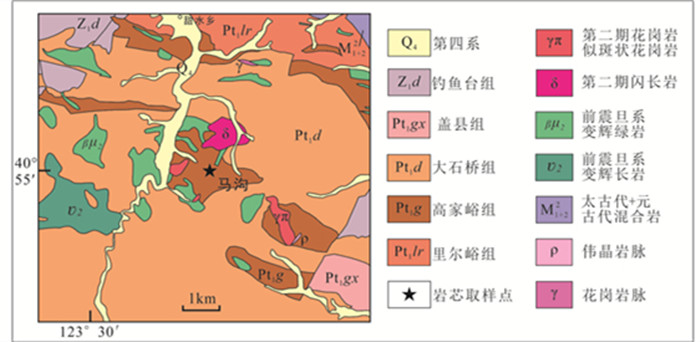
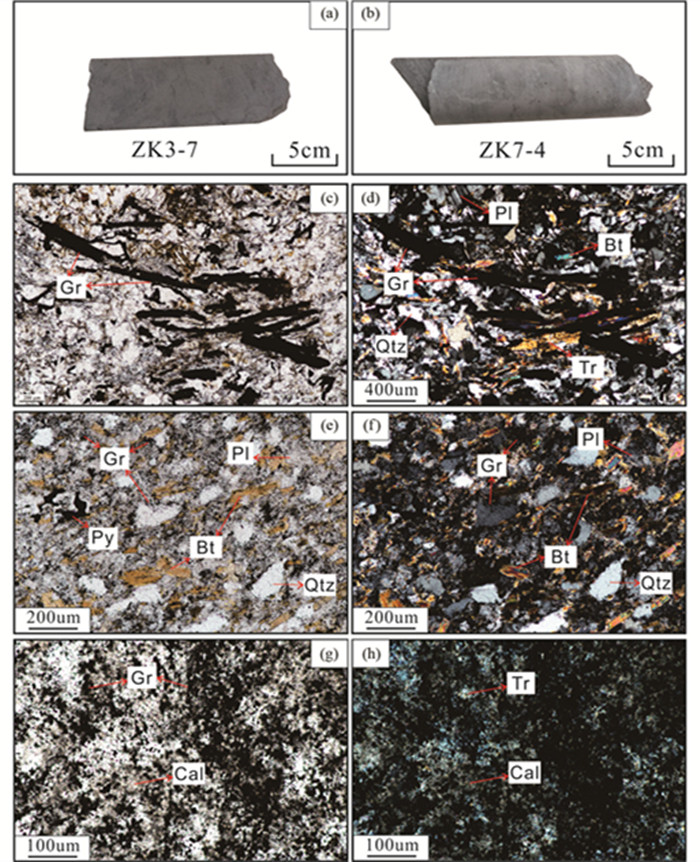
1.3 辽河群石墨矿产出层位及岩石学特征辽河群石墨矿主要产于高家峪组中。北辽河群高家峪组底部的主要岩石组成为二云母片岩、含石榴石二云母石英片岩、黑云母片岩和千枚岩等;中部以白云石大理岩、透辉-透闪石大理岩以及碳质方解石大理岩为主;上部的岩性主要为黑色碳质泥沙质板岩,夹有含碳质石英方解大理岩及含碳质凝灰岩等。南辽河群高家峪组以含石墨为其主要特征,主要由含石墨黑云片岩-片麻岩、含石墨透闪长英质粒状岩石、含石墨大理岩、石墨透闪岩、夕线黑云斜长片岩-片麻岩、斜长角闪岩、二云母片岩等岩石组成。本文研究的石墨矿样品采自于北辽河群的甜水乡马沟地区(高家峪组),取自两口钻井岩芯(ZK3-7和ZK7-4;由辽宁省有色地质局一〇三队提供),岩芯采样区地质简图及位置见图 2,代表性的石墨钻孔岩芯手标本照片见图 3a, b。
|
图 2 胶-辽-吉带甜水乡地区(辽河群石墨矿)地质简图(据辽宁省第一区域地质测量队,1975①修改) Fig. 2 Simplified geological map of the Tianshui Country area |
① 辽宁省第一区域地质测量队. 1975. 1:20万辽阳幅地质图修改
|
图 3 辽河群石墨矿手标本和显微镜下照片 (a、b)石墨矿岩芯手标本;(c、d)含石墨变质杂砂岩;(e、f)含石墨黑云母长英质片麻岩;(g、h)含石墨透闪大理岩. Bt-黑云母; Cal-方解石; Gr-石墨; Pl-斜长石; Py-黄铁矿; Qtz -石英; Tr-透闪石 Fig. 3 Representative photos of the hand specimen and photomicrographs of the graphite deposits in the Liaohe Group (a, b) hand specimen of the graphite deposits; (c, d) graphite-bearing meta-greywacke; (e, f) graphite-bearing biotite feldspar gneisses; (g, h) graphite-bearing tremolite marble. Bt-biotite; Cal-calcite; Gr-graphite; Pl-plagioclase; Py-pyrite; Qtz-quartz; Tr-tremolite |
含石墨矿的主要岩石类型有:含石墨变质杂砂岩、含石墨黑云母长英质片麻岩和含石墨透闪大理岩。其岩相学特征如下:含石墨变质杂砂岩,主要由石英、长石、透闪石、石墨,以及少量黑云母和黄铁矿等组成,其中石墨主要呈片状、条带状,少量为粒状(图 3c, d)。含石墨黑云母长英质片麻岩主要由石英、长石、黑云母和石墨组成,还含有少量的黄铁矿,其中长石部分绢云母化,石墨以粒状为主,少量片状(图 3e, f)。含石墨透闪大理岩中的主要矿物为方解石、透闪石、石墨,以及少量的石英和黄铁矿,石墨主要呈粒状(图 3g, h)。
2 分析方法 2.1 全岩主量、微量元素分析本文挑选了代表性的含石墨岩石样品进行全岩地球化学测试分析。首先手标本剥掉表面的风化层,用去离子水洗净,打碎成细小颗粒后,选择没有裂隙和脉体的部分,再次用去离子水洗净,然后在玛瑙研钵中研磨成200目以下的粉末;接着在澳实分析检测(广州)有限公司进行全岩主量和微量元素的测试分析。主量元素采用XRF(X射线荧光光谱仪PANalytical Axios)方法测试,烧失量(LOI)通过样品在1000℃下灼烧后的质量差得到,主量元素的分析误差(1σ)小于1%。对于微量元素分析步骤如下:首先将大约0.2g样品和0.9g偏硼酸锂混合均匀,1000℃下熔化,冷却之后溶解在100mL 4% HNO3/2% HCl溶液中;然后再使用电感耦合等离子体质谱仪(Perkin Elmer Elan 9000)对溶液进行测试。标样选用GSR-1和GSR-3,测试结果表明大多数微量元素的实验相对误差小于10%。
2.2 拉曼光谱学分析本文中的拉曼光谱学分析测试工作是在中国地质科学院地质研究所显微激光拉曼实验室完成的。拉曼光谱仪型号为Horiba LabRAM HR Evolution,搭载Olympus BX41显微镜,使用100倍物镜,光源为double Nd: YAG laser,波长532nm,强度80mW,光谱分辨率为±0.59cm-1,激光束斑为1~2μm,信号采集时间为5~10s,每次测试前用单晶硅进行校正。测试石墨的拉曼光谱时,为了防止激光发热对石墨拉曼谱峰的影响,我们将激光强度设为1mW,测试过程参照Beyssac et al. (2003)的步骤。
2.3 石墨碳稳定同位素分析本文中的石墨碳同位素分析是在中国科学院地质与地球物理研究所稳定同位素地球化学实验室测试完成的,使用的仪器为ThermoFisher 253质谱仪,搭配GasBench Ⅱ系统。测试岩石样品中石墨的碳同位素过程如下:首先称量一定量的样品粉末(200目)和6N HCl反应24h,确保样品中的碳酸岩矿物被完全反应掉。再经过中和、干燥之后将样品放入锡胶囊中,将装有样品的锡胶囊封住放入EA自动送样机中灼烧,将产生的CO2导入质谱仪中测试碳同位素值,标样为已知碳同位素的尿素(IVA)以及石墨(GBW04407),测量误差为0.15‰。其中碳同位素用南卡罗莱纳州白垩纪皮迪建造中的箭石进行标准化(VPDB,δ13Ccarb)。
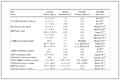
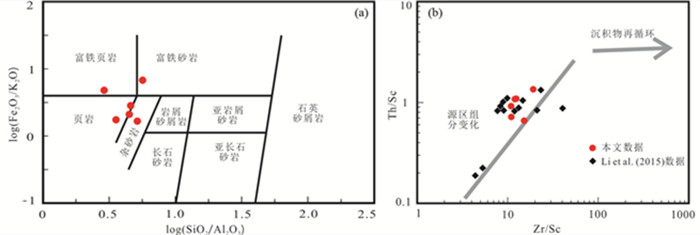
3 测试结果 3.1 含石墨样品全岩地球化学特征辽河群高家峪组中含石墨样品具有变化的主量元素特征(表 1),其中SiO2= 38.82%~59.90%, TiO2=0.35%~0.57%, Al2O3=8.18%~14.12%, Fe2O3T=1.73%~5.99%, MgO=6.79%~11.45%, CaO=1.86%~12.15%, Na2O=1.9%~4.96%, K2O=0.5%~3.04%。这些含石墨岩石普遍具有高的烧失量(LOI),除了样品ZK7-4H31的烧失量为3.94%,其它样品的烧失量均大于10% (LOI=10.30%~21.52%)(表 1)。在log(Fe2O3/K2O)-log(SiO2/Al2O3)判别图解中,这些含石墨岩石位于砂岩和页岩区域内(图 4a; Herron, 1988)。
|
表 1 辽河群含石墨岩石样品主量(wt%)、微量(×10-6)元素数据 Table 1 Major (wt%) and trace (×10-6) elements of the graphite-bearing rock samples in the Liaohe Group |
|
图 4 辽河群石墨矿log(Fe2O3/K2O)-log(SiO2/Al2O3)分类图解(a, 据Herron, 1988)和Th/Sc-Zr/Sc判别图解(b, 据McLennan et al., 1993) Fig. 4 Log(Fe2O3/K2O) vs. log(SiO2/Al2O3) (a, after Herron, 1988) and Th/Sc vs. Zr/Sc (b, after McLennan et al., 1993) classification diagrams of the graphite deposits in the Liaohe Group |
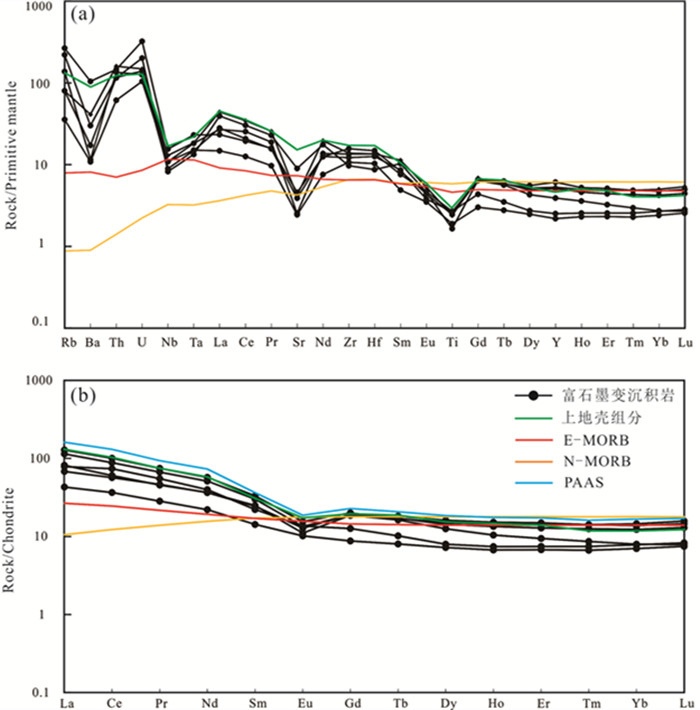
辽河群含石墨岩石样品具有相似的微量元素特征(图 5),但不同微量元素的含量具有一定的差异性。其中大离子亲石元素(LILEs)含量Rb (22.7×10⁻⁶~170×10-6)、Ba(121×10-6~734 ×10-6)、Sr(51.7×10⁻⁶~190.5×10⁻⁶)具有较宽的变化范围,Rb (87.1×10⁻⁶)、Ba(251.9 ×10⁻⁶)、Sr(94.1×10⁻⁶)的平均值均小于太古宙后澳大利亚平均页岩(PAAS;Taylor and McLennan, 1985)中Rb、Ba和Sr的含量(表 1),表明辽河群含石墨岩石在后期变质作用过程中,大离子亲石元素发生了元素迁移作用。这些样品的高场强元素含量(HFSEs:Nb=5.9×10⁻⁶~11.1×10⁻⁶, Ta=0.55×10⁻⁶~0.95×10⁻⁶, Zr=109×10-6~176×10-6, Hf=2.7×10⁻⁶~4.6×10⁻⁶)变化范围较窄,和PAAS以及上地壳成分特征相似,表明它们在后期变质作用过程中,高场强元素未发生明显的迁移。在原始地幔标准化微量元素图解中(图 5a),这些样品具有Th、U元素正异常和Nb、Ta、Sr、Ti元素负异常的特征,和上地壳组分的微量元素特征相似(Rudnick and Gao, 2003)。在球粒陨石标准化稀土元素配分图中(图 5b),这些样品具有轻稀土(LREE)富集[(La/Yb)N= 4.9~10.3]和Eu负异常(Eu/Eu*=0.51~0.78)的特征,和PAAS和上地壳的稀土元素特征相似(Taylor and McLennan, 1985; Rudnick and Gao, 2003)。
|
图 5 辽河群石墨矿原始地幔标准化微量元素蛛网图(a)和球粒陨石标准化稀土元素配分图(b)(标准化值据Sun and McDonough, 1989) 上地壳组分引自Rudnick and Gao (2003);PAAS-太古宙后澳大利亚平均页岩(Taylor and McLennan, 1985);E-MORB-富集洋中脊玄武岩;N-MORB-正常洋中脊玄武岩 Fig. 5 Primitive mantle-normalized trace element diagram (a) and chondrite-normalized REE patterns (b) for the graphite deposits in the Liaohe Group (normalization values after Sun and McDonough, 1989) The data of upper continental crust are from Rudnick and Gao (2003); PAAS-post-Archean Australian average shales (Taylor and McLennan, 1985); E-MORB-enriched mid-ocean ridge basalt; N-MORB-Normal mid-ocean ridge basalt |
碳质物质的拉曼光谱峰可以分为两个区域,一级谱峰区(1100~1800cm-1)和二级谱峰区(2500~3100cm-1)(Tuinstra and Koenig, 1970; Nemanich and Solin, 1979)。石墨拉曼光谱峰在一级谱峰区的主峰为G峰(≈1580cm-1),石墨结晶度越高,G峰越尖锐(Beyssac et al., 2002)。此外,石墨拉曼光谱峰在一级谱峰区还存在D1(≈1350cm-1)和D2(≈1620cm-1)两个缺陷峰,这两个峰的面积随着石墨结晶度的升高而逐渐降低(Nemanich and Solin, 1979; Beyssac et al., 2002)。在二级谱峰区,石墨拉曼光谱峰的位置主要位于2700cm-1附近,为S1峰,随着石墨结晶度的升高,S1谱峰对称度降低,其谱峰可以进一步分解为两个小谱峰(Wopenka and Pasteris, 1993; Beyssac et al., 2003; Reich and Thomsen, 2004)。
我们对辽河群含石墨岩石样品中的石墨进行了详细的显微拉曼光谱学分析,代表性结果如图 6所示。辽河群石墨矿中的石墨整体都具有非常尖锐的G峰和微弱的D1、D2缺陷峰,二级谱峰区的S1峰都显示不对称的特征,并且可以分解为两个小的谱峰,表明辽河群石墨矿中的石墨都具有比较高的结晶度(Beyssac et al., 2002)。此外,不同含石墨岩石样品中的石墨拉曼光谱峰具有一定的差异性(图 6),而且同一样品不同石墨颗粒的拉曼光谱峰也存在一定的差异(图 6a, b)。峰面积比值R2[R2=D1/(G+D1+D2)]位于0.03~0.20区域内,峰强度比值R1 (R1= D1/G)为0.03~0.28。

|
图 6 辽河群不同含石墨岩石样品中石墨拉曼光谱学特征 (a、b) 含石墨透闪大理岩(ZK3-7H4);(c)含石墨黑云母长英质片麻岩(ZK7-4H31);(d)含石墨变质杂砂岩(ZK7-4H55) Fig. 6 Raman spectra of graphite in different graphite-bearing rock samples from the Liaohe Group (a, b) graphite-bearing tremolite marble (ZK3-7H4); (c) graphite-bearing biotite feldspar gneisses (ZK7-4H31); (d) graphite-bearing meta-greywacke (ZK7-4H55) |
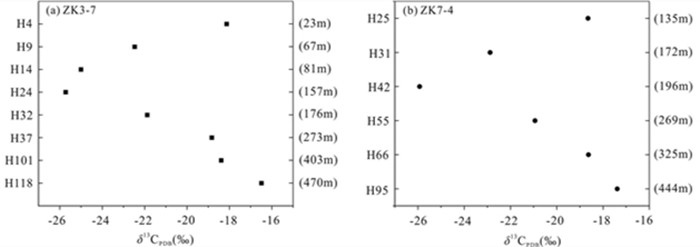
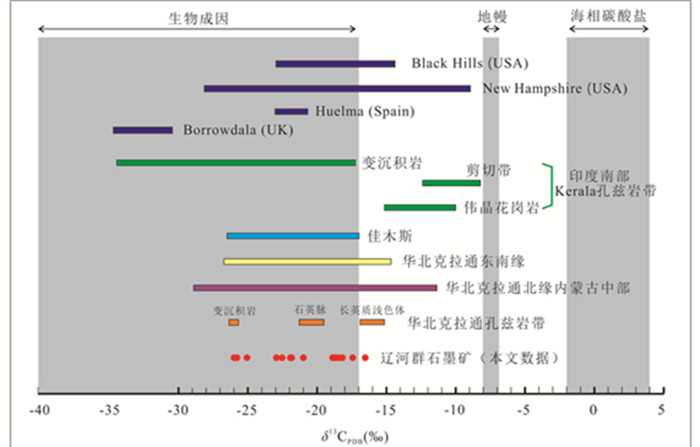
辽河群含石墨岩石样品(钻井岩芯ZK3-7、ZK7-4)石墨碳同位素测试结果列在表 2以及投在图 7中。这些样品的石墨碳同位素具有比较宽的变化范围(δ13CPDB=-16.49‰~-25.93‰),和华北克拉通周缘其它地区(佳木斯、华北克拉通东南缘、华北克拉通孔兹岩带和内蒙古中部)以及印度南部Kerala孔兹岩带的石墨矿具有相似的碳同位素特征(图 8)。其中钻井岩芯ZK3-7的样品石墨碳同位素值δ13CPDB(‰)位于-16.49‰~-25.72‰区间,石墨碳同位素的值随着样品的埋藏深度先降低后升高。取自钻井岩芯ZK7-4的样品石墨碳同位素值和ZK3-7相似(δ13CPDB=-17.39‰~-25.93‰),其石墨碳同位素的值也具有随着深度先降低后升高的特征。不同含石墨岩石样品具有相似的石墨碳同位素特征(表 2和图 7)。
|
|
表 2 辽河群含石墨岩石样品石墨碳同位素测试结果 Table 2 Carbon isotope values of the graphite deposits in the Liaohe Group |
|
图 7 辽河群含石墨岩石样品石墨碳同位素 (a)岩芯钻孔ZK3-7;(b)岩芯钻孔ZK7-4;纵坐标左侧为岩芯编号,右侧为取样深度 Fig. 7 Carbon isotope of graphite in different graphite-bearing rock samples from the Liaohe Group (a) Borehole ZK3-7; (b) Borehole ZK7-4; The left side of the ordinate is the sample number, and the right side is the sampling depth |
有机物转变为石墨的过程主要受温度控制,随着变质温度的升高,有机碳的结晶度逐渐升高(Landis, 1971; Wada et al., 1994; Nishimura et al., 2000; Beyssac et al., 2002)。石墨的拉曼光谱峰对石墨结构的变化非常敏感(Wopenka and Pasteris, 1993),其中G峰(1580cm-1)主要和石墨晶体中的E2G2震动模式(在石墨芳香烃结构平面内的震动)有关(Beyssac et al., 2002)。此外,由于在石墨晶体的层间存在杂环原子(例如O、H、N)或结构缺陷,在石墨拉曼光谱的一级谱峰区常出现另外两个缺陷峰D1和D2峰,这两个缺陷峰强度越高,石墨的结晶度越低(Wopenka and Pasteris, 1993; Beyssac et al., 2003)。石墨拉曼光谱在二级谱峰区的谱峰主要受谐波和组合衍射影响,石墨晶体由二维到三维转变过程中会使得二级谱峰区S1峰分解为两个小峰,反应其具有高结晶度特征(Wopenka and Pasteris, 1993; Beyssac et al., 2003; Reich and Thomsen, 2004)。由于石墨的形成是不可逆的,其结晶度不受退变质过程的影响,因而许多学者用石墨拉曼谱峰特征来计算其经历的峰期变质温度(Beyssac et al., 2002, 2019; Busemann et al., 2007; Aoya et al., 2010; Hilchie and Jamieson, 2014; 李凯月等, 2018)。
Beyssac et al. (2002)通过对比分析大量的有机物变质成因石墨的拉曼光谱学特征,发现可以通过峰面积比R2 [R2=D1/(G+D1+D2)]和峰强度比R1(R1=D1/G)两个参数对石墨的结晶度进行定量化分析,而且可以根据R2比值计算石墨结晶温度,其计算方程为T(℃) =-445×R2+641(误差范围±50℃,温度范围330~650℃)。我们对辽河群石墨矿中不同含石墨岩石样品中的石墨进行了详细的拉曼光谱学分析,通过谱峰分解计算得出这些样品的R2比值位于0.03~0.2区间内,对应的石墨形成温度为551~627℃。贺高品和叶慧文(1998a, b)采用传统矿物对温压计对南、北辽河群的P-T条件进行了估算,得出其峰期变质温度压力条件分别为610~670℃/0.60~0.68GPa和600~640℃/0.64~0.73GPa,和我们计算的石墨拉曼光谱峰记录的峰期温度相似。然而,最近Liu et al. (2019)在南辽河群的三家子地区发现了含堇青石的泥质麻粒岩,相平衡模拟表明其峰期变质温度可以达到790~840℃。尽管到目前为止在北辽河群还没有发现麻粒岩相的变质记录,本文研究区的石墨矿是否和华北克拉通孔兹岩带中的石墨矿一样经历了麻粒岩相的变质?我们通过石墨拉曼光谱学研究认为这种可能性不大。原因如下,石墨拉曼光谱峰主要受温度控制,其拉曼光谱参数对温度很敏感,如果含石墨的岩石样品达到了麻粒岩相的变质作用,石墨的拉曼光谱峰将记录这一变质温度条件,石墨拉曼光谱峰一级谱峰区D1、D2缺陷峰将消失,对应的R2比值为零(Chopin et al., 1991; Beyssac et al., 2002)。而辽河群石墨矿中没有发现D1和D2缺陷峰消失的石墨拉曼峰,其最高结晶度对应的温度大约为627℃,记录了高角闪岩相的变质作用。
4.2 石墨成因分析:有机成因VS.无机成因石墨是地球表面稳定存在的单质碳,是地表碳储库的重要组成部分(Mackenzie et al., 2004)。岩石中的石墨主要有两种形成机制:(1)有机物经过变质作用转变成石墨;(2)在一定的温度压力条件下从碳过饱和的C-H-O流体中沉淀结晶形成石墨(Luque et al., 1998, 2009;Zhu et al., 2020)。
稳定碳同位素地球化学分析可以示踪碳的来源,常用来研究金刚石的成因(Thomassot et al., 2007; Walter et al., 2011)以及早期(太古宙)生命演化(Schidlowski, 2001; Ueno et al., 2002; Van Zuilen et al., 2003; Papineau et al., 2010; Lepland et al., 2011),也是研究石墨成因的有效手段(Luque et al., 2012; Yang et al., 2014; Zhong et al., 2019)。由于碳同位素的分馏作用,原始地球的碳储库发生碳同位素分馏,轻碳同位素(12C)倾向于富集在有机物中,碳酸盐则富集重碳同位素(13C)(Javoy et al., 1986; Chacko et al., 2001; Luque et al., 2012),因此会形成具有不同碳同位素值的碳储库。形成石墨的碳主要有三个来源:有机物、碳酸盐和地幔碳。其中有机物的碳同位素(δ13CPDB‰)多位于-17‰~-40‰范围内,平均为-26‰~-28‰(Schidlowski, 1987, 2001; Hoefs, 2009)。典型海洋碳酸盐往往富集重碳同位素,其δ13CPDB值位于-2‰~+4‰区间内(Sharp, 2007)。地幔碳同位素的值则位于-7‰附近(Hahn-Weinheimer and Hirner, 1981; Weis et al., 1981)。
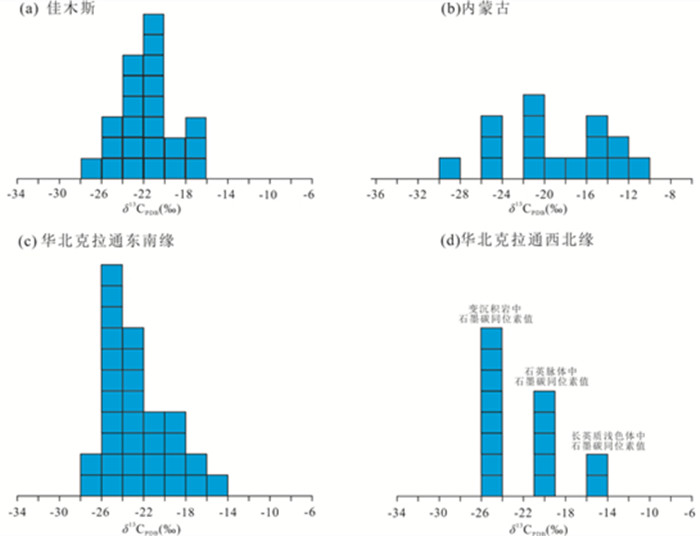
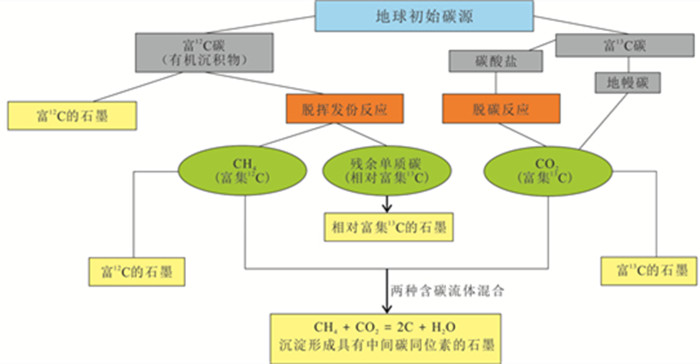
由于地球有机物相对无机碳(碳酸盐和地幔碳)富集轻同位素,许多学者认为变沉积岩中富集12C碳同位素的石墨是有机物在高级变质作用过程中变质形成的(Landis, 1971; Grew, 1974; Santosh and Wada, 1992; Radhika et al., 1995; Dissanayake et al., 2000)。前人对印度南部Kerala孔兹岩带中的石墨进行了详细的碳同位素研究,发现呈浸染状分布在层状变泥质岩中的石墨具有轻的碳同位素组成(δ13CPDB =-34.3‰~-17.5‰; 图 8),认为这些石墨是有机物变质形成的,具有有机碳的同位素特征(Santosh and Wada, 1992, 1993a, b; Radhika et al., 1995; Radhika and Santosh, 1996)。然而Kerala孔兹岩带剪切带以及伟晶花岗岩中的石墨都记录了更重的碳同位素特征,分别为-8.2‰~-12.4‰和-10‰~-15.1‰(图 8;Radhika and Santosh, 1996),被认为是从含CO2流体中沉淀结晶出来的。华北克拉通西北部的孔兹岩带中的石墨矿具有和印度南部Kerala孔兹岩带石墨相似的碳同位素特征,在变质沉积岩中石墨具有轻的碳同位素值(δ13CPDB=-25.3‰~-25.7‰),而在石英脉体(δ13CPDB=-19.1‰~-20.9‰)和长英质浅色体(δ13CPDB=-15.8‰~-16.8‰)中的石墨则分别具有更重的碳同位素值(图 8和图 9d;Yang et al., 2014),Yang et al. (2014)认为变质沉积岩中的石墨是由有机物变质形成的,而对于石墨脉体以及长英质浅色体中的石墨,则是多种碳源汇聚的结果,是从有机物脱挥发分形成的含碳流体和外来的含CO2流体混合形成的流体中沉淀出来的。陈衍景等(2000)总结了华北克拉通周缘不同地区的石墨矿碳同位素特征(图 8和图 9a-c),包括佳木斯(δ13CPDB=-17.0‰~-26.5‰)、内蒙古中部(δ13CPDB=-11.4‰~-28.9‰)和华北克拉通东南缘(δ13CPDB=-14.7‰~-26.8‰),它们的碳同位素值都具有很宽的变化范围,陈衍景等(2000)提出混合岩化过程中无机碳的加入是导致变沉积岩中石墨碳同位素变重的主要原因。从以上讨论我们可以看出不管是印度Kerala孔兹岩带中的石墨,还是华北克拉通周缘的石墨,其碳同位素值都具有很宽的变化范围,具有复杂的成因过程,容易造成石墨成因的多解性。图 10总结了不同碳源形成石墨的碳同位素特征,如果石墨的碳来源于富12C的有机物,则形成的石墨也具有轻的碳同位素特征;如果石墨的碳来源于富13C的碳(碳酸盐或地幔碳),则形成的石墨具有重的碳同位素特征;此外,如果富12C以及富13C的两种流体混合,则会形成具有中间碳同位素值的石墨(Crespo et al., 2004; Luque et al., 2012)。
|
图 9 华北克拉通周缘石墨矿石墨碳同位素直方图 (a-c)佳木斯、内蒙古、华北克拉通东南缘(陈衍景等,2000); (d)华北克拉通西北缘(Yang et al., 2014) Fig. 9 Histograms assembling the carbon isotope composition of graphites from Jiamusi Block, Inner Mongolia, southeastern margin of North China Craton (a-c, after Chen et al., 2000) and northwestern margin of North China Craton (d, after Yang et al., 2014) |
|
图 10 不同碳源形成不同碳同位素值石墨示意图(据Crespo et al., 2004修改) Fig. 10 Schematic diagram depicting the carbon isotope ratio in graphite derived from different carbon sources (modified after Crespo et al., 2004) |
辽河群石墨矿的碳同位素值具有很宽的变化范围,从-16.49‰到-25.93‰,和华北克拉通周缘其它地区的石墨矿相似。在图 8中,这些石墨矿岩石的石墨碳同位素值主要位于生物成因区域内,然而单独依靠石墨碳同位素并不能很好的限定石墨是通过有机物变质形成还是从含碳流体中沉淀形成的。因为流体沉淀形成石墨的碳同位素值也可以位于生物成因区域内(富集轻碳同位素),例如英国Borrowdala(Barrenechea et al., 2009; Luque et al., 2009; Ortega et al., 2010)、西班牙Huelma(Barrenechea et al., 1997)、美国New Hampshire(Rumble III and Hoering, 1986; Rumble III et al., 1986)和Black Hills(Nabelek et al., 2003; Huff and Nabelek, 2007)地区的石墨矿都是通过流体沉淀形成的,然而它们的碳同位素值大多位于生物成因区域内(图 8)。因此,对于辽河群石墨矿的成因机制及碳源问题,需要进一步结合岩相学特征和沉积构造环境来限定。
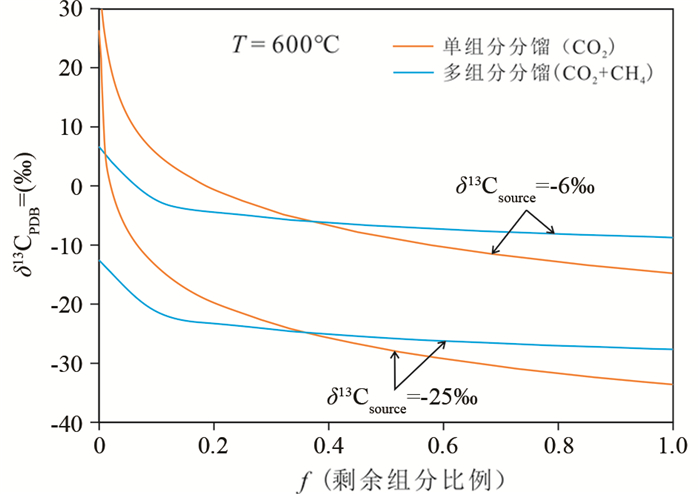
辽河群含石墨岩石的微量元素数据表明,这些样品具有Th、U元素正异常和Nb、Ta、Sr、Ti元素负异常的特征,此外,球粒陨石标准化稀土元素图解表明它们具有轻稀土富集和Eu负异常的特征,这些地球化学特征和PAAS以及上地壳的微量元素特征相似。Th/Sc-Zr/Sc图解可以用来很好的指示沉积物的再循环过程(McLennan et al., 1993; Asiedu et al., 2000),沉积物再循环过程中Zr/Sc的比值相对Th/Sc会发生显著的增加。在Th/Sc-Zr/Sc图解中(图 4b),辽河群含石墨样品的Th/Sc和Zr/Sc比值显示一定的正相关性,落在源区组分变化线上,没有出现Zr的显著增加现象,表明这些样品没有经历后期沉积物的再循环过程。Li et al. (2015)对辽河群变沉积岩进行了详细的地球化学研究,根据化学蚀变指数(CIA; Nesbitt and Young, 1982)以及成分变化指数(ICV; Cox et al., 1995),表明辽河群变沉积岩具有低的成熟度,未经历长途搬运,是快速堆积的产物。前人通过碎屑锆石和地球化学研究,认为辽河群变沉积岩(辽河群石墨矿的原岩)主要形成于弧后盆地活动大陆边缘环境(Li et al., 2015; Wang et al., 2017a, 2020a)。岩相学研究表明辽河群石墨矿的石墨主要以浸染状分布在辽河群变沉积岩中,因此我们认为在辽河群沉积物快速堆积过程中,还伴随着大量有机物的加入。沉积物快速堆积且未经历长途搬运,为有机物的埋藏保存提供了良好的环境。在后期的变质作用过程中,有机物发生变质分解并逐渐形成具有高结晶度的石墨。岩相学研究表明含石墨岩石样品中普遍含有一定量的黄铁矿,表明其沉积环境具有一定的还原性。有机物在还原环境下分解的产物主要以CH4为主,而CH4富集轻的碳同位素(12C),因此会使残余的有机碳同位素逐渐变重(Rumble III and Hoering, 1986; Wada et al., 1994)。这可以用来解释辽河群石墨矿具有比较宽泛的碳同位素特征,并且具有逐渐变重的趋势。然而,有研究者用多组分流体的瑞利分馏来解释具有中间碳同位素特征的石墨成因(图 11; Ray, 2009; Luque et al., 2012; Yang et al., 2014),这种模型可以很好的解释华北克拉通孔兹岩带中石英脉以及浅色体中具有较重碳同位素特征的石墨成因(Yang et al., 2014)。但是,岩相学研究表明辽河群石墨矿大多以浸染状分布在层状地层中,没有流体沉淀结晶石墨的特征,因此不太可能是从多组分流体中通过瑞利分馏形成的。因此,我们认为辽河群石墨矿是由有机物经过变质作用形成的,其变质程度可以达到高角闪岩相,低于华北克拉通孔兹岩带中石墨的变质程度(麻粒岩相;Yang et al., 2014);有机物在变质作用过程中发生不同程度的CH4分解作用,导致石墨碳同位素具有向富13C同位素演化的趋势。
|
图 11 在600℃温度下,单组分(CO2,黄线)和多组分(CO2+CH4,蓝线)含碳流体瑞利分馏形成石墨碳同位素演化曲线(据Luque et al., 2012修改) Fig. 11 Evolution curves of δ13C values for graphite precipitated from single component (CO2, yellow lines) and multicomponent (CO2+CH4, blue lines) during Rayleigh fractionation at 600℃ (modified after Luque et al., 2012) |
前人对胶-辽-吉带内辽河群原岩时代开展了大量的同位素年代学研究(辽宁省地质矿产局, 1989; Luo et al., 2004, 2008; Lu et al., 2006; 李壮等, 2015; 刘福来等, 2015; 王惠初等, 2015; Wang et al., 2017a, 2020a; 刘平华等, 2017)。早期基于K-Ar、Rb-Sr和Sm-Nd全岩等时线或单颗粒锆石蒸发定年研究,前人认为辽河群形成于2.3~1.9Ga(张秋生等, 1988; 辽宁省地质矿产局, 1989; 白瑾, 1993),然而由于胶-辽-吉带辽河群在后期经历了多期变质-深熔事件叠加,会引起K-Ar、Rb-Sr和Sm-Nd同位素体系的开放,导致上述研究方法不能很好的制约辽河群的沉积时代。随后,许多学者使用LA-ICP-MS锆石定年方法对辽河群碎屑锆石进行了详细的研究,以其中岩浆锆石的最小年龄代表沉积的最老年龄,而最大变质年龄则代表沉积的最新年龄,通过这一方法得出辽河群的沉积时代为2.05~1.95Ga (Luo et al., 2004, 2008; 刘福来等, 2015)。近年来,Wang et al. (2020a)对北辽河群进行了大量碎屑锆石年代学的研究工作,年龄数据表明北辽河群里尔峪组的年龄谱峰为2.17Ga,高家峪组和大石桥组都具有双年龄谱峰,分别为2.51Ga/2.17Ga和2.51Ga/2.18Ga。此外,在北辽河群发育大量切穿沉积地层的变质基性岩脉(Meng et al., 2014; Xu et al., 2018),年代学研究表明其侵位时间为2.13Ga。因此,辽河群的沉积时代应早于2.13Ga。综上我们认为位于北辽河群高家峪组中的石墨矿沉积时代为2.13~2.17Ga。根据前述讨论(章节4.2部分),我们认为在2.13~2.17Ga,有大量的有机物沉积在弧后盆地活动大陆边缘环境,在后期的弧-陆碰撞造山以及后碰撞作用过程中(2000~1895Ma; 1875~1850Ma; Xu and Liu, 2019),有机物逐渐发生变质形成石墨并聚集形成石墨矿床。
4.4 对地球古环境的启示年代学研究表明,辽河群石墨矿沉积时代大约在2.13~2.17Ga,和华北克拉通西北缘孔兹岩带石墨矿的沉积时代(2.07~2.15Ga; Li et al., 2011; Zhang et al., 2014)相似。陈衍景等(2000)总结了华北克拉通周缘石墨矿特征,认为这些含石墨岩石的沉积时代可能为2.05~2.3Ga。这些年代学数据表明华北克拉通周缘巨量石墨矿床大部分都形成于古元古代层侵纪(2.3~2.05Ga)。与此同时,在世界各克拉通层侵纪碳酸盐地层序列中普遍发现了碳同位素(δ13Ccarb)正异常现象(Baker and Fallick, 1989a, b; Karhu, 1993; Karhu and Holland, 1996; Melezhik and Fallick, 1996; Aharon, 2005; Bekker et al., 2006; Frauenstein et al., 2009; Maheshwari et al., 2010;Tang et al., 2011; Pufahl and Hiatt, 2012; Martin et al., 2013)。这一全球性δ13Ccarb正漂移事件又称为拉玛岗地-瓦图里事件(Lomagundi-Jatuli Event, LJE; Baker and Fallick, 1989a, b)。有许多研究者认为LJE事件和有机物的埋藏有关(Karhu and Holland, 1996; Bekker et al., 2008)。根据公式δ13Cin= δ13Ccarb(1-forg)+δ13Corg forg(δ13Cin、δ13Ccarb、δ13Corg分别代表进入大气中的碳同位素值、沉积碳酸盐碳同位素值和有机物碳同位素值,forg则代表有机物埋藏的比例),在δ13Cin和δ13Corg值不变的情况下,如果有机物埋藏量增多,相应的碳酸盐矿物δ13Ccarb会升高(Eguchi et al., 2020)。此外,根据光合作用CO2+H2O=CH2O+O2,有机物的埋藏量控制着地表氧含量的变化,有机物埋藏量的增加会导致大气氧含量逐渐升高(Karhu and Holland, 1996)。大量研究表明地球表生环境首次大规模充氧事件(大氧化事件,GOE)发生时间大约在2.3~2.0Ga(Bekker et al., 2006; Lyons et al., 2014; Luo et al., 2016),和LJE事件的时间相一致。在这一时期,地球各圈层性质发生了全球性突变,例如发育全球性硅铁建造,红层、沉积磷矿和蒸发岩普遍发育,叠层石及碳酸盐岩大量出现,发育大量石墨矿床等(陈衍景, 1990;Tang et al., 2016)。华北克拉通周缘古元古代(2.3~2.05Ga)大量石墨矿床的沉积很有可能是GOE和LJE事件的沉积响应。
关于地球古元古代早期大氧化事件的成因,前人已经做了大量的研究(Kasting et al., 1993; Ohmoto, 1996; Holland, 1999, 2002, 2006, 2009; Ohmoto et al., 2004, 2006; Canfield, 2005; Kump and Barley, 2007; Kump, 2008; Lyons et al., 2014; Lee et al., 2016; Luo et al., 2016; Duncan and Dasgupta, 2017; Eguchi et al., 2020)。传统简单模型认为这时期蓝藻细菌的出现可以导致大气氧含量的快速增加,然而Brocks et al. (1999)在2.7~2.8Ga沉积地层中也发现了蓝藻细菌,表明GOE事件不能简单的用蓝藻细菌的出现来解释。Kasting et al. (1993)认为大气H2的逃逸可以改变地球的氧化还原状态,使地幔逐渐氧化,进而使火山喷出氧化性气体含量增加。Lee et al. (2016)认为2.7~2.5Ga大陆壳形成后,地壳岩石由铁镁质向硅酸质的转变使地壳吸附氧的能力降低,可以促使大气氧含量的增加;大陆壳形成后风化作用可以为海洋生物提供大量的营养物质,促使光合作用产氧量的增加。此外,2.5Ga左右板块俯冲的初始启动可以使大量有机物被俯冲带入地幔深部并固存下来,进而促使大气氧含量的增加(Duncan and Dasgupta, 2017)。最近,Eguchi et al. (2020)提出,2.3~2.0Ga期间地球构造转变导致火山喷出CO2含量的大量增加,可以使地表沉积的碳酸盐和有机物含量都显著增加,进而导致大气氧含量的升高。综合来看,不管是哪种模式,大气氧含量的升高都伴随着大量有机物的沉积。华北克拉通周缘古元古代早期(2.3~2.05Ga)沉积的大量有机物可能记录了这一时期大气充氧过程,这些有机物在后期经历了多期变质事件的改造而转变成了具有高结晶度的石墨,进一步对其进行沉积构造环境方面的研究对于揭示大氧化事件的成因仍具有重要的意义。
5 结论根据对胶-辽-吉造山带辽河群石墨矿(甜水乡马沟石墨矿)详细的岩相学、地球化学、拉曼光谱学以及碳同位素等方面的研究,本文得到如下几点认识:
(1) 辽河群石墨矿主要岩石类型为含石墨变质杂砂岩、含石墨黑云母长英质片麻岩和含石墨透闪大理岩,地球化学特征表明它们具有低的成熟度,未经历长途搬运,是快速堆积的产物,主要沉积于活动大陆边缘环境。
(2) 辽河群石墨矿中的石墨具有非常高的结晶度,其拉曼峰面积比值R2=0.03~0.2,对应的石墨形成温度为551~627℃,记录了高角闪岩相的变质作用。
(3) 辽河群石墨矿碳同位素值具有很宽的变化范围(δ13CPDB=-16.49‰~-25.93‰),是有机物在变质过程中脱CH4造成的。其沉积时代为2.13~2.17Ga,在后期的弧-陆碰撞造山以及后碰撞作用过程中(2000~1895Ma; 1875~1850Ma),有机物逐渐发生变质形成石墨并聚集形成石墨矿床。
(4) 华北克拉通周缘大量石墨矿的沉积时代(2.3~2.05Ga)和大氧化事件发生的时间一致,可能是地球早期大氧化事件的沉积响应。
致谢 感谢辽宁省有色地质一〇三队在野外工作中提供的大力支持和帮助;感谢中国地质科学院地质研究所显微激光拉曼实验室张聪副研究员在石墨拉曼光谱测试过程中提供的帮助;感谢中国科学院地质与地球物理研究所稳定同位素分析实验室李洪伟老师在石墨碳同位素测试过程中提供的帮助;感谢审稿专家汤好书研究员和李旭平教授对本文提出了宝贵的修改意见。
Aharon P. 2005. Redox stratification and anoxia of the Early Precambrian oceans: Implications for carbon isotope excursions and oxidation events. Precambrian Research, 137(3-4): 207-222
|
Aoya M, Kouketsu Y, Endo S, Shimizu H, Mizukami T, Nakamura D and Wallis S. 2010. Extending the applicability of the Raman carbonaceous-material geothermometer using data from contact metamorphic rocks. Journal of Metamorphic Geology, 28(9): 895-914 DOI:10.1111/j.1525-1314.2010.00896.x
|
Asiedu DK, Suzuki S, Nogami K and Shibata T. 2000. Geochemistry of Lower Cretaceous sediments, Inner Zone of Southwest Japan: Constraints on provenance and tectonic environment. Geochemical Journal, 34(2): 155-173 DOI:10.2343/geochemj.34.155
|
Bai J. 1993. The Precambrian Geology and Pb-Zn Mineralization in the Northern Margin of North China Platform. Beijing: Geological Publishing House, 1-132 (in Chinese)
|
Baker AJ and Fallick AE. 1989a. Heavy carbon in two-billion-year-old marbles from Lofoten-Vesteralen, Norway: Implications for the Precambrian carbon cycle. Geochimica et Cosmochimica Acta, 53(5): 1111-1115 DOI:10.1016/0016-7037(89)90216-0
|
Baker AJ and Fallick AE. 1989b. Evidence from Lewisian limestones for isotopically heavy carbon in two-thousand-million-year-old sea water. Nature, 337(6205): 352-354 DOI:10.1038/337352a0
|
Barrenechea JF, Luque FJ, Rodas M and Pasteris JD. 1997. Vein-type graphite in Jurassic volcanic rocks of the external zone of the Betic Cordillera, southern Spain. The Canadian Mineralogist, 35(6): 1379-1390
|
Barrenechea JF, Luque FJ, Millward D, Ortega L, Beyssac O and Rodas M. 2009. Graphite morphologies from the Borrowdale deposit (NW England, UK): Raman and SIMS data. Contributions to Mineralogy and Petrology, 158(1): 37-51 DOI:10.1007/s00410-008-0369-y
|
Bekker A, Karhu JA and Kaufman AJ. 2006. Carbon isotope record for the onset of the Lomagundi carbon isotope excursion in the Great Lakes Area, North America. Precambrian Research, 148(1-2): 145-180 DOI:10.1016/j.precamres.2006.03.008
|
Bekker A, Holmden C, Beukes NJ, Kenig F, Eglinton B and Patterson WP. 2008. Fractionation between inorganic and organic carbon during the Lomagundi (2. 22~2.1Ga) carbon isotope excursion. Earth and Planetary Science Letters, 271(1-4): 278-291 DOI:10.1016/j.epsl.2008.04.021
|
Beyssac O, Goffé B, Chopin C and Rouzaud JN. 2002. Raman spectra of carbonaceous material in metasediments: A new geothermometer. Journal of Metamorphic Geology, 20(9): 859-871 DOI:10.1046/j.1525-1314.2002.00408.x
|
Beyssac O, Goffé B, Petitet JP, Froigneux E, Moreau M and Rouzaud JN. 2003. On the characterization of disordered and heterogeneous carbonaceous materials by Raman spectroscopy. Spectrochimica Acta Part A: Molecular and Biomolecular Spectroscopy, 59(10): 2267-2276 DOI:10.1016/S1386-1425(03)00070-2
|
Beyssac O, Pattison DRM and Bourdelle F. 2019. Contrasting degrees of recrystallization of carbonaceous material in the Nelson aureole, British Columbia and Ballachulish aureole, Scotland, with implications for thermometry based on Raman spectroscopy of carbonaceous material. Journal of Metamorphic Geology, 37(1): 71-95 DOI:10.1111/jmg.12449
|
Brocks JJ, Logan GA, Buick R and Summons RE. 1999. Archean molecular fossils and the early rise of eukaryotes. Science, 285(5430): 1033-1036 DOI:10.1126/science.285.5430.1033
|
Bureau of Geology and Mineral Resources of Liaoning Province. 1989. Regional Geology of Liaoning Province. Beijing: Geological Publishing House: 1-856 (in Chinese)
|
Busemann H, Alexander CMOD and Nittler LR. 2007. Characterization of insoluble organic matter in primitive meteorites by micro-Raman spectroscopy. Meteoritics & Planetary Science, 42(7-8): 1387-1416
|
Cai J, Liu FL, Liu PH, Wang F, Meng E, Wang W, Yang H, Ji L and Liu LS. 2017. Discovery of granulite-facies metamorphic rocks in the Ji'an area, northeastern Jiao-Liao-Ji Belt, North China Craton: Metamorphic P-T evolution and geological implications. Precambrian Research, 303: 626-640 DOI:10.1016/j.precamres.2017.08.018
|
Cai J, Liu FL and Liu CH. 2020. A unique Paleoproterozoic HP-UHT metamorphic event recorded by the Bengbu mafic granulites in the southwestern Jiao-Liao-Ji Belt, North China Craton. Gondwana Research, 80: 244-274 DOI:10.1016/j.gr.2019.10.010
|
Canfield DE. 2005. The early history of atmospheric oxygen: Homage to Robert M. Garrels. Annual Review of Earth and Planetary Sciences, 33: 1-36 DOI:10.1146/annurev.earth.33.092203.122711
|
Chacko T, Cole DR and Horita J. 2001. Equilibrium oxygen, hydrogen and carbon isotope fractionation factors applicable to geologic systems. Reviews in Mineralogy and Geochemistry, 43(1): 1-81 DOI:10.2138/gsrmg.43.1.1
|
Chen CX. 2000. Minerogenic system of magnesian nonmetallic deposits in Early Proterozoic Mg-rich carbonate formations in eastern Liaoning Province. Ph. D. Dissertation. Wuhan: China University of Geosciences (Wuhan) (in Chinese)
|
Chen CX and Cai KQ. 2000. Minerogenic system of magnesian nonmetallic deposits in Early Proterozoic Mg-rich carbonate formations in eastern Liaoning Province. Acta Geologica Sinica, 74(3): 623-631
|
Chen YC, Wang DH, Chen ZH, Xu ZG, Li JK, Rui ZY, Sheng JF, Xu Y, Yuan ZX, Bai G, Zhu MY, Li HM, Gao L, Li HQ, Qu WJ, Chen W, Wang YB, Zhang YS, Ye HT, Ying YJ, Wang CH, Liu SB and Fu XJ. 2010. The Research Technology Requirements of National Important Mineral and Regional Metallogenic Regularity. Beijing: Geological Publishing House, 1-179 (in Chinese)
|
Chen YJ. 1990. Evidences for the catastrophe in geologic environment at about 2300Ma and the discussions on several problems. Journal of Stratigraphy, 14(3): 178-184 (in Chinese with English abstract)
|
Chen YJ, Liu CQ, Chen HY, Zhang ZJ and Li C. 2000. Carbon isotope geochemistry of graphite deposits and ore-bearing khondalite series in North China: Implications for several geoscientific problems. Acta Petrologica Sinica, 16(2): 233-244 (in Chinese with English abstract)
|
Chopin C, Henry C and Michard A. 1991. Geology and petrology of the coesite-bearing terrain, Dora Maira massif, Western Alps. European Journal of Mineralogy, 3(2): 263-292 DOI:10.1127/ejm/3/2/0263
|
Cox R, Lowe DR and Cullers RL. 1995. The influence of sediment recycling and basement composition on evolution of mudrock chemistry in the southwestern United States. Geochimica et Cosmochimica Acta, 59(14): 2919-2940 DOI:10.1016/0016-7037(95)00185-9
|
Crespo E, Luque J, Fernández-Rodrígu C, Rodas M, Díaz-Azpiroz M, Fernández-Caliani JC and Barrenechea JF. 2004. Significance of graphite occurrences in the Aracena Metamorphic Belt, Iberian Massif. Geological Magazine, 141(6): 687-697 DOI:10.1017/S0016756804009896
|
Crossley P. 2000. Graphite-High-tech supply sharpens up. Industrial Minerals, 398: 31-47
|
Dissanayake CB, Chandrajith R and Boudou JP. 2000. Biogenic graphite as a potential geomarker-application to continental reconstructions of Pan-African Gondwana terrains. Gondwana Research, 3(3): 405-413 DOI:10.1016/S1342-937X(05)70298-7
|
Duncan MS and Dasgupta R. 2017. Rise of Earth's atmospheric oxygen controlled by efficient subduction of organic carbon. Nature Geoscience, 10(5): 387-392 DOI:10.1038/ngeo2939
|
Eguchi J, Seales J and Dasgupta R. 2020. Great Oxidation and Lomagundi events linked by deep cycling and enhanced degassing of carbon. Nature Geoscience, 13(1): 71-76 DOI:10.1038/s41561-019-0492-6
|
Frauenstein F, Veizer J, Beukes N, Van Niekerk HS and Coetzee LL. 2009. Transvaal Supergroup carbonates: Implications for Paleoproterozoic δ18O and δ13C records. Precambrian Research, 175(1-4): 149-160 DOI:10.1016/j.precamres.2009.09.005
|
Grew ES. 1974. Carbonaceous material in some metamorphic rocks of New England and other areas. The Journal of Geology, 82(1): 50-73 DOI:10.1086/627936
|
Guo SS and Li SG. 2009. SHRIMP zircon U-Pb ages for the Paleoproterozoic metamorphic-magmatic events in the southeast margin of the North China Craton. Science in China (Series D), 52(8): 1039-1045 DOI:10.1007/s11430-009-0099-7
|
Hahn-Weinheimer P and Hirner A. 1981. Isotopic evidence for the origin of graphite. Geochemical Journal, 15(1): 9-15 DOI:10.2343/geochemj.15.9
|
He GP and Ye HW. 1998a. Composition and main characteristics of Early Proterozoic metamorphic terranes in eastern Liaoning and southern Jilin areas. Journal of Changchun University of Science and Technology, 28(2): 121-126, 134 (in Chinese with English abstract)
|
He GP and Ye HW. 1998b. Two types of Early Proterozoic metamorphism and its tectonic significance in eastern Liaoning and southern Jilin areas. Acta Petrologica Sinica, 14(2): 152-162 (in Chinese with English abstract)
|
Herron MM. 1988. Geochemical classification of terrigenous sands and shales from core or log data. Journal of Sedimentary Petrology, 58(5): 820-829
|
Hilchie LJ and Jamieson RA. 2014. Graphite thermometry in a low-pressure contact aureole, Halifax, Nova Scotia. Lithos, 208-209: 21-33 DOI:10.1016/j.lithos.2014.08.015
|
Hoefs J. 2009. Stable Isotope Geochemistry. 6th Edition. Berlin, Germany: Springer-Verlag: 53-107
|
Holland HD. 1999. When did the Earth's atmosphere become oxic? A Reply. The Geochemical News, 100: 20-22
|
Holland HD. 2002. Volcanic gases, black smokers, and the Great Oxidation Event. Geochimica et Cosmochimica Acta, 66(21): 3811-3826 DOI:10.1016/S0016-7037(02)00950-X
|
Holland HD. 2006. The oxygenation of the atmosphere and oceans. Philosophical Transactions of the Royal Society B: Biological Sciences, 361(1470): 903-915 DOI:10.1098/rstb.2006.1838
|
Holland HD. 2009. Why the atmosphere became oxygenated: A proposal. Geochimica et Cosmochimica Acta, 73(18): 5241-5255 DOI:10.1016/j.gca.2009.05.070
|
Huff TA and Nabelek PI. 2007. Production of carbonic fluids during metamorphism of graphitic pelites in a collisional orogen: An assessment from fluid inclusions. Geochimica et Cosmochimica Acta, 71(20): 4997-5015 DOI:10.1016/j.gca.2007.08.001
|
Javoy M, Pineau F and Delorme H. 1986. Carbon and nitrogen isotopes in the mantle. Chemical Geology, 57(1-2): 41-62 DOI:10.1016/0009-2541(86)90093-8
|
Jiang SY, Chen CX, Chen YQ, Jiang YH, Dai BZ and Ni P. 2004. Geochemistry and genetic model for the giant magnesite deposits in the eastern Liaoning Province, China. Acta Petrologica Sinica, 20(4): 765-772 (in Chinese with English abstract)
|
Karhu JA. 1993. Palaeoproterozoic evolution of the carbon isotope ratios of sedimentary carbonates in the Fennoscandian Shield. Geological Survey of Finland Bulletin, 371: 1-87
|
Karhu JA and Holland HD. 1996. Carbon isotopes and the rise of atmospheric oxygen. Geology, 24(10): 867-870 DOI:10.1130/0091-7613(1996)024<0867:CIATRO>2.3.CO;2
|
Kasting JF, Eggler DH and Raeburn SP. 1993. Mantle redox evolution and the oxidation state of the Archean atmosphere. The Journal of Geology, 101(2): 245-257 DOI:10.1086/648219
|
Kump LR and Barley ME. 2007. Increased subaerial volcanism and the rise of atmospheric oxygen 2. 5 billion years ago. Nature, 448(7157): 1033-1036
|
Kump LR. 2008. The rise of atmospheric oxygen. Nature, 451(7176): 277-278 DOI:10.1038/nature06587
|
Lan XY. 1981. Study on genesis of the Nanshu graphite deposit and on feature of Precambrian graphite-bearing rock association, Shandong. Journal of Changchun University of Earth Sciences, (3): 30-42 (in Chinese)
|
Landis CA. 1971. Graphitization of dispersed carbonaceous material in metamorphic rocks. Contributions to Mineralogy and Petrology, 30(1): 34-45 DOI:10.1007/BF00373366
|
Lee CTA, Yeung LY, McKenzie NR, Yokoyama Y, Ozaki K and Lenardic A. 2016. Two-step rise of atmospheric oxygen linked to the growth of continents. Nature Geoscience, 9(6): 417-424 DOI:10.1038/ngeo2707
|
Lepland A, van Zuilen MA and Philippot P. 2011. Fluid-deposited graphite and its geobiological implications in Early Archean gneiss from Akilia, Greenland. Geobiology, 9(1): 2-9 DOI:10.1111/j.1472-4669.2010.00261.x
|
Li C, Wang DH, Zhao H, Pei HX, Li XW, Zhou LM, Du AD and Qu WJ. 2015. Minerogenetic regularity of graphite deposits in China. Mineral Deposits, 34(6): 1223-1236 (in Chinese with English abstract)
|
Li KY, Chen YJ, She ZB, Tang HS and Chen WY. 2018. Carbon isotope compositions and geochemical characteristics of the Zhangshe graphite deposit of the Jingshan Group, Jiaobei. Earth Science Frontiers, 25(5): 19-33 (in Chinese with English abstract)
|
Li SZ, Han ZZ, Liu YJ, Yang ZS and Ma R. 2001. Continental dynamics and regional metamorphism of the Liaohe Group. Geological Review, 47(1): 9-18 (in Chinese with English abstract)
|
Li SZ, Zhao GC, Sun M, Wu FY, Liu JZ, Hao DF, Han ZZ and Luo Y. 2004. Mesozoic, not Paleoproterozoic SHRIMP U-Pb zircon ages of two Liaoji granites, Eastern Block, North China Craton. International Geology Review, 46(2): 162-176 DOI:10.2747/0020-6814.46.2.162
|
Li SZ, Zhao GC, Sun M, Han ZZ, Luo Y, Hao DF and Xia XP. 2005. Deformation history of the Paleoproterozoic Liaohe assemblage in the Eastern Block of the North China Craton. Journal of Asian Earth Sciences, 24(5): 659-674 DOI:10.1016/j.jseaes.2003.11.008
|
Li SZ and Zhao GC. 2007. SHRIMP U-Pb zircon geochronology of the Liaoji granitoids: Constraints on the evolution of the Paleoproterozoic Jiao-Liao-Ji belt in the Eastern Block of the North China Craton. Precambrian Research, 158(1-2): 1-16 DOI:10.1016/j.precamres.2007.04.001
|
Li XP, Yang ZY, Zhao GC, Grapes R and Guo JH. 2011. Geochronology of khondalite-series rocks of the Jining Complex: Confirmation of depositional age and tectonometamorphic evolution of the North China Craton. International Geology Review, 53(10): 1194-1211 DOI:10.1080/00206810903548984
|
Li Z, Chen B, Liu JW, Zhang L and Yang C. 2015. Zircon U-Pb ages and their implications for the South Liaohe Group in the Liaodong Peninsula, Northeast China. Acta Petrologica Sinica, 31(6): 1589-1605 (in Chinese with English abstract)
|
Li Z, Chen B, Wei CJ, Wang CX and Han W. 2015. Provenance and tectonic setting of the Paleoproterozoic metasedimentary rocks from the Liaohe Group, Jiao-Liao-Ji Belt, North China Craton: Insights from detrital zircon U-Pb geochronology, whole-rock Sm-Nd isotopes, and geochemistry. Journal of Asian Earth Sciences, 111: 711-732 DOI:10.1016/j.jseaes.2015.06.003
|
Liu DY, Nutman AP, Compston W, Wu JS and Shen QH. 1992. Remnants of ≥ 3800Ma crust in the Chinese part of the Sino-Korean Craton. Geology, 20(4): 339-342 DOI:10.1130/0091-7613(1992)020<0339:ROMCIT>2.3.CO;2
|
Liu FL, Liu PH, Wang F, Liu CH and Cai J. 2015. Progresses and overviews of voluminous meta-sedimentary series within the Paleoproterozoic Jiao-Liao-Ji orogenic/mobile belt, North China Craton. Acta Petrologica Sinica, 31(10): 2816-2846 (in Chinese with English abstract)
|
Liu PH, Cai J and Zou L. 2017. Metamorphic P-T-t path and its geological implication of the Sanjiazi garnet amphibolites from the northern Liaodong Penisula, Jiao-Liao-Ji belt: Constraints on phase equilibria and zircon U-Pb dating. Acta Petrologica Sinica, 33(9): 2649-2674 (in Chinese with English abstract)
|
Liu PH, Liu FL, Tian ZH, Cai J, Ji L and Wang F. 2019. Petrological and geochronological evidence for Paleoproterozoic granulite-facies metamorphism of the South Liaohe Group in the Jiao-Liao-Ji Belt, North China Craton. Precambrian Research, 327: 121-143 DOI:10.1016/j.precamres.2019.03.002
|
Lu XP, Wu FY, Lin JQ, Sun DY, Zhang YB and Guo CL. 2004. Geochronological successions of the Early Precambrian granitic magmatism in southern Liaodong Peninsula and its constraints on tectonic evolution of the North China Craton. Chinese Journal of Geology, 39(1): 123-138 (in Chinese with English abstract)
|
Lu XP, Wu FY, Guo JH, Wilde SA, Yang JH, Liu XM and Zhang XO. 2006. Zircon U-Pb geochronological constraints on the Paleoproterozoic crustal evolution of the Eastern Block in the North China Craton. Precambrian Research, 146(3-4): 138-164 DOI:10.1016/j.precamres.2006.01.009
|
Luo GM, One S, Beukes NJ, Wang DT, Xie SC and Summons RE. 2016. Rapid oxygenation of Earth's atmosphere 2. 33 billion years ago. Science Advances, 2(5): e1600134
|
Luo Y, Sun M, Zhao GC, Li SZ, Xu P, Ye K and Xia XP. 2004. LA-ICP-MS U-Pb zircon ages of the Liaohe Group in the Eastern Block of the North China Craton: Constraints on the evolution of the Jiao-Liao-Ji Belt. Precambrian Research, 134(3-4): 349-371 DOI:10.1016/j.precamres.2004.07.002
|
Luo Y, Sun M, Zhao GC, Li SZ, Ayers JC, Xia X and Zhang JH. 2008. A comparison of U-Pb and Hf isotopic compositions of detrital zircons from the North and South Liaohe groups: Constraints on the evolution of the Jiao-Liao-Ji Belt, North China Craton. Precambrian Research, 163(3-4): 279-306 DOI:10.1016/j.precamres.2008.01.002
|
Luque FJ, Pasteris JD, Wopenka B, Rodas M and Barrenechea JF. 1998. Natural fluid-deposited graphite: Mineralogical characteristics and mechanisms of formation. American Journal of Science, 298(6): 471-498 DOI:10.2475/ajs.298.6.471
|
Luque FJ, Ortega L, Barrenechea JF, Millward D, Beyssac O and Huizenga JM. 2009. Deposition of highly crystalline graphite from moderate-temperature fluids. Geology, 37(3): 275-278 DOI:10.1130/G25284A.1
|
Luque FJ, Crespo-Feo E, Barrenechea JF and Ortega L. 2012. Carbon isotopes of graphite: Implications on fluid history. Geoscience Frontiers, 3(2): 197-207 DOI:10.1016/j.gsf.2011.11.006
|
Luque FJ, Huizenga JM, Crespo-Feo E, Wada H, Ortega L and Barrenechea JF. 2014. Vein graphite deposits: Geological settings, origin, and economic significance. Mineralium Deposita, 49(2): 261-277 DOI:10.1007/s00126-013-0489-9
|
Lyons TW, Reinhard CT and Planavsky NJ. 2014. The rise of oxygen in Earth's early ocean and atmosphere. Nature, 506(7488): 307-315 DOI:10.1038/nature13068
|
Mackenzie FT, Lerman A and Andersson AJ. 2004. Past and present of sediment and carbon biogeochemical cycling models. Biogeosciences, 1(1): 11-32 DOI:10.5194/bg-1-11-2004
|
Maheshwari A, Sial AN, Gaucher C, Bossi J, Bekker A, Ferreira VP and Romano AW. 2010. Global nature of the Paleoproterozoic Lomagundi carbon isotope excursion: A review of occurrences in Brazil, India, and Uruguay. Precambrian Research, 182(4): 274-299 DOI:10.1016/j.precamres.2010.06.017
|
Martin AP, Condon DJ, Prave AR and Lepland A. 2013. A review of temporal constraints for the Palaeoproterozoic large, positive carbonate carbon isotope excursion (the Lomagundi-Jatuli event). Earth-Science Reviews, 127: 242-261 DOI:10.1016/j.earscirev.2013.10.006
|
McLennan SM, Hemming S, McDaniel DK and Hanson GN. 1993. Geochemical approaches to sedimentation, provenance, and tectonics. In: Johnsson MJ and Basu A (eds.). Processes Controlling the Composition of Clastic Sediments. Geological Society of America, 284: 21-40
|
Melezhik VA and Fallick AE. 1996. A widespread positive δ13Ccarb anomaly at around 2. 33~2.06Ga on the Fennoscandian Shield: A paradox? Terra Nova, 8(2): 141-157
|
Meng E, Liu FL, Liu PH, Liu CH, Yang H, Wang F, Shi JR and Cai J. 2014. Petrogenesis and tectonic significance of Paleoproterozoic meta-mafic rocks from central Liaodong Peninsula, Northeast China: Evidence from zircon U-Pb dating and in situ Lu-Hf isotopes, and whole-rock geochemistry. Precambrian Research, 247: 92-109 DOI:10.1016/j.precamres.2014.03.017
|
Nabelek PI, Wilke M, Huff TA and Wopenka B. 2003. Methane, an important component of fluids in graphitic metapelites. Geochimica et Cosmochimica Acta, Supplement, 67(18): 317
|
Nemanich RJ and Solin SA. 1979. First-and second-order Raman scattering from finite-size crystals of graphite. Physical Review B, 20(2): 392-401 DOI:10.1103/PhysRevB.20.392
|
Nesbitt HW and Young GM. 1982. Early Proterozoic climates and plate motions inferred from major element chemistry of lutites. Nature, 299(5885): 715-717 DOI:10.1038/299715a0
|
Nishimura Y, Coombs DS, Landis CA and Itaya T. 2000. Continuous metamorphic gradient documented by graphitization and K-Ar age, Southeast Otago, New Zealand. American Mineralogist, 85(11-12): 1625-1636 DOI:10.2138/am-2000-11-1206
|
Novoselov KS, Geim AK, Morozov SV, Jiang D, Zhang Y, Dubonos SV, Grigorieva IV and Firsov AA. 2004. Electric field effect in atomically thin carbon films. Science, 306(5696): 666-669 DOI:10.1126/science.1102896
|
Ohmoto H. 1996. Evidence in pre-2. 2Ga paleosols for the early evolution of atmospheric oxygen and terrestrial biota. Geology, 24(12): 1135-1138
|
Ohmoto H, Watanabe Y and Kumazawa K. 2004. Evidence from massive siderite beds for a CO2-rich atmosphere before-1. 8 billion years ago. Nature, 429(6990): 395-399
|
Ohmoto H, Watanabe Y, Ikemi H, Poulson SR and Taylor BE. 2006. Sulphur isotope evidence for an oxic Archaean atmosphere. Nature, 442(7105): 908-911 DOI:10.1038/nature05044
|
Ortega L, Millward D, Luque FJ, Barrenechea JF, Beyssac O, Huizenga JM, Rodas M and Clarke SM. 2010. The graphite deposit at Borrowdale (UK): A catastrophic mineralizing event associated with Ordovician magmatism. Geochimica et Cosmochimica Acta, 74(8): 2429-2449 DOI:10.1016/j.gca.2010.01.020
|
Papineau D, De Gregorio BT, Stroud RM, Steele A, Pecoits E, Konhauser K, Wang JH and Fogel ML. 2010. Ancient graphite in the Eoarchean quartz-pyroxene rocks from Akilia in southern West Greenland Ⅱ: Isotopic and chemical compositions and comparison with Paleoproterozoic banded iron formations. Geochimica et Cosmochimica Acta, 74(20): 5884-5905 DOI:10.1016/j.gca.2010.07.002
|
Pufahl PK and Hiatt EE. 2012. Oxygenation of the Earth's atmosphere-ocean system: A review of physical and chemical sedimentologic responses. Marine and Petroleum Geology, 32(1): 1-20 DOI:10.1016/j.marpetgeo.2011.12.002
|
Radhika UP, Santosh M and Wada H. 1995. Graphite occurrences in southern Kerala: Characteristics and genesis. Journal of Geological Society of India, 45(6): 653-666
|
Radhika UP and Santosh M. 1996. Shear-zone hosted graphite in southern Kerala, India: Implications for CO2 infiltration. Journal of Southeast Asian Earth Sciences, 14(3-4): 265-273 DOI:10.1016/S0743-9547(96)00063-3
|
Ray JS. 2009. Carbon isotopic variations in fluid-deposited graphite: Evidence for multicomponent Rayleigh isotopic fractionation. International Geology Review, 51(1): 45-57 DOI:10.1080/00206810802625057
|
Reich S and Thomsen C. 2004. Raman spectroscopy of graphite. Philosophical Transactions of the Royal Society A: Mathematical, Physical and Engineering Sciences, 362(1824): 2271-2288 DOI:10.1098/rsta.2004.1454
|
Rudnick RL and Gao S. 2003. Composition of the continental crust. In: Holland HD and Turekian KK (eds.). Treatise on Geochemistry. Amsterdam: Elsevier, 3: 1-64
|
Rumble III D and Hoering TC. 1986. Carbon isotope geochemistry of graphite vein deposits from New Hampshire, U. S.A. Geochimica et Cosmochimica Acta, 50(6): 1239-1247 DOI:10.1016/0016-7037(86)90407-2
|
Rumble Ⅲ D, Duke EF and Hoering TL. 1986. Hydrothermal graphite in New Hampshire: Evidence of carbon mobility during regional metamorphism. Geology, 14(6): 452-455 DOI:10.1130/0091-7613(1986)14<452:HGINHE>2.0.CO;2
|
Santosh M and Wada H. 1992. Fluid processes in the Earth's lower crust: Evidence from microscale isotopic zonation in graphite crystals. Current Science, 63(6): 320-325
|
Santosh M and Wada H. 1993a. A carbon isotope study of graphites from the Kerala khondalite belt, southern India: Evidence for CO2 infiltration in granulites. The Journal of Geology, 101(5): 643-650 DOI:10.1086/648255
|
Santosh M and Wada H. 1993b. Microscale isotopic zonation in graphite crystals: Evidence for channelled CO influx in granulites. Earth and Planetary Science Letters, 119(1-2): 19-26 DOI:10.1016/0012-821X(93)90003-R
|
Schidlowski M. 1987. Application of stable carbon isotopes to early biochemical evolution on Earth. Annual Review of Earth and Planetary Sciences, 15: 47-72 DOI:10.1146/annurev.ea.15.050187.000403
|
Schidlowski M. 2001. Carbon isotopes as biogeochemical recorders of life over 3. 8Ga of Earth history: Evolution of a concept. Precambrian Research, 106(1-2): 117-134
|
Sharp Z. 2007. Principles of Stable Isotope Geochemistry. Upper Saddle River, New Jersey: Pearson Prentice Hall: 1-344
|
Singh AP, Mishra M, Chandra A and Dhawan S. 2011. Graphene oxide/ferrofluid/cement composites for electromagnetic interference shielding application. Nanotechnology, 22(46): 465701 DOI:10.1088/0957-4484/22/46/465701
|
Sun SS and McDonough WS. 1989. Chemical and isotopic systematics of oceanic basalts: Implications for mantle composition and processes. In: Saunders AD and Norry MJ (eds.). Magmatism in the Ocean Basins, Geological Society, London, Special Publications, 42(1): 313-345 DOI:10.1144/GSL.SP.1989.042.01.19
|
Tang HS, Chen YJ, Wu G and Lai Y. 2011. Paleoproterozoic positive δ13Ccarb excursion in the northeastern Sino-Korean Craton: Evidence of the Lomagundi event. Gondwana Research, 19(2): 471-481 DOI:10.1016/j.gr.2010.07.002
|
Tang HS, Chen YJ, Li KY, Chen WY, Zhu XQ, Ling KY and Sun XH. 2016. Early Paleoproterozoic metallogenic explosion in North China Craton. In: Zhai MG, Zhao Y and Zhao TP (eds.). Main Tectonic Events and Metallogeny of the North China Craton. Singapore: Springer, 305-327
|
Taylor SR and McLennan SM. 1985. The Continental Crust: Its Composition and Evolution. Oxford: Blackwell: 1-312
|
Thomassot E, Cartigny P, Harris JW and Viljoen KS. 2007. Methane-related diamond crystallization in the Earth's mantle: Stable isotope evidences from a single diamond-bearing xenolith. Earth and Planetary Science Letters, 257(3-4): 362-371 DOI:10.1016/j.epsl.2007.02.020
|
Tian ZH, Liu FL, Windley BF, Liu PH, Wang F, Liu CH, Wang W, Cai J and Xiao WJ. 2017. Polyphase structural deformation of low-to medium-grade metamorphic rocks of the Liaohe Group in the Jiao-Liao-Ji Orogenic Belt, North China Craton: Correlations with tectonic evolution. Precambrian Research, 303: 641-659 DOI:10.1016/j.precamres.2017.08.017
|
Tuinstra F and Koenig JL. 1970. Raman spectrum of graphite. Journal of Chemical Physics, 53(3): 1126-1130 DOI:10.1063/1.1674108
|
Ueno Y, Yurimoto H, Yoshioka H, Komiya T and Maruyama S. 2002. Ion microprobe analysis of graphite from ca. 3.8Ga metasediments, Isua supracrustal belt, West Greenland: Relationship between metamorphism and carbon isotopic composition. Geochimica et Cosmochimica Acta, 66(7): 1257-1268
|
Van Zuilen MA, Lepland A, Teranes J, Finarelli J, Wahlen M and Arrhenius G. 2003. Graphite and carbonates in the 3. 8Ga old Isua Supracrustal Belt, southern West Greenland. Precambrian Research, 126(3-4): 331-348
|
Wada H, Tomita T, Matsuura K, Tuchi K, Ito M and Morikiyo T. 1994. Graphitization of carbonaceous matter during metamorphism with references to carbonate and pelitic rocks of contact and regional metamorphisms, Japan. Contributions to Mineralogy and Petrology, 118(3): 217-228 DOI:10.1007/BF00306643
|
Walter MJ, Kohn SC, Araujo D, Bulanova GP, Smith CB, Gaillou E, Wang J, Steele A and Shirey SB. 2011. Deep mantle cycling of oceanic crust: Evidence from diamonds and their mineral inclusions. Science, 334(6052): 54-57 DOI:10.1126/science.1209300
|
Wan YS, Song B, Liu DY, Li HM, Yang C, Zhang QD, Yang CH, Geng YS and Shen QH. 2001. Geochronology and geochemistry of 3. 8~2.5Ga ancient rock belt in the Dongshan Scenic Park, Anshan area. Acta Geologica Sinica, 75(3): 363-370 (in Chinese with English abstract)
|
Wan YS, Liu DY, Song B, Wu JS, Yang CH, Zhang ZQ and Geng YS. 2005. Geochemical and Nd isotopic compositions of 3. 8Ga meta-quartz dioritic and trondhjemitic rocks from the Anshan area and their geological significance. Journal of Asian Earth Sciences, 24(5): 563-575
|
Wang DH, Chen YC, Xu ZG, Sheng JF, Zhu MY, Liu XF, Zhang CQ, Wang CH and Wang YL. 2013. Prediction type of mineral resources and its application in the assessment work of mineral resources potential. Journal of Jilin University (Earth Science Edition), 43(4): 1092-1099, 1100 (in Chinese with English abstract)
|
Wang F, Liu FL, Liu PH, Cai J, Schertl HP, Ji L, Liu LS and Tian ZH. 2017a. In situ zircon U-Pb dating and whole-rock geochemistry of metasedimentary rocks from South Liaohe Group, Jiao-Liao-Ji orogenic belt: Constraints on the depositional and metamorphic ages, and implications for tectonic setting. Precambrian Research, 303: 764-780 DOI:10.1016/j.precamres.2017.10.002
|
Wang F, Liu FL, Schertl HP, Xu W, Liu PH and Tian ZH. 2020a. Detrital zircon U-Pb geochronology and Hf isotopes of the Liaohe Group, Jiao-Liao-Ji Belt: Implications for the Paleoproterozoic tectonic evolution. Precambrian Research, 340: 105633 DOI:10.1016/j.precamres.2020.105633
|
Wang HC, Lu SN, Chu H, Xiang ZQ, Zhang CJ and Liu H. 2011. Zircon U-Pb age and tectonic setting of meta-basalts of Liaohe Group in Helan area, Liaoyang, Liaoning Province. Journal of Jilin University (Earth Science Edition), 41(5): 1322-1334, 1361 (in Chinese with English abstract)
|
Wang HC, Ren YW, Lu SN, Kang JL, Chu H, Yu HB and Zhang CJ. 2015. Stratigraphic units and tectonic setting of the Paleoproterozoic Liao-Ji Orogen. Acta Geoscientica Sinica, 36(5): 583-598 (in Chinese with English abstract)
|
Wang JY, Liu JC, Zhang HD, Zhang HR and Li Y. 2020b. Metamorphism, geochemistry, and carbon source on sedimentary-metamorphic graphite deposits in eastern Shandong, China. Geological Journal, 55(5): 3748-3769 DOI:10.1002/gj.3621
|
Wang XP, Peng P, Wang C, Yang SY, Söderlund U and Su XD. 2017b. Nature of three episodes of Paleoproterozoic magmatism (2180Ma, 2115Ma and 1890Ma) in the Liaoji belt, North China with implications for tectonic evolution. Precambrian Research, 298: 252-267 DOI:10.1016/j.precamres.2017.06.003
|
Weis PL, Friedman I and Gleason JP. 1981. The origin of epigenetic graphite: Evidence from isotopes. Geochimica et Cosmochimica Acta, 45(12): 2325-2332 DOI:10.1016/0016-7037(81)90086-7
|
Wopenka B and Pasteris JD. 1993. Structural characterization of kerogens to granulite-facies graphite: Applicability of Raman microprobe spectroscopy. American Mineralogist, 78(5-6): 533-557
|
Wu FY, Li QL, Yang JH, Kim JN and Han RH. 2016. Crustal growth and evolution of the Rangnim Massif, northern Korean Peninsula. Acta Petrologica Sinica, 32(10): 2933-2947 (in Chinese with English abstract)
|
Xiao KY, Sun L, Li SY and Huang A. 2016. Geological characteristics and mineralization potential of graphite resource in China. Acta Geoscientica Sinica, 37(5): 607-614 (in Chinese with English abstract)
|
Xu W, Liu FL, Tian ZH, Liu LS, Ji L and Dong YS. 2018. Source and petrogenesis of Paleoproterozoic meta-mafic rocks intruding into the North Liaohe Group: Implications for back-arc extension prior to the formation of the Jiao-Liao-Ji Belt, North China Craton. Precambrian Research, 307: 66-81 DOI:10.1016/j.precamres.2018.01.011
|
Xu W and Liu FL. 2019. Geochronological and geochemical insights into the tectonic evolution of the Paleoproterozoic Jiao-Liao-Ji Belt, Sino-Korean Craton. Earth-Science Reviews, 193: 162-198 DOI:10.1016/j.earscirev.2019.04.019
|
Yang QY, Santosh M and Wada H. 2014. Graphite mineralization in Paleoproterozoic khondalites of the North China Craton: A carbon isotope study. Precambrian Research, 255: 641-652 DOI:10.1016/j.precamres.2014.04.005
|
Zhai MG, Sills JD and Windley BF. 1990. Metamorphic minerals and metamorphism of Anshan Group in Anshan-Benxi area Liaoning. Acta Petrologica et Mineralogica, 9(2): 148-158 (in Chinese with English abstract)
|
Zhai MG and Peng P. 2007. Paleoproterozoic events in the North China Craton. Acta Petrologica Sinica, 23(11): 2665-2682 (in Chinese with English abstract)
|
Zhai MG and Santosh M. 2011. The Early Precambrian odyssey of the North China Craton: A synoptic overview. Gondwana Research, 20(1): 6-25 DOI:10.1016/j.gr.2011.02.005
|
Zhai MG and Santosh M. 2013. Metallogeny of the North China Craton: Link with secular changes in the evolving Earth. Gondwana Research, 24(1): 275-297 DOI:10.1016/j.gr.2013.02.007
|
Zhang HF, Zhai MG, Santosh M, Wang HZ, Zhao L and Ni ZY. 2014. Paleoproterozoic granulites from the Xinghe graphite mine, North China Craton: Geology, zircon U-Pb geochronology and implications for the timing of deformation, mineralization and metamorphism. Ore Geology Reviews, 63: 478-497 DOI:10.1016/j.oregeorev.2014.03.014
|
Zhang QS, Yang ZS and Liu LD. 1988. Early Crust and Ore Deposits in the Eastern Liaoning Peninsula. Beijing: Geological Publishing House: 218-322 (in Chinese)
|
Zhao GC, Wilde SA, Cawood PA and Sun M. 2001. Archean blocks and their boundaries in the North China Craton: Lithological, geochemical, structural and P-T path constraints and tectonic evolution. Precambrian Research, 107(1-2): 45-73 DOI:10.1016/S0301-9268(00)00154-6
|
Zhao GC, Sun M, Wilde SA and Li SZ. 2005. Late Archean to Paleoproterozoic evolution of the North China Craton: Key issues revisited. Precambrian Research, 136(2): 177-202 DOI:10.1016/j.precamres.2004.10.002
|
Zhao GC, Cao L, Wilde SA, Sun M, Choe WJ and Li SZ. 2006. Implications based on the first SHRIMP U-Pb zircon dating on Precambrian granitoid rocks in North Korea. Earth and Planetary Science Letters, 251(3-4): 365-379 DOI:10.1016/j.epsl.2006.09.021
|
Zhao GC. 2009. Metamorphic evolution of major tectonic units in the basement of the North China Craton: Key issues and discussion. Acta Petrologica Sinica, 25(8): 1772-1792 (in Chinese with English abstract)
|
Zhao GC, Cawood PA, Li SZ, Wilde SA, Sun M, Zhang J, He YH and Yin CQ. 2012. Amalgamation of the North China Craton: Key issues and discussion. Precambrian Research, 222-223: 55-76 DOI:10.1016/j.precamres.2012.09.016
|
Zhao GC and Zhai MG. 2013. Lithotectonic elements of Precambrian basement in the North China Craton: Review and tectonic implications. Gondwana Research, 23(4): 1207-1240 DOI:10.1016/j.gr.2012.08.016
|
Zhong Y, Ma XD, Li HK and Zhai MG. 2019. Revisit and comparative analysis of the typical graphite deposits in the Paleoproterozoic khondalite series, western North China Craton: Implications for genesis, depositional environment and prospecting potential. Ore Geology Reviews, 109: 370-380 DOI:10.1016/j.oregeorev.2019.04.023
|
Zhou JB, Wilde SA, Zhao GC, Zheng CQ, Jin W, Zhang XZ and Cheng H. 2008. SHRIMP U-Pb zircon dating of the Neoproterozoic Penglai Group and Archean gneisses from the Jiaobei Terrane, North China, and their tectonic implications. Precambrian Research, 160(3-4): 323-340 DOI:10.1016/j.precamres.2007.08.004
|
Zhu JJ, Zhang LF, Tao RB and Fei YW. 2020. The formation of graphite-rich eclogite vein in S. W. Tianshan (China) and its implication for deep carbon cycling in subduction zone. Chemical Geology, 533: 119430
|
白瑾. 1993. 华北陆台北缘前寒武纪地质及铅锌成矿作用. 北京: 地质出版社, 1-132.
|
陈从喜. 2000. 辽东早元古代镁质碳酸盐岩建造镁质非金属矿床成矿系统研究. 博士学位论文. 武汉: 中国地质大学(武汉)
|
陈衍景. 1990. 23亿年地质环境突变的证据及若干问题的讨论. 地层学杂志, 14(3): 178-184. |
陈衍景, 刘丛强, 陈华勇, 张增杰, 李超. 2000. 中国北方石墨矿床及赋矿孔达岩系碳同位素特征及有关问题讨论. 岩石学报, 16(2): 233-244. |
陈毓川, 王登红, 陈郑辉, 徐志刚, 李建康, 芮宗瑶, 盛继福, 徐珏, 袁忠信, 白鸽, 朱明玉, 李厚民, 高兰, 李华芹, 屈文俊, 陈文, 王彦斌, 张永生, 叶会寿, 应立娟, 王成辉, 刘善宝, 付旭杰. 2010. 重要矿产和区域成矿规律研究技术要求. 北京: 地质出版社, 1-179.
|
贺高品, 叶慧文. 1998a. 辽东-吉南地区早元古代变质地体的组成及主要特征. 长春科技大学学报, 28(2): 121-126, 134. |
贺高品, 叶慧文. 1998b. 辽东-吉南地区早元古代两种类型变质作用及其构造意义. 岩石学报, 14(2): 152-162. |
蒋少涌, 陈从喜, 陈永权, 姜耀辉, 戴宝章, 倪培. 2004. 中国辽东地区超大型菱镁矿矿床的地球化学特征和成因模式. 岩石学报, 20(4): 765-772. |
兰心俨. 1981. 山东南墅前寒武纪含石墨建造的特征及石墨矿床的成因研究. 长春地质学院学报, (3): 30-42. |
李超, 王登红, 赵鸿, 裴浩翔, 李欣尉, 周利敏, 杜安道, 屈文俊. 2015. 中国石墨矿床成矿规律概要. 矿床地质, 34(6): 1223-1236. |
李凯月, 陈衍景, 佘振兵, 汤好书, 陈威宇. 2018. 胶北荆山群张舍石墨矿碳同位素特征及其地质意义. 地学前缘, 25(5): 19-3. |
李三忠, 韩宗珠, 刘永江, 杨振升, 马瑞. 2001. 辽河群区域变质特征及其大陆动力学意义. 地质论评, 47(1): 9-18. |
李壮, 陈斌, 刘经纬, 张璐, 杨川. 2015. 辽东半岛南辽河群锆石U-Pb年代学及其地质意义. 岩石学报, 31(6): 1589-1605. |
辽宁省地质矿产局. 1989. 辽宁省区域地质志. 北京: 地质出版社, 1-856.
|
刘福来, 刘平华, 王舫, 刘超辉, 蔡佳. 2015. 胶-辽-吉古元古代造山/活动带巨量变沉积岩系的研究进展. 岩石学报, 31(10): 2816-2846. |
刘平华, 蔡佳, 邹雷. 2017. 辽东半岛北部三家子石榴斜长角闪岩变质演化P-T-t轨迹及其地质意义: 来自相平衡模拟与锆石U-Pb定年的约束. 岩石学报, 33(9): 2649-2674. |
陆孝平, 吴福元, 林景仟, 孙德有, 张艳斌, 郭春丽. 2004. 辽东半岛南部早前寒武纪花岗质岩浆作用的年代学格架. 地质科学, 39(1): 123-138. DOI:10.3321/j.issn:0563-5020.2004.01.013 |
万渝生, 宋彪, 刘敦一, 李惠民, 杨淳, 张巧大, 杨崇辉, 耿元生, 沈其韩. 2001. 鞍山东山风景区3. 8 ~ 2. 5Ga古老岩带的同位素地质年代学和地球化学. 地质学报, 75(3): 363-370. |
王登红, 陈毓川, 徐志刚, 盛继福, 朱明玉, 刘喜方, 张长青, 王成辉, 王永磊. 2013. 矿产预测类型及其在矿产资源潜力评价中的运用. 吉林大学学报(地球科学版), 43(4): 1092-1099, 1100. |
王惠初, 陆松年, 初航, 相振群, 张长捷, 刘欢. 2011. 辽阳河栏地区辽河群中变质基性熔岩的锆石U-Pb年龄与形成构造背景. 吉林大学学报(地球科学版), 41(5): 1322-1334, 1361. |
王惠初, 任云伟, 陆松年, 康健丽, 初航, 于宏斌, 张长捷. 2015. 辽吉古元古代造山带的地层单元划分与构造属性. 地球学报, 36(5): 583-598. |
吴福元, 李秋立, 杨正赫, 金正男, 韩龙渊. 2016. 朝鲜北部狼林地块构造归属与地壳形成时代. 岩石学报, 32(10): 2933-2947. |
肖克炎, 孙莉, 李思远, 黄安. 2016. 我国石墨矿产地质特征及资源潜力分析. 地球学报, 37(5): 607-614. |
翟明国, Sills JD, Windley BF. 1990. 鞍本地区鞍山群变质矿物及变质作用. 岩石矿物学杂志, 9(2): 148-158. |
翟明国, 彭澎. 2007. 华北克拉通古元古代构造事件. 岩石学报, 23(11): 2665-2682. DOI:10.3969/j.issn.1000-0569.2007.11.001 |
张秋生, 杨振升, 刘连登. 1988. 辽东半岛早期地壳演化与矿产. 北京: 地质出版社: 218-332. |
赵国春. 2009. 华北克拉通基底主要构造单元变质作用演化及其若干问题讨论. 岩石学报, 25(8): 1772-1792. |