 2021, Vol. 37


洋盆的消减闭合与陆-陆碰撞是古缝合带形成的重要阶段。这个过程往往伴随着多样性的岩浆活动,这些活动记录了洋陆转换的关键信息。通过对岩浆岩进行岩相学、年代学、地球化学和同位素研究,我们可以深入了解洋盆闭合和陆-陆碰撞过程。
班公湖-怒江缝合带地处青藏高原中北部,是中特提斯洋消减闭合后的残留遗迹(Yin andHarrison, 2000;Pan et al., 2012;Metcalfe, 2013)。已有研究表明,该洋盆在侏罗-白垩纪时期发生俯冲消减,闭合后导致拉萨-羌塘板块碰撞(Cao et al., 2016;Li et al., 2016;Liu et al., 2016;Wang et al., 2016;Zhu et al., 2016)。众多研究从岩石学、地层学和古地磁等方面探讨该洋盆闭合以及陆-陆碰撞时限,但争论激烈。一种观点认为洋盆闭合与陆-陆碰撞发生在晚侏罗-早白垩世时期(汪明州和董得源,1984;Dewey et al., 1988;Yin et al., 1988;Ma et al., 2017),另一种观点则认为早白垩世时期洋盆尚未完全闭合(朱弟成等,2006;鲍佩声等,2007;Fan et al., 2014, 2015, 2018;Cao et al., 2016;Hao et al., 2016)。为了有效约束该洋盆闭合时限和洋陆转换过程,本文对缝合带中段尼玛地区白垩纪花岗岩开展系统的岩相学、地球化学、年代学和Hf同位素研究。基于前人研究成果,深入探讨岩石成因和构造背景,进而为班公湖-怒江缝合带的演化过程提供重要信息。
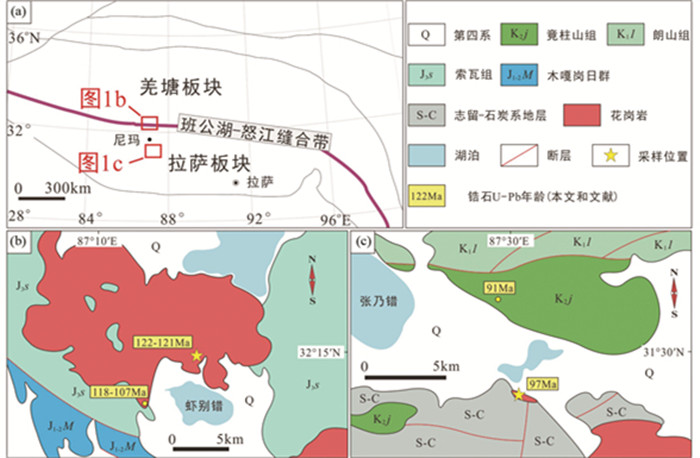
1 区域地质概况青藏高原主要位于中国西藏自治区内,地处特提斯构造域的东段。高原上分布多个近东西向的缝合带和板块。班公湖-怒江缝合带作为班公湖-怒江特提斯洋的残余,南北分割羌塘和拉萨板块(图 1a)。它西起班公湖,向东经过改则、丁青和怒江等地,并沿东南方向延伸,全长超过2000km。该缝合带主要由蛇绿岩和复理石沉积组成。蛇绿岩主体形成于侏罗纪,多数表现出与俯冲相关的SSZ型特征(史仁灯,2007;Liu et al., 2016;Wang et al., 2016)。木嘎岗日群普遍出露在缝合带内,主要由砂岩、页岩和玄武岩组成,代表了班公湖-怒江特提斯洋在中生代时期半深海-深海沉积(Fan et al., 2015;Huang et al., 2015;Zeng et al., 2016a)。前人研究表明,班公湖-怒江特提斯洋可能在二叠-侏罗纪打开,并在侏罗-白垩纪发生双向俯冲(Yin and Harrison, 2000;Zhu et al., 2011, 2016;Pan et al., 2012;Metcalfe, 2013;Cao et al., 2016;Li et al., 2016;Liu et al., 2016;Wang et al., 2016)。缝合带及其两侧广泛发育侏罗-白垩纪岩浆岩,这些岩浆活动记录了班公湖-怒江特提斯洋消减闭合以及板块碰撞的过程,是重塑古缝合带演化的重要窗口(Sui et al., 2013;Chen et al., 2014, 2015;Li et al., 2014;Wang et al., 2014, 2018, 2020;Wu et al., 2015, 2019a, b; Cao et al., 2016;Fan et al., 2016;Hao et al., 2016;Zeng et al., 2016b;Zhu et al., 2016;Hu et al., 2017;Liu et al., 2017; Yi et al., 2018)。
|
图 1 青藏高原大地构造简图(a,据Zhai et al., 2016)、虾别错地区地质简图(b)和张乃错地区地质简图(c) 引用年龄数据来自Kapp et al.(2007),Yang et al.(2018)和Wang et al.(2014) Fig. 1 Tectonic framework of the Tibet Plateau(a, modified after Zhai et al., 2016), geological sketch maps of the Xiabie Co area(b) and the Zhangnai Co area(c) |
研究区地处西藏尼玛县,大地构造位于羌塘板块南缘和拉萨板块北部(图 1b,c)。区域内未见蛇绿岩露头。北部研究区主要出露地层为中下侏罗统木嘎岗日群(J1-2M)和上侏罗统索瓦组(J3s;图 1b)。木嘎岗日群含有砂岩、灰岩以及枕状玄武岩。索瓦组主要由中薄层状灰岩组成,代表了近滨浅海环境。索瓦组与木嘎岗日群呈断层接触关系。南部研究区出露的地层有志留-石炭纪地层、下白垩统朗山组(K1l)和上白垩统竟柱山组(K2j;图 1c)。志留-石炭纪地层包括中上志留统扎弄俄玛组(S2-3z)、下泥盆统达尔东组(D1d)、中上泥盆统查果拉玛组(D2-3c)和下石炭统永珠组(C1y)。朗山组地层中发育大量生物碎屑灰岩,灰岩中可见圆笠虫化石。竟柱山组与朗山组断层接触,代表一套磨拉石沉积,由砾岩、砂岩和火山岩组成。夹层英安岩锆石U-Pb年龄为91Ma,表明竟柱山组沉积时代为晚白垩世早期(Wang et al., 2014)。同时,北部和南部研究区广泛分布中酸性侵入体,这些岩石后期侵入到古老地层中,形成时代为早白垩世到晚白垩世(Kapp et al., 2007;Wang et al., 2014;Yang et al., 2018, 2019)。
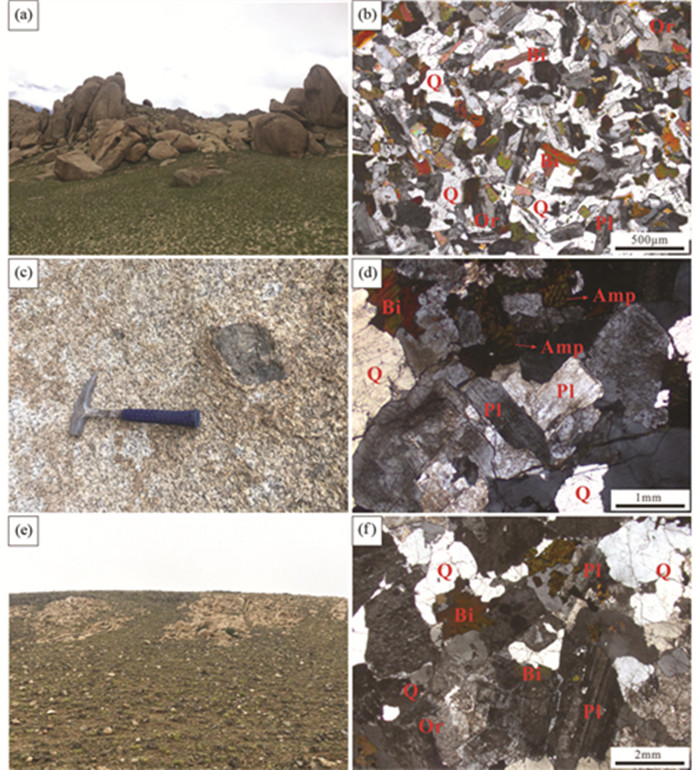
本次研究的白垩纪岩浆岩以侵入岩为主,分别出露在尼玛县北部虾别错和南部张乃错附近。虾别错岩体以花岗岩为主,侵入到上侏罗统索瓦组地层(图 1b)。岩石遭受风化剥蚀,多呈圆柱体(图 2a)。花岗岩里发育暗色包体,两者呈截然型接触(图 2c)。寄主岩石岩性为含黑云母二长花岗岩,矿物组成为黑云母(10%)、斜长石(25%)、正长石(30%)和石英(35%)。矿物粒径一般在0.1~0.5mm(图 2b)。包体野外直径10~30cm,形态各异,多呈椭圆状;岩性为石英闪长岩,含有黑云母(5%)、石英(10%)、角闪石(15%)和斜长石(70%)。矿物粒径在0.5~3mm之间(图 2d)。张乃错花岗岩侵入到志留-石炭纪地层中(图 1c),岩性为含黑云母二长花岗岩(图 2e),造岩矿物为黑云母(10%)、斜长石(25%~30%)、正长石(25%~30%)和石英(35%)。矿物粒径为0.5~3mm。镜下结果显示,所有岩石经历了不同程度的蚀变作用(绿泥石化和碳酸岩化)。
|
图 2 西藏虾别错和张乃错地区花岗岩与包体野外和显微照片 Amp-角闪石;Bi-黑云母;Or-正长石;Pl-斜长石;Q-石英 Fig. 2 Field photographs and microphotographs of the granites and enclaves in the Xiabie Co and Zhangnai Co areas, Tibet |
锆石分选在河北省区域地质调查研究所完成。锆石透、反射光照片和阴极发光图像采集在中国地质科学院地质研究所完成。锆石U-Pb定年在北京科荟测试技术有限公司完成。利用LA-ICP-MS系统对锆石开展U-Pb同位素分析,详细测试过程和仪器运行条件可参考侯可军等(2009)。激光剥蚀直径为25μm,能量为6.25J/cm2,脉冲频率为8Hz。锆石标准GJ-1作为外标进行同位素分馏校正。采用软件ICPMSDataCal 8.0进行U-Th-Pb同位素比值漂移、元素含量校正和U-Th-Pb同位素比值及年龄计算(Liu et al., 2010)。锆石U-Pb年龄谐和图绘制和加权平均年龄计算均采用Isoplot 3.0完成(Ludwig, 2003)。
2.2 锆石Lu-Hf同位素分析锆石Lu-Hf同位素测试在北京科荟测试技术有限公司完成。测试仪器为Neptune Plus多接收电感耦合等离子体质谱仪与213nm激光剥蚀系统构成的LA-MC-ICP-MS。Lu-Hf同位素分析点位与U-Pb测年点位重合或相邻。具体分析过程见Wu et al.(2006)。分析过程中采用的束斑直径为45μm,剥蚀能量为10~11J/cm2,脉冲频率为10Hz。标准锆石GJ-1作为外标,监测仪器运行稳定性。本次实验过程中获得的GJ-1标样测试值为0.282006±4(2SD, n=90),这与推荐值在误差范围内一致(Morel et al., 2008)。
2.3 全岩地球化学分析全岩主量和微量元素分析在北京科荟测试技术有限公司完成。主量元素分析采用熔片X荧光光谱法(XRF),仪器为SHIMADZU公司生产的XRF-1800型X射线荧光光谱仪。样品烧失量(LOI)的测定采用马弗炉加热烧失法。微量元素分析利用等离子体质谱仪(ICP-MS)完成。测试过程中将样品粉末烘干,称取约40mg加入HF和HNO3溶解,再密封到高压釜中,放至烘箱内190℃加热48小时。蒸干后的样品加入HNO3再次密封到高压釜中,转移至烘箱内加热烘干。冷却后,用浓HNO3充分溶解样品,并送至ICP-MS测定微量元素。分析结果误差一般小于5%。
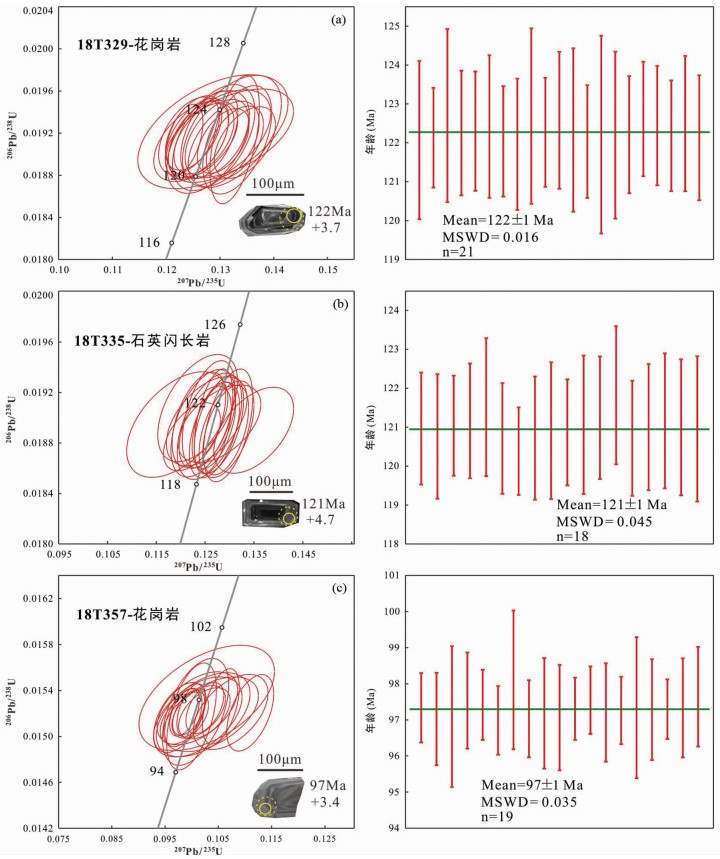
3 测试结果 3.1 锆石U-Pb年龄本次研究对3件侵入岩样品(虾别错花岗岩(18T329)及包体(18T335)和张乃错花岗岩(18T357))进行了锆石U-Pb定年,测试分析结果见图 3和表 1。在阴极发光图像里,锆石多呈长柱状、半自形-自形晶体,发育岩浆振荡环带。锆石长度在100~200μm之间,长宽比1:1~3:1(图 3)。分析结果显示,锆石中Th含量为214×10-6~4373×10-6,U含量为353×10-6~3498×10-6,Th/U比值为0.26~1.87。上述这些特征表明锆石均为典型的岩浆成因锆石(Hoskin and Schaltegger, 2003)。
|
图 3 西藏虾别错和张乃错花岗岩与包体锆石U-Pb年龄谐和图、代表性锆石阴极发光(CL)图像和加权平均年龄图 锆石CL图像里实线和虚线圆圈分别代表锆石U-Pb测年位置和Hf同位素测试位置 Fig. 3 Zircon U-Pb concordia diagrams, representative CL images, and weighted average age diagrams of the granites and enclaves in the Xiabie Co and Zhangnai Co areas, Tibet |
|
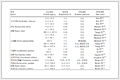
表 1 西藏虾别错和张乃错花岗岩与包体锆石U-Pb定年结果 Table 1 Zircon U-Pb age data of the granites and enclaves in the Xiabie Co and Zhangnai Co areas, Tibet |


虾别错花岗岩和包体具有相似的206Pb/238U加权平均年龄,分别为122±1Ma(18T329;n=21,MSWD=0.016)和121±1Ma(18T335; n=18, MSWD=0.045)(图 3a,b)。张乃错花岗岩样品(18T357)获得锆石206Pb/238U加权平均年龄为97±1Ma(18T357;n=19, MSWD=0.035)(图 3c)。上述结果表明这些岩体形成于早白垩世到晚白垩世(122~97Ma)。
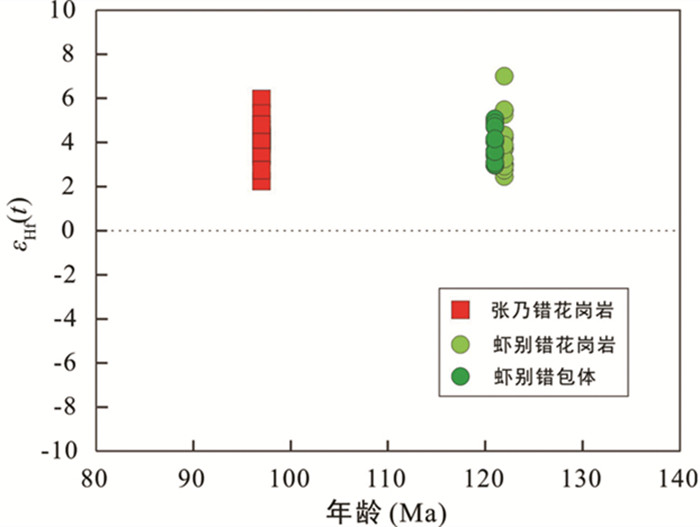
3.2 锆石Lu-Hf同位素对3件锆石样品开展Lu-Hf同位素分析,结果见表 2。虾别错花岗岩和包体具有相似的锆石Hf同位素组成。其中花岗岩锆石176Hf/177Hf比值为0.282767~0.282902,εHf(t)值为+2.4~+7.0,对应二阶段tDM2模式年龄为731~1023Ma(图 4)。包体锆石176Hf/177Hf值范围在0.282783~0.282843之间,εHf(t)值+3.0~+5.1,对应tDM2模式年龄为854~989Ma(图 4)。张乃错花岗岩锆石176Hf/177Hf比值为0.282779~ 0.282884,εHf(t)值为+2.2~+6.0,二阶段tDM2模式年龄为779~1016Ma(图 4)。
|
|
表 2 西藏虾别错和张乃错花岗岩与包体锆石Hf同位素分析结果 Table 2 Zircon Hf isotopic compositions of the granites and enclaves in the Xiabie Co and Zhangnai Co areas, Tibet |
|
图 4 西藏虾别错和张乃错花岗岩与包体锆石U-Pb年龄-εHf(t)值图解 Fig. 4 Plot of U-Pb ages vs. εHf(t) values for granites and enclaves in the Xiabie Co and Zhangnai Co areas, Tibet |
所有样品全岩地球化学测试结果见表 3。测试样品具有较低的烧失量(0.29%~ 0.91%),表明采集的样品新鲜。在下文讨论过程中,所有样品主量元素重新标准化为无烧失量百分比。
|
|
表 3 西藏虾别错和张乃错花岗岩与包体全岩主量(wt%)和微量元素(×10-6)组成 Table 3 Whole-rock major (wt%) and trace (×10-6) element compositions of the granites and enclaves in the Xiabie Co and Zhangnai Co areas, Tibet |
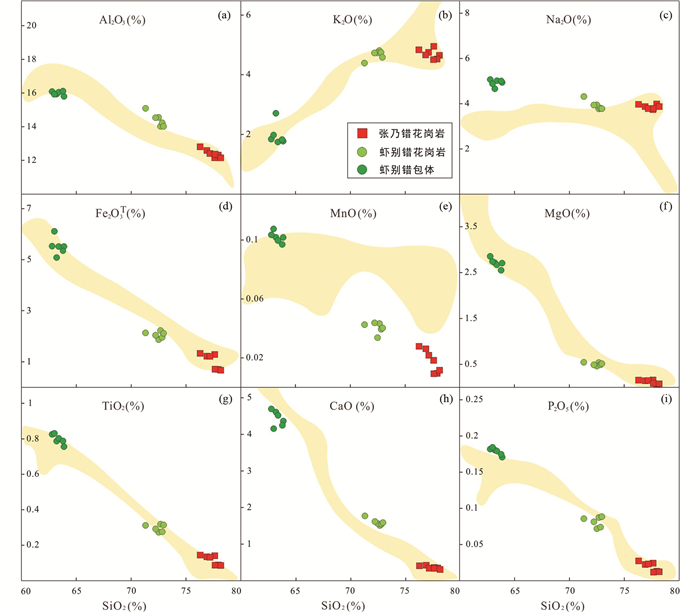
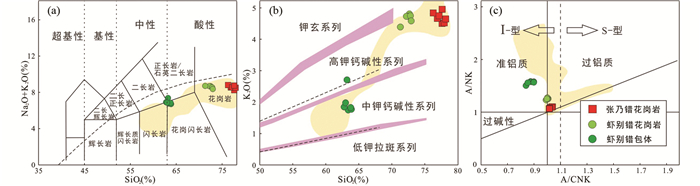
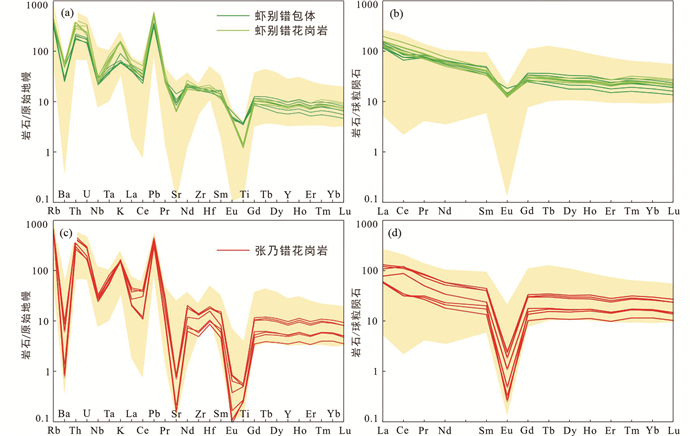
虾别错花岗岩具有较高SiO2(71.32%~72.96%)、Al2O3(14.02%~15.09%),K2O(4.39%~4.81%)和Na2O(3.77%~4.32%)以及较低CaO(1.51%~1.77%)、MgO(0.46%~0.54%)和P2O5(0.07%~0.09%)含量(图 5)。在TAS和K2O-SiO2图解里,所有样品点均落入花岗岩区域,并表现出高钾钙碱性特征(图 6a,b)。样品A/CNK值为0.99~1.01,属于准铝质到弱过铝质系列(图 6c)。原始地幔标准化蛛网图上,所有样品富集Rb、Th、U和Pb,亏损Ba、Nb、Sr和Ti等元素(图 7a)。该花岗岩相对富集轻稀土((La/Yb)N =4.59~8.26),并表现出明显的Eu负异常(Eu/Eu*=0.35~0.46)。
|
图 5 西藏虾别错和张乃错花岗岩与包体Harker图解 黄色区域代表了研究区白垩纪岩浆岩,数据引自Wang et al. (2014)和Yang et al.(2018, 2019),图 6、图 7和图 8同 Fig. 5 The Harker diagrams of the granites and enclaves in the Xiabie Co and Zhangnai Co areas, Tibet |
|
图 6 西藏虾别错和张乃错花岗岩与包体(Na2O+K2O)-SiO2(a,Le Bas et al., 1986)、K2O-SiO2(b,LeMaitre, 2002)和A/NK-A/CNK(c,Le Maitre, 1989)图解 Fig. 6 (Na2O+K2O) vs. SiO2(a, Le Bas et al., 1986), K2O vs. SiO2(b, LeMaitre, 2002), and A/NK vs. A/CNK(c, Le Maitre, 1989)diagrams of the granites and enclaves in the Xiabie Co and Zhangnai Co areas, Tibet |
|
图 7 西藏虾别错和张乃错花岗岩与包体原始地幔标准化微量元素蛛网图(a、c)和球粒陨石标准化稀土元素配分图解(b、d)(标准化值来自Sun and McDonough, 1989) Fig. 7 Primitive-normalized multi-element spider diagrams (a, c) and chondrite-normalized REE diagrams(b, d)of the granites and enclaves in the Xiabie Co and Zhangnai Co areas, Tibet(normalizing values from Sun and McDonough, 1989) |
与虾别错寄主花岗岩相比,包体样品具有较低SiO2(62.80%~63.88%)和K2O(1.75%~2.71%)含量,较高Al2O3(15.80%~16.11%)、Na2O(4.66%~5.07%)、CaO(4.16%~4.69%)、MgO(2.55%~2.85%)和P2O5(0.17%~0.18%)含量(图 5)。这些样品点落入闪长岩至花岗闪长岩区域中,表现出中钾钙碱性特征(图 6a,b)。A/CNK值(0.84~ 0.90)偏低,属于准铝质系列(图 6c)。样品的微量元素分布与寄主花岗岩相似,富集Rb、Th、U和Pb,亏损Ba、Nb、Sr和Ti等元素(图 7a)。在球粒陨石标准化稀土配分曲线图里,这些包体同样表现出轻、重稀土分异((La/Yb)N = 4.45~10.23)和Eu负异常(Eu/Eu* = 0.29~0.64;图 7b)。但值得注意的是,部分样品具有微弱Ce负异常(Ce/Ce* =0.70~0.94)。
张乃错花岗岩具有高含量SiO2(76.30%~78.18%)、Al2O3(12.15%~12.81%)、Na2O(3.73%~3.99%)、K2O(4.51%~4.95%)和CaO(4.16%~4.69%)。MgO(0.07% ~0.16%)和P2O5(0.01%~0.03%)含量普遍偏低(图 5)。张乃错花岗岩表现出高钾钙碱性特征,属于弱过铝质系列(A/CNK=1.01~1.04;图 6b,c)。在原始地幔标准化蛛网图中,样品富集Rh、Th、U和Pb,亏损Ba、Nb、Sr和Ti等元素(图 7c)。稀土配分曲线图上,Eu具有明显负异常(Eu/Eu*=0.01~0.07)。同时,一些样品也表现出Ce异常(Ce/Ce*=0.74~1.41;图 7d)。
4 讨论 4.1 区域白垩纪岩浆岩班公湖-怒江缝合带及其两侧广泛分布早-晚白垩世岩浆岩,这些岩浆岩成为探索班公湖-怒江特提斯洋演化的重要线索。本次工作在尼玛县周边获得了花岗岩形成年龄为122~97Ma,指示岩浆活动发生在早白垩世至晚白垩世时期。同期岩浆作用在研究区也有报道,如虾别错和张乃错附近出露的花岗岩体,其锆石U-Pb年龄为118~100Ma(Kapp et al., 2007;Yang et al., 2018, 2019)。这些花岗岩均属于高分异花岗岩。此外,Wang et al. (2014)在张乃错附近竟柱山组里报道了~91Ma安山岩和英安岩,这些火山岩具有高MgO (2.8%~5.9%),并表现出埃达克岩亲缘性。在研究区西侧阿索地区也出露白垩纪岩浆岩,其中包括早白垩世高镁闪长岩(128~124Ma)、A2型花岗岩(117~115Ma)和晚白垩世埃达克质花岗闪长斑岩(89~88Ma;Liu et al., 2019;Luo et al., 2019;Wang et al., 2020)。总的来说,研究区及其周缘在白垩世发育成分多样的中酸性岩浆岩,这些岩浆活动为重塑班公湖-怒江特提斯洋俯冲至闭合过程提供重要资料。
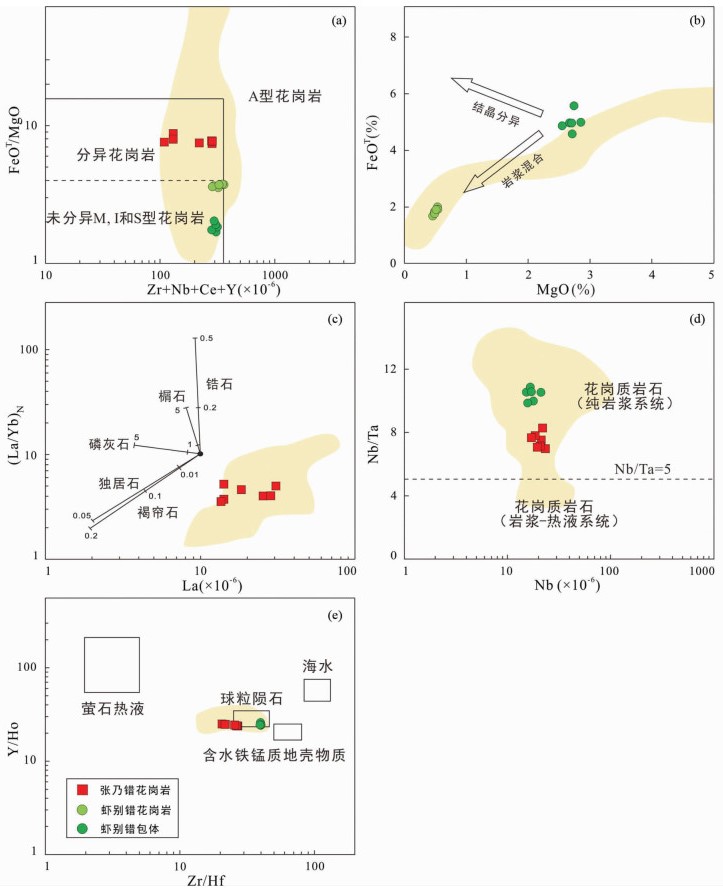
4.2 岩石成因 4.2.1 虾别错花岗岩和包体地球化学特征表明,虾别错花岗岩属于Ⅰ型花岗岩:(1)SiO2和P2O5呈负相关关系(图 5i;Wu et al., 2003);(2)较低的A/CNK值(0.99~1.01;图 6c;Chappell and White 1974);(3)低Zr和Zr+Nb+Ce+Y含量以及FeOT/MgO比值(图 8a;Whalen et al., 1987)。Ⅰ型花岗岩一般可由幔源基性岩浆结晶分异、壳源物质部分熔融或壳幔岩浆混合形成(Turner et al., 1992;Chappell, 1999;Collins and Richards, 2008;Pankhurst et al., 2013)。区域内未广泛出露基性岩浆岩,因此结晶分异成岩的可能性不大。虾别错花岗岩锆石具有正的εHf(t)值(+2.4~+7.0;图 4),暗示其可能由新生地壳部分熔融形成。同时,我们也观察到εHf(t)值变化范围较大,并且花岗岩中发育有暗色包体,这些特征表明虾别错花岗岩可能是壳幔岩浆混合作用的产物。对包体进行深入分析,诸多证据表明岩浆混合作用在花岗岩和包体形成过程中发挥了重要作用。
|
图 8 西藏虾别错和张乃错花岗岩与包体(FeOT/MgO)-(Zr+Nb+Ce+Y)(a,Whalen et al., 1987)、FeOT-MgO(b,Zorpi et al., 1991)、(La/Yb)N-La(c,Wu et al., 2003)、Nb/Ta-Nb(d,Ballouard et al., 2016)和Y/Ho-Zr/Hf(e,Bau, 1996)图解 Fig. 8 FeOT/MgO vs. Zr+Nb+Ce+Y(a, Whalen et al., 1987), FeOT vs. MgO(b, Zorpi et al., 1991), (La/Yb)N vs. La(c, Wu et al., 2003), Nb/Ta vs. Nb(d, Ballouard et al., 2016) and Y/Ho vs. Zr/Hf(e, Bau, 1996)diagrams of the granites and enclaves in the Xiabie Co and Zhangnai Co areas, Tibet |
已有研究表明花岗岩中暗色包体可来源于:(1)寄主花岗岩早期堆晶产物(Shellnutt et al., 2010);(2)花岗岩源区难以熔融的残留物(Chappell et al., 1987);(3)花岗质岩浆对围岩的捕掳体(Chappell et al., 2012);(4)幔源镁铁质岩浆加入到花岗质岩浆后混合的产物(Vernon, 1984;Perugini et al., 2003;Feeley et al., 2008)。在第一个模型里,包体通常具有堆晶结构,其矿物粒径与寄主岩相近(Didier and Barbarin, 1991)。然而虾别错石英闪长质包体不发育堆晶结构,包体矿物粒径(0.5~3mm)明显大于寄主花岗岩矿物粒径(0.1~0.5mm)。第二个模型中,包体具有变质岩或沉积岩的结构构造特征(Chappell and White, 1992)。但是虾别错包体形态一般为椭圆形,镜下矿物具有典型的岩浆岩结构,表明该包体并非源区残留物(图 2c,d)。同时,在寄主花岗岩和包体接触边界未发现烘烤现象,说明包体并不是围岩的捕掳体。所以,虾别错包体最有可能是幔源镁铁质岩浆加入到花岗质岩浆后混合的产物。包体具有较高的Mg#值(51~55)、Cr(33×10-6~43×10-6)和Ni(18×10-6~25×10-6)含量,暗示其来源于地幔。寄主花岗岩和包体造岩矿物中均含有黑云母、斜长石和石英,并且包体中出现平衡矿物石英,很可能是岩浆混合的结果。在Harker图解里两者CaO、MgO、TiO2、Al2O3、MgO和P2O5等氧化物与SiO2呈线性关系(图 5),表明寄主花岗岩和包体之间发生一定程度的混合作用(杨高学等,2009)。相似的微量元素分布以及Hf同位素特征(寄主花岗岩εHf(t)值:+2.4~+7.0;包体εHf(t)值:+3.0~+5.1)也表明寄主花岗岩和包体之间可能发生过成分交换(图 4、图 7a,b)。在FeOT-MgO图解中,两者成分显现出混合趋势(图 8b;Zorpi et al., 1991)。综合以上特征,虾别错包体可能是幔源岩浆与花岗质熔体混和的产物。因此,岩浆混合作用在虾别错寄主花岗岩和包体形成过程中扮演主要角色。
4.2.2 张乃错花岗岩张乃错花岗岩具有与虾别错寄主花岗岩相似的地球化学特征(图 5i、图 6c、图 8a),这些特征表明该花岗岩也属于Ⅰ型花岗岩。在野外勘察过程中,张乃错花岗岩附近未广泛出露基性岩体,同时花岗岩体中也不发育暗色包体。该花岗岩具有正的锆石εHf(t)值(+2.2~+6.0;图 4),应是新生地壳部分熔融的产物。与虾别错寄主花岗岩相比,张乃错花岗岩具有更高SiO2和K2O,以及更低Al2O3、MgO、MnO、TiO2、Fe2O3T、CaO和P2O5(图 5),并强烈亏损Ba、Sr和Eu(图 7c,d),表明该花岗岩体经历过强烈结晶分异(图 8a)。低Sr含量(3.2×10⁻⁶~17.2×10⁻⁶),Ba、Sr和Eu负异常显示长石发生结晶分异(图 7c,d)。SiO2与Al2O3之间的负相关性进一步表明斜长石发生分异(图 5a)。Nb、Ta和Ti的亏损可能是钛铁矿或金红石分异的结果(图 7c)。另外,Fe2O3T、TiO2与SiO2之间负线性趋势显示Fe-Ti氧化物也发生结晶分异(图 5d,g)。在原始地幔标准化微量元素蛛网图里,Zr元素出现明显亏损,副矿物锆石可能发生分异(图 7c)。在(La/Yb)N-La图解里,副矿物磷灰石也发生结晶分异(图 8c)。因此,张乃错花岗岩来源于新生地壳,并经历高度结晶分异(如斜长石、钛铁矿和磷灰石等矿物分异)。
4.2.3 稀土异常在稀土配分曲线图里,虾别错包体和张乃错花岗岩均表现出不规则的稀土元素分布特征,如Ce正负异常(Ce/Ce*=0.70~1.41;图 7b,d)。样品TE1, 3值在0.92~1.05之间,低于稀土四分组效应的标准(1.1;Irber, 1999)。对于岩浆岩里出现稀土不规则分布特征,目前有以下多个解释:(1)地表风化作用(Takahashi et al., 2002;Ma et al., 2007);(2)流体与熔体相互作用(Bau, 1996;Irber, 1999;Zhao et al., 2002;Veksler et al., 2005);(3)副矿物结晶分异(Zhao and Cooper, 1993;Pan and Breaks, 1997);和(4)继承原岩的稀土异常(Neal and Taylor, 1989;Shimizu et al., 1992;Shao et al., 2015;Bellot et al., 2018)。研究的样品均具有较低的烧失量(0.29%~0.91%),未经历明显的风化作用。一般高度演化的岩石会受热液蚀变而出现稀土异常,这些异常归因于岩浆熔体与热液相互作用(Zhao et al., 2002)。此时,高演化的岩浆熔体Nb/Ta值一般小于5(Ballouard et al., 2016),并具有明显偏离球粒陨石的Y/Ho和Zr/Hf比值(Bau, 1996)。虾别错包体和张乃错花岗岩样品Nb/Ta值在7~11之间(图 8d)。Y/Ho和Zr/Hf比值分别为24~26和21~40,样品均落入球粒陨石区域及附近(图 8e)。以上特征说明虾别错包体和张乃错花岗岩形成于纯熔体系统,不存在热液和熔体相互作用的过程。高分异花岗岩稀土元素分布由副矿物主导(吴福元等,2007),副矿物结晶分异可能会导致稀土异常。然而,Rayleigh分异模型表明副矿物的结晶分异过程会导致出现不合理的矿物组分含量,并且模型结果并未获得与之相对应的稀土异常(Bau, 1996;Irber, 1999)。此外,虾别错包体不属于高分异花岗岩(图 8a),但其也表现出稀土异常特征。因此,我们认为研究样品的稀土异常现象可能与副矿物结晶分异过程无关。已有研究显示一些物源(如风化古土壤和海相沉积物)具有不规则的REE分布特征,这些物质加入到源区参与岩浆作用会使形成的岩浆岩具有类似的REE分布((Hole et al., 1984;Neal and Taylor, 1989;Bellot et al., 2018;Yang et al., 2018)。古土壤和海相沉积物均具有明显的Ce正负异常,该特征在虾别错包体和张乃错花岗岩中也同样存在。研究样品虽具有正的εHf(t)值(+2.4~+7.0),但其部分二阶段模式年龄相对较老(可至1016Ma)。因此,我们认为研究样品源区可能混入这些古老循环物质并继承了它们的稀土特征。
4.3 构造背景班公湖-怒江缝合带及其两侧发育白垩纪岩浆岩,该期岩浆作用与班公湖-怒江特提斯洋南-北双向俯冲和之后拉萨-羌塘板块碰撞有关(Zhu et al., 2016)。然而,班公湖-怒江特提斯洋在早白垩世时期是否完全闭合依旧处于争论中。部分学者认为班公湖-怒江特提斯洋在早白垩世时期尚未完全闭合,现有资料证据如早白垩世蛇绿岩(~132Ma洞错蛇绿岩;鲍佩声等,2007)、洋岛(~116Ma仲岗洋岛和~108Ma塔仁本洋岛;朱弟成等,2006;Fan et al., 2014)、半深海-深海沉积(~118Ma扎嘎组;Fan et al., 2015)和俯冲相关的岩浆作用(Wang et al., 2020)。另外学者根据区域地层接触关系、海相到陆相的沉积转变以及碰撞背景深熔的花岗岩等认为班公湖-怒江特提斯洋在晚侏罗-早白垩世时期发生闭合,羌塘和拉萨板块发生碰撞(汪明州和董得源,1984;Dewey et al., 1988;Yin and Harrison, 2000;Kapp et al., 2007;Ma et al., 2017)。
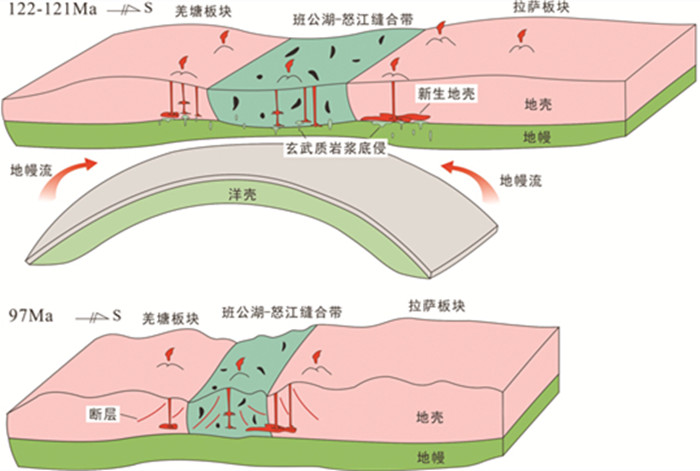
虾别错早白垩世花岗岩(~122Ma)大地构造位于羌塘板块南缘,可能形成于班公湖-怒江特提斯洋北向俯冲或闭合背景。花岗岩中出现暗色包体,表明幔源物质在成岩过程中作出重要贡献。已有研究成果显示,班公湖-怒江缝合带及其附近早白垩世岩浆岩普遍具有正的εHf(t)值,并且部分岩石中也发育暗色包体(Zhu et al., 2009, 2011;Hao et al., 2016)。这些岩浆活动被解释为是由幔源岩浆底侵作用导致的。同时,尼玛地区沉积地层由海相过渡到非海相发生在125~118Ma,表明此时班公湖-怒江特提斯洋经历闭合的过程(Kapp et al., 2007)。在邻区阿索,俯冲背景下形成的高镁闪长岩(128~124Ma)和拉萨-羌塘板块碰撞背景下形成的A2型花岗岩(117~115Ma)也限定了班公湖-怒江特提斯洋的闭合时间为124 ~117Ma(Wang et al., 2020)。因此,我们认为虾别错早白垩世花岗岩(~122Ma)应形成于大洋闭合的过程(图 9)。由于洋壳密度较大而发生下沉,最终引发地幔流和幔源基性岩浆的底侵(Zhu et al., 2016)。
|
图 9 西藏尼玛地区白垩纪岩浆岩(122~97Ma)地球动力学背景示意图 Fig. 9 Schematic illustrations showing the geodynamic settings of the Cretaceous magmatic rocks (122~97Ma) in the Nyima area, Tibet |
张乃错晚白垩世花岗岩(~97Ma)地处拉萨地块北部,其形成应与班公湖-怒江特提斯洋南向俯冲或拉萨-羌塘板块碰撞相关。如前文所述,在早白垩世晚期,班公湖-怒江特提斯洋已经发生闭合,拉萨和羌塘板块发生碰撞。研究区分布的晚白垩世陆相磨拉石沉积(竟柱山组)也表明该时期大洋已经闭合,区域进入陆内演化阶段(Pan et al., 2012;Wang et al., 2014;Wu et al., 2019b)。持续的碰撞挤压可导致地壳增厚并发生局部熔融(Chen et al., 2015;Sun et al., 2015)。该认识得到了研究区及邻区晚白垩世岩浆活动的响应,如新生地壳发生部分熔融形成了~97Ma张乃错花岗岩和增厚地壳来源的~90Ma埃达克岩(图 9;Wang et al., 2014;Liu et al., 2019;Luo et al., 2019)。
本文研究的花岗质岩浆岩约束了白垩纪时期班公湖-怒江缝合带的演化过程。在早白垩世中晚期,南-北向俯冲的班公湖-怒江特提斯洋发生闭合,此时洋壳岩石圈下沉引发幔源基性岩浆底侵。底侵作用不仅提供了充足的热量,也让幔源物质加入到岩浆房中参与成岩过程,导致虾别错花岗岩(~122Ma)发育暗色包体并具有较亏损的锆石Hf同位素组成。在晚白垩世早期,随着洋盆闭合以及拉萨-羌塘板块的持续碰撞,地壳逐渐增厚。岩浆活动以地壳部分熔融为主,形成张乃错花岗岩(~97Ma)和伴生的埃达克岩。因此,区域上122~97Ma岩浆活动是班公湖-怒江缝合带从洋盆闭合到南北两侧板块挤压碰撞的响应。
5 结论(1) 尼玛地区虾别错花岗岩和包体形成于早白垩世(122~121Ma),张乃错花岗岩形成于晚白垩世(97Ma)。
(2) 虾别错花岗岩和包体是壳幔物质混合作用的产物,形成于班公湖-怒江特提斯洋闭合过程;张乃错花岗岩来源于新生地壳,后期经历高度结晶分异作用,形成于洋盆闭合后拉萨与羌塘板块碰撞过程。
(3) 班公湖-怒江特提斯洋在早白垩世时期发生闭合。尼玛白垩纪岩浆作用记录了缝合带从洋盆闭合到拉萨-羌塘板块挤压碰撞的演变过程。
致谢 感谢项目组成员在野外和室内实验工作中给予了无私帮助;两位审稿人详细审阅了本文并提出宝贵的修改意见,在此表示感谢。
Ballouard C, Poujol M, Boulvais P, Branquet Y, Tartèse R and Vigneresse JL. 2016. Nb-Ta fractionation in peraluminous granites: A marker of the magmatic-hydrothermal transition. Geology, 44(3): 231-234 DOI:10.1130/G37475.1
|
Bao PS, Xiao XC, Su L and Wang J. 2007. Petrological, geochemical and chronological constraints for the tectonic setting of the Dongco ophiolite in Tibet. Science in China (Series D), 37(3): 298-307 (in Chinese)
|
Bau M. 1996. Controls on the fractionation of isovalent trace elements in magmatic andaqueous systems: Evidence from Y/Ho, Zr/Hf, and lanthanide tetrad effect. Contributions to Mineralogy and Petrology, 123(3): 323-333 DOI:10.1007/s004100050159
|
Bellot N, Boyet M, Doucelance R, Bonnand P, Savov IP, Plank T and Elliott T. 2018. Origin of negative cerium anomalies in subduction-related volcanic samples: Constraints from Ce and Nd isotopes. Chemical Geology, 500: 46-63 DOI:10.1016/j.chemgeo.2018.09.006
|
Cao MJ, Qin KZ, Li GM, Li JX, ZhaoJX, Evans NJ and Hollings P. 2016. Tectono-magmatic evolution of Late Jurassic to Early Cretaceous granitoids in the west-central Lhasa subterrane, Tibet. Gondwana Research, 39: 386-400 DOI:10.1016/j.gr.2016.01.006
|
Chappell BW and White AJK. 1974. Two contrasting granite types. Pacific Geology, 8: 173-174
|
Chappell BW, White AJR and Wyborn D. 1987. The importance of residual source material (restite) in granite petrogenesis. Journal of Petrology, 28(6): 1111-1138 DOI:10.1093/petrology/28.6.1111
|
Chappell BW and White AJR. 1992. I-and S-type granites in the Lachlan Fold Belt. Earth and Environmental Science Transactions of the Royal Society of Edinburgh, 83(1-2): 1-26 DOI:10.1017/S0263593300007720
|
Chappell BW. 1999. Aluminium saturation in I- and S-type granites and the characterization of fractionated haplo-granites. Lithos, 46(3): 535-551 DOI:10.1016/S0024-4937(98)00086-3
|
Chappell BW, Bryant CJ and Wyborn D. 2012. Peraluminous I-type granites. Lithos, 153: 142-153 DOI:10.1016/j.lithos.2012.07.008
|
Chen JL, Xu JF, Yu HX, Wang BD, Wu JB and Feng YX. 2015. Late Cretaceous high-Mg# granitoids in southernTibet: Implications for the early crustal thickening and tectonic evolution of the Tibetan Plateau?. Lithos, 232: 12-22 DOI:10.1016/j.lithos.2015.06.020
|
Chen Y, Zhu DC, Zhao ZD, Meng FY, Wang Q, Santosh M, Wang LQ, Dong GC and Mo XX. 2014. Slab breakoff triggered ca. 113Ma magmatism around Xainza area of the Lhasa Terrane, Tibet. Gondwana Research, 26(2): 449-463
|
Collins WJ and Richards SW. 2008. Geodynamic significance of S-type granites in circum-Pacific orogens. Geology, 36(7): 559-562 DOI:10.1130/G24658A.1
|
Dewey JF, Shackleton RM, Chang CF and Sun YY. 1988. The tectonic evolution of the Tibetan Plateau. Philosophical Transactions of the Royal Society A Mathematical Physical and Engineering Sciences, 327(1594): 379-413
|
Didier J and Barbarin B. 1991. Enclaves and Granite Petrology. Development in Petrology. Amsterdam, Netherlands: Elsevier Science Publishers
|
Fan JJ, Li C, Xie CM and Wang M. 2014. Petrology, geochemistry, and geochronology of the Zhonggang ocean island, northern Tibet: Implications for the evolution of the Banggongco-Nujiang oceanic arm of the Neo-Tethys. International Geology Review, 56(12): 1504-1520 DOI:10.1080/00206814.2014.947639
|
Fan JJ, Li C, Liu YM and Xu JX. 2015. Age and nature of the Late Early Cretaceous Zhaga Formation, northern Tibet: Constraints on when the Bangong-Nujiang Neo-Tethys ocean closed. International Geology Review, 57(3): 342-353 DOI:10.1080/00206814.2015.1006695
|
Fan JJ, Li C, Wu H, Zhang TY, Wang M, Chen JW and Xu JX. 2016. Late Jurassica dakitic granodiorite in the Dong Co area, northern Tibet: Implications for subduction of the Bangong-Nujiang oceanic lithosphere and related accretion ofthe Southern Qiangtang Terrane. Tectonophysics, 691: 345-361 DOI:10.1016/j.tecto.2016.10.026
|
Fan JJ, Li C, Wang M and Xie CM. 2018. Reconstructing in space and time the closure of the middle and western segments of the Bangong-Nujiang Tethyan Ocean in the Tibetan Plateau. International Journal of Earth Science, 107(1): 231-249 DOI:10.1007/s00531-017-1487-4
|
Feeley TC, Wilson LF and Underwood SJ. 2008. Distribution and compositions of magmatic inclusions in the Mount Helen dome, Lassen Volcanic Center, California: Insights into magma chamber processes. Lithos, 106(1-2): 173-189 DOI:10.1016/j.lithos.2008.07.010
|
Hao LL, Wang Q, Wyman DA, Ou Q, Dan W, Jiang ZQ, Wu FY, Yang JH, Long XP and Li J. 2016. Underplating of basaltic magmas and crustal growth in a continental arc: Evidence from Late Mesozoic intermediate-felsic intrusive rocks in southern Qiangtang, central Tibet. Lithos, 245: 223-242 DOI:10.1016/j.lithos.2015.09.015
|
Hole MJ, Saunders AD, Marriner GF and Tarney J. 1984. Subduction of pelagic sediments: Implications for the origin of Ce-anomalous basalts from the Mariana Islands. Journal of Geological Society, 141: 453-472 DOI:10.1144/gsjgs.141.3.0453
|
Hoskin PWO and Schaltegger U. 2003. The composition of zircon and igneous and metamorphic petrogenesis. Reviews in Mineralogy and Geochemistry, 53(1): 27-62 DOI:10.2113/0530027
|
Hou KJ, Li YH and Tian YY. 2009. In situ U-Pb zircon dating using laser ablation-multi-ion couting-ICP-MS. Mineral Deposits, 28: 481-492 (in Chinese with English abstract)
|
Hu PY, Zhai QG, Jahn BM, Wang J, Li C, Chung SL, Lee HY and Tang SH. 2017. Late Early Cretaceous magmatic rocks (118~113Ma) in the middle segment of the Bangong-Nujiang suture zone, Tibetan Plateau: Evidence of lithospheric delamination. Gondwana Research, 44: 116-138 DOI:10.1016/j.gr.2016.12.005
|
Huang QS, Shi RD, O'Reilly SY, Griffin WL, Zhang M, Liu DL and Zhang XR. 2015. Re-Os isotopic constraints on the evolution of the Bangong-Nujiang Tethyan oceanic mantle, Central Tibet. Lithos, 224-225: 32-45 DOI:10.1016/j.lithos.2015.02.023
|
Irber W. 1999. The lanthanide tetrad effect and its correlation with K/Rb, Eu/Eu*, Sr/Eu, Y/Ho, and Zr/Hf of evolving peraluminous granite suites. Geochimica et Cosmochimica Acta, 63(3-4): 489-508 DOI:10.1016/S0016-7037(99)00027-7
|
Kapp P, De Celles PG, Gehrels GE, Heizier M and Ding L. 2007. Geological records of the Lhasa-Qiangtang and Indo-Asian collisions in the Nima area of central Tibet. Geological Society of America Bulletin, 119(7): 917-932
|
Le Bas MJ, Le Maitre RW, Streckeisen A and Zanettin B. 1986. A chemical classification of volcanic rocks based on the total alkali-silica diagram. Journal of Petrology, 27(3): 745-750 DOI:10.1093/petrology/27.3.745
|
Le Maitre RW. 1989. A Classification of Igneous Rocks and Glossary Terms. 2nd Edition. , Oxford: Blackwell Scientific Publications, 1-193
|
Le Maitre RW. 2002. Igneous Rocks: A Classification and Glossary of Terms: Recommendations of the International Union of Geological Sciences Subcommission on the Systematics of Igneous Rocks.
|
Li SM, Zhu DC, Wang Q, Zhao ZD, Sui QL, Liu SA, Liu D and Mo XX. 2014. Northward subduction of Bangong-Nujiang Tethys: Insight from Late Jurassic intrusive rocks from Bangong Tso in western Tibet. Lithos, 205: 284-297 DOI:10.1016/j.lithos.2014.07.010
|
Li YL, He J, Han ZP, Wang CS, Ma PF, Zhou A, Liu SA and Xu M. 2016. Late Jurassic sodium-rich adakitic intrusive rocks in the southern Qiangtang terrane, central Tibet, and their implications for the Bangong-Nujiang Ocean subduction. Lithos, 245: 34-46 DOI:10.1016/j.lithos.2015.10.014
|
Liu DL, Shi RD, Ding L, Huang QS, Zhang XR, Yue YH and Zhang LY. 2017. Zircon U-Pb age and Hf isotopic compositions of Mesozoic granitoids in southern Qiangtang, Tibet: Implications for the subduction of the Bangong-Nujiang Tethyan Ocean. Gondwana Research, 41: 157-172 DOI:10.1016/j.gr.2015.04.007
|
Liu T, Zhai QG, Wang J, Bao PS, Qiangba ZX, Tang SH and Tang Y. 2016. Tectonic significance of the Dongqiao ophiolite in the north-central Tibetan plateau: Evidence from zircon dating, petrological, geochemical and Sr-Nd-Hf isotopic characterization. Journal of Asian Earth Science, 116: 139-154 DOI:10.1016/j.jseaes.2015.11.014
|
Liu YM, Wang M, Li C, Li SZ, Xie CM, Zeng XW, Dong YC and Liu JH. 2019. Late Cretaceous tectono-magmatic activity in the Nize region, central Tibet: Evidence for lithospheric delamination beneath the Qiangtang-Lhasa collision zone. International Geology Review, 61(5): 562-583 DOI:10.1080/00206814.2018.1437789
|
Liu YS, Gao S, Hu ZC, Gao CG, Zong KQ and Wang DB. 2010. Continental and oceanic crust recycling-induced melt-peridotite interactions in the Trans-North China Orogen: U-Pb dating, Hf isotopes and trace elements in zircons from mantle xenoliths. Journal of Petrology, 51(1-2): 537-571 DOI:10.1093/petrology/egp082
|
Ludwig KR. 2003. User's Manual for Isoplot 3.00: A Geochronological Toolkit for Microsoft Excel. Berkeley: Berkeley Geochronology Center
|
Luo AB, Wang M, Li C, Xie CM, Fan JJ, Zhang TY, Liu JH and Wang W. 2019. Petrogenesis of early Late Cretaceous Asa-intrusive rocks in central Tibet, western China: Post-collisional partial melting of thickened lower crust. International Journal of Earth Sciences, 108(6): 1979-1999 DOI:10.1007/s00531-019-01744-4
|
Ma AL, Hu XM, Garzanti E, Han Z and Lai W. 2017. Sedimentary and tectonic evolution of the southern Qiangtang basin: Implications for the Lhasa-Qiangtang collision timing. Journal of Geophysical Research: Solid Earth, 122(7): 4790-4813 DOI:10.1002/2017JB014211
|
Ma JL, Wei GJ, Xu YG, Long WG and Sun WD. 2007. Mobilization and re-distribution of major and trace elements during extreme weathering of basalt in Hainan Island, South China. Geochimica et Cosmochimica Acta, 71(13): 3223-3237 DOI:10.1016/j.gca.2007.03.035
|
Metcalfe I. 2013. Gondwana dispersion and Asian accretion: Tectonic and palaeogeographic evolution of eastern Tethys. Journal of Asian Earth Sciences, 66: 1-33 DOI:10.1016/j.jseaes.2012.12.020
|
Morel MLA, Nebel O, Nebel-Jacobsen YJ, Miller JS and Vroon PZ. 2008. Hafnium isotope characterization of the GJ-1 zircon reference material by solution and laser-ablation MC-ICPMS. Chemical Geology, 255(1-2): 231-235 DOI:10.1016/j.chemgeo.2008.06.040
|
Neal CR and Taylor LA. 1989. A negative Ce anomaly in a peridotite xenolith: Evidence for crustal recycling into the mantle or mantle metasomatism?. Geochimica et Cosmochimica Acta, 53(5): 1035-1040 DOI:10.1016/0016-7037(89)90208-1
|
Pan GT, Wang LQ, Li RS, Yuan SH, Ji WH, Yin FG, Zhang WP and Wang BD. 2012. Tectonic evolution of the Qinghai-Tibet Plateau. Journal of Asian Earth Sciences, 53: 3-14 DOI:10.1016/j.jseaes.2011.12.018
|
Pan YM and Breaks FW. 1997. Rare-earth elements in fluorapatite, separation Lakearea, Ontario: Evidence for S-type granite-rare element pegmatite linkage. The Canadian Mineralogist, 35(3): 659-671
|
Pankhurst MJ, Schaefer BF, Turner SP, Argles T and Wade CE. 2013. The source of A-type magmas in two contrasting settings: U-Pb, Lu-Hf and Re-Os isotopic constraints. Chemical Geology, 351: 175-194 DOI:10.1016/j.chemgeo.2013.05.010
|
Perugini D, Poli G, Christofides G and Eleftheriadis G. 2003. Magma mixing in the Sithonia Plutonic Complex, Greece: Evidence from mafic microgranular enclaves. Mineralogy and Petrology, 78(3-4): 173-200 DOI:10.1007/s00710-002-0225-0
|
Shao FL, Niu YL, Regelous M and Zhu DC. 2015. Petrogenesis of peralkaline rhyolites in an intra-plate setting: Glass House Mountains, southeast Queensland, Australia. Lithos, 216-217: 196-210 DOI:10.1016/j.lithos.2014.12.015
|
Shellnutt JG, Jahn BM and Dostal J. 2010. Elemental and Sr-Nd isotope geochemistry of micro-granular enclaves from peralkaline A-type granitic plutons of the Emeishan large igneous province, SW China. Lithos, 199(1-2): 34-36
|
Shi RD. 2007. SHRIMP dating of the Bangong Lake SSZ-type ophiolite: Constraints on the closure time of ocean in the Bangong Lake-Nujiang River, northwestern Tibet. Chinese Science Bulletin, 52(2): 223-227 (in Chinese) DOI:10.1360/csb2007-52-2-223
|
Shimizu H, Sawatari H, Kawata Y, Dunkley PN and Masuda A. 1992. Ce and Nd isotope geochemistry on island arc volcanic rocks with negative Ce anomaly: Existence of sources with concave REE patterns in the mantle beneath the Solomon and Bonin island arcs. Contributions to Mineralogy and Petrology, 110(2-3): 242-252 DOI:10.1007/BF00310741
|
Sui QL, Wang Q, Zhu DC, Zhao ZD, Chen Y, Santosh M, Hu ZC, Yuan HL and Mo XX. 2013. Compositional diversity of ca. 110Ma magmatism in the northern Lhasa Terrane, Tibet: Implications for the magmatic origin and crustal growth in a continent-continent collision zone. Lithos, 168-169: 144-159
|
Sun GY, Hu XM, Zhu DC, Hong WT, Wang JG and Wang Q. 2015. Thickened juvenile lower crust-derived ~90Ma adakitic rocks in the central Lhasa terrane, Tibet. Lithos, 224-225: 225-239 DOI:10.1016/j.lithos.2015.03.010
|
Sun SS and McDonough WS. 1989. Chemical and isotopic systematics of oceanic basalts: Implications for mantle composition and processes. In: Saunders AD and Norry MJ (eds.). Magmatism in the Ocean Basins. Geological Society, London, Special Publications, 42(1): 313-345 DOI:10.1144/GSL.SP.1989.042.01.19
|
Takahashi Y, Yoshida H, Sato N, Hama K, Yusa Y and Shimizu H. 2002. W-and M-type tetrad effects in REE patterns for water-rock systems in the Tono uranium deposit, central Japan. Chemical Geology, 184(3-4): 311-335 DOI:10.1016/S0009-2541(01)00388-6
|
Turner SP, Foden JD and Morrison RS. 1992. Derivation of some A-type magmas by fractionation of basaltic magma: An example from the Padthaway Ridge, South Australia. Lithos, 28(2): 151-179 DOI:10.1016/0024-4937(92)90029-X
|
Veksler IV, Dorfman AM, Kamenetsky M, Dulski P and Dingwell DB. 2005. Partitioning of lanthanides and Y between immiscible silicate and fluoridemelts, fluorite and cryolite and the origin of the lanthanide tetrad effect in igneous rocks. Geochimica et Cosmochimica Acta, 69(11): 2847-2868 DOI:10.1016/j.gca.2004.08.007
|
Vernon Rh. 1984. Microgranitoid enclaves in granites: Globules of hybrid magma quenched in a plutonic environment. Nature, 309(5967): 438-439 DOI:10.1038/309438a0
|
Wang BD, Wang LQ, Chung SL, Che JL, Yin FG, Liu H, Li XB and Chen LK. 2016. Evolution of the Bangong-Nujiang Tethyan Ocean: Insights from the geochronology and geochemistry of mafic rocks within ophiolites. Lithos, 245: 18-33 DOI:10.1016/j.lithos.2015.07.016
|
Wang MZ and Dong DY. 1984. Stromatoporoids from the Dongqiao Formation (Upper Jurassic-Lower Cretaceous) in northern Xizang (Tibet). Acta Palaeontologica Sinica, 23(3): 343-349 (in Chinese with English abstract)
|
Wang Q, Zhu DC, Zhao ZD, Liu SA, Chung SL, Li SM, Liu D, Dai JG, Wang LQ and Mo XX. 2014. Origin of the ca. 90Ma magnesia-rich volcanic rocks in SE Nyima, Central Tibet: Products of lithospheric delamination beneath the Lhasa-Qiangtang collision zone. Lithos, 198-199: 24-37
|
Wang W, Wang M, Li C, Fan JJ, Xu W and Dong YC. 2018. Early Cretaceous K-rich rhyolites from the Duolong Cu-Au deposit, southern Qiangtang, China: Evidence for crustal growth. International Geology Review, 60(9): 1098-1115 DOI:10.1080/00206814.2017.1365632
|
Wang W, Wang M, Zhai QG, Xie CM, Hu PY, Li C, Liu JH and Luo AB. 2020. Transition from oceanic subduction to continental collision recorded in the Bangong-Nujiang suture zone: Insights from Early Cretaceous magmatic rocks in the north-central Tibet. Gondwana Research, 78: 77-91 DOI:10.1016/j.gr.2019.09.008
|
Whalen JB, Currie KL and Chappell BW. 1987. A-type granites: Geochemical characteristics, discrimination and petrogenesis. Contributions to Mineralogy and Petrology, 95(4): 407-419 DOI:10.1007/BF00402202
|
Wu FY, Jahn BM, Wilde SA, Lo CH, Yui TF, Lin Q, Ge WC and Sun DY. 2003. Highly fractionated I-type granites in NE China (Ⅰ): Geochronology and petrogenesis. Lithos, 66(3-4): 241-273 DOI:10.1016/S0024-4937(02)00222-0
|
Wu FY, Yang YH, Xie LW, Yang JH and Xu P. 2006. Hf isotopic compositions of the standard zircons and baddeleyites used in U-Pb geochronology. Chemical Geology, 234(1-2): 105-126 DOI:10.1016/j.chemgeo.2006.05.003
|
Wu FY, Li XH, Yang JH and Zheng YF. 2007. Discussions on the petrogenesis of granites. Acta Petrologica Sinica, 23(6): 1217-1238 (in Chinese with English abstract)
|
Wu H, Li C, Xu MJ and Li XK. 2015. Early Cretaceous adakitic magmatism in the Dachagou area, northern Lhasa terrane, Tibet: Implications for slab roll-back and subsequent slab break-off of the lithosphere of the Bangong-Nujiang Ocean. Journal of Asian Earth Sciences, 97: 51-66 DOI:10.1016/j.jseaes.2014.10.014
|
Wu H, Sun SL, Liu HY, Chu H and Ding W. 2019a. An Early Cretaceous slab window beneath central Tibet, SW China: Evidence from OIB-like alkaline gabbros in the Duolong area. Terra Nova, 31(1): 67-75
|
Wu H, Chen JW, Wang Q and Yu YP. 2019b. Spatial and temporal variations in the geochemistry of Cretaceous high-Sr/Y rocks in Central Tibet. American Journal of Science, 319(2): 105-121 DOI:10.2475/02.2019.02
|
Yang GX, Li YJ, Wu HE, Si GH, Jin Z and Zhang YZ. 2009. LA-ICP-MS zircon U-Pb dating of the Huangyangshan pluton and its enclaves from Kalamaili area eastern Junggar, Xinjiang, and geological implications. Acta Petrologica Sinica, 25(12): 3197-3207 (in Chinese with English abstract)
|
Yang ZY, Wang Q, Zhang CF, Dan W, Zhang XZ, Qi Y, Xia XP and Zhao ZH. 2018. Rare earth element tetrad effect and negative Ce anomalies of the granite porphyries in southern Qiangtang Terrane, central Tibet: New insights into the genesis of highly evolved granites. Lithos, 312-313: 258-273 DOI:10.1016/j.lithos.2018.04.018
|
Yang ZY, Wang Q, Zhang CF, Yang JH, Ma L, Wang J, Sun P and Qi Y. 2019. Cretaceous (~100Ma) high-silica granites in the Gajin area, Central Tibet: Petrogenesis and implications for collision between the Lhasa and Qiangtang terranes. Lithos, 324-325: 402-417 DOI:10.1016/j.lithos.2018.11.011
|
Yi JK, Wang Q, Zhu DC, Li SM, Liu SA, Wang R, Zhang LL and Zhao ZD. 2018. Westward-Younging high-Mg adakitic magmatism in central Tibet: Record of a westward-migrating lithospheric foundering beneath the Lhasa-Qiangtang collision zone during the Late Cretaceous. Lithos, 316-317: 92-103 DOI:10.1016/j.lithos.2018.07.001
|
Yin A and Harrison TM. 2000. Geologic evolution of the Himalayan-Tibetan orogeny. Annual Review of Earth and Planetary Sciences, 28: 211-280 DOI:10.1146/annurev.earth.28.1.211
|
Yin JX, Xu JT, Liu CJ and Li H. 1988. The Tibetan Plateau: Regional stratigraphic context and previous work. Philosophical Transactions of the Royal Society of London. Series A, Mathematical and Physical Sciences, 327(1594): 5-52 DOI:10.1098/rsta.1988.0121
|
Zeng M, Zhang X, Cao H, Ettensohn FR, Cheng WB and Lang XH. 2016a. Late Triassic initial subduction of the Bangong-Nujiang Ocean beneath Qiangtang revealed: Stratigraphic and geochronological evidence from Gaize, Tibet. Basin Research, 28(1): 147-157 DOI:10.1111/bre.12105
|
Zeng YC, Chen JL, Xu JF, Wang BD and Huang F. 2016b. Sediment melting during subduction initiation: Geochronological and geochemical evidence from the Darutso high-Mg andesites within ophiolite melange, central Tibet. Geochemistry, Geophysics, Geosystems, 17(12): 4859-4877 DOI:10.1002/2016GC006456
|
Zhai QG, Jahn BM, Wang J, Hu PY, Chung SL, Lee HY, Tang SH and Tang Y. 2016. Oldest Paleo-Tethyan ophiolitic mélange in the Tibetan Plateau. Geological Society of America Bulletin, 128(3-4): 355-373 DOI:10.1130/B31296.1
|
Zhao JX and Cooper JA. 1993. Fractionation of monazite in the development of V-shaped REE patterns in leucogranite systems: Evidence from a muscovite leucogranite body in central Australia. Lithos, 30(1): 23-32 DOI:10.1016/0024-4937(93)90003-U
|
Zhao ZH, Xiong XL, Han XD, Wang YX, Wang Q, Bao ZW and Jahn BM. 2002. Controls on the REE tetrad effect in granites: Evidence from the Qianlishan and Baerzhe granites, China. Geochemical Journal, 36(6): 527-543 DOI:10.2343/geochemj.36.527
|
Zhu DC, Pan GT, Mo XX, Wang LQ, Zhao ZD, Liao ZL, Geng QR and Dong GC. 2006. Identification for the Mesozoic OIB-type basalts in central Qinghai-Tibetan Plateau: geochronology, geochemistry and their tectonic setting. Acta Geologica Sinica, 80(9): 1312-1328 (in Chinese with English abstract)
|
Zhu DC, Mo XX, Niu YL, Zhao ZD, Wang LQ, Liu YS and Wu FY. 2009. Geochemical investigation of Early Cretaceous igneous rocks along an east-west traverse throughout the central Lhasa terrane, Tibet. Chemical Geology, 268(3-4): 298-312 DOI:10.1016/j.chemgeo.2009.09.008
|
Zhu DC, Zhao ZD, Niu YL, Mo XX, Chung SL, Hou ZQ, Wang LQ and Wu FY. 2011. The Lhasa terrane: Record of a micro-continent and its histories of drift and growth. Earth and Planetary Science Letters, 301(1-2): 241-255 DOI:10.1016/j.epsl.2010.11.005
|
Zhu DC, Li SM, Cawood PA, Wang Q, Zhao ZD, Liu SA and Wang LQ. 2016. Assembly of the Lhasa and Qiangtang terranes in central Tibet by divergent double subduction. Lithos, 245: 7-17 DOI:10.1016/j.lithos.2015.06.023
|
Zorpi MJ, Coulon C and Orsini JB. 1991. Hybridization between felsic and mafic magmas incalc-alkaline granitoids: A case study in northern Sardinia, Italy. Chemical Geology, 92(1-3): 45-86 DOI:10.1016/0009-2541(91)90049-W
|
鲍佩声, 肖序常, 苏犁, 王军. 2007. 西藏洞错蛇绿岩的构造环境: 岩石学、地球化学和年代学制约. 中国科学(D辑), 37(3): 298-307. |
侯可军, 李延河, 田有荣. 2009. LA-MC-ICP-MS锆石微区原位U-Pb定年技术. 矿床地质, 28(4): 481-492. DOI:10.3969/j.issn.0258-7106.2009.04.010 |
史仁灯. 2007. 班公湖SSZ型蛇绿岩年龄对班-怒洋时限的制约. 科学通报, 52(2): 223-227. DOI:10.3321/j.issn:0023-074X.2007.02.016 |
汪明州, 董得源. 1984. 藏北东巧组层孔虫. 古生物学报, 23(3): 343-349. |
吴福元, 李献华, 杨进辉, 郑永飞. 2007. 花岗岩成因研究的若干问题. 岩石学报, 23(6): 1217-1238. DOI:10.3969/j.issn.1000-0569.2007.06.001 |
杨高学, 李永军, 吴宏恩, 司国辉, 金朝, 张永智. 2009. 东准噶尔卡拉麦里地区黄羊山花岗岩和包体LA-ICP-MS锆石U-Pb测年及地质意义. 岩石学报, 25(12): 3197-3207. |
朱弟成, 潘桂棠, 莫宣学, 王立全, 赵志丹, 廖忠礼, 耿全如, 董国臣. 2006. 青藏高原中部中生代OIB型玄武岩的识别: 年代学、地球化学及其构造环境. 地质学报, 80(9): 1312-1328. DOI:10.3321/j.issn:0001-5717.2006.09.008 |