 2021, Vol. 37


2. 香港大学地球科学系, 香港;
3. 大陆动力学国家重点实验室, 西北大学地质学系, 西安 710069
2. Department of Earth Sciences, University of HongKong, Pokfulam Road, Hong Kong, China;
3. State Key Laboratory of Continental Dynamics, Department of Geology, Northwest University, Xi'an 710069, China
青藏高原代表了冈瓦纳大陆的最北缘,是地球上最高的高原,其演化历史可以追溯到前寒武纪晚期,涉及到多个古洋盆的打开、俯冲和消亡以及多个陆块的裂离、漂移和拼贴过程(Zhang et al., 2014; Zhai et al., 2016; Hu et al., 2018a, b, c, 2019a),在全球构造地质学研究中处于特殊的地位。近年来,随着地质填图工作的全面覆盖以及测试分析手段的进步,青藏高原晚古生代-新生代的板块构造演化过程已经日趋清晰(Yin and Harrison, 2000; Zhu et al., 2011, 2012, 2013),但是对于青藏高原前寒武纪-早古生代演化历史的认知程度仍然很低。究其原因,主要在于:(1)上古生界和中生界地层的大面积覆盖以及中生代岩浆岩的广泛发育掩盖了早期演化记录;(2)新生代高原隆升伴随的大规模构造运动严重改造了早期演化记录。尽管如此,青藏高原前寒武纪-早古生代演化历史是不能回避的关键问题。
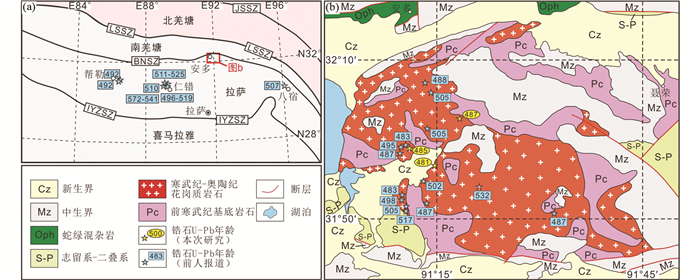
拉萨地块大地构造位置上位于班公湖-怒江板块缝合带和雅鲁藏布江板块缝合带之间,地理位置上位于青藏高原中部,为组成青藏高原的主要板块之一(图 1a)(Yin and Harrison, 2000; Metcalfe, 2013; Zhu et al., 2013; Li et al., 2018; Zhao et al., 2018)。长期以来,拉萨地块上没有发现确切的埃迪卡拉纪-奥陶纪岩浆记录。然而,近几年的相关研究工作取得了突破性进展,在帮勒(Zhu et al., 2012)、仁错(计文化等, 2009; Gehrels et al., 2011)、安多(Zhang et al., 2012; Xie et al., 2013)和八宿(李才等, 2008)地区陆续发现了埃迪卡拉纪-奥陶纪岩浆记录,从而为认识和重建青藏高原早期演化过程打开了新的窗口。然而,目前对这些岩石的研究程度依然较低,总体还处于野外描述和锆石定年阶段。虽然新近有学者开展了部分埃迪卡拉纪-寒武纪岩石的地球化学和同位素研究工作(Zhu et al., 2012; Zhang et al., 2012; Ding et al., 2015),奥陶纪岩石的相关研究依然较少,成为认识青藏高原早期形成演化的瓶颈之一。本文报道了安多地区奥陶纪花岗岩的LA-ICP-MS锆石U-Pb定年、岩石地球化学和锆石Hf同位素分析结果,在详细分析前人资料的基础上,揭示其岩浆源区特征以及构造背景,进而探讨青藏高原早期形成演化过程。
|
图 1 青藏高原中部构造划分简图(a)和安多地区区域地质简图(b) JSSZ-金沙江缝合带;LSSZ-龙木错-双湖-澜沧江缝合带;BNSZ-班公湖-怒江缝合带;IYZSZ-雅鲁藏布江缝合带.年龄资料李才等, 2008; 解超明等, 2010; Gehrels et al., 2011; Guynn et al., 2012; Zhang et al., 2012; Zhu et al., 2012; Hu et al., 2013, 2018a; Xie et al., 2013; Ding et al., 2015 Fig. 1 Simplified tectonic map of the central Tibetan Plateau (a) and geological map of the Amdo area (b) |
前人研究表明,青藏高原存在多个东西向展布的地块,例如北羌塘、南羌塘、拉萨等(图 1a)。这些地块被一系列东西向延伸的特提斯板块缝合带所分割,其中龙木错-双湖-澜沧江板块缝合带代表了冈瓦纳大陆与劳亚大陆的界线,因而位于该缝合带以南的南羌塘和拉萨地块被认为来自冈瓦纳大陆北缘(李才, 2008; Zhai et al., 2016; Hu et al., 2019a)。安多微陆块夹持于南羌塘和拉萨地块之间。新近研究显示,安多微陆块的新元古代-早古生代岩浆-变质记录与拉萨地块较为类似,而与南羌塘地块区别明显(Hu et al., 2018b),因此本文倾向于认为安多微陆块是拉萨地块的一部分。
目前,在拉萨地块上已经发现了多处早古生代岩浆记录,分别位于帮勒、仁错、安多和八宿地区(图 1)。Zhu et al. (2012)对帮勒地区的寒武纪火山岩进行了研究,发现它们具有双峰式的特征,主要为玄武岩和流纹岩,并且获得了492Ma的LA-ICP-MS锆石U-Pb定年结果。计文化等(2009)、Hu et al. (2013)和Ding et al. (2015)报道仁错地区存在寒武纪流纹岩,呈夹层状出露于变质沉积地层中。此外,在该地区还出露有埃迪卡拉纪的岩浆岩,主要为辉长岩、英云闪长岩和流纹岩(Hu et al., 2018a)。安多和八宿地区的早古生代岩石主要为花岗岩,时代跨度为532~483Ma(解超明等, 2010; Guynn et al., 2012; Zhang et al., 2012; Xie et al., 2013; 李才等, 2008)。
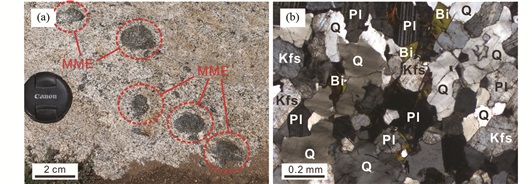
安多地区中-新生代构造运动较为强烈,发育有多条东西向断裂。该地区出露的地层包括前寒武纪变质基底片麻岩、古生界、中生界和新生界,岩浆岩主要为侏罗-白垩纪蛇绿混杂岩和早古生代花岗岩,在中生界中可见较多中-酸性火山岩夹层。其中,早古生代花岗岩侵入于前寒武纪基底岩石之中,被中生代地层以角度不整合覆盖,与古生界多为断层接触关系。本文研究的花岗岩,出露于安多县城以南约25km,具细粒花岗结构,片麻状构造(图 2a)。镜下鉴定结果显示,花岗岩主要矿物组成为石英(40%~50%)、钾长石(10%~15%)和斜长石(30%~35%),黑云母含量较少(约5%);副矿物有锆石、榍石等(图 2b)。石英为不规则粒状,可见波状消光;斜长石为半自形-自形,普遍发育聚片双晶;钾长石为不规则板状,未见格子双晶;黑云母呈黄褐色,片状。部分斜长石和钾长石受后期蚀变影响,表面呈现浑浊状。此外,花岗岩中可见暗色微粒包体,呈浑圆状,直径为2~5cm(图 2a);呈不均匀分布,岩体内部相对较多(约20%),边缘相对较少(约5%);主要组成矿物为角闪石(~30%)、辉石(~35%)、斜长石(~30%)和少量石英(~5%)。
|
图 2 安多地区奥陶纪花岗岩的野外露头照片(a)和显微镜下特征(b) MME-暗色微粒包体;Q-石英;Pl-斜长石;Kfs-钾长石;Bi-黑云母 Fig. 2 Field characteristics (a) and photomicrographs (b) of the Ordovician granites from the Amdo area |
锆石的分选在河北省区域地质调查院完成,采用常规的重液和磁选方法进行分选,最后在双目显微镜下挑纯。样品靶的制备在中国地质科学院地质研究所完成,制成的样品靶直径为25mm。锆石的阴极荧光图像分析在中国地质科学院地质研究所的阴极荧光分析系统(HITACH S-3000N型场发射环境扫描电镜和Gatan公司Chroma阴极荧光谱仪)上完成。样品的锆石U-Th测年在北京科荟测试技术有限公司完成,分析仪器为美国ESI公司生产的NWR 193nm激光剥蚀进样系统和德国AnlyitikJena公司生产的PQMS Elite型四级杆等离子体质谱仪联合构成的激光等离子体质谱仪(LA-ICP-MS)。本次分析中激光器工作频率为10Hz;测试点束斑直径为25μm,剥蚀采样时间为45s,具体分析流程见侯可军等(2009)。锆石GJ-1(Jackson et al., 2004)作为外部标准来校正分析过程中的同位素分馏;NIST610作为外部标准来获得分析点的Th和U的含量。锆石U-Pb年龄用ICPMSDataCal数据处理软件(Liu et al., 2010)计算获得,加权平均年龄的计算和谐和图的绘制采用ISOPLOT 3.0程序(Ludwig, 2003)。锆石Hf同位素分析在中国科学院地质与地球物理研究所Neptune多接收电感耦合等离子质谱仪(MC-ICPMS)和193nm激光取样系统上进行,仪器的运行条件及详细的分析过程参见Wu et al. (2006)。采用单点剥蚀模式,斑束固定为44μm。实验测定过程中,MUD标准锆石的176Hf/177Hf的测定结果是0.282505±21,与前人获得的结果一致(Wu et al., 2006)。
地球化学样品的主量元素、微量元素和稀土元素的分析均在北京科荟测试技术有限公司完成。主量元素采用X-射线荧光光谱仪(SHIMADZU XRF- 1800)分析。微量元素和稀土元素的分析仪器为Analyticjena PQMS elite等离子质谱仪,实验室分析详细方法见相关参考文献(Hu et al., 2019a)。
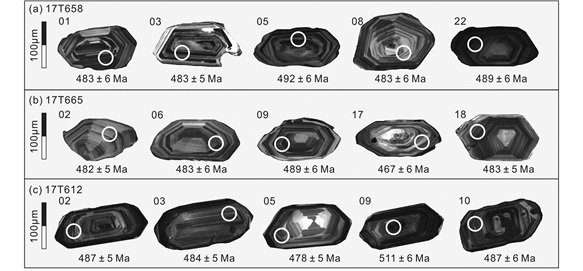
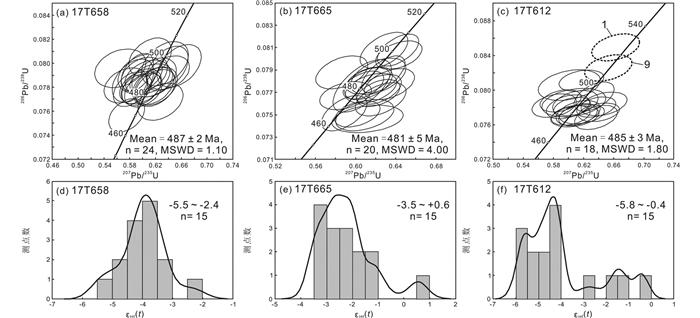
3 分析结果 3.1 LA-ICP-MS锆石U-Pb年代学花岗岩样品(17T658、17T665和17T612)中锆石具有较典型的岩浆振荡环带结构(图 3),且晶形比较完整,呈自形晶-半自形晶,长约100~200μm,长/宽比为1:2~1:3,显示出岩浆锆石的特点。锆石测点的Th含量为91×10-6~1778×10-6,U为118×10-6~1854×10-6,Th/U比值介于0.53和1.49之间(表 1),为典型的岩浆锆石(吴元保和郑永飞, 2004)。所有测点在U-Pb谐和图(图 4)上集中落在谐和线上或其附近,表明锆石形成后U-Pb体系是基本封闭的,没有U或者Pb同位素的明显丢失或加入,测试结果真实可信。17T658样品中的24个测点、17T665样品中的20个测点和17T612样品中的18个测点分别获得了487±2Ma(2σ;MSWD=1.10)、481±5Ma(2σ;MSWD=4.00)和485±3Ma(2σ;MSWD=1.80)的206Pb/238U加权平均年龄,代表花岗岩的形成年龄,即奥陶纪早期。
|
图 3 安多地区奥陶纪花岗岩中典型锆石的阴极荧光图像 Fig. 3 Cathodoluminescence images of typical zircons of the dated granite samples from the Amdo area |
|
表 1 安多地区奥陶纪花岗岩的锆石LA-ICP-MS U-Pb-Th分析结果 Table 1 LA-ICP-MS U-Pb-Th data for zircons from the Ordovician granites from the Amdo area |
|
图 4 安多地区奥陶纪花岗岩中锆石的U-Pb谐和图(a-c)和Hf同位素分析结果(d-f) Fig. 4 U-Pb concordia diagrams (a-c) and Hf isotopic compositions (d-f) of the zircons from the Ordovician granites from the Amdo area |
样品的锆石Hf同位素是在锆石U-Pb定年的同一颗锆石的相同部位或相同结构的邻近部位测定的,测试结果见表 2。花岗岩中锆石的εHf(t)值介于-5.8和+0.6之间;二阶段Hf模式年龄(tDMC)变化范围为1432~1820Ma,平均值为1668Ma。
|
|
表 2 安多地区奥陶纪花岗岩的锆石Hf同位素组成 Table 2 Hf isotopic compositions for zircons of the Ordovician granites from the Amdo area |
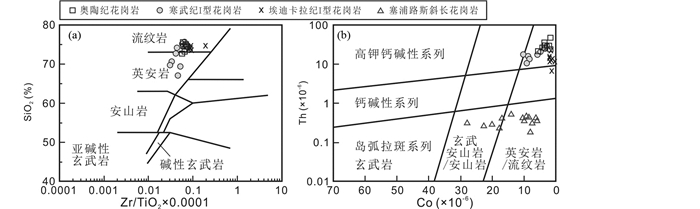
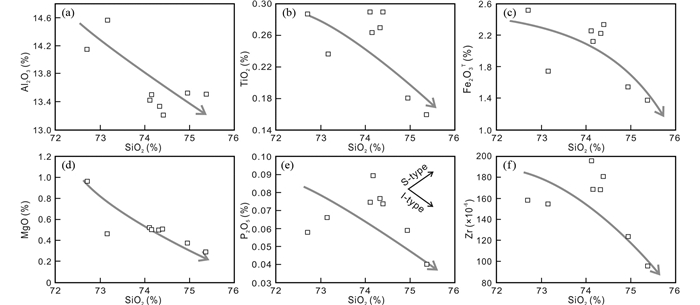
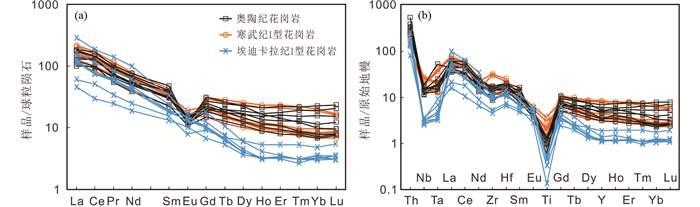
所有花岗岩样品均表现出高硅的特征(SiO2含量为72.71%~75.37%;去烧失量归一化处理之后,下同)(表 3)。在SiO2-Zr/Ti(图 5a)和Th-Co(图 5b)岩石分类图上,样品投点落入高钾钙碱性系列流纹岩区域。在哈克图解上(图 6),Al2O3、TiO2、Fe2O3T、MgO、P2O5和Zr均与SiO2呈现负相关关系。样品的∑REE总体含量较低,在122×10-6~220×10-6之间。在稀土元素球粒陨石标准化模式图(图 7a)上,所有样品的曲线一致性较好,均表现为右倾的海鸥型,(La/Yb)N比值为4.86~22.4,同时具有明显负Eu异常,Eu/Eu*比值为0.30~0.64。在岩石微量元素原始地幔标准化蛛网图(图 7b)上,样品亏损Nb、Ta和Ti元素,富集Th元素。
|
|
表 3 安多地区奥陶纪花岗岩的全岩主量(wt%)和微量(×10-6)元素含量分析结果 Table 3 Concentrations of major (wt%) and trace elements (×10-6) of the Ordovician granites from the Amdo area |
|
图 5 安多地区奥陶纪花岗岩的SiO2-Zr/Ti图解(a, 据Winchester and Floyd, 1977)和Th-Co图解(b, 据Hastie et al., 2007) 寒武纪和埃迪卡拉纪I型花岗岩的数据引自Xie et al. (2013)和Hu et al. (2018a);塞浦路斯斜长花岗岩的数据引自Freund et al. (2014) Fig. 5 SiO2 vs. Zr/Ti (a, after Winchester and Floyd, 1977) and Th vs. Co (b, after Hastie et al., 2007) diagrams of the Ordovician granites from the Amdo area The data of Cambrian and Ediacaran I-type granites from Xie et al. (2013) and Hu et al. (2018a), the data of Cyprus plagiogranites from Freund et al. (2014) |
|
图 6 安多地区奥陶纪花岗岩的哈克图解 Fig. 6 Harker diagrams of the Ordovician granites from the Amdo area |
|
图 7 安多地区奥陶纪花岗岩的球粒陨石标准化稀土元素配分图(a)和原始地幔标准化微量元素蛛网图(b)(标准化值据Sun and McDonough, 1989) 寒武纪和埃迪卡拉纪I型花岗岩的数据引自Xie et al. (2013)和Hu et al. (2018a) Fig. 7 Chondrite-normalized rare-earth element patterns (a) and primitive mantle-normalized spider diagrams (b) for the Ordovician granites from the Amdo area (normalization values after Sun and McDonough, 1989) The data of Cambrian and Ediacaran I-type granites from Xie et al. (2013) and Hu et al. (2018a) |
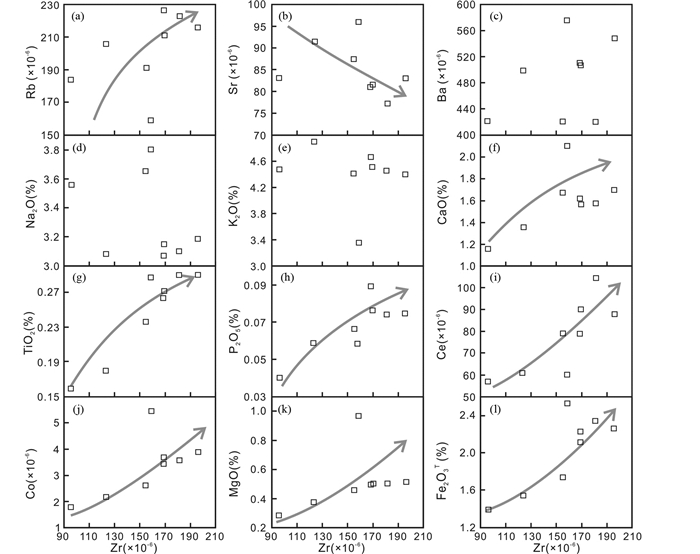
虽然本次研究的花岗岩样品具有较低的烧失量(0.67%~0.90%),镜下和野外观察结果表明它们受到了后期变质和蚀变作用的影响,样品中部分元素的的含量可能会发生迁移。通常认为,Zr是最稳定的元素之一,在变质和蚀变过程中,不易发生迁移。本文选择典型的活动元素(Rb、Sr、Ba、Na、K和Ca)、过渡元素(Mg、Fe和Co)和不活动元素(Ti、P和Ce)与Zr进行投图(部分元素的含量由其氧化物的含量代替)(图 8)。结果显示,部分活动元素(Ba、Na和K)呈现离散状,说明其成分受到了后期变质和蚀变作用的改造。与此对应的是,其余活动元素和全部过渡和不活动元素均表现出与Zr的线性演化关系。因此,本次研究主要依据过渡和不活动元素以及部分活动元素(Rb、Sr和Ca)的含量来对样品进行岩石学分类和成因讨论。
|
图 8 安多地区奥陶纪花岗岩中典型的活动元素、过渡元素和不活动元素与Zr的二元协变图解 Fig. 8 Plots of select mobile, immobile, and transition elements vs. Zr for the Ordovician granites from the Amdo area |
依据地球化学特征和矿物组成,花岗岩可以分为I型、S型、M型和A型(Chappell and White, 1974)。本文研究的花岗岩具有较低的10000×Ga/Al比值(1.93~2.18)和锆石饱和温度(747~804℃,Watson and Harrison, 2005),与A型花岗岩(10000×Ga/Al>2.7;锆石饱和温度>800℃)有明显差别。M型花岗岩是洋壳的组成部分,一般具有低Th的特点,例如塞浦路斯蛇绿岩中的斜长花岗岩(Freund et al., 2014),与本文研究的花岗岩明显不同(图 5b)。实验研究结果表明,在I型花岗岩浆(准铝质或弱过铝质)中,磷灰石的溶解度较低,容易达到过饱和而结晶分离,因而在岩浆分异过程中与SiO2含量呈负相关;然而,在S型花岗岩浆(强过铝质)中,磷灰石溶解度较高,不易结晶分离,常具有高的P2O5含量(>0.26%),并且随SiO2含量的增加而增大(Wolf and London, 1994)。本文的数据显示,花岗岩具有较低的P2O5含量(0.04×10⁻⁶~0.09×10⁻⁶),并且P2O5含量随着SiO2的增加而降低(图 6e),所以应当属于I型花岗岩。此外,通过矿物组成也可以区分S型和I型花岗岩;S型花岗岩以白云母、堇青石、石榴石等富铝矿物为特征,而I型花岗岩通常由石英、数量不等的斜长石和碱性长石、普通角闪石和黑云母组成,不含白云母。如前文所述,安多地区奥陶纪花岗岩的矿物组成与I型花岗岩更为相似。
关于I型花岗岩的成因,目前主要有两种解释:(1)地壳内变质火成岩的部分熔融作用(Chappell and White, 1974);和(2)地幔岩浆对沉积物质的改造,即混染结晶分异过程(Kemp et al., 2007)。本文研究的花岗岩的锆石εHf(t)值介于-5.8和+0.6之间,其变化范围明显大于分析测试误差,指示不均一的岩浆源区。同时,部分花岗岩露头上可见暗色微粒包体,与壳-幔混合作用一致。帮勒地区近同时代双峰式火山岩(约492Ma)中的玄武岩(εHf(t)=-0.7~+7.5)和流纹岩(εHf(t)=-13.9~-4.6)可能分别代表了幔源和壳源端元。此外,花岗岩的部分元素含量与SiO2表现出相关关系(图 6),表明其母岩浆形成后可能经历了结晶分异过程。TiO2(图 6b)、Fe2O3T(图 6c)和MgO(图 6d)与SiO2呈现负相关关系,指示岩浆演化晚期存在含Fe、Ti矿物的结晶分异。Zr与SiO2具有负相关关系(图 6f),与锆石的分异一致。Al2O3与SiO2表现出线性关系(图 6a),表明也发生了长石的结晶分异作用。
4.3 构造环境自20世纪70年代板块构造学说引入青藏高原构造研究领域以来,威尔逊旋回(Wilson cycle)被广泛应用于探索青藏高原的构造演化历史。威尔逊旋回是大陆岩石圈在水平方向上的彼此分离与拼合运动的一次全过程,即:大陆岩石圈由崩裂开始(胚胎期,如东非裂谷)、以裂谷为生长中心的雏形洋区渐次形成洋中脊(幼年期,如红海)、扩散出现洋盆进而成为大洋盆(成年期,如大西洋),而后大洋岩石圈向两侧的大陆岩石圈下俯冲、消亡,洋壳进入地幔而重熔,从而洋盆缩小(衰退期,如太平洋),随后洋中脊消失,仅剩残余洋盆(终了期,如地中海),最后大陆渐次接近、碰撞,出现造山带,遂拼合成陆的过程(遗迹期,如雅鲁藏布江板块缝合带)(Wilson, 1966; Shirey and Richardson, 2011)。前人研究表明,I型花岗岩几乎可能形成于威尔逊旋回的每个阶段,因而需要结合区域地质背景来确定其形成的构造环境。
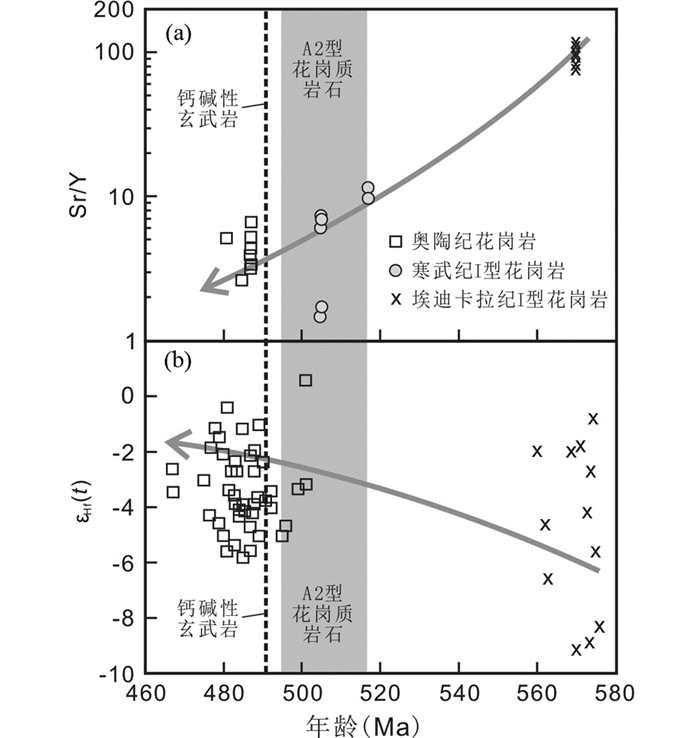
如果确定I型花岗质岩石形成于大陆地壳的熔融过程,其Sr/Y比值可以指示岩浆的起源深度(Chung et al., 2003; Hou et al., 2004)。Hu et al. (2018a)报道仁错地区存在埃迪卡拉纪的I型花岗岩(约572Ma),具有高Sr/Y比值的特征,应当形成于增厚地壳的环境。Xie et al. (2013)则在安多地区识别出了寒武纪的I型花岗岩(505~517Ma)。对比埃迪卡拉纪-寒武纪I型花岗岩的地球化学资料可知,它们的Sr/Y比值随时间呈下降趋势(图 9a),与伸展环境中地壳的持续减薄过程相一致。与此对应的是,奥陶纪花岗岩的锆石εHf(t)值高于埃迪卡拉纪I型花岗岩(图 9b),指示有更多的幔源物质加入,与幔源岩浆上涌过程相一致。
|
图 9 安多地区埃迪卡拉纪-奥陶纪I型花岗岩中Sr/Y比值(a)和锆石εHf(t)值(b)与锆石U-Pb年龄的二元协变图解 寒武纪I型花岗岩、埃迪卡拉纪I型花岗岩、寒武纪A2型花岗质岩石和寒武纪钙碱性玄武岩的数据分别引自Xie et al. (2013)、Hu et al. (2018a)、Ding et al. (2015)和Zhu et al. (2012) Fig. 9 Plots of Sr/Y ratio (a) and zircon εHf(t) value (b) vs. zircon age for the Ediacaran-Ordovician I-type granites from the Lhasa terrane The data of Cambrian I-type granites, Ediacaran I-type granites, Cambrian A2-type granitoids, and Cambrian calc-alkaline basalts from Xie et al. (2013), Hu et al. (2018a), Ding et al. (2015), and Zhu et al. (2012), respectively |
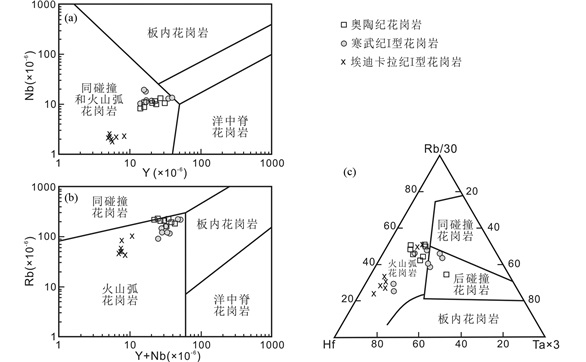
大陆地壳伸展和幔源岩浆上涌过程,通常存在于威尔逊旋回中的胚胎期(大陆裂谷)、衰退期(弧后盆地)和终了期(后碰撞)阶段。前人报道拉萨地块上存在寒武纪钙碱性玄武岩(Zhu et al., 2012)和A2型花岗质岩石(Ding et al., 2015),与大陆裂谷环境不符。在构造环境判别图解上(图 10),埃迪卡拉纪-奥陶纪I型花岗岩投点主要落于火山弧、同碰撞和后碰撞相关花岗岩区域,指示活动大陆边缘环境。此外,值得注意的是,在拉萨地块仁错地区存在寒武-奥陶纪角度不整合,强烈变形的寒武纪地层和下覆未变形的奥陶纪地层的产状呈近90°直交(李才等, 2010),与弧后盆地环境不符。Hu et al. (2019b)对寒武纪地层中的砂岩开展了碎屑锆石定年研究,并且依据Cawood et al. (2012)的统计分析方法将其沉积环境解释为与碰撞相关(前陆盆地)。因此,本文推测安多地区奥陶纪花岗岩形成于后碰撞环境。
|
图 10 安多地区奥陶纪花岗岩的Nb-Y (a, 据Pearce and Peate, 1995)、Rb-(Y+Nb) (b, 据Pearce and Peate, 1995)和Rb-Hf-Ta (c, 据Harris et al., 1986)构造环境判别图解 寒武纪和埃迪卡拉纪I型花岗岩的数据引自Xie et al. (2013)和Hu et al. (2018a) Fig. 10 Nb vs. Y (a, after Pearce and Peate, 1995), Rb vs. Y+Nb (b, after Pearce and Peate, 1995) and Rb-Hf-Ta (c, after Harris et al., 1986) plots the Ordovician granites from the Amdo area The data of Cambrian and Ediacaran I-type granites from Xie et al. (2013) and Hu et al. (2018a) |
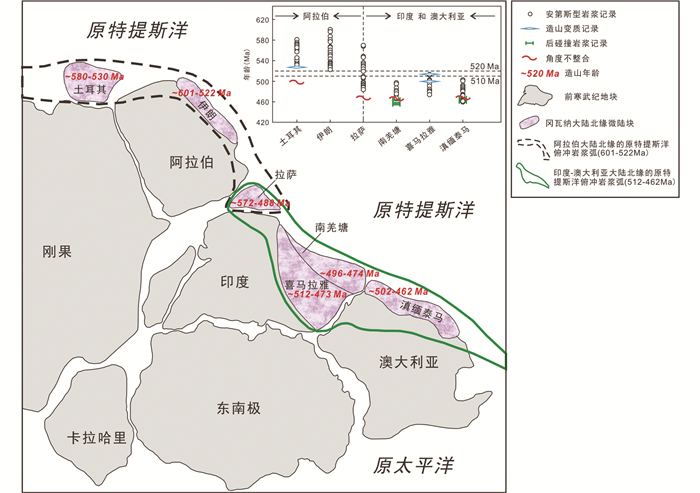
如前文所述,拉萨地块被认为来自于冈瓦纳大陆北缘,因而与冈瓦纳大陆埃迪卡拉纪-奥陶纪构造演化历史关系密切。埃迪卡拉纪-奥陶纪是冈瓦纳大陆构造演化历史的一个重要阶段。在这一时期,泛非运动基本结束,东-西冈瓦纳大陆基本拼合完毕,这一事件同时也导致在冈瓦纳大陆边缘的洋壳俯冲作用(Meert, 2003; Cawood and Buchan, 2007; Cawood et al., 2007)。已有的研究表明,东、西冈瓦纳大陆各微陆块的碰撞拼合时代为570~510Ma左右(Meert, 2003; Cawood and Buchan, 2007)。同时,冈瓦纳大陆南缘(即原太平洋边缘)由被动大陆边缘转化为活动大陆边缘,于580~550Ma开始俯冲消减(Cawood and Buchan, 2007)。然而,冈瓦纳大陆北缘(即原特提斯边缘)有没有转化为活动大陆边缘目前还没有统一的结论。本次研究在拉萨地块安多地区识别出了奥陶纪I型花岗岩,可能形成于后碰撞环境,从而为冈瓦纳大陆构造演化历史的提供了新的约束,即在埃迪卡拉纪-奥陶纪冈瓦纳大陆北缘应当为安第斯型活动大陆边缘,部分地区发育有外围陆块的拼贴。这一推断也得到了冈瓦纳大陆北缘其他陆块上地质资料的支持。土耳其(Gürsu, 2008, 2016; Gürsu et al., 2015)、伊朗(Moghadam et al., 2015)、巴基斯坦(Zanchi and Gaetani, 2011; Qasim et al., 2015)、南羌塘(Hu et al., 2015; Liu et al., 2019)、喜马拉雅(Wang et al., 2012; Gao et al., 2019)、滇缅泰马(Sibumasu)(Wang et al., 2013)等地区均发现了相关的弧岩浆、变质变形记录或者沉积角度不整合,形成了一条超过5000km长的、沿冈瓦纳大陆北缘分布的安第斯型造山带。此外,值得注意的是,这一造山带具有“西早东晚”时空分布特征,即阿拉伯大陆北缘(601~522Ma)的相关记录明显早于印度-澳大利亚大陆北缘(512~462Ma)。拉萨地块的安第斯型造山记录(572~488Ma)与阿拉伯大陆北缘和印度-澳大利亚大陆北缘均可对比,指示拉萨地块可能位于阿拉伯北缘与印度北缘的过渡位置(Hu et al., 2018a)(图 11)。
|
图 11 冈瓦纳大陆北缘埃迪卡拉纪-早古生代安第斯型岩浆弧分布示意图(据Hu et al., 2018d) Fig. 11 Reconstruction of Gondwana showing the Ediacaran-Ordovician Andean-type orogen along the northern Gondwana margin (after Hu et al., 2018d) |
综合上述分析讨论,初步得出以下结论:
(1) LA-ICP-MS锆石U-Pb定年结果表明,安多地区存在早奥陶世花岗岩,形成时代为487±2Ma、481±5Ma和485±3Ma。
(2) 花岗岩为I型花岗岩,具有不均一的锆石εHf(t)值(-5.8~+0.6),可能形成于壳源和幔源岩浆的混合作用,随后经历了广泛的结晶分异过程。拉萨地块的埃迪卡拉纪-奥陶纪I型花岗岩具有Sr/Y比值降低和锆石εHf(t)值升高的演化趋势,指示伸展环境下的幔源岩浆上涌过程。
(3) 综合前人研究成果可知,安多地区奥陶纪花岗岩可能形成于后碰撞环境,与埃迪卡拉纪-奥陶纪冈瓦纳大陆北缘的洋壳俯冲和陆块拼贴相关。
致谢 锆石U-Pb定年得到了中国地质科学院矿产资源研究所侯可军副研究员的帮助;锆石Hf同位素分析得到了中国科学院地质与地球物理研究所李娇实验师的帮助;两位审稿人对本文提出的中肯的、建设性的修改意见。在此一并致以衷心的感谢。
Cawood PA and Buchan C. 2007. Linking accretionary orogenesis with supercontinent assembly. Earth-Science Reviews, 82(3-4): 217-256 DOI:10.1016/j.earscirev.2007.03.003
|
Cawood PA, Johnson MRW and Nemchin AA. 2007. Early Palaeozoic orogenesis along the Indian margin of Gondwana: Tectonic response to Gondwana assembly. Earth and Planetary Science Letters, 255(1-2): 70-84 DOI:10.1016/j.epsl.2006.12.006
|
Cawood PA, Hawkesworth CJ and Dhuime B. 2012. Detrital zircon record and tectonic setting. Geology, 40(10): 875-878 DOI:10.1130/G32945.1
|
Chappell BW and White AJR. 1974. Two contrasting granite types. Pacific Geology, 8: 173-174
|
Chung SL, Liu DY, Ji JQ, Chu MF, Lee HY, Wen DJ, Lo CH, Lee TY, Qian Q and Zhang Q. 2003. Adakites from continental collision zones: Melting of thickened lower crust beneath southern Tibet. Geology, 31(11): 1021-1024 DOI:10.1130/G19796.1
|
Ding HX, Zhang ZM, Dong X, Yan R, Lin YH and Jiang HY. 2015. Cambrian ultrapotassic rhyolites from the Lhasa terrane, South Tibet: Evidence for Andean-type magmatism along the northern active margin of Gondwana. Gondwana Research, 27(4): 1616-1629 DOI:10.1016/j.gr.2014.02.003
|
Freund S, Haase KM, Keith M, Beier C and Garbe-Schönberg D. 2014. Constraints on the formation of geochemically variable plagiogranite intrusions in the Troodos Ophiolite, Cyprus. Contributions to Mineralogy and Petrology, 167: 978 DOI:10.1007/s00410-014-0978-6
|
Gao LE, Zeng LS, Hu GY, Wang YY, Wang Q, Guo CL and Hou KJ. 2019. Early Paleozoic magmatism along the northern margin of East Gondwana. Lithos, 334-335: 25-41 DOI:10.1016/j.lithos.2019.03.007
|
Gehrels G, Kapp P, DeCelles P, Pullen A, Blakey R, Weislogel A, Ding L, Guynn J, Martin A, McQuarrie N and Yin A. 2011. Detrital zircon geochronology of pre-Tertiary strata in the Tibetan-Himalayan orogen. Tectonics, 30(5): TC5016
|
Gürsu S. 2008. Petrogenetic and tectonic significance of rift-related Pre-Early Cambrian mafic dikes, Central Taurides, Turkey. International Geology Review, 50(10): 895-913 DOI:10.2747/0020-6814.50.10.895
|
Gürsu S, Möller A, Göncüoglu MC, Köksal S, Demircan H, Köksal FT, Kozlu H and Sunal G. 2015. Neoproterozoic continental arc volcanism at the northern edge of the Arabian Plate, SE Turkey. Precambrian Research, 258: 208-233 DOI:10.1016/j.precamres.2014.12.017
|
Gürsu S. 2016. A new petrogenetic model for meta-granitic rocks in the central and southern Menderes Massif-W Turkey: Implications for Cadomian crustal evolution within the Pan-African mega-cycle. Precambrian Research, 275: 450-470 DOI:10.1016/j.precamres.2016.01.025
|
Guynn J, Kapp P, Gehrels GE and Ding L. 2012. U-Pb geochronology of basement rocks in central Tibet and paleogeographic implications. Journal of Asian Earth Sciences, 43(1): 23-50 DOI:10.1016/j.jseaes.2011.09.003
|
Harris NBW, Pearce JA and Tindle AG. 1986. Geochemical characteristics of collision-zone magmatism. Geological Society, London, Special Publications, 19: 67-81 DOI:10.1144/GSL.SP.1986.019.01.04
|
Hastie AR, Kerr AC, Pearce JA and Mitchell SF. 2007. Classification of altered volcanic island arc rocks using immobile trace elements: Development of the Th-Co discrimination diagram. Journal of Petrology, 48(12): 2341-2357 DOI:10.1093/petrology/egm062
|
Hou KJ, Li YH and Tian YR. 2009. In situ U-Pb zircon dating using laser ablation-multi ion counting-ICP-MS. Mineral Deposits, 28(4): 481-492 (in Chinese with English abstract)
|
Hou ZQ, Gao YF, Qu XM, Rui ZY and Mo XX. 2004. Origin of adakitic intrusives generated during Mid-Miocene east-west extension in southern Tibet. Earth and Planetary Science Letters, 220(1-2): 139-155 DOI:10.1016/S0012-821X(04)00007-X
|
Hu PY, Li C, Wang M, Xie CM and Wu YW. 2013. Cambrian volcanism in the Lhasa terrane, southern Tibet: Record of an Early Paleozoic Andean-type magmatic arc along the Gondwana proto-Tethyan margin. Journal of Asian Earth Sciences, 77: 91-107 DOI:10.1016/j.jseaes.2013.08.015
|
Hu PY, Zhai QG, Jahn BM, Wang J, Li C, Lee HY and Tang SH. 2015. Early Ordovician granites from the South Qiangtang terrane, northern Tibet: Implications for the early Paleozoic tectonic evolution along the Gondwanan proto-Tethyan margin. Lithos, 220-223: 318-338 DOI:10.1016/j.lithos.2014.12.020
|
Hu PY, Zhai QG, Wang J, Tang Y, Wang HT and Hou KJ. 2018a. Ediacaran magmatism in the North Lhasa terrane, Tibet and its tectonic implications. Precambrian Research, 307: 137-154 DOI:10.1016/j.precamres.2018.01.012
|
Hu PY, Zhai QG, Wang J, Tang Y, Wang HT, Zhu ZC and Wu H. 2018b. Middle Neoproterozoic (ca. 760Ma) arc and back-arc system in the North Lhasa terrane, Tibet, inferred from coeval N-MORB-and arc-type gabbros. Precambrian Research, 316: 275-290 DOI:10.1016/j.precamres.2018.08.022
|
Hu PY, Zhai QG, Wang J, Tang Y, Wang HT and Hou KJ. 2018c. Precambrian origin of the North Lhasa terrane, Tibetan Plateau: Constraint from early Cryogenian back-arc magmatism. Precambrian Research, 313: 51-67 DOI:10.1016/j.precamres.2018.05.014
|
Hu PY, Zhai QG, Zhao GC, Wang J, Tang Y, Wang HT, Zhu ZC, Wang W and Wu H. 2018d. Early Neoproterozoic (ca. 900Ma) rift sedimentation and mafic magmatism in the North Lhasa Terrane, Tibet: Paleogeographic and tectonic implications. Lithos, 320-321: 403-415 DOI:10.1016/j.lithos.2018.09.036
|
Hu PY, Zhai QG, Zhao GC, Wang J, Tang Y, Wang HT, Zhu ZC, Wu H, Wang W and Huang ZQ. 2019a. Late Cryogenian magmatic activity in the North Lhasa terrane, Tibet: Implication of slab break-off process. Gondwana Research, 71: 129-149 DOI:10.1016/j.gr.2019.02.005
|
Hu PY, Zhai QG, Zhao GC, Wang J, Tang Y, Zhu ZC and Wu H. 2019b. The North Lhasa terrane in Tibet was attached with the Gondwana before it was drafted away in Jurassic: Evidence from detrital zircon studies. Journal of Asian Earth Sciences, 185: 104055 DOI:10.1016/j.jseaes.2019.104055
|
Jackson SE, Pearson NJ, Griffin WL and Belousova EA. 2004. The application of laser ablation-inductively coupled plasma-mass spectrometry to in situ U-Pb zircon geochronology. Chemical Geology, 211(1-2): 47-69 DOI:10.1016/j.chemgeo.2004.06.017
|
Ji WH, Chen SJ, Zhao ZM, Li RS, He SP and Wang C. 2009. Discovery of the Cambiran volcanic rocks in the Xainza area, Gangdese orogenic belt, Tibet, China and its significance. Geological Bulletin of China, 28(9): 1350-1354 (in Chinese with English abstract)
|
Kemp AIS, Hawkesworth CJ, Foster GL, Paterson BA, Woodhead JD, Hergt JM, Gray CM and Whitehouse MJ. 2007. Magmatic and crustal differentiation history of granitic rocks from Hf-O isotopes in zircon. Science, 315(5814): 980-983 DOI:10.1126/science.1136154
|
Li C. 2008. A review on 20 years' study of the Longmu Co-Shuanghu-Lancang River Suture Zone in Qinghai-Xizang (Tibet) Plateau. Geological Review, 54(1): 105-119 (in Chinese with English abstract)
|
Li C, Xie YW, Sha SL and Dong YS. 2008. SHRIMP U-Pb zircon dating of the Pan-African granite in Baxoi County, eastern Tibet China. Geological Bulletin of China, 27(1): 64-68 (in Chinese with English abstract)
|
Li C, Wu YW, Wang M and Yang HT. 2010. Significant progress on Pan-African and Early Paleozoic orogenic events in Qinghai-Tibet Plateau: Discovery of Pan-African orogenic unconformity and Cambrian System in the Gangdise area, Tibet, China. Geological Bulletin of China, 29(12): 1733-1736 (in Chinese with English abstract)
|
Li SZ, Zhao SJ, Liu X, Cao HH, Yu S, Li XY, Somerville I, Yu SY and Suo YH. 2018. Closure of the Proto-Tethys Ocean and Early Paleozoic amalgamation of microcontinental blocks in East Asia. Earth-Science Reviews, 186: 37-75 DOI:10.1016/j.earscirev.2017.01.011
|
Liu YM, Xie CM, Li C, Li SZ, Santosh M, Wang M and Fan JJ. 2019. Breakup of the northern margin of Gondwana through lithospheric delamination: Evidence from the Tibetan Plateau. GSA Bulletin, 131(3-4): 675-694 DOI:10.1130/B31958.1
|
Liu YS, Gao S, Hu ZC, Gao CG, Zong KQ and Wang DB. 2010. Continental and oceanic crust recycling-induced melt-peridotite interactions in the Trans-North China Orogen: U-Pb dating, Hf isotopes and trace elements in zircons from mantle xenoliths. Journal of Petrology, 51(1-2): 537-571 DOI:10.1093/petrology/egp082
|
Ludwig KJ. 2003. Isoplot 3.00: A geochronological toolkit for Microsoft Excel. Berkeley Geochronology Center Special Publication
|
Meert JG. 2003. A synopsis of events related to the assembly of eastern Gondwana. Tectonophysics, 362(1-4): 1-40 DOI:10.1016/S0040-1951(02)00629-7
|
Metcalfe I. 2013. Gondwana dispersion and Asian accretion: Tectonic and palaeogeographic evolution of eastern Tethys. Journal of Asian Earth Sciences, 66: 1-33 DOI:10.1016/j.jseaes.2012.12.020
|
Moghadam HS, Khademi M, Hu ZC, Stern RJ, Santos JF and Wu YB. 2015. Cadomian (Ediacaran-Cambrian) arc magmatism in the ChahJam-Biarjmand metamorphic complex (Iran): Magmatism along the northern active margin of Gondwana. Gondwana Research, 27(1): 439-452 DOI:10.1016/j.gr.2013.10.014
|
Pearce JA and Peate DW. 1995. Tectonic implications of the composition of volcanic ARC magmas. Annual Review of Earth and Planetary Sciences, 23(1): 251-285 DOI:10.1146/annurev.ea.23.050195.001343
|
Qasim M, Khan MA and Haneef M. 2015. Stratigraphic characterization and structural analysis of the northwestern Hazara Ranges across Panjal Thrust, northern Pakistan. Arabian Journal of Geosciences, 8: 7811-7829 DOI:10.1007/s12517-015-1787-6
|
Shirey SB and Richardson SH. 2011. Start of the Wilson cycle at 3Ga shown by diamonds from subcontinental mantle. Science, 333(6041): 434-436 DOI:10.1126/science.1206275
|
Sun SS and McDonough WF. 1989. Chemical and isotopic systematics of oceanic basalt: Implications for mantle composition and processes. In: Saunders AD and Norry MJ (eds.). Magmatism in the Ocean Basins. Geological Society, London, Special Publications, 42(1): 313-345 DOI:10.1144/GSL.SP.1989.042.01.19
|
Wang XX, Zhang JJ, Santosh M, Liu J, Yan SY and Guo L. 2012. Andean-type orogeny in the Himalayas of South Tibet: Implications for Early Paleozoic tectonics along the Indian margin of Gondwana. Lithos, 154: 248-262 DOI:10.1016/j.lithos.2012.07.011
|
Wang YJ, Xing XW, Cawood PA, Lai SC, Xia XP, Fan WM, Liu HC and Zhang FF. 2013. Petrogenesis of Early Paleozoic peraluminous granite in the Sibumasu Block of SW Yunnan and diachronous accretionary orogenesis along the northern margin of Gondwana. Lithos, 182-183: 67-85 DOI:10.1016/j.lithos.2013.09.010
|
Watson EB and Harrison TM. 2005. Zircon thermometer reveals minimum melting conditions on earliest earth. Science, 308(5723): 841-844 DOI:10.1126/science.1110873
|
Wilson JT. 1966. Did the Atlantic close and then re-open?. Nature, 211(5050): 676-681 DOI:10.1038/211676a0
|
Winchester JA and Floyd PA. 1977. Geochemical discrimination of different magma series and their differentiation products using immobile elements. Chemical Geology, 20: 325-343 DOI:10.1016/0009-2541(77)90057-2
|
Wolf MB and London D. 1994. Apatite dissolution into peraluminous haplogranitic melts: An experimental study of solubilities and mechanisms. Geochimica et Cosmochimica Acta, 58(19): 4127-4145 DOI:10.1016/0016-7037(94)90269-0
|
Wu FY, Yang YH, Xie LW, Yang JH and Xu P. 2006. Hf isotopic compositions of the standard zircons and baddeleyites used in U-Pb geochronology. Chemical Geology, 234(1-2): 105-126 DOI:10.1016/j.chemgeo.2006.05.003
|
Wu YB and Zheng YF. 2004. Genesis of zircon and its constraints on interpretation of U-Pb age. Chinese Science Bulletin, 49(15): 1544-1569
|
Xie CM, Li C, Su L, Wu YW, Wang M and Yu H. 2010. LA-ICP-MS U-Pb dating of zircon from granite-gneiss in the Amdo area, northern Tibet, China. Geological Bulletin of China, 29(12): 1737-1744 (in Chinese with English abstract)
|
Xie CM, Li C, Su L, Wu YW and Xie YW. 2013. Pan-African and early Paleozoic tectonothermal events in the Nyainrong microcontinent: Constraints from geochronology and geochemistry. Science China (Earth Sciences), 56(12): 2066-2079 DOI:10.1007/s11430-013-4724-0
|
Yin A and Harrison TM. 2000. Geologic evolution of the Himalayan-Tibetan orogen. Annual Review of Earth and Planetary Sciences, 28(1): 211-280 DOI:10.1146/annurev.earth.28.1.211
|
Zanchi A and Gaetani M. 2011. The geology of the Karakoram range, Pakistan: The new 1:100, 000 geological map of Central-Western Karakoram. Italian Journal of Geosciences, 130(2): 161-262
|
Zhai QG, Jahn BM, Wang J, Hu PY, Chung SL, Lee HY, Tang SH and Tang Y. 2016. Oldest Paleo-Tethyan ophiolitic mélange in the Tibetan Plateau. GSA Bulletin, 128(3-4): 355-373 DOI:10.1130/B31296.1
|
Zhang ZM, Dong X, Liu F, Lin YH, Yan R and Santosh M. 2012. Tectonic evolution of the Amdo Terrane, Central Tibet: Petrochemistry and Zircon U-Pb geochronology. The Journal of Geology, 120(4): 431-451 DOI:10.1086/665799
|
Zhang XZ, Dong YS, Li C, Deng MR, Zhang L and Xu W. 2014. Silurian high-pressure granulites from Central Qiangtang, Tibet: Constraints on early Paleozoic collision along the northeastern margin of Gondwana. Earth and Planetary Science Letters, 405: 39-51 DOI:10.1016/j.epsl.2014.08.013
|
Zhao GC, Wang YJ, Huang BC, Dong YP, Li SZ, Zhang GW and Yu S. 2018. Geological reconstructions of the East Asian blocks: From the breakup of Rodinia to the assembly of Pangea. Earth-Science Reviews, 186: 262-286 DOI:10.1016/j.earscirev.2018.10.003
|
Zhu DC, Zhao ZD, Niu YL, Dilek Y and Mo XX. 2011. Lhasa terrane in southern Tibet came from Australia. Geology, 39(8): 727-730 DOI:10.1130/G31895.1
|
Zhu DC, Zhao ZD, Niu YL, Dilek Y, Wang Q, Ji WH, Dong GC, Sui QL, Liu YS, Yuan HL and Mo XX. 2012. Cambrian bimodal volcanism in the Lhasa Terrane, southern Tibet: Record of an early Paleozoic Andean-type magmatic arc in the Australian proto-Tethyan margin. Chemical Geology, 328: 290-308 DOI:10.1016/j.chemgeo.2011.12.024
|
Zhu DC, Zhai ZD, Niu YL, Dilek Y, Hou ZQ and Mo XX. 2013. The origin and pre-Cenozoic evolution of the Tibetan Plateau. Gondwana Research, 23(4): 1429-1454 DOI:10.1016/j.gr.2012.02.002
|
侯可军, 李延河, 田有荣. 2009. LA-MC-ICP-MS锆石微区原位U-Pb定年技术. 矿床地质, 28(4): 481-492. DOI:10.3969/j.issn.0258-7106.2009.04.010 |
计文化, 陈守建, 赵振明, 李荣社, 何世平, 王超. 2009. 西藏冈底斯构造带申扎一带寒武系火山岩的发现及其地质意义. 地质通报, 28(9): 1350-1354. DOI:10.3969/j.issn.1671-2552.2009.09.026 |
李才, 谢尧武, 沙绍礼, 董永胜. 2008. 藏东八宿地区泛非期花岗岩锆石SHRIMP U-Pb定年. 地质通报, 27(1): 64-68. DOI:10.3969/j.issn.1671-2552.2008.01.005 |
李才. 2008. 青藏高原龙木错-双湖-澜沧江板块缝合带研究二十年. 地质论评, 54(1): 105-119. DOI:10.3321/j.issn:0371-5736.2008.01.012 |
李才, 吴彦旺, 王明, 杨韩涛. 2010. 青藏高原泛非-早古生代造山事件研究重大进展——冈底斯地区寒武系和泛非造山不整合的发现. 地质通报, 29(12): 1733-1736. DOI:10.3969/j.issn.1671-2552.2010.12.001 |
吴元保, 郑永飞. 2004. 锆石成因矿物学研究及其对U-Pb年龄解释的制约. 科学通报, 49(16): 1589-1604. DOI:10.3321/j.issn:0023-074X.2004.16.002 |
解超明, 李才, 苏犁, 吴彦旺, 王明, 于红. 2010. 藏北安多地区花岗片麻岩锆石LA-ICP-MS U-Pb定年. 地质通报, 29(12): 1737-1744. DOI:10.3969/j.issn.1671-2552.2010.12.002 |