 2021, Vol. 37


2. 中国科学院地球科学研究院, 北京 100029;
3. 自然资源部深地动力学重点实验室, 中国地质科学院地质研究所, 北京 100037;
4. 中国科学院大学地球与行星科学学院, 北京 100049
2. Innovation Academy for Earth Science, Chinese Academy of Sciences, Beijing 100029, China;
3. Key Laboratory of Deep-Earth Dynamics of Ministry of Natural Resources, Institude of Geology, Chinese Academy of Geological Sciences, Beijing 100037, China;
4. College of Earth and Planetary Sciences, University of Chinese Academy of Sciences, Beijing 100049, China
造山带变质岩可以保存复杂的变质-构造-流体演化信息,是研究汇聚板块边缘俯冲-碰撞-折返过程的关键对象(Chopin, 2003)。而石榴子石作为变质岩的主要组成矿物之一,晶体粒间元素扩散速度缓慢,可以记录复杂的化学和结构变化(Xia et al., 2012, 2019; 张建新等, 2002; 夏琼霞和郑永飞, 2011; 夏琼霞等, 2013; 夏琼霞, 2019)。石榴子石在同一变质岩中可以保存多种形态,如斑晶状、后成合晶状、冠状体、红眼圈状(red-eye socket)和环礁状(atoll-shaped)等(Herwartz et al., 2011; Robyr et al., 2014; Bucher et al., 2019; Faryad et al., 2019),不同形态或结构/部位的石榴子石(成分)往往含不同的矿物包裹体,表明它们可能形成于不同的变质-构造-流体环境(Carswell and Compagnoni, 2003; Davis and Whitney, 2006)。因此,发育特征结构和化学成分环带的石榴子石是探讨造山带演化详细过程的关键矿物之一。
“环状”石榴子石(ring garnet)与“环礁状”石榴子石(atoll garnet)相似,是中-高级变质岩中发育的特殊结构。“环礁状”石榴子石在以往研究中被广泛报道(Spiess et al., 2001; Passchier and Trouw, 2005; Faryad et al., 2010; Ruiz Cruz, 2011; Enami et al., 2012),而单纯的“环状”石榴子石研究甚少。“环礁状”石榴子石是指一个完整或近似完整的石榴子石环形围绕石榴子石残骸(岛礁状)或其它矿物生长的现象,可产于片岩、麻粒岩和榴辉岩等岩石中(Xiao et al., 2002; Liu et al., 2006; Ruiz Cruz, 2011; Enami et al., 2012; Jonnalagadda et al., 2017; Ren et al., 2018)。已有研究表明,“环礁状”石榴子石外环的成因主要包括多核生长与合并、快速而短暂的变斑晶骨架生长、对核部石榴子石的重吸收和再结晶等(Cooper, 1972; Smellie, 1974; Godard, 1988; Spiess et al., 2001; Dobbs et al., 2003; Cheng et al., 2007; Robyr et al., 2014)。而“环状”石榴子石缺少“岛礁状”石榴子石残核,不易判断是否存在过早期石榴子石核,因此对于研究其成因具有一定的困难。
我国大别超高压变质带榴辉岩中保存典型的“环礁状”石榴子石,有学者认为它们是由于超高压榴辉岩在折返过程中的外部流体渗透作用,使核部石榴子石分解而后再结晶形成的(Xiao et al., 2002; Liu et al., 2006; Cheng et al., 2007, 2009),也有学者认为“环礁状”石榴子石是早期进变质阶段正常石榴子石核被外部流体渗透发生分解、在保留下来的石榴子石外环基础上再增生形成的(Cao et al., 2018)。在大别超高压带东延部分,即苏鲁超高压变质带,以往研究主要集中于含正常结构石榴子石的榴辉岩、花岗岩和长英质脉体等超高压岩石(Wang et al., 1993; Zhang et al., 1995a; Yang, 2004)。Chen et al. (2015)报道了威海地区超高压闪长质片麻岩发育特殊核-边结构的石榴子石,从岩相学照片可判断为“环礁状”石榴子石,被认为形成于俯冲陆壳的折返阶段地质流体作用下的溶解-再沉淀机制。
近年来,在区域地质调查基础上,我们在威海地区首次发现含“环状”石榴子石的石榴角闪岩,其岩相学特征不同于苏鲁超高压带常见的退变榴辉岩(Wang et al., 1993; Yao et al., 2000; Yang, 2004; Zhang et al., 2006b; Xia et al., 2018),也不同于北苏鲁造山带内发育“红眼圈”结构的、具有华北板块属性的基性麻粒岩(Zhang et al., 2006a; Liu et al., 2017a, 2018a; 刘利双等, 2015, 2017)。本文拟对这类岩石开展详细的岩相学、矿物主微量元素、锆石U-Pb年代学和变质作用研究,查明“环状”石榴子石的成因及其形成的变质条件,这对于详细刻画北苏鲁造山带的变质-构造-流体演化过程具有重要的科学意义。
1 地质背景研究区位于苏鲁造山带东北端的威海地区,其西北侧以烟台-青岛-五莲断裂为界与华北板块东南缘的胶北地体相邻(图 1; Tang et al., 2007, 2008b; Zhang et al., 2014)。

|
图 1 苏鲁造山带东北端及邻区区域地质概况 (a)大别-苏鲁造山带(据Zheng et al., 2003修改);(b)北苏鲁超高压带及胶北地体(据中国地质科学院地质研究所和山东省第四地质矿产勘查院, 2002①修改) Fig. 1 Simplified geological map of northeast of the Sulu orogenic belt and its adjacent region (a) geological sketch of the Dabie-Sulu orogenic belt (modified after Zheng et al., 2003); (b) simplified geological map of the northern Sulu ultrahigh-pressure belt and its adjacent region |
① 中国地质科学院地质研究所, 山东省第四地质矿产勘查院.2002. 1:50万大别-苏鲁造山带地质图(苏鲁地区)
苏鲁-大别造山带是中-晚三叠世(240~220Ma)扬子板块与华北板块之间的俯冲-碰撞过程形成的(Cong, 1996; Liou et al., 1996, 2009; Hacker et al., 2000; Liou, 2000; Zhang et al., 2000),北部为超高压带,南部为高压带,西南方为大别高压-超高压带,东北部为苏鲁高压-超高压带。北苏鲁超高压带主体由花岗质片麻岩以及少量表壳岩和变镁铁-超镁铁质岩石薄层或透镜体组成(Cong and Wang, 1999; Zheng et al., 2003; Liu and Liou, 2011),其原岩普遍形成于新元古代(850~750Ma)(Ames et al., 1996; Hacker et al., 1998; Zheng et al., 2003, 2004, 2007; 许志琴等, 2006; Tang et al., 2008b; Liu and Liou, 2011),代表了来自于扬子板块北缘的陆壳物质(Zheng et al., 2003, 2004; Tang et al., 2008a)。其中,变镁铁-超镁铁质岩石以榴辉岩为代表,呈无根的透镜体、脉状和似层状产于片麻岩中,长轴方向与区域片麻理总体方向一致。大量以柯石英、金刚石等为代表的超高压矿物的准确识别(Ye et al., 2000; Liu and Liou, 2011),表明榴辉岩及其围岩组成的巨量陆壳物质普遍发生了深俯冲,以近等温减压的顺时针变质演化P-T-t轨迹为特征(Liou et al., 2009; Zhang et al., 2009; Liu and Liou, 2011),可划分为四个阶段:高压石英榴辉岩相进变质阶段、峰期超高压柯石英/金刚石榴辉岩相变质阶段、峰后石英榴辉岩-麻粒岩相退变质阶段和晚期角闪岩相退变质阶段,其变质P-T条件分别为570~690℃/17~21kbar、750~850℃/34~40kbar、600~750℃/12~24kbar和550~650℃/7~10.5kbar(Zhang et al., 1995a, 2005, 2009; Liu and Liou, 2011)。超高压变质时代为中三叠世(240~225Ma),角闪岩相退变质时代为晚三叠世(220~200Ma)(Liu and Liou, 2011; 刘福来等, 2011及其参考文献)。
胶北地体位于华北板块东南缘,主要由太古宙-古元古代(ca. 2900~1800Ma)的TTG-花岗片麻岩、表壳岩(以荆山群和粉子山群为代表)和变镁铁-超镁铁质岩石(如基性麻粒岩)组成(Wan et al., 2006; Jahn et al., 2008; Tam et al., 2011, 2012a, b, c; Liu et al., 2013a; Wang and Zhou, 2014; Wu et al., 2014),它们共同经历了古元古代(1950~1850Ma)麻粒岩相变质事件(Zhou et al., 2008; Tam et al., 2011; 刘平华等, 2010; Liu et al., 2017b),并伴随广泛的深熔作用(刘福来等, 2015),其变质演化P-T-t轨迹具有近等温减压至近等压冷却的顺时针型式(刘平华等, 2010; Tam et al., 2012a, b, c; Liu et al., 2013b)。近年来北苏鲁造山带内部华北板块变质残片的识别(Zhang et al., 2006a; Liu et al., 2017a, 2018a)以及华北板块东南缘三叠纪变质记录的发现(Wan et al., 2007; Liu et al., 2018b),表明华北板块东南缘可能卷入了三叠纪的碰撞-造山事件。
威海地区位于苏鲁造山带东北端,是研究超高压变质作用的经典地区。该区主体出露新元古代花岗片麻岩,夹零星的榴辉岩、变质表壳岩和超基性岩岩块或透镜体(图 1b),它们共同经历了中-晚三叠世(235~225Ma)的超高压变质作用(Liu and Liou, 2011及其参考文献)。岩石学和变质作用研究表明,该区榴辉岩以经历峰后麻粒岩相变质作用的叠加为特征(Wang et al., 1993; Zhang et al., 1995b; Banno et al., 2000)区别于南苏鲁超高压带地区榴辉岩。此外,近年来在初村镇-羊亭镇一带识别出“红眼圈”结构基性麻粒岩和石榴角闪岩,普遍经历了晚古元古代(1855~1818Ma)的麻粒岩相变质作用(Xiang et al., 2014; Liu et al., 2018a; Xu et al., 2019),并可能遭受三叠纪(235~205Ma)变质作用的叠加(Liu et al., 2018a; Xu et al., 2019; 刘利双, 2019)。以“红眼圈状”石榴子石为代表的变质矿物组合形成于高压麻粒岩相(730~850℃/11.0~15.5kbar)变质条件(刘利双, 2019)。值得注意的是,Chen et al. (2015)在威海闪长片麻岩中发现“环礁状”石榴子石,它具有较高的δ18O值和水含量,可能与俯冲带流体作用相关。
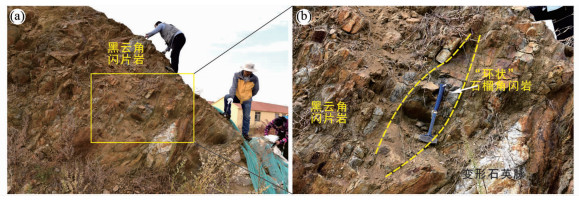
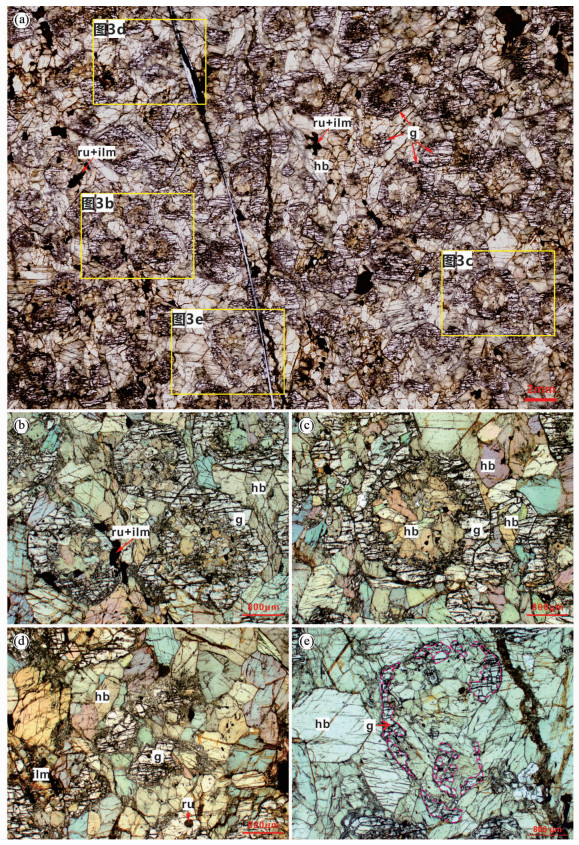
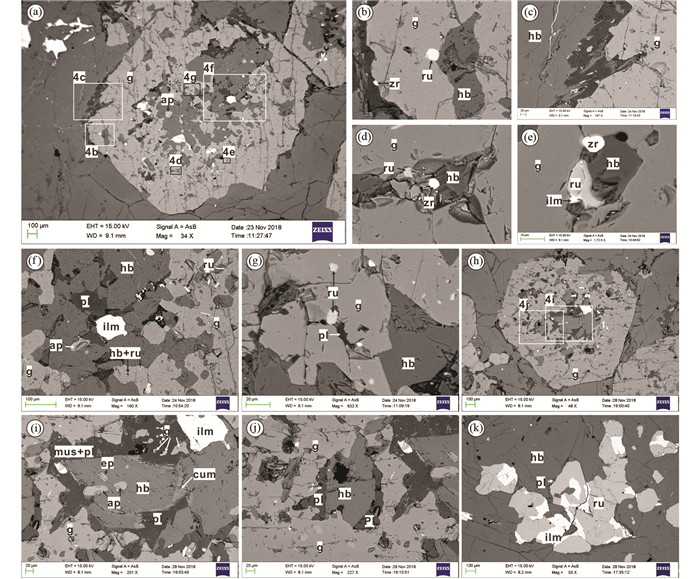
2 岩石学及岩相学特征本文研究的“环状”石榴角闪岩样品采自威海地区泊于镇附近,以透镜体形式产出,边部转变为黑云角闪片岩(图 2),其围岩为花岗片麻岩。主要组成矿物为石榴子石(20%~25%)和角闪石(60%~65%)(图 3),含少量的斜长石(3%~5%)、白云母(1%~2%)、镁铁闪石(< 1%)、石英(< 1%)和绿泥石(< 1%)等,副矿物主要为金红石(1%~1.5%)、钛铁矿(0.5%~1%)、磷灰石(~1%)和磁铁矿(< 1%)(图 4)。其中,石榴子石主要有五种形态(图 3):1)绝大多数以自形的环状产出,粒径可达3~5mm,环绕角闪石生长(图 3a-c),环内壁被细粒石榴子石+角闪石+斜长石±白云母+钛铁矿±金红石±磷灰石环绕(图 4a, f-j),环外边与基质中板柱状角闪石接触面平整(图 3a、图 4h),局部被改造,转变为白云母+钾长石+斜长石(图 4a, c),石榴子石环核部包裹体为角闪石+金红石+锆石+钛铁矿(图 4b-e);2)少数石榴子石以近似完整的自形晶产出,粒径为2~3mm,含大量的包裹体矿物,如角闪石+斜长石+金红石+白云母+钛铁矿+磷灰石等,边部与角闪石接触面平整(图 3a);3)极少数以较小的不规则斑晶产出,边部为角闪石+斜长石+白云母(图 3d);4)少量石榴子石以细条状沿角闪石粒间分布,整体形态呈半自形石榴子石环(图 3e);5)少量细小石榴子石以角闪石包体产出。角闪石主要有四种形态:基质中的板柱状角闪石斑晶、“环状”石榴子石的核部斑晶、石榴子石环内外边部的细粒角闪石和石榴子石的包裹体(图 3)。斜长石和白云母主要以石榴子石环内、外边的细粒状形式产出(图 4h, i),镁铁闪石主要产于石榴子石与角闪石接触边界或角闪石边部(图 4i),极少量的石英、钾长石和绿帘石以大颗粒角闪石斑晶中的包裹体形式产出。次生矿物绿泥石主要分布于石榴子石内边或外边的后成合晶附近。基质中的金红石边部局部转变为钛铁矿(图 4k),少数金红石以包裹体形式产于石榴子石中(图 4b, d)。磷灰石以斑晶或包裹体形式产出(图 4i)。
|
图 2 威海地区含“环状”石榴子石的石榴角闪岩野外露头 Fig. 2 Outcrop of ring garnet-bearing hornblendite in the Weihai area |
|
图 3 “环状”石榴角闪岩显微结构照片(单偏光) (a)岩石薄片扫面图;(b)石榴子石围绕角闪石生长,石榴子石消失位置的金红石几乎全部转变为钛铁矿;(c)石榴子石环内边发育后成合晶,环外边与大颗粒角闪石接触面平直;(d)小颗粒石榴子石边部发育后成合晶;(e)细条状石榴子石沿角闪石粒间或解理缝分布 Fig. 3 Microphotographs of ring garnet-bearing hornblendite from the Weihai area (a) a scanning map of rock thin section; (b) hornblende is sourrounded by ring garnet, and rutile is almost transformed into ilmenite where garnet disappears; (c) the inner rim of ring garnet is replaced by symplectite, and the outer rim contacts with hornblende with straight and clean surface; (d) symplectites grow on the rim of fine-grained garnet; (e) small strip garnets are distributed along the grain boundaries of hornblende |
|
图 4 威海地区“环状”石榴角闪岩显微结构照片(背散射) (a)“环形”石榴子石全貌图;(b)石榴子石的角闪石+金红石包裹体,环外边分布有锆石;(c)石榴子石环外边发育的后成合晶,主要由角闪石+白云母+金红石+钛铁矿组成;(d)石榴子石环内边的后成合晶中含角闪石、金红石和锆石包裹体;(e)石榴子石环内边的后成合晶中含角闪石、金红石、钛铁矿和锆石包裹体;(f)石榴子石环内边的后成合晶由石榴子石+角闪石+斜长石+金红石+钛铁矿+磷灰石组成;(g)石榴子石环内边附近细粒石榴子石含斜长石和金红石包裹体;(h)石榴子石内部发育大量包裹体,外边界平直;(i)石榴子石内部的角闪石与石榴子石环内边之间发育细粒石榴子石、斜长石和白云母等矿物,其中角闪石含绿帘石和磷灰石包裹体,边部转变为镁铁闪石;(j)石榴子石环内边的后成合晶矿物组合为石榴子石+斜长石+角闪石;(k)金红石部分转变为钛铁矿 Fig. 4 Microphotographs of ring garnet-bearing hornblendite from the Weihai area (a) a close-up view of ring garnet; (b) inclusions of hornblende and rutile in ring garnet, and zircon grows near the outer rim of garnet; (c) symplectites, consisting of hornblende+muscovite+rutile+ilmenite, are distributed near the outer rim of ring garnet; (d) symplectite near the inner rim of ring garnet contains inclusions of hornblende, rutile and zircon; (e) inclusions of hornblende, rutile, ilmenite and zircon in the inner symplectite of ring garnet; (f) symplectite near the inner rim of ring garnet consists of fine-grained garnet, hornblende, plagioclase, rutile, ilmenite and apatite; (g) fine-grained garnet near the inner rim of ring garnet contains inclusions of plagioclase and rutile; (h) ring garnet contains abundant inclusions in the inner core, and has straight outer boundaries; (i) fine-grained garnet, plagioclase and muscovite grow between the inner rim of ring garnet and hornblende in garnet core, and the hornblende whose rim was transformed into cummingtonite contains inclusions of epidote and apatite; (j) symplectite near the inner rim of ring garnet contains garnet, plagioclase and hornblende; (k) rutile was partially replaced by ilmenite |
本文采用的矿物缩写:g-石榴子石;hb-角闪石;pl-斜长石;mu-白云母;q-石英;cum-镁铁闪石;ep-绿帘石;ap-磷灰石;ru-金红石;ilm-钛铁矿;zr-锆石。
3 实验方法矿物主量元素分析在中国科学院地质与地球物理研究所电子探针与扫描电镜实验室完成。电子探针(EMP)型号为JOEL-JXA8100,加速电压为15kV,电流为10nA,束斑直径为1μm或5μm。实验以天然或人工样品为标样,共分析了Si、Ti、Al、Cr、Fe、Mn、Mg、Ca、Na、K和Ni等元素。实验数据采用ZAF修正。
矿物微量元素分析在中国科学院地质与地球物理研究所激光剥蚀电感耦合等离子体质谱仪(LA-ICP-MS)上完成。仪器型号为Agilent 7500a,激光剥蚀系统为193nm的GeoLas HD。激光剥蚀束斑直径为60μm,电压为25kV,频率为10Hz。以He气作为剥蚀物质的载气,将剥蚀物质运送至质谱仪进行测试分析。数据处理以NIST SRM 610作为外标,以USGS BCR-2G作为质量监控标样。43Ca作为内部校正标准。软件使用GLITTER程序(Griffin et al., 2008)。微量元素含量的准确度和精度为5%~10%。
1件样品的锆石分选在河北省廊坊市区域地质调查研究院进行。首先将每件样品破碎至适当粒级,经清洗、烘干和筛选,采用磁选和重液分选法,分选出不同粒级的锆石晶体,然后在双目镜下挑选出颗粒较好的锆石晶体制靶。阴极发光(CL)图像拍摄和SHRIMP U-Pb定年在北京离子探针中心完成。分析测试中一次流O2-强度为3~5nA,束斑大小为25~30μm,每个分析点采用5组扫描。标样TEM(206Pb/238U年龄为417Ma)采用锆石年龄校正,对实测204Pb含量进行普通铅校正。单点同位素比值和年龄误差为1σ。详细分析流程参考Williams (1998),数据处理采用SQUID和ISOPLOT程序(Ludwig, 2003)。
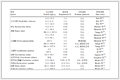
4 矿物主量元素本文对石榴角闪岩的主要组成矿物石榴子石、角闪石、斜长石和白云母进行了主量元素分析,代表性矿物化学成分见表 1、表 2。
|
表 1 威海地区石榴角闪岩中“环状”石榴子石的代表性主量元素(wt%) Table 1 Representative major elements (wt%) of ring garnet of the hornblendite from the Weihai area |
|
|
表 2 威海地区石榴角闪岩中角闪石、斜长石和白云母的代表性主量元素(wt%) Table 2 Representative major elements of (wt%) hornblende, plagioclase and muscovite of the hornblendite from the Weihai area |
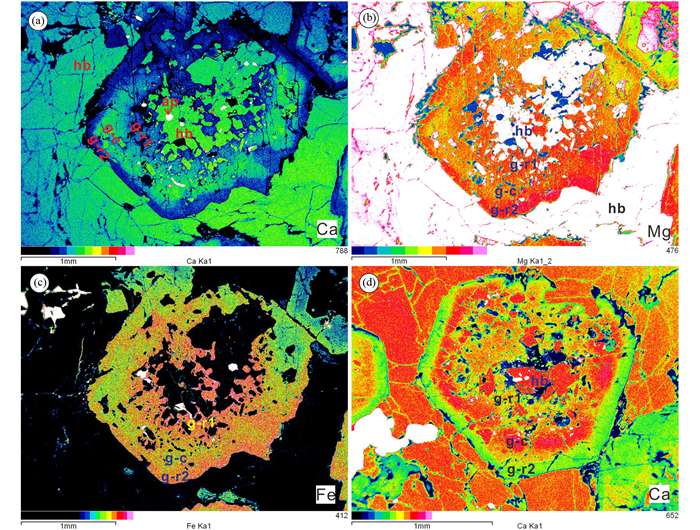
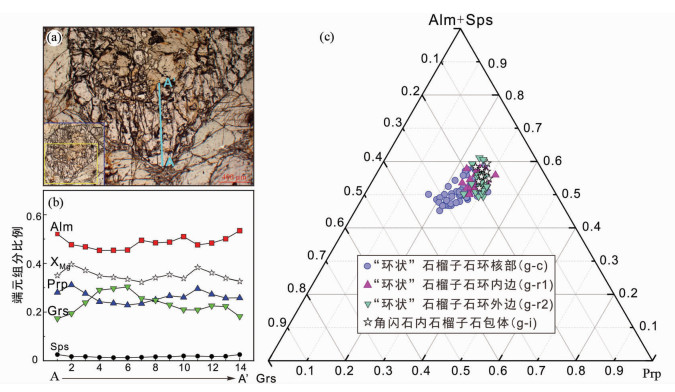
石榴子石(A3B2(SiO4)3)的成分整体上属于铁铝榴石(Alm)-钙铝榴石(Grs)-镁铝榴石(Prp)固溶体(XMg=Mg/(Mg+Fe2+)为0.25~0.40;Alm=0.44~0.58;Grs=0.15~0.33;Prp=0.17~0.32),含极少量的锰铝榴石(Sps=0.01~0.03;表 1)。初步X射线扫描图像显示,“环状”石榴子石由环核部(g-c)向环内边(g-r1)和环外边(g-r2),具有Ca降低、Mg和Fe升高趋势(图 5),而且在环外边Ca组分突然降低(图 5a, d),相应位置的Mg组分有所升高(图 5b),Mn变化不明显或略有升高(图略)。进一步电子探针成分测试表明,“环状”石榴子石环沿着环内边-环核部-环外边方向(A′→A),Grs先缓慢升高,在靠近环外边位置又迅速降低,Prp与Grs具有相反的变化趋势,Alm先逐渐降低而后又逐渐升高(中间可能由于包裹体影响而有所升高),Sps仅在两端略有升高(图 6a, b)。通过对多个石榴子石的主元素分析,总体上,“环状”石榴子石环核部(g-c)的Alm、Grs、Prp、Sps和XMg值分别变化于0.44~0.56、0.14~0.33、0.17~0.32、0.01~0.02和0.25~0.39之间,环内边后成合晶状石榴子石(g-r1)的Alm、Grs、Prp、Sps和XMg值分别介于0.48~0.56、0.13~0.23、0.23~0.31、0.02~0.03和0.29~0.38之间,而环外边(g-r2)的Alm、Grs、Prp、Sps和XMg值分别为0.48~0.58、0.14~0.24、0.24~0.31、0.02~0.03和0.29~0.40,由环核部向内、环外边,石榴子石的Grs降低,而Alm明显升高,Prp有升高趋势,Sps略有升高(图 6c和表 1)。此外,石榴子石内角闪石包体石榴子石(g-i)的Alm、Grs、Prp、Sps和XMg值分别为0.50~0.57、0.13~0.19、0.25~0.30、0.02~0.03和0.31~0.37,与石榴子石内、外边部成分相似(图 6c和表 1)。
|
图 5 图 4(a、h)中“环状”石榴子石的Ca、Mg和Fe成分面扫描图像 (a)石榴子石由环核部(g-c)向内、外两个方向逐渐降低,在环外边(g-r2)位置Ca突然降至最低;(b)石榴子石由环核部向内、外两个方向逐渐升高,在环外边(g-r2)位置Mg突然升至最高;(c)石榴子石由环核部(g-c)向环内(g-r1)、外(g-r2)边的Fe升高;(d)“环状”石榴子石可明显分为高Ca、中Ca和低Ca部分 Fig. 5 X-ray composition of the ring garnet in Fig. 4a, h (a) Ca content decreases gradually from the garnet ring to both the inner and the outer directions, and minimizes at the outer rim; (b) Ca content increases gradually from the garnet ring to both the inner and the outer directions, and maximizes at the outer rim; (c) Fe content increases from the garnet ring to both the inner and the outer rims; (d) ring garnet includes high-Ca, medium-Ca and low-Ca parts |
|
图 6 石榴子石的代表性成分环带(a、b)和Grs-(Alm+Sps)-Prp图解(c) (a)“环状”石榴子石及成分剖面A-A′位置;(b)图(a)中A-A′剖面的化学成分环带;(c)石榴子石环核部(g-c)、环内边(g-r1)、环外边(g-r2)和角闪石内包体石榴子石(g-i)的Grs-(Alm+Sps)-Prp图解 Fig. 6 Chemical compositional profile (a, b) and Grs-(Alm+Sps)-Prp diagram (c) of ring garnet (a) profile A-A′ location on the ring garnet; (b) compositional profile of A-A′ in figure (a); (c) Grs-(Alm+Sps)-Prp diagram of the core (g-c), inner rim (g-r1) and outer rim (g-r2) of ring garnet |
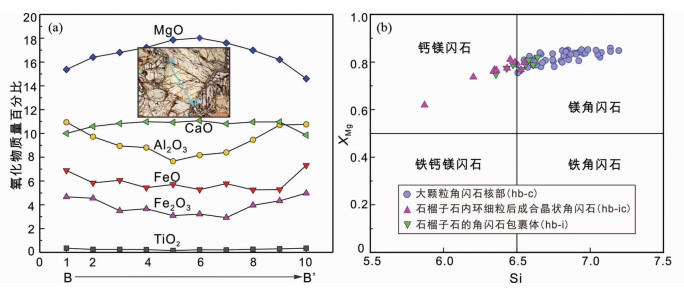
角闪石(A0-1B2C5T8O22(OH, F, Cl)2)从产状上可分为三类:基质中大颗粒(hb-c)、石榴子石内包裹体(hb-i)和石榴子石环内边小颗粒后成合晶(hb-ic),化学成分分类据Leake et al. (1997)。基质中大颗粒角闪石从核部到边部,MgO降低,Al2O3和FeO升高(图 7a),而石榴子石内包裹的角闪石从核至边的元素含量变化无明显规律(未发表资料)。总体上,基质中大颗粒角闪石成分主要为镁角闪石(7b),Si=6.498~7.195p.f.u.,Al=1.264~2.267p.f.u.,Ti=0.016~0.113p.f.u.,XMg=0.75~0.86(表 2),石榴子石内包裹体和环内边小颗粒后成合晶角闪石主要为镁角闪石向钙镁闪石过渡区(图 7b),化学成分接近基质中大颗粒角闪石边部,Si=5.87~6.640p.f.u.,Al=2.030~3.425p.f.u.,Ti=0.032~0.143p.f.u.,XMg=0.62~0.82(表 2)。
|
图 7 角闪石的代表性成分环带(a)和Si-XMg分类图解(b) Fig. 7 Chemical compositional profile (a) and Si-XMg diagram (b) of hornblende |
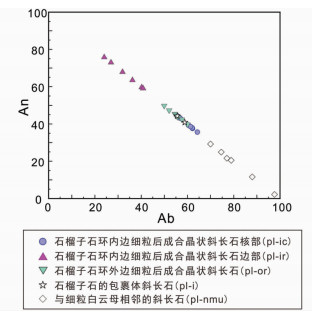
斜长石(NaAlSi3O8-CaAlSi3O8)从产状上主要分为四类:石榴子石环内边细粒后成合晶状、石榴子石环外边细粒状(pl-oc)、石榴子石包裹体(pl-i)和与白云母相邻的斜长石(pl-nmu)。其中“环状”石榴子石环内边细粒后成合晶状斜长石成分具有核边差异,边部(pl-ir)比核部(pl-ic)更富Ca,核部为中长石(An=25~37)边部为拉长石-培长石(An=31~37)。石榴子石环外边细粒后成合晶状斜长石成分接近pl-ic成分,主要为中长石,An=28~36(图 8)。石榴子石内包裹体斜长石主要为奥长石(图 8),An=~35。
|
图 8 斜长石的Ab-An图解 Fig. 8 Ab-An diagram of plagioclase |
白云母(KAl2(Si3Al)O10(OH, F)2)从产状上主要分为三类:“环状”石榴子石环内边附近细粒状、石榴子石包裹体和环外边附近细粒状,它们化学成分接近,Si=3.095~3.219p.f.u.,XNa(Na/(Na+K))=0.01~0.16,XFe(Fe2+/(Fe2++Mg))=0.44~0.89(表 2)。
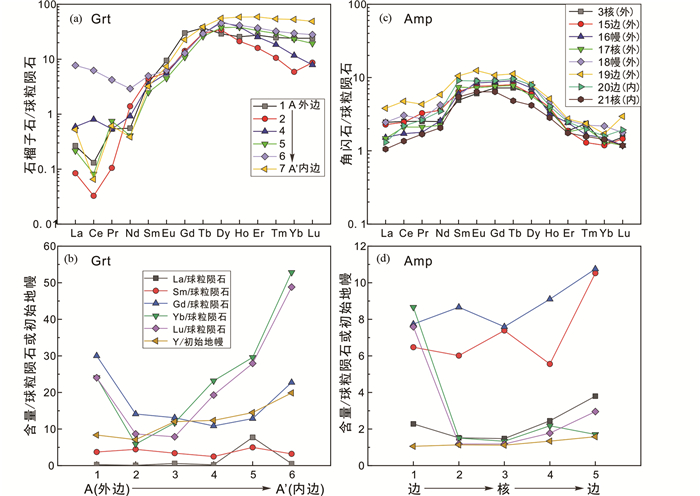
5 矿物微量元素本文选取“环状”石榴子石和石榴子石环内、外的角闪石进行微量元素测试,分析结果见表 3和图 9。具有主量元素环带的“环状”石榴子石稀土总量(∑REE)为19.68×10⁻⁶~46.16×10⁻⁶,轻(LREE)、重(HREE)稀土元素分异明显,极其富集重稀土(图 9a),轻(∑LREE)、中(∑MREE)和重(∑HREE)稀土元素总量分别为0.36×10⁻⁶~7.40×10⁻⁶、3.84×10⁻⁶~8.68×10⁻⁶和13.96×10⁻⁶~38.72×10⁻⁶,(La/Yb)N、(La/Sm)N和(Gd/Yb)N值分别为0.01~0.26、0.02~3.24和0.43~2.40,无明显的Eu异常(δEu=0.72~0.90)。从环内边(A′)到环外边(A),轻-中稀土元素(La和Sm)变化不明显,HREE(Gd、Yb和Lu)先逐渐降低而后在环外边处突然增高(图 9b)。Y含量逐渐降低,在环外边处略有升高(图 9b)。
|
|
表 3 威海地区石榴角闪岩中“环状”石榴子石和角闪石的稀土元素含量(×10-6) Table 3 Rare earth elements (×10-6) of ring garnet and hornblende of the hornblendite from the Weihai area |
|
图 9 “环状”石榴子石和角闪石的稀土元素图解(标准化值据Sun and McDonough, 1989) Fig. 9 Chondrite-normalized REE patterns of ring garnet and hornblende (normalization values from Sun and McDonough, 1989) |
石榴子石环内、外的角闪石稀土元素特征相似,稀土总量(∑REE)为6.71×10⁻⁶~15.12×10⁻⁶,轻(2.20×10⁻⁶~6.94×10⁻⁶)、重(1.82×10⁻⁶~3.22×10⁻⁶)稀土元素含量较低,而富集中稀土(2.69×10⁻⁶~4.96×10⁻⁶),球粒陨石标准化稀土配分模式显示为“钟形”(图 9c)。大颗粒角闪石微量元素含量具有一定的核边差异,边部比核部具有相对富集的含量,Y含量变化不明显,如图 9d。
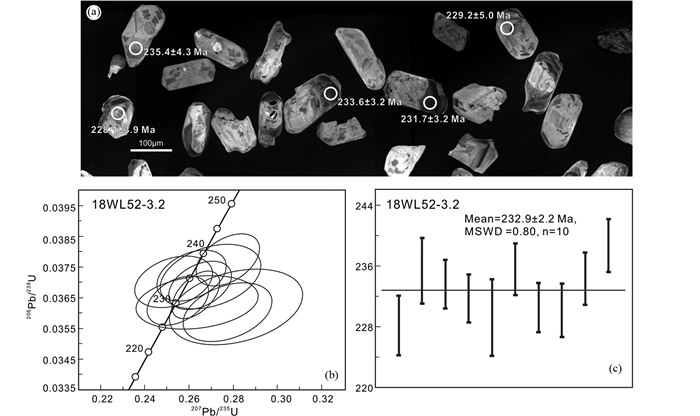
6 锆石CL图像和SHRIMP U-Pb年龄“环状”石榴角闪岩的锆石呈自形或半自形柱状,长轴介于100~200μm之间,短轴约60~100μm(图 10a)。大多数锆石CL图像发光性不均匀,整体呈灰-白色,可能由于较低的U含量而未获取有效的U-Pb表面年龄;少量锆石的边部发光性较暗,呈灰色,部分发育规则环带,结合较低的Th/U比判断为变质锆石(图 10a)。锆石包体较少。10颗变质锆石记录的206Pb/238U年龄变化范围较窄,集中于238.7±3.5Ma~228.1±3.9Ma之间,Th、U含量和Th/U比值分别为0.16×10-6~0.47×10-6、47×10-6~362×10-6和0.001~0.004,相应的加权平均年龄为232.9±2.2Ma(MSWD=0.80, n=10)(图 10b, c和表 4),应代表该样品的变质时代。
|
图 10 “环状”石榴角闪岩中变质锆石的阴极发光图像(a)与U-Pb年龄图解(b、c) Fig. 10 Cathodoluminescence (CL) images (a) and U-Pb ages (b, c) of the metamorphic zircon of the ring garnet-bearing hornblendite |
|
|
表 4 “环状”石榴角闪岩的锆石SHRIMP U-Pb年龄 Table 4 SHRIMP U-Pb ages of ring garnet-bearing hornblendite from the Weihai area |


石榴子石成分环带在一定程度上可以反映变质过程中的P-T条件或变质反应的变化,X射线主元素分析图谱明确且全面地展示石榴子石的成分环带,从而可初步确定变质岩经历的变质期次和阶段性,结合石榴子石组分环带和共生矿物组合,可用于确定连续或幕式变质作用发生的P-T条件(Herwartz et al., 2011; Li and Massonne, 2018; Ren et al., 2018; Bucher et al., 2019; Faryad et al., 2019)。基于X射线主元素扫面,本文“环状”石榴子石由环核部(g-c)向环内(g-r1)、外边方向Ca含量逐渐降低,且环外边(g-r2)处Ca含量发生突变,明显低于其内侧石榴子石(图 5a, d),因此从石榴子石成分环带,可初步判断石榴子石经历了3阶段生长:最高Ca部分(g-c)的成核阶段、相对低Ca部分(g-r1)的扩展阶段和最低Ca部分(g-r2)的快速塑形阶段,分别对应M1、M2和M3阶段变质作用。从矿物组合上,“环状”石榴子石包裹体有少量角闪石、斜长石和金红石,石榴子石内包裹矿物有角闪石、斜长石、绿帘石、磷灰石和钛铁矿等(图 4),而环外边石榴子石干净,由此可以进一步确定M1、M2和M3阶段的矿物组合分别为g-c+hb-i/hb-c+pl-i/pl-ic+ru+ep+ap、g-r1+hb-ic+pl-ir+ilm±ru±ap和g-r2±hb±ilm。此外,石榴子石边部及裂隙中往往分布少量白云母,角闪石边部转变为镁铁闪石,可能代表流体蚀变的结果。
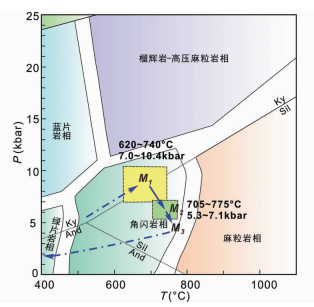
采用HPQ地质温度计(Holland and Blundy, 1994)和GHPQ地质压力计(Kohn and Spear, 1990)对变质P-T条件进行估算,M1阶段7个矿物对的估算结果为620~740℃/6.8~10.4kbar,集中于630~720℃/7.0~8.3kbar,M2阶段5个矿物对的估算结果为705~775℃/5.3~7.1kbar(图 9b),均为角闪岩相变质条件(图 11)。由M1至M2阶段,压力降低,温度有所升高。而M3阶段由于缺乏相应的矿物组合暂时无法估算具体的变质条件,但据降低的Ca组分和升高的Mg组分,推测其P-T条件应比M2阶段压力稍低而温度稍高。因此,该“环状”石榴角闪岩经历了明显的降压升温过程(M1→M2→M3)。
|
图 11 “环状”石榴角闪岩不同变质阶段的温压条件估算 变质P-T空间格子引自Brown (2014) Fig. 11 Temperature-pressure conditions for multiple metamorphic stages of the ring-shaped garnet hornblendite Metamorphic P-T space was cited from Brown (2014) |
“环状”石榴子石具有自形或半自形的晶体轮廓,明显不同于串珠状分布的“红眼圈状”石榴子石(Zhao et al., 1999; Wu et al., 2012; Yang and Wei, 2017),与“环礁状”石榴子石具有一定相似性。尽管“环礁状”石榴子石成因存在较大争议,但主要存在以下几种经典模式:(1)同时的多核生长与合并,由于外围晶体合并速度快于中心部位而形成“环礁状”石榴子石集合体(Cooper, 1972; Godard, 1988; Spiess et al., 2001; Dobbs et al., 2003);(2)快速而短暂的变斑晶生长,先形成“环状”石榴子石骨架(Atherton and Edmunds, 1966; Ushakova and Usova, 1990);(3)对早期核部石榴子石的重吸收和再结晶作用(Smellie, 1974; Cheng et al., 2007);(4)多期变质作用的结果(Robyr et al., 2014)。那么“环状”石榴子石是否形成于上述成因机制,需进一步分析。
首先,虽然在北苏鲁造山带的基性麻粒岩和斜长角闪岩中发现多期变质证据(Liu et al., 2017a, 2018a),但该“环状”石榴角闪岩与它们的岩相学特征及年代记录明显不同。前者不仅存在两期变质石榴子石,即斑晶状和“红眼圈状”石榴子石(叶凯等, 1999; Zhai et al., 2000; Zhang et al., 2006a; Liu et al., 2017a, 2018a),还存在古元古代和三叠纪两期变质年代记录,尤其是基性麻粒岩中存在大量的古元古代变质锆石(Liou et al., 2006; Liu et al., 2017a, 2018a)。而“环状”石榴角闪岩只存在三叠纪变质锆石(图 10),且不存在多期变质矿物组合,因此无证据表明“环状”石榴子石是多期变质的结果,排除成因(4)。
其次,石榴子石X射线主元素谱图可见,石榴子石Ca、Mg和Fe存在渐变和突变两个阶段(图 5),表明“环状”石榴子石的复杂性和阶段性。尽管缺乏EBSD方法对石榴子石结晶优选方位的控制,但多个石榴子石主元素扫面结果显示,早期石榴子石(M1-M2阶段)元素变化不具有绝对规律性,有些从环核部向环内、外边Ca降低、Mg和Fe升高(图 5),有些从环内边经环核部到环外边的Mg逐渐升高(未发表资料),表明石榴子石的早期生长可能具有多向性;而在最晚阶段(M3),在环外边均表现出Ca的突降、Mg和Fe的陡增现象,且M3阶段形成具有一定宽度的石榴子石边(g-r2),表明该阶段发生的变质反应与M1-M2阶段完全不同。由M1至M2阶段,发生的变质反应可能为hb+pl+ep→g+hb+pl,反应物中的绿帘石和斜长石不断被消耗,导致M2阶段石榴子石(g-c)比M1阶段石榴子石(g-r1)含有的Ca组分不断减低,相应地,Mg和Fe组分具有一定程度升高(图 5)。而M2至M3阶段,随着绿帘石和斜长石消耗完毕,不能继续提供充足的Ca,因此导致石榴子石(g-r2)中Ca组分陡降(图 5a, d)。从微量元素方面,图 8中由石榴子石环内向外的HREE含量逐渐降低并在边部又突然升高,表明该石榴子石由环核部开始向内、外边不断生长过程中体系HREE含量不断升高,此过程可能得益于角闪石分解速度的不断加快,而到M3阶段为石榴子石提供REE的矿物由绿帘石和角闪石几乎完全转变为角闪石,此过程导致角闪石HREE急剧降低,形成“钟形”稀土配分模式(图 9c)。值得一提的是,最晚阶段外部富REE流体也可为石榴子石提供升高的HREE含量。
由此可见,石榴子石能保留自形轮廓和复杂的组分环带,表明石榴子石经历了成核、扩展和快速塑性等多阶段生长过程。前两个阶段与“环礁状”石榴子石成因(1)相似,石榴子石早期可能是多核生长与合并的结果,形成早期“环状”石榴子石的雏形,而最晚阶段与“环礁状”石榴子石成因(2)相近,是“环状”石榴子石快速成形阶段。该岩石全岩极其富Mg和Fe,且SiO2不饱和,在ACF图解上全岩成分与角闪石成分极其接近(未发表资料),表明其原岩中除角闪石之外的矿物(如斜长石和绿帘石含量)含量极少,分布在角闪石粒间,变质初期使石榴子石在角闪石粒间不断生长。随着变质反应的发生,绿帘石和角闪石不断分解,形成粒间流体,加快元素扩散,使石榴子石不断长大。最晚阶段,变质温度不断升高、粒间流体积累以及外部富REE流体的渗透作用,可能是促使石榴子石快速形成“环状”骨架的动力学机制。
北苏鲁发现的“红眼圈状”石榴子石在变形强烈的石榴角闪岩中更加发育,而干体系下基性麻粒岩中的石榴子石冠状体较难形成完整而封闭的“红眼圈”(刘利双, 2019),我们初步认为流体作用使镁铁矿物(如单斜辉石、角闪石和石榴子石)更容易分解,并形成新的含水矿物(如角闪石)和名义上不含水矿物(如石榴子石)(Hacker et al., 2003; Baxter and Caddick, 2013)。此外,有关大别地区榴辉岩中发育的“环礁状”石榴子石成因,尽管多位学者观点不尽相同,但普遍认为与大陆俯冲带流体作用息息相关(Xiao et al., 2002; Liu et al., 2006; Cheng et al., 2007, 2009; Cao et al., 2018)。无独有偶,Chen et al. (2015)在本文采样点附近发现的“环礁状”石榴子石增生边与石榴子石核具有突变的化学组成,增生边具有相对较高的δ18O值和H2O含量,同时期形成的榍石U-Pb年龄为226±6Ma,因此Chen et al. (2015)认为“环礁状”石榴子石增生边为早期石榴子石溶解-再沉淀的产物,与深俯冲大陆地壳折返过程中的流体活动有关。以往研究表明,三叠纪陆壳俯冲-折返过程伴随着明显的流体作用,这些流体可形成于俯冲进变质过程中含水矿物脱水、峰期变质的超临界流体、折返过程退变质阶段含羟基矿物相脱水以及外部流体的加入,它们在大陆俯冲-碰撞带的物质转换和元素迁移方面发挥着至关重要的作用(Xiao et al., 2000; Hacker, 2008; Hermann et al., 2013; Wang et al., 2017)。实际岩石观察往往显示超高压岩石由核部到外部退变质程度逐渐强烈,表明使超高压岩石发生大规模退变的控制因素之一是外部流体(Yao et al., 2000; Xiao et al., 2002; 张泽明等, 2006; Guo et al., 2016; 刘景波, 2019)。本文“环状”石榴角闪岩中角闪石和石榴子石并未发生明显定向排列,也未见其它强烈变形的痕迹,但石榴子石普遍发育定向裂理(图 3、图 4),表明其曾经历了一定程度的外部流体渗透作用(Smit et al., 2011)。
7.3 地质意义本文“环状”石榴角闪岩全岩体系富Mg、Fe,且SiO2不饱和(未发表资料),因此在较低的压力条件即可出现石榴子石(Green and Ringwood, 1967),变质P-T条件限定(图 11)进一步证明了这一点,表明“环状”石榴子石并非超高压变质产物。因此,该石榴角闪石岩可能与北苏鲁造山带北端乳山-威海一带的非超高压“外来岩片”均来自于华北板块东南缘(Zhai et al., 2000; Zhang et al., 2006a, 2014; Liu et al., 2017a, 2018a; Xu et al., 2019)。已有研究表明,这些构造岩片保留大量的古元古代(1.95~1.8Ga)高压麻粒岩相变质作用记录(Zhai et al., 2000; Liou et al., 2006; Zhang et al., 2006a; 刘利双等, 2015; Liu et al., 2017a, 2018a)。尽管部分岩石记录了三叠纪(245~201Ma)变质改造(Liu et al., 2017a, 2018a),但新生矿物组合(如“红眼圈状”石榴子石)对原有矿物组合(如石榴子石、单斜辉石和斜方辉石)替代不完全,形成冠状体结构。本文“环状”石榴角闪岩为富水体系,在三叠纪区域变质过程中形成大量新生的三叠纪变质锆石(图 10),且受局部流体作用发育完整的石榴子石环带,相对完整地记录了华北板块东南缘卷入陆-陆碰撞造山过程,经历了角闪岩相变质作用。
8 结论通过岩相学、矿物化学、锆石U-Pb年代学和变质作用的综合研究,得出以下结论:
(1) 威海地区“环状”石榴子石形成于角闪岩相,变质P-T条件为620~775℃/5.3~10.4kbar。
(2)“环状”石榴子石的生长包括成核(M1)、扩展(M2)和快速塑性(M3)共3个阶段。其中M1至M2阶段,变质反应主要消耗绿帘石和斜长石,使石榴子石Ca含量逐渐降低;M2至M3阶段,绿帘石和斜长石消耗完毕,反应物主要消耗角闪石,导致角闪石HREE含量降低并形成“钟形”稀土配分模式,而使石榴子石Ca含量突然降低且HREE含量升高。
(3)“环状”石榴子石的最终快速塑形过程与变质温度升高、粒间流体增多和大陆-俯冲碰撞带的流体渗透作用息息相关。
致谢 陈意研究员对原稿提出了十分有益的建议,期刊编辑以及两位审稿人刘晓春研究员和续海金教授对本文提出了非常宝贵的修改意见,张晴博士对英文摘要进行了认真修改,在此一并表示感谢!
谨以此文敬贺我国著名前寒武纪与变质地质学家沈其韩院士百岁华诞,祝愿先生健康长寿!
Ames LL, Zhou GZ and Xiong BC. 1996. Geochronology and isotopic character of ultrahigh-pressure metamorphism with implications for collision of the Sino-Korean and Yangtze cratons, central China. Tectonics, 15(2): 472-489 DOI:10.1029/95TC02552
|
Atherton MP and Edmunds WM. 1966. An electron microprobe study of some zoned garnets from metamorphic rocks. Earth and Planetary Science Letters, 1(4): 185-193 DOI:10.1016/0012-821X(66)90066-5
|
Banno S, Enami M, Hirajima T, Ishiwatari A and Wang QC. 2000. Decompression P-T path of coesite eclogite to granulite from Weihai, eastern China. Lithos, 52(1-4): 97-108 DOI:10.1016/S0024-4937(99)00086-9
|
Baxter EF and Caddick MJ. 2013. Garnet growth as a proxy for progressive subduction zone dehydration. Geology, 41(6): 643-646 DOI:10.1130/G34004.1
|
Brown M. 2014. The contribution of metamorphic petrology to understanding lithosphere evolution and geodynamics. Geoscience Frontiers, 5(4): 553-569 DOI:10.1016/j.gsf.2014.02.005
|
Bucher K, Weisenberger TB, Klemm O and Weber S. 2019. Decoding the complex internal chemical structure of garnet porphyroblasts from the Zermatt area, Western Alps. Journal of Metamorphic Geology, 37(9): 1151-1169 DOI:10.1111/jmg.12506
|
Cao DD, Cheng H, Zhang LM and Wang K. 2018. Origin of atoll garnets in ultra-high-pressure eclogites and implications for infiltration of external fluids. Journal of Asian Earth Sciences, 160: 224-238 DOI:10.1016/j.jseaes.2018.04.030
|
Carswell DA and Compagnoni R. 2003. Ultrahigh pressure metamorphism. European Mineralogical Union, Notes in Mineralogy, 5: 1-508
|
Chen YX, Zhou K, Zheng YF, Chen RX and Hu ZC. 2015. Garnet geochemistry records the action of metamorphic fluids in ultrahigh-pressure dioritic gneiss from the Sulu orogen. Chemical Geology, 398: 46-60 DOI:10.1016/j.chemgeo.2015.01.021
|
Cheng H, Nakamura E, Kobayashi K and Zhou ZY. 2007. Origin of atoll garnets in eclogites and implications for the redistribution of trace elements during slab exhumation in a continental subduction zone. American Mineralogist, 92(7): 1119-1129 DOI:10.2138/am.2007.2343
|
Cheng H, Nakamura E and Zhou ZY. 2009. Garnet Lu-Hf dating of retrograde fluid activity during ultrahigh-pressure metamorphic eclogites exhumation. Mineralogy and Petrology, 95(3-4): 315-326 DOI:10.1007/s00710-008-0030-5
|
Chopin C. 2003. Ultrahigh-pressure metamorphism: Tracing continental crust into the mantle. Earth and Planetary Science Letters, 212(1-2): 1-14 DOI:10.1016/S0012-821X(03)00261-9
|
Cong BL. 1996. Ultrahigh-Pressure Metamorphic Rocks in the Dabieshan-Sulu Region of China. Beijing: Science Press, 1-224
|
Cong BL and Wang QC. 1999. The Dabie-Sulu UHP rocks belt: Review and prospect. Chinese Science Bulletin, 44(12): 1074-1086 DOI:10.1007/BF02886130
|
Cooper AF. 1972. Progressive metamorphism of metabasic rocks from the Haast Schist Group of Southern New Zealand. Journal of Petrology, 13(3): 457-492 DOI:10.1093/petrology/13.3.457
|
Davis PB and Whitney DL. 2006. Petrogenesis of lawsonite and epidote eclogite and blueschist, Sivrihisar Massif, Turkey. Journal of Metamorphic Geology, 24(9): 823-849
|
Dobbs HT, Peruzzo L, Seno F, Spiess R and Prior DJ. 2003. Unraveling the Schneeberg garnet puzzle: A numerical model of multiple nucleation and coalescence. Contributions to Mineralogy and Petrology, 146(1): 1-9 DOI:10.1007/s00410-003-0488-4
|
Enami M, Ko ZW, Win A and Tsuboi M. 2012. Eclogite from the Kumon range, Myanmar: Petrology and tectonic implications. Gondwana Research, 21(2-3): 548-558 DOI:10.1016/j.gr.2011.07.018
|
Faryad SW, Klápová H and Nosál L. 2010. Mechanism of formation of atoll garnet during high-pressure metamorphism. Mineralogical Magazine, 74(1): 111-126 DOI:10.1180/minmag.2010.074.1.111
|
Faryad SW, Baldwin SL, Jedlicka R and Ježek J. 2019. Two-stage garnet growth in coesite eclogite from the southeastern Papua New Guinea (U)HP terrane and its geodynamic significance. Contributions to Mineralogy and Petrology, 174(9): 73 DOI:10.1007/s00410-019-1612-4
|
Godard G. 1988. Petrology of some eclogites in the Hercynides: The eclogites from the southern Armorican Massif, France. In: Smith DC (ed.). Eclogites and Eclogite-Facies Rocks. Amsterdam: Elsevier, 451-519
|
Green DH and Ringwood AE. 1967. An experimental investigation of the gabbro to eclogite transformation and its petrological applications. Geochimica Et Cosmochimica Acta, 31(5): 767-833 DOI:10.1016/S0016-7037(67)80031-0
|
Griffin WL, Powell WJ, Pearson NJ and O'Reilly SY. 2008. GLITTER: data reduction software for laser ablation ICP-MS. In: Sylvester PJ (ed.). Laser Ablation ICP-MS in the Earth Sciences: Current Practices and Outstanding Issues. Vancouver, B.C: Mineralogical Association of Canada, 308-311
|
Guo S, Yang YH, Chen Y, Su B, Gao YJ, Zhang LM, Liu JB and Mao Q. 2016. Grain-scale Sr isotope heterogeneity in amphibolite (retrograded UHP eclogite, Dabie terrane): Implications for the origin and flow behavior of retrograde fluids during slab exhumation. Lithos, 266-267: 383-405 DOI:10.1016/j.lithos.2016.10.014
|
Hacker BR, Ratschbacher L, Webb L, Ireland T, Walker D and Dong SW. 1998. U-Pb zircon ages constrain the architecture of the ultrahigh-pressure Qinling-Dabie Orogen, China. Earth and Planetary Science Letters, 161(1-4): 215-230 DOI:10.1016/S0012-821X(98)00152-6
|
Hacker BR, Ratschbacher L, Webb L, McWilliams MO, Ireland T, Calvert A, Dong SW, Wenk HR and Chateigner D. 2000. Exhumation of ultrahigh-pressure continental crust in east central China: Late Triassic-Early Jurassic tectonic unroofing. Journal of Geophysical Research: Solid Earth, 105(B6): 13339-13364 DOI:10.1029/2000JB900039
|
Hacker BR, Abers GA and Peacock SM. 2003. Subduction factory 1. Theoretical mineralogy, densities, seismic wave speeds, and H2O contents. Journal of Geophysical Research, 108(B1): 2029
|
Hacker BR. 2008. H2O subduction beyond arcs. Geochemistry, Geophysics, Geosystems, 9(3): Q03001
|
Hermann J, Zheng YF and Rubatto D. 2013. Deep fluids in subducted continental crust. Elements, 9(4): 281-287 DOI:10.2113/gselements.9.4.281
|
Herwartz D, Nagel TJ, Münker C, Scherer EE and Froitzheim N. 2011. Tracing two orogenic cycles in one eclogite sample by Lu-Hf garnet chronometry. Nature Geoscience, 4(3): 178-183 DOI:10.1038/ngeo1060
|
Holland T and Blundy J. 1994. Non-ideal interactions in calcic amphiboles and their bearing on amphibole-plagioclase thermometry. Contributions to Mineralogy and Petrology, 116(4): 433-447 DOI:10.1007/BF00310910
|
Jahn BM, Liu DY, Wan YS, Song B and Wu JS. 2008. Archean crustal evolution of the Jiaodong Peninsula, China, as revealed by zircon SHRIMP geochronology, elemental and Nd-isotope geochemistry. American Journal of Science, 308(3): 232-269 DOI:10.2475/03.2008.03
|
Jonnalagadda MK, Karmalkar NR, Duraiswami RA, Harshe S, Gain S and Griffin WL. 2017. Formation of atoll garnets in the UHP eclogites of the Tso Morari Complex, Ladakh, Himalaya. Journal of Earth System Science, 126(8): 107 DOI:10.1007/s12040-017-0887-y
|
Kohn MJ and Spear FS. 1990. Two new geobarometers for garnet amphibolites, with applications to southeastern Vermont. American Mineralogist, 75: 89-96
|
Leake BE, Wooley AR, Arps CES, Birch WD, Gilbert MC, Grice JD, Hawthorne FC, Kato A, Kisch HJ and Krivovichec VG. 1997. Nomenclature of amphiboles; report of the Subcommittee on Amphiboles of the International Mineralogical Association Commission on New Minerals and Mineral Names. European Journal of Mineralogy, 9(9): 1019-1037
|
Li BT and Massonne HJ. 2018. Two Tertiary metamorphic events recognized in high-pressure metapelites of the Nevado-Filábride Complex (Betic Cordillera, S Spain). Journal of Metamorphic Geology, 36(5): 603-630 DOI:10.1111/jmg.12312
|
Liou JG, Zhang RY, Eide EA, Maruyama S, Wang X and Ernst WG. 1996. Metamorphism and tectonics of high-P and ultrahigh-P belts in Dabie-Sulu Regions, eastern central China. In: Yin A and Harrison TM (eds.). The Tectonic Evolution of Asia. Cambridge: Cambridge University Press, 300-343
|
Liou JG. 2000. Geophysics: Into the forbidden zone. Science, 287(5456): 1215-1216 DOI:10.1126/science.287.5456.1215
|
Liou JG, Tsujimori T, Chu W, Zhang RY and Wooden JL. 2006. Protolith and metamorphic ages of the Haiyangsuo Complex, eastern China: A non-UHP exotic tectonic slab in the Sulu ultrahigh-pressure terrane. Mineralogy and Petrology, 88(1-2): 207-226 DOI:10.1007/s00710-006-0156-2
|
Liou JG, Ernst WG, Zhang RY, Tsujimori T and Jahn BM. 2009. Ultrahigh-pressure minerals and metamorphic terranes-the view from China. Journal of Asian Earth Sciences, 35(3-4): 199-231 DOI:10.1016/j.jseaes.2008.10.012
|
Liu FL and Liou JG. 2011. Zircon as the best mineral for P-T-time history of UHP metamorphism: A review on mineral inclusions and U-Pb SHRIMP ages of zircons from the Dabie-Sulu UHP rocks. Journal of Asian Earth Sciences, 40(1): 1-39 DOI:10.1016/j.jseaes.2010.08.007
|
Liu FL, Shi JR, Liu JH, Ye JG, Liu PH and Wang F. 2011. Protolith and ultranhigh-pressure (UHP) metamorphic ages of ultramafic rocks in Weihai area, North Sulu UHP terrane. Acta Petrologica Sinica, 27(4): 1075-1084 (in Chinese with English abstract)
|
Liu FL, Liu PH, Wang F, Liu CH and Cai J. 2015. Progresses and overviews of voluminous meta-sedimentary series within the Paleoproterozoic Jiao-Liao-Ji orogenic/mobile belt, North China Craton. Acta Petrologica Sinica, 31(10): 2816-2846 (in Chinese with English abstract)
|
Liu FL, Liu LS, Liu PH, Wang F, Cai J, Liu JH, Wang W and Ji L. 2017a. A relic slice of archean-early Paleoproterozoic basement of Jiaobei Terrane identified within the Sulu UHP belt: Evidence from protolith and metamorphic ages from meta-mafic rocks, TTG-granitic gneisses, and metasedimentary rocks in the Haiyangsuo region. Precambrian Research, 303: 117-152 DOI:10.1016/j.precamres.2017.03.014
|
Liu JB, Ye K and Sun M. 2006. Exhumation P-T path of UHP eclogites in the Hong'an area, western Dabie Mountains, China. Lithos, 89(1-2): 154-173 DOI:10.1016/j.lithos.2005.12.002
|
Liu JB. 2019. Carbon-bearing fluids forming in the process of metamorphism of subduction zones. Acta Petrologica Sinica, 35(1): 89-98 (in Chinese with English abstract) DOI:10.18654/1000-0569/2019.01.06
|
Liu JH, Liu FL, Ding ZJ, Liu CH, Yang H, Liu PH, Wang F and Meng E. 2013a. The growth, reworking and metamorphism of Early Precambrian crust in the Jiaobei terrane, the North China Craton: Constraints from U-Th-Pb and Lu-Hf isotopic systematics, and REE concentrations of zircon from Archean granitoid gneisses. Precambrian Research, 224: 287-303 DOI:10.1016/j.precamres.2012.10.003
|
Liu LS, Liu FL, Liu PH, Cai J, Shi JR and Liu CH. 2015. Geochemical characteristics and metamorphic evolution of meta-mafic rocks from Haiyangsuo area, Sulu ultrahigh-pressure metamorphic belt. Acta Petrologica Sinica, 31(10): 2863-2888 (in Chinese with English abstract)
|
Liu LS, Liu FL and Wang W. 2017. The polygenetic meta-mafic rocks from the northeast of Sulu ultrahigh-pressure metamorphic belt: Insight from petrology, isotope geochronology and geochemistry. Acta Petrologica Sinica, 33(9): 2899-2924 (in Chinese with English abstract)
|
Liu LS, Liu FL, Liu PH, Wang W, Ji L, Wang F and Cai J. 2018a. Petrology, geochemistry and geochronology of the meta-mafic rocks in the North Sulu ultrahigh-pressure belt: Implications for their petrogenetic diversity and complex tectonic evolution. Precambrian Research, 316: 127-154 DOI:10.1016/j.precamres.2018.08.002
|
Liu LS, Liu FL, Santosh M, Wang HN and Ji L. 2018b. Paleoproterozoic and Triassic metamorphic events in the Jiaobei Terrane, Jiao-Liao-Ji Belt, China: Hidden clues on multiple metamorphism and new insights into complex tectonic evolution. Gondwana Research, 60: 105-128 DOI:10.1016/j.gr.2018.04.008
|
Liu LS. 2019. The petrology, geochemistry, multiple metamophic events and tectonic evolution of the exotic rock slices in the Sulu ultrahigh-pressure metamorphic belt. Ph. D. Dissertation. Beijing: Chinese Academy of Geological Sciences, 1-165 (in Chinese with English summary)
|
Liu PH, Liu FL, Wang F and Liu JH. 2010. Genetic mineralogy and metamorphic evolution of mafic high-pressure (HP) granulites from the Shandong Peninsula, China. Acta Petrologica Sinica, 26(7): 2039-2056 (in Chinese with English abstract)
|
Liu PH, Liu FL, Liu CH, Wang F, Liu JH, Yang H, Cai J and Shi JR. 2013b. Petrogenesis, P-T-t path, and tectonic significance of high-pressure mafic granulites from the Jiaobei terrane, North China Craton. Precambrian Research, 233: 237-258 DOI:10.1016/j.precamres.2013.05.003
|
Liu PH, Liu FL, Cai J, Wang F, Liu CH, Liu JH, Yang H, Shi JR and Liu LS. 2017b. Discovery and geological significance of high-pressure mafic granulites in the Pingdu-Anqiu area of the Jiaobei Terrane, the Jiao-Liao-Ji Belt, the North China Craton. Precambrian Research, 303: 445-469 DOI:10.1016/j.precamres.2017.05.022
|
Ludwig KR. 2003. User's manual for Isoplot/Ex, version 3.0:A Geochronological Toolkit for Microsoft Excel. Berkeley Geochronology Center: Special Publication, 1-71
|
Passchier CW and Trouw RAJ. 2005. Microtectonics. Berlin, Heidelberg: Springer, 226-230
|
Ren YF, Chen DL, Kelsey DE, Gong XK, Liu L, Zhu XH and Yang SJ. 2018. Metamorphic evolution of a newly identified Mesoproterozoic oceanic slice in the Yuka terrane and its implications for a multi-cyclic orogenic history of the North Qaidam UHPM belt. Journal of Metamorphic Geology, 36(4): 463-488 DOI:10.1111/jmg.12300
|
Robyr M, Darbellay B and Baumgartner LP. 2014. Matrix-dependent garnet growth in polymetamorphic rocks of the Sesia zone, Italian Alps. Journal of Metamorphic Geology, 32(1): 3-24 DOI:10.1111/jmg.12055
|
Ruiz Cruz MD. 2011. Origin of atoll garnet in schists from the Alpujárride Complex (Central zone of the Betic Cordillera, Spain): Implications on the P-T evolution. Mineralogy and Petrology, 101(3-4): 245-261 DOI:10.1007/s00710-011-0147-9
|
Smellie JAT. 1974. Formation of atoll garnets from the aureole of the Ardara pluton, Co. Donegal, Ireland. Mineralogical Magazine, 39(308): 878-888 DOI:10.1180/minmag.1974.039.308.07
|
Smit MA, Scherer EE, John T and Janssen A. 2011. Creep of garnet in eclogite: Mechanisms and implications. Earth and Planetary Science Letters, 311(3-4): 411-419 DOI:10.1016/j.epsl.2011.09.024
|
Spiess R, Peruzzo L, Prior DJ and Wheeler J. 2001. Development of garnet porphyroblasts by multiple nucleation, coalescence and boundary misorientation-driven rotations. Journal of Metamorphic Geology, 19(3): 269-290
|
Sun SS and McDonough WF. 1989. Chemical and isotopic systematics of oceanic basalts: Implications for mantle composition and processes. In: Saunders AD and Norry MJ (eds.). Magmatism in the Ocean Basins. Geological Society, London, Special Publications, 42(1): 313-345
|
Tam PY, Zhao GC, Liu FL, Zhou XW, Sun M and Li SZ. 2011. Timing of metamorphism in the Paleoproterozoic Jiao-Liao-Ji Belt: New SHRIMP U-Pb zircon dating of granulites, gneisses and marbles of the Jiaobei massif in the North China Craton. Gondwana Research, 19(1): 150-162 DOI:10.1016/j.gr.2010.05.007
|
Tam PY, Zhao GC, Sun M, Li SZ, Iizuka Y, Ma GSK, Yin CQ, He YH and Wu ML. 2012a. Metamorphic P-T path and tectonic implications of medium-pressure pelitic granulites from the Jiaobei massif in the Jiao-Liao-Ji Belt, North China Craton. Precambrian Research, 220-221: 177-191 DOI:10.1016/j.precamres.2012.08.008
|
Tam PY, Zhao GC, Sun M, Li SZ, Wu ML and Yin CQ. 2012b. Petrology and metamorphic P-T path of high-pressure mafic granulites from the Jiaobei massif in the Jiao-Liao-Ji Belt, North China Craton. Lithos, 155: 94-109 DOI:10.1016/j.lithos.2012.08.018
|
Tam PY, Zhao GC, Zhou XW, Sun M, Guo JH, Li SZ, Yin CQ, Wu ML and He YH. 2012c. Metamorphic P-T path and implications of high-pressure pelitic granulites from the Jiaobei massif in the Jiao-Liao-Ji Belt, North China Craton. Gondwana Research, 22(1): 104-117 DOI:10.1016/j.gr.2011.09.006
|
Tang J, Zheng YF, Wu YB, Gong B and Liu XM. 2007. Geochronology and geochemistry of metamorphic rocks in the Jiaobei terrane: Constraints on its tectonic affinity in the Sulu orogen. Precambrian Research, 152(1-2): 48-82 DOI:10.1016/j.precamres.2006.09.001
|
Tang J, Zheng YF, Gong B, Wu YB, Gao TS, Yuan HL and Wu FY. 2008a. Extreme oxygen isotope signature of meteoric water in magmatic zircon from metagranite in the Sulu orogen, China: Implications for Neoproterozoic rift magmatism. Geochimica et Cosmochimica Acta, 72(13): 3139-3169 DOI:10.1016/j.gca.2008.04.017
|
Tang J, Zheng YF, Wu YB, Gong B, Zha XQ and Liu XM. 2008b. Zircon U-Pb age and geochemical constraints on the tectonic affinity of the Jiaodong terrane in the Sulu orogen, China. Precambrian Research, 161(3-4): 389-418 DOI:10.1016/j.precamres.2007.09.008
|
Ushakova EN and Usova LV. 1990. Atoll garnet in the contact aureole of an area of southeastern Tuva. Geologia I Geofizika, 31: 50-59
|
Wan YS, Song B, Liu DY, Wilde SA, Wu JS, Shi YR, Yin XY and Zhou HY. 2006. SHRIMP U-Pb zircon geochronology of Palaeoproterozoic metasedimentary rocks in the North China Craton: Evidence for a major Late Palaeoproterozoic tectonothermal event. Precambrian Research, 149(3-4): 249-271 DOI:10.1016/j.precamres.2006.06.006
|
Wan YS, Song TR, Liu DY, Yang TN, Yin XY, Chen ZY and Zhang QD. 2007. Mesozoic monazite in Neoproterozoic metasediments: Evidence for low-grade metamorphism of Sinian sediments during Triassic continental collision, Liaodong Peninsula, NE China. Geochemical Journal, 41(1): 47-55 DOI:10.2343/geochemj.41.47
|
Wang QC, Akira I, Zhao ZY, Takaο H, Nοbuki H, Masaki E, Zhai MG, Li JJ and Cong BL. 1993. Coesite-bearing granulite retrograded from eclogite in Weihai, eastern China. European Journal of Mineralogy, 5(1): 141-152 DOI:10.1127/ejm/5/1/0141
|
Wang SJ, Wang L, Brown M, Piccoli PM, Johnson TE, Feng P, Deng H, Kitajima K and Huang Y. 2017. Fluid generation and evolution during exhumation of deeply subducted UHP continental crust: Petrogenesis of composite granite-quartz veins in the Sulu belt, China. Journal of Metamorphic Geology, 35(6): 601-629 DOI:10.1111/jmg.12248
|
Wang W and Zhou MF. 2014. Provenance and tectonic setting of the Paleo-to Mesoproterozoic Dongchuan Group in the southwestern Yangtze Block, South China: Implication for the breakup of the supercontinent Columbia. Tectonophysics, 610: 110-127 DOI:10.1016/j.tecto.2013.11.009
|
Williams IS. 1998. U-Th-Pb geochronology by ion microprobe. In: McKibben MA, Shanks WC and Ridley WI (eds.). Applications of Microanalytical Techniques to Understanding Mineralizing Processes. Review of Economic Geology, 7: 1-35
|
Wu ML, Zhao GC, Sun M, Yin CQ, Li SZ and Tam PY. 2012. Petrology and P-T path of the Yishui mafic granulites: Implications for tectonothermal evolution of the western Shandong Complex in the Eastern Block of the North China Craton. Precambrian Research, 222-223: 312-324 DOI:10.1016/j.precamres.2011.08.008
|
Wu ML, Zhao GC, Sun M, Li SZ, Bao ZA, Tam PY, Eizenhöefer PR and He YH. 2014. Zircon U-Pb geochronology and Hf isotopes of major lithologies from the Jiaodong Terrane: Implications for the crustal evolution of the Eastern Block of the North China Craton. Lithos, 190-191: 71-84 DOI:10.1016/j.lithos.2013.12.004
|
Xia B, Brown M, Wang L, Wang SJ and Piccoli P. 2018. Phase equilibrium modeling of MT-UHP eclogite: A case study of coesite eclogite at Yangkou Bay, Sulu Belt, eastern China. Journal of Petrology, 59(7): 1253-1280 DOI:10.1093/petrology/egy060
|
Xia QX and Zheng YF. 2011. The composition and chemical zoning in garnet from high to ultrahigh pressure metamorphic rocks. Acta Petrologica Sinica, 27(2): 433-450 (in Chinese with English abstract)
|
Xia QX, Zheng YF, Lu XN, Hu ZC and Xu HJ. 2012. Formation of metamorphic and metamorphosed garnets in the low-T/UHP metagranite during continental collision in the Dabie orogen. Lithos, 136-139: 73-92 DOI:10.1016/j.lithos.2011.10.004
|
Xia QX, Zhou LG and Zheng YF. 2013. Zonation and multiphase growth of garnet in UHP metamorphic rocks of continental subduction zone. Chinese Science Bulletin, 58(22): 2138-2144 (in Chinese) DOI:10.1360/csb2013-58-22-2138
|
Xia QX. 2019. Different origins of garnet in high to ultrahigh pressure metamorphic rocks. Earth Science, 44(12): 4042-4049 (in Chinese with English abstract)
|
Xia QX, Gao P, Yang G, Zheng YF, Zhao ZF, Li WC and Luo X. 2019. The origin of garnets in anatectic rocks from the Eastern Himalayan Syntaxis, southeastern Tibet: Constraints from major and trace element zoning and phase equilibrium relationships. Journal of Petrology, 60(11): 2241-2280 DOI:10.1093/petrology/egaa009
|
Xiang H, Zhang ZM, Lei HC, Qi M, Dong X, Wang W and Lin YH. 2014. Paleoproterozoic ultrahigh-temperature pelitic granulites in the northern Sulu orogen: Constraints from petrology and geochronology. Precambrian Research, 254: 273-289 DOI:10.1016/j.precamres.2014.09.004
|
Xiao YL, Hoefs J, van den Kerkhof AM, Fiebig J and Zheng YF. 2000. Fluid history of UHP metamorphism in Dabie Shan, China: A fluid inclusion and oxygen isotope study on the coesite-bearing eclogite from Bixiling. Contributions to Mineralogy and Petrology, 139(1): 1-16 DOI:10.1007/s004100050570
|
Xiao YL, Hoefs J, Van Den Kerkhof AM, Simon K, Fiebig J and Zheng YF. 2002. Fluid evolution during HP and UHP metamorphism in Dabie Shan, China: Constraints from mineral chemistry, fluid inclusions and stable isotopes. Journal of Petrology, 43(8): 1505-1527 DOI:10.1093/petrology/43.8.1505
|
Xu HJ, Lei HC, Xiong ZW and Zhang JF. 2019. Paleoproterozoic ultrahigh-temperature granulite-facies metamorphism in the Sulu orogen, eastern China: Evidence from zircon and monazite in the pelitic granulite. Precambrian Research, 333: 105430 DOI:10.1016/j.precamres.2019.105430
|
Xu ZQ, Liu FL, Qi XX, Zhang ZM, Yang JS, Zeng LS and Liang FH. 2006. Record for Rodinia supercontinent breakup event in the south Sulu ultra-high pressure metamorphic terrane. Acta Petrologica Sinica, 22(7): 1745-1760 (in Chinese with English abstract)
|
Yang C and Wei CJ. 2017. Two phases of granulite facies metamorphism during the Neoarchean and Paleoproterozoic in the East Hebei, North China Craton: Records from mafic granulites. Precambrian Research, 301: 49-64 DOI:10.1016/j.precamres.2017.09.005
|
Yang TN. 2004. Retrograded textures and associated mass transfer: Evidence for aqueous fluid action during exhumation of the Qinglongshan eclogite, Southern Sulu ultrahigh pressure metamorphic terrane, eastern China. Journal of Metamorphic Geology, 22(7): 653-669 DOI:10.1111/j.1525-1314.2004.00540.x
|
Yao YP, Ye K, Liu JB, Cong BL and Wang QC. 2000. A transitional eclogite-to high pressure granulite-facies overprint on coesite-eclogite at Taohang in the Sulu ultrahigh-pressure terrane, eastern China. Lithos, 52(1-4): 109-120 DOI:10.1016/S0024-4937(99)00087-0
|
Ye K, Cong BL, Hirajima T and Bonno S. 1999. Transformation from granulite to transitional eclogite at Haiyangsuo, Rushan County, eastern Shandong Peninsula: The kinetic process and tectonic implications. Acta Petrologica Sinica, 15(1): 21-36 (in Chinese with English abstract)
|
Ye K, Yao YP, Katayama I, Cong BL, Wang QC and Maruyama S. 2000. Large areal extent of ultrahigh-pressure metamorphism in the Sulu ultrahigh-pressure terrane of East China: New implications from coesite and omphacite inclusions in zircon of granitic gneiss. Lithos, 52(1-4): 157-164 DOI:10.1016/S0024-4937(99)00089-4
|
Zhai MG, Cong BL, Guo JH, Liu WJ, Li YG and Wang QC. 2000. Sm-Nd geochronology and petrography of garnet pyroxene granulites in the northern Sulu region of China and their geotectonic implication. Lithos, 52(1-4): 23-33 DOI:10.1016/S0024-4937(99)00082-1
|
Zhang JX, Meng FC and Qi XX. 2002. Comparison of garnet zoning between eclogites in Da Qaidam and Xitieshan on the northern margin of the Qaidam basin. Geological Bulletin of China, 21(3): 123-129 (in Chinese with English abstract)
|
Zhang RY, Hirajima T, Banno S, Cong BL and Liou JG. 1995a. Petrology of ultrahigh-pressure rocks from the southern Su-Lu region, eastern China. Journal of Metamorphic Geology, 13(6): 659-675 DOI:10.1111/j.1525-1314.1995.tb00250.x
|
Zhang RY, Liou JG and Ernst WG. 1995b. Ultrahigh-pressure metamorphism and decompressional P-T paths of eclogites and country rocks from Weihai, eastern China. Island Arc, 4(4): 293-309 DOI:10.1111/j.1440-1738.1995.tb00151.x
|
Zhang RY, Liou JG, Yang JS and Yui TF. 2000. Petrochemical constraints for dual origin of garnet peridotites from the Dabie-Sulu UHP terrane, eastern-central China. Journal of Metamorphic Geology, 18(2): 149-166 DOI:10.1046/j.1525-1314.2000.00248.x
|
Zhang RY, Liou JG, Tsujimori T and Maruyama S. 2006a. Non-ultrahigh-pressure unit bordering the Sulu ultrahigh-pressure terrane, eastern China: Transformation of Proterozoic granulite and gabbro to garnet amphibolite. In: Hacker BR, McClelland WC and Liou JG (eds.). Ultrahigh-Pressure Meta-Morphism: Deep Continental Subduction. Geological Society of America Special Paper, 403: 169-206
|
Zhang RY, Iizuka Y, Ernst WG, Liou JG, Xu ZQ, Tsujimori T, Lo CH and Jahn BM. 2009. Metamorphic P-T conditions and thermal structure of Chinese Continental Scientific Drilling main hole eclogites: Fe-Mg partitioning thermometer vs. Zr-in-rutile thermometer. Journal of Metamorphic Geology, 27(9): 757-772 DOI:10.1111/j.1525-1314.2009.00831.x
|
Zhang SB, Tang J and Zheng YF. 2014. Contrasting Lu-Hf isotopes in zircon from Precambrian metamorphic rocks in the Jiaodong Peninsula: Constraints on the tectonic suture between North China and South China. Precambrian Research, 245: 29-50 DOI:10.1016/j.precamres.2014.01.006
|
Zhang ZM, Xiao YL, Liu FL, Liou JG and Hoefs J. 2005. Petrogenesis of UHP metamorphic rocks from Qinglongshan, southern Sulu, east-central China. Lithos, 81(1-4): 189-207 DOI:10.1016/j.lithos.2004.10.002
|
Zhang ZM, Liou JG, Zhao XD and Shi C. 2006b. Petrogenesis of Maobei rutile eclogites from the southern Sulu ultrahigh-pressure metamorphic belt, eastern China. Journal of Metamorphic Geology, 24(8): 727-741 DOI:10.1111/j.1525-1314.2006.00665.x
|
Zhang ZM, Shen K, Zhao XD and Shi C. 2006. Fluid during the UHP metamorphism: Constraints from the petrology, oxygen isotope and fluid inclusion studies of the Sulu UHP metamorphic rocks. Acta Petrologica Sinica, 22(7): 1985-1998 (in Chinese with English abstract)
|
Zhao GC, Wilde SA, Cawood PA and Lu LZ. 1999. Thermal evolution of two textural types of mafic granulites in the North China craton: Evidence for both mantle plume and collisional tectonics. Geological Magazine, 136(3): 223-240 DOI:10.1017/S001675689900254X
|
Zheng YF, Fu B, Gong B and Li L. 2003. Stable isotope geochemistry of ultrahigh pressure metamorphic rocks from the Dabie-Sulu orogen in China: Implications for geodynamics and fluid regime. Earth-Science Reviews, 62(1-2): 105-161 DOI:10.1016/S0012-8252(02)00133-2
|
Zheng YF, Wu YB, Chen FK, Gong B, Li L and Zhao ZF. 2004. Zircon U-Pb and oxygen isotope evidence for a large-scale 18O depletion event in igneous rocks during the Neoproterozoic. Geochimica et Cosmochimica Acta, 68(20): 4145-4165 DOI:10.1016/j.gca.2004.01.007
|
Zheng YF, Wu YB, Gong B, Chen RX, Tang J and Zhao ZF. 2007. Tectonic driving of Neoproterozoic glaciations: Evidence from extreme oxygen isotope signature of meteoric water in granite. Earth and Planetary Science Letters, 256(1-2): 196-210 DOI:10.1016/j.epsl.2007.01.026
|
Zhou XW, Zhao GC, Wei CJ, Geng YS and Sun M. 2008. EPMA U-Th-Pb monazite and SHRIMP U-Pb zircon geochronology of high-pressure pelitic granulites in the Jiaobei massif of the north China Craton. American Journal of Science, 308(3): 328-350 DOI:10.2475/03.2008.06
|
刘福来, 施建荣, 刘建辉, 叶建国, 刘平华, 王舫. 2011. 北苏鲁威海地区超基性岩的原岩形成时代和超高压变质时代. 岩石学报, 27(4): 1075-1084. |
刘福来, 刘平华, 王舫, 刘超辉, 蔡佳. 2015. 胶-辽-吉古元古代造山/活动带巨量变沉积岩系的研究进展. 岩石学报, 30(10): 2816-2846. |
刘景波. 2019. 俯冲带变质过程中的含碳流体. 岩石学报, 35(1): 89-98. |
刘利双, 刘福来, 刘平华, 蔡佳, 施建荣, 刘超辉. 2015. 苏鲁超高压变质带中海阳所地区变基性岩的地球化学性质及变质演化特征. 岩石学报, 31(10): 2863-2888. |
刘利双, 刘福来, 王伟. 2017. 苏鲁超高压变质带东北端多种成因类型变基性岩: 来自岩石学、同位素年代学及地球化学属性的制约. 岩石学报, 33(9): 2899-2924. |
刘利双. 2019. 苏鲁超高压带"外来岩片"的岩石学、地球化学、多期变质事件及其构造演化. 博士学位论文. 北京: 中国地质科学院, 161-165
|
刘平华, 刘福来, 王舫, 刘建辉. 2010. 山东半岛基性高压麻粒岩的成因矿物学及变质演化. 岩石学报, 26(7): 2039-2056. |
夏琼霞, 郑永飞. 2011. 高压-超高压变质岩石中石榴石的环带和成因. 岩石学报, 27(2): 433-450. |
夏琼霞, 周李岗, 郑永飞. 2013. 大陆俯冲带超高压变质岩石中石榴石的环带和多阶段生长. 科学通报, 58(22): 2138-2144. |
夏琼霞. 2019. 高压-超高压变质岩石中不同成因的石榴石. 地球科学, 44(12): 4042-4049. |
许志琴, 刘福来, 戚学祥, 张泽明, 杨经绥, 曾令森, 梁凤华. 2006. 南苏鲁超高压变质地体中罗迪尼亚超大陆裂解事件的记录. 岩石学报, 22(7): 1745-1760. |
叶凯, 从柏林, 平岛崇男, 坂野升平. 1999. 山东海阳所麻粒岩向过渡榴辉岩转化的变质动力学过程及其构造意义. 岩石学报, 15(1): 21-36. |
张建新, 孟繁聪, 戚学祥. 2002. 柴达木盆地北缘大柴旦和锡铁山榴辉岩中石榴子石环带对比及地质意义. 地质通报, 21(3): 123-129. DOI:10.3969/j.issn.1671-2552.2002.03.003 |
张泽明, 沈昆, 赵旭东, 石超. 2006. 超高压变质作用过程中的流体——来自苏鲁超高压变质岩岩石学、氧同位素和流体包裹体研究的限定. 岩石学报, 22(7): 1985-1998. |