 2020, Vol. 36


中亚造山带作为世界上最大的显生宙造山带,夹持在西伯利亚克拉通与塔里木-华北克拉通之间(图 1a),其复杂的构造演化过程被认为与古亚洲洋的构造运动密切相关(Windley et al., 1990, 2007;Xiao et al., 2010)。古亚洲洋盆的形成、演化以及增生造山与地体拼贴过程造就了现有的构造格架(图 1a)(Coleman,1989;Allen et al., 1993, 1995;Şengör et al., 1993;Jahn et al., 2000;Xiao et al., 2004, 2010; Windley et al., 2007;Xiao and Santosh, 2014;杨富林等,2016;田健等,2020a)。

|
图 1 中亚造山带构造简图(a)及北山造山带蛇绿岩分布图(b)(据Xiao et al., 2010修改) Fig. 1 Structural map of the Central Asian Orogenic Belt (a) and temporal and spatial distribution of ophiolites in the Beishan Orogenic Belt (b) (slightly modified after Xiao et al., 2010) |
北山造山带分布于中亚造山带南缘(图 1a),经历了多阶段的俯冲拼贴过程,形成了从南向北依次出露的柳园-账房山、红柳河-牛圈子-白云山-洗肠井(简称红柳河-洗肠井带)、小黄山-芨芨台子及红石山-百合山等多条蛇绿混杂岩带(图 1b)。前人对这些不同蛇绿混杂岩进行了研究,获得了丰富的年代学资料(图 1b)(于福生等,2006;张元元和郭召杰,2008;Wu et al., 2011;李向民等,2012;侯青叶等,2012;武鹏等,2012;余吉远等,2012;Tian et al., 2014;王国强等,2014;孙立新等,2017)。红柳河-洗肠井带呈北西西向展布于北山造山带中部(图 1b),近年来的资料表明,该蛇绿岩形成于寒武纪(张元元和郭召杰,2008;Ao et al., 2012;侯青叶等,2012;胡新茁等,2015;孙立新等,2017;Shi et al., 2018)、晚奥陶世-早志留世(武鹏等,2012;Tian et al., 2014)或晚志留世(于福生等,2006),蛇绿岩类型为MOR型(杨合群等,2010;侯青叶等,2012)或SSZ型(于福生等,2006;Tian et al., 2014;Shi et al., 2018)。由此可见,红柳河-洗肠井洋壳的形成时代、蛇绿岩类型有待进一步研究。另外,前人虽然报道了大量的SSZ型蛇绿岩,但是一直以来缺少一些特殊岩类的发现,比如MORB-like玄武岩、玻尼岩、富铌玄武岩及高镁安山岩等,这些反映洋盆初始俯冲作用的岩石组合对于认识蛇绿岩的构造环境及俯冲作用的精细过程具有重要的意义(Reagan et al., 2010;Ishizuka et al., 2014;Hickey-Vargas et al., 2018;Li et al., 2020)。
本次工作基于内蒙古北山地区1/5万月牙山幅区域地质调查,查明了白云山地区蛇绿混杂岩的组成特征,首次识别出了寒武纪钙碱性斜长花岗岩及MORB-like玄武岩,结合前人报道的晚寒武世钙碱性辉长岩的地球化学特征,探讨红柳河-洗肠井洋的演化历史。
1 区域地质概况北山造山带,位于中亚造山带南缘,向东与兴蒙造山带相连,向西与天山造山带相连,自南向北由石板山地块、双鹰山地块、马鬃山地块、旱山地块及雀儿山地块组成(图 1b, Xiao et al., 2010)。
红柳河-洗肠井带位于北山造山带中部,为北山造山带跨越新甘蒙地区的一条重要的早古生代构造混杂岩带(图 1b)。蛇绿混杂岩中不同时代、不同类型蛇绿岩共存的特征可能反映了复杂的俯冲-增生过程(Flower and Dilek, 2003;Dilek et al., 2008)。另外,前人依据蛇绿岩带两侧构造变形及岩浆作用的差异,认为其可能代表了敦煌地体(塔里木克拉通)与北侧造山带微陆块的缝合带位置(于福生等,2000;徐学义等,2008;杨合群等,2010)。因此,该蛇绿混杂岩带的研究对于研究增生造山作用及前寒武纪地质演化均具有重要的意义。然而,大量的研究集中在红柳河、牛圈子及洗肠井地区蛇绿混杂岩(于福生等,2006;张元元和郭召杰,2008;Wu et al., 2011;李向民等,2012;侯青叶等,2012;武鹏等,2012;余吉远等,2012;Tian et al., 2014;王国强等,2014),对于白云山地区蛇绿混杂岩的研究却很少(孙立新等,2017)。
白云山地区位于内蒙古额济纳旗西部,红柳河-洗肠井带从测区通过(图 1b)。在白云山地区,蛇绿混杂岩带呈北西西向带状展布,出露宽2~6km,可控长度约26km,两侧延伸出研究区外,总体表现为岩块与基质的强烈混杂(图 2)。孙立新等(2017)获得辉长岩的锆石U-Pb年龄为496.4±2.2Ma,认为白云山蛇绿岩形成于晚寒武世(图 2)。蛇绿混杂岩带北部为上奥陶统白云山组,为大洋俯冲的弧前杂岩,其中分布有零星的玄武岩岩块(图 2)。蛇绿混杂岩带南部为泥盆系三个井组及墩墩山组,其中岩石变质变形较弱,反映了蛇绿混杂岩就位后的沉积建造,这些泥盆系地层在牛圈子一带同样发育(李向民等,2011;Guo et al., 2014, 2017;程先钰等,2020;牛亚卓等,2020;田健等,2020b)。蛇绿岩带北侧发育的大面积花岗闪长岩为晚泥盆世陆缘岩浆弧的产物(Zhang et al., 2012;Song et al., 2013a)。

|
图 2 白云山蛇绿混杂岩带地质简图及采样点位置(据田健等,2020b修改) Fig. 2 Simplified geological map of the Baiyunshan ophiolitic mélange belts and sampling locations(slightly modified after Tian et al., 2020b) |
白云山蛇绿混杂岩带中大面积的基性熔岩呈北西西或南北向不规则产出(图 2),与南侧的辉长岩、北侧的白云山组砂岩均断层接触(图 3),该逆断层切割了糜棱面理,反映了北山造山带晚古生代的拼贴作用,该构造事件发生在中-晚二叠世(Mao et al., 2012;Song et al., 2015)。基性熔岩岩性为绿泥钠长片岩或变质玄武岩,总体呈基质产出,绿泥钠长片岩发育在相对强变形带中,变质玄武岩发育在相对弱变形带中,糜棱面理十分发育,局部可见片理膝褶(图 4a),其中分布有碳酸盐化超基性岩、辉长岩、硅质岩等不同类型的岩块(图 4b,c)。变质玄武岩中保留硅质、碳酸盐岩的杏仁体(图 4d)。斜长花岗岩呈脉状侵入于绿泥钠长片岩之中(图 4e),岩性为中细粒斜长花岗岩(图 4f)。

|
图 3 白云山地区蛇绿混杂岩的实测剖面(据剖面02缩放) Fig. 3 Measured section of basic lavas from the ophiolite mélanges in the Baiyunshan area (modified from Pm02) |

|
图 4 白云山地区岩块与基质的混杂特征及不同类型蛇绿岩的野外特征 (a)大面积的基性熔岩及其中的碳酸盐化超基性岩岩块;(b)绿泥钠长片岩为基质,其中分布碳酸盐化超基性岩、辉长岩及硅质岩岩块;(c)蛇纹岩基质表现出的S-C组构及右型剪切特征;(d)砂岩基质中玄武岩及辉橄岩岩块;(e)基性熔岩中发育的片理褶皱;(f)绿泥钠长片岩中发育的糜棱面理;(g)变质玄武岩中的杏仁体构造;(h)斜长花岗岩侵入于绿泥钠长片岩之中;(i)斜长花岗岩野外特征 Fig. 4 Field photos showing block and matrix characteristics of different types of ophiolites in the Baiyunshan area (a) a large area of basic lava and the block of carbonated ultrabasic rocks dispersed; (b) chlorite albite schist as matrix, the types of blocks including carbonated ultrabasic rock, gabbro and siliceous rock; (c) S-C fabric and right-hand shear characteristics in the serpentine matrix; (d) the types of blocks including basalt and pyroxenite dispersed within the sandstone matrix; (e) schistose fold developed in basic lava; (f) mylonite foliation developed in chlorite albite schist; (g) the amygdaloid structure in the metabasalts; (h) the plagiogranites intruding into chlorite albite schists; (i) the field outcrop of the plagiogranites |
绿泥钠长片岩 呈灰绿色,鳞片变晶结构,片状构造,由钠长石(55%±)、绿泥石(40%±)、绿帘石(3%~5%)、不透明矿物(2%~5%)组成(图 5a)。钠长石呈微粒状,粒径一般<0.05mm,拉长定向明显。绿泥石呈鳞片状,直径一般<0.05mm,定向明显,常见集合体呈线纹状聚集。绿帘石呈微粒状,直径一般<0.03mm,星散状定向分布,有的略显线纹状、细小堆状等聚集,判断主为残留状的破碎状的斜长石假像。不透明矿物集合体主显断续及弯曲的线纹状、线痕状,零散定向分布。

|
图 5 白云山地区基性熔岩与斜长花岗岩的正交偏光显微镜下特征 (a)绿泥钠长片岩显微特征;(b、c)变质玄武岩显微特征;(d)斜长花岗岩显微特征. Ch-绿泥石;Ab-钠长石;Pl-斜长石;Q-石英;Cc-方解石 Fig. 5 The microscopic characteristics under cross-polarized light of basic lavas and the plagiogranites in the Baiyunshan area (a) microscopic feature of chlorite-albite schists; (b, c) microscopic features of meta-basalts; (d) microscopic features of plagiogranite. Ch-chlorite; Ab-albite; Pl-plagioclase; Q-quartz; CC-calcite |
变质玄武岩 呈灰绿色,变余斑状结构,似板状构造,由斑晶(5%)、基质(95%)组成(图 5b, c)。斑晶由斜长石(4%±)、少量暗色矿物假像(1%±)构成,直径一般0.1~1.0mm,零散定向分布。斜长石半自形,高岭土化,部分斜长石呈拉伸断裂状;暗色矿物为绿帘石、绿泥石假像。基质由钠长石(50%~55%)、阳起石(40%±)、不透明矿物(2%~5%)构成。钠长石呈微粒状,粒径一般<0.05mm,部分钠长石的集合体仍保留板条状的外形。阳起石呈纤柱状、针柱状,直径<0.1mm,定向明显,部分呈线纹状、线痕状聚集。不透明矿物呈微粒状,星散状定向分布。可见部分方解石、硅质等充填的杏仁体(图 5c)。
斜长花岗岩 呈灰白色,半自形中细粒结构,块状构造,由斜长石(75%~80%)、石英(20%~25%)及少量黑云母假像组成(图 5d)。斜长石:呈半自形板状,粒径一般0.3~2mm,少部分2~4.5mm,杂乱分布,轻高岭土化、绢云母化,可见聚片双晶。石英:呈他形粒状,粒径一般0.2~5mm不等,单晶或集合体状产出。黑云母假像:呈叶片状,片径一般0.2~0.5mm,零星分布,被绿泥石及少量铁质交代。
3 分析方法 3.1 锆石LA-ICP-MS年龄测定及锆石原位Hf同位素分析样品无污染碎样和锆石的挑选工作由河北省廊坊区域地质矿产调查研究所实验室完成,北京锆年领航科技有限公司完成了锆石制靶,以及透射光、反射光和阴极发光(CL)显微照相等工作。
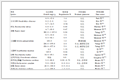
锆石U-Pb年代学和Lu-Hf同位素分析在中国地质调查局天津地质调查中心实验室的193nm激光剥蚀系统(New Wave)和多接收器电感耦合等离子体质谱仪(MC-ICP-MS,Neptune)上完成。U-Pb年代学测试方法见文献(李怀坤等,2009)。采用GJ-1作为外部标准校正锆石的U、Th和Pb同位素分馏;采用NIST610玻璃作为标样计算锆石中U、Th和Pb含量;利用ICPMSDataCal程序(Liu et al., 2010)和Isoplot程序(Ludwig,2003)进行数据处理。分析结果见表 1。Lu-Hf同位素实验过程中,91500的176Hf/177Hf和176Lu/177Hf测定结果分别为0.282303±37(2σ,n=35)和0.00030,亏损地幔模式年龄(tDM)计算采用Griffin et al. (2000)的推荐值,等离子体质谱实验室方法和同位素分馏校正参考文献Wu et al.(2006),分析结果见表 2。
|
表 1 白云山地区斜长花岗岩(样品Tw4027-3)锆石U-Pb定年数据 Table 1 Zircon LA-ICP-MS U-Pb data for the plagiogranite (Sample Tw4027-3) in the Baiyunshan area |
|
|
表 2 白云山地区斜长花岗岩(样品Tw4027-3) Hf同位素特征 Table 2 Hf isotopic composition data for the plagiogranite (Sample Tw4027-3) in the Baiyunshan area |
主量、微量和稀土元素分析在中国地质调查局天津地质调查中心元素分析实验室完成。将样品熔制成玻璃饼,然后采用X射线荧光光谱仪XRF-1500进行主元素测定,分析精度优于1%。称取40mg样品于Tenon罐中,加人HNO3和HF充分溶解后,用1%的HNO3稀释后,在Finigan MAT公司生产的双聚焦电感藕合等离子质谱仪(ICP-MS)ELEMENT上测定微量和稀土元素,分析精度优于5%。分析结果见表 3。
|
|
表 3 白云山地区不同类型蛇绿岩的全岩主量元素(wt%)、微量元素和稀土元素(×10-6)数据 Table 3 Whole-rock major element (wt%) and trace element (×10-6) compositions for the different types of ophiolite in the Baiyunshan area |
斜长花岗岩锆石CL图像中,多呈半自形柱状,长宽比在2:1~1:1之间,生长环带清晰(图 6a),Th/U比值在0.29~0.68,属典型酸性岩岩浆锆石。样品Tw 4027-3共测试24个数据点,全部位于谐和线上,其中23个点(1~18, 20~24)年龄集中,给出的206Pb/238U加权平均年龄为519.8±2.1Ma(图 6b)。由此可见,斜长花岗岩形成于中寒武世。

|
图 6 白云山地区斜长花岗岩锆石CL图像(a)和LA-ICP-MS U-Pb谐和图以及加权年龄平均值(b) Fig. 6 Zircon CL images (a) and U-Pb age concordia diagrams and weighted average 206Pb/238U ages (b) of the plagiogranite in the Baiyunshan area |
白云山地区斜长花岗岩锆石具有正的εHf(t)值(+10.6~+15.0),锆石tDM1为527~708Ma,与锆石tDM2年龄(530~812Ma)相近,且多数锆石模式年龄与结晶年龄非常接近或略早。εHf(t)-t图显示本文发现的斜长花岗岩与侯青叶等(2012)报道的月牙山蛇绿岩中早寒武世斜长花岗岩的投点类似,均在亏损地幔演化线或其附近(图 7)。

|
图 7 白云山及月牙山地区寒武纪斜长花岗岩Hf同位素特征(底图据Guo et al., 2017) Fig. 7 Hf isotopic characteristics of the Cambrian plagiogranites in the Baiyunshan and Yueyashan area(base map after Guo et al., 2017) |
在野外岩石定名和室内岩矿鉴定的基础上,对所采集样品使用QAP及TAS等图解进行判别。对于斜长花岗岩,QAP图解显示样品点落在英云闪长岩范围内Q-P线上(图 8a)。岩石高硅(SiO2=72.10%~74.33%)、富钠(Na2O=6.21%~7.17%)、低钾(K2O=0.16%~0.23%)、高Na2O/K2O比(31.2~38.8)、低FeOT(FeOT=2.53%~3.05%),SiO2-K2O图解显示样品点落入了大洋斜长花岗岩区域内(图 8b),AFM图解显示钙碱性系列的特征(图 8d)。对于基性熔岩,岩石低硅(SiO2=43.06%~49.72%)、相对富钠低钾(Na2O=2.16%~3.84%, K2O=0.04%~0.21%),相对高的FeOT及钛(FeOT=8.43%~10.20%, TiO2=0.81%~1.23%),Mg#在55.4~66.7之间,火山岩TAS图解及AFM图解显示了大多数样品点落在拉斑玄武岩系列的范围内(图 8c, d)。

|
图 8 白云山地区不同类型蛇绿岩的主量元素判别图 (a) QAP分类图解(Streckeisen and Le Maitre,1979);(b) K2O-SiO2变异图(Coleman,1977);(c) TAS diagram(Le Maitre,1989);(d) AFM diagram(Irvine and Baragar, 1971) Fig. 8 The discrimination diagrams based on major elements for the different types of ophiolite in the Baiyunshan area (a) QAP diagram (Streckeisen and Le Maitre, 1979); (b) K2O vs. SiO2 diagram (Coleman, 1977); (c) TAS diagram (Le Maitre, 1989); (d) AFM diagram (Irvine and Baragar, 1971) |
微量元素蛛网图显示,斜长花岗岩具有大离子亲石元素Nb、Ta、Sr、P、Ti亏损,高场强元素Zr、U、Hf富集的特征(图 9a)。Sr、P、Ti亏损可能与斜长石、磷灰石及钛铁矿等矿物的分离结晶有关,高场强元素Zr、U、Hf富集显示了锆石等矿物的形成。基性熔岩具有总体分异较弱,弱的Nb、Ta亏损及Sr正异常的特点(图 9a)。

|
图 9 白云山地区不同类型蛇绿岩的原始地幔标准化微量元素蛛网图(a)和球粒陨石标准化稀土元素配分曲线(b)(标准化值据Sun and McDonough, 1989) Fig. 9 Primitive mantle-normalized trace element spidergrams (a) and chondrite-normalized REE patterns (b) for the different types of ophiolitic mélanges in the Baiyunshan area(normalization values after Sun and McDonough, 1989) |
稀土元素配分曲线显示,斜长花岗岩具有稀土总量低(REE=32.96×10⁻⁶~72.32×10⁻⁶)、轻重稀土元素弱-中等分馏((La/Yb)N=1.35~7.44)、中等Eu负异常(δEu=0.41~0.57)的特征,Eu负异常与斜长石的分离结晶有关(图 9b)。基性熔岩具有稀土总量低(REE=45.80×10⁻⁶~67.67×10⁻⁶)、轻重稀土基本未分馏的特点((La/Yb)N=1.02~1.52),显示了与N-MORB稀土元素含量相近的特点(图 9b)。
5 讨论 5.1 白云山地区蛇绿混杂岩的物质组成及变形特征红柳河-洗肠井蛇绿混杂岩带分布于北山造山带中部,该带从白云山南侧通过(图 1b)。在白云山地区,蛇绿混杂岩表现为整体无序,局部有序的特征,由岩块和基质组成。其中,岩块岩石类型包括辉橄岩、橄辉岩、碳酸盐化超基性岩、辉石岩、辉长岩、玄武岩及斜长花岗岩等蛇绿岩岩块及硅质岩、白云质大理岩等外来岩块;基质主要为蛇纹岩、绿泥钠长片岩及砂板岩基质(图 2)。局部可见堆晶超镁铁质岩-镁铁质岩叠置的层序。蛇纹岩基质中夹杂的岩块主要为辉橄岩、橄辉岩、碳酸盐化超基性岩、辉石岩、辉长岩等;而绿泥片岩基质中则主要发育辉橄岩、碳酸盐化超基性岩、辉长岩、斜长花岗岩及硅质岩等岩块(图 3);砂板岩基质中以玄武岩、橄辉岩及碳酸盐化超基性岩岩块为主(图 4a)。从蛇绿混杂岩的物质组成来看,基质具有分带性,南侧以砂板岩基质为主,北侧以蛇纹岩基质及绿泥钠长片岩基质为主,反映了俯冲增生杂岩的特征。
在蛇绿混杂岩中识别出三期构造变形:第一期表现为韧性剪切变形,主要发育在强糜棱岩化的基质与相对刚性的岩块之间,S-C组构与不对称剪切残斑指示糜棱面理优选方位为北西向(图 4b), 反映了同俯冲构造变形的特征;第二期变形为为脆-韧性变形(D1),形成枢纽近东西向的紧闭褶皱,在玄武岩中表现为透入性片理(图 4b),伴随有低绿片岩相变质,反映了拼贴作用下强烈挤压变形的特征;第三期变形为北东向右型走滑断裂,蛇绿岩边界被错动,在基性熔岩中表现为玄武岩片理膝褶,形成倾伏向为北东向的褶皱枢纽。
5.2 白云山地区寒武纪弧前蛇绿岩的识别蛇绿岩构造环境的识别对于认识洋陆转化过程具有重要的意义(肖庆辉等,2016)。由于大洋板块的俯冲作用,缝合带中保存较好的大多为SSZ型蛇绿岩(史仁灯,2005;Li et al., 2018, 2020),然而,SSZ蛇绿岩可以形成于弧前及弧后等不同构造环境中。近年来,MORB-like玄武岩、玻尼岩、富铌玄武岩及高镁安山岩等弧前岩石组合成为了研究大洋俯冲作用的热点之一(Reagan et al., 2010;Ishizuka et al., 2014;Hickey-Vargas et al., 2018;Li et al., 2020),一般认为MORB-like玄武岩的出现为俯冲作用开始的重要标志(Reagan et al., 2010;Li et al., 2020)。
本次工作在白云山地区新发现的斜长花岗岩具有高Na2O/K2O(31.2~38.8), 具有大洋斜长花岗岩的特点(图 8b),锆石年龄为519.8±2.1Ma,显示其中寒武世的时代特征。εHf(t)-t图上显示了地幔分异的特征,与侯青叶等(2012)在洗肠井地区识别出的寒武纪斜长花岗岩具有类似的同位素特征。由此可见,本文识别的斜长花岗岩为蛇绿岩的组成部分。微量元素蛛网图中Nb-Ta亏损(图 9a)及轻重稀土元素弱-中等分馏((La/Yb)N=1.35~7.44)的右倾配分曲线(图 9b)显示了岛弧岩浆岩的特征。Th/Yb-Nb/Yb图解(图 10a)上样品点落在俯冲晚期的岩浆岩范围内。因此,可以判定白云山地区斜长花岗岩属于岛弧钙碱性岩浆岩。

|
图 10 白云山地区不同类型蛇绿岩的构造背景判别图解 (a) Th/Yb-Nb/Yb图解(Pearce, 2008); (b) Hf/3-Th-Nb/16(Wood, 1980); (c) V-V-Ti/1000图解(Ishizuka et al., 2014); (d) Sc-V图解(Pearce, 2008). A-正常型洋脊拉斑玄武岩;B-异常型洋脊拉斑玄武岩;C-板内碱性玄武岩;D-岛弧玄武岩(钙碱性系列-拉斑玄武岩系列).数据来源:Mariana MORB-like玄武岩来自于Reagan et al. (2010);迪彦庙玄武岩MORB-like来自于Li et al. (2020);太平洋MORB来自于东太平洋PetDB数据库;MORB来自于Jenner and O'Neill (2012) Fig. 10 Discriminant diagrams of tectonic settings of the ophiolitic mélanges in the Baiyunshan area (a) Th/Yb vs. Ta/Yb diagram (Pearce, 2008); (b)Hf/3-Th-Nb/16 diagram (Wood, 1980); (c) Ti vs. V diagram Ishizuka et al., 2014); (d) Sc vs. V diagram (Pearce, 2008). A-Normal oceanic ridge tholeiite; B-Anomalous ridge tholeiite; C-Intraplate alkaline basalt; D-Island arc basalt (Calc-alkaline-tholeiitic series). Data sources: Reagan et al. (2010) for Mariana MORB-like Basalts; Li et al. (2020) for Diyanmiao MORB-like Basalts; Pacific MORB from the East Pacific Rise adopted from PetDB database (http://www.petdb.org/); Jenner and O'Neill (2012) for MORB |
对于被斜长花岗岩侵入的基性熔岩,其Mg#在55.4~66.7之间(平均值为60.9),低于典型的洋中脊玄武岩(N-MORB)(Mg#> 65;Pearce, 1983);TiO2含量在0.81%~1.23%(平均值为1.03),相比MORB(平均值1.5%;Pearce, 1983)偏低,而高于正常的岛弧岩浆岩(平均值0.82%;Ishizuka et al., 2014;肖庆辉等,2016);微量元素蛛网图显示了弱的Nb、Ta亏损及Sr正异常的特点(图 9a),稀土元素配分曲线显示轻重稀土基本未分馏的特点(图 9b),总体反映了兼具MORB与正常岛弧岩浆岩的特征。成因判别Th/Y-Sm/Y图解(图 11a)上,部分样品投点位于原始地幔区,部分样品则落入相对亏损的地幔源区;La/Ba-La/Nb图解(图 11b)上,一部分样品靠近MORB,一部分样品落在俯冲交代的的岩石圈地幔范围内,总体反映了源区比较复杂的特征。构造判别图解Th/Yb-Nb/Yb(图 10a)上,所有样品点均落在弱俯冲区的范围内,与Li et al. (2020)识别的迪彦庙MORB-like玄武岩及Reagan et al.(2010)识别的Mariana MORB-like玄武岩具有类似的分布范围;Hf/3-Th-Nb/16图(图 10b)中,样品投点落在正常洋中脊玄武岩与岛弧玄武岩的界线附近,显示了大洋中脊玄武岩与岛弧玄武岩的特征;V-Ti/1000图解及Sc-V图解(图 10c, d)上,样品具有与迪彦庙MORB-Like玄武岩及Mariana MORB-like玄武岩相似的含量特征。因此,白云山地区基性熔岩为MORB-like玄武岩。

|
图 11 白云山地区不同类型蛇绿岩的岩石成因判别图解(底图据Saunders et al., 1987) (a)Th/Y-Sm/Th图解; (b) La/Ba-La/Nb图解 Fig. 11 Discriminant diagrams of petrogenesis of the ophiolitic mélanges in the Baiyunshan area (base map after Saunders et al., 1987) (a)Th/Y vs. Sm/Th diagram; (b) La/Ba vs. La/Nb diagram |
作为对比,我们对孙立新等(2017)报道的晚寒武世辉长岩(496.4±2.2Ma)相关数据进行了分析:其TiO2含量在0.10%~0.12%,微量元素蛛网图上显示了强烈的Nb-Ta-P-Ti负异常及Sr正异常(图 9a);在Th/Y-Sm/Y及La/Ba-La/ Nb图解(图 11a,b)上,显示其源区具有富集地幔或俯冲交代岩石圈地幔的特征;构造判别图解Th/Yb-Nb/Yb(图 10a)显示了俯冲晚期岩浆岩的特征;Hf/3-Th-Nb/16图解中(图 10b)样品投点均落在岛弧钙碱性玄武岩的范围内,由此可见,晚寒武世辉长岩为典型的岛弧钙碱性岩浆岩。
综上,白云山地区蛇绿混杂岩形成于弧前环境。该蛇绿岩形成于寒武纪,早寒武世发育MORB-like型玄武岩,中-晚寒武世发育岛弧钙碱性辉长岩及斜长花岗岩,反映了从初始俯冲-正常俯冲的岩浆过程(图 12)。

|
图 12 白云山地区红柳河-洗肠井洋盆的俯冲过程 Fig. 12 The subduction process of the Hongliuhe-Xichangjing ocean in the Baiyunshan area |
大量的研究表明,红柳河-洗肠井蛇绿混杂岩的时代分布在早寒武世-晚志留世(于福生等,2006; 张元元和郭召杰,2008;Ao et al., 2012; 侯青叶等,2012;Tian et al., 2014; 胡新茁等,2015;孙立新等,2017; Shi et al., 2018; 本次工作),大多数蛇绿混杂岩具有SSZ蛇绿岩的特征(于福生等,2006;Ao et al., 2012;Tian et al., 2014;Shi et al., 2018)。侯青叶等(2012)认为洗肠井地区寒武纪蛇绿混杂岩为MOR型蛇绿岩,但其所研究的样品中微量元素蛛网图中显示了Nb-Ta负异常,该负异常多与弧岩浆岩有关(Hacker et al., 2011;Castro et al., 2013)。因此,到目前为止,北山造山带中部尚未有可靠的大洋中脊玄武岩(MORB)的报道。
考虑到蛇绿岩北侧的公婆泉岩浆弧的时代集中在526~421Ma(Song et al., 2015;胡新茁等,2015;Yuan et al., 2018),我们认为,洋盆的向北俯冲作用持续到晚志留世。而在蛇绿混杂岩带的南侧,主要出露寒武系西双鹰山组、下奥陶统罗雅楚山组,其沉积环境稳定、泥砂质沉积岩发育的特征显示了稳定的沉积环境(甘肃省地调院,2001①),与塔里木克拉通稳定的早古生代沉积地层的特征一致(舒良树等,2019)。另外,蛇绿岩带南侧缺乏与俯冲相关的岩浆岩。由此可见,洋盆可能并不存在向南的俯冲作用。综上所述,红柳河-洗肠井洋盆具有向北的俯冲极性。
① 甘肃省地调院. 2001. 1/250000马鬃山幅区域地质调查报告.兰州:甘肃省第三地质调查院
6 结论(1) 白云山蛇绿混杂岩由不同类型的岩块与基质组成。基质具有分带性,南侧以砂板岩基质为主,北侧以蛇纹岩基质及绿泥钠长片岩基质为主,反映了俯冲增生杂岩的特征。在蛇绿混杂岩带中识别出俯冲期、拼贴期及隆升走滑期等三期构造变形。
(2) 白云山蛇绿混杂岩中侵入基性熔岩的斜长花岗岩的锆石U-Pb年代学显示蛇绿岩形成于中寒武世,Hf同位素特征显示了地幔分异的特征。
(3) 白云山蛇绿混杂岩形成于弧前环境,早寒武世发育MORB-like型玄武岩,中-晚寒武世发育岛弧钙碱性辉长岩及斜长花岗岩。
致谢 感谢两位匿名审稿人及本刊编辑提出的宝贵意见及建议。本文在野外调查过程中与中国地质调查局天津地质调查中心王惠初、李承东研究员进行了深入的讨论,使作者受益匪浅。
Allen MB, Windley BF and Zhang C. 1993. Palaeozoic collisional tectonics and magmatism of the Chinese Tien Shan, Central Asia. Tectonophysics, 220(1-4): 89-115 DOI:10.1016/0040-1951(93)90225-9 |
Allen MB, Engör AMC and Natal'in BA. 1995. Junggar, Turfan and Alakol basins as Late Permian to Early Triassic extensional structures in a sinistral shear zone in the Altaid orogenic collage, Central Asia. Journal of the Geological Society, 152(2): 327-338 DOI:10.1144/gsjgs.152.2.0327 |
Ao SJ, Xiao WJ, Han CM, Li XH, Qu JF, Zhang JE, Guo QQ and Tian ZH. 2012. Cambrian to Early Silurian ophiolites and accretionary processes in the Beishan collage, NW China:Implications for the architecture of the Southern Altaids. Geological Magazine, 149(4): 606-625 DOI:10.1017/S0016756811000884 |
Castro A, Vogt K and Gerya T. 2013. Generation of new continental crust by sublithospheric silicic-magma relamination in arcs:A test of Taylor's andesite model. Gondwana Research, 23(4): 1554-1566 DOI:10.1016/j.gr.2012.07.004 |
Cheng XY, Teng XJ, Tian J and Duan XL. 2020. Geochemical characteristics, isotopic ages and tectonic environment of Sangejing Formation in Beishan orogenic belt, Inner Mongolia. Geological Bulletin of China, 39(9): 1461-1473 (in Chinese with English abstract) |
Coleman RG. 1977. Ophiolites. Berlin: Heidelberg Springer
|
Coleman RG. 1989. Continental growth of Northwest China. Tectonics, 8(3): 621-635 |
Dilek Y, Furnes H and Shallo M. 2008. Geochemistry of the Jurassic Mirdita Ophiolite (Albania) and the MORB to SSZ evolution of a marginal basin oceanic crust. Lithos, 100(1-4): 174-209 DOI:10.1016/j.lithos.2007.06.026 |
Flower MFJ and Dilek Y. 2003. Arc-trench rollback and forearc accretion:1. A collision-induced mantle flow model for Tethyan ophiolites. In:Dilek Y and Robinson PT (eds.). Ophiolites in Earth History. Geological Society, London, Special Publications, 218(1):21-41
|
Griffin WL, Pearson NJ, Belousova E, Jackson SE, van Achterbergh E, O'Reilly SY and Shee SR. 2000. The Hf isotope composition of cratonic mantle:LAM-MC-ICPMS analysis of zircon megacrysts in kimberlites. Geochimica et Cosmochimica Acta, 64(1): 133-147 DOI:10.1016/S0016-7037(99)00343-9 |
Guo QQ, Xiao WJ, Hou QL, Windley BF, Han CM, Tian ZH and Song DF. 2014. Construction of Late Devonian Dundunshan arc in the Beishan orogen and its implication for tectonics of southern Central Asian Orogenic Belt. Lithos, 184-187: 361-378 DOI:10.1016/j.lithos.2013.11.007 |
Guo QQ, Chung SL, Xiao WJ, Hou QL and Li S. 2017. Petrogenesis and tectonic implications of Late Devonian arc volcanic rocks in southern Beishan orogen, NW China:Geochemical and Nd-Sr-Hf isotopic constraints. Lithos, 278-281: 84-96 DOI:10.1016/j.lithos.2017.01.017 |
Hacker BR, Kelemen PB and Behn MD. 2011. Differentiation of the continental crust by relamination. Earth and Planetary Science Letters, 307(3-4): 501-516 DOI:10.1016/j.epsl.2011.05.024 |
Hickey-Vargas R, Yogodzinski GM, Ishizuka O, McCarthy A, Bizimis M, Kusano Y, Savov IP and Arculus R. 2018. Origin of depleted basalts during subduction initiation and early development of the Izu-Bonin-Mariana island arc:Evidence from IODP expedition 351 site U1438, Amami-Sankaku basin. Geochimica et Cosmochimica Acta, 229: 85-111 DOI:10.1016/j.gca.2018.03.007 |
Hou QY, Wang Z, Liu JB, Wang J and Li DP. 2012. Geochemistry characteristics and SHRIMP dating of Yueyashan ophiolite in Beishan Orogen. Geoscience, 26(5): 1008-1018 (in Chinese with English abstract) |
Hu XZ, Zhao GC, Hu XY, Liao YF and Cheng HF. 2015. Geological characteristics, formation epoch and geotectonic significance of the Yueyashan ophiolitic tectonic mélange in Beishan area, Inner Mongolia. Geological Bulletin of China, 34(2-3): 425-436 (in Chinese with English abstract) |
Irvine TN and Baragar WRA. 1971. A guide to the chemical classification of the common volcanic rocks. Canadian Journal of Earth Sciences, 8(5): 523-548 |
Ishizuka O, Tani K and Reagan MK. 2014. Izu-Bonin-Mariana forearc crust as a modern ophiolite analogue. Elements, 10(2): 115-120 |
Jahn BM, Wu FY and Chen B. 2000. Granitoids of the Central Asian Orogenic Belt and continental growth in the Phanerozoic. Earth and Environmental Science Transactions of the Royal Society of Edinburgh, 91(1-2): 181-193 DOI:10.1017/S0263593300007367 |
Jenner FE and O'Neill HSC. 2012. Analysis of 60 elements in 616 ocean floor basaltic glasses. Geochemistry, Geophysics, Geosystems, 13(2): Q02005 |
Le Maitre RW. 1989. A Classification of Igneous Rocks and Glossary of Terms. Oxford: Blackwell
|
Li HK, Geng JZ, Hao S, Zhang YQ and Li HM. 2009. Study on the using LA-MC-ICPMS to date the U-Pb isotopic age of zircons. Acta Mineralogica Sinica, 29(Suppl.l): 600-601 (in Chinese) |
Li XM, Yu JY, Wang GQ, Wu P and Zhou ZQ. 2011. LA-ICP-MS zircon U-Pb dating of Devonian Sangejing Formation and Dundunshan Group in Hongliuyuan, Beishan area, Gansu Province. Geological Bulletin of China, 30(10): 1501-1507 (in Chinese with English abstract) |
Li XM, Yu JY, Wang GQ and Wu P. 2012. Geochronology of Jijitaizi ophiolite in Beishan area, Gansu Province, and its geological significance. Geological Bulletin of China, 31(12): 2025-2031 (in Chinese with English abstract) |
Li YJ, Wang GH, Santosh M, Wang JF, Dong PP and Li HY. 2018. Supra-subduction zone ophiolites from Inner Mongolia, North China:Implications for the tectonic history of the southeastern Central Asian Orogenic Belt. Gondwana Research, 59: 126-143 DOI:10.1016/j.gr.2018.02.018 |
Li YJ, Wang GH, Santosh M, Wang JF, Dong PP and Li HY. 2020. Subduction initiation of the SE Paleo-Asian Ocean:Evidence from a well preserved intra-oceanic forearc ophiolite fragment in central Inner Mongolia, North China. Earth and Planetary Science Letters, 535: 116087 DOI:10.1016/j.epsl.2020.116087 |
Liu YS, Gao S, Hu ZC, Gao CG, Zong KQ and Wang DB. 2010. Continental and oceanic crust recycling-induced melt-peridotite interactions in the Trans-North China Orogen:U-Pb dating, Hf isotopes and trace elements in zircons from mantle xenoliths. Journal of Petrology, 51(1-2): 537-571 DOI:10.1093/petrology/egp082 |
Ludwig KR. 2003. User's Manual for Isoplot 3.00:A Geochronological Toolkit for Microsoft Excel. Berkeley: Berkeley Geochronology Center
|
Mao QG, Xiao WJ, Windley BF, Han CM, Q u, J F, Ao SJ, Zhang JE and Guo QQ. 2012. The Liuyuan complex in the Beishan, NW China:A Carboniferous-Permian ophiolitic fore-arc sliver in the southern Altaids. Geological Magazine, 149(3): 483-506 DOI:10.1017/S0016756811000811 |
Niu YZ, Song B, Zhou JL, Xu W, Shi JZ, Zhang YX and Lu JC. 2020. Lithofacies and chronology of volcano-sedimentary sequence in the southern Beishan Region, Central Asian Orogenic Belt and its paleogeographical implication. Acta Geologica Sinica, 94(2): 615-633 (in Chinese with English abstract) |
Pearce JA. 1983. Role of the sub-continental lithosphere in magma genesis at active continental margins. In: Hawkesworth CJ and Norry MJ (eds.). Continental Basalts and Mantle Xenoliths. Nantwich: Shiva, 230-249
|
Pearce JA. 2008. Geochemical fingerprinting of oceanic basalts with applications to ophiolite classification and the search for Archean oceanic crust. Lithos, 100(1-4): 14-48 DOI:10.1016/j.lithos.2007.06.016 |
Reagan MK, Ishizuka O, Stern RJ, Kelley KA, Ohara Y, Blichert-Toft J, Bloomer SH, Cash J, Fryer P, Hanan BB, Hickey-Vargas R, Ishii T, Kimura JI, Peate DW, Rowe MC and Woods M. 2010. Fore-arc basalts and subduction initiation in the Izu-Bonin-Mariana system. Geochemistry, Geophysics, Geosystems, 11(3): Q03X12 |
Saunders AD, Rogers G, Marriner GF, Terrell DJ and Verma SP. 1987. Geochemistry of Cenezoic volcanic rocks, Baja California, Mexico:Implications for the petrogenesis of post-subduction magmas. Journal of Volcanology and Geothermal Research, 32(1-3): 223-245 DOI:10.1016/0377-0273(87)90046-1 |
Şengör AMC, Natal'in BA and Burtman VS. 1993. Evolution of the Altaid tectonic collage and Palaeozoic crustal growth in Eurasia. Nature, 364(6435): 299-307 |
Shi RD. 2005. Comment on the progress in and problems on ophiolite study. Geological Review, 51(6): 681-693 (in Chinese with English abstract) |
Shi YR, Zhang W, Kröner A, Li LL and Jian P. 2018. Cambrian ophiolite complexes in the Beishan area, China, southern margin of the Central Asian Orogenic Belt. Journal of Asian Earth Sciences, 153: 193-205 |
Shu LS, Deng XL and Ma XX. 2019. Tectonic affinity between central Tianshan basement and Tarim block craton. Earth Science, 44(5): 1584-1601 (in Chinese with English abstract) |
Song DF, Xiao WJ, Han CM and Tian ZH. 2013a. Geochronological and geochemical study of gneiss-schist complexes and associated granitoids, Beishan Orogen, southern Altaids. International Geology Review, 55(14): 1705-1727 |
Song DF, Xiao WJ, Han CM, Li JL, Qu JF, Guo QQ, Lin LN and Wang ZM. 2013b. Progressive accretionary tectonics of the Beishan orogenic collage, southern Altaids:Insights from zircon U-Pb and Hf isotopic data of high-grade complexes. Precambrian Research, 227: 368-388 |
Song DF, Xiao WJ, Windley BF, Han CM and Tian ZH. 2015. A Paleozoic Japan-type subduction-accretion system in the Beishan orogenic collage, southern Central Asian Orogenic Belt. Lithos, 224-225: 195-213 |
Streckeisen AL and Le Maitre RW. 1979. A chemical approximation to the modal QAPF classification of the igneous rocks. Neues Jahrbuch fur Mineralogie, Abhandlungen, 136: 169-206 |
Sun LX, Zhang JH, Ren BF, Niu WC, Ren YW and Zhang K. 2017. Geochemical characteristics and U-Pb age of Baiyunshan ophiolite mélange in the Beishan orogenic belt and their geological implications. Acta Petrologica et Mineralogica, 36(2): 131-147 (in Chinese with English abstract) |
Sun SS and McDonough WF. 1989. Chemical and isotopic systematics of oceanic basalts:Implications for mantle composition and processes. In:Saunders AD and Norry MJ (eds.). Magmatism in the Ocean Basins. Geological Society, London, Special Publication, 42(1):313-345
|
Tian J, Duan XL and Cheng XY. 2020a. Source characteristics of the Late Silurian-Early Devonian intrusive rocks in the central part of the Beishan orogenic belt, NW China. Geological Survey and Research, 43(3): 207-211 (in Chinese with English abstract) |
Tian J, Xin HT, Teng XJ, Duan XL, Cheng XY, Zhang Y and Ren BF. 2020b. The determination of volcanic rocks in Upper Devonian Dundunshan Formation in the Baiyunshan area of Beishan orogenic belt, Inner Mongolia. Acta Petrologica Sinica, 36(2): 509-525 (in Chinese with English abstract) |
Tian ZH, Xiao WJ, Windley BF, Lin LN, Han CM, Zhang JE, Wan B, Ao SJ, Song DF and Feng JY. 2014. Structure, age, and tectonic development of the Huoshishan-Niujuanzi ophiolitic mélange, Beishan, southernmost Altaids. Gondwana Research, 25(2): 820-841 |
Wang GQ, Li XM, Xu XY, Yu JY and Wu P. 2014. Ziron U-Pb chronological study of the Hongshishan ophiolite in the Beishan area and their tectonic significance. Acta Petrologica Sinica, 30(6): 1685-1694 (in Chinese with English abstract) |
Windley BF, Allen MB, Zhang C, Zhao ZY and Wang GR. 1990. Paleozoic accretion and Cenozoic redeformation of the Chinese Tien Shan Range, Central Asia. Geology, 18(2): 128-131 |
Windley BF, Alexeiev D, Xiao WJ, Kröner A and Badarch G. 2007. Tectonic models for accretion of the Central Asian Orogenic Belt. Journal of the Geological Society, 164(1): 31-47 |
Wood DA. 1980. The application of a Th-Hf-Ta diagram to problems of tectonomagmatic classification and to establishing the nature of crustal contamination of basaltic lavas of the British Tertiary volcanic province. Earth and Planetary Science Letters, 50(1): 11-30 |
Wu FY, Yang YH, Xie LW, Yang JH and Xu P. 2006. Hf isotopic compositions of the standard zircons and baddeleyites used in U-Pb geochronology. Chemical Geology, 234(1-2): 105-126 |
Wu P, Wang GQ, Li XM, Yu JY and Kang L. 2012. The age of Niujuanzi ophiolite in Beishan area of Gansu Province and its geological significance. Geological Bulletin of China, 31(12): 2032-2037 (in Chinese with English abstract) |
Wu TR, Zheng RG, Zhang W, Feng JC and Xu C. 2011. Tectonic framework of Beishan Mountain-northern Alxa Area and the time constraints for the closing of the Paleo-Asian Ocean. In: Proceedings of the Fifth Workshop on 1: 5000000 International Geological Map of Asia. Beijing, 95-98
|
Xiao QH, Li TD, Pan GT, Lu SN, Ding XZ, Deng JF, Feng YM, Liu Y, Kou CH and Yang LL. 2016. Petrologic ideas for identification of ocean-continent transition:Recognition of intra-oceanic arc and initial subduction. Geology in China, 43(3): 721-737 (in Chinese with English abstract) |
Xiao W, Windley BF, Badarch G, Sun S, Li J, Qin K and Wang Z. 2004. Palaeozoic accretionary and convergent tectonics of the southern Altaids:Implications for the growth of Central Asia. Journal of the Geological Society, 161(3): 339-342 |
Xiao WJ, Mao QG, Windley BF, Han CM, Qu JF, Zhang JE, Ao SJ, Guo QQ, Cleven NR, Lin SF, Shan YH and Li JL. 2010. Paleozoic multiple accretionary and collisional processes of the Beishan orogenic collage. American Journal of Science, 310(10): 1553-1594 |
Xiao WJ and Santosh M. 2014. The western Central Asian Orogenic Belt:A window to accretionary orogenesis and continental growth. Gondwana Research, 25(4): 1429-1444 |
Xu XY, He SP, Wang HL, Cheng JL, Zhang EP and Feng YM. 2008. Introduction to Geology in Northwest China. Beijing: Science Press (in Chinese)
|
Yang FL, Zhao ZX, Jia WY, Yang L, Xu H, Jia YQ and Gao Y. 2016. Discussion on the forming age of the Beishan Group in the Beishan area, Inner Mongolia. Geological Survey and Research, 39(2): 89-94 (in Chinese with English abstract) |
Yang HQ, Li Y, Zhao GB, Li WY, Wang XH, Jiang HB, Tan WJ and Sun NY. 2010. Character and structural attribute of the Beishan ophiolite. Northwestern Geology, 43(1): 26-36 (in Chinese with English abstract) |
Yu FS, Wang CY, Qi JF and Wang T. 2000. The clarification and tectonic implication of the Early Silurian ophiolite mélange in Hongliuhe area. Journal of Mineralogy and Petrology, 20(4): 60-66 (in Chinese with English abstract) |
Yu FS, Li JB and Wang T. 2006. The U-Pb isotopic age of zircon from Hongliuhe ophiolites in East Tianshan Mountains, Northwest China. Acta Geoscientia Sinica, 27(3): 213-216 (in Chinese with English abstract) |
Yu JY, Li XG, Wang GQ, Wu P and Yan QJ. 2012. Zircon U-Pb ages of Huitongshan and Zhangfangshan ophiolite in Beishan of Gansu-Inner Mongolia border area and their significance. Geological Bulletin of China, 31(12): 2038-2045 (in Chinese with English abstract) |
Yuan Y, Zong KQ, He ZY, Klemd R, Jiang HY, Zhang W, Liu YS, Hu ZC and Zhang ZM. 2018. Geochemical evidence for Paleozoic crustal growth and tectonic conversion in the Northern Beishan Orogenic Belt, southern Central Asian Orogenic Belt. Lithos, 302-303: 189-202 |
Zhang W, Pease V, Wu TR, Zheng RG, Feng JC, He YK, Luo HL and Xu C. 2012. Discovery of an adakite-like pluton near Dongqiyishan (Beishan, NW China):Its age and tectonic significance. Lithos, 142-143: 148-160 |
Zhang YY and Guo ZJ. 2008. Accurate constraint on formation and emplacement age of Hongliuhe ophiolite, boundary region between Xinjiang and Gansu provinces and its tectonic implication. Acta Petrologica Sinica, 24(4): 803-809 (in Chinese with English abstract) |
程先钰, 滕学建, 田健, 段霄龙. 2020. 内蒙古北山造山带三个井组地球化学特征、同位素年龄及其构造环境. 地质通报, 39(09): 1461-1473. |
侯青叶, 王忠, 刘金宝, 王瑾, 李大鹏. 2012. 北山月牙山蛇绿岩地球化学特征及SHRIMP定年. 现代地质, 26(5): 1008-1018. |
胡新茁, 赵国春, 胡新悦, 廖云峰, 程海峰. 2015. 内蒙古北山地区月牙山蛇绿质构造混杂岩带地质特征、形成时代及大地构造意义. 地质通报, 34(2-3): 425-436. |
李怀坤, 耿建珍, 郝爽, 张永清, 李惠民. 2009. 用激光烧蚀多接收器等离子体质谱仪(LA-MC-ICPMS)测定锆石U-Pb同位素年龄的研究. 矿物学报, 29(增1): 600-601. |
李向民, 余吉远, 王国强, 武鹏, 周志强. 2011. 甘肃北山红柳园地区泥盆系三个井组和墩墩山群LA-ICP-MS锆石U-Pb测年及其意义. 地质通报, 30(10): 1501-1507. |
李向民, 余吉远, 王国强, 武鹏. 2012. 甘肃北山地区芨芨台子蛇绿岩LA-ICP-MS锆石U-Pb测年及其地质意义. 地质通报, 31(12): 2025-2031. |
牛亚卓, 宋博, 周俊林, 许伟, 史冀忠, 张宇轩, 卢进才. 2020. 中亚造山带北山南部下泥盆统火山-沉积地层的岩相、时代及古地理意义. 地质学报, 94(2): 615-633. |
史仁灯. 2005. 蛇绿岩研究进展、存在问题及思考. 地质论评, 51(6): 681-693. |
舒良树, 邓兴梁, 马绪宣. 2019. 中天山基底与塔里木克拉通的构造亲缘性. 地球科学, 44(5): 1584-1601. |
孙立新, 张家辉, 任邦方, 牛文超, 任云伟, 张阔. 2017. 北山造山带白云山蛇绿混杂岩的地球化学特征、时代及地质意义. 岩石矿物学杂志, 36(2): 131-147. |
田健, 段霄龙, 程先钰. 2020a. 北山造山带中部晚志留世-早泥盆世侵入岩源区特征及其反映的陆壳增生机制. 地质调查与研究, 43(3): 207-211. |
田健, 辛后田, 滕学建, 段霄龙, 程先钰, 张永, 任邦方. 2020b. 内蒙古北山造山带白云山地区上泥盆统墩墩山组火山岩的厘定及其构造意义. 岩石学报, 36(2): 509-525. |
王国强, 李向民, 徐学义, 余吉远, 武鹏. 2014. 甘肃北山红石山蛇绿岩锆石U-Pb年代学研究及构造意义. 岩石学报, 30(6): 1685-1694. |
武鹏, 王国强, 李向民, 余吉远, 康磊. 2012. 甘肃北山地区牛圈子蛇绿岩的形成时代及地质意义. 地质通报, 31(12): 2032-2037. |
肖庆辉, 李廷栋, 潘桂棠, 陆松年, 丁孝忠, 邓晋福, 冯益民, 刘勇, 寇彩化, 杨琳琳. 2016. 识别洋陆转换的岩石学思路——洋内弧与初始俯冲的识别. 中国地质, 43(3): 721-737. |
徐学义, 何世平, 王洪亮, 陈隽璐, 张二朋, 冯益民. 2008. 中国西北部地质概论. 北京: 科学出版社.
|
杨富林, 赵志雄, 贾文艳, 杨亮, 许海, 贾元琴, 高勇. 2016. 内蒙古北山地区北山岩群形成时代探讨. 地质调查与研究, 39(2): 89-94. |
杨合群, 李英, 赵国斌, 李文渊, 王小红, 姜寒冰, 谭文娟, 孙南一. 2010. 北山蛇绿岩特征及构造属性. 西北地质, 43(1): 26-36. |
于福生, 王春英, 漆家福, 王涛. 2000. 甘新交界红柳河地区早志留世蛇绿混杂岩的厘定及大地构造意义. 矿物岩石, 20(4): 60-66. |
于福生, 李金宝, 王涛. 2006. 东天山红柳河地区蛇绿岩U-Pb同位素年龄. 地球学报, 27(3): 213-216. |
余吉远, 李向民, 王国强, 武鹏, 闫巧娟. 2012. 甘肃北山地区辉铜山和帐房山蛇绿岩LA-ICP-MS锆石U-Pb年龄及地质意义. 地质通报, 31(12): 2038-2045. |
张元元, 郭召杰. 2008. 甘新交界红柳河蛇绿岩形成和侵位年龄的准确限定及大地构造意义. 岩石学报, 24(4): 803-809. |