 2020, Vol. 36


2. 中国科学院西北生态环境资源研究院, 兰州 730000;
3. 中国地震台网中心, 北京 100045
2. Northwest institute of Eco-Environment and Resources, Chinese Academy of Sciences, Lanzhou 730000, China;
3. China Earthquake Networks Center, Beijing 100045, China
受印度板块持续的向北推移和欧亚大陆阻挡的双重影响,青藏高原长期处于近南北向的挤压环境,发生在高原内部和各块体边界的构造变形主要表现为向北推移、缩短加厚,以及向东挤出等(钟大赉和丁林, 1996; Tapponnier et al., 2001;许志琴等, 2013)。新生代早期以来,青藏高原向东挤出导致了川滇菱形块体的形成。受到华南块体的阻挡,川滇菱形块体向南南东方向逃逸,并围绕喜马拉雅东构造结顺时针旋转(邓起东等, 2002;张培震, 2008)。川滇块体是青藏高原东缘侧向挤出最强也是最具代表性的活动块体。现如今,川滇地区地面高程变化剧烈、深大断裂纵横展布、强震频发,是高原物质向东和东南逃逸的主要通道(徐锡伟等, 2005;吴中海等, 2015;朱介寿等, 2017)。川滇块体的西北边界金沙江断裂是一条多期活动的缝合线,其中北段被认为属于晚更新世-全新世活动段,第四纪时期因受青藏高原挤出运动的影响而表现出右旋走滑兼逆冲性质(王二七等, 2018);川滇菱形块体的西南边界红河断裂带是一条右旋走滑断裂(许志琴等, 2012;邓起东等, 2002;徐锡伟等, 2003)。金沙江-红河断裂带内地热活动强烈,有大量温泉出露,为深部流体运移提供有利条件(Tang et al., 2017)。
美国圣安地列斯断裂(Kulongoski et al., 2013),土耳其北安纳托利亚断裂(Italiano et al., 2009)和日本大量非火山断裂地区(Umeda and Ninomiya, 2009)等温泉气体氦同位素和碳同位素时空变化与断裂活动之间的关系研究结果显示,断裂活动强列区域是深部物质运移的良好通道;活动断裂带内温泉气体氦同位素比值较高的区域,其深部通常存在明显的高导低速区。因此,活动断裂带温泉气体氦同位素和碳同位素时空变化调查结果,可以定量地获得不同比例幔源氦和二氧化碳的时空变化特征(Zmazek et al., 2002),进而研究活动断裂带的活动性与温泉气体中幔源氦和二氧化碳的关系。
迄今为止,青藏高原已经开展了大量温泉气氦同位素和碳同位素的调查研究,为深刻理解区域构造地质特征提供了有益参考。例如,青藏高原中部和南部的温泉研究结果表明,青藏高原中部存在大量的深部流体上涌(Yokoyama et al., 1999; Newell et al., 2008; Luo et al., 2014)。青藏高原东缘鲜水河断裂、安宁河断裂和理塘断裂,以及通关火山和腾冲火山的研究发现,在通关火山和腾冲火山以及康定地区有大量的深部物质上涌现象(赵慈平等, 2012;郭正府等, 2014; Zhou et al., 2015, 2017)。由于地质条件复杂,对金沙江-红河断裂带还没有进行深入的温泉气调查研究,为了探讨该断裂带是否也存在深部流体上涌现象及其可能的时空变化,近几年对其进行了系统的温泉气体地球化学研究,并为金沙江-红河断裂带未来温泉气体地球化学地震监测、矿产资源评价,以及环境研究提供基础数据。
1 地质概况金沙江-哀牢山缝合带夹持于西侧兰坪-思茅地块(北印支地块)与东侧华南板块之间,总体呈北西-南东向展布,包括北段金沙江缝合带和南段哀牢山缝合带两个分支;其分别经历了前寒武纪-志留纪时期的原特提斯旋回、泥盆纪-三叠纪的古特提斯旋回、二叠纪-白垩纪的中特提斯旋回(侯增谦等, 2004;许志琴等, 2012)及新生代时期的新特提斯旋回(Deng et al., 2014)。始于新生代的印度-欧亚大陆碰撞造山过程分为主碰撞(65~41Ma)、晚碰撞(40~26Ma)和后碰撞(25~0Ma)3个阶段;其中,晚碰撞造山作用发生于印度与亚洲大陆的持续汇聚和SN向挤压背景之下,青藏高原东缘主要是以大规模走滑剪切为特征(侯增谦等, 2006),以青藏高原东缘三江地区表现最为显著,发育了一系列由北北西至南北向深大断裂组成的大规模走滑断裂系统,即著名的金沙江-红河走滑断裂系统(侯增谦等, 2004; 2006; Xu et al., 2012)。沿走滑断裂广泛发育新生代富碱侵入岩和钾质火山岩,构成著名的长达~1000km的金沙江-红河富碱岩浆岩带(简平等, 1999;侯增谦等, 2004, 2006)。金沙江-红河断裂带带内大型Au矿带(63~28Ma)受大规模走滑剪切作用控制,受控于统一的深部作用过程,与软流圈上涌导致的幔源或壳/幔混源岩浆活动密切相关(侯增谦等, 2006)。金沙江断裂带曾经是一条强烈活动的超岩石圈断裂带,也是切穿整个地壳深入地幔的巨型深断裂带。红河断裂带北起青藏高原东部,斜贯云南及越南北部,向东南延伸进入南海海域,总体呈北西-北西西走向,长达1000余千米,是我国西南地区地质时期最为重要的一级构造单元边界断裂带(武精凯等, 2019)。
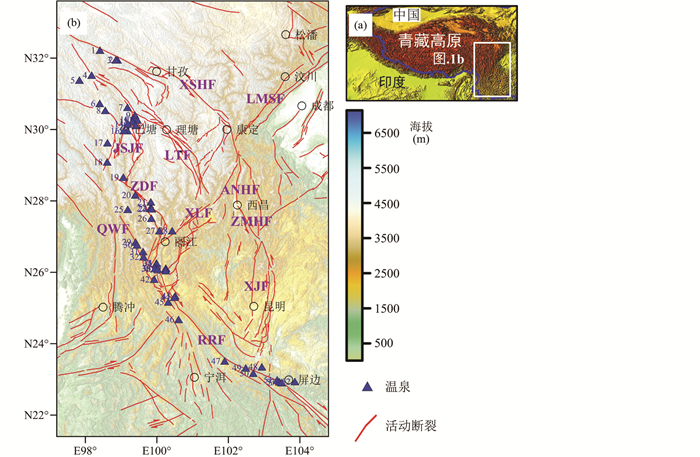
2 测量方法2015年3月~2019年7月,经过5次考察,在金沙江-红河断裂带内采集54个温泉气体样品(图 1、表 1),温泉气体采样容器为500mL的玻璃瓶,野外现场利用排水取气法采集。温泉气样品的N2、H2、CO2、O2、CH4和Ar组分使用Agilent Macro 3000便气相色谱仪实验室测量,测量精度估计如下:其含量1%~100%时相对标准偏差 < 0.5%,含量0.01%~1%时相对标准偏差 < 1%,含量0.001%~0.01%时相对标准偏差 < 2%,而含量0.0001%~0.001%时相对标准偏差 < 5%(Zhou et al., 2015)。温泉气样品中He、Ne和C同位素是在中国科学院西北生态环境资源研究院油气资源研究中心分析测试量的,温泉气He、Ne和Ar的浓度以及同位素使用Noblesse稀有气体同位素质谱仪进行分析,氦同位素测量中R值在1×10⁻⁷以上时,测试误差是±10%,在1×10⁻⁸~1×10⁻⁷的测量数据误差是±15%(Cao et al., 2018)。碳同位素比值是用Delta Plus XL质谱计分析完成的,该仪器由美国Thermo Finnigan公司制造,由HP6890气相色谱、燃烧/转换炉、接口和DeltaPlusXP质谱计组成;稳定碳同位素组成用δ13C表示;13C/12C的精度为0.6‰(Li et al., 2014)。
|
图 1 金沙江-红河断裂温泉气体采样点分布图 (a)青藏高原地形图;(b)川滇地形图和采样点位置图,活动断裂据吴熙彦等(2018) Fig. 1 Location of sampling sites of hot spring gas along Jinshajiang-Red River fault (a) topographic map of the Tibetan Plateau; (b) topographic map of the study area are shown in Fig. 1a, active faults after Wu et al. (2018). Location of gas sampling sites of hot spring gas along Jinshajiang-Red River fault. Abbreviations: JSJF-Jinshajiang fault; RRF-Red River fault; LTF-Litang fault; XSHF-Xianshuihe fault; LMSF-Longmenshan fault; BTF-Batang fault; XLF-Xiaojinhe-Lijiang fault; Qiaohou-Weixi fault-QWF; Zhongdian fault-ZDF; Anninghe falult-ANF; Zemuhe fault-ZMHF. Blue triangles represent as hot springs |
|
表 1 金沙江-红河断裂带温泉点位置以及周围出露岩性 Table 1 Location of sampling sites of hot spring gas along JSJ-RRF and adjacent outcrop of rock |
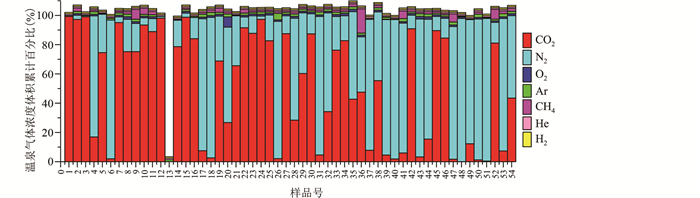
从温泉气体的浓度数据可以看出(表 2、图 2),根据气体主要组分可以将温泉划分成两大类型,第一类是CO2浓度为主要组成部分,有28个温泉,CO2浓度平均值大于50%,其范围是54.42%~99.32%。第二类是N2为主要组成部分的温泉,有23个温泉,其温泉气中N2浓度平均值的范围是55.34%~97.90%。所有温泉气中He的浓度平均值范围是1.1×10⁻⁶~1587×10-6,H2的浓度平均值范围是1.7×10⁻⁶~514.0×10⁻⁶,CH4的浓度平均值范围是0.01%~15.54%。3He/4He(R/Ra)值的平均值分布范围是0.04~0.62,δ13CCO2(PDB)值的平均值分布范围为-23.6‰~-2.9‰,δ13CCH4(PDB)值分布范围为-63.7‰~-14.1‰(表 2)。
|
|
表 2 金沙江-红河断裂带温泉气体化学组分、氦和碳同位素数据表 Table 2 Chemical compositions, helilum and carbon isotopes in hot spring gas from the JSJ-RRF |
|
图 2 温泉气体组分浓度累计体积百分比 Fig. 2 Cumulative volume percentage of concentration of hot spring gas |
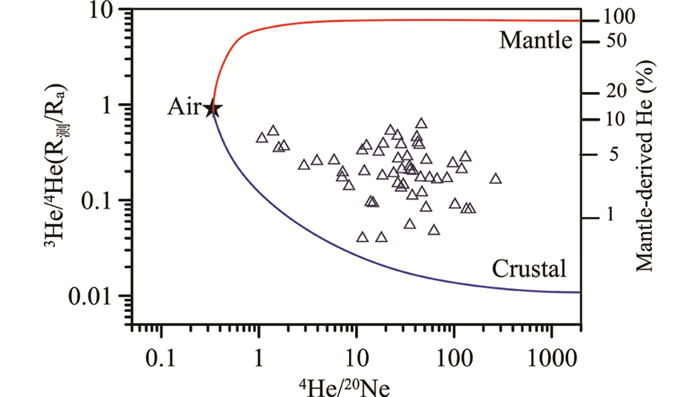
金沙江-红河断裂带温泉气样品的3He/4He值均小于0.7Ra,表现出典型壳源氦的特征。幔源、壳源和空气中的He各自具有特征的3He/4He比值,分别为(1.1×10-5~1.4×10-5、2×10-8和1.39×10-6(Mamyrin et al., 1970; Ozima and Podosek, 1983)。对3He/4He值进行大气校正(Rc/Ra)后可以计算出幔源He的百分比(Sano and Wakita, 1985)。金沙江-红河断裂带温泉幔源氦的比例平均值范围是0~7.5%,因此,温泉气体中氦主要是地壳来源(图 3、表 2)。有29个温泉气体中有明显的幔源氦(平均值>2%)(表 2)。在火山地区很容易能观察到大量的幔源氦,如腾冲火山(赵慈平等, 2012)和五大连池火山(Xu et al., 2013),然而,在金沙江-红河断裂带没有新生代的活火山,不可能是火山地区幔源氦释放。金沙江-红河断裂带为幔源氦向上运移提供了很好的通道;幔源氦沿着深大断裂向上运移过程中,被来自壳源氦的稀释,这个现象在鲜水河断裂带也同样观察到(Zhou et al., 2015)。另外,金沙江-红河断裂带内广泛发育的新生代富碱侵入岩和钾质火山岩锂含量范围在4.7×10⁻⁶~33.2×10⁻⁶(Tran et al., 2014),幔源氦也不可能是6Li的衰变产生的3He和核弹爆炸过程中氚衰变产生的3He(Yokoyama et al., 1999)。在金沙江-红河断裂带氦同位素相对较高的区域是幔源氦沿断裂向上逸散到地表的结果。
|
图 3 54个温泉气体中3He/4He与4He/20Ne比值平均值的关系图 不同端元的值:空气(3He/4He=1.4×10-6, 4He/20Ne=0.318);地幔(3He/4He=12×10-6, 4He/20Ne=100, 000);地壳(3He/4He=0.02×10-6, 4He/20Ne=100, 000)(据Ozima and Podosek, 1983; Ballentine et al., 2005) Fig. 3 Plot of 3He/4He vs. 4He/20Ne average ratios in 54 samples of hot spring gas Mixing lines between the atmosphere and upper mantle and the atmosphere and crust were calculated using the end members: air (3He/4He=1.4×10-6, 4He/20Ne=0.318), upper mantle (3He/4He=12×10-6, 4He/20Ne=100, 000), old continental crust (3He/4He=0.02×10-6, 4He/20Ne=100, 000) (after Ozima and Podosek, 1983; Ballentine et al., 2005) |
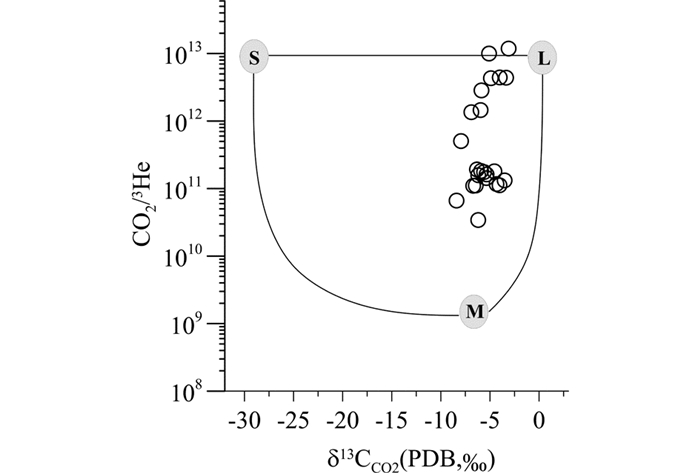
温泉气含碳化合物的碳同位素组成包含丰富的重要信息(Hilton, 1996; Kulongoski et al., 2013)。大量研究结果显示,有机成因CO2的δ13CCO2一般都 < -10‰,主要分布在-30‰~-10‰之间;无机成因二氧化碳的δ13CCO2一般重于-8‰,主要分布在-8‰~+3‰之间。无机成因二氧化碳中,由碳酸盐岩变质成因二氧化碳的δ13CCO2值接近于碳酸盐岩的δ13CCO2值,在0±3‰左右,火山-岩浆成因和幔源成因二氧化碳的δ13CCO2=-6‰±2‰(Javoy et al., 1986; Sano and Marty, 1995)。温泉气体中各种来源的CO2的碳同位素存在重叠,不能通过碳同位素直接得出CO2的主要来源,另外,温泉气体中的二氧化碳在物理化学过程中相比氦有更多同位素分馏(Hilton, 1996)。利用δ13CCO2与CO2/3He的比值的关系来解析CO2的来源是经常使用的方法(图 4)(Sano and Marty, 1995; Barry et al., 2013)。温泉气体中的CO2来源主要分成3个来源端元,分别是幔源(M):CO2/3He=2×109,δ13C=-6.5‰;灰岩来源(L):CO2/3He=1×1013,δ13C=0‰;和沉积有机质来源(S):CO2/3He=1×1013,δ13C=-6.5‰(Sano and Marty, 1995; Marty and Jambon, 1987; O'Nions and Oxburgh, 1988)。利用以上方法计算温泉气体中不同来源CO2时,以下两种情况的温泉气体不适合,一是温泉气体中主要组分是氮气的点;二是温泉气体中CO2因方解石沉淀而损失(Ray et al., 2009),浓度平均值低于75%的点,金沙江-红河断裂带温气体中CO2定量计算结果见表 3。金沙江-红河断裂带温气体中CO2幔源组成比例平均值范围是0.01%~4.2%,灰岩来源范围是66.9%~93.7%,有机成因来源6.3%~31.6%。这表明金沙江-红河断裂带温泉气体中主要组成是CO2的点,其CO2主要来自三叠纪碳酸盐岩热分解以及碳酸盐岩的溶解(尹福光等, 2014)。在川西理塘断裂和鲜水河断裂的温泉气体中CO2也是主要来自灰岩的热解,比例超过80%(Zhou et al., 2015, 2017)。大量的温泉位于中生代灰岩区(尹福光等, 2014),而二氧化碳浓度低,N2浓度高的点多位于金沙江蛇绿岩区和哀牢山混合岩区(尹福光等, 2014)。
|
图 4 温泉气体中CO2/3He-δ13CCO2的关系 Fig. 4 Plot of CO2/3He vs. δ13CCO2 for the bubble gas samples in the JSJ-RRF The end-member compositions for sedimentary organic carbon (S), mantle carbon (M) and lime stones (L) are δ13CCO2=-30‰, -6.5‰ and 0‰; and CO2/3He=1×1013, 2×10⁹ and 1×10¹³, respectively (Sano and Marty, 1995). The trajectories for binary mixing between M and L, M and S, and L and S are shown in the diagram |
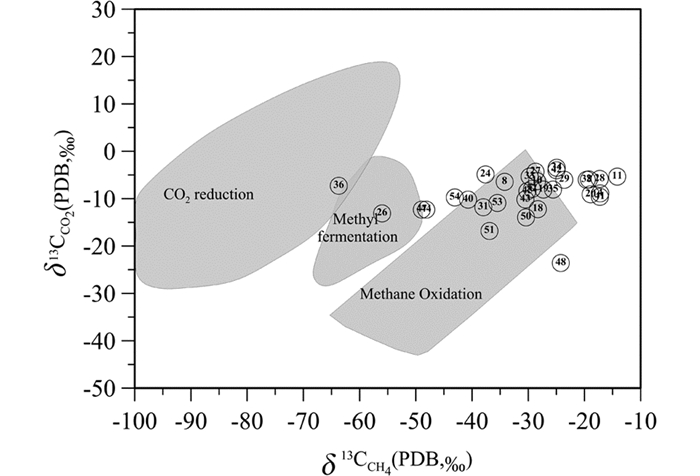
δ13CCH4-δ13CCO2的关系图 5中可以看出,金沙江-红河断裂带温泉点(8,10,18,19,27,31,33,35,43,45,50,51,52,53,54)气体中有机成因的CO2主要是甲烷氧化形成。
|
|
表 3 温泉气体中CO2来源比例 Table 3 The percentage of different origins of CO2 in hot spring gas |
金沙江-红河断裂带温泉气中的CH4的浓度都低于6%,只有温泉36号点,其浓度达到15.54%(表 2)。碳同位素δ13CCH4-δ13CCO2关系(图 5)显示,温泉点2、4、11、20、28、32和41的气体甲烷是无机成因,其它温泉点气体甲烷主要是有机成因。温泉点26、44和47的气体CH4是甲烷产生菌在严格厌氧的条件下形成。龙门山断裂带温泉中也发现有类似来源的甲烷(Zheng et al., 2013)。温泉点36的气体CH4主要是二氧化碳还原形成的。
|
图 5 δ13CCO2-δ13CCH4关系图(底图据Woltemate et al., 1984) Fig. 5 Cross plot of δ13CCO2 vs. δ13CCH4 in gas samples (base map after Woltemate et al., 1984) |
断裂带内的氢气可能有以下几个来源:(1)H2作为深源气体,地球在形成时,地球内部就储存有大量的H2,这些H2会延着地球的薄弱地带逸散到大气中(Neal and Stanger, 1983);(2)断裂破裂,硅酸岩新鲜岩石面发生水岩反应产生氢气(Kameda et al., 2003),活动断裂带活动性越强,断裂带内硅酸岩新鲜破裂面越发育,产生的H2越多(Kita et al., 1982)(3)在岩石中U和Th元素在放射性衰减过程中与水产生高浓度氢气(Lin et al., 2005);(4)橄榄石蛇纹石化过程中产生大量氢气(Katayama et al., 2010);(5)土壤有机质在厌氧细菌发酵过程中产生氢气(Libert et al., 2011)。由于H2是世界上已知的密度最小的气体,很强的扩散性和穿透性,难溶解于水,在地壳深部向上运移过程中受大气降水中溶解氢气污染轻微,是非常好的示踪气体(Neal and Stanger, 1983)。
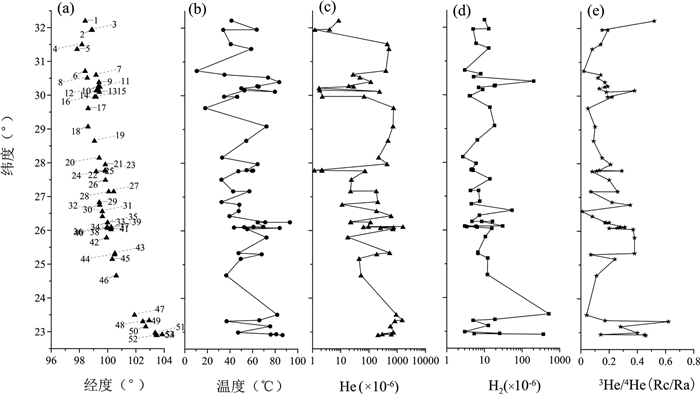
4.2 温泉气体空间变化与断裂活动性的关系金沙江-红河断裂带温泉水的温度、气体中氦气的浓度和氦同位素校正值从北向南,呈增加的趋势(图 6)。这种趋势变化主要与青藏高原东缘地壳从南向北增厚有关。地壳厚度的增加,增加了幔源氦向上运移的距离,受到壳源氦的混染程度越高(Yokoyama et al., 1999)。青藏块体从边缘向内部莫霍面深度和地壳厚度加深和增厚,分别为52~62km和54~66km;四川盆地莫霍面深度为38~42km;从南东向北西川滇菱形块体莫霍面深度为42~62km;红河断裂带以西的滇西地块,从南向北莫霍面深度为34~52km;龙门山、红河断裂带是莫霍面深度变化的梯度带;红河断裂带两侧自北向南莫霍面深度差异逐渐增加(徐志萍等, 2018)。川西高原深部呈现下地壳以增厚为主,中地壳以热塑性变形为主,上地壳以块体走滑变形为主的地壳结构特点(高玲举等, 2015)。
|
图 6 温泉水的温度和温泉气体中的He、H2、氦同位素校正值空间变化 (a)温泉采样点分布;(b)温度;(c) He;(d) H2;(d)氦同位素校正值 Fig. 6 Geographic distribution of the concentration of He and H2, 3He/4He (Rc/Ra) in bubbling gas along the JSJ-RRF (a) sampling sites; (b) water temperature of hot spring; (c) He; (d) H2; (e) 3He/4He (Rc/Ra) |
温泉水温、温泉气体中氢气的浓度和氦同位素校正值从北向南出现3个明显的峰值。这3个峰值位于金沙江-红河断裂带内的三个断裂交汇区域(图 7)。断裂交汇区域,断裂纵横交错,裂隙发育,有利于深部流体(He、H2和CO2等)向上运移(Kameda et al., 2003; Kämpf et al., 2013)。第一个峰值出现在北东向的巴塘断裂与近南北向的金沙江主断裂交汇区域;巴塘断裂走向北东与近南北向的金沙江主断裂相交。金沙江断裂带由西界断裂(金沙江缝合带西界)、东界断裂(中咱推覆体东界)和金沙江主断裂等3条主要断裂和西支断裂、巴塘断裂以及其他一些近南北向次级断裂组成,宽约50~60km,总体走向近南北向,控制不同构造层的边界;大致以巴塘断裂和德钦-中甸-大具断裂为界,金沙江断裂带可分为北、中、南3段;南段即维西-乔后断裂和中甸-龙蟠-乔后断裂带(周荣军等, 2005; Xu et al., 2012)。金沙江断裂带,居里面形成局部抬升,深部可能存在高温地热异常源(高玲举等, 2015)。第二个峰值位于红河断裂与中甸断裂、剑川断裂、乔后-维西断裂交汇区域;维西-乔后断裂右旋走滑特征明显,与红河断裂相连,北与金沙江断裂相接,新生代以来具有与红河断裂和金沙江断裂相似的运动学特征、相同的地质演化历史和构造变形机制,是红河活动断裂的北延部分(常祖峰, 2015)。在中甸构造带和盐源-永胜构造带深部壳幔存在大规模低阻异常,这可能与地下局部熔融体和地热流有关(李文军等, 2016;罗愫等, 2020)。第三个峰值位于小江断裂、奠边府断裂与红河断裂的交汇区域小江断裂带南段位于近SN向的鲜水河-小江断裂系与NW向的红河-哀牢山断裂系的交会地带(韩竹军等, 2017)。奠边府断裂现今的左行走滑与红河断裂现今的右行走滑共同组成了一组共轭断裂系(唐渊等, 2009)。在金沙江-红河断裂的三个断裂交汇区,P波波速相对8.0km/s,都存在明显的低速区(Lei et al., 2014)。在红河断裂带西北端部和小江断裂带下方有两个下地壳低速区,其方位各向异性程度与上地壳相当(高原等, 2020)。这在美国西部也同样观测的这种现象,P波速低地区对应氦同位素较高(Newell et al., 2005; Hu et al., 2018)。在断裂交汇区域,断裂发育,为深部流体向上运移提供了很好的通道,同样在鲜水河断裂、龙门山断裂和磨西断裂交汇处,有大量的幔源氦运移到地表(Zhou et al., 2017)。
青藏高原东南缘的川滇地区壳幔变形特征及地球动力学模式一直是研究的热点问题之一。青藏高原演变的“下地壳流模型”在当前国际地学界很流行。因而,寻找下地壳流存在与否的证据,是地球科学必须面对的一个科学问题。第一个可能的通道,在川滇菱形块体的北部,壳内存在异常低波速区,且主要分布于中下地壳,跨过丽江-金河断裂,波速值有所增加,低速层的埋深也减小,但低速区的横向分布不均。第二个可能的通道,在云南地区,壳内低速区的分布范围较大,但主要分布在滇中地区,且低速区似乎被小江断裂和金沙-红河断裂限制在特定的区域内(王苏等, 2015)。川西和滇西地区地壳内部热流为地热高值区(唐晗晗等, 2020)。金沙江-红河断裂带内的温泉气体中氦同位素校正值的第一个峰值和第二个峰值都位于第一个可能的通道内,第三个峰值位于第二个可能的通道内。然而,要从地球化学方面解释“下地壳流模型”,需要在川滇地区进行高密度温泉气体地球化学采样研究,高分辨率的刻画下地壳流空间分布特征。
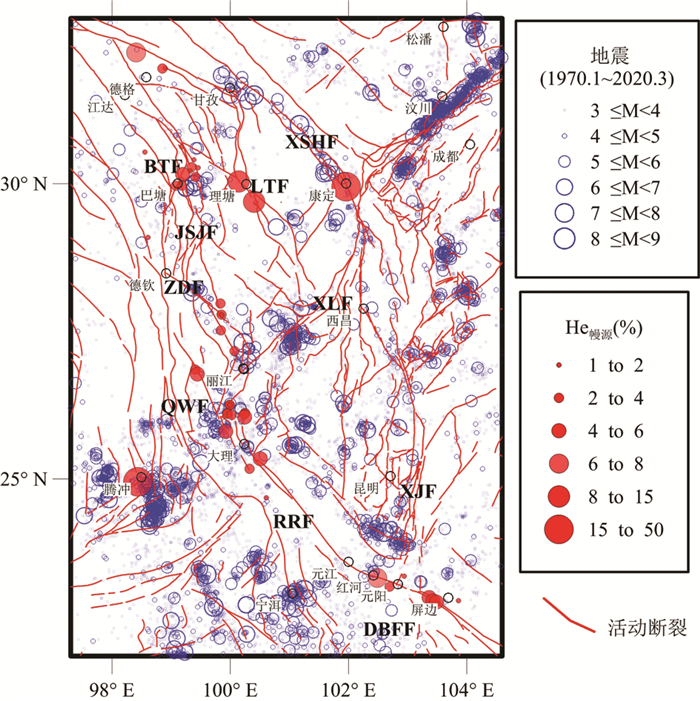
金沙江-红河断裂带内的每个温泉幔源氦比例平均值从0~7.5%。腾冲火山地区大滚锅幔源氦比例是43.9%(2015年4月1日,Zhang et al., 2016);鲜水河断裂灌顶温泉幔源氦比例44%(2009年6月1日, Zhou et al., 2015);理塘断裂查卡和道班温泉幔源氦分别是8.1%(2016年4月28日)和10.5%(2013年5月18日)(Zhou et al., 2017);与以上川滇的深部流体上涌地区相比,金沙江-红河断裂的幔源氦贡献率低于以上地区,地震活动性也比以上地区低(图 7)。
|
图 7 金沙江-红河断裂地震活动性与幔源氦比例的关系 Fig. 7 The relationship between seismic activities with percentage of mantle-derived He in hot spring gases along the JSJ-RRF |
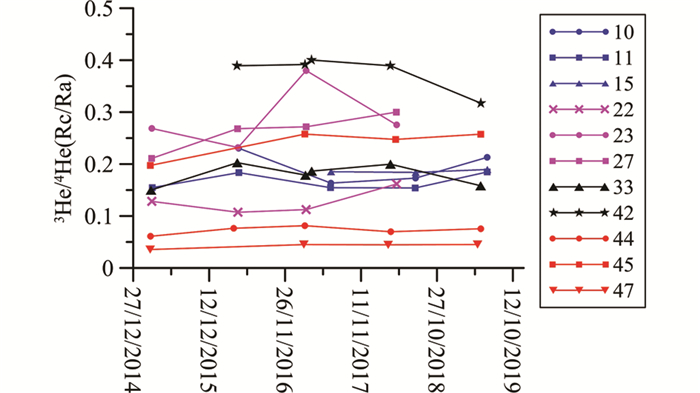
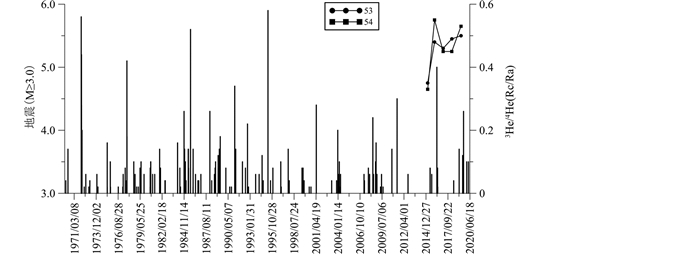
2015年3月至2019年6月,红河断裂带温泉点53和54号的气体氦同位素校正值有明显的上升趋势,23号的气体氦同位素校正值呈现先上升后下降的变化,其它点没有明显的变化(图 8、图 9)。在2016年5月4日个旧4.7级地震前,温泉点53和54的气体氦同位素有明显上升,地震后下降,之后又继续上升。从1970年至2004年,红河断裂南段发生了三次震级超过5.0的地震,包括1972年1月23日5.8级(震源深度:20km)、1977年9月30日5.1级(震源深度:18km)、1995年4月25日5.9级(震源深度:33km)等地震。从2004年1月开始,区域地震活动性出现上升的趋势(图 9),这可能与红河断裂南段深部流体上涌增加有关。这个区域温泉气氦同位素值的上升表明出现了大量深部流体的上涌,可能对断裂有一定的弱化作用(Cappa and Rutqvist, 2012; Klemperer et al., 2013),并增加了断裂内部孔隙压力(Giammanco et al., 2008; Terakawa et al., 2013),对地震的孕育和发生起到重要的促进作用(Fulton and Saffer, 2009; Bräuer et al., 2011)。从2016年3月至2018年3月,23号温泉气体氦同位素校正值上升和下降过程中,周围100km没有发生地震,22号与23号温泉相距4.6km,氦同位素校正值变化幅度小,这可能是深部流体上涌幅度小,持续时间短,未能引起地震的发生。目前,金沙江-红河断裂带氦同位素监测时间间隔长,对地震预测的分辨率不够,需要将来进行高密度的长时间段观测,进一步观察相应的这种变化。
|
图 8 温泉气体中Rc/Ra的时间变化 Fig. 8 Temporal variations of Rc/Ra values |
|
图 9 红河断裂南段地震活动性与校正氦同位素时间变化的关系 Fig. 9 The relationships between seismic activities with of Rc/Ra values Earthquakes (Ms≥3.0) occurred from 1/1/1970 to 1/4/2020, in the area with longitude range from 101.6345° to 103.875732°, latitude range from 22.654572° to 23.825551° |
(1) 根据温泉气体组分特征,金沙江-红河断裂带的温泉主要分成两大类,一类是以CO2为主要组分,另一类是以N2为主要组分;温泉气体中的氦主要是壳源,二氧化碳主要是来自灰岩裂解。
(2) 金沙江-红河断裂带温泉气体氢气和氦气的同位素出现三个明显的峰值,分别在金沙江与巴塘断裂交汇区、中甸断裂与红河断裂交汇区,以及红河断裂带南段与小江断裂和奠边府断裂交汇区出现。
(3) 金沙江-红河断裂带幔源物质的上涌释放与区域地震活动性具有很好的对应关系,并对区域地震的孕育和发生具有促进作用。
致谢 感谢四川省地震局杜方研究员和云南省地震局付虹研究员为野外测量提供的大力支持;非常感谢审稿专家给予的宝贵修改建议。
Ballentine CJ, Marty B, Sherwood LB and Cassidy M. 2005. Neon isotopes constrain convection and volatile origin in the Earth's mantle. Nature, 433(7021): 33-38 DOI:10.1038/nature03182 |
Bräuer K, Kämpf H, Koch U and Strauch G. 2011. Monthly monitoring of gas and isotope compositions in the free gas phase at degassing locations close to the Novy Kostel focal zone in the western Eger Rift, Czech Republic. Chemical Geology, 290(3-4): 163-176 DOI:10.1016/j.chemgeo.2011.09.012 |
Cao CH, Zhang MJ, Tang QY, Yang Y, Lv ZG, Zhang TW, Chen C, Yang H and Li LW. 2018. Noble gas isotopic variations and geological implication of Longmaxi shale gas in Sichuan Basin, China. Marine and Petroleum Geology, 89: 38-46 DOI:10.1016/j.marpetgeo.2017.01.022 |
Cappa F and Rutqvist J. 2012. Seismic rupture and ground accelerations induced by CO2 injection in the shallow crust. Geophysical Journal International, 190(3): 1784-1789 DOI:10.1111/j.1365-246X.2012.05606.x |
Chang ZF. 2015. Seismotectonic background of the 2013 Benzilan M5.9 earthquake, Yunnan Province. Seismology and Geology, 37(1): 192-207 (in Chinese with English abstract) |
Deng J, Wang QF, Li GJ, Li CS and Wang CM. 2014. Tethys tectonic evolution and its bearing on the distribution of important mineral deposits in the Sanjiang region, SW China. Gondwana Research, 26(2): 419-437 DOI:10.1016/j.gr.2013.08.002 |
Deng QD, Zhang PZ, Ran YK, Yang XP, Min W and Chu QZ. 2003. Basic characteristics of active tectonics of China. Science in China (Series D), 46(4): 356-372 |
Fulton PM and Saffer DM. 2009. Potential role of mantle-derived fluids in weakening the San Andreas Fault. Journal of Geophysical Research, 114(B7): B07408 |
Gao LJ, Zhang J and Dong M. 2015. The study of gravity-magnetic anomaly and tectonic background in Sichuan west region. Chinese Journal of Geophysics, 58(8): 2996-3008 (in Chinese with English abstract) |
Gao Y, Shi YT and Wang Q. 2020. Seismic anisotropy in the southeastern margin of the Tibetan Plateau and its deep tectonic significances. Chinese Journal of Geophysics, 63(3): 802-816 (in Chinese with English abstract) |
Giammanco S, Palano M, Scaltrito A, Scarfì L and Sortino F. 2008. Possible role of fluid overpressure in the generation of earthquake swarms in active tectonic areas:The case of the Peloritani Mts. (Sicily, Italy). Journal of Volcanology and Geothermal Research, 178(4): 795-806 DOI:10.1016/j.jvolgeores.2008.09.005 |
Guo ZF, Zhang ML, Cheng ZH, Zhang LH and Liu JQ. 2014. Fluxes and genesis of greenhouse gases emissions from typical volcanic fields in China. Acta Petrologica Sinica, 30(11): 3467-3480 (in Chinese with English abstract) |
Han ZJ, Dong SP, Mao ZB, Hu N, Tan XB, Yuan RM and Guo P. 2017. The Holocene activity and strike-slip rate of the southern segment of Xiaojiang fault in the southeastern Yunnan region, China. Seismology and Geology, 39(1): 1-19 (in Chinese with English abstract) |
Hilton DR. 1996. The helium and carbon isotope systematics of a continental geothermal system:Results from monitoring studies at Long Valley Caldera (California, U.S.A.). Chemical Geology, 127(4): 269-295 DOI:10.1016/0009-2541(95)00134-4 |
Hou ZQ, Yang YQ, Qu XM, Huang DH, Lü QT, Wang HP, Yu JJ and Tang SH. 2004. Tectonic evolution and mineralization systems of the Yidun Arc Orogen in Sanjiang Region, China. Acta Geologica Sinica, 78(1): 109-120 (in Chinese with English abstract) |
Hou ZQ, Pan GT, Wang AJ, Mo XX, Tian SH, Sun XM, Ding L, Wang EQ, Gao YF, Xie YL, Zeng PS, Qin KZ, Xu JF, Qu XM, Yang ZM, Yang ZS, Fei HC, Meng XQ and Li ZQ. 2006. Metallogenesis in Tibetan collisional orogenic belt:Ⅱ. Mineralization in late-collisional transformation setting. Mineral Deposits, 25(5): 521-543 (in Chinese with English abstract) |
Hu JF, Badal J, Yang HY, Li GQ and Peng HC. 2018. Comprehensive crustal structure and seismological evidence for lower crustal flow in the southeastern margin of Tibet revealed by receiver functions. Gondwana Research, 55: 42-59 DOI:10.1016/j.gr.2017.11.007 |
Italiano F, Martinelli G, Bonfanti P and Caracausi A. 2009. Long-term (1997~2007) geochemical monitoring of gases from the Umbria-Marche region. Tectonophysics, 476(1-2): 282-296 DOI:10.1016/j.tecto.2009.02.040 |
Javoy M, Pineau F and Delorme H. 1986. Carbon and nitrogen isotopes in the mantle. Chemical Geology, 57(1-2): 41-62 DOI:10.1016/0009-2541(86)90093-8 |
Jian P, Wang XF, He LQ and Wang CS. 1999. U-Pb zircon dating of anothosite and plagiogranite from the Jinshajiang ophiolite belt. Acta Petrologica Sinica, 15(4): 590-593 (in Chinese with English abstract) |
Kameda J, Saruwatari K and Tanaka H. 2003. H2 generation in wet grinding of granite and single-crystal powders and implications for H2 concentration on active faults. Geophysical Research Letters, 30(20): 2063 |
Kämpf H, Bräuer K, Schumann J, Hahne K and Strauch G. 2013. CO2 discharge in an active, non-volcanic continental rift area (Czech Republic):Characterisation (δ13C, 3He/4He) and quantification of diffuse and vent CO2 emissions. Chemical Geology, 339: 71-83 DOI:10.1016/j.chemgeo.2012.08.005 |
Katayama I, Kurosaki I and Hirauchi K. 2010. Low silica activity for hydrogen generation during serpentinization:An example of natural serpentinites in the Mineoka ophiolite complex, central Japan. Earth and Planetary Science Letters, 298(1-2): 199-204 DOI:10.1016/j.epsl.2010.07.045 |
Kita I, Matsuo S and Wakita H. 1982. H2 generation by reaction between H2O and crushed rock:An experimental study on H2 degassing from the active fault zone. Journal of Geophysical Research, 87(B13): 10789-10795 DOI:10.1029/JB087iB13p10789 |
Klemperer SL, Kennedy BM, Sastry SR, Makovsky Y, Harinarayana T and Leech ML. 2013. Mantle fluids in the Karakoram fault:Helium isotope evidence. Earth and Planetary Science Letters, 366: 59-70 DOI:10.1016/j.epsl.2013.01.013 |
Kulongoski JT, Hilton DR, Barry PH, Esser BK, Hillegonds D and Belitz K. 2013. Volatile fluxes through the Big Bend section of the San Andreas Fault, California:Helium and carbon-dioxide systematics. Chemical Geology, 339: 92-102 DOI:10.1016/j.chemgeo.2012.09.007 |
Lei JS, Li Y, Xie FR, Teng JW, Zhang GW, Sun CQ and Zha XH. 2014. Pn anisotropic tomography and dynamics under eastern Tibetan Plateau. Journal of Geophysical Research:Solid Earth, 119(3): 2174-2198 DOI:10.1002/2013JB010847 |
Li WJ, Shao ZG, Wen XZ, Wang QX, Wang GC, Zhang Y, Jiang CS and Wang WX. 2016. Deep structure derived from the Mouding-Shangri-La magnetotelluric profile in western Yunnan Province. Chinese Journal of Geophysics, 59(1): 229-239 (in Chinese with English abstract) |
Li ZP, Wang XB, Li LW, Zhang MJ, Tao MX, Xing LT, Cao CH and Xi YQ. 2014. Development of new method of δ13C measurement for trace hydrocarbons in natural gas using solid phase micro-extraction coupled to gas chromatography isotope ratio mass spectrometry. Journal of Chromatography A, 1372: 228-235 DOI:10.1016/j.chroma.2014.10.089 |
Libert M, Bildstein O, Esnault L, Jullien M and Sellier R. 2011. Molecular hydrogen:An abundant energy source for bacterial activity in nuclear waste repositories. Physics and Chemistry of the Earth, Parts A/B/C, 36(17-18): 1616-1623 DOI:10.1016/j.pce.2011.10.010 |
Lin LH, Hall J, Lippmann-Pipke J, Ward JA, Lollar BS, DeFlaun M, Rothmel R, Moser D, Gihring TM, Mislowack B and Onstott TC. 2005. Radiolytic H2 in continental crust:Nuclear power for deep subsurface microbial communities. Geochemistry, Geophysics, Geosystems, 6: Q07003 |
Luo M, Huang HG, Zhang P, Wu QB and Chen DF. 2014. Origins of gas discharging from the Qiangtang Basin in the northern Qinghai-Tibet Plateau, China:Evidence from gas compositions, helium, and carbon isotopes. Journal of Geochemical Exploration, 146: 119-126 DOI:10.1016/j.gexplo.2014.08.006 |
Luo S, Yu CQ, Zhang G, Li DW, Qu C, Zhang HM, Tian ZY and Huang J. 2020. Deep electrical resistivity structure of the Sanjiang Area, western Yunnan:An example of the Fugong-Qiaojia profile. Chinese Journal of Geophysics, 63(3): 1026-1042 (in Chinese with English abstract) |
Mamyrin BA, Anufrier GS, Kamensky IL and Tolstikhin IN. 1970. Determination of the isotopic composition of helium in the atmosphere. Geochemistry International, 7: 498-505 |
Marty B and Jambon A. 1987. C/3He in volatile fluxes from the solid Earth:Implication for carbon geodynamics. Earth and Planetary Science Letters, 83(1-4): 16-26 DOI:10.1016/0012-821X(87)90047-1 |
Neal C and Stanger G. 1983. Hydrogen generation from mantle source rocks in Oman. Earth and Planetary Science Letters, 66: 315-320 DOI:10.1016/0012-821X(83)90144-9 |
Newell DL, Crossey LJ, Karlstrom KE, Fischer TP and Hilton DR. 2005. Continental-scale links between the mantle and groundwater systems of the western United States: Evidence from travertine springs and regional He isotope data, GSA Today, 15(12), 4-10
|
Newell DL, Jessup MJ, Cottle JM, Hilton DR, Sharp ZD and Fischer TP. 2008. Aqueous and isotope geochemistry of mineral springs along the southern margin of the Tibetan Plateau:Implications for fluid sources and regional degassing of CO2. Geochemistry, Geophysics, Geosystems, 9(8): Q08014 |
O'Nions RK and Oxburgh ER. 1988. Helium, volatile fluxes and the development of continental crust. Earth and Planetary Science Letters, 90(3): 331-347 |
Ozima M and Podosek FA. 1983. Noble Gas Geochemistry. Cambridge: Cambridge University Press
|
Ray MC, Hilton DR, Muñoz J, Fischer TP and Shaw AM. 2009. The effects of volatile recycling, degassing and crustal contamination on the helium and carbon geochemistry of hydrothermal fluids from the Southern Volcanic Zone of Chile. Chemical Geology, 266(1-2): 38-49 DOI:10.1016/j.chemgeo.2008.12.026 |
Sano Y and Wakita H. 1985. Geographical distribution of 3He/4He ratios in Japan:Implications for arc tectonics and incipient magmatism. Journal of Geophysical Research, 90(B10): 8729-8741 DOI:10.1029/JB090iB10p08729 |
Sano Y and Marty B. 1995. Origin of carbon in fumarolic gas from island arcs. Chemical Geology, 119(1-4): 265-274 DOI:10.1016/0009-2541(94)00097-R |
Tang HH, Guo LH and Fang Y. 2020. Estimation of heat flow in southeastern margin of Tibetan Plateau and its analysis of the correlation with earthquake activity. Chinese Journal of Geophysics, 63(3): 1056-1069 (in Chinese with English abstract) |
Tang XC, Zhang J, Pang ZH, Hu SB, Tian J and Bao SJ. 2017. The eastern Tibetan Plateau geothermal belt, western China:Geology, geophysics, genesis, and hydrothermal system. Tectonophysics, 717: 433-448 DOI:10.1016/j.tecto.2017.08.035 |
Tang Y, Liu JL, Tran MD and Song ZJ. 2009. Structural characteristics of the Dien Bien Phu strike slip fault zone and its regional tectonic implication. Acta Geologica Sinica, 83(10): 1401-1414 (in Chinese with English abstract) |
Tapponnier P, Xu ZQ, Roger F, Meyer B, Arnaud N, Wittlinger G and Yang JS. 2001. Oblique stepwise rise and growth of the Tibet Plateau. Science, 294(5547): 1671-1677 DOI:10.1126/science.105978 |
Terakawa T, Hashimoto C and Matsu'ura M. 2013. Changes in seismic activity following the 2011 Tohoku-oki earthquake:Effects of pore fluid pressure. Earth and Planetary Science Letters, 365: 17-24 DOI:10.1016/j.epsl.2013.01.017 |
Tran MD, Liu JL, Nguyen QL, Chen Y, Tang Y, Song ZJ, Zhang ZC and Zhao ZD. 2014. Cenozoic high-K alkaline magmatism and associated Cu-Mo-Au mineralization in the Jinping-Fan Si Pan region, southeastern Ailao Shan-Red River shear zone, southwestern China-northwestern Vietnam. Journal of Asian Earth Sciences, 79: 858-872 DOI:10.1016/j.jseaes.2013.03.027 |
Umeda K and Ninomiya A. 2009. Helium isotopes as a tool for detecting concealed active faults. Geochemistry, Geophysics, Geosystems, 10(8): Q08010 |
Wang EQ, Meng K, Xu G, Fan C and Su Z. 2018. Cenozoic two-stage obduction of the Indian subcontinent:On the interaction between the Indian Ocean, Tethyan and Eurasian plates. Acta Petrologica Sinica, 34(7): 1867-1875 (in Chinese with English abstract) |
Wang S, Xu XY and Hu JF. 2015. Review on the study of crustal structure and geodynamic models for the southeast margin of the Tibetan Plateau. Chinese Journal of Geophysics, 58(11): 4235-4253 (in Chinese with English abstract) |
Woltemate I, Whiticar MJ and Schoell M. 1984. Carbon and hydrogen isotopic composition of bacterial methane in a shallow freshwater lake. Limnology and Oceanography, 29(5): 985-992 DOI:10.4319/lo.1984.29.5.0985 |
Wu JK, Zhao ZD, Yang YY, Lei HS, Miao Z, Liu D, Zhu DC and Yu XH. 2019. Petrogenesis and geological implications of the alkali-rich porphyry in southern Ailaoshan-Red River shear zone. Acta Petrologica Sinica, 35(2): 485-504 (in Chinese with English abstract) DOI:10.18654/1000-0569/2019.02.14 |
Wu XY, Xu XW, Yu GH, Cheng J, Chen GH, An YF and Wang QX. 2018. Map preparation of earthquake surface ruptures in the national experimental field of earthquake monitoring and prediction in Sichuan and Yunnan provinces. Seismology and Geology, 40(01): 27-41 (in Chinese with English abstract) |
Wu ZH, Long CX, Fan TY, Zhou CJ, Feng H, Yang ZY and Tong YB. 2015. The arc rotational-shear active tectonic system on the southeastern margin of Tibetan Plateau and its dynamic characteristics and mechanism. Geological Bulletin of China, 34(1): 1-31 (in Chinese with English abstract) |
Xu LL, Bi XW, Hu RZ, Zhang XC, Su WC, Qu WJ, Hu ZC and Tang YY. 2012. Relationships between porphyry Cu-Mo mineralization in the Jinshajiang-Red River metallogenic belt and tectonic activity:Constraints from zircon U-Pb and molybdenite Re-Os geochronology. Ore Geology Reviews, 48: 460-473 DOI:10.1016/j.oregeorev.2012.05.010 |
Xu S, Zheng GD, Nakai S, Wakita H, Wang XB and Guo ZF. 2013. Hydrothermal He and CO2 at Wudalianchi intra-plate volcano, NE China. Journal of Asian Earth Sciences, 62: 526-530 DOI:10.1016/j.jseaes.2012.11.001 |
Xu XW, Wen XZ, Zheng RZ, Ma WT, Song FM and Yu GH. 2003. The latest structural change pattern and dynamic source of active blocks in Sichuan Yunnan area. Science in China (Series D), 33(suppl.1): 151-162 (in Chinese) |
Xu XW, Zhang PZ, Wen XZ, Qin ZL, Chen GH and Zhu AL. 2005. Features of active tectonics and recurrence behaviors of strong earthquakes in the western Sichuan Province and its adjacent regions. Seismology and Geology, 27(3): 446-461 (in Chinese with English abstract) |
Xu ZP, Wang FY, Jiang L, Xu SQ and Tang L. 2018. The depth of Moho interface and crustal thickness in Sichuan-Yunnan region, China. Seismology and Geology, 40(6): 1318-1331 (in Chinese with English abstract) |
Xu ZQ, Yang JS, Li HQ, Wang RR and Cai ZH. 2012. Indosinian collision-orogenic system of Chinese continent and its orogenic mechanism. Acta Petrologica Sinica, 28(6): 1697-1709 (in Chinese with English abstract) |
Xu ZQ, Yang JS, Li WC, Li HQ, Cai ZH, Yan Z and Ma CQ. 2013. Paleo-Tethys system and accretionary orogen in the Tibet Plateau. Acta Petrologica Sinica, 29(6): 1847-1860 (in Chinese with English abstract) |
Yin FG, Sun ZM and Hu SH. 2014. Geological Maps and Brochures of the Three Rivers in Southwest China. Beijing: Geological Publishing House (in Chinese)
|
Yokoyama T, Nakai S and Wakita H. 1999. Helium and carbon isotopic compositions of hot spring gases in the Tibetan Plateau. Journal of Volcanology and Geothermal Research, 88(1-2): 99-107 DOI:10.1016/S0377-0273(98)00108-5 |
Zhang ML, Guo ZF, Sano Y, Zhang LH, Sun YT, Cheng ZH and Yang TF. 2016. Magma-derived CO2 emissions in the Tengchong volcanic field, SE Tibet:Implications for deep carbon cycle at intra-continent subduction zone. Journal of Asian Earth Sciences, 127: 76-90 DOI:10.1016/j.jseaes.2016.06.009 |
Zhang PZ. 2008. Present tectonic deformation, strain distribution and deep dynamic process in the western Sichuan area on the eastern margin of the Qinghai Tibet Plateau. Science in China (Series D), 38(9): 1041-1056 (in Chinese) |
Zhao CP, Ran H and Wang Y. 2012. Present-day mantle-derived helium release in the Tengchong volcanic field, Southwest China:Implications for tectonics and magmatism. Acta Petrologica Sinica, 28(4): 1189-1204 (in Chinese with English abstract) |
Zheng GD, Xu S, Liang SY, Shi PL and Zhao J. 2013. Gas emission from the Qingzhu River after the 2008 Wenchuan Earthquake, Southwest China. Chemical Geology, 339: 187-193 DOI:10.1016/j.chemgeo.2012.10.032 |
Zhong DL and Ding L. 1996. Uplift process and mechanism of the Qinghai Tibet Plateau. Science in China (Series D), 26(4): 289-295 (in Chinese) |
Zhou RJ, Chen GX, Li Y, Zhou ZH, Gong Y, He YL and Li XG. 2005. Research on active faults in Litang-Batang region, western Sichuan Province, and the seismogenic structures of the 1989 Batang M6.7 earthquake swarm. Seismology and Geology, 27(1): 31-43 (in Chinese with English abstract) |
Zhou XC, Wang WC, Chen Z, Yi L, Liu L, Xie C, Cui YJ, Du JG, Cheng JW and Yang LM. 2015. Hot spring gas geochemistry in western Sichuan Province, China after the Wenchuan Ms 8.0 earthquake. Terrestrial, Atmospheric and Oceanic Sciences, 26(4): 361-373 DOI:10.3319/TAO.2015.01.05.01(TT) |
Zhou XC, Liu L, Chen Z, Cui YJ and Du JG. 2017. Gas geochemistry of the hot spring in the Litang fault zone, Southeast Tibetan Plateau. Applied Geochemistry, 79: 17-26 DOI:10.1016/j.apgeochem.2017.01.022 |
Zhu JS, Wang XB, Yang YH, Fan J and Cheng XQ. 2017. The crustal flow beneath the eastern margin of the Tibetan Plateau and its process of dynamics. Chinese Journal of Geophysics, 60(6): 2038-2057 (in Chinese with English abstract) |
Zmazek B, Italiano F, Živčič M, Vaupotič J, Kobal I and Martinelli G. 2002. Geochemical monitoring of thermal waters in Slovenia:Relationships to seismic activity. Applied Radiation and Isotopes, 57(6): 919-930 DOI:10.1016/S0969-8043(02)00200-2 |
常祖峰. 2015. 2013年云南奔子栏M5.9地震发生的地震地质背景. 地震地质, 37(1): 192-207. DOI:10.3969/j.issn.0253-4967.2015.01.015 |
邓起东, 张培震, 冉勇康, 杨晓平, 闵伟, 楚全芝. 2002. 中国活动构造基本特征. 中国科学(D辑), 32(12): 1020-1030. |
高玲举, 张健, 董淼. 2015. 川西高原重磁异常特征与构造背景分析. 地球物理学报, 58(8): 2996-3008. |
高原, 石玉涛, 王琼. 2020. 青藏高原东南缘地震各向异性及其深部构造意义. 地球物理学报, 63(3): 802-816. |
郭正府, 张茂亮, 成智慧, 张丽红, 刘嘉麒. 2014. 中国大陆新生代典型火山区温室气体释放的规模及其成因. 岩石学报, 30(11): 3467-3480. |
韩竹军, 董绍鹏, 毛泽斌, 呼楠, 谭锡斌, 袁仁茂, 郭鹏. 2017. 小江断裂带南段全新世活动的地质地貌证据与滑动速率. 地震地质, 39(1): 1-19. DOI:10.3969/j.issn.0253-4967.2017.01.001 |
侯增谦, 杨岳清, 曲晓明, 黄典豪, 吕庆田, 王海平, 余金杰, 唐绍华. 2004. 三江地区义敦岛弧造山带演化和成矿系统. 地质学报, 78(1): 109-120. |
侯增谦, 潘桂棠, 王安建, 莫宣学, 田世洪, 孙晓明, 丁林, 王二七, 高永丰, 谢玉玲, 曾普胜, 秦克章, 许继峰, 曲晓明, 杨志明, 杨竹森, 费红彩, 孟祥金, 李振清. 2006. 青藏高原碰撞造山带:Ⅱ. 晚碰撞转换成矿作用.矿床地质, 25(5): 521-543. |
简平, 汪啸风, 何龙清, 王传尚. 1999. 金沙江蛇绿岩中斜长岩和斜长花岗岩的U-Pb年龄及地质意义. 岩石学报, 15(4): 590-593. DOI:10.3321/j.issn:1000-0569.1999.04.012 |
李文军, 邵志刚, 闻学泽, 王启欣, 王根成, 张营, 蒋长胜, 王武星. 2016. 滇西牟定-香格里拉电性剖面及深部构造. 地球物理学报, 59(1): 229-239. |
罗愫, 于常青, 张刚, 李德伟, 瞿辰, 张慧民, 田镇瑜, 皇健. 2020. 滇西三江构造带电性结构特征——以福贡-巧家剖面为例. 地球物理学报, 63(3): 1026-1042. |
唐晗晗, 郭良辉, 方圆. 2020. 青藏高原东南缘热流估算及与地震活动相关性分析. 地球物理学报, 63(3): 1056-1069. |
唐渊, 刘俊来, Tran MD, 宋志杰. 2009. 奠边府走滑断裂带的构造特征、遥感解译及其区域构造意义. 地质学报, 83(10): 1401-1414. DOI:10.3321/j.issn:0001-5717.2009.10.004 |
王二七, 孟恺, 许光, 樊春, 苏哲. 2018. 印度陆块新生代两次仰冲事件及其构造驱动机制:论印度洋、特提斯和欧亚板块相互作用. 岩石学报, 34(7): 1867-1875. |
王苏, 徐晓雅, 胡家富. 2015. 青藏高原东南缘的地壳结构与动力学模式研究综述. 地球物理学报, 58(11): 4235-4253. |
武精凯, 赵志丹, 杨逸云, 雷杭山, 苗壮, 刘栋, 朱弟成, 喻学惠. 2019. 云南哀牢山-红河断裂带南段新生代富碱斑岩岩石成因和地质意义. 岩石学报, 35(2): 485-504. |
吴熙彦, 徐锡伟, 于贵华, 程佳, 陈桂华, 安艳芬, 王启欣. 2018. 国家川滇实验场地震地表破裂带分布图编制. 地震地质, 40(1): 27-41. DOI:10.3969/j.issn.0253-4967.2018.01.003 |
吴中海, 龙长兴, 范桃园, 周春景, 冯卉, 杨振宇, 仝亚博. 2015. 青藏高原东南缘弧形旋扭活动构造体系及其动力学特征与机制. 地质通报, 34(1): 1-31. DOI:10.3969/j.issn.1671-2552.2015.01.002 |
徐锡伟, 闻学泽, 郑荣章, 马文涛, 宋方敏, 于贵华. 2003. 川滇地区活动块体最新构造变动样式及其动力来源. 中国科学(D辑), 33(增1): 151-162. |
徐锡伟, 张培震, 闻学泽, 秦尊丽, 陈桂华, 朱艾斓. 2005. 川西及其邻近地区活动构造基本特征与强震复发模型. 地震地质, 27(3): 446-461. DOI:10.3969/j.issn.0253-4967.2005.03.010 |
徐志萍, 王夫运, 姜磊, 徐顺强, 唐淋. 2018. 川滇地区莫霍面深度和地壳厚度. 地震地质, 40(6): 1318-1331. |
许志琴, 杨经绥, 李化启, 王瑞瑞, 蔡志慧. 2012. 中国大陆印支碰撞造山系及其造山机制. 岩石学报, 28(6): 1697-1709. |
许志琴, 杨经绥, 李文昌, 李化启, 蔡志慧, 闫臻, 马昌前. 2013. 青藏高原中的古特提斯体制与增生造山作用. 岩石学报, 29(6): 1847-1860. |
尹福光, 孙志明, 胡世华. 2014. 中国西南三江地质图及说明书. 北京: 地质出版社.
|
张培震. 2008. 青藏高原东缘川西地区的现今构造变形、应变分配与深部动力过程. 中国科学(D辑), 38(9): 1041-1056. DOI:10.3321/j.issn:1006-9267.2008.09.001 |
赵慈平, 冉华, 王云. 2012. 腾冲火山区的现代幔源氦释放:构造和岩浆活动意义. 岩石学报, 28(4): 1189-1204. |
钟大赉, 丁林. 1996. 青藏高原的隆起过程及其机制探讨. 中国科学(D辑), 26(4): 289-295. DOI:10.3321/j.issn:1006-9267.1996.04.001 |
周荣军, 陈国星, 李勇, 周朝晖, 龚宇, 何玉林, 黎小刚. 2005. 四川西部理塘-巴塘地区的活动断裂与1989年巴塘6.7级震群发震构造研究. 地震地质, 27(1): 31-43. DOI:10.3969/j.issn.0253-4967.2005.01.004 |
朱介寿, 王绪本, 杨宜海, 范军, 程先琼. 2017. 青藏高原东缘的地壳流及动力过程. 地球物理学报, 60(6): 2038-2057. |