 2020, Vol. 36


2. 中国科学院地质与地球物理研究所, 地球与行星物理院重点实验室, 北京 100029;
3. 中国科学院地球科学研究院, 北京 100029;
4. 中国科学院大学地球与行星科学学院, 北京 100049;
5. 南方海洋科学与工程广东省实验室(广州), 广州 511458
2. Key Laboratory of Earth and Planetary Physics, Institute of Geology and Geophysics, Chinese Academy of Sciences, Beijing 100029, China;
3. Innovation Academy for Earth Science, Chinese Academy of Sciences, Beijing 100029, China;
4. College of Earth and Planetary Sciences, University of Chinese Academy of Sciences, Beijing 100049, China;
5. Southern Marine Science and Engineering Guangdong Laboratory(Guangzhou), Guangzhou 511458, China
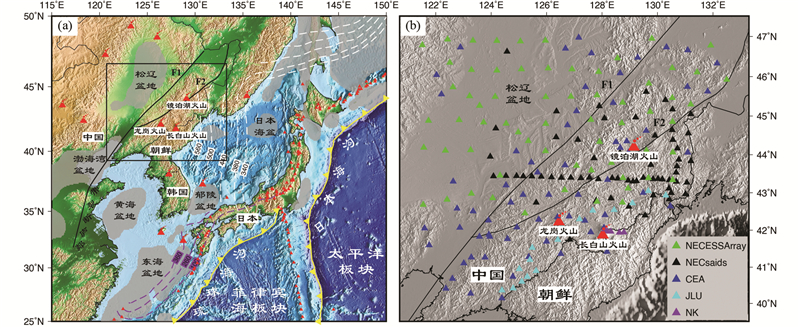
中、新生代以来,太平洋板块和菲律宾板块向欧亚板块的持续俯冲碰撞产生了狭长的俯冲带和一系列沿着俯冲带走向分布的岛弧火山,形成了西太平洋地区典型的沟-弧-盆构造体系(图 1a)。晚新生代以来,西太平洋地区还发育众多远离俯冲带分布的陆内火山,包括中国东北地区的长白山火山、龙岗火山、镜泊湖火山等(Liu et al., 2001),其中位于中朝边境,距离日本海沟约1200km的长白山火山是中国境内现存规模最大、保存最为完整和潜在喷发危险最强的一座活火山(洪汉净等, 2007; Stone, 2010; 刘若新, 2015; 刘嘉麒等, 2015)。长白山火山历史上曾发生多次剧烈喷发,造成了国际性的影响,约在公元946年的“千年大喷发”被认为是全新世以来全球最大规模火山喷发事件之一(Wei et al., 2013; 刘嘉麒等, 2015; Oppenheimer et al., 2017),其喷出的火山灰在日本北海道地区沉降了数厘米厚(Horn and Schmincke, 2000),甚至在北极格林兰的冰芯中都有记录(Sun et al., 2014)。2002~2005年间,长白山火山处于一个较为活跃的时期,火山地震活动性的增加(吴建平等, 2005; 明跃红等, 2007)、GPS和水准监测观察到的地表隆起(胡亚轩等, 2004; 李克等, 2009)以及温泉气体地球化学组分异常(高玲等, 2006)表明这个时期长白山火山下方有岩浆活动的迹象,似乎证实并加剧了该火山可能出现再次喷发的危险性(洪汉净等, 2007; Stone, 2010, 2011, 2013; Xu et al., 2012; 刘嘉麒等, 2015; Witze, 2016)。此外,距离长白山火山直线距离约140km的朝鲜核爆事件(Hong et al., 2016)与西太平洋俯冲带周边发生的诸如2011年日本东北近海9.0级大地震(Lei et al., 2013; Liu et al., 2017a)对长白山火山的扰动影响也受到了相应的关注。
|
图 1 东北亚地区构造简图(a)及研究区域地震台站分布图(b) (a)黄色带锯齿曲线表示海沟;白色和紫色虚线分别表示俯冲太平洋板块和菲律宾板块的等深线;红色小三角形代表岛弧火山,带拖尾的红色火山标志代表晚新生代陆内火山;灰色区域表示厚度超过1.5km的沉积盆地;F1-依兰-伊通断裂;F2-敦化-密山断裂;黑色方框表示本研究的区域(图b). (b)不同颜色三角形代表不同的地震台阵,绿色、黑色、蓝色、青色和紫红色分别表示NECESSArray台阵、NECsaids台阵、CEA固定台、吉林大学流动台和朝鲜境内的流动台 Fig. 1 Map of NE Asia showing the main tectonic features (a) and map of the study area showing the distribution of seismic stations (b) (a) the trenches are marked by yellow saw-toothed lines. Interface depths of the subducting Pacific slab and Philippine Sea slab are outlined by white and purple dashed contour lines, respectively. Small red triangles show the locations of island arc volcanoes and red volcano symbols denote the Late Cenozoic intraplate volcanoes. The gray area in the background delineates the major sedimentary basins with thickness larger than 1.5km. F1-Yilan-Yitong fault; F2-Dunhua-Mishan fault. The black rectangle outlines our study region as shown in (b). (b) triangles with different colors represent different seismic networks. The green, black, blue, cyan, and magenta triangles represent NECESSArray, NECsaids Array, CEA permanent stations, portable stations deployed by the Jilin University and in North Korea, respectively |
作为中国乃至东北亚地区规模最大和最具潜在喷发危险的长白山火山已成为研究西太平洋地区陆内火山成因及其动力学机制的天然实验室。近年来,前人围绕长白山火山开展了大量的地球物理和地球化学研究工作并取得了丰硕的成果(详见郭文峰等(2015)、Zhang et al. (2018)和陈棋福等(2019)的综述),例如区域大尺度地震层析成像研究(Lei and Zhao, 2005; Tang et al., 2014; Guo et al., 2018; Yang et al., 2019; Zhang et al., 2019; 田有等, 2019)揭示出长白山火山下方存在大规模的地幔热物质上涌,表明整座火山存在深部的岩浆源补给。火山岩石地球化学、地球物理深部探测、地球动力学数值模拟等多学科研究均表明长白山火山的岩浆起源与西太平洋板块的深俯冲作用(图 1a)密切相关(Zhao, 2004; Lei and Zhao, 2005; Tang et al., 2014; 刘嘉麒等, 2015; Tian et al., 2016; Chen et al., 2017; Guo et al., 2018; 雷建设等, 2018; 徐义刚等, 2018; Zhang et al., 2019; 田有等, 2019; Yang and Faccenda, 2020)。然而目前大多数地震学层析成像研究聚焦于探讨长白山火山的深部地幔起源,对于其浅部壳幔岩浆系统的研究相对较少,而近年来已有的地球物理探测结果对长白山火山地壳岩浆房的空间分布位置、几何形态以及部分熔融程度等关键科学问题的认识仍存在较大分歧。因此本研究通过搜集长白山火山及邻区尽可能多的地震台站数据,采用背景噪声成像方法来获取研究区域高精度的Rayleigh面波相速度结构,为进一步精细刻画长白山火山壳幔岩浆系统提供重要的地震学观测依据。
1 长白山火山壳幔岩浆系统的地球物理探测研究现状20世纪90年代以来,前人利用多种地球物理方法对长白山火山壳幔岩浆系统进行了探测研究。汤吉等(2001)利用在长白山火山区呈伞状分布的61个大地电磁测点观测资料获得的反演结果表明,在长白山天池火山口以北约7km下方12~45km深度位置存在一个低阻体并有向下延伸的趋势,推测可能反映了地壳岩浆囊的存在。仇根根等(2014)利用跨长白山天池火山口长约100km的北偏东向大地电磁测深观测数据,反演获得的结果在电性结构不均匀性和由浅至深存在多个低阻体特征方面与汤吉等(2001)的结果类似,但是该研究显示在长白山天池火山口以北7~20km处下方大约20~50km深度位置上存在一个规模较大近似呈“Y”字型的低阻区,此结果与汤吉等(2001)获得的电性结构存在较大的局部差异(详见仇根根等(2014)中图 11的对比)。同样基于横跨长白山天池火山口的南北向人工地震测深剖面数据,张先康等(2002)和Song et al. (2007)获得的与长白山天池火山地壳岩浆囊结构相关的低速体位置也存在较大差异:张先康等(2002)反演建立的P波速度结构显示,长白山天池火山口正下方从大约9km深度一直到壳幔过渡带位置存在一个上大下小的“串珠状”低速体;而Song et al. (2007)给出的剖面结果则表明在长白山天池火山口以北30~60km下方深度10~25km的中地壳存在一个明显的低速体(详见陈棋福等(2019)中图 5的对比)。
近年来,前人利用地震层析成像得到的与长白山火山壳幔岩浆系统相关的速度结构特征也存在明显差异。Kim et al. (2017)基于中国东北地区NECESSArray流动台阵(图 1b绿色三角形)的部分数据以及早期的PASSCAL台阵数据,采用变维贝叶斯反演方法得到了长白山火山下方相对较高的剪切波速度异常,结合Song et al. (2007)构建的P波速度模型,作者解释认为长白山火山中、下地壳存在两层结构:下层是幔源基性玄武质岩浆底侵体,上层是幔源基性玄武质岩浆经结晶分异作用后冷却固结形成的长英质岩体,目前这两层岩体结构都处于相对低温的状态,没有表现出“活跃”的岩浆活动特征。然而,Kim et al. (2017)的成像结果及其解释与前人大多数研究得出长白山火山正下方地壳内存在与高温岩浆房相关的低阻体/低速体/低密度体的普遍认识(汤吉等, 2001; 张先康等, 2002; Choi et al., 2013)都不一致。Fan and Chen (2019)利用在长白山及周边地区布设的NECsaids台阵(图 1b黑色三角形)、NECESSArray台阵及固定台(图 1b蓝色三角形)数据,采用背景噪声和地震面波联合反演方法获得的成像结果,揭示出长白山火山中-下地壳呈现出显著的低速特征,推测低速异常可能指示了地壳岩浆房的存在。Zhu et al. (2019)利用吉林大学在长白山附近区域布设的流动台阵(图 1b青色三角形)、NECESSArray台阵及固定台资料,采用背景噪声和接收函数联合反演得到的成像结果表明:长白山火山中地壳有一个显著的低速体,推测可能是壳内岩浆房的位置。最近,Fan et al. (2020)基于中国、朝鲜、韩国以及日本的地震台站数据,应用面波双台法成像技术得到的成像结果同样发现长白山火山中-下地壳深度位置存在显著的低波速异常结构。
由于长白山火山坐落于中朝边界(图 1b),目前有关其浅部岩浆系统的认识大部分都来自于中国一侧的地球物理探测,而极其缺乏朝鲜境内的观测资料。目前在朝鲜境内针对长白山火山开展的地震学研究仅有来自英国、美国和朝鲜的有限的联合地震观测(图 1b紫色三角形;Kyong-Song et al., 2016; Hammond et al., 2020),而近年来在中国一侧开展的地震成像研究(Kim et al., 2017; Fan and Chen, 2019; Zhu et al., 2019)都还没有利用上长白山火山在朝鲜境内的地震台数据(2018年10月在IRIS上公开,http://ds.iris.edu/mda/1U/)。因此本研究对区域内上述多个密集台阵的地震观测数据进行分析,尤其是中朝地震资料的联合处理,将有助于提升对长白山火山壳幔速度结构的成像分辨率。
2 背景噪声成像 2.1 研究数据如图 1b所示,本研究开展的背景噪声成像一共利用了4个流动地震台阵和区域固定台网的垂向连续波形数据。其中,探测深俯冲的中国东北地震台阵NECsaids(Wang et al., 2016)密集布设的60个宽频带流动地震台数据的时间跨度为2010年7月至2017年9月;中、美、日国际合作布设的NECESSArray台阵(Tao et al., 2014)的64个宽频带流动地震台数据的时间跨度为2009年9月至2011年8月;吉林大学布设的16个宽频带流动地震台数据(本研究直接使用Zhu et al. (2019)提供的背景噪声互相关数据)的时间跨度为2007年至2010年;朝鲜境内6个宽频带流动地震台数据(Kyong-Song et al., 2016)的时间跨度为2013年8月至2015年8月;国家测震台网数据备份中心提供的67个CEA固定台站数据(郑秀芬等, 2009)的时间跨度为2009年9月至2017年9月。
2.2 成像方法基于以上所述的密集地震台阵观测数据,本研究采用背景噪声成像方法来反演获取研究区域高分辨率的二维面波相速度结构。背景噪声成像是结构地震学领域近年来发展起来的一种较新的地震学成像方法,其物理机制可以简要解释为:在散射波场中的两个接收点记录的地震信号看似杂乱无章,但是通过较长时间互相关计算得到的噪声互相关函数则包含了与这两个接收点之间地球内部介质结构特征相关的信号(两点间介质的经验格林函数),对该信号的进一步分析处理便可以对地球内部速度结构进行成像。背景噪声成像方法突破了传统面波层析成像依赖地震事件的局限性,可以得到更短周期的成像结果,对于地震活动性较弱的研究区,如果地震台站分布较好的话就可以获得研究区内高分辨率的浅层速度结构。近十多年来,随着固定和流动地震台站数据的日益增多,该成像方法已被广泛应用于全球各个地区从小尺度浅层精细结构成像到大尺度壳幔结构的探测研究中(Shapiro et al., 2005; Yao et al., 2006; Bensen et al., 2008; Zheng et al., 2011; 唐有彩等, 2011; 潘佳铁等, 2014; Guo et al., 2016; 付媛媛和高原, 2016; Movaghari and Doloei, 2020)。
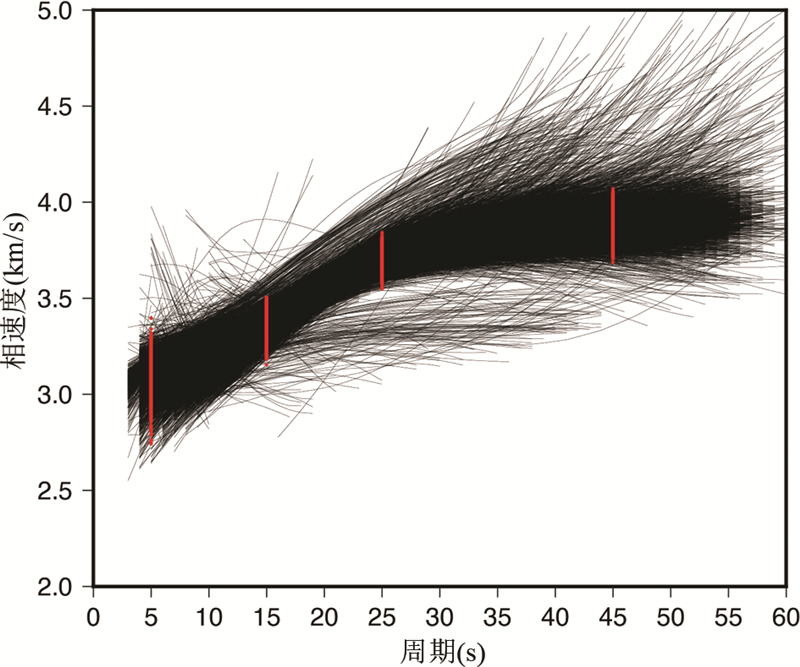
参照Bensen et al. (2007)归纳的背景噪声数据处理流程,本研究对NECsaids、NECESSArray和朝鲜境内共3个流动地震台阵及固定地震台的单台地震数据做了如下处理:按天截取连续波形数据、1Hz减采样、去均值、去线性趋势、去仪器响应、2~100s带通滤波、时间域归一化和频率域谱白化。单台数据预处理完成后,计算台站对间的单日噪声互相关函数并线性叠加得到最终的噪声互相关函数,图 2给出了黑龙江MDJ(牡丹江)台站与研究区域内其它所有台站之间的噪声互相关记录,图中清晰且近似对称的明显面波信号为本研究后续获取高精度的反演结果奠定了坚实的数据基础。由于实际地球介质中噪声源并不是理想的均匀性分布,造成互相关函数在某一方向上可能具有明显的优势,因此为了降低噪声源非均匀性的影响以提高信噪比,我们将台站对间的噪声互相关函数进行对称叠加并取平均,得到所谓的对称分量(Bensen et al., 2007)。接着本研究采用基于多重滤波和相匹配滤波技术的自动频时分析方法(Levshin and Ritzwoller, 2001)来提取台站对间的相速度频散曲线,图 3中黑色曲线展示了本研究在区域内提取到的所有原始相速度频散曲线。

|
图 2 MDJ(牡丹江)台站与研究区域其它台站之间的噪声互相关记录 横、纵坐标分别代表互相关延迟时间和台间距 Fig. 2 Ambient noise cross-correlation records between station MDJ and all other stations Horizontal and vertical axes represent the cross-correlation lag time and the station spacing, respectively |
|
图 3 测量获得的原始频散曲线结果(黑色曲线)和经质量控制后在实际反演中利用的频散数据(红色圆点) Fig. 3 Raw dispersion measurements (black curves) and the selected dispersion data (red dots) used in the final inversion after quality controls |
在利用基于噪声互相关函数提取的频散曲线反演二维群速度/相速度图像的过程中,频散曲线的质量控制非常重要,因为不符合实际情况和偏差过大的异常输入数据会导致反演结果的较大不准确性。本研究反演使用的频散数据,一共经过了以下三个方面的质量控制:①对于每个周期只保留互相关函数信噪比大于15(Bensen et al., 2008)的频散数据(信噪比的定义参照Bensen et al. (2007),即面波信号窗内最大振幅与随后噪声窗内波形均方根的比值);②为了满足远场条件以确保频散测量结果在理论上真实可靠,对于每个周期只保留台间距大于2倍波长的频散数据;③利用两次试错反演剔除掉走时残差过大的异常频散数据,第一次试错反演后去掉走时残差大于5s的异常频散数据,第二次试错反演后去掉走时残差大于2倍标准差的异常频散数据。经过以上质量控制后最终在所选成像周期(5s、15s、25s和45s)上被反演利用的频散数据点如图 3中的红色圆点所示。
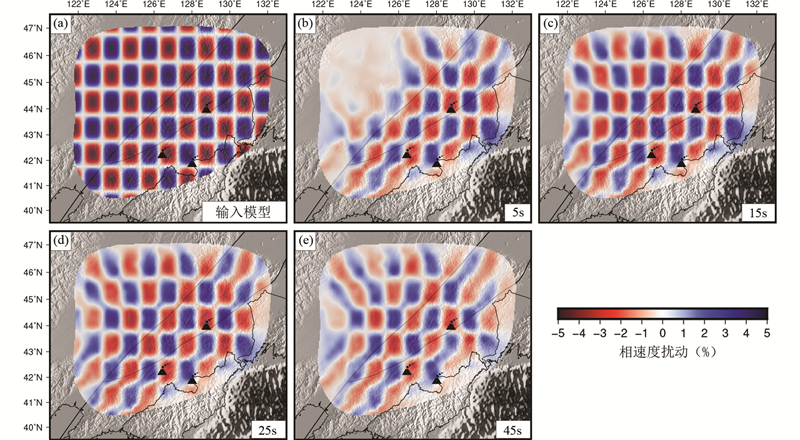
得到相速度频散曲线后,本研究采用基于射线理论的面波层析成像方法(Barmin et al., 2001)来反演建立研究区域二维Rayleigh面波相速度模型。为了检查反演参数设置是否合理以及测试反演模型的分辨能力,我们进行了如图 4和图 5所示的两种不同异常尺度输入模型的检测板恢复性测试。图 4a和图 5a是网格大小分别为1°×1°和0.5°×0.5°的输入模型(对应空间分辨率分别为100km和50km左右),给定的平均速度为4km/s,高、低速异常幅度百分比分别为5%和-5%,正演计算的台站对间理论走时加入了与实际反演相同标准差的高斯白噪声,接着采用与实际反演相同的参数设置对加入噪声的理论走时数据进行反演,得到如图 4b-e和图 5b-e所示各个周期上的反演结果。对于1°×1°的检测板测试(图 4),除了在5s短周期(图 4b)的松辽盆地内部由于射线分布相对不足导致恢复的结果出现了拖尾效应(smearing effects),其它地区在各个周期上的输入模型都能得到比较好的恢复;对于更小尺度0.5°×0.5°的检测板测试(图 5),松辽盆地在5s短周期以及研究区域边缘地带在各个周期上的恢复效果相对较差,但是整体上来看还是能够对输入模型进行基本的恢复(图 5b-e),说明本研究实际反演的结果是足够可靠和稳健的。
|
图 4 背景噪声成像1°×1°检测板恢复性测试 (a)输入模型;(b-e)不同周期(5s、15s、25s和40s)上的检测板恢复结果 Fig. 4 Checkerboard recovery test for the ambient noise tomography with the input anomaly size of 1°×1° (a) input model; (b) recovered models at several different periods (5s, 15s, 25s, and 45s) |

|
图 5 背景噪声成像0.5°×0.5°检测板恢复性测试 (a)输入模型;(b-e)不同周期(5s、15s、25s和40s)上的检测板恢复结果 Fig. 5 Checkerboard recovery test for the ambient noise tomography with the input anomaly size of 0.5°×0.5° (a) input model; (b) recovered models at several different periods (5s, 15s, 25s, and 45s) |
5s短周期上的成像结果(图 6a)与地表地质构造相吻合:研究区域西北方向的松辽盆地表现为大面积低速,依兰-伊通断裂以东的广袤山脉地区表现为整体高速,但是海拔最高的长白山火山却呈现明显的局部低速异常。如图 6b-c所示,随着周期的增大(15~25s),松辽盆地的低速异常逐渐减弱并有向高速异常转变的趋势,而长白山火山区的低速异常则变得更为显著,影响范围也在逐步扩大,在25s周期上(图 6c),龙岗火山和镜泊湖火山同样观察到开始有低速异常的出现。到了45s的稍长周期(图 6d),长白山火山、龙岗火山以及镜泊湖火山都表现出低速异常特征,其中长白山火山区的低速异常范围最大,幅值也最为显著,达到了-5%左右。

|
图 6 背景噪声成像获得的不同周期上二维Rayleigh面波相速度图像 Fig. 6 2-D Rayleigh-wave phase velocity maps at different periods derived from the ambient noise tomography |
Rayleigh面波相速度主要对地下介质的剪切波速度结构比较敏感,而且不同周期的面波对深度的敏感性不一样:周期越长(对应波长一般越长)的面波对地下速度结构的敏感深度就越深,一般来说,基阶Rayleigh面波相速度对剪切波速度结构最大敏感深度在其三分之一个波长左右。同时,在地球内部介质中传播的剪切波对流体、温度和熔融状态比较敏感,高温岩浆体在地震波速度结构上表现为低速特征,因此可以通过地震层析成像的方法来对地下岩浆体结构进行观测识别。基于Tao et al. (2018)利用全波形成像获得的东亚地区三维剪切波速度模型,我们提取出本研究区域的一维剪切波平均速度模型,然后结合CPS软件(Herrmann, 2013)计算得到了如图 7所示的敏感核曲线,本研究在5s、15s、25s和45s周期上得到的相速度图像主要反映了上地壳、中地壳、下地壳和上地幔顶部的速度结构特征,因此以下我们直接在深度范围上对我们的成像结果进行讨论。

|
图 7 所选成像周期(5s、15s、25s和45s)上Rayleigh面波对剪切波的深度敏感核曲线 Fig. 7 Rayleigh-wave phase velocity sensitivity kernels to shear wave as a function of depth at selected periods (5s, 15s, 25s and 45s) |
由于存在巨厚的松散沉积层,松辽盆地在上地壳深度位置(图 6a)表现为大面积的低速异常,随着深度增加进入中-下地壳后,松辽盆地的低速异常则明显减弱,除了沉积厚度最大的盆地中央地区能观察到部分低速异常外,盆地边缘地带由于具有相对较浅的结晶基底而开始出现向高速异常的转变(图 6b-c)。与长白山火山相比,邻近的龙岗火山和镜泊湖火山在中-上地壳深度(图 6a-b)没有观察到明显的低速异常特征,但是在下地壳(图 6c)开始出现明显的低速异常,并有向上地幔延伸的趋势(图 6d),这与前人大地电磁(朱仁学等, 2001)、接收函数(段永红等, 2005)和背景噪声波形伴随成像(Liu et al., 2017b)的研究结果相一致,表明龙岗火山和镜泊湖火山下地壳和上地幔顶部相应深度位置可能存在部分熔融,但是与长白山火山相比部分熔融程度明显偏低。岩石地球化学研究也表明龙岗火山和镜泊湖火山喷出的火山岩形成于低程度的部分熔融过程,没有经历过明显的岩浆分离结晶作用(Chen et al., 2007; Liu et al., 2009)。此外,龙岗火山和长白山火山区在长周期图像上呈现的大范围低速异常(图 6a)表明这两座火山在上地幔深度位置可能是同源的。
3.3 长白山火山长白山火山上地壳有局部低速异常(图 6a),中-下地壳表现为大范围显著的低速异常,该成像结果与前人研究得到长白山火山正下方存在壳内深部低阻体/低速体/低密度体的探测结果基本一致(汤吉等, 2001; 张先康等, 2002; Choi et al., 2013)。与Kim et al. (2017)认为长白山火山中-下地壳存在总体冷却的双层岩体结构解释不同,基于本研究的成像结果,我们倾向于认为长白山火山下方存在与部分熔融相关的中-下地壳岩浆房,而对于上地壳局部的低速异常,我们推测可能反映了长白山火山壳内深部岩浆向浅部运移的岩浆通道或者是区域更小尺度的岩浆聚集体(Fan and Chen, 2019)。地球化学和数值模拟研究表明大陆下地壳是岩浆发生大规模存储和演化的最佳区域,因为下地壳深度位置提供的热力学和流变学条件十分适合幔源岩浆的分离结晶过程(Hildreth and Moorbath, 1988; Annen et al., 2006; Cashman et al., 2017),而长白山火山喷发的火山岩在地球化学成份上经历了从基性岩到中-酸性岩的过渡(Chen et al., 2007; Zhang et al., 2015; 刘嘉麒等, 2015),因此综合地球物理和地球化学的观测资料,我们推测出现显著低波速异常的长白山火山中-下地壳存在一个主要的壳内深部岩浆房。如图 8中的卡通图所示,该岩浆房由幔源玄武质岩浆侵入下地壳后发生停留聚集而形成,壳内岩浆房进一步发生的结晶分异作用导致了中-酸性岩浆的形成,较低密度、更富长英质的岩浆体趋向于向浅部运移,从而形成横向和垂向上的低速体结构(Cashman et al., 2017)。同时,壳内深部岩浆房还可能为长白山火山周边地区现今富集的浅表温泉热液活动(Hahm et al., 2008)持续提供着热源(或物源)。火山岩石地球化学研究揭示出长白山火山喷出的基性岩含有来自下地壳的EM1同位素特征,而后期喷发的中-酸火山岩则形成于基性岩浆的结晶分异作用(Zhang et al., 2015),本研究刻画的长白山火山壳内岩浆系统特征与该认识相一致。

|
图 8 长白山火山地壳-上地幔岩浆系统卡通示意图(据Fan and Chen, 2019修改) Fig. 8 Cartoon illustration for the crust and upper mantle magmatic system beneath the Changbaishan volcano (modified after Fan and Chen, 2019) |
众多大尺度地震层析成像结果(Lei and Zhao, 2005; Tang et al., 2014; Tian et al., 2016; Chen et al., 2017; Guo et al., 2018; Zhang et al., 2019; 田有等, 2019)观察到长白山火山上地幔有大规模的低波速异常,本研究的成像结果(图 6d)也揭示出长白山火山上地幔顶部(岩石圈地幔)存在显著的低速特征,表明上涌的软流圈热物质可能已经到达或者接近莫霍面的位置,并为壳内岩浆房提供了持续的幔源岩浆补给(图 8),大量地球化学研究也表明软流圈减压熔融后上涌引起了中国东北地区晚新生代的火山岩浆活动(Xu et al., 2003; Chen et al., 2007; Zou et al., 2008)。由于面波对深度敏感性的限制,本研究结果对上地幔更深的速度结构尚缺乏约束,但是结合上述前人大尺度地震层析成像结果,可以合理推测长白山火山地幔上涌能够进一步追溯到地幔转换带的深度,而最近的地球动力学数值模拟研究(Yang and Faccenda, 2020)也进一步验证了含水地幔过渡带上涌造就了包括长白山火山在内的中国东北地区晚新生代陆内火山作用。
4 结论本研究通过汇集长白山火山及邻区至今为止最为密集的流动地震台阵和固定地震台观测资料,采用背景噪声成像方法获得了研究区高精度的Rayleigh面波相速度图像,基于成像结果的综合分析得出了如下几点认识:
(1) 龙岗火山和镜泊湖火山下地壳和上地幔深度范围的低速异常可能反映出较低程度的部分熔融;龙岗火山与长白山火山在上地幔深度的连通低速异常表明这两座火山可能起源于一个共同的上地幔岩浆源。
(2) 长白山火山中-下地壳低速体可能指示了岩浆房的存在,上地壳局部低速体可能反映了壳内深部岩浆上涌的通道或者是小范围聚集的岩浆体结构。
(3) 长白山火山上地幔顶部的低速区可能对应软流圈地幔热物质上涌,其减压熔融为壳内岩浆房提供了幔源岩浆补给。
致谢 感谢评审专家完善的修改建议,感谢所有参与探测深俯冲的中国东北地震台阵(NECsaids台阵)的架设和维护工作人员。中国地震局地球物理研究所“国家数字测震台网数据备份中心”(doi: 10.11998/SeisDmc/SN, http://www.seisdmc.ac.cn)为本研究提供了固定台的地震波形数据。
Annen C, Blundy JD and Sparks RSJ. 2006. The genesis of intermediate and silicic magmas in deep crustal hot zones. Journal of Petrology, 47(3): 505-539 DOI:10.1093/petrology/egi084 |
Barmin MP, Ritzwoller MH and Levshin AL. 2001. A fast and reliable method for surface wave tomography. Pure and Applied Geophysics, 158(8): 1351-1375 DOI:10.1007/PL00001225 |
Bensen GD, Ritzwoller MH, Barmin MP, Levshin AL, Lin F, Moschetti MP, Shapiro NM and Yang Y. 2007. Processing seismic ambient noise data to obtain reliable broad-band surface wave dispersion measurements. Geophysical Journal International, 169(3): 1239-1260 DOI:10.1111/j.1365-246X.2007.03374.x |
Bensen GD, Ritzwoller MH and Shapiro NM. 2008. Broadband ambient noise surface wave tomography across the United States. Journal of Geophysical Research:Solid Earth, 113(B5): B05306 |
Cashman KV, Sparks RSJ and Blundy JD. 2017. Vertically extensive and unstable magmatic systems:A unified view of igneous processes. Science, 355(6331): eaag3055 DOI:10.1126/science.aag3055 |
Chen CX, Zhao DP, Tian Y, Wu SG, Hasegawa A, Lei JS, Park JH and Kang IB. 2017. Mantle transition zone, stagnant slab and intraplate volcanism in Northeast Asia. Geophysical Journal International, 209(1): 68-85 |
Chen QF, Ai YS and Chen Y. 2019. Overview of deep structures under the Changbaishan volcanic area in northeast China. Science China (Earth Sciences), 62(6): 935-952 |
Chen Y, Zhang YX, Graham D, Su SG and Deng JF. 2007. Geochemistry of Cenozoic basalts and mantle xenoliths in Northeast China. Lithos, 96(1-2): 108-126 |
Choi S, Oh CW and Götze HJ. 2013. Three-dimensional density modeling of the EGM2008 gravity field over the Mount Paekdu volcanic area. Journal of Geophysical Research:Solid Earth, 118(7): 3820-3836 DOI:10.1002/jgrb.50266 |
Duan YH, Zhang XK, Liu Z, Yuan QX, Xu ZF, Wang FY, Fang SM and Yang ZX. 2005. A study on crustal structures of Changbaishan-Jingpohu volcanic area using receiver functions. Chinese Journal of Geophysics, 48(2): 352-358 (in Chinese with English abstract) |
Fan XL and Chen QF. 2019. Seismic constraints on the magmatic system beneath the Changbaishan volcano:Insight into its origin and regional tectonics. Journal of Geophysical Research:Solid Earth, 124(2): 2003-2024 DOI:10.1029/2018JB016288 |
Fan XL, Chen QF, Legendre CP and Guo Z. 2020. Intraplate volcanism and regional geodynamics in NE Asia revealed by anisotropic Rayleigh-wave tomography. Geophysical Research Letters, 47(1): e2019GL085623 |
Fu YY and Gao Y. 2016. Phase velocity tomography of Rayleigh and Love waves using ambient noise in Northeast China. Chinese Journal of Geophysics, 59(2): 494-503 (in Chinese with English abstract) |
Gao L, Shangguan ZG, Wei HQ and Wu CZ. 2006. Recent geochemical changes of hot-spring gases from Tianchi volcano area, Changbai Mountains, Northeast China. Seismology and Geology, 28(3): 358-366 (in Chinese with English abstract) |
Guo WF, Liu JQ, Xu WG, Li W and Lei M. 2015. Reassessment of the magma system beneath Tianchi volcano, Changbaishan:Phase equilibria constraints. Science Bulletin, 60(35): 3489-3500 (in Chinese) |
Guo Z, Chen YJ, Ning JY, Yang YJ, Afonso JC and Tang YC. 2016. Seismic evidence of on-going sublithosphere upper mantle convection for intra-plate volcanism in Northeast China. Earth and Planetary Science Letters, 433: 31-43 DOI:10.1016/j.epsl.2015.09.035 |
Guo Z, Wang K, Yang YJ, Tang YC, Chen YJ and Hung SH. 2018. The origin and mantle dynamics of Quaternary intraplate volcanism in Northeast China from joint inversion of surface wave and body wave. Journal of Geophysical Research:Solid Earth, 123(3): 2410-2425 DOI:10.1002/2017JB014948 |
Hahm D, Hilton DR, Cho M, Wei H and Kim KR. 2008. Geothermal He and CO2 variations at Changbaishan intra-plate volcano (NE China) and the nature of the sub-continental lithospheric mantle. Geophysical Research Letters, 35(22): L22304 DOI:10.1029/2008GL035955 |
Hammond JOS, Wu JP, Ri KS, Wei W, Yu JN and Oppenheimer C. 2020. Distribution of partial melt beneath Changbaishan/Paektu volcano, China/Democratic People's Republic of Korea. Geochemistry, Geophysics, Geosystems, 21(1): e2019GC008461 |
Herrmann RB. 2013. Computer programs in seismology:An evolving tool for instruction and research. Seismological Research Letters, 84(6): 1081-1088 DOI:10.1785/0220110096 |
Hildreth W and Moorbath S. 1988. Crustal contributions to arc magmatism in the Andes of central Chile. Contributions to Mineralogy and Petrology, 98(4): 455-489 DOI:10.1007/BF00372365 |
Hong HJ, Wu JP, Wang QL, Li K, Zhao CP, Shangguan ZG, Yang QF, Zhang HR and Liu GM. 2007. Volcanic threat levels and classification of volcanic activity in China. Seismology and Geology, 29(3): 447-458 (in Chinese with English abstract) |
Hong TK, Choi E, Park S and Shin JS. 2016. Prediction of ground motion and dynamic stress change in Baekdusan (Changbaishan) volcano caused by a North Korean nuclear explosion. Scientific Reports, 6: 21477 DOI:10.1038/srep21477 |
Horn S and Schmincke HU. 2000. Volatile emission during the eruption of Baitoushan Volcano (China/North Korea) ca. 969 AD.. Bulletin of Volcanology, 61(8): 537-555 DOI:10.1007/s004450050004 |
Hu YX, Wang QL, Cui DX, Li K and Zheng CF. 2004. Joint inversion of geometric deformation in Changbaishan volcanic area. Journal Geodesy and Geodynamics, 24(4): 90-94 (in Chinese with English abstract) |
Kim S, Tkalčic' H and Rhie J. 2017. Seismic constraints on magma evolution beneath Mount Baekdu (Changbai) volcano from transdimensional Bayesian inversion of ambient noise data. Journal of Geophysical Research:Solid Earth, 122(7): 5452-5473 |
Kyong-Song R, Hammond JOS, Chol-Nam K, Hyok K, Yong-Gun Y, Gil-Jong P, Chong-Song R, Oppenheimer C, Liu KW, Iacovino K and Kum-Ran R. 2016. Evidence for partial melt in the crust beneath Mt.Paektu (Changbaishan), Democratic People's Republic of Korea and China.. Science Advances, 2(4): e1501513 |
Lei JS and Zhao DP. 2005. P-wave tomography and origin of the Changbai intraplate volcano in Northeast Asia. Tectonophysics, 397(3-4): 281-295 DOI:10.1016/j.tecto.2004.12.009 |
Lei JS, Xie FR, Fan QC and Santosh M. 2013. Seismic imaging of the deep structure under the Chinese volcanoes:An overview. Physics of the Earth and Planetary Interiors, 224: 104-123 |
Lei JS, Zhao DP, Xu YG, Fan QC, Mi Q, Du MF and Lu MW. 2018. Is there a gap in the stagnant Pacific slab in the mantle transition zone under the Changbaishan volcano?. Acta Petrologica Sinica, 34(1): 13-22 (in Chinese with English abstract) |
Levshin AL and Ritzwoller MH. 2001. Automated detection, extraction, and measurement of regional surface waves. Pure and Applied Geophysics, 158(8): 1531-1545 DOI:10.1007/PL00001233 |
Li K, Liu JQ, Pan XD, Liu GM, Wu CZ and Guo F. 2009. Crust deformation monitoring and research in Tianchi volcanic area, Changbai mountains from 2000~2007. Seismology and Geology, 31(4): 639-646 (in Chinese with English abstract) |
Liu GM, Li CY, Peng ZG, Li XM and Wu J. 2017a. Detecting remotely triggered microseismicity around Changbaishan Volcano following nuclear explosions in North Korea and large distant earthquakes around the world. Geophysical Research Letters, 44(10): 4829-4838 |
Liu JQ, Han JT and Fyfe WS. 2001. Cenozoic episodic volcanism and continental rifting in Northeast China and possible link to Japan Sea development as revealed from K-Ar geochronology. Tectonophysics, 339(3-4): 385-401 DOI:10.1016/S0040-1951(01)00132-9 |
Liu JQ, Chu GQ, Han JT, Rioual P, Jiao WY and Wang KJ. 2009. Volcanic eruptions in the Longgang volcanic field, northeastern China, during the past 15, 000 years. Journal of Asian Earth Sciences, 34(5): 645-654 DOI:10.1016/j.jseaes.2008.09.005 |
Liu JQ, Chen SS, Guo WF, Sun CQ, Zhang ML and Guo ZF. 2015. Research advances in the Mt.Changbai volcano. . Bulletin of Mineralogy, Petrology and Geochemistry, 34(4): 710-723 (in Chinese with English abstract) |
Liu RX. 2015. The bibliography of the Changbaishan volcano:Volcanism in modern times and the sustainable development of the human society. Bulletin of Mineralogy, Petrology and Geochemistry, 34(5): 1073-1076 (in Chinese) |
Liu YN, Niu FL, Chen M and Yang WC. 2017b. 3-D crustal and uppermost mantle structure beneath NE China revealed by ambient noise adjoint tomography. Earth and Planetary Science Letters, 461: 20-29 DOI:10.1016/j.epsl.2016.12.029 |
Ming YH, Wu JP, Su W, Fang LH and Wang WL. 2007. Harmonic-spectral event at Changbaishan Tianchi volcano. Seismology and Geology, 29(3): 492-501 (in Chinese with English abstract) |
Movaghari R and Doloei GJ. 2020. 3-D crustal structure of the Iran plateau using phase velocity ambient noise tomography. Geophysical Journal International, 220(3): 1555-1568 DOI:10.1093/gji/ggz537 |
Oppenheimer C, Wacker L, Xu JD, Galván JD, Stoffel M, Guillet S, Corona C, Sigl M, Di Cosmo N, Hajdas I, Pan B, Breuker R, Schneider L, Esper J, Fei J, Hammond JOS and Büntgen U. 2017. Multi-proxy dating the 'Millennium Eruption' of Changbaishan to late 946 CE. Quaternary Science Reviews, 158: 164-171 DOI:10.1016/j.quascirev.2016.12.024 |
Pan JT, Li YH, Wu QJ and Yu DX. 2014. 3-D S-wave velocity structure of crust and upper-mantle beneath the Northeast China. Chinese Journal of Geophysics, 57(7): 2077-2087 (in Chinese with English abstract) |
Qiu GG, Pei FG, Fang H, Du BR, Zhang XB, Zhang PH, Yuan YZ, He MX and Bai DW. 2014. Analysis of magma chamber at the Tianchi volcano area in Changbai Mountain. Chinese Journal of Geophysics, 57(10): 3466-3477 (in Chinese with English abstract) |
Shapiro NM, Campillo M, Stehly L and Ritzwoller MH. 2005. High-resolution surface-wave tomography from ambient seismic noise. Science, 307(5715): 1615-1618 |
Song JL, Hetland EA, Wu FT, Zhang XK, Liu GD and Yang ZX. 2007. P-wave velocity structure under the Changbaishan volcanic region, NE China, from wide-angle reflection and refraction data. Tectonophysics, 433(1-4): 127-139 DOI:10.1016/j.tecto.2006.09.012 |
Stone R. 2010. Is China's riskiest volcano stirring or merely biding its time?. Science, 329(5991): 498-499 |
Stone R. 2011. Vigil at North Korea's Mount Doom. Science, 334(6056): 584-588 DOI:10.1126/science.334.6056.584 |
Stone R. 2013. Sizing up a slumbering giant. Science, 341(6150): 1060-1061 DOI:10.1126/science.341.6150.1060 |
Sun CQ, Plunkett G, Liu JQ, Zhao HL, Sigl M, McConnell JR, Pilcher JR, Vinther B, Steffensen JP and Hall V. 2014. Ash from Changbaishan Millennium eruption recorded in Greenland ice:Implications for determining the eruption's timing and impact. Geophysical Research Letters, 41(2): 694-701 DOI:10.1002/2013GL058642 |
Tang J, Deng QH, Zhao GZ, Li WJ, Xuan F, Jin GW, Bai DH, Zhan Y, Liang JG, Pu XH, Wang JJ, Li GS, Hong F, Ma MZ and Chen FX. 2001. Electric conductivity and magma chamber at the Tianchi volcano area in Changbaishan Mountain. Seismology and Geology, 23(2): 191-200 (in Chinese with English abstract) |
Tang YC, Chen YS, Yang YJ, Ding ZF, Liu RF, Feng YG, Li P, Yu CQ, Wei SQ, Fan WY, Wang HY, Zhou SY and Ning JY. 2011. Ambient noise tomography in North China Craton. Chinese Journal of Geophysics, 54(8): 2011-2022 (in Chinese with English abstract) |
Tang YC, Obayashi M, Niu FL, Grand SP, Chen YJ, Kawakatsu H, Tanaka S, Ning JY and Ni JF. 2014. Changbaishan volcanism in Northeast China linked to subduction-induced mantle upwelling. Nature Geoscience, 7(6): 470-475 DOI:10.1038/ngeo2166 |
Tao K, Niu FL, Ning JY, Chen YJ, Grand S, Kawakatsu H, Tanaka S, Obayashi M and Ni J. 2014. Crustal structure beneath NE China imaged by NECESSArray receiver function data. Earth and Planetary Science Letters, 398: 48-57 DOI:10.1016/j.epsl.2014.04.043 |
Tao K, Grand SP and Niu FL. 2018. Seismic structure of the upper mantle beneath Eastern Asia from full waveform seismic tomography. Geochemistry, Geophysics, Geosystems, 19(8): 2732-2763 DOI:10.1029/2018GC007460 |
Tian Y, Zhu HX, Zhao DP, Liu C, Feng X, Liu T and Ma JC. 2016. Mantle transition zone structure beneath the Changbai volcano:Insight into deep slab dehydration and hot upwelling near the 410km discontinuity. Journal of Geophysical Research:Solid Earth, 121(8): 5794-5808 DOI:10.1002/2016JB012959 |
Tian Y, Ma JC, Liu C, Feng X, Liu TT, Zhu HX, Yan D and Li HH. 2019. Effects of subduction of the western Pacific plate on tectonic evolution of Northeast China and geodynamic implications. Chinese Journal of Geophysics, 62(3): 1071-1082 (in Chinese with English abstract) |
Wang X, Chen QF, Li J and Wei SJ. 2016. Seismic sensor misorientation measurement using P-wave particle motion:An application to the NECsaids Array. Seismological Research Letters, 87(4): 901-911 DOI:10.1785/0220160005 |
Wei HQ, Liu GM and Gill J. 2013. Review of eruptive activity at Tianchi volcano, Changbaishan, Northeast China:Implications for possible future eruptions. Bulletin of Volcanology, 75(4): 706 DOI:10.1007/s00445-013-0706-5 |
Witze A. 2016. North Korea lets scientists peer inside dangerous volcano. Nature, 532(7599): 290-291 DOI:10.1038/nature.2016.19751 |
Wu JP, Ming YH, Zhang HR, Su W and Liu YM. 2005. Seismic activity at the Changbaishan Tianchi volcano in the summer of 2002. Chinese Journal of Geophysics, 48(3): 621-628 (in Chinese with English abstract) |
Xu JD, Liu GM, Wu JP, Ming YH, Wang QL, Cui DX, Shangguan ZG, Pan B, Lin XD and Liu JQ. 2012. Recent unrest of Changbaishan volcano, Northeast China:A precursor of a future eruption?. Geophysical Research Letters, 39(16): L16305 |
Xu YG, Menzies MA, Thirlwall MF, Huang XL, Liu Y and Chen XM. 2003. "Reactive" harzburgites from Huinan, NE China:Products of the lithosphere-asthenosphere interaction during lithospheric thinning?. Geochimica et Cosmochimica Acta, 67(3): 487-505 DOI:10.1016/S0016-7037(02)01089-X |
Xu YG, Li HY, Hong LB, Ma L, Ma Q and Sun MD. 2018. Generation of Cenozoic intraplate basalts in the big mantle wedge under eastern Asia. Science China (Earth Sciences), 61(7): 869-886 DOI:10.1007/s11430-017-9192-y |
Yang JF and Faccenda M. 2020. Intraplate volcanism originating from upwelling hydrous mantle transition zone. Nature, 579(7797): 88-91 DOI:10.1038/s41586-020-2045-y |
Yang Y, Lei JS, Ai YS, Zhang GW, Sun CQ, Fan EB, Li L, Mi Q, Lu MW, He J, Wang J, Du MF, Zhang B, Tian FF, Ma C and Liu ZM. 2019. Crustal structure beneath Northeast China from ambient noise tomography. Physics of the Earth and Planetary Interiors, 293: 106257 DOI:10.1016/j.pepi.2019.04.008 |
Yao HJ, Van Der Hilst RD and De Hoop MV. 2006. Surface-wave array tomography in SE Tibet from ambient seismic noise and two-station analysis:I.Phase velocity maps. . Geophysical Journal International, 166(2): 732-744 DOI:10.1111/j.1365-246X.2006.03028.x |
Zhang FX, Wu QJ, Li YH and Zhang RQ. 2019. The seismic evidence of velocity variation for Changbaishan volcanism in Northeast China. Geophysical Journal International, 218(1): 283-294 DOI:10.1093/gji/ggz157 |
Zhang ML, Guo ZF, Cheng ZH, Zhang LH and Liu JQ. 2015. Late Cenozoic intraplate volcanism in Changbai volcanic field, on the border of China and North Korea:Insights into deep subduction of the Pacific slab and intraplate volcanism. Journal of the Geological Society, 172(5): 648-663 DOI:10.1144/jgs2014-080 |
Zhang ML, Guo ZF, Liu JQ, Liu GM, Zhang LH, Lei M, Zhao WB, Ma L, Sepe V and Ventura G. 2018. The intraplate Changbaishan volcanic field (China/North Korea):A review on eruptive history, magma genesis, geodynamic significance, recent dynamics and potential hazards. Earth-Science Reviews, 187: 19-52 DOI:10.1016/j.earscirev.2018.07.011 |
Zhang XK, Zhang CK, Zhao JR, Yang ZX, Li SL, Zhang JS, Liu BF, Cheng SX, Sun GW and Pan SZ. 2002. Deep seismic sounding investigation into the deep structure of the magma system in Changbaishan Tianchi volconic region. Acta Seismologica Sinica, 24(2): 135-143 (in Chinese with English abstract) |
Zhao DP. 2004. Global tomographic images of mantle plumes and subducting slabs:Insight into deep Earth dynamics. Physics of the Earth and Planetary Interiors, 146(1-2): 3-34 DOI:10.1016/j.pepi.2003.07.032 |
Zheng XF, Ouyang B, Zhang DN, Yao ZX, Liang JH and Zheng J. 2009. Technical system construction of Data Backup centre for China Seismograph Network and the data support to researches on the Wenchuan earthquake. Chinese Journal of Geophysics, 52(5): 1412-1417 (in Chinese with English abstract) |
Zheng Y, Shen WS, Zhou LQ, Yang YJ, Xie ZJ and Ritzwoller MH. 2011. Crust and uppermost mantle beneath the North China Craton, northeastern China, and the Sea of Japan from ambient noise tomography. Journal of Geophysical Research:Solid Earth, 116(B12): B12312 DOI:10.1029/2011JB008637 |
Zhu HX, Tian Y, Zhao DP, Li HH and Liu C. 2019. Seismic structure of the Changbai intraplate volcano in NE China from joint inversion of ambient noise and receiver functions. Journal of Geophysical Research:Solid Earth, 124(5): 4984-5002 DOI:10.1029/2018JB016600 |
Zhu RX, Fu WZ, Meng LS, Chen HZ and Zhao Y. 2001. Preliminary study on electric structure in the Jingbohu volcano area of the Heilongjiang Province. Seismology and Geology, 23(2): 186-190 (in Chinese with English abstract) |
Zou HB, Fan QC and Yao YP. 2008. U-Th systematics of dispersed young volcanoes in NE China:Asthenosphere upwelling caused by piling up and upward thickening of stagnant Pacific slab. Chemical Geology, 255(1-2): 134-142 DOI:10.1016/j.chemgeo.2008.06.022 |
陈棋福, 艾印双, 陈赟. 2019. 长白山火山区深部结构探测的研究进展与展望. 中国科学(地球科学), 49(5): 778-795. |
段永红, 张先康, 刘志, 原秦喜, 徐朝繁, 王夫运, 方盛明, 杨卓欣. 2005. 长白山-镜泊湖火山区地壳结构接收函数研究. 地球物理学报, 48(2): 352-358. DOI:10.3321/j.issn:0001-5733.2005.02.017 |
付媛媛, 高原. 2016. 东北地区背景噪声的Rayleigh和Love波相速度层析成像. 地球物理学报, 59(2): 494-503. |
高玲, 上官志冠, 魏海泉, 武成智. 2006. 长白山天池火山近期气体地球化学的异常变化. 地震地质, 28(3): 358-366. DOI:10.3969/j.issn.0253-4967.2006.03.004 |
郭文峰, 刘嘉麒, 徐文刚, 李稳, 雷敏. 2015. 长白山天池火山岩浆系统再认识:岩石热力学模拟. 科学通报, 60(35): 3489-3500. |
洪汉净, 吴建平, 王庆良, 李克, 赵慈平, 上官志冠, 杨清福, 张恒荣, 刘国明. 2007. 中国火山危险性等级与活动性分类. 地震地质, 29(3): 447-458. DOI:10.3969/j.issn.0253-4967.2007.03.001 |
胡亚轩, 王庆良, 崔笃信, 李克, 郑传芳. 2004. 长白山火山区几何形变的联合反演. 大地测量与地球动力学, 24(4): 90-94. |
雷建设, 赵大鹏, 徐义刚, 樊祺诚, 米琦, 杜沫霏, 鲁明文. 2018. 长白山火山下方地幔转换带中滞留的俯冲太平洋板块存在空缺吗?. 岩石学报, 34(1): 13-22. |
李克, 刘俊清, 盘晓东, 刘国明, 武成智, 郭峰. 2009. 2000~2007年期间长白山天池火山区地壳变形监测与分析. 地震地质, 31(4): 639-646. DOI:10.3969/j.issn.0253-4967.2009.04.007 |
刘嘉麒, 陈双双, 郭文峰, 孙春青, 张茂亮, 郭正府. 2015. 长白山火山研究进展. 矿物岩石地球化学通报, 34(4): 710-723. DOI:10.3969/j.issn.1007-2802.2015.04.005 |
刘若新. 2015. 长白山天池火山的前世今生——近代火山活动与人类社会可持续发展(二). 矿物岩石地球化学通报, 34(5): 1073-1076. DOI:10.3969/j.issn.1007-2802.2015.05.028 |
明跃红, 吴建平, 苏伟, 房立华, 王未来. 2007. 长白山天池火山区的谐频事件. 地震地质, 29(3): 492-501. DOI:10.3969/j.issn.0253-4967.2007.03.005 |
潘佳铁, 李永华, 吴庆举, 余大新. 2014. 中国东北地区地壳上地幔三维S波速度结构. 地球物理学报, 57(7): 2077-2087. |
仇根根, 裴发根, 方慧, 杜炳锐, 张小博, 张鹏辉, 袁永真, 何梅兴, 白大为. 2014. 长白山天池火山岩浆系统分析. 地球物理学报, 57(10): 3466-3477. DOI:10.6038/cjg20141032 |
汤吉, 邓前辉, 赵国泽, 李文军, 宣飞, 晋光文, 白登海, 詹艳, 梁竞阁, 蒲兴华, 王继军, 李国深, 洪飞, 马明志, 陈风学. 2001. 长白山天池火山区电性结构和岩浆系统. 地震地质, 23(2): 191-200. DOI:10.3969/j.issn.0253-4967.2001.02.008 |
唐有彩, 陈永顺, 杨英杰, 丁志峰, 刘瑞丰, 冯永革, 李鹏, 俞春泉, 魏松峤, 范文渊, 王海洋, 周仕勇, 宁杰远. 2011. 华北克拉通中部地区背景噪声成像. 地球物理学报, 54(8): 2011-2022. DOI:10.3969/j.issn.0001-5733.2011.08.008 |
田有, 马锦程, 刘财, 冯晅, 刘婷婷, 朱洪翔, 闫冬, 李红昊. 2019. 西太平洋俯冲板块对中国东北构造演化的影响及其动力学意义. 地球物理学报, 62(3): 1071-1082. |
吴建平, 明跃红, 张恒荣, 苏伟, 刘一鸣. 2005. 2002年夏季长白山天池火山区的地震活动研究. 地球物理学报, 48(3): 621-628. DOI:10.3321/j.issn:0001-5733.2005.03.020 |
徐义刚, 李洪颜, 洪路兵, 马亮, 马强, 孙明道. 2018. 东亚大地幔楔与中国东部新生代板内玄武岩成因. 中国科学(地球科学), 48(7): 825-843. |
张先康, 张成科, 赵金仁, 杨卓欣, 李松林, 张建狮, 刘宝峰, 成双喜, 孙国伟, 潘素珍. 2002. 长白山天池火山区岩浆系统深部结构的深地震测深研究. 地震学报, 24(2): 135-143. DOI:10.3321/j.issn:0253-3782.2002.02.003 |
郑秀芬, 欧阳飚, 张东宁, 姚志祥, 梁建宏, 郑洁. 2009. "国家数字测震台网数据备份中心"技术系统建设及其对汶川大地震研究的数据支撑. 地球物理学报, 52(5): 1412-1417. DOI:10.3969/j.issn.0001-5733.2009.05.031 |
朱仁学, 付维洲, 孟令顺, 陈洪洲, 赵谊. 2001. 黑龙江镜泊湖火山地区电性结构初步研究. 地震地质, 23(2): 186-190. DOI:10.3969/j.issn.0253-4967.2001.02.007 |