 2020, Vol. 36


2. 山东黄金矿业(莱州)有限公司焦家金矿, 莱州 261400
2. Shandong Gold Mining(Laizhou) Limited Company Jiaojia Gold Deposit, Laizhou 261400, China
花岗质岩石热液蚀变作用和金矿化有着密切的时空关系(Laurich et al., 2014; Meier et al., 2015; 邱昆峰等, 2015; 张志超等, 2015)。其中,沿断裂或节理两侧岩石发红是热液金矿床中常见的热液蚀变表现,常作为重要的找矿标志。但是,对于岩石发红现象(即“红化”)的成因认识目前存在较大分歧,Nakano et al. (2005)认为斜长石被钾长石交代过程中形成的纳米级铁包体分布在次生条纹长石的微孔隙中致使岩石发红。Putnis et al. (2007)认为岩石发红是钾长石化过程中形成的大量孔隙被自流体中沉淀的赤铁矿充填导致,而Engvik et al. (2008)的研究表明钠长石交代斜长石的过程中同样可以发生赤铁矿化导致岩石发红。Pluemper and Putnis (2009)认为岩石的红化是多种蚀变作用叠加的结果,包括钠长石化、绢云母化和钾长石化,这些蚀变作用主要发生在斜长石的核部,其中钾长石化使得流体和花岗岩蚀变释放的铁形成氧化物沉淀在斜长石内部。张宇等(2014)认为钠长石化过程中,来自斜长石、黑云母等矿物蚀变释放的铁以氧化物形式充填入斜长石核部蚀变孔隙中,致使岩石变红,并非钾长石化。这种分歧在很大程度上制约了红化蚀变对金成矿作用的认识。因此,亟需开展红化蚀变矿物学和地球化学研究,查明红化蚀变特征及其对金成矿贡献。
胶东是我国最重要的金矿集区,已探明储量超过5000t(Deng et al., 2019),是环太平洋中生代金成矿系统的重要组成部分(Goldfarb et al., 1998; Goldfarb and Santosh, 2014; Groves et al., 2020)。玲珑型花岗质岩与金矿床有着密切的空间关系,是区内金矿床最主要的赋矿围岩(Deng et al., 2003, 2008, 2015a; 邓军等, 2006; 杨立强等, 2014; Yang et al., 2016a)。胶东金矿床均赋存于沿NE-NNE向断裂带展布的大规模红化蚀变岩中(陈光远等, 1997)。尽管前人对于红化蚀变带进行大量矿物学工作,但对于红化蚀变实质仍存在争议:①红化蚀变实质是钾长石化(邓军等, 2010; 曹晖等, 2013; 刘向东等, 2019);②岩石发红主要是由于成矿早期暗色矿物蚀变分解,造岩元素大量迁出,残留的Si、Fe、Al、Ti元素形成赤铁矿、金红石等矿物,使围岩中的浅色矿物染色而形成(陈光远等, 1997)。造成这些认识差异的原因是前人对红化蚀变形成过程缺乏系统探讨,这在一定程度上制约了矿床成因的研究和找矿勘探的工作。寺庄金矿床已探明储量超过120t,而赋存于红化蚀变带内的Ⅲ号矿体群占已探明资源储量70%,因此是研究红化蚀变与金成矿的理想对象。为此,本文在详实的野外地质工作基础之上,精细研究寺庄金矿床强、弱红化蚀变岩内矿物组合和元素组成特征,系统探讨红化蚀变过程和受控因素及其与金成矿的关系。
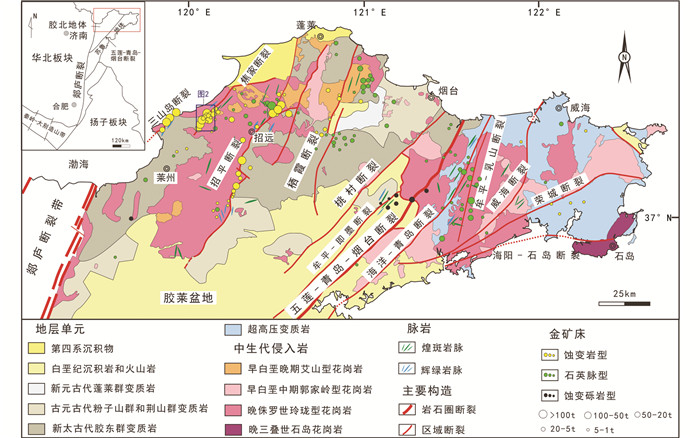
1 区域地质与矿床地质胶东是一个主要由前寒武纪基底岩石和超高压变质岩块组成、中生代构造-岩浆作用发育的内生热液金矿集区(图 1; 杨立强等, 2014, 2019; Yang et al., 2017; Deng and Wang, 2016; Deng et al., 2019, 2020a, b; Zhang et al., 2019, 2020a, b),已探明储量超过4000吨,约占全国的1/3,现年产量超百吨,约占全国的1/4(Goldfarb and Santosh, 2014; Yang et al., 2016b)。胶东地区进一步分为东、西两部分:东部即苏鲁地体北段,属秦岭-大别-苏鲁造山带;西部即胶北地体。胶北隆起位于胶北地体北部,区内变质岩建造由太古宇胶东群TTG、古元古界粉子山群和荆山群、以及新元古界蓬莱群变质沉积岩组成(Tang et al., 2007; Zhai and Santosh, 2011; Tam et al., 2011; 张良等, 2014; Yang et al., 2014; Deng et al., 2011, 2015b; Zhang et al., 2017)。中生代岩浆岩分布广泛,主要由晚侏罗世玲珑型花岗岩、早白垩世早期郭家岭型花岗岩、早白垩世晚期艾山型花岗岩以及大量中基性脉岩组成(Song et al., 2014; Gong et al., 2013, 2015; Yang et al., 2016a; Deng et al., 2015b, 2017, 2019; Wang et al., 2015)。其中,玲珑型和郭家岭型花岗质岩是区内金矿床最主要的赋矿围岩,其赋存胶东95%以上的金资源储量(邓军等, 2006; Deng et al., 2008; Goldfarb and Santosh, 2014; 杨立强等, 2014)。玲珑型黑云母花岗岩呈NNE向带状分布于焦家断裂与招平断裂之间(图 1),侵位年龄为166~149Ma(Jiang et al., 2012; Yang et al., 2012);郭家岭型花岗质岩体主要由石英二长岩、二长花岗岩和花岗闪长岩组成,于126~132Ma侵入到玲珑型花岗岩体中(Hou et al., 2007; Yang et al., 2012; 图 1)。区域构造断裂主要呈NNE-NE向展布,
|
图 1 胶东构造地质与金矿分布简图(据Yang et al., 2016b, 2017, 2018; Deng et al., 2017修改) Fig. 1 Simplified geological map of the Jiaodong gold province (modified after Yang et al., 2016b, 2017, 2018; Deng et al., 2017) |
自西向东依次为三山岛断裂、焦家断裂和招平断裂,与发育在玲珑型花岗岩体和郭家岭型花岗岩体中的较小规模的NNE-NE向断裂节理联合控制金矿床的分布(邓军等, 2006; Deng et al., 2008; 杨立强等, 2014; Goldfarb and Santosh, 2014)。焦家断裂带呈NE-NNE展布,长约60km,宽约50~2000m,控制带内已发现20多个金矿床(Yang et al., 2016c),控制金矿床资源总量已超过1200t(Deng et al., 2015a),该断裂也是寺庄金矿床主要控矿断裂。
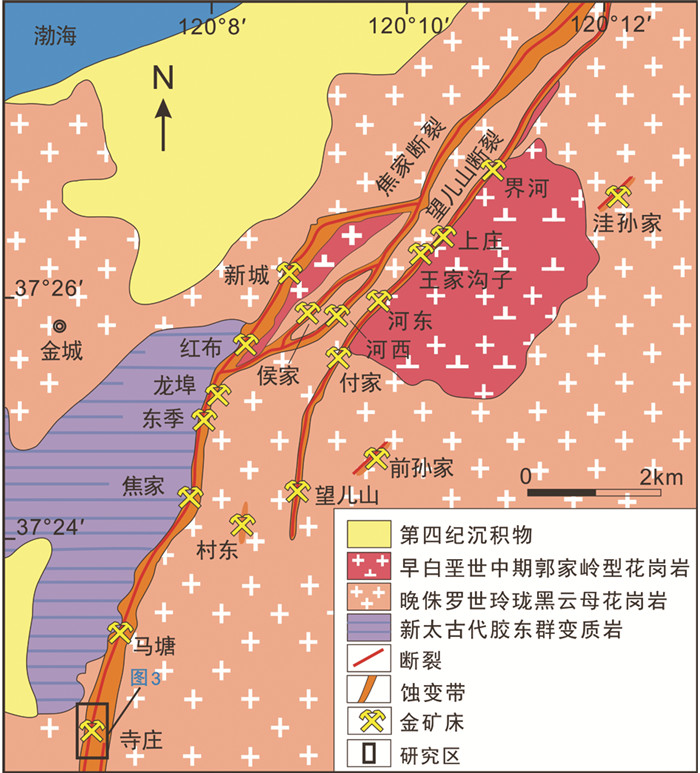
寺庄金矿床位于莱州市朱桥镇寺庄村一带,属于焦家金矿田最南端(图 2)(卫清等, 2018; 刘向东等, 2019)。矿区主要出露地层为太古宇胶东群,岩性为混合岩化黑云斜长变粒岩和斜长角闪岩,分布于矿区西部,焦家断裂带上盘。矿区内花岗岩出露广泛,分布于焦家断裂下盘,主要为玲珑黑云母花岗岩(图 3)(冯建秋, 2016; Wei et al., 2019),是寺庄金矿床主要赋矿围岩。矿区内构造主要为焦家断裂及其下盘次级断裂。焦家断裂沿胶东群与玲珑黑云母花岗岩接触带发育,走向NNE,倾向NW,倾角30°~45°,上缓下陡,宽几十米至上百米。矿体主要分布在焦家断裂下盘黑云母花岗岩中,按照矿体赋存部位及地质特征可划分为3个矿体,编号为Ⅰ、Ⅱ、Ⅲ号矿体,以网脉状、浸染状和团块状矿化为主。围岩热液蚀变强烈,分带明显,从主断裂带向外依次可划分为黄铁绢英岩化带、绢英岩化带和大规模的红化蚀变带。此外矿区还发育硅化、碳酸盐化和绿泥石化等围岩蚀变。
|
图 2 焦家金矿田地质简图(据Yang et al., 2016b) Fig. 2 Simplified geological map of the Jiaojia gold ore field (after Yang et al., 2016b) |

|
图 3 寺庄金矿床地质简图(据Wei et al., 2019修改) Fig. 3 Sketch geological map of the Sizhuang gold deposit (modified after Wei et al., 2019) |
寺庄金矿床主要赋矿围岩为焦家断裂下盘黑云母花岗岩和上盘胶东群变质岩(冯建秋, 2016; Wei et al., 2019; 刘向东等, 2019)。红化蚀变发育在黑云母花岗岩中(图 4b),沿焦家主断层或沿其次级断裂-裂隙分布,规模较大。按照距离主断裂远近可分为强、弱红化蚀变两种:①强红化蚀变带(图 4d)靠近主断裂,并与绢英岩化带呈过渡关系,绢英岩化带内部常常残留强红化蚀变花岗岩(图 4c),指示红化蚀变早于绢英岩化、黄铁绢英岩化蚀变。强红化蚀变花岗岩手标本颜色鲜艳,出现新生粗粒热液钾长石和载金矿物黄铁矿(图 4h)。②弱红化蚀变带(图 4e)距离焦家主断裂较远,与玲珑黑云母花岗岩呈过渡关系(图 3c),仅在次级裂隙周围5~20cm表现为蚀变加强的现象,呈菱形格状分布(图 4b),且裂隙中常常被石英-黄铁矿脉充填(图 3c);岩石手标本略微发红,但仍然保留花岗岩的结构特征(图 4g)。约占已探明金资源总量70%的Ⅲ号矿体赋存于主裂面之下200~400m红化花岗岩中,以脉状、网脉状矿化为主,矿体呈脉状、透镜状产出,指示金成矿与红化蚀变关系密切。

|
图 4 寺庄金矿床红化蚀变野外及手标本照片 (a)大规模红化蚀变岩;(b)线状分布的红化蚀变岩;(c)绢英岩化蚀变带中残留红化花岗岩;(d)强红化蚀变带;(e)弱红化蚀变带;(f)新鲜黑云母花岗岩;(g)块状弱红化花岗岩;(h)块状强红化花岗岩;(i)绢英岩 Fig. 4 Typical features of rubefication alteration and in the Sizhuang gold deposit (a) largescale rubefication alteration; (b) lineage rubefication alteration; (c) rubefication granite relic in sericite-quartz alteration; (d) strong rubefication zone; (e) weak rubefication zone; (f) fresh biotite granite; (g) weak rubefication granite; (h) strong rubefication granite; (i) sericite-quartz altered rock |
寺庄金矿床本次样品均来自寺庄金矿床井下坑道内(图 3c),描述见表 1。将新鲜花岗岩和红化蚀变花岗岩磨制成薄片进行镜下观察和电子探针分析。薄片镜下观察在中国地质大学(北京)矿物标型实验室Leica-DM4500P高级偏光显微镜下完成。电子探针实验在核工业北京地质研究院电子探针实验室完成,仪器型号为JXA-8100,加速电压为20kV,束流100nA,束斑大小1~5μm,修正方法ZAF。扫描电镜实验是在核工业北京地质研究院地质矿产研究所岩矿实验室完成,所用仪器为TESCAN VEGA3扫描电镜,分辨率为3.5nm/30kV(钨灯丝)。
|
表 1 寺庄金矿床新鲜花岗岩与红化蚀变花岗岩分析测试表 Table 1 Sample information of Sizhuang unaltered and altered granite |
详细的岩相学观察发现不同蚀变强度对应不同的矿物组合。弱红化蚀变带内蚀变主要集中在斜长石核部,而边部几乎没有蚀变,整颗斜长石表现为核部混浊而边部干净,形成明显的净边结构(图 5b, c)。核部混浊是由于斜长石内部发育有大量钠长石和鳞片状绢云母,和少量热液钾长石(图 6b),说明绢云母、热液钾长石与钠长石关系密切。更长石核部被钠长石交代后具有多孔的特征,孔隙长轴从几微米到数十微米不等,孔隙边缘不平,在孔隙内部出现赤铁矿颗粒(图 6a),这说明蚀变后孔隙是原生微孔隙经过流体改造后进一步扩大,并且逐渐连成一体。强红化蚀变花岗岩镜下特征表现为斜长石、绿泥石、石英等矿物被正条纹长石所包裹(图 5d、图 6c)或者斜长石颗粒被热液钾长石交代(图 5e),条纹长石中钠长石条纹从颗粒中心到边部逐渐减少(图 5d)。新形成的热液钾长石内部发现残留钠长石(图 6d)。

|
图 5 寺庄金矿床红化蚀变镜下特征 (a)新鲜玲珑黑云母花岗岩;(b)斜长石核部发生蚀变,弱红化花岗岩;(c)斜长石核部发生蚀变,黑云母发生绿泥石化,弱红化花岗岩;(d)条纹长石,从长石中心到边部,Na长石条纹逐渐变少变弱,强红化蚀变带;(e)斜长石边部次生加大的热液钾长石,强红化蚀变带;(f)石英交代黑云母.矿物缩写:Kfs-钾长石;Px-辉石;Pl-斜长石;Ser-白云母;Chl-绿泥石;Q-石英;Mc-微斜长石;Bt-黑云母;Per-条纹长石 Fig. 5 Photomicrographs of representative granite and rubefication altered granite in the Sizhuang gold deposit (a) fresh biotite granite; (b) the alteration of the plagioclase in weak rubefication zone; (c) the alteration of the plagioclase and chloritization of biotite in weak rubefication granite; (d) albite decrease from the core to the margin in perthite; (e) secondary k-feldspar around plagioclase; (f) quartz replace biotite. Abbreviation: Kfs-K-feldspar; Px-pyroxene; Pl-plagioclase; Ser-sericite; Chl-chlorite; Q-quartz; Mc-microcline; Bt-biotite; Per-perthite |

|
图 6 红化蚀变带蚀变长石及显微孔隙的扫描电镜(SEM)及背散射(BSE)显微照片 (a)弱红化蚀变花岗岩中斜长石的核部(SEM);(b)斜长石核部出现绢云母和热液钾长石(BSE);(c)黑云母蚀变成金红石,热液钾长石包裹斜长石(BSE);(d)热液钾长石包裹钠长石(BSE).矿物缩写:Ab-钠长石;Hem-赤铁矿;Cal-方解石 Fig. 6 SEM and BSE images showing petrographic aspects of feldspar in rubefication zone (a) the hydrothermal feldspar and sericite in the core of plagioclase (SEM); (b) hydrothermal k-feldspar wrap plagioclase (BSE); (c) ruthile replace biotite and hydrothermal K-feldspar wrap plagioclase (BSE); (d) hydrothermal k-feldspar wrap plagioclase and albite (BSE). Abbreviation: Ab-albite; Hem-hematite; Cal-calcite |
在弱红化蚀变带内,蚀变主要发生在斜长石的核部,形成钠长石、绢云母、少量钾长石及赤铁矿等矿物组合,表明早期富Na热液在斜长石核部进行交代。而在强红化蚀变带内,蚀变发生在斜长石外部,出现粗粒热液钾长石,并且正条纹长石从核部到边部条纹逐渐减少变细直到消失,说明流体从富Na到富K逐渐转变。值得注意的是,在蚀变斜长石核部并没有发现金红石。
3.3 元素地球化学特征选取新鲜花岗岩中的斜长石、原生钾长石、弱红化花岗岩中具有净边结构的斜长石以及强红化蚀变带中新生的热液钾长石,对其进行电子探针分析,结果见表 2。
|
|
表 2 长石化学组成电子探针分析结果与结构计算(wt%) Table 2 Electron microprobe analyses and structural formula of feldspar (wt%) |
未蚀变的斜长石成分为An7.69-19.27Ab78.98-91.59,为更长石。原生钾长石成分为Or86.24-95.96Ab4.04-13.61。在弱红化蚀变带中,具有净边结构的斜长石边部(Ab84.46An14.46)到核部(Ab92.42An2.19)(表 2),表明核部已经基本蚀变为钠长石,且蚀变后的核部比边部更加富Na贫Ca,形成明显的“反环带结构”(张宇等, 2014)。而对于强烈红化蚀变的区域,出现大量的热液钾长石,成分为Or91.31-97.92Ab2.08-8.69。与原生钾长石相比,热液钾长石更富K贫Na。
不同蚀变程度的样品的电子探针分析结果表明(表 2),随着蚀变程度的加强,长石成分发生较为规律的变化。在弱红化蚀变区域,蚀变主要发生在斜长石核部,基本被蚀变成钠长石、绢云母和钾长石,同时出现大量赤铁矿,而边部几乎没有蚀变(图 5b, c、图 6a, b)。随着蚀变的进一步加强,流体从富Na向富K成分转变,斜长石逐渐消失,出现大量的热液钾长石,相比于原生钾长石,新形成的热液钾长石更富Or组分(图 7)。

|
图 7 寺庄金矿床长石Or-Ab-An分类图解 Fig. 7 Or-Ab-An diagram of feldspars from the Sizhuang gold deposit |
为讨论红化蚀变过程中元素变化规律,本文收集前人在该矿床的主量元素数据(表 3),采用(Grant, 1986, 2005)的方法对主量元素的活动性进行描述。但如何选择不活动元素是进行质量平衡计算的关键。在热液流体-岩石反应过程中,Al2O3和TiO2通常被认为是不活动的(Condie and Sinha, 1996),但Al在变形变质作用过程中仍有一定的活动性(Ague, 1994),尤其是长石绢云母化过程中有部分析出(O'Hara, 1988; O'Hara and Blackburn, 1989)。寺庄金矿床红化蚀变过程中有绢云母和热液钾长石等矿物形成,导致Al不适合作为不活动组分。Ti在岩石中的含量低,而且其活动性小,在水岩反应以及岩石变形变质过程中相对稳定,因此可以作为理想参照元素(Condie and Sinha, 1996; Ague, 1997; Klammer, 1997)。计算公式为:

|
|
|
表 3 新鲜黑云母花岗岩和红化蚀变花岗岩主量元素分析结果(wt%) Table 3 Major elements compositions of fresh biotite granite and rubefication granite (wt%) |
ΔCAi和ΔCoi分别代表蚀变岩石和新鲜岩石中元素Ti的含量,CATiO2和CATiO2分别代表蚀变岩石和未蚀变岩石中的TiO2含量,ΔCi代表每100g样品中元素的带入带出量。将3个未蚀变花岗岩的数据取平均值作为ΔC0i,5个红化蚀变花岗岩的数据取平均值作为ΔCAi,投入Isocon图解上(图 8),穿过TiO2的线作为Isocon线。

|
图 8 新鲜花岗岩及红化蚀变花岗岩的Isocon图解 数据来源:卫清等, 2018; 刘向东等, 2019 Fig. 8 Isocon diagrams in which fresh granite versus the rubefication granite Data source: Wei et al., 2018; Liu et al., 2019 |
红化蚀变带中SiO2、K2O及烧失量的含量上升,CaO、Na2O、Al2O3、FeOT、MgO的含量降低,P2O5的含量基本没变。在更长石向钠长石转变过程中,Ca被流体活化带出,因此表现出CaO的含量减少。虽然红化蚀变过程中有钠长石形成,但主要集中在更长石内部。流体带出斜长石内部大量的Ca和少量Na,残留的Na以钠长石的形式保存下来,随后钠长石被绢云母、钾长石所取代,造成Na和Al含量减少。蚀变过程中花岗岩中的Fe可能被活化出来,部分形成氧化物充填在斜长石核部或,一部分被带走,所以FeOT的含量也相应降低。强红化蚀变带内出现大量热液钾长石,说明流体中K和Si含量增加。P2O5含量基本不变,表明磷灰石并没有发生分解。黑云母绿泥石化的过程中引起MgO的含量下降。
4 讨论 4.1 红化蚀变物理化学过程及其控制因素长石蚀变,包括溶解、溶解组分的运移及次生矿物的沉淀在地质过程中普遍存在(Giles, 1987; Glasmann, 1992; Alekseyev et al., 1997; Lasaga and Luttge, 2001; Fu et al., 2009; Kampman et al., 2009; Crundwell, 2015; Yuan et al., 2017)。前文对红化蚀变带进行详细研究,表明寺庄金矿床红化并不同于前人认为的钾长石化(Li et al., 2013)或赤铁矿金红石化(陈光远等, 1997),而是一个复杂的反应过程。在弱红化蚀变区域,斜长石核部发生蚀变而边部基本保持干净(图 5b, c),并且在蚀变的核部沉淀有少量绢云母、钾长石(图 6b)和赤铁矿包体(图 6a), 明显区别于未蚀变斜长石(图 5a)。随着红化蚀变程度的增强,出现大量的热液钾长石。
在弱红化蚀变区域,蚀变主要发生在斜长石核部,以钠长石化为主,形成少量绢云母和热液钾长石以及赤铁矿包体。造成这样现象原因可能是受到An组分影响(Nishimoto et al., 2008; Yuguchi et al., 2019)或者斜长石内部显微孔隙的控制(张宇等, 2014)。通常花岗岩中斜长石的成分变化较大,主要表现在从核部到边部An组分规律变化。但本文通过对未蚀变的斜长石进行电子探针分析发现,斜长石An含量为18~20,成分基本无变化,且核部蚀变区域与边部未蚀变区域边界明显,表明An组分并不是控制斜长石核部蚀变的主要因素。斜长石晶体内部发育有较多的显微孔隙(Que and Allen, 1996; Parsons and Lee, 2009; 张宇等, 2014)。这是由于斜长石早期结晶过程中捕获周围的包裹体,在岩浆冷凝后包裹体体积减小,形成孔隙,这些孔隙可占整个长石颗粒体积的1%~2%(Montgomery and Brace, 1975)。然而边部随着物质的消耗,结晶速度逐渐降低,斜长石生长缓慢,因此边部孔隙消失。钠长石交代斜长石的过程受到界面-耦合溶解-再沉淀这一机制控制(Niedermeier et al., 2009)。斜长石受到流体改造后,溶解部分的体积大于新形成的钠长石体积,因此蚀变后的斜长石核部孔隙明显增大且更不规则,这有助于后续流体进一步改造斜长石,最终这些孔隙进一步扩大并且联通在一起,作为流体通道有效的控制流体运移,同时也为新形成的绢云母、赤铁矿和少量钾长石提供沉淀的场所。通过镜下观察发现,钠长石化与绢云母化关系密切,并且受到斜长石核部孔隙控制。Engvik et al. (2008)对斜长石核部蚀变钠长石进行透射电镜TEM分析发现绢云母交代钠长石条纹,这说明钠长石化形成早于绢云母化。奥长石本身Or含量为0.73~1.55,并不足以提供充足的K+(Pluemper and Putnis, 2009),因此K+可能来自于流体或黑云母的蚀变(Kontonikas-Charos et al., 2014; Yuguchi et al., 2019)。
通过精细的矿物学研究我们发现赤铁矿与钠长石化关系密切,并且在钠长石化后形成的孔隙中以显微包体的形态存在。Isocon图解显示红化蚀变过程中FeOT表现出带出的特征,因此Fe不可能来自红化流体(图 8)。Putnis et al. (2007)研究发现钾长石交代斜长石的过程中,赤铁矿以玫瑰花状或针状沉淀在热液钾长石孔隙中,因此证明赤铁矿并非是岩浆结晶的产物。未蚀变斜长石电子探针结果显示斜长石内部含有一定量的Fe,但与热液钾长石中的Fe含量相差较小,说明赤铁矿中的Fe不可能来自于更长石的分解。镜下观察发现黑云母发生绿泥石化或被石英所交代(图 5c, f),因此Fe可能来自黑云母等镁铁质矿物的分解。
与弱红化蚀变带相比,强红化蚀变带主要发育钾长石化,热液钾长石主要以正条纹长石或斜长石次生加大边的形式产出(图 5d, e)。正条纹长石内部包裹原生斜长石,并且从颗粒核部到边缘,钠长石条纹逐渐减少变稀,表明流体中Na的含量逐渐降低,K的含量逐渐增高。在较高的温度环境,Na+进入结晶相而K+进入流体相(Orville, 1963),这表明随着蚀变强度的加强,流体的温度逐渐降低。值得注意的是,并没有在新形成的热液钾长石孔隙内部发现赤铁矿微粒,表明赤铁矿颗粒钠长石化过程中全部沉淀。
寺庄超大型金矿床的红化蚀变受NE-NNE向焦家断裂带及其次级断裂-裂隙系统控制,野外地质特征表明红化蚀变为成矿前蚀变。红化蚀变与断裂关系不仅仅表现宏观尺度,同时也可以通过微观尺度上的裂隙反映出来(Wahlgren et al., 2004)。岩石内部的裂隙是流体在低渗透率岩石内进行活动的主要运移通道(Austrheim, 1987; Jamtveit et al., 1990; Bons, 2001; Engvik et al., 2005)。前人研究表明焦家金矿带在玲珑岩体侵位后,郭家岭岩体侵位前受到NW-NNW向挤压,玲珑花岗岩普遍发育近平行于主断裂的片麻理构造(图 4f),而在成矿前发生韧-脆性变形转换(李瑞红, 2017)。该转换使得早先应变较弱时,分散颗粒尺度的流体不断彼此相连形成与主剪切面近乎平行的流体运移网络(高帮飞, 2008),为成矿前玲珑花岗岩岩体发生大范围红化提供热液流体运移通道。
关于红化流体来源已有大量稳定同位素研究(卫清等, 2015; Mao et al., 2008; Wen et al., 2015, 2016)。本文胶东金矿床成矿前形成的岩石主要有新太古界胶东群变质岩,燕山期玲珑型黑云母花岗岩和郭家岭型似斑状花岗闪长岩,红化蚀变可能的流体来源为胶东群变质水,玲珑岩浆水,郭家岭岩浆水和大气降水。然而区域变质作用比中生代构造-岩浆岩浆活动早约2000Ma(邓军等, 2006; Yang et al., 2007; 杨立强等, 2014),且红化蚀变主体发育在玲珑岩体内,表明红化流体不可能来自于胶东群变质水。因此可能来源为玲珑岩浆水或郭家岭岩浆水。本文统计胶西北金矿床红化流体氢氧同位素数据,并进行投图。在红化流体的δD-δ18O图解上(图 9),投点集中在玲珑岩浆水附近。这说明红化流体主要来自于玲珑岩浆期后热液,后期有少量大气降水的混入。前人利用二长石温度计和流体包裹体测温等手段限定红化蚀变温度范围为300~500℃(刘向东等, 2019; 卫清等, 2015)。稀土元素特征表现出明显的Eu正异常(δEu>1)(刘向东等, 2019),指示红化流体为高氧逸度(Sverjensky, 1984; Michard, 1989),这与在红化蚀变带中发现大量赤铁矿包体现象相一致。

|
图 9 胶东典型金矿红化蚀变带δ18O水-δD水关系图解(据Yang et al., 2016a) 数据来源;卫清等, 2015; Mao et al., 2008; Wen et al., 2015, 2016 Fig. 9 Diagram showing δ18Owater vs. δDwater for typical gold deposits in Jiaodong Peninsula (modified after Yang et al., 2016a) Data sources: Wei et al., 2015; Mao et al., 2008; Wen et al., 2015, 2016 |
综上所述,红化蚀变属于成矿前蚀变,高温、高氧逸度、富K玲珑岩浆期后热液受焦家主断裂韧-脆性变形转换过程中形成的裂隙控制,沿焦家主断裂及其次级断裂向上运移并向围岩进行广泛的渗透交代。
4.2 红化蚀变对金成矿的贡献寺庄金矿床红化流体性质为高温、高氧逸度、富K玲珑岩浆期后热液,而胶东金矿成矿流体性质为还原性、中低温、低盐度、富CO2(Deng et al., 2015a; Yang et al., 2016a; Guo et al., 2017; Wei et al., 2019),并且金主要以Au(HS)2-的形式进行运移(Yang et al., 2016b; 杨立强等, 2014),这说明红化流体并未直接参与金成矿过程。
矿物学证据表明,红化蚀变过程中斜长石核部孔隙增大。斜长石受流体改造的过程中严格受到界面-耦合溶解再沉淀机制控制。该机制显著特征是流体改造后的矿物具有多孔的特征。钠长石交代斜长石后形成大量孔隙,使得后续的流体容易通过这些孔隙与周围矿物进一步发生反应。随着反应的进一步进行,这些孔隙相互连接贯通,提高岩石渗透率。
寺庄金矿床红化蚀变典型特征是在强红化蚀变带内出现大量热液钾长石。热液钾长石交代原生长石的过程涉及体积膨胀,其中钠长石、钙长石被钾长石交代后对应矿物单分子体积膨胀率分别为8.6%和13.4%(徐兴旺等, 2002)。热液钾长石交代斜长石过程中的体积膨胀可导致岩石原生破裂的愈合与流体的圈闭,被圈闭流体的进一步钾交代与系统的体积膨胀将导致被圈闭流体的压力积聚,当新形成的流体应力大于岩石的抗张强度时将使岩石致裂(Xu et al., 2004)。岩石力学研究表明岩石的抗张强度、抗压强度和弹性模量随着蚀变岩中钾长石含量的增加而降低,并且多序次钾化蚀变花岗岩的抗压强度只有未蚀变花岗岩(原岩)的一半(徐兴旺等, 2002)。焦家断裂带构造变形具有多期特征,红化蚀变主要形成于成矿前的韧-脆性变形期(李瑞红, 2017),可以提供大量热液钾长石,使岩石的抗压强度急剧减小,形成有利于成矿期断裂带活动的环境。
红化流体与围岩进行渗透交代过程中,斜长石核部孔隙增大,提高红化蚀变岩的渗透率;随着水岩反应进一步进行,大量热液钾长石交代斜长石的过程中致使红化蚀变岩的抗压强度急剧减小,形成有利于成矿期断裂带活动及成矿流体运移和成矿物质的沉淀的围岩条件。
5 结论(1) 胶西北寺庄金矿床红化蚀变根据强度可分为强、弱红化蚀变两种。弱红化蚀变主要发育在斜长石核部,以钠长石化为主,同时形成少量绢云母、热液钾长石和赤铁矿包体,致使岩石发红;随着水岩反应的增强,蚀变以钾长石化为主,大量新生粗粒热液钾长石是岩石变红的主要原因。
(2) 红化蚀变整体表现为SiO2、K2O迁入,Na2O、CaO、Al2O3、FeOT、MgO迁出,且强红化蚀变过程中新形成的条纹长石表现出边部钠长石条纹消失的特征,反映流体由富Na向富K的转变。红化流体主要为高温(300~500℃)、高氧逸度(δEu>1)、富碱性的玲珑岩浆期后热液,与成矿期中低温、还原性、富CO2成矿流体性质相反,表明红化流体并未直接参与金成矿过程。
(3) 红化蚀变属于成矿前蚀变,红化蚀变过程中,流体受到焦家主断裂韧-脆性变形转换过程中形成的裂隙控制,沿焦家主断裂及其次级断裂向上运移并向围岩进行渗透交代,致使斜长石核部孔隙增大,提高红化蚀变岩的渗透率;随着水岩反应进一步进行,蚀变由钠长石化转变为钾长石化,热液钾长石交代斜长石的过程导致岩石体积膨胀而破裂,使红化蚀变岩的抗压强度急剧减小,有利于成矿期断裂带活动以及成矿流体运移和成矿物质的沉淀。
致谢 研究工作得到了邓军教授和David Groves教授的指导;论文修改过程中得到中国地质大学(北京)邱昆峰副教授、刘向东博士和中国科学院地质与地球物理研究所汪远征博士帮助;野外工作得到了山东黄金矿业股份有限公司寺庄金矿相关工作人士的支持和帮助;样品测试得到了核工业北京地质研究院地质分析测试研究中心葛祥坤、邰宗尧老师的帮助;两位审稿人为本文提供了宝贵的修改意见;谨此致谢。
Ague JJ. 1994. Mass transfer during Barrovian metamorphism of pelites, south-central Connecticut; Ⅰ:Evidence for changes in composition and volume. American Journal of Science, 294(8): 989-1057 DOI:10.2475/ajs.294.8.989 |
Ague JJ. 1997. Compositional variations in metamorphosed sediments of the Littleton Formation, New Hampshire; discussion. American Journal of Science, 297(4): 440-449 DOI:10.2475/ajs.297.4.440 |
Alekseyev VA, Medvedeva LS, Prisyagina NI and Meshalkin SS and Balabin AI. 1997. Change in the dissolution rates of alkali feldspars as a result of secondary mineral precipitation and approach to equilibrium. Geochimica et Cosmochimica Acta, 61(6): 1125-1142 DOI:10.1016/S0016-7037(96)00405-X |
Austrheim H. 1987. Eclogitization of lower crustal granulites by fluid migration through shear zones. Earth and Planetary Science Letters, 81(2-3): 221-232 DOI:10.1016/0012-821X(87)90158-0 |
Bons PD. 2001. The formation of large quartz veins by rapid ascent of fluids in mobile hydrofractures. Tectonophysics, 336(1-4): 1-17 DOI:10.1016/S0040-1951(01)00090-7 |
Cao H, Li SR, Jiang W, Li Q and Hai DJ and Wang Z. 2013. Research on the petrographic characteristics of the potash feldspathized rock of the Jinqingding gold deposit in the eastern Shandong Province and its forming temperature. Earth Science Frontiers, 20(3): 94-103 (in Chinese with English abstract) |
Chen GY, Sun DS and Shao W. 1997. Essence of reddenization in wall alteration of Jiaodong gold deposits and its genetic and prospecting significance. In: Anthology of the Institute of geology of the Chinese Academy of Geological Sciences (29-30). Beijing: Geological Society of China, 146-153 (in Chinese)
|
Condie KC and Sinha AK. 1996. Rare earth and other trace element mobility during mylonitization:A comparison of the Brevard and Hope Valley shear zones in the Appalachian Mountains, USA. Journal of Metamorphic Geology, 14(2): 213-226 DOI:10.1046/j.1525-1314.1996.05899.x |
Crundwell FK. 2015. The mechanism of dissolution of the feldspars:Part Ⅱ dissolution at conditions close to equilibrium. Hydrometallurgy, 151: 163-171 DOI:10.1016/j.hydromet.2014.10.004 |
Deng J, Yang LQ, Sun ZS, Wang JP, Wang QF and Xin HB and Li XJ. 2003. A metallogenic model of gold deposits of the Jiaodong granite-greenstone Belt. Acta Geologica Sinica, 77(4): 537-546 DOI:10.1111/j.1755-6724.2003.tb00134.x |
Deng J, Yang LQ, Ge LS, Wang QF, Zhang J, Gao BF and Zhou YH and Jiang SQ. 2006. Research advances in the Mesozoic tectonic regimes during the formation of Jiaodong ore cluster area. Progress in Natural Sciences, 16(8): 777-784 DOI:10.1080/10020070612330069 |
Deng J, Wang QF, Yang LQ, Zhou L, Gong QJ, Yuan WM, Xu H and Guo CY and Liu XW. 2008. The structure of ore-controlling strain and stress fields in the Shangzhuang gold deposit in Shandong Province, China. Acta Geologica Sinica, 82(4): 769-780 |
Deng J, Chen YM and Liu Q, et al. 2010. The Gold Metallogenic System and Mineral Resources Exploration of Sanshandao Fault Zone, Shandong Province. Beijing: Geological Publishing House, 1-371 (in Chinese)
|
Deng J, Wang QF, Wan L, Liu H and Yang LQ and Zhang J. 2011. A multifractal analysis of mineralization characteristics of the Dayingezhuang disseminated-veinlet gold deposit in the Jiaodong gold province of China. Ore Geology Reviews, 40(1): 54-64 |
Deng J, Liu XF and Wang QF and Pan RG. 2015a. Origin of the Jiaodong type Xinli gold deposit, Jiaodong Peninsula, China:Constraints from fluid inclusion and C-D-O-S-Sr isotope compositions. Ore Geology Reviews, 65: 674-686 DOI:10.1016/j.oregeorev.2014.04.018 |
Deng J, Wang CM, Bagas L and Carranza EJM and Lu YJ. 2015b. Cretaceous-Cenozoic tectonic history of the Jiaojia Fault and gold mineralization in the Jiaodong Peninsula, China:Constraints from zircon U-Pb, illite K-Ar, and apatite fission track thermochronometry. Mineralium Deposita, 50(8): 987-1006 DOI:10.1007/s00126-015-0584-1 |
Deng J and Wang QF. 2016. Gold mineralization in China:Metallogenic provinces, deposit types and tectonic framework. Gondwana Research, 36: 219-274 DOI:10.1016/j.gr.2015.10.003 |
Deng J, Liu XF, Wang QF and Dilek Y and Liang YY. 2017. Isotopic characterization and petrogenetic modeling of Early Cretaceous mafic diking:Lithospheric extension in the North China craton, eastern Asia. GSA Bulletin, 129(11-12): 1379-1407 DOI:10.1130/B31609.1 |
Deng J, Yang LQ, Li RH, Groves DI, Santosh M, Wang ZL and Sai SX and Wang SR. 2019. Regional structural control on the distribution of world-class gold deposits:An overview from the giant Jiaodong Gold Province, China. Geological Journal, 54(1): 378-391 DOI:10.1002/gj.3186 |
Deng J, Qiu KF, Wang QF, Goldfarb RJ, Yang LQ, Zi JW and Geng JZ and Ma Y. 2020a. In situ dating of hydrothermal monazite and implications for the geodynamic controls on ore formation in the Jiaodong gold province, eastern China. Economic Geology, 115(3): 671-685 DOI:10.5382/econgeo.4711 |
Deng J, Wang QF, Santosh M, Liu XF, Liang YY and Zhao R and Yang L. 2020b. Remobilization of metasomatized mantle lithosphere:A new model for the Jiaodong gold province, eastern China. Mineralium Deposita, 55(2): 257-274 DOI:10.1007/s00126-019-00925-0 |
Engvik AK, Bertram A, Kalthoff JF, Stockhert B and Austrheim H and Elvevold S. 2005. Magma-driven hydraulic fracturing and infiltration of fluids into the damaged host rock, an example from Dronning Maud Land Antarctica. Journal of Structural Geology, 27(5): 839-854 DOI:10.1016/j.jsg.2005.01.009 |
Engvik AK, Putnis A and Gerald JDF and Austrheim H. 2008. Albitization of granitic rocks:The mechanism of replacement of oligoclase by albite. Canadian Mineralogist, 46(6): 1401-1415 DOI:10.3749/canmin.46.6.1401 |
Feng JQ. 2016. Characteristics and evolution of ore-forming fluid in the Sizhuang gold deposit, Jiaodong Peninsula. Master Degree Thesis. Beijing:China University of Geosciences: 1-56 |
Fu Q, Lu P, Konishi H, Dilmore R, Xu HF and Seyfried WE Jr and Zhu C. 2009. Coupled alkali-feldspar dissolution and secondary mineral precipitation in batch systems:1. New experiments at 200℃ and 300bars. Chemical Geology, 258(3-4): 125-135 |
Gao BF. 2008. Structural deformation, fluid flow and gold mineralization in the Zhaoping fault zone, Shandong Province, China. Ph. D. Dissertation. Beijing:China University of Geosciences: 1-132 |
Giles MR. 1987. Mass transfer and problems of secondary porosity creation in deeply buried hydrocarbon reservoirs. Marine and Petroleum Geology, 4(3): 188-204 DOI:10.1016/0264-8172(87)90044-4 |
Glasmann JR. 1992. The fate of feldspar in Brent Group reservoirs, North Sea:A regional synthesis of diagenesis in shallow, intermediate, and deep burial environments. Geological Society, London, Special Publications, 61(1): 329-350 DOI:10.1144/GSL.SP.1992.061.01.17 |
Goldfarb RJ and Phillips GN and Nokleberg WJ. 1998. Tectonic setting of synorogenic gold deposits of the Pacific Rim. Ore Geology Reviews, 13(1-5): 185-218 DOI:10.1016/S0169-1368(97)00018-8 |
Goldfarb RJ and Santosh M. 2014. The dilemma of the Jiaodong gold deposits:Are they unique?. Geoscience Frontiers, 5(2): 139-153 DOI:10.1016/j.gsf.2013.11.001 |
Gong QJ, Deng J, Wang CM and Wang ZL and Zhou LZ. 2013. Element behaviors due to rock weathering and its implication to geochemical anomaly recognition:A case study on Linglong biotite granite in Jiaodong Peninsula, China. Journal of Geochemical Exploration, 128: 14-24 DOI:10.1016/j.gexplo.2013.01.004 |
Gong QJ, Deng J, Jia YJ and Tong YK and Liu NQ. 2015. Empirical equations to describe trace element behaviors due to rock weathering in China. Journal of Geochemical Exploration, 152: 110-117 DOI:10.1016/j.gexplo.2015.02.004 |
Grant JA. 1986. The isocon diagram:A simple solution to Gresens' equation for metasomatic alteration. Economic Geology, 81(8): 1976-1982 DOI:10.2113/gsecongeo.81.8.1976 |
Grant JA. 2005. Isocon analysis:A brief review of the method and applications. Physics and Chemistry of the Earth, Parts A/B/C, 30(17-18): 997-1004 DOI:10.1016/j.pce.2004.11.003 |
Groves DI, Santosh M, Deng J, Wang QF and Yang LQ and Zhang L. 2020. A holistic model for the origin of orogenic gold deposits and its implications for exploration. Mineralium Deposita, 55(2): 275-292 DOI:10.1007/s00126-019-00877-5 |
Guo LN, Goldfarb RJ, Wang ZL, Li RH and Chen BH and Li JL. 2017. A comparison of Jiaojia- and Linglong-type gold deposit ore-forming fluids:Do they differ?. Ore Geology Reviews, 88: 511-533 DOI:10.1016/j.oregeorev.2016.12.003 |
Hou ML, Jiang YH, Jiang SY and Ling HF and Zhao KD. 2007. Contrasting origins of Late Mesozoic adakitic granitoids from the northwestern Jiaodong Peninsula, East China:Implications for crustal thickening to delamination. Geological Magazine, 144(4): 619-631 DOI:10.1017/S0016756807003494 |
Jamtveit B and Bucher-Nurminen K and Austrheim H. 1990. Fluid controlled eclogitization of granulites in deep crustal shear zones, Bergen Arcs, Western Norway. Contributions to Mineralogy and Petrology, 104(2): 184-193 DOI:10.1007/BF00306442 |
Jiang N, Chen JZ and Guo JH and Chang GH. 2012. In situ zircon U-Pb, oxygen and hafnium isotopic compositions of Jurassic granites from the North China craton:Evidence for Triassic subduction of continental crust and subsequent metamorphism-related 18O depletion. Lithos, 142-143: 84-94 DOI:10.1016/j.lithos.2012.02.018 |
Kampman N, Bickle M, Becker J and Assayag N and Chapman H. 2009. Feldspar dissolution kinetics and Gibbs free energy dependence in a CO2-enriched groundwater system, Green River, Utah. Earth and Planetary Science Letters, 284(3-4): 473-488 DOI:10.1016/j.epsl.2009.05.013 |
Klammer D. 1997. Mass change during extreme acid-sulphate hydrothermal alteration of a Tertiary latite, Styria, Austria. Chemical Geology, 141(1-2): 33-48 DOI:10.1016/S0009-2541(97)00056-9 |
Kontonikas-Charos A and Ciobanu CL and Cook NJ. 2014. Albitization and redistribution of REE and Y in IOCG systems:Insights from Moonta-Wallaroo, Yorke Peninsula, South Australia. Lithos, 208-209: 178-201 DOI:10.1016/j.lithos.2014.09.001 |
Lasaga AC and Luttge A. 2001. Variation of crystal dissolution rate based on a dissolution stepwave model. Science, 291(5512): 2400-2404 DOI:10.1126/science.1058173 |
Laurich B, Urai JL, Desbois G and Vollmer C and Nussbaum C. 2014. Microstructural evolution of an incipient fault zone in Opalinus Clay:Insights from an optical and electron microscopic study of ion-beam polished samples from the Main Fault in the Mt-Terri Underground Research Laboratory. Journal of Structural Geology, 67: 107-128 DOI:10.1016/j.jsg.2014.07.014 |
Li RH. 2017. Ore-controlling structural model of Jiaojia gold belt. Ph. D. Dissertation. Beijing: China University of Geosciences, 1-150 (in Chinese with English summary)
|
Li XC, Fan HR, Santosh M, Hu FF and Yang KF and Lan TG. 2013. Hydrothermal alteration associated with Mesozoic granite-hosted gold mineralization at the Sanshandao deposit, Jiaodong gold province, China. Ore Geology Reviews, 53: 403-421 DOI:10.1016/j.oregeorev.2013.01.020 |
Liu XD, Deng J, Zhang L, Lin SY, Zhou ML, Song YZ and Xu XL and Lian CQ. 2019. Hydrothermal alteration of the Sizhuang gold deposit, northwestern Jiaodong Peninsula, eastern China. Acta Petrologica Sinica, 35(5): 1551-1565 (in Chinese with English abstract) DOI:10.18654/1000-0569/2019.05.15 |
Mao JW, Wang YT, Li HM, Pirajno F and Zhang CQ and Wang RT. 2008. The relationship of mantle-derived fluids to gold metallogenesis in the Jiaodong Peninsula:Evidence from D-O-C-S isotope systematics. Ore Geology Reviews, 33(3-4): 361-381 DOI:10.1016/j.oregeorev.2007.01.003 |
Meier S and Bauer JF and Philipp SL. 2015. Fault zone characteristics, fracture systems and permeability implications of Middle Triassic Muschelkalk in Southwest Germany. Journal of Structural Geology, 70: 170-189 DOI:10.1016/j.jsg.2014.12.005 |
Michard A. 1989. Rare earth element systematics in hydrothermal fluids. Geochimica et Cosmochimica Acta, 53(3): 745-750 DOI:10.1016/0016-7037(89)90017-3 |
Montgomery CW and Brace WF. 1975. Micropores in plagioclase. Contributions to Mineralogy and Petrology, 52(1): 17-28 DOI:10.1007/BF00377999 |
Nakano S and Akai J and Shimobayashi N. 2005. Contrasting Fe-Ca distributions and related microtextures in syenite alkali feldspar from the Patagonian Andes, Chile. Mineralogical Magazine, 69(4): 521-535 DOI:10.1180/0026461056940268 |
Niedermeier DRD, Putnis A, Geisler T and Golla-Schindler U and Putnis CV. 2009. The mechanism of cation and oxygen isotope exchange in alkali feldspars under hydrothermal conditions. Contributions to Mineralogy and Petrology, 157(1): 65-76 DOI:10.1007/s00410-008-0320-2 |
Nishimoto S, Ukai E and Amano K and Yoshida H. 2008. Alteration process in deep granitic rock:An example of Toki granite, central Japan. Journal of the Japan Society of Engineering Geology, 49(2): 94-104 DOI:10.5110/jjseg.49.94 |
O'Hara K. 1988. Fluid flow and volume loss during mylonitization:An origin for phyllonite in an overthrust setting, North Carolina U.S.A.. Tectonophysics, 156(1-2): 21-36 DOI:10.1016/0040-1951(88)90280-6 |
O'Hara K and Blackburn WH. 1989. Volume-loss model for trace-element enrichments in mylonites. Geology, 17(6): 524-527 DOI:10.1130/0091-7613(1989)017<0524:VLMFTE>2.3.CO;2 |
Orville PM. 1963. Alkali ion exchange between vapor and feldspar phases. American Journal of Science, 261(3): 201-237 DOI:10.2475/ajs.261.3.201 |
Parsons I and Lee MR. 2009. Mutual replacement reactions in alkali feldspars I:Microtextures and mechanisms. Contributions to Mineralogy and Petrology, 157(5): 641-661 DOI:10.1007/s00410-008-0355-4 |
Pluemper O and Putnis A. 2009. The complex hydrothermal history of granitic rocks:Multiple feldspar replacement reactions under subsolidus conditions. Journal of Petrology, 50(5): 967-987 DOI:10.1093/petrology/egp028 |
Putnis A, Hinrichs R, Putnis CV and Golla-Schindler U and Collins LG. 2007. Hematite in porous red-clouded feldspars:Evidence of large-scale crustal fluid-rock interaction. Lithos, 95(1-2): 10-18 DOI:10.1016/j.lithos.2006.07.004 |
Qiu KF and Song KR and Song YH. 2015. Magmatic-hydrothermal fluid evolution of the Wenquan porphyry molybdenum deposit in the north margin of the West Qinling, China. Acta Petrologica Sinica, 31(11): 3391-3404 (in Chinese with English abstract) |
Que M and Allen AR. 1996. Sericitization of plagioclase in the Rosses Granite Complex, Co. Donegal, Ireland. Mineralogical Magazine, 60(403): 927-936 DOI:10.1180/minmag.1996.060.403.07 |
Song MC, Deng J, Yi PH, Yang LQ, Cui SX, Xu JX, Zhou ML, Huang TL and Song GZ and Song YX. 2014. The Kiloton class Jiaojia gold deposit in eastern Shandong Province and its genesis. Acta Geologica Sinica, 88(3): 801-824 DOI:10.1111/1755-6724.12239 |
Sverjensky DA. 1984. Europium redox equilibria in aqueous solution. Earth and Planetary Science Letters, 67(1): 70-78 |
Tam PY, Zhao GC, Liu FL, Zhou XW and Sun M and Li SZ. 2011. Timing of metamorphism in the Paleoproterozoic Jiao-Liao-Ji Belt:New SHRIMP U-Pb zircon dating of granulites, gneisses and marbles of the Jiaobei massif in the North China Craton. Gondwana Research, 19(1): 150-162 DOI:10.1016/j.gr.2010.05.007 |
Tang J, Zheng YF, Wu YB and Gong B and Liu X. 2007. Geochronology and geochemistry of metamorphic rocks in the Jiaobei terrane:Constraints on its tectonic affinity in the Sulu orogen. Precambrian Research, 152(1): 48-82 DOI:10.1016/j.precamres.2006.09.001 |
Wahlgren CH, Ahl M, Sandahl KA, Berglund J, Petersson J, Ekström M and Persson PO. 2004. Bedrock mapping 2003-Simpevarp subarea. Outcrop data, fracture data, modal and geochemical classification of rock types, bedrock map, radiometric dating. Oskarshamn site investigation. Swedish Nuclear Fuel and Waste Management Co. (SKB) Report P-04-102
|
Wang CM, Deng J, Santosh M, Carranza EJM, Gong QJ, Guo CY and Xia R and Lai XR. 2015. Timing, tectonic implications and genesis of gold mineralization in the Xincheng gold deposit, China:C-H-O isotopes, pyrite Rb-Sr and zircon fission track thermochronometry. Ore Geology Reviews, 65: 659-673 DOI:10.1016/j.oregeorev.2014.04.022 |
Wei Q, Fan HR, Lan TG, Liu X and Jiang XH and Wen BJ. 2015. Genesis of Sizhuang gold deposit, Jiaodong Peninsula:Evidences from fluid inclusion and quartz solubility modeling. Acta Petrologica Sinica, 31(4): 1049-1062 (in Chinese with English abstract) |
Wei Q, Fan HR and Lan TG and Liu X. 2018. Hydrothermal alteration and element migration in the Sizhuang gold deposit, Jiaodong Province, China. Bulletin of Mineralogy, Petrology and Geochemistry, 37(2): 283-293 (in Chinese with English abstract) |
Wei YJ, Yang LQ, Feng JQ, Wang H, Lü GY and Li WC and Liu SG. 2019. Ore-fluid evolution of the Sizhuang orogenic gold deposit, Jiaodong Peninsula, China. Minerals, 9(3): 190 |
Wen BJ, Fan HR, Santosh M, Hu FF and Pirajno F and Yang KF. 2015. Genesis of two different types of gold mineralization in the Linglong gold field, China:Constrains from geology, fluid inclusions and stable isotope. Ore Geology Reviews, 65: 643-658 DOI:10.1016/j.oregeorev.2014.03.018 |
Wen BJ, Fan HR, Hu FF, Liu X, Yang KF and Sun ZF and Sun ZF. 2016. Fluid evolution and ore genesis of the giant Sanshandao gold deposit, Jiaodong gold province, China:Constrains from geology, fluid inclusions and H-O-S-He-Ar isotopic compositions. Journal of Geochemical Exploration, 171: 96-112 DOI:10.1016/j.gexplo.2016.01.007 |
Xu XW, Cai XP, Zhang BL and Liang GH and Wang J. 2002. Microfractures induced by K-metasomatic pumping pressures and self-governed propagation of K-metasomatism in Hougou area, northwestern Hebei Province, China. Mineral Deposits, 21(Suppl.1): 739-742 (in Chinese with English abstract) |
Xu XW, Cai XP and Zhang BL and Wang J. 2004. Explosive microfractures induced by k-metasomatism. Journal of Asian Earth Sciences, 23(3): 307-319 DOI:10.1016/S1367-9120(03)00135-4 |
Yang KF, Fan HR, Santosh M, Hu FF, Wilde SA, Lan TG and Lu LN and Liu YS. 2012. Reactivation of the Archean lower crust:Implications for zircon geochronology, elemental and Sr-Nd-Hf isotopic geochemistry of Late Mesozoic granitoids from northwestern Jiaodong Terrane, the North China Craton. Lithos, 146-147: 112-127 DOI:10.1016/j.lithos.2012.04.035 |
Yang LQ, Deng J, Ge LS, Wang QF, Zhang J, Gao BF and Jiang SQ and Xu H. 2007. Metallogenic epoch and genesis of the gold deposits in Jiaodong Peninsula, eastern China:A regional review. Progress in Natural Science, 17(2): 138-143 DOI:10.1080/10020070612331343237 |
Yang LQ, Deng J, Goldfarb RJ, Zhang J and Gao BF and Wang ZL. 2014. 40Ar/39Ar geochronological constraints on the formation of the Dayingezhuang gold deposit:New implications for timing and duration of hydrothermal activity in the Jiaodong gold province, China. Gondwana Research, 25(4): 1469-1483 DOI:10.1016/j.gr.2013.07.001 |
Yang LQ, Deng J, Wang ZL, Zhang L, Guo LN and Song MC and Zheng XL. 2014. Mesozoic gold metallogenic system of the Jiaodong gold province, eastern China. Acta Petrologica Sinica, 30(9): 2447-2467 (in Chinese with English abstract) |
Yang LQ, Deng J, Guo LN, Wang ZL and Li XZ and Li JL. 2016a. Origin and evolution of ore fluid, and gold-deposition processes at the giant Taishang gold deposit, Jiaodong Peninsula, eastern China. Ore Geology Reviews, 72: 585-602 DOI:10.1016/j.oregeorev.2015.08.021 |
Yang LQ, Deng J, Wang ZL, Guo LN, Li RH, Groves DI, Danyushevsky LV, Zhang C and Zheng XL and Zhao H. 2016b. Relationships between gold and pyrite at the Xincheng gold deposit, Jiaodong Peninsula, China:Implications for gold source and deposition in a brittle epizonal environment. Economic Geology, 111(1): 105-126 DOI:10.2113/econgeo.111.1.105 |
Yang LQ, Deng J, Guo RP, Guo LN, Wang ZL and Chen BH and Wang XD. 2016c. World-class Xincheng gold deposit:An example from the giant Jiaodong gold province. Geoscience Frontiers, 7(3): 419-430 DOI:10.1016/j.gsf.2015.08.006 |
Yang LQ, Guo LN, Wang ZL, Zhao RX and Song MC and Zheng XL. 2017. Timing and mechanism of gold mineralization at the Wang'ershan gold deposit, Jiaodong Peninsula, eastern China. Ore Geology Reviews, 88: 491-510 DOI:10.1016/j.oregeorev.2016.06.027 |
Yang LQ, Dilek Y, Wang ZL and Weinberg RF and Liu Y. 2018. Late Jurassic, high Ba-Sr Linglong granites in the Jiaodong Peninsula, East China:Lower crustal melting products in the eastern North China Craton. Geological Magazine, 155(5): 1040-1062 DOI:10.1017/S0016756816001230 |
Yang LQ, Deng J, Song MC, Yu XF, Wang ZL and Li RH and Wang SR. 2019. Structure control on formation and localization of giant deposits:An example of Jiaodong gold deposits in China. Geotectonica et Metallogenia, 43(3): 431-446 (in Chinese with English abstract) |
Yuan GH, Cao YC and Gluyas J and Jia ZZ. 2017. Reactive transport modeling of coupled feldspar dissolution and secondary mineral precipitation and its implication for diagenetic interaction in sandstones. Geochimica et Cosmochimica Acta, 207: 232-255 DOI:10.1016/j.gca.2017.03.022 |
Yuguchi T, Shoubuzawa K, Ogita Y, Yagi K, Ishibashi M and Sasao E and Nishiyama T. 2019. Role of micropores, mass transfer, and reaction rate in the hydrothermal alteration process of plagioclase in a granitic pluton. American Mineralogist, 104(4): 536-556 DOI:10.2138/am-2019-6786 |
Zhang L, Liu Y, Li RH, Huang T, Zhang RZ and Chen BH and Li JK. 2014. Lead isotope geochemistry of Dayingezhuang gold deposit, Jiaodong Peninsula, China. Acta Petrologica Sinica, 30(9): 2468-2480 (in Chinese with English abstract) |
Zhang L, Yang LQ, Wang Y, Weinberg RF and An P and Chen BY. 2017. Thermochronologic constrains on the processes of formation and exhumation of the Xinli orogenic gold deposit, Jiaodong Peninsula, eastern China. Ore Geology Reviews, 81: 140-153 DOI:10.1016/j.oregeorev.2016.09.026 |
Zhang L, Yang LQ, Weinberg RF, Groves DI, Wang ZL, Li GW, Liu Y and Zhang C and Wang ZK. 2019. Anatomy of a world-class epizonal orogenic-gold system:A holistic thermochronological analysis of the Xincheng gold deposit, Jiaodong Peninsula, eastern China. Gondwana Research, 70: 50-70 DOI:10.1016/j.gr.2018.12.013 |
Zhang L, Groves DI, Yang LQ, Wang GW, Liu XD, Li DP, Song YX, Shan W and Sun SC and Wang ZK. 2020a. Relative roles of formation and preservation on gold endowment along the Sanshandao gold belt in the Jiaodong gold province, China:Importance for province- to district-scale gold exploration. Mineralium Deposita, 55(2): 325-344 DOI:10.1007/s00126-019-00908-1 |
Zhang L, Weinberg RF, Yang LQ, Groves DI, Sai SX, Matchan E, Phillips D, Kohn BP, Miggins DP and Liu Y and Deng J. 2020b. Mesozoic orogenic gold mineralization in the Jiaodong Peninsula, China:A focused event at 120±2Ma during cooling of pregold granite intrusions. Economic Geology, 115(2): 415-441 DOI:10.5382/econgeo.4716 |
Zhang Y, Li YG, Li F and Zhang HT and Chong SS. 2014. Characteristic and essence of rubefication in wall rock alteration of Anjiayingzi gold deposit in Harqin banner, Inner Mongolia. Acta Petrologica Sinica, 30(2): 576-588 (in Chinese with English abstract) |
Zhang ZC, Li N, Ji XZ, Han Z, Guo YY and Li ZC. 2015. Hydrothermal alteration of the Anba deposit, Yangshan gold belt, western Qinling. Acta Petrologica Sinica, 31(11): 3405-3419 (in Chinese with English abstract)
|
Zhai MG and Santosh M. 2011. The early Precambrian odyssey of the North China Craton:A synoptic overview. Gondwana Research, 20(1): 6-25 DOI:10.1016/j.gr.2011.02.005 |
曹晖, 李胜荣, 姜文, 李青, 海东婧, 王真. 2013. 胶东金青顶金矿钾长石化岩相学特征及形成温度的估算. 地学前缘, 20(3): 94-103. |
陈光远, 孙岱生, 邵伟. 1997.胶东金矿红化蚀变的实质与成因及其找矿意义.中国地质科学院地质研究所文集(29-30).北京: 中国地质学会, 146-153
|
邓军, 杨立强, 葛良胜, 王庆飞, 张静, 高帮飞, 周应华, 江少卿. 2006. 胶东矿集区形成的构造体制研究进展. 自然科学进展, 16(5): 513-518. DOI:10.3321/j.issn:1002-008X.2006.05.001 |
邓军, 陈玉民, 刘钦, 等. 2010. 胶东三山岛断裂带金成矿系统与资源勘查. 北京: 地质出版社, 1-371.
|
冯建秋. 2016.胶东寺庄金矿床成矿流体特征及演化.硕士学位论文.北京: 中国地质大学, 1-56 http://www.cqvip.com/QK/71995x/201704/epub1000000873907.html
|
高帮飞. 2008.山东招平金矿带构造-流体耦合成矿动力学.博士学位论文.北京: 中国地质大学, 1-132 http://cdmd.cnki.com.cn/Article/CDMD-11415-1015017307.htm
|
李瑞红. 2017.焦家金矿带构造控矿模式.博士学位论文.北京: 中国地质大学, 1-150 http://cdmd.cnki.com.cn/Article/CDMD-11415-1017126681.htm
|
刘向东, 邓军, 张良, 林少一, 周明岭, 宋宇宙, 徐晓磊, 连琛芹. 2019. 胶西北寺庄金矿床热液蚀变作用. 岩石学报, 35(5): 1551-1565. |
邱昆峰, 宋开瑞, 宋耀辉. 2015. 西秦岭温泉斑岩钼矿床岩浆-热液演化. 岩石学报, 31(11): 3391-3404. |
卫清, 范宏瑞, 蓝廷广, 刘玄, 姜晓辉, 文博杰. 2015. 胶东寺庄金矿床成因:流体包裹体与石英溶解度证据. 岩石学报, 31(4): 1049-1062. |
卫清, 范宏瑞, 蓝廷广, 刘玄. 2018. 胶东寺庄金矿热液蚀变作用与元素迁移规律. 矿物岩石地球化学通报, 37(2): 283-293. |
徐兴旺, 蔡新平, 张宝林, 梁光河, 王杰. 2002. 冀西北后沟地区钾交代的泵压致裂与自组织扩展. 矿床地质, 21(增1): 739-742. |
杨立强, 邓军, 王中亮, 张良, 郭林楠, 宋明春, 郑小礼. 2014. 胶东中生代金成矿系统. 岩石学报, 30(9): 2447-2467. |
杨立强, 邓军, 宋明春, 于学峰, 王中亮, 李瑞红, 王偲瑞. 2019. 巨型矿床形成与定位的构造控制:胶东金矿集区剖析. 大地构造与成矿学, 43(3): 431-446. |
张良, 刘跃, 李瑞红, 黄涛, 张瑞忠, 陈炳翰, 李金奎. 2014. 胶东大尹格庄金矿床铅同位素地球化学. 岩石学报, 30(9): 2468-2480. |
张宇, 李永刚, 李飞, 张洪涛, 种松树. 2014. 内蒙古喀喇沁旗安家营子金矿红化蚀变的特征及其实质. 岩石学报, 30(2): 576-588. |
张志超, 李楠, 戢兴忠, 韩忠, 郭耀宇, 李在春. 2015. 西秦岭阳山金矿带安坝矿床热液蚀变作用. 岩石学报, 31(11): 3405-3419. |