 2020, Vol. 36


2. 新华联矿业有限公司, 北京 101116;
3. 醴陵市正冲金矿开采有限公司, 醴陵 412200
2. Macrolink Mineral Co., Ltd, Beijing 101116, China;
3. The Liling Zhengchong Gold Mining Co., Ltd, Liling 412200, China
热液脉状金矿床是世界范围内金资源储量最多的金矿床类型(Weatherley and Henley, 2013),可赋存于各个时代的变质地体中(Groves et al., 1998; Goldfarb et al., 2005; Yang et al., 2014; Zhang et al., 2020a),其成矿流体特征与金沉淀机制研究较多,已取得较好的认识或达成共识(杨立强等, 2014, 2020; Yang et al., 2017; Deng et al., 2018, 2020a; Qiu et al., 2019, 2020; Zu et al., 2019),然而其成矿物质和流体来源仍具争议。因脉状金矿床成矿过程与构造、岩浆、变质等地质事件关系的认识差异,产生不同成矿物质与流体的来源模型:变质脱流体模型认为成矿物质来源于造山过程中绿片岩相变质作用向角闪岩相变质作用转变时,含碳与水的绿片岩脱挥发份时产生的H2O、CO2、S与Au(Phillips and Powell, 2010; Tomkins, 2010);许多学者认为金成矿作用与俯冲洋壳大洋沉积物或交代富集地幔脱水、脱二氧化碳与脱硫化作用相关(Deng et al., 2020b; Groves et al., 2020a, b);无独有偶,Fu and Touret(2014)认为地幔脱水作用能够为脉状金矿提供大量的富二氧化碳流体;少量学者认为脉状金矿床的形成与碱性侵入岩的母岩浆产生的深部岩浆热液流体有关(Mueller et al., 2008);浅部地表水或大气降水与深部变质-岩浆流体的相互作用组成的混合/多源模型(Hagemann et al., 1994);鉴于大多数矿床成矿后经历了复杂的隆升、剥蚀与改造历史,次生流体包裹体发育,大气降水混合模型没有普适性(Goldfarb and Groves, 2015)。
金在脉状金矿床中多以含硫氢根络合物形式在流体中运移,并且流体中存在大量的HS-与S2-,硫化物的δ34S值在一定程度上与流体的δ34S值相似(Ohmoto and Goldhaber, 1997; Yang et al., 2016a)。此外,铅同位素在矿物质运移、沉淀过程中不会因物化条件的作用而发生变化。黄铁矿、毒砂作为该类型金矿床中的重要载金矿物,矿物内不含U、Th等放射性元素,铅同位素的比值更为稳定(Deng et al., 2003; 张静等,2009; 张良等,2014)。Goldfarb and Groves(2015)认为脉石矿物H-O同位素数据无法排除次生流体包裹体的影响,从而导致结果的可靠性存疑。因此,更精细的单矿物挑选与硫化物硫、铅同位素方法共同使用,有助于更有效地示踪矿床成矿物质来源(Qiu et al., 2016, 2017; Yang et al., 2016b; Deng et al., 2017)。
长沙-平江(长-平)金成矿带位于我国第三大金矿集区——江南造山带中段(图 1),金资源储量高达250余吨。区内金矿床均赋存于新元古界冷家溪群地层内,是典型的变质沉积岩容矿的热液脉状金矿床,其巨量金来源与矿床成因是令人关注的关键科学问题。长-平带内赋矿围岩金丰度可达19.3×10⁻⁹~62.9×10⁻⁹,被众多学者认为是成矿物质的直接矿源层(罗献林,1988;叶传庆等,1988;Liu et al., 2019);但石英脉的3He/4He高值特征指示区内万古脉状金矿床的形成与地幔岩石减压部分脱气造成动力学分馏有关,成矿流体的δD值也证明成矿流体具有岩浆或深部来源特征(毛景文等,1997)。这与Xu et al.(2017)总结江南造山带金矿床硫同位素值分布得出的结果相似,即金矿床硫主要为变质来源,并混有少量岩浆出溶的硫。Zhang et al.(2018)通过与金共生热液绢云母氢同位素与石英氧同位素,黄铁矿、毒砂硫、铅同位素分析,判断黄金洞金矿床成矿流体来源于变质流体,成矿物质来源于比新元古界冷家溪群变质级别更高的变质岩或某一时期大洋俯冲板片沉积物。可见前人针对成矿物质来源研究并未达成共识。为此,本文在详细划分成矿阶段的前提下,排除细粒多金属硫化物包体对实验结果的干扰,通过自形载金毒砂与黄铁矿S-Pb同位素分析,对比前人区域内脉状金矿床、斑岩型铜-多金属矿床、赋矿变质沉积岩系与花岗岩体同位素研究成果,综合探讨正冲金矿床成矿物质来源,并进一步查明矿床成因。

|
图 1 江南造山带区域位置(a)及长-平金成矿带区域地质图与金成矿分布特征(b,据Xu et al., 2017修编) Fig. 1 Location of Jiangnan Orogen (a) and regional geologic map and the distributions of gold deposits in the Changsha-Pingjiang metallogenic belt (b, modified after Xu et al., 2017) |
江南造山带位于扬子板块与华夏板块之间(图 1a),其经历了早新元古代古南海板块向华夏板块的俯冲,以及随后发生的扬子板块与华夏板块的大陆碰撞(Wang et al., 2010; Deng and Wang, 2016);晚新元古代时期陆内发生后造山拉伸作用,造山带内发生稳定的沉积(周金城等,2008;王自强等,2012);扬子板块与华夏板块在早古生代再次发生汇聚、陆内碰撞作用(舒良树,2006; Faure et al., 2009);早中生代由于华南板块与华北板块大陆碰撞影响,造山带内发育一系列褶皱、推覆断层(Wang et al., 2005);晚中生代,盆-岭结构在特提斯洋向古太平洋板块转化后初步形成(张岳桥等,2012)。复杂与漫长的增生、造山运动使得江南造山带内发育有大量的金-多金属矿床,其中40个金矿床沿NE-NNE向深大断裂分散于造山带内,金资源总量可达970余吨(Xu et al., 2017)。
江南造山带中段长-平金成矿带以NE-NNE向新宁-灰汤(新-灰)、长-平、醴陵-衡东深大断裂与NEE-近E-W-向韧性剪切带为构造格架(图 1b)。地层发育有震旦系-志留系砾岩、页岩和板岩,泥盆系-三叠系灰岩、砂岩、泥岩和粉砂岩,白垩系砂岩和泥岩与第四系红层,赋矿围岩新元古界冷家溪群板岩与板溪群砾岩、砂岩、凝灰岩和板岩。燕山期、印支期、加里东期和新元古代岩浆岩在长-平金成矿内均有出露,但与区域内的三大金矿田——黄金洞金矿田(金资源量80t)、万古金矿田(金资源量85t)与醴陵金矿田(金资源量约80t)的分布并无明显的空间关系。金矿床分布于长-平断裂或新-灰断裂与北东东向至近东西向韧性剪切带交汇处,并都位于深大断裂下盘的新元古界浅变质岩系中,受次级断裂控制(孙思辰等,2018; Zhang et al., 2019, 2020b)。铜-多金属硫化物矿床在该区域内分布广泛,多与白垩纪-晚侏罗世七宝山、连云山、望湘、幕阜山岩体具有空间联系(图 1b)。
1.2 矿床地质特征正冲金矿床是醴陵金矿田内近年来新发现的金矿床,金资源储量为19t。该矿床赋矿围岩主要是新元古代浅变质岩系:黄浒洞组下段杂砂岩和泥质板岩、黄浒洞组上段砂岩、泥岩和板岩与小木坪组下段砂岩和泥质板岩。金矿体受NE-NNE向右行断层和NW逆断层严格控制(图 2a)。NE-NNE向矿体走向延伸达数百米,厚度较薄,仅为10~30cm,具有典型的剪切脉特征,主要发育有V16-1、V16-2、V18与V24矿体。NW向V79、V80、V81与V82蚀变带厚度较大,最厚处可达为200m,但沿倾角变陡,矿体减薄,具有逆断裂控矿的特征。矿区内北东至近东西向F2与F6为成矿后活动的正断裂,倾角分别为65°~75°与31°~82°,倾向北东,切错两组方向矿体。矿区内发育有成矿前花岗岩脉(株),蚀变程度较强,局部具有黄铁矿、毒砂等矿化特征,被金矿体切穿(图 2b)。

|
图 2 正冲金矿床地质图(a)及82号钻孔勘探线剖面图(b)(据Sun et al., 2020修编) Fig. 2 Geological map of the Zhengchong gold deposit (a) and drill section (line 82) in the Zhengchong gold deposit (b) (modified after Sun et al., 2020) |
正冲金矿床矿石类型以石英-硫化物脉型、黄铁毒砂绢英岩型与石英包裹板岩角砾岩型矿石为主(图 3、图 4)。根据野外宏观尺度与镜下微观尺度观察,正冲金矿床内矿石矿物的形成阶段如图 5,主要有金、黄铁矿、毒砂、黄铜矿、闪锌矿、方铅矿与少量黝锑铜矿和磁黄铁矿;脉石矿物主要为石英,绢云母,少量绿泥石与方解石等。金在矿床中以自然金与不可见金两种方式赋存于毒砂与黄铁矿中,据选厂统计,不可见金所占比例达60%。成矿早阶段,矿床内发育有粗粒乳白色石英脉,脉中可见大量细粒的白云母,但未见有明显的矿化(图 3a、图 4a)。成矿主阶段,乳白色石英脉发生构造破碎并充填石英-白云母-黄铁矿-毒砂细脉与少量的绿泥石(图 3a、图 4b, c)。细脉中的黄铁矿、毒砂裂隙与矿化围岩内的压力影构造中均发育有方铅矿、闪锌矿、黄铜矿、黝锑铜矿和磁黄铁矿等多金属硫化物,与自然金共生(图 4d, e)。此外,矿床内还发育有大量浸染状的自形黄铁矿、毒砂,被认为是成矿主阶段不可见金的重要载金矿物(图 4f-h;Sun et al., 2020)。成矿晚阶段,石英-硫化物细脉被晚阶段石英-方解石脉切穿(图 4i)。

|
图 3 正冲金矿床矿石类型 (a)石英-硫化物型矿石;(b)黄铁毒砂绢英岩型;(c)石英包裹板岩角砾岩型矿石 Fig. 3 Mineralization styles in the Zhengchong gold deposit (a) quartz-sulfide vein; (b) pyrite- arsenopyrite- sericite- quartz altered slate; (c) slate breccia within hydrothermal quartz |

|
图 4 正冲金矿床矿物显微照片 (a)成矿早阶段贫矿石英脉与白云母;(b)贫矿石英脉裂隙中充填有石英-白云母-黄铁矿-毒砂细脉;(c)成矿主阶段内发育有少量绿泥石脉;(d)在黄铁矿裂隙中发育有自然金、方铅矿、黄铜矿、闪锌矿、磁黄铁矿与少量的金红石;(e)黄铁矿压力影构造中发育黄铜矿、闪锌矿、黝锑铜矿;(f)黄铁矿、毒砂呈浸染状发育于矿化板岩内;(g)自形毒砂颗粒;(h)自形黄铁矿颗粒;(i)成矿晚阶段石英-方解石脉切割石英-硫化物脉. Apy-毒砂; Au-金; Cal-方解石; Ccp-黄铜矿; Chl-绿泥石; Mus-白云母; Po-磁黄铁矿; Py-黄铁矿; Qtz-石英; Rt-金红石; Sp-闪锌矿; Tet-黝锑铜矿 Fig. 4 Photomicrography of ore minerals at the Zhengchong gold deposit (a) barren quartz vein and muscovite from early ore-stage; (b) fine quartz-muscovite-pyrite-arsenopyrite vein filled in the fracture of barren quartz vein; (c) minor chlorite occurs in the main ore-stage; (d) gold formed with galena, chalcopyrite, sphalerite, pyrrhotite and minor rutile in the fractures of pyrite; (e) chalcopyrite, sphalerite and tetrahedrite occur in the pressure shadow of the pyrite; (f) disseminated euhedral to sub-hedral pyrite and arsenopyrite in mineralized slate; (g) euhedral arsenopyrite; (h) euhedral pyrite; (i) quartz-sulfide vein is cut cross by calcite -quartz vein. Apy-arsenopyrite; Au-gold; Cal-calcite; Ccp-chalcopyrite; Chl-chlorite; Mus-muscovite; Po-pyrrhotite; Py-pyrite; Qtz-quartz; Rt-rutile; Sp-sphalerite; Tet-tetrahedrite |

|
图 5 正冲金矿床热液矿物生成顺序图 Fig. 5 Paragenetic assemblage and sequence of mineral at the Zhengchong gold deposit |
本次测试分析实验主要选取正冲金矿床290m与180m中段NE-NNE向与NW向矿体的黄铁矿-毒砂绢英岩矿石、石英-(自然金)-多金属硫化物矿石和石英包裹板岩角砾岩型矿石,通过显微镜下观察确定黄铁矿、毒砂和石英与金共生组合关系,尽可能挑选较为自形的单个黄铁矿、毒砂颗粒,防止裂隙中充填的其他多金属硫化物对实验结果干扰,最终挑选ZC17D01B1、ZC17D04B1、ZC17D05B1-1、ZC17D08B1、ZC17D08B2、ZC17D10B1和ZC17D10B2-2,共7块样品。将样品进行碎样处理,并逐级过筛,在双目镜下分选黄铁矿、毒砂和石英单矿物,保证每个样品所挑选的单矿物颗粒小于200目,纯度达99%。载金黄铁矿、毒砂硫与铅同位素分析在核工业北京地质研究所进行。硫同位素分析在980℃、2×10⁻²Pa条件下与O2反应,产生的SO2利用Giesemann et al. (1994)的方法通过Delta V质谱仪进行分析。并采用CDT标准,用δ34S来表示,测试精度可达±0.2‰。Pb同位素分析首先将样品中混入的Tl元素排除,使用国际Tl同位素标样对分析仪器的质量分馏进行校对,再对样品进行酸溶解,通过阴离子交换树脂提取Pb,干燥后用1%的HNO3稀释,并在测试中用标样NBS-981对铅同位素值进行校正。
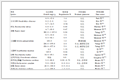
2.2 硫同位素正冲金矿床主成矿阶段7件样品中,除ZC17D04B1由于样品内毒砂含量较低,只进行黄铁矿硫同位素测试外,其它样品均同时进行黄铁矿与毒砂硫同位素分析(表 1)。本次研究实验数据显示6件毒砂样品、7件黄铁矿样品δ34S值均为负值。毒砂δ34S变化幅度较小为-4.7‰~-0.9‰,均值为-3.0%,且高于黄铁矿δ34S值,为-9.1‰~-1.1‰,均值为-4.4‰。结合Liu et al. (2019)对正冲金矿床9件矿石样品中挑选出的4件毒砂与8件黄铁矿单矿物硫同位素值(毒砂δ34S为-2.1‰~-0.1‰,黄铁矿δ34S为-8.9‰~-1.7‰)(表 1)。
|
表 1 正冲金矿床毒砂与黄铁矿硫、铅同位素数据 Table 1 The S and Pb isotopes data of the Zhengchong gold deposit |
正冲金矿床5件毒砂样品与7件黄铁矿样品进行铅同位素分析(表 1)。毒砂铅同位素数据208Pb/204Pb、207Pb/204Pb与206Pb/204Pb分别为37.867~38.285、15.555~15.663与17.743~18.073,略高于黄铁矿铅同位素37.774~38.268、15.547~15.660与17.670~18.021。Liu et al. (2019)所测得4件毒砂样品与7件黄铁矿样品铅同位素数据均略高于本次实验结果(表 1),其测得花岗岩208Pb/204Pb、207Pb/204Pb与206Pb/204Pb组分分别为38.972~40.342、15.692~15.763和18.569~19.614(Liu et al., 2019)。
3 讨论 3.1 成矿物理化学条件硫同位素作为重要的成矿物质来源示踪方法,在脉状金矿床的研究中得到了较为广泛的运用(Yang et al., 2016c; Zu et al., 2020)。硫同位素的组成受热液流体氧逸度、pH值与矿物形成温度的影响(Hoefs,2009)。矿石与脉石矿物组合与成矿流体富CO2、低盐度的特征(Liu et al., 2019)均指示正冲金矿床流体为弱酸性至中性,pH值约为6~7(叶传庆等,1988;刘英俊等,1993;刘育等,2017),含矿流体中的硫以S2-和HS-形式运移,因而黄铁矿、毒砂的硫同位素组成能够代表成矿流体的硫同位素值(Ohmoto and Goldhaber, 1997; Yang et al., 2016d)。正冲金矿床成矿阶段载金黄铁矿δ34S值为-9.1‰~-1.1‰,均值为-4.4‰,毒砂δ34S为-4.7‰~-0.9‰,均值为-3.0%,即δ34S毒砂>δ34S黄铁矿,说明成矿期硫同位素平衡分馏且封闭体系内质量基本平衡。金成矿作用与大规模的硅化、绢云母化、硫化与少量的绿泥石化密切相关,指示金成矿作用主体发生于250~400℃温度条件下,与Sun et al.(2019)使用矿物温度计手段测得正冲金矿床载金毒砂形成温度为322~397℃的认识一致。本研究分析测试选取的黄铁矿晶型较好、且未发生明显后期破碎变形,其形成温度略低于同阶段形成的毒砂,约为350℃(Large et al., 2012; Finch and Tomkins, 2017)。利用上述黄铁矿硫同位素组成、形成温度和pH值,在Ohmoto(1972)logfO2-pH-δ34S图中获得成矿时氧逸度约10-30.7(图 6)。

|
图 6 正冲金矿床成矿阶段载金黄铁矿logfO2-pH-δ34S图(据Ohmoto, 1972) 1表示为δ34S等值线,()中的数值代表δ34S∑S=0时黄铁矿的δ34S值;2表示为Fe-S-O矿物相线(∑S=0.01mol/kg) Fig. 6 Diagram of logfO2-pH-δ34S in the main ore stages ore-bearing pyrite at the Zhengchong gold deposit (after Ohmoto, 1972) 1 means δ34S contours. Values in () are for pyrite at δ34S∑S=0; 2 means Fe-S-O mineral boundaries at ∑S=0.1mol/kg H2O. Barite soluble/insoluble boundary at m(Ba2+)+m(∑S)=10-3 |
不少学者应用载金硫化物硫同位素研究长-平带金矿床成矿物质来源,但由于δ34S值分布较广,具有混合硫的来源特征(董国军等,2008;夏浩东等, 2017),为了排除数据中极端值的干扰,本次研究选用箱线图进行δ34S数据统计与处理(图 7)。长-平带内矿物硫同位素箱线图显示,正冲金矿床黄铁矿与毒砂δ34S值较窄,分别集中于-7.0‰~-2.6‰和-3.7‰~-0.9‰,与黄金洞金矿田(黄铁矿、毒砂分别为-9.7‰~-6.0‰与-7.5‰~-5.2‰)、肖家山金矿床和雁林寺金矿床(黄铁矿、毒砂分别为-4.3‰~-1.1‰与-1.5‰~-0.4‰)具有一定的重叠,均位于负值区域。许多学者认为长-平带内金矿床的硫来源于围岩冷家溪群地层(叶传庆等,1988;罗献林,1988;Liu et al., 2019),结合前人对该套地层中黄铁矿的硫同位素分析结果,5个δ34S值显示相对该地层具有更还原的硫,集中于-13.1‰~-10.4‰区间,-6.3‰为异常值(刘亮明等,1999),低于长-平带内各金矿床的硫化物硫同位素值(表 2)。

|
图 7 长-平带岩石、矿物硫同位素分布规律 (a)正冲金矿床载金硫化物与毒砂δ34S箱线图解,长-平带内脉型金矿床中黄铁矿、毒砂δ34S与斑岩型矿床内黄铁矿、冷家溪群板岩中黄铁矿、正冲金矿床内花岗岩数据来自表 2;(b)世界范围内赋存于变质沉积岩的造山型金矿δ34S值随时间变化曲线与海水中硫酸盐曲线对比(据Goldfarb et al., 1997; Chang et al., 2008) Fig. 7 Sulfur isotopic distribution of rocks and minerals in the Chang-Ping metallogenic belt (a) the 'box and whisker' plots of ore-bearing pyrite and arsenopyrite from Zhengchong gold deposit, and all the data of the pyrite and arsenopyrite from vein-type gold deposit, pyrite from porphyry-type deposits, pyrite from Lengjiaxi Group in Chang-Ping metallogenic belt and granitoids from Zhengchong deposit are listed in Table 2; (b) variation in sulfur isotopic compositions of sulfides in global sediment-hosted orogenic gold deposits through geologic time compared to the time-dependent marine sulfate curve (after Goldfarb et al., 1997; Chang et al., 2008) |
|
|
表 2 长-平带内矿床、沉积地层与花岗岩的δ34S值 Table 2 The δ34S of various deposits, sediment rocks and granitoids along the Changsha-Pingjiang Fault |
① 王育民, 欧阳昌泰, 陈遇灏. 1984.中国铅锌矿床地质勘探问题研究.长沙:湖南省地质矿产局, 1-522
除脉状金矿床在长-平成矿带内广泛分布外,该区域内还发育有斑岩型铜-钴、铜-钼等矿床,其分布与晚侏罗世-白垩纪岩体具有明显的空间联系。在该类型矿床中,当物理化学条件平衡状态下,各硫化物中的硫元素的富集顺序具有差异:BiS3<Sb2S<Cu2S<PbS<Cu5FeS4<CuFeS2<ZnS<FeS1-x<FeS2<MoS2(郑永飞和陈江峰,2000),导致斑岩型矿床中黄铁矿、黄铜矿、闪锌矿和方铅矿中的δ34S值具有差异。其中,斑岩型矿床中黄铁矿δ34S值集中于-1.0‰~4.2‰,正冲矿区内花岗岩全岩δ34S值为-2.2‰~1.0‰,均略高于正冲金矿床黄铁矿δ34S值(图 7a)。
正冲金矿床与长-平带内斑岩型矿床中硫化物与各岩体铅同位素均具有较宽的208Pb/204Pb特征,但208Pb/204Pb-206Pb/204Pb图解显示长-平带内斑岩型矿床中硫化物与各岩体铅同位素具有一定的重叠,反映两者的铅具有相似的来源。本次铅同位素数据显示正冲金矿床与斑岩型矿床中硫化物与各岩体铅同位素具有显著的差异,投影点主要位于造山带演化曲线与上地壳之间(图 8a),构造环境判别图也显示矿床黄铁矿、毒砂铅同位素组成位于地壳与造山带环境中

|
图 8 长-平金成矿带主要地质体208Pb/204Pb-206Pb/204Pb模式图(a)及构造环境判别图(b)(底图据Zartman and Doe, 1981) 数据列于表 3;A, B, C, D为各区域中样品相对集中区 Fig. 8 208Pb/204Pb vs. 206Pb/204Pb plot (a) and the tectonic and environment discriminant diagram (b) for the main geological body from the Chang-Ping metallogenic belt (base map after Zartman and Doe, 1981) Data sources are listed in Table 3. A, B, C, D represent the centralized areas |
(图 8b),表明铅来源可能是造山带内变质沉积地层(表 3)。并且,发育在正冲金矿床内的花岗岩全岩样品具有较宽的206Pb/204Pb分布区间(Liu et al., 2019),与矿区内硫化物铅同位素特征不同,排除了矿区内早期存在的岩浆岩对成矿阶段铅的贡献。
|
|
表 3 长-平带内矿床、沉积地层与花岗岩的铅同位素值 Table 3 The lead isotopic data of various deposits, sediment rocks and granitoids along the Changsha-Pingjiang Fault |


通过对比正冲金矿床与长-平带内其余脉状金矿床载金硫化物与赋矿围岩冷家溪群地层、区域内花岗岩体δ34S值和铅同位素分布特征,正冲金矿床中的硫、铅具有变质来源的特征。然而正冲金矿床乃至醴陵金矿田内冷家溪群地层变质程度较低,不能直接提供成矿物质。在变质脱挥发份模型中,深部矿源岩发生绿片岩相至角闪岩相变质作用转换过程中释放的含金流体向上运移,并在中上地壳绿片岩相地层中形成脉状金矿床(Phillips and Powell, 2010; Tomkins, 2010; Deng et al., 2015),但矿床形成时间要略晚于区域变质事件的峰值年龄(Groves et al., 2020a)。因此,正冲金矿床成矿物质可能来源于深部,比冷家溪群更深、更高变质程度的沉积岩,与区域内黄金洞金矿田具有相似的成矿物质与流体来源(Zhang et al., 2018)。
3.3 矿床成因NE-NNE向长-平带内多期次的构造-岩浆-成矿事件导致区域内发育有富饶的金、铜、钴等多金属矿床(图 1)。正冲金矿床矿体均赋存于NW向与NNE向次级断裂构造中,以脉状形式产出。金矿化伴随有强烈的硅化、硫化和绢云母化等蚀变,自然金与不可见金在矿床中均有分布,成矿流体具有富CO2、低盐度特征(Liu et al., 2019),与造山型金矿床成矿流体具有相似性(Goldfarb et al., 2005)。正冲金矿床、黄金洞金矿田和万古金矿床的赋矿地层均为新元古界浅变质岩系,矿体主要受构造控制,矿床中载金矿物硫、铅同位素组成与该套地层同位素组成具有显著的差异,无法指示新元古界地层与脉状金矿床具有成因联系。正冲金矿床成矿物质也不具岩浆来源特征。正冲金矿床黄铁矿、毒砂δ34S集中于-5.2‰~-2.0‰之间,与世界范围内三叠纪或早白垩世形成的沉积岩容矿的造山型金矿δ34S值一致(图 7b)。与此同时,笔者尚未发表的主成矿阶段白云母40Ar-39Ar年龄数据指示正冲金矿床成矿年龄为220Ma左右。因此,该金矿床形成于早三叠世华南与华北板块的碰撞作用过程中(Zhang et al., 2019)。
综合上述地质、地球化学与地质年代学数据,早三叠世碰撞造山作用过程中,区内深部含水、含碳地层经历了绿片岩相向角闪岩相变质作用转换,脱挥发份,释放大量的水、二氧化碳与金,沿一级长-平深大断裂向上运移,并在中浅地壳次级断裂系统内聚集沉淀,形成正冲造山型金矿床(Groves et al., 1998; Goldfarb et al., 2005)。
4 结论(1) 正冲金矿床成矿作用可分为乳白色贫矿石英-白云母、石英-白云母-黄铁矿-毒砂-多金属硫化物-少量绿泥石和石英-方解石三个阶段;毒砂与黄铁矿是自然金与不可见金的重要载体。
(2) 正冲金矿床自形载金黄铁矿与毒砂δ34S值较窄,分别为-9.1‰~-1.1‰与-4.7‰~-0.9‰,成矿流体氧逸度约10-30.7,均低于长-平带斑岩型矿床黄铁矿与正冲矿区内花岗岩全岩δ34S值,且明显区别于区域内赋矿地层δ34S值;铅同位素组成反映载金矿物中铅来源于上地壳或造山带。以上指示区内岩浆与赋矿沉积变质围岩并不是金矿床成矿物质的主要来源,成矿物质可能来源于比冷家溪群变质程度更高的、沉积位置更深的变质沉积岩。
(3) 正冲金矿床矿体受北北东与北西向两组方向断裂控制,赋存于低变质程度的板岩中,成矿流体具有富CO2,低盐度特征。矿床形成于约220Ma华南与华北碰撞造山过程中,金矿床中载金黄铁矿、毒砂与世界范围内同时期变质沉积岩容矿的造山型金矿具有相似的δ34S值特征;以上证据共同表明正冲金矿属造山型金矿床。
致谢 研究工作得到了中国地质大学(北京)邓军教授、邱昆峰副教授和和文言副教授,西澳大学David I. Groves教授,科罗拉多矿业学院Richard J. Goldfarb教授与莫纳什大学Roberto F. Weinberg教授的指导和帮助;野外工作得到了正冲金矿床与湖南省有色地质勘查局214队文亭院长等相关工作人员的帮助与支持;硫、铅同位素测试得到了核工业北京地质研究所实验人员的帮助;两位匿名审稿人提供了宝贵的审稿意见;谨此致谢。
Chang ZS and Large RR and Maslennikov V. 2008. Sulfur isotopes in sediment-hosted orogenic gold deposits:Evidence for an early timing and a seawater sulfur source. Geology, 36(12): 971-974 DOI:10.1130/G25001A.1 |
Deng HJ, Xia HD and Xi CZ and Cui YL. 2013. Geochemical characteristics of ore-forming fluids for Tongyuan-Heshangpo gold deposit, Pingjiang County, Hunan Province. Acta Mineralogica Sinica, 33(4): 691-697 (in Chinese with English abstract) |
Deng J, Yang LQ, Sun ZS, Wang JP, Wang QF and Xin HB and Li XJ. 2003. A metallogenic model of gold deposits of the Jiaodong granite-greenstone Belt. Acta Geologica Sinica, 77(4): 537-546 DOI:10.1111/j.1755-6724.2003.tb00134.x |
Deng J, Wang CM, Bagas L and Carranza EJM and Lu YJ. 2015. Cretaceous-Cenozoic tectonic history of the Jiaojia Fault and gold mineralization in the Jiaodong Peninsula, China:Constraints from zircon U-Pb, illite K-Ar, and apatite fission track thermochronometry. Mineralium Deposita, 50(8): 987-1006 DOI:10.1007/s00126-015-0584-1 |
Deng J and Wang QF. 2016. Gold mineralization in China:Metallogenic provinces, deposit types and tectonic framework. Gondwana Research, 36: 219-274 DOI:10.1016/j.gr.2015.10.003 |
Deng J, Liu XF, Wang QF and Dilek Y and Liang YY. 2017. Isotopic characterization and petrogenetic modeling of Early Cretaceous mafic diking:Lithospheric extension in the North China Craton, eastern Asia. GSA Bulletin, 129(11-12): 1379-1407 DOI:10.1130/B31609.1 |
Deng J, Wang CM, Bagas L and Santosh M and Yao EY. 2018. Crustal architecture and metallogenesis in the south-eastern North China Craton. Earth-Science Reviews, 182: 251-272 DOI:10.1016/j.earscirev.2018.05.001 |
Deng J, Qiu KF, Wang QF, Goldfarb RJ, Yang LQ, Zi JW and Geng JZ and Ma Y. 2020a. In-situ dating of hydrothermal monazite and implications for the geodynamic controls on ore formation in the Jiaodong gold province, eastern China. Economic Geology, 115(3): 671-685 DOI:10.5382/econgeo.4711 |
Deng J, Wang QF, Santosh M, Liu XF, Liang YY, Yang LQ and Zhao R and Yang L. 2020b. Remobilization of metasomatized mantle lithosphere:A new model for the Jiaodong gold province, eastern China. Mineralium Deposita, 55(2): 257-274 DOI:10.1007/s00126-019-00925-0 |
Dong GJ, Xu DR, Wang L, Chen GH, He ZL, Fu GG and Wu J and Wang ZL. 2008. Determination of mineralizing ages on gold ore deposits in the eastern Hunan Province, south China and isotopic tracking on ore-forming fluids:Re-discussing gold ore deposit type. Geotectonica et Metallogenia, 32(4): 482-491 (in Chinese with English abstract) |
Faure M, Shu LS, Wang B and Charvet J and Monie P. 2009. Intracontinental subduction:A possible mechanism for the Early Palaeozoic orogen of SE China. Terra Nova, 21(5): 360-368 DOI:10.1111/j.1365-3121.2009.00888.x |
Finch EG and Tomkins AG. 2017. Pyrite-pyrrhotite stability in a metamorphic aureole:Implications for orogenic gold genesis. Economic Geology, 112(3): 661-674 DOI:10.2113/econgeo.112.3.661 |
Fu B and Touret JLR. 2014. From granulite fluids to quartz-carbonate megashear zones:The gold rush. Geoscience Frontiers, 5(5): 747-758 DOI:10.1016/j.gsf.2014.03.013 |
Giesemann A, Jäger HJ, Norman AL and Krouse HR and Brand WA. 1994. Online sulfur-isotope determination using an elemental analyzer coupled to a mass spectrometer. Analytical Chemistry, 66(18): 2816-2819 DOI:10.1021/ac00090a005 |
Goldfarb RJ, Miller LD and Leach DL and Snee LW. 1997. Gold deposits in metamorphic rocks of Alaska. In:Goldfarb RJ and Miller LD (eds.). Mineral Deposits of Alaska:Economic Geology Monograph Series. Society of Economic Geologists, 9: 151-190 |
Goldfarb RJ, Baker T, Dubé B, Groves DI, Hart CJR and Gosselin P. 2005. Distribution, character, and genesis of gold deposits in metamorphic terran. In: Hedenquist JW, Thompson JFH, Goldfarb RJ and Richards JP (eds.). Economic Geology, 100th Anniversary Volume. Society of Economic Geologists, 407-450
|
Goldfarb RJ and Groves DI. 2015. Orogenic gold:Common or evolving fluid and metal sources through time. Lithos, 233: 2-26 DOI:10.1016/j.lithos.2015.07.011 |
Groves DI, Goldfarb RJ, Gebre-Mariam M and Hagemann SG and Robert F. 1998. Orogenic gold deposits:A proposed classification in the context of their crustal distribution and relationship to other gold deposit types. Ore Geology Reviews, 13(1-5): 7-27 DOI:10.1016/S0169-1368(97)00012-7 |
Groves DI and Zhang L and Santosh M. 2020a. Subduction, mantle metasomatism, and gold:A dynamic and genetic conjunction. Geological Society of America Bulletin DOI:10.1130/B35379.1 |
Groves DI, Santosh M, Deng J, Wang QF and Yang LQ and Zhang L. 2020b. A holistic model for the origin of orogenic gold deposits and its implications for exploration. Mineralium Deposita, 55(2): 275-292 DOI:10.1007/s00126-019-00877-5 |
Hagemann SG and Gebre-Mariam M and Groves DI. 1994. Surface-water influx in shallow-level Archean lode-gold deposits in Western Australia. Geology, 22(12): 1067-1070 DOI:10.1130/0091-7613(1994)022<1067:SWIISL>2.3.CO;2 |
Hoefs J. 2009. Stable Isotope Geochemistry. 6th Edition. Berlin, Heidelberg:Springer: 123-136 |
Hu JL, Chen JX, Xu DM, Wu CX, Zhang K, Liu JS and Liu AS and Liu CP. 2017. Age and sources of the ore-forming material for the Qibaoshan Cu-polymetallic deposit in Hu'nan Province:Evidence from quartz vein Rb-Sr isotopic dating and S-Pb isotopes. Geological Bulletin of China, 36(5): 857-866 (in Chinese with English abstract) |
Hu XZ and Peng ES and Sun ZJ. 2000. Geological characteristics and genesis of the Qibaoshan Cu-polymetal deposit. Geotectonica et Metallogenia, 24(4): 365-370 (in Chinese with English abstract) |
Jiang XX and Li J and Zhao T. 2016. Ore-forming material source of Xiaojiashan gold deposit of northeastern Hunan. Land & Resources Herald, 13(3): 1-7 (in Chinese with English abstract) |
Large R, Thomas H, Craw D and Henne A and Henderson S. 2012. Diagenetic pyrite as a source for metals in orogenic gold deposits, Otago schist, New Zealand. New Zealand Journal of Geology and Geophysics, 55(2): 137-149 DOI:10.1080/00288306.2012.682282 |
Liu DR and Wu YZ and Liu SN. 1994. Geochemistry of Wangu gold deposit. Hunan Geology, 13(2): 83-90 (in Chinese with English abstract) |
Liu HC and Zhu BQ. 1994. Geochronology study of Banxi Group and Lengjiaxi Group from Xiangxi. Chinese Science Bulletin, 39(2): 148-150 (in Chinese) DOI:10.1360/csb1994-39-2-148 |
Liu HQ, Jin WQ and Zhang LX and Shen KF. 2001. Discussion on sources of metallogenetic materials of porphyry-type and hydrothermal copper deposits in northeastern Hunan Province. Geology and Mineral Resources of South China, (1): 40-47 (in Chinese with English abstract) |
Liu LM and Peng SL and Wu YZ. 1999. Genetic features forming vein-type gold deposits in northeastern Hunan. Journal of Central South University of Technology, 30(1): 4-7 (in Chinese with English abstract) |
Liu QQ, Shao YJ, Chen M, Algeo TJ, Li H, Dick JM, Wang C, Wang WS and Li ZQ and Liu ZF. 2019. Insights into the genesis of orogenic gold deposits from the Zhengchong gold field, northeastern Hunan Province, China. Ore Geology Reviews, 105: 337-355 DOI:10.1016/j.oregeorev.2019.01.002 |
Liu Y, Zhang L, Sun SC, Qi P and Wu SG and Gao L. 2017. Mineralization mechanism of Yangshanzhuang gold deposit, northeastern Hunan Province. Acta Petrologica Sinica, 33(7): 2273-2284 (in Chinese with English abstract) |
Liu YJ and Sun CY and Ma DS. 1993. Jiangnan Gold Deposits and Their Metallogenic Geochemical Background. Nanjing: Nanjing University Press (in Chinese)
|
Lu YM and Yin HR and Shen RJ. 1984. Genetic model of the Qibaoshan polymetallic ore deposit. Mineral Deposits, 3(4): 53-60 (in Chinese with English abstract) |
Luo XL. 1988. On the genesis and metallogenic model of the Huangjindong gold deposit from Hunan. Journal of Guilin Institute of Technology, 8(8): 225-240 (in Chinese with English abstract) |
Mao JW, Li YH, Li HY and Wang DH and Song HB. 1997. Helium isotopic evidence on metalgenisis of mantle fluids in the Wangu gold deposit, Hunan Province. Geological Review, 43(6): 646-649 (in Chinese with English abstract) |
Mueller AG, Hall GC, Nemchin AA, Stein HJ and Creaser RA and Mason DR. 2008. Archean high-Mg monzodiorite-syenite, epidote skarn, and biotite-sericite gold lodes in the Granny Smith-Wallaby district, Australia:U-Pb and Re-Os chronometry of two intrusion-related hydrothermal systems. Mineralium Deposita, 43(3): 337-362 DOI:10.1007/s00126-007-0164-0 |
Ohmoto H. 1972. Systematics of sulfur and carbon isotopes in hydrothermal ore deposits. Economic Geology, 67(5): 551-578 DOI:10.2113/gsecongeo.67.5.551 |
Ohmoto H and Goldhaber MB. 1997. Sulfur and carbon isotopes. In: Barnes HL (ed.). Geochemistry of Hydrothermal Ore Deposits. 3rd Edition. New York: John Wiley, 517-611
|
Phillips GN and Powell R. 2010. Formation of gold deposits:A metamorphic devolatilization model. Journal of Metamorphic Geology, 28(6): 689-718 DOI:10.1111/j.1525-1314.2010.00887.x |
Qiu KF, Taylor RD, Song YH, Yu HC and Song KR and Li N. 2016. Geologic and geochemical insights into the formation of the Taiyangshan porphyry copper-molybdenum deposit, Western Qinling Orogenic Belt, China. Gondwana Research, 35: 40-58 DOI:10.1016/j.gr.2016.03.014 |
Qiu KF, Marsh E, Yu HC, Pfaff K, Gulbransen C and Gou ZY and Li N. 2017. Fluid and metal sources of the Wenquan porphyry molybdenum deposit, Western Qinling, NW China. Ore Geology Reviews, 86: 459-473 DOI:10.1016/j.oregeorev.2017.02.035 |
Qiu KF, Yu HC, Wu MQ, Geng JZ, Ge XK and Gou ZY and Taylor RD. 2019. Discrete Zr and REE mineralization of the Baerzhe rare-metal deposit, China. American Mineralogist, 104(10): 1487-1502 DOI:10.2138/am-2019-6890 |
Qiu KF, Yu HC, Deng J, McIntire D, Gou ZY, Geng JZ, Chang ZS, Zhu R, Li KN and Goldfarb R. 2020. The giant Zaozigou Au-Sb deposit in West Qinling, China: Magmatic- or metamorphic-hydrothermal origin? Mineralium Deposita, 55(2): 345-363 https://link.springer.com/article/10.1007/s00126-019-00937-w
|
Shen RJ. 1996. Genetic model of Liuyang Qibaoshan deposit. In: New Developments of Hunan in Earth Science. Changsha: Hunan Science & Technology Press (in Chinese)
|
Shu LS. 2006. Predevonian tectonic evolution of South China:From Cathaysian Block to Caledonian Period folded orogenic belt. Geological Journal of China Universities, 12(4): 418-431 (in Chinese with English abstract) |
Sun SC, Zhang L, Wu SG, Gao L and Peng JS and Wen T. 2018. Metallogenic mechanism of the Huangjindong gold deposit, Jiangnan Orogenic Belt:Constraints from mineral formation environment and physicochemical conditions of metallogenesis. Acta Petrologica Sinica, 34(5): 1469-1483 (in Chinese with English abstract) |
Sun SC, Zhang L, Li RH, Wen T, Xu H, Wang JY, Li ZQ, Zhang F and Zhang XJ and Guo H. 2019. Process and mechanism of gold mineralization at the Zhengchong gold deposit, Jiangnan Orogenic Belt:Evidence from the arsenopyrite and chlorite mineral thermometers. Minerals, 9(2): 133 DOI:10.3390/min9020133 |
Sun SC, Yang LQ, Zhang L, Olin P, Gao X, Li RH, Wang JY, Li ZQ and Zhang F and Wen T. 2020. In-situ trace elements on pyrite and arsenopyrite of the Zhengchong gold deposit, Jiangnan Orogen:Insights for the mineralization mechanism. Ore Geology Reviews, 122: 103486 DOI:10.1016/j.oregeorev.2020.103486 |
Tomkins AG. 2010. Windows of metamorphic sulfur liberation in the crust:Implications for gold deposit genesis. Geochimica et Cosmochimica Acta, 74(11): 3246-3259 DOI:10.1016/j.gca.2010.03.003 |
Wang YJ, Zhang YH and Fan WM and Peng TP. 2005. Structural signatures and 40Ar/39Ar geochronology of the Indosinian Xuefengshan tectonic belt, South China Block. Journal of Structural Geology, 27(6): 985-998 DOI:10.1016/j.jsg.2005.04.004 |
Wang YJ, Zhang FF, Fan WM, Zhang GW, Chen SY and Cawood PA and Zhang AM. 2010. Tectonic setting of the South China Block in the Early Paleozoic:Resolving intracontinental and ocean closure models from detrital zircon U-Pb geochronology. Tectonics, 29(6): TC6020 DOI:10.1029/2010TC002750 |
Wang ZL, Xu DR, Chi GX, Shao YJ, Lai JQ, Deng T, Guo F, Wang Z, Dong GJ and Ning JT and Zou SS. 2017. Mineralogical and isotopic constraints on the genesis of the Jingchong Co-Cu polymetallic ore deposit in north-eastern Hunan Province, South China. Ore Geology Reviews, 88: 638-654 DOI:10.1016/j.oregeorev.2017.02.011 |
Wang ZQ, Gao LZ and Ding XZ and Huang ZZ. 2012. Tectonic environment of the metamorphosed basement in the Jiangnan Orogen and its evolutional features. Geological Review, 58(3): 401-413 (in Chinese with English abstract) |
Weatherley DK and Henley RW. 2013. Flash vaporization during earthquakes evidenced by gold deposits. Nature Geoscience, 6(4): 294-298 DOI:10.1038/ngeo1759 |
Xia HD, Xi CZ, Deng HJ and Xiao X and Wu SG. 2017. Genesis of Huangjindong gold deposit:New evidence for sulfur, lead isotopes and fluid inclusions. Gold, 38(10): 19-24 (in Chinese with English abstract) |
Xu DR, Deng T, Chi GX, Wang ZL, Zou FH and Zhang JL and Zou SH. 2017. Gold mineralization in the Jiangnan Orogenic Belt of South China:Geological, geochemical and geochronological characteristics, ore deposit-type and geodynamic setting. Ore Geology Reviews, 88: 565-618 DOI:10.1016/j.oregeorev.2017.02.004 |
Yang LQ, Deng J, Goldfarb RJ, Zhang J and Gao BF and Wang ZL. 2014. 40Ar/39Ar geochronological constraints on the formation of the Dayingezhuang gold deposit:New implications for timing and duration of hydrothermal activity in the Jiaodong gold province, China. Gondwana Research, 25(4): 1469-1483 DOI:10.1016/j.gr.2013.07.001 |
Yang LQ, Deng J, Wang ZL, Zhang L, Guo LN and Song MC and Zheng XL. 2014. Mesozoic gold metallogenic system of the Jiaodong gold province, eastern China. Acta Petrologica Sinica, 30(9): 2447-2467 (in Chinese with English abstract) |
Yang LQ, Deng J, Wang ZL, Guo LN, Li RH, Groves DI, Danyushevsky LV, Zhang C and Zheng XL and Zhao H. 2016a. Relationships between gold and pyrite at the Xincheng gold deposit, Jiaodong Peninsula, China:Implications for gold source and deposition in a brittle epizonal environment. Economic Geology, 111(1): 105-126 DOI:10.2113/econgeo.111.1.105 |
Yang LQ, Deng J, Guo LN, Wang ZL and Li XZ and Li JL. 2016b. Origin and evolution of ore fluid, and gold-deposition processes at the giant Taishang gold deposit, Jiaodong Peninsula, eastern China. Ore Geology Reviews, 72: 585-602 DOI:10.1016/j.oregeorev.2015.08.021 |
Yang LQ, Deng J, Li N, Zhang C and Ji XZ and Yu JY. 2016c. Isotopic characteristics of gold deposits in the Yangshan Gold Belt, West Qinling, central China:Implications for fluid and metal sources and ore genesis. Journal of Geochemical Exploration, 168: 103-118 DOI:10.1016/j.gexplo.2016.06.006 |
Yang LQ, Deng J, Guo RP, Guo LN, Wang ZL and Chen BH and Wang XD. 2016d. World-class Xincheng gold deposit:An example from the giant Jiaodong Gold Province. Geoscience Frontiers, 7(3): 419-430 DOI:10.1016/j.gsf.2015.08.006 |
Yang LQ, Guo LN, Wang ZL, Zhao RX and Song MC and Zheng XL. 2017. Timing and mechanism of gold mineralization at the Wang'ershan gold deposit, Jiaodong Peninsula, eastern China. Ore Geology Reviews, 88: 491-510 DOI:10.1016/j.oregeorev.2016.06.027 |
Yang LQ, Li RH, Gao X and Qiu KF and Zhang L. 2020. A preliminary study of extreme enrichment of critical elements in the Jiaodong gold deposits, China. Acta Petrologica Sinica, 36(5): 1285-1314 (in Chinese with English abstract) DOI:10.18654/1000-0569/2020.05.01 |
Ye CQ, Dai WJ and Liu YC and Han XJ. 1988. Discussion on the genesis and prospecting significance of Huangjindong gold deposit. Gold Geological Technology, (2): 24-36 (in Chinese) |
Yi ZS, Luo XY and Zhou DH and Xiao CY. 2010. Geological characteristics and genesis of Jinchong Co-Cu polymetal deposit, Liuyang, Hunan Province. Geology and Mineral Resources of South China, (3): 12-18 (in Chinese with English abstract) |
Zartman RE and Doe BR. 1981. Plumbotectonics:The model. Tectonophysics, 75(1-2): 135-162 DOI:10.1016/0040-1951(81)90213-4 |
Zhang J, Yang Y, Hu HZ, Wang ZG and Li GP and Li ZL. 2009. C-S-Pb isotope geochemistry of the Yindonggou orogenic type silver deposit in He'nan Province. Acta Petrologica Sinica, 25(11): 2833-2842 (in Chinese with English abstract) |
Zhang L, Liu Y, Li RH, Huang T, Zhang RZ and Chen BH and Li JK. 2014. Lead isotope geochemistry of Dayingezhuang gold deposit, Jiaodong Peninsula, China. Acta Petrologica Sinica, 30(9): 2468-2480 (in Chinese with English abstract) |
Zhang L, Yang LQ, David IG, Liu Y, Sun SC, Qi P and Wu SG and Peng JS. 2018. Geological and isotopic constraints on ore genesis, Huangjindong gold deposit, Jiangnan Orogen, southern China. Ore Geology Reviews, 99: 264-281 DOI:10.1016/j.oregeorev.2018.06.013 |
Zhang L, Yang LQ, Groves DI, Sun SC, Li Y, Wang JY, Li RH, Wu SG, Gao L, Guo JL and Chen XG and Chen JH. 2019. An overview of timing and structural geometry of gold, gold-antimony and antimony mineralization in the Jiangnan Orogen, southern China. Ore Geology Reviews, 115: 103173 DOI:10.1016/j.oregeorev.2019.103173 |
Zhang L, Weinberg RF, Yang LQ, Groves DI, Sai SX, Matchan E, Phillips D, Kohn BP, Miggins DP and Liu Y and Deng J. 2020a. Mesozoic orogenic gold mineralization in the Jiaodong Peninsula, China:A focused event at 120±2Ma during cooling of pregold granite intrusions. Economic Geology, 115(2): 415-441 DOI:10.5382/econgeo.4716 |
Zhang L, Groves DI, Yang LQ, Sun SC, Weinberg RF, Wang JY, Wu SG, Gao L and Yuan LL and Li RH. 2020b. Utilization of pre-existing competent and barren quartz veins as hosts to later orogenic gold ores at Huangjindong gold deposit, Jiangnan Orogen, southern China. Mineralium Deposita, 55(2): 363-380 DOI:10.1007/s00126-019-00904-5 |
Zhang YQ, Dong SW, Li JH, Cui JJ, Shi W and Su JB and Li Y. 2012. The new progress in the study of Mesozoic tectonics of South China. Acta Geoscientica Sinica, 33(3): 257-279 (in Chinese with English abstract) |
Zheng YF and Chen JF. 2000. Stable Isotope Geochemistry. Beijing: Science Press, 218-239 (in Chinese)
|
Zhou JC and Wang XL and Qiu JS. 2008. Is the Jiangnan Orogenic Belt a Grenvillian Orogenic Belt? Some problems about the Precambrian geology of South China. Geological Journal of China Universities, 14(1): 64-72 (in Chinese with English abstract) |
Zu B, Seltmann R, Xue CJ, Wang T, Dolgopolova A, Li C, Zhou LM, Pak N, Ivleva E and Chai MC and Zhao XB. 2019. Multiple episodes of Late Paleozoic Cu-Au mineralization in the Chatkal-Kurama terrane:New constraints from the Kuru-Tegerek and Bozymchak skarn deposits, Kyrgyzstan. Ore Geology Reviews, 113: 103077 DOI:10.1016/j.oregeorev.2019.103077 |
Zu B, Xue CJ, Seltmann R, Dolgopolova A, Chi GX and Li C. 2020. Geology, geochronology, and S-Pb-Os geochemistry of the Alastuo gold deposit, West Tianshan, NW China. Mineralium Deposita |
邓会娟, 夏浩东, 息朝庄, 崔银亮. 2013. 湖南平江童源-和尚坡金矿区成矿流体地球化学特征. 矿物学报, 33(4): 691-697. |
董国军, 许德如, 王力, 陈广浩, 贺转利, 符巩固, 吴俊, 王智琳. 2008. 湘东地区金矿床矿化年龄的测定及含矿流体来源的示踪——兼论矿床成因类型. 大地构造与成矿学, 32(4): 482-491. DOI:10.3969/j.issn.1001-1552.2008.04.012 |
胡俊良, 陈娇霞, 徐德明, 吴昌雄, 张鲲, 刘劲松, 刘阿睢, 刘重芃. 2017. 湘东北七宝山铜多金属矿床成矿时代及成矿物质来源——石英脉Rb-Sr定年和S-Pb同位素组成. 地质通报, 36(5): 857-866. DOI:10.3969/j.issn.1671-2552.2017.05.017 |
胡祥昭, 彭恩生, 孙振家. 2000. 湘东北七宝山铜多金属矿床地质特征及成因探讨. 大地构造与成矿学, 24(4): 365-370. DOI:10.3969/j.issn.1001-1552.2000.04.010 |
蒋星祥, 李剑, 赵拓. 2016. 湘东北地区肖家山金矿床成矿物质来源. 国土资源导刊, 13(3): 1-7. DOI:10.3969/j.issn.1672-5603.2016.03.002 |
柳德荣, 吴延之, 刘石年. 1994. 平江万古金矿床地球化学研究. 湖南地质, 13(2): 83-90. |
刘海臣, 朱炳泉. 1994. 湘西板溪群及冷家溪群的时代研究. 科学通报, 39(2): 148-150. DOI:10.3321/j.issn:0023-074X.1994.02.013 |
刘姤群, 金维群, 张录秀, 沈克富. 2001. 湘东北斑岩型和热液脉型铜矿成矿物质来源探讨. 华南地质与矿产, (1): 40-47. DOI:10.3969/j.issn.1007-3701.2001.01.006 |
刘亮明, 彭省临, 吴延之. 1999. 湘东北地区脉型金矿床的活化转移. 中南工业大学学报, 30(1): 4-7. |
刘育, 张良, 孙思辰, 綦鹏, 吴胜刚, 高磊. 2017. 湘东北杨山庄金矿床流体成矿机制. 岩石学报, 33(7): 2273-2284. |
刘英俊, 孙承辕, 马东升. 1993. 江南金矿及其成矿地球化学背景. 南京: 南京大学出版社.
|
陆玉梅, 殷浩然, 沈瑞锦. 1984. 七宝山多金属矿床成因模式. 矿床地质, 3(4): 53-60. |
罗献林. 1988. 论湖南黄金洞金矿床的成因及成矿模式. 桂林冶金地质学院学报, 8(8): 225-240. |
毛景文, 李延河, 李红艳, 王登红, 宋鹤彬. 1997. 湖南万古金矿床地幔流体成矿的氦同位素证据. 地质论评, 43(6): 646-649. DOI:10.3321/j.issn:0371-5736.1997.06.011 |
沈瑞锦. 1996. 浏阳七宝山矿床成因模式.见:湖南地学新进展. 长沙: 湖南科学技术出版社.
|
舒良树. 2006. 华南前泥盆纪构造演化:从华夏地块到加里东期造山带. 高校地质学报, 12(4): 418-431. DOI:10.3969/j.issn.1006-7493.2006.04.002 |
孙思辰, 张良, 吴圣刚, 高磊, 彭劲松, 文亭. 2018. 江南造山带黄金洞金矿床成矿机制:矿物形成环境与金成矿物理化学条件制约. 岩石学报, 34(5): 1469-1483. |
王自强, 高林志, 丁孝忠, 黄志忠. 2012. "江南造山带"变质基底形成的构造环境及演化特征. 地质论评, 58(3): 401-413. DOI:10.3969/j.issn.0371-5736.2012.03.001 |
夏浩东, 息朝庄, 邓会娟, 肖晓, 吴圣刚. 2017. 湘东北黄金洞金矿床成因:硫、铅同位素和流体包裹体新证据. 黄金, 38(10): 19-24. DOI:10.11792/hj20171004 |
杨立强, 邓军, 王中亮, 张良, 郭林楠, 宋明春, 郑小礼. 2014. 胶东中生代金成矿系统. 岩石学报, 30(9): 2447-2467. |
杨立强, 李瑞红, 高雪, 邱昆峰, 张良. 2020. 胶东金矿床中关键金属超常富集特征与机理初探. 岩石学报, 36(5): 1285-1314. |
叶传庆, 戴文剑, 刘荫椿, 韩秀军. 1988. 试论黄金洞金矿床成因及找矿意议. 黄金地质科技, (2): 24-36. |
易祖水, 罗小亚, 周东红, 肖朝阳. 2010. 浏阳市井冲钴铜多金属矿床地质特征及成因浅析. 华南地质与矿产, (3): 12-18. DOI:10.3969/j.issn.1007-3701.2010.03.002 |
张静, 杨艳, 胡海珠, 王志光, 李国平, 李忠烈. 2009. 河南银洞沟造山型银矿床碳硫铅同位素地球化学. 岩石学报, 25(11): 2833-2842. |
张良, 刘跃, 李瑞红, 黄涛, 张瑞忠, 陈炳翰, 李金奎. 2014. 胶东大尹格庄金矿床铅同位素地球化学. 岩石学报, 30(9): 2468-2480. |
张岳桥, 董树文, 李建华, 崔建军, 施炜, 苏金宝, 李勇. 2012. 华南中生代大地构造研究新进展. 地球学报, 33(3): 257-279. |
郑永飞, 陈江峰. 2000. 稳定同位素地球化学. 北京: 科学出版社, 218-239.
|
周金城, 王孝磊, 邱检生. 2008. 江南造山带是否格林威尔期造山带?——关于华南前寒武纪地质的几个问题. 高校地质学报, 14(1): 64-72. DOI:10.3969/j.issn.1006-7493.2008.01.007 |