 2020, Vol. 36


2. 中国地质大学地质过程与矿产资源国家重点实验室, 北京 100083;
3. 新疆维吾尔族自治区有色地质勘查局七〇四队, 哈密 839000
2. State Key Laboratory of Geological Processes and Mineral Resources, China University of Geosciences, Beijing 100083, China;
3. No. 704 Geological Party, Xinjiang GeoExploration Bureau for Nonferrous Metals, Hami 839000, China
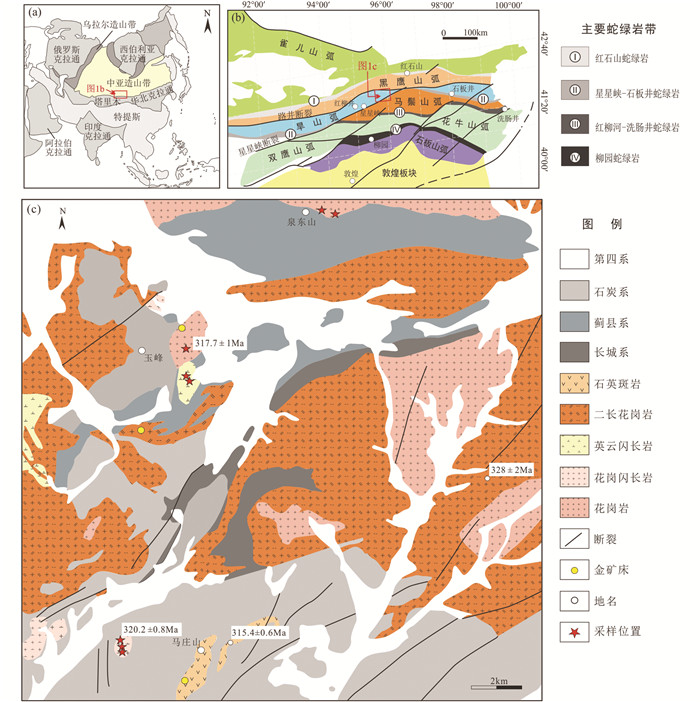
中亚造山带(CAOB),夹持于西伯利亚和塔里木-华北板块之间(图 1a),是世界最大的显生宙增生型造山带之一,经历了漫长而又复杂的增生造山过程(Şengör et al., 1993; Windley et al., 2007; Wang et al., 2012; Goldfarb et al., 2014; Zhang et al., 2017; Chen et al., 2020)。北山造山带地处中亚造山带南缘,西邻天山造山带,东接索伦构造带,是剖析中亚造山带南缘构造演化过程的关键区域之一(图 1a)。北山造山带南带由花牛山和石板山岛弧组成,记录了古老微陆块的俯冲-碰撞过程(Liu et al., 2011; Zong et al., 2017; Yuan et al., 2018)。北山北带由马鬃山岛弧、旱山岛弧和雀儿山岛弧组成,其性质和构造演化尚存在争议;一种观点认为,晚古生代火成岩与俯冲-增生过程有关(Xiao et al., 2010; Ao et al., 2016; Han and Zhao, 2018);另一种观点认为,晚古生代的侵入岩形成于伸展环境(Zheng et al., 2013; Zhang et al., 2017)。基于此,本文对北山北带旱山弧内马庄山地区广泛分布的花岗岩类进行岩石学、元素地球化学、锆石U-Pb年代学及Nd-Hf同位素等研究,结合前人的研究资料,分析研究区花岗岩类的岩石成因和岩浆来源,进一步探讨北山北带的构造演化过程。
|
图 1 中亚造山带构造示意图(a, 据Sengor and NataPin, 1996)、北山构造简图(b, 据Xiao et al., 2010修改)和马庄山区域地质图(c, 据新疆维吾尔自治区有色地质勘查局704队, 2018①修改) Fig. 1 Schematic tectonic map showing the location of Central Asian Orogenic Belt (a, after Sengor and NataPin, 1996), tectonic position of the Beishan orogenic collage (b, after Xiao et al., 2010), geological map of the Mazhuangshan area and sample locations (c) |
新疆维吾尔自治区有色地质勘查局704队. 2018.新疆哈密市玉峰金矿预查设计报告
1 区域地质背景北山造山带是由前寒武系的变质基底、古生代岛弧、蛇绿岩带、微陆块和增生杂岩带等拼合而成(毛启贵, 2010; Tian et al., 2014; 郑荣国等, 2016),经历了古生代-中生代长期的多阶段、复杂的俯冲拼贴过程,是研究中亚造山带的地球动力学演化过程和古亚洲洋的最终闭合时限的关键区域(Xiao et al., 2010; Song et al., 2013a, b; Tian et al., 2014; Cleven et al., 2015)。受南北板块的构造挤压,造山带、断裂、盆地呈近东西走向,形成了造山带、盆地相间的构造格局(陈衍景, 2000)。由北向南,北山造山带依次可划分为雀儿山弧、黑鹰山-旱山弧、马鬃山弧、双鹰山-花牛山弧、石板山弧和等5个单元(图 1b, Xiao et al., 2010)。雀儿山弧为奥陶纪-二叠纪的活动大陆边缘弧,发育奥陶纪-二叠纪活动陆缘火山岩及碎屑沉积岩地层,并出露古生代侵入岩(聂凤军等, 2002; 刘明强等, 2006; 丁嘉鑫等, 2015)。黑鹰山弧为前寒武纪岛弧,出露石炭系基性-中性火山岩及碎屑岩、古生代及中生代花岗岩(丁嘉鑫等, 2015),带内发育浅成低温热液金矿床(图 1b,如霍勒扎德盖金矿;疏孙平等, 2017)。旱山弧为一古生代的复合型岛弧,主要由高级片麻岩和花岗岩组成(Xiao et al., 2010),并发育有多个以浅成低温热液型金矿床为主体的金矿床(如:马庄山、南金山和修翁哈拉金矿床;Chen et al., 2012; Deng and Wang, 2016; Wang et al., 2019; 王琦崧等, 2019)。马鬃山弧为奥陶纪-二叠纪的复合型岛弧,主要由绿片岩-角闪岩相变质岩、火山岩和侵入岩组成(Song et al., 2013c),该弧内分布金窝子、210等金矿床(Chen et al., 2020)。双鹰山-花牛山岛弧为寒武纪-二叠纪的复合型岛弧,主要发育新元古代-晚古生代地层和侵入岩(王鑫玉, 2017),已发现国庆、玉山等钨矿床(丁嘉鑫等, 2015)。而最南端的石板山岛弧为向南俯冲的古生代-二叠纪活动大陆边缘弧,主要出露有泥盆系、石炭系和二叠系的碎屑沉积岩、火山岩和火山碎屑岩等(Xiao et al., 2010),弧内发育有与韧性剪切带有关的热液金矿床(如:小西弓金矿;江思宏, 2004)。
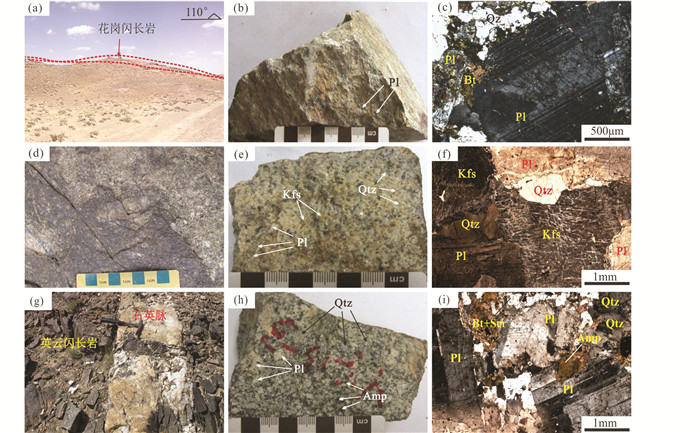
2 岩体产出及岩相学特征研究区位于新疆-甘肃交界的泉东山-马庄山一带,大地构造位置属于旱山弧西段,其南北两侧分别受星星峡走滑断层和路井两条大断裂的控制(图 1b)。区内出露地层除第四系冲洪积外,主要为蓟县系大理岩、灰岩,长城系星星峡组片麻岩,石炭系灰岩、火山碎屑岩、安山岩、英安岩和碳酸盐岩等(图 1c)。岩浆活动以酸性为主,出露二长花岗岩、花岗闪长岩、花岗岩、石英斑岩等,其中以花岗岩类岩石分布最为广泛,多呈岩基、岩株或岩枝状侵入于石炭系火山岩中(图 1c、图 2a),局部可见石英脉侵入英云闪长岩(图 2g)。野外地质调查和资料显示,各岩相侵入体从早到晚的时间顺序大致为二长花岗岩、花岗闪长岩、花岗岩、石英斑岩,部分侵入体与围岩的外接触带可见烘烤边,表明其接触关系为热侵位。
|
图 2 马庄山地区花岗岩类野外及镜下照片 (a-c)花岗闪长岩的野外产状、手标本和显微照片(+),(d-f)钾长花岗岩的野外产状、手标本和显微照片(+),(g-i)英云闪长岩的野外产状、手标本和显微照片(+).Qtz-石英;Pl-斜长石;Kfs-钾长石;Bt-黑云母;Amp-角闪石;Ser-绢云母 Fig. 2 Field and petrographic photos of granitoids in the Mazhuangshan area (a-c) occurrence, hand specimen and micrograph of granodiorite (+); (d-f) occurrence, hand specimen and micrograph of K-feldspar granite (+); (g-i) occurrence, hand specimen and micrograph of tonalite (+). Qtz-quartz; Pl-plagioclase; Kfs-K-feldspar; Bt-biotite; Amp-amphibole; Ser-sericite |
花岗闪长岩主要出露在马庄山以西约3km处,呈岩基和岩枝产出,灰白色-肉红色(图 2b),中粗粒结构,块状构造。主要由石英(20%~25%)、斜长石(40%~45%)、钾长石(~20%)、少量黑云母(~10%)组成。其中,斜长石表面浑浊,呈自形-半自形柱状,粒径约为0.5~3mm,局部可见环带结构,部分已绢云母化(图 2c);钾长石表面呈肉红色,半自形板状,部分绢云母化,大小为0.3~1.5mm;石英多呈他形粒状,粒径约为0.1~0.3mm,局部可见波状消光;黑云母多呈片状,粒径约0.1~0.5mm。
钾长花岗岩位于泉东山以北1km和玉峰以东约4km处,呈岩珠产出,在空间上总体呈NE向展布,明显受区内断裂控制,出露面积较小,约20km2。岩石呈灰黄色-肉红色、中粗粒结构(图 2e),主要矿物有石英(~40%)、钾长石(~50%)和斜长石(~10%)。其中,钾长石以条纹长石为主,发育格子双晶,粒径约为0.8~3mm;斜长石多呈半自形,斜长石表面浑浊,粒径约为0.5~3mm;石英为灰白色,呈他形粒状,局部可见波状消光,粒径为0.1~1mm(图 2f)。
英云闪长岩位于位于玉峰以东约4km处,呈岩枝产出,灰黑色-灰绿色,粒度中等,块状构造(图 2h)。主要由黑云母(20%~30%),石英(~25%),斜长石(30%~40%)以及角闪石(5%)组成。其中,斜长石多呈自形-半自形,宽板状、聚片双晶发育(图 2i),粒径约为0.5~3.5mm;石英,灰白色,多呈他形粒状,粒径为0.1~0.3mm;角闪石呈他形,含量较少,粒径约为0.2~0.5mm。
二长花岗岩主要出露在研究区东北部的明水附近,呈岩基产出,浅肉红色和灰白色,中-粗粒,似斑状结构,块状构造。主要由微斜长石(20%~30%)、斜长石(25%~35%)、石英(35%~45%)和黑云母(8%~15%)组成。其中微斜长石主要为条纹长石和钾长石,半自形板柱状,卡氏双晶、格子双晶发育;斜长石多呈自形-半自形板状,聚片双晶和环带结构发育,部分已蚀变为绢云母;石英他形粒状;部分黑云母蚀变为绿泥石、绿帘石和黝帘石(Zhang et al., 2017)。
3 样品采集和测试方法 3.1 样品采集本次研究的花岗质类岩石采自马庄山金矿附近及其以北的10km范围内,岩体围岩主要是石炭系火山碎屑岩、碳酸盐岩和石英斑岩。在野外地质调查的基础上,对钾长花岗岩、英云闪长岩、花岗闪长岩等进行系统采集,样品采自岩体地表或钻孔岩芯,具体位置见图 1c。取样过程中,尽量选取新鲜、未蚀变的岩石;在对所有样品进行显微岩相学观察的基础上,筛选8件进行全岩成分分析,2件进行锆石定年分析,3件进行同位素测试。
3.2 测试方法全岩主量、微量及稀土元素分析测试在澳实矿物实验室(广州)完成。主量元素测试采用ME-XRF06的分析方法,所用仪器为X-荧光光谱分析仪,型号为PANalytical AXIOS,检测下限为0.01n×10-2,分析精度和准确度优于0.01%;微量元素所用分析方法为ME-ICP61,所用仪器为电感耦合等离子体质谱仪,型号为ELAN 9000,分析精度和准确度:Th、U为0.05×10⁻⁶,Cs、Sr、Ta为0.1×10⁻⁶,Ba为0.5×10⁻⁶,Rb、Hf、Nb为0.2×10⁻⁶,Zr为2×10⁻⁶,V、Co、Ni、Cr为1×10⁻⁶,K、P、Ti为0.01%;稀土元素分析方法为ME-MS81(硼酸锂熔融、等离子质谱定量测试),所用仪器仍为电感耦合等离子体质谱仪,分析精度和准确度除La、Ce、Y为0.5×10⁻⁶外,其余均为0.05×10⁻⁶。
Nd同位素组成测试在中国科学院广州地球化学研究所同位素地球化学国家重点实验室完成,样品测试所用仪器为Finnigan Neptune多接收器电感耦合等离子质谱仪(MC-ICP-MS)。同位素分析采用Teflon溶样器,加入HNO3和HF混合溶样,用专用的阳离子交换柱进行分离。详细的分析流程及仪器分析情况见(梁细荣等, 2002)。在本文样品分析过程中,EstonJndi-1标准的143Nd/144Nd测定值0.512087±2(2σ,N=18)。
锆石U-Pb定年在中国地质大学(北京)地质过程和矿产资源重点实验室完成,分析过程中使用的激光剥蚀束斑,直径为32μm,使用He、Ar分别作为其载气和补偿气。年龄外标采用国际标准锆石91500校正,MUD作为同位素监测样品,元素含量的外标和内标分别采用的是NIST610、29Si,通过本次实验测得的标样的结果,在推荐值范围内(Ludwig, 2003)。
锆石Hf同位素分析在武汉上谱分析科技有限责任公司完成,仪器采用多接收质谱仪MC-ICP-MS(Neptune Plus)和相干193nm准分子激光剥蚀系统(GeoLasPro HD)。关键参数:束斑:44μm,能量强度:8mJ/cm2,频率:8Hz,载气:600ml/min,标样推荐值(91500:0.282308,GJ-1:0.282013,TEM: 0.282677)。εHf(t)根据每个测点的锆石U-Pb年龄计算而来,采用的176Lu衰变常数λ=1.867×10⁻¹¹y(SöSöderlund et al., 2004),利用平均大陆壳的176Lu/177Hf=0.015(Griffin et al., 2002)计算锆石Hf同位素地壳模式年龄(tDM2)。
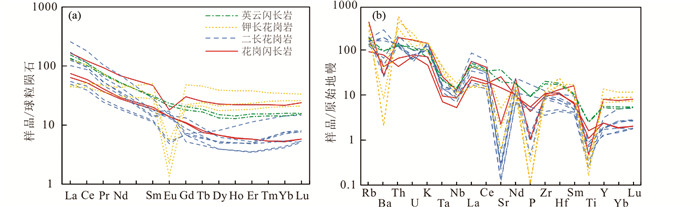
4 测试结果 4.1 主、微量元素钾长花岗岩SiO2含量为76.35%~78.48%、K2O为2.86%~4.95%、P2O5为0.01%、全碱(Na2O+K2O)含量7.14%~8.75%、K2O/Na2O比值0.67~1.33、Zr/Hf比值介于18~24之间(表 1)。在TAS图解上,样品点落在花岗岩区域(图 3a);在SiO2-K2O图解(图 3b)中,主要落入高钾钙碱性-钙碱性系列范围。钾长花岗岩的稀土元素总量中等,∑REE=83×10-6~154×10-6、(La/Yb)N值为1.4~6.3、δEu=0.04~0.21,相对富集轻稀土元素、亏损重稀土元素,显示强的负Eu异常(图 4a),表明岩浆曾发生明显的斜长石的分离结晶作用(张宏飞和高山, 2012)。微量元素原始地幔标准化蛛网图显示:钾长花岗岩富集Rb、K、Th和U大离子亲石元素,亏损P、Ta、Nb和Ta高场强元素(图 4b)。
|
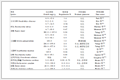
表 1 马庄山地区花岗岩类主量元素(wt%)、稀土、微量元素(×10-6)测试结果 Table 1 Major (wt%) and trace (×10-6) elements data of the granitoids in Mazhuangshan area |

|
图 3 马庄山地区花岗岩类的TAS图解(a, 底图据Middlemost, 1994)和K2O-SiO2图解(b, 底图据Rickwood, 1989) Fig. 3 TAS diagram (a, base map after Middlemost, 1994) and K2O vs. SiO2 diagram (b, base map after Rickwood, 1989) of the granitoids in Mazhuangshan area |
英云闪长岩SiO2含量为64.54%~64.75%、K2O为3.63%~4.33%、P2O5为0.20%~0.21%、全碱(Na2O+K2O)含量为6.51%~6.94%、K2O/Na2O比值为0.50~0.91,Zr/Hf比值38~39。在TAS图解上,样品落在花岗闪长岩区域(图 3a);在SiO2-K2O图解上落入高钾钙碱性-钙碱性区域(图 3b)。英云闪长岩的稀土元素总量中等,∑REE=153.35×10⁻⁶~162.49×10⁻⁶,(La/Yb)N值为8.6~10.9,δEu=0.89~0.90(表 1),表明轻重稀土分异中等,相对富集轻稀土元素、亏损重稀土元素,显示弱的负Eu异常(图 4a),表明岩浆没有发生明显的斜长石的分离结晶作用(张宏飞和高山, 2012)。总体富集Rb、K、Th和U大离子亲石元素,亏损P、Ta、Nb和Ti高场强等元素(图 4b)。
|
图 4 马庄山地区花岗岩类球粒陨石标准化稀土元素配分型式(a, 标准化值据Boynton, 1984)和原始地幔标准化微量元素蜘蛛图(b, 标准化值据Sun and McDonough, 1989) Fig. 4 Chondrite-normalized REE patterns (a, normalization values after Boynton, 1984) and primitive mantle-normalized trace element spider diagrams (b, normalization values after Sun and McDonough, 1989) of the granitoids |
花岗闪长岩SiO2含量为66.64%~67.86%、K2O为1.53%~4.65%、P2O5为0.02%~0.12%、全碱(Na2O+K2O)为4.72%~6.55%、K2O/Na2O比值0.30~0.43、Zr/Hf比值28~36。在TAS图解上,样品落在花岗闪长岩区域(图 3a);全岩样品中硅高钾中磷,1件为钾玄岩系列,另2件是钙碱性系列(图 3b)。花岗闪长岩的稀土元素总量中等,∑REE=76×10-6~193×10-6,(La/Yb)N值为7.7~14.0,δEu=0.47~0.97(表 1),表明轻重稀土分异中等,显示弱的负Eu异常(图 4a)。微量元素特征与英云闪长岩相似(图 4b)。
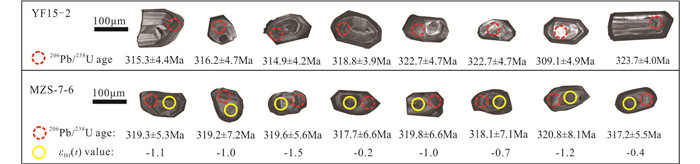
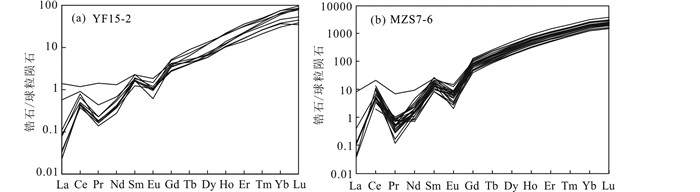
4.2 锆石U-Pb年龄选取2件岩石样品进行了锆石U-Pb定年分析。所测定锆石多呈透明长柱或短柱状,自形程度较好,粒径多为80~120μm,阴极发光图像上具清晰的震荡环带(图 5)。锆石具有较高的Th(43×10-6~634×10-6)、U(154×10-6~758×10-6)含量和Th/U比值(0.28~0.86)(表 2),稀土元素配分曲线具有轻稀土亏损、重稀土富集、明显Ce正异常、Eu负异常的特点(图 6);显示岩浆锆石的特征(Belousova et al., 2002)。
|
图 5 花岗岩类岩石中锆石阴极发光图像 Fig. 5 Cathodoluminescence images of the zircon from granitoids |
|
|
表 2 马庄山地区花岗闪长岩和钾长花岗岩LA-ICP-MS锆石测年数据 Table 2 Zircon U-Pb isotope data of granodiorite and K-feldspar granite in Mazhuangshan area |
|
图 6 花岗岩类岩石中锆石的球粒陨石标准化稀土元素配分图(标准化值据Boynton, 1984) Fig. 6 Chondrite-normalized REE patterns of the zircon from granitoids (normalized after Boynton, 1984) |
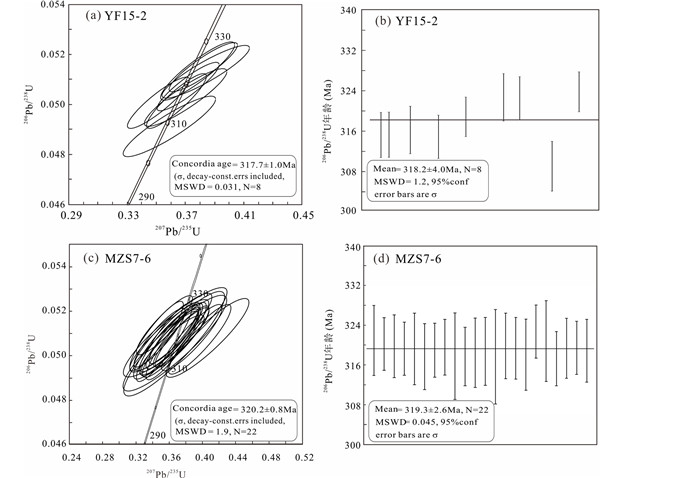
钾长花岗岩(YF15-2)8颗锆石颗粒的LA-ICP-MS U-Pb年龄测定表明,其U-Pb一致年龄为317.7±1.0Ma(MSWD=0.031;图 7a),206Pb/238U加权平均年龄值为318.2±4.0Ma(MSWD=1.2;图 7b)。
|
图 7 马庄山地区花岗岩类LA-ICP-MS U-Pb年龄一致曲线(a、c)和加权平均年龄谱图(b、d) Fig. 7 U-Pb concordant age (a, c) and weighted mean zircon 206Pb/238U age (b, d) of the granitoids at Mazhuangshan |
花岗闪长岩(MZS7-6)22颗锆石颗粒的LA-ICP-MS U-Pb年龄测定显示,其U-Pb一致年龄为320.2±0.8Ma(MSWD=1.9;图 7c),206Pb/238U加权平均年龄值为319.3±2.6Ma(MSWD=0.045;图 7d)。
4.3 Nd-Hf同位素本文测试并统计研究区附近的全岩Nd同位素测试样品共10件,统计结果见表 3。钾长花岗岩的εNd(t)在-5.30~-4.24之间,(143Nd/144Nd)i值为0.511958~0.512013。花岗闪长岩的εNd(t)为-5.31,(143Nd/144Nd)i值为0.511968。石英斑岩的εNd(t)在-2.27~1.82之间,(143Nd/144Nd)i值为0.512135~0.512326。二长花岗岩的εNd(t)在-2.0~-1.7之间,(143Nd/144Nd)i值为0.512113~0.512128。
|
|
表 3 马庄山地区花岗岩类全岩Nd同位素组成 Table 3 Nd isotope data of the granitoids at Mazhuangshan |
花岗闪长岩锆石Hf同位素测点位于LA-ICP-MS U-Pb年龄测点旁(图 5b),Hf同位素共测试12个点(MZS7-6)。测试结果见表 4,176Lu/177Hf比值介于0.000804~0.001816,176Hf/177Hf比值在0.282489~0.282590,εHf(t)介于-3.6~-0.2,平均-1.1,tDM介于947~1086Ma,tDM2为1318~1537Ma。
|
|
表 4 马庄山地区花岗闪长岩中锆石的Hf同位素组成 Table 4 Zircon Hf isotopic compositions of the granodiorite in Mazhuangshan area |
岩浆岩类型的识别对于岩浆源区、构造环境识别有重要的意义,其成因类型可划分为I型、S型和A型(Chappell and White, 1974, 1991; Collins et al., 1982)。I型花岗岩被认为是未风化的火成岩经过部分熔融、结晶形成的,Na2O/K2O值一般小于1,特征矿物为角闪石(Chappell et al., 2012);S型花岗岩被认为是壳源沉积物经部分熔融、结晶形成的,Na2O/K2O值一般大于1,特征性矿物为堇青石、石榴石和夕线石(Chappell and White, 1974);A型花岗岩是产于稳定大陆板块和裂谷内部的碱性、无水的花岗岩,特征矿物是碱性暗色矿物(如钠闪石;Chappell and White, 1974; Mille, 1985)。
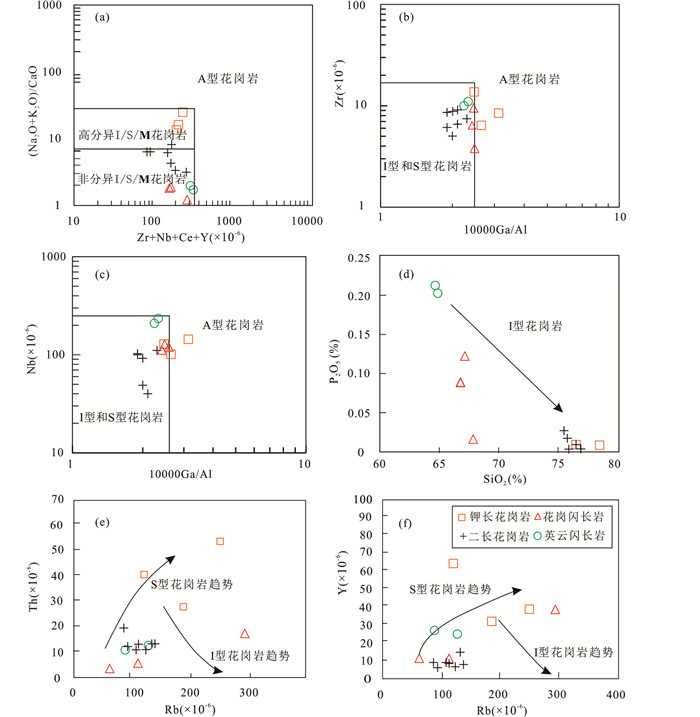
研究区英云闪长岩在显微镜下明显可见角闪石。英云闪长岩和花岗闪长岩的Na2O/K2O比值为0.3~0.9。在(Na2O+K2O)/CaO-Zr+Nb+Ce+Y图解(图 8a)中,英云闪长岩和花岗闪长岩的投影点均落入未分异花岗岩区;在10000Ga/Al-Zr和10000Ga/Al-Nb图解(图 8b, c)中,样品点均落在I或S型花岗岩范围内。岩浆分异演化过程中,I型花岗岩的P2O5含量具有随着SiO2含量的增加而递减的特征,S型花岗岩则具有相反的趋势,因此,P2O5可以用来区分低分异的I型和S型花岗岩(Li et al., 2006, 2007; Wu et al., 2003)。在P2O5-SiO2关系图解(图 8d)中,P2O5与SiO2相呈现负相关关系,与S型花岗岩的负相关性有明显的区别;在Rb-Th和Rb-Y的图解(图 8e, f)中,Y、Th与Rb均呈现正相关的关系,与I型花岗岩的特征一致(Chappell, 1999; Green and Watson, 1982; Li et al., 2007)。综上,认为研究区英云闪长岩和花岗闪长岩应属I型花岗岩,这也与区内广泛发育的二长花岗岩的类型相一致(Zhang et al., 2017)。
|
图 8 马庄山地区花岗岩类岩石的成因判别图(底图据Whalen et al., 1987) (a) (Na2O+K2O)/CaO与Zr+Nb+Ce+Y图;(b) Zr与10000Ga/Al花岗岩分类图;(c) Nb与10000Ga/Al花岗岩分类图;(d) P2O5-SiO2图解;(e) Rb-Th图解;(f) Rb-Y图解 Fig. 8 Discrimination diagrams of the granitoids at Mazhuangshan area (base map after Whalen et al., 1987) (a) (Na2O+K2O)/CaO vs. Zr+Nb+Ce+Y diagram; Zr (b) and Nb (c) vs. 10000 Ga/Al diagrams; (d) P2O5 vs. SiO2 diagram; Th (e) and Y(f) vs. Rb diagrams |
相比较而言,区内钾长花岗岩因其较高的10000Ga/Al值,样品总体落入了A型花岗岩和靠近A型花岗岩的区域内(图 8b, c)。考虑到A型花岗岩往往与SiO2>72%的I型或S型高分异花岗岩在地球化学特征上表现出一定的相似性(Whalen et al., 1987; Wu et al., 2003),而钾长花岗岩与花岗闪长岩是同时代的产物(其为年龄分别为317Ma和320Ma左右)(图 8a, b),具有相同的矿物组合和类似的地球化学特征,因此,推测钾长花岗岩为高分异I型花岗岩。
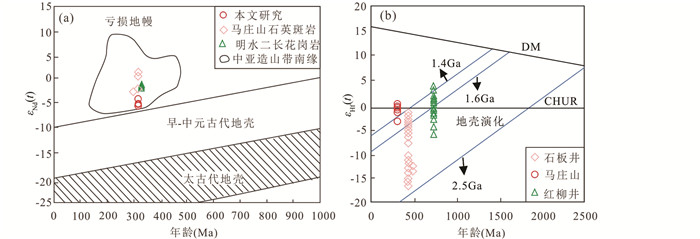
5.2 岩浆来源中亚造山带大部分显生宙花岗岩以正的εNd(t)值与年轻的Sm-Nd模式年龄为主(Jahn et al., 2000)。研究区内大部分花岗岩类样品的εNd(t)值小于0,反映了前寒武纪古陆的残余(图 9a),或者说岩浆形成过程中有老地壳的混入,与研究区广泛出露的早中元古界所处的浅海相沉积环境吻合(周济元等, 2002)。与此同时,研究区少部分花岗岩类样品的εNd(t)值>0,反映了岩石可能有一定的地幔物质来源。总体而言,研究区花岗岩类的εNd(t)表现了壳幔混合的特征。
|
图 9 马庄山地区花岗岩类岩石t-εNd(t)(a)和t-εHf(t)(b)图解 除本文之外的其他数据聂凤军等(2002)、洪大卫和谢锡林(2000)、Jahn et al. (2000)、Lei et al. (2013)、Song et al. (2013b)、Zhang et al. (2017)及王琦崧等(2019) Fig. 9 Diagrams of the age vs. εNd(t) (a) and age vs. εHf(t) (b) for the granitoids in Mazhuangshan area The data of other intrusions from Nie et al. (2002), Hong and Xie (2000), Jahn et al. (2000), Lei et al. (2013), Song et al. (2013b), Zhang et al. (2017) and Wang et al. (2019) |
Hf同位素具有较高的封闭温度,不会因后期的部分熔融、分离结晶而发生变化,故Hf同位素可以用来揭示岩石源区特征(Griffin et al., 2000; 吴福元等, 2007)。锆石Hf同位素分析目前被广泛用于反应花岗岩的源岩性质和源区特征。一般来说,正的εHf(t)值被解释为其源岩可能来自新生地壳或亏损地幔(Jahn et al., 2000; Vervoort et al., 2000),负的εHf(t)值指示其源岩为古老地壳物质(Kinny and Maas, 2003)。研究区花岗闪长岩的εHf(t)介于-3.6~-0.2,tDM2为1318~1537Ma。在εHf(t)-t图解中,大部分样品的投点落在亏损地幔(DM)和球粒陨石(CHUR)演化线之间,少部分样品则落在球粒陨石演化线以下,暗示其源岩以古老地壳为主,并有少量新生地壳或亏损地幔参与(图 9b),这也与研究区Nd同位素特征相一致。锆石Hf二阶段模式年龄(tDM2)指示亏损地幔熔融形成玄武质下地壳时代,即模式年龄代表了壳幔分异时代(吴福元等, 2007)。研究区花岗闪长岩锆石Hf二阶段模式年龄(tDM2)为1321~1537Ma(表 4),与岩体的实际侵位年龄(~320Ma)差别较大,代表了旱山弧微古陆在中元古代早期有一次古老地壳增生。
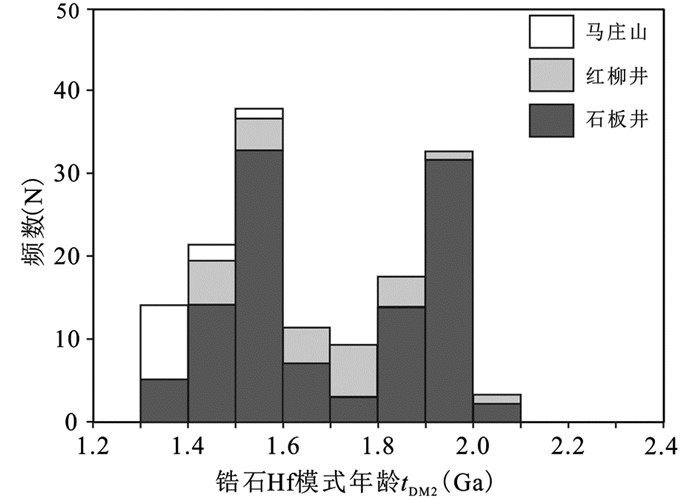
为了对比研究,同时收集北山地区旱山弧内、不同时代的花岗质岩石的Hf同位素组成,分析旱山弧地壳演化史。从西到东分别选取红柳井(95°E)、马庄山(96°E)、石板井(98°E)的中元古代至晚古生代花岗质片麻岩和花岗岩类岩石(He et al., 2014, 2015; Wang et al., 2014; Gao et al., 2015),它们的锆石Hf模式年龄介于1.3~2.3Ga之间,显示1.5~1.6Ga和1.9~2.0Ga两个峰值(图 10)。前人的研究表明,旱山弧与北山锆石Hf模式年龄都具有1.9~2.0Ga峰值(He et al., 2018),这一时间与元古代全球陆壳增长的重大地质事件同步(Kröner et al., 2014, 2017)。这进一步印证了,研究区的古地壳可能是在古元古代(约2.0Ga)形成,之后经历了新一期的中元古代(约1.5Ga)地壳生长。
|
图 10 旱山弧花岗质岩石锆石Hf模式年龄频率直方图 Fig. 10 Zircon Hf isotopic diagram from the granitoids in the Hanshan arc |
前人曾对研究区及附近的花岗岩类岩石开展了一系列的同位素年代学工作。Zhang et al. (2017)获得研究区东北侧明水地区的二长花岗岩锆石LA-ICP-MS锆石U-Pb一致年龄为328±2Ma;王琦崧等(2019)获得马庄山地区的石英斑岩的锆石LA-ICP-MS锆石U-Pb一致年龄分别为315.4±0.6Ma;本次工作首次获得马庄山地区的钾长花岗岩和花岗闪长岩的锆石LA-ICP-MS锆石U-Pb一致年龄分别为317.7±1.0Ma和320.2±0.8Ma。综合上述研究结果,研究区花岗岩类岩石侵位时代在315~328Ma,反应了该区岩浆岩侵位时代于早石炭世-晚石炭世。
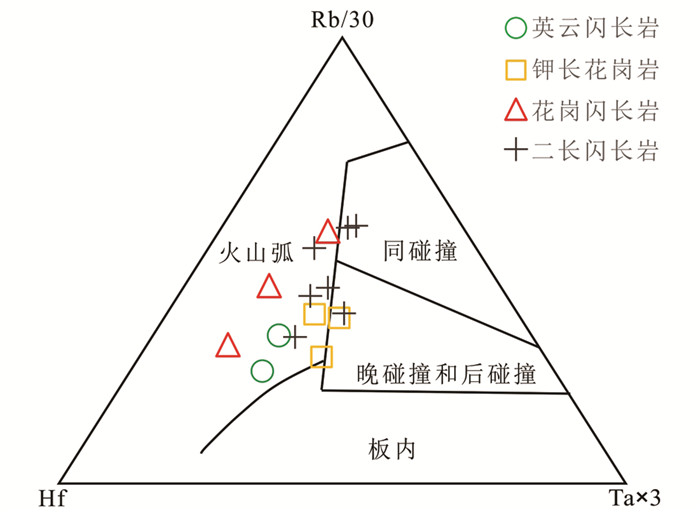
前人对北山造山带晚古生代的构造环境的认识存在分歧。一种观点认为,晚古生代火成岩与俯冲-增生过程有关(Xiao et al., 2010; Ao et al., 2016; Han and Zhao, 2018);而另一种观点认为,晚古生代的侵入岩形成于伸展环境(Zheng et al., 2013; Zhang et al., 2017)。从本文研究区情况看,北山造山带马庄山地区的岩石组合为英云闪长岩、花岗闪长岩和钾长花岗岩。上述部分花岗岩类岩石中含有富水矿物角闪石、黑云母,说明岩浆含水,显示与洋壳俯冲作用有关的弧火山组合特征(肖庆辉等, 2009)。与此同时,岩石相对富集大离子亲石元素,亏损高场强元素(图 4b),Ti-Nb-Ta的负异常,显示了岩石处于俯冲区弧火山岩特征(Pearce et al., 1984)。在花岗岩Hf-Rb/30-Ta×3构造环境判别图上(图 11),英云闪长岩、花岗闪长岩和钾长花岗岩样品点均落入火山弧区,也反映了研究区晚石炭世为火山弧环境。
|
图 11 马庄山地区花岗岩Hf-Rb/30-Ta×3构造环境判别图解(底图据Rollinson, 1993) Fig. 11 The Hf-Rb/30-Ta×3 discriminant diagram for granites (base map after Rollinson, 1993) |
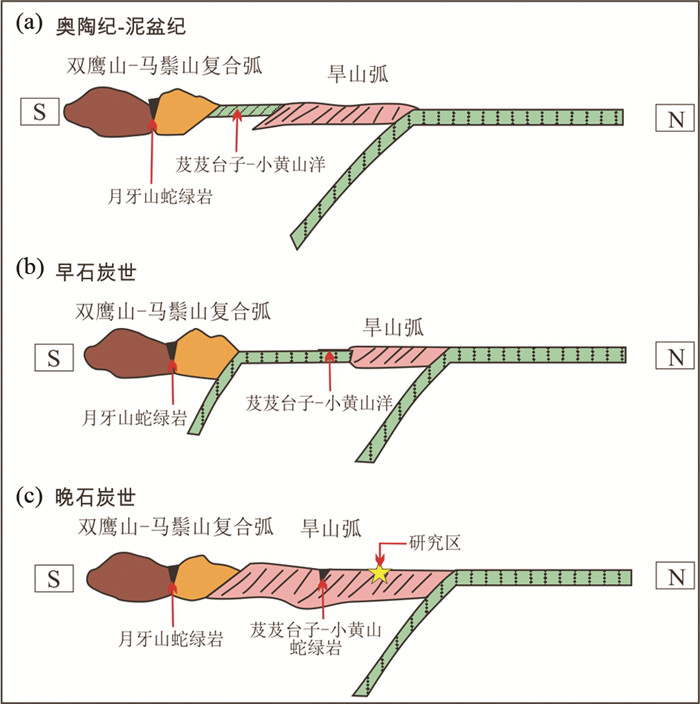
结合整个区域构造演化情况以及研究区花岗岩类构造环境背景,将北山造山带内奥陶纪-石炭纪期间旱山弧的构造演化总结如下(图 12):奥陶纪-泥盆纪时期,双鹰山弧与马鬃山弧之间的月牙山洋闭合,月牙山蛇绿岩形成,双鹰山弧与马鬃山弧拼贴在一起(图 12a);早石炭世时期,古亚洲洋向东天山和北山下俯冲,俯冲板片后撤使得东天山-北山复合造山带北部进入弧后拉分盆地时期(Xiao et al., 2018),红石山洋和星星峡-石板井洋盆可能就是古亚洲洋板片后撤拉张的产物(张元元和郭召杰, 2008; Zheng et al., 2013; 王国强等, 2014; Xiao et al., 2018)。与此同时,旱山弧南侧的芨芨台子-小黄山洋向南侧俯冲(图 12b);晚石炭世时期,以芨芨台子-小黄山洋代表的洋向南俯冲角度逐渐减小,直至闭合。与此同时,古亚洲洋向南俯冲,在约317~320Ma,研究区处于火山弧环境,下地壳物质的部分熔融形成了钾长花岗岩和花岗闪长岩的初始岩浆,侵位至地壳浅部产出(图 12c)。晚石炭世末期,古大洋逐渐闭合,北山研究区开始进入后碰撞造山阶段。
|
图 12 北山造山带北带奥陶纪-石炭纪构造演化示意图(据Ao et al., 2016修改) Fig. 12 Schematic diagram showing the tectonic evolution of the Northern Beishan Orogen from Ordovician to Carboniferous (modified after Ao et al., 2016) |
(1) 马庄山地区的花岗岩类岩石包括花岗闪长岩、钾长花岗岩、英云闪长岩,总体属于富硅、钾,低铁、磷、钛的高钾钙碱性-钙碱性系列,英云闪长岩、花岗闪长岩显示低分异I型花岗岩的特征,而钾长花岗岩显示高分异I型花岗岩的特征。
(2) 马庄山地区钾长花岗岩与花岗闪长岩成岩年龄分别为317.7±1.0Ma、320.2±0.8Ma,形成于古亚洲洋俯冲背景下的弧环境。
(3) 研究区花岗岩类初始εNd(t)在-5.31~1.82。花岗闪长岩锆石176Hf/177Hf在0.282489~0.282590之间,εHf(t)介于-3.6~-0.2之间,tDM2为1318~1537Ma,认为其可能来源于下地壳物质的部分熔融,原始岩浆在上侵过程中有部分地幔物质的加入。
致谢野外工作得到了西部矿业哈密金矿、新疆有色704队的大力支持;实验工作得到了中国科学院广州地球化学研究所肖兵博士、中国地质大学(北京)地质过程与矿产资源国家重点实验室相鹏老师的帮助和支持;两位审稿人为本文提出了建设性修改建议;在此一并表示感谢。
Ao SJ, Xiao WJ, Windley BF, Mao QG, Han CM, Zhang JN and Yang LK and Geng JZ. 2016. Paleozoic accretionary orogenesis in the eastern Beishan orogen:Constraints from zircon U-Pb and 40Ar/39Ar geochronology. Gondwana Research, 30: 224-235 DOI:10.1016/j.gr.2015.03.004 |
Belousova E, Griffin W and O'Reilly SY and Fisher N. 2002. Igneous zircon:Trace element composition as an indicator of source rock type. Contributions to Mineralogy and Petrology, 143(5): 602-622 DOI:10.1007/s00410-002-0364-7 |
Boynton WV. 1984. Cosmochemistry of the rare earth elements:Meteorite studies. Developments in Geochemistry, 2: 63-114 DOI:10.1016/B978-0-444-42148-7.50008-3 |
Chappell BW and White AJR. 1974. Two contrasting granite types. Pacific Geology, 8: 173-174 |
Chappell BW and White AJR. 1991. Restite enclaves and the restite model. In: Didier J and Barbarin B (eds.). Enclaves and Granite Petrology. Amsterdam: Elsevier, 375-381
|
Chappell BW. 1999. Aluminium saturation in I- and S-type granites and the characterization of fractionated haplogranites. Lithos, 46(3): 535-551 DOI:10.1016/S0024-4937(98)00086-3 |
Chappell BW and Bryant CJ and Wyborn D. 2012. Peraluminous I-type granites. Lithos, 153: 142-153 DOI:10.1016/j.lithos.2012.07.008 |
Chen X, Wu YS, Zhao KD and Zhou KF and Chen YJ. 2020. Age, sediment source and tectonic setting of the ore-hosting Jinwozi Formation at the Jinwozi gold deposit in Beishan Orogen, NW China:Evidence from detrital zircon U-Pb ages and Lu-Hf isotopes. Ore Geology Reviews, 117: 103296 DOI:10.1016/j.oregeorev.2019.103296 |
Chen YJ. 2000. Progress in the study of central asia-type orogenesis-metallogenesis in northwest China. Geological Journal of China Universities, 6(1): 17-22 (in Chinese with English abstract) |
Chen YJ, Pirajno F, Wu G and Qi JP and Xiong XL. 2012. Epithermal deposits in North Xinjiang, NW China. International Journal of Earth Sciences, 101(4): 889-917 DOI:10.1007/s00531-011-0689-4 |
Cleven NR and Lin SF and Xiao WJ. 2015. The Hongliuhe fold-and-thrust belt:Evidence of terminal collision and suture-reactivation after the Early Permian in the Beishan orogenic collage, Northwest China. Gondwana Research, 27(2): 796-810 DOI:10.1016/j.gr.2013.12.004 |
Collins WJ, Beams SD and White AJR and Chappell BW. 1982. Nature and origin of A-type granites with particular reference to Southeastern Australia. Contributions to Mineralogy and Petrology, 80(2): 189-200 DOI:10.1007/BF00374895 |
Deng J and Wang QF. 2016. Gold mineralization in China:Metallogenic provinces, deposit types and tectonic framework. Gondwana Research, 36: 219-274 DOI:10.1016/j.gr.2015.10.003 |
Ding JX, Han CM, Xiao WJ and Wang ZM and Yang XM. 2015. Geochemistry and U-Pb geochronology of tungsten deposit of Huaniushan island arc in the Beishan Orogenic Belt, and its geodynamic background. Acta Petrologica Sinica, 31(2): 594-616 (in Chinese with English abstract) |
Gao J, Wang XS, Klemd R, Jiang T, Qian Q and Mu LX and Ma YZ. 2015. Record of assembly and breakup of Rodinia in the southwestern Altaids:Evidence from Neoproterozoic magmatism in the Chinese Western Tianshan Orogen. Journal of Asian Earth Sciences, 113: 173-193 DOI:10.1016/j.jseaes.2015.02.002 |
Goldfarb RJ, Taylor RD, Collins GS and Goryachev NA and Orlandini OF. 2014. Phanerozoic continental growth and gold metallogeny of Asia. Gondwana Research, 25(1): 48-102 DOI:10.1016/j.gr.2013.03.002 |
Green TH and Watson EB. 1982. Crystallization of apatite in natural magmas under high pressure, hydrous conditions, with particular reference to 'orogenic' rock series. Contributions to Mineralogy and Petrology, 79(1): 96-105 DOI:10.1007/BF00376966 |
Griffin WL, Pearson NJ, Belousova E, Jackson SE, Van Achterbergh E and O'Reilly SY and Shee SR. 2000. The Hf isotope composition of cratonic mantle:LAM-MC-ICPMS analysis of zircon megacrysts in kimberlites. Geochimica et Cosmochimica Acta, 64(1): 133-147 DOI:10.1016/S0016-7037(99)00343-9 |
Griffin WL, Wang X, Jackson SE, Pearson NJ, O'Reilly SY and Xu XS and Zhou XM. 2002. Zircon chemistry and magma mixing, SE China:In-situ analysis of Hf isotopes, Tonglu and Pingtan igneous complexes. Lithos, 61(3-4): 237-269 DOI:10.1016/S0024-4937(02)00082-8 |
Griffin WL, Pearson NJ and Belousova EA and Saeed A. 2006. Comment:Hf-isotope heterogeneity in zircon 91500. Chemical Geology, 233(3-4): 358-363 DOI:10.1016/j.chemgeo.2006.03.007 |
Han YG and Zhao GC. 2018. Final amalgamation of the Tianshan and Junggar orogenic collage in the southwestern Central Asian Orogenic Belt:Constraints on the closure of the Paleo-Asian Ocean. Earth-Science Reviews, 186: 129-152 DOI:10.1016/j.earscirev.2017.09.012 |
Hart SR. 1984. A large-scale isotope anomaly in the Southern Hemisphere mantle. Nature, 309(5971): 753-757 DOI:10.1038/309753a0 |
He ZY, Zhang ZM, Zong KQ, Xiang H and Chen XJ and Xia MJ. 2014. Zircon U-Pb and Hf isotopic studies of the Xingxingxia Complex from Eastern Tianshan (NW China):Significance to the reconstruction and tectonics of the southern Central Asian Orogenic Belt. Lithos, 190-191: 485-499 DOI:10.1016/j.lithos.2013.12.023 |
He ZY, Klemd R, Zhang ZM, Zong KQ, Sun LX and Tian ZL and Huang BT. 2015. Mesoproterozoic continental arc magmatism and crustal growth in the eastern Central Tianshan Arc Terrane of the southern Central Asian Orogenic Belt:Geochronological and geochemical evidence. Lithos, 236-237: 74-89 DOI:10.1016/j.lithos.2015.08.009 |
He ZY, Klemd R and Yan LL and Zhang ZM. 2018. The origin and crustal evolution of microcontinents in the Beishan orogen of the southern Central Asian Orogenic Belt. Earth-Science Reviews, 185: 1-14 DOI:10.1016/j.earscirev.2018.05.012 |
Hong DW and Xie XL. 2000. Genesis of positive ε(Nd, t) granitoids in the Da Hinggan MTS. -Mongolia orogenic belt and growth continental crust. Geoscience Frontiers, 7(2): 441-456 (in Chinese with English abstract) |
Jahn BM and Griffin WL and Windley B. 2000. Continental growth in the Phanerozoic:Evidence from Central Asia. Tectonophysics, 328(1-2): vii-x DOI:10.1016/S0040-1951(00)00174-8 |
Jiang SH. 2004. Magmatism and gold metallogeny in Beishan Mt., northwestern China. Ph. D. Dissertation. Beijing: Chinese Academy of Geological Sciences, 1-186 (in Chinese)
|
Kinny PD and Maas R. 2003. Lu-Hf and Sm-Nd isotope systems in zircon. Reviews in Mineralogy and Geochemistry, 53(1): 327-341 DOI:10.2113/0530327 |
Kröner A, Kovach V, Belousova E, Hegner E, Armstrong R, Dolgopolova A, Seltmann R, Alexeiev DV, Hoffmann JE, Wong J, Sun M, Cai K, Wang T, Tong Y, Wilde SA and Degtyarev KE and Rytsk E. 2014. Reassessment of continental growth during the accretionary history of the Central Asian Orogenic Belt. Gondwana Research, 25(1): 103-125 DOI:10.1016/j.gr.2012.12.023 |
Kröner A, Kovach V, Alexeiev D, Wang KL, Wong J and Degtyarev K and Kozakov I. 2017. No excessive crustal growth in the Central Asian Orogenic Belt:Further evidence from field relationships and isotopic data. Gondwana Research, 50: 135-166 DOI:10.1016/j.gr.2017.04.006 |
Lei RX, Wu CZ, Chi GX, Gu LX, Dong LH, Qu X and Jiang YH and Jiang SY. 2013. The Neoproterozoic Hongliujing A-type granite in Central Tianshan (NW China):LA-ICP-MS zircon U-Pb geochronology, geochemistry, Nd-Hf isotope and tectonic significance. Journal of Asian Earth Sciences, 74: 142-154 DOI:10.1016/j.jseaes.2013.03.025 |
Li HQ, Chen FW and Cai H and Liu HQ. 1999. Study on isotopic chronology of the Mazhuangshan gold mineralization, eastern Xinjiang. Scientia Geologica Sinica, 34(2): 251-256 (in Chinese with English abstract) |
Li XH, Li ZX and Li WX and Wang YJ. 2006. Initiation of the indosinian orogeny in South China:Evidence for a Permian magmatic arc on Hainan Island. Journal of Geology, 114(3): 341-353 DOI:10.1086/501222 |
Li XH, Li ZX, Li WX, Liu Y, Yuan C and Wei GJ and Qi CS. 2007. U-Pb zircon, geochemical and Sr-Nd-Hf isotopic constraints on age and origin of Jurassic I- and A-type granites from central Guangdong, SE China:A major igneous event in response to foundering of a subducted flat-slab?. Lithos, 96(1-2): 186-204 DOI:10.1016/j.lithos.2006.09.018 |
Li Y, Yang JS, Zhang J, Li TF, Chen SY and Ren YF and Xu XZ. 2011. Tectonical significance of the Carboniferous volcanic rocks in eastern Tianshan. Acta Petrologica Sinica, 27(1): 193-209 (in Chinese with English abstract) |
Liang XR, Wei GJ and Li XH and Liu Y. 2002. Rapid and precise measurement for 143Nd/144Nd isotopic ratios using a multi-collector inductively coupled plasma mass spectrometer. Rock and Mineral Analysis, 21(4): 247-251 (in Chinese with English abstract) |
Liu CX, Chen BL, Jahn BM and Wu GG and Liu YS. 2011. Early Paleozoic (ca. 465Ma) eclogites from Beishan (NW China) and their bearing on the tectonic evolution of the southern Central Asian Orogenic Belt. Journal of Asian Earth Sciences, 42(4): 715-731 |
Liu MQ and Wang JJ and Dai WJ. 2006. The U-Pb age of single-grained zircon from Maanshanbei granite in Hongshishan area of the Beishan orogenic belt, Gansu Province. Acta Petrologica et Mineralogica, 25(6): 437-479 (in Chinese with English abstract) |
Mao QG, Xiao WJ, Han CM, Sun M, Yuan C, Zhang JN and Ao SJ and Li JL. 2010. Discovery of Middle Silurian adakite granite and its tectonic significance in Liuyuan area, Beishan Moutains, NW China. Acta Petrologica Sinica, 26(2): 584-596 (in Chinese with English abstract) |
Middlemost EAK. 1994. Naming materials in the magma/igneous rock system. Earth-Science Reviews, 37(3-4): 215-224 DOI:10.1016/0012-8252(94)90029-9 |
Miller CF. 1985. Are strongly peraluminous magmas derived from pelitic sedimentary sources?. The Journal of Geology, 93(6): 673-689 DOI:10.1086/628995 |
Nie FJ, Jiang SH and Bai DM. 2002. Metallogenic Studies and Ore Prospecting in the Conjunctionarea of Inner Mongolia Autonomous Region, Gansu Province and Xinjiang Uygur Autonomous Region (Beishan Mt.), Northwest China. Beijing: Geological Publishing House, 1-480 (in Chinese)
|
Pearce JA and Harris NBW and Tindle AG. 1984. Trace element discrimination diagrams for the tectonic interpretation of granitic rocks. Journal of Petrology, 25(4): 956-983 DOI:10.1093/petrology/25.4.956 |
Rickwood PC. 1989. Boundary lines within petrologic diagrams which use oxides of major and minor elements. Lithos, 22(4): 247-263 DOI:10.1016/0024-4937(89)90028-5 |
Rollinson HR. 1993. Using Geochemical Data:Evaluation, Presentation, Interpretation. Singapore: Longman Singapore Publishers, 1-352
|
Şengör AMC and NataPin BA. 1996. Paleotectonics of Asia: Fragments of a synthesis. In: Yin A and Harrison M (eds.). The Tectonic Evalution of Asia. Cambridge: Cambridge University Press, 480-640
|
Şengör AMC and Natal'in BA and Burtman VS. 1993. Evolution of the Altaid tectonic collage and Palaeozoic crustal growth in Eurasia. Nature, 364(6435): 299-307 DOI:10.1038/364299a0 |
Shu SP, Zhang J, Chen YJ and Li QG and Wang QS. 2017. Discovery and geological significance of tellurides in the Herzhedegai gold deposit, Beishan metallogenic belt. Acta Petrologica Sinica, 33(6): 1859-1871 (in Chinese with English abstract) |
Söderlund U, Patchett PJ and Vervoort JD and Isachsen CE. 2004. The 176Lu decay constant determined by Lu-Hf and U-Pb isotope systematics of Precambrian mafic intrusions. Earth and Planetary Science Letters, 219(3-4): 311-324 DOI:10.1016/S0012-821X(04)00012-3 |
Song DF, Xiao WJ, Han CM, Tian ZH and Wang ZM. 2013a. Provenance of metasedimentary rocks from the Beishan orogenic collage, southern Altaids:Constraints from detrital zircon U-Pb and Hf isotopic data. Gondwana Research, 24(3-4): 1127-1151 DOI:10.1016/j.gr.2013.02.002 |
Song DF, Xiao WJ, Han CM. Li JL, Qu JF, Guo QQ and Lin LN and Wang ZM. 2013b. Progressive accretionary tectonics of the Beishan orogenic collage, southern Altaids:Insights from zircon U-Pb and Hf isotopic data of high-grade complexes. Precambrian Research, 227: 368-388 DOI:10.1016/j.precamres.2012.06.011 |
Song DF, Xiao WJ and Han CM and Tian ZH. 2013c. Geochronological and geochemical study of gneiss-schist complexes and associated granitoids, Beishan Orogen, southern Altaids. International Geology Review, 55(14): 1705-1727 DOI:10.1080/00206814.2013.792515 |
Steiger RH and Jäger E. 1977. Subcommission on geochronology:Convention on the use of decay constants in geo-and cosmochronology. Earth and Planetary Science Letters, 36(3): 359-362 DOI:10.1016/0012-821X(77)90060-7 |
Sun SS and McDonough WF. 1989. Chemical and isotopic systematics of oceanic basalts:Implications for mantle composition and processes. In:Sanders AD and Norry MJ (eds.). Magmatism in Ocean Basins. Geological Society, London, Special Publications, 42(1): 313-345 DOI:10.1144/GSL.SP.1989.042.01.19 |
Tian ZH, Xiao WJ, Windley BF, Lin LN, Han CM, Zhang JE, Wan B, Ao SJ and Song DF and Feng J. 2014. Structure, age, and tectonic development of the Huoshishan-Niujuanzi ophiolitic mélange, Beishan, southernmost Altaids. Gondwana Research, 25(2): 820-841 DOI:10.1016/j.gr.2013.05.006 |
Vervoort JD, Patchett PJ, Albarède F, Blichert-Toft J and Rudnick R and Downes H. 2000. Hf-Nd isotopic evolution of the lower crust. Earth and Planetary Science Letters, 181(1-2): 115-129 DOI:10.1016/S0012-821X(00)00170-9 |
Wang GQ, Li XM, Xu XY and Yu JY and Wu P. 2014. Ziron U-Pb chronological study of the Hongshishan ophiolite in the Beishan area and their tectonic significance. Acta Petrologica Sinica, 30(6): 1685-1694 (in Chinese with English abstract) |
Wang QS, Zhang J, Shu SP, Lai C and Xu BW and Sun HW. 2019. Genesis of the Xiuwenghala gold deposit in the Beishan Orogen, Northwest China:Evidence from geology, fluid inclusion, and H-O-S-Pb isotopes. Resource Geology, 69(2): 211-226 DOI:10.1111/rge.12198 |
Wang QS, Zhang J, Wang S and Yu LD and Xiao B. 2019. Petrogenesis and tectonic setting of the quartz porphyry in Mazhuangshan gold deposit, Eastern Tianshan Orogen:Evidence from geochemistry, zircon U-Pb geochronology and Sr-Nd-Hf isotopes. Acta Petrologica Sinica, 35(5): 1503-1518 (in Chinese with English abstract) DOI:10.18654/1000-0569/2019.05.12 |
Wang XY. 2017. The rock assemblages, spatial and temporal variations in the Gongpoquan arc, Beishan and their implications for tectonic setting. Ph. D. Dissertation. Guangzhou: Guangzhou Institute of Geochemistry, Chinese Academy of Sciences, 1-161 (in Chinese)
|
Wang YW, Wang JB, Wang LJ, Long LL, Tang PZ, Liao Z and Zhang HQ and Shi Y. 2012. The Tuerkubantao ophiolite mélange in Xinjiang, NW China:New evidence for the Erqis suture zone. Geoscience Frontiers, 3(5): 587-602 DOI:10.1016/j.gsf.2012.02.002 |
Wang ZM, Han CM, Xiao WJ, Su BX and Sakyi PA. Song DF and Lin LN. 2014. The petrogenesis and tectonic implications of the granitoid gneisses from Xingxingxia in the eastern segment of Central Tianshan. Journal of Asian Earth Sciences, 88: 277-292 DOI:10.1016/j.jseaes.2014.03.015 |
Whalen JB and Currie KL and Chappell BW. 1987. A-type granites:Geochemical characteristics, discrimination and petrogenesis. Contributions to Mineralogy and Petrology, 95(4): 407-419 DOI:10.1007/BF00402202 |
Windley BF, Alexeiev D, Xiao WJ and Kröner A and Badarch G. 2007. Tectonic models for accretion of the Central Asian Orogenic Belt. Journal of the Geological Society, 164: 31-47 DOI:10.1144/0016-76492006-022 |
Wu FY, Jahn BM, Wilde SA, Lo CH, Yui TF, Lin Q and Ge WC and Sun DY. 2003. Highly fractionated I-type granites in NE China (Ⅰ):Geochronology and petrogenesis. Lithos, 66(3-4): 241-273 DOI:10.1016/S0024-4937(02)00222-0 |
Wu FY, Li ZH and Zheng YF and Gao S. 2007. Lu-Hf isotopic systematics and their applications in petrology. Acta petrologica Sinica, 23(2): 185-220 (in Chinese with English abstract) |
Xiao QH, Deng JF, Qiu RZ and Liu Y and Feng YF. 2009. A preliminary study of the relationship between granitoids and the growth of continental crust:A case study of the formation of key orogen granitoids in China. Geology in China, 36(3): 594-622 (in Chinese with English abstract) |
Xiao WJ, Mao QG, Windley BF, Han CM, Qu JF, Zhang JE, Ao SJ, Guo QQ, Cleven NR, Lin SF and Shan YH and Li JL. 2010. Paleozoic multiple accretionary and collisional processes of the Beishan orogenic collage. American Journal of Science, 310(10): 1553-1594 DOI:10.2475/10.2010.12 |
Xiao WJ, Windley BF, Han CM, Liu W, Wan B, Zhang JE, Ao SJ and Zhang ZY and Song DF. 2018. Late Paleozoic to Early Triassic multiple roll-back and oroclinal bending of the Mongolia collage in Central Asia. Earth-Science Reviews, 186: 94-128 DOI:10.1016/j.earscirev.2017.09.020 |
Yuan Y, Zong KQ, He ZY, Klemd R, Jiang HY, Zhang W, Liu YS and Hu ZC and Zhang ZM. 2018. Geochemical evidence for Paleozoic crustal growth and tectonic conversion in the Northern Beishan Orogenic Belt, southern Central Asian Orogenic Belt. Lithos, 302-303: 189-202 DOI:10.1016/j.lithos.2017.12.026 |
Zhang HF and Gao S. 2012. Geochemistry. Beijing: Geological Publishing House, 1-409 (in Chinese)
|
Zhang W, Pease V, Meng QP and Zheng RG and Wu TR. 2017. Age and petrogenesis of Mingshui-Shuangjingzi granites from the northern Beishan area, Northwest China, and their implications for tectonic evolution. Geosciences Journal, 21(5): 667-682 DOI:10.1007/s12303-017-0017-5 |
Zhang YY and Guo ZJ. 2008. Accurate constraint on formation and emplacement age of Hongliuhe ophiolite, boundary region between Xinjiang and Gansu provinces and its tectonic implications. Acta Petrologica Sinica, 24(4): 803-809 (in Chinese with English abstract) |
Zheng RG, Wu TR, Zhang W and Xu C and Meng QP. 2013. Late Paleozoic subduction system in the southern Central Asian Orogenic Belt:Evidences from geochronology and geochemistry of the Xiaohuangshan ophiolite in the Beishan orogenic belt. Journal of Asian Earth Sciences, 62: 463-475 DOI:10.1016/j.jseaes.2012.10.033 |
Zheng RG, Wu TR, Xiao WJ and Meng QP and Zhang W. 2016. Geochronology, geochemistry and tectonic implications of the Shuangjizi composite pluton in the northern Beishan. Acta Geologica Sinica, 90(11): 3153-3172 (in Chinese with English abstract) |
Zhou JY, Cui BF and Chen SZ and Xiao HL. 2002. Geological characteristics and genesis of Mazhuangshan gold-sliver deposit at Hami, Xinjiang. Mineral Deposit, 21(Suppl.1): 791-795 (in Chinese) |
Zong KQ, Klemd R, Yuan Y, He ZY, Guo JL, Shi XL, Liu YS and Hu ZC and Zhang ZM. 2017. The assembly of Rodinia:The correlation of Early Neoproterozoic (ca. 900Ma) high-grade metamorphism and continental arc formation in the southern Beishan Orogen, southern Central Asian Orogenic Belt (CAOB). Precambrian Research, 290: 32-48 |
陈衍景. 2000. 中国西北地区中亚型造山-成矿作用的研究意义和进展. 高校地质学报, 6(1): 17-22. DOI:10.3969/j.issn.1006-7493.2000.01.002 |
丁嘉鑫, 韩春明, 肖文交, 王忠梅, 杨晓梅. 2015. 北山造山带花牛山岛弧东段钨矿床成矿时代和成矿动力学过程. 岩石学报, 31(2): 594-616. |
洪大卫, 谢锡林. 2000. 兴蒙造山带ε(Nd, t)值花岗岩的成因和大陆地壳生长. 地学前缘, 7(2): 441-456. DOI:10.3321/j.issn:1005-2321.2000.02.012 |
江思宏. 2004.北山地区岩浆活动与金的成矿作用.博士学位论文.北京: 中国地质科学院, 1-186 http://www.wanfangdata.com.cn/details/detail.do?_type=degree&id=Y662067
|
梁细荣, 韦刚健, 李献华, 刘颖. 2002. 多收集器等离子体质谱快速精确测定钕同位素比值. 岩矿测试, 21(4): 247-251. DOI:10.3969/j.issn.0254-5357.2002.04.002 |
刘明强, 王建军, 代文军. 2006. 甘肃北山红石山地区马鞍山北花岗岩体的单颗粒锆石U-Pb年龄及地质意义. 岩石矿物学杂志, 25(6): 473-479. DOI:10.3969/j.issn.1000-6524.2006.06.003 |
毛启贵, 肖文交, 韩春明, 孙敏, 袁超, 张继恩, 敖松坚, 李继亮. 2010. 北山柳园地区中志留世埃达克质花岗岩类及其地质意义. 岩石学报, 26(2): 584-596. |
聂凤军, 江思宏, 白大明. 2002. 北山地区金属矿床成矿规律及找矿方向. 北京: 地质出版社408.
|
疏孙平, 张静, 陈衍景, 李雷, 李秋根, 王琦崧. 2017. 北山成矿带霍勒扎德盖金矿床碲化物的发现及其地质意义. 岩石学报, 33(6): 1859-1871. |
王国强, 李向民, 徐学义, 余吉远, 武鹏. 2014. 甘肃北山红石山蛇绿岩锆石U-Pb年代学研究及构造意义. 岩石学报, 30(6): 1685-1694. |
王琦崧, 张静, 王肃, 于立栋, 肖兵. 2019. 东天山马庄山金矿区赋矿石英斑岩的岩石成因和构造背景:元素地球化学、U-Pb年代学和Sr-Nd-Hf同位素约束. 岩石学报, 35(5): 1503-1518. |
王鑫玉. 2017.北山公婆泉岛弧岩石组合, 岩浆时空演变及其构造意义: 博士学位论文.广州: 中国科学院广州地球化学研究所, 1-161 https://kns.cnki.net/KCMS/detail/detail.aspx?dbcode=CDFD&dbname=CDFD&filename=1018073456.nh
|
吴福元, 李献华, 郑永飞, 高山. 2007. Lu-Hf同位素体系及其岩石学应用. 岩石学报, 23(2): 185-220. |
肖庆辉, 邓晋福, 邱瑞照, 刘勇, 冯艳芳. 2009. 花岗岩类与大陆地壳生长初探——以中国典型造山带花岗岩类岩石的形成为例. 中国地质, 36(3): 594-622. DOI:10.3969/j.issn.1000-3657.2009.03.008 |
张宏飞, 高山. 2012. 地球化学. 北京: 地质出版社409.
|
张元元, 郭召杰. 2008. 甘新交界红柳河蛇绿岩形成和侵位年龄的准确限定及大地构造意义. 岩石学报, 24(4): 803-809. |
郑荣国, 吴泰然, 肖文交, 孟庆鹏, 张文. 2016. 北山北部双井子复式岩体年代学、地球化学及其大地构造意义. 地质学报, 90(11): 3153-3172. DOI:10.3969/j.issn.0001-5717.2016.11.012 |
周济元, 催炳芳, 陈世忠, 肖惠良. 2002. 新疆哈密马庄山金(银)矿床地质特征及成因. 矿床地质, 21(增1): 791-795. |