 2020, Vol. 36


2. 中国地质调查局南京地质调查中心, 南京 210016
2. Nanjing Center of China Geological Survey, Nanjing 210016, China
岩浆混合作用是两种或多种不同成分、粘度、密度及温度的同源或异源岩浆,以机械混合(mingling)或化学混合(mixing)的方式发生的相互作用(Campbell and Turner, 1989; Tonarini et al., 2009),可以发生在岩浆源区及运移-侵位的多个阶段(Hibbard, 1981; Anderson, 1983; Vernon, 1990; Humphreys et al., 2006; 王德滋和谢磊, 2008; Jafari et al., 2015),是造成火成岩多样性的主要原因之一,历来受到研究者的广泛关注。大量地球物理观察及岩石学研究均证实,与火山作用有关的岩浆混合作用,大多发生于地壳浅部岩浆房(< 4km深度)中,往往与岩浆的补给(recharge)过程有关(Sparks et al., 1977; Couch et al., 2001; 樊祺诚等, 2005; De Silva et al., 2008; Ruprecht and Bachmann, 2012; Befus and Gardner, 2016),也是诱发火山喷发的重要机制(Sparks et al., 1977; Ruprecht and Bachmann, 2010; Druitt et al., 2012; Befus and Gardner, 2016; 丁磊磊等, 2018)。
通常来说,当更热、更低粘度及更富挥发分的深源岩浆进入火山机构之下的浅部酸性岩浆房时,由于补给岩浆与先存岩浆之间化学成分、物理性质的不均衡性,二者会发生混合(周金城等, 1994; 薛怀民等, 2001; Phillips and Woods, 2002; 樊祺诚等, 2005; Price et al., 2012; Mills and Coleman, 2013; Tost et al., 2016),或者由补给岩浆提供热量导致先存岩浆房内不同成分层之间发生热柱对流自混合(self-mixing)作用(Couch et al., 2001; Pignatelli et al., 2016)。岩浆房内的混合作用,一方面导致岩浆房中岩浆体积、温度和压力不断增大,当最终超过静岩压力或者存在外来因素影响时,可以诱发火山喷发;另一方面形成一系列具中间组分的混合岩浆,在喷出物中岩浆混合往往表现为包体、捕掳晶、骸晶、晶体的碎裂及矿物的反环带等不平衡现象,同时还可能在斑晶、包裹体中出现成分的不均一性和分组性(Hibbard, 1981; Pallister et al., 1992; 周金城等, 1994; De Silva et al., 2008; Viccaro et al., 2010; Price et al., 2012; 颜丽丽等, 2015; 陆天宇等, 2016)。
在这些过程中,基性岩浆与酸性岩浆的混合现象最易在野外识别,故一直以来都是岩石学家的主要研究对象(马昌前等,1992;Murphy et al., 1998; Griffin et al., 2002; Phillips and Woods, 2002;樊祺诚等,2005;王德滋和谢磊,2008;Yan et al., 2016)。但越来越多的研究表明,在浅部岩浆房内,演化程度较高的酸性岩浆的补给也能导致先存的、趋于静止的酸性岩浆再活化(remobilization),从而诱发火山喷发同时产生一系列岩浆混合现象,如秘鲁南部埃纳普蒂纳(Huaynaputina Volcano)、希腊圣托里尼(Santorini Volcano)及美国黄石公园(Yellowstone)等酸性火山的喷发均与酸性岩浆的补给过程有关(Venezky and Rutherford, 1997; Eichelberger and Izbekov, 2000; Eichelberger et al., 2000; De Silva et al., 2008; Druitt et al., 2012; Befus and Gardner, 2016)。在秘鲁的埃纳普蒂纳火山中,尽管所有的喷发物都是英安岩,但其中所包含的斜长石成分和结构特征、火山玻璃地球化学特征、挥发分组成以及晶体含量等差异表明存在两种不同演化程度英安质岩浆,演化程度较低的高温英安质岩浆补给到演化程度较高的英安质岩浆房中,二者发生物质和能量的交换及混合,促使岩浆房内发生对流运动,岩浆房体积和压力不断增大,最终打开一个岩浆通道导致火山喷发(De Silva et al., 2008),类似的过程在美国黄石公园、希腊圣托里尼等酸性火山中也被证实(Druitt et al., 2012; Befus and Gardner, 2016);而更为直接的证据是,在酸性火山的喷发产物中,可以同时出现两种或两种以上的酸性喷出物(Matsumoto et al., 2018)。
在我国浙闽沿海广泛发育的晚中生代火成岩中,已有的研究基本上集中于深成岩中基性和酸性端元之间的混合作用(周新民等,1992;董传万等, 1998, 2007, 2008;Griffin et al., 2002;谢磊等,2004;陈荣等,2005),而与这些深成侵入岩在时空上密切共生,成因上紧密联系的火山岩中,与岩浆混合有关的现象却罕有报道。这些晚中生代火山岩主体为流纹质,伴生少量基性火山岩,形成双峰式火山岩组合(Zhou et al., 2006);在个别地区可伴生少量中间岩浆岩,形成复合岩流(周金城等,1994;薛怀民等,2001;谢昕等,2003)。其中双峰式火山或者复合岩流,常在地球化学组成上表现出明显的混合趋势,例如基性与酸性端元一致的同位素特征、在哈克图解上呈线性变化的主-微量元素组成及少量中间岩浆的出现(周金城等,1994;薛怀民等,2001;谢昕等,2003)。因此,研究者大多认为,幔源基性岩浆和壳源酸性岩浆发生不同程度的混合或成分交换,是造成浙闽沿海晚中生代火山岩及其地球化学成分相关性的关键,也被认为是壳幔相互作用的主要表现形式之一(董传万等, 1998, 2007, 2008; Xu et al., 1999; 陈荣等,2005; Zhou et al., 2006; Guo et al., 2012;Liu et al., 2012)。但值得注意的是,与深成岩不同,这些火山岩中的基性包体、捕掳晶及矿物的不平衡结构等与岩浆混合有关的现象极为罕见。在拔茅等极少数地区,英安岩中含有少量的安山质包体和熔蚀成港湾状的斜长石斑晶,被认为是玄武质岩浆和流纹质岩浆混合的直接证据(周金城等,1994;薛怀民等,2001)。除此之外,其余双峰式火山岩或者复合岩流大多只在地球化学上表现出相关趋势,因此,这些大规模喷发的酸性火山岩中,存在混合趋势的基性与酸性岩浆是否与侵入岩中一样,通过直接接触发生相互作用,从而改变彼此的化学成分及矿物组成?事实上,对于大规模喷发的酸性火山岩来说,考虑到岩浆之间的粘度、密度等因素,相比基性与酸性岩浆之间的混合作用,酸性岩浆与酸性岩浆之间的混合可能更为普遍(De Silva et al., 2008),但在我国东南沿海地区,相关的问题尚缺少足够的关注和研究。
本文报道了浙东小雄破火山内一个次级火山口中粗面质和流纹质两种酸性岩浆之间的混合现象,通过详细的野外调查、岩相学及地球化学研究,揭示了二者的成因联系及形成机制,这对深入理解中国东南沿海晚中生代大规模喷发的酸性火山岩浆房结构、岩浆演化及喷发过程提供了重要参考。
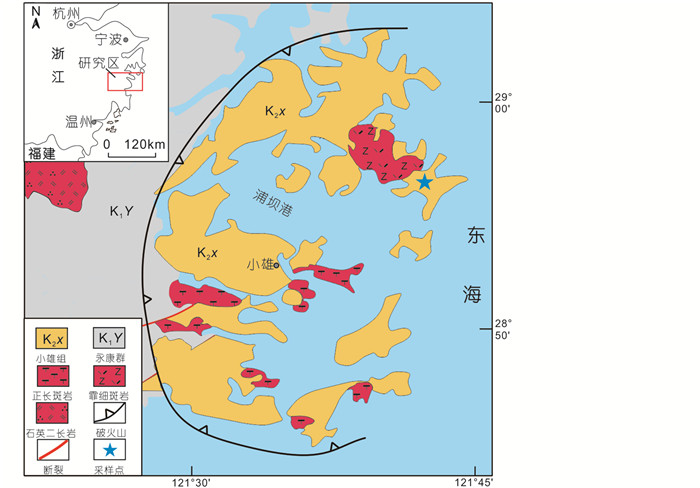
1 地质背景与岩相学特征小雄破火山位于浙东临海-三门一带,是叠置于早白垩世火山构造洼地之上的典型晚白垩世破火山机构(图 1)。破火山内出露的小雄组主体岩性为碱长流纹岩、(碱长)流纹质凝灰岩,其年龄集中于88~98Ma(翁祖山和余方明,1999;邢光福等,2009;Liu et al., 2012)。小雄组底部砂砾岩和沉凝灰岩分别不整合于磨石山群和永康群馆头组、朝川组之上,破火山中央最晚期形成的侵入岩为正长斑岩,其锆石U-Pb年龄与火山岩基本一致。小雄破火山是区域上晚中生代最晚阶段火山活动的产物,也被认为是中国东南部晚中生代的岩浆活动结束的标志(翁祖山和余方明,1999;邢光福等,2009;Liu et al., 2012;刘磊等,2017)。
|
图 1 小雄破火山地质简图(据浙江省地质调查院,1980①修改) Fig. 1 Geologic sketch map of the Xiaoxiong Caldera |
① 浙江省地质调查院. 1980.1:20万临海幅地质调查报告
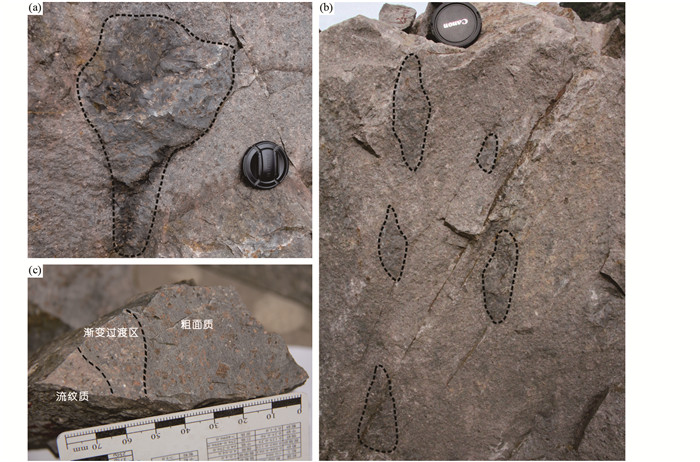
研究区为小雄破火山内一个次级火山口,其中心主体是流纹岩组成的火山颈,直径约30m,周边地层为爆发相的角砾熔结凝灰岩。在火山颈内,粗面质岩浆和流纹质岩浆的混合现象十分普遍(图 2)。露头上流纹岩多为灰白、浅灰及浅肉红色,肉眼可见大量细小的正长石、透长石、石英以及少量黑云母斑晶,粒径多小于3mm;而粗面岩多呈灰黑-灰褐色,正长石为唯一肉眼可见的斑晶,呈肉红色-红褐色,颗粒粗大,粒径多大于5mm;颗粒自形,粒状-短柱状,但普遍具强烈的熔蚀现象,部分为中空骸晶状或筛孔状(图 2a, c)。
|
图 2 研究区野外露头照片 (a)粗面质岩浆团块呈纺锤状散布于流纹质岩浆中,可见由正长石斑晶组成的聚晶;(b)多个椭球状粗面质团块沿其长轴方向定向分布;(c)粗面岩中熔蚀严重的正长石斑晶以及粗面质和流纹质岩浆接触边缘渐变过渡的现象 Fig. 2 Field photographs of the studied rock series (a) the trachytic magma lump with orthoclase glomerocrysts is distributed in the rhyolic magma show a spindle shape; (b) trachytic magma lumps are oriented along their long axis; (c) heavily resorptive orthoclase phenocrysts of trachytic magma and gradual transition phenomenon between the trachytic and rhyolitic magma |
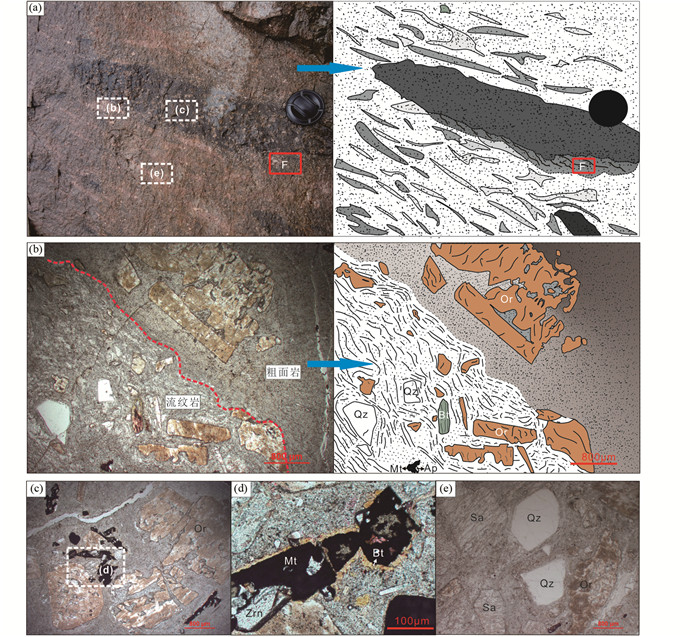
在露头上,粗面质岩浆团块形态多样,大多为粗细不一的条带状,部分则为透镜体状、水滴状、纺锤状及火焰状等,其直径变化较大,长度从数厘米至近一米左右,长宽比大多3~10(图 2a, b、图 3a),其中较大的纺锤状以及水滴状的粗面质团块,其尖端朝下,而条带状以及透镜体状的团块长轴面则近竖直,表明岩浆是垂直向上运移的,在较大的粗面质岩浆团块边部,有时可见粗面质岩浆及其中的正长石斑晶有明显的碎裂以及剪切现象,且矿物组合与内部有一定的差别,正长石颗粒变小,出现少量灰白色长石及石英(图 3a内(F)-红色方框区域)。据Cordonnier et al.(2009)的研究,粗面质团块边部的这种剪切与碎裂现象与两种岩浆之间的粘度-温度差有关。当高温的粗面质岩浆注入相对低温的流纹质岩浆后,其边部发生了淬冷并形成相对坚硬的外壳,当其在火山通道中快速运移时,受周围岩浆剪应力的影响,其淬冷边及其中的矿物会发生碎裂变形,并可在边部发育雁列式的微裂隙。这些均暗示两类岩浆是在塑性状态下共同向上运移的,换言之,两种岩浆在冷却前就发生了明显的混合作用,而且这一过程可能同时或者稍早于火山的喷发;另一方面,粗面质岩浆团块内部矿物组成在横向上的变化,可能也与挥发分从内部的溢出,以及伴随温度降低所导致的岩浆在微观尺度上的分异有关(Castro et al., 2013;Rodríguez and Castro, 2017)。
|
图 3 露头及代表性样品岩相学特征 (a)左侧为野外露头,浅肉红色流纹岩中包裹灰褐色粗面岩;右侧为对应的素描图,粗面质岩浆条带边部发育一系列微小裂隙,该部分与流纹质岩浆之间为渐变关系(图 3a内红色方框F区域); (b)流纹岩与粗面岩的接触界限(图中红色虚线),在流纹岩中具有明显的流动构造,右侧为对应的素描图;(c)粗面岩中大的正长石斑晶,熔蚀强烈;(d)粗面岩中钛磁铁矿+锆石+磷灰石的集合体, 钛磁铁矿四周被黑云母包围形成反应边结构;(e)流纹岩的斑晶特征:其中石英、正长石斑晶仅在边部有熔蚀现象, 正长石斑晶大小不一,大者其形态及结构与粗面质岩浆中的正长石斑晶类似,透长石表面新鲜,裂纹发育. Qz-石英;Or-正长石;Sa-透长石;Bt-黑云母;Mt-磁铁矿;Ap-磷灰石;Zrn-锆石 Fig. 3 Field and petrographic characteristics of representative samples (a) outcrop (left) with gray-brown trachytic blocks scatterred in the light-red rhyolitic magma, corresponding sketch figure (right); (b) boundary between rhyolite and trachyte (red dotted line) with distinct flow texture in the rhyolite; (c) large and heavily resorbed orthoclase phenocrysts in trachyte; (d) cluster of titanomagnetite, zircon and apatite in trachyte, showing a reaction texture with titanomagnetites surrounded by biotites; (e) characters of phenocrysts in rhyolite: quartz and feldspar phenocrysts vary in size and have a dissolutionedge, the larger orthoclase crystals are similar to the orthoclase phenocrysts in trachyte, the sanidines are clear and frequently have cracks. (F) a series of tiny fissures are exposed on the edge of the large trachytic band (the red box area in Fig. 3a), its color and phenocrystal composition are gradual transion with the surrounded rhyolic magma. Qz-quartz; Or-orthoclase; Sa-sanidine; Bt-biotite; Mt-magnetite; Ap-apatite; Zrn-zircon |
两种岩浆的比例在不同部位变化较大,总体上,在火山颈中心部位,粗面质岩浆少于露头面积的1/4左右,靠近火山颈外侧,粗面质团块的含量明显降低;但在靠近火山颈中心位置粗面质团块的含量显著增多,局部可占1/2以上或更多。多数情况下,粗面质与流纹质岩浆界限清晰截然,但渐变过渡现象也十分常见,如图 2c,该区域矿物组合与流纹质岩浆一致,颜色介于粗面质岩浆的灰褐色与流纹质岩浆的灰白色之间,且含有少量与粗面质岩浆中正长石颗粒相似的粗大正长石颗粒,表明粗面质岩浆和流纹质岩浆在二者接触部位有轻微的混合作用;此外,那些较小的条带常具有类似于浆屑的形态,呈浅灰黑-浅褐色,与较大的条带一起呈定向或略呈交织状排列,其形态类似于福建平潭地区岩浆混杂岩中鱼群状的辉长岩包体(董传万等,1998),其矿物组合也常介于上述两种端元岩浆之间,显然,较小的条带往往是两种岩浆混合的产物。其中少量细小条带具有分叉状或燕尾状尾部以及弧面状形态,显示出刚性状态下破碎的迹象,暗示岩浆房内可能存在部分固结的岩浆,在岩浆混合过程中发生破裂被携带至地表。
在显微镜下,流纹岩样品往往可见清晰的流动构造,斑晶由石英(3%)、透长石(5%)、正长石(2%)组成,其中石英呈半自形粒状,粒径0.5~4.0mm,部分被熔蚀成港湾状;透长石呈短柱状,粒径1~3cm,表面新鲜,裂纹发育,无明显熔蚀现象;正长石呈短柱状、长柱状、板状、棱角状,粒径0.5~5mm,大小不一,破碎严重,表面多风化呈褐红色,部分被熔蚀为孔洞状,其形态特征与粗面岩样品中的正长石斑晶的类似,流纹岩样品的基质多为霏细结构,并可见重结晶的流动条带。
而粗面岩样品中斑晶几乎全为正长石,表面风化呈褐红色,含量约占10~15%,呈短柱状、粒状,粒径变化于2~8mm,大都在5mm左右,常可见多个正长石斑晶聚集在一起构成聚斑结构,仅有不到40%的正长石为独立的颗粒。正长石斑晶大多严重熔蚀呈筛孔状、骸晶状;其基质为隐晶质,有时也具流动构造,在与流纹岩的接触部位尤其明显,流纹沿二者界线延伸。大多数情况下,粗面质岩浆与流纹质岩浆接触边缘界线不甚清晰(图 2c、图 3a),碎裂的正长石有明显向流纹质岩浆流动的现象。副矿物主要为钛磁铁矿、锆石、磷灰石,有意思的是,钛磁铁矿常常包裹磷灰石、锆石颗粒,并在其周围有黑云母的反应边,可能与异源流体或岩浆的加入及反应过程有关(Nakamura,1995;Venezky and Rutherford, 1999)。
2 分析方法在野外调查及岩相学研究的基础上,挑选具不同色率及结构特征、矿物特征的粗面岩(17xx-5-7、-9、-12、-13)和流纹岩样品(17xx-5-1、-3、-4、-6、-8、-10)粗碎后采用无污染玛瑙碎至200目制成粉末样,取其30~50g以备全岩化学分析测试,该过程在河北省辰昌岩矿检测技术服务有限公司完成。全岩主微量元素测试在中国地质科学院国家地质实验测试中心进行,每个样品称取0.7g,加入硼酸高温熔融成玻璃片,采用PW4400荧光光谱仪进行主量元素分析,氧化物总量分析精度和准确度优于5%;全岩微量元素含量采用电感耦合等离子质谱仪(PE300Q)测定,分析精度和准确度一般优于10%(Rudnick et al., 2004)。
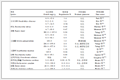
3 分析结果 3.1 主量元素所有样品的全岩地球化学分析结果列于表 1。在TAS图上,所分析样品分别落在流纹岩及粗面岩两个区域内(图 4a),与野外及岩相学观察一致。流纹岩富硅(SiO2=70.5%~72.3%)、富碱(K2O+Na2O=9.7%~10.2%), 且K2O含量(5.4%~5.8%)大于Na2O(4.2%~4.4%), K2O/Na2O比为1.25~1.34。其Al2O3为13.7% ~14.3%,CaO含量极低,均小于0.8%,铝饱和指数A/CNK值为0.95~0.98(平均为0.97);相对于流纹岩而言,粗面岩硅含量较低(SiO2=66.5%~67.9%),但更加富碱(K2O+Na2O=11.4%~12.0%),同样K2O含量(6.1%~6.5%)大于Na2O (5.3%~5.6%), K2O/Na2O比为1.11~1.23,Al2O3、CaO含量也更高(Al2O3=15.0%~16.1%;CaO=0.7%~0.9%),A/CNK值为0.90~0.94(平均值为0.92),总体来说,流纹岩和粗面岩都具有高硅、富碱及过铝质的特点(图 4b)。在Hark图解中(图 5),本次所研究的所有酸性火山岩样品与小雄破火山机构内同时代其他样品一样(包括同时代形成的熔结凝灰岩、粗面斑岩以及正长斑岩), 具有相似的主量元素组成以及一致的、良好的协变关系,暗示他们是同一岩浆系统的产物。在SiO2>66%时,随着SiO2含量的增加, TiO2、FeOT、P2O5和K2O、Na2O、MgO含量降低, 并呈现曲线演化趋势, 表明结晶分异控制着不同岩浆的演化过程, 这与岩浆混合作用所形成的趋势明显不同, 后者往往表现为单调的、直线分布(Zorpi et al., 1989;Blundy and Sparks, 1992;Tatsumi and Suzuki, 2009;Lee and Bachmann, 2014;Rossi et al., 2019),而CaO由于较低的含量,其变化的趋势不明显。
|
表 1 样品主量元素(wt%)和微量元素(×10-6)成分 Table 1 Major (wt%) and trace elements (×10-6) abundance of the samples |

|
图 4 小雄破火山内火山岩TAS图解(a, 底图据Middlemost, 1994)和A/NK-A/CNK分类图解(b, 底图据Maniar and Piccoli, 1989) 文献数据来自邢光福等(2009), 翁祖山和俞方明(1999); 后图同 Fig. 4 TAS diagram of volcanics in Xiaoxiong Caldera (a, after Middlemost, 1994) and A/NK vs. A/CNK classification diagram (b, after Maniar and Piccoli, 1989) The reference data from Xing et al. (2009), Weng and Yu (1999).The following figures are the same |

|
图 5 小雄破火山火山岩主量元素Harker图解 Fig. 5 Harker diagrams of volcanics in Xiaoxiong Caldera |
从样品的球粒陨石标准化稀土元素配分图(图 6a)可见,两种岩石具有相似的稀土元素配分型式,均显示出轻稀土富集的右倾特征,轻重稀土分馏明显。粗面岩稀土元素总含量(∑REE=777.0×10⁻⁶~983.8×10⁻⁶)及轻重稀土分馏程度((La/Yb)N=29.0~34.7)高于流纹岩相应值(∑REE=475.9×10-6~629.0×10-6、(La/Yb)N=14.1~19.8),但流纹岩(δEu=0.35~0.46,平均为0.40)比粗面岩(δEu=0.43~0.53,平均为0.50)显示出更大的Eu负异常以及低的Al2O3、K2O含量,表明流纹质岩浆经历了更多的钾长石分异。在原始地幔标准化微量元素蛛网图上(图 6b),所有样品均具有基本一致的微量元素分布特征,均富集Th、U、Zr、Hf、LREE和Rb、K,亏损Nb、Ta、Sr、Ti;但粗面岩较流纹岩有更高的LREE、更低的Nb、Ta。同时,伴随SiO2的增加,全岩的Zr、Hf、LREE明显降低,同时LREE及Nb、Th、Zr之间具良好的线性关系(图 7),与主量元素一样,这些均暗示结晶分异作用可能控制着不同样品间的成分变化趋势。

|
图 6 小雄破火山火山岩球粒陨石标准化稀土元素配分图(a)及原始地幔标准化微量元素蛛网图解(b)(标准化值据Sun and McDonough, 1989) Fig. 6 Chondrite-normalized REE patterns (a) and primitive mantle-normalized trace element spider diagrams (b) of volcanics in Xiaoxiong Caldera (normalization values after Sun and McDonough, 1989) |

|
图 7 小雄破火山火山岩微量元素图解 灰色实线代表岩石结晶分离趋势,所选取的母岩浆为17XX-5-7,分离矿物组合主要依据粗面岩样品的斑晶组成确定:正长石(88.1%)、磷灰石(3.7%)、钛铁矿(8%)、锆石(0.2%),计算方法及数据处理软件据Ersoy and Helvacı(2010).矿物分配系数为:(1)钾长石:La(1.01)、Th(0.022)、Nb(0.01)、Yb(0.03),数据引自Bea et al.(1994);(2)磷灰石:La(21.7)、Th(17.1)、Nb(0.1)、Yb(12.3),数据引自Bea et al.(1994);(3)钛铁矿:La(1.31)、Th(0.427)、Nb(6.58)、Yb(0.55),数据引自Mahood and Hildreth(1983);(4)锆石:La(1.3)、Th(22.1)、Yb(278),数据引自Bea et al. (1994) Fig. 7 Harker diagrams of the trace element of volcanics in Xiaoxiong Caldera The grey lines represent the trend of fractional crystallization. The sample 17XX-5-7 is assumed as parent magma and the fractional mineral association is mainly determined by the phenocrystal composition of the trachyte, that is: Orthoclase (88.1%)、Apatite (3.7%), Ilmenite (8%), Zircon (0.2%), calculation method and software according to Ersoy and Helvacı (2010). Partition coefficients are: (1) K-feldspar: La (1.01), Th (0.022), Nb (0.01), Yb (0.03), after Bea et al. (1994); (2) Apatite: La (21.7), Th (17.1), Nb (0.1), Yb (12.3), after Bea et al. (1994); (3) Ilmenite: La (1.31), Th (0.427), Nb (6.58), Yb (0.55), after Mahood and Hildreth (1983); (4) Zircon: La (1.3), Th (22.1), Yb(278), after Bea et al. (1994) |
如前所述,所有样品的主、微量元素之间具有良好的协变关系,显然与结晶分异作用有关。随着SiO2含量的增加,TiO2、FeOT的一致降低暗示着钛磁铁矿的分异;而P2O5、LREE的显著降低则明显受磷灰石控制,因为磷灰石中强烈富集LREE(Watson and Green, 1981; Rønsbo, 1989; Pasero et al., 2010; Zirner et al., 2015);K2O、Na2O、Al2O3的快速降低则暗示钾长石是主要的分异相,这与全岩强烈的Eu、Sr、Ba负异常一致。相比之下,CaO的含量降低不明显,且其含量较低,表明无明显的辉石、角闪石或钙质斜长石分异,这与岩相学观察一致。另一方面,由于锆石中强烈富集Hf以及HREE(Griffin et al., 2002; 刘锐等,2009; Zhou et al., 2018),全岩Zr、Hf的降低则显然受锆石的分离控制,但重稀土却基本不变,则暗示所分离的锆石比例不高。
粗面岩和流纹岩的球粒陨石标准化稀土元素曲线型式相似,各曲线之间呈近于平行的关系,表明这些岩石的同源性(Civetta et al., 1998);在蛛网图中,二者同样具有相似的配分型式,都显示富集高场强元素(Th、U、Zr、Hf、LREE)和大离子亲石元素(Rb、K、Pb),亏损高场强元素(Ba、Sr、Nb、Ta、P、Ti),暗示岩浆可能起源于地壳重熔(Rudnick and Gao, 2003)。其Rb/Sr、Ti/Zr比值分别为2.96~6.19、3.93~4.63,位于壳源岩浆(Rb/Sr>0.5,Ti/Zr < 20)的范围内(Tischendorf and Palchen, 1985),同时粗面岩的Nd/Ta、Th/Nb及Nb/Yb比值与流纹岩的差别不大。值得注意的是,所有的样品协变规律与整个小雄破火山内已报道的火山-次火山岩样品变化趋势一致,且高场强元素的比值也在同一范围内,表明二者可能是同一岩浆系统分异的产物。事实上,对于整个小雄破火山或者东南沿海晚中生代任意一个典型火山机构来说,已有的研究也均认为这些火山机构内不同类型的火山岩是同源岩浆分异的产物(福建永泰云山、浙江雁荡山、江西相山,Jiang et al., 2005;邢光福等,2009; Yan et al., 2016, 2018)。假定分异程度最低的粗面岩样品为初始岩浆,微量元素分离结晶模拟计算显示,流纹质岩浆可以通过初始岩浆~80%分离结晶而产生,所模拟的分离矿物组合与粗面质岩浆中矿物斑晶组合一致(图 7)。
4.2 酸性岩浆的自混合作用全岩主、微量元素的协变规律及模拟计算均表明:流纹岩与粗面岩地球化学演化趋势主要受结晶分异过程控制,同时本文所研究样品与小雄破火山内其他火山物质一样,均应是同一岩浆系统分异的产物。但另一方面,野外及岩相学证据均支持共存的粗面质及流纹质岩浆在喷发之前经历了岩浆混合过程。这种冲突暗示,两种岩浆在冷却前并未经历大规模的化学混合并达到完全的化学平衡,其混合过程应该以机械混合为主,或仅伴有局部的化学混合,同时要求两种岩浆在混合前应处于相对独立状态(De Silva et al., 2008),并在发生混合后快速并运移至地表并冷却。
在这样的前提下,两种酸性岩浆在混合前的状态可以存在两种模式:(1)共同位于一个岩浆房内不同部位,由于长期的分异以及热扩散,两种成分的岩浆处于化学-热相对平衡状态(陶奎元和薛怀民,1989;Sumner and Wolf, 2003; Wilcock et al., 2010; Bachmann and Huber, 2016);(2)或者分别位于同一岩浆系统的不同深度岩浆房,两种成分的岩浆处于化学-热不平衡状态(Befus and Gardner, 2016; Cashman et al., 2017)。但不论是那种情况,在一个长期存在的岩浆房内,因为分异作用以及热的扩散,必然会形成相应的层状或带状岩浆房。假设第二种模式是对的,可以想象,当来源于相对深部粗面质岩浆房内的低分异、热的粗面质岩浆上升并进入流纹质岩浆房时,流纹质岩浆房内的粥状层也必然会发生明显的活化,导致粥状层中透长石熔融并进入岩浆房顶部,所形成的最终喷发产物中,这些透长石的熔蚀现象应该是普遍的;同时在流纹岩中应该能观察到与岩浆房底部粥状层有关的结构,即透长石聚晶现象。但这两种现象在本文所研究的流纹质样品中都是缺失的。因此,更合理的解释是模式(1),即二者处于同一岩浆房内,并在无外力影响的情况下处于热-化学平衡状态。此外,不论是露头(图 2)还是薄片中,粗面质岩浆普遍存在的聚晶结构是岩浆房内堆晶的最直接证据(Marsh, 1996; Kinman et al., 2009; Higgins and Chandrasekharam, 2007)。
大量的研究都证实,地壳浅部的岩浆房,大多是来源于更深部岩浆房的岩浆多期次注入、聚集所形成(Degruyter et al., 2012; Cassidy et al., 2016)。其在形成后,受岩浆结晶分异、热重力扩散及岩浆房结构等因素的影响,岩浆房在物质成分、温度及结构上具有分带性,早先结晶出比重大的矿物晶体沉降在岩浆房底部及边部形成富晶体、不易流动的粥状区(mush zone);而分异程度较高、富含挥发分、贫晶体的岩浆由于其密度较小,在浮力的作用下聚集在岩浆房顶部(Hildreth, 1981;陶奎元和薛怀民,1989;夏林圻等,1992;Sumner and Wolf, 2003;邢光福等,2009;Wilcock et al., 2010; Bachmann et al., 2012; Lee and Morton, 2015; Bachmann and Huber, 2016);在整个岩浆房中,熔体所占比例往往极小(约2%~9%),不均匀地分布在晶体间隙之内(Huang et al., 2015; Cooper, 2017)。考虑到本文所研究的粗面岩及流纹岩在矿物组成、结构的差异及二者之间的结晶分异趋势,粗面质岩浆可能代表了岩浆房底部及边部富正长石、钛磁铁矿、锆石、磷灰石的堆晶部分,岩石中普遍存在的正长石、钛磁铁矿-磷灰石-锆石聚晶也支持这点(图 3c, d),而分异程度较高的部分则聚集在岩浆房较上部形成富熔体的流纹质岩浆并结晶出粒径较小的石英、长石等晶体。岩浆房上部的流纹质岩浆高硅、温度较低且更富挥发分,下部的粗面质岩浆相对而言硅含量低但温度要更高。不同成分层间的密度差成为抵御热不稳定的主要因素,使得同一岩浆房内,不同成分层的岩浆在无外来因素影响的情况下,保持相对稳定(Fridrich and Mahood, 1987)。
当有少量更热、更基性的岩浆聚集在高位岩浆房底部或进入岩浆房内部时,它往往不是首先与岩浆房底部的粥状区发生大规模的对流及混合过程,而是先发生热扩散导致粗面质岩浆的温度升高,促使晶粥区活化,因为热平衡作用远易于化学平衡作用(Couch et al., 2001)。在粗面质岩浆中存在的少量微粒基性包体(~2cm)包体、正长石广泛发育的熔蚀结构以及区域上大量出现的同时代双峰式火山岩、基性岩墙均暗示小雄破火山内这些酸性岩浆可能同样受幔源岩浆在底部聚集的影响。因此,当可能存在的基性岩浆聚集到地壳浅部岩浆房底部时,首先在高温的影响下,堆晶部分的正长石斑晶发生强烈熔蚀,类似的现象在肯尼亚地区新生代过碱性酸性岩中也被大量报道(Sumner and Wolff, 2003; Macdonald et al., 2008),同时,先存的钛磁铁矿与岩浆反应生成黑云母反应边。随着粗面质岩浆温度持续升高,其与上部的流纹质岩浆温度差异进一步增大,这种不稳定的热梯度(向下更热)以及成分梯度将会导致上层流纹质岩浆和下层粗面质岩浆发生强烈的对流作用(Cooper and Kent, 2014),使得粗面质“晶粥”活化并以热柱的形式注入流纹质岩浆中,在浅部发生扩散与混合,以透镜体状、水滴状、纺锤状及火焰状等散布于流纹质岩浆中。当对流及混合作用的继续进行,混合程度进一步增大,两种岩浆之间开始相互扩散以及发生化学混合,并可产生具中间组分的岩浆。混合的程度与混合作用发生的时间、两种岩浆的温度、粘度差及注入的流动速度有关(王德滋和谢磊,2008)。
在这一系列过程中,基性岩浆甚至不需直接进入酸性岩浆房,可能只是提供了岩浆房内对流的热源(Couch et al., 2001)。由于粗面质岩浆位于岩浆房底部,直接受基性岩浆的加热,矿物斑晶的熔蚀现象十分普遍,而流纹质岩浆由于仅有部分受到对流的粗面质岩浆影响,其中的长石则并未发生广泛的熔蚀作用。但遗憾的是,由于大部分样品内主要造岩矿物都经历了强烈的蚀变,对不同类型岩浆喷发前所处的压力、稳定、挥发分等物理化学状态,这一过程仍待进一步的研究细化。
5 结论(1) 野外及岩石岩相学研究表明,浙东小雄破火山内存在两种酸性岩浆,即粗面质和流纹质岩浆的混合现象,暗示在中国东南部大规模喷发的中生代火山岩中,岩浆混合不仅存在于成分、来源存在很大差异的幔源基性和壳源酸性岩浆之间,可能更广泛的存在于相似或不同成分的酸性岩浆之间。
(2) 两种酸性岩浆的主、微量元素变化特征及其他地质证据均指示它们是同一母岩浆结晶分异的产物,来源于同一层状岩浆房内不同部位。考虑到粗面质及流纹质岩浆在矿物组成、结构等方面的差异,粗面质岩浆应代表岩浆房底部及边部富晶体贫熔体的堆晶或粥状层部分(正长石+钛磁铁矿+锆石+磷灰石),而分异程度较高的部分则代表聚集于岩浆房上部富熔体贫晶体的部分,在其中结晶出粒径较小的石英、透长石等晶体。
(3) 两种酸性岩浆的混合现象可能与地壳浅部层状岩浆房内部的自混合现象有关。即当岩浆房底部存在更热、更基性的岩浆聚集时,岩浆房下部晶粥区内的粗面质岩浆迅速升温、活化,从而向上运移并与上部富熔体贫晶体的流纹质岩浆发生自混合作用。
致谢 感谢两位匿名审稿人提出的建设性意见;感谢马天芳老师在样品测试中提供的帮助。
Anderson Jr AT. 1983. Oscillatory zoning of plagioclase: Nomarski interference contrast microscopy of etched polished sections. American Mineralogist, 68(1-2): 125-129 |
Bachmann O, Deering CD, Ruprecht JS, Huber C, Skopelitis A and Schnyder C. 2012. Evolution of silicic magmas in the Kos-Nisyros volcanic center, Greece: A petrological cycle associated with caldera collapse. Contributions to Mineralogy and Petrology, 163(1): 151-166 |
Bachmann O and Huber C. 2016. Silicic magma reservoirs in the Earth's crust. American Mineralogist, 101(11): 2377-2404 |
Bea F, Pereira MD and Stroh A. 1994. Mineral/leucosome trace-element partitioning in a peraluminous migmatite (a laser ablation-ICP-MS study). Chemical Geology, 117(1-4): 0-312 |
Befus KS and Gardner JE. 2016. Magma storage and evolution of the most recent effusive and explosive eruptions from Yellowstone Caldera. Contributions to Mineralogy and Petrology, 171: 30
|
Blundy JD and Sparks RSJ. 1992. Petrogenesis of mafic inclusions in granitoids of the Adamello Massif, Italy. Journal of Petrology, 33(5): 1039-1104 |
Campbell IH and Turner JS. 1989. Fountains in magma chambers. Journal of Petrology, 30(4): 885-923 |
Cashman KV, Sparks RSJ and Blundy JD. 2017. Vertically extensive and unstable magmatic systems: A unified view of igneous processes. Science, 355(6331): eaag3055 |
Cassidy M, Castro JM, Helo C, Troll VR, Deegan FM, Muir D, Neave DA and Mueller SP. 2016. Volatile dilution during magma injections and implications for volcano explosivity. Geology, 44(12): 1027-1030 |
Castro A, Vogt K and Gerya T. 2013. Generation of new continental crust by sublithospheric silicic-magma relamination in arcs: A test of Taylor's andesite model. Gondwana Research, 23(4): 1554-1566 |
Chen R, Xing GF, Yang ZL, Shen JL and Zhou YZ. 2005. Study on Beizhang and Lianglong granites and theirdark enclaves. Geological Journal of China Universities, 11(2): 264-275 (in Chinese with English abstract) |
Civetta L, D'Antonio M, Orsi G and Tilton GR. 1998. The geochemistry of volcanic rocks from Pantelleria Island, Sicily Channel: Petrogenesis and characteristics of the mantle source region. Journal of Petrology, 39(8): 1453-1491 |
Cooper KM and Kent AJR. 2014. Rapid remobilization of magmatic crystals kept in cold storage. Nature, 506(7489): 480-483 |
Cooper KM. 2017. What does a magma reservoir look like? The "Crystal's-Eye" view. Elements, 13(1): 23-28 |
Cordonnier B, Hess KU, Lavallee Y and Dingwell DB. 2009. Rheological properties of dome lavas: Case study of Unzen volcano. Earth and Planetary Science Letters, 279(3-4): 263-272 |
Couch S, Sparks RSJ and Carroll MR. 2001. Mineral disequilibrium in lavas explained by convective self-mixing in open magma chambers. Nature, 411(6841): 1037-1039 |
De Silva S, Salas G and Schubring S. 2008. Triggering explosive eruptions: The case for silicic magma recharge at Huaynaputina, southern Peru. Geology, 36(5): 387-390 |
Degruyter W, Bachmann O, Burgisser A and Manga M. 2012. The effects of outgassing on the transition between effusive and explosive silicic eruptions. Earth and Planetary Science Letters, 349-350: 161-170
|
Ding LL, Liu JQ, Guo ZF and Zhang L. 2018. The eruption trigger of the dacitic magma in Tengchong during the Middle Pleistocene. Acta Petrologica Sinica, 34(1): 113-125 (in Chinese with English abstract) |
Dong CW, Li WX, Chen XM, Xu XS and Zhou XM. 1998. Late Mesozoic magma mixing in the southeast of Fujian: Petrological record of Pingtan igneous complex. Progress in Natural Science, 8(5): 581-586 (in Chinese) |
Dong CW, Xu XS, Yan Q, Lin XB and Zhu GQ. 2007. A new case of Late Mesozoic crust-mantle interaction in eastern Zhejiang: Geochronology and geochemistry of the Ru'ao diabase-granite composite intrusions. Acta Petrologica Sinica, 23(6): 1303-1312 (in Chinese with English abstract) |
Dong CW, Yang SF, Tang LM and Du ZY. 2008. Petrology and Geochemistry of the Xinchang composit igneous complexes, Zhejiang and their geological implication. Geological Journal of China Universities, 14(3): 365-376 (in Chinese with English abstract) |
Druitt TH, Costa F, Deloule E, Dungan M and Scaillet B. 2012. Decadal to monthly time scales of magma transfer and reservoir growth at a caldera volcano. Nature, 482(7383): 77-80 |
Eichelberger JC and Izbekov PE. 2000. Eruption of andesite triggered by dyke injection: Contrasting cases at Karymsky Volcano, Kamchatka and Mt Katmai, Alaska. Philosophical Transactions: Mathematical, Physical and Engineering Sciences, 358(1770): 1465-1485 |
Eichelberger JC, Chertkoff DG, Dreher ST and Nye CJ. 2000. Magmas in collision: Rethinking chemical zonation in silicic magmas. Geology, 28(7): 603-606 |
ErsoyY Helvacı C. 2010. FC-AFC-FCA and mixing modeler: A Microsoft Excel spreadsheet program for modeling geochemical differentiation of magma by crystal fractionation, crustal assimilation and mixing. Computers & Geosciences, 36(3): 383-390 |
Fan QC, Sui JL, Sun Q, Li N and Wang TH. 2005. Preliminary research of magma mixing and explosive mechanism of the Millennium eruption of Tianchi volcano. Acta Petrologica Sinica, 21(6): 1703-1708 (in Chinese with English abstract) |
Fridrich CJ and Mahood GA. 1987. Compositional layers in the zoned magma chamber of the Grizzly Peak Tuff. Geology, 15(4): 299-303 |
Mahood G and Hildreth W. 1983. Large partition coefficients for trace elements in high-silica rhyolites. Geochimica et Cosmochimica Acta, 47(1): 11-30 |
Griffin WL, Wang X, Jackson SE, Pearson NJ, O'Reilly SY, Xu XS and Zhou XM. 2002. Zircon chemistry and magma mixing, SE China: In-situ analysis of Hf isotopes, Tonglu and Pingtan igneous complexes. Lithos, 61(3-4): 237-269 |
Guo F, Fan WM, Li CW, Zhao L, Li HX and Yang JH. 2012. Multi-stage crust-mantle interaction in SE China: Temporal, thermal and compositional constraints from the Mesozoic felsic volcanic rocks in eastern Guangdong-Fujian provinces. Lithos, 150: 62-84 |
Hibbard MJ. 1981. The magma mixing origin of mantled feldspars. Contributions to Mineralogy and Petrology, 76(2): 158-170 |
Higgins MD and Chandrasekharam D. 2007. Nature of sub-volcanic magma chambers, Deccan Province, India: Evidence from quantitative textural analysis of plagioclase megacrysts in the Giant Plagioclase Basalts. Journal of Petrology, 48(5): 885-900 |
Hildreth W. 1981. Gradients in silicic magma chambers: Implications for lithospheric magmatism. Journal of Geophysical Research: Solid Earth, 86(B11): 10153-10192 |
Huang HH, Lin FC, Schmandt B, Farrell J, Smith RB and Tsai VC. 2015. The Yellowstone magmatic system from the mantle plume to the upper crust. Science, 348(6236): 773-776 |
Humphreys MCS, Blundy JD and Sparks RSJ. 2006. Magma evolution and open-system processes at Shiveluch Volcano: Insights from phenocryst zoning. Journal of Petrology, 47(12): 2303-2334 |
Jafari A, Fazlnia A and Jamei S. 2015. Mafic enclaves in north of Urumieh plutonic complex: Evidence of magma mixing and mingling, Sanandaj-Irjan zone, NW Iran. Arabian Journal of Geosciences, 8(9): 7191-7206 |
Jiang YH, Ling HF and Jiang SY. 2005 Mantle-derived fluid and uranium mineralization: Evidence from the world-class Xiangshan uranium deposit, SE China. Mineral Deposit Research: Meeting the Global Challenge. Springer Berlin Heidelberg, 269-271
|
Kinman WS, Neal CR, Davidson JP and Font L. 2009. The dynamics of Kerguelen Plateau magma evolution: New insights from major element, trace element and Sr isotope microanalysis of plagioclase hosted in Elan Bank basalts. Chemical Geology, 264(1-4): 247-265 |
Lee CTA and Bachmann O. 2014. How important is the role of crystal fractionation in making intermediate magmas? Insights from Zr and P systematics. Earth and Planetary Science Letters, 393: 266-274 |
Lee CTA and Morton DM. 2015. High silica granites: Terminal porosity and crystal settling in shallow magma chambers. Earth and Planetary Science Letters, 409: 23-31 |
Liu L, Xu XS and Zou HB. 2012. Episodic eruptions of the Late Mesozoic volcanic sequences in southeastern Zhejiang, SE China: Petrogenesis and implications for the geodynamics of paleo-Pacific subduction. Lithos, 154: 166-180 |
Liu L, Xu XS, Xia Y, Liang QD and Pei XL. 2017. Disintegration of Late Mesozoic Zhucun Formation in southeastern Zhejiang: Geochronology and petrogenesis of the related volcanic rocks. Acta Petrologica Sinica, 33(1): 115-126 (in Chinese with English abstract) |
Liu R, Zhou HW, Zhang L, Zhong ZQ, Zeng W, Xaing H, Jin S, Lv XQ and Li CZ. 2009. Paleoproterozoic reworking of ancient crust in the Cathaysia Block, south China: Evidence from zircon trace elements, U-Pb and Lu-Hf isotopes. Chinese Science Bulletin, 54(9): 1543-1554 |
Lu TY, He ZY, Zhang ZM, Shui XF and Yan LL. 2016. Magma mixing of the Nyemo post-collisional granite from the Gangdese magmaticbelt, Tibet: Evidence of microstructures. Acta Petrologica Sinica, 32(12): 3613-3623 (in Chinese with English abstract) |
Ma CQ, Wang RJ and Qiu JX. 1992. Enclaves as indicators of the origin of granitoid magma and repeater magma mingling: An example from the Zhoukoudian intrusion, Beijing. Geological Review, 38(2): 109-119 (in Chinese with English abstract) |
Macdonald R, Belkin HE, Fitton JG, Rogers NW, Nejbert K, Tindle AG and Marshall AS. 2008. The roles of fractional crystallization, magma mixing, crystal mush remobilization and volatile-melt interactions in the genesis of a young basalt-peralkaline rhyolite suite, the Greater Olkaria Volcanic Complex, Kenya Rift Valley. Journal of Petrology, 49(8): 1515-1547 |
Maniar PD and Piccoli PM. 1989. Tectonic discrimination of granitoids. GSA Bulletin, 101(5): 635-643 |
Marsh BD. 1996. Solidification fronts and magmatic evolution. Mineralogical Magazine, 60(1): 5-40 |
Matsumoto A, Hasegawa T and Nakagawa M. 2018. Petrology of the 120ka caldera-forming eruption of Kutcharo Volcano, Eastern Hokkaido, Japan: Coexistence of multiple silicic magmas and their relationship with mafic magmas. Journal of Petrology, 59(4): 771-793 |
Middlemost EAK. 1994. Naming materials in the magma/igneous rock system. Earth-science Reviews, 37(1-4): 215-224 |
Mills RD and Coleman DS. 2013. Temporal and chemical connections between plutons and ignimbrites from the Mount Princeton magmatic center. Contributions to Mineralogy and Petrology, 165(5): 961-980 |
Murphy MD, Sparks RSJ, Barclay J, Carroll MR, Lejeune AM, Brewer TS, Macdonald R, Black S and Young S. 1998. The role of magma mixing in triggering the current eruption at the Soufriere Hills volcano, Montserrat, WestIndies. Geophysical Research Letters, 25(18): 3433-3436 |
Nakamura M. 1995. Continuous mixing of crystal mush and replenished magma in the ongoing Unzen eruption. Geology, 23(9): 807-810 |
Pallister JS, Hoblitt RP and Reyes AG. 1992. A basalt trigger for the 1991 eruptions of Pinatubo volcano?. Nature, 356(6368): 456-428 |
Pasero M, Kampf AR, Ferraris C, Pekov IV, Rakovan J and White TJ. 2010. Nomenclature of the apatite supergroup minerals. European Journal of Mineralogy, 22(2): 163-179 |
Phillips JC and Woods AW. 2002. Suppression of large-scale magma mixing by melt-volatile separation. Earth and Planetary Science Letter, 204(1-2): 47-60 |
Pignatelli I, Faure F and Mosser-Ruck R. 2016. Self-mixing magma in the Ruiz Peak rhyodacite (New Mexico, USA): A mechanism explaining the formation of long period polytypes of mica. Lithos, 266-267: 332-347
|
Price RC, Gamble JA, Smith IEM, MaasR, Waight T, Stewart RB and Woodhead J. 2012. The anatomy of an Andesite volcano: A time-stratigraphic study of andesite petrogenesis and crustal evolution at Ruapehu Volcano, New Zealand. Journal of Petrology, 53(10): 2139-2189 |
Rodríguez C and Castro A. 2017. Silicic magma differentiation in ascent conduits: Experimental constraints. Lithos, 272-273: 261-277
|
Rønsbo JG. 1989. Coupled substitutions involving REEs and Na and Si in apatites in alkaline rocks from the Ilimaussaq intrusion, South Greenland, and the petrological implications. American Mineralogist, 74(7-8): 896-901 |
Rossi S, Petrelli M, Morgavi D, Vetere FP, Almeev RR, Astbury RL and Perugini D. 2019. Role of magma mixing in the pre-eruptive dynamics of the Aeolian Islands volcanoes (Southern Tyrrhenian Sea, Italy). Lithos, 324-325: 165-179
|
Rudnick RL and Gao S. 2003. Composition of the continental crust.In: Rudnick RL (ed.).The Crust, Treatise on Geochemistry. Amsterdam: Elsevier Science, 3: 1-64 |
Rudnick RL, Gao S, Ling WL, Liu YS and McDonough WF. 2004. Petrology and geochemistry of spinel peridotite xenoliths from Hannuoba and Qixia, North China Craton. Lithos, 77(1-4): 609-637 |
Ruprecht P and Bachmann O. 2010. Pre-eruptive reheating during magma mixing at Quizapu volcano and the implications for the explosiveness of silicic arc volcanoes. Geology, 38(10): 919-922 |
Sparks SRJ, Sigurdsson H and Wilson L. 1977. Magma mixing: A mechanism for triggering acid explosive eruptions. Nature, 267(5609): 315-318 |
Sun SS and McDonough WF. 1989. Chemical and isotopic systematics of oceanic basalts: Implications for mantle composition and processes.In: Saunders AD and Norry MJ (eds.).Magmatism in the Ocean Basins. Geological Society, London, Special Publication, 42(1): 313-345 |
Sumner JM and Wolff J. 2003. Petrogenesis of mixed-magma, high-grade, peralkaline ignimbrite 'TL' (Gran Canaria): Diverse styles of mixing in a replenished, zoned magma chamber. Journal of Volcanology & Geothermal Research, 126(1): 109-126 |
Tao KY and Xue HM. 1989. The characteristics and origin of gradient in Niangniangshan alkaline magma chamber. Acta Petrologica et Mineralogica, 8(4): 289-299 (in Chinese with English abstract) |
Tatsumi Y and Suzuki T. 2009. Tholeiitic vs calc-alkalic differentiation and evolution of arc crust: Constraints from melting experiments on a basalt from the Izu-Bonin-Mariana Arc. Journal of Petrology, 50(8): 1575-1603 |
Tischendorf G and Palchen W. 1985. On the classification of granitoids. Zeitschrift fuer Geologische Wissenschaften, 13(5): 615-627 |
Tonarini S, D'Antonio M, Di Vito MA, Orsi G and Carandente A. 2009. Geochemical and B-Sr-Nd isotopic evidence for mingling and mixing processes in the magmatic system that fed the Astroni volcano (4.1~3.8ka) within the Campi Flegrei caldera (southern Italy). Lithos, 107(3-4): 135-151 |
Tost M, Price RC, Cronin SJ and Smith IEM. 2016. New insights into the evolution of the magmatic system of a composite andesite volcano revealed by clasts from distal mass-flow deposits: Ruapehu volcano, New Zealand. Bulletin of Volcanology, 78(5): 38 |
Venezky DY and Rutherford MJ. 1997. Preeruption conditions and timing of dacite-andesite magma mixing in the 2.2ka eruption at Mount Rainier. Journal of Geophysical Research: Solid Earth, 102(B9): 20069-20086 |
Venezky DY and Rutherford MJ. 1999. Petrology and Fe-Ti oxide re-equilibration of the 1991 Mount Unzen mixed magma. Journal of Volcanology and Geothermal Research, 89(1-4): 213-230 |
Vernon RH. 1990. Crystallization and hybridism in microgranitoid enclave magmas: Microstructural evidence. Journal of Geophysical Research: Solid Earth, 95(11): 17849-17859 |
Viccaro M, Giacomoni PP, Ferlito C and Cristofolini R. 2010. Dynamics of magma supply at Mt.Etna volcano (Southern Italy) as revealed by textural and compositional features of plagioclase phenocrysts. Lithos, 116(1-2): 77-91 |
Wang DZ and Xie L. 2008. Magma mingling: Evidence from enclaves. Geological Journal of China Universities, 14(1): 16-21 (in Chinese with English abstract) |
Watson EB and Green TH. 1981. Apatite/liquid partition coefficients for the rare earth elements and strontium. Earth and Planetary Science Letters, 56: 405-421 |
Weng ZS and Yu FM. 1999. Establishment of Upper Cretaceous Xiaoxiong Formation in coast of East Zhejiang. Volcanology & Mineral Resources, 20(3): 197-204 (in Chinese with English abstract) |
Wilcock J, Longpré MA, De Moor JM and RossJ Zimmerer M. 2010. Calderas bottom-to-top: An online seminar and field trip. Eos, Transactions American Geophysical Union, 91(1): 1-2 |
Xia LQ, Xia ZC, Zhang C, Clocchiatti R, Joron JL and Dardel J. 1992. Differentiation mechanism and evolution of high level magma reservoir from Xiangshan, China. Acta Petrologica Sinica, 8(3): 205-221 (in Chinese with English abstract) |
Xie L, Wang DZ, Wang RC, Qiu JS and Chen XM. 2004. Complex zoning texture in plagioclases from the quartz diorite enclave in the Putuo granitic complex, Zhejiang Province: Record of magma mixing. Acta Petrologica Sinica, 20(6): 1397-1408 (in Chinese with English abstract) |
Xie X, Xu XS, Xing GF and Zou HB. 2003. Geochemistry and genesis of Early Cretaceous volcanic rock assemblages in eastern Zhejiang. Acta Petrologica Sinica, 19(3): 385-398 (in Chinese with English abstract) |
Xing GF, Chen R, Yang ZL, Zhou YZ, Li LM, Jiang Y and Chen ZH. 2009. Characteristics and tectonic setting of Late Cretaceous volcanic magmatism in the coastal Southeast China. Acta Petrologica Sinica, 25(1): 77-91 (in Chinese with English abstract) |
Xu XS, Dong CW, Li WX and Zhou XM. 1999. Late Mesozoic intrusive complexes in the coastal area of Fujian, SE China: The significance of the gabbro-diorite-granite association. Lithos, 46(2): 299-315 |
Xue HM, Tao KY, Yang ZL, Xie JY and Xie FG. 2001. Magmatism of Bamao caldera, Zhejiang Province: Composite evolution of poly-mechanism in open system. Acta Petrologica Sinica, 17(3): 403-412 (in Chinese with English abstract) |
Yan LL, He ZY, Liu L and Zhao ZD. 2015. Magma mixing in the Yandangshan volcanic-intrusive complex, Zhejiang Province: Evidence from feldspar zoning of the mafic microgranular enclave. Geological Bulletin of China, 34(2-3): 466-473 (in Chinese with English abstract) |
Yan LL, He ZY, Jahn BM and Zhao ZD. 2016. Formation of the Yandangshan volcanic-plutonic complex (SE China) by melt extraction and crystal accumulation. Lithos, 266-267: 287-308
|
Yan LL, He ZY, Beier C and Klemd R. 2018. Geochemical constraints on the link between volcanism and plutonism at the Yunshan caldera complex, SE china. Contributions to Mineralogy and Petrology, 173(1): 4 |
Zhou JC, Zhang HJ and Yu WY. 1994. Magma mixing in Early Cretaceous composite lava flows in Xinchang, Zhejiang. Acta Petrologica Sinica, 10(3): 236-247 (in Chinese with English abstract) |
Zhou LM, Wang R, Hou ZQ, Li C, Zhao H, Li XW and Qu WJ. 2018. Hot Paleocene-Eocene Gangdese arc: Growth of continental crust in southern Tibet. Gondwana Research, 62: 178-197 |
Zhou XM, Yao YP and Xu XS. 1992. Quenched enclaves in Dajushan Granitoid and their Genesis, east Zhejiang, China. Acta Petrologica Sinica, 8(3): 234-242 (in Chinese with English abstract) |
Zhou XM, Sun T, Shen WZ, Shu LS and Niu YL. 2006. Petrogenesis of Mesozoic granitoids and volcanic rocks in South China: A response to tectonic evolution. Episodes, 29(1): 26-33 |
Zirner ALK, Marks MAW, Wenzel T, Jacob DE and Markl G. 2015. Rare earth elements in apatite as a monitor of magmatic and metasomatic processes: The Ilímaussaq complex, South Greenland. Lithos, 228-229: 12-22
|
Zorpi MJ, Coulon C, Orsini JB and Cocirta C. 1989. Magma mingling, zoning and emplacement in calc-alkaline granitoid plutons. Tectonophysics, 157(4): 315-329 |
陈荣, 邢光福, 杨祝良, 沈加林, 周宇章. 2005. 浙东白垩纪北漳和梁弄花岗岩体及其暗色岩石包体研究. 高校地质学报, 11(2): 264-275. |
丁磊磊, 刘嘉麒, 郭正府, 张磊. 2018. 滇西腾冲中更新世英安质岩浆的爆发机制. 岩石学报, 34(1): 113-125. |
董传万, 李武显, 陈小明, 徐夕生, 周新民. 1998. 闽东南晚中生代岩浆混合作用:平潭火成杂岩的岩石学证据. 自然科学进展, 8(5): 581-586. |
董传万, 徐夕生, 闫强, 林秀斌, 竺国强. 2007. 浙东晚中生代壳幔相互作用的新例证——新昌儒岙辉绿岩-花岗岩复合岩体的年代学与地球化学. 岩石学报, 23(6): 1303-1312. |
董传万, 杨树锋, 唐立梅, 杜振永. 2008. 浙江新昌复合式火成杂岩的岩石学、地球化学及其地质意义. 高校地质学报, 14(3): 365-376. |
樊祺诚, 隋建立, 孙谦, 李霓, 王团华. 2005. 天池火山千年大喷发的岩浆混合作用与喷发机制初步探讨. 岩石学报, 21(6): 1703-1708. |
刘磊, 徐夕生, 夏炎, 梁琼丹, 裴小利. 2017. 浙东南地区晚中生代"祝村组"的解体:相关火山岩形成时代及岩石成因. 岩石学报, 33(1): 115-126. |
刘锐, 周汉文, 张利, 钟增球, 曾雯, 向华, 靳松, 吕新前, 李春忠. 2009. 华夏地块古元古代陆壳再造:锆石微量元素与U-Pb和Lu-Hf同位素证据. 科学通报, 54(7): 906-917. |
陆天宇, 贺振宇, 张泽明, 水新芳, 颜丽丽. 2016. 西藏冈底斯尼木后碰撞花岗岩的岩浆混合作用:显微结构证据. 岩石学报, 32(12): 3613-3623. |
马昌前, 王人镜, 邱家骧. 1992. 花岗质岩浆起源和多次岩浆混合的标志:包体——以北京周口店岩体为例. 地质论评, 38(2): 109-119. |
陶奎元, 薛怀民. 1989. 论南京娘娘山碱性岩浆房的梯度及其成因机制. 岩石矿物学杂志, 8(4): 289-299. |
王德滋, 谢磊. 2008. 岩浆混合作用:来自岩石包体的证据. 高校地质学报, 14(1): 16-21. |
翁祖山, 俞方明. 1999. 浙东沿海上白垩统小雄组的建立. 资源调查与环境, 20(3): 197-204. |
夏林圻, 夏祖春, 张诚, Clocchiatti R, Joron JL, Dardel J. 1992. 相山高位岩浆房分异机制和演化. 岩石学报, 8(3): 205-221. |
谢磊, 王德滋, 王汝成, 邱检生, 陈小明. 2004. 浙江普陀花岗杂岩体中的石英闪长质包体:斜长石内部复杂环带研究与岩浆混合史记录. 岩石学报, 20(6): 1397-1408. |
谢昕, 徐夕生, 邢光福, 邹海波. 2003. 浙东早白垩世火山岩组合的地球化学及其成因研究. 岩石学报, 19(3): 385-398. |
邢光福, 陈荣, 杨祝良, 周宇章, 李龙明, 姜杨, 陈志洪. 2009. 东南沿海晚白垩世火山岩浆活动特征及其构造背景. 岩石学报, 25(1): 77-91. |
薛怀民, 陶奎元, 杨祝良, 谢家莹, 谢方贵. 2001. 浙江拔茅破火山岩浆作用:开放体系多机制复合演化. 岩石学报, 17(3): 403-412. |
颜丽丽, 贺振宇, 刘磊, 赵志丹. 2015. 浙江雁荡山火山-侵入杂岩的岩浆混合作用-暗色包体中长石环带的证据. 地质通报, 34(2-3): 466-473. |
周金城, 张海进, 俞云文. 1994. 浙江新昌早白垩世复合岩流中的岩浆混合作用. 岩石学报, 10(3): 236-247. |
周新民, 姚玉鹏, 徐夕生. 1992. 浙东大衢山花岗岩中淬冷包体及其成因机制. 岩石学报, 8(3): 234-242. |