 2020, Vol. 36


2. 青岛海洋科学与技术试点国家实验室, 海洋矿产资源评价与探测技术功能实验室, 青岛 266237;
3. 中国科学院海洋大科学研究中心, 青岛 266071;
4. 中国科学院大学, 北京 100049
2. Laboratory for Marine Mineral Resources, Qingdao National Laboratory for Marine Science and Technology, Qingdao 266237, China;
3. Center for Ocean Mega-Science, Chinese Academy of Sciences, Qingdao 266071, China;
4. University of Chinese Academy of Sciences, Beijing 100049, China
板块构造理论提出以来,作为地球内部-外部,物质和能量交换的重要场所,俯冲带得到了地质学家的广泛关注。在俯冲带,地壳(陆壳和洋壳)表面物质发生深俯冲(Chopin, 1984; Li et al., 2000; Smith, 1984; Sun et al., 2018),进入深部地幔,造成地幔的化学不均一性,可以形成不同的地幔端元(Niu and O'Hara, 2003; Niu et al., 2017);同时,俯冲板片释放的熔/流体(Kawamoto et al., 2013, 2018; Portnyagin et al., 2007; 肖益林等, 2015),又可以促使地幔楔发生部分熔融,进而形成大量的岛弧岩浆(Churikova et al., 2001, 2007; Du et al., 2018, 2019; John et al., 2012; Meng et al., 2019)。尤其在大洋俯冲带,岛弧岩浆体系广泛分布。由于俯冲带俯冲条件的差异,如俯冲速度和角度,俯冲板片类型和年龄,俯冲沉积物厚度等,往往可以形成具有成因差异的岛弧岩浆(Syracuse et al., 2010; 刘鑫等, 2017; 张国良等, 2017);而且,即使在单个俯冲带体系内,随着板片深度及构造特征的变化,岛弧岩浆组成和成因也存在显著差异(Ishikawa and Tera, 1999; Ishikawa et al., 2001; Nielsen and Marschall, 2017)。因此,岛弧岩浆详细的岩石学,地球化学,地球物理等多学科的综合研究是揭示俯冲带俯冲参数的有效途径。全球多个岛弧体系的系统研究已经广泛开展并获得了丰富的地质数据,大大促进了对俯冲带地质过程的认识,如勘察加岛弧、日本岛弧、千岛岛弧、马里亚纳岛弧和雅浦岛弧等(Churikova et al., 2007; Ishikawa and Tera, 1999; Moriguti et al., 2004; Turner et al., 1998)。国内学者对于西太平洋多个岛弧体系的研究已经较为深入(郭雨帆等, 2018; 李三忠等, 2012; 刘鑫等, 2017; 张国良等, 2017; 张正一等, 2017),但作为该类俯冲体系的重要成员,太平洋西北部的勘察加岛弧则关注相对较少。
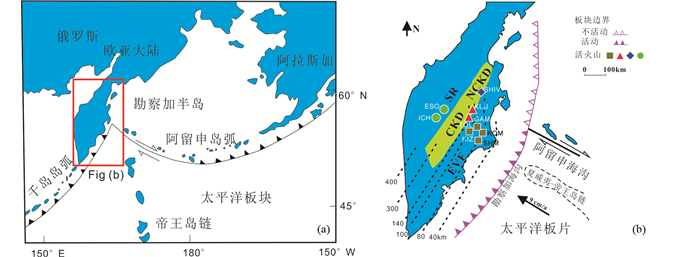
勘察加半岛处于欧亚大陆与太平洋板块汇聚边界的关键位置,构成了西北太平洋长达2000km千岛-勘察加火山岛链的北部,西临鄂霍次克海,东邻太平洋和白令海,是环太平洋“火链”的重要组成部分(图 1a)。在勘察加半岛东南侧,太平洋板块携带帝王岛链(65Ma)以~9cm/a的速度向下俯冲(Minster and Jordan, 1978),导致勘察加半岛火山作用十分发育(图 1b),包含200多座第四纪火山,其中含有28座活火山。位于勘察加半岛中北部的克柳切夫火山(Klyuchevskoy海拔为4750m),是全球岩浆产率最大的火山之一(55百万吨/年),其岩浆产率曾高达60~90百万吨/年(Fedotov et al., 2010)。根据火山作用与海沟的距离,从东到西可以将勘察加岛弧分为3个火山密集区:(1)东部前缘火山(the Eastern Volcanic Front: EVF);(2)中部火山(the Central Kamchatka Depression: CKD)和中北部火山(the Northern Central Kamchatka Depression: NCKD),其中中部火山边缘发育明显的裂谷带;(3)弧后火山(Sredinny Ridge: SR)。SR区域代表了死亡的中新世火山前缘,由于克罗诺基地体(Kronotsky)推覆和晚期火山活动的喷发而运移至现在弧后的位置(图 1b)。地球物理的证据表明勘察加半岛地壳厚度具有一定的变化范围,从南部到北部地壳厚度由20km增厚至42km;垂直海沟方向上(CKD区域),从弧后至克柳切夫火山地壳厚度由30km增厚至42km(Balesta, 1991)。地震带研究显示从东部前缘火山到弧后,俯冲贝尼奥夫带深度从90~110km,变化至180~200km,在SR下方达300~400km (Gorbatov et al., 1997)。由于夏威夷-帝王岛链的俯冲促使勘察加半岛在南北方向存在俯冲角度的差异,南部俯冲角度约为55°,而北部约为35°(Gorbatov et al., 1997)。
|
图 1 勘察加半岛位置及火山分布 (a)勘察加半岛位置简图(据Kersting and Arculus, 1995修改).三角形标记的实线代表了海沟的位置;(b)勘察加半岛不同火山密集区,从东向西分别为东部前缘火山(EVF),中部火山(CKD),中北部火山(NCKD)和弧后火山(SR).虚线及标记数字代表了贝尼奥夫带的深度(据Gorbatov et al., 1997).代表性火山有EVF区域:SHM-Shmidt;KOM-Komarov;KIZ-Kizimen;GAM-Gamchen;CKD区域:TOL-Tolbachik;KLU-Klyuchevskoy;NCKD区域:SHIV-Shiveluch;SR区域:ESO-Eso plateau basalts;ICH-Ichinsky Fig. 1 Location of the Kamchatka Peninsula and the distribution of the volcanoes (a) location map showing the Kamchatka Peninsula in the northwestern Pacific (after Kersting and Arculus, 1995). A solid line with triangle decoration denotes the location of the trench; (b) simplified map showing the Quaternary volcanoes, from east to the west, Eastern Volcanic Front (EVF); Central Kamchatka Depression (CKD); North Central Kamchatka Depression (NCKD); Sredinny Ridge (SR). The depth of the Benioff zone is from Gorbatov et al. (1997). Representative volcano EVF region: SHM-Shmidt; KOM-Komarov; KIZ-Kizimen; GAM-Gamchen; CKD region: TOL-Tolbachik; KLU-Klyuchevskoy; NCKD region: SHIV-Shiveluch; SR region: ESO-Eso plateau basalts; ICH-Ichinsky |
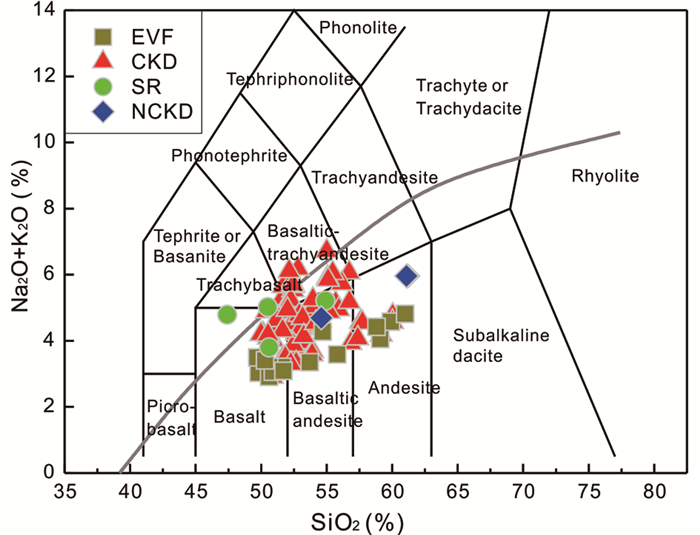
勘察加半岛具有岩浆产率大,源区沉积物质少,俯冲物质相对简单,穿弧距离长(100~300km)等特点(Churikova et al., 2001, 2007),因此勘察加半岛是研究俯冲板片-地幔反应的理想地区。勘察加岛弧岩石岩性主要为玄武岩,玄武质安山岩,仅在少数地区有安山岩产出,而在NCKD区域,则主要为安山岩(图 2)。从前缘火山到弧后,勘察加岛弧岩浆地球化学特征具有系统性的变化(图 2、图 3和图 4)。如K2O逐渐升高,EVF为低钾,CKD为中-高钾,而SR则主要为高钾(图 4a);微量元素及同位素也表现为系统性的穿弧变化(图 4b, c)。另外,在勘察加半岛EVF和SR区域,发育大量塌陷的破火山口,在这些破火山口的边缘发育有玄武质岩浆和地壳源区熔融形成硅质岩浆(熔结凝灰岩,年龄集中于更新世),其成分也具有穿弧系统性变化的特征,如K2O从弧前到弧后逐渐升高(Bindeman et al., 2010)。系统性的变化特征可能反应岛弧岩浆岩石成因的差异,该方向上的研究在过去十几年里有了较大的进展,本文对该进展进行了详细的讨论和总结,希望可以促进对勘察加岛弧岩石成因的理解,并加深和拓宽对俯冲带岩浆活动的认识。
|
图 2 勘察加半岛代表性岛弧岩石全岩(Na2O+K2O)-SiO2图解 Picro-basalt-苦橄质玄武岩;Basalt-玄武岩;Basaltic andesite-玄武安山岩;Andesite-安山岩;Subalkaline dacite-亚碱性英安岩;Rhyolite-流纹岩;Trachybasalt-粗玄岩;Basaltic-trachyandesite-玄武粗安岩;Trachyandesite-粗安岩;Trachyte or Trachydacite-粗面岩或粗面英安岩;Tephrite or Basanite-碱玄岩或碧玄岩;Phonotephrite-响岩质碱玄岩;Tephriphonolite-碱玄质响岩;Phonolite-响岩.数据引自Churikova et al.(2001, 2007, 2015a, b); Turner et al. (2013); Bergal-Kuvikas et al. (2017) Fig. 2 Na2O+K2O vs. SiO2 diagram of representative arc lavas from the Kamchatka Arc Data from Churikova et al.(2001, 2007, 2015a, b); Turner et al. (2013); Bergal-Kuvikas et al. (2017) |
|
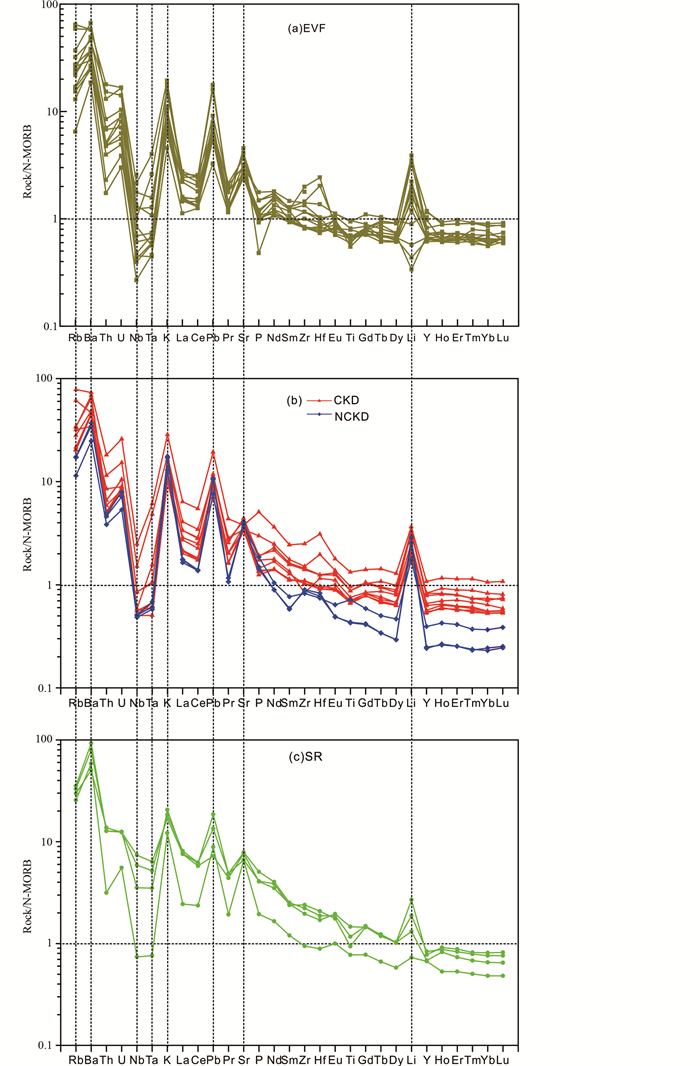
图 3 勘察加半岛代表性岛弧岩石N-MORB标准化微量元素曲线(标准化值据Sun and McDonough, 1989) 数据引自Churikova et al.(2001, 2007) Fig. 3 N-MORB-normalized trace element distribution diagrams of representative arc lavas from the Kamchatka Arc (normalization values after Sun and McDonough, 1989) Data from Churikova et al.(2001, 2007) |
|
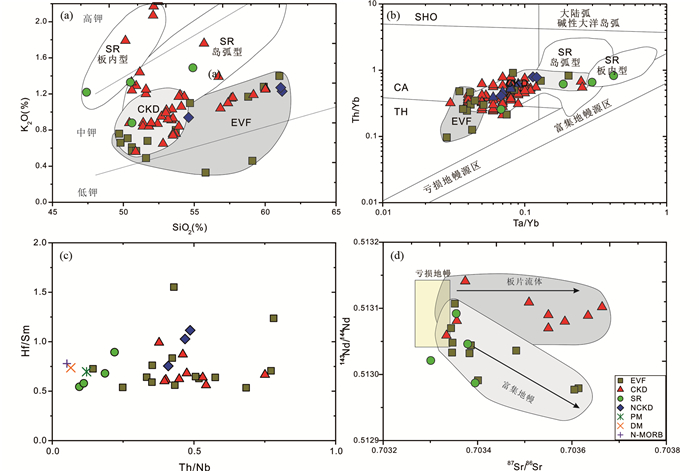
图 4 勘察加半岛代表性岛弧岩石样品地球化学特征 (a)勘察加岛弧SiO2-K2O图解,前缘火山到弧后火山K2O逐渐升高. EVF主要为低-中钾,CKD主要为中-高钾,SR为中-高钾;(b)勘察加岛弧Th/Yb-Ta/Yb相关性图解,EVF和CKD岩浆具有低的Th/Yb和Ta/Yb比值,而SR则较高,表明存在不同的地幔源区;(c)勘察加岛弧Hf/Sm-Th/Nb相关性图解,其中EVF和CKD区域具有类似的Hf/Sm和Th/Nb比值,而弧后区域SR则具有低Th/Nb和Hf/Sm比值.初始地幔,亏损地幔和洋中脊玄武岩的Th/Nb和Hf/Sm比值分别来自McDonough and Sun (1995), Salters and Stracke (2004)和Sun and McDonough (1989);(d)勘察加岛弧岩浆143Nd/144Nd-87Sr/86Sr图解,SR区域岩浆具有相对于亏损地幔较低的143Nd/144Nd比值和较高的87Sr/86Sr比值,表明可能存在富集地幔,CKD区域具有类似于亏损地幔的143Nd/144Nd比值,但明显较高的87Sr/86Sr,可能指示了岩浆源区有板片流体的加入. PM-初始地幔;DM-亏损地幔;N-MORB-N类洋中脊玄武岩.数据引自Churikova et al.(2001, 2007, 2015a, b); Turner et al. (2013); Bergal-Kuvikas et al. (2017).图中的区域来自Churikova et al. (2001) Fig. 4 Geochemical compositions of representative arc lavas from the Kamchatka Arc (a) SiO2 vs. K2O diagram. From EVF to SR, K2O content increases gradually from low K to high K; (b) Th/Yb vs. Ta/Yb diagram. EVF and CKD show lower Th/Yb and Ta/Yb ratios than SR, which demonstrate that mantle source below SR is significantly enriched compared to EVF and CKD; (c) Hf/Sm vs. Th/Nb diagram, EVF show similar ratios to CKD, but SR display slightly lower Th/Nb ratios than both EVF and CKD. The ratios of PM, DM and N-MORB are from McDonough and Sun (1995), Salters and Stracke (2004) and Sun and McDonough (1989), respectively; (d) 143Nd /144Nd vs. 87Sr/86Sr diagram. Compared to the depleted mantle, SR show lower 143Nd/144Nd ratio and higher 87Sr/86Sr ratio, which suggest that there is enriched mantle below SR, while CKD show 143Nd/144Nd ratio similar to the N-MORB but higher 87Sr/86Sr ratio, which demonstrate that mantle source below CKD is modified by the slab-derived fluid. PM-Primitive mantle; DM-Depleted mantle; N-MORB-N-type middle ocean ridge basalts. Data from Churikova et al.(2001, 2007, 2015a, b); Turner et al. (2013); Bergal-Kuvikas et al. (2017). The regions are from Churikova et al. (2001) |
俯冲板片之上的地幔楔是岛弧岩浆的主要源区,因此岛弧岩浆岩石成因的研究需要首先考察地幔源区特征。俯冲板片分异流体的交代是地幔楔熔融的主要诱因,而流体几乎不含大部分不相容元素(如高场强元素HFSE和重稀土HREE),而且在中-大比例部分熔融过程中,不相容元素不发生变化,因此不相容元素的特征可以用来反映源区性质(Pearce and Parkinson, 1993)。勘察加EVF、CKD和SR区域的岩浆具有典型岛弧岩浆的特征,即富集大离子亲石元素(LILE)和轻稀土元素(LREE),而亏损高场强元素(HFSE),反应了流体交代的过程(图 3)。从弧前到弧后,沿着穿弧剖面,大离子亲石元素和高场强元素浓度逐渐升高(图 3),暗示其存在不同的地幔源区和熔融比例(Churikova et al., 2001)。
Pearce and Parkinson (1993)根据元素不相容性,将元素分为极不相容元素(very highly incompatible, VHI),高度不相容元素(highly incompatible, HI)和中度不相容元素(moderately incompatible, MI),并将不同类别的元素进行标准化,其配分形式,可以反映源区的熔融程度和地幔性质:若VHI=HI=MI,则表明源区熔融程度较大;若VHI>HI>MI,则表明熔融程度较低。勘察加岛弧EVF和CKD岩浆不相容元素配分形式表现为VHI>HI=MI,表明EVF和CKD区域地幔源区部分熔融程度较大,而CKD区域,部分高K岩石不相容元素配分形式表现为VHI>HI>MI,表明CKD高K岩浆地幔源区经历了中等程度部分熔融,而SR区域岩石具有VHI>>HI>/=MI的不相容元素分配特征,表明地幔源区经历了低-中等程度的部分熔融,而且SR可能存在富集的地幔源区(Churikova et al., 2001)。
勘察加岛弧岩浆不同火山密集区,Nb/Yb比值具有系统差别,EVF和CKD区域Nb/Yb比值与MORB一致,表明EVF和CKD来源于亏损地幔,而SR区域岩浆具有高Nb/Yb比值的特征,暗示其来源于富集地幔(Churikova et al., 2001)。另外,根据Th/Yb和Ta/Yb相关性图解(图 4b),Churikova et al. (2001)认为SR区域岩浆具有较为富集的地幔源区,而EVF和CKD区域地幔源区则较为亏损。然而,无论是Th-Yb元素对,还是Ta-Yb元素对,在地幔部分熔融过程中的分配系数都差异明显,因此这两对元素比值不仅受控于源区组成,而且受控于部分熔融,并不适宜用来讨论源区差异。因此本文选取了Th/Nb和Hf/Sm比值进行投图,结果显示,EVF和CKD区域岩浆具有类似的特征,但SR区域岩浆则具有较低Th/Nb比值,反应了不同的地幔源区(图 4c)。
勘察加岛弧岩浆Sr-Nd同位素组成也反映了不同火山区域具有不同性质的地幔源区(图 4d)。其中CKD区域岩浆具有与MORB类似的143Nd/144Nd比值,而较高的87Sr/86Sr比值,表明可能存在板片分异流体的加入(图 4d)。SR区域岩浆则具有低于MORB的143Nd/144Nd比值和较高的87Sr/86Sr比值,指示其存在富集地幔源区(图 4d),可能为EMⅠ端元(Churikova et al., 2001; Volynets et al., 1997; Zindler and Hart, 1986)。
勘察加岛弧CKD区域存在大量的火山作用,其成分特征较为复杂,可能反映了地幔源区性质的差异。如CKD部分岩浆具有高K钙碱性的特征(图 4a),而且相对富集不相容元素,具有高的Ta/Yb和Th/Yb比值(图 4b),可能代表高K岩石源区略微富集或者具有更多的流体贡献(Churikova et al., 2001)。然而,Portnyagin and Manea (2008)则认为由于俯冲板片结构差异导致的热差异是CKD地球化学组成差异的主要原因。地震学的研究也显示CKD区域可能存在不同的地幔源区,比如接收函数成像(receiver function imaging)结果显示在CKD下方上地幔深度(大约110km)存在一个明显的低速带,结合岩石学模拟的结果,Nikulin et al. (2012)认为在CKD下方可能同时存在辉石岩熔体和橄榄岩熔体两个独立地幔源区,而不是简单的流体导致的地幔楔熔融。其中高MgO和CaO含量的岩石主要来自橄榄岩源区的熔融,如Tolbachik火山;而低CaO含量的岩石则代表了辉石岩的部分熔融,如活动的Tolbachik、Klyuchevskoy和Shiveluch火山,消亡火山Zarechny和Kharchinsky。CKD区域岛弧岩浆随着纬度的增加,CaO逐渐降低,表明北侧岩石源区辉石岩熔融所占的比例较大(Nikulin et al., 2012)。
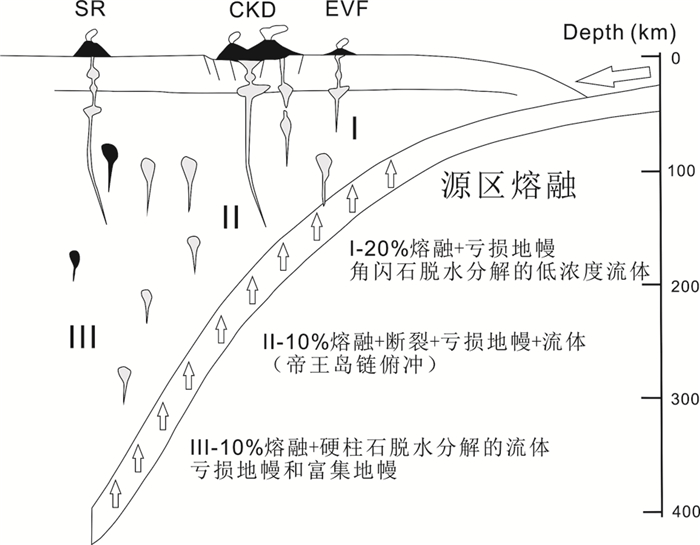
2 源区熔融过程板片俯冲过程中,随着俯冲深度的增加,板片流体的成分和性质也随之改变,进而可能导致源区熔融程度的系统变化。勘察加岛弧岩浆主微量元素特征沿着穿弧剖面表现出系统变化的特征,部分特征可能反应了源区熔融过程的差别(Churikova et al., 2001, 2007)。地幔楔熔融过程中,残留相中的单斜辉石可以保留Ca,而Na则进入熔体相,因此熔融程度与Na/Ca比值有一定相关性。Churikova et al. (2001)发现勘察岛弧岩浆从EVF至CKD,(Na2O/CaO)6(角标6表示主量元素校正到MgO=6%,Plank and Langmuir, 1988)明显升高,CKD至SR,(Na2O/CaO)6比值则基本保持恒定,表明EVF火山具有较高的熔融程度(20%),而CKD和SR区域熔融程度较低,且变化不大(9%~12%)。该结论与VHI,HI和MI配分形式所获得的结论一致(Churikova et al., 2001)。熔融程度的差别可能是由于不同深度不同矿物分解形成的流体性质差异导致的(详见5.1)。然而,(Na2O/CaO)6与板片深度却没有相关性,可能暗示地幔楔发生了两阶段的熔融过程(Churikova et al., 2001)。Huang et al. (2018)对勘察加半岛岛弧岩浆进行了Zn同位素的研究,结果显示不同区域岩石均具有高于亏损地幔的δ66Zn值,而δ66Zn与Ba/La、Ba/Th、Sr/Y、Hf/Lu等板片物质交代的指标均没有明显相关性,表明板片熔/流体对Zn同位素组成影响较小。Huang et al. (2018)模拟计算了部分熔融过程中Zn同位素分馏,结果显示地幔部分熔融过程可以形成勘察加岛弧岩浆较高δ66Zn值。
因此,勘察加岛弧不同火山区域具有差异的地幔源区,且熔融程度也不相同(图 5)。对于EVF和CKD区域岩浆,其微量元素特征可由亏损地幔经历不同程度部分熔融,再混合一定量的板片流体形成,表明岩浆主要来源于亏损地幔;而SR区域岩浆相对富集Nb、Ta、Th等高场强元素,部分熔融的计算表明源区存在一定比例(5%~35%)的富集地幔,且具有低于MORB的143Nd/144Nd比值,较高的87Sr/86Sr比值,指示其存在富集地幔源区(图 5)。根据(Na2O/CaO)6比值的变化,表明有前缘火山至弧后,熔融程度先逐渐降低,然后基本保持恒定(图 5)。
|
图 5 勘察加岛弧不同区域熔融机制模型图(据Churikova et al., 2001修改) EVF和SR区域流体主要来源于俯冲板片,CKD区域流体来自俯冲板片和夏威夷帝王岛链,其中EVF和CKD区域流体主要为角闪石脱水分解形成的富水的流体,SR区域流体为硬柱石脱水分解形成的流体. EVF区域地幔熔融程度较高,CKD和SR区域熔融程度低,且SR区域存在富集地幔 Fig. 5 Schematic model showing the relationship between the factors that influence the across-arc geochemical zonation in Kamchatka Arc (modified after Churikova et al., 2001) The fluid source below EVF and SR is dominated by the subducted slab, while both the suducted slab and the Hawaii-Emperor Seamounts support the extremely large fluid flux for the CKD lavas. The degree of melting changes from 20% for EVF to 9%~12% for CKD and SR |
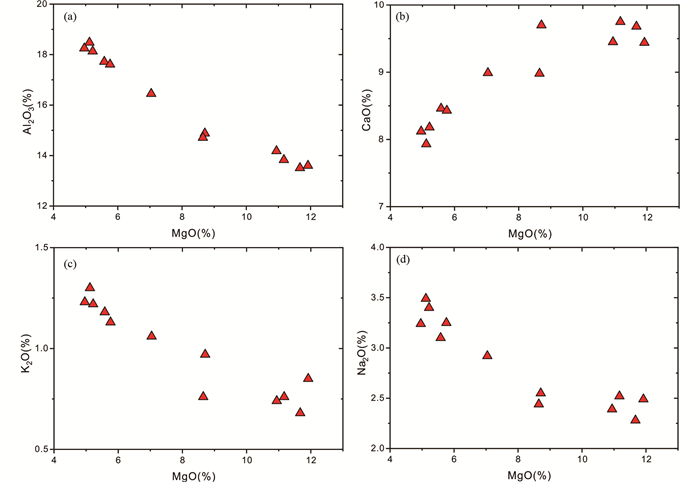
勘察加岛弧部分单个火山存在大量多期次、多成因的火山活动。该类火山活动产生的岩浆随时间演化,其成分发生明显变化,可能反应了岩浆过程中的结晶分异作用。如勘察加岛弧CKD区域克柳切夫火山(Klyuchevskoy)同时存在高铝玄武岩(High Aluminum Basalts, HAB, MgO < 6%)和高镁玄武岩(High Magnesia Basalts, HMB, MgO>7%),因此是研究HAB岩浆成因的理想地区(Ozerov, 2000)。关于高铝玄武岩的成因,一直存在较大的争议。主要存在2个观点:(1)HAB直接由俯冲洋壳及沉积物部分熔融形成;(2)HAB由高镁玄武岩(High Magnesia Basalts, HMB, MgO>7%)母岩浆通过岩浆结晶分异作用形成;其他的观点包括镁质岩浆+斜长石堆晶和熔体再平衡等(Ariskin et al., 1995; Bergal-Kuvikas et al., 2017; Koulakov et al., 2016; Ozerov, 2000)。Ozerov (2000)对克柳切夫火山不同类型岛弧岩浆进行了详细的地球化学研究,结果发现HAB和HMB主量元素SiO2、TiO2、Al2O3、Na2O、K2O与MgO具有明显的负相关,而且具有连续的演化趋势,表明两者可能是同一母岩浆经历结晶分异形成的(图 6)。在岩浆演化过程中,MgO和CaO逐渐降低,而TiO2、Na2O、K2O逐渐升高,表明存在橄榄石和辉石的分异结晶(图 6)。在矿物组成上,HMB主要富集橄榄石,单斜辉石,尖晶石等早期形成的矿物,而HAB则富集斜长石,磁铁矿等晚期矿物,也证明两者存在分异结晶的过程,为同一母岩浆(Ozerov, 2000)。
|
图 6 勘察加岛弧CKD区域克柳切夫火山代表性样品主量元素相关性图解 数据引自Ozerov (2000) Fig. 6 Variation diagrams of major elements showing the compositions of lavas from Klyuchevskoy volcano in the CKD area, the Kamchatka Arc Data from Ozerov (2000) |
根据K2O的含量,HMB岩浆又可以分为低钾系列(K2O < 0.8%)和高钾系列(K2O>0.8%),两者具有类似的MgO含量,但K2O变化较大,表明两者可能来自不同源区(Bergal-Kuvikas et al., 2017)。低钾和高钾系列均具有高的Th/Yb和Ba/La比值,表明源区可能存在超临界流体,而且高钾系列具有明显高于低钾系列的Th/Yb比值,表明高钾系列可能形成于更深的地幔源区(Bergal-Kuvikas et al., 2017; Kessel et al., 2005)。HMB中高钾系列岩浆经过进一步岩浆分异结晶和同化混染过程可以形成HAB岩浆,进一步证明了HAB的成因模式为岩浆演化过程(Bergal-Kuvikas et al., 2017; Mironov et al., 2001; Ozerov, 2000)。地震层析成像的研究显示,在克柳切夫火山下方不存在明显的流体通道,而主要表现为小的倾斜的弥散式流体通道,代表其源区可能来自于不同深度,也证明了高钾和低钾系列具有不同的岩浆源区和成岩深度(Koulakov et al., 2016)。
目前,勘察加半岛存在一系列的活火山,其喷发时间得到了精确的记录,因此为研究岩浆演化随时间变化的规律提供了理想的天然样品(Shcherbakov et al., 2011; Turner et al., 2013)。自1956年以来,克柳切夫火山(Klyuchevskoy)南侧的别济米安纳火山(Bezymianny)保持了长期间歇性的喷发(Turner et al., 2013)。Turner et al. (2013)对该期间33次喷发的岩浆样品进行了完整的取样(55件样品)和详细的角闪石矿物化学及地球化学研究,结果显示样品为安山质的成分,而且随时间演化镁铁质的比例逐渐增加(1956年SiO2约61%,MgO约2.5%,而2010年SiO2约57%,MgO约4%)。同时,样品中的角闪石也表现出明显的成分变化,即早期的样品主要为低Al含量(Al2O3约8%~11%)的角闪石,而后期形成的角闪石一般具有较高的Al含量(Al2O3约13%~15%)。根据大量的模拟和计算,Turner et al. (2013)认为岩浆成分的演化既反映了岩浆源区不同的压力条件,同时也表明源区存在岩浆混合作用。具体可以分为3个阶段,首先,在1956年以前,岩浆源区包含3个相对独立的成分,并且形成于不同地壳深度,此时的岩浆主要来自于最浅部的源区的贡献;之后在1956~1979年之间,较浅的两个岩浆源区发生了混合,并促使了岩浆喷发;最后在1979~2010年之间,最深部同时也是最基性的岩浆源区与上部的两个源区发生了混合,导致了岩浆喷发,此时最浅处的岩浆贡献极低,而主要来自深部的岩浆(Shcherbakov et al., 2011; Turner et al., 2013)。该结论与斜长石中震荡环带所反映的岩浆多次补充过程是一致的(Shcherbakov et al., 2011)。
4 岛弧岩浆源区熔/流体交代俯冲板片来源熔/流体的交代可以降低地幔楔的熔融温度,进而促使地幔楔熔融,产生岛弧岩浆(Cao et al., 2017, 2019; Liu et al., 2019)。因此,源区熔/流体交代过程的研究是揭示岛弧岩浆岩石成因的关键。根据水和溶质比例的不同,板片熔/流体可以分为富水流体,含水熔体和超临界流体(肖益林等, 2015)。富水流体富集大离子亲石元素(LILE),而亏损高场强元素(HFSE)和重稀土元素(HREE),而俯冲板片形成的熔体则富集所有的不相容元素,包括HFSE,HREE(Brenan et al., 1995; Defant and Drummond, 1990; Martin, 1999)。岛弧岩浆微量元素的富集主要是俯冲板片熔/流体的贡献(Nielsen and Marschall, 2017; Shu et al., 2017),作为具有典型沟-弧-盆体系的勘察加岛弧,目前已经有大量关于岩浆源区熔/流体交代过程的研究。
4.1 流体交代流体活动性元素及其比值可以有效示踪源区流体交代过程。如Ce和Pb具有类似相容性,在部分熔融和结晶分异过程中Ce/Pb比值基本保持不变,但Pb流体活动性较强,因此Ce/Pb比值可以有效示踪流体活动(Miller et al., 1994)。勘察加岛弧岩浆不同区域Ce/Pb比值和Ba/Zr比值没有系统变化,表明流体加入的量没有系统的减少或增加(Churikova et al., 2001)。但CKD区域具有明显高的U/Th比值,可能代表了一次早期的流体加入事件(Churikova et al., 2001)。
随着板片的俯冲,不同矿物发生脱水分解,进而释放出富集不同元素的流体,因此可以使用岛弧岩浆的主微量元素特征揭示源区矿物的分解作用(Schmidt and Poli, 1998)。角闪石分解形成的流体具有低的Si和高的LILE,具有高的活动性,可以交代地幔楔形成较多的熔体,因此角闪石释放的流体可能是EVF和CKD区域源区的主要流体类型,而硬柱石分解形成的流体具有高的Si含量,水含量少,可以运移较多的HFSE,但此类流体黏度更大,活动性较弱,因此造成的部分熔融程度较低,可能是SR区域流体的主要来源(Bureau and Keppler, 1999)。从弧前到弧后,勘察加岛弧La/Yb比值逐渐升高,可能反映了硬柱石的脱水分解(Churikova et al., 2001; Schmidt and Poli, 1998)。
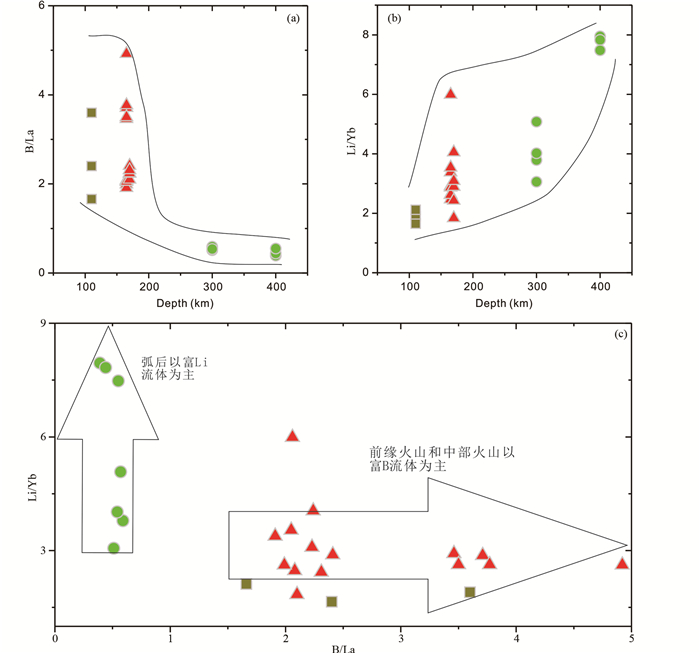
为了获得初始岩浆的挥发分组成,并排除岩浆去气作用对挥发分的影响,Churikova et al. (2007)对橄榄石中的熔体包裹体进行了详细的地球化学研究,结果显示橄榄石中熔体包裹体微量元素特征与岛弧岩浆全岩基本类似,但变化范围更大,能够更好地反映源区的特征,与岛弧岩浆全岩特征类似,橄榄石中的熔体包裹体微量元素整体具有富集LILE和LREE,亏损HFSE的特征(Churikova et al., 2007)。勘察加岛弧S/Yb,Cl/Yb从前缘火山至弧后,逐渐降低,F/Yb则逐渐升高。EVF和CKD区域具有更高的Cl/Nb、S/Nb、U/Nb、Th/Nb、Ba/Nb、K/Nb和P/Nb比值,而且与B具有正相关,表明EVF和CKD区域主要受富B流体的交代(Churikova et al., 2007)。CKD区域具有最高的S含量和S/Nb、U/Th比值,而且与CKD岩浆高的δ18O耦合,表明CKD区域流体主要来自蚀变洋壳(Dorendorf et al., 2000)。SR区域F/Yb和B/Yb具有正相关,而且具有最高Li/Yb比值,表明主要受富Li流体的交代(Churikova et al., 2007)。综合熔体包裹体微量元素信息,Churikova et al. (2007)提出勘察加岛弧下方存在三种流体端元:(1)EVF流体主要在前缘火山,富集B、Cl和亲硫元素,具有较高的B/La比值和较低的U/Th比值,在CKD和SR区域该类流体逐渐减少(图 7a);(2)CKD流体主要影响CKD区域,表现为高度富集S、Cl和U(图 7b);(3)SR流体富集F、Li和Be,该类流体可能在CKD下方释放,然后运移至SR区域(图 7c)。Churikova et al. (2007)认为不同含水矿物的脱水分解是造成不同流体端元的主要原因,EVF和CKD区域主要是角闪石和蛇纹石脱水,而弧后区域则主要是硬柱石脱水,该结论与全岩观测一致(Churikova et al., 2001)。根据批式熔融和质量平衡计算,Churikova et al. (2007)估算了流体和地幔端元对挥发分及流体活动性元素的贡献,结果表明F、Cl和S均主要来自板片流体(>30%)。
|
图 7 勘察加岛弧不同区域流体性质 (a)橄榄石中熔体包裹体B/La比值随板片深度逐渐降低;(b)橄榄石中熔体包裹体Li/Yb比值随板片深度逐渐升高;(c)根据熔体包裹体挥发分和流体活动性元素差异,推断勘察加岛弧下方存在不同的流体端元,前缘火山和中部火山以富B流体为主,而弧后火山则以富Li流体为主.图例同图 2,数据引自Churikova et al.(2001, 2007) Fig. 7 Fluid characteristics across the Kamchatka Arc From arc front to back arc, B/La ratios of melt inclusions decreases (a), while Li/Yb ratios increases (b) gradually; (c) three fluid endmembers are inferred from the decoupling of Li/Yb and B/La ratios. The EVF was dominated by fluid enriched in B and LILE; the CKD was dominated by fluid enriched in S and U; while in the back arc, the fluid was enriched in F and Be. Legends as in Fig. 2. Data from Churikova et al.(2001, 2007) |
对CKD区域克柳切夫火山(Klyuchevskoy)的研究发现,该岩浆中橄榄石(5.8‰~7.1‰)和辉石(5.7‰~7.7‰)具有明显高于正常亏损地幔的δ18O值(5.4‰~5.8‰, Eiler et al., 2000)。辉石与橄榄石之间分馏值与岩浆温度条件下平衡分馏值接近,表明O同位素分馏基本处于平衡状态(Dorendorf et al., 2000)。岩石δ18O值与流体活动性元素(K、Si、Cs、Li、Sr、Rb、Ba、Th、U、LREE)及Sr同位素组成表现出明显的正相关,表明岛弧岩浆形成于亏损地幔源区与富集流体的交换过程,古老的太平洋板片及帝王岛链的快速俯冲可能是形成CKD异常高δ18O的主要原因(Dorendorf et al., 2000)。对克柳切夫火山橄榄石斑晶和寄主玄武质玻璃的研究也发现,高的δ18O值与高的H2O含量相耦合,也证明了火山源区存在较大的流体通量(Auer et al., 2008)。Auer et al. (2008)认为在SR区域岩浆形成时,俯冲板片已经交代了上地幔,并形成了高δ18O的特征,后期俯冲洋壳与该交代地幔的反应,最终导致高岩浆产率和高δ18O的CKD岩浆形成。
Kersting and Arculus (1995)对勘察加半岛的研究表明岛弧岩浆(Klyuchevskoy、Tolbachik、Kumroch-Shish和Maly Semiachik)Pb同位素组成(206Pb/204Pb=18.15~18.30、207Pb/204Pb=15.45~15.48、208Pb/204Pb=37.74~37.95)变化小,且明显低于太平洋沉积物Pb同位素组成(206Pb/204Pb=18.51~18.78、207Pb/204Pb=15.56~15.64、208Pb/204Pb=38.49~38.75),因此Kersting and Arculus (1995)认为勘察加岛弧下方未发生沉积物的俯冲,并且不存在沉积物分异的流体的加入。该结论与勘察加岛弧较低的10Be浓度(0.0~1.2×10⁶at/g)一致(Tsvetkov et al., 1989)。
俯冲带地幔交代作用的研究主要集中于俯冲带岛弧岩浆以及俯冲沉积物和蚀变洋壳的研究,对于俯冲带超镁铁质地幔捕虏体(尤其是橄榄岩和辉石岩捕虏体)的研究则较少,这主要是由于岛弧岩浆中捕虏体的出露较少。在勘察加岛弧岩浆(如Shiveluch火山、Avachinsky火山、Kharchinsky火山、Valovayam火山)中出露了一定量的超镁铁质捕虏体,为研究弧下地幔交代作用提供了直接样品(Halama et al., 2009; Ionov and Seitz, 2008; Kepezhinskas et al., 1996; Kersting and Arculus, 1995; Siegrist et al., 2019; Tomanikova et al., 2019)。勘察加半岛NCKD区域Kharchinsky火山中地幔捕虏体全岩地球化学及矿物化学的研究表明捕虏体具有明显的Ce负异常和高的Ba/Th比值,反映了被高氧化性流体交代的过程,同时单斜辉石岩捕虏体具有高于岛弧岩石的εHf值,可能代表了岛弧岩石地幔源区物质组成的改变(Siegrist et al., 2019)。勘察加岛弧EVF地区Avachinsky火山中地幔捕虏体Li同位素体系的研究表明全岩和单矿物均具有类似于亏损地幔的Li同位素组成,表明被交代的地幔捕虏体可能经历了后期的扩散再平衡作用(Halama et al., 2009; Ionov and Seitz, 2008)。
为了探讨岛弧岩石地幔源区流体交代特征及变化规律,近期,Liu et al. (unpublished)对勘察加岛弧穿弧剖面上的9座火山中出露的岛弧岩石进行了流体活动性元素(如As、Mo、Sn、W和Sb等)和Li同位素体系的系统研究,结果显示岛弧岩石随着俯冲深度的增加(俯冲温度和压力增加),流体活动性元素比值(如As/Ce和Sb/Ce等)系统降低,反映了俯冲板片释放到岛弧源区的流体通量逐渐降低。分析前人已发表的不同区域岛弧岩石的微量元素特征,Liu et al. (unpublished)发现CKD区域具有异常高的U/Th、La/Sm和B/Nb比值,因此推测CKD区域源区可能存在硬柱石分解释放的流体。
相对于流体活动性元素比值(如As/Ce和Sb/Ce等),勘察加半岛不同区域岛弧岩石的Li同位素组成变化较小,而且与N-MORB类似,这与已发表岛弧岩石的Li同位素特征类似(Tomascak et al., 2002; Liu et al., unpublished)。进一步的脱水模拟结果显示,俯冲板片及蛇纹石化橄榄岩释放的流体均具有极高的Li含量和重的Li同位素组成,表明勘察加半岛岛弧岩石的Li同位素体系未受俯冲板片及蛇纹岩释放流体的影响(Tomascak et al., 2002; Liu et al., unpublished)。综上,勘察加半岛岛弧源区俯冲沉积物分异流体有限,但存在板片分异流体的加入,而且随着板片俯冲及脱水反应的进行,流体的组成也逐渐变化,通过岛弧岩石综合的元素及同位素研究可以有效揭示以上变化规律。
4.2 勘察加岛弧B同位素组成及对流体的示踪B是流体活动性元素,而且B及B同位素在俯冲带相关地质储库中具有显著差异,因此B同位素体系可以有效示踪俯冲带流体相关的地质活动(Chaussidon and Marty, 1995; De Hoog and Savov, 2018; Ishikawa et al., 2001)。如地幔具有极低的B浓度([B] < 0.05×10⁻⁶)和B同位素组成(δ11B=-7.1‰),而地壳岩石(洋壳,蚀变洋壳,沉积物和蛇纹石化橄榄岩)则富集B([B]>100×10-6,100~1000×地幔)且具有差异的B同位素组成(Chaussidon and Jambon, 1994; Marschall and Foster, 2018)。在俯冲过程中,随着板片脱水B跟随挥发分释放到弧前区域,并产生B同位素的分馏(Pabst et al., 2012; Scambelluri and Tonarini, 2012),导致残余板片具有较轻的B同位素组成,因此通常可以在穿弧剖面岛弧岩浆中观察到B浓度和B同位素组成逐渐降低的趋势(Ishikawa and Nakamura, 1994; Ishikawa and Tera, 1997, 1999; Leeman et al., 1994)。Ishikawa et al. (2001)对勘察加半岛不同火山区域岛弧岩浆进行了B同位素的研究,结果显示从前缘火山到弧后,EVF区域具有明显较高的B/Nb比值(14~22)和δ11B值(+4.9~+5.6‰),而SR区域岩浆则具有较低的B/Nb比值(~3)和δ11B值(-2‰),表明在前缘火山具有大量的俯冲板片流体加入,而弧后区域流体较少(图 8a)。然而,整个勘察加岛弧穿弧剖面并没有表现出B同位素组成系统降低的趋势(图 8a),主要是因为CKD区域具有明显偏高的δ11B值,可能反应了CKD区域具有高B含量和重B同位素组成的流体加入(Ishikawa et al., 2001)。CKD区域异常高的δ11B值和B/Nb比值,与该区域发现的高18O组成特征相耦合,表明可能由于帝王岛链的俯冲而在CKD区域存在更大的流体通量(Dorendorf et al., 2000; Ishikawa et al., 2001)。勘察加岛弧岩浆在Nb/B比值和δ11B相关图中表现为明显的混合趋势(图 8b),该趋势可以解释为高δ11B值,低Nb/B比值的板片流体和低δ11B值,高Nb/B比值的地幔楔混合。通过简单瑞利分馏模拟,Ishikawa et al. (2001)认为蚀变洋壳和/或蛇纹石化橄榄石是该流体的主要来源。

|
图 8 勘察加岛弧不同区域B同位素组成 (a)勘察加岛弧穿弧剖面δ11B与贝尼奥夫带深度相关图解;(b)勘察加岛弧δ11B与Nb/B比值图解,表现为明显的混合趋势.北千岛岛弧的数据引自Ishikawa et al. (2001),亏损地幔范围据Chaussidon and Jambon (1994) Fig. 8 Across-arc variations of B isotopes in Kamchatka Arc (a) δ11B vs. depth of Wadati-Benioff Zone; (b) δ11B vs. Nb/B ratios, which show mixing trend between the mantle wedge and slab-derived fluids. Data from Ishikawa et al. 2001. Depleted mantle and Northern Kurile values (Chaussidon and Jambon, 1994; Ishikawa et al., 2001) for δ11B are shown for comparison |
然而,Ishikawa et al. (2001)的模拟忽略了在俯冲变质脱水过程中的B同位素分馏,即随着重B同位素的释放,残余的板片将逐渐富集轻的B同位素,因此脱水流体也逐渐变轻(Benton et al., 2001; Bouvier et al., 2008, 2010; Marschall et al., 2007)。基于模拟计算的结果,Konrad-Schmolke et al. (2016)认为勘察加岛弧岩石B/Nb和B同位素的变化趋势可以解释为俯冲板片的连续脱水,地幔楔的蛇纹石化和之后板片下部地幔的脱水。Konrad-Schmolke et al. (2016)指出EVF区域的流体主要为来自俯冲板片和地幔楔中的绿泥石脱水,而CKD区域的脱水矿物则主要为俯冲板片下部地幔中的蛇纹石,因此形成了CKD区域异常高的B/Nb和B同位素组成(Ishikawa et al., 2001)。然而,大部分俯冲带都可能存在以上过程,仅有勘察加岛弧地区存在该特征,因此以上数值模拟可能过分强调了俯冲板片下部地幔的脱水过程。帝王海山岛链的俯冲是勘察加地区独有的特点,可能是CKD区域异常重B同位素组成以及高岩浆产率的主要原因(Dorendorf et al., 2000)。
近期,Tomanikova et al. (2019)对勘察加弧下地幔捕虏体中的角闪石、金云母、辉石等交代矿物进行了B同位素体系的研究,结果显示交代矿物具有低的B含量(0.2×10⁻⁶~3.1×10⁻⁶)和较轻的B同位素组成(δ11B=-16.6‰~+0.9‰),表明勘察加岛弧岩石高的B含量和重的B同位素组成(图 8)无法由交代的弧下地幔楔直接熔融形成,而需要蛇纹岩分异的具有高B含量和重B同位素组成的流体参与。
4.3 熔体交代勘察加半岛NCKD区域思维纳弛火山(Shiveluch)携带的超基性地幔捕虏体中主要包含尖晶石纯橄岩、方辉橄榄岩及角闪石金云母辉石岩,其中地幔捕虏体中的斜方辉石呈纤维状产出,局部与角闪石及金云母呈脉状穿切橄榄石,这些产出特征及矿物化学组成表明岛弧源区地幔楔经历了熔体交代过程(Bryant et al., 2007)。橄榄石、斜方辉石和尖晶石的平衡共生表明地幔捕虏体处于较为氧化的状态,氧逸度ΔlogFMQ高达+3.3,这主要是由熔体橄榄岩反应导致的(Bryant et al., 2007)。类似地,NCKD区域哈钦斯基火山(Kharchinsky)携带的超基性地幔捕虏体中包含橄榄岩和少量的单斜辉石岩和斜方辉石岩,这些地幔捕虏体均出露大量的金云母、角闪石和绿色尖晶石等矿物,其结构特征表明这些矿物主要为熔体后期结晶形成的,直接反映了地幔楔经历的熔体交代作用,进一步的矿物化学研究表明交代熔体主要来自俯冲洋壳的部分熔融(Kersting and Arculus, 1995; Siegrist et al., 2019)。
该结论也被勘察加NCKD区域岛弧岩浆地球化学的组成所证明,典型的火山主要包含思维纳弛火山(Shiveluch),扎列奇内火山(Zarechny)和哈钦斯基火山(Kharchinsky)。与CKD岛弧岩浆不同,NCKD岩浆具有高的(SiO2)6.0、(K2O)6.0和(Na2O)6.0含量,而且(Sr/Y)6.0和(La/Yb)6.0比值明显高于正常地幔值,岩石整体具有埃达克岩的特征,表明源区可能存在俯冲板片的熔融(Churikova et al., 2001; Yogodzinski et al., 2001)。通常认为,年轻的,热的俯冲板片更容易发生熔融形成埃达克岩,然而在勘察加岛弧下方主要为古老的太平洋板块(Defant and Drummond, 1990),这与一般的认识存在差异。Yogodzinski et al. (2001)结合地球物理和地球化学的证据,认为NCKD下方可能存在一个板片窗,同时,太平洋板片发生了撕裂,使板片直接接触到了异常地幔热流,而且,NCKD下方太平洋板片处于Komandorsky板片的转换边界,因此热的地幔热流在三个方向发生加热,进而促使太平洋板片发生了熔融(图 9)。该研究表明埃达克岩的形成不仅与俯冲板片的性质相关,而且与俯冲几何结构等物理条件有关(Yogodzinski et al., 1995, 2001)。热模拟的研究也证明了太平洋板块北部存在撕裂和减薄,而且该减薄可能是由明治-夏威夷(Meiji-Hawaiian)热点的俯冲导致的(Davaille and Lees, 2004)。另外,NCKD岩浆HFSE含量与正常CKD类似,表明板片熔融没有明显增加HFSE,可能是由于源区残留榍石或金红石等富集HFSE的矿物所导致的(Churikova et al., 2001)。

|
图 9 太平洋板块向北俯冲到阿留申下方、向西俯冲到勘察加半岛下方(据Yogodzinski et al., 2001修改) 太平洋板块在交汇处发生撕裂,促使地幔热流接触板片边界和板片窗.在板片上方产生了埃达克岩浆,包括勘察加到NCKD区域的Shiveluch火山和Aleutians火山.该模型可以较好地解释古老板片熔融形成埃达克岩 Fig. 9 Schematic map showing Pacific plate subducted to the north beneath the central Aleutians and to the west beneath Kamchatka (modified after Yogodzinski et al., 2001) Pacific plate is being torn at the cross location and prompt large heat flow. The arrows indicate asthenospheric flow around the plate edges. Adakitic volcanism is observed at Shiveluch volcano in Kamchatka and Aleutions volcano. This schematic would explain the melting of relatively old subducting plates |
勘察加岛弧体系是西太平洋大量沟-弧-盆体系中的重要组成部分。前人已经发表了大量关于勘察加岛弧岩石成因方面的研究。结果表明,沿着穿弧剖面,勘察加岛弧岩浆地球化学组成表现出系统变化的趋势,反应了岛弧源区地幔特征,熔融过程,岩浆结晶分异及熔/流体交代过程的差异。火山前缘至弧后,勘察加岛弧岩浆Th/Yb、Ta/Yb和HFSE元素含量逐渐升高,表明地幔源区由亏损地幔逐渐转变为富集地幔;主量元素(Na/Ca)及不相容元素配分的系统变化揭示了地幔源区熔融程度的变化,弧前区域熔融程度较大,中部区域和弧后则较低;流体活动性元素,同位素及熔体包裹体的研究表明岛弧岩浆源区存在大量的熔/流体交代过程。勘察加岛弧源区可能存在不同的流体端元,主要反应了在不同深度不同含水矿物的分解。另外,勘察加岛弧部分单个火山作用具有复杂的地球化学成分,可能主要反映了岩浆结晶分异过程。以上新的成果,有助于加深理解西太平洋沟-弧-盆体系的成因,促进对于俯冲带岩浆活动的认识。
致谢 本研究成果还受国家自然科学基金项目(41903006)、中国博士后科学基金资助项目(2019M652497)、山东省博士后创新项目和青岛市博士后应用研究项目的资助。感谢审稿专家给予认真而细致的评审,对本文质量的提升大有裨益。
Ariskin AA, Barmina GS, Ozerov AY and Nielsen RL. 1995. Genesis of high-alumina basalts from Klyuchevskoi volcano. Petrology, 3(5): 496-521 |
Auer S, Bindeman I, Wallace P, Ponomareva V and Portnyagin M. 2008. The origin of hydrous, high-δ18O voluminous volcanism:Diverse oxygen isotope values and high magmatic water contents within the volcanic record of Klyuchevskoy volcano, Kamchatka, Russia. Contributions to Mineralogy and Petrology, 157(2): 209-230 |
Balesta S. 1991. Earth crust structure and magma chambers of the areas of present Kamchatka volcanism. Nauka, Moscow:Active Volcanoes of Kamchatka: 36-45 |
Benton LD, Ryan JG and Tera F. 2001. Boron isotope systematics of slab fluids as inferred from a serpentine seamount, Mariana forearc. Earth and Planetary Science Letters, 187(3-4): 273-282 DOI:10.1016/S0012-821X(01)00286-2 |
Bergal-Kuvikas O, Nakagawa M, Kuritani T, Muravyev Y, Malik N, Klimenko E, Amma-Miyasaka M, Matsumoto A and Shimada S. 2017. A petrological and geochemical study on time-series samples from Klyuchevskoy volcano, Kamchatka arc. Contributions to Mineralogy and Petrology, 172(5): 35 DOI:10.1007/s00410-017-1347-z |
Bindeman IN, Leonov VL, Izbekov PE, Ponomareva VV, Watts KE, Shipley NK, Perepelov AB, Bazanova LI, Jicha BR, Singer BS, Schmitt AK, Portnyagin MV and Chen CH. 2010. Large-volume silicic volcanism in Kamchatka:Ar-Ar and U-Pb ages, isotopic, and geochemical characteristics of major pre-Holocene caldera-forming eruptions. Journal of Volcanology and Geothermal Research, 189(1-2): 57-80 DOI:10.1016/j.jvolgeores.2009.10.009 |
Bouvier AS, Métrich N and Deloule E. 2008. Slab-derived fluids in the magma sources of St. Vincent (Lesser Antilles Arc):Volatile and light element imprints.Journal of Petrology, 49(8): 1427-1448 |
Bouvier AS, Métrich N and Deloule E. 2010. Light elements, volatiles, and stable isotopes in basaltic melt inclusions from Grenada, Lesser Antilles:Inferences for magma genesis. Geochemistry, Geophysics, Geosystems, 11(9): Q09004 |
Brenan JM, Shaw HF, Ryerson FJ and Phinney DL. 1995. Mineral-aqueous fluid partitioning of trace elements at 900℃ and 2.0GPa:Constraints on the trace element chemistry of mantle and deep crustal fluids. Geochimica et Cosmochimica Acta, 59(16): 3331-3350 DOI:10.1016/0016-7037(95)00215-L |
Bryant JA, Yogodzinski GM and Churikova TG. 2007. Melt-mantle interactions beneath the Kamchatka arc:Evidence from ultramafic xenoliths from Shiveluch volcano. Geochemistry, Geophysics, Geosystems, 8(4): Q04007 |
Bureau H and Keppler H. 1999. Complete miscibility between silicate melts and hydrous fluids in the upper mantle:Experimental evidence and geochemical implications. Earth and Planetary Science Letters, 165(2): 187-196 DOI:10.1016/S0012-821X(98)00266-0 |
Cao YT, Liu L, Chen DL, Wang C, Yang WQ, Kang L and Zhu XH. 2017. Partial melting during exhumation of Paleozoic retrograde eclogite in North Qaidam, western China. Journal of Asian Earth Sciences, 148: 223-240 DOI:10.1016/j.jseaes.2017.09.009 |
Cao YT, Liu L, Wang C, Kang L, Li D, Yang WQ and Zhu XH. 2019. Timing and nature of the partial melting processes during the exhumation of the garnet-bearing biotite gneiss in the southern Altyn Tagh HP/UHP belt, Western China. Journal of Asian Earth Sciences, 170: 274-293 DOI:10.1016/j.jseaes.2018.11.005 |
Chaussidon M and Jambon A. 1994. Boron content and isotopic composition of oceanic basalts:Geochemical and cosmochemical implications. Earth and Planetary Science Letters, 121(3-4): 277-291 DOI:10.1016/0012-821X(94)90073-6 |
Chaussidon M and Marty B. 1995. Primitive boron isotope composition of the mantle. Science, 269(5222): 383-386 DOI:10.1126/science.269.5222.383 |
Chopin C. 1984. Coesite and pure pyrope in high-grade blueschists of the western alps:A first record and some consequences. Contributions to Mineralogy and Petrology, 86(2): 107-118 DOI:10.1007/BF00381838 |
Churikova T, Dorendorf F and Wörner G. 2001. Sources and fluids in the mantle wedge below Kamchatka:Evidence from across-arc geochemical variation. Journal of Petrology, 42(8): 1567-1593 DOI:10.1093/petrology/42.8.1567 |
Churikova T, Wörner G, Mironov N and Kronz A. 2007. Volatile (S, Cl and F) and fluid mobile trace element compositions in melt inclusions:Implications for variable fluid sources across the Kamchatka arc. Contributions to Mineralogy and Petrology, 154(2): 217-239 DOI:10.1007/s00410-007-0190-z |
Churikova T, Gordeychik BN, Edwards BR, Ponomareva VV and Zelenin EA. 2015a. The Tolbachik volcanic massif:A review of the petrology, volcanology and eruption history prior to the 2012-2013 eruption. Journal of Volcanology and Geothermal Research, 307: 3-21 DOI:10.1016/j.jvolgeores.2015.10.016 |
Churikova T, Gordeychik BN, Iwamori H, Nakamura H, Ishizuka O, Nishizawa T, Haraguchi S, Miyazaki T and Vaglarov BS. 2015b. Petrological and geochemical evolution of the Tolbachik volcanic massif, Kamchatka, Russia. Journal of Volcanology and Geothermal Research, 307: 156-181 DOI:10.1016/j.jvolgeores.2015.10.026 |
Davaille A and Lees JM. 2004. Thermal modeling of subducted plates:Tear and hotspot at the Kamchatka corner. Earth and Planetary Science Letters, 226(3-4): 293-304 DOI:10.1016/j.epsl.2004.07.024 |
De Hoog JCM and Savov IP. 2018. Boron isotopes as a tracer of subduction zone processes. In: Marschall HR and Foster GL (eds.). Boron Isotopes: The Fifth Element. Cham: Springer, 217-247 https: //www.researchgate.net/publication/320960672_Boron_Isotopes_as_a_Tracer_of_Subduction_Zone_Processes
|
Defant MJ and Drummond MS. 1990. Derivation of some modern arc magmas by melting of young subducted lithosphere. Nature, 347(6294): 662-665 DOI:10.1038/347662a0 |
Dorendorf F, Wiechert U and Wörner G. 2000. Hydrated sub-arc mantle:A source for the Kluchevskoy volcano, Kamchatka/Russia. Earth and Planetary Science Letters, 175(1-2): 69-86 DOI:10.1016/S0012-821X(99)00288-5 |
Du L, Long XP, Yuan C, Zhang YY, Huang ZY, Sun M and Xiao WJ. 2018. Petrogenesis of Late Paleozoic diorites and A-type granites in the central Eastern Tianshan, NW China:Response to post-collisional extension triggered by slab breakoff. Lithos, 318-319: 47-59 DOI:10.1016/j.lithos.2018.08.006 |
Du L, Zhang YY, Huang ZY, Li XP, Yuan C, Wu B and Long XP. 2019. Devonian to carboniferous tectonic evolution of the Kangguer Ocean in the Eastern Tianshan, NW China:Insights from three episodes of granitoids. Lithos, 350-351: 105243 DOI:10.1016/j.lithos.2019.105243 |
Eiler JM, Schiano P, Kitchen N and Stolper EM. 2000. Oxygen-isotope evidence for recycled crust in the sources of mid-ocean-ridge basalts. Nature, 403(6769): 530-534 DOI:10.1038/35000553 |
Fedotov SA, Zharinov NA and Gontovaya LI. 2010. The magmatic system of the Klyuchevskaya group of volcanoes inferred from data on its eruptions, earthquakes, deformation, and deep structure. Journal of Volcanology and Seismology, 4(1): 1-33 DOI:10.1134/S074204631001001X |
Gorbatov A, Kostoglodov V, Suárez G and Gordeev E. 1997. Seismicity and structure of the Kamchatka subduction zone. Journal of Geophysical Research, 102(B8): 17883-17898 DOI:10.1029/96JB03491 |
Guo YF, Luo JH, Gong W, Dong FF, Tang LR and Zha XH. 2018. P-wave seismic tomography of the Japan-Kuril trench transition zone. Journal of Geodesy and Geodynamics, 38(6): 639-645 (in Chinese with English abstract) |
Halama R, Savov IP, Rudnick RL and McDonough WF. 2009. Insights into Li and Li isotope cycling and sub-arc metasomatism from veined mantle xenoliths, Kamchatka. Contributions to Mineralogy and Petrology, 158(2): 197-222 DOI:10.1007/s00410-009-0378-5 |
Huang J, Zhang XC, Chen S, Tang LM, Wörner G, Yu HM and Huang F. 2018. Zinc isotopic systematics of Kamchatka-Aleutian arc magmas controlled by mantle melting. Geochimica et Cosmochimica Acta, 238: 85-101 DOI:10.1016/j.gca.2018.07.012 |
Ionov DA and Seitz HM. 2008. Lithium abundances and isotopic compositions in mantle xenoliths from subduction and intra-plate settings:Mantle sources vs. eruption histories. Earth and Planetary Science Letters, 266(3-4): 316-331 DOI:10.1016/j.epsl.2007.11.020 |
Ishikawa T and Nakamura E. 1994. Origin of the slab component in arc lavas from across-arc variation of B and Pb isotopes. Nature, 370(6486): 205-208 DOI:10.1038/370205a0 |
Ishikawa T and Tera F. 1997. Source, composition and distribution of the fluid in the Kurile mantle wedge:Constraints from across-arc variations of B/Nb and B isotopes. Earth and Planetary Science Letters, 152(1-4): 123-138 DOI:10.1016/S0012-821X(97)00144-1 |
Ishikawa T and Tera F. 1999. Two isotopically distinct fluid components involved in the Mariana arc:Evidence from Nb/B ratios and B, Sr, Nd, and Pb isotope systematics. Geology, 27(1): 83-86 DOI:10.1130/0091-7613(1999)027<0083:TIDFCI>2.3.CO;2 |
Ishikawa T, Tera F and Nakazawa T. 2001. Boron isotope and trace element systematics of the three volcanic zones in the Kamchatka arc. Geochimica et Cosmochimica Acta, 65(24): 4523-4537 DOI:10.1016/S0016-7037(01)00765-7 |
John T, Gussone N, Podladchikov YY, Bebout GE, Dohmen R, Halama R, Klemd R, Magna T and Seitz HM. 2012. Volcanic arcs fed by rapid pulsed fluid flow through subducting slabs. Nature Geoscience, 5(7): 489-492 DOI:10.1038/ngeo1482 |
Kawamoto T, Yoshikawa M, Kumagai Y, Mirabueno MHT, Okuno M and Kobayashi T. 2013. Mantle wedge infiltrated with saline fluids from dehydration and decarbonation of subducting slab. Proceedings of the National Academy of Sciences of the United States of America, 110(24): 9663-9668 DOI:10.1073/pnas.1302040110 |
Kawamoto T, Hertwig A, Schertl HP and Maresch WV. 2018. Fluid inclusions in jadeitite and jadeite-rich rock from serpentinite mélanges in northern Hispaniola:Trapped ambient fluids in a cold subduction channel. Lithos, 308-309: 227-241 DOI:10.1016/j.lithos.2018.02.024 |
Kepezhinskas P, Defant MJ and Drummond MS. 1996. Progressive enrichment of island arc mantle by melt-peridotite interaction inferred from Kamchatka xenoliths. Geochimica et Cosmochimica Acta, 60(7): 1217-1229 DOI:10.1016/0016-7037(96)00001-4 |
Kersting AB and Arculus RJ. 1995. Pb isotope composition of Klyuchevskoy volcano, Kamchatka and North Pacific sediments:Implications for magma genesis and crustal recycling in the Kamchatkan arc. Earth and Planetary Science Letters, 136(3-4): 133-148 DOI:10.1016/0012-821X(95)00196-J |
Kessel R, Schmidt MW, Ulmer P and Pettke T. 2005. Trace element signature of subduction-zone fluids, melts and supercritical liquids at 120~180km depth. Nature, 437(7059): 724-727 DOI:10.1038/nature03971 |
Konrad-Schmolke M, Halama R and Manea VC. 2016. Slab mantle dehydrates beneath Kamchatka-Yet recycles water into the deep mantle. Geochemistry, Geophysics, Geosystems, 17(8): 2987-3007 DOI:10.1002/2016GC006335 |
Koulakov IY, Kukarina EV, Gordeev EI, Chebrov VN and Vernikovsky VA. 2016. Magma sources in the mantle wedge beneath the volcanoes of the Klyuchevskoy group and Kizimen based on seismic tomography modeling. Russian Geology and Geophysics, 57(1): 82-94 DOI:10.1016/j.rgg.2016.01.006 |
Leeman WP, Carr MJ and Morris JD. 1994. Boron geochemistry of the Central American Volcanic Arc:Constraints on the genesis of subduction-related magmas. Geochimica et Cosmochimica Acta, 58(1): 149-168 DOI:10.1016/0016-7037(94)90453-7 |
Li SG, Jagoutz E, Chen YZ and Li QL. 2000. Sm-Nd and Rb-Sr isotopic chronology and cooling history of ultrahigh pressure metamorphic rocks and their country rocks at Shuanghe in the Dabie Mountains, Central China. Geochimica et Cosmochimica Acta, 64(6): 1077-1093 DOI:10.1016/S0016-7037(99)00319-1 |
Li SZ, Suo YH, Liu X, Dai LM, Yu S, Zhao SJ, Ma Y, Wang XF, Cheng SX, Xue YC, Xiong LJ and An HT. 2012. Basic structural pattern and tectonic models of the South China Sea:Problems, Advances and Controversies. Marine Geology & Quaternary Geology, 32(6): 35-53 (in Chinese with English abstract) |
Liu HY, Sun H, Xiao YL, Wang YY, Zeng LS, Li WY, Guo HH, Yu HM and Pack A. 2019. Lithium isotope systematics of the Sumdo eclogite, Tibet:Tracing fluid/rock interaction of subducted low-T altered oceanic crust. Geochimica et Cosmochimica Acta, 246: 385-405 DOI:10.1016/j.gca.2018.12.002 |
Liu X, Li SZ, Zhao SJ, Guo LL, Wang YM, Li XY, Wang PC, Sun WJ, Cao XZ, Dai LM, Yu SY, Zhang Z, Zang YB, Kong XC, Zhang Y and Zheng QL. 2017. Structure of the Mariana subduction system. Earth Science Frontiers, 24(4): 329-340 (in Chinese with English abstract) |
Marschall HR, Altherr R and Rüpke L. 2007. Squeezing out the slab-modelling the release of Li, Be and B during progressive high-pressure metamorphism. Chemical Geology, 239(3-4): 323-335 DOI:10.1016/j.chemgeo.2006.08.008 |
Marschall HR and Foster GL. 2018. Boron isotopes in the earth and planetary sciences-a short history and introduction. In: Marschall HR and Foster GL (eds.). Boron Isotopes: The Fifth Element. Cham: Springer, 1-11 https: //www.researchgate.net/publication/321150255_Boron_Isotopes_in_the_Earth_and_Planetary_Sciences-A_Short_History_and_Introduction
|
Martin H. 1999. Adakitic magmas:Modern analogues of Archaean granitoids. Lithos, 46(3): 411-429 DOI:10.1016/S0024-4937(98)00076-0 |
McDonough WF and Sun SS. 1995. The composition of the Earth. Chemical Geology, 120(3-4): 223-253 DOI:10.1016/0009-2541(94)00140-4 |
Meng YK, Xiong FH, Xu ZQ and Ma XX. 2019. Petrogenesis of Late Cretaceous mafic enclaves and their host granites in the Nyemo region of southern Tibet:Implications for the tectonic-magmatic evolution of the Central Gangdese Belt. Journal of Asian Earth Sciences, 176: 27-41 DOI:10.1016/j.jseaes.2019.01.041 |
Miller DM, Goldstein SL and Langmuir CH. 1994. Cerium/lead and lead isotope ratios in arc magmas and the enrichment of lead in the continents. Nature, 368(6471): 514-520 DOI:10.1038/368514a0 |
Minster JB and Jordan TH. 1978. Present-day plate motions. Journal of Geophysical Research, 83(B11): 5331-5354 DOI:10.1029/JB083iB11p05331 |
Mironov NL, Portnyagin MV, Pletchov PY and Khubunaya SA. 2001. Final stages of magma evolution in Klyuchevskoy Volcano, Kamchatka:Evidence from melt inclusions in minerals of high-alumina basalts. Petrology, 9(1): 51-69 |
Moriguti T, Shibata T and Nakamura E. 2004. Lithium, boron and lead isotope and trace element systematics of Quaternary basaltic volcanic rocks in northeastern Japan:Mineralogical controls on slab-derived fluid composition. Chemical Geology, 212(1-2): 81-100 DOI:10.1016/j.chemgeo.2004.08.005 |
Nielsen SG and Marschall HR. 2017. Geochemical evidence for mélange melting in global arcs. Science Advances, 3(4): e1602402 DOI:10.1126/sciadv.1602402 |
Nikulin A, Levin V, Carr M, Herzberg C and West M. 2012. Evidence for two upper mantle sources driving volcanism in Central Kamchatka. Earth and Planetary Science Letters, 321-322: 14-19 DOI:10.1016/j.epsl.2011.12.039 |
Niu YL and O'Hara MJ. 2003. Origin of ocean island basalts:A new perspective from petrology, geochemistry, and mineral physics considerations. Journal of Geophysical Research, 108(B4): 2209 |
Niu YL, Shi XF, Li TG, Wu SG, Sun WD and Zhu RX. 2017. Testing the mantle plume hypothesis:An IODP effort to drill into the Kamchatka-Okhotsk Sea basement. Science Bulletin, 62(21): 1464-1472 DOI:10.1016/j.scib.2017.09.019 |
Ozerov AY. 2000. The evolution of high-alumina basalts of the Klyuchevskoy volcano, Kamchatka, Russia, based on microprobe analyses of mineral inclusions. Journal of Volcanology and Geothermal Research, 95(1-4): 65-79 DOI:10.1016/S0377-0273(99)00118-3 |
Pabst S, Zack T, Savov IP, Ludwig T, Rost D, Tonarini S and Vicenzi EP. 2012. The fate of subducted oceanic slabs in the shallow mantle:Insights from boron isotopes and light element composition of metasomatized blueschists from the Mariana forearc. Lithos, 132-133: 162-179 DOI:10.1016/j.lithos.2011.11.010 |
Pearce JA and Parkinson IJ. 1993. Trace element models for mantle melting: application to volcanic arc petrogenesis. In: Prichard HM, Alabaster A, Harris NBW and Neary CR (eds.). Magmatic Processes and Plate Tectonics. Geological Society, London, Special Publications, 76(1): 373-403 http://en.cnki.com.cn/article_en/cjfdtotal-dzkq200004003.htm
|
Plank T and Langmuir CH. 1988. An evaluation of the global variations in the major element chemistry of arc basalts. Earth and Planetary Science Letters, 90(4): 349-370 DOI:10.1016/0012-821X(88)90135-5 |
Portnyagin M, Hoernle K, Plechov P, Mironov N and Khubunaya S. 2007. Constraints on mantle melting and composition and nature of slab components in volcanic arcs from volatiles (H2O, S, Cl, F) and trace elements in melt inclusions from the Kamchatka Arc. Earth and Planetary Science Letters, 255(1-2): 53-69 DOI:10.1016/j.epsl.2006.12.005 |
Portnyagin M and Manea VC. 2008. Mantle temperature control on composition of arc magmas along the Central Kamchatka Depression. Geology, 36(7): 519-522 DOI:10.1130/G24636A.1 |
Salters VJM and Stracke A. 2004. Composition of the depleted mantle. Geochemistry, Geophysics, Geosystems, 5(5): Q05B07 |
Scambelluri M and Tonarini S. 2012. Boron isotope evidence for shallow fluid transfer across subduction zones by serpentinized mantle. Geology, 40(10): 907-910 DOI:10.1130/G33233.1 |
Schmidt MW and Poli S. 1998. Experimentally based water budgets for dehydrating slabs and consequences for arc magma generation. Earth and Planetary Science Letters, 163(1-4): 361-379 DOI:10.1016/S0012-821X(98)00142-3 |
Shcherbakov VD, Plechov PY, Izbekov PE and Shipman JS. 2011. Plagioclase zoning as an indicator of magma processes at Bezymianny Volcano, Kamchatka. Contributions to Mineralogy and Petrology, 162(1): 83-99 DOI:10.1007/s00410-010-0584-1 |
Shu YC, Nielsen SG, Zeng ZG, Shinjo R, Blusztajn J, Wang XY and Chen S. 2017. Tracing subducted sediment inputs to the Ryukyu arc-Okinawa Trough system:Evidence from thallium isotopes. Geochimica et Cosmochimica Acta, 217: 462-491 DOI:10.1016/j.gca.2017.08.035 |
Siegrist M, Yogodzinski G, Bizimis M, Fournelle J, Churikova T, Dektor C and Mobley R. 2019. Fragments of metasomatized forearc:Origin and implications of mafic and ultramafic xenoliths from Kharchinsky Volcano, Kamchatka. Geochemistry, Geophysics, Geosystems, 20(9): 4426-4456 DOI:10.1029/2019GC008478 |
Smith DC. 1984. Coesite in clinopyroxene in the Caledonides and its implications for geodynamics. Nature, 310(5979): 641-644 DOI:10.1038/310641a0 |
Sun GM, Li XP, Duan WY, Chen S, Wang ZL, Zhao LQ and Feng QD. 2018. Metamorphic characteristics and tectonic implications of the Kadui blueschist in the central Yarlung Zangbo suture zone, Southern Tibet. Journal of Earth Science, 29(5): 1026-1039 DOI:10.1007/s12583-018-0854-9 |
Sun SS and McDonough WF. 1989. Chemical and isotopic systematics of oceanic basalts: Implications for mantle composition and processes. In: Saunders AD and Norry MJ (eds.). Magmatism in the Ocean Basins. Geological Society, London, Special Publication, 42(1): 313-345 https: //www.researchgate.net/publication/231575101_Chemical_and_isotopic_systematics_of_oceanic_basalts_Implications_for_mantle_composition_and_processes
|
Syracuse EM, van Keken PE and Abers GA. 2010. The global range of subduction zone thermal models. Physics of the Earth and Planetary Interiors, 183(1-2): 73-90 DOI:10.1016/j.pepi.2010.02.004 |
Tomanikova L, Savov IP, Harvey J, de Hoog JCM, Churikova TG, Gordeychik B and Yogodzinski GM. 2019. A limited role for metasomatized subarc mantle in the generation of boron isotope signatures of arc volcanic rocks. Geology, 47(6): 517-521 DOI:10.1130/G46092.1 |
Tomascak PB, Widom E, Benton LD, Goldstein SL and Ryan JG. 2002. The control of lithium budgets in island arcs. Earth and Planetary Science Letters, 196(3-4): 227-238 DOI:10.1016/S0012-821X(01)00614-8 |
Tsvetkov AA, Gladkov NG and Volynets ON. 1989. Problem of sediment subduction and 10Be isotope in lavas of Kuril Islands and Kamchatka Peninsula. Translated from USSR Academy of Sciences, 306: 1220-1225 |
Turner S, McDermott F, Hawkesworth C and Kepezhinskas P. 1998. A U-series study of lavas from Kamchatka and the Aleutians:Constraints on source composition and melting processes. Contributions to Mineralogy and Petrology, 133(3): 217-234 DOI:10.1007/s004100050449 |
Turner S, Izbekov P and Langmuir C. 2013. The magma plumbing system of Bezymianny Volcano:Insights from a 54 year time series of trace element whole-rock geochemistry and amphibole compositions. Journal of Volcanology and Geothermal Research, 263: 108-121 DOI:10.1016/j.jvolgeores.2012.12.014 |
Volynets ON, Karpenko SF, Kay RW and Gorring M. 1997. Isotopic composition of Late Neogene K-Na alkaline basalts of Eastern Kamchatka:Indicators of the heterogeneity mantle magma sources. Geokhimiya, 35(10): 1005-1018 |
Xiao YL, Sun H, Gu HO, Huang J, Li WY and Liu L. 2015. Fluid/melt in continental deep subduction zones:Compositions and related geochemical fractionations. Science China (Earth Sciences), 58(9): 1457-1476 DOI:10.1007/s11430-015-5149-8 |
Yogodzinski GM, Kay RW, Volynets ON, Koloskov AV and Kay SM. 1995. Magnesian andesite in the western Aleutian Komandorsky region:Implications for slab melting and processes in the mantle wedge. GSA Bulletin, 107(5): 505-519 DOI:10.1130/0016-7606(1995)107<0505:MAITWA>2.3.CO;2 |
Yogodzinski GM, Lees JM, Churikova TG, Dorendorf F, Wöerner G and Volynets ON. 2001. Geochemical evidence for the melting of subducting oceanic lithosphere at plate edges. Nature, 409(6819): 500-504 DOI:10.1038/35054039 |
Zhang GL, Wang S, Zhang J, Luo Q and Li TG. 2017. Proceedings of subduction system and intra-oceanic volcanism of the western Pacific. Oceanologia et Limnologia Sinica, 48(6): 1220-1234 (in Chinese with English abstract) |
Zhang ZY, Dong DD, Zhang GX and Zhang GL. 2017. Topographic constraints on the subduction erosion of the Yap arc, western Pacific. Marine Geology & Quaternary Geology, 37(1): 41-50 (in Chinese with English abstract) |
Zindler A and Hart S. 1986. Chemical geodynamics. Annual Review of Earth and Planetary Sciences, 14: 493-571 DOI:10.1146/annurev.ea.14.050186.002425 |
郭雨帆, 罗佳宏, 宫伟, 董非非, 汤兰荣, 查小惠. 2018. 日本-千岛海沟转折处地震层析成像研究. 大地测量与地球动力学, 38(6): 639-645. |
李三忠, 索艳慧, 刘鑫, 戴黎明, 余珊, 赵淑娟, 马云, 王霄飞, 程世秀, 薛友辰, 熊莉娟, 安慧婷. 2012. 南海的基本构造特征与成因模型:问题与进展及论争. 海洋地质与第四纪地质, 32(6): 35-53. |
刘鑫, 李三忠, 赵淑娟, 郭玲莉, 王永明, 李玺瑶, 王鹏程, 孙文军, 曹现志, 戴黎明, 于胜尧, 张臻, 臧艺博, 孔祥超, 张勇, 郑祺亮. 2017. 马里亚纳俯冲系统的构造特征. 地学前缘, 24(4): 329-340. |
肖益林, 孙贺, 顾海欧, 黄建, 李王晔, 刘磊. 2015. 大陆深俯冲过程中的熔/流体成分与地球化学分异. 中国科学(地球科学), 45(8): 1063-1087. |
张国良, 王帅, 张吉, 罗青, 李铁刚. 2017. 西太平洋若干沟-弧-盆体系及板内岩浆成因研究进展. 海洋与湖沼, 48(6): 1220-1234. |
张正一, 董冬冬, 张广旭, 张国良. 2017. 板块俯冲侵蚀雅浦岛弧的地形制约. 海洋地质与第四纪地质, 37(1): 41-50. |